Deuteronomy 14:28

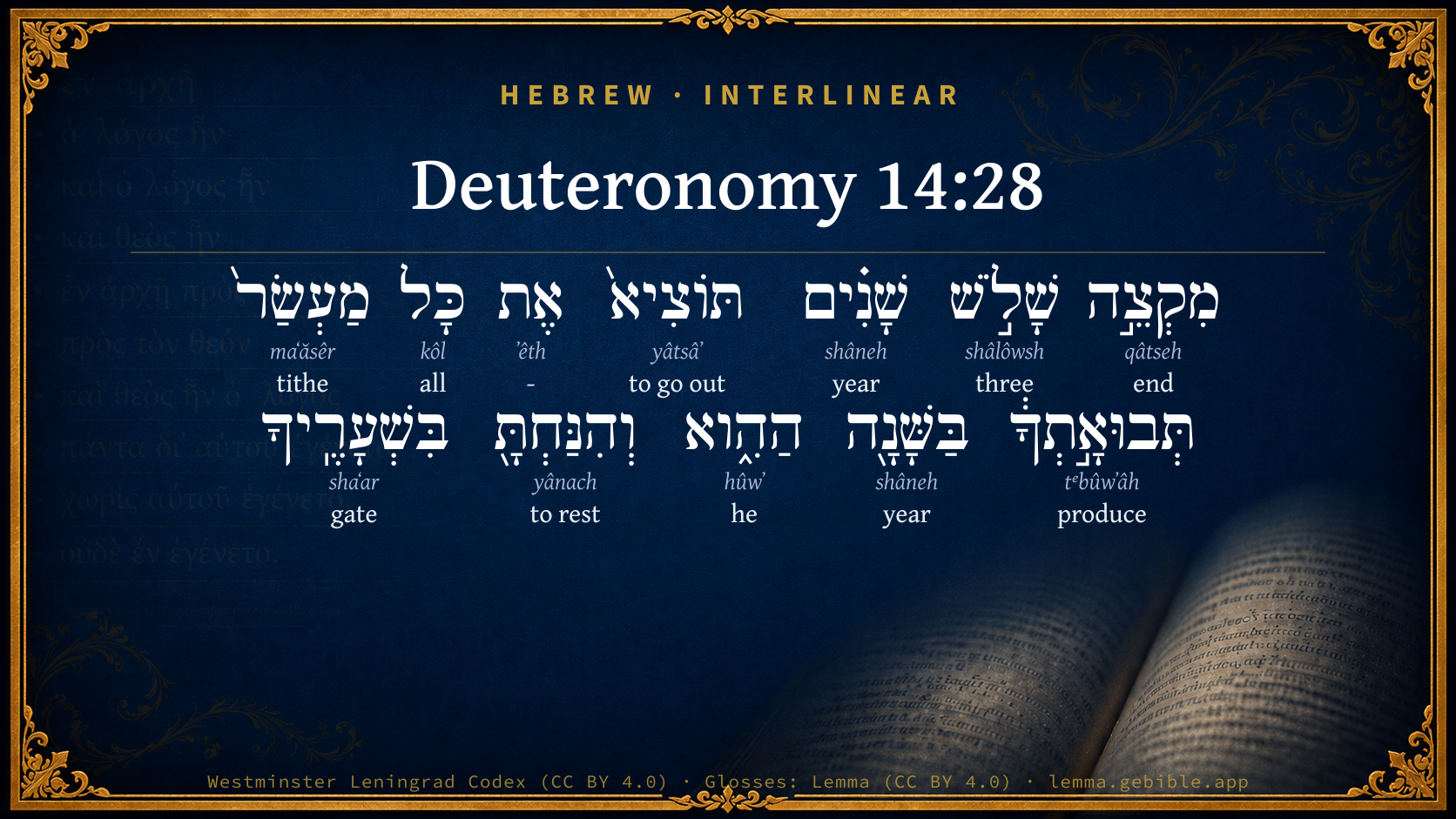
Hebrew (Westminster Leningrad Codex) Deuteronomy 14:28 appears in the Hebrew Old Testament. The text above is from the Westminster Leningrad Codex. Each word links to its Strong’s number, a concise gloss, and parsing drawn from the Open Scriptures Hebrew Bible morphology. Click any word for its full Brown-Driver-Briggs (BDB) entry.
Download image
Cite this verse

Deuteronomy 14:28 (World English Bible). Public Domain. Lemma interlinear Bible study tool, https://lemma.gebible.app/v/deuteronomy/14/28.

Show BibTeX & RIS
BibTeX
RIS
English Translation
At the end of every three years you shall bring forth all the tithe of your increase in the same year, and shall lay it up within your gates:
World English Bible · Public Domain
Download a study sheet

One document with this verse’s original text, its word-by-word gloss line, the meaning frame, cross-references with their text, attributed commentary, and full source and license credits — printable, and it pastes into notes with its structure intact.

This verse Autodidact and up

Study sheet (.html) Plain text (.txt)

A passage Seminary Student

Up to 50 verses in one chapter. A passage sheet keeps up to 6 commentary sources and 12 cross-references per verse, in the order this page ranks them, and says so on the sheet whenever that leaves anything out. Ask for a single verse and you get the Autodidact verse sheet above.

Everything on this page stays free to read, with no account — the sheet is a download of what is already on screen, not access to it.

Want to remove ads? Support Godless Engineer
Compare translations 3

The same verse in 3 English versions, stacked beneath the original-language interlinear above. Click any original word for its lexicon entry.

Each is an independent rendering of the whole verse — the interlinear is not word-aligned to these translations.

Highlighted words mark where these versions differ — a whole-verse word diff, not a word-by-word alignment.

  • World English Bible Public Domain
    At the end of every three years you shall bring forth all the tithe of your increase in the same year, and shall lay it up within your gates:
  • King James Version Public Domain
    At the end of three years thou shalt bring forth all the tithe of thine increase the same year, and shalt lay it up within thy gates:
  • unfoldingWord Literal Text CC BY-SA 4.0
    At the end of every three years you shall bring out all the tithe of your produce in that year, and you shall deposit within your gates;

unfoldingWord Literal Text — © unfoldingWord, licensed CC BY-SA 4.0. Word-aligned USFM3 via Door43 (git.door43.org/unfoldingWord/en_ult).

Versions to compare (up to 4)

3 of 4 selected

Show all 18 translations

Every available English version of this verse, each an independent rendering of the whole verse.

  • World English Bible Public Domain
    At the end of every three years you shall bring forth all the tithe of your increase in the same year, and shall lay it up within your gates:
  • Berean Standard Bible Public Domain
    At the end of every three years, bring a tenth of all your produce for that year and lay it up within your gates.
  • Majority Standard Bible Public Domain
    At the end of every three years, bring a tenth of all your produce for that year and lay it up within your gates.
  • King James Version Public Domain
    At the end of three years thou shalt bring forth all the tithe of thine increase the same year, and shalt lay it up within thy gates:
  • American Standard Version (1901) Public Domain
    At the end of every three years thou shalt bring forth all the tithe of thine increase in the same year, and shalt lay it up within thy gates:
  • Revised Version (1885) Public Domain
    At the end of every three years thou shalt bring forth all the tithe of thine increase in the same year, and shalt lay it up within thy gates:
  • Geneva Bible (1599) Public Domain
    At the end of three yeere thou shalt bring foorth all the tithes of thine increase of the same yeere, and lay it vp within thy gates.
  • Douay-Rheims (1899) Public Domain
    The third year thou shalt separate another tithe of all things that grow to thee at that time, and shalt lay it up within thy gates.
  • Young's Literal Translation Public Domain
    `At the end of three years thou dost bring out all the tithe of thine increase in that year, and hast placed `it' within thy gates;
  • Literal Standard Version CC BY-SA 4.0
    At the end of three years you bring out all the tithe of your increase in that year, and have placed [it] within your gates;
  • Unlocked Literal Bible CC BY-SA 4.0
    At the end of every three years you will present all the tithe of your produce in the same year, and you will store it up within your gates;
  • unfoldingWord Literal Text CC BY-SA 4.0
    At the end of every three years you shall bring out all the tithe of your produce in that year, and you shall deposit within your gates;
  • Darby Bible Public Domain
    At the end of three years thou shalt bring forth all the tithe of thine increase the same year, and shalt lay it up within thy gates;
  • World Messianic Bible Public Domain
    At the end of every three years you shall bring all the tithe of your increase in the same year, and shall store it within your gates.
  • Webster's Bible Public Domain
    At the end of three years thou shalt bring forth all the tithe of thy increase the same year, and shalt lay it up within thy gates:
  • Free Bible Version CC BY-SA 4.0
    At the end of every third year, collect a tenth of all your produce for that year and store it in your town.
  • Bible in Basic English Public Domain
    At the end of every three years take a tenth part of all your increase for that year, and put it in store inside your walls:
  • JPS Tanakh (1917) Public Domain
    At the end of every three years, even in the same year, thou shalt bring forth all the tithe of thine increase, and shall lay it up within thy gates.

Literal Standard Version (2020), Covenant Press — licensed CC BY-SA 4.0. Text via the HelloAO Bible API (eBible.org). Unlocked Literal Bible (unfoldingWord) — licensed CC BY-SA 4.0. Text via the HelloAO Bible API (eBible.org). unfoldingWord Literal Text — © unfoldingWord, licensed CC BY-SA 4.0. Word-aligned USFM3 via Door43 (git.door43.org/unfoldingWord/en_ult). Free Bible Version, Dr. Jonathan Gallagher — licensed CC BY-SA 4.0. Text via the HelloAO Bible API (eBible.org).

Word by word

More ways to search: Search by grammar → Find every occurrence → Compare this word →

Practice this passage: Drill this verse → Learn its vocabulary →

מַעְשַׂר֙
maʻăsêr
H4643
“tithe of”
Noun, Common, Masculine, Singular, Construct
Part of Speech
Noun
Type
Common
Gender
Masculine
Number
Singular
State
Construct
Full BDB Definition

Origin: from H6240

TWOT: 1711h

tithe, tenth part - tenth part - tithe, payment of a tenth part
  1. מִקְצֵ֣ה qâtseh H7097 “from · end of” Preposition + Noun, Common, Both, Singular, Construct
  2. שָׁלֹ֣שׁ shâlôwsh H7969 “three” Adjective, Cardinal number, Feminine, Singular, Absolute
  3. שָׁנִ֗ים shâneh H8141 “years” Noun, Common, Feminine, Plural, Absolute
  4. תּוֹצִיא֙ yâtsâʼ H3318 “to go out” Verb, Hiphil, Imperfect, 2nd Person, Masculine, Singular
  5. אֶת ʼêth H853 “-” Particle, Direct Object
  6. כָּל kôl H3605 “all of” Noun, Common, Masculine, Singular, Construct
  7. תְּבוּאָ֣תְךָ֔ tᵉbûwʼâh H8393 “produce · your” Noun, Common, Feminine, Singular, Construct + Suffix, Personal, 2nd Person, Masculine, Singular
  8. בַּשָּׁנָ֖ה shâneh H8141 “in/at the · year” Preposition, Determined + Noun, Common, Feminine, Singular, Absolute
  9. הַהִ֑וא hûwʼ H1931 “the · he” Particle, Definite Article + Pronoun, Personal, 3rd Person, Feminine, Singular
  10. וְהִנַּחְתָּ֖ yânach H3240 “and · to rest” Conjunction + Verb, Hiphil, Sequential Perfect, 2nd Person, Masculine, Singular
  11. בִּשְׁעָרֶֽיךָ shaʻar H8179 “in/at · gates · your” Preposition + Noun, Common, Masculine, Plural, Construct + Suffix, Personal, 2nd Person, Masculine, Singular

About this verse

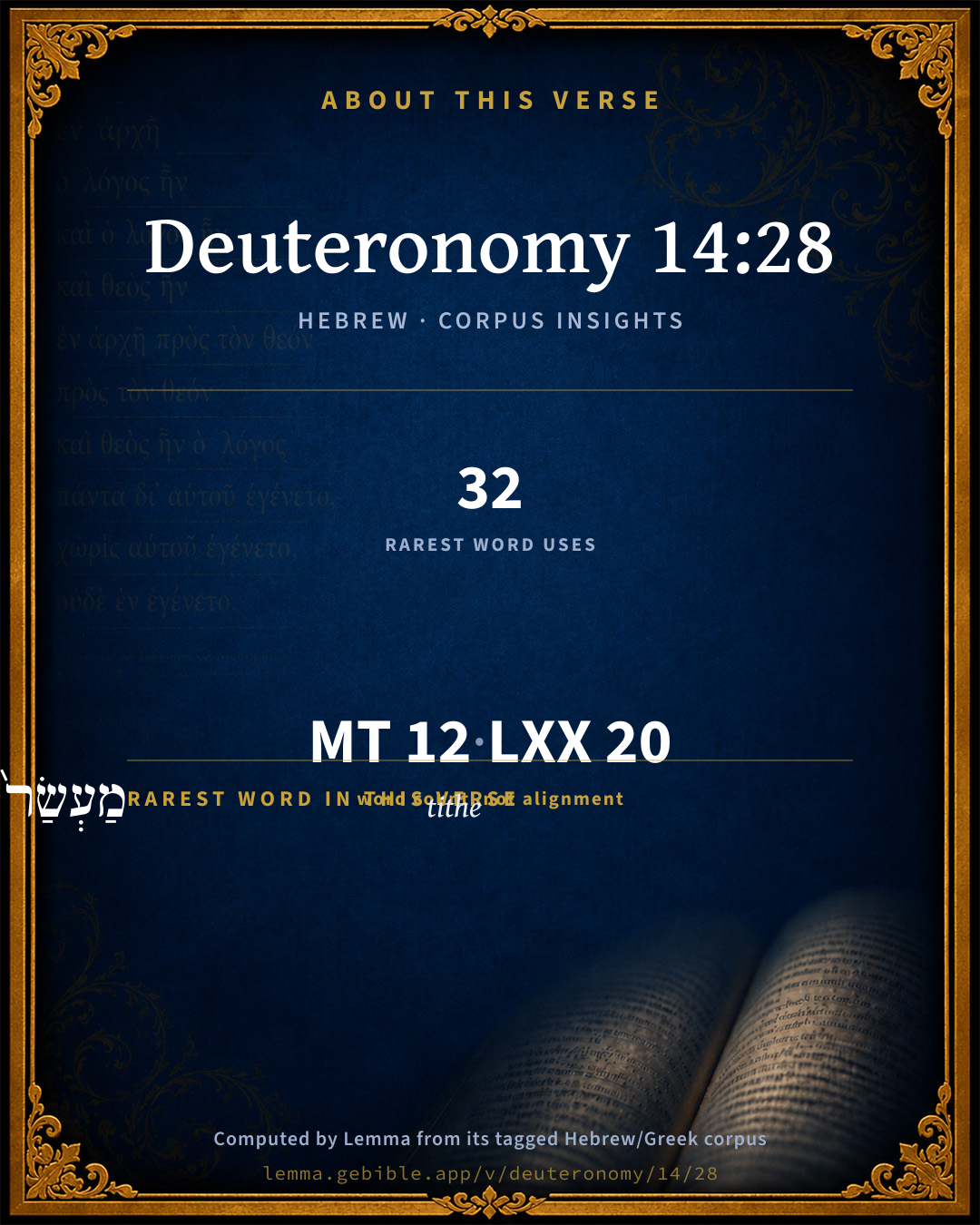
These counts appear in no published source. They are computed here, from the morphology-tagged text and Lemma’s own curated glosses. What Lemma adds →

12
words
11
distinct lemmas
Pentateuch
section

Shared distinctive vocabulary

מַעְשַׂר֙ tithe H4643 occurs in 27 verses of the Hebrew Bible. Also found in:

Grammatical profile

  • 2 verbs
  • 7 nouns
  • 1 adjective
  • 1 pronoun
  • 1 particle

Verb forms

  • תּוֹצִיא֙ Hiphil · Imperfect
  • וְהִנַּחְתָּ֖ Hiphil · Sequential Perfect

Repetition

A word recurs within this verse — often emphatic in Hebrew:

  • שָׁנִ֗ים year H8141 ×2

Hebrew & Septuagint length

In English translation the verse runs 29 words from the Hebrew and 24 from the Septuagint (LXX English) — closely comparable.

A rough comparison of the two English renderings, which tokenize alike — not a word-level alignment.

Word counts can differ between the Hebrew and the Greek without any difference in meaning — e.g. the Hebrew direct-object marker אֵת has no separate Greek word, and Greek often adds the article ὁ.

In the original languages it is 12 Hebrew tokens and 20 Greek tokens — but the two are counted differently (Hebrew bundles its prefixes and suffixes into one token; the Greek is in lemma form), so that isn’t a like-for-like length.

Cross-references

3

Topical passages linked to Deuteronomy 14:28 in the Treasury of Scripture Knowledge — connected by theme and wording, ordered by reader-vote popularity; previews shown in the World English Bible.

  • Deuteronomy 14:22 You shall surely tithe all the increase of your seed, that which comes forth from the field year by year.
  • Deuteronomy 26:12–15 When you have made an end of tithing all the tithe of your increase in the third year, which is the year of tithing, then you shall give it to the Levite, to the foreigner, to the fatherless, and to the widow, that they may eat within your gates, and be filled.
  • Amos 4:4 "Go to Bethel, and sin; To Gilgal, and sin more. Bring your sacrifices every morning, Your tithes every three days,

Cross-references courtesy of OpenBible.info (CC BY 4.0).

Hebrew and Greek witnesses Masoretic Hebrew ↔ Greek Septuagint

The same verse in the two great witnesses to the Old Testament, shown verse-for-verse.

These are two independent witnesses, not word-aligned to each other, and the Septuagint is shown in lemma (dictionary) form.

Hebrew Deuteronomy 14:28 Masoretic · Westminster Leningrad Codex

מִקְצֵ֣ה שָׁלֹ֣שׁ שָׁנִ֗ים תּוֹצִיא֙ אֶת כָּל מַעְשַׂר֙ תְּבוּאָ֣תְךָ֔ בַּשָּׁנָ֖ה הַהִ֑וא וְהִנַּחְתָּ֖ בִּשְׁעָרֶֽיךָ

At the end of every three years you shall bring forth all the tithe of your increase in the same year, and shall lay it up within your gates:

World English Bible · Public Domain

Greek LXX Deuteronomy 14:28 Septuagint · lemma form

μετά τρεῖς ἔτος ἐκφέρω πᾶς ὁ ἐπιδέκατος ὁ γένημα σύ ἐν ὁ ἐνιαυτός ἐκεῖνος τίθημι αὐτός ἐν ὁ πόλις σύ

After three years you shall bring out all the tithes of your fruits, in that year you shall lay it up in your cities.

LXX2012 (modern English Septuagint) · Public Domain

Hebrew: Westminster Leningrad Codex (CC BY 4.0). Greek: Septuagint (public domain); English from LXX2012 (modern English Septuagint) (Public Domain). How the Septuagint differs from the Hebrew →

Targum (Aramaic paraphrase)

2

The Targum is the ancient Jewish Aramaic paraphrase of the Hebrew Scriptures — an interpretive translation, not the Hebrew text itself. Onkelos (literal) and Pseudo-Jonathan (expansive) render the Torah, and Jonathan the Prophets. Coverage is partial: where no permissively-licensed English translation exists for a verse, only the Aramaic is shown. This is verse-level text, not a word-by-word alignment to the Hebrew.

  1. Targum Onkelos Torah (Genesis–Deuteronomy)
    מִסוֹף תְּלַת שְׁנִין תַּפֵק יָת כָּל מַעְשַׂר עֲלַלְתָּךְ בְּשַׁתָּא הַהִיא וְתַצְנַע בְּקִרְוָיךְ

    (no public-domain English translation for this verse)

    Targum Onkelos — Aramaic: “Onkelos Genesis” (public domain); “Onkelos Exodus” (public domain); “Onkelos Leviticus” (public domain); “Onkelos Numbers” (public domain); “Onkelos Deuteronomy” (public domain). English: “Sefaria Community Translation” (CC0 1.0 (public-domain dedication)); “J.W. Etheridge. The Targums of Onkelos and Jonathan Ben Uzziel on the Pentateuch. London: Longmans, Green, 1862” (public domain). Text via Sefaria.

  2. Targum Pseudo-Jonathan Torah (Genesis–Deuteronomy)
    מִסּוֹף תְּלַת שְׁנִין תַּפְקוּן יַת כָּל מַעֲשַר עֲלַלְתְּכוֹן בְּשַׁתָּא הַהוּא וְתַצְנִיעוּן בְּקִרְוֵיכוֹן

    At the end of three years you shall bring forth all the tenths of your produce for that year, and lay them up in your cities.

    Targum Pseudo-Jonathan — Aramaic: “Targum Jonathan on Genesis” (public domain); “Targum Jonathan on Exodus” (public domain); “Targum Jonathan on Leviticus” (public domain); “Targum Jonathan on Numbers” (public domain); “Targum Jonathan on Deuteronomy” (public domain). English: “The Targum of Jonathan ben Uzziel, trans. J. W. Etheridge, London, 1862” (public domain). Text via Sefaria.

Commentary

Notes on Deuteronomy 14:28 from classic Christian and Jewish commentators (each source and its license shown beneath its notes). The classic Christian expositions comment on the surrounding passage and are grouped to its opening verse, so a note may address several verses; the Jewish commentaries on the Tanakh (Rashi and others) are per-verse, so they appear only where the commentator wrote on this verse.

Lemma curates 59 commentaries, every one of them public domain or Creative Commons licensed, each selected and text-cleaned for this edition rather than reprinted as found. About our sources →

Tyndale Open Study Notes

Tyndale Open Resources

14:28 An annual tithe was required of all adult Israelite males as part of their festival observances (15:20; 16:16-17). The tithe every third year met the needs of the Levites and other dependent classes in Israelite society (14:29). See study note on Lev 27:30.

Tyndale Open Study Notes — © Tyndale Open Resources, licensed CC BY-SA 4.0. Text via the HelloAO Bible API.

Geneva Bible (1599)

Geneva Bible translators

Besides the yearly tithes that were given to the Levites, these were laid up in store for the poor.

Geneva Bible (1599) marginal notes — public domain. Text via Bolls.life.

Jamieson, Fausset & Brown

Robert Jamieson, A. R. Fausset & David Brown

At the end of three years . . . the Levite . . . shall come, &c.--The Levites having no inheritance like the other tribes, the Israelites were not to forget them, but honestly to tithe their increase [Num 18:24]. Besides the tenth of all the land produce, they had forty-eight cities, with the surrounding grounds [Num 35:7], "the best of the land," and a certain proportion of the sacrifices as their allotted perquisites. They had, therefore, if not an affluent, yet a comfortable and independent, fund for their support.

Next: Deuteronomy Chapter 15

Jamieson, Fausset & Brown — Commentary Critical and Explanatory on the Whole Bible (1871) — public domain (CC PDM 1.0). Text via the HelloAO Bible API.

Ellicott's Commentary for English Readers

(28) At the end of three years thou shalt bring forth ail the tithe.—This is called by the Jews Ma’aser ‘Ani, “the poor’s tithe.” They regard it as identical with the second tithe, which was ordinarily eaten by the owners at Jerusalem; but in every third and sixth year was bestowed upon the poor.

A Bible Commentary for English Readers, edited by Charles John Ellicott (1878–1897) — public domain. Text from a community e-Sword module.

The Cambridge Bible for Schools and Colleges

gen. ed. J. J. S. Perowne

28. At the end of every three years] Deu_26:12 : when thou hast finished tithing all the tithe of thine income in the third year, which is the year of tithing. See below.

thou shalt bring forth] That is for public or profane use as opposed to the bringing in of offerings designed for use in the sanctuary: cp. Deu_17:5, Deu_21:19, Deu_22:15; Deu_22:21; Deu_22:24.

all the tithe] All, not prefixed to tithe in Deu_14:22, has been variously interpreted either as meaning that the whole tithe was not exacted for the sanctuary in the first and second years but only a nominal tithe (as under Moslem law the tithe was sometimes only. 1/20 or even 1/40th of the crop), and was to be fully exacted only in each third year for charitable purposes; or else that in the third year no tithe was taken to the Temple but all the tithe was given to the local poor (Oettli, Berth. and others). The latter seems the more likely. Steuernagel thinks that every third year there were two tithes exacted, that for the poor being in addition to that taken every year to the Sanctuary. But in that case the law would not have described the third year tithe for the poor as all the tithe.

and shall lay it up within thy gates] Rather, let it remain or (lit.) rest there; either in distinction to the tithes of the other two years, which are carried from home to the Sanctuary; or else because instead of being consumed at once like those tithes it is to be stored for the continual sustenance of—

The Cambridge Bible for Schools and Colleges (gen. ed. J. J. S. Perowne; Cambridge University Press, 1878–1918) — public domain. Text from a community e-Sword module.

Albert Barnes' Notes on the Bible

Compare the marginal references. The tithe thus directed in the third year to be dispensed in charity at home, was not paid in addition to that in other years bestowed on the sacred meals, but was substituted for it. The three years would count from the sabbatical year (see the next chapter), in which year there would of course be neither payment of tithe nor celebration of the feasts at the sanctuary. In the third year and sixth year of the septennial cycle the feasts would be superseded by the private hospitality enjoined in these verses.

Albert Barnes' Notes on the Bible (1834–1885) — public domain. Text from a community e-Sword/MySword module.

Matthew Poole's English Annotations

At the end of three years, i.e. in the third year, as it is expressed, Deu 26:12. So, in the end of three years, or of seven years, is the same with in the third or seventh year, as appears by comparing Deu 31:10; Jos 9:16,17; 2Ki 18:9,10; 17:6.

All the tithe of thine increase. I join with those expositors who make this the same tithe with the former, Deu 14:22, as being called by the same title without any distinction between them, save only as to the place of eating them. See Poole "Deu 14:22", and See Poole "Deu 12:17".

The same year: this is added to show that he speaks of the third year, and not of the fourth year, as some might conjecture from the phrase, at the end of three years.

Matthew Poole's English Annotations on the Holy Bible (1683–1685) — public domain. Text from a community e-Sword/MySword module.

Whedon's Commentary on the Bible

Daniel D. Whedon

28. At the end of three years — The tithe of the third year, which was to be bestowed upon the poor, was not paid in addition to the tithe which was on other years devoted to the sacred festival, but took the place of it.

Daniel D. Whedon (gen. ed.), Commentary on the Old and New Testaments (1874–1909) — public domain. Text from a community e-Sword module.

The Pulpit Commentary

Vers. 28, 29. Every third year the whole tithe of the year"s produce was to be set apart, not to be brought to the sanctuary to be eaten before the Lord, but as a portion in their towns for the Levite, the stranger, the widow, and the fatherless. The end of three years; i.e. as the third year expired, consequently, in the last year of the triennium; (Deu_26:12) just as "the end of seven years" means each seventh year (Deu_15:1 Deu_31:10; Jer_34:14) This was not an additional tithe, but the former differently applied; the tithe of the first and second years was to be eaten before the Lord at the sanctuary; the tithe of the third year was for the poor and needy.

The Pulpit Commentary (1880–1919), ed. H.D.M. Spence-Jones & Joseph S. Exell — public domain. Text from a community e-Sword module.

John Wesley's Explanatory Notes

At the end of three years - That is, in the third year, as it is, expressed, chap. xxvi, 12. The same year - This is added to shew that he speaks of the third year, and not of the fourth year, as some might conjecture from the phrase, at the end of three years.

John Wesley, Explanatory Notes Upon the Whole Bible (1754–1765) — public domain. Text via the GEBible commentary corpus.

Keil & Delitzsch

C. F. Keil & F. Delitzsch

Every third year, on the other hand, they were to separate the whole of the tithe from the year's produce ("bring forth," sc., from the granary), and leaven it in their gates (i.e., their towns), and feed the Levites, the strangers, and the widows and orphans with it. They were not to take it to the sanctuary, therefore; but according to Deu 26:12., after bringing it out, were to make confession to the Lord of what they had done, and pray for His blessing. "At the end of three years:" i.e., when the third year, namely the civil year, which closed with the harvest (see at Exo 23:16), had come to an end. This regulation as to the time was founded upon the observance of the sabbatical year, as we may see from Deu 15:1, where the seventh year is no other than the sabbatical year. Twice, therefore, within the period of a sabbatical year, namely in the third and sixth years, the tithe set apart for a sacrificial meal was not to be eaten at the sanctuary, but to be used in the different towns of the land in providing festal meals for those who had no possessions, viz., the Levites, strangers, widows, and orphans. Consequently this tithe cannot properly be called the "third tithe," as it is by many of the Rabbins, but rather the "poor tithe," as it was simply in the way of applying it that it differed from the "second" (see Hottinger, de decimies, exerc. viii. pp. 182ff., and my Archol. i. p. 339). As an encouragement to carry out these instructions, Moses closes in Deu 14:29 with an allusion to the divine blessing which would follow their observance.

Keil & Delitzsch — Biblical Commentary on the Old Testament (1861–1891) — public domain (CC PDM 1.0). Text via the HelloAO Bible API. (Old Testament only.)

unfoldingWord translationNotes

Door43 World Missions Community

every three years you will present all the tithe of your produce

Once every 3 years the Israelites were to store their tithes within their own towns so that it would be used to provide for the Levites, orphans, widows and foreigners. (See: Numbers)

within your gates

Here "gates" represents the entire city or town. AT: "inside your city" (See: Synecdoche)

because he has no portion nor inheritance with you

God not giving any land to the Levites is spoken of as if he were not giving them an inheritance. (See: Metaphor)

fatherless

These are children whose parents have both died and do not have relatives to care for them.

widow

This is a woman whose husband has died and has no children to care for her in her old age.

in all the work of your hand that you do

Here "hand" represents the whole person. This refers to the work that someone does. AT: "in all the work you do" (See: Synecdoche)

translationWords

year

tenth

gate

Levi

inherit

alien

Yahweh

God

bless

works

hand

unfoldingWord translationNotes — © Distant Shores Media and the Door43 World Missions Community, licensed CC BY-SA 4.0. Source: git.door43.org/Door43/en_tn.

Rashi

Rabbi Shlomo Yitzchaki (Rashi)

מקצה שלש שנים AT THE END OF THREE YEARS [THOU SHALT BRING FORTH ALL THE TITHE OF THY INCREASE THE SAME YEAR] — Scripture hereby intends to teach you that if one has delayed to give his tithes of the first and the second year of the Sabbatical period, he has to remove them from his house in the third year.

Rashi on the Tanakh — English translations: “The Judaica Press complete Tanach with Rashi, translated by A. J. Rosenberg” (CC BY 4.0); “Pentateuch with Rashi's commentary by M. Rosenbaum and A.M. Silbermann, 1929-1934” (public domain); “The Metsudah Tanach series, Lakewood, N.J” (CC BY 4.0); and “The Book of Joshua, Metsudah Publications, 1997” (CC BY 4.0). Text via Sefaria.

Lesson kit

Teaching starters — assembled from the data on this page, not authored interpretation. Every prompt links to the verse data it draws on. Edit before teaching.

Deuteronomy, in the Pentateuch, opens this verse with 12 words (11 distinct Hebrew lemmas). Its most distinctive word is maʻăsêr (“tithe”). A historical commentator’s framing appears above. Read the whole chapter for the surrounding context.

Discussion questions

  1. What does “tithe” (maʻăsêr) contribute to the verse as a whole?
  2. Genesis 14:20 shares the word «tithe» with this verse. How do the two illuminate each other?
  3. “year” occurs 2× in this one verse. What is the effect of the repetition?
  4. The translations on this page render this verse differently — a whole-verse word diff, not a word-by-word alignment. What might account for the different wordings?
  5. The verb «תּוֹצִיא֙» is Hiphil Imperfect. How does its form color the action?
  6. Reading how Tyndale Open Study Notes and Geneva Bible (1599) read this verse, where do the two commentators agree and where do they part?

Things to notice

Reading settings

Reading text

Shown beneath each verse's original-language words.

Old Testament
Old Testament edition

Read the OT as the Masoretic Hebrew (MT) or the Greek Septuagint (LXX).

English shown for the Greek Septuagint (in the Hebrew ↔ Greek comparison).

Comparing translations? Open the Compare panel on any verse page to stack up to four side by side.