Isaiah 14:31

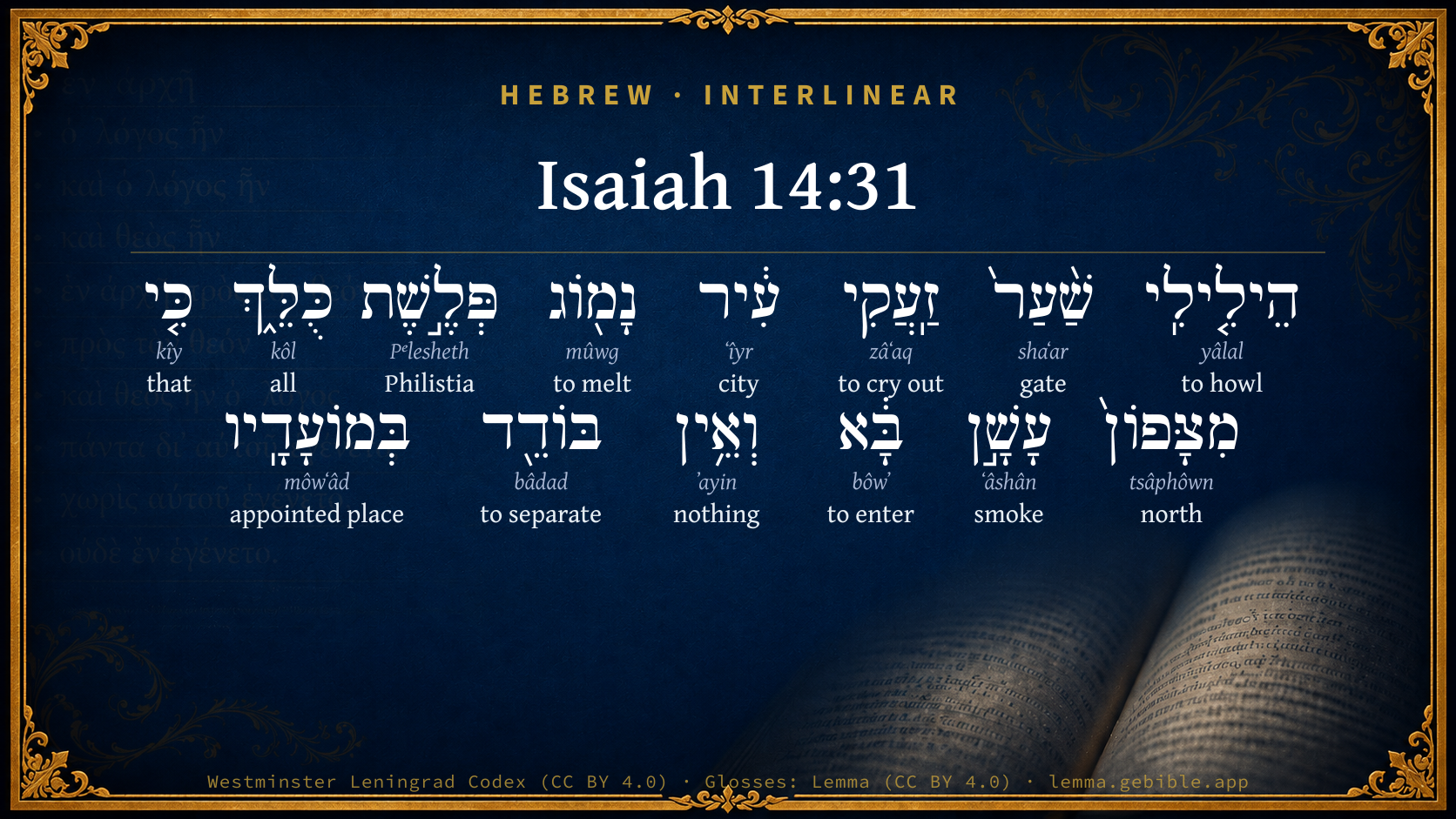
Hebrew (Westminster Leningrad Codex) Isaiah 14:31 appears in the Hebrew Old Testament. The text above is from the Westminster Leningrad Codex. Each word links to its Strong’s number, a concise gloss, and parsing drawn from the Open Scriptures Hebrew Bible morphology. Click any word for its full Brown-Driver-Briggs (BDB) entry.
Download image
Cite this verse

Isaiah 14:31 (World English Bible). Public Domain. Lemma interlinear Bible study tool, https://lemma.gebible.app/v/isaiah/14/31.

Show BibTeX & RIS
BibTeX
RIS
English Translation
Howl, gate; cry, city; you are melted away, Philistia, all of you; for there comes a smoke out of the north, and there is no straggler in his ranks.
World English Bible · Public Domain
Highlights
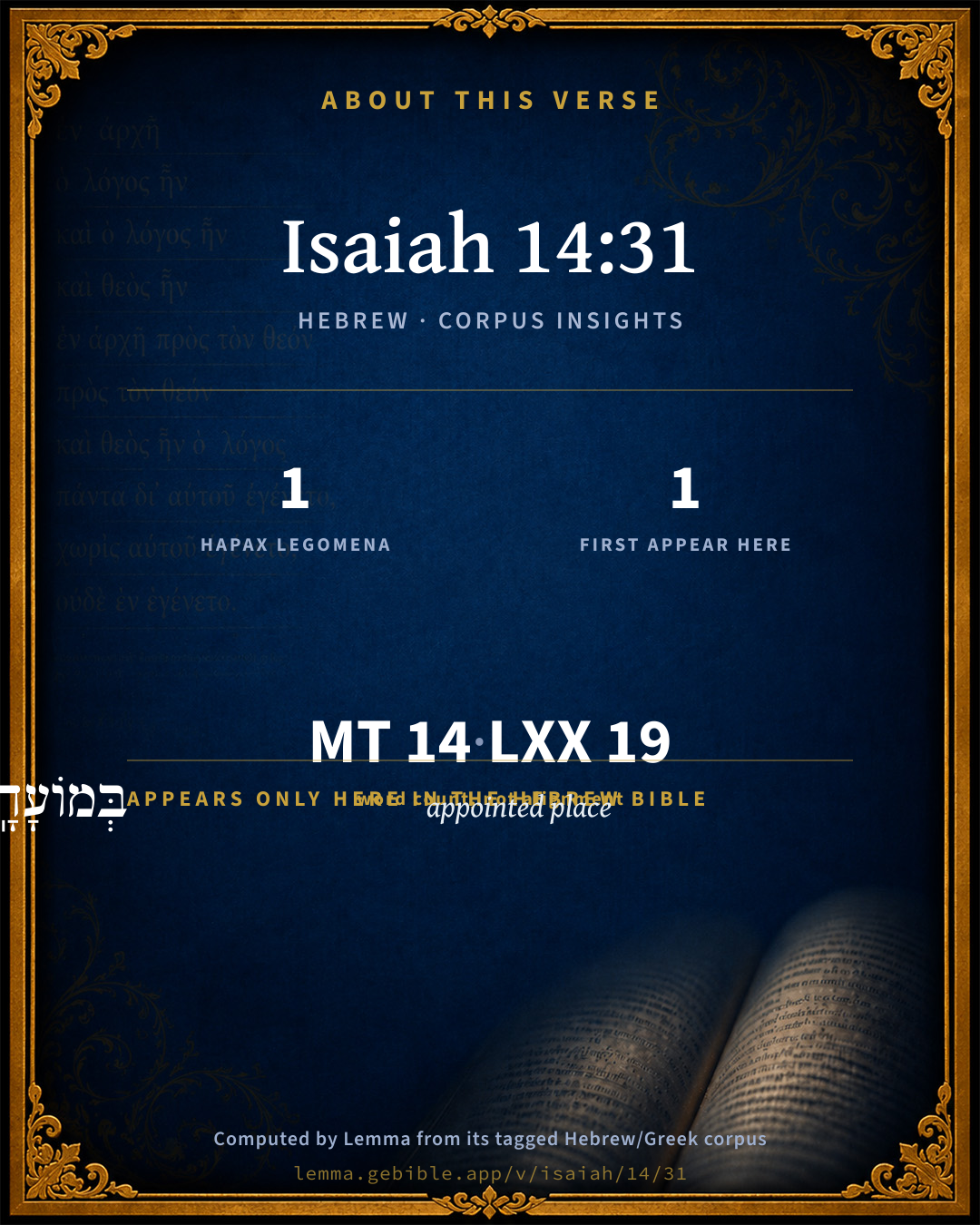
  • 1 hapax legomenon — only here in the Hebrew Bible
  • 1 first appearance in the Hebrew Bible
Full analysis ↓
Download a study sheet

One document with this verse’s original text, its word-by-word gloss line, the meaning frame, cross-references with their text, attributed commentary, and full source and license credits — printable, and it pastes into notes with its structure intact.

This verse Autodidact and up

Study sheet (.html) Plain text (.txt)

A passage Seminary Student

Up to 50 verses in one chapter. A passage sheet keeps up to 6 commentary sources and 12 cross-references per verse, in the order this page ranks them, and says so on the sheet whenever that leaves anything out. Ask for a single verse and you get the Autodidact verse sheet above.

Everything on this page stays free to read, with no account — the sheet is a download of what is already on screen, not access to it.

Want to remove ads? Support Godless Engineer
Compare translations 3

The same verse in 3 English versions, stacked beneath the original-language interlinear above. Click any original word for its lexicon entry.

Each is an independent rendering of the whole verse — the interlinear is not word-aligned to these translations.

Highlighted words mark where these versions differ — a whole-verse word diff, not a word-by-word alignment.

  • World English Bible Public Domain
    Howl, gate; cry, city; you are melted away, Philistia, all of you; for there comes a smoke out of the north, and there is no straggler in his ranks.
  • King James Version Public Domain
    Howl, O gate; cry, O city; thou, whole Palestina, art dissolved: for there shall come from the north a smoke, and none shall be alone in his appointed times.
  • unfoldingWord Literal Text CC BY-SA 4.0
    Wail, gate! Cry out, city! Be dissolved, Philistia, all of you! For from the north smoke is coming, and none in his assembly is being separate.

unfoldingWord Literal Text — © unfoldingWord, licensed CC BY-SA 4.0. Word-aligned USFM3 via Door43 (git.door43.org/unfoldingWord/en_ult).

Versions to compare (up to 4)

3 of 4 selected

Show all 18 translations

Every available English version of this verse, each an independent rendering of the whole verse.

  • World English Bible Public Domain
    Howl, gate; cry, city; you are melted away, Philistia, all of you; for there comes a smoke out of the north, and there is no straggler in his ranks.
  • Berean Standard Bible Public Domain
    Wail, O gate! Cry out, O city! Melt away, all you Philistines! For a cloud of smoke comes from the north, and there are no stragglers in its ranks.
  • Majority Standard Bible Public Domain
    Wail, O gate! Cry out, O city! Melt away, all you Philistines! For a cloud of smoke comes from the north, and there are no stragglers in its ranks.
  • King James Version Public Domain
    Howl, O gate; cry, O city; thou, whole Palestina, art dissolved: for there shall come from the north a smoke, and none shall be alone in his appointed times.
  • American Standard Version (1901) Public Domain
    Howl, O gate; cry, O city; thou art melted away, O Philistia, all of thee; for there cometh a smoke out of the north, and there is no straggler in his ranks.
  • Revised Version (1885) Public Domain
    Howl, O gate; cry, O city; thou art melted away, O Philistia, all of thee; for there cometh a smoke out of the north, and none standeth aloof at his appointed times.
  • Geneva Bible (1599) Public Domain
    Howle, O gate, crie, O citie: thou whole lande of Palestina art dissolued, for there shall come from the North a smoke, and none shalbe alone, at his time appointed.
  • Douay-Rheims (1899) Public Domain
    Howl, O gate; cry, O city: all Philistia is thrown down: for a smoke shall come from the north, and there is none that shall escape his troop.
  • Young's Literal Translation Public Domain
    Howl, O gate; cry, O city, Melted art thou, Philistia, all of thee, For from the north smoke hath come, And there is none alone in his set places.
  • Literal Standard Version CC BY-SA 4.0
    Howl, O gate; cry, O city, || You are melted, Philistia, all of you, || For smoke has come from the north, || And there is none alone in his set places.”
  • Unlocked Literal Bible CC BY-SA 4.0
    Howl, gate; cry, city; all of you will melt away, Philistia. For out of the north comes a cloud of smoke, and there is no straggler in his ranks.
  • unfoldingWord Literal Text CC BY-SA 4.0
    Wail, gate! Cry out, city! Be dissolved, Philistia, all of you! For from the north smoke is coming, and none in his assembly is being separate.
  • Darby Bible Public Domain
    Howl, O gate! cry, O city! thou, Philistia, art wholly dissolved; for there cometh from the north a smoke, and none remaineth apart in his gatherings [of troops].
  • World Messianic Bible Public Domain
    Howl, gate! Cry, city! You are melted away, Philistia, all of you; for smoke comes out of the north, and there is no straggler in his ranks.
  • Webster's Bible Public Domain
    Howl, O gate; cry, O city; thou, all Palestina, art dissolved: for there shall come from the north a smoke, and none shall be alone in his appointed times.
  • Free Bible Version CC BY-SA 4.0
    Howl, gates! Weep, town! Melt away in fear, all you Philistines! For a cloud of smoke is approaching from the north—an army with no soldier hanging back.
  • Bible in Basic English Public Domain
    Send out a cry, O door! Make sounds of sorrow, O town! All your land has come to nothing, O Philistia; for there comes a smoke out of the north, and everyone keeps his place in the line.
  • JPS Tanakh (1917) Public Domain
    Howl, O gate; cry, O city; melt away, O Philistia, all of thee; for there cometh a smoke out of the north, and there is no straggler in his ranks.

Literal Standard Version (2020), Covenant Press — licensed CC BY-SA 4.0. Text via the HelloAO Bible API (eBible.org). Unlocked Literal Bible (unfoldingWord) — licensed CC BY-SA 4.0. Text via the HelloAO Bible API (eBible.org). unfoldingWord Literal Text — © unfoldingWord, licensed CC BY-SA 4.0. Word-aligned USFM3 via Door43 (git.door43.org/unfoldingWord/en_ult). Free Bible Version, Dr. Jonathan Gallagher — licensed CC BY-SA 4.0. Text via the HelloAO Bible API (eBible.org).

Word by word

More ways to search: Search by grammar → Find every occurrence → Compare this word →

Practice this passage: Drill this verse → Learn its vocabulary →

בְּמוֹעָדָֽיו
môwʻâd
H4151
“in/at · appointed places · his”
Preposition + Noun, Common, Masculine, Plural, Construct + Suffix, Personal, 3rd Person, Masculine, Singular
Part of Speech
Preposition + Noun
Type
Common
Gender
Masculine
Number
Plural
State
Construct
Full BDB Definition

Origin: from H3259

TWOT: 878c

appointed place (in army)
  1. הֵילִ֤ילִֽי yâlal H3213 “howl” Verb, Hiphil, Imperative, 2nd Person, Feminine, Singular
  2. שַׁ֨עַר֙ shaʻar H8179 “gate” Noun, Common, Masculine, Singular, Absolute
  3. זַֽעֲקִי zâʻaq H2199 “cry out” Verb, Qal, Imperative, 2nd Person, Feminine, Singular
  4. עִ֔יר ʻîyr H5892 “city” Noun, Common, Feminine, Singular, Absolute
  5. נָמ֖וֹג mûwg H4127 “to melt” Verb, Niphal, Infinitive Absolute
  6. פְּלֶ֣שֶׁת Pᵉlesheth H6429 “Philistia” Noun, Proper
  7. כֻּלֵּ֑ךְ kôl H3605 “all · your” Noun, Common, Masculine, Singular, Construct + Suffix, Personal, 2nd Person, Feminine, Singular
  8. כִּ֤י kîy H3588 “that” Conjunction
  9. מִצָּפוֹן֙ tsâphôwn H6828 “from · north” Preposition + Noun, Common, Feminine, Singular, Absolute
  10. עָשָׁ֣ן ʻâshân H6227 “smoke” Noun, Common, Masculine, Singular, Absolute
  11. בָּ֔א bôwʼ H935 “to enter” Verb, Qal, Perfect, 3rd Person, Masculine, Singular
  12. וְאֵ֥ין ʼayin H369 “and · nothing” Conjunction + Particle, Negative
  13. בּוֹדֵ֖ד bâdad H909 “separating” Verb, Qal, Participle Active, Masculine, Singular, Absolute

About this verse

These counts appear in no published source. They are computed here, from the morphology-tagged text and Lemma’s own curated glosses. What Lemma adds →

14
words
14
distinct lemmas
Prophets
section

Notable vocabulary

1 hapax legomenon — a word that appears only here in the entire Hebrew Bible:

  • בְּמוֹעָדָֽיו appointed place H4151

First appearance in Scripture

This word makes its first canonical appearance in the Hebrew Bible here:

  • בְּמוֹעָדָֽיו appointed place H4151

Shared distinctive vocabulary

בּוֹדֵ֖ד to separate H909 occurs in 4 verses of the Hebrew Bible. Also found in:

Grammatical profile

  • 5 verbs
  • 7 nouns
  • 1 conjunction
  • 1 particle

Verb forms

  • הֵילִ֤ילִֽי Hiphil · Imperative
  • זַֽעֲקִי Qal · Imperative
  • נָמ֖וֹג Niphal · Infinitive Absolute
  • בָּ֔א Qal · Perfect
  • בּוֹדֵ֖ד Qal · Participle Active

Hebrew & Septuagint length

In English translation the verse runs 29 words from the Hebrew and 30 from the Septuagint (LXX English) — closely comparable.

A rough comparison of the two English renderings, which tokenize alike — not a word-level alignment.

Word counts can differ between the Hebrew and the Greek without any difference in meaning — e.g. the Hebrew direct-object marker אֵת has no separate Greek word, and Greek often adds the article ὁ.

In the original languages it is 14 Hebrew tokens and 19 Greek tokens — but the two are counted differently (Hebrew bundles its prefixes and suffixes into one token; the Greek is in lemma form), so that isn’t a like-for-like length.

Cross-references

8

Topical passages linked to Isaiah 14:31 in the Treasury of Scripture Knowledge — connected by theme and wording, ordered by reader-vote popularity; previews shown in the World English Bible.

  • Isaiah 20:1 In the year that Tartan came to Ashdod, when Sargon the king of Assyria sent him, and he fought against Ashdod and took it;
  • Jeremiah 1:14 Then Yahweh said to me, Out of the north evil shall break forth on all the inhabitants of the land.
  • Isaiah 13:6 Wail; for the day of Yahweh is at hand; as destruction from the Almighty shall it come.
  • Isaiah 14:29 Don't rejoice, O Philistia, all of you, because the rod that struck you is broken; for out of the serpent's root shall come forth an adder, and his fruit shall be a fiery flying serpent.
  • Jeremiah 25:16–20 They shall drink, and reel back and forth, and be mad, because of the sword that I will send among them.
  • Isaiah 3:26 Her gates shall lament and mourn; And she shall be desolate and sit on the ground.
  • Isaiah 16:7 Therefore shall Moab wail for Moab, everyone shall wail: for the raisin-cakes of Kir Hareseth shall you mourn, utterly stricken.
  • Isaiah 24:12 In the city is left desolation, and the gate is struck with destruction.

Cross-references courtesy of OpenBible.info (CC BY 4.0).

Hebrew and Greek witnesses Masoretic Hebrew ↔ Greek Septuagint

The same verse in the two great witnesses to the Old Testament, shown verse-for-verse.

These are two independent witnesses, not word-aligned to each other, and the Septuagint is shown in lemma (dictionary) form.

Hebrew Isaiah 14:31 Masoretic · Westminster Leningrad Codex

הֵילִ֤ילִֽי שַׁ֨עַר֙ זַֽעֲקִי עִ֔יר נָמ֖וֹג פְּלֶ֣שֶׁת כֻּלֵּ֑ךְ כִּ֤י מִצָּפוֹן֙ עָשָׁ֣ן בָּ֔א וְאֵ֥ין בּוֹדֵ֖ד בְּמוֹעָדָֽיו

Howl, gate; cry, city; you are melted away, Philistia, all of you; for there comes a smoke out of the north, and there is no straggler in his ranks.

World English Bible · Public Domain

Greek LXX Isaiah 14:31 Septuagint · lemma form

ὀλολύζω πύλη πόλις κράζω πόλις ταράσσω ὁ ἀλλόφυλος πᾶς ὅτι καπνός ἀπό βορέας ἔρχομαι καί οὐ εἰμί ὁ εἰμί

Howl, you⌃ gates of cities; let the cities be troubled and cry, even all the Philistines: for smoke is coming from the north, and there is no possibility of living.

LXX2012 (modern English Septuagint) · Public Domain

On this verse, Albert Barnes' Notes on the Bible discusses the Septuagint’s reading. Read the note in Commentary ↓

Hebrew: Westminster Leningrad Codex (CC BY 4.0). Greek: Septuagint (public domain); English from LXX2012 (modern English Septuagint) (Public Domain). How the Septuagint differs from the Hebrew →

Targum (Aramaic paraphrase)

1

The Targum is the ancient Jewish Aramaic paraphrase of the Hebrew Scriptures — an interpretive translation, not the Hebrew text itself. Onkelos (literal) and Pseudo-Jonathan (expansive) render the Torah, and Jonathan the Prophets. Coverage is partial: where no permissively-licensed English translation exists for a verse, only the Aramaic is shown. This is verse-level text, not a word-by-word alignment to the Hebrew.

  1. Targum Jonathan Prophets (Joshua–Malachi)
    אֱלִילִי עַל תַּרְעָךְ צַוְחִי עַל קִרְוָךְ אִתְבַּרְתּוּן פְּלִשְׁתָּאֵי כּוּלְכוֹן אֲרֵי מִצִפּוּנָא פּוּרְעֲנוּתָא אָתֵי וְלֵית דִמְאַחַר בְּזִמְנוֹהִי:

    Howl, on account of thy gate, cry on account of thy city, ye, O Philistines, all of you; ye shall be broken: because from the north vengeance is coming, and is not delaying its appointed time.

    Targum Jonathan — Aramaic: “Mikraot Gedolot” (public domain). English: “Sefaria Community Translation” (CC0 1.0 (public-domain dedication)); “London "Chaldee Paraphrase," 1871” (public domain). Text via Sefaria.

Commentary

Notes on Isaiah 14:31 from classic Christian and Jewish commentators (each source and its license shown beneath its notes). The classic Christian expositions comment on the surrounding passage and are grouped to its opening verse, so a note may address several verses; the Jewish commentaries on the Tanakh (Rashi and others) are per-verse, so they appear only where the commentator wrote on this verse.

Lemma curates 59 commentaries, every one of them public domain or Creative Commons licensed, each selected and text-cleaned for this edition rather than reprinted as found. About our sources →

Trapp's Complete Commentary

John Trapp

Isa 14:31 Howl, O gate; cry, O city; thou, whole Palestina, [art] dissolved: for there shall come from the north a smoke, and none [shall be] alone in his appointed times.

Ver. 31. Howl, O gate.] Philistines are elsewhere taxed for flashy and foolish mirth {Jdg 16:23-30 2Sa 1:20-21} Here they are told they have more cause to fear than flear, to sigh than sing, to howl than hollo.

“ Quis globus, O cives, caligiue, volvitur atra?

Hostis adest. ” - Virg.

From the north a smoke,] i.e., Hezekiah’s army raising a dust, and setting all in a combustion.

John Trapp, A Commentary or Exposition upon All the Books of the Old and New Testament (1647–1656) — public domain. Text from a community e-Sword module.

Joseph Benson's Commentary

Isa 14:31. Howl, O gate — O people, who used to pass through the gates; cry, O city — O inhabitants of the city; or city may be put collectively for all their cities. Thou, whole Palestina, art dissolved — Hebrew, נמוג, art melted, which may be understood, either of the faintness of their spirits and courage, or of the dissolution of their state; there shall come from the north a smoke — A grievous judgment, or calamity, often signified by smoke, as Gen 15:17; Joe 2:30; both because smoke is generally accompanied with fire, and because it darkens the air, and afflictions are frequently signified by fire and darkness. Many interpreters understand the prophet as speaking here of the calamity brought on the Philistines by Hezekiah, foretold in the preceding verses, observing that Judea lay to the north of some parts of Palestine. But certainly it lay more to the east than north of the greater part of that country: and accordingly, the Scriptures generally speak of the Philistines as being to the west of the Jews: see Isa 11:14. It seems, therefore, that Chaldea, and not Judea, is here meant by the north, as it generally is in the writings of the prophets; and that the calamity intended is not that spoken of in Isa 14:29-30, but a new affliction to be brought upon them by the Assyrians or Babylonians: probably the same which Jeremiah predicted as coming from the north on the Philistines, Jer 47:2, &c. And none shall be alone in his appointed times — When God’s appointed time shall come, not one of all that numerous army that shall invade Palestine, shall desert his colours, lag behind the rest, or withdraw his hand, till the work of destruction be finished.

Joseph Benson's Commentary on the Old and New Testaments (1811–1818) — public domain. Text from a community e-Sword module.

Tyndale Open Study Notes

Tyndale Open Resources

14:31 The advancing army, probably Assyria, would stir up clouds of dust like smoke that were ominously visible in the north.

Tyndale Open Study Notes — © Tyndale Open Resources, licensed CC BY-SA 4.0. Text via the HelloAO Bible API.

Geneva Bible (1599)

Geneva Bible translators

That is, from the Jews or Assyrians: for they were brought to most extreme misery.

But they shall be all ready, and join together.

Geneva Bible (1599) marginal notes — public domain. Text via Bolls.life.

Jamieson, Fausset & Brown

Robert Jamieson, A. R. Fausset & David Brown

gate--that is, ye who throng the gate; the chief place of concourse in a city.

from . . . north--Judea, north and east of Palestine.

smoke--from the signal-fire, whereby a hostile army was called together; the Jews' signal-fire is meant here, the "pillar of cloud and fire," (Exo 13:21; Neh 9:19); or else from the region devastated by fire [MAURER]. GESENIUS less probably refers it to the cloud of dust raised by the invading army.

none . . . alone . . . in . . . appointed times--Rather, "There shall not be a straggler among his (the enemy's) levies." The Jewish host shall advance on Palestine in close array; none shall fall back or lag from weariness (Isa 5:26-27), [LOWTH]. MAURER thinks the Hebrew will not bear the rendering "levies" or "armies." He translates, "There is not one (of the Philistine watch guards) who will remain alone (exposed to the enemy) at his post," through fright. On "alone," compare Psa 102:7; Hos 8:9.

Jamieson, Fausset & Brown — Commentary Critical and Explanatory on the Whole Bible (1871) — public domain (CC PDM 1.0). Text via the HelloAO Bible API.

Adam Clarke's Commentary

Verse 31. There shall come from the north a smoke - "From the north cometh a smoke"] That is, a cloud of dust raised by the march of Hezekiah's army against Philistia; which lay to the south-west from Jerusalem. A great dust raised has, at a distance, the appearance of smoke: Fumantes pulvere campi; "The fields smoking with dust." - VIRG. AEn. xi. 908.

Adam Clarke's Commentary on the Bible (1810–1826) — public domain. Text from a community e-Sword/MySword module.

Ellicott's Commentary for English Readers

(31) Howl, O gate . . .—The “gate,” as elsewhere, is the symbol of the city’s strength. The “city” stands probably for Ashdod, as the most conspicuous of the Philistine cities.

From the north.—Here of the Assyrian invaders, as in Jer_1:14; Jer_10:22; Jer_46:20 of the Chaldean. The “smoke” may be either that of the cities which the Assyrians burnt, or, more probably, the torch-signals, or beacons, which they used in their night marches or encampments (Jer_6:1; Jer_1:2). (See Note on Isa_4:5.)

None shall be alone in his appointed times.—Better, there is no straggler at the appointed places: i.e., all the troops shall meet at the rendezvous which was indicated by the column of fiery smoke as a signal.

A Bible Commentary for English Readers, edited by Charles John Ellicott (1878–1897) — public domain. Text from a community e-Sword module.

The Cambridge Bible for Schools and Colleges

gen. ed. J. J. S. Perowne

31. As in Isa_14:29 the prophet had rebuked the premature rejoicing of the Philistines, so here he calls them to public lamentation in view of the advancing enemy.

thou … art dissolved] Render as an imper. melt away, entire Philistia! Smoke may be either a symbol of war (Jer_1:13 f.) or it may be a vivid picture of the burning villages that mark the track of the invader. The phrase from the north points almost unmistakeably to the Assyrians (see on ch. Isa_10:27).

none shall be … times] Most critics render: there is no straggler in his battalions (cf. ch. Isa_5:27). The last word closely resembles that for “appointed times,” but is differently vocalised, and does not occur elsewhere.

The Cambridge Bible for Schools and Colleges (gen. ed. J. J. S. Perowne; Cambridge University Press, 1878–1918) — public domain. Text from a community e-Sword module.

John Gill's Exposition

What shall one then answer the messengers of the nation?.... Or nations, of any of the nations. Not the messengers sent to Hezekiah, Isa 39:1 but rather such as were sent to him, to congratulate him upon his victory over the Philistines; or any others that were sent, and came from other nations, that inquired about these matters, and the answer returned is,

That the Lord hath founded Zion; and not Hezekiah; he had given his people victory over their enemies, and protected, defended, and established them, and therefore ought to have all the glory:

and the poor of his people shall trust in it; or, "betake themselves to it"; as to a place of safety, being founded by the Lord, and under his protection. So the church of God, which often goes by the name of Zion in Scripture, is of his founding; he has laid Christ as the foundation of it, and such as are sensible of their spiritual poverty, misery, and danger, trust in him; not in Zion, but in the foundation God has laid in Zion, or built his church upon.

Next: Isaiah Chapter 15

John Gill's Exposition of the Whole Bible (1746–1763) — public domain (CC PDM 1.0). Text via the HelloAO Bible API.

Albert Barnes' Notes on the Bible

Howl, O gate - That is, ye who throng the gate. The gates of a city were the chief places of concourse.

Cry, O city - The prophet here fixes the attention upon some principal city of Philistia, and calls upon it to be alarmed in view of the judgments that were about to come upon the whole land.

Art dissolved - The word ‘dissolved’ (מוג mûg) is applied to that which melts, or which wastes away gradually, and then to that which faints or disappears. It means here that the kingdom of Philistia would disappear, or be destroyed. It probably conveys the idea of its fainting, or becoming feeble from fear or apprehension.

From the north a smoke - From the regions of Judah, which lay north and east of Philistia. The ‘smoke’ here probably refers to a cloud of dust that would be seen to rise in that direction made by an invading army.

And none shall be alone in his appointed times - There has been a great variety of interpretation in regard to this passage. Lowth renders it, ‘And there shall not be a straggler among his levies.’ The Hebrew is, as in the margin, ‘And not solitary in his assemblies.’ The Septuagint renders it, Καί οὐκ ἔσται τοῦ εῖναι Kai ouk estai tou einai - ‘And it is not to be endured.’ The Chaldee, ‘And there shall be none who shall retard him in his times.’ The Arabic, ‘Neither is there anyone who can stand in his footsteps.’ The Vulgate, ‘Neither is there anyone who can escape his army.’ Aben Ezra renders it, ‘No one of the Philistines shall dare to remain in their palaces, as when a smoke comes into a house all are driven out.’ Probably the correct idea is given by Lowth; and the same interpretation is given by Gesenius, Rosenmuller, Dathe, and Michaelis. No one of the invading army of Hezekiah shall come by himself; no one shall be weary or be a straggler; the army shall advance in close military array, and in dense columns; and this is represented as the cause of the cloud or smoke that the prophet saw rising, the cloud of dust that was made by the close ranks of the invading host (compare Isa 5:27).

Albert Barnes' Notes on the Bible (1834–1885) — public domain. Text from a community e-Sword/MySword module.

Matthew Poole's English Annotations

O gate: the gate is put either,

1. Metaphorically, for the people passing through the gates, or for the magistrates and others who used to meet in the gate for judgment, or upon other occasions; or,

2. Synecdochically, for the city, as gates are commonly put, as Jer 22:19, and as it is explained in the next words.

O city: city is here put collectively for their cities, of which see 1Sa 6:17.

Dissolved, Heb. melted; which may be understood either,

1. Of the fainting of their spirits and courage, as Exo 15:15; Jos 2:9,24, &c.; or, 2. Of the dissolution of their state.

From the north; either,

1. From Judea; which lay northward from some part of the Philistines’ land. But in truth Judea lay more east than north from Palestine, and therefore the Philistines are said to be on the west, Isa 11:14, and never, so far as I remember, on the north. Or,

2. From Chaldea. as may be gathered,

1. From the Scripture use of this phrase, which generally designs that country, as Jer 1:14,15; 6:1,22, &c.

2. From Jer 47, where destruction is threatened to the Philistines from the north, Isa 14:2, which all understand of the Chaldeans under Nebuchadnezzar. And whereas it is speciously objected, That this suits not with the next verse, which speaks of Zion’s safety at the time of this destruction of the Philistines, whereas Zion and the land and people of Judah were destroyed together with the Philistines by Nebuchadnezzar; I humbly conceive it may be answered, that that verse is added to express the far differing condition of God’s people and of the Philistines in the events of that Babylonian war; and that whereas the Philistines should be irrecoverably and eternally destroyed thereby, and no remnant of them should be left, as was said, Isa 14:30, God’s people, though they should be sorely scourged, and carried into captivity, yet they should be strangely preserved, and after some years delivered, and restored to their own land and temple; whereby it would appear that Zion stood upon a sure foundation, and, albeit it was grievously shaken, yet it could not be utterly and finally overthrown.

A smoke; a grievous judgment and calamity, which is oft signified by smoke, as Gen 15:17; Deu 29:20; Joe 2:30, either because smoke is generally accompanied with fire, or because it causeth a great darkness in the air; for afflictions are frequently described under the names of fire and darkness. In his appointed times: when God’s appointed time shall come for the execution of this judgment, not one person of all that numerous army, which is signified by the smoke last mentioned, shall retire and desert his colours, or lag behind the rest; but they shall march with great unanimity and alacrity, and none of them shall withdraw his hand till the work be finished, till the Philistines be utterly destroyed.

Matthew Poole's English Annotations on the Holy Bible (1683–1685) — public domain. Text from a community e-Sword/MySword module.

Whedon's Commentary on the Bible

Daniel D. Whedon

31. Howl, O gate — Ye who throng the gates; the chief place of concourse for trials of justice, for news, and for business. The gates here are those of Philistia’s fortress-towns.

Dissolved — Possibly, this word is used in allusion to another panic stricken Philistian scene, recorded in 1Sa_14:12-16. The word is well illustrated by it.

From the north a smoke — From Judah, north and northeast. The passage, literally translated, reads: “Out of the north cometh a smoke,” as of a marching column of cloud or flame; symbol of Jehovah’s lead of his own to battle.

None shall be alone in his appointed times — Most commentators now agree in the main with Lowth’s rendering: “There is no straggler in his levies,” or “in his appointed places.” That is, all the portions of his host are at their appointed posts of duty, and reach their places of rendezvous in good time and accurate order.

Daniel D. Whedon (gen. ed.), Commentary on the Old and New Testaments (1874–1909) — public domain. Text from a community e-Sword module.

The Pulpit Commentary

Howl, O gate; cry, O city. Each city of Philistia is hidden to howl and lament. All will suffer; not one will be spared. Art dissolved; literally, art melted; i.e. "faintest through fear". (comp. Jos_2:9 Jer_49:23) There shall come from the north a smoke. The "smoke" is the Assyrian host, which ravages the country as it advances, burning towns, and villages, and peasants" cots, and watchmen"s towers. It enters the country "from the north," as a matter of course, where it adjoins upon Judaea. The coast route, which led through the Plain of Sharon, was that commonly followed by Egyptian armies. None shall be alone in his appointed times; rather, there shall be no straggler at the rendezvous.

The Pulpit Commentary (1880–1919), ed. H.D.M. Spence-Jones & Joseph S. Exell — public domain. Text from a community e-Sword module.

John Wesley's Explanatory Notes

Gate - The gate is put for the city. City - City is here put collectively for their cities. The north - From Chaldea. A smoak - A grievous judgment and calamity. Times - When God's appointed time shall come, not one of all that numerous army shall desert his colours, or lag behind the rest.

John Wesley, Explanatory Notes Upon the Whole Bible (1754–1765) — public domain. Text via the GEBible commentary corpus.

Keil & Delitzsch

C. F. Keil & F. Delitzsch

The massah consists of two strophes. The first threatens judgment from Judah, and the second - of seven lines - threatens judgment from Asshur. "Howl, O gate! cry, O city! O Philistia, thou must melt entirely away; for from the north cometh smoke, and there is no isolated one among his hosts." שׁער, which is a masculine everywhere else, is construed here as a feminine, possibly in order that the two imperfects may harmonize; for there is nothing to recommend Luzzatto's suggestion, that שׁער should be taken as an accusative. The strong gates of the Philistian cities (Ashdod and Gaza), of world-wide renown, and the cities themselves, shall lift up a cry of anguish; and Philistia, which has hitherto been full of joy, shall melt away in the heat of alarm (Isa 13:7, nâmōg, inf. abs. niph.; on the form itself, compare Isa 59:13): for from the north there comes a singing and burning fire, which proclaims its coming afar off by the smoke which it produces; in other words, an all-destroying army, out of whose ranks not one falls away from weariness or self-will (cf., Isa 5:27), that is to say, an army without a gap, animated throughout with one common desire. (מועד, after the form מושב, the mass of people assembled at an appointed place, or mō'ed, Jos 8:14; Sa1 20:35, and for an appointed end.)

Keil & Delitzsch — Biblical Commentary on the Old Testament (1861–1891) — public domain (CC PDM 1.0). Text via the HelloAO Bible API. (Old Testament only.)

J. A. Alexander on Isaiah

Joseph Addison Alexander

“Howl, oh gate! cry, oh city! dissolved, oh Philistia, is the whole of thee; for out of the north a smoke comes, and there is no straggler in his forces.” The Philistines are not only forbidden to rejoice, but exhorted to lament. The object of address is a single city representing all the rest. Gate is not here put for the judges or nobles who were wont to sit there, nor is it even mentioned as the chief place of concourse, but rather with allusion to the defenses of the city, as a parallel expression to city itself. According to some writers, the smoke here meant is that of conflagrations kindled by the enemy. Some of the older writers understood it simply as an emblem for wrath or trouble. Lowth cites Virgil’s fumantes pulvere campos, and supposes an allusion to the clouds of dust raised by an army on the march. Others refer it to the practice of literally carrying fire in front of caravans to mark the course.

It may be doubted, notwithstanding the allusion in the last clause, whether it was intended to refer to an army at all. If not, we may suppose with Calvin that smoke is mentioned merely as a sign of distant and approaching fire, a natural and common metaphor for any powerful destroying agent. The diversity of judgments as to the particular enemy here meant, and the slightness of the grounds on which they severally rest, may suffice to show that the prophecy is really generic, not specific, and includes all the agencies and means by which the Philistines were punished for their constant and inveterate enmity to the chosen people, as well as for idolatry and other crimes.

Joseph Addison Alexander, The Prophecies of Isaiah (1846–1847; New York: Scribner, 1870–1878) — public domain. Text from a community e-Sword module.

unfoldingWord translationNotes

Door43 World Missions Community

Howl, gate; cry, city

Here "gate" and "city" represent the people at the city gates and in the cities. "Howl, you people at the city gates; cry, you people in the cities" (See: Metonymy)

you will melt away

Melting away represents becoming weak because of fear. AT: "you will grow weak with fear" (See: Metaphor)

For out of the north comes a cloud of smoke

This implies that a large army is coming from the north. AT: "For from the north comes a large army with a cloud of smoke" (See: Assumed Knowledge and Implicit Information)

a cloud of smoke

Possible meanings are 1) this represents a cloud of dust that the army stirs up as they travel on dry dirt roads. AT: "a cloud of dust" or 2) there is a lot of smoke because of all the things that the army destroys and burns. AT: "much smoke" (See: Metaphor)

there is no straggler in his ranks

"no one in his ranks walks slowly behind the others"

How will they respond to the messengers of that nation?

The author uses this question to introduce his instruction about how the Israelites should speak to the messengers. AT: "This is how we will answer the messengers of Philistia." (See: Rhetorical Question)

Yahweh has founded Zion

"Yahweh started Zion"

in her

"in Jerusalem" or "there"

the afflicted of his people

"those of his people who have been afflicted"

translationWords

gate

Philistines

nation

Yahweh

Zion

afflicted

people group

refuge

unfoldingWord translationNotes — © Distant Shores Media and the Door43 World Missions Community, licensed CC BY-SA 4.0. Source: git.door43.org/Door43/en_tn.

Rashi

Rabbi Shlomo Yitzchaki (Rashi)

for from the North smoke has come Retribution harsh as smoke shall come upon them from the north. Gaza and its boundaries, which Hezekiah smote, were in the south of Eretz Israel in the southwestern corner. Eretz Israel is found to be north of it. And so we find in Sifrei in Ha’azinu 322: They attempted to flee through the south, and they turned them over, as it is stated (Amos 1:6): “For three transgressions of Gaza... [because of their exiling a complete exile to deliver to Edom.]” Hence, we learn that Gaza is on the south.

and there is no straggler in his ranks Jonathan renders: And there is no straggler among his appointed ones, i.e., in his ranks whom he appointed to come upon them, and no one delays his steps to be secluded and to come in seclusion alone, but all of them shall come as one, with strength.

Rashi on the Tanakh — English translations: “The Judaica Press complete Tanach with Rashi, translated by A. J. Rosenberg” (CC BY 4.0); “Pentateuch with Rashi's commentary by M. Rosenbaum and A.M. Silbermann, 1929-1934” (public domain); “The Metsudah Tanach series, Lakewood, N.J” (CC BY 4.0); and “The Book of Joshua, Metsudah Publications, 1997” (CC BY 4.0). Text via Sefaria.

Ibn Ezra

Rabbi Abraham ibn Ezra

הילילי Howl. Lift up thy voice publicly.

For there shall come from the north a smoke. The king of Assyria, and probably Sennacherib is meant, as may be inferred from the words that the Lord hath founded Zion (ver. xxxii).

בודד Alone. Related to בָּדָד alone.

במועדיו In his castles. The smoke shall enter, and no one shall be able to remain there, even alone.

Ibn Ezra on the Tanakh — English translations: “Sefaria Community Translation” (CC0 1.0 (public-domain dedication)); “Yalkut, Sifsei Chachomim Chumash, Metsudah Publications, 2009” (CC BY 4.0); and “Commentary of Ibn Ezra on Isaiah - trans. by M. Friedlander, 1873” (public domain). Text via Sefaria.

Lesson kit

Teaching starters — assembled from the data on this page, not authored interpretation. Every prompt links to the verse data it draws on. Edit before teaching.

Isaiah, in the Prophets, opens this verse with 14 words (14 distinct Hebrew lemmas). Its most distinctive word is môwʻâd (“appointed place”). A historical commentator’s framing appears above. Read the whole chapter for the surrounding context.

Discussion questions

  1. The word môwʻâd carries the sense “appointed place.” How does it shape the verse?
  2. This verse holds 1 word here found nowhere else in the Hebrew Bible. What might the rare word draw attention to?
  3. The word “appointed place” first appears here in Scripture. What is being introduced at this debut?
  4. Leviticus 13:46 shares the word «to separate» with this verse. How do the two illuminate each other?
  5. These translations render this verse differently; the difference is in the English rendering, not the original. What questions does that raise?
  6. The verb «הֵילִ֤ילִֽי» is Hiphil Imperative. How does its form color the action?
  7. Reading how Trapp's Complete Commentary and Joseph Benson's Commentary read this verse, where do the two commentators agree and where do they part?

Things to notice

Reading settings

Reading text

Shown beneath each verse's original-language words.

Old Testament
Old Testament edition

Read the OT as the Masoretic Hebrew (MT) or the Greek Septuagint (LXX).

English shown for the Greek Septuagint (in the Hebrew ↔ Greek comparison).

Comparing translations? Open the Compare panel on any verse page to stack up to four side by side.