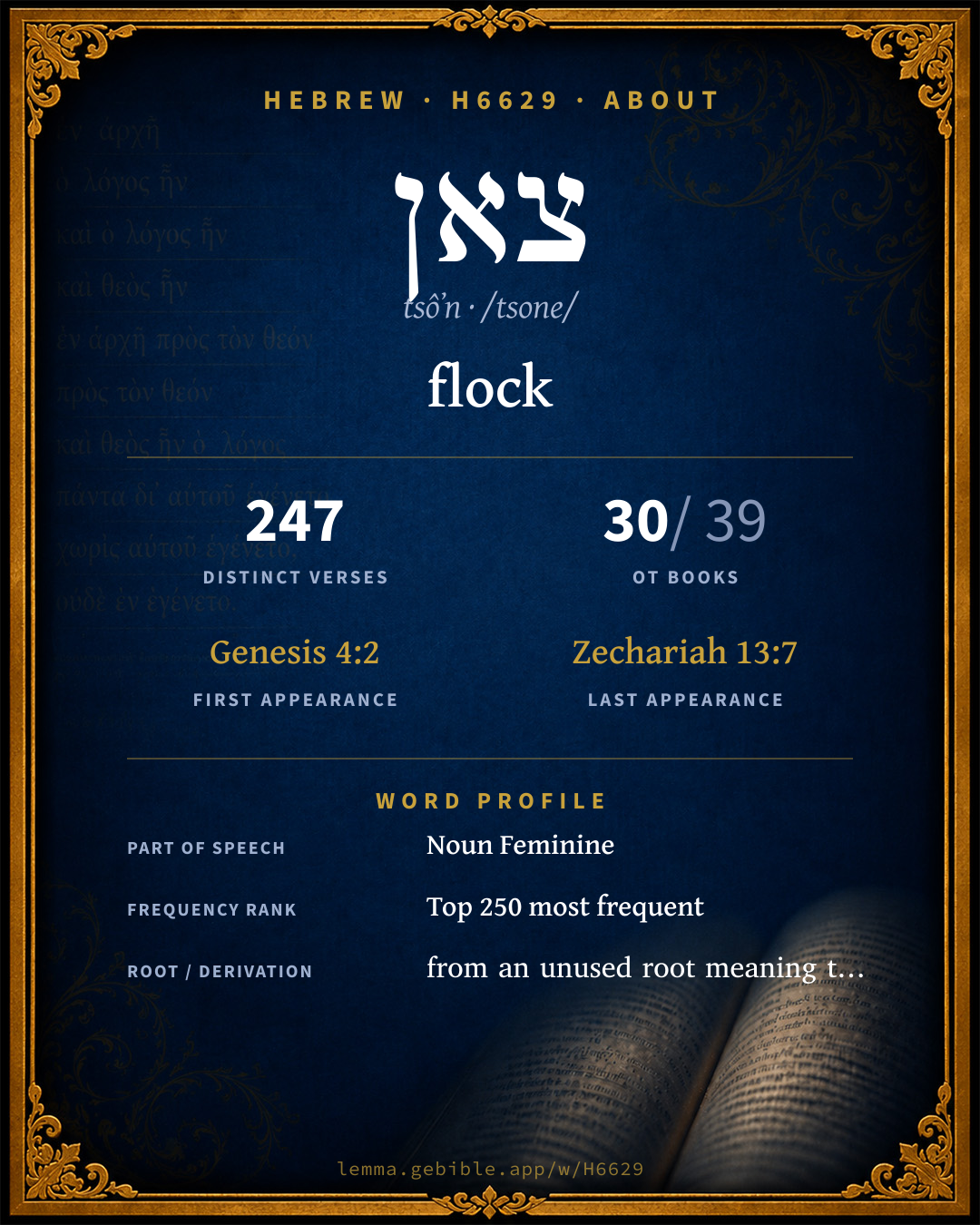
צֹאן
flock
also: small cattle, sheep, sheep and goats, flocks fuller range ↓
Full lexicon entry — Brown-Driver-Briggs (BDB)
From Brown-Driver-Briggs (BDB)
Where this word appears
See every Absolute-state word in the Hebrew Bible →
Grammar key — what these labels mean
Part of speech
- Noun
- A naming word — a person, place, thing, or idea.
Noun type
- Common
- A common noun — a general class of person, place, or thing (“king,” “city,” “water”), not a specific name.
State
- Absolute
- The independent form of a noun, not bound to a following word.
- Construct
- A noun bound to a following noun in a possessive / “of” relationship (the construct chain).
Gender
- Both
- Attested as both masculine and feminine.
Number
- Singular
- One.
- Plural
- More than one (in Hebrew, generally three or more).
Grammatical forms
- Noun, Common, Both, Singular, Absolute 178 times (65%)
- Noun, Common, Both, Singular, Construct 94 times (34%)
- Noun, Common, Both, Plural, Construct 2 times (1%)
Parsed forms decoded from the imported morphology (morphhb / Westminster Leningrad Codex — WLC text public domain, morphhb tagging CC BY 4.0), counted across 274 parsed occurrences — not distinct verses.
Page 1 of 2 — showing verses 1–200 of 247 distinct verses where H6629 appears, across 30 books. Click any verse to open its interlinear word-by-word view. Verse text shown in the World English Bible for context — . Each verse’s Hebrew form is shown with its reference; the English is not keyword-highlighted, since the data carries no word-level English alignment. Use “Compare translations” on any verse to read it across multiple English versions. This concordance covers the Hebrew Bible; Septuagint (Greek Old Testament) occurrences are not indexed here.
Genesis 52 verses
- Genesis 4:2 צֹ֔אן n c bs Again she gave birth, to Cain's brother Abel. Abel was a keeper of sheep, but Cain was a tiller of the ground.
- Genesis 4:4 צֹאנ֖/וֹ n c bs cs + sfx pers 3ms Abel also brought some of the firstborn of his flock and of the fat of it. Yahweh respected Abel and his offering,
- Genesis 12:16 צֹאן n c bs He dealt well with Abram for her sake. He had sheep, and oxen, and male donkeys, and men-servants, and maid-servants, and female donkeys, and camels.
- Genesis 13:5 צֹאן n c bs Lot also, who went with Abram, had flocks, and herds, and tents.
- Genesis 20:14 צֹ֣אן n c bs Abimelech took sheep and oxen, men-servants and women-servants, and gave them to Abraham, and restored Sarah, his wife to him.
- Genesis 21:27 צֹ֣אן n c bs Abraham took sheep and oxen, and gave them to Abimelech. Those two made a covenant.
- Genesis 21:28 הַ/צֹּ֖אן ptcl def.art + n c bs Abraham set seven ewe lambs of the flock by themselves.
- Genesis 24:35 צֹ֤אן n c bs Yahweh has blessed my master greatly. He has become great. He has given him flocks and herds, silver and gold, men-servants and maid-servants, and camels and donkeys.
- Genesis 26:14 צֹאן֙ n c bs He had possessions of flocks, possessions of herds, and a great household. The Philistines envied him.
- Genesis 27:9 הַ/צֹּ֔אן ptcl def.art + n c bs Go now to the flock, and get me from there two good kids of the goats. I will make them savory food for your father, such as he loves.
- Genesis 29:2 צֹאן֙ n c bs He looked, and behold, a well in the field, and, behold, three flocks of sheep lying there by it. For out of that well they watered the flocks. The stone on the well's mouth was great.
- Genesis 29:3 הַ/צֹּ֑אן ptcl def.art + n c bs There all the flocks were gathered. They rolled the stone from the well's mouth, and watered the sheep, and put the stone again on the well's mouth in its place.
- Genesis 29:6 הַ/צֹּֽאן ptcl def.art + n c bs He said to them, "Is it well with him?" They said, "It is well. See, Rachel, his daughter, is coming with the sheep."
- Genesis 29:7 הַ/צֹּ֖אן ptcl def.art + n c bs He said, "Behold, it is still the middle of the day, not time to gather the cattle together. Water the sheep, and go and feed them."
- Genesis 29:8 הַ/צֹּֽאן ptcl def.art + n c bs They said, "We can't, until all the flocks are gathered together, and they roll the stone from the well's mouth. Then we water the sheep."
- Genesis 29:9 הַ/צֹּאן֙ ptcl def.art + n c bs While he was yet speaking with them, Rachel came with her father's sheep, for she kept them.
- Genesis 29:10 צֹ֥אן צֹ֥אן n c bs cs n c bs cs It happened, when Jacob saw Rachel the daughter of Laban, his mother's brother, and the sheep of Laban, his mother's brother, that Jacob went near, and rolled the stone from the well's mouth, and watered the flock of Laban his mother's brother.
- Genesis 30:31 צֹֽאנְ/ךָ֖ n c bs cs + sfx pers 2ms He said, "What shall I give you?" Jacob said, "You shall not give me anything. If you will do this thing for me, I will again feed your flock and keep it.
- Genesis 30:32 צֹֽאנְ/ךָ֜ n c bs cs + sfx pers 2ms I will pass through all your flock today, removing from there every speckled and spotted one, and every black one among the sheep, and the spotted and speckled among the goats. This will be my hire.
- Genesis 30:36 צֹ֥אן n c bs cs He set three days' journey between himself and Jacob, and Jacob fed the rest of Laban's flocks.
- Genesis 30:38 הַ/צֹּ֤אן הַ/צֹּ֔אן ptcl def.art + n c bs ptcl def.art + n c bs He set the rods which he had peeled opposite the flocks in the gutters in the watering-troughs where the flocks came to drink. They conceived when they came to drink.
- Genesis 30:39 הַ/צֹּ֖אן הַ/צֹּ֔אן ptcl def.art + n c bs ptcl def.art + n c bs The flocks conceived before the rods, and the flocks brought forth streaked, speckled, and spotted.
- Genesis 30:40 הַ/צֹּ֧אן בְּ/צֹ֣אן צֹ֥אן ptcl def.art + n c bs prep + n c bs cs n c bs cs Jacob separated the lambs, and set the faces of the flocks toward the streaked and all the black in the flock of Laban: and he put his own droves apart, and didn't put them into Laban's flock.
- Genesis 30:41 הַ/צֹּ֣אן הַ/צֹּ֖אן ptcl def.art + n c bs ptcl def.art + n c bs It happened, whenever the stronger of the flock conceived, that Jacob laid the rods before the eyes of the flock in the gutters, that they might conceive among the rods;
- Genesis 30:42 הַ/צֹּ֖אן ptcl def.art + n c bs but when the flock were feeble, he didn't put them in. So the feebler were Laban's, and the stronger Jacob's.
- Genesis 30:43 צֹ֣אן n c bs The man increased exceedingly, and had large flocks, maid-servants and men-servants, and camels and donkeys.
- Genesis 31:4 צֹאנֽ/וֹ n c bs cs + sfx pers 3ms Jacob sent and called Rachel and Leah to the field to his flock,
- Genesis 31:8 הַ/צֹּ֖אן הַ/צֹּ֖אן ptcl def.art + n c bs ptcl def.art + n c bs If he said this, 'The speckled will be your wages,' then all the flock bore speckled. If he said this, 'The streaked will be your wages,' then all the flock bore streaked.
- Genesis 31:10 הַ/צֹּ֔אן הַ/צֹּ֔אן ptcl def.art + n c bs ptcl def.art + n c bs It happened at the time that the flock conceive, that I lifted up my eyes, and saw in a dream, and behold, the male goats which leaped on the flock were streaked, speckled, and grizzled.
- Genesis 31:12 הַ/צֹּ֔אן ptcl def.art + n c bs He said, 'Now lift up your eyes, and behold, all the male goats which leap on the flock are streaked, speckled, and grizzled, for I have seen all that Laban does to you.
- Genesis 31:19 צֹאנ֑/וֹ n c bs cs + sfx pers 3ms Now Laban had gone to shear his sheep: and Rachel stole the teraphim that were her father's.
- Genesis 31:38 צֹאנְ/ךָ֖ n c bs cs + sfx pers 2ms These twenty years have I been with you. Your ewes and your female goats have not cast their young, and I haven't eaten the rams of your flocks.
- Genesis 31:41 בְּ/צֹאנֶ֑/ךָ prep + n c bs cs + sfx pers 2ms These twenty years have I been in your house. I served you fourteen years for your two daughters, and six years for your flock, and you have changed my wages ten times.
- Genesis 31:43 וְ/הַ/צֹּ֣אן צֹאנִ֔/י conj + ptcl def.art + n c bs n c bs cs + sfx pers 1cs Laban answered Jacob, "The daughters are my daughters, the children are my children, the flocks are my flocks, and all that you see is mine: and what can I do this day to these my daughters, or to their children whom they have borne?
- Genesis 32:5 צֹ֖אן n c bs I have oxen, donkeys, flocks, men-servants, and maid-servants. I have sent to tell my lord, that I may find favor in your sight.'"
- Genesis 32:7 הַ/צֹּ֧אן ptcl def.art + n c bs Then Jacob was greatly afraid and was distressed: and he divided the people who were with him, and the flocks, and the herds, and the camels, into two companies;
- Genesis 33:13 וְ/הַ/צֹּ֥אן הַ/צֹּֽאן conj + ptcl def.art + n c bs ptcl def.art + n c bs Jacob said to him, "My lord knows that the children are tender, and that the flocks and herds with me have their young, and if they overdrive them one day, all the flocks will die.
- Genesis 34:28 צֹאנָ֥/ם n c bs cs + sfx pers 3mp They took their flocks, their herds, their donkeys, that which was in the city, that which was in the field;
- Genesis 37:2 בַּ/צֹּ֔אן prep det + n c bs This is the history of the generations of Jacob. Joseph, being seventeen years old, was feeding the flock with his brothers. He was a boy with the sons of Bilhah and Zilpah, his father's wives. Joseph brought an evil report of them to their father.
- Genesis 37:12 צֹ֥אן n c bs cs His brothers went to feed their father's flock in Shechem.
- Genesis 37:14 הַ/צֹּ֔אן ptcl def.art + n c bs He said to him, "Go now, see whether it is well with your brothers, and well with the flock; and bring me word again." So he sent him out of the valley of Hebron, and he came to Shechem.
- Genesis 38:12 צֹאנ/וֹ֙ n c bs cs + sfx pers 3ms After many days, Shua's daughter, the wife of Judah, died. Judah was comforted, and went up to his sheep-shearers to Timnah, he and his friend Hirah, the Adullamite.
- Genesis 38:13 צֹאנֽ/וֹ n c bs cs + sfx pers 3ms It was told Tamar, saying, "Behold, your father-in-law is going up to Timnah to shear his sheep."
- Genesis 38:17 הַ/צֹּ֑אן ptcl def.art + n c bs He said, "I will send you a kid of the goats from the flock." She said, "Will you give me a pledge, until you send it?"
- Genesis 45:10 וְ/צֹאנְ/ךָ֥ conj + n c bs cs + sfx pers 2ms You shall dwell in the land of Goshen, and you will be near to me, you, your children, your children's children, your flocks, your herds, and all that you have.
- Genesis 46:32 צֹ֔אן וְ/צֹאנָ֧/ם n c bs conj + n c bs cs + sfx pers 3mp These men are shepherds, for they have been keepers of cattle, and they have brought their flocks, and their herds, and all that they have.'
- Genesis 46:34 צֹֽאן n c bs that you shall say, 'Your servants have been keepers of cattle from our youth even until now, both we, and our fathers:' that you may dwell in the land of Goshen; for every shepherd is an abomination to the Egyptians."
- Genesis 47:1 וְ/צֹאנָ֤/ם conj + n c bs cs + sfx pers 3mp Then Joseph went in and told Pharaoh, and said, "My father and my brothers, with their flocks, their herds, and all that they own, have come out of the land of Canaan; and, behold, they are in the land of Goshen."
- Genesis 47:3 צֹאן֙ n c bs Pharaoh said to his brothers, "What is your occupation?" They said to Pharaoh, "Your servants are shepherds, both we, and our fathers."
- Genesis 47:4 לַ/צֹּאן֙ prep det + n c bs They said to Pharaoh, "We have come to live as foreigners in the land, for there is no pasture for your servants' flocks. For the famine is severe in the land of Canaan. Now therefore, please let your servants dwell in the land of Goshen."
- Genesis 47:17 הַ/צֹּ֛אן ptcl def.art + n c bs They brought their cattle to Joseph, and Joseph gave them bread in exchange for the horses, and for the flocks, and for the herds, and for the donkeys: and he fed them with bread in exchange for all their cattle for that year.
- Genesis 50:8 וְ/צֹאנָ֣/ם conj + n c bs cs + sfx pers 3mp all the house of Joseph, his brothers, and his father's house. Only their little ones, their flocks, and their herds, they left in the land of Goshen.
Exodus 14 verses
- Exodus 2:16 צֹ֥אן n c bs cs Now the priest of Midian had seven daughters. They came and drew water, and filled the troughs to water their father's flock.
- Exodus 2:17 צֹאנָֽ/ם n c bs cs + sfx pers 3mp The shepherds came and drove them away; but Moses stood up and helped them, and watered their flock.
- Exodus 2:19 הַ/צֹּֽאן ptcl def.art + n c bs They said, "An Egyptian delivered us out of the hand of the shepherds, and moreover he drew water for us, and watered the flock."
- Exodus 3:1 צֹ֛אן הַ/צֹּאן֙ n c bs cs ptcl def.art + n c bs Now Moses was keeping the flock of Jethro, his father-in-law, the priest of Midian, and he led the flock to the back of the wilderness, and came to God's mountain, to Horeb.
- Exodus 9:3 וּ/בַ/צֹּ֑אן conj + prep det + n c bs behold, the hand of Yahweh is on your cattle which are in the field, on the horses, on the donkeys, on the camels, on the herds, and on the flocks with a very grievous pestilence.
- Exodus 10:9 בְּ/צֹאנֵ֤/נוּ prep + n c bs cs + sfx pers 1cp Moses said, "We will go with our young and with our old; with our sons and with our daughters, with our flocks and with our herds will we go; for we must hold a feast to Yahweh."
- Exodus 10:24 צֹאנְ/כֶ֥ם n c bs cs + sfx pers 2mp Pharaoh called to Moses, and said, "Go, serve Yahweh. Only let your flocks and your herds stay behind. Let your little ones also go with you."
- Exodus 12:21 צֹ֛אן n c bs Then Moses called for all the elders of Israel, and said to them, "Draw out, and take lambs according to your families, and kill the Passover.
- Exodus 12:32 צֹאנְ/כֶ֨ם n c bs cs + sfx pers 2mp Take both your flocks and your herds, as you have said, and be gone; and bless me also!"
- Exodus 12:38 וְ/צֹ֣אן conj + n c bs A mixed multitude went up also with them, with flocks, herds, and even very much cattle.
- Exodus 20:24 צֹֽאנְ/ךָ֖ n c bs cs + sfx pers 2ms You shall make an altar of earth for me, and shall sacrifice on it your burnt offerings and your peace-offerings, your sheep and your oxen. In every place where I record my name I will come to you and I will bless you.
- Exodus 22:1 צֹ֖אן n c bs "If a man steals an ox or a sheep, and kills it, or sells it; he shall pay five oxen for an ox, and four sheep for a sheep.
- Exodus 22:30 לְ/צֹאנֶ֑/ךָ prep + n c bs cs + sfx pers 2ms You shall do likewise with your oxen and with your sheep. Seven days it shall be with its mother, then on the eighth day you shall give it me.
- Exodus 34:3 הַ/צֹּ֤אן ptcl def.art + n c bs No one shall come up with you; neither let anyone be seen throughout all the mountain; neither let the flocks nor herds feed before that mountain."
Leviticus 9 verses
- Leviticus 1:2 הַ/צֹּ֔אן ptcl def.art + n c bs "Speak to the children of Israel, and tell them, 'When anyone of you offers an offering to Yahweh, you shall offer your offering of the cattle, from the herd and from the flock.
- Leviticus 1:10 הַ/צֹּ֨אן ptcl def.art + n c bs "'If his offering is from the flock, from the sheep, or from the goats, for a burnt offering, he shall offer a male without blemish.
- Leviticus 3:6 הַ/צֹּ֧אן ptcl def.art + n c bs "'If his offering for a sacrifice of peace offerings to Yahweh is from the flock; male or female, he shall offer it without blemish.
- Leviticus 5:6 הַ/צֹּ֥אן ptcl def.art + n c bs and he shall bring his trespass offering to Yahweh for his sin which he has sinned, a female from the flock, a lamb or a goat, for a sin offering; and the priest shall make atonement for him concerning his sin.
- Leviticus 5:15 הַ/צֹּ֗אן ptcl def.art + n c bs "If anyone commits a trespass, and sins unwittingly, in the holy things of Yahweh; then he shall bring his trespass offering to Yahweh, a ram without blemish from the flock, according to your estimation in silver by shekels, after the shekel of the sanctuary, for a trespass offering.
- Leviticus 5:18 הַ/צֹּ֛אן ptcl def.art + n c bs He shall bring a ram without blemish from of the flock, according to your estimation, for a trespass offering, to the priest; and the priest shall make atonement for him concerning the thing in which he sinned and didn't know it, and he will be forgiven.
- Leviticus 6:6 הַ/צֹּ֛אן ptcl def.art + n c bs He shall bring his trespass offering to Yahweh, a ram without blemish from the flock, according to your estimation, for a trespass offering, to the priest.
- Leviticus 22:21 בַ/צֹּ֑אן prep det + n c bs Whoever offers a sacrifice of peace offerings to Yahweh to accomplish a vow, or for a freewill offering, of the herd or of the flock, it shall be perfect to be accepted; there shall be no blemish therein.
- Leviticus 27:32 וָ/צֹ֔אן conj + n c bs All the tithe of the herds or the flocks, whatever passes under the rod, the tenth shall be holy to Yahweh.
Numbers 12 verses
- Numbers 11:22 הֲ/צֹ֧אן ptcl inter + n c bs Shall flocks and herds be slain for them, to suffice them? or shall all the fish of the sea be gathered together for them, to suffice them?
- Numbers 15:3 הַ/צֹּֽאן ptcl def.art + n c bs and will make an offering by fire to Yahweh, a burnt offering, or a sacrifice, to accomplish a vow, or as a freewill-offering, or in your set feasts, to make a sweet savor to Yahweh, of the herd, or of the flock;
- Numbers 22:40 וָ/צֹ֑אן conj + n c bs Balak sacrificed oxen and sheep, and sent to Balaam, and to the princes who were with him.
- Numbers 27:17 כַּ/צֹּ֕אן prep det + n c bs who may go out before them, and who may come in before them, and who may lead them out, and who may bring them in; that the congregation of Yahweh not be as sheep which have no shepherd.
- Numbers 31:28 הַ/צֹּֽאן ptcl def.art + n c bs Levy a tribute to Yahweh of the men of war who went out to battle: one soul of five hundred, [both] of the persons, and of the oxen, and of the donkeys, and of the flocks:
- Numbers 31:30 הַ/צֹּ֖אן ptcl def.art + n c bs Of the children of Israel's half, you shall take one drawn out of every fifty, of the persons, of the oxen, of the donkeys, and of the flocks, [even] of all the cattle, and give them to the Levites, who keep the charge of the tent of Yahweh.
- Numbers 31:32 צֹ֗אן n c bs Now the prey, over and above the booty which the men of war took, was six hundred seventy-five thousand sheep,
- Numbers 31:36 הַ/צֹּ֗אן ptcl def.art + n c bs The half, which was the portion of those who went out to war, was in number three hundred thirty-seven thousand five hundred sheep:
- Numbers 31:37 הַ/צֹּ֑אן ptcl def.art + n c bs and Yahweh's tribute of the sheep was six hundred seventy-five.
- Numbers 31:43 הַ/צֹּ֑אן ptcl def.art + n c bs (now the congregation's half was three hundred thirty-seven thousand five hundred sheep,
- Numbers 32:16 צֹ֛אן n c bs They came near to him, and said, We will build sheepfolds here for our cattle, and cities for our little ones:
- Numbers 32:36 צֹֽאן n c bs and Beth Nimrah, and Beth Haran: fortified cities, and folds for sheep.
Deuteronomy 16 verses
- Deuteronomy 7:13 צֹאנֶ֔/ךָ n c bs cs + sfx pers 2ms and he will love you, and bless you, and multiply you; he will also bless the fruit of your body and the fruit of your ground, your grain and your new wine and your oil, the increase of your cattle and the young of your flock, in the land which he swore to your fathers to give you.
- Deuteronomy 8:13 וְ/צֹֽאנְ/ךָ֙ conj + n c bs cs + sfx pers 2ms and when your herds and your flocks multiply, and your silver and your gold is multiplied, and all that you have is multiplied;
- Deuteronomy 12:6 וְ/צֹאנְ/כֶֽם conj + n c bs cs + sfx pers 2mp and there you shall bring your burnt offerings, and your sacrifices, and your tithes, and the heave-offering of your hand, and your vows, and your freewill-offerings, and the firstborn of your herd and of your flock:
- Deuteronomy 12:17 וְ/צֹאנֶ֑/ךָ conj + n c bs cs + sfx pers 2ms You may not eat within your gates the tithe of your grain, or of your new wine, or of your oil, or the firstborn of your herd or of your flock, nor any of your vows which you vow, nor your freewill-offerings, nor the heave-offering of your hand;
- Deuteronomy 12:21 וּ/מִ/צֹּֽאנְ/ךָ֗ conj + prep + n c bs cs + sfx pers 2ms If the place which Yahweh your God shall choose, to put his name there, be too far from you, then you shall kill of your herd and of your flock, which Yahweh has given you, as I have commanded you; and you may eat within your gates, after all the desire of your soul.
- Deuteronomy 14:23 וְ/צֹאנֶ֑/ךָ conj + n c bs cs + sfx pers 2ms You shall eat before Yahweh your God, in the place which he shall choose, to cause his name to dwell there, the tithe of your grain, of your new wine, and of your oil, and the firstborn of your herd and of your flock; that you may learn to fear Yahweh your God always.
- Deuteronomy 14:26 וּ/בַ/צֹּ֗אן conj + prep det + n c bs and you shall bestow the money for whatever your soul desires, for oxen, or for sheep, or for wine, or for strong drink, or for whatever your soul asks of you; and you shall eat there before Yahweh your God, and you shall rejoice, you and your household.
- Deuteronomy 15:14 מִ/צֹּ֣אנְ/ךָ֔ prep + n c bs cs + sfx pers 2ms you shall furnish him liberally out of your flock, and out of your threshing floor, and out of your winepress; as Yahweh your God has blessed you, you shall give to him.
- Deuteronomy 15:19 וּ/בְ/צֹֽאנְ/ךָ֙ צֹאנֶֽ/ךָ conj + prep + n c bs cs + sfx pers 2ms n c bs cs + sfx pers 2ms All the firstborn males that are born of your herd and of your flock you shall sanctify to Yahweh your God: you shall do no work with the firstborn of your herd, nor shear the firstborn of your flock.
- Deuteronomy 16:2 צֹ֣אן n c bs You shall sacrifice the Passover to Yahweh your God, of the flock and the herd, in the place which Yahweh shall choose, to cause his name to dwell there.
- Deuteronomy 18:4 צֹאנְ/ךָ֖ n c bs cs + sfx pers 2ms The first fruits of your grain, of your new wine, and of your oil, and the first of the fleece of your sheep, shall you give him.
- Deuteronomy 28:4 צֹאנֶֽ/ךָ n c bs cs + sfx pers 2ms Blessed shall be the fruit of your body, and the fruit of your ground, and the fruit of your animals, the increase of your cattle, and the young of your flock.
- Deuteronomy 28:18 צֹאנֶֽ/ךָ n c bs cs + sfx pers 2ms Cursed shall be the fruit of your body, and the fruit of your ground, the increase of your cattle, and the young of your flock.
- Deuteronomy 28:31 צֹֽאנְ/ךָ֙ n c bs cs + sfx pers 2ms Your ox shall be slain before your eyes, and you shall not eat of it: your donkey shall be violently taken away from before your face, and shall not be restored to you: your sheep shall be given to your enemies, and you shall have none to save you.
- Deuteronomy 28:51 צֹאנֶ֑/ךָ n c bs cs + sfx pers 2ms and shall eat the fruit of your cattle, and the fruit of your ground, until you are destroyed; that also shall not leave you grain, new wine, or oil, the increase of your cattle, or the young of your flock, until they have caused you to perish.
- Deuteronomy 32:14 צֹ֗אן n c bs Butter of the herd, and milk of the flock, With fat of lambs, Rams of the breed of Bashan, and goats, With the finest of the wheat; Of the blood of the grape you drank wine.
Joshua 1 verse
1 Samuel 19 verses
- 1 Samuel 8:17 צֹאנְ/כֶ֖ם n c bs cs + sfx pers 2mp He will take the tenth of your flocks: and you shall be his servants.
- 1 Samuel 14:32 צֹ֧אן n c bs and the people flew on the spoil, and took sheep, and oxen, and calves, and killed them on the ground; and the people ate them with the blood.
- 1 Samuel 15:9 הַ/צֹּאן֩ ptcl def.art + n c bs But Saul and the people spared Agag, and the best of the sheep, and of the oxen, and of the fatlings, and the lambs, and all that was good, and wouldn't utterly destroy them: but everything that was vile and refuse, that they destroyed utterly.
- 1 Samuel 15:14 הַ/צֹּ֥אן ptcl def.art + n c bs Samuel said, What means then this bleating of the sheep in my ears, and the lowing of the oxen which I hear?
- 1 Samuel 15:15 הַ/צֹּאן֙ ptcl def.art + n c bs Saul said, They have brought them from the Amalekites: for the people spared the best of the sheep and of the oxen, to sacrifice to Yahweh your God; and the rest we have utterly destroyed.
- 1 Samuel 15:21 צֹ֥אן n c bs But the people took of the spoil, sheep and oxen, the chief of the devoted things, to sacrifice to Yahweh your God in Gilgal.
- 1 Samuel 16:11 בַּ/צֹּ֑אן prep det + n c bs Samuel said to Jesse, Are here all your children? He said, There remains yet the youngest, and, behold, he is keeping the sheep. Samuel said to Jesse, Send and get him; for we will not sit down until he come here.
- 1 Samuel 16:19 בַּ/צֹּֽאן prep det + n c bs Therefore Saul sent messengers to Jesse, and said, Send me David your son, who is with the sheep.
- 1 Samuel 17:15 צֹ֥אן n c bs cs Now David went back and forth from Saul to feed his father's sheep at Bethlehem.
- 1 Samuel 17:20 הַ/צֹּאן֙ ptcl def.art + n c bs David rose up early in the morning, and left the sheep with a keeper, and took, and went, as Jesse had commanded him; and he came to the place of the wagons, as the host which was going forth to the fight shouted for the battle.
- 1 Samuel 17:28 הַ/צֹּ֤אן ptcl def.art + n c bs Eliab his eldest brother heard when he spoke to the men; and Eliab's anger was kindled against David, and he said, Why are you come down? and with whom have you left those few sheep in the wilderness? I know your pride, and the naughtiness of your heart; for you have come down that you might see the battle.
- 1 Samuel 17:34 בַּ/צֹּ֑אן prep det + n c bs David said to Saul, Your servant was keeping his father's sheep; and when there came a lion, or a bear, and took a lamb out of the flock,
- 1 Samuel 24:3 הַ/צֹּ֤אן ptcl def.art + n c bs He came to the sheep pens by the way, where was a cave; and Saul went in to cover his feet. Now David and his men were abiding in the innermost parts of the cave.
- 1 Samuel 25:2 צֹ֥אן צֹאנ֖/וֹ n c bs n c bs cs + sfx pers 3ms There was a man in Maon, whose possessions were in Carmel; and the man was very great, and he had three thousand sheep, and a thousand goats: and he was shearing his sheep in Carmel.
- 1 Samuel 25:4 צֹאנֽ/וֹ n c bs cs + sfx pers 3ms David heard in the wilderness that Nabal was shearing his sheep.
- 1 Samuel 25:16 הַ/צֹּֽאן ptcl def.art + n c bs they were a wall to us both by night and by day, all the while we were with them keeping the sheep.
- 1 Samuel 25:18 צֹ֤אן n c bs Then Abigail made haste, and took two hundred loaves, and two bottles of wine, and five sheep ready dressed, and five measures of parched grain, and one hundred clusters of raisins, and two hundred cakes of figs, and laid them on donkeys.
- 1 Samuel 27:9 צֹ֨אן n c bs David struck the land, and saved neither man nor woman alive, and took away the sheep, and the oxen, and the donkeys, and the camels, and the clothing; and he returned, and came to Achish.
- 1 Samuel 30:20 הַ/צֹּ֖אן ptcl def.art + n c bs David took all the flocks and the herds, [which] they drove before those [other] cattle, and said, This is David's spoil.
2 Samuel 5 verses
- 2 Samuel 7:8 הַ/צֹּ֑אן ptcl def.art + n c bs Now therefore thus shall you tell my servant David, Thus says Yahweh of Hosts, I took you from the sheep pen, from following the sheep, that you should be prince over my people, over Israel;
- 2 Samuel 12:2 צֹ֥אן n c bs The rich man had very many flocks and herds,
- 2 Samuel 12:4 מִ/צֹּאנ/וֹ֙ prep + n c bs cs + sfx pers 3ms A traveler came to the rich man, and he spared to take of his own flock and of his own herd, to dress for the wayfaring man who had come to him, but took the poor man's lamb, and dressed it for the man who had come to him."
- 2 Samuel 17:29 וְ/צֹאן֙ conj + n c bs and honey, and butter, and sheep, and cheese of the herd, for David, and for the people who were with him, to eat: for they said, The people are hungry, and weary, and thirsty, in the wilderness.
- 2 Samuel 24:17 הַ/צֹּ֖אן ptcl def.art + n c bs David spoke to Yahweh when he saw the angel who struck the people, and said, Behold, I have sinned, and I have done perversely; but these sheep, what have they done? Please let your hand be against me, and against my father's house.
1 Kings 7 verses
- 1 Kings 1:9 צֹ֤אן n c bs Adonijah killed sheep and oxen and fatlings by the stone of Zoheleth, which is beside En Rogel; and he called all his brothers, the king's sons, and all the men of Judah, the king's servants:
- 1 Kings 1:19 וְ/צֹאן֮ conj + n c bs and he has slain oxen and fatlings and sheep in abundance, and has called all the sons of the king, and Abiathar the priest, and Joab the captain of the host; but he hasn't called Solomon your servant.
- 1 Kings 1:25 וְ/צֹאן֮ conj + n c bs For he is gone down this day, and has slain oxen and fatlings and sheep in abundance, and has called all the king's sons, and the captains of the host, and Abiathar the priest; and, behold, they are eating and drinking before him, and say, [Long] live king Adonijah.
- 1 Kings 4:23 צֹ֑אן n c bs ten fat oxen, and twenty oxen out of the pastures, and one hundred sheep, besides harts, and gazelles, and roebucks, and fattened fowl.
- 1 Kings 8:5 צֹ֣אן n c bs King Solomon and all the congregation of Israel, who were assembled to him, were with him before the ark, sacrificing sheep and oxen, that could not be counted nor numbered for multitude.
- 1 Kings 8:63 וְ/צֹ֕אן conj + n c bs Solomon offered for the sacrifice of peace-offerings, which he offered to Yahweh, two and twenty thousand oxen, and one hundred twenty thousand sheep. So the king and all the children of Israel dedicated the house of Yahweh.
- 1 Kings 22:17 כַּ/צֹּ֕אן prep det + n c bs He said, I saw all Israel scattered on the mountains, as sheep that have no shepherd: and Yahweh said, These have no master; let them return every man to his house in peace.
2 Kings 1 verse
1 Chronicles 7 verses
- 1 Chronicles 4:39 לְ/צֹאנָֽ/ם prep + n c bs cs + sfx pers 3mp They went to the entrance of Gedor, even to the east side of the valley, to seek pasture for their flocks.
- 1 Chronicles 4:41 לְ/צֹאנָ֖/ם prep + n c bs cs + sfx pers 3mp These written by name came in the days of Hezekiah king of Judah, and struck their tents, and the Meunim who were found there, and destroyed them utterly to this day, and lived in their place; because there was pasture there for their flocks.
- 1 Chronicles 5:21 וְ/צֹ֗אן conj + n c bs They took away their cattle; of their camels fifty thousand, and of sheep two hundred fifty thousand, and of donkeys two thousand, and of men one hundred thousand.
- 1 Chronicles 12:40 וְ/צֹ֖אן conj + n c bs Moreover those who were near to them, [even] as far as Issachar and Zebulun and Naphtali, brought bread on donkeys, and on camels, and on mules, and on oxen, food of meal, cakes of figs, and clusters of raisins, and wine, and oil, and oxen, and sheep in abundance: for there was joy in Israel.
- 1 Chronicles 17:7 הַ/צֹּ֑אן ptcl def.art + n c bs Now therefore thus shall you tell my servant David, Thus says Yahweh of Hosts, I took you from the sheep pen, from following the sheep, that you should be prince over my people Israel:
- 1 Chronicles 21:17 הַ/צֹּ֖אן ptcl def.art + n c bs David said to God, Isn't it I who commanded the people to be numbered? It is even I who have sinned and done very wickedly; but these sheep, what have they done? Please let your hand, O Yahweh my God, be against me, and against my father's house; but not against your people, that they should be plagued.
- 1 Chronicles 27:31 הַ/צֹּ֖אן ptcl def.art + n c bs All these were the rulers of the substance which was king David's.
2 Chronicles 12 verses
- 2 Chronicles 5:6 צֹ֣אן n c bs King Solomon and all the congregation of Israel, that were assembled to him, were before the ark, sacrificing sheep and oxen, that could not be counted nor numbered for multitude.
- 2 Chronicles 7:5 וְ/צֹ֕אן conj + n c bs King Solomon offered a sacrifice of twenty-two thousand oxen, and a hundred and twenty thousand sheep. So the king and all the people dedicated the house of God.
- 2 Chronicles 14:15 צֹ֤אן n c bs They struck also the tents of cattle, and carried away sheep in abundance, and camels, and returned to Jerusalem.
- 2 Chronicles 15:11 וְ/צֹ֖אן conj + n c bs They sacrificed to Yahweh in that day, of the spoil which they had brought, seven hundred oxen and seven thousand sheep.
- 2 Chronicles 17:11 צֹ֕אן n c bs Some of the Philistines brought Jehoshaphat presents, and silver for tribute; the Arabians also brought him flocks, seven thousand and seven hundred rams, and seven thousand and seven hundred male goats.
- 2 Chronicles 18:2 צֹ֤אן n c bs After certain years he went down to Ahab to Samaria. Ahab killed sheep and oxen for him in abundance, and for the people who were with him, and moved him to go up [with him] to Ramoth-gilead.
- 2 Chronicles 18:16 כַּ/צֹּ֕אן prep det + n c bs He said, I saw all Israel scattered on the mountains, as sheep that have no shepherd: and Yahweh said, These have no master; let them return every man to his house in peace.
- 2 Chronicles 29:33 וְ/צֹ֖אן conj + n c bs The consecrated things were six hundred oxen and three thousand sheep.
- 2 Chronicles 30:24 צֹאן֒ וְ/צֹ֖אן n c bs conj + n c bs For Hezekiah king of Judah did give to the assembly for offerings one thousand bulls and seven thousand sheep; and the princes gave to the assembly a thousand bulls and ten thousand sheep: and a great number of priests sanctified themselves.
- 2 Chronicles 31:6 וָ/צֹ֔אן conj + n c bs The children of Israel and Judah, who lived in the cities of Judah, they also brought in the tithe of oxen and sheep, and the tithe of dedicated things which were consecrated to Yahweh their God, and laid them by heaps.
- 2 Chronicles 32:29 צֹ֥אן n c bs Moreover he provided him cities, and possessions of flocks and herds in abundance; for God had given him very much substance.
- 2 Chronicles 35:7 צֹ֞אן n c bs Josiah gave to the children of the people, of the flock, lambs and kids, all of them for the Passover offerings, to all who were present, to the number of thirty thousand, and three thousand bulls: these were of the king's substance.
Ezra 1 verse
Nehemiah 5 verses
- Nehemiah 3:1 הַ/צֹּ֔אן ptcl def.art + n c bs Then Eliashib the high priest rose up with his brothers the priests, and they built the sheep gate; they sanctified it, and set up the doors of it; even to the tower of Hammeah they sanctified it, to the tower of Hananel.
- Nehemiah 3:32 הַ/צֹּ֔אן ptcl def.art + n c bs Between the ascent of the corner and the sheep gate repaired the goldsmiths and the merchants.
- Nehemiah 5:18 צֹ֠אן n c bs Now that which was prepared for one day was one ox and six choice sheep; also fowls were prepared for me, and once in ten days store of all sorts of wine: yet for all this I didn't demand the bread of the governor, because the bondage was heavy on this people.
- Nehemiah 10:36 וְ/צֹאנֵ֗י/נוּ conj + n c bp cs + sfx pers 1cp also the firstborn of our sons, and of our cattle, as it is written in the law, and the firstborn of our herds and of our flocks, to bring to the house of our God, to the priests who minister in the house of our God;
- Nehemiah 12:39 הַ/צֹּ֑אן ptcl def.art + n c bs and above the gate of Ephraim, and by the old gate, and by the fish gate, and the tower of Hananel, and the tower of Hammeah, even to the sheep gate: and they stood still in the gate of the guard.
Job 5 verses
- Job 1:3 צֹ֜אן n c bs His possessions also were seven thousand sheep, three thousand camels, five hundred yoke of oxen, five hundred she-donkeys, and a very great household; so that this man was the greatest of all the children of the east.
- Job 1:16 בַּ/צֹּ֛אן prep det + n c bs While he was still speaking, there also came another, and said, "The fire of God has fallen from the sky, and has burned up the sheep and the servants, and consumed them, and I alone have escaped to tell you."
- Job 21:11 כַ֭/צֹּאן prep det + n c bs They send forth their little ones like a flock. Their children dance.
- Job 30:1 צֹאנִֽ/י n c bs cs + sfx pers 1cs "But now those who are younger than I, have me in derision, Whose fathers I would have disdained to put with my sheep dogs.
- Job 42:12 צֹ֗אן n c bs So Yahweh blessed the latter end of Job more than his beginning. He had fourteen thousand sheep, six thousand camels, one thousand yoke of oxen, and a thousand female donkeys.
Psalms 16 verses
- Psalms 44:11 כְּ/צֹ֣אן prep + n c bs cs You have made us like sheep for food, And have scattered us among the nations.
- Psalms 44:22 כְּ/צֹ֣אן prep + n c bs cs Yes, for your sake we are killed all day long. We are regarded as sheep for the slaughter.
- Psalms 49:14 כַּ/צֹּ֤אן prep det + n c bs They are appointed as a flock for Sheol. Death shall be their shepherd. The upright shall have dominion over them in the morning. Their beauty shall decay in Sheol, Far from their mansion.
- Psalms 65:13 הַ/צֹּ֗אן ptcl def.art + n c bs The pastures are covered with flocks. The valleys also are clothed with grain. They shout for joy! They also sing.
- Psalms 74:1 בְּ/צֹ֣אן prep + n c bs cs God, why have you rejected us forever? Why does your anger smolder against the sheep of your pasture?
- Psalms 77:20 כַ/צֹּ֣אן prep det + n c bs You led your people like a flock, By the hand of Moses and Aaron.
- Psalms 78:52 כַּ/צֹּ֣אן prep det + n c bs But he led forth his own people like sheep, And guided them in the wilderness like a flock.
- Psalms 78:70 צֹֽאן n c bs He also chose David his servant, And took him from the sheepfolds;
- Psalms 79:13 וְ/צֹ֥אן conj + n c bs cs So we, your people and sheep of your pasture, Will give you thanks forever. We will praise you forever, to all generations.
- Psalms 80:1 כַּ/צֹּ֣אן prep det + n c bs Hear us, Shepherd of Israel, You who lead Joseph like a flock, You who sit above the cherubim, shine forth.
- Psalms 95:7 וְ/צֹ֣אן conj + n c bs cs For he is our God. We are the people of his pasture, And the sheep in his care. Today, oh that you would hear his voice!
- Psalms 100:3 וְ/צֹ֣אן conj + n c bs cs Know that Yahweh, he is God. It is he who has made us, and we are his. We are his people, and the sheep of his pasture.
- Psalms 107:41 כַּ֝/צֹּ֗אן prep det + n c bs Yet he lifts the needy out of their affliction, And increases their families like a flock.
- Psalms 114:4 צֹֽאן n c bs The mountains skipped like rams, The little hills like lambs.
- Psalms 114:6 צֹֽאן n c bs You mountains, that you skipped like rams; You little hills, like lambs?
- Psalms 144:13 צֹאונֵ֣/נוּ n c bp cs + sfx pers 1cp Our barns are full, filled with all kinds of provision. Our sheep bring forth thousands and ten thousands in our fields.
Proverbs 1 verse
Ecclesiastes 1 verse
Song of Solomon 1 verse
Isaiah 8 verses
- Isaiah 7:21 צֹֽאן n c bs It shall happen in that day that a man shall keep alive a young cow, and two sheep;
- Isaiah 13:14 וּ/כְ/צֹ֖אן conj + prep + n c bs It shall happen, that as the chased roe, and as sheep that no man gathers, they shall turn every man to his own people, and shall flee every man to his own land.
- Isaiah 22:13 צֹ֔אן n c bs and behold, joy and gladness, killing oxen and killing sheep, eating flesh and drinking wine: let us eat and drink, for tomorrow we shall die.
- Isaiah 53:6 כַּ/צֹּ֣אן prep det + n c bs All we like sheep have gone astray; everyone has turned to his own way; and Yahweh has laid on him the iniquity of us all.
- Isaiah 60:7 צֹ֤אן n c bs cs All the flocks of Kedar shall be gathered together to you, the rams of Nebaioth shall minister to you; they shall come up with acceptance on my altar; and I will glorify the house of my glory.
- Isaiah 61:5 צֹאנְ/כֶ֑ם n c bs cs + sfx pers 2mp Strangers shall stand and feed your flocks, and foreigners shall be your plowmen and your vine-dressers.
- Isaiah 63:11 צֹאנ֔/וֹ n c bs cs + sfx pers 3ms Then he remembered the days of old, Moses [and] his people, [saying], Where is he who brought them up out of the sea with the shepherds of his flock? where is he who put his holy Spirit in the midst of them?
- Isaiah 65:10 צֹ֔אן n c bs Sharon shall be a fold of flocks, and the valley of Achor a place for herds to lie down in, for my people who have sought me.
Jeremiah 18 verses
- Jeremiah 3:24 צֹאנָ/ם֙ n c bs cs + sfx pers 3mp But the shameful thing has devoured the labor of our fathers from our youth, their flocks and their herds, their sons and their daughters.
- Jeremiah 5:17 צֹאנְ/ךָ֙ n c bs cs + sfx pers 2ms They shall eat up your harvest, and your bread, [which] your sons and your daughters should eat; they shall eat up your flocks and your herds; they shall eat up your vines and your fig trees; they shall beat down your fortified cities, in which you trust, with the sword.
- Jeremiah 12:3 כְּ/צֹ֣אן prep + n c bs But you, Yahweh, know me; you see me, and try my heart toward you: pull them out like sheep for the slaughter, and prepare them for the day of slaughter.
- Jeremiah 13:20 צֹ֖אן n c bs cs Lift up your eyes, and see those who come from the north: where is the flock that was given you, your beautiful flock?
- Jeremiah 23:1 צֹ֥אן n c bs cs Woe to the shepherds who destroy and scatter the sheep of my pasture! says Yahweh.
- Jeremiah 23:2 צֹאנִ/י֙ n c bs cs + sfx pers 1cs Therefore thus says Yahweh, the God of Israel, against the shepherds who feed my people: You have scattered my flock, and driven them away, and have not visited them; behold, I will visit on you the evil of your doings, says Yahweh.
- Jeremiah 23:3 צֹאנִ֔/י n c bs cs + sfx pers 1cs I will gather the remnant of my flock out of all the countries where I have driven them, and will bring them again to their folds; and they shall be fruitful and multiply.
About this entry
At a glance — auto-summarized from this page’s data, not written by a person. Every figure links to its source below. This summary describes the numbers; it doesn’t interpret them.
At its core, צאן (tsôʼn) means “flock.” Not a single-sense word: its full sense range also takes in “small cattle”, “sheep”, and “sheep and goats”. With 247 verses in 30 books, it is a common word in the Hebrew Bible. First canonically at Genesis 4:2, it enters the text early. From the same root come צנא and צאנן. Dig into 247-verse concordance and the renderings breakdown below.
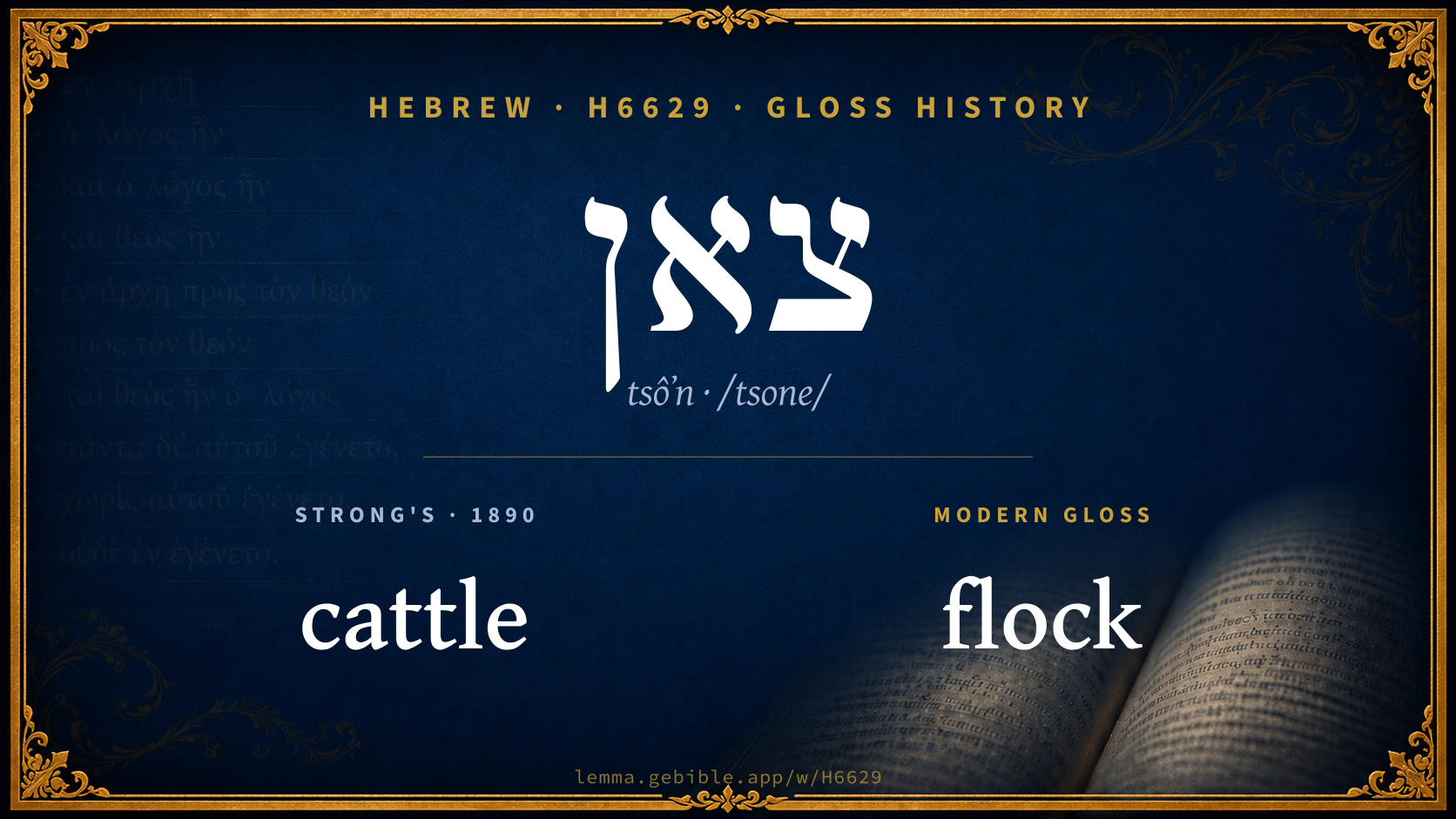
Gloss history
Strong's 1890 vs modern scholarship
About this word
Strong's H6629 catalogs a Hebrew word from the Hebrew Old Testament.
These counts are not copied from any lexicon or concordance. They are computed here, from the morphology-tagged Hebrew Old Testament. What Lemma adds →
- 247
- distinct verses
- The word appears in 247 distinct verses.
- 30 / 39
- OT books
- The word appears in 30 of 39 Old Testament books.
- #180
- by frequency
- Top 250 most frequent Hebrew words (rank 180 of 8,640 Hebrew words by occurrence).
View all 247 occurrences in the concordance →
By section of the Old Testament
By traditional corpus
Conventional, traditional groupings — biblical authorship is debated, so this is a traditional corpus grouping, not an authorship claim. Each share is this word’s portion of its verses in that division of the Hebrew canon. Each figure is a share of the word’s 247 distinct verses.
- Torah (Pentateuch) 103 verses · 42%
- Prophets (Nevi'im) 95 verses · 38%
- Writings (Ketuvim) 49 verses · 20%
How translations render this word
Counts come from each version’s own published word-to-Strong’s tagging or interlinear alignment — an approximate guide to how each version renders this word, not a word-level alignment the data otherwise carries. Because each total is that version’s own tagged count, the per-version totals vary from one another and need not match the appearance or distinct-verse counts above. These counts may also differ from a printed concordance because Lemma counts each distinctly tagged rendering and does not collapse phrase taggings into a single head-word total. This is a fixed set of word-tagged versions (KJV, ASV, BSB, ULT) and does not change with the reading translation you choose elsewhere. Each version’s license is shown beside its name below (and on Sources).
- King James Version: Sheep 97×, Flock 68×, Flocks 43×
- American Standard Version: Sheep 88×, Flock 63×, Flocks 40×
- Berean Standard Bible: Sheep 85×, Flock 70×, Flocks 62×
- unfoldingWord Literal Text: Flock 95×, Sheep 69×, Flock s 32×
King James Version Public Domain
Renders H6629 across 264 tagged occurrences — most commonly:
Plus 28 renderings that appear only once — usually multi-word phrases or single function words the recovered tagging swept in, not distinct renderings. Not rendered by a distinct English word in 10 further occurrences.
American Standard Version Public Domain
Renders H6629 across 265 tagged occurrences — most commonly:
Plus 50 renderings that appear only once — usually multi-word phrases or single function words the recovered tagging swept in, not distinct renderings.
Berean Standard Bible Public Domain
Renders H6629 across 259 tagged occurrences — most commonly:
Plus 22 renderings that appear only once — usually multi-word phrases or single function words the recovered tagging swept in, not distinct renderings. Not rendered by a distinct English word in 15 further occurrences.
unfoldingWord Literal Text CC BY-SA 4.0
Renders H6629 across 277 tagged occurrences — most commonly:
Plus other, less common renderings. Plus 19 renderings that appear only once — usually multi-word phrases or single function words the recovered tagging swept in, not distinct renderings.
Senses in the full BDB
What do BDB’s symbols mean?
BDB uses these scholarly abbreviations:
| Symbol | Meaning |
|---|---|
| 𝔊 | the Septuagint (the ancient Greek translation, LXX) |
| 𝔙 | the Vulgate (the Latin translation) |
| 𝔖 | the Syriac version (the Peshitta) |
| 𝔗 | the Targum (the Aramaic translation) |
| ψ | the Psalms |
| √ | root (the underlying root or stem) |
| ‖ | parallel passage (a synonymous or contrasted parallel) |
| † | the dagger: every passage where the word occurs is cited |
The 5 senses and sub-senses the full Brown-Driver-Briggs lexicon distinguishes for this word, in lexicon order (not ranked by frequency), with BDB’s own verbatim wording and sub-sense lettering. Shown in Hebrew script with BDB’s own scholarly abbreviations. The condensed entry is in the Lexicon Entry tab. See also the Forms in the corpus table below.
- 1. lit.
- a. small cattle, usually of sheep and goats in one flock (RobBR i. 477) Gn 30:31, 32 +; sheep specified also 21:28 (כִּבְשׂת הַצּ׳), 31:38 (אֵילֵי צ׳) +; sheep only 1 S 25:2 (+ עִזִּים); goats specified Gn 27:9; Je 50:8; צ׳ as yielding (1) animals for food Am 6:4 (כָּרִים), 1 S 14:32; 2 S 12:4; Ne 5:18 +; צ׳ מַאֲכָל ψ 44:12 (in sim.); (2) wool Gn 31:19 + (v. [גָּזַז], גֵּז); (3) milk, חֲלֵב צ׳ Dt 32:14 (? goats’ milk, cf. Pr 27:27); (4) sacrif. victims Gn 4:4 (J), Lv 1:2, 10; 3:6; Nu 15:3 (all P), 22:40 (E), Dt 12:6, 17, 21 + often; so צֹאן קָדָשִׁים Ez 36:38a, cf. בְּכוֹרֵי בְקָרֵינוּ וְצֹאנֵינוּ Ne 10:37; in gen. as property (often + בָּקָר, etc.) Gn 12:16; 13:5; 24:35 Jb 1:3; 42:12 + often (v. also ii. [עַשְׁתָּרוֹת]); gift Gn 20:14; 21:27; 38:17 (goat), Dt 15:14; 2 Ch 17:11; booty 1 S 15:9, 15 +. e.g. Genesis 30:31
- b. צ׳ sometimes of a definite number of animals (i.e. as pl. of שֶׂה, etc.): two Is 7:21, four Ex 21:37 (larger numbers v. 1 S 25:2, 5, 18; Nu 31:32, 36; Ne 5:18; Jb 1:3; 42:12 supr.).—Vid. also בֵּן 7 b; גְּדֵרָה, מִכְלָה, מַרְבֵּץ, נָוֶה, עֵדֶר; כֶּלֶב, רֹעֶה, שַׁעַר. e.g. Isaiah 7:21
- 2. sim. of multitude Ez 36:37, 38, cf. ψ 107:41; of children Jb 21:11; of dead, with death as shepherd ψ 49:15; of (shepherdless) Isr. Nu 27:17; 1 K 22:17 = 2 Ch 18:16; Zc 10:2; 13:7, wandering in sin Is 53:6; of Isr. led by י׳ ψ 77:21; 78:52; 80:2, cf. Zc 9:16 (on text v. We Now); Ez 34:12; of Isr. in distress, כְּצ׳ טִבְחָה ψ 44:23, cf. (of wicked) צ׳ לְטִבְחָה Je 12:3; of scattered Bab. Is 13:14. e.g. Ezekiel 36:37
- 3. metaph. of multitude, צ׳ אָדָם Ez 36:38; of Isr. 2 S 24:17 = 1 Ch 21:17; Je 23:1, 2, 3; Ez 24:5, and especially sustained fig. 34:2, 3 + 17 times 34, also Zc 11:7, 17; צ׳ אֹבְדוֹת Je 50:6, צ׳ תִּפְאַרְתֵּךְ 13:20; of Isr. under י׳’s care, (-וֹ, י—ִ) צ׳ מַרְעִיתֶ֑ךָ ψ 74:1; 79:13; 100:3; Ez 34:31, also צ׳ יָדוֹ ψ 95:7 (‖ עַם־מַרְעִיתוֹ; read perhaps צ׳ מַרְעִיתוֹ, עַם יָדוֹ, so Che al.); צ׳ נַחֲלָתֶ֑ךָ Mi 7:14; also in combinations: אַדִּירֵי הַצּ׳ Je 25:34, 35, 36, צ׳ חַהֲרֵגָה Zc 11:4, 7 (cf. ψ 44:23), עֲנִיֵּי הַצּ׳ v 7, 11 (all of Isr.); of Edom צְעִירֵי הַצּ׳ Je 49:20; 50:45. e.g. Ezekiel 36:38
Senses from the full Brown-Driver-Briggs lexicon (Brown, Driver, Briggs; Oxford 1906 — public domain), digitized via Sefaria, supplemented by the OpenScriptures HebrewLexicon (CC BY 4.0). Full attribution on Sources.
Word origin
n.coll.f. Gn 30:36 (poss. m. v 39a +, KöSynt. § 247 g, but dub., v 39b c. vb. fpl., as usually; in 1 S 15:14 join הַזֶּה with קוֹל; v. further Albr ZAW xv (1895), 316 ff.) small cattle, sheep and goats, flock, flocks;—צ׳ abs. Gn 4:2 +, cstr. 29:9 +; sf. צֹאנוֹ 4:4 +; צֹאנֵנוּ Ex 10:9, צֹאונֵנוּ ψ 144:13; as pl. צֹאנֵינוּ Ne 10:37 van d. H. Gi (not Baer); s. [צֹנֶא] צֹנֶה p. 856, etc.;—
— Brown-Driver-Briggs (Oxford 1906, public domain), digitized via Sefaria, supplemented by the OpenScriptures HebrewLexicon (CC BY 4.0). See Sources.
Origin: from an unused root meaning to migrate
Jastrow Dictionary
A second Hebrew/Aramaic lexicon for comparison, covering Aramaic and post-biblical (Talmudic, Targumic, Midrashic) usage that the biblical-Hebrew BDB does not. Matched by lemma rather than by Strong’s number, so a lemma may carry more than one Jastrow headword (shown separately below), and the entries cover usage well beyond the Bible.
צֹאן
- (b. h.) flock, small cattle. Gen. R. s. 73 צֹאנוֹ של לבן Laban’s flock. Gen. R. s. 42 אם אין תישים אין צ׳ אם אין צ׳ וכ׳ where there are no bucks, there is no flock, and where there is no flock, there is no shepherd; Lev. R. s. 11; Esth. R. introd.; a. fr.—צ׳ ברזל, v. בַּרְזֶל.
A Dictionary of the Targumim, the Talmud Babli and Yerushalmi, and the Midrashic Literature (Marcus Jastrow; London, Luzac, 1903) — Public Domain. Digitized via Sefaria. Digitized via Sefaria. Full attribution on Sources.
Forms in the corpus
The 117 distinct written forms H6629 takes in the Hebrew Bible, most frequent first — each parse links to that state’s occurrences in the concordance. Hebrew forms include their vowel points and cantillation, so a single lemma takes many written forms.
The 60 most common forms are shown; 57 rarer forms follow in the full concordance.
Same root — word family
Other BDB entries built from the same root as H6629, grouped by Strong’s listed origin. These share a root / origin per the lexicon — not necessarily a shared meaning. Each links to that word’s own entry.
Derived from this word
Proper names from this root
People and places named from this root — a name, not an additional meaning of the word.
Compare all same-root words → 1 of the same-root words is a proper name (a person or place). They share a root, not necessarily a meaning.
Septuagint verse parallels
This word appears in 231 verses that also exist in the Greek Old Testament (Septuagint), out of the 247 Hebrew verses it occurs in. You can read those verses in Greek by switching the Old Testament edition to the Septuagint.
Read these verses in the Septuagint
- Genesis 4:2
- Exodus 2:16
- Leviticus 1:2
- Numbers 11:22
- Deuteronomy 7:13
- Joshua 7:24
- 1 Samuel 8:17
- 2 Samuel 7:8
- 1 Kings 1:9
- 2 Kings 5:26
- 1 Chronicles 4:39
- 2 Chronicles 5:6
This is a verse-level parallel only — the same verses exist in both the Hebrew and Greek Old Testaments. No word-level Hebrew↔Greek correspondence is claimed: the data carries no such alignment, so no Greek word is shown as this Hebrew word’s translation. Coverage is not total — the Septuagint omits the deuterocanon and renumbers the Psalms, so some Hebrew verses have no direct Greek parallel.