

2 Chronicles 18:2

Hebrew (Westminster Leningrad Codex) 2 Chronicles 18:2 appears in the Hebrew Old Testament. The text above is from the Westminster Leningrad Codex. Each word links to its Strong’s number, a concise gloss, and parsing drawn from the Open Scriptures Hebrew Bible morphology. Click any word for its full Brown-Driver-Briggs (BDB) entry.
Download image
Cite this verse

2 Chronicles 18:2 (World English Bible). Public Domain. Lemma interlinear Bible study tool, https://lemma.gebible.app/v/2-chronicles/18/2.

Show BibTeX & RIS
BibTeX
RIS
English Translation
After certain years he went down to Ahab to Samaria. Ahab killed sheep and oxen for him in abundance, and for the people who were with him, and moved him to go up [with him] to Ramoth-gilead.
World English Bible · Public Domain
Download a study sheet

One document with this verse’s original text, its word-by-word gloss line, the meaning frame, cross-references with their text, attributed commentary, and full source and license credits — printable, and it pastes into notes with its structure intact.

This verse Autodidact and up

Study sheet (.html) Plain text (.txt)

A passage Seminary Student

Up to 50 verses in one chapter. A passage sheet keeps up to 6 commentary sources and 12 cross-references per verse, in the order this page ranks them, and says so on the sheet whenever that leaves anything out. Ask for a single verse and you get the Autodidact verse sheet above.

Everything on this page stays free to read, with no account — the sheet is a download of what is already on screen, not access to it.

Want to remove ads? Support Godless Engineer
Compare translations 3

The same verse in 3 English versions, stacked beneath the original-language interlinear above. Click any original word for its lexicon entry.

Each is an independent rendering of the whole verse — the interlinear is not word-aligned to these translations.

Highlighted words mark where these versions differ — a whole-verse word diff, not a word-by-word alignment.

  • World English Bible Public Domain
    After certain years he went down to Ahab to Samaria. Ahab killed sheep and oxen for him in abundance, and for the people who were with him, and moved him to go up [with him] to Ramoth-gilead.
  • King James Version Public Domain
    And after certain years he went down to Ahab to Samaria. And Ahab killed sheep and oxen for him in abundance, and for the people that he had with him, and persuaded him to go up with him to Ramothgilead.
  • unfoldingWord Literal Text CC BY-SA 4.0
    And he went down at the end of years to Ahab in Samaria, and Ahab sacrificed for him sheep and oxen in abundance and for the people who were with him. And he incited him to go up against Ramoth Gilead.

unfoldingWord Literal Text — © unfoldingWord, licensed CC BY-SA 4.0. Word-aligned USFM3 via Door43 (git.door43.org/unfoldingWord/en_ult).

Versions to compare (up to 4)

3 of 4 selected

Show all 18 translations

Every available English version of this verse, each an independent rendering of the whole verse.

  • World English Bible Public Domain
    After certain years he went down to Ahab to Samaria. Ahab killed sheep and oxen for him in abundance, and for the people who were with him, and moved him to go up [with him] to Ramoth-gilead.
  • Berean Standard Bible Public Domain
    And some years later he went down to visit Ahab in Samaria, where Ahab sacrificed many sheep and cattle for him and the people with him, and urged him to march up to Ramoth-gilead.
  • Majority Standard Bible Public Domain
    And some years later he went down to visit Ahab in Samaria, where Ahab sacrificed many sheep and cattle for him and the people with him and urged him to march up to Ramoth-gilead.
  • King James Version Public Domain
    And after certain years he went down to Ahab to Samaria. And Ahab killed sheep and oxen for him in abundance, and for the people that he had with him, and persuaded him to go up with him to Ramothgilead.
  • American Standard Version (1901) Public Domain
    And after certain years he went down to Ahab to Samaria. And Ahab killed sheep and oxen for him in abundance, and for the people that were with him, and moved him to go up `with him' to Ramoth-gilead.
  • Revised Version (1885) Public Domain
    And after certain years he went down to Ahab to Samaria. And Ahab killed sheep and oxen for him in abundance, and for the people that were with him, and moved him to go up with him to Ramoth-gilead.
  • Geneva Bible (1599) Public Domain
    And after certaine yeeres he went downe to Ahab to Samaria: and Ahab slew sheepe and oxen for him in great nomber, and for the people that he had with him, and entised him to goe vp vnto Ramoth Gilead.
  • Douay-Rheims (1899) Public Domain
    And he went down to him after some years to Samaria: and Achab at his coming killed sheep and oxen in abundance for him and the people that came with him: and he persuaded him to go up to Ramoth Galaad.
  • Young's Literal Translation Public Domain
    and goeth down at the end of `certain' years unto Ahab to Samaria, and Ahab sacrificeth for him sheep and oxen in abundance, and for the people who `are' with him, and persuadeth him to go up unto Ramoth-Gilead.
  • Literal Standard Version CC BY-SA 4.0
    and goes down at the end of [certain] years to Samaria to [visit] Ahab, and Ahab sacrifices sheep and oxen in abundance for him and for the people who [are] with him, and persuades him to go up to Ramoth-Gilead.
  • Unlocked Literal Bible CC BY-SA 4.0
    After some years, he went down to Ahab in Samaria. Ahab killed many sheep and oxen for him and the people who were with him. Ahab also persuaded him to attack Ramoth Gilead with him.
  • unfoldingWord Literal Text CC BY-SA 4.0
    And he went down at the end of years to Ahab in Samaria, and Ahab sacrificed for him sheep and oxen in abundance and for the people who were with him. And he incited him to go up against Ramoth Gilead.
  • Darby Bible Public Domain
    And after [certain] years he went down to Ahab, to Samaria. And Ahab killed sheep and oxen for him in abundance, and for the people that were with him, and urged him to go up against Ramoth-Gilead.
  • World Messianic Bible Public Domain
    After some years, he went down to Ahab to Samaria. Ahab killed sheep and cattle for him in abundance, and for the people who were with him, and moved him to go up with him to Ramoth Gilead.
  • Webster's Bible Public Domain
    And after certain years he went down to Ahab to Samaria. And Ahab killed sheep and oxen for him in abundance, and for the people that he had with him, and persuaded him to go up with him to Ramoth-gilead.
  • Free Bible Version CC BY-SA 4.0
    Some years later he went to pay Ahab a visit in Samaria. Ahab sacrificed many sheep and cattle for him and the people who accompanied him, and encouraged him to attack Ramoth-gilead.
  • Bible in Basic English Public Domain
    And after some years he went down to Samaria to see Ahab. And Ahab made a feast for him and the people who were with him, putting to death great numbers of sheep and oxen; and he got Jehoshaphat to go with him to Ramoth-gilead.
  • JPS Tanakh (1917) Public Domain
    And after a lapse of years he went down to Ahab to Samaria. And Ahab killed sheep and oxen for him in abundance, and for the people that were with him, and persuaded him to go up with him to Ramoth-gilead.

Literal Standard Version (2020), Covenant Press — licensed CC BY-SA 4.0. Text via the HelloAO Bible API (eBible.org). Unlocked Literal Bible (unfoldingWord) — licensed CC BY-SA 4.0. Text via the HelloAO Bible API (eBible.org). unfoldingWord Literal Text — © unfoldingWord, licensed CC BY-SA 4.0. Word-aligned USFM3 via Door43 (git.door43.org/unfoldingWord/en_ult). Free Bible Version, Dr. Jonathan Gallagher — licensed CC BY-SA 4.0. Text via the HelloAO Bible API (eBible.org).

Word by word

More ways to search: Search by grammar → Find every occurrence → Compare this word →

Practice this passage: Drill this verse → Learn its vocabulary →

וַיְסִיתֵ֕הוּ
çûwth
H5496
“and · to entice · him”
Conjunction + Verb, Hiphil, Sequential Imperfect, 3rd Person, Masculine, Singular + Suffix, Personal, 3rd Person, Masculine, Singular
Part of Speech
Conjunction + Verb
Stem
Hiphil
Form
Sequential Imperfect
Person
3rd Person
Gender
Masculine
Number
Singular
Full BDB Definition

Origin: perhaps denominative from H7898

TWOT: 1481

to incite, allure, instigate, entice - (Hiphil) - to incite (to a request) - to allure, lure - to instigate (bad sense)
  1. וַיֵּרֶד֩ yârad H3381 “and · to go down” Conjunction + Verb, Qal, Sequential Imperfect, 3rd Person, Masculine, Singular
  2. לְקֵ֨ץ qêts H7093 “to/for · end of” Preposition + Noun, Common, Masculine, Singular, Construct
  3. שָׁנִ֤ים shâneh H8141 “years” Noun, Common, Feminine, Plural, Absolute
  4. אֶל ʼêl H413 “to” Preposition
  5. אַחְאָב֙ ʼAchʼâb H256 “Ahab” Noun, Proper
  6. לְשֹׁ֣מְר֔וֹן Shômᵉrôwn H8111 “to/for · Samaria” Preposition + Noun, Proper
  7. וַיִּֽזְבַּֽח zâbach H2076 “and · to sacrifice” Conjunction + Verb, Qal, Sequential Imperfect, 3rd Person, Masculine, Singular
  8. אַחְאָ֜ב ʼAchʼâb H256 “Ahab” Noun, Proper
  9. צֹ֤אן tsôʼn H6629 “flock” Noun, Common, Both, Singular, Absolute
  10. וּבָקָר֙ bâqâr H1241 “and · cattle” Conjunction + Noun, Common, Both, Singular, Absolute
  11. לָרֹ֔ב rôb H7230 “to/for · multitude” Preposition + Noun, Common, Both, Singular, Absolute
  12. וְלָעָ֖ם ʻam H5971 “and · to/for the · people” Conjunction + Preposition, Determined + Noun, Common, Masculine, Singular, Absolute
  13. אֲשֶׁ֣ר ʼăsher H834 “which” Particle, Relative
  14. עִמּ֑וֹ ʻim H5973 “with · him” Preposition + Suffix, Personal, 3rd Person, Masculine, Singular
  15. לַעֲל֖וֹת ʻâlâh H5927 “to go up” Preposition + Verb, Qal, Infinitive Construct
  16. אֶל ʼêl H413 “to” Preposition
  17. רָמ֥וֹת Râmôth Gilʻâd H7433 “Ramoth” Noun, Proper
  18. גִּלְעָֽד Gilʻâd H1568 “Gilead” Noun, Proper

About this verse

These counts appear in no published source. They are computed here, from the morphology-tagged text and Lemma’s own curated glosses. What Lemma adds →

20
words
17
distinct lemmas
Historical
section

Notable vocabulary

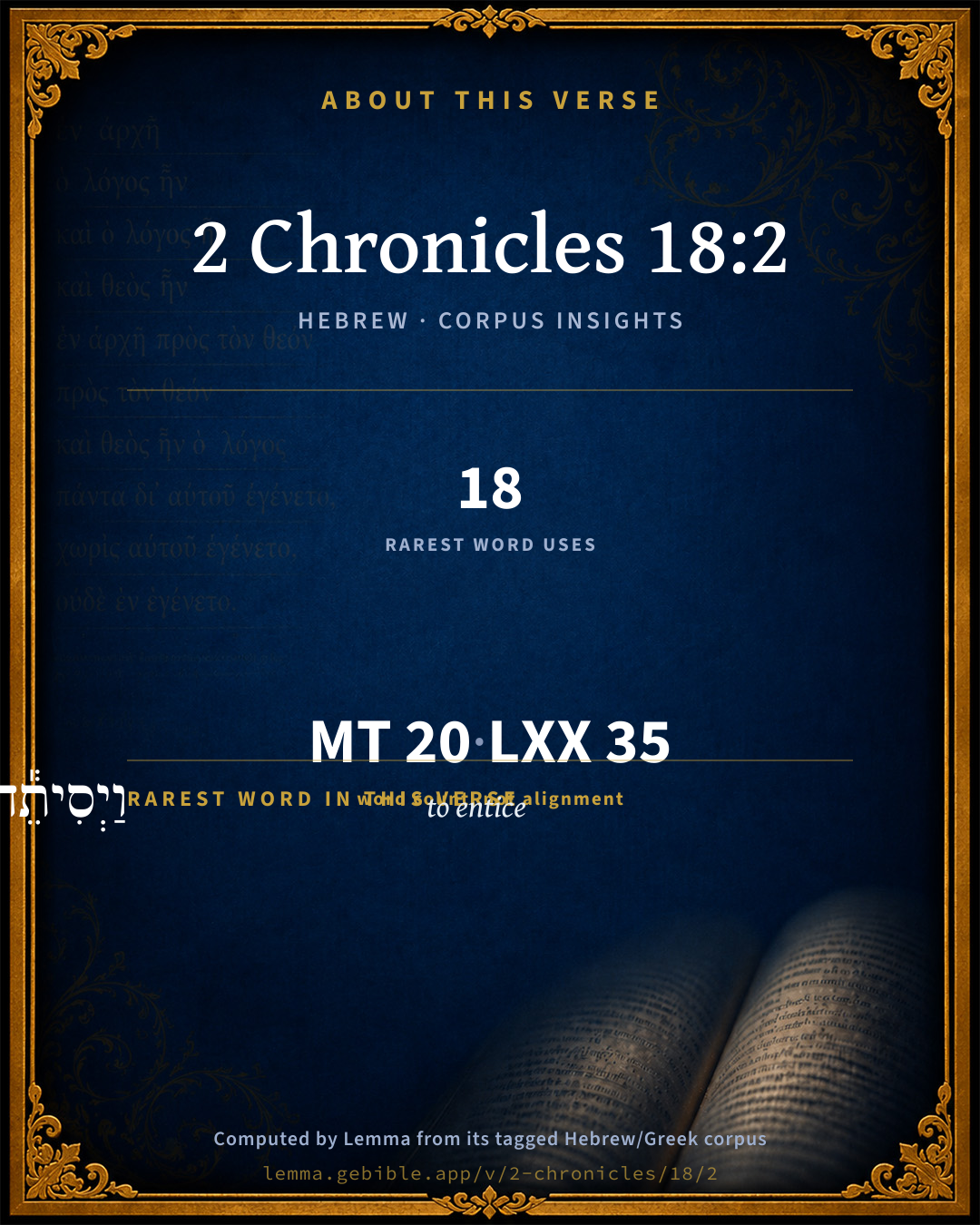
The rarest word here is וַיְסִיתֵ֕הוּ to entice H5496 — appearing just 18 times in the whole Hebrew Bible.

Shared distinctive vocabulary

וַיְסִיתֵ֕הוּ to entice H5496 occurs in 18 verses of the Hebrew Bible. Also found in:

Grammatical profile

  • 4 verbs
  • 11 nouns
  • 4 prepositions
  • 1 particle

Verb forms

  • וַיֵּרֶד֩ Qal · Sequential Imperfect
  • וַיִּֽזְבַּֽח Qal · Sequential Imperfect
  • וַיְסִיתֵ֕הוּ Hiphil · Sequential Imperfect
  • לַעֲל֖וֹת Qal · Infinitive Construct

Repetition

Words recur within this verse — often emphatic in Hebrew:

  • אַחְאָב֙ Ahab H256 ×2
  • אֶל to H413 ×2

Hebrew & Septuagint length

In English translation the verse runs 37 words from the Hebrew and 46 from the Septuagint (LXX English) — closely comparable.

A rough comparison of the two English renderings, which tokenize alike — not a word-level alignment.

Word counts can differ between the Hebrew and the Greek without any difference in meaning — e.g. the Hebrew direct-object marker אֵת has no separate Greek word, and Greek often adds the article ὁ.

In the original languages it is 20 Hebrew tokens and 35 Greek tokens — but the two are counted differently (Hebrew bundles its prefixes and suffixes into one token; the Greek is in lemma form), so that isn’t a like-for-like length.

Cross-references

11

Topical passages linked to 2 Chronicles 18:2 in the Treasury of Scripture Knowledge — connected by theme and wording, ordered by reader-vote popularity; previews shown in the World English Bible.

  • 1 Kings 1:9 Adonijah killed sheep and oxen and fatlings by the stone of Zoheleth, which is beside En Rogel; and he called all his brothers, the king's sons, and all the men of Judah, the king's servants:
  • 2 Kings 9:1 Elisha the prophet called one of the sons of the prophets, and said to him, Gird up your loins, and take this vial of oil in your hand, and go to Ramoth-gilead.
  • 2 Chronicles 19:2 Jehu the son of Hanani the seer went out to meet him, and said to king Jehoshaphat, Should you help the wicked, and love those who hate Yahweh? for this thing wrath is on you from before Yahweh.
  • Deuteronomy 4:43 [namely], Bezer in the wilderness, in the plain country, for the Reubenites; and Ramoth in Gilead, for the Gadites; and Golan in Bashan, for the Manassites.
  • Joshua 20:8 Beyond the Jordan at Jericho eastward, they assigned Bezer in the wilderness in the plain out of the tribe of Reuben, and Ramoth in Gilead out of the tribe of Gad, and Golan in Bashan out of the tribe of Manasseh.
  • 1 Kings 4:13 Ben Geber, in Ramoth-gilead (to him [pertained] the towns of Jair the son of Manasseh, which are in Gilead; [even] to him [pertained] the region of Argob, which is in Bashan, sixty great cities with walls and brazen bars);
  • 1 Kings 17:7 It happened after a while, that the brook dried up, because there was no rain in the land.
  • 1 Kings 22:2–35 It happened in the third year, that Jehoshaphat the king of Judah came down to the king of Israel.
  • Nehemiah 13:6 But in all this [time] I was not at Jerusalem; for in the two and thirtieth year of Artaxerxes king of Babylon I went to the king: and after certain days asked I leave of the king,
  • Isaiah 22:12–13 In that day did the Lord, Yahweh of Hosts, call to weeping, and to mourning, and to baldness, and to girding with sackcloth:
  • Luke 17:27–29 They ate, they drank, they married, they were given in marriage, until the day that Noah entered into the ark, and the flood came, and destroyed them all.

Cross-references courtesy of OpenBible.info (CC BY 4.0).

Hebrew and Greek witnesses Masoretic Hebrew ↔ Greek Septuagint

The same verse in the two great witnesses to the Old Testament, shown verse-for-verse.

These are two independent witnesses, not word-aligned to each other, and the Septuagint is shown in lemma (dictionary) form.

Hebrew 2 Chronicles 18:2 Masoretic · Westminster Leningrad Codex

וַיֵּרֶד֩ לְקֵ֨ץ שָׁנִ֤ים אֶל אַחְאָב֙ לְשֹׁ֣מְר֔וֹן וַיִּֽזְבַּֽח ל֨וֹ אַחְאָ֜ב צֹ֤אן וּבָקָר֙ לָרֹ֔ב וְלָעָ֖ם אֲשֶׁ֣ר עִמּ֑וֹ וַיְסִיתֵ֕הוּ לַעֲל֖וֹת אֶל רָמ֥וֹת גִּלְעָֽד

After certain years he went down to Ahab to Samaria. Ahab killed sheep and oxen for him in abundance, and for the people who were with him, and moved him to go up [with him] to Ramoth-gilead.

World English Bible · Public Domain

Greek LXX 2 Chronicles 18:2 Septuagint · lemma form

καί καταβαίνω διά τέλος ἔτος πρός αχααβ εἰς σαμαρεία καί θύω αὐτός αχααβ πρόβατον καί μόσχος πολύς καί ὁ λαός ὁ μετά αὐτός καί ἀπατάω αὐτός ὁ συν ἀναβαίνω μετά αὐτός εἰς ραμωθ ὁ γαλααδίτις

And he went down after a term of years to Achaab to Samaria: and Achaab killed for him sheep and calves, in abundance, and for the people with him, and he much desired him to go up with him to Ramoth of the country of Galaad.

LXX2012 (modern English Septuagint) · Public Domain

Hebrew: Westminster Leningrad Codex (CC BY 4.0). Greek: Septuagint (public domain); English from LXX2012 (modern English Septuagint) (Public Domain). How the Septuagint differs from the Hebrew →

Commentary

Notes on 2 Chronicles 18:2 from classic Christian and Jewish commentators (each source and its license shown beneath its notes). The classic Christian expositions comment on the surrounding passage and are grouped to its opening verse, so a note may address several verses; the Jewish commentaries on the Tanakh (Rashi and others) are per-verse, so they appear only where the commentator wrote on this verse.

Lemma curates 59 commentaries, every one of them public domain or Creative Commons licensed, each selected and text-cleaned for this edition rather than reprinted as found. About our sources →

Trapp's Complete Commentary

John Trapp

2Ch 18:2 And after [certain] years he went down to Ahab to Samaria. And Ahab killed sheep and oxen for him in abundance, and for the people that [he had] with him, and persuaded him to go up [with him] to Ramothgilead.

Ver. 2. He went down to Ahab to Samaria.] See 1Ki 22:2, in which chapter we have the same history related as here, not abridged - as is usual with this author - but at large; this much commendeth it unto us as necessary and profitable, since the Holy Ghost doth nothing in vain.

And Ahab killed sheep and oxen.] As to feast him and his retinue, so, haply, to sacrifice to the gods, as idolaters used to do when great strangers came unto them. Dido did so when Æneas came to her court.

“ Simul Aeneam in regia ducit

Tecta, simul divum templis indicit honorem. ” - Aeneid, lib. i.

Now Jezebel was Dido’s countrywoman, and had a great influence upon her husband Ahab.

John Trapp, A Commentary or Exposition upon All the Books of the Old and New Testament (1647–1656) — public domain. Text from a community e-Sword module.

Geneva Bible (1599)

Geneva Bible translators

That is, the third year, 1 Kings 22:2.

To recover it out of the hands of the Syrians.

Geneva Bible (1599) marginal notes — public domain. Text via Bolls.life.

Ellicott's Commentary for English Readers

(2) And after certain years.—See margin. 1Ki_22:2 has: “And it came to pass in the third year, that Jehoshaphat went down,” &c.—a date which is relative to the three years’ truce between Syria and Israel mentioned in the preceding verse. From 1Ki_22:51 of the same chapter we learn that this visit took place in the sixteenth or seventeenth year of the reign of Jehoshaphat. The marriage of Jehoram and Athaliah preceded the visit by eight or nine years. (Syriac and Arabic, “and after two years.”)

And Ahab killed sheep and oxen for him in abundance.—This royal hospitality is here represented as part of a deliberate plan for obtaining the co-operation of Jehoshaphat in the projected campaign.

Persuaded him.—Incited, pricked him on (Jdg_1:12); especially to evil; 1Ch_21:1, Deu_13:7. In 1Ki_22:3, Ahab broaches the subject of the expedition to his court.

To go up . . . to.—To make an expedition against a town or country (Isa_7:1; Isa_7:6; 1Ki_15:17). Comp. Isa_8:7-8.

A Bible Commentary for English Readers, edited by Charles John Ellicott (1878–1897) — public domain. Text from a community e-Sword module.

The Cambridge Bible for Schools and Colleges

gen. ed. J. J. S. Perowne

2. killed sheep and oxen] This phrase implies a feast, for flesh is eaten in the East only on festal occasions. The phrase used for supplying necessary food is to set bread and water before one.

that he had with him] R.V. that were with him.

and persuaded him] R.V. and moved him. The meaning of both phrases is the same, for in old English to persuade means to use persuasion without reference to the success of the action.

Ramoth-gilead] Deu_4:43; 1Ki_4:13; 1Ki_22:3; 2Ki_8:28; 2Ki_9:1; 2Ki_9:14. Ramoth was a city of refuge and (under Solomon) the seat of the governor of a province. Probably it was the most important Israelite city east of Jordan. It has been identified—but not beyond doubt—with the modern es-Salṭ. Bädeker, p. 177.

The Cambridge Bible for Schools and Colleges (gen. ed. J. J. S. Perowne; Cambridge University Press, 1878–1918) — public domain. Text from a community e-Sword module.

John Gill's Exposition

And after certain years,.... Two years, according to the Syriac and Arabic versions, or in the third year after the affinity was contracted, see Kg1 22:2,

he went down to Ahab to Samaria; to pay him a visit upon the alliance, civil and matrimonial, contracted between them:

and Ahab killed sheep and oxen for him in abundance, and for the people that he had with him; entertained him and his retinue in a very grand and liberal manner:

and persuaded him to go up with him to Ramothgilead; from hence, to the end of the chapter, it is the same with Kg1 22:4.

Next: 2 Chronicles Chapter 19

John Gill's Exposition of the Whole Bible (1746–1763) — public domain (CC PDM 1.0). Text via the HelloAO Bible API.

Albert Barnes' Notes on the Bible

After certain years - In Jehoshaphat’s 17th year 1Ki 22:51, not less than 8 years after the marriage (marginal reference note).

Albert Barnes' Notes on the Bible (1834–1885) — public domain. Text from a community e-Sword/MySword module.

Whedon's Commentary on the Bible

Daniel D. Whedon

2. Ahab killed sheep and oxen for him — Made for him a grand feast, thus seeking to secure his consent to assist him in the war with Syria. It was by such attention, and also by words of hope and promise, that Ahab persuaded Jehoshaphat to join him in the war.

Daniel D. Whedon (gen. ed.), Commentary on the Old and New Testaments (1874–1909) — public domain. Text from a community e-Sword module.

The Pulpit Commentary

After certain years he went down. In lieu of the italic type certain" here, the English idiom, "years after," would aptly reproduce the facts of the case. This journey to Samaria to see Ahab was made in the seventeenth year of Jehoshaphat"s reign. (1Ki_22:51; comp. 2Ch_20:35 and 2Ki_3:1) What were the precise antecedent circumstances of this visit of Jehoshaphat to Ahab it is interesting to surmise whether it were the fruit of an invitation direct from Ahab, who had his own designs, or whether it were for diplomatic reasons, that worked in the mind of Jehoshaphat as well as of Ahab, in view of Syria. It is evident that Ahab promptly determined to improve this conference of kings. Persuaded him; i.e. he took steps to induce him. This is the uniform signification of the word here used in the eighteen times of its occurrence, and mostly in doubtful, or worse than doubtful, matter. The form is the hiph. of tWs, in which conjugation only the verb occurs. The Revised Version renders "moved." The visiting and cooperating of Jehoshaphat and Ahab made a novel departure in the history of the rended kingdoms of Judah and Israel, and continued till the time of Jehu. Ramoth-Gilead. This important city of Gad, (Jos_20:8 Jos_21:38) in Palestine beyond Jordan, comes into question as one not surrendered to the king-dora of Israel in good faith, according to the promise of Benhadad, (1Ki_20:34; comp. 1, 4, 7, 11, 20, 30, 33) Benhadad"s father having taken it from Omri, father of Ahab. For "all the might that he showed," and presumably in conflicts with Syria, Omri was evidently a heavy loser. Ramoth-Gilead means "the heights of Gilead.

Vers. 2, 3.

Spiritual unwariness.

When Jehoshaphat came into contact with Ahab, he encountered a man who was more than his match in respect of policy. Indeed, he may be said to have fallen readily into the trap which his neighbour laid for him. Ahab received him as his guest with ostentatious hospitality; and when Jehoshaphat was in a grateful and perhaps elated mood, he proposed a combination in which they were to share the risks and losses, but not to divide the gains. To this the King of Judah unwisely consented. The "offensive alliance" was a mistake on his part. Simple straightforwardness needs to be flanked with some wariness or natural sagacity, otherwise it may lead us into compromising and even ruinous situations. In the conduct of our life, it is of very great importance that we should not show unwariness in

I THE FORMATION OF OUR FRIENDSHIPS, Jehoshaphat did an unwise thing in forming a friendship with Ahab; intimacy with such a man could not possibly end in his own elevation. We should not "love them that hate the Lord" (see homily on. (2Ch_19:2) In nothing is it more needful to show wariness and wisdom than in the choice of our friends; a mistake here means bitter disappointment, unimaginable misery, and, in all likelihood, spiritual deterioration if not positive ruin. Be slow to bind this bend. of friendship, which may, indeed, be a link to every good thing that blesses us, but which may be a fetter that chains us to every bad thing that curses and degrades us.

II THE ENCOUNTERING OF SOCIAL PERILS. Whether or not Jehoshaphat suffered from the blandishments and allurements of the court where Jezebel was queen, we do not know. Certainly he ought to have thought twice before he exposed himself and his attendants to that serious peril. How much of social peril can we meet and master? That is a question which every man must answer for himself. But it is clear that a very large number of human souls have overestimated their capacity for resistance. The degenerating influences of a society which is not Christian, but worldly, or vicious, are a power which we must only encounter with the utmost circumspection. We may take counsel here of Ahab himself. (1Ki_20:11) Men go airily and easily to the contest with those social forces, and they come out of the conflict worsted and wounded, perhaps even unto death. Be wary here, for you stand in a "slippery place.

III THE UNDERTAKING OF OUR ACHIEVEMENTS. Very readily, to all appearance, Jehoshaphat acceded to Ahab"s proposal (ver. 2). But it was one involving himself, his family, his princes, and his people in great hazards. Syria was a power not at all to be despised, and, except the Lord appeared on their behalf, they would most likely be defeated. And what reason had Jehoshaphat to conclude that he would have the arm of Jehovah on his side when he was going hand-in-hand with such a man as Ahab? It was a very doubtful procedure; and the haste with which it was agreed. upon showed no sagacity at all. Before we adopt our neighbour"s proposal we should weigh well all its probable and, so far as we can tell, its possible consequences; and not those which affect ourselves only, but those also which affect our kindred and connections. We may go "with a light heart " into an enterprise that means nothing less than disaster. Before undertaking anything of importance, there should be

(1) careful consideration, looking at the subject from all points of view;

(2) consultation with the wise and good;

(3) prayer for Divine guidance.

IV THE REGULATION OF OUR CHRISTIAN LIFE. Some men leave the retention of their spiritual integrity almost wholly to their good impulses. But this is a rash and perilous course. It is, indeed, the foolish and often fatal absence of all method. He who has the wariness which is wisdom, will adopt and maintain carefully regulated habits of devotion and of self-culture. C.

The Pulpit Commentary (1880–1919), ed. H.D.M. Spence-Jones & Joseph S. Exell — public domain. Text from a community e-Sword module.

Rashi

Rabbi Shlomo Yitzchaki (Rashi)

And he went down at the end of years And in I Kings (22:2) it is written: “And it was in the third year, that Jehoshaphat came down, etc.” This refers to the third year since he had released Ben Hadad (ibid. 20:34).

and he enticed him to go up to Ramoth Gilead as is written in the Book of I Kings (22: 3): “Do you know that Ramoth Gilead is ours,” because when Jacob built the mound [of stones] there and called it Galead, he took possession of it, and our forefathers took Gilead and the heights (רָמוֹת), which are a continuation and an attachment to the city. But when our forefathers in Moses’ time seized Gilead, they were silent and refrained from taking it, because they did not care for it, or perhaps in Moses’ time, they did take it, but later the nations took it from Israel’s hands, but it is [in fact] ours.

Rashi on the Tanakh — English translations: “The Judaica Press complete Tanach with Rashi, translated by A. J. Rosenberg” (CC BY 4.0); “Pentateuch with Rashi's commentary by M. Rosenbaum and A.M. Silbermann, 1929-1934” (public domain); “The Metsudah Tanach series, Lakewood, N.J” (CC BY 4.0); and “The Book of Joshua, Metsudah Publications, 1997” (CC BY 4.0). Text via Sefaria.

Lesson kit

Teaching starters — assembled from the data on this page, not authored interpretation. Every prompt links to the verse data it draws on. Edit before teaching.

2 Chronicles, in the Historical, opens this verse with 20 words (17 distinct Hebrew lemmas). Its most distinctive word is çûwth (“to entice”). A historical commentator’s framing appears above. Read the whole chapter for the surrounding context.

Discussion questions

  1. The word çûwth carries the sense “to entice.” How does it shape the verse?
  2. How does Deuteronomy 13:6, which shares the word «to entice», read alongside this verse?
  3. What does the repetition of “Ahab” (2× in this one verse) do in this verse?
  4. These translations render this verse differently; the difference is in the English rendering, not the original. What questions does that raise?
  5. «וַיֵּרֶד֩» is a Qal Sequential Imperfect verb. How does that grammatical form shape the action described?
  6. Compare how Trapp's Complete Commentary and Geneva Bible (1599) read this verse. Where do they agree or differ?

Things to notice

Reading settings

Reading text

Shown beneath each verse's original-language words.

Old Testament
Old Testament edition

Read the OT as the Masoretic Hebrew (MT) or the Greek Septuagint (LXX).

English shown for the Greek Septuagint (in the Hebrew ↔ Greek comparison).

Comparing translations? Open the Compare panel on any verse page to stack up to four side by side.