
2 Chronicles 30:24

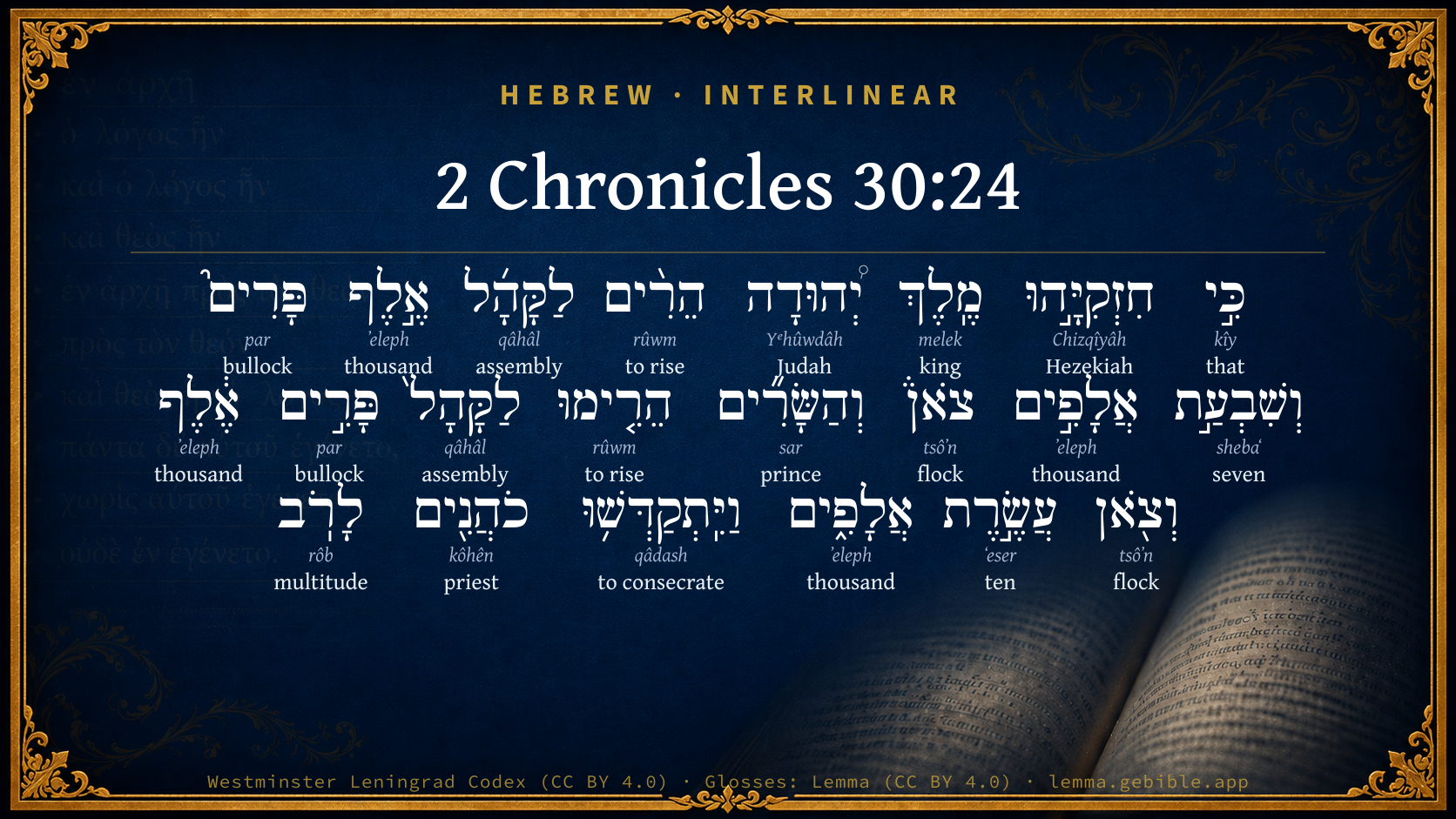
Hebrew (Westminster Leningrad Codex) 2 Chronicles 30:24 appears in the Hebrew Old Testament. The text above is from the Westminster Leningrad Codex. Each word links to its Strong’s number, a concise gloss, and parsing drawn from the Open Scriptures Hebrew Bible morphology. Click any word for its full Brown-Driver-Briggs (BDB) entry.
Download image
Cite this verse

2 Chronicles 30:24 (World English Bible). Public Domain. Lemma interlinear Bible study tool, https://lemma.gebible.app/v/2-chronicles/30/24.

Show BibTeX & RIS
BibTeX
RIS
English Translation
For Hezekiah king of Judah did give to the assembly for offerings one thousand bulls and seven thousand sheep; and the princes gave to the assembly a thousand bulls and ten thousand sheep: and a great number of priests sanctified themselves.
World English Bible · Public Domain
Download a study sheet

One document with this verse’s original text, its word-by-word gloss line, the meaning frame, cross-references with their text, attributed commentary, and full source and license credits — printable, and it pastes into notes with its structure intact.

This verse Autodidact and up

Study sheet (.html) Plain text (.txt)

A passage Seminary Student

Up to 50 verses in one chapter. A passage sheet keeps up to 6 commentary sources and 12 cross-references per verse, in the order this page ranks them, and says so on the sheet whenever that leaves anything out. Ask for a single verse and you get the Autodidact verse sheet above.

Everything on this page stays free to read, with no account — the sheet is a download of what is already on screen, not access to it.

Want to remove ads? Support Godless Engineer
Compare translations 3

The same verse in 3 English versions, stacked beneath the original-language interlinear above. Click any original word for its lexicon entry.

Each is an independent rendering of the whole verse — the interlinear is not word-aligned to these translations.

Highlighted words mark where these versions differ — a whole-verse word diff, not a word-by-word alignment.

  • World English Bible Public Domain
    For Hezekiah king of Judah did give to the assembly for offerings one thousand bulls and seven thousand sheep; and the princes gave to the assembly a thousand bulls and ten thousand sheep: and a great number of priests sanctified themselves.
  • King James Version Public Domain
    For Hezekiah king of Judah did give to the congregation a thousand bullocks and seven thousand sheep; and the princes gave to the congregation a thousand bullocks and ten thousand sheep: and a great number of priests sanctified themselves.
  • unfoldingWord Literal Text CC BY-SA 4.0
    For Hezekiah the king of Judah contributed to the assembly 1,000 bulls and 7,000 sheep; and the chiefs contributed to the assembly 1,000 bulls and 10,000 sheep. And many priests consecrated themselves.

unfoldingWord Literal Text — © unfoldingWord, licensed CC BY-SA 4.0. Word-aligned USFM3 via Door43 (git.door43.org/unfoldingWord/en_ult).

Versions to compare (up to 4)

3 of 4 selected

Show all 18 translations

Every available English version of this verse, each an independent rendering of the whole verse.

  • World English Bible Public Domain
    For Hezekiah king of Judah did give to the assembly for offerings one thousand bulls and seven thousand sheep; and the princes gave to the assembly a thousand bulls and ten thousand sheep: and a great number of priests sanctified themselves.
  • Berean Standard Bible Public Domain
    For Hezekiah king of Judah contributed a thousand bulls and seven thousand sheep for the assembly, and the officials contributed a thousand bulls and ten thousand sheep for the assembly, and a great number of priests consecrated themselves.
  • Majority Standard Bible Public Domain
    For Hezekiah king of Judah contributed a thousand bulls and seven thousand sheep for the assembly, and the officials contributed a thousand bulls and ten thousand sheep for the assembly, and a great number of priests consecrated themselves.
  • King James Version Public Domain
    For Hezekiah king of Judah did give to the congregation a thousand bullocks and seven thousand sheep; and the princes gave to the congregation a thousand bullocks and ten thousand sheep: and a great number of priests sanctified themselves.
  • American Standard Version (1901) Public Domain
    For Hezekiah king of Judah did give to the assembly for offerings a thousand bullocks and seven thousand sheep; and the princes gave to the assembly a thousand bullocks and ten thousand sheep: and a great number of priests sanctified themselves.
  • Revised Version (1885) Public Domain
    For Hezekiah king of Judah did give to the congregation for offerings a thousand bullocks and seven thousand sheep; and the princes gave to the congregation a thousand bullocks and ten thousand sheep: and a great number of priests sanctified themselves.
  • Geneva Bible (1599) Public Domain
    For Hezekiah King of Iudah had giuen to the Congregation a thousande bullockes, and seuen thousand sheepe. And the princes had giuen to the Congregation a thousand bullocks, and ten thousand sheepe: and many Priests were sanctified.
  • Douay-Rheims (1899) Public Domain
    And it pleased the whole multitude to keep other seven days: which they did with great joy.
  • Young's Literal Translation Public Domain
    for Hezekiah king of Judah hath presented to the assembly a thousand bullocks, and seven thousand sheep; and the heads have presented to the assembly bullocks a thousand, and sheep ten thousand; and priests sanctify themselves in abundance.
  • Literal Standard Version CC BY-SA 4.0
    for Hezekiah king of Judah has presented one thousand bullocks and seven thousand sheep to the assembly; and the heads have presented one thousand bullocks and ten thousand sheep to the assembly; and priests sanctify themselves in abundance.
  • Unlocked Literal Bible CC BY-SA 4.0
    For Hezekiah king of Judah gave the assembly one thousand bulls and seven thousand sheep as an offering; and the leaders gave to the assembly one thousand bulls and ten thousand sheep and goats. A large number of priests consecrated themselves.
  • unfoldingWord Literal Text CC BY-SA 4.0
    For Hezekiah the king of Judah contributed to the assembly 1,000 bulls and 7,000 sheep; and the chiefs contributed to the assembly 1,000 bulls and 10,000 sheep. And many priests consecrated themselves.
  • Darby Bible Public Domain
    For Hezekiah king of Judah gave to the congregation as heave-offering: a thousand bullocks and seven thousand sheep; and the princes gave to the congregation a thousand bullocks and ten thousand sheep; and a great number of priests hallowed themselves.
  • World Messianic Bible Public Domain
    For Hezekiah king of Judah gave to the assembly for offerings one thousand bulls and seven thousand sheep; and the princes gave to the assembly a thousand bulls and ten thousand sheep; and a great number of priests sanctified themselves.
  • Webster's Bible Public Domain
    For Hezekiah king of Judah gave to the congregation a thousand bullocks and seven thousand sheep; and the princes gave to the congregation a thousand bullocks and ten thousand sheep: and a great number of priests sanctified themselves.
  • Free Bible Version CC BY-SA 4.0
    Hezekiah, king of Judah, gave a thousand bulls and seven thousand sheep as offerings on behalf of the assembly. The officials in turn gave a thousand bulls and ten thousand sheep as offerings on behalf of the assembly. A large number of priests purified themselves.
  • Bible in Basic English Public Domain
    For Hezekiah, king of Judah, gave to the people for offerings, a thousand oxen and seven thousand sheep; and the rulers gave a thousand oxen and ten thousand sheep; and a great number of priests made themselves holy.
  • JPS Tanakh (1917) Public Domain
    For Hezekiah king of Judah did give to the congregation for offerings a thousand bullocks and seven thousand sheep; and the princes gave to the congregation a thousand bullocks and ten thousand sheep; and priests sanctified themselves in great numbers.

Literal Standard Version (2020), Covenant Press — licensed CC BY-SA 4.0. Text via the HelloAO Bible API (eBible.org). Unlocked Literal Bible (unfoldingWord) — licensed CC BY-SA 4.0. Text via the HelloAO Bible API (eBible.org). unfoldingWord Literal Text — © unfoldingWord, licensed CC BY-SA 4.0. Word-aligned USFM3 via Door43 (git.door43.org/unfoldingWord/en_ult). Free Bible Version, Dr. Jonathan Gallagher — licensed CC BY-SA 4.0. Text via the HelloAO Bible API (eBible.org).

Word by word

More ways to search: Search by grammar → Find every occurrence → Compare this word →

Practice this passage: Drill this verse → Learn its vocabulary →

לַקָּהָ֜ל
qâhâl
H6951
“to/for the · assembly”
Preposition, Determined + Noun, Common, Masculine, Singular, Absolute
Part of Speech
Preposition + Noun
Type
Common
Gender
Masculine
Number
Singular
State
Absolute
Full BDB Definition

Origin: from H6950

TWOT: 1991a

assembly, company, congregation, convocation - assembly - for evil counsel, war or invasion, religious purposes - company (of returning exiles) - congregation - as organised body
  1. כִּ֣י kîy H3588 “that” Conjunction
  2. חִזְקִיָּ֣הוּ Chizqîyâh H2396 “Hezekiah” Noun, Proper
  3. מֶֽלֶךְ melek H4428 “king of” Noun, Common, Masculine, Singular, Construct
  4. יְ֠הוּדָה Yᵉhûwdâh H3063 “Judah” Noun, Proper
  5. הֵרִ֨ים rûwm H7311 “to rise” Verb, Hiphil, Perfect, 3rd Person, Masculine, Singular
  6. אֶ֣לֶף ʼeleph H505 “thousand” Adjective, Cardinal number, Both, Singular, Absolute
  7. פָּרִים֮ par H6499 “bullocks” Noun, Common, Masculine, Plural, Absolute
  8. וְשִׁבְעַ֣ת shebaʻ H7651 “and · seven” Conjunction + Adjective, Cardinal number, Masculine, Singular, Construct
  9. אֲלָפִ֣ים ʼeleph H505 “thousand” Adjective, Cardinal number, Both, Plural, Absolute
  10. צֹאן֒ tsôʼn H6629 “flock” Noun, Common, Both, Singular, Absolute
  11. וְהַשָּׂרִ֞ים sar H8269 “and · the · princes” Conjunction + Particle, Definite Article + Noun, Common, Masculine, Plural, Absolute
  12. הֵרִ֤ימוּ rûwm H7311 “to rise” Verb, Hiphil, Perfect, 3rd Person, Common, Plural
  13. לַקָּהָל֙ qâhâl H6951 “to/for the · assembly” Preposition, Determined + Noun, Common, Masculine, Singular, Absolute
  14. פָּרִ֣ים par H6499 “bullocks” Noun, Common, Masculine, Plural, Absolute
  15. אֶ֔לֶף ʼeleph H505 “thousand” Adjective, Cardinal number, Both, Singular, Absolute
  16. וְצֹ֖אן tsôʼn H6629 “and · flock” Conjunction + Noun, Common, Both, Singular, Absolute
  17. עֲשֶׂ֣רֶת ʻeser H6235 “ten” Adjective, Cardinal number, Masculine, Singular, Construct
  18. אֲלָפִ֑ים ʼeleph H505 “thousand” Adjective, Cardinal number, Both, Plural, Absolute
  19. וַיִּֽתְקַדְּשׁ֥וּ qâdash H6942 “and · to consecrate” Conjunction + Verb, Hithpael, Sequential Imperfect, 3rd Person, Masculine, Plural
  20. כֹהֲנִ֖ים kôhên H3548 “priests” Noun, Common, Masculine, Plural, Absolute
  21. לָרֹֽב rôb H7230 “to/for · multitude” Preposition + Noun, Common, Both, Singular, Absolute

About this verse

These counts appear in no published source. They are computed here, from the morphology-tagged text and Lemma’s own curated glosses. What Lemma adds →

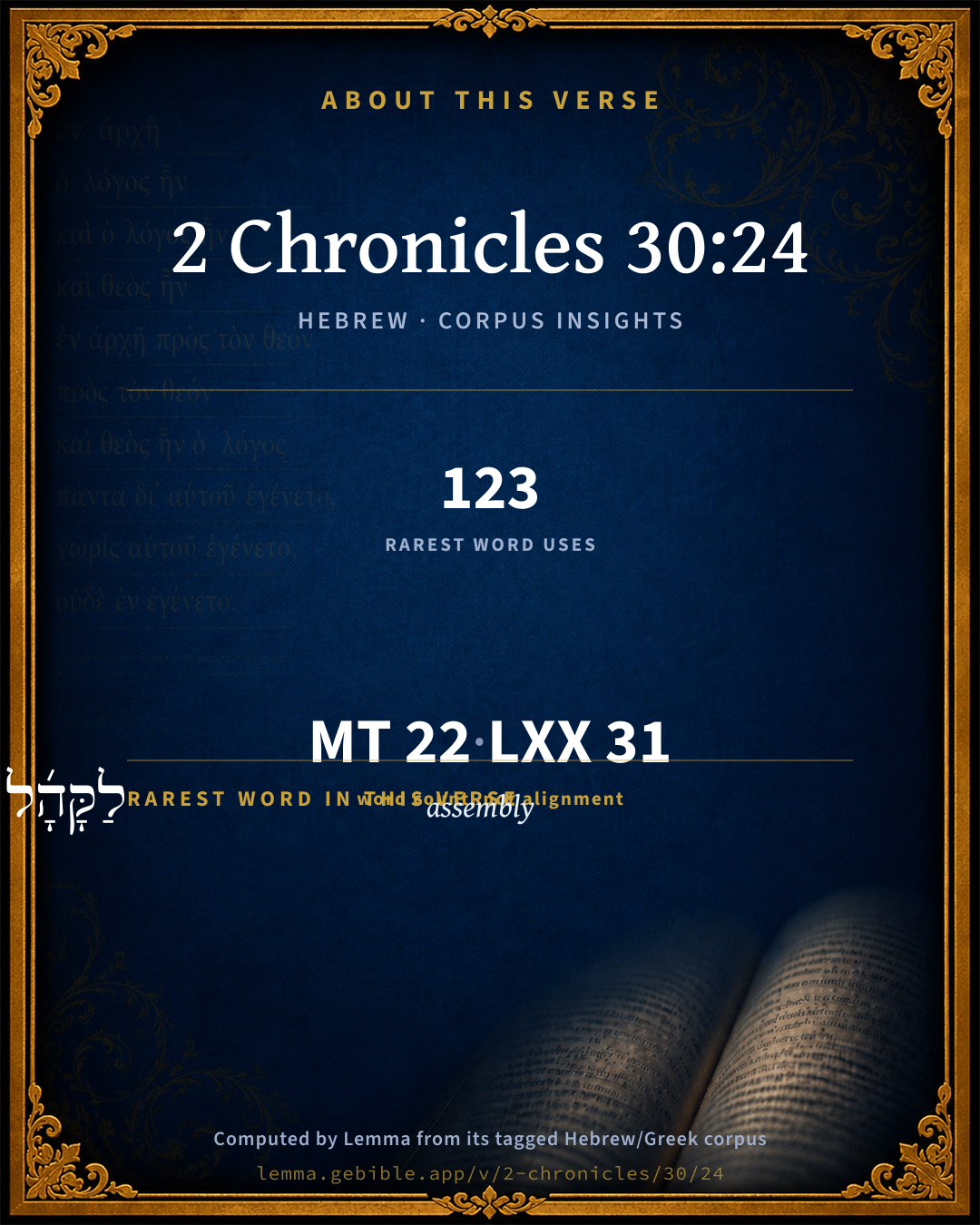
22
words
15
distinct lemmas
Historical
section

Grammatical profile

  • 3 verbs
  • 12 nouns
  • 6 adjectives
  • 1 conjunction

Verb forms

  • הֵרִ֨ים Hiphil · Perfect
  • הֵרִ֤ימוּ Hiphil · Perfect
  • וַיִּֽתְקַדְּשׁ֥וּ Hithpael · Sequential Imperfect

Repetition

Words recur within this verse — often emphatic in Hebrew:

  • אֶ֣לֶף thousand H505 ×4
  • הֵרִ֨ים to rise H7311 ×2
  • לַקָּהָ֜ל assembly H6951 ×2
  • פָּרִים֮ bullock H6499 ×2
  • צֹאן֒ flock H6629 ×2

Hebrew & Septuagint length

In English translation the verse runs 41 words from the Hebrew and 40 from the Septuagint (LXX English) — closely comparable.

A rough comparison of the two English renderings, which tokenize alike — not a word-level alignment.

Word counts can differ between the Hebrew and the Greek without any difference in meaning — e.g. the Hebrew direct-object marker אֵת has no separate Greek word, and Greek often adds the article ὁ.

In the original languages it is 22 Hebrew tokens and 31 Greek tokens — but the two are counted differently (Hebrew bundles its prefixes and suffixes into one token; the Greek is in lemma form), so that isn’t a like-for-like length.

Cross-references

6

Topical passages linked to 2 Chronicles 30:24 in the Treasury of Scripture Knowledge — connected by theme and wording, ordered by reader-vote popularity; previews shown in the World English Bible.

  • 2 Chronicles 29:34 But the priests were too few, so that they could not flay all the burnt offerings: therefore their brothers the Levites helped them, until the work was ended, and until the priests had sanctified themselves; for the Levites were more upright in heart to sanctify themselves than the priests.
  • 2 Chronicles 35:7–8 Josiah gave to the children of the people, of the flock, lambs and kids, all of them for the Passover offerings, to all who were present, to the number of thirty thousand, and three thousand bulls: these were of the king's substance.
  • 1 Chronicles 29:3–9 In addition, because I have set my affection on the house of my God, seeing that I have a treasure of my own of gold and silver, I give it to the house of my God, over and above all that I have prepared for the holy house,
  • 2 Chronicles 30:3 For they could not keep it at that time, because the priests had not sanctified themselves in sufficient number, neither had the people gathered themselves together to Jerusalem.
  • Ezekiel 45:17 It shall be the prince's part to give the burnt offerings, and the meal-offerings, and the drink-offerings, in the feasts, and on the new moons, and on the Sabbaths, in all the appointed feasts of the house of Israel: he shall prepare the sin-offering, and the meal-offering, and the burnt offering, and the peace-offerings, to make atonement for the house of Israel.
  • Ephesians 4:8 Therefore he says, "When he ascended on high, he led captivity captive, and gave gifts to men."

Cross-references courtesy of OpenBible.info (CC BY 4.0).

Hebrew and Greek witnesses Masoretic Hebrew ↔ Greek Septuagint

The same verse in the two great witnesses to the Old Testament, shown verse-for-verse.

These are two independent witnesses, not word-aligned to each other, and the Septuagint is shown in lemma (dictionary) form.

Hebrew 2 Chronicles 30:24 Masoretic · Westminster Leningrad Codex

כִּ֣י חִזְקִיָּ֣הוּ מֶֽלֶךְ יְ֠הוּדָה הֵרִ֨ים לַקָּהָ֜ל אֶ֣לֶף פָּרִים֮ וְשִׁבְעַ֣ת אֲלָפִ֣ים צֹאן֒ וְהַשָּׂרִ֞ים הֵרִ֤ימוּ לַקָּהָל֙ פָּרִ֣ים אֶ֔לֶף וְצֹ֖אן עֲשֶׂ֣רֶת אֲלָפִ֑ים וַיִּֽתְקַדְּשׁ֥וּ כֹהֲנִ֖ים לָרֹֽב

For Hezekiah king of Judah did give to the assembly for offerings one thousand bulls and seven thousand sheep; and the princes gave to the assembly a thousand bulls and ten thousand sheep: and a great number of priests sanctified themselves.

World English Bible · Public Domain

Greek LXX 2 Chronicles 30:24 Septuagint · lemma form

ὅτι εζεκιας ἀποἄρχω ὁ ἰουδά ὁ ἐκκλησία μόσχος χίλιοι καί ἑπτακισχίλιοι πρόβατον καί ὁ ἄρχων ἀποἄρχω ὁ λαός μόσχος χίλιοι καί πρόβατον δέκα χιλίας καί ὁ ἅγιος ὁ ἱερεύς εἰς πλῆθος

For Ezekias set apart for Juda, even for the congregation, a thousand calves and seven thousand sheep; and the princes set apart for the people a thousand calves and ten thousand sheep: and the holy things of the priests abundantly.

LXX2012 (modern English Septuagint) · Public Domain

Hebrew: Westminster Leningrad Codex (CC BY 4.0). Greek: Septuagint (public domain); English from LXX2012 (modern English Septuagint) (Public Domain). How the Septuagint differs from the Hebrew →

Commentary

Notes on 2 Chronicles 30:24 from classic Christian and Jewish commentators (each source and its license shown beneath its notes). The classic Christian expositions comment on the surrounding passage and are grouped to its opening verse, so a note may address several verses; the Jewish commentaries on the Tanakh (Rashi and others) are per-verse, so they appear only where the commentator wrote on this verse.

Lemma curates 59 commentaries, every one of them public domain or Creative Commons licensed, each selected and text-cleaned for this edition rather than reprinted as found. About our sources →

Trapp's Complete Commentary

John Trapp

2Ch 30:24 For Hezekiah king of Judah did give to the congregation a thousand bullocks and seven thousand sheep; and the princes gave to the congregation a thousand bullocks and ten thousand sheep: and a great number of priests sanctified themselves.

Ver. 24. And the princes gave a thousand bullocks.] Neither the king nor princes spared for cost to further so good a motion, and to draw the people to stay with delight; those of the ten tribes especially, that they may be better instructed.

John Trapp, A Commentary or Exposition upon All the Books of the Old and New Testament (1647–1656) — public domain. Text from a community e-Sword module.

Joseph Benson's Commentary

2Ch 30:24. Hezekiah did give a thousand bullocks, and seven thousand sheep — First to God, to whom the parts appointed were offered in a way of thanksgiving; and then to the people, who feasted upon the relics, as the offerer used to do in peace-offerings: and Hezekiah, who was the offerer, gave away his right in the remains of the sacrifices to the people. Which generosity is the more considerable, because it was in the beginning of his reign, when he found the exchequer empty; and when he had been at great expense about cleansing and refitting the temple, and making preparations for this great feast. By this great liberality of the king and princes, God was honoured, the joy of the festival was kept up, and the strangers were encouraged to come again to Jerusalem.

Joseph Benson's Commentary on the Old and New Testaments (1811–1818) — public domain. Text from a community e-Sword module.

Geneva Bible (1599)

Geneva Bible translators

This great liberality declareth how kings, princes, and all they to whom God hath given wherewith, ought to be most ready to bestow it in setting forth of God’s glory.

Geneva Bible (1599) marginal notes — public domain. Text via Bolls.life.

Jamieson, Fausset & Brown

Robert Jamieson, A. R. Fausset & David Brown

and a great number of priests sanctified themselves--so that there would be a sufficient number of hands for the additional services.

Next: 2 Chronicles Chapter 31

Jamieson, Fausset & Brown — Commentary Critical and Explanatory on the Whole Bible (1871) — public domain (CC PDM 1.0). Text via the HelloAO Bible API.

Ellicott's Commentary for English Readers

(24) Did give . . . gave.—Had presented (Exo_35:24)—scil., for sacrifice as a tĕrûmâh, or “heave offering.” The gifts of king and princes for the Mazzôth festival were so abundant that they sufficed not only for the feast itself, but also for an additional week of rejoicing.

And a great number of priests.—Literally, and priests had sanctified themselves in multitude, or to abundance. The priests no longer hung back as they had done previously (2Ch_30:3; 2Ch_30:15; 2Ch_29:34). There was now no lack of persons duly purified for the sacrifice of so many victims.

A Bible Commentary for English Readers, edited by Charles John Ellicott (1878–1897) — public domain. Text from a community e-Sword module.

The Cambridge Bible for Schools and Colleges

gen. ed. J. J. S. Perowne

24. did give to the congregation] R.V. did give to the congregation for offerings.

sanctified themselves] Cp. 2Ch_29:34.

The Cambridge Bible for Schools and Colleges (gen. ed. J. J. S. Perowne; Cambridge University Press, 1878–1918) — public domain. Text from a community e-Sword module.

John Gill's Exposition

And all the congregation of Judah, with the priests and Levites,.... The people that were gathered together out of the several cities of Judah, which no doubt was the largest congregation, with whom the priests and Levites are joined, as being of that kingdom, and dwellers in Jerusalem, where their office lay:

and all the congregation that came out of Israel; out of the ten tribes, particularly Ephraim, Manasseh, Issachar, and Zebulun, Ch2 30:18, and the strangers that came out of the land of Israel, and that dwelt in Judah, rejoiced; the proselytes, even such as were circumcised, who ate of the passover, and kept the feast of unleavened bread, as well as the other days of rejoicing, the former of which none might partake of but circumcised persons; and it can hardly be thought that any other would come out of Israel on such an occasion, see Exo 12:48.

John Gill's Exposition of the Whole Bible (1746–1763) — public domain (CC PDM 1.0). Text via the HelloAO Bible API.

Matthew Poole's English Annotations

Hezekiah did give to the congregation; first to God, to whom the parts appointed were offered in way of thanksgiving; and then to the people, who feasted upon the relics, as the offerer used to do in peace-offerings; and Hezekiah, who was the offerer, gave away his right in the remains of the sacrifices to the people.

A thousand bullocks and seven thousand sheep; which generosity is the more considerable, because it was in the beginning of his reign, when he found the royal exchequer exhausted and empty; and when he had been at great expense about the cleansing and refitting of the temple, and making preparations for this great feast.

A great number of priests sanctified themselves; having now both more time and further need of sanctifying themselves to offer these numerous sacrifices.

Matthew Poole's English Annotations on the Holy Bible (1683–1685) — public domain. Text from a community e-Sword/MySword module.

The Pulpit Commentary

Did give. This is an inadequate rendering. Revised Version reads, did give for offerings; others read, "gave as an heave offering." In the light of our 2Ch_35:7-9, the Revised Version rendering seems sufficient.

The Pulpit Commentary (1880–1919), ed. H.D.M. Spence-Jones & Joseph S. Exell — public domain. Text from a community e-Sword module.

John Wesley's Explanatory Notes

Did give - First to God, to whom the parts appointed were offered in a way of thanksgiving; and then to the people, who feasted upon the relicks, as the offerer used to do in peace- offerings: and Hezekiah, who was the offerer, gave away his right in the remains of the sacrifices to the people. Which generosity is the more considerable, because it was in the beginning of his reign, when he found the exchequer empty; and when he had been at great expense about cleansing and refitting the temple, and making preparations for this great feast.

John Wesley, Explanatory Notes Upon the Whole Bible (1754–1765) — public domain. Text via the GEBible commentary corpus.

Rashi

Rabbi Shlomo Yitzchaki (Rashi)

separated from his small cattle and from his large cattle.

for the congregation one thousand bulls, etc. and they were eating together, the king, the officers, and the people, with joy.

Rashi on the Tanakh — English translations: “The Judaica Press complete Tanach with Rashi, translated by A. J. Rosenberg” (CC BY 4.0); “Pentateuch with Rashi's commentary by M. Rosenbaum and A.M. Silbermann, 1929-1934” (public domain); “The Metsudah Tanach series, Lakewood, N.J” (CC BY 4.0); and “The Book of Joshua, Metsudah Publications, 1997” (CC BY 4.0). Text via Sefaria.

Lesson kit

Teaching starters — assembled from the data on this page, not authored interpretation. Every prompt links to the verse data it draws on. Edit before teaching.

2 Chronicles, in the Historical, opens this verse with 22 words (15 distinct Hebrew lemmas). Its most distinctive word is qâhâl (“assembly”). A historical commentator’s framing appears above. Read the whole chapter for the surrounding context.

Discussion questions

  1. How does “assembly” (qâhâl) shape what this verse is saying?
  2. How does 2 Chronicles 29:34, which shares this passage’s theme, read alongside this verse?
  3. What does the repetition of “thousand” (4× in this one verse) do in this verse?
  4. These translations render this verse differently. What is at stake in choosing one wording over another?
  5. «הֵרִ֨ים» is a Hiphil Perfect verb. How does that grammatical form shape the action described?
  6. Compare how Trapp's Complete Commentary and Joseph Benson's Commentary read this verse. Where do they agree or differ?

Things to notice

Reading settings

Reading text

Shown beneath each verse's original-language words.

Old Testament
Old Testament edition

Read the OT as the Masoretic Hebrew (MT) or the Greek Septuagint (LXX).

English shown for the Greek Septuagint (in the Hebrew ↔ Greek comparison).

Comparing translations? Open the Compare panel on any verse page to stack up to four side by side.