
Deuteronomy 28:51

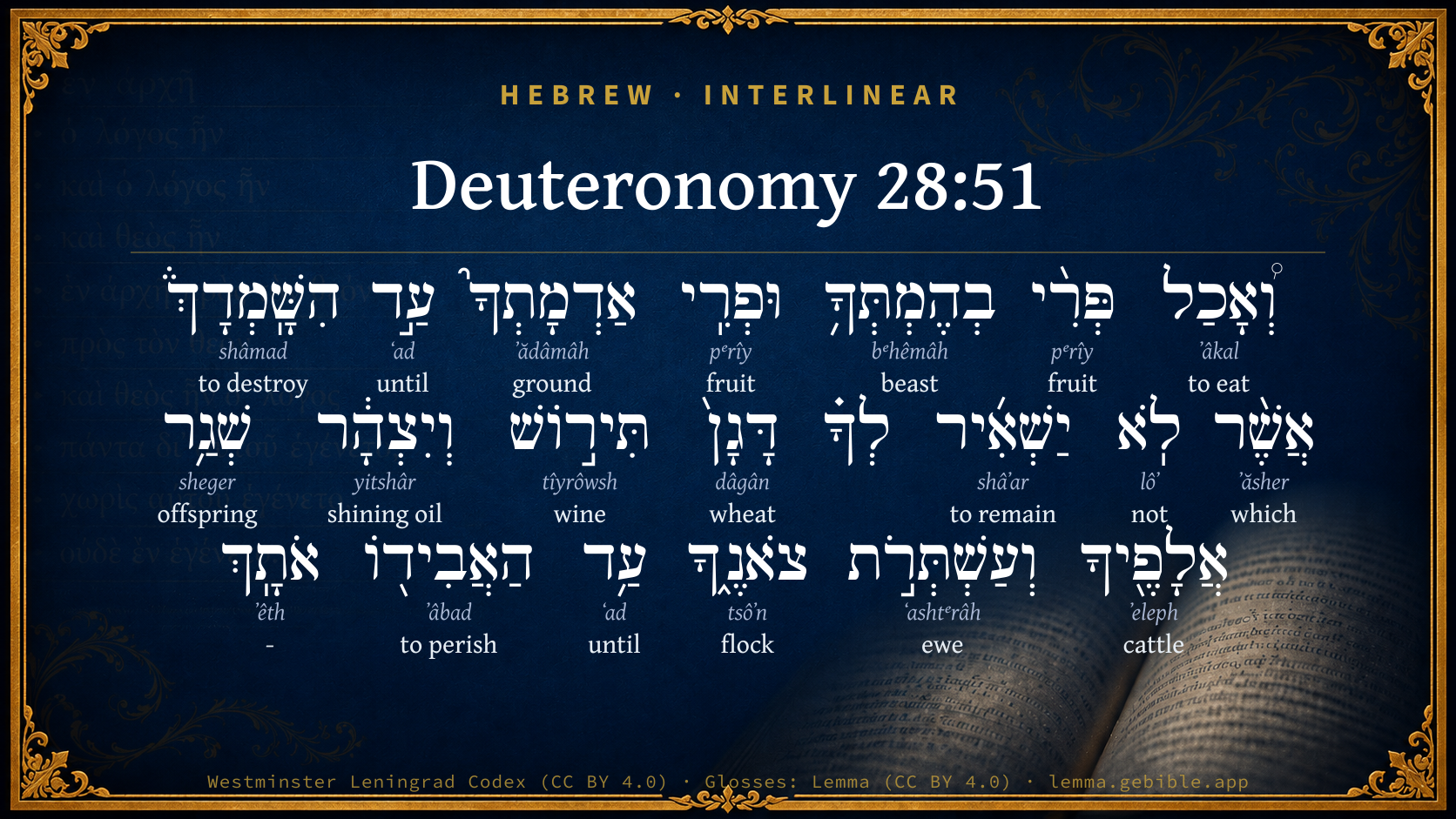
Hebrew (Westminster Leningrad Codex) Deuteronomy 28:51 appears in the Hebrew Old Testament. The text above is from the Westminster Leningrad Codex. Each word links to its Strong’s number, a concise gloss, and parsing drawn from the Open Scriptures Hebrew Bible morphology. Click any word for its full Brown-Driver-Briggs (BDB) entry.
Download image
Cite this verse

Deuteronomy 28:51 (World English Bible). Public Domain. Lemma interlinear Bible study tool, https://lemma.gebible.app/v/deuteronomy/28/51.

Show BibTeX & RIS
BibTeX
RIS
English Translation
and shall eat the fruit of your cattle, and the fruit of your ground, until you are destroyed; that also shall not leave you grain, new wine, or oil, the increase of your cattle, or the young of your flock, until they have caused you to perish.
World English Bible · Public Domain
Download a study sheet

One document with this verse’s original text, its word-by-word gloss line, the meaning frame, cross-references with their text, attributed commentary, and full source and license credits — printable, and it pastes into notes with its structure intact.

This verse Autodidact and up

Study sheet (.html) Plain text (.txt)

A passage Seminary Student

Up to 50 verses in one chapter. A passage sheet keeps up to 6 commentary sources and 12 cross-references per verse, in the order this page ranks them, and says so on the sheet whenever that leaves anything out. Ask for a single verse and you get the Autodidact verse sheet above.

Everything on this page stays free to read, with no account — the sheet is a download of what is already on screen, not access to it.

Want to remove ads? Support Godless Engineer
Compare translations 3

The same verse in 3 English versions, stacked beneath the original-language interlinear above. Click any original word for its lexicon entry.

Each is an independent rendering of the whole verse — the interlinear is not word-aligned to these translations.

Highlighted words mark where these versions differ — a whole-verse word diff, not a word-by-word alignment.

  • World English Bible Public Domain
    and shall eat the fruit of your cattle, and the fruit of your ground, until you are destroyed; that also shall not leave you grain, new wine, or oil, the increase of your cattle, or the young of your flock, until they have caused you to perish.
  • King James Version Public Domain
    And he shall eat the fruit of thy cattle, and the fruit of thy land, until thou be destroyed: which also shall not leave thee either corn, wine, or oil, or the increase of thy kine, or flocks of thy sheep, until he have destroyed thee.
  • unfoldingWord Literal Text CC BY-SA 4.0
    And it will eat the fruit of your cattle and the fruit of your land until you are destroyed, which will leave for you no grain, new wine, or oil, young of your cattle or young of your flock, until it causes you to perish.

unfoldingWord Literal Text — © unfoldingWord, licensed CC BY-SA 4.0. Word-aligned USFM3 via Door43 (git.door43.org/unfoldingWord/en_ult).

Versions to compare (up to 4)

3 of 4 selected

Show all 18 translations

Every available English version of this verse, each an independent rendering of the whole verse.

  • World English Bible Public Domain
    and shall eat the fruit of your cattle, and the fruit of your ground, until you are destroyed; that also shall not leave you grain, new wine, or oil, the increase of your cattle, or the young of your flock, until they have caused you to perish.
  • Berean Standard Bible Public Domain
    They will eat the offspring of your livestock and the produce of your land until you are destroyed. They will leave you no grain or new wine or oil, no calves of your herds or lambs of your flocks, until they have caused you to perish.
  • Majority Standard Bible Public Domain
    They will eat the offspring of your livestock and the produce of your land until you are destroyed. They will leave you no grain or new wine or oil, no calves of your herds or lambs of your flocks, until they have caused you to perish.
  • King James Version Public Domain
    And he shall eat the fruit of thy cattle, and the fruit of thy land, until thou be destroyed: which also shall not leave thee either corn, wine, or oil, or the increase of thy kine, or flocks of thy sheep, until he have destroyed thee.
  • American Standard Version (1901) Public Domain
    and shall eat the fruit of thy cattle, and the fruit of thy ground, until thou be destroyed; that also shall not leave thee grain, new wine, or oil, the increase of thy cattle, or the young of thy flock, until they have caused thee to perish.
  • Revised Version (1885) Public Domain
    and he shall eat the fruit of thy cattle, and the fruit of thy ground, until thou be destroyed: which also shall not leave thee corn, wine, or oil, the increase of thy kine, or the young of thy flock, until he have caused thee to perish.
  • Geneva Bible (1599) Public Domain
    The same shall eate the fruit of thy cattell, and the fruite of thy land vntill thou be destroyed, and he shall leaue thee neyther wheate, wine, nor oyle, neither the increase of thy kyne, nor the flockes of thy sheepe, vntill he haue brought thee to nought.
  • Douay-Rheims (1899) Public Domain
    And will devour the fruit of thy cattle, and the fruits of thy land: until thou be destroyed, and will leave thee no wheat, nor wine, nor oil, nor herds of oxen, nor flocks of sheep: until he destroy thee.
  • Young's Literal Translation Public Domain
    and it hath eaten the fruit of thy cattle, and the fruit of thy ground, till thou art destroyed; which leaveth not to thee corn, new wine, and oil, increase of thine oxen, and wealth of thy flock, till it hath destroyed thee.
  • Literal Standard Version CC BY-SA 4.0
    and it has eaten the fruit of your livestock and the fruit of your ground, until you are destroyed; which does not leave to you grain, new wine, and oil, the increase of your oxen, and the wealth of your flock, until it has destroyed you.
  • Unlocked Literal Bible CC BY-SA 4.0
    They will eat the young of your cattle and the fruit of your land until you are destroyed. They will leave for you no grain, new wine, or oil, no young of your cattle or of your flock, until they have caused you to perish.
  • unfoldingWord Literal Text CC BY-SA 4.0
    And it will eat the fruit of your cattle and the fruit of your land until you are destroyed, which will leave for you no grain, new wine, or oil, young of your cattle or young of your flock, until it causes you to perish.
  • Darby Bible Public Domain
    and he shall eat the fruit of thy cattle, and the fruit of thy ground, until thou be destroyed; for he shall not leave thee corn, new wine, or oil, offspring of thy kine, or increase of thy sheep, until he have destroyed thee.
  • World Messianic Bible Public Domain
    They will eat the fruit of your livestock and the fruit of your ground, until you are destroyed. They also won’t leave you grain, new wine, oil, the increase of your livestock, or the young of your flock, until they have caused you to perish.
  • Webster's Bible Public Domain
    And he shall eat the fruit of thy cattle, and the fruit of thy land, until thou art destroyed: which also shall not leave thee either corn, wine, or oil, or the increase of thy cattle, or flocks of thy sheep, until he hath destroyed thee.
  • Free Bible Version CC BY-SA 4.0
    They will eat your lambs and calves and the crops you've grown until you are destroyed. They won't leave you any grain or new wine or olive oil, no calves from your herds or lambs from your flocks, so you'll die of starvation.
  • Bible in Basic English Public Domain
    He will take the fruit of your cattle and of your land till death puts an end to you: he will let you have nothing of your grain or wine or oil or any of the increase of your cattle or the young of your flock, till he has made your destruction complete.
  • JPS Tanakh (1917) Public Domain
    And he shall eat the fruit of thy cattle, and the fruit of thy ground, until thou be destroyed; that also shall not leave thee corn, wine, or oil, the increase of thy kine, or the young of thy flock, until he have caused thee to perish.

Literal Standard Version (2020), Covenant Press — licensed CC BY-SA 4.0. Text via the HelloAO Bible API (eBible.org). Unlocked Literal Bible (unfoldingWord) — licensed CC BY-SA 4.0. Text via the HelloAO Bible API (eBible.org). unfoldingWord Literal Text — © unfoldingWord, licensed CC BY-SA 4.0. Word-aligned USFM3 via Door43 (git.door43.org/unfoldingWord/en_ult). Free Bible Version, Dr. Jonathan Gallagher — licensed CC BY-SA 4.0. Text via the HelloAO Bible API (eBible.org).

Word by word

More ways to search: Search by grammar → Find every occurrence → Compare this word →

Practice this passage: Drill this verse → Learn its vocabulary →

וְעַשְׁתְּרֹ֣ת
ʻashtᵉrâh
H6251
“and · ewe”
Conjunction + Noun, Proper
Part of Speech
Conjunction + Noun
Type
Proper
Full BDB Definition

Origin: probably from H6238

TWOT: 1718a

ewe, flock, increase, young
  1. וְ֠אָכַל ʼâkal H398 “and · to eat” Conjunction + Verb, Qal, Sequential Perfect, 3rd Person, Masculine, Singular
  2. פְּרִ֨י pᵉrîy H6529 “fruit of” Noun, Common, Masculine, Singular, Construct
  3. בְהֶמְתְּךָ֥ bᵉhêmâh H929 “beast · your” Noun, Common, Feminine, Singular, Construct + Suffix, Personal, 2nd Person, Masculine, Singular
  4. וּפְרִֽי pᵉrîy H6529 “and · fruit of” Conjunction + Noun, Common, Masculine, Singular, Construct
  5. אַדְמָתְךָ֮ ʼădâmâh H127 “ground · your” Noun, Common, Feminine, Singular, Construct + Suffix, Personal, 2nd Person, Masculine, Singular
  6. עַ֣ד ʻad H5704 “until” Preposition
  7. הִשָּֽׁמְדָךְ֒ shâmad H8045 “to destroy · you” Verb, Niphal, Infinitive Construct + Suffix, Personal, 2nd Person, Feminine, Singular
  8. אֲשֶׁ֨ר ʼăsher H834 “which” Particle, Relative
  9. לֹֽא lôʼ H3808 “not” Particle, Negative
  10. יַשְׁאִ֜יר shâʼar H7604 “to remain” Verb, Hiphil, Imperfect, 3rd Person, Masculine, Singular
  11. דָּגָן֙ dâgân H1715 “wheat” Noun, Common, Masculine, Singular, Absolute
  12. תִּיר֣וֹשׁ tîyrôwsh H8492 “wine” Noun, Common, Masculine, Singular, Absolute
  13. וְיִצְהָ֔ר yitshâr H3323 “and · shining oil” Conjunction + Noun, Common, Masculine, Singular, Absolute
  14. שְׁגַ֥ר sheger H7698 “offspring of” Noun, Common, Masculine, Singular, Construct
  15. אֲלָפֶ֖יךָ ʼeleph H504 “cattle · your” Noun, Common, Masculine, Plural, Construct + Suffix, Personal, 2nd Person, Masculine, Singular
  16. צֹאנֶ֑ךָ tsôʼn H6629 “flock · your” Noun, Common, Both, Singular, Construct + Suffix, Personal, 2nd Person, Masculine, Singular
  17. עַ֥ד ʻad H5704 “until” Preposition
  18. הַאֲבִיד֖וֹ ʼâbad H6 “to perish · him” Verb, Hiphil, Infinitive Construct + Suffix, Personal, 3rd Person, Masculine, Singular
  19. אֹתָֽךְ ʼêth H853 “- · you” Particle, Direct Object + Suffix, Personal, 2nd Person, Feminine, Singular

About this verse

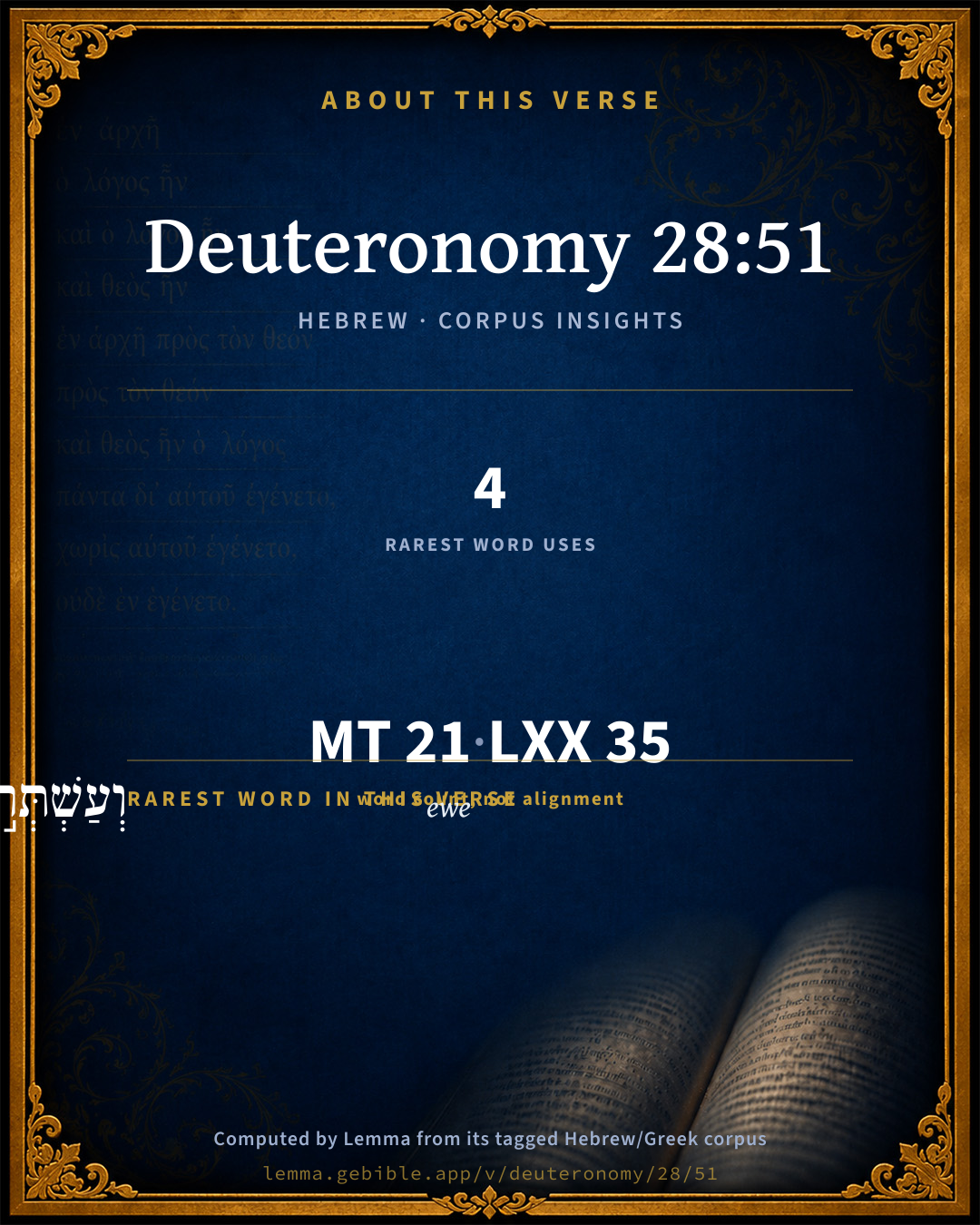
These counts appear in no published source. They are computed here, from the morphology-tagged text and Lemma’s own curated glosses. What Lemma adds →

21
words
18
distinct lemmas
Pentateuch
section

Notable vocabulary

The rarest word here is וְעַשְׁתְּרֹ֣ת ewe H6251 — appearing just 4 times in the whole Hebrew Bible.

Shared distinctive vocabulary

וְעַשְׁתְּרֹ֣ת ewe H6251 occurs in 4 verses of the Hebrew Bible. Also found in:

Grammatical profile

  • 4 verbs
  • 11 nouns
  • 3 prepositions
  • 3 particles

Verb forms

  • וְ֠אָכַל Qal · Sequential Perfect
  • הִשָּֽׁמְדָךְ֒ Niphal · Infinitive Construct
  • יַשְׁאִ֜יר Hiphil · Imperfect
  • הַאֲבִיד֖וֹ Hiphil · Infinitive Construct

Repetition

Words recur within this verse — often emphatic in Hebrew:

  • פְּרִ֨י fruit H6529 ×2
  • עַ֣ד until H5704 ×2

Hebrew & Septuagint length

In English translation the verse runs 47 words from the Hebrew and 43 from the Septuagint (LXX English) — closely comparable.

A rough comparison of the two English renderings, which tokenize alike — not a word-level alignment.

Word counts can differ between the Hebrew and the Greek without any difference in meaning — e.g. the Hebrew direct-object marker אֵת has no separate Greek word, and Greek often adds the article ὁ.

In the original languages it is 21 Hebrew tokens and 35 Greek tokens — but the two are counted differently (Hebrew bundles its prefixes and suffixes into one token; the Greek is in lemma form), so that isn’t a like-for-like length.

Cross-references

8

Topical passages linked to Deuteronomy 28:51 in the Treasury of Scripture Knowledge — connected by theme and wording, ordered by reader-vote popularity; previews shown in the World English Bible.

  • Deuteronomy 28:33 The fruit of your ground, and all your labors, shall a nation which you don't know eat up; and you shall be only oppressed and crushed always;
  • Isaiah 62:8 Yahweh has sworn by his right hand, and by the arm of his strength, Surely I will no more give your grain to be food for your enemies; and foreigners shall not drink your new wine, for which you have labored:
  • Leviticus 26:26 When I break your staff of bread, ten women shall bake your bread in one oven, and they shall deliver your bread again by weight: and you shall eat, and not be satisfied.
  • Isaiah 1:7 Your country is desolate. Your cities are burned with fire. Strangers devour your land in your presence, And it is desolate, As overthrown by strangers.
  • Jeremiah 15:13 Your substance and your treasures will I give for a spoil without price, and that for all your sins, even in all your borders.
  • Jeremiah 17:3 My mountain in the field, I will give your substance and all your treasures for a spoil, [and] your high places, because of sin, throughout all your borders.
  • Ezekiel 12:19 and tell the people of the land, Thus says the Lord Yahweh concerning the inhabitants of Jerusalem, and the land of Israel: They shall eat their bread with fearfulness, and drink their water in dismay, that her land may be desolate, [and despoiled] of all that is therein, because of the violence of all those who dwell therein.
  • Habakkuk 3:16–17 I heard, and my body trembled. My lips quivered at the voice. Rottenness enters into my bones, and I tremble in my place, Because I must wait quietly for the day of trouble, For the coming up of the people who invade us.

Cross-references courtesy of OpenBible.info (CC BY 4.0).

Hebrew and Greek witnesses Masoretic Hebrew ↔ Greek Septuagint

The same verse in the two great witnesses to the Old Testament, shown verse-for-verse.

These are two independent witnesses, not word-aligned to each other, and the Septuagint is shown in lemma (dictionary) form.

Hebrew Deuteronomy 28:51 Masoretic · Westminster Leningrad Codex

וְ֠אָכַל פְּרִ֨י בְהֶמְתְּךָ֥ וּפְרִֽי אַדְמָתְךָ֮ עַ֣ד הִשָּֽׁמְדָךְ֒ אֲשֶׁ֨ר לֹֽא יַשְׁאִ֜יר לְךָ֗ דָּגָן֙ תִּיר֣וֹשׁ וְיִצְהָ֔ר שְׁגַ֥ר אֲלָפֶ֖יךָ וְעַשְׁתְּרֹ֣ת צֹאנֶ֑ךָ עַ֥ד הַאֲבִיד֖וֹ אֹתָֽךְ

and shall eat the fruit of your cattle, and the fruit of your ground, until you are destroyed; that also shall not leave you grain, new wine, or oil, the increase of your cattle, or the young of your flock, until they have caused you to perish.

World English Bible · Public Domain

Greek LXX Deuteronomy 28:51 Septuagint · lemma form

καί καταἐσθίω ὁ ἔκγονος ὁ κτῆνος σύ καί ὁ γένημα ὁ γῆ σύ ὥστε μή καταλείπω σύ σῖτος οἶνος ἔλαιον ὁ βουκόλιον ὁ βοῦς σύ καί ὁ ποίμνιον ὁ πρόβατον σύ ἕως ἄν ἀποὀλλύω σύ

And it shall eat up the young of your cattle, and the fruits of your land, so as not to leave to you corn, wine, oil, the herds of your oxen, and the flocks of your sheep, until it shall have destroyed you;

LXX2012 (modern English Septuagint) · Public Domain

On this verse, The Cambridge Bible for Schools and Colleges discusses the Septuagint’s reading. Read the note in Commentary ↓

Hebrew: Westminster Leningrad Codex (CC BY 4.0). Greek: Septuagint (public domain); English from LXX2012 (modern English Septuagint) (Public Domain). How the Septuagint differs from the Hebrew →

Targum (Aramaic paraphrase)

2

The Targum is the ancient Jewish Aramaic paraphrase of the Hebrew Scriptures — an interpretive translation, not the Hebrew text itself. Onkelos (literal) and Pseudo-Jonathan (expansive) render the Torah, and Jonathan the Prophets. Coverage is partial: where no permissively-licensed English translation exists for a verse, only the Aramaic is shown. This is verse-level text, not a word-by-word alignment to the Hebrew.

  1. Targum Onkelos Torah (Genesis–Deuteronomy)
    וְיֵיכוּל וַלְדָא דִבְעִירָךְ וְאִבָּא דְאַרְעָךְ עַד דְתִשְׁתֵּצֵי דִי לָא יַשְׁאַר לָךְ עִבוּרָא חַמְרָא וּמִשְׁחָא בַּקְרֵי תוֹרָיךְ וְעֶדְרֵי עָנָךְ עַד דְיוֹבֵד יָתָךְ

    (no public-domain English translation for this verse)

    Targum Onkelos — Aramaic: “Onkelos Genesis” (public domain); “Onkelos Exodus” (public domain); “Onkelos Leviticus” (public domain); “Onkelos Numbers” (public domain); “Onkelos Deuteronomy” (public domain). English: “Sefaria Community Translation” (CC0 1.0 (public-domain dedication)); “J.W. Etheridge. The Targums of Onkelos and Jonathan Ben Uzziel on the Pentateuch. London: Longmans, Green, 1862” (public domain). Text via Sefaria.

  2. Targum Pseudo-Jonathan Torah (Genesis–Deuteronomy)
    וְיִגְמְרוּן וַולְדֵי דִבְעִרֵיכוֹן וּפֵירֵי אַרְעֲכוֹן עַד דְתִשְׁתֵּיצוּן דְלָא יְשַׁיְירוּן לְכוֹן עִבּוּר מְשַׁח וַחֲמַר בַּקְרֵי תוֹרֵיכוֹן וְעֶדְרֵי עָנֵיכוֹן עַד זְמַן דִי יְהוֹבְדוּן יַתְכוֹן

    And they will consume the increase of your cattle and the fruit of your ground till you are wasted away; for they will leave you neither corn, oil, wine, herds, nor flocks, until the time that they have destroyed you.

    Targum Pseudo-Jonathan — Aramaic: “Targum Jonathan on Genesis” (public domain); “Targum Jonathan on Exodus” (public domain); “Targum Jonathan on Leviticus” (public domain); “Targum Jonathan on Numbers” (public domain); “Targum Jonathan on Deuteronomy” (public domain). English: “The Targum of Jonathan ben Uzziel, trans. J. W. Etheridge, London, 1862” (public domain). Text via Sefaria.

Commentary

Notes on Deuteronomy 28:51 from classic Christian and Jewish commentators (each source and its license shown beneath its notes). The classic Christian expositions comment on the surrounding passage and are grouped to its opening verse, so a note may address several verses; the Jewish commentaries on the Tanakh (Rashi and others) are per-verse, so they appear only where the commentator wrote on this verse.

Lemma curates 59 commentaries, every one of them public domain or Creative Commons licensed, each selected and text-cleaned for this edition rather than reprinted as found. About our sources →

Trapp's Complete Commentary

John Trapp

Deu 28:51 And he shall eat the fruit of thy cattle, and the fruit of thy land, until thou be destroyed: which [also] shall not leave thee [either] corn, wine, or oil, [or] the increase of thy kine, or flocks of thy sheep, until he have destroyed thee.

Ver. 51. Fruit of thy cattle.] See on Deu 28:31.

John Trapp, A Commentary or Exposition upon All the Books of the Old and New Testament (1647–1656) — public domain. Text from a community e-Sword module.

Geneva Bible (1599)

Geneva Bible translators

Or, firstborn of thy bullock.

Geneva Bible (1599) marginal notes — public domain. Text via Bolls.life.

Jamieson, Fausset & Brown

Robert Jamieson, A. R. Fausset & David Brown

he shall eat the fruit of thy cattle, &c.--According to the Jewish historian, every district of the country through which they passed was strewn with the wrecks of their devastation.

Jamieson, Fausset & Brown — Commentary Critical and Explanatory on the Whole Bible (1871) — public domain (CC PDM 1.0). Text via the HelloAO Bible API.

The Cambridge Bible for Schools and Colleges

gen. ed. J. J. S. Perowne

51. See Deu_28:4; Deu_28:18; Deu_28:20; Deu_28:24. All but a few LXX codd. omit until thou be destroyed.

The Cambridge Bible for Schools and Colleges (gen. ed. J. J. S. Perowne; Cambridge University Press, 1878–1918) — public domain. Text from a community e-Sword module.

John Gill's Exposition

So that he will not give to any of them of the flesh of his children whom he shall eat,.... Neither give to a brother, nor to a wife, nor to any of his remaining children, the least bit of the flesh of a child he has killed and dressed for his own food; which adds to the barbarity of his action:

because he hath nothing left him in the siege, and in the straitness wherewith thine enemies shall distress thee in all thy gates; every creature being eaten up, dogs, cats, &c. and whatsoever else could be any ways made food of; as the dung of beasts, belts, shoes, the leather on shields, &c. as Josephus (d) says they did eat; and this being the case, nothing eatable remaining, therefore his heart would be hardened against his nearest relations, and not allow them the least part with him, even of what was so shocking and unnatural.

(d) De Bello Jud. l. 6. c. 3. sect. 3.

John Gill's Exposition of the Whole Bible (1746–1763) — public domain (CC PDM 1.0). Text via the HelloAO Bible API.

Haydock's Catholic Bible Commentary

Until thou be destroyed. This was not expressed in the Septuagint.

George Leo Haydock (1774–1849), Haydock's Catholic Family Bible and Commentary, 1859 edition — public domain. Excludes Psalms (Douay-Rheims chapter numbering differs from Protestant) and Deuterocanonical books (Catholic canon only).

Lesson kit

Teaching starters — assembled from the data on this page, not authored interpretation. Every prompt links to the verse data it draws on. Edit before teaching.

Deuteronomy, in the Pentateuch, opens this verse with 21 words (18 distinct Hebrew lemmas). Its most distinctive word is ʻashtᵉrâh (“ewe”). A historical commentator’s framing appears above. Read the whole chapter for the surrounding context.

Discussion questions

  1. The word ʻashtᵉrâh carries the sense “ewe.” How does it shape the verse?
  2. How does Deuteronomy 7:13, which shares the word «ewe», read alongside this verse?
  3. What does the repetition of “fruit” (2× in this one verse) do in this verse?
  4. The translations on this page render this verse differently — a whole-verse word diff, not a word-by-word alignment. What might account for the different wordings?
  5. «וְ֠אָכַל» is a Qal Sequential Perfect verb. How does that grammatical form shape the action described?
  6. Compare how Trapp's Complete Commentary and Geneva Bible (1599) read this verse. Where do they agree or differ?

Things to notice

Reading settings

Reading text

Shown beneath each verse's original-language words.

Old Testament
Old Testament edition

Read the OT as the Masoretic Hebrew (MT) or the Greek Septuagint (LXX).

English shown for the Greek Septuagint (in the Hebrew ↔ Greek comparison).

Comparing translations? Open the Compare panel on any verse page to stack up to four side by side.