
Exodus 9:3

Hebrew (Westminster Leningrad Codex) Exodus 9:3 appears in the Hebrew Old Testament. The text above is from the Westminster Leningrad Codex. Each word links to its Strong’s number, a concise gloss, and parsing drawn from the Open Scriptures Hebrew Bible morphology. Click any word for its full Brown-Driver-Briggs (BDB) entry.
Download image
Cite this verse

Exodus 9:3 (World English Bible). Public Domain. Lemma interlinear Bible study tool, https://lemma.gebible.app/v/exodus/9/3.

Show BibTeX & RIS
BibTeX
RIS
English Translation
behold, the hand of Yahweh is on your cattle which are in the field, on the horses, on the donkeys, on the camels, on the herds, and on the flocks with a very grievous pestilence.
World English Bible · Public Domain
Download a study sheet

One document with this verse’s original text, its word-by-word gloss line, the meaning frame, cross-references with their text, attributed commentary, and full source and license credits — printable, and it pastes into notes with its structure intact.

This verse Autodidact and up

Study sheet (.html) Plain text (.txt)

A passage Seminary Student

Up to 50 verses in one chapter. A passage sheet keeps up to 6 commentary sources and 12 cross-references per verse, in the order this page ranks them, and says so on the sheet whenever that leaves anything out. Ask for a single verse and you get the Autodidact verse sheet above.

Everything on this page stays free to read, with no account — the sheet is a download of what is already on screen, not access to it.

Want to remove ads? Support Godless Engineer
Compare translations 3

The same verse in 3 English versions, stacked beneath the original-language interlinear above. Click any original word for its lexicon entry.

Each is an independent rendering of the whole verse — the interlinear is not word-aligned to these translations.

Highlighted words mark where these versions differ — a whole-verse word diff, not a word-by-word alignment.

  • World English Bible Public Domain
    behold, the hand of Yahweh is on your cattle which are in the field, on the horses, on the donkeys, on the camels, on the herds, and on the flocks with a very grievous pestilence.
  • King James Version Public Domain
    Behold, the hand of the LORD is upon thy cattle which is in the field, upon the horses, upon the asses, upon the camels, upon the oxen, and upon the sheep: there shall be a very grievous murrain.
  • unfoldingWord Literal Text CC BY-SA 4.0
    behold! The hand of Yahweh is about to be on your livestock which are in the field, on the horses, on the donkeys, on the camels, on the cattle, and on the flock—an exceedingly heavy plague.

unfoldingWord Literal Text — © unfoldingWord, licensed CC BY-SA 4.0. Word-aligned USFM3 via Door43 (git.door43.org/unfoldingWord/en_ult).

Versions to compare (up to 4)

3 of 4 selected

Show all 18 translations

Every available English version of this verse, each an independent rendering of the whole verse.

  • World English Bible Public Domain
    behold, the hand of Yahweh is on your cattle which are in the field, on the horses, on the donkeys, on the camels, on the herds, and on the flocks with a very grievous pestilence.
  • Berean Standard Bible Public Domain
    then the hand of the LORD will bring a severe plague on your livestock in the field—on your horses, donkeys, camels, herds, and flocks.
  • Majority Standard Bible Public Domain
    then the hand of the LORD will bring a severe plague on your livestock in the field—on your horses, donkeys, camels, herds, and flocks.
  • King James Version Public Domain
    Behold, the hand of the LORD is upon thy cattle which is in the field, upon the horses, upon the asses, upon the camels, upon the oxen, and upon the sheep: there shall be a very grievous murrain.
  • American Standard Version (1901) Public Domain
    behold, the hand of Jehovah is upon thy cattle which are in the field, upon the horses, upon the asses, upon the camels, upon the herds, and upon the flocks: `there shall be' a very grievous murrain.
  • Revised Version (1885) Public Domain
    behold, the hand of the LORD is upon thy cattle which is in the field, upon the horses, upon the asses, upon the camels, upon the herds, and upon the flocks: there shall be a very grievous murrain.
  • Geneva Bible (1599) Public Domain
    Beholde, the hande of the Lord is vpon thy flocke which is in the fielde: for vpon the horses, vpon the asses, vpon the camels, vpon the cattell, and vpon the sheepe shalbe a mightie great moraine.
  • Douay-Rheims (1899) Public Domain
    Behold my hand shall be upon thy fields: and a very grievous murrain upon thy horses, and asses, and camels, and oxen, and sheep.
  • Young's Literal Translation Public Domain
    lo, the hand of Jehovah is on thy cattle which `are' in the field, on horses, on asses, on camels, on herd, and on flock -- a pestilence very grievous.
  • Literal Standard Version CC BY-SA 4.0
    behold, the hand of YHWH is on your livestock which [are] in the field, on horses, on donkeys, on camels, on herd, and on flock—a very grievous pestilence.
  • Unlocked Literal Bible CC BY-SA 4.0
    then Yahweh's hand will be on your cattle in the fields and on the horses, donkeys, camels, herds, and flocks, and it will cause a terrible disease.
  • unfoldingWord Literal Text CC BY-SA 4.0
    behold! The hand of Yahweh is about to be on your livestock which are in the field, on the horses, on the donkeys, on the camels, on the cattle, and on the flock—an exceedingly heavy plague.
  • Darby Bible Public Domain
    behold, the hand of Jehovah shall be on thy cattle which is in the field, on the horses, on the asses, on the camels, on the oxen and on the sheep, with a very grievous plague.
  • World Messianic Bible Public Domain
    behold, the LORD’s hand is on your livestock which are in the field, on the horses, on the donkeys, on the camels, on the herds, and on the flocks with a very grievous pestilence.
  • Webster's Bible Public Domain
    Behold, the hand of the LORD is upon thy cattle which are in the field, upon the horses, upon the asses, upon the camels, upon the oxen, and upon the sheep: there shall be a very grievous murrain.
  • Free Bible Version CC BY-SA 4.0
    I will punish you by bringing a very severe plague on your livestock—on your horses, donkeys, camels, herds, and flocks.
  • Bible in Basic English Public Domain
    Then the hand of the Lord will put on your cattle in the field, on the horses and the asses and the camels, on the herds and the flocks, a very evil disease.
  • JPS Tanakh (1917) Public Domain
    behold, the hand of the LORD is upon thy cattle which are in the field, upon the horses, upon the asses, upon the camels, upon the herds, and upon the flocks; there shall be a very grievous murrain.

Literal Standard Version (2020), Covenant Press — licensed CC BY-SA 4.0. Text via the HelloAO Bible API (eBible.org). Unlocked Literal Bible (unfoldingWord) — licensed CC BY-SA 4.0. Text via the HelloAO Bible API (eBible.org). unfoldingWord Literal Text — © unfoldingWord, licensed CC BY-SA 4.0. Word-aligned USFM3 via Door43 (git.door43.org/unfoldingWord/en_ult). Free Bible Version, Dr. Jonathan Gallagher — licensed CC BY-SA 4.0. Text via the HelloAO Bible API (eBible.org).

Word by word

More ways to search: Search by grammar → Find every occurrence → Compare this word →

Practice this passage: Drill this verse → Learn its vocabulary →

כָּבֵ֥ד
kâbêd
H3515
“heavy”
Adjective, Adjective, Masculine, Singular, Absolute
Part of Speech
Adjective
Type
Adjective
Gender
Masculine
Number
Singular
State
Absolute
Full BDB Definition

Origin: from H3513

TWOT: 943a

heavy, great - heavy - massive, abundant, numerous - heavy, dull - hard, difficult, burdensome - very oppressive, numerous, rich
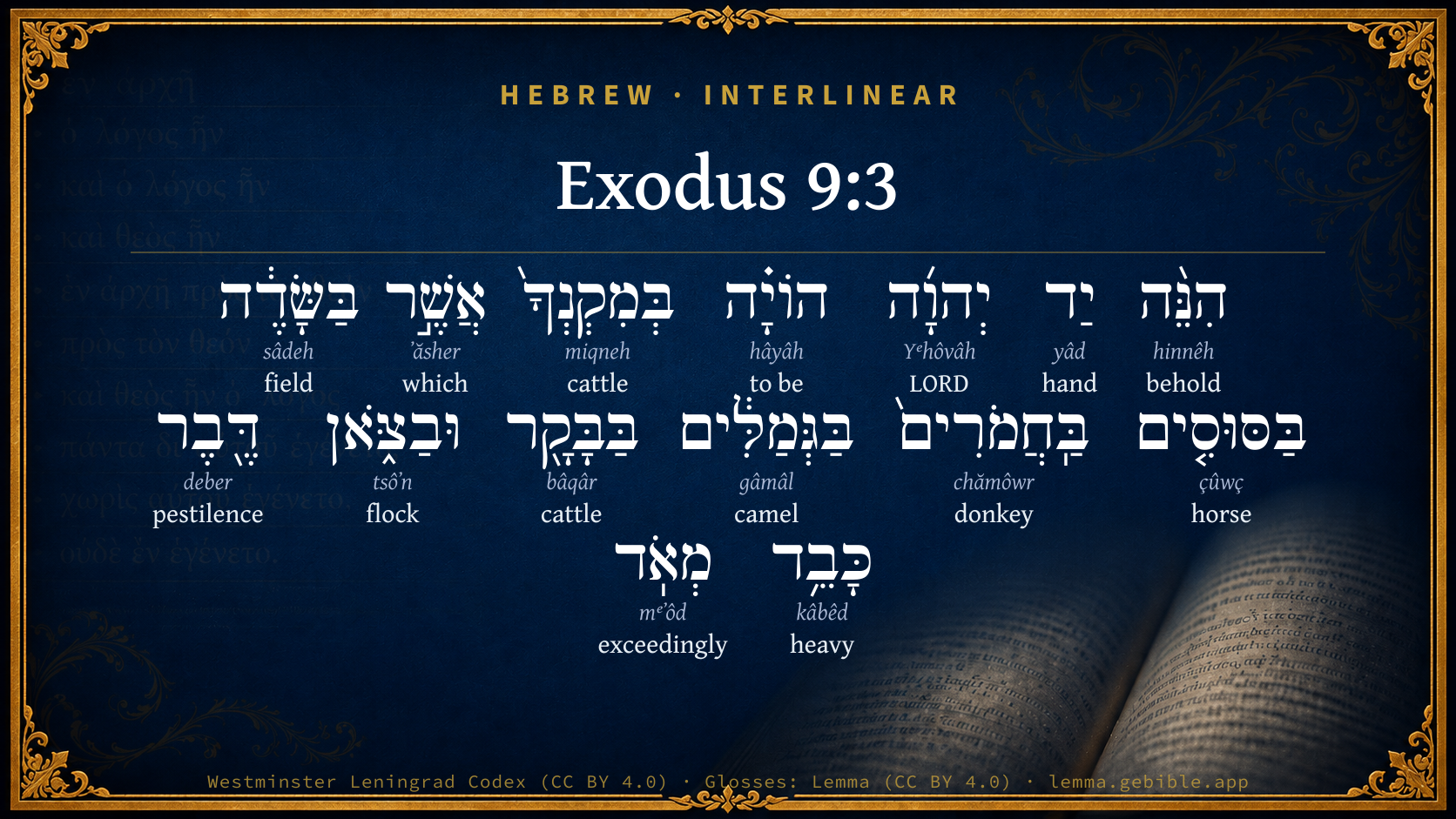
  1. הִנֵּ֨ה hinnêh H2009 “behold” Particle, Demonstrative
  2. יַד yâd H3027 “hand of” Noun, Common, Both, Singular, Construct
  3. יְהוָ֜ה Yᵉhôvâh H3068 “LORD” Noun, Proper
  4. הוֹיָ֗ה hâyâh H1961 “being” Verb, Qal, Participle Active, Feminine, Singular, Absolute
  5. בְּמִקְנְךָ֙ miqneh H4735 “in/at · cattle · your” Preposition + Noun, Common, Masculine, Singular, Construct + Suffix, Personal, 2nd Person, Masculine, Singular
  6. אֲשֶׁ֣ר ʼăsher H834 “which” Particle, Relative
  7. בַּשָּׂדֶ֔ה sâdeh H7704 “in/at the · field” Preposition, Determined + Noun, Common, Masculine, Singular, Absolute
  8. בַּסּוּסִ֤ים çûwç H5483 “in/at the · horses” Preposition, Determined + Noun, Common, Masculine, Plural, Absolute
  9. בַּֽחֲמֹרִים֙ chămôwr H2543 “in/at the · donkeys” Preposition, Determined + Noun, Common, Both, Plural, Absolute
  10. בַּגְּמַלִּ֔ים gâmâl H1581 “in/at the · camels” Preposition, Determined + Noun, Common, Masculine, Plural, Absolute
  11. בַּבָּקָ֖ר bâqâr H1241 “in/at the · cattle” Preposition, Determined + Noun, Common, Both, Singular, Absolute
  12. וּבַצֹּ֑אן tsôʼn H6629 “and · in/at the · flock” Conjunction + Preposition, Determined + Noun, Common, Both, Singular, Absolute
  13. דֶּ֖בֶר deber H1698 “pestilence” Noun, Common, Masculine, Singular, Absolute
  14. מְאֹֽד mᵉʼôd H3966 “exceedingly” Adverb

About this verse

These counts appear in no published source. They are computed here, from the morphology-tagged text and Lemma’s own curated glosses. What Lemma adds →

15
words
15
distinct lemmas
Pentateuch
section

Shared distinctive vocabulary

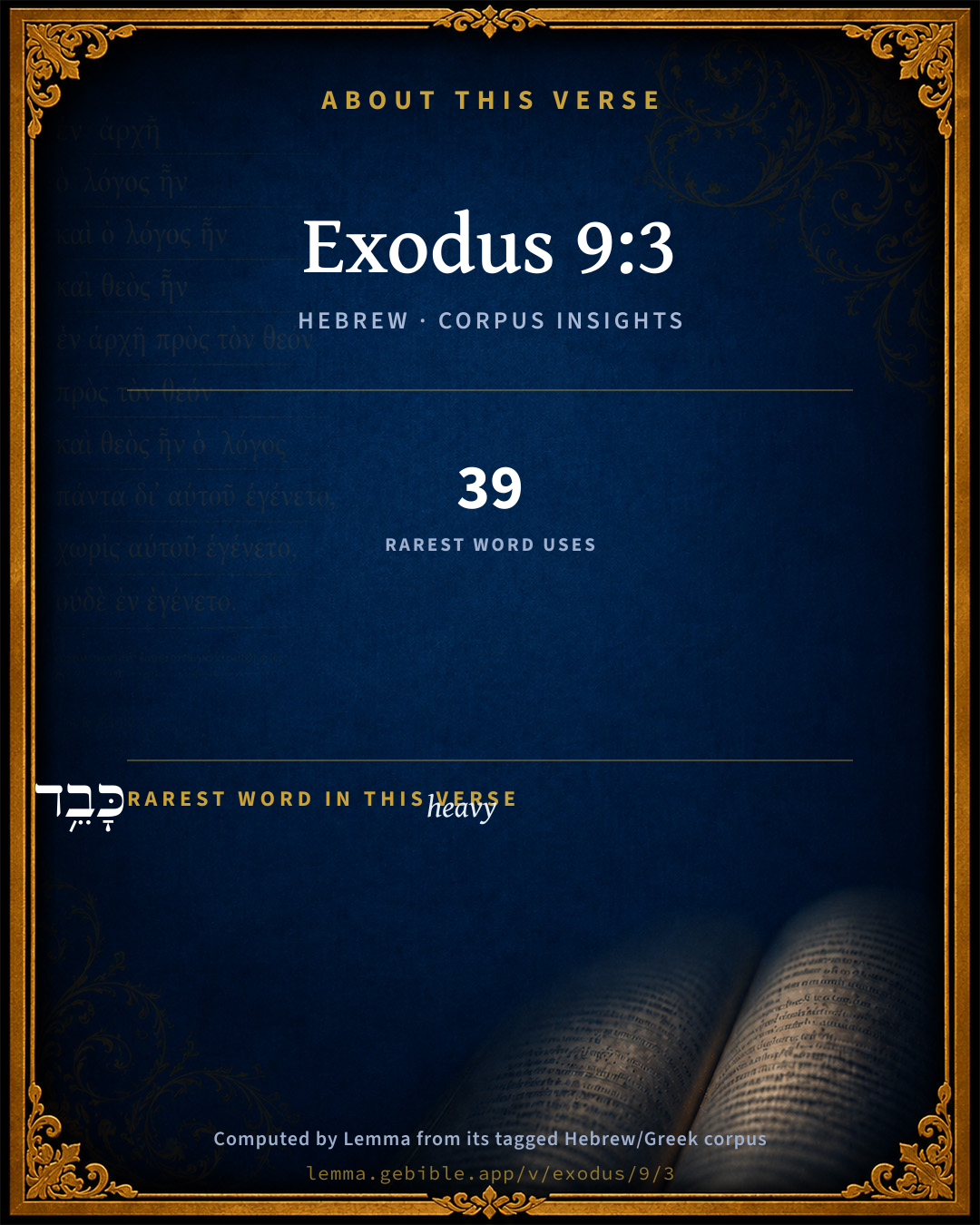
כָּבֵ֥ד heavy H3515 occurs in 38 verses of the Hebrew Bible. Also found in:

Grammatical profile

  • 1 verb
  • 10 nouns
  • 1 adjective
  • 1 adverb
  • 2 particles

Verb forms

  • הוֹיָ֗ה Qal · Participle Active

Hebrew & Septuagint length

In English translation the verse runs 35 words from the Hebrew and 34 from the Septuagint (LXX English) — closely comparable.

A rough comparison of the two English renderings, which tokenize alike — not a word-level alignment.

Word counts can differ between the Hebrew and the Greek without any difference in meaning — e.g. the Hebrew direct-object marker אֵת has no separate Greek word, and Greek often adds the article ὁ.

Cross-references

6

Topical passages linked to Exodus 9:3 in the Treasury of Scripture Knowledge — connected by theme and wording, ordered by reader-vote popularity; previews shown in the World English Bible.

  • Exodus 7:4 But Pharaoh will not listen to you, and I will lay my hand on Egypt, and bring forth my hosts, my people the children of Israel, out of the land of Egypt by great judgments.
  • Acts 13:11 Now, behold, the hand of the Lord is on you, and you will be blind, not seeing the sun for a season!" Immediately there fell on him a mist and darkness. He went around seeking someone to lead him by the hand.
  • Exodus 5:3 They said, "The God of the Hebrews has met with us. Please let us go three days' journey into the wilderness, and sacrifice to Yahweh, our God, lest he fall on us with pestilence, or with the sword."
  • Exodus 8:19 Then the magicians said to Pharaoh, "This is the finger of God:" and Pharaoh's heart was hardened, and he didn't listen to them; as Yahweh had spoken.
  • 1 Samuel 5:6–11 But the hand of Yahweh was heavy on them of Ashdod, and he destroyed them, and struck them with tumors, even Ashdod and the borders of it.
  • 1 Samuel 6:9 Behold; if it goes up by the way of its own border to Beth-shemesh, then he has done us this great evil: but if not, then we shall know that it is not his hand that struck us; it was a chance that happened to us."

Cross-references courtesy of OpenBible.info (CC BY 4.0).

Hebrew and Greek witnesses Masoretic Hebrew ↔ Greek Septuagint

The same verse in the two great witnesses to the Old Testament, shown verse-for-verse.

These are two independent witnesses, not word-aligned to each other, and the Septuagint is shown in lemma (dictionary) form.

Hebrew Exodus 9:3 Masoretic · Westminster Leningrad Codex

הִנֵּ֨ה יַד יְהוָ֜ה הוֹיָ֗ה בְּמִקְנְךָ֙ אֲשֶׁ֣ר בַּשָּׂדֶ֔ה בַּסּוּסִ֤ים בַּֽחֲמֹרִים֙ בַּגְּמַלִּ֔ים בַּבָּקָ֖ר וּבַצֹּ֑אן דֶּ֖בֶר כָּבֵ֥ד מְאֹֽד

behold, the hand of Yahweh is on your cattle which are in the field, on the horses, on the donkeys, on the camels, on the herds, and on the flocks with a very grievous pestilence.

World English Bible · Public Domain

Greek LXX Exodus 9:3 Septuagint · lemma form

ἰδού χείρ κύριος ἐπιεἰμί ἐν ὁ κτῆνος σύ ὁ ἐν ὁ πεδίον ἐν τε ὁ ἵππος καί ἐν ὁ ὑποζύγιον καί ὁ κάμηλος καί βοῦς καί πρόβατον θάνατος μέγας σφόδρα

behold, the hand of the Lord shall be upon your cattle in the fields, both on the horses, and on the asses, and on the camels and oxen and sheep, a very great mortality.

LXX2012 (modern English Septuagint) · Public Domain

On this verse, Adam Clarke's Commentary discusses the Septuagint’s reading. Read the note in Commentary ↓

Hebrew: Westminster Leningrad Codex (CC BY 4.0). Greek: Septuagint (public domain); English from LXX2012 (modern English Septuagint) (Public Domain). How the Septuagint differs from the Hebrew →

Targum (Aramaic paraphrase)

2

The Targum is the ancient Jewish Aramaic paraphrase of the Hebrew Scriptures — an interpretive translation, not the Hebrew text itself. Onkelos (literal) and Pseudo-Jonathan (expansive) render the Torah, and Jonathan the Prophets. Coverage is partial: where no permissively-licensed English translation exists for a verse, only the Aramaic is shown. This is verse-level text, not a word-by-word alignment to the Hebrew.

  1. Targum Onkelos Torah (Genesis–Deuteronomy)
    הָא מָחָא מִן קֳדָם יְיָ הַוְיָא בִּבְעִירָךְ דִי בְחַקְלָא בְּסוּסְוָתָא בַּחֲמָרֵי בְּגַמְלֵי בְּתוֹרֵי וּבְעָנָא מוֹתָא תַּקִיף לַחֲדָא:

    (no public-domain English translation for this verse)

    Targum Onkelos — Aramaic: “Onkelos Genesis” (public domain); “Onkelos Exodus” (public domain); “Onkelos Leviticus” (public domain); “Onkelos Numbers” (public domain); “Onkelos Deuteronomy” (public domain). English: “Sefaria Community Translation” (CC0 1.0 (public-domain dedication)); “J.W. Etheridge. The Targums of Onkelos and Jonathan Ben Uzziel on the Pentateuch. London: Longmans, Green, 1862” (public domain). Text via Sefaria.

  2. Targum Pseudo-Jonathan Torah (Genesis–Deuteronomy)
    הָא מְחַת יְדָא דַיְיָ הַוְיָא כְּעַן כַּד לָא הֲוַת לְמֶהֱוֵי בִּבְעִירָךְ דִבְחַקְלָא בְּסוּסְוָותָא בְּחַמְרֵי בִּגְמַלֵי בְּתוֹרֵי וּבְעָנָא מוֹתָא תַקִיף לַחֲדָא

    behold, the stroke of the Lord's hand shall be as it hath not been yet, upon thy cattle that are in the field, upon the horses, and upon the asses, upon the camels, oxen, and sheep, with a very mighty death.

    Targum Pseudo-Jonathan — Aramaic: “Targum Jonathan on Genesis” (public domain); “Targum Jonathan on Exodus” (public domain); “Targum Jonathan on Leviticus” (public domain); “Targum Jonathan on Numbers” (public domain); “Targum Jonathan on Deuteronomy” (public domain). English: “The Targum of Jonathan ben Uzziel, trans. J. W. Etheridge, London, 1862” (public domain). Text via Sefaria.

Commentary

Notes on Exodus 9:3 from classic Christian and Jewish commentators (each source and its license shown beneath its notes). The classic Christian expositions comment on the surrounding passage and are grouped to its opening verse, so a note may address several verses; the Jewish commentaries on the Tanakh (Rashi and others) are per-verse, so they appear only where the commentator wrote on this verse.

Lemma curates 59 commentaries, every one of them public domain or Creative Commons licensed, each selected and text-cleaned for this edition rather than reprinted as found. About our sources →

The Cambridge Bible for Schools and Colleges

gen. ed. J. J. S. Perowne

3. cattle] lit. possessions, commonly used of possessions in sheep and oxen (Exo_12:38, Gen_47:14), but including here other animals as well.

camels] Camels were not used, or bred, in ancient Egypt, nor do they appear ‘in any inscription or painting before the Greek period’ (Erman, p. 493; cf. W. Max Müller, EB. i. 634; Sayce, EHH. 169). They look here like an anachronism: the reference may however be to camels belonging to traders, which had brought merchandise into Egypt across the desert from Arabia, or elsewhere (cf. Gen_37:25).

grievous] i.e. severe: see on Exo_8:24.

murrain] the word which, when used of a disease of men, is commonly rendered pestilence (v. 15, Exo_9:3, and frequently); it is applied to a cattle plague only here and Psa_78:50.

Egypt does not seem to be often visited by cattle plagues. Pruner (Krankheiten des Orients, p. 108 ff.), and Lepsius (Letters from Eg., p. 44), cited by Kn., mention, however, a severe epidemic which began in 1842, and by June, 1843, had raged for nine months (Mrs Poole, The Englishwoman in Egypt, 1844, ii. 114 f.), causing great mortality among oxen and sheep, though it did not affect camels or horses. Pruner attributed this epidemic to the water of the Nile, which was low and impure at the time when it began: cattle which were at a distance from the Nile, and could obtain good water, were not attacked by it. There have also been cattle plagues in Egypt in recent years.

The Cambridge Bible for Schools and Colleges (gen. ed. J. J. S. Perowne; Cambridge University Press, 1878–1918) — public domain. Text from a community e-Sword module.

Trapp's Complete Commentary

John Trapp

Exo 9:3 Behold, the hand of the LORD is upon thy cattle which [is] in the field, upon the horses, upon the asses, upon the camels, upon the oxen, and upon the sheep: [there shall be] a very grievous murrain.

Ver. 3. Is upon thy cattle.] Both those ad esum and those ad usum. Men sin, these suffer, and therefore groan. {Rom 8:22}

John Trapp, A Commentary or Exposition upon All the Books of the Old and New Testament (1647–1656) — public domain. Text from a community e-Sword module.

Joseph Benson's Commentary

Exo 9:3. The hand of the Lord — Immediately, without the stretching out of Aaron’s hand; is upon the cattle — Many of which, some of all kinds, should die by a sort of pestilence. The hand of God is to be acknowledged even in the sickness and death of cattle, or other damage sustained in them; for a sparrow falls not to the ground without our Father. And his providence is to be acknowledged with thankfulness in the life of the cattle, for he preserveth man and beast, Psa 36:6.

Joseph Benson's Commentary on the Old and New Testaments (1811–1818) — public domain. Text from a community e-Sword module.

Tyndale Open Study Notes

Tyndale Open Resources

9:3 Your livestock refers specifically to field animals. Other animals would have boils inflicted upon them in the next plague. • The term all (also in 9:6) is not absolute; it does not mean that every single livestock animal was killed. There were still some left to protect from the hail of the seventh plague (9:20).

Tyndale Open Study Notes — © Tyndale Open Resources, licensed CC BY-SA 4.0. Text via the HelloAO Bible API.

Geneva Bible (1599)

Geneva Bible translators

The fifth plague.

Geneva Bible (1599) marginal notes — public domain. Text via Bolls.life.

Adam Clarke's Commentary

The FIFTH plague - the MURRAIN

Verse 3. The hand of the Lord] The power of God manifested in judgment.

Upon the horses] סוסים susim. This is the first place the horse is mentioned; a creature for which Egypt and Arabia were always famous. sus is supposed to have the same meaning with שש sas, which signifies to be active, brisk, or lively, all which are proper appellatives of the horse, especially in Arabia and Egypt. Because of their activity and swiftness they were sacrificed and dedicated to the sun, and perhaps it was principally on this account that God prohibited the use of them among the Israelites.

A very grievous murrain.] The murrain is a very contagious disease among cattle, the symptoms of which are a hanging down and swelling of the head, abundance of gum in the eyes, rattling in the throat, difficulty of breathing, palpitation of the heart, staggering, a hot breath, and a shining tongue; which symptoms prove that a general inflammation has taken place. The original word דבר deber is variously translated. The Septuagint have θανατος, death; the Vulgate has pestis, a plague or pestilence; the old Saxon version, [Anglo-Saxon], from [Anglo-Saxon], to die, any fatal disease. Our English word murrain comes either from the French mourir, to die, or from the Greek μαραινω maraino, to grow lean, waste away. The term mortality would be the nearest in sense to the original, as no particular disorder is specified by the Hebrew word.

Adam Clarke's Commentary on the Bible (1810–1826) — public domain. Text from a community e-Sword/MySword module.

John Gill's Exposition

Behold, the hand of the Lord,.... Which was stronger than his, with which he held the Israelites:

is upon thy cattle which is in the field: this takes in all in general, of which the particulars follow, though limited to such as were in the field, and so did not take in what were at home in their out houses and stables:

upon the horses: of which there was great plenty in Egypt, as appears from various places of Scripture:

upon the asses; used for carrying burdens from place to place:

and upon the camels; used the like purposes, and to ride upon, and particularly to travel with through desert places for commerce, being able to proceed on without water for a considerable time:

upon the oxen, and upon the sheep; oxen were for labour to plough with, and sheep for their wool, and all of them to trade with: there shall be

a very grievous murrain: or "pestilence" (y), a very noisome one, and which would carry off great numbers; the Targums of Onkelos and Jonathan render it a "death", as the Jews commonly call a pestilence, whether on man or beast, because it generally sweeps away large numbers.

(y) "pestis", V. L. Pagninus, Montanus, Piscator; "pestilentia", Drusius; so Tigurine version.

John Gill's Exposition of the Whole Bible (1746–1763) — public domain (CC PDM 1.0). Text via the HelloAO Bible API.

Albert Barnes' Notes on the Bible

A very grievous murrain - Or “pestilence;” but the word “murrain,” i. e. “a great mortality,” exactly expresses the meaning. This terrible visitation struck far more severely than the preceding, which had caused distress and suffering; it attacked the resources of the nation.

The camels - These animals are only twice mentioned, here and Gen 12:16, in connection with Egypt. Though camels are never represented on the monuments, they were known to the Egyptians, and were probably used on the frontier.

Albert Barnes' Notes on the Bible (1834–1885) — public domain. Text from a community e-Sword/MySword module.

Haydock's Catholic Bible Commentary

My hand. God inflicts the fourth, fifth, and tenth plagues without Moses.

George Leo Haydock (1774–1849), Haydock's Catholic Family Bible and Commentary, 1859 edition — public domain. Excludes Psalms (Douay-Rheims chapter numbering differs from Protestant) and Deuterocanonical books (Catholic canon only).

Matthew Poole's English Annotations

The hand of the Lord; in an immediate manner, not by my rod, that thou mayst know it is not I, but the Lord, which doth all these things to thee.

Thy cattle which they kept for their wool or milk, or manifold uses and services, though not for food and sacrifice.

Matthew Poole's English Annotations on the Holy Bible (1683–1685) — public domain. Text from a community e-Sword/MySword module.

Whedon's Commentary on the Bible

Daniel D. Whedon

FIFTH PLAGUE — MURRAIN, Exo_9:1-7.

3. The hand of the Lord is upon thy cattle which is in the field — This infliction seems to be limited to the cattle which were in the open air. All of the animals here mentioned are represented in the Egyptian monuments except the camel, which, though used in Egypt from the earliest times, yet for some reason never occurs in the hieroglyphic inscriptions, or in the pictured representations of the tombs. Stuart Poole supposes that the camel was unclean in the eyes of the Egyptians, as associated with the hated nomad tribes of the desert and the abominated Shepherd Dynasties. See Gen_46:34, and note. In the populous cities and cultivated fields of the Nile valley the services of the camel would not be required; but to cross the sands which bounded the valley the “ship of the desert” was indispensable: yet perhaps the Egyptians generally employed the Arabs in this caravan service. The horses of Egypt were celebrated from early times: thence Solomon imported his into Palestine. They were greatly esteemed for chariot service and for war, but asses and cattle were generally employed for draught. The cheap, strong, patient ass was, and is, the peasant’s chief dependence for labour. Sheep were reared chiefly for their wool, mutton being rarely used. Large flocks were kept in the neighbourhood of Memphis, even to the number of two thousand.

Daniel D. Whedon (gen. ed.), Commentary on the Old and New Testaments (1874–1909) — public domain. Text from a community e-Sword module.

The Pulpit Commentary

Thy cattle which is in the field. The word "cattle" here is to be taken generally, as including under it the various kinds particularised. The cattle are mentioned as being at this time "in the field," because during the inundation all of them were brought in and housed, while, after the waters had retired, and the land had dried, most of them were turned out to graze. This is always the time at which epidemics break out. The horses, the asses, etc. Horses, which had been unknown prior to the Hyksos invasion, and which consequently do not appear in the list of animals presented to Abraham, (Gen_12:16) first became common under the eighteenth dynasty, when they seem to have been employed exclusively in war. Their use for agricultural purposes, which is perhaps here indicated, was not till later. (See Chabas, Etudes sur l"Antquite" Historic, p. 421.) The ass was employed in great numbers at all times in Egypt. Women and children rode on them, men sometimes in a sort of litter between two of them. They were chiefly used for carrying burthens, which were sometimes of enormous size (Lepsius, Denkmaler, Part 2. pls. 42a, 47, 56, 80 c, etc.). The camels. Camels are not represented on any Egyptian monument; but they are occasionally mentioned in the inscriptions (Chabas, Etudes, pp. 400-13). They are called kauri or kamaru. There is no doubt of their employment by the Egyptians as beasts of burthen in the traffic with Syria and with the Sinaitic peninsula.

The Pulpit Commentary (1880–1919), ed. H.D.M. Spence-Jones & Joseph S. Exell — public domain. Text from a community e-Sword module.

John Wesley's Explanatory Notes

The hand of the Lord - Immediately, without the stretching out of Aaron's hand, is upon the cattle, many of which, some of all kinds, shall die by a sort of pestilence. The hand of God is to be acknowledged even in the sickness and death of cattle, or other damage sustained in them; for a sparrow falls not to the ground without our father. And his providence is to be acknowledged with thankfulness in the life of the cattle, for he preserveth man and beast, Psalm xxxvi, 6.

John Wesley, Explanatory Notes Upon the Whole Bible (1754–1765) — public domain. Text via the GEBible commentary corpus.

Keil & Delitzsch

C. F. Keil & F. Delitzsch

"The hand of Jehovah will be (הויה, which only occurs here, as the participle of היה, generally takes its form from הוה, Neh 6:6; Ecc 2:22) against thy cattle...as a very severe plague (דּבר that which sweeps away, a plague), i.e., will smite them with a severe plague. A distinction was again made between the Israelites and the Egyptians. "Of all (the cattle) belonging to the children of Israel, not one (דּבּר Exo 9:4, = אחד Exo 9:6) shall die." A definite time was also fixed for the coming of the plague, as in the case of the previous one (Exo 8:23), in order that, whereas murrains occasionally occur in Egypt, Pharaoh might discern in his one the judgment of Jehovah.

Keil & Delitzsch — Biblical Commentary on the Old Testament (1861–1891) — public domain (CC PDM 1.0). Text via the HelloAO Bible API. (Old Testament only.)

Rashi

Rabbi Shlomo Yitzchaki (Rashi)

‎הנה יד ה׳ הוֹיָה BEHOLD THE HAND OF THE LORD IS — The verb הויה is in the present tense, for so one says in the feminine gender of the past היתה, “she was”, of the future, תהיה, “she will be” and of the present, הוֹיָה, the latter form being similar to עוֹשָׂה and רוֹצָה and רוֹעָה (Fem. part. sing. Kal of ל"ה verbs).

Rashi on the Tanakh — English translations: “The Judaica Press complete Tanach with Rashi, translated by A. J. Rosenberg” (CC BY 4.0); “Pentateuch with Rashi's commentary by M. Rosenbaum and A.M. Silbermann, 1929-1934” (public domain); “The Metsudah Tanach series, Lakewood, N.J” (CC BY 4.0); and “The Book of Joshua, Metsudah Publications, 1997” (CC BY 4.0). Text via Sefaria.

Ramban (Nachmanides)

Rabbi Moshe ben Nachman (Ramban / Nachmanides)

BEHOLD, THE HAND OF THE ETERNAL IS UPON THY CATTLE WHICH ARE IN THE FIELD. Scripture speaks of the ordinary custom that most cattle are in the field, but the plague was also upon the cattle in the houses, just as it is said, And all the cattle of Egypt died. It is possible that because every shepherd is an abomination unto the Egyptians, the Egyptians removed the cattle from the cities except for the use of horses for riding and asses for loading. Thus the cattle were located far from Egypt, grazing in the fields bordering upon Goshen, and in those pastures the cattle of the Egyptians and of the Israelites would intermingle. Therefore it was necessary that it be said, And the Eternal shall make a division between the cattle of Israel and the cattle of Egypt. It may be that the division was necessary because since the pestilence was caused by the change of air, it should naturally spread over the whole district, [affecting the cattle of the Israelites as well], but G-d dealt wondrously with them.

Ramban (Nachmanides) on the Tanakh — English translation: “Commentary on the Torah by Ramban (Nachmanides). Translated and annotated by Charles B. Chavel. New York, Shilo Pub. House, 1971-1976” (CC BY 4.0). Text via Sefaria.

Lesson kit

Teaching starters — assembled from the data on this page, not authored interpretation. Every prompt links to the verse data it draws on. Edit before teaching.

Exodus, in the Pentateuch, opens this verse with 15 words (15 distinct Hebrew lemmas). Its most distinctive word is kâbêd (“heavy”). A historical commentator’s framing appears above. Read the whole chapter for the surrounding context.

Discussion questions

  1. How does “heavy” (kâbêd) shape what this verse is saying?
  2. Genesis 12:10 shares the word «heavy» with this verse. How do the two illuminate each other?
  3. The translations on this page render this verse differently — a whole-verse word diff, not a word-by-word alignment. What might account for the different wordings?
  4. The verb «הוֹיָ֗ה» is Qal Participle Active. How does its form color the action?
  5. Reading how The Cambridge Bible for Schools and Colleges and Trapp's Complete Commentary read this verse, where do the two commentators agree and where do they part?

Things to notice

Reading settings

Reading text

Shown beneath each verse's original-language words.

Old Testament
Old Testament edition

Read the OT as the Masoretic Hebrew (MT) or the Greek Septuagint (LXX).

English shown for the Greek Septuagint (in the Hebrew ↔ Greek comparison).

Comparing translations? Open the Compare panel on any verse page to stack up to four side by side.