1 Samuel 15:21

Hebrew (Westminster Leningrad Codex) 1 Samuel 15:21 appears in the Hebrew Old Testament. The text above is from the Westminster Leningrad Codex. Each word links to its Strong’s number, a concise gloss, and parsing drawn from the Open Scriptures Hebrew Bible morphology. Click any word for its full Brown-Driver-Briggs (BDB) entry.
Download image
Cite this verse

1 Samuel 15:21 (World English Bible). Public Domain. Lemma interlinear Bible study tool, https://lemma.gebible.app/v/1-samuel/15/21.

Show BibTeX & RIS
BibTeX
RIS
English Translation
But the people took of the spoil, sheep and oxen, the chief of the devoted things, to sacrifice to Yahweh your God in Gilgal.
World English Bible · Public Domain
Download a study sheet

One document with this verse’s original text, its word-by-word gloss line, the meaning frame, cross-references with their text, attributed commentary, and full source and license credits — printable, and it pastes into notes with its structure intact.

This verse Autodidact and up

Study sheet (.html) Plain text (.txt)

A passage Seminary Student

Up to 50 verses in one chapter. A passage sheet keeps up to 6 commentary sources and 12 cross-references per verse, in the order this page ranks them, and says so on the sheet whenever that leaves anything out. Ask for a single verse and you get the Autodidact verse sheet above.

Everything on this page stays free to read, with no account — the sheet is a download of what is already on screen, not access to it.

Want to remove ads? Support Godless Engineer
Compare translations 3

The same verse in 3 English versions, stacked beneath the original-language interlinear above. Click any original word for its lexicon entry.

Each is an independent rendering of the whole verse — the interlinear is not word-aligned to these translations.

Highlighted words mark where these versions differ — a whole-verse word diff, not a word-by-word alignment.

  • World English Bible Public Domain
    But the people took of the spoil, sheep and oxen, the chief of the devoted things, to sacrifice to Yahweh your God in Gilgal.
  • King James Version Public Domain
    But the people took of the spoil, sheep and oxen, the chief of the things which should have been utterly destroyed, to sacrifice unto the LORD thy God in Gilgal.
  • unfoldingWord Literal Text CC BY-SA 4.0
    And the people took from the plunder sheep and cattle, the first of the devoted thing, to sacrifice to Yahweh your God at Gilgal.”

unfoldingWord Literal Text — © unfoldingWord, licensed CC BY-SA 4.0. Word-aligned USFM3 via Door43 (git.door43.org/unfoldingWord/en_ult).

Versions to compare (up to 4)

3 of 4 selected

Show all 18 translations

Every available English version of this verse, each an independent rendering of the whole verse.

  • World English Bible Public Domain
    But the people took of the spoil, sheep and oxen, the chief of the devoted things, to sacrifice to Yahweh your God in Gilgal.
  • Berean Standard Bible Public Domain
    The troops took sheep and cattle from the plunder, the best of the things devoted to destruction, in order to sacrifice them to the LORD your God at Gilgal.”
  • Majority Standard Bible Public Domain
    The troops took sheep and cattle from the plunder, the best of the things devoted to destruction, in order to sacrifice them to the LORD your God at Gilgal.”
  • King James Version Public Domain
    But the people took of the spoil, sheep and oxen, the chief of the things which should have been utterly destroyed, to sacrifice unto the LORD thy God in Gilgal.
  • American Standard Version (1901) Public Domain
    But the people took of the spoil, sheep and oxen, the chief of the devoted things, to sacrifice unto Jehovah thy God in Gilgal.
  • Revised Version (1885) Public Domain
    But the people took of the spoil, sheep and oxen, the chief of the devoted things, to sacrifice unto the LORD thy God in Gilgal.
  • Geneva Bible (1599) Public Domain
    But the people tooke of the spoyle, sheepe, and oxen, and the chiefest of the things which shoulde haue bene destroyed, to offer vnto the Lord thy God in Gilgal.
  • Douay-Rheims (1899) Public Domain
    But the people took of the spoils sheep and oxen, as the firstfruits of those things that were slain, to offer sacrifice to the Lord their God in Galgal.
  • Young's Literal Translation Public Domain
    and the people taketh of the spoil of the flock and herd, the first part of the devoted thing, for sacrifice to Jehovah thy God in Gilgal.'
  • Literal Standard Version CC BY-SA 4.0
    and the people take of the spoil of the flock and herd, the first part of the devoted thing, for sacrifice to your God YHWH in Gilgal.”
  • Unlocked Literal Bible CC BY-SA 4.0
    But the people took some of the booty—sheep and oxen, the best of the things devoted to destruction, to sacrifice to Yahweh your God in Gilgal.”
  • unfoldingWord Literal Text CC BY-SA 4.0
    And the people took from the plunder sheep and cattle, the first of the devoted thing, to sacrifice to Yahweh your God at Gilgal.”
  • Darby Bible Public Domain
    But the people took of the spoil, sheep and oxen, the choicest of the devoted things, to sacrifice to Jehovah thy God in Gilgal.
  • World Messianic Bible Public Domain
    But the people took of the plunder, sheep and cattle, the best of the devoted things, to sacrifice to the LORD your God in Gilgal.”
  • Webster's Bible Public Domain
    But the people took of the spoil, sheep and oxen, the chief of the things which should have been utterly destroyed, to sacrifice to the LORD thy God in Gilgal.
  • Free Bible Version CC BY-SA 4.0
    The army took sheep and cattle from the plunder, the best of what was consecrated to God, to sacrifice them to the Lord your God in Gilgal.”
  • Bible in Basic English Public Domain
    But the people took some of their goods, sheep and oxen, the chief of the things which were put to the curse, to make an offering of them to the Lord your God in Gilgal.
  • JPS Tanakh (1917) Public Domain
    But the people took of the spoil, sheep and oxen, the chief of the devoted things, to sacrifice unto the LORD thy God in Gilgal.'

Literal Standard Version (2020), Covenant Press — licensed CC BY-SA 4.0. Text via the HelloAO Bible API (eBible.org). Unlocked Literal Bible (unfoldingWord) — licensed CC BY-SA 4.0. Text via the HelloAO Bible API (eBible.org). unfoldingWord Literal Text — © unfoldingWord, licensed CC BY-SA 4.0. Word-aligned USFM3 via Door43 (git.door43.org/unfoldingWord/en_ult). Free Bible Version, Dr. Jonathan Gallagher — licensed CC BY-SA 4.0. Text via the HelloAO Bible API (eBible.org).

Word by word

More ways to search: Search by grammar → Find every occurrence → Compare this word →

Practice this passage: Drill this verse → Learn its vocabulary →

הַחֵ֑רֶם
chêrem
H2764
“the · devoted thing”
Particle, Definite Article + Noun, Common, Masculine, Singular, Absolute
Part of Speech
Particle + Noun
Type
Common
Gender
Masculine
Number
Singular
State
Absolute
Full BDB Definition

Origin: from H2763

TWOT: 744a , 745a

a thing devoted, thing dedicated, ban, devotion - a net, thing perforated - have been utterly destroyed, (appointed to) utter destruction
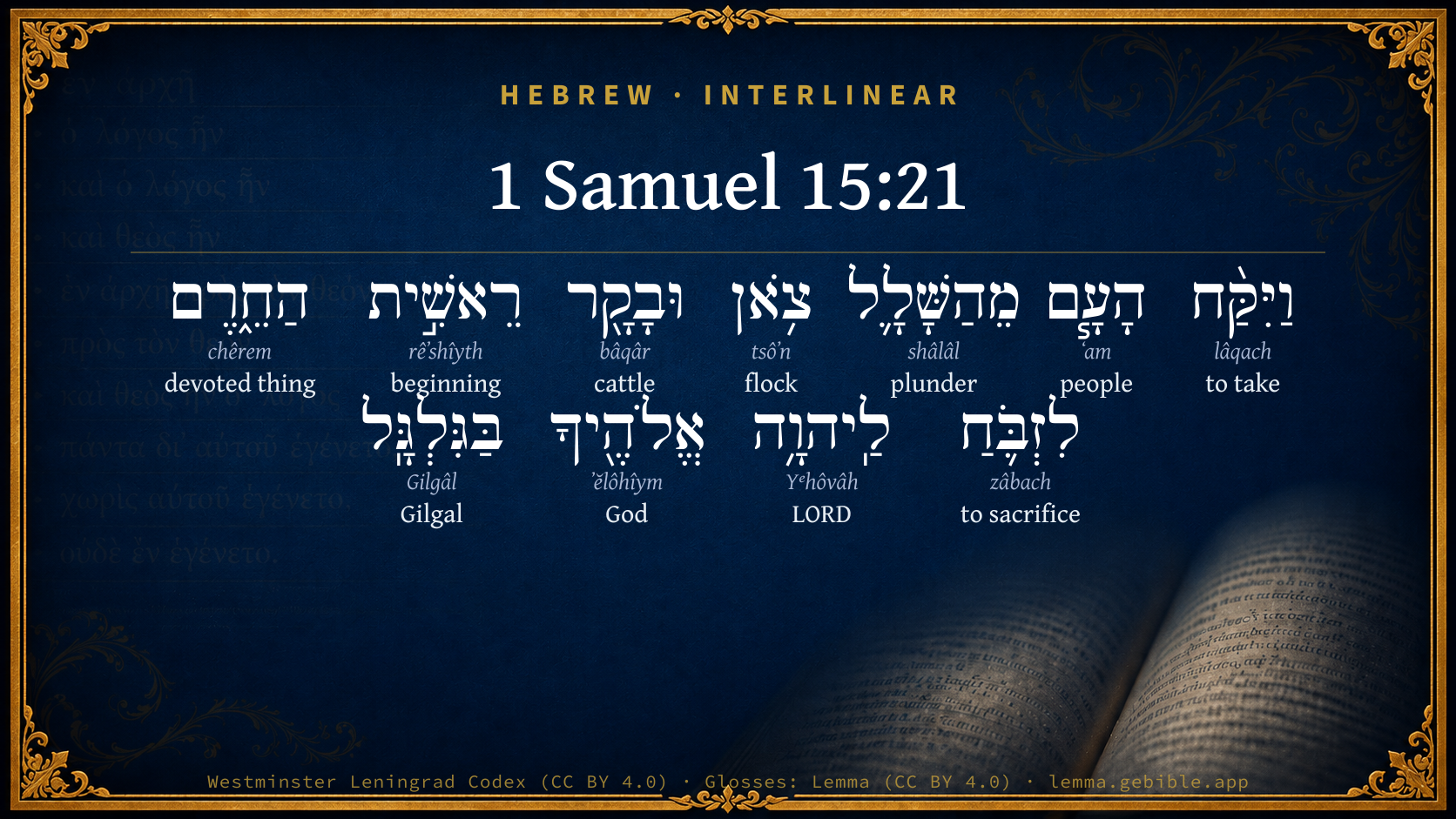
  1. וַיִּקַּ֨ח lâqach H3947 “and · to take” Conjunction + Verb, Qal, Sequential Imperfect, 3rd Person, Masculine, Singular
  2. הָעָ֧ם ʻam H5971 “the · people” Particle, Definite Article + Noun, Common, Masculine, Singular, Absolute
  3. מֵהַשָּׁלָ֛ל shâlâl H7998 “from · the · plunder” Preposition + Particle, Definite Article + Noun, Common, Masculine, Singular, Absolute
  4. צֹ֥אן tsôʼn H6629 “flock” Noun, Common, Both, Singular, Absolute
  5. וּבָקָ֖ר bâqâr H1241 “and · cattle” Conjunction + Noun, Common, Both, Singular, Absolute
  6. רֵאשִׁ֣ית rêʼshîyth H7225 “beginning of” Noun, Common, Feminine, Singular, Construct
  7. לִזְבֹּ֛חַ zâbach H2076 “to sacrifice” Preposition + Verb, Qal, Infinitive Construct
  8. לַֽיהוָ֥ה Yᵉhôvâh H3068 “to/for · LORD” Preposition + Noun, Proper
  9. אֱלֹהֶ֖יךָ ʼĕlôhîym H430 “God(s) · your” Noun, Common, Masculine, Plural, Construct + Suffix, Personal, 2nd Person, Masculine, Singular
  10. בַּגִּלְגָּֽל Gilgâl H1537 “in/at the · Gilgal” Preposition, Determined + Noun, Proper

About this verse

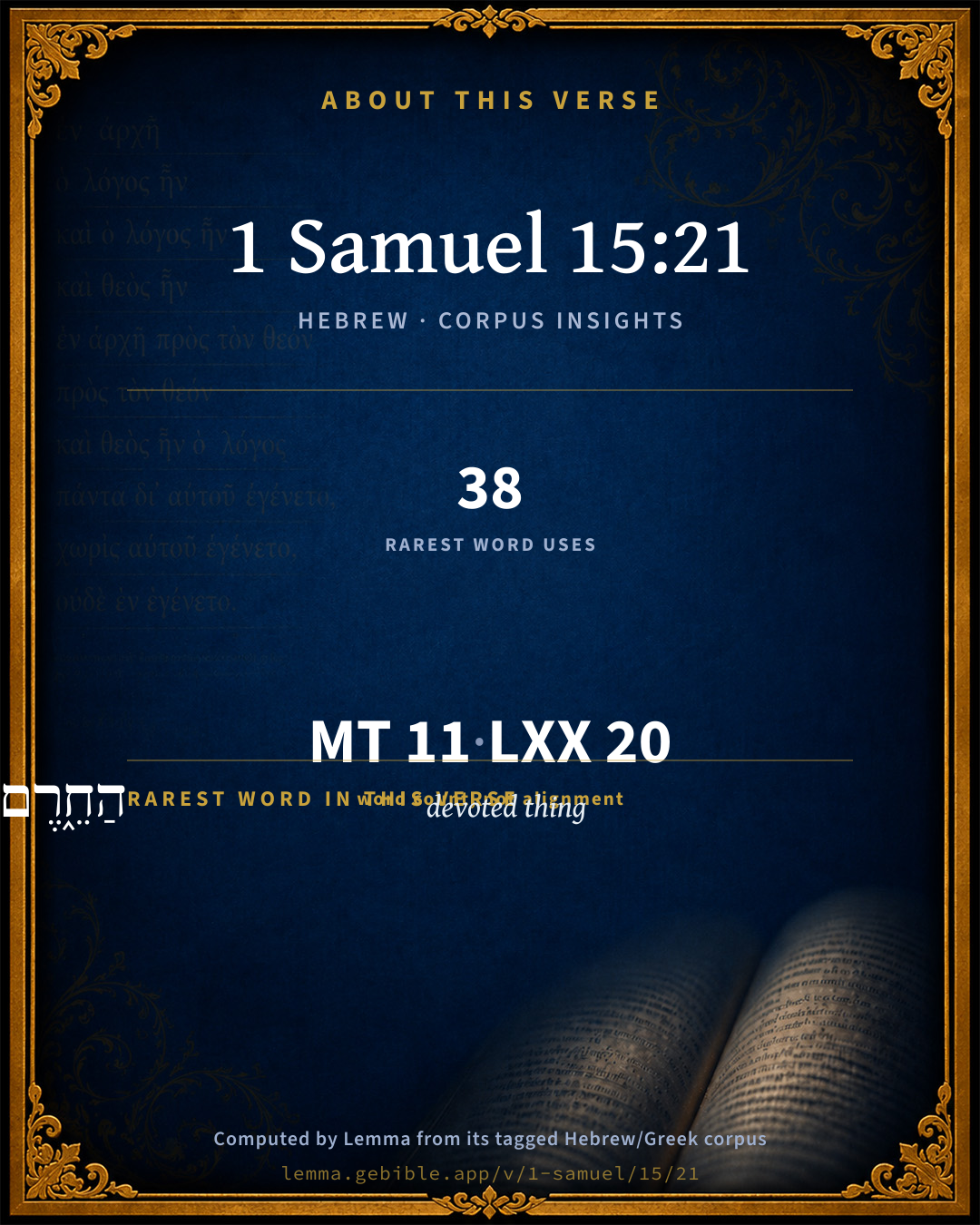
These counts appear in no published source. They are computed here, from the morphology-tagged text and Lemma’s own curated glosses. What Lemma adds →

11
words
11
distinct lemmas
Historical
section

Shared distinctive vocabulary

הַחֵ֑רֶם devoted thing H2764 occurs in 31 verses of the Hebrew Bible. Also found in:

Grammatical profile

  • 2 verbs
  • 9 nouns

Verb forms

  • וַיִּקַּ֨ח Qal · Sequential Imperfect
  • לִזְבֹּ֛חַ Qal · Infinitive Construct

Hebrew & Septuagint length

In English translation the verse runs 24 words from the Hebrew and 27 from the Septuagint (LXX English) — closely comparable.

A rough comparison of the two English renderings, which tokenize alike — not a word-level alignment.

Word counts can differ between the Hebrew and the Greek without any difference in meaning — e.g. the Hebrew direct-object marker אֵת has no separate Greek word, and Greek often adds the article ὁ.

In the original languages it is 11 Hebrew tokens and 20 Greek tokens — but the two are counted differently (Hebrew bundles its prefixes and suffixes into one token; the Greek is in lemma form), so that isn’t a like-for-like length.

Cross-references

3

Topical passages linked to 1 Samuel 15:21 in the Treasury of Scripture Knowledge — connected by theme and wording, ordered by reader-vote popularity; previews shown in the World English Bible.

  • 1 Samuel 15:15 Saul said, They have brought them from the Amalekites: for the people spared the best of the sheep and of the oxen, to sacrifice to Yahweh your God; and the rest we have utterly destroyed.
  • Exodus 32:22–23 Aaron said, "Don't let the anger of my lord grow hot. You know the people, that they are set on evil.
  • Genesis 3:13 Yahweh God said to the woman, "What is this you have done?" The woman said, "The serpent deceived me, and I ate."

Cross-references courtesy of OpenBible.info (CC BY 4.0).

Hebrew and Greek witnesses Masoretic Hebrew ↔ Greek Septuagint

The same verse in the two great witnesses to the Old Testament, shown verse-for-verse.

These are two independent witnesses, not word-aligned to each other, and the Septuagint is shown in lemma (dictionary) form.

Hebrew 1 Samuel 15:21 Masoretic · Westminster Leningrad Codex

וַיִּקַּ֨ח הָעָ֧ם מֵהַשָּׁלָ֛ל צֹ֥אן וּבָקָ֖ר רֵאשִׁ֣ית הַחֵ֑רֶם לִזְבֹּ֛חַ לַֽיהוָ֥ה אֱלֹהֶ֖יךָ בַּגִּלְגָּֽל

But the people took of the spoil, sheep and oxen, the chief of the devoted things, to sacrifice to Yahweh your God in Gilgal.

World English Bible · Public Domain

Greek LXX 1 Samuel 15:21 Septuagint · lemma form

καί λαμβάνω ὁ λαός ὁ σκῦλον ποίμνιον καί βουκόλιον ὁ πρῶτος ὁ ἐξολέθρευμα θύω ἐνώπιον κύριος θεός ἐγώ ἐν γάλγαλα

But the people took of the spoils the best flocks and herds out of that which was destroyed, to sacrifice before the Lord our God in Galgal.

LXX2012 (modern English Septuagint) · Public Domain

Hebrew: Westminster Leningrad Codex (CC BY 4.0). Greek: Septuagint (public domain); English from LXX2012 (modern English Septuagint) (Public Domain). How the Septuagint differs from the Hebrew →

Targum (Aramaic paraphrase)

1

The Targum is the ancient Jewish Aramaic paraphrase of the Hebrew Scriptures — an interpretive translation, not the Hebrew text itself. Onkelos (literal) and Pseudo-Jonathan (expansive) render the Torah, and Jonathan the Prophets. Coverage is partial: where no permissively-licensed English translation exists for a verse, only the Aramaic is shown. This is verse-level text, not a word-by-word alignment to the Hebrew.

  1. Targum Jonathan Prophets (Joshua–Malachi)
    וְאַפְרֵישׁ עַמָא מִן בִּזְתָא עָאָן וְתוֹרִין קֳדָם דְיַחְרְמוּן לְדַבָּחָא קֳדָם יְיָ אֱלָהָךְ בְּגִלְגָלָא:

    (no public-domain English translation for this verse)

    Targum Jonathan — Aramaic: “Mikraot Gedolot” (public domain). English: “Sefaria Community Translation” (CC0 1.0 (public-domain dedication)); “London "Chaldee Paraphrase," 1871” (public domain). Text via Sefaria.

Commentary

Notes on 1 Samuel 15:21 from classic Christian and Jewish commentators (each source and its license shown beneath its notes). The classic Christian expositions comment on the surrounding passage and are grouped to its opening verse, so a note may address several verses; the Jewish commentaries on the Tanakh (Rashi and others) are per-verse, so they appear only where the commentator wrote on this verse.

Lemma curates 59 commentaries, every one of them public domain or Creative Commons licensed, each selected and text-cleaned for this edition rather than reprinted as found. About our sources →

Trapp's Complete Commentary

John Trapp

1Sa 15:21 But the people took of the spoil, sheep and oxen, the chief of the things which should have been utterly destroyed, to sacrifice unto the LORD thy God in Gilgal.

Ver. 21. But the people took, &c.] See 1Sa 15:15.

John Trapp, A Commentary or Exposition upon All the Books of the Old and New Testament (1647–1656) — public domain. Text from a community e-Sword module.

Tyndale Open Study Notes

Tyndale Open Resources

15:21 my troops: Saul persisted in blaming others (see 15:15). • Gilgal was a religious center. Saul tried to use religion to justify disobedience to God.

Tyndale Open Study Notes — © Tyndale Open Resources, licensed CC BY-SA 4.0. Text via the HelloAO Bible API.

Adam Clarke's Commentary

Verse 21. To sacrifice unto the Lord] Thus he endeavours to excuse the people. They did not take the spoil in order to enrich themselves by it, but to sacrifice unto the Lord; and did not this motive justify their conduct?

Adam Clarke's Commentary on the Bible (1810–1826) — public domain. Text from a community e-Sword/MySword module.

The Cambridge Bible for Schools and Colleges

gen. ed. J. J. S. Perowne

21. the chief of the things which should have been utterly destroyed] The chief of the devoted things (cherem). It might seem a praiseworthy act to reserve the spoil for sacrifice: but since it was “devoted,” it did not belong to the Israelites, and no offering could be made of it.

The Cambridge Bible for Schools and Colleges (gen. ed. J. J. S. Perowne; Cambridge University Press, 1878–1918) — public domain. Text from a community e-Sword module.

John Gill's Exposition

But the people took the spoil, the sheep and oxen,.... Still he continues to lay the blame on the people, when he, as king, ought to have restrained them:

the chief of the things, which should have been utterly destroyed; this betrays him, and is an evidence against him; he could not plead ignorance, he knew and he owns, that according to the command of God they were all devoted to destruction; and therefore he ought not to have suffered the people to have spared any on whatsoever pretence, but to have seen all destroyed; but he was as deeply in it as they, and therefore palliates the thing, and endeavours to excuse them by observing, that their end was good, the service and glory of God, which perhaps were never thought of till now: namely:

to sacrifice unto the Lord thy God in Gilgal; as peace offerings, by way of thanksgiving for the victory obtained, Sa1 15:15.

John Gill's Exposition of the Whole Bible (1746–1763) — public domain (CC PDM 1.0). Text via the HelloAO Bible API.

Albert Barnes' Notes on the Bible

The Lord thy God - There is an implied censure of Samuel in this phrase. Saul says that Samuel blames him for what was done in honor of Samuel’s God; as if be had more zeal for the glory of God than was felt by Samuel.

Albert Barnes' Notes on the Bible (1834–1885) — public domain. Text from a community e-Sword/MySword module.

Haydock's Catholic Bible Commentary

First-fruits, or the best. --- Slain. Hebrew, "of the anathema."

George Leo Haydock (1774–1849), Haydock's Catholic Family Bible and Commentary, 1859 edition — public domain. Excludes Psalms (Douay-Rheims chapter numbering differs from Protestant) and Deuterocanonical books (Catholic canon only).

Matthew Poole's English Annotations

Heb. the chief of the devoted things; which being devoted to destruction, I thought it most proper to destroy them by way of sacrifice to God. But God had commanded Saul himself to smite and slay all upon the place, above, 1Sa 15:3.

Matthew Poole's English Annotations on the Holy Bible (1683–1685) — public domain. Text from a community e-Sword/MySword module.

John Wesley's Explanatory Notes

But the people, &c. - Here the conscience of Saul begins to awake, tho' but a little: for he still lays the blame on the people.

John Wesley, Explanatory Notes Upon the Whole Bible (1754–1765) — public domain. Text via the GEBible commentary corpus.

Keil & Delitzsch

C. F. Keil & F. Delitzsch

Even the sparing of the cattle he endeavoured to defend as the fulfilment of a religious duty. The people had taken sheep and oxen from the booty, "as firstlings of the ban," to sacrifice to Jehovah. Sacrificing the best of the booty taken in war as an offering of first-fruits to the Lord, was not indeed prescribed in the law, but was a praiseworthy sign of piety, by which all honour was rendered to the Lord as the giver of the victory (see Num 31:48.). This, Saul meant to say, was what the people had done on the present occasion; only he overlooked the fact, that what was banned to the Lord could not be offered to Him as a burnt-offering, because, being most holy, it belonged to Him already (Lev 27:29), and according to Deu 13:16, was to be put to death, as Samuel had expressly said to Saul (Sa1 15:3).

Keil & Delitzsch — Biblical Commentary on the Old Testament (1861–1891) — public domain (CC PDM 1.0). Text via the HelloAO Bible API. (Old Testament only.)

Rashi

Rabbi Shlomo Yitzchaki (Rashi)

The best of that which was to be destroyed. [רֵאשִׁית] meaning the best of the, חֵרֶם and similarly, "the best of your corn," as it is stated, "when you set aside the finest part of it." Targum Yonoson renders [רֵאשִׁית] 'before they banned it.'

Rashi on the Tanakh — English translations: “The Judaica Press complete Tanach with Rashi, translated by A. J. Rosenberg” (CC BY 4.0); “Pentateuch with Rashi's commentary by M. Rosenbaum and A.M. Silbermann, 1929-1934” (public domain); “The Metsudah Tanach series, Lakewood, N.J” (CC BY 4.0); and “The Book of Joshua, Metsudah Publications, 1997” (CC BY 4.0). Text via Sefaria.

Lesson kit

Teaching starters — assembled from the data on this page, not authored interpretation. Every prompt links to the verse data it draws on. Edit before teaching.

1 Samuel, in the Historical, opens this verse with 11 words (11 distinct Hebrew lemmas). Its most distinctive word is chêrem (“devoted thing”). A historical commentator’s framing appears above. Read the whole chapter for the surrounding context.

Discussion questions

  1. What does “devoted thing” (chêrem) contribute to the verse as a whole?
  2. How does Leviticus 27:21, which shares the word «devoted thing», read alongside this verse?
  3. These translations render this verse differently. What is at stake in choosing one wording over another?
  4. «וַיִּקַּ֨ח» is a Qal Sequential Imperfect verb. How does that grammatical form shape the action described?
  5. Compare how Trapp's Complete Commentary and Tyndale Open Study Notes read this verse. Where do they agree or differ?

Things to notice

Reading settings

Reading text

Shown beneath each verse's original-language words.

Old Testament
Old Testament edition

Read the OT as the Masoretic Hebrew (MT) or the Greek Septuagint (LXX).

English shown for the Greek Septuagint (in the Hebrew ↔ Greek comparison).

Comparing translations? Open the Compare panel on any verse page to stack up to four side by side.