Numbers 31:32

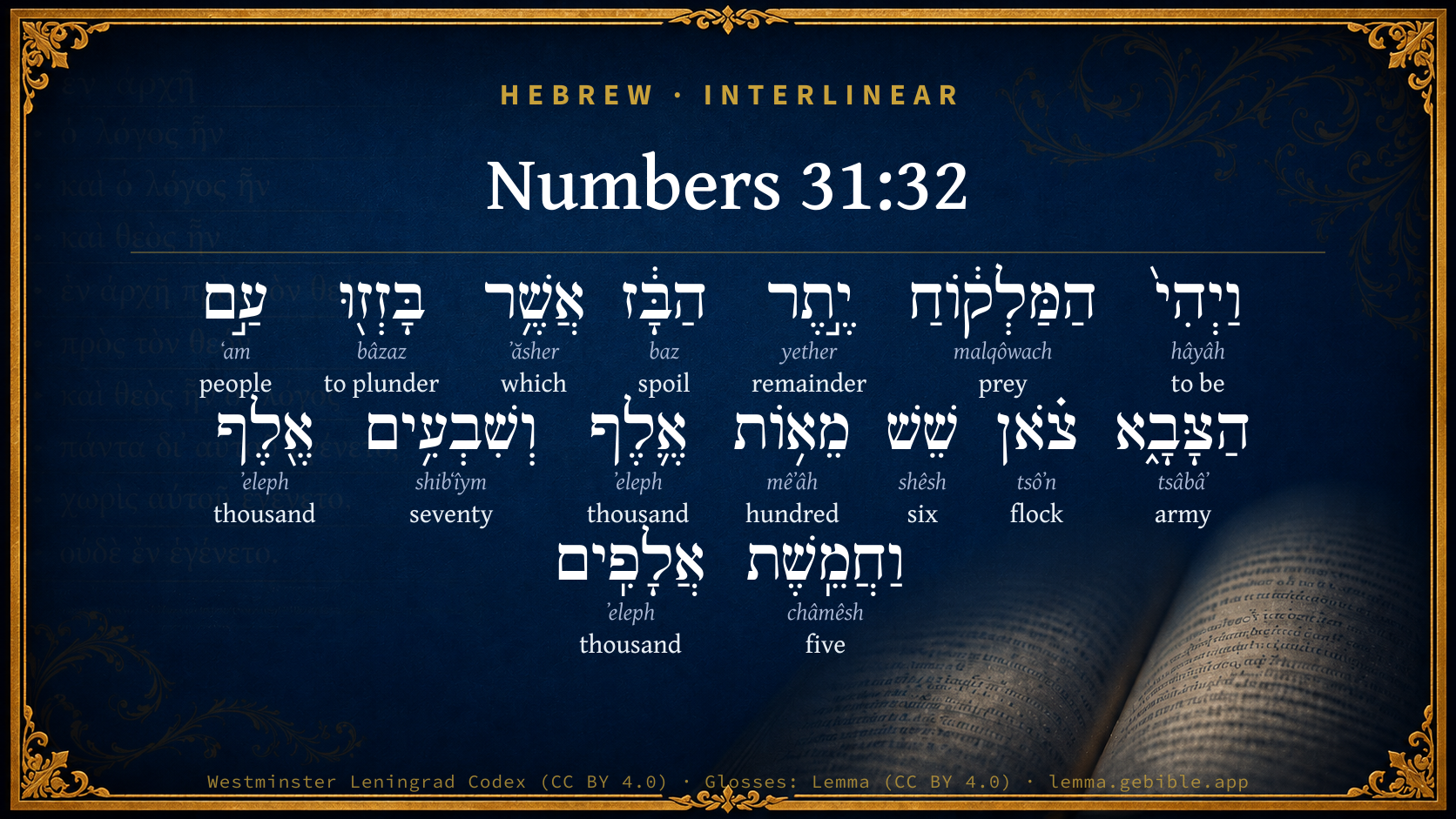
Hebrew (Westminster Leningrad Codex) Numbers 31:32 appears in the Hebrew Old Testament. The text above is from the Westminster Leningrad Codex. Each word links to its Strong’s number, a concise gloss, and parsing drawn from the Open Scriptures Hebrew Bible morphology. Click any word for its full Brown-Driver-Briggs (BDB) entry.
Download image
Cite this verse

Numbers 31:32 (World English Bible). Public Domain. Lemma interlinear Bible study tool, https://lemma.gebible.app/v/numbers/31/32.

Show BibTeX & RIS
BibTeX
RIS
English Translation
Now the prey, over and above the booty which the men of war took, was six hundred seventy-five thousand sheep,
World English Bible · Public Domain
Download a study sheet

One document with this verse’s original text, its word-by-word gloss line, the meaning frame, cross-references with their text, attributed commentary, and full source and license credits — printable, and it pastes into notes with its structure intact.

This verse Autodidact and up

Study sheet (.html) Plain text (.txt)

A passage Seminary Student

Up to 50 verses in one chapter. A passage sheet keeps up to 6 commentary sources and 12 cross-references per verse, in the order this page ranks them, and says so on the sheet whenever that leaves anything out. Ask for a single verse and you get the Autodidact verse sheet above.

Everything on this page stays free to read, with no account — the sheet is a download of what is already on screen, not access to it.

Want to remove ads? Support Godless Engineer
Compare translations 3

The same verse in 3 English versions, stacked beneath the original-language interlinear above. Click any original word for its lexicon entry.

Each is an independent rendering of the whole verse — the interlinear is not word-aligned to these translations.

Highlighted words mark where these versions differ — a whole-verse word diff, not a word-by-word alignment.

  • World English Bible Public Domain
    Now the prey, over and above the booty which the men of war took, was six hundred seventy-five thousand sheep,
  • King James Version Public Domain
    And the booty, being the rest of the prey which the men of war had caught, was six hundred thousand and seventy thousand and five thousand sheep,
  • unfoldingWord Literal Text CC BY-SA 4.0
    And the booty, the remainder of the plunder that the people of the army plundered, was 675, 000 sheep,

unfoldingWord Literal Text — © unfoldingWord, licensed CC BY-SA 4.0. Word-aligned USFM3 via Door43 (git.door43.org/unfoldingWord/en_ult).

Versions to compare (up to 4)

3 of 4 selected

Show all 18 translations

Every available English version of this verse, each an independent rendering of the whole verse.

  • World English Bible Public Domain
    Now the prey, over and above the booty which the men of war took, was six hundred seventy-five thousand sheep,
  • Berean Standard Bible Public Domain
    and this plunder remained from the spoils the soldiers had taken: 675,000 sheep,
  • Majority Standard Bible Public Domain
    and this plunder remained from the spoils the soldiers had taken: 675,000 sheep,
  • King James Version Public Domain
    And the booty, being the rest of the prey which the men of war had caught, was six hundred thousand and seventy thousand and five thousand sheep,
  • American Standard Version (1901) Public Domain
    Now the prey, over and above the booty which the men of war took, was six hundred thousand and seventy thousand and five thousand sheep,
  • Revised Version (1885) Public Domain
    Now the prey, over and above the booty which the men of war took, was six hundred thousand and seventy thousand and five thousand sheep,
  • Geneva Bible (1599) Public Domain
    And the bootie, to wit, the rest of the praie which the men of warre had spoyled, was sixe hundreth seuentie and fiue thousand sheepe,
  • Douay-Rheims (1899) Public Domain
    And the spoil which the army had taken, was six hundred seventy-five thousand sheep,
  • Young's Literal Translation Public Domain
    And the prey, the residue of the spoil which the people of the host have spoiled, is of the flock six hundred thousand, and seventy thousand, and five thousand;
  • Literal Standard Version CC BY-SA 4.0
    And the prey, the remainder of the spoil which the people of the host have spoiled, is six hundred thousand and seventy thousand and five thousand of the flock;
  • Unlocked Literal Bible CC BY-SA 4.0
    Now the plunder that remained of what the soldiers had taken was 675,000 sheep,
  • unfoldingWord Literal Text CC BY-SA 4.0
    And the booty, the remainder of the plunder that the people of the army plundered, was 675, 000 sheep,
  • Darby Bible Public Domain
    And the prey, the rest of the spoil, which the men of war had taken, was six hundred and seventy-five thousand sheep,
  • World Messianic Bible Public Domain
    Now the plunder, over and above the booty which the men of war took, was six hundred seventy-five thousand sheep,
  • Webster's Bible Public Domain
    And the booty, being the rest of the prey which the men of war had taken, was six hundred thousand and seventy thousand and five thousand sheep,
  • Free Bible Version CC BY-SA 4.0
    This was the list of plunder remaining that had been looted by the troops: 675,000 sheep,
  • Bible in Basic English Public Domain
    Now the beasts taken, in addition to what the fighting-men took for themselves, were six hundred and seventy-five thousand sheep,
  • JPS Tanakh (1917) Public Domain
    Now the prey, over and above the booty which the men of war took, was six hundred thousand and seventy thousand and five thousand sheep,

Literal Standard Version (2020), Covenant Press — licensed CC BY-SA 4.0. Text via the HelloAO Bible API (eBible.org). Unlocked Literal Bible (unfoldingWord) — licensed CC BY-SA 4.0. Text via the HelloAO Bible API (eBible.org). unfoldingWord Literal Text — © unfoldingWord, licensed CC BY-SA 4.0. Word-aligned USFM3 via Door43 (git.door43.org/unfoldingWord/en_ult). Free Bible Version, Dr. Jonathan Gallagher — licensed CC BY-SA 4.0. Text via the HelloAO Bible API (eBible.org).

Word by word

More ways to search: Search by grammar → Find every occurrence → Compare this word →

Practice this passage: Drill this verse → Learn its vocabulary →

הַמַּלְק֔וֹחַ
malqôwach
H4455
“the · prey”
Particle, Definite Article + Noun, Common, Masculine, Singular, Absolute
Part of Speech
Particle + Noun
Type
Common
Gender
Masculine
Number
Singular
State
Absolute
Full BDB Definition

Origin: from H3947

TWOT: 1124b , 1124c

booty, prey - jaw
  1. וַיְהִי֙ hâyâh H1961 “and · to be” Conjunction + Verb, Qal, Sequential Imperfect, 3rd Person, Masculine, Singular
  2. יֶ֣תֶר yether H3499 “remainder of” Noun, Common, Masculine, Singular, Construct
  3. הַבָּ֔ז baz H957 “the · spoil” Particle, Definite Article + Noun, Common, Masculine, Singular, Absolute
  4. אֲשֶׁ֥ר ʼăsher H834 “which” Particle, Relative
  5. בָּזְז֖וּ bâzaz H962 “to plunder” Verb, Qal, Perfect, 3rd Person, Common, Plural
  6. עַ֣ם ʻam H5971 “people of” Noun, Common, Masculine, Singular, Construct
  7. הַצָּבָ֑א tsâbâʼ H6635 “the · army” Particle, Definite Article + Noun, Common, Both, Singular, Absolute
  8. צֹ֗אן tsôʼn H6629 “flock” Noun, Common, Both, Singular, Absolute
  9. שֵׁשׁ shêsh H8337 “six” Adjective, Cardinal number, Feminine, Singular, Absolute
  10. מֵא֥וֹת mêʼâh H3967 “hundred” Adjective, Cardinal number, Both, Plural, Absolute
  11. אֶ֛לֶף ʼeleph H505 “thousand” Adjective, Cardinal number, Both, Singular, Absolute
  12. וְשִׁבְעִ֥ים shibʻîym H7657 “and · seventy” Conjunction + Adjective, Cardinal number, Both, Plural, Absolute
  13. אֶ֖לֶף ʼeleph H505 “thousand” Adjective, Cardinal number, Both, Singular, Absolute
  14. וַחֲמֵֽשֶׁת châmêsh H2568 “and · five” Conjunction + Adjective, Cardinal number, Masculine, Singular, Construct
  15. אֲלָפִֽים ʼeleph H505 “thousand” Adjective, Cardinal number, Both, Plural, Absolute

About this verse

These counts appear in no published source. They are computed here, from the morphology-tagged text and Lemma’s own curated glosses. What Lemma adds →

16
words
14
distinct lemmas
Pentateuch
section

Notable vocabulary

The rarest word here is הַמַּלְק֔וֹחַ prey H4455 — appearing just 8 times in the whole Hebrew Bible.

Shared distinctive vocabulary

הַמַּלְק֔וֹחַ prey H4455 occurs in 8 verses of the Hebrew Bible. Also found in:

Grammatical profile

  • 2 verbs
  • 6 nouns
  • 7 adjectives
  • 1 particle

Verb forms

  • וַיְהִי֙ Qal · Sequential Imperfect
  • בָּזְז֖וּ Qal · Perfect

Repetition

A word recurs within this verse — often emphatic in Hebrew:

  • אֶ֛לֶף thousand H505 ×3

Hebrew & Septuagint length

In English translation the verse runs 20 words from the Hebrew and 19 from the Septuagint (LXX English) — closely comparable.

A rough comparison of the two English renderings, which tokenize alike — not a word-level alignment.

Word counts can differ between the Hebrew and the Greek without any difference in meaning — e.g. the Hebrew direct-object marker אֵת has no separate Greek word, and Greek often adds the article ὁ.

In the original languages it is 16 Hebrew tokens and 22 Greek tokens — but the two are counted differently (Hebrew bundles its prefixes and suffixes into one token; the Greek is in lemma form), so that isn’t a like-for-like length.

Hebrew and Greek witnesses Masoretic Hebrew ↔ Greek Septuagint

The same verse in the two great witnesses to the Old Testament, shown verse-for-verse.

These are two independent witnesses, not word-aligned to each other, and the Septuagint is shown in lemma (dictionary) form.

Hebrew Numbers 31:32 Masoretic · Westminster Leningrad Codex

וַיְהִי֙ הַמַּלְק֔וֹחַ יֶ֣תֶר הַבָּ֔ז אֲשֶׁ֥ר בָּזְז֖וּ עַ֣ם הַצָּבָ֑א צֹ֗אן שֵׁשׁ מֵא֥וֹת אֶ֛לֶף וְשִׁבְעִ֥ים אֶ֖לֶף וַחֲמֵֽשֶׁת אֲלָפִֽים

Now the prey, over and above the booty which the men of war took, was six hundred seventy-five thousand sheep,

World English Bible · Public Domain

Greek LXX Numbers 31:32 Septuagint · lemma form

καί γίγνομαι ὁ πλεόνασμα ὁ προνομή ὅς προνομεύω ὁ ἀνήρ ὁ πολεμιστής ἀπό ὁ πρόβατον ἑξακόσιοι χιλιάς καί ἑβδομήκοντα καί πέντε χιλιάς

And that which remained of the spoil which the warriors took, was—of the sheep, six hundred and seventy-five thousand:

LXX2012 (modern English Septuagint) · Public Domain

On this verse, The Pulpit Commentary discusses the Septuagint’s reading. Read the note in Commentary ↓

Hebrew: Westminster Leningrad Codex (CC BY 4.0). Greek: Septuagint (public domain); English from LXX2012 (modern English Septuagint) (Public Domain). How the Septuagint differs from the Hebrew →

Targum (Aramaic paraphrase)

2

The Targum is the ancient Jewish Aramaic paraphrase of the Hebrew Scriptures — an interpretive translation, not the Hebrew text itself. Onkelos (literal) and Pseudo-Jonathan (expansive) render the Torah, and Jonathan the Prophets. Coverage is partial: where no permissively-licensed English translation exists for a verse, only the Aramaic is shown. This is verse-level text, not a word-by-word alignment to the Hebrew.

  1. Targum Onkelos Torah (Genesis–Deuteronomy)
    וַהֲוָה דְבַרְתָּא שְׁאָר בִּיזָא דִי בְזוֹ עַמָא דִי נְפָקוּ לְחֵילָא עָנָא שִׁית מְאָה וְשַׁבְעִין וְחַמְשָׁא אַלְפִין

    (no public-domain English translation for this verse)

    Targum Onkelos — Aramaic: “Onkelos Genesis” (public domain); “Onkelos Exodus” (public domain); “Onkelos Leviticus” (public domain); “Onkelos Numbers” (public domain); “Onkelos Deuteronomy” (public domain). English: “Sefaria Community Translation” (CC0 1.0 (public-domain dedication)); “J.W. Etheridge. The Targums of Onkelos and Jonathan Ben Uzziel on the Pentateuch. London: Longmans, Green, 1862” (public domain). Text via Sefaria.

  2. Targum Pseudo-Jonathan Torah (Genesis–Deuteronomy)
    וַהֲוָה סְכוּם דְבַרְתָּא שִׁיוּר בִּזְתָא דְבָזוּ עַמָא דִנְפָקוּ לְחֵילָא מִנְיַין עָנָא שִׁית מְאָה וְשׁוּבְעִין וְחַמְשָׁא אַלְפִין

    And the amount of the prey, the rest of the spoil which had been taken by the people who went forth in the host,-the number of the sheep was six hundred and seventy-five thousand;

    Targum Pseudo-Jonathan — Aramaic: “Targum Jonathan on Genesis” (public domain); “Targum Jonathan on Exodus” (public domain); “Targum Jonathan on Leviticus” (public domain); “Targum Jonathan on Numbers” (public domain); “Targum Jonathan on Deuteronomy” (public domain). English: “The Targum of Jonathan ben Uzziel, trans. J. W. Etheridge, London, 1862” (public domain). Text via Sefaria.

Commentary

Notes on Numbers 31:32 from classic Christian and Jewish commentators (each source and its license shown beneath its notes). The classic Christian expositions comment on the surrounding passage and are grouped to its opening verse, so a note may address several verses; the Jewish commentaries on the Tanakh (Rashi and others) are per-verse, so they appear only where the commentator wrote on this verse.

Lemma curates 59 commentaries, every one of them public domain or Creative Commons licensed, each selected and text-cleaned for this edition rather than reprinted as found. About our sources →

Tyndale Open Study Notes

Tyndale Open Resources

31:32-35 The total number of animals and young girls who were not killed was quite large, which indicates that Israel fought against many Midianites.

Tyndale Open Study Notes — © Tyndale Open Resources, licensed CC BY-SA 4.0. Text via the HelloAO Bible API.

Jamieson, Fausset & Brown

Robert Jamieson, A. R. Fausset & David Brown

the booty, being the rest of the prey which the men of war had caught--Some of the captives having been killed (Num 31:17) and part of the cattle taken for the support of the army, the total amount of the booty remaining was in the following proportions:

Prey Total Amount Half to Soldiers Deducted to God Half to Congregation Deducted to Levites

Sheep 675,000 337,500 675 337,500 6,750

Beeves 72,000 36,000 72 36,000 720

Asses 61,000 30,500 61 30,500 610

Persons 32,000 16,000 32 16,000 320

Jamieson, Fausset & Brown — Commentary Critical and Explanatory on the Whole Bible (1871) — public domain (CC PDM 1.0). Text via the HelloAO Bible API.

Adam Clarke's Commentary

Verse 32. The booty] It appears from the enumeration here that the Israelites, in this war against the Midianites, took 32,000 female prisoners, 61,000 asses, 72,000 beeves, 675,000 sheep and small cattle; besides the immense number of males who fell in battle, and the women and children who were slain by the Divine command, Nu 31:17. And it does not appear that in this expedition, a single man of Israel fell! This was naturally to be expected, because the battle was the Lord's, Nu 31:49.

As the booty was divided into two equal parts, Nu 31:22, one for the soldiers employed in the expedition, and the other for those who, being equally willing to be employed, were ordered to stay in the camp; so each of the parties in this booty was to give a certain proportion to the Lord. The soldiers to give to the Lord one out of every five hundred persons, beeves, asses, and sheep, Nu 31:28. The people, who by staying at home risked nothing, and had no fatigue, were to give one out of fifty of the above, Nu 31:30. The booty, its divisions among the soldiers and people, the proportion given by each to the Lord and to the Levites, will be seen in one view by the following table, which I copy from Houbigant.

Total of sheep 675,000

To the soldiers .. 337,500

To the people ... 337,500

.. of beeves ... 72,000

To the soldiers .... 36,000

To the people ..... 36,000

.. of asses ..... 61,000

To the soldiers .... 30,500

To the people ..... 30,500

.. of persons .. 32,000

To the soldiers .... 16,000

To the people ..... 16,000

..... sheep .......

To the Lord from the soldiers ....... 675

To the Levites from the people .. 6,750

..... beeves ......

To the Lord from the soldiers ........ 72

To the Levites from the people .... 720

..... asses .......

To the Lord from the soldiers ........ 61

To the Levites from the people .... 610

..... persons .....

To the Lord from the soldiers ........ 32

To the Levites from the people .... 320

In this table the booty is equally divided between the people and the soldiers; a five-hundredth part being given to the Lord, and a fiftieth part to the Levites.

Adam Clarke's Commentary on the Bible (1810–1826) — public domain. Text from a community e-Sword/MySword module.

Ellicott's Commentary for English Readers

(32) And the booty, being the rest of the prey . . . —The reference may be to the residue of the captives after the slaughter of all the males and of a large number of the women, and to the cattle which were brought to the camp, some, it may be, having been lost or slaughtered for food; or it may be to the booty which had been taken in captives and animals, as distinguished from the gold and silver, &c.

A Bible Commentary for English Readers, edited by Charles John Ellicott (1878–1897) — public domain. Text from a community e-Sword module.

The Cambridge Bible for Schools and Colleges

gen. ed. J. J. S. Perowne

32. over and above the booty] the remainder of the booty. The revisers connected the words with Num_31:53 (see marg. there), but that is concerned only with the private looting of gold ornaments. Here ‘the booty’ is synonymous with ‘the prey,’ and the words may be paraphrased ‘the prey, or rather that which remained of it.’ That which was captured on the field of battle would be diminished from a variety of causes, e.g. the necessary slaughter of animals for food, possibly the death from hardships on the return journey of some among the prisoners who were ill or infirm; also by the slaughter commanded in Num_31:17.

The Cambridge Bible for Schools and Colleges (gen. ed. J. J. S. Perowne; Cambridge University Press, 1878–1918) — public domain. Text from a community e-Sword module.

John Gill's Exposition

And all the gold of the offering that they offered up to the Lord,.... The whole amount, weight, and value of it put together:

even of the captains of thousands, and the captains of hundreds, and perhaps of every common soldier, who might contribute his part, though it is not mentioned, but included in the oblation of the officers:

was 16,750 shekels; which, according to the calculation of a very learned man (i), were 7,780 ounces, four drachms, two scruples, and thirty five grains.

(i) Scheuchzer. Physica Sacr. vol. 2. p. 399.

John Gill's Exposition of the Whole Bible (1746–1763) — public domain (CC PDM 1.0). Text via the HelloAO Bible API.

Albert Barnes' Notes on the Bible

Compare Num 31:11, and render “And the prey” (i. e., the live prey) “in addition to the spoil which the men of war seized, etc.” The “spoil” is described in Num 31:50.

The number of sheep, beeves, asses, and persons taken is given in this and following verses in round thousands. Hence, the Lord’s tribute (Num 31:29, Num 31:37-38, etc.), being the 500th part of the half, comes out also in round numbers. The enormous amount both of live stock and of personal ornament was characteristic of the Midianites. When they invaded Israel in the days of the Judges, their wealth was still of the same kind (Jdg 6:5; Jdg 8:24 ff). The Bedouins, notwithstanding their wild nomadic life, retain their ancestral love of finery to the present day.

Albert Barnes' Notes on the Bible (1834–1885) — public domain. Text from a community e-Sword/MySword module.

Haydock's Catholic Bible Commentary

Spoil. Hebrew, "the remains of the spoil," which had not been consumed by the 12,000. (Calmet)

George Leo Haydock (1774–1849), Haydock's Catholic Family Bible and Commentary, 1859 edition — public domain. Excludes Psalms (Douay-Rheims chapter numbering differs from Protestant) and Deuterocanonical books (Catholic canon only).

Matthew Poole's English Annotations

The rest of the prey; all which was now left of the prey. It is so expressed because they took more, but some of the persons were since killed, Num 31:17, and some of the cattle was spent for the necessary provisions of the army.

Matthew Poole's English Annotations on the Holy Bible (1683–1685) — public domain. Text from a community e-Sword/MySword module.

The Pulpit Commentary

The booty, being the rest of the prey. Rather, "the prey (jwOqlMh, see on verse 11), to wit, the rest of the booty". (zBh, as in Num_14:3, Num_14:31) Septuagint, to pleonasma thv pronomhv , i.e., what actually remained to be divided. The numbers given are obviously round numbers, such as the Israelites seem always to have employed in enumeration. The immense quantity of cattle captured was in accordance with the habits of the Midianites in the days of Gideon (Jud_1:6:5) and of their modem representatives today.

The Pulpit Commentary (1880–1919), ed. H.D.M. Spence-Jones & Joseph S. Exell — public domain. Text from a community e-Sword module.

unfoldingWord translationNotes

Door43 World Missions Community

Now

This word is used here to mark a break in the main teaching. Here Moses begins listing the amount of plunder and how much went to the soldiers, to the people, and to Yahweh.

675,000 sheep

"six hundred and seventy-five thousand sheep" (See: Numbers)

seventy-two thousand oxen, sixty-one thousand donkeys, and thirty-two thousand women

"72,000 oxen, 61,000 donkeys, and 32,000 women" (See: Numbers)

women who had never slept with any man

This refers to women who are virgins. (See: Euphemism)

translationWords

ewe

cow

donkey

had relations with

unfoldingWord translationNotes — © Distant Shores Media and the Door43 World Missions Community, licensed CC BY-SA 4.0. Source: git.door43.org/Door43/en_tn.

Rashi

Rabbi Shlomo Yitzchaki (Rashi)

ויהי המלקוח יתר הבז AND THE PREY, OVER AND ABOVE THE BOOTY … WAS [SIX HUNDRED THOUSAND etc.] — Because they had not been commanded (v. 28) to levy a tribute from the movables but only from the מלקוח (the men and cattle; cf. Rashi on v. 11) it (Scripture) writes this expression: ויהי המלקוח, that which came under the law of being divided (v. 27) and which also came under the law of tribute — which was over and above (יתר) the booty of the movables, אשר בזזו עם הצבא איש לו WHICH THE MEN OF THE HOST HAD PLUNDERED, EACH FOR HIMSELF, and which did not come under the law of being divided, — the number of sheep was etc. (i.e. צאן at the beginning of the second half of the verse means: the number of sheep).

Rashi on the Tanakh — English translations: “The Judaica Press complete Tanach with Rashi, translated by A. J. Rosenberg” (CC BY 4.0); “Pentateuch with Rashi's commentary by M. Rosenbaum and A.M. Silbermann, 1929-1934” (public domain); “The Metsudah Tanach series, Lakewood, N.J” (CC BY 4.0); and “The Book of Joshua, Metsudah Publications, 1997” (CC BY 4.0). Text via Sefaria.

Lesson kit

Teaching starters — assembled from the data on this page, not authored interpretation. Every prompt links to the verse data it draws on. Edit before teaching.

Numbers, in the Pentateuch, opens this verse with 16 words (14 distinct Hebrew lemmas). Its most distinctive word is malqôwach (“prey”). A historical commentator’s framing appears above. Read the whole chapter for the surrounding context.

Discussion questions

  1. The word malqôwach carries the sense “prey.” How does it shape the verse?
  2. How does Numbers 31:11, which shares the word «prey», read alongside this verse?
  3. What does the repetition of “thousand” (3× in this one verse) do in this verse?
  4. These translations render this verse differently; the difference is in the English rendering, not the original. What questions does that raise?
  5. «וַיְהִי֙» is a Qal Sequential Imperfect verb. How does that grammatical form shape the action described?
  6. Compare how Tyndale Open Study Notes and Jamieson, Fausset & Brown read this verse. Where do they agree or differ?

Things to notice

Reading settings

Reading text

Shown beneath each verse's original-language words.

Old Testament
Old Testament edition

Read the OT as the Masoretic Hebrew (MT) or the Greek Septuagint (LXX).

English shown for the Greek Septuagint (in the Hebrew ↔ Greek comparison).

Comparing translations? Open the Compare panel on any verse page to stack up to four side by side.