
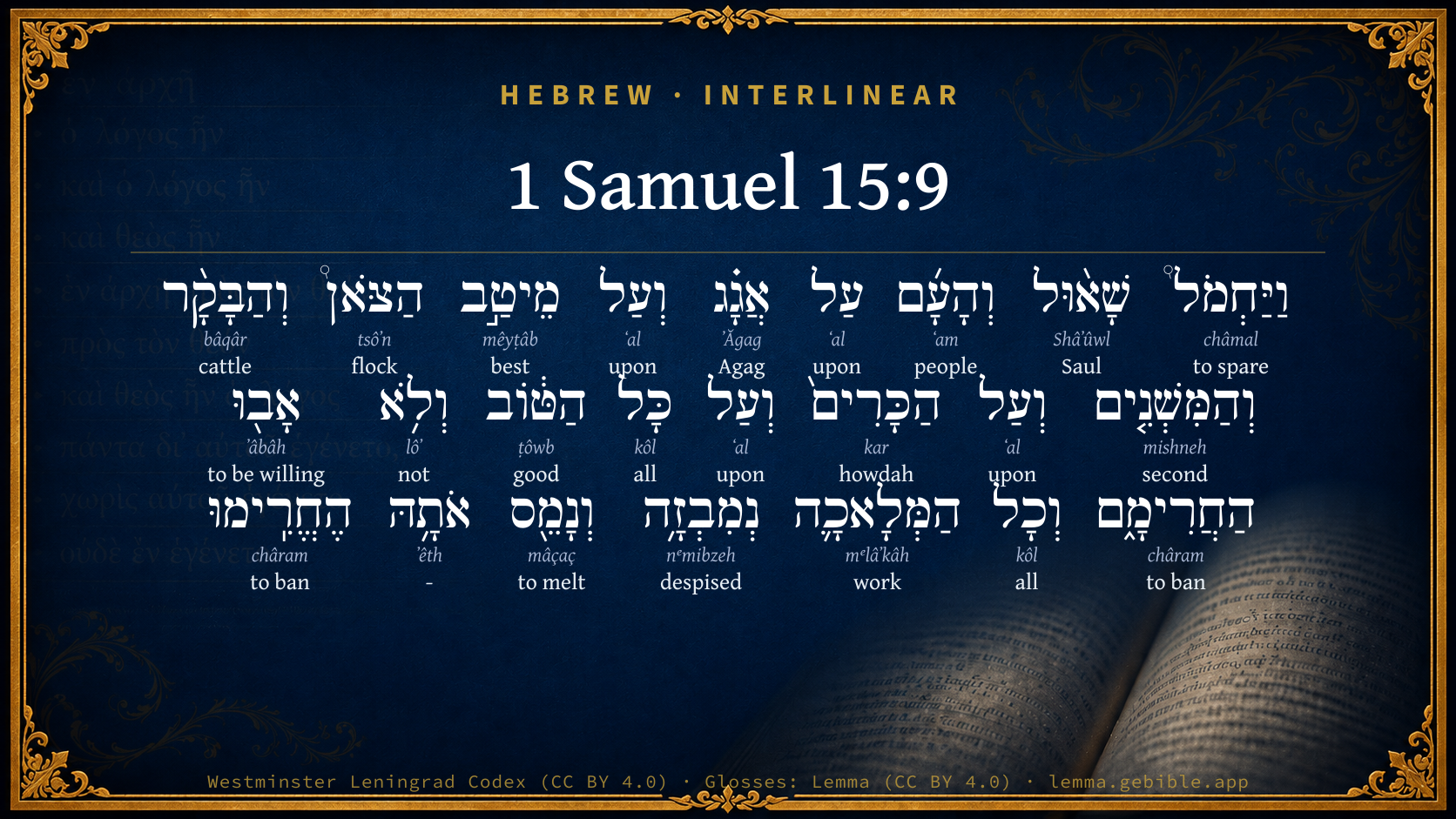
1 Samuel 15:9

Hebrew (Westminster Leningrad Codex) 1 Samuel 15:9 appears in the Hebrew Old Testament. The text above is from the Westminster Leningrad Codex. Each word links to its Strong’s number, a concise gloss, and parsing drawn from the Open Scriptures Hebrew Bible morphology. Click any word for its full Brown-Driver-Briggs (BDB) entry.
Download image
Cite this verse

1 Samuel 15:9 (World English Bible). Public Domain. Lemma interlinear Bible study tool, https://lemma.gebible.app/v/1-samuel/15/9.

Show BibTeX & RIS
BibTeX
RIS
English Translation
But Saul and the people spared Agag, and the best of the sheep, and of the oxen, and of the fatlings, and the lambs, and all that was good, and wouldn't utterly destroy them: but everything that was vile and refuse, that they destroyed utterly.
World English Bible · Public Domain
Highlights
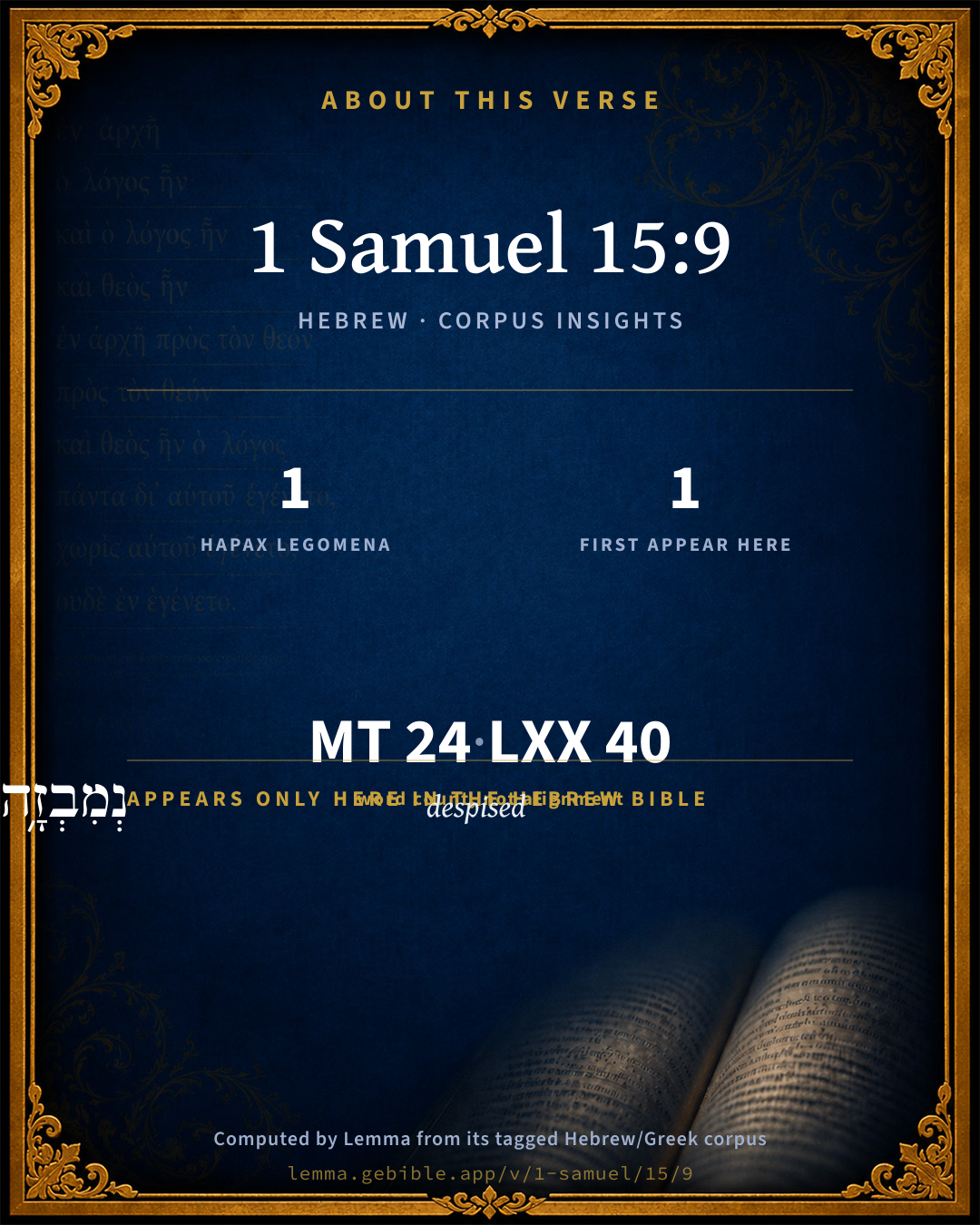
  • 1 hapax legomenon — only here in the Hebrew Bible
  • 1 first appearance in the Hebrew Bible
Full analysis ↓
Download a study sheet

One document with this verse’s original text, its word-by-word gloss line, the meaning frame, cross-references with their text, attributed commentary, and full source and license credits — printable, and it pastes into notes with its structure intact.

This verse Autodidact and up

Study sheet (.html) Plain text (.txt)

A passage Seminary Student

Up to 50 verses in one chapter. A passage sheet keeps up to 6 commentary sources and 12 cross-references per verse, in the order this page ranks them, and says so on the sheet whenever that leaves anything out. Ask for a single verse and you get the Autodidact verse sheet above.

Everything on this page stays free to read, with no account — the sheet is a download of what is already on screen, not access to it.

Want to remove ads? Support Godless Engineer
Compare translations 3

The same verse in 3 English versions, stacked beneath the original-language interlinear above. Click any original word for its lexicon entry.

Each is an independent rendering of the whole verse — the interlinear is not word-aligned to these translations.

Highlighted words mark where these versions differ — a whole-verse word diff, not a word-by-word alignment.

  • World English Bible Public Domain
    But Saul and the people spared Agag, and the best of the sheep, and of the oxen, and of the fatlings, and the lambs, and all that was good, and wouldn't utterly destroy them: but everything that was vile and refuse, that they destroyed utterly.
  • King James Version Public Domain
    But Saul and the people spared Agag, and the best of the sheep, and of the oxen, and of the fatlings, and the lambs, and all that was good, and would not utterly destroy them: but every thing that was vile and refuse, that they destroyed utterly.
  • unfoldingWord Literal Text CC BY-SA 4.0
    But Saul and the people had compassion on Agag and on the best of the sheep and the cattle and the second ones and on the lambs and on all of the good, and they were not willing to devote them. But all of the despised and weakened property, they devoted it.

unfoldingWord Literal Text — © unfoldingWord, licensed CC BY-SA 4.0. Word-aligned USFM3 via Door43 (git.door43.org/unfoldingWord/en_ult).

Versions to compare (up to 4)

3 of 4 selected

Show all 18 translations

Every available English version of this verse, each an independent rendering of the whole verse.

  • World English Bible Public Domain
    But Saul and the people spared Agag, and the best of the sheep, and of the oxen, and of the fatlings, and the lambs, and all that was good, and wouldn't utterly destroy them: but everything that was vile and refuse, that they destroyed utterly.
  • Berean Standard Bible Public Domain
    Saul and his troops spared Agag, along with the best of the sheep and cattle, the fat calves and lambs, and the best of everything else. They were unwilling to destroy them, but they devoted to destruction all that was despised and worthless.
  • Majority Standard Bible Public Domain
    Saul and his troops spared Agag, along with the best of the sheep and cattle, the fat calves and lambs, and the best of everything else. They were unwilling to devote them to destruction, but they devoted to destruction all that was despised and worthless.
  • King James Version Public Domain
    But Saul and the people spared Agag, and the best of the sheep, and of the oxen, and of the fatlings, and the lambs, and all that was good, and would not utterly destroy them: but every thing that was vile and refuse, that they destroyed utterly.
  • American Standard Version (1901) Public Domain
    But Saul and the people spared Agag, and the best of the sheep, and of the oxen, and of the fatlings, and the lambs, and all that was good, and would not utterly destroy them: but everything that was vile and refuse, that they destroyed utterly.
  • Revised Version (1885) Public Domain
    But Saul and the people spared Agag, and the best of the sheep, and of the oxen, and of the fatlings, and the lambs, and all that was good, and would not utterly destroy them: but every thing that was vile and refuse, that they destroyed utterly.
  • Geneva Bible (1599) Public Domain
    But Saul and the people spared Agag, and the better sheepe, and the oxen, and the fat beasts, and the lambes, and all that was good, and they would not destroy them: but euery thing that was vile and nought worth, that they destroyed.
  • Douay-Rheims (1899) Public Domain
    And Saul and the people spared Agag and the best of the flocks of sheep and of the herds, and the garments and the rams, and all that was beautiful, and would not destroy them: but every thing that was vile and good for nothing, that they destroyed.
  • Young's Literal Translation Public Domain
    and Saul hath pity -- also the people -- on Agag, and on the best of the flock, and of the herd, and of the seconds, and on the lambs, and on all that `is' good, and have not been willing to devote them; and all the work, despised and wasted -- it they devoted.
  • Literal Standard Version CC BY-SA 4.0
    and Saul has pity—also the people—on Agag, and on the best of the flock, and of the herd, and of the seconds, and on the lambs, and on all that [is] good, and have not been willing to devote them; and all the work, despised and wasted—it they devoted.
  • Unlocked Literal Bible CC BY-SA 4.0
    But Saul and the people spared Agag, as well as the best of the sheep, oxen, fattened calves, and the lambs. Everything that was good, they did not destroy. But they completely destroyed anything that was despised and worthless.
  • unfoldingWord Literal Text CC BY-SA 4.0
    But Saul and the people had compassion on Agag and on the best of the sheep and the cattle and the second ones and on the lambs and on all of the good, and they were not willing to devote them. But all of the despised and weakened property, they devoted it.
  • Darby Bible Public Domain
    And Saul and the people spared Agag, and the best of the sheep and oxen, and beasts of the second bearing, and the lambs, and all that was good, and would not devote them to destruction; but everything that was mean and weak, that they destroyed utterly.
  • World Messianic Bible Public Domain
    But Saul and the people spared Agag and the best of the sheep, of the cattle, of the fat calves, of the lambs, and all that was good, and were not willing to utterly destroy them; but everything that was vile and refuse, that they destroyed utterly.
  • Webster's Bible Public Domain
    But Saul and the people spared Agag, and the best of the sheep, and of the oxen, and of the fatlings, and the lambs, and all that was good, and would not utterly destroy them: but every thing that was vile and refuse, that they destroyed utterly.
  • Free Bible Version CC BY-SA 4.0
    Saul and his army spared Agag, together with the best sheep and cattle, the fat calves and lambs, and everything else that was any good. They didn't want to destroy those, but they completely destroyed all that was unwanted and worthless.
  • Bible in Basic English Public Domain
    But Saul and the people did not put Agag to death, and they kept the best of the sheep and the oxen and the fat beasts and the lambs, and whatever was good, not desiring to put them to the curse: but everything which was bad and of no use they put to the curse.
  • JPS Tanakh (1917) Public Domain
    But Saul and the people spared Agag, and the best of the sheep, and of the oxen, even the young of the second birth, and the lambs, and all that was good, and would not utterly destroy them; but every thing that was of no account and feeble, that they destroyed utterly.

Literal Standard Version (2020), Covenant Press — licensed CC BY-SA 4.0. Text via the HelloAO Bible API (eBible.org). Unlocked Literal Bible (unfoldingWord) — licensed CC BY-SA 4.0. Text via the HelloAO Bible API (eBible.org). unfoldingWord Literal Text — © unfoldingWord, licensed CC BY-SA 4.0. Word-aligned USFM3 via Door43 (git.door43.org/unfoldingWord/en_ult). Free Bible Version, Dr. Jonathan Gallagher — licensed CC BY-SA 4.0. Text via the HelloAO Bible API (eBible.org).

Word by word

More ways to search: Search by grammar → Find every occurrence → Compare this word →

Practice this passage: Drill this verse → Learn its vocabulary →

נְמִבְזָ֥ה
nᵉmibzeh
H5240
“despised”
Noun, Common, Feminine, Singular, Absolute
Part of Speech
Noun
Type
Common
Gender
Feminine
Number
Singular
State
Absolute
Full BDB Definition

Origin: from H959

TWOT: 224

vile, despised, disdained, held in contempt
  1. וַיַּחְמֹל֩ châmal H2550 “and · to spare” Conjunction + Verb, Qal, Sequential Imperfect, 3rd Person, Masculine, Singular
  2. שָׁא֨וּל Shâʼûwl H7586 “Saul” Noun, Proper
  3. וְהָעָ֜ם ʻam H5971 “and · the · people” Conjunction + Particle, Definite Article + Noun, Common, Masculine, Singular, Absolute
  4. עַל ʻal H5921 “upon” Preposition
  5. אֲגָ֗ג ʼĂgag H90 “Agag” Noun, Proper
  6. וְעַל ʻal H5921 “and · upon” Conjunction + Preposition
  7. מֵיטַ֣ב mêyṭâb H4315 “best of” Noun, Common, Masculine, Singular, Construct
  8. הַצֹּאן֩ tsôʼn H6629 “the · flock” Particle, Definite Article + Noun, Common, Both, Singular, Absolute
  9. וְהַבָּקָ֨ר bâqâr H1241 “and · the · cattle” Conjunction + Particle, Definite Article + Noun, Common, Both, Singular, Absolute
  10. וְהַמִּשְׁנִ֤ים mishneh H4932 “and · the · second rank” Conjunction + Particle, Definite Article + Noun, Common, Masculine, Plural, Absolute
  11. וְעַל ʻal H5921 “and · upon” Conjunction + Preposition
  12. הַכָּרִים֙ kar H3733 “the · howdahs” Particle, Definite Article + Noun, Common, Masculine, Plural, Absolute
  13. וְעַל ʻal H5921 “and · upon” Conjunction + Preposition
  14. כָּל kôl H3605 “all of” Noun, Common, Masculine, Singular, Construct
  15. הַטּ֔וֹב ṭôwb H2896 “the · good” Particle, Definite Article + Adjective, Adjective, Masculine, Singular, Absolute
  16. וְלֹ֥א lôʼ H3808 “and · not” Conjunction + Particle, Negative
  17. אָב֖וּ ʼâbâh H14 “to be willing” Verb, Qal, Perfect, 3rd Person, Common, Plural
  18. הַחֲרִימָ֑ם châram H2763 “to ban · them” Verb, Hiphil, Infinitive Construct + Suffix, Personal, 3rd Person, Masculine, Plural
  19. וְכָל kôl H3605 “and · all of” Conjunction + Noun, Common, Masculine, Singular, Construct
  20. הַמְּלָאכָ֛ה mᵉlâʼkâh H4399 “the · work” Particle, Definite Article + Noun, Common, Feminine, Singular, Absolute
  21. וְנָמֵ֖ס mâçaç H4549 “and · melting” Conjunction + Verb, Niphal, Participle Active, Masculine, Singular, Absolute
  22. אֹתָ֥הּ ʼêth H853 “- · her” Particle, Direct Object + Suffix, Personal, 3rd Person, Feminine, Singular
  23. הֶחֱרִֽימוּ châram H2763 “to ban” Verb, Hiphil, Perfect, 3rd Person, Common, Plural

About this verse

These counts appear in no published source. They are computed here, from the morphology-tagged text and Lemma’s own curated glosses. What Lemma adds →

24
words
19
distinct lemmas
Historical
section

Notable vocabulary

1 hapax legomenon — a word that appears only here in the entire Hebrew Bible:

  • נְמִבְזָ֥ה despised H5240

First appearance in Scripture

This word makes its first canonical appearance in the Hebrew Bible here:

  • נְמִבְזָ֥ה despised H5240

Shared distinctive vocabulary

מֵיטַ֣ב best H4315 occurs in 5 verses of the Hebrew Bible. Also found in:

Grammatical profile

  • 5 verbs
  • 12 nouns
  • 1 adjective
  • 4 prepositions
  • 2 particles

Verb forms

  • וַיַּחְמֹל֩ Qal · Sequential Imperfect
  • אָב֖וּ Qal · Perfect
  • הַחֲרִימָ֑ם Hiphil · Infinitive Construct
  • וְנָמֵ֖ס Niphal · Participle Active
  • הֶחֱרִֽימוּ Hiphil · Perfect

Repetition

Words recur within this verse — often emphatic in Hebrew:

  • עַל upon H5921 ×4
  • כָּל all H3605 ×2
  • הַחֲרִימָ֑ם to ban H2763 ×2

Hebrew & Septuagint length

In English translation the verse runs 45 words from the Hebrew and 46 from the Septuagint (LXX English) — closely comparable.

A rough comparison of the two English renderings, which tokenize alike — not a word-level alignment.

Word counts can differ between the Hebrew and the Greek without any difference in meaning — e.g. the Hebrew direct-object marker אֵת has no separate Greek word, and Greek often adds the article ὁ.

In the original languages it is 24 Hebrew tokens and 40 Greek tokens — but the two are counted differently (Hebrew bundles its prefixes and suffixes into one token; the Greek is in lemma form), so that isn’t a like-for-like length.

Cross-references

5

Topical passages linked to 1 Samuel 15:9 in the Treasury of Scripture Knowledge — connected by theme and wording, ordered by reader-vote popularity; previews shown in the World English Bible.

  • 1 Samuel 15:15 Saul said, They have brought them from the Amalekites: for the people spared the best of the sheep and of the oxen, to sacrifice to Yahweh your God; and the rest we have utterly destroyed.
  • 1 Samuel 15:3 Now go and strike Amalek, and utterly destroy all that they have, and don't spare them; but kill both man and woman, infant and suckling, ox and sheep, camel and donkey.
  • 1 Samuel 15:19 Why then didn't you obey the voice of Yahweh, but flew on the spoil, and did that which was evil in the sight of Yahweh?"
  • Joshua 7:21 when I saw among the spoil a goodly Babylonian mantle, and two hundred shekels of silver, and a wedge of gold of fifty shekels weight, then I coveted them, and took them; and, behold, they are hid in the earth in the midst of my tent, and the silver under it.
  • 2 Samuel 6:13 It was so, that, when those who bore the ark of Yahweh had gone six paces, he sacrificed an ox and a fattened calf.

Cross-references courtesy of OpenBible.info (CC BY 4.0).

Hebrew and Greek witnesses Masoretic Hebrew ↔ Greek Septuagint

The same verse in the two great witnesses to the Old Testament, shown verse-for-verse.

These are two independent witnesses, not word-aligned to each other, and the Septuagint is shown in lemma (dictionary) form.

Hebrew 1 Samuel 15:9 Masoretic · Westminster Leningrad Codex

וַיַּחְמֹל֩ שָׁא֨וּל וְהָעָ֜ם עַל אֲגָ֗ג וְעַל מֵיטַ֣ב הַצֹּאן֩ וְהַבָּקָ֨ר וְהַמִּשְׁנִ֤ים וְעַל הַכָּרִים֙ וְעַל כָּל הַטּ֔וֹב וְלֹ֥א אָב֖וּ הַחֲרִימָ֑ם וְכָל הַמְּלָאכָ֛ה נְמִבְזָ֥ה וְנָמֵ֖ס אֹתָ֥הּ הֶחֱרִֽימוּ

But Saul and the people spared Agag, and the best of the sheep, and of the oxen, and of the fatlings, and the lambs, and all that was good, and wouldn't utterly destroy them: but everything that was vile and refuse, that they destroyed utterly.

World English Bible · Public Domain

Greek LXX 1 Samuel 15:9 Septuagint · lemma form

καί περιποιέω σαούλ καί πᾶς ὁ λαός ὁ αγαγ ζάω καί ὁ ἀγαθός ὁ ποίμνιον καί ὁ βουλόλιον καί ὁ ἔδεσμα καί ὁ ἀμπελών καί πᾶς ὁ ἀγαθός καί οὐ βούλομαι αὐτός ἐκὀλεθρεύω καί πᾶς ἔργον ἀτιμόω καί ἐκοὐθενόω ἐκὀλεθρεύω

And Saul and all the people saved Agag alive, and the best of the flocks, and of the herds, and of the fruits, of the vineyards, and of all the good things; and they would not destroy them: but every worthless and refuse thing they destroyed.

LXX2012 (modern English Septuagint) · Public Domain

On this verse, Haydock's Catholic Bible Commentary discusses the Septuagint’s reading. Read the note in Commentary ↓

Hebrew: Westminster Leningrad Codex (CC BY 4.0). Greek: Septuagint (public domain); English from LXX2012 (modern English Septuagint) (Public Domain). How the Septuagint differs from the Hebrew →

Targum (Aramaic paraphrase)

1

The Targum is the ancient Jewish Aramaic paraphrase of the Hebrew Scriptures — an interpretive translation, not the Hebrew text itself. Onkelos (literal) and Pseudo-Jonathan (expansive) render the Torah, and Jonathan the Prophets. Coverage is partial: where no permissively-licensed English translation exists for a verse, only the Aramaic is shown. This is verse-level text, not a word-by-word alignment to the Hebrew.

  1. Targum Jonathan Prophets (Joshua–Malachi)
    וְחָס שָׁאוּל וְעַמָא עַל אֲגָג וְעַל שְׁפַר עָנָא וְתוֹרֵי שַׁמִינַיָא וּפַטִימַיָא וְעַל כָּל דְטַב וְלָא אָבוּ לְגַמָרוּתְהוֹן וְכָל מִדַעַם דְשַׁיִט וְדִבְסִיר יָתָהּ גַמִירוּ:

    (no public-domain English translation for this verse)

    Targum Jonathan — Aramaic: “Mikraot Gedolot” (public domain). English: “Sefaria Community Translation” (CC0 1.0 (public-domain dedication)); “London "Chaldee Paraphrase," 1871” (public domain). Text via Sefaria.

Commentary

Notes on 1 Samuel 15:9 from classic Christian and Jewish commentators (each source and its license shown beneath its notes). The classic Christian expositions comment on the surrounding passage and are grouped to its opening verse, so a note may address several verses; the Jewish commentaries on the Tanakh (Rashi and others) are per-verse, so they appear only where the commentator wrote on this verse.

Lemma curates 59 commentaries, every one of them public domain or Creative Commons licensed, each selected and text-cleaned for this edition rather than reprinted as found. About our sources →

Trapp's Complete Commentary

John Trapp

1Sa 15:9 But Saul and the people spared Agag, and the best of the sheep, and of the oxen, and of the fatlings, and the lambs, and all [that was] good, and would not utterly destroy them: but every thing [that was] vile and refuse, that they destroyed utterly.

Ver. 9. And the best of the sheep.] If Saul spare Agag, the people will take liberty to spare the best of the spoil, - Regis ad exemplum, &c., the sins of the great command imitation, and do as seldom go without attendants as their persons, - which they ought not to have done, because together with those spoils, the memory also of the nation remained, which God had decreed utterly to blot out. They should have done as they did once at Jericho. {Jos 6:17} But the dust of covetousness had put out their eyes; neither was it godliness, - as they pretended, - but gain, that made them so to fly upon the spoil. {1Sa 15:19}

John Trapp, A Commentary or Exposition upon All the Books of the Old and New Testament (1647–1656) — public domain. Text from a community e-Sword module.

Joseph Benson's Commentary

1Sa 15:9. Would not utterly destroy them — As they had been commanded of God, but took them as a prey to themselves. Every thing that was vile, they destroyed — All that was not worth the keeping. Thus they obeyed God as far as they could, without inconvenience and loss to themselves, which is a striking instance of the baseness of human nature, when governed by covetousness, or any such like grovelling affection or appetite.

Joseph Benson's Commentary on the Old and New Testaments (1811–1818) — public domain. Text from a community e-Sword module.

Tyndale Open Study Notes

Tyndale Open Resources

15:9 Saul and his men directly disobeyed the Lord’s command to “completely destroy” the Amalekites (15:3). Though the entire army participated in the disobedience of God’s command, Saul alone was responsible as their leader.

Tyndale Open Study Notes — © Tyndale Open Resources, licensed CC BY-SA 4.0. Text via the HelloAO Bible API.

Ellicott's Commentary for English Readers

(9) And he took Agag . . . alive.—Agag seems to have been for the sovereigns of Amalek the official title, like Pharaoh in the case of the kings of Egypt, and Abimelech among certain of the Philistine peoples. The meaning of the term Agag is unknown.

Utterly destroyed all the people.—That is to say, Ir-Amalek was sacked, and the nation generally broken up; but many, no doubt, escaped into the desert, for we hear of the people again on several occasions in this book. In 1Ch_4:43 their complete, and probably final, annihilation is recorded.

(9) Agag, and the best of the sheep, and of the oxen.—It would seem that Saul carried out the awful curse to the letter (with the exception that he spared the king) in the case of the human beings and the less valuable of their beasts. But covetousness seems to have suggested the preservation of the choicest cattle, and pride probably induced the Hebrew king to save Agag alive, that he might show the people his royal captive.

A Bible Commentary for English Readers, edited by Charles John Ellicott (1878–1897) — public domain. Text from a community e-Sword module.

The Cambridge Bible for Schools and Colleges

gen. ed. J. J. S. Perowne

9. spared Agag] Perhaps to grace his triumph and to be an evidence of his victory (Jdg_1:7): perhaps from a feeling of sympathy with a fellow king (1Ki_20:32).

and the best of the sheep, &c.] In direct violation of the Divine command. It was to be a sacred war from which the people were to take no gain of spoil, in token that it was undertaken in the execution of a Divine vengeance and not for their own profit.

fatlings] See note on p. 246.

The Cambridge Bible for Schools and Colleges (gen. ed. J. J. S. Perowne; Cambridge University Press, 1878–1918) — public domain. Text from a community e-Sword module.

John Gill's Exposition

And Saul and all the people spared Agag,.... Perhaps Saul made the motion to spare him, and the people agreed to it; it may be, out of respect to him as a king; or because of the comeliness of his person, the height of his stature, and the largeness of his body, as Josephus (y) notes; or to carry him in triumph in a public show, see Sa1 15:12.

and the best of the sheep, and of the oxen, and of the fatlings; or "of the second sort", as in the margin, the second best; or rather which shed their two long teeth, as sheep at two years old did when reckoned at their full strength, and fittest for sacrifice (z):

and the lambs, and all that was good, and would not utterly destroy them; as they were commanded, but kept them for their own private use and advantage, and this not only the best and fattest of the flocks and herds, but of their household goods:

but everything that was vile and refuse, that they destroyed utterly: such of the cattle that were poor and lean, lame or blind, or had any defect in them, and household goods that were mere rubbish and lumber; such they entirely destroyed, killed the creatures, and burnt the goods; in doing which they thought they fulfilled the will of God.

(y) Ut supra, (Antiqu. l. 6. c. 7.) sect. 2. (z) Bidentes, Virgil. Aeneid. l. 6. ver. 39. Vid. Servium in ib.

John Gill's Exposition of the Whole Bible (1746–1763) — public domain (CC PDM 1.0). Text via the HelloAO Bible API.

Albert Barnes' Notes on the Bible

The fatlings - The present Hebrew text cannot be so rendered. It can only mean “the second best” (compare the margin), i. e., sheep of the age to cut or shed the two teeth, sheep in their prime. But it is probable that the reading is corrupt, and that “fat or dainty bits” is the true reading.

Albert Barnes' Notes on the Bible (1834–1885) — public domain. Text from a community e-Sword/MySword module.

Haydock's Catholic Bible Commentary

Garments. Hebrew is commonly rendered, "fatlings." Septuagint, "eatables." (Calmet) --- Avarice seems to have actuated Saul, (Lyranus) or a false pity, (Josephus) or a desire to grace his triumph, ver. 12. (Glossa.) (Menochius)

George Leo Haydock (1774–1849), Haydock's Catholic Family Bible and Commentary, 1859 edition — public domain. Excludes Psalms (Douay-Rheims chapter numbering differs from Protestant) and Deuterocanonical books (Catholic canon only).

Matthew Poole's English Annotations

Saul and the people; the one proposed to do so, and the other consented to it, and so both were guilty.

All that was good; which it is more than probable they reserved for their own use, rather than for sacrifice, because they knew God would not accept a sacrifice contrary to his own command. Thus they obey God only so far as they could without inconvenience to themselves; they destroyed only what was not worth keeping, nor fit for their use.

Matthew Poole's English Annotations on the Holy Bible (1683–1685) — public domain. Text from a community e-Sword/MySword module.

Whedon's Commentary on the Bible

Daniel D. Whedon

9. Spared Agag, and the best of the sheep — The one for the purpose of gratifying his vainglory by leading captive so illustrious a slave; the other to gratify his covetousness. Thus he repeated the sin of Achan. Jos_7:21.

Of the fatlings — משׁנים, of the second sort, as margin correctly reads. The reference is, probably, to the age of the animals: those of the second birth, or later born, and therefore tender and particularly desirable, either for food or sacrifice.

Daniel D. Whedon (gen. ed.), Commentary on the Old and New Testaments (1874–1909) — public domain. Text from a community e-Sword module.

The Pulpit Commentary

The fatlings. So the Syriac and Chaldee render the word, but the Hebrew literally means "the second best." Kimchi and Tanchum give perhaps a preferable rendering, "the second born," such animals being considered superior to the first born, as the dams had by that time arrived at their full strength.

The Pulpit Commentary (1880–1919), ed. H.D.M. Spence-Jones & Joseph S. Exell — public domain. Text from a community e-Sword module.

John Wesley's Explanatory Notes

Vile - Thus they obeyed God only so far as they could without inconvenience to themselves.

John Wesley, Explanatory Notes Upon the Whole Bible (1754–1765) — public domain. Text via the GEBible commentary corpus.

Rashi

Rabbi Shlomo Yitzchaki (Rashi)

The fattened cattle. This word has no likeness [in Scripture]. These are the fattened cattle; and I say that the expression of מִשְׁנִים is like וְכֶסֶף מִשְׁנֶה [meaning double money], because they are doubled over with flesh and fat. Similarly, 'And the ox which was fattened [הַשֵּׁנִי] seven years.'

Undesirable and inferior. Meaning the same as נִבְזֶה; and the 'מ' is superfluous.

Rashi on the Tanakh — English translations: “The Judaica Press complete Tanach with Rashi, translated by A. J. Rosenberg” (CC BY 4.0); “Pentateuch with Rashi's commentary by M. Rosenbaum and A.M. Silbermann, 1929-1934” (public domain); “The Metsudah Tanach series, Lakewood, N.J” (CC BY 4.0); and “The Book of Joshua, Metsudah Publications, 1997” (CC BY 4.0). Text via Sefaria.

Lesson kit

Teaching starters — assembled from the data on this page, not authored interpretation. Every prompt links to the verse data it draws on. Edit before teaching.

1 Samuel, in the Historical, opens this verse with 24 words (19 distinct Hebrew lemmas). Its most distinctive word is nᵉmibzeh (“despised”). A historical commentator’s framing appears above. Read the whole chapter for the surrounding context.

Discussion questions

  1. What does “despised” (nᵉmibzeh) contribute to the verse as a whole?
  2. 1 word here appears nowhere else in the Hebrew Bible. Why might the author reach for such rare wording?
  3. This is the first place “despised” appears in Scripture (first appears here). What does its debut here establish?
  4. How does Genesis 47:6, which shares the word «best», read alongside this verse?
  5. What does the repetition of “upon” (4× in this one verse) do in this verse?
  6. These translations render this verse differently. What is at stake in choosing one wording over another?
  7. «וַיַּחְמֹל֩» is a Qal Sequential Imperfect verb. How does that grammatical form shape the action described?
  8. Compare how Trapp's Complete Commentary and Joseph Benson's Commentary read this verse. Where do they agree or differ?

Things to notice

  • 1 word in this verse appears nowhere else in the Hebrew Bible.
  • 1 word makes its first canonical appearance in Scripture here.
  • This verse counts 24 Hebrew ↔ 40 Greek words.
  • These translations choose different wording for 24 words in this verse.
  • “upon” occurs 4× in this single verse.

Reading settings

Reading text

Shown beneath each verse's original-language words.

Old Testament
Old Testament edition

Read the OT as the Masoretic Hebrew (MT) or the Greek Septuagint (LXX).

English shown for the Greek Septuagint (in the Hebrew ↔ Greek comparison).

Comparing translations? Open the Compare panel on any verse page to stack up to four side by side.