Deuteronomy 28:18

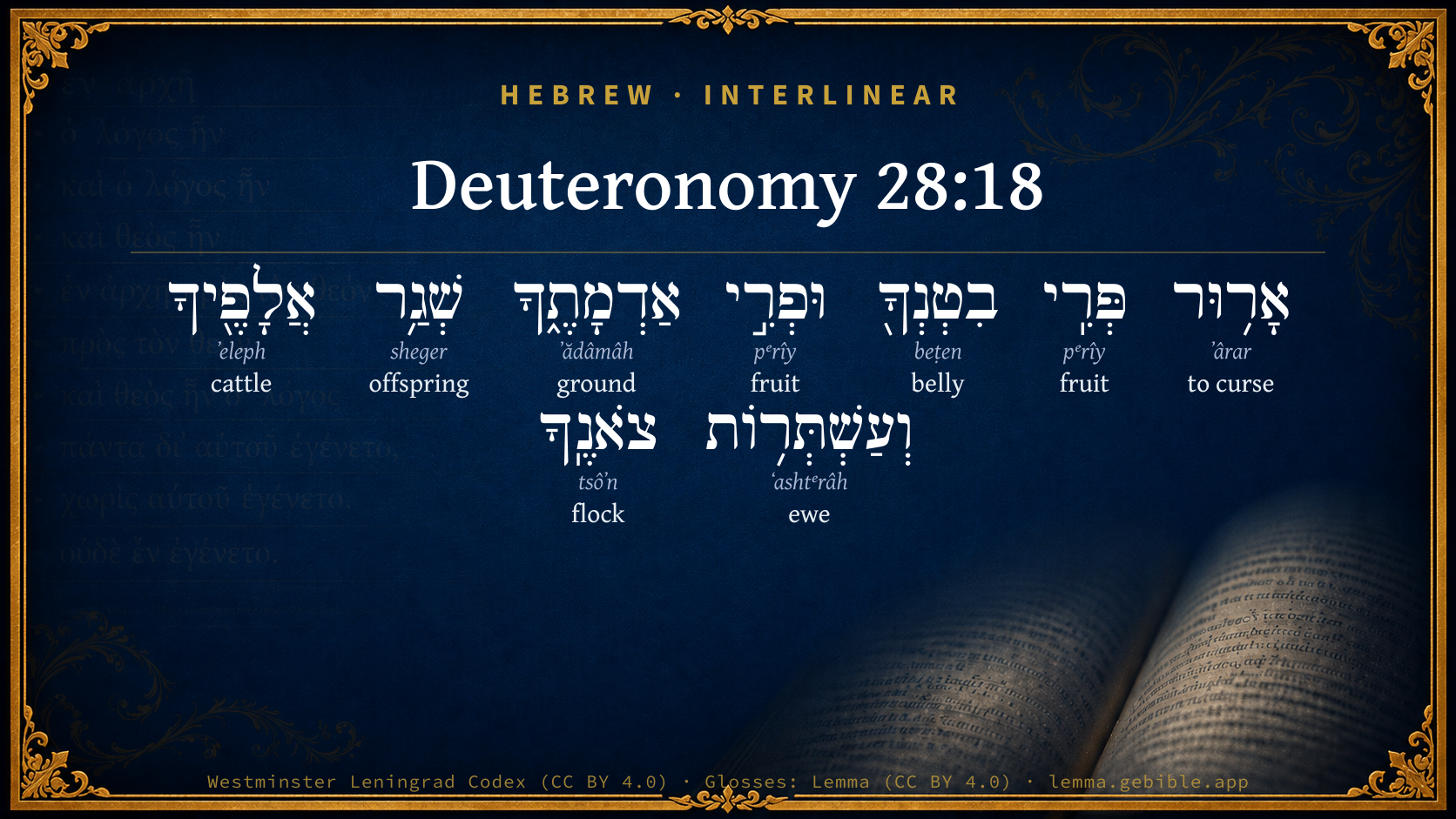
Hebrew (Westminster Leningrad Codex) Deuteronomy 28:18 appears in the Hebrew Old Testament. The text above is from the Westminster Leningrad Codex. Each word links to its Strong’s number, a concise gloss, and parsing drawn from the Open Scriptures Hebrew Bible morphology. Click any word for its full Brown-Driver-Briggs (BDB) entry.
Download image
Cite this verse

Deuteronomy 28:18 (World English Bible). Public Domain. Lemma interlinear Bible study tool, https://lemma.gebible.app/v/deuteronomy/28/18.

Show BibTeX & RIS
BibTeX
RIS
English Translation
Cursed shall be the fruit of your body, and the fruit of your ground, the increase of your cattle, and the young of your flock.
World English Bible · Public Domain
Download a study sheet

One document with this verse’s original text, its word-by-word gloss line, the meaning frame, cross-references with their text, attributed commentary, and full source and license credits — printable, and it pastes into notes with its structure intact.

This verse Autodidact and up

Study sheet (.html) Plain text (.txt)

A passage Seminary Student

Up to 50 verses in one chapter. A passage sheet keeps up to 6 commentary sources and 12 cross-references per verse, in the order this page ranks them, and says so on the sheet whenever that leaves anything out. Ask for a single verse and you get the Autodidact verse sheet above.

Everything on this page stays free to read, with no account — the sheet is a download of what is already on screen, not access to it.

Want to remove ads? Support Godless Engineer
Compare translations 3

The same verse in 3 English versions, stacked beneath the original-language interlinear above. Click any original word for its lexicon entry.

Each is an independent rendering of the whole verse — the interlinear is not word-aligned to these translations.

Highlighted words mark where these versions differ — a whole-verse word diff, not a word-by-word alignment.

  • World English Bible Public Domain
    Cursed shall be the fruit of your body, and the fruit of your ground, the increase of your cattle, and the young of your flock.
  • King James Version Public Domain
    Cursed shall be the fruit of thy body, and the fruit of thy land, the increase of thy kine, and the flocks of thy sheep.
  • unfoldingWord Literal Text CC BY-SA 4.0
    Cursed the fruit of your womb and the fruit of your ground, the increase of your cattle, and the young of your flock.

unfoldingWord Literal Text — © unfoldingWord, licensed CC BY-SA 4.0. Word-aligned USFM3 via Door43 (git.door43.org/unfoldingWord/en_ult).

Versions to compare (up to 4)

3 of 4 selected

Show all 18 translations

Every available English version of this verse, each an independent rendering of the whole verse.

  • World English Bible Public Domain
    Cursed shall be the fruit of your body, and the fruit of your ground, the increase of your cattle, and the young of your flock.
  • Berean Standard Bible Public Domain
    The fruit of your womb will be cursed, as well as the produce of your land, the calves of your herds, and the lambs of your flocks.
  • Majority Standard Bible Public Domain
    The fruit of your womb will be cursed, as well as the produce of your land, the calves of your herds, and the lambs of your flocks.
  • King James Version Public Domain
    Cursed shall be the fruit of thy body, and the fruit of thy land, the increase of thy kine, and the flocks of thy sheep.
  • American Standard Version (1901) Public Domain
    Cursed shall be the fruit of thy body, and the fruit of thy ground, the increase of thy cattle, and the young of thy flock.
  • Revised Version (1885) Public Domain
    Cursed shall be the fruit of thy body, and the fruit of thy ground, the increase of thy kine, and the young of thy flock.
  • Geneva Bible (1599) Public Domain
    Cursed shall be the fruite of thy body, and the fruite of thy land, the increase of thy kine, and the flockes of thy sheepe.
  • Douay-Rheims (1899) Public Domain
    Cursed shall be the fruit of thy womb, and the fruit of thy ground, the herds of thy oxen, and the flocks of thy sheep.
  • Young's Literal Translation Public Domain
    `Cursed `is' the fruit of thy body, and the fruit of thy land, increase of thine oxen, and wealth of thy flock.
  • Literal Standard Version CC BY-SA 4.0
    Cursed [is] the fruit of your body, and the fruit of your land, the increase of your oxen, and the wealth of your flock.
  • Unlocked Literal Bible CC BY-SA 4.0
    Cursed will be the fruit of your body, the fruit of your ground, the increase of your cattle, and the young of your flock.
  • unfoldingWord Literal Text CC BY-SA 4.0
    Cursed the fruit of your womb and the fruit of your ground, the increase of your cattle, and the young of your flock.
  • Darby Bible Public Domain
    Cursed shall be the fruit of thy womb, and the fruit of thy ground, the offspring of thy kine, and the increase of thy sheep.
  • World Messianic Bible Public Domain
    The fruit of your body, the fruit of your ground, the increase of your livestock, and the young of your flock will be cursed.
  • Webster's Bible Public Domain
    Cursed shall be the fruit of thy body, and the fruit of thy land, the increase of thy kine, and the flocks of thy sheep.
  • Free Bible Version CC BY-SA 4.0
    You will be cursed by not having children, and by not having good harvests, and by your cattle not having calves, and your sheep not having lambs.
  • Bible in Basic English Public Domain
    A curse will be on the fruit of your body, and on the fruit of your land, on the increase of your cattle, and the young of your flock.
  • JPS Tanakh (1917) Public Domain
    Cursed shall be the fruit of thy body, and the fruit of thy land, the increase of thy kine, and the young of thy flock.

Literal Standard Version (2020), Covenant Press — licensed CC BY-SA 4.0. Text via the HelloAO Bible API (eBible.org). Unlocked Literal Bible (unfoldingWord) — licensed CC BY-SA 4.0. Text via the HelloAO Bible API (eBible.org). unfoldingWord Literal Text — © unfoldingWord, licensed CC BY-SA 4.0. Word-aligned USFM3 via Door43 (git.door43.org/unfoldingWord/en_ult). Free Bible Version, Dr. Jonathan Gallagher — licensed CC BY-SA 4.0. Text via the HelloAO Bible API (eBible.org).

Word by word

More ways to search: Search by grammar → Find every occurrence → Compare this word →

Practice this passage: Drill this verse → Learn its vocabulary →

וְעַשְׁתְּר֥וֹת
ʻashtᵉrâh
H6251
“and · ewe”
Conjunction + Noun, Proper
Part of Speech
Conjunction + Noun
Type
Proper
Full BDB Definition

Origin: probably from H6238

TWOT: 1718a

ewe, flock, increase, young
  1. אָר֥וּר ʼârar H779 “cursed” Verb, Qal, Participle Passive, Masculine, Singular, Absolute
  2. פְּרִֽי pᵉrîy H6529 “fruit of” Noun, Common, Masculine, Singular, Construct
  3. בִטְנְךָ֖ beṭen H990 “belly · your” Noun, Common, Feminine, Singular, Construct + Suffix, Personal, 2nd Person, Masculine, Singular
  4. וּפְרִ֣י pᵉrîy H6529 “and · fruit of” Conjunction + Noun, Common, Masculine, Singular, Construct
  5. אַדְמָתֶ֑ךָ ʼădâmâh H127 “ground · your” Noun, Common, Feminine, Singular, Construct + Suffix, Personal, 2nd Person, Masculine, Singular
  6. שְׁגַ֥ר sheger H7698 “offspring of” Noun, Common, Masculine, Singular, Construct
  7. אֲלָפֶ֖יךָ ʼeleph H504 “cattle · your” Noun, Common, Masculine, Plural, Construct + Suffix, Personal, 2nd Person, Masculine, Singular
  8. צֹאנֶֽךָ tsôʼn H6629 “flock · your” Noun, Common, Both, Singular, Construct + Suffix, Personal, 2nd Person, Masculine, Singular

About this verse

These counts appear in no published source. They are computed here, from the morphology-tagged text and Lemma’s own curated glosses. What Lemma adds →

9
words
8
distinct lemmas
Pentateuch
section

Notable vocabulary

The rarest word here is וְעַשְׁתְּר֥וֹת ewe H6251 — appearing just 4 times in the whole Hebrew Bible.

Shared distinctive vocabulary

וְעַשְׁתְּר֥וֹת ewe H6251 occurs in 4 verses of the Hebrew Bible. Also found in:

Grammatical profile

  • 1 verb
  • 8 nouns

Verb forms

  • אָר֥וּר Qal · Participle Passive

Repetition

A word recurs within this verse — often emphatic in Hebrew:

  • פְּרִֽי fruit H6529 ×2

Hebrew & Septuagint length

In English translation the verse runs 25 words from the Hebrew and 25 from the Septuagint (LXX English) — the same length.

A rough comparison of the two English renderings, which tokenize alike — not a word-level alignment.

Word counts can differ between the Hebrew and the Greek without any difference in meaning — e.g. the Hebrew direct-object marker אֵת has no separate Greek word, and Greek often adds the article ὁ.

Cross-references

13

Topical passages linked to Deuteronomy 28:18 in the Treasury of Scripture Knowledge — connected by theme and wording, ordered by reader-vote popularity; previews shown in the World English Bible.

  • Leviticus 26:26 When I break your staff of bread, ten women shall bake your bread in one oven, and they shall deliver your bread again by weight: and you shall eat, and not be satisfied.
  • Leviticus 26:19–20 I will break the pride of your power, and I will make your sky like iron, and your soil like brass;
  • Deuteronomy 5:9 you shall not bow down yourself to them, nor serve them; for I, Yahweh, your God, am a jealous God, visiting the iniquity of the fathers on the children, and on the third and on the fourth generation of those who hate me;
  • Deuteronomy 28:4 Blessed shall be the fruit of your body, and the fruit of your ground, and the fruit of your animals, the increase of your cattle, and the young of your flock.
  • Deuteronomy 28:16 Cursed shall you be in the city, and cursed shall you be in the field.
  • Job 18:16–19 His roots shall be dried up beneath, Above shall his branch be cut off.
  • Psalms 109:9–15 Let his children be fatherless, And his wife a widow.
  • Lamentations 2:20 Look, Yahweh, and see to whom you have done thus! Shall the women eat their fruit, the children that are dandled in the hands? Shall the priest and the prophet be killed in the sanctuary of the Lord?
  • Habakkuk 3:17 For though the fig tree doesn't flourish, Nor fruit be in the vines; The labor of the olive fails, The fields yield no food; The flocks are cut off from the fold, And there is no herd in the stalls:
  • Lamentations 2:11–12 My eyes do fail with tears, my heart is troubled; My liver is poured on the earth, because of the destruction of the daughter of my people, Because the young children and the infants swoon in the streets of the city.
  • Hosea 9:11–14 As for Ephraim, their glory will fly away like a bird. There will be no birth, none with child, and no conception.
  • Malachi 2:3 Behold, I will rebuke your seed, and will spread dung on your faces, even the dung of your feasts; and you will be taken away with it.
  • Luke 23:29–30 For behold, the days are coming in which they will say, 'Blessed are the barren, the wombs that never bore, and the breasts that never nursed.'

Cross-references courtesy of OpenBible.info (CC BY 4.0).

Hebrew and Greek witnesses Masoretic Hebrew ↔ Greek Septuagint

The same verse in the two great witnesses to the Old Testament, shown verse-for-verse.

These are two independent witnesses, not word-aligned to each other, and the Septuagint is shown in lemma (dictionary) form.

Hebrew Deuteronomy 28:18 Masoretic · Westminster Leningrad Codex

אָר֥וּר פְּרִֽי בִטְנְךָ֖ וּפְרִ֣י אַדְמָתֶ֑ךָ שְׁגַ֥ר אֲלָפֶ֖יךָ וְעַשְׁתְּר֥וֹת צֹאנֶֽךָ

Cursed shall be the fruit of your body, and the fruit of your ground, the increase of your cattle, and the young of your flock.

World English Bible · Public Domain

Greek LXX Deuteronomy 28:18 Septuagint · lemma form

ἐπικατάρατος ὁ ἔκγονος ὁ κοιλία σύ καί ὁ γένημα ὁ γῆ σύ ὁ βουκόλιον ὁ βοῦς σύ καί ὁ ποίμνιον ὁ πρόβατον σύ

Cursed shall be the offspring of your body, and the fruits of your land, the herds of your oxen, and the flocks of your sheep.

LXX2012 (modern English Septuagint) · Public Domain

Hebrew: Westminster Leningrad Codex (CC BY 4.0). Greek: Septuagint (public domain); English from LXX2012 (modern English Septuagint) (Public Domain). How the Septuagint differs from the Hebrew →

Targum (Aramaic paraphrase)

2

The Targum is the ancient Jewish Aramaic paraphrase of the Hebrew Scriptures — an interpretive translation, not the Hebrew text itself. Onkelos (literal) and Pseudo-Jonathan (expansive) render the Torah, and Jonathan the Prophets. Coverage is partial: where no permissively-licensed English translation exists for a verse, only the Aramaic is shown. This is verse-level text, not a word-by-word alignment to the Hebrew.

  1. Targum Onkelos Torah (Genesis–Deuteronomy)
    לִיטּ וַלְדָא דִמְעָךְ וְאִבָּא דְאַרְעָךְ בַּקְרֵי תוֹרָיךְ וְעֶדְרֵי עָנָךְ

    (no public-domain English translation for this verse)

    Targum Onkelos — Aramaic: “Onkelos Genesis” (public domain); “Onkelos Exodus” (public domain); “Onkelos Leviticus” (public domain); “Onkelos Numbers” (public domain); “Onkelos Deuteronomy” (public domain). English: “Sefaria Community Translation” (CC0 1.0 (public-domain dedication)); “J.W. Etheridge. The Targums of Onkelos and Jonathan Ben Uzziel on the Pentateuch. London: Longmans, Green, 1862” (public domain). Text via Sefaria.

  2. Targum Pseudo-Jonathan Torah (Genesis–Deuteronomy)
    לִיטִין וַולְדֵי מֵעֵיכוֹן וּפֵירֵי אַרְעֲכוֹן בַּקְרֵי תּוֹרֵיכוֹן וְעֶדְרֵי עָנֵיכוֹן

    Accursed the children of your wombs, the fruits of your ground, the oxen of your herds, and the sheep of your flocks.

    Targum Pseudo-Jonathan — Aramaic: “Targum Jonathan on Genesis” (public domain); “Targum Jonathan on Exodus” (public domain); “Targum Jonathan on Leviticus” (public domain); “Targum Jonathan on Numbers” (public domain); “Targum Jonathan on Deuteronomy” (public domain). English: “The Targum of Jonathan ben Uzziel, trans. J. W. Etheridge, London, 1862” (public domain). Text via Sefaria.

Commentary

Notes on Deuteronomy 28:18 from classic Christian and Jewish commentators (each source and its license shown beneath its notes). The classic Christian expositions comment on the surrounding passage and are grouped to its opening verse, so a note may address several verses; the Jewish commentaries on the Tanakh (Rashi and others) are per-verse, so they appear only where the commentator wrote on this verse.

Lemma curates 59 commentaries, every one of them public domain or Creative Commons licensed, each selected and text-cleaned for this edition rather than reprinted as found. About our sources →

Trapp's Complete Commentary

John Trapp

Deu 28:18 Cursed [shall be] the fruit of thy body, and the fruit of thy land, the increase of thy kine, and the flocks of thy sheep.

Ver. 18. {See Trapp on "Deu 28:15"}

John Trapp, A Commentary or Exposition upon All the Books of the Old and New Testament (1647–1656) — public domain. Text from a community e-Sword module.

John Gill's Exposition

The Lord shall make the pestilence cleave unto thee,.... Not only to come upon them; but to continue with them:

until he have consumed thee from off the land whither thou goest to possess it; which shows that this respects not some particular seasons, when the pestilence came and continued awhile, and then ceased, as in the times of David; but when it became more general, and issued with other judgments in the utter consumption of them, as at the destruction of Jerusalem, both by the Babylonians and the Romans; at what times the pestilence raged and remained, until by that and other sore judgments the land was wholly depopulated.

John Gill's Exposition of the Whole Bible (1746–1763) — public domain (CC PDM 1.0). Text via the HelloAO Bible API.

unfoldingWord translationNotes

Door43 World Missions Community

General Information:

Moses speaks to the Israelites as if they were one man, so the words "you" and "your" here are singular. (See: Forms of You)

General Information:

These phrases appeared earlier in the chapter. See how you translated many of these words in Deuteronomy 28:3-4 and Deuteronomy 28:5-6.

Cursed will be

This can be stated in active form. AT: "Yahweh will curse" (See: Active or Passive)

the fruit of your body, the fruit of your ground

This is an idiom for "your children, your crops." See how you translated this in Deuteronomy 28:4. (See: Idiom)

the increase of your cattle, and the young of your flock

This doublet is two ways of saying that Yahweh will make the Israelites' animals many and strong. AT: "the calves of the cattle and the lambs of the flocks" (See: Doublet)

when you come in ... when you go out

This merism refers to all of life's activities everywhere they go. See how you translated this in Deuteronomy 28:6 (See: Merism)

translationWords

curse

body

flocks

unfoldingWord translationNotes — © Distant Shores Media and the Door43 World Missions Community, licensed CC BY-SA 4.0. Source: git.door43.org/Door43/en_tn.

Ramban (Nachmanides)

Rabbi Moshe ben Nachman (Ramban / Nachmanides)

In the blessings he mentioned first the fruit of thy body and afterwards thy basket and thy kneading-trough, Verse 5. for the fruit of the body is the best and most beloved, but in the curses he delayed it [mentioning first thy basket and thy kneading-trough in Verse 17, and the fruit of thy body in Verse 18] because the punishment extends first to a man’s possessions, and, if he does not repent, it reaches the fruit of his body. Similarly, in the blessings he mentioned first the smiting of the enemies before the blessing in thy barns, and in all that thou puttest thy hand unto, Verse 8. for triumph over the enemy is the honor and necessity for them in the conquest of the lands, and their dwelling safely among the peoples. And in the curses he mentioned first the diminishing in all that thou puttest thy hand unto to do and delayed their being smitten before the enemies, Verse 25. for this is the punishment that would reach them afterwards — and in the end they would be exiled., Verse 68.

Ramban (Nachmanides) on the Tanakh — English translation: “Commentary on the Torah by Ramban (Nachmanides). Translated and annotated by Charles B. Chavel. New York, Shilo Pub. House, 1971-1976” (CC BY 4.0). Text via Sefaria.

Lesson kit

Teaching starters — assembled from the data on this page, not authored interpretation. Every prompt links to the verse data it draws on. Edit before teaching.

Deuteronomy, in the Pentateuch, opens this verse with 9 words (8 distinct Hebrew lemmas). Its most distinctive word is ʻashtᵉrâh (“ewe”). A historical commentator’s framing appears above. Read the whole chapter for the surrounding context.

Discussion questions

  1. The word ʻashtᵉrâh carries the sense “ewe.” How does it shape the verse?
  2. Deuteronomy 7:13 shares the word «ewe» with this verse. How do the two illuminate each other?
  3. “fruit” occurs 2× in this one verse. What is the effect of the repetition?
  4. The translations on this page render this verse differently — a whole-verse word diff, not a word-by-word alignment. What might account for the different wordings?
  5. The verb «אָר֥וּר» is Qal Participle Passive. How does its form color the action?
  6. Reading how Trapp's Complete Commentary and John Gill's Exposition read this verse, where do the two commentators agree and where do they part?

Things to notice

Reading settings

Reading text

Shown beneath each verse's original-language words.

Old Testament
Old Testament edition

Read the OT as the Masoretic Hebrew (MT) or the Greek Septuagint (LXX).

English shown for the Greek Septuagint (in the Hebrew ↔ Greek comparison).

Comparing translations? Open the Compare panel on any verse page to stack up to four side by side.