
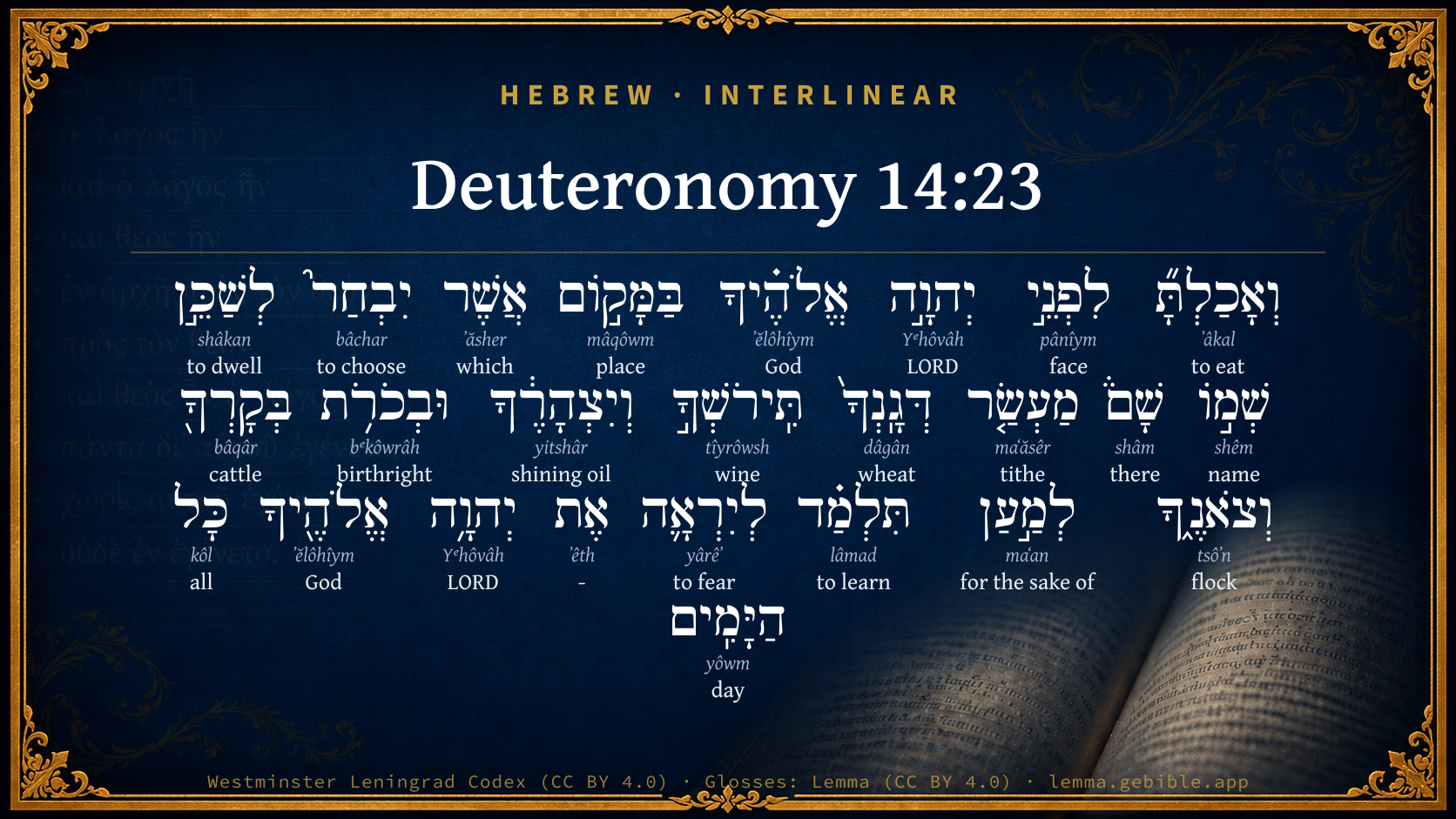
Deuteronomy 14:23

Hebrew (Westminster Leningrad Codex) Deuteronomy 14:23 appears in the Hebrew Old Testament. The text above is from the Westminster Leningrad Codex. Each word links to its Strong’s number, a concise gloss, and parsing drawn from the Open Scriptures Hebrew Bible morphology. Click any word for its full Brown-Driver-Briggs (BDB) entry.
Download image
Cite this verse

Deuteronomy 14:23 (World English Bible). Public Domain. Lemma interlinear Bible study tool, https://lemma.gebible.app/v/deuteronomy/14/23.

Show BibTeX & RIS
BibTeX
RIS
English Translation
You shall eat before Yahweh your God, in the place which he shall choose, to cause his name to dwell there, the tithe of your grain, of your new wine, and of your oil, and the firstborn of your herd and of your flock; that you may learn to fear Yahweh your God always.
World English Bible · Public Domain
Download a study sheet

One document with this verse’s original text, its word-by-word gloss line, the meaning frame, cross-references with their text, attributed commentary, and full source and license credits — printable, and it pastes into notes with its structure intact.

This verse Autodidact and up

Study sheet (.html) Plain text (.txt)

A passage Seminary Student

Up to 50 verses in one chapter. A passage sheet keeps up to 6 commentary sources and 12 cross-references per verse, in the order this page ranks them, and says so on the sheet whenever that leaves anything out. Ask for a single verse and you get the Autodidact verse sheet above.

Everything on this page stays free to read, with no account — the sheet is a download of what is already on screen, not access to it.

Want to remove ads? Support Godless Engineer
Compare translations 3

The same verse in 3 English versions, stacked beneath the original-language interlinear above. Click any original word for its lexicon entry.

Each is an independent rendering of the whole verse — the interlinear is not word-aligned to these translations.

Highlighted words mark where these versions differ — a whole-verse word diff, not a word-by-word alignment.

  • World English Bible Public Domain
    You shall eat before Yahweh your God, in the place which he shall choose, to cause his name to dwell there, the tithe of your grain, of your new wine, and of your oil, and the firstborn of your herd and of your flock; that you may learn to fear Yahweh your God always.
  • King James Version Public Domain
    And thou shalt eat before the LORD thy God, in the place which he shall choose to place his name there, the tithe of thy corn, of thy wine, and of thine oil, and the firstlings of thy herds and of thy flocks; that thou mayest learn to fear the LORD thy God always.
  • unfoldingWord Literal Text CC BY-SA 4.0
    And you shall eat to the face of Yahweh your God, in the place that he will choose to make his name stay there, the tithe of your grain, your new wine, and your oil and the firstborn of your herd and your flock, so that you will learn to honor Yahweh your God all the days.

unfoldingWord Literal Text — © unfoldingWord, licensed CC BY-SA 4.0. Word-aligned USFM3 via Door43 (git.door43.org/unfoldingWord/en_ult).

Versions to compare (up to 4)

3 of 4 selected

Show all 18 translations

Every available English version of this verse, each an independent rendering of the whole verse.

  • World English Bible Public Domain
    You shall eat before Yahweh your God, in the place which he shall choose, to cause his name to dwell there, the tithe of your grain, of your new wine, and of your oil, and the firstborn of your herd and of your flock; that you may learn to fear Yahweh your God always.
  • Berean Standard Bible Public Domain
    And you are to eat a tenth of your grain, new wine, and oil, and the firstborn of your herds and flocks, in the presence of the LORD your God at the place He will choose as a dwelling for His Name, so that you may learn to fear the LORD your God always.
  • Majority Standard Bible Public Domain
    And you are to eat a tenth of your grain, new wine, and oil, and the firstborn of your herds and flocks, in the presence of the LORD your God at the place He will choose as a dwelling for His Name, so that you may learn to fear the LORD your God always.
  • King James Version Public Domain
    And thou shalt eat before the LORD thy God, in the place which he shall choose to place his name there, the tithe of thy corn, of thy wine, and of thine oil, and the firstlings of thy herds and of thy flocks; that thou mayest learn to fear the LORD thy God always.
  • American Standard Version (1901) Public Domain
    And thou shalt eat before Jehovah thy God, in the place which he shall choose, to cause his name to dwell there, the tithe of thy grain, of thy new wine, and of thine oil, and the firstlings of thy herd and of thy flock; that thou mayest learn to fear Jehovah thy God always.
  • Revised Version (1885) Public Domain
    And thou shalt eat before the LORD thy God, in the place which he shall choose to cause his name to dwell there, the tithe of thy corn, of thy wine, and of thine oil, and the firstlings of thy herd and of thy flock; that thou mayest learn to fear the LORD thy God always.
  • Geneva Bible (1599) Public Domain
    And thou shalt eate before the Lord thy God (in the place which he shall chose to cause his Name to dwell there) the tithe of thy corne, of thy wine, and of thine oyle, and the first borne of thy kine and of thy sheepe, that thou maiest learne to feare the Lord thy God alway.
  • Douay-Rheims (1899) Public Domain
    And thou shalt eat before the Lord thy God in the place which he shall choose, that his name may be called upon therein, the tithe of thy corn, and thy wine, and thy oil, and the firstborn of thy herds and thy sheep: that thou mayst learn to fear the Lord thy God at all times.
  • Young's Literal Translation Public Domain
    and thou hast eaten before Jehovah thy God, in the place where He doth choose to cause His name to tabernacle, the tithe of thy corn, of thy new wine, and of thine oil, and the firstlings of thy herd, and of thy flock, so that thou dost learn to fear Jehovah thy God all the days.
  • Literal Standard Version CC BY-SA 4.0
    and you have eaten before your God YHWH, in the place where He chooses to cause His Name to dwell, the tithe of your grain, of your new wine, and of your oil, and the firstlings of your herd, and of your flock, so that you learn to fear your God YHWH [for] all the days.
  • Unlocked Literal Bible CC BY-SA 4.0
    You must eat before Yahweh your God, in the place that he will choose as his sanctuary, the tithe of your grain, of your new wine, and of your oil, and the firstborn of your herd and your flock; that you may learn to always honor Yahweh your God.
  • unfoldingWord Literal Text CC BY-SA 4.0
    And you shall eat to the face of Yahweh your God, in the place that he will choose to make his name stay there, the tithe of your grain, your new wine, and your oil and the firstborn of your herd and your flock, so that you will learn to honor Yahweh your God all the days.
  • Darby Bible Public Domain
    And thou shalt eat before Jehovah thy God, in the place which he will choose to cause his name to dwell there, the tithe of thy corn, of thy new wine, and of thine oil, and the firstlings of thy herds and of thy flocks; that thou mayest learn to fear Jehovah thy God continually.
  • World Messianic Bible Public Domain
    You shall eat before the LORD your God, in the place which he chooses to cause his name to dwell, the tithe of your grain, of your new wine, and of your oil, and the firstborn of your herd and of your flock; that you may learn to fear the LORD your God always.
  • Webster's Bible Public Domain
    And thou shalt eat before the LORD thy God, in the place which he shall choose to place his name there, the tithe of thy corn, of thy wine, and of thy oil, and the firstlings of thy herds and of thy flocks; that thou mayest learn to fear the LORD thy God always.
  • Free Bible Version CC BY-SA 4.0
    You are to eat a tenth of your grain, new wine, and olive oil, and the firstborn of your herds and flocks, in the presence of the Lord your God at the place he will choose to live with you, so that you will learn to always respect the Lord your God.
  • Bible in Basic English Public Domain
    And make a feast before the Lord your God, in the place which is to be marked out, where his name will be for ever, of the tenth part of your grain and your wine and your oil, and the first births of your herds and your flocks; so that you may have the fear of the Lord your God in your hearts at all times.
  • JPS Tanakh (1917) Public Domain
    And thou shalt eat before the LORD thy God, in the place which He shall choose to cause His name to dwell there, the tithe of thy corn, of thy wine, and of thine oil, and the firstlings of thy herd and of thy flock; that thou mayest learn to fear the LORD thy God always.

Literal Standard Version (2020), Covenant Press — licensed CC BY-SA 4.0. Text via the HelloAO Bible API (eBible.org). Unlocked Literal Bible (unfoldingWord) — licensed CC BY-SA 4.0. Text via the HelloAO Bible API (eBible.org). unfoldingWord Literal Text — © unfoldingWord, licensed CC BY-SA 4.0. Word-aligned USFM3 via Door43 (git.door43.org/unfoldingWord/en_ult). Free Bible Version, Dr. Jonathan Gallagher — licensed CC BY-SA 4.0. Text via the HelloAO Bible API (eBible.org).

Word by word

More ways to search: Search by grammar → Find every occurrence → Compare this word →

Practice this passage: Drill this verse → Learn its vocabulary →

וּבְכֹרֹ֥ת
bᵉkôwrâh
H1062
“and · birthrights of”
Conjunction + Noun, Common, Both, Plural, Construct
Part of Speech
Conjunction + Noun
Type
Common
Gender
Both
Number
Plural
State
Construct
Full BDB Definition

Origin: from H1060

TWOT: 244c

birthright, primogeniture, right of the first-born
  1. וְאָכַלְתָּ֞ ʼâkal H398 “and · to eat” Conjunction + Verb, Qal, Sequential Perfect, 2nd Person, Masculine, Singular
  2. לִפְנֵ֣י pânîym H6440 “to/for · face(s) of” Preposition + Noun, Common, Both, Plural, Construct
  3. יְהוָ֣ה Yᵉhôvâh H3068 “LORD” Noun, Proper
  4. אֱלֹהֶ֗יךָ ʼĕlôhîym H430 “God(s) · your” Noun, Common, Masculine, Plural, Construct + Suffix, Personal, 2nd Person, Masculine, Singular
  5. בַּמָּק֣וֹם mâqôwm H4725 “in/at the · place” Preposition, Determined + Noun, Common, Masculine, Singular, Absolute
  6. אֲשֶׁר ʼăsher H834 “which” Particle, Relative
  7. יִבְחַר֮ bâchar H977 “to choose” Verb, Qal, Imperfect, 3rd Person, Masculine, Singular
  8. לְשַׁכֵּ֣ן shâkan H7931 “to dwell” Preposition + Verb, Piel, Infinitive Construct
  9. שְׁמ֣וֹ shêm H8034 “name · his” Noun, Common, Masculine, Singular, Construct + Suffix, Personal, 3rd Person, Masculine, Singular
  10. שָׁם֒ shâm H8033 “there” Adverb
  11. מַעְשַׂ֤ר maʻăsêr H4643 “tithe of” Noun, Common, Masculine, Singular, Construct
  12. דְּגָֽנְךָ֙ dâgân H1715 “wheat · your” Noun, Common, Masculine, Singular, Construct + Suffix, Personal, 2nd Person, Masculine, Singular
  13. תִּֽירֹשְׁךָ֣ tîyrôwsh H8492 “wine · your” Noun, Common, Masculine, Singular, Construct + Suffix, Personal, 2nd Person, Masculine, Singular
  14. וְיִצְהָרֶ֔ךָ yitshâr H3323 “and · shining oil · your” Conjunction + Noun, Common, Masculine, Singular, Construct + Suffix, Personal, 2nd Person, Masculine, Singular
  15. בְּקָרְךָ֖ bâqâr H1241 “cattle · your” Noun, Common, Both, Singular, Construct + Suffix, Personal, 2nd Person, Masculine, Singular
  16. וְצֹאנֶ֑ךָ tsôʼn H6629 “and · flock · your” Conjunction + Noun, Common, Both, Singular, Construct + Suffix, Personal, 2nd Person, Masculine, Singular
  17. לְמַ֣עַן maʻan H4616 “for the sake of” Preposition
  18. תִּלְמַ֗ד lâmad H3925 “to learn” Verb, Qal, Imperfect, 2nd Person, Masculine, Singular
  19. לְיִרְאָ֛ה yârêʼ H3372 “to fear” Preposition + Verb, Qal, Infinitive Construct
  20. אֶת ʼêth H853 “-” Particle, Direct Object
  21. יְהוָ֥ה Yᵉhôvâh H3068 “LORD” Noun, Proper
  22. אֱלֹהֶ֖יךָ ʼĕlôhîym H430 “God(s) · your” Noun, Common, Masculine, Plural, Construct + Suffix, Personal, 2nd Person, Masculine, Singular
  23. כָּל kôl H3605 “all of” Noun, Common, Masculine, Singular, Construct
  24. הַיָּמִֽים yôwm H3117 “the · days” Particle, Definite Article + Noun, Common, Masculine, Plural, Absolute

About this verse

These counts appear in no published source. They are computed here, from the morphology-tagged text and Lemma’s own curated glosses. What Lemma adds →

25
words
23
distinct lemmas
Pentateuch
section

Notable vocabulary

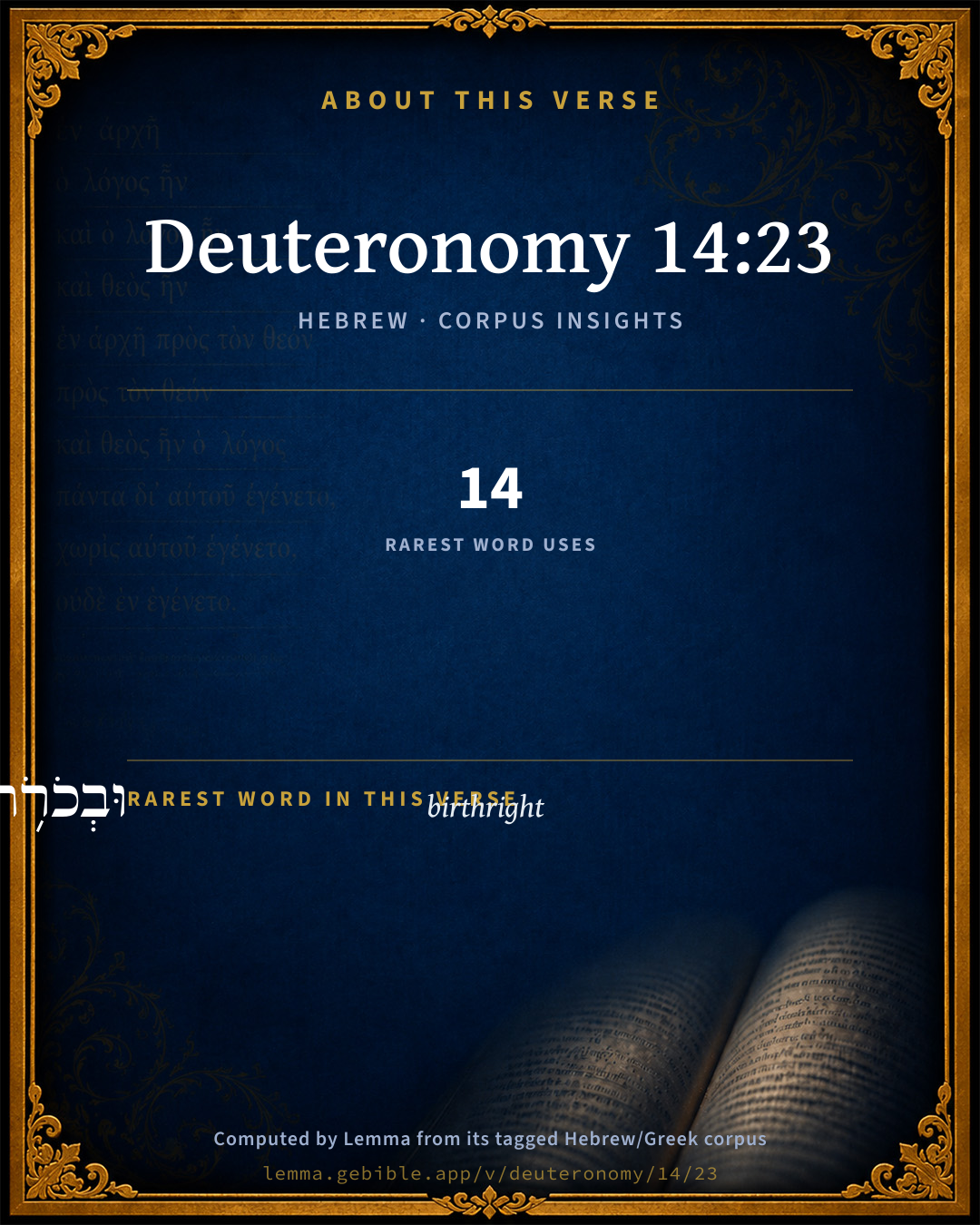
The rarest word here is וּבְכֹרֹ֥ת birthright H1062 — appearing just 14 times in the whole Hebrew Bible.

Shared distinctive vocabulary

וּבְכֹרֹ֥ת birthright H1062 occurs in 13 verses of the Hebrew Bible. Also found in:

Grammatical profile

  • 5 verbs
  • 16 nouns
  • 1 preposition
  • 1 adverb
  • 2 particles

Verb forms

  • וְאָכַלְתָּ֞ Qal · Sequential Perfect
  • יִבְחַר֮ Qal · Imperfect
  • לְשַׁכֵּ֣ן Piel · Infinitive Construct
  • תִּלְמַ֗ד Qal · Imperfect
  • לְיִרְאָ֛ה Qal · Infinitive Construct

Repetition

Words recur within this verse — often emphatic in Hebrew:

  • יְהוָ֣ה LORD H3068 ×2
  • אֱלֹהֶ֗יךָ God H430 ×2

Hebrew & Septuagint length

In English translation the verse runs 54 words from the Hebrew and 57 from the Septuagint (LXX English) — closely comparable.

A rough comparison of the two English renderings, which tokenize alike — not a word-level alignment.

Word counts can differ between the Hebrew and the Greek without any difference in meaning — e.g. the Hebrew direct-object marker אֵת has no separate Greek word, and Greek often adds the article ὁ.

Cross-references

4

Topical passages linked to Deuteronomy 14:23 in the Treasury of Scripture Knowledge — connected by theme and wording, ordered by reader-vote popularity; previews shown in the World English Bible.

  • Deuteronomy 12:5–7 But to the place which Yahweh your God shall choose out of all your tribes, to put his name there, even to his habitation shall you seek, and there you shall come;
  • Deuteronomy 4:10 the day that you stood before Yahweh your God in Horeb, when Yahweh said to me, Assemble me the people, and I will make them hear my words, that they may learn to fear me all the days that they live on the earth, and that they may teach their children.
  • Deuteronomy 12:17–18 You may not eat within your gates the tithe of your grain, or of your new wine, or of your oil, or the firstborn of your herd or of your flock, nor any of your vows which you vow, nor your freewill-offerings, nor the heave-offering of your hand;
  • Deuteronomy 15:19–20 All the firstborn males that are born of your herd and of your flock you shall sanctify to Yahweh your God: you shall do no work with the firstborn of your herd, nor shear the firstborn of your flock.

Cross-references courtesy of OpenBible.info (CC BY 4.0).

Hebrew and Greek witnesses Masoretic Hebrew ↔ Greek Septuagint

The same verse in the two great witnesses to the Old Testament, shown verse-for-verse.

These are two independent witnesses, not word-aligned to each other, and the Septuagint is shown in lemma (dictionary) form.

Hebrew Deuteronomy 14:23 Masoretic · Westminster Leningrad Codex

וְאָכַלְתָּ֞ לִפְנֵ֣י יְהוָ֣ה אֱלֹהֶ֗יךָ בַּמָּק֣וֹם אֲשֶׁר יִבְחַר֮ לְשַׁכֵּ֣ן שְׁמ֣וֹ שָׁם֒ מַעְשַׂ֤ר דְּגָֽנְךָ֙ תִּֽירֹשְׁךָ֣ וְיִצְהָרֶ֔ךָ וּבְכֹרֹ֥ת בְּקָרְךָ֖ וְצֹאנֶ֑ךָ לְמַ֣עַן תִּלְמַ֗ד לְיִרְאָ֛ה אֶת יְהוָ֥ה אֱלֹהֶ֖יךָ כָּל הַיָּמִֽים

You shall eat before Yahweh your God, in the place which he shall choose, to cause his name to dwell there, the tithe of your grain, of your new wine, and of your oil, and the firstborn of your herd and of your flock; that you may learn to fear Yahweh your God always.

World English Bible · Public Domain

Greek LXX Deuteronomy 14:23 Septuagint · lemma form

καί ἐσθίω αὐτός ἔναντι κύριος ὁ θεός σύ ἐν ὁ τόπος ὅς ἄν ἐκλέγω κύριος ὁ θεός σύ ἐπικαλέω ὁ ὄνομα αὐτός ἐκεῖ φέρω ὁ ἐπιδέκατος ὁ σῖτος σύ καί ὁ οἶνος σύ καί ὁ ἔλαιον σύ ὁ πρωτότοκος ὁ βοῦς σύ καί ὁ πρόβατον σύ ἵνα μανθάνω φοβέω κύριος ὁ θεός σύ πᾶς ὁ ἡμέρα

And you shall eat it in the place which the Lord your God shall choose to have his name called there; you⌃ shall bring the tithe of your corn and of your wine, and of your oil, the firstborn of your herd and of your flock, that you may learn to fear the Lord your God always.

LXX2012 (modern English Septuagint) · Public Domain

On this verse, The Cambridge Bible for Schools and Colleges discusses the Septuagint’s reading. Read the note in Commentary ↓

Hebrew: Westminster Leningrad Codex (CC BY 4.0). Greek: Septuagint (public domain); English from LXX2012 (modern English Septuagint) (Public Domain). How the Septuagint differs from the Hebrew →

Targum (Aramaic paraphrase)

2

The Targum is the ancient Jewish Aramaic paraphrase of the Hebrew Scriptures — an interpretive translation, not the Hebrew text itself. Onkelos (literal) and Pseudo-Jonathan (expansive) render the Torah, and Jonathan the Prophets. Coverage is partial: where no permissively-licensed English translation exists for a verse, only the Aramaic is shown. This is verse-level text, not a word-by-word alignment to the Hebrew.

  1. Targum Onkelos Torah (Genesis–Deuteronomy)
    וְתֵיכוּל קֳדָם יְיָ אֱלָהָךְ בְּאַתְרָא דִי יִתִּרְעֵי לְאַשְׁרָאָה שְׁכִנְתֵּהּ תַּמָן מַעְשַׂר עִבוּרָךְ חַמְרָךְ וּמִשְׁחָךְ וּבְכוֹרֵי תוֹרָךְ וְעָנָךְ בְּדִיל דְתֵילַף לְמִדְחַל קֳדָם יְיָ אֱלָהָךְ כָּל יוֹמַיָא

    (no public-domain English translation for this verse)

    Targum Onkelos — Aramaic: “Onkelos Genesis” (public domain); “Onkelos Exodus” (public domain); “Onkelos Leviticus” (public domain); “Onkelos Numbers” (public domain); “Onkelos Deuteronomy” (public domain). English: “Sefaria Community Translation” (CC0 1.0 (public-domain dedication)); “J.W. Etheridge. The Targums of Onkelos and Jonathan Ben Uzziel on the Pentateuch. London: Longmans, Green, 1862” (public domain). Text via Sefaria.

  2. Targum Pseudo-Jonathan Torah (Genesis–Deuteronomy)
    וְתֵיכְלוּן מַעַשְרָא תִנְיָינָא קֳדָם יְיָ אֱלָהָכוֹן בְּאַתְרָא דְיִתְרְעֵי לְאַשְׁרָאָה שְׁכִינְתֵּיהּ תַּמָּן מַעֲשַר עִיבּוּרֵיכוֹן חַמְרֵיכוֹן וּמִשְׁחֲכוֹן וְכֵן בִּכּוּרֵי תוֹרֵיכוֹן וְעָנֵיכוֹן מִן בִּגְלַל דְּתֵילְפוּן לְמִדְחַל מִן קֳדָם יְיָ אֱלָהָכוֹן כָּל יוֹמַיָא

    And the second tythe you shall eat before the Lord your God in the place which He will choose to make His Shekinah to dwell there; the tenths of your corn, your vines, and your oil, and likewise the firstlings of your oxen and sheep, that you may learn to fear the Lord your God all the days.

    Targum Pseudo-Jonathan — Aramaic: “Targum Jonathan on Genesis” (public domain); “Targum Jonathan on Exodus” (public domain); “Targum Jonathan on Leviticus” (public domain); “Targum Jonathan on Numbers” (public domain); “Targum Jonathan on Deuteronomy” (public domain). English: “The Targum of Jonathan ben Uzziel, trans. J. W. Etheridge, London, 1862” (public domain). Text via Sefaria.

Commentary

Notes on Deuteronomy 14:23 from classic Christian and Jewish commentators (each source and its license shown beneath its notes). The classic Christian expositions comment on the surrounding passage and are grouped to its opening verse, so a note may address several verses; the Jewish commentaries on the Tanakh (Rashi and others) are per-verse, so they appear only where the commentator wrote on this verse.

Lemma curates 59 commentaries, every one of them public domain or Creative Commons licensed, each selected and text-cleaned for this edition rather than reprinted as found. About our sources →

Trapp's Complete Commentary

John Trapp

Deu 14:23 And thou shalt eat before the LORD thy God, in the place which he shall choose to place his name there, the tithe of thy corn, of thy wine, and of thine oil, and the firstlings of thy herds and of thy flocks; that thou mayest learn to fear the LORD thy God always.

Ver. 23. That thou mayest learn,] A man cannot converse with God, but he shall learn something. Semper a te doctior redeo, said he to his friend. Moses came from the mount with his face shining. Compare Ecc 8:1.

John Trapp, A Commentary or Exposition upon All the Books of the Old and New Testament (1647–1656) — public domain. Text from a community e-Sword module.

Tyndale Open Study Notes

Tyndale Open Resources

14:23 The place the Lord your God chooses for his name to be honored (literally the place he will cause his name to dwell) was the central sanctuary, the Lord’s dwelling on the earth among his people (see 12:5, 18).

Tyndale Open Study Notes — © Tyndale Open Resources, licensed CC BY-SA 4.0. Text via the HelloAO Bible API.

Ellicott's Commentary for English Readers

(23) And thou shalt eat before the Lord thy God—i.e., thou shalt eat the second tithe. This was to be done two years; but in the third and sixth years there was a different arrangement (see Deu_14:28). In the seventh year, which was Sabbatical, there would probably be no tithe, for there was to be no harvest. The profit of the earth was for all, and every one was free to eat at pleasure.

A Bible Commentary for English Readers, edited by Charles John Ellicott (1878–1897) — public domain. Text from a community e-Sword module.

The Cambridge Bible for Schools and Colleges

gen. ed. J. J. S. Perowne

23. eat before the Lord] See on Deu_12:7.

the place which he shall choose] Sam., LXX, which Jehovah thy God shall choose; see on Deu_12:5. Before this the tithe was offered at the local sanctuaries, Amo_4:4.

corn, wine, and oil] Defining that which cometh forth from the field. A purely vegetable tithe: so always in D as in Num_18:27; Num_18:30, corn of threshing floor, fulness of winepress or vat (cp. D, Deu_15:14, Deu_16:13), Neh_10:35-37 (Neh_10:36-38), tithe of the ground (cp. Lev_27:30, whether of the seed of the land or fruit of tree). To this an animal tithe is added by Lev_27:32 and 2Ch_31:6. Corn stands for all cereals; it is singular that nowhere is the fig, the third of the great triad of Israel’s fruit trees, mentioned along with wine and oil.

and the firstlings, etc.] The law of firstlings is Deu_15:19 ff.; here they are mentioned only incidentally, perhaps because the tithes were to be presented at the same time with them. There is no reference here to an animal tithe. ‘Mere firstlings, set apart from the yearly increase of the herds, distinct from the firstborn and offered as a substitute for the animal tithe, are not to be thought of’ (Dillm.).

that thou mayest learn to fear] Such regular offerings mean the practice of the fear of God, for by them the offerers acknowledge that to God and not to their own labour the blessings of their fields are due. The same intention is attributed to making the people hear God’s word, Deu_4:10 (q.v.), and to the injunction to the king to read always in the law, Deu_17:19.

24 f. Another practical consequence of the centralisation of the worship, like that which permits the profane slaughter and enjoyment of animals, Deu_12:21 ff.

if the way be too long for thee, etc.] Cp. Deu_12:21 : if the place … be too far from thee, Deu_19:6.

when the Lord thy God shall bless thee] Means neither with a great extension of thy land (Knobel) nor with so rich a harvest that thou art unable to carry the tithe of it so far (Dillm.), but, more generally, with thy yearly harvests. Was there, then, no tithe when the harvest failed?

shalt thou turn it into money] Heb. may mean either give it in, or in exchange for, money. The Heb. keseph often = silver, usually supposed to have been called so from its paleness (W. R. Smith, Journ. Phil. xiv. 125); but the root is just as probably to cut off, or cut in pieces (Jerusalem, i. 329), and keseph is therefore applicable, and is applied, to other metals. In any case money is the right translation here. Coins proper were not in use in Israel before the Persian period; but from a very early date there was a metallic currency, partly in silver (cp. 1Sa_9:8, quarter of a silver shekel, 2Sa_14:26, shekels stamped by David) and partly in copper (which was current in Palestine by 1400 b.c., Tell-el-Amarna Letters); of the latter the gera or 20th part of the shekel, Eze_45:12, was no doubt one form. On the currency in W. Asia see A. R. S. Kennedy in Hastings’ D.B. art. ‘Money.’

thou shalt bind up the money in thine hand] Heb. confine. As the Heb. for purse (Gen_42:35; Pro_7:20) comes from another form of this root, we might use the Eng. denom. vb. thou shalt purse it in thine hand. Usually money was carried in the girdle, but this seems to imply a form of purse attached to the fingers or wrist.

The Cambridge Bible for Schools and Colleges (gen. ed. J. J. S. Perowne; Cambridge University Press, 1878–1918) — public domain. Text from a community e-Sword module.

John Gill's Exposition

And thou shall bestow that money for whatsoever thy soul lusteth after,.... He might buy what provision he would with it, what he best liked, and was most agreeable to his appetite:

for oxen, or for sheep; he might purchase beef or mutton, or any other sort of meat that could be got, and was lawful to be eaten, as before directed:

or for wine, or for strong drink; to drink with his food, whether wine or any other liquor; the Targum of Jonathan is, wine new or old, which he chose; but the latter, strong drink, Aben Ezra says, was a liquor made of honey and of dates, of wheat and of barley:

or for whatsoever thy soul desireth; whether eatable or drinkable:

and thou shalt eat there before the Lord thy God; he having put his name in that place; and dwelling there, as the Lord did in the temple of Jerusalem:

and thou shalt rejoice, thou and thy household; eat their food with cheerfulness and gladness, making a feast of it and keeping it as such, he and his whole family, his wife and children, or as many as were with him; and all males were obliged to appear at the three grand yearly festivals, and it was at one of these this was to be done.

John Gill's Exposition of the Whole Bible (1746–1763) — public domain (CC PDM 1.0). Text via the HelloAO Bible API.

Matthew Poole's English Annotations

See Poole on "Deu 12:6", See Poole on "Deu 12:17".

Matthew Poole's English Annotations on the Holy Bible (1683–1685) — public domain. Text from a community e-Sword/MySword module.

Scofield Reference Notes

C. I. Scofield

fear

(See Scofield "Psa 19:9").

The Scofield Reference Bible (1917 edition), notes by C. I. Scofield — public domain. Text from a community e-Sword module.

Rashi

Rabbi Shlomo Yitzchaki (Rashi)

'ואכלת וגו AND THOU SHALT EAT [BEFORE THE LORD THY GOD, IN THE PLACE WHICH HE SHALL CHOOSE … THE TITHE OF THY CORN etc.] — This is the “Second Tithe”, for it (Scripture) has already taught us to give the “First Tithe” to the Levites — as it is said, (Numbers 18:26) “[And unto the Levite shalt thou speak …], when ye take of the children of Israel the tithes”, etc., — and besides it gave them permission to eat it in any place, as it is said, (Numbers 18:31) “and ye shall eat it in any place” — thus you must admit that this tithe mentioned here, (which is to be eaten by an ordinary Israelite in Jerusalem) must be another one, — the “Second Tithe”.

Rashi on the Tanakh — English translations: “The Judaica Press complete Tanach with Rashi, translated by A. J. Rosenberg” (CC BY 4.0); “Pentateuch with Rashi's commentary by M. Rosenbaum and A.M. Silbermann, 1929-1934” (public domain); “The Metsudah Tanach series, Lakewood, N.J” (CC BY 4.0); and “The Book of Joshua, Metsudah Publications, 1997” (CC BY 4.0). Text via Sefaria.

Lesson kit

Teaching starters — assembled from the data on this page, not authored interpretation. Every prompt links to the verse data it draws on. Edit before teaching.

Deuteronomy, in the Pentateuch, opens this verse with 25 words (23 distinct Hebrew lemmas). Its most distinctive word is bᵉkôwrâh (“birthright”). A historical commentator’s framing appears above. Read the whole chapter for the surrounding context.

Discussion questions

  1. The word bᵉkôwrâh carries the sense “birthright.” How does it shape the verse?
  2. How does Genesis 4:4, which shares the word «birthright», read alongside this verse?
  3. What does the repetition of “LORD” (2× in this one verse) do in this verse?
  4. The translations on this page render this verse differently — a whole-verse word diff, not a word-by-word alignment. What might account for the different wordings?
  5. «וְאָכַלְתָּ֞» is a Qal Sequential Perfect verb. How does that grammatical form shape the action described?
  6. Compare how Trapp's Complete Commentary and Tyndale Open Study Notes read this verse. Where do they agree or differ?

Things to notice

Reading settings

Reading text

Shown beneath each verse's original-language words.

Old Testament
Old Testament edition

Read the OT as the Masoretic Hebrew (MT) or the Greek Septuagint (LXX).

English shown for the Greek Septuagint (in the Hebrew ↔ Greek comparison).

Comparing translations? Open the Compare panel on any verse page to stack up to four side by side.