1 Samuel 30:20

Hebrew (Westminster Leningrad Codex) 1 Samuel 30:20 appears in the Hebrew Old Testament. The text above is from the Westminster Leningrad Codex. Each word links to its Strong’s number, a concise gloss, and parsing drawn from the Open Scriptures Hebrew Bible morphology. Click any word for its full Brown-Driver-Briggs (BDB) entry.
Download image
Cite this verse

1 Samuel 30:20 (World English Bible). Public Domain. Lemma interlinear Bible study tool, https://lemma.gebible.app/v/1-samuel/30/20.

Show BibTeX & RIS
BibTeX
RIS
English Translation
David took all the flocks and the herds, [which] they drove before those [other] cattle, and said, This is David's spoil.
World English Bible · Public Domain
Download a study sheet

One document with this verse’s original text, its word-by-word gloss line, the meaning frame, cross-references with their text, attributed commentary, and full source and license credits — printable, and it pastes into notes with its structure intact.

This verse Autodidact and up

Study sheet (.html) Plain text (.txt)

A passage Seminary Student

Up to 50 verses in one chapter. A passage sheet keeps up to 6 commentary sources and 12 cross-references per verse, in the order this page ranks them, and says so on the sheet whenever that leaves anything out. Ask for a single verse and you get the Autodidact verse sheet above.

Everything on this page stays free to read, with no account — the sheet is a download of what is already on screen, not access to it.

Want to remove ads? Support Godless Engineer
Compare translations 3

The same verse in 3 English versions, stacked beneath the original-language interlinear above. Click any original word for its lexicon entry.

Each is an independent rendering of the whole verse — the interlinear is not word-aligned to these translations.

Highlighted words mark where these versions differ — a whole-verse word diff, not a word-by-word alignment.

  • World English Bible Public Domain
    David took all the flocks and the herds, [which] they drove before those [other] cattle, and said, This is David's spoil.
  • King James Version Public Domain
    And David took all the flocks and the herds, which they drave before those other cattle, and said, This is David's spoil.
  • unfoldingWord Literal Text CC BY-SA 4.0
    And David took all of the sheep and the cattle. They drove to the face of that livestock and said, “This the plunder of David.”

unfoldingWord Literal Text — © unfoldingWord, licensed CC BY-SA 4.0. Word-aligned USFM3 via Door43 (git.door43.org/unfoldingWord/en_ult).

Versions to compare (up to 4)

3 of 4 selected

Show all 18 translations

Every available English version of this verse, each an independent rendering of the whole verse.

  • World English Bible Public Domain
    David took all the flocks and the herds, [which] they drove before those [other] cattle, and said, This is David's spoil.
  • Berean Standard Bible Public Domain
    And he recovered all the flocks and herds, which his men drove ahead of the other livestock, calling out, “This is David’s plunder!”
  • Majority Standard Bible Public Domain
    And he took all the flocks and herds, which his men drove ahead of the other livestock, calling out, “This is David’s plunder!”
  • King James Version Public Domain
    And David took all the flocks and the herds, which they drave before those other cattle, and said, This is David's spoil.
  • American Standard Version (1901) Public Domain
    And David took all the flocks and the herds, `which' they drove before those `other' cattle, and said, This is David's spoil.
  • Revised Version (1885) Public Domain
    And David took all the flocks and the herds, which they drave before those other cattle, and said, This is David’s spoil.
  • Geneva Bible (1599) Public Domain
    Dauid also tooke all the sheepe, and the oxen, and they draue them before his cattell, and said, This is Dauids pray.
  • Douay-Rheims (1899) Public Domain
    And he took all the flocks and the herds, and made them go before him: and they said: This is the prey of David.
  • Young's Literal Translation Public Domain
    and David taketh the whole of the flock, and of the herd, they have led on before these cattle, and they say, `This `is' David's spoil.'
  • Literal Standard Version CC BY-SA 4.0
    and David takes the whole of the flock and of the herd [that] they have led on before these livestock, and they say, “This [is] David’s spoil.”
  • Unlocked Literal Bible CC BY-SA 4.0
    David took all the flocks and the herds, which the men drove ahead of the other cattle. They said, “This is David's booty.”
  • unfoldingWord Literal Text CC BY-SA 4.0
    And David took all of the sheep and the cattle. They drove to the face of that livestock and said, “This the plunder of David.”
  • Darby Bible Public Domain
    And David took all the flocks and the herds, [which] they drove before the other cattle, and said, This is David's spoil.
  • World Messianic Bible Public Domain
    David took all the flocks and the herds, which they drove before those other livestock, and said, “This is David’s plunder.”
  • Webster's Bible Public Domain
    And David took all the flocks and the herds, which they drove before those other cattle, and said, This is David's spoil.
  • Free Bible Version CC BY-SA 4.0
    He also recovered all the flocks and herds. His men drove them ahead of the other livestock, shouting, “This is David's plunder!”
  • Bible in Basic English Public Domain
    And they took all the flocks and herds, and driving them in front of him, said, These are David's.
  • JPS Tanakh (1917) Public Domain
    And David took all the flocks and the herds, which they drove before those other cattle, and said: 'This is David's spoil.'

Literal Standard Version (2020), Covenant Press — licensed CC BY-SA 4.0. Text via the HelloAO Bible API (eBible.org). Unlocked Literal Bible (unfoldingWord) — licensed CC BY-SA 4.0. Text via the HelloAO Bible API (eBible.org). unfoldingWord Literal Text — © unfoldingWord, licensed CC BY-SA 4.0. Word-aligned USFM3 via Door43 (git.door43.org/unfoldingWord/en_ult). Free Bible Version, Dr. Jonathan Gallagher — licensed CC BY-SA 4.0. Text via the HelloAO Bible API (eBible.org).

Word by word

More ways to search: Search by grammar → Find every occurrence → Compare this word →

Practice this passage: Drill this verse → Learn its vocabulary →

נָהֲג֗וּ
nâhag
H5090
“to drive”
Verb, Qal, Perfect, 3rd Person, Common, Plural
Part of Speech
Verb
Stem
Qal
Form
Perfect
Person
3rd Person
Gender
Common
Number
Plural
Full BDB Definition

Origin: a primitive root

TWOT: 1309 , 1310

to drive, lead, guide, conduct - (Qal) - to drive, lead on, drive away, drive off - to behave itself (figuratively) (of heart) - (Piel) - to drive away, lead off - to lead on, guide, guide on - to cause to drive - (Piel) to moan, lament
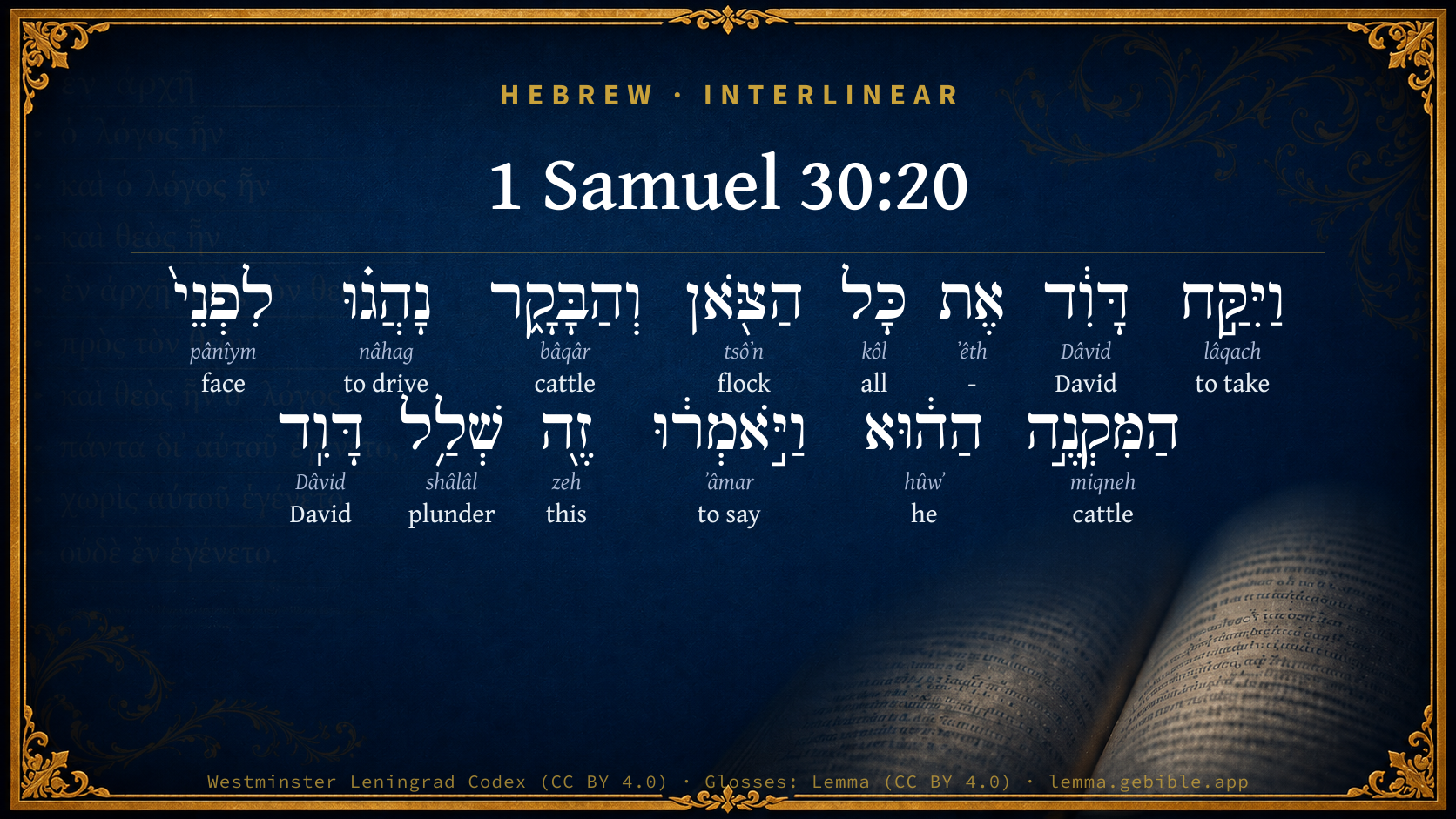
  1. וַיִּקַּ֣ח lâqach H3947 “and · to take” Conjunction + Verb, Qal, Sequential Imperfect, 3rd Person, Masculine, Singular
  2. דָּוִ֔ד Dâvid H1732 “David” Noun, Proper
  3. אֶת ʼêth H853 “-” Particle, Direct Object
  4. כָּל kôl H3605 “all of” Noun, Common, Masculine, Singular, Construct
  5. הַצֹּ֖אן tsôʼn H6629 “the · flock” Particle, Definite Article + Noun, Common, Both, Singular, Absolute
  6. וְהַבָּקָ֑ר bâqâr H1241 “and · the · cattle” Conjunction + Particle, Definite Article + Noun, Common, Both, Singular, Absolute
  7. לִפְנֵי֙ pânîym H6440 “to/for · face(s) of” Preposition + Noun, Common, Both, Plural, Construct
  8. הַמִּקְנֶ֣ה miqneh H4735 “the · cattle” Particle, Definite Article + Noun, Common, Masculine, Singular, Absolute
  9. הַה֔וּא hûwʼ H1931 “the · he” Particle, Definite Article + Pronoun, Personal, 3rd Person, Masculine, Singular
  10. וַיֹּ֣אמְר֔וּ ʼâmar H559 “and · to say” Conjunction + Verb, Qal, Sequential Imperfect, 3rd Person, Masculine, Plural
  11. זֶ֖ה zeh H2088 “this” Pronoun, Demonstrative, Masculine, Singular
  12. שְׁלַ֥ל shâlâl H7998 “plunder of” Noun, Common, Masculine, Singular, Construct
  13. דָּוִֽד Dâvid H1732 “David” Noun, Proper

About this verse

These counts appear in no published source. They are computed here, from the morphology-tagged text and Lemma’s own curated glosses. What Lemma adds →

14
words
13
distinct lemmas
Historical
section

Shared distinctive vocabulary

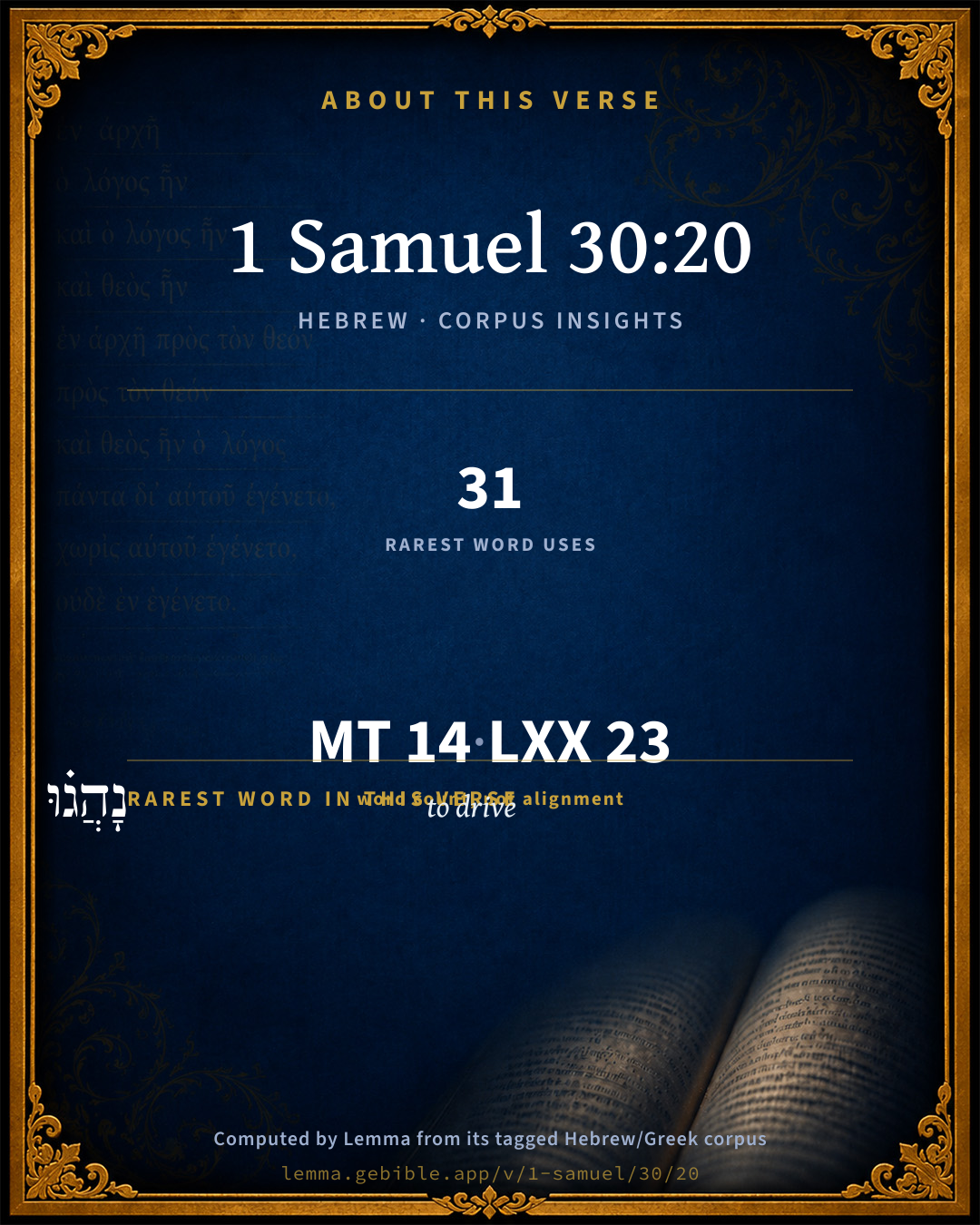
נָהֲג֗וּ to drive H5090 occurs in 31 verses of the Hebrew Bible. Also found in:

Grammatical profile

  • 3 verbs
  • 8 nouns
  • 2 pronouns
  • 1 particle

Verb forms

  • וַיִּקַּ֣ח Qal · Sequential Imperfect
  • נָהֲג֗וּ Qal · Perfect
  • וַיֹּ֣אמְר֔וּ Qal · Sequential Imperfect

Repetition

A word recurs within this verse — often emphatic in Hebrew:

  • דָּוִ֔ד David H1732 ×2

Hebrew & Septuagint length

In English translation the verse runs 21 words from the Hebrew and 29 from the Septuagint (LXX English) — closely comparable.

A rough comparison of the two English renderings, which tokenize alike — not a word-level alignment.

Word counts can differ between the Hebrew and the Greek without any difference in meaning — e.g. the Hebrew direct-object marker אֵת has no separate Greek word, and Greek often adds the article ὁ.

In the original languages it is 14 Hebrew tokens and 23 Greek tokens — but the two are counted differently (Hebrew bundles its prefixes and suffixes into one token; the Greek is in lemma form), so that isn’t a like-for-like length.

Cross-references

5

Topical passages linked to 1 Samuel 30:20 in the Treasury of Scripture Knowledge — connected by theme and wording, ordered by reader-vote popularity; previews shown in the World English Bible.

  • 1 Samuel 30:26 When David came to Ziklag, he sent of the spoil to the elders of Judah, even to his friends, saying, Behold, a present for you of the spoil of the enemies of Yahweh:
  • Numbers 31:9–12 The children of Israel took captive the women of Midian and their little ones; and all their cattle, and all their flocks, and all their goods, they took for a prey.
  • 2 Chronicles 20:25 When Jehoshaphat and his people came to take the spoil of them, they found among them in abundance both riches and dead bodies, and precious jewels, which they stripped off for themselves, more than they could carry away: and they were three days in taking the spoil, it was so much.
  • Isaiah 53:12 Therefore will I divide him a portion with the great, and he shall divide the spoil with the strong; because he poured out his soul to death, and was numbered with the transgressors: yet he bore the sin of many, and made intercession for the transgressors.
  • Romans 8:37 No, in all these things, we are more than conquerors through him who loved us.

Cross-references courtesy of OpenBible.info (CC BY 4.0).

Hebrew and Greek witnesses Masoretic Hebrew ↔ Greek Septuagint

The same verse in the two great witnesses to the Old Testament, shown verse-for-verse.

These are two independent witnesses, not word-aligned to each other, and the Septuagint is shown in lemma (dictionary) form.

Hebrew 1 Samuel 30:20 Masoretic · Westminster Leningrad Codex

וַיִּקַּ֣ח דָּוִ֔ד אֶת כָּל הַצֹּ֖אן וְהַבָּקָ֑ר נָהֲג֗וּ לִפְנֵי֙ הַמִּקְנֶ֣ה הַה֔וּא וַיֹּ֣אמְר֔וּ זֶ֖ה שְׁלַ֥ל דָּוִֽד

David took all the flocks and the herds, [which] they drove before those [other] cattle, and said, This is David's spoil.

World English Bible · Public Domain

Greek LXX 1 Samuel 30:20 Septuagint · lemma form

καί λαμβάνω δαυίδ πᾶς ὁ ποίμνιον καί ὁ βουκόλιον καί ἀποἄγω ἔμπροσθεν ὁ σκῦλον καί ὁ σκῦλον ἐκεῖνος λέγω οὗτος ὁ σκῦλον δαυίδ

And he took all the flocks, and the herds, and led them away before the spoils: and it was said of these spoils, These are the spoils of David.

LXX2012 (modern English Septuagint) · Public Domain

Hebrew: Westminster Leningrad Codex (CC BY 4.0). Greek: Septuagint (public domain); English from LXX2012 (modern English Septuagint) (Public Domain). How the Septuagint differs from the Hebrew →

Targum (Aramaic paraphrase)

1

The Targum is the ancient Jewish Aramaic paraphrase of the Hebrew Scriptures — an interpretive translation, not the Hebrew text itself. Onkelos (literal) and Pseudo-Jonathan (expansive) render the Torah, and Jonathan the Prophets. Coverage is partial: where no permissively-licensed English translation exists for a verse, only the Aramaic is shown. This is verse-level text, not a word-by-word alignment to the Hebrew.

  1. Targum Jonathan Prophets (Joshua–Malachi)
    וּשְׁבָא דָוִד יַת כָּל עָנָא וְתוֹרֵי דַבָּרוּ קֳדָם גֵיתַיָא הָאִינוּן וַאֲמַרוּ דֵין עֲדָהָא דְדָוִד:

    (no public-domain English translation for this verse)

    Targum Jonathan — Aramaic: “Mikraot Gedolot” (public domain). English: “Sefaria Community Translation” (CC0 1.0 (public-domain dedication)); “London "Chaldee Paraphrase," 1871” (public domain). Text via Sefaria.

Commentary

Notes on 1 Samuel 30:20 from classic Christian and Jewish commentators (each source and its license shown beneath its notes). The classic Christian expositions comment on the surrounding passage and are grouped to its opening verse, so a note may address several verses; the Jewish commentaries on the Tanakh (Rashi and others) are per-verse, so they appear only where the commentator wrote on this verse.

Lemma curates 59 commentaries, every one of them public domain or Creative Commons licensed, each selected and text-cleaned for this edition rather than reprinted as found. About our sources →

Trapp's Complete Commentary

John Trapp

1Sa 30:20 And David took all the flocks and the herds, [which] they drave before those [other] cattle, and said, This [is] David’s spoil.

Ver. 20. And David took all the flocks,] i.e., All the rest of the flocks and herds which the enemy had pillaged from other places.

And said, This is David’s spoil.] The soldiers said so, and as some think, sung so, this being the burden of their triumphant song. This was better, I trow, than to speak of stoning him: to make him amends for which, some say they gave him all this booty.

John Trapp, A Commentary or Exposition upon All the Books of the Old and New Testament (1647–1656) — public domain. Text from a community e-Sword module.

The Biblical Illustrator

Joseph S. Exell

1Sa_30:20

This is Davids spoil.

Davids spoil

David may be regarded as a very special type of our Lord Jesus Christ.

I. We begin with the first observation that, practically, all the spoil of that day was Davids spoil, and in truth, all the good that we enjoy comes to us through our Lord Jesus.

1. Davids men defeated the Amalekites, and took their spoil, but it was for Davids sake that God gave success go the band.

2. Moreover, Davids men gained the victory over Amalek because of Davids leadership. If he had not been there to lead them to the fight, in the moment of their despair they would have lost all heart, and would have remained amidst the burning walls of Ziklag a discomfited company. The Lord Jesus Christ has been here among us and has fought our battle for us, and recovered all that we had lost by Adams fall and by our own sin. They said of Waterloo that it was a soldiers battle, and the victory was due to the men; but ours is our Commanders battle, and every victory won by us is due to the great Captain of our salvation. And our Lord Jesus has recovered for us the lucre as well as the past. Our outlook was grim and dark indeed till Jesus came; but oh, how bright it is now that he has completed his glorious work! Death is no more the dreaded grave of all our hopes. Hell exists no longer for believerses Heaven, whose gates were dosed, is now set wide open to every soul that believeth. We have recovered life and immortal bliss.

II. Those good things which we now possess, over and above what we lost by sin, come to us by the Lord Jesus. And first, think: In Christ Jesus human nature is lifted up where it never ought have been before. Man was made in his innocence to occupy a very lofty place. Thou madest him to have dominion over all the works of Thy hands; Thee hast put all things under his feet. The nearest being to God is a man. The noblest existence--how shall I word it?--the noblest of all beings is God, and the God-man Christ Jesse, in whom dwelleth all the fulness of the Godhead bodily, is with Him upon the throne. It is a wondrous honour this, that manhood should be taken into intimate connection, yea, absolute union with God!

2. Another blessing which was not ears before the fall, and therefore never was lost, but comes to as a surplusage, is the fact that we are redeemed.

3. We shall be creatures who have known sin and have been recovered from its pollution. We shall forever remember the price at which we were redeemed; and we shall have ties upon us that will bind us to an undeviating loyalty to him who exalted us to so glorious a condition.

4. We receive blessings unknown to beings who have never fallen.

5. Again, to my mind it is a very blessed fact that you and I will partake of a privilege which would have been certainly unnecessary to Adam, and could not by Adam have been known, and that is, the privilege of resurrection. Our singular relation to God, and yet to materialism, is another rare gift of Jesus. God intended, by the salvation of man, and the lifting up of man into union with himself, to link together in one the lowest and the highest--his creation and himself. Materialism is somewhat exalted in being connected with spirit at all. When spirit becomes connected with God, and refined materialism becomes connected with a purified spirit, by the resurrection from the dead, then shall be brought to pass the uplifting of clay and its junction with the celestial.

7. Our manifestation of the full glory of God is another of the choice gifts which the pierced hands of Jesus alone bestow. Principalities and powers shall see in the mystical body of Christ more of God than in all the universe besides. They will study in the saints the eternal purposes of God, and see therein His love, His wisdom, His power, His justice, His mercy blended in an amazing way.

III. That which we willingly give to Jesus may be called His spoil. There is a spoil for Christ which every true-hearted followed of His votes to Him enthusiastically.

1. First, our hearts are His alone foreverse Of every believing heart it may be said, This is Davids spoil.

2. Now there is another property I should like King Jesus to have, and that in our special gifts. I know one who, before his conversion, was wont to sing, and be often charmed the ears of men with the sweet music which he poured forth; but when he was converted he said, Henceforth my tongue shall sing nothing but blue praises of God. He devoted himself to proclaiming the gospel by his song, for he said, This is Davids spoil. Have you not some gift or other, dear friend, of which you could say, Henceforth this shall be sacred to my bleeding Lord?

3. Moreover, while our whole selves must be yielded to the Lord Jesus, there is one thing that must always be Christs, and that, is our religious homage as a church.

4. Lastly, have you not something of your own proper substance that shall be Davids spoil just now? There was a man who, in the providence of God, had been enabled to lay by many thousands. He was a very rich and respected man. I have heard it said that he owned at least half a million; and at one collection, when he felt specially grateful and generous, he found a well-worn sixpence for the place, for that was Davids spoil! That was Davids spoil. Out of all that he possessed, that sixpence was Davids spoil! This was the measure of his gratitude! Judge by this how much he owed, or at least how much he desired to pay. Are there not many persons who, on that despicable scale, reward the Saviour for the travail of His soul? (C. H Spurgeon.)

The Biblical Illustrator, edited by Joseph S. Exell (c. 1880s–1900s) — public domain. Text from a community e-Sword module.

Joseph Benson's Commentary

1Sa 30:20. David took all the flocks — Which had been taken by the Amalekites from the Philistines and others. Which they drave before those other cattle — His soldiers drave them before those cattle that belonged to Ziklag, which the Amalekites had taken from David and his men. And said, This is David’s spoil — Not that he claimed it all to himself. But the soldiers, who lately were so incensed against him that they spake of stoning him, now, upon his success, magnify him, and triumphantly celebrate his praise; and say, concerning this spoil, David purchased it by his valour and conduct, and he may dispose of it as he pleaseth.

Joseph Benson's Commentary on the Old and New Testaments (1811–1818) — public domain. Text from a community e-Sword module.

Keil & Delitzsch

C. F. Keil & F. Delitzsch

Sa1 30:20 is obscure: "And David took all the sheep and the oxen: they drove them before those cattle, and said, This is David's booty." In order to obtain any meaning whatever from this literal rendering of the words, we must understand by the sheep and oxen those which belonged to the Amalekites, and the flocks taken from them as booty; and by "those cattle," the cattle belonging to David and his men, which the Amalekites had driven away, and the Israelites had now recovered from them: so that David had the sheep and oxen which he had taken from the Amalekites as booty driven in front of the rest of the cattle which the Israelites had recovered; whereupon the drovers exclaimed, "This (the sheep and oxen) is David's booty." It is true that there is nothing said in what goes before about any booty that David had taken from the Amalekites, in addition to what they had taken from the Israelites; but the fact that David had really taken such booty is perfectly obvious from Sa1 30:26-31, where he is said to have sent portions of the booty of the enemies of Jehovah to different places in the land. If this explanation be not accepted, there is no other course open than to follow the Vulgate, alter לפני into לפניו, and render the middle clause thus: "they drove those cattle (viz., the sheep and oxen already mentioned) before him," as Luther has done. But even in that case we could hardly understand anything else by the sheep and oxen than the cattle belonging to the Amalekites, and taken from them as booty.

Keil & Delitzsch — Biblical Commentary on the Old Testament (1861–1891) — public domain (CC PDM 1.0). Text via the HelloAO Bible API. (Old Testament only.)

Geneva Bible (1599)

Geneva Bible translators

Which the Amalekites had taken of others, and David from them, besides the goods of Ziklag.

Geneva Bible (1599) marginal notes — public domain. Text via Bolls.life.

Adam Clarke's Commentary

Verse 20. And David took all the flocks] He and his men not only recovered all their own property, but they recovered all the spoil which these Amalekites had taken from the south of Judah, the Cherethites, and the south of Caleb. When this was separated from the rest, it was given to David, and called David's spoil.

Adam Clarke's Commentary on the Bible (1810–1826) — public domain. Text from a community e-Sword/MySword module.

Ellicott's Commentary for English Readers

(20) The flocks and the herds, which they drave.—In the English translation the word “which,” inserted in italics, obscures the sense; the literal reading is, “And David took all the flocks and the herds; they drove them before their cattle, and said, this is David’s spoil.” David took, no doubt, by popular acclamation as his share of the plunder, all the flocks and herds belonging to the Amalekites, mostly acquired, no doubt, in the late raid; these were driven in front of “those cattle” thus particularising the cattle of Ziklag belonging to David’s own people. Of course, this plunder went back to the original Israelitish owners. The drovers, as they marched behind the vast herds of Amalekite cattle, sung of the prowess of their leader in words long remembered, “See all this. This is David’s spoil.” It was “these herds”—numerically, probably very great—that David distributed among the friendly cities of the south. (See 1Sa_30:26; 1Sa_30:31.) All the other plunder of the camp—arms, accoutrements, ornaments, jewels, camels’ cloths, &c.—was divided, as Bishop Hervey well suggests, among the little army. David’s motive in choosing the sheep and oxen (for his warriors certainly the least desirable part of the Amalekite possession) is evident from 1Sa_30:26-31. They were the most acceptable presents he could make to his friends in Judah.

A Bible Commentary for English Readers, edited by Charles John Ellicott (1878–1897) — public domain. Text from a community e-Sword module.

The Cambridge Bible for Schools and Colleges

gen. ed. J. J. S. Perowne

20. This verse as it stands admits of no satisfactory explanation. It is best to follow the Vulgate, with which the Sept. in the main agrees, and read, And he took all the flocks and the herds, and drave them before him: and they said, This is David’s spoil: i.e. he not only recovered his own property, but took a rich booty besides, which his men drove off with shouts of triumph. The number of places to which he sent presents (1Sa_30:26-31) shews how large it must have been.

The Cambridge Bible for Schools and Colleges (gen. ed. J. J. S. Perowne; Cambridge University Press, 1878–1918) — public domain. Text from a community e-Sword module.

John Gill's Exposition

And David took all the flocks, and the herds,.... Which they had taken from the land of the Philistines, or which belonged to the Amalekites properly:

which they drave before those other cattle; which had been carried from Ziklag; first went the spoil taken from other places, and then those taken from David and his men, or what was found at Ziklag. Abarbinel supposes the meaning to be this, that the herds were driven before the flocks, that the oxen were led out first, and then the sheep followed, as being the weaker sort, and more easily to be driven, and carried off; but the former sense seems best:

and said, this is David's spoil; either the whole of it, it being owing to him that it was got or brought back; or this may respect some peculiar part of it made a present of to him; or it may design what the Amalekites had taken from others, which was at the disposal of David, as distinguished from what was taken from Ziklag, and was restored, or to be restored to the proper owners: it may be taken in the first and more general sense, as being the song, or the burden of the song, sung by David's men as they returned with the spoil, giving him all the honour of it, of whom, but a little before, they talked of stoning.

John Gill's Exposition of the Whole Bible (1746–1763) — public domain (CC PDM 1.0). Text via the HelloAO Bible API.

Albert Barnes' Notes on the Bible

The meaning is, “and David took all the sheep and oxen which the Amalekites drove” (i. e. had in their possession) “before that acquisition of cattle” (namely, before what they took in their raid to the south), “and they” (the people) “said, This is David’s spoil.” This was his share as captain of the band (compare Jdg 8:24-26). All the other plunder of the camp - arms, ornaments, jewels, money, clothes, camels, accoutrements, and so on - was divided among the little army. David’s motive in choosing the sheep and oxen for himself was to make presents to his friends in Judah 1Sa 30:26-31.

Albert Barnes' Notes on the Bible (1834–1885) — public domain. Text from a community e-Sword/MySword module.

Haydock's Catholic Bible Commentary

And made. Hebrew, "which they drove before those things (or cattle," taken from the Amalecites. Haydock) "which were separated from those which David had recovered." Each one reclaimed what he had lost. Perhaps David’s portion was placed by itself. (Calmet) --- Grotius thinks that, as the things taken in war cannot be reclaimed by the former proprietors, all was equally divided. See Selden, Jur. vi. 16.

George Leo Haydock (1774–1849), Haydock's Catholic Family Bible and Commentary, 1859 edition — public domain. Excludes Psalms (Douay-Rheims chapter numbering differs from Protestant) and Deuterocanonical books (Catholic canon only).

Matthew Poole's English Annotations

All the flocks and the herds, to wit, which the Amalekites had taken from the Philistines, or others.

Before those other cattle; before those which belonged to Ziklag.

This is David’s spoil, i.e. the soldiers, who lately were so incensed against David, that they spake of stoning him; now upon this success magnify him, and triumphantly celebrate his praise; and say concerning this spoil, David purchased it by his valour and conduct, and he may dispose of it as he pleaseth.

Matthew Poole's English Annotations on the Holy Bible (1683–1685) — public domain. Text from a community e-Sword/MySword module.

Whedon's Commentary on the Bible

Daniel D. Whedon

20. David took all the flocks and the herds — Which belonged to the Amalekites.

Which they drave before those other cattle — Those other cattle mean the cattle which belonged to David and his men. So David not only recovered his own cattle, but he took all that belonged to the Amalekites besides, and called it his spoil. Of this spoil he sent to his friends in Judah. 1Sa_30:26-31.

Daniel D. Whedon (gen. ed.), Commentary on the Old and New Testaments (1874–1909) — public domain. Text from a community e-Sword module.

The Pulpit Commentary

This verse, which is made unintelligible in the A.V by the insertion of the unauthorised word which, is really free from difficulty. After David, as related in vers. 18, 19, had recovered the cattle carried oft by the Amalekites, he also took all the flocks and herds belonging to them; and his own men "made these go in front of that body of cattle, and said, This is David"s spoil," i.e. they presented it to him by acclamation. It was this large booty which he distributed among his friends (vers. 26-31).

The Pulpit Commentary (1880–1919), ed. H.D.M. Spence-Jones & Joseph S. Exell — public domain. Text from a community e-Sword module.

John Wesley's Explanatory Notes

Other cattle - Before those that belonged to Ziklag. David's spoil - The soldiers, who lately were so incensed against David, that they spake of stoning him: now upon this success magnify him, and triumphantly celebrate his praise; and say concerning this spoil, David purchased it by his valour and conduct, and he may dispose of it as he pleaseth.

John Wesley, Explanatory Notes Upon the Whole Bible (1754–1765) — public domain. Text via the GEBible commentary corpus.

Rashi

Rabbi Shlomo Yitzchaki (Rashi)

All the sheep and cattle. Which the troop had captured from the south of Yehudah and from the south of Caleiv.

They led. Men who were leading and marching before those cattle, to honor and praise themselves, [by declaring,] 'This is Dovid's spoil.'

Rashi on the Tanakh — English translations: “The Judaica Press complete Tanach with Rashi, translated by A. J. Rosenberg” (CC BY 4.0); “Pentateuch with Rashi's commentary by M. Rosenbaum and A.M. Silbermann, 1929-1934” (public domain); “The Metsudah Tanach series, Lakewood, N.J” (CC BY 4.0); and “The Book of Joshua, Metsudah Publications, 1997” (CC BY 4.0). Text via Sefaria.

Lesson kit

Teaching starters — assembled from the data on this page, not authored interpretation. Every prompt links to the verse data it draws on. Edit before teaching.

1 Samuel, in the Historical, opens this verse with 14 words (13 distinct Hebrew lemmas). Its most distinctive word is nâhag (“to drive”). A historical commentator’s framing appears above. Read the whole chapter for the surrounding context.

Discussion questions

  1. The word nâhag carries the sense “to drive.” How does it shape the verse?
  2. How does Genesis 31:18, which shares the word «to drive», read alongside this verse?
  3. What does the repetition of “David” (2× in this one verse) do in this verse?
  4. These translations render this verse differently; the difference is in the English rendering, not the original. What questions does that raise?
  5. «וַיִּקַּ֣ח» is a Qal Sequential Imperfect verb. How does that grammatical form shape the action described?
  6. Compare how Trapp's Complete Commentary and The Biblical Illustrator read this verse. Where do they agree or differ?

Things to notice

Reading settings

Reading text

Shown beneath each verse's original-language words.

Old Testament
Old Testament edition

Read the OT as the Masoretic Hebrew (MT) or the Greek Septuagint (LXX).

English shown for the Greek Septuagint (in the Hebrew ↔ Greek comparison).

Comparing translations? Open the Compare panel on any verse page to stack up to four side by side.