
Ezekiel 34:6

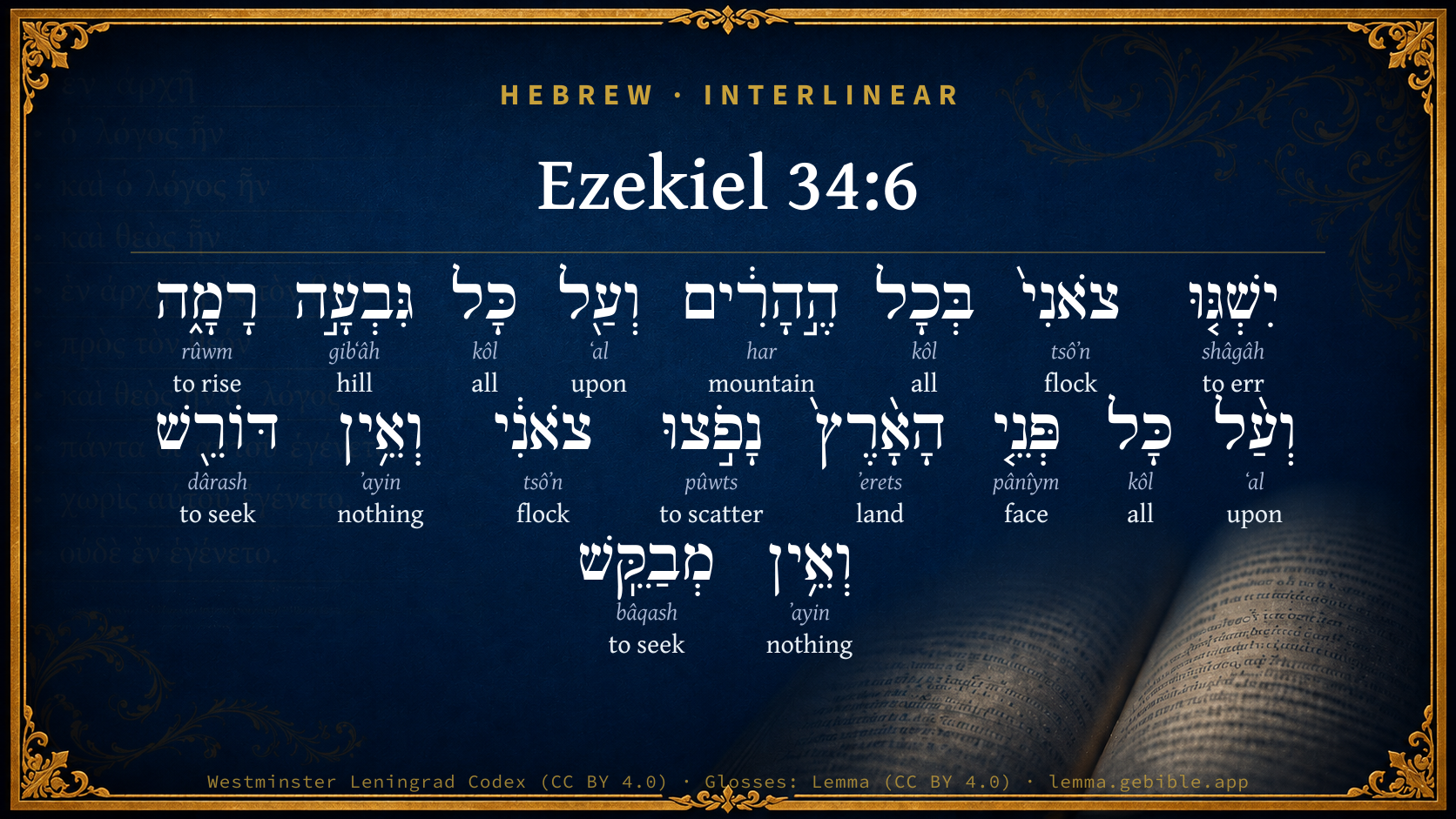
Hebrew (Westminster Leningrad Codex) Ezekiel 34:6 appears in the Hebrew Old Testament. The text above is from the Westminster Leningrad Codex. Each word links to its Strong’s number, a concise gloss, and parsing drawn from the Open Scriptures Hebrew Bible morphology. Click any word for its full Brown-Driver-Briggs (BDB) entry.
Download image
Cite this verse

Ezekiel 34:6 (World English Bible). Public Domain. Lemma interlinear Bible study tool, https://lemma.gebible.app/v/ezekiel/34/6.

Show BibTeX & RIS
BibTeX
RIS
English Translation
My sheep wandered through all the mountains, and on every high hill: yes, my sheep were scattered on all the surface of the earth; and there was none who searched or sought.
World English Bible · Public Domain
Download a study sheet

One document with this verse’s original text, its word-by-word gloss line, the meaning frame, cross-references with their text, attributed commentary, and full source and license credits — printable, and it pastes into notes with its structure intact.

This verse Autodidact and up

Study sheet (.html) Plain text (.txt)

A passage Seminary Student

Up to 50 verses in one chapter. A passage sheet keeps up to 6 commentary sources and 12 cross-references per verse, in the order this page ranks them, and says so on the sheet whenever that leaves anything out. Ask for a single verse and you get the Autodidact verse sheet above.

Everything on this page stays free to read, with no account — the sheet is a download of what is already on screen, not access to it.

Want to remove ads? Support Godless Engineer
Compare translations 3

The same verse in 3 English versions, stacked beneath the original-language interlinear above. Click any original word for its lexicon entry.

Each is an independent rendering of the whole verse — the interlinear is not word-aligned to these translations.

Highlighted words mark where these versions differ — a whole-verse word diff, not a word-by-word alignment.

  • World English Bible Public Domain
    My sheep wandered through all the mountains, and on every high hill: yes, my sheep were scattered on all the surface of the earth; and there was none who searched or sought.
  • King James Version Public Domain
    My sheep wandered through all the mountains, and upon every high hill: yea, my flock was scattered upon all the face of the earth, and none did search or seek after them.
  • unfoldingWord Literal Text CC BY-SA 4.0
    My flock strays on all of the mountains and on every high hill, and it is dispersed over the entire surface of the earth. Yet no one is searching for them.

unfoldingWord Literal Text — © unfoldingWord, licensed CC BY-SA 4.0. Word-aligned USFM3 via Door43 (git.door43.org/unfoldingWord/en_ult).

Versions to compare (up to 4)

3 of 4 selected

Show all 18 translations

Every available English version of this verse, each an independent rendering of the whole verse.

  • World English Bible Public Domain
    My sheep wandered through all the mountains, and on every high hill: yes, my sheep were scattered on all the surface of the earth; and there was none who searched or sought.
  • Berean Standard Bible Public Domain
    My flock went astray on all the mountains and every high hill. They were scattered over the face of all the earth, with no one to search for them or seek them out.’
  • Majority Standard Bible Public Domain
    My flock went astray on all the mountains and every high hill. They were scattered over the face of all the earth, with no one to search for them or seek them out.’
  • King James Version Public Domain
    My sheep wandered through all the mountains, and upon every high hill: yea, my flock was scattered upon all the face of the earth, and none did search or seek after them.
  • American Standard Version (1901) Public Domain
    My sheep wandered through all the mountains, and upon every high hill: yea, my sheep were scattered upon all the face of the earth; and there was none that did search or seek `after them'.
  • Revised Version (1885) Public Domain
    My sheep wandered through all the mountains, and upon every high hill: yea, my sheep were scattered upon all the face of the earth; and there was none that did search or seek after them.
  • Geneva Bible (1599) Public Domain
    My sheepe wandred through all the mountaines, and vpon euery hie hill: yea, my flocke was scattered through al the earth, and none did seeke or search after them.
  • Douay-Rheims (1899) Public Domain
    My sheep have wandered in every mountain, and in every high hill: and my flocks mere scattered upon the face of the earth, and there was none that sought them, there was none, I say, that sought them.
  • Young's Literal Translation Public Domain
    Go astray do My flock on all the mountains, And on every high hill, And on all the face of the land have My flock been scattered, And there is none inquiring, and none seeking.
  • Literal Standard Version CC BY-SA 4.0
    My flock goes astray on all the mountains, || And on every high hill, || And My flock has been scattered on [the] whole face of the earth, || And there is none inquiring, and none seeking.
  • Unlocked Literal Bible CC BY-SA 4.0
    My flock strays on all of the mountains and on every high hill, and it is dispersed over the entire surface of the earth. Yet no one is searching for them.
  • unfoldingWord Literal Text CC BY-SA 4.0
    My flock strays on all of the mountains and on every high hill, and it is dispersed over the entire surface of the earth. Yet no one is searching for them.
  • Darby Bible Public Domain
    My sheep wandered through all the mountains, and upon every high hill, and my sheep have been scattered upon all the face of the earth, and there was none that searched, or that sought for them.
  • World Messianic Bible Public Domain
    My sheep wandered through all the mountains and on every high hill. Yes, my sheep were scattered on all the surface of the earth. There was no one who searched or sought.”
  • Webster's Bible Public Domain
    My sheep wandered through all the mountains, and upon every high hill: yes, my flock was scattered upon all the face of the earth, and none did search or seek for them.
  • Free Bible Version CC BY-SA 4.0
    My sheep strayed, going to all the mountains and high hills. They were scattered everywhere, and there was no one to go and look for them.
  • Bible in Basic English Public Domain
    And my sheep went out of the way, wandering through all the mountains and on every high hill: my sheep went here and there over all the face of the earth; and no one was troubled about them or went in search of them.
  • JPS Tanakh (1917) Public Domain
    My sheep wandered through all the mountains, and upon every high hill, yea, upon all the face of the earth were My sheep scattered, and there was none that did search or seek.

Literal Standard Version (2020), Covenant Press — licensed CC BY-SA 4.0. Text via the HelloAO Bible API (eBible.org). Unlocked Literal Bible (unfoldingWord) — licensed CC BY-SA 4.0. Text via the HelloAO Bible API (eBible.org). unfoldingWord Literal Text — © unfoldingWord, licensed CC BY-SA 4.0. Word-aligned USFM3 via Door43 (git.door43.org/unfoldingWord/en_ult). Free Bible Version, Dr. Jonathan Gallagher — licensed CC BY-SA 4.0. Text via the HelloAO Bible API (eBible.org).

Word by word

More ways to search: Search by grammar → Find every occurrence → Compare this word →

Practice this passage: Drill this verse → Learn its vocabulary →

יִשְׁגּ֤וּ
shâgâh
H7686
“to err”
Verb, Qal, Imperfect, 3rd Person, Masculine, Plural
Part of Speech
Verb
Stem
Qal
Form
Imperfect
Person
3rd Person
Gender
Masculine
Number
Plural
Full BDB Definition

Origin: a primitive root

TWOT: 2325

to go astray, stray, err - (Qal) - to err, stray - to swerve, meander, reel, roll, be intoxicated, err (in drunkenness) - to go astray (morally) - to commit sin of ignorance or inadvertence, err (ignorantly) - (Hiphil) - to lead astray - to lead astray, mislead (mentally) - to lead astray (morally)
  1. צֹאנִי֙ tsôʼn H6629 “flock · my” Noun, Common, Both, Singular, Construct + Suffix, Personal, 1st Person, Common, Singular
  2. בְּכָל kôl H3605 “in/at · all of” Preposition + Noun, Common, Masculine, Singular, Construct
  3. הֶ֣הָרִ֔ים har H2022 “the · mountains” Particle, Definite Article + Noun, Common, Masculine, Plural, Absolute
  4. וְעַ֖ל ʻal H5921 “and · upon” Conjunction + Preposition
  5. כָּל kôl H3605 “all of” Noun, Common, Masculine, Singular, Construct
  6. גִּבְעָ֣ה gibʻâh H1389 “hill” Noun, Common, Feminine, Singular, Absolute
  7. רָמָ֑ה rûwm H7311 “rising” Verb, Qal, Participle Active, Feminine, Singular, Absolute
  8. וְעַ֨ל ʻal H5921 “and · upon” Conjunction + Preposition
  9. כָּל kôl H3605 “all of” Noun, Common, Masculine, Singular, Construct
  10. פְּנֵ֤י pânîym H6440 “face(s) of” Noun, Common, Both, Plural, Construct
  11. הָאָ֨רֶץ֙ ʼerets H776 “the · land” Particle, Definite Article + Noun, Common, Both, Singular, Absolute
  12. נָפֹ֣צוּ pûwts H6327 “to scatter” Verb, Niphal, Perfect, 3rd Person, Common, Plural
  13. צֹאנִ֔י tsôʼn H6629 “flock · my” Noun, Common, Both, Singular, Construct + Suffix, Personal, 1st Person, Common, Singular
  14. וְאֵ֥ין ʼayin H369 “and · nothing” Conjunction + Particle, Negative
  15. דּוֹרֵ֖שׁ dârash H1875 “seeking” Verb, Qal, Participle Active, Masculine, Singular, Absolute
  16. וְאֵ֥ין ʼayin H369 “and · nothing” Conjunction + Particle, Negative
  17. מְבַקֵּֽשׁ bâqash H1245 “seeking” Verb, Piel, Participle Active, Masculine, Singular, Absolute

About this verse

These counts appear in no published source. They are computed here, from the morphology-tagged text and Lemma’s own curated glosses. What Lemma adds →

18
words
13
distinct lemmas
Prophets
section

Notable vocabulary

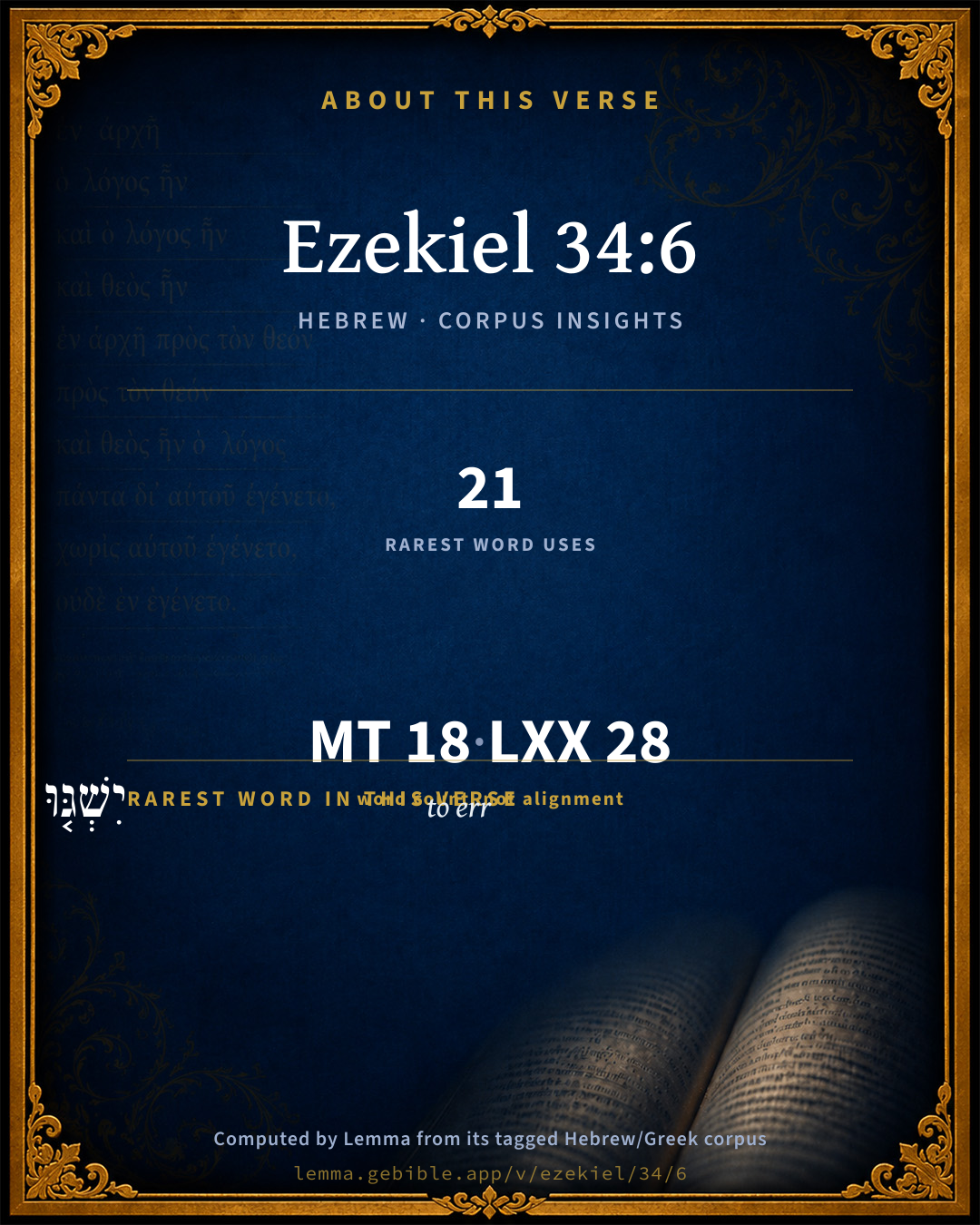
The rarest word here is יִשְׁגּ֤וּ to err H7686 — appearing just 21 times in the whole Hebrew Bible.

Shared distinctive vocabulary

יִשְׁגּ֤וּ to err H7686 occurs in 19 verses of the Hebrew Bible. Also found in:

Grammatical profile

  • 5 verbs
  • 9 nouns
  • 2 prepositions
  • 2 particles

Verb forms

  • יִשְׁגּ֤וּ Qal · Imperfect
  • רָמָ֑ה Qal · Participle Active
  • נָפֹ֣צוּ Niphal · Perfect
  • דּוֹרֵ֖שׁ Qal · Participle Active
  • מְבַקֵּֽשׁ Piel · Participle Active

Repetition

Words recur within this verse — often emphatic in Hebrew:

  • בְּכָל all H3605 ×3
  • צֹאנִי֙ flock H6629 ×2
  • וְעַ֖ל upon H5921 ×2
  • וְאֵ֥ין nothing H369 ×2

Hebrew & Septuagint length

In English translation the verse runs 32 words from the Hebrew and 36 from the Septuagint (LXX English) — closely comparable.

A rough comparison of the two English renderings, which tokenize alike — not a word-level alignment.

Word counts can differ between the Hebrew and the Greek without any difference in meaning — e.g. the Hebrew direct-object marker אֵת has no separate Greek word, and Greek often adds the article ὁ.

In the original languages it is 18 Hebrew tokens and 28 Greek tokens — but the two are counted differently (Hebrew bundles its prefixes and suffixes into one token; the Greek is in lemma form), so that isn’t a like-for-like length.

Cross-references

8

Topical passages linked to Ezekiel 34:6 in the Treasury of Scripture Knowledge — connected by theme and wording, ordered by reader-vote popularity; previews shown in the World English Bible.

  • Psalms 142:4 Look on my right, and see; For there is no one who is concerned for me. Refuge has fled from me. No one cares for my soul.
  • 1 Peter 2:25 For you were going astray like sheep; but are now returned to the Shepherd and Overseer of your souls.
  • Jeremiah 40:11–12 Likewise when all the Jews who were in Moab, and among the children of Ammon, and in Edom, and who were in all the countries, heard that the king of Babylon had left a remnant of Judah, and that he had set over them Gedaliah the son of Ahikam, the son of Shaphan;
  • Ezekiel 7:16 But those of those who escape shall escape, and shall be on the mountains like doves of the valleys, all of them moaning, every one in his iniquity.
  • John 10:16 I have other sheep, which are not of this fold. I must bring them also, and they will hear my voice. They will become one flock with one shepherd.
  • Jeremiah 5:1 Run you back and forth through the streets of Jerusalem, and see now, and know, and seek in the broad places of it, if you can find a man, if there are any who does justly, who seeks truth; and I will pardon her.
  • Jeremiah 13:16 Give glory to Yahweh your God, before he cause darkness, and before your feet stumble on the dark mountains, and, while you look for light, he turn it into the shadow of death, and make it gross darkness.
  • Hebrews 11:37–38 They were stoned. They were sawn apart. They were tempted. They were slain with the sword. They went around in sheep skins and in goat skins; being destitute, afflicted, ill-treated

Cross-references courtesy of OpenBible.info (CC BY 4.0).

Hebrew and Greek witnesses Masoretic Hebrew ↔ Greek Septuagint

The same verse in the two great witnesses to the Old Testament, shown verse-for-verse.

These are two independent witnesses, not word-aligned to each other, and the Septuagint is shown in lemma (dictionary) form.

Hebrew Ezekiel 34:6 Masoretic · Westminster Leningrad Codex

יִשְׁגּ֤וּ צֹאנִי֙ בְּכָל הֶ֣הָרִ֔ים וְעַ֖ל כָּל גִּבְעָ֣ה רָמָ֑ה וְעַ֨ל כָּל פְּנֵ֤י הָאָ֨רֶץ֙ נָפֹ֣צוּ צֹאנִ֔י וְאֵ֥ין דּוֹרֵ֖שׁ וְאֵ֥ין מְבַקֵּֽשׁ

My sheep wandered through all the mountains, and on every high hill: yes, my sheep were scattered on all the surface of the earth; and there was none who searched or sought.

World English Bible · Public Domain

Greek LXX Ezekiel 34:6 Septuagint · lemma form

καί διασπείρω ἐγώ ὁ πρόβατον ἐν πᾶς ὄρος καί ἐπί πᾶς βουνός ὑψηλός καί ἐπί πρόσωπον πᾶς ὁ γῆ διασπείρω καί οὐ εἰμί ὁ ἐκζητέω οὐδέ ὁ ἀποστρέφω

And my sheep were scattered on every mountain, and on every high hill: yes, they were scattered on the face of the earth, and there was none to seek them out, nor to bring them back.

LXX2012 (modern English Septuagint) · Public Domain

Hebrew: Westminster Leningrad Codex (CC BY 4.0). Greek: Septuagint (public domain); English from LXX2012 (modern English Septuagint) (Public Domain). How the Septuagint differs from the Hebrew →

Targum (Aramaic paraphrase)

1

The Targum is the ancient Jewish Aramaic paraphrase of the Hebrew Scriptures — an interpretive translation, not the Hebrew text itself. Onkelos (literal) and Pseudo-Jonathan (expansive) render the Torah, and Jonathan the Prophets. Coverage is partial: where no permissively-licensed English translation exists for a verse, only the Aramaic is shown. This is verse-level text, not a word-by-word alignment to the Hebrew.

  1. Targum Jonathan Prophets (Joshua–Malachi)
    טְעוֹ עַמִי בְּכָל טוּרַיָא וְעַל כָּל רָמָא מְנַטְלָא וְעַל כָּל אַפֵּי אַרְעָא אִתְבְּדָרוּ עַמִי וְלֵית דְתָבַע וְלֵית דְבָעֵי:

    (no public-domain English translation for this verse)

    Targum Jonathan — Aramaic: “Mikraot Gedolot” (public domain). English: “Sefaria Community Translation” (CC0 1.0 (public-domain dedication)); “London "Chaldee Paraphrase," 1871” (public domain). Text via Sefaria.

Commentary

Notes on Ezekiel 34:6 from classic Christian and Jewish commentators (each source and its license shown beneath its notes). The classic Christian expositions comment on the surrounding passage and are grouped to its opening verse, so a note may address several verses; the Jewish commentaries on the Tanakh (Rashi and others) are per-verse, so they appear only where the commentator wrote on this verse.

Lemma curates 59 commentaries, every one of them public domain or Creative Commons licensed, each selected and text-cleaned for this edition rather than reprinted as found. About our sources →

Trapp's Complete Commentary

John Trapp

Eze 34:6 My sheep wandered through all the mountains, and upon every high hill: yea, my flock was scattered upon all the face of the earth, and none did search or seek [after them].

Ver. 6. My sheep wandered.] Through the shepherd’s supine negligence, or bloody truculence. Surely, as the herd of deer forsake and push away the wounded deer from them, so did these cruel shepherds, being non pastores sed impostores, non episcopi sed aposcopi, non praelati sed Pilati, as Bernard wittily; sheep biters rather than shepherds; "greedy dogs"; {Isa 56:10-11} "grievous wolves." {Act 20:29}

And none did search or seek after them.] Nec erat qui quaereret aut requireret.

John Trapp, A Commentary or Exposition upon All the Books of the Old and New Testament (1647–1656) — public domain. Text from a community e-Sword module.

Jamieson, Fausset & Brown

Robert Jamieson, A. R. Fausset & David Brown

every high hill--the scene of their idolatries sanctioned by the rulers.

search . . . seek--rather, "seek . . . search." The former is the part of the superior rulers to inquire after: to search out is the duty of the subordinate rulers [JUNIUS].

Jamieson, Fausset & Brown — Commentary Critical and Explanatory on the Whole Bible (1871) — public domain (CC PDM 1.0). Text via the HelloAO Bible API.

Adam Clarke's Commentary

Verse 6. My sheep wandered through all the mountains] They all became idolaters, and lost the knowledge of the true God. And could it be otherwise while they had such pastors?

"Himself a wanderer from the narrow way;

His silly sheep, no wonder that they stray!"

Reader, if thou be a minister, a preacher, or a person in holy orders, or pretended holy orders, or art one pretending to holy orders, look at the qualifications of a good shepherd as laid down by the prophet.

1. He professes to be a shepherd, and to be qualified for the office.

2. In consequence he undertakes the care of a flock. This supposes that he believes the great Bishop of souls has called him to the pastoral office; and that office implies that he is to give all diligence to save the souls of them that hear him.

HIS QUALIFICATIONS

1. He is skilful; he knows the disease of sin and its consequences; for the Eternal Spirit, by whom he is called, has convinced him of sin, of righteousness, and of judgment.

2. He knows well the great remedy for this disease, the passion and sacrificial death of the Lord Jesus Christ.

3. He is skilful, and knows how to apply this remedy.

4. The flock over which he watches is, in its individuals, either, - 1. Healthy and sound. 2. Or, in a state of convalescence, returning to health. 3. Or, still under the whole power of the general disease. 4. Or, some are dying in a state of spiritual weakness. 5. Or, some are fallen into sin, and sorely bruised and broken in their souls by that fall. 6. Or, some have been driven away by some sore temptation or cruel usage. 7. Or, some have wandered from the flock, are got into strange pastures, and are perverted by erroneous doctrines. Or, 8. Some wolf has got among them, and scattered the whole flock. Now, the true shepherd, the pastor of God's choosing, knows-

1. How to keep the healthy in health; and cause them to grow in grace, and in the knowledge of Jesus Christ.

2. How to nourish, feed, and care for the convalescent, that they may be brought into a state of spiritual soundness.

3. How to reprove, instruct, and awaken those who are still under the full power of the disease of sin.

4. How to find out and remove the cause of all that spiritual weakness of which he sees some slowly dying.

5. How to deal with those who have fallen into some scandalous sin, and restore them from their fall.

6. How to find out and turn aside the sore temptation or cruel usage by which some have been driven away.

7. How to seek and bring back to the fold those who have strayed into strange pastures, and have had their souls perverted by erroneous doctrines; and knows also how, by a godly discipline, to preserve him in the flock, and keep the flock honourably together.

8. How to oppose, confound, and expel the grievous wolf, who has got among the flock, and is scattering them from each other, and from God. He knows how to preach, explain, and defend the truth. He is well acquainted with the weapons he is to use, and the spirit in which he is to employ them.

In a word, the true shepherd gives up his life to the sheep; spends and is spent for the glory of God; and gives up his life for the sheep, in defence of them, and in labouring for their welfare. And while he is thus employed, it is the duty of the flock to feed and clothe him; and see that neither he nor his family lack the necessaries and conveniencies of life. The labourer is worthy of his meat. He who does not labour, or, because of his ignorance of God and salvation, cannot labour, in the word and doctrine, deserves neither meat nor drink; and if he exact that by law, which he has not honestly earned by a proper discharge of the pastoral function, let him read this chapter, and learn from it what a fearful account he shall have to give to the chief Shepherd at the great day; and what a dreadful punishment shall be inflicted on him, when the blood of the souls lost through his neglect or inefficiency is visited upon him! See Clarke on Eze 3:17, &c.

Adam Clarke's Commentary on the Bible (1810–1826) — public domain. Text from a community e-Sword/MySword module.

Ellicott's Commentary for English Readers

(6) My sheep wandered.—In the pronouns, my sheep and my flock, God again claims the people for His own. Without proper guides, they have indeed strayed far away from Him, and there has been none to inquire after or seek them out in their lost condition. The two words search and seek refer, the former to asking or inquiring, the latter to searching after.

In such a state of things, plainly the first act of mercy to the flock must be the removal of the unfaithful shepherds. This is promised (Eze_34:7-10), but, after Ezekiel’s manner, with reiterated declaration of the unfaithfulness of the shepherds.

A Bible Commentary for English Readers, edited by Charles John Ellicott (1878–1897) — public domain. Text from a community e-Sword module.

John Gill's Exposition

My sheep wandered through all the mountains, and upon every high hill,.... As sheep do, when gone astray, go from mountain to hill; so the people of Israel fled from place to place, through the cruelty of their rulers, or through the force of the enemy, being carried captive into many kingdoms and nations, signified by mountains; and perhaps there is some allusion, to their worshipping of idols on hills and mountains, being drawn into it by the false prophets:

yea, my flock was scattered upon all the face of the earth; so great and general was the dispersion by the several captivities: the Lord has sheep, or some of his elect, some that belong to his flock, in all parts of the world:

and none did search or seek after them; but he will himself, as in Eze 34:11, for he will lose none of them; but this does not excuse the shepherds.

John Gill's Exposition of the Whole Bible (1746–1763) — public domain (CC PDM 1.0). Text via the HelloAO Bible API.

Matthew Poole's English Annotations

My sheep: these shepherds forgot the flock was not their property, but God will not lose his property in them, nor shall shepherds find at last they were more than God’s stewards, and accountable.

Through all the mountains; when endangered, affrighted, pursued, they got upon the mountains by their own choice, or carried away by enemies; or it may refer to their wandering after idols worshipped in high places, or perhaps to kingdoms and states and great cities, compared to mountains, that there they might find what they could not at home, quiet and safety.

Upon every high hill; the same thing in like words.

My flock; they were, if any among the Jews could be called so, my flock that were so used; not the swine, and goats, and unclean beasts, that by whole herds rested undisturbed. It was Baruch and Jeremiah were fain to hide.

Scattered upon all the face of the earth; they were dispersed through maladministration to all parts of the known world; it is a hyperbole that speaks a mighty scattering.

None did search; the shepherds were contented, nay, glad they were rid of them, neither principal officers searched nor inferior sought after them.

Matthew Poole's English Annotations on the Holy Bible (1683–1685) — public domain. Text from a community e-Sword/MySword module.

Rashi

Rabbi Shlomo Yitzchaki (Rashi)

My flock strayed They wander astray over the face of all the mountains; i.e., they are going free for anyone to do to them as he wishes, and you did not reprove them and did not judge between a man and his fellow.

Rashi on the Tanakh — English translations: “The Judaica Press complete Tanach with Rashi, translated by A. J. Rosenberg” (CC BY 4.0); “Pentateuch with Rashi's commentary by M. Rosenbaum and A.M. Silbermann, 1929-1934” (public domain); “The Metsudah Tanach series, Lakewood, N.J” (CC BY 4.0); and “The Book of Joshua, Metsudah Publications, 1997” (CC BY 4.0). Text via Sefaria.

Lesson kit

Teaching starters — assembled from the data on this page, not authored interpretation. Every prompt links to the verse data it draws on. Edit before teaching.

Ezekiel, in the Prophets, opens this verse with 18 words (13 distinct Hebrew lemmas). Its most distinctive word is shâgâh (“to err”). A historical commentator’s framing appears above. Read the whole chapter for the surrounding context.

Discussion questions

  1. What does “to err” (shâgâh) contribute to the verse as a whole?
  2. Leviticus 4:13 shares the word «to err» with this verse. How do the two illuminate each other?
  3. “all” occurs 3× in this one verse. What is the effect of the repetition?
  4. These translations render this verse differently. What is at stake in choosing one wording over another?
  5. The verb «יִשְׁגּ֤וּ» is Qal Imperfect. How does its form color the action?
  6. Reading how Trapp's Complete Commentary and Jamieson, Fausset & Brown read this verse, where do the two commentators agree and where do they part?

Things to notice

Reading settings

Reading text

Shown beneath each verse's original-language words.

Old Testament
Old Testament edition

Read the OT as the Masoretic Hebrew (MT) or the Greek Septuagint (LXX).

English shown for the Greek Septuagint (in the Hebrew ↔ Greek comparison).

Comparing translations? Open the Compare panel on any verse page to stack up to four side by side.