
Ezekiel 36:38

Hebrew (Westminster Leningrad Codex) Ezekiel 36:38 appears in the Hebrew Old Testament. The text above is from the Westminster Leningrad Codex. Each word links to its Strong’s number, a concise gloss, and parsing drawn from the Open Scriptures Hebrew Bible morphology. Click any word for its full Brown-Driver-Briggs (BDB) entry.
Download image
Cite this verse

Ezekiel 36:38 (World English Bible). Public Domain. Lemma interlinear Bible study tool, https://lemma.gebible.app/v/ezekiel/36/38.

Show BibTeX & RIS
BibTeX
RIS
English Translation
As the flock for sacrifice, as the flock of Jerusalem in her appointed feasts, so shall the waste cities be filled with flocks of men; and they shall know that I am Yahweh.
World English Bible · Public Domain
Download a study sheet

One document with this verse’s original text, its word-by-word gloss line, the meaning frame, cross-references with their text, attributed commentary, and full source and license credits — printable, and it pastes into notes with its structure intact.

This verse Autodidact and up

Study sheet (.html) Plain text (.txt)

A passage Seminary Student

Up to 50 verses in one chapter. A passage sheet keeps up to 6 commentary sources and 12 cross-references per verse, in the order this page ranks them, and says so on the sheet whenever that leaves anything out. Ask for a single verse and you get the Autodidact verse sheet above.

Everything on this page stays free to read, with no account — the sheet is a download of what is already on screen, not access to it.

Want to remove ads? Support Godless Engineer
Compare translations 3

The same verse in 3 English versions, stacked beneath the original-language interlinear above. Click any original word for its lexicon entry.

Each is an independent rendering of the whole verse — the interlinear is not word-aligned to these translations.

Highlighted words mark where these versions differ — a whole-verse word diff, not a word-by-word alignment.

  • World English Bible Public Domain
    As the flock for sacrifice, as the flock of Jerusalem in her appointed feasts, so shall the waste cities be filled with flocks of men; and they shall know that I am Yahweh.
  • King James Version Public Domain
    As the holy flock, as the flock of Jerusalem in her solemn feasts; so shall the waste cities be filled with flocks of men: and they shall know that I am the LORD.
  • unfoldingWord Literal Text CC BY-SA 4.0
    Like the flock is set apart for sacrifices, like the flock in Jerusalem at her appointed feasts, so will the ruined cities be filled with flocks of people and they will know that I am Yahweh.’”

unfoldingWord Literal Text — © unfoldingWord, licensed CC BY-SA 4.0. Word-aligned USFM3 via Door43 (git.door43.org/unfoldingWord/en_ult).

Versions to compare (up to 4)

3 of 4 selected

Show all 18 translations

Every available English version of this verse, each an independent rendering of the whole verse.

  • World English Bible Public Domain
    As the flock for sacrifice, as the flock of Jerusalem in her appointed feasts, so shall the waste cities be filled with flocks of men; and they shall know that I am Yahweh.
  • Berean Standard Bible Public Domain
    Like the numerous flocks for sacrifices at Jerusalem during her appointed feasts, so the ruined cities will be filled with flocks of people. Then they will know that I am the LORD.”
  • Majority Standard Bible Public Domain
    Like the numerous flocks for sacrifices at Jerusalem during her appointed feasts, so the ruined cities will be filled with flocks of people. Then they will know that I am the LORD.”
  • King James Version Public Domain
    As the holy flock, as the flock of Jerusalem in her solemn feasts; so shall the waste cities be filled with flocks of men: and they shall know that I am the LORD.
  • American Standard Version (1901) Public Domain
    As the flock for sacrifice, as the flock of Jerusalem in her appointed feasts, so shall the waste cities be filled with flocks of men; and they shall know that I am Jehovah.
  • Revised Version (1885) Public Domain
    As the flock for sacrifice, as the flock of Jerusalem in her appointed feasts; so shall the waste cities be filled with flocks of men: and they shall know that I am the LORD.
  • Geneva Bible (1599) Public Domain
    As the holy flocke, as the flocke of Ierusalem in their solemne feastes, so shall the desolate cities be filled with flockes of men, and they shall know, that I am the Lord.
  • Douay-Rheims (1899) Public Domain
    As a holy dock, as the flock of Jerusalem in her solemn feasts: so shall the waste cities be full of flocks of men: and they shall know that I am the Lord.
  • Young's Literal Translation Public Domain
    As a flock of holy ones, as a flock of Jerusalem, In her appointed seasons, So are the waste cities full of flocks of men, And they have known that I `am' Jehovah!'
  • Literal Standard Version CC BY-SA 4.0
    As a flock of holy ones, as a flock of Jerusalem, || In her appointed times, || So the dried up cities are full of flocks of man, || And they have known that I [am] YHWH!”
  • Unlocked Literal Bible CC BY-SA 4.0
    Like the flock is set apart for sacrifices, like the flock in Jerusalem at her appointed feasts, so will the ruined cities be filled with flocks of people and they will know that I am Yahweh.'”
  • unfoldingWord Literal Text CC BY-SA 4.0
    Like the flock is set apart for sacrifices, like the flock in Jerusalem at her appointed feasts, so will the ruined cities be filled with flocks of people and they will know that I am Yahweh.’”
  • Darby Bible Public Domain
    As the holy flock, as the flock of Jerusalem in her set feasts, so shall the waste cities be filled with flocks of men: and they shall know that I [am] Jehovah.
  • World Messianic Bible Public Domain
    As the flock for sacrifice, as the flock of Jerusalem in her appointed feasts, so the waste cities will be filled with flocks of men. Then they will know that I am the LORD.’”
  • Webster's Bible Public Domain
    As the holy flock, as the flock of Jerusalem in her solemn feasts; so shall the waste cities be filled with flocks of men: and they shall know that I am the LORD.
  • Free Bible Version CC BY-SA 4.0
    Just like all the many flocks that are brought to Jerusalem to be sacrificed during the religious festivals, so the towns that were once demolished will be full of flocks of people. Then they will know that I am the Lord.”
  • Bible in Basic English Public Domain
    Like sheep for the offerings, like the sheep of Jerusalem at her fixed feasts, so the unpeopled towns will be made full of men: and they will be certain that I am the Lord.
  • JPS Tanakh (1917) Public Domain
    As the flock for sacrifice, as the flock of Jerusalem in her appointed seasons, so shall the waste cities be filled with flocks of men; and they shall know that I am the LORD.'

Literal Standard Version (2020), Covenant Press — licensed CC BY-SA 4.0. Text via the HelloAO Bible API (eBible.org). Unlocked Literal Bible (unfoldingWord) — licensed CC BY-SA 4.0. Text via the HelloAO Bible API (eBible.org). unfoldingWord Literal Text — © unfoldingWord, licensed CC BY-SA 4.0. Word-aligned USFM3 via Door43 (git.door43.org/unfoldingWord/en_ult). Free Bible Version, Dr. Jonathan Gallagher — licensed CC BY-SA 4.0. Text via the HelloAO Bible API (eBible.org).

Word by word

More ways to search: Search by grammar → Find every occurrence → Compare this word →

Practice this passage: Drill this verse → Learn its vocabulary →

הֶחֳרֵב֔וֹת
chârêb
H2720
“the · desolate”
Particle, Definite Article + Adjective, Adjective, Feminine, Plural, Absolute
Part of Speech
Particle + Adjective
Type
Adjective
Gender
Feminine
Number
Plural
State
Absolute
Full BDB Definition

Origin: from H2717

TWOT: 731a

waste, desolate, dry
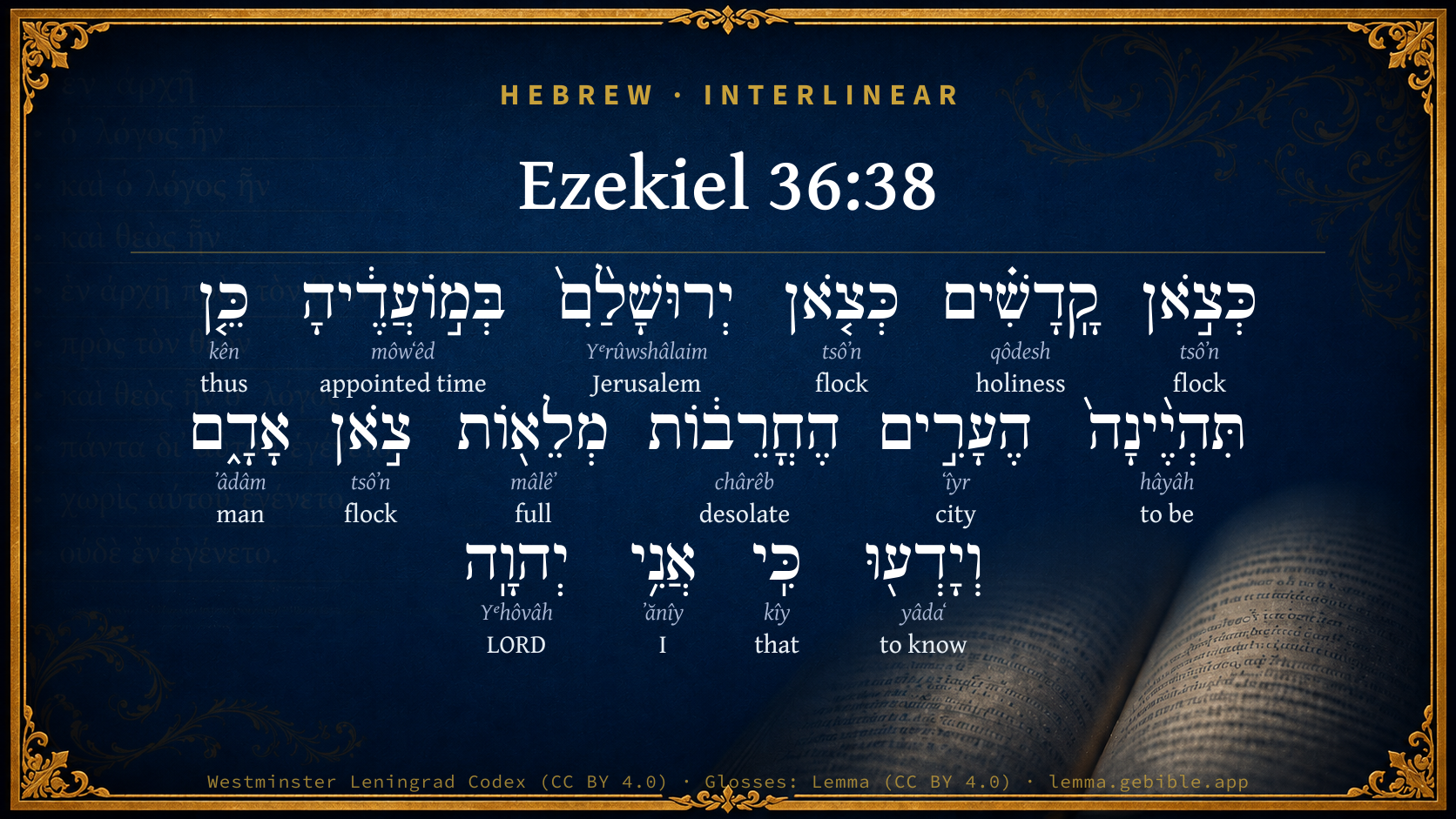
  1. כְּצֹ֣אן tsôʼn H6629 “like/as · flock of” Preposition + Noun, Common, Both, Singular, Construct
  2. קָֽדָשִׁ֗ים qôdesh H6944 “holy things” Noun, Common, Masculine, Plural, Absolute
  3. כְּצֹ֤אן tsôʼn H6629 “like/as · flock of” Preposition + Noun, Common, Both, Singular, Construct
  4. יְרוּשָׁלִַ֨ם֙ Yᵉrûwshâlaim H3389 “Jerusalem” Noun, Proper
  5. בְּמ֣וֹעֲדֶ֔יהָ môwʻêd H4150 “in/at · appointed times · her” Preposition + Noun, Common, Masculine, Plural, Construct + Suffix, Personal, 3rd Person, Feminine, Singular
  6. כֵּ֤ן kên H3651 “thus” Particle, Demonstrative
  7. תִּהְיֶ֨ינָה֙ hâyâh H1961 “to be” Verb, Qal, Imperfect, 3rd Person, Feminine, Plural
  8. הֶעָרִ֣ים ʻîyr H5892 “the · cities” Particle, Definite Article + Noun, Common, Feminine, Plural, Absolute
  9. מְלֵא֖וֹת mâlêʼ H4392 “full” Adjective, Adjective, Feminine, Plural, Absolute
  10. צֹ֣אן tsôʼn H6629 “flock of” Noun, Common, Both, Singular, Construct
  11. אָדָ֑ם ʼâdâm H120 “man” Noun, Common, Masculine, Singular, Absolute
  12. וְיָדְע֖וּ yâdaʻ H3045 “and · to know” Conjunction + Verb, Qal, Sequential Perfect, 3rd Person, Common, Plural
  13. כִּֽי kîy H3588 “that” Conjunction
  14. אֲנִ֥י ʼănîy H589 “I” Pronoun, Personal, 1st Person, Common, Singular
  15. יְהוָֽה Yᵉhôvâh H3068 “LORD” Noun, Proper

About this verse

These counts appear in no published source. They are computed here, from the morphology-tagged text and Lemma’s own curated glosses. What Lemma adds →

16
words
14
distinct lemmas
Prophets
section

Notable vocabulary

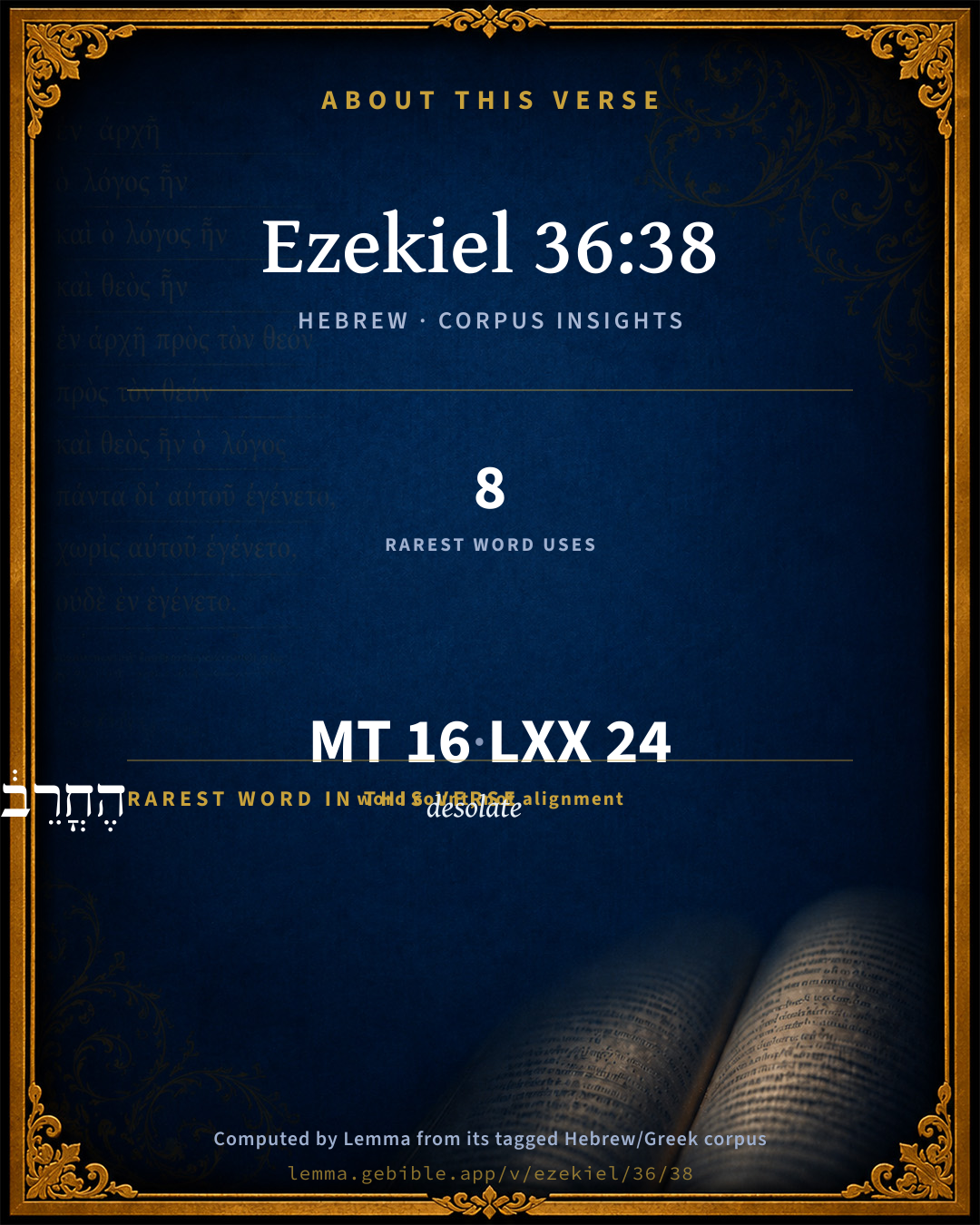
The rarest word here is הֶחֳרֵב֔וֹת desolate H2720 — appearing just 8 times in the whole Hebrew Bible.

Shared distinctive vocabulary

הֶחֳרֵב֔וֹת desolate H2720 occurs in 8 verses of the Hebrew Bible. Also found in:

Grammatical profile

  • 2 verbs
  • 9 nouns
  • 2 adjectives
  • 1 pronoun
  • 1 conjunction
  • 1 particle

Verb forms

  • תִּהְיֶ֨ינָה֙ Qal · Imperfect
  • וְיָדְע֖וּ Qal · Sequential Perfect

Repetition

A word recurs within this verse — often emphatic in Hebrew:

  • כְּצֹ֣אן flock H6629 ×3

Hebrew & Septuagint length

In English translation the verse runs 33 words from the Hebrew and 31 from the Septuagint (LXX English) — closely comparable.

A rough comparison of the two English renderings, which tokenize alike — not a word-level alignment.

Word counts can differ between the Hebrew and the Greek without any difference in meaning — e.g. the Hebrew direct-object marker אֵת has no separate Greek word, and Greek often adds the article ὁ.

In the original languages it is 16 Hebrew tokens and 24 Greek tokens — but the two are counted differently (Hebrew bundles its prefixes and suffixes into one token; the Greek is in lemma form), so that isn’t a like-for-like length.

Cross-references

15

Topical passages linked to Ezekiel 36:38 in the Treasury of Scripture Knowledge — connected by theme and wording, ordered by reader-vote popularity; previews shown in the World English Bible.

  • 1 Kings 8:63 Solomon offered for the sacrifice of peace-offerings, which he offered to Yahweh, two and twenty thousand oxen, and one hundred twenty thousand sheep. So the king and all the children of Israel dedicated the house of Yahweh.
  • John 10:16 I have other sheep, which are not of this fold. I must bring them also, and they will hear my voice. They will become one flock with one shepherd.
  • Acts 2:5–11 Now there were dwelling in Jerusalem Jews, devout men, from every nation under the sky.
  • Exodus 23:17 Three times in the year all your males shall appear before the Lord Yahweh.
  • Exodus 34:23 Three times in the year all your males shall appear before the Lord Yahweh, the God of Israel.
  • Deuteronomy 16:16 Three times in a year shall all your males appear before Yahweh your God in the place which he shall choose: in the feast of unleavened bread, and in the feast of weeks, and in the feast of tents; and they shall not appear before Yahweh empty:
  • 2 Chronicles 7:8 So Solomon held the feast at that time seven days, and all Israel with him, a very great assembly, from the entrance of Hamath to the brook of Egypt.
  • 2 Chronicles 30:21–27 The children of Israel who were present at Jerusalem kept the feast of unleavened bread seven days with great gladness; and the Levites and the priests praised Yahweh day by day, [singing] with loud instruments to Yahweh.
  • 2 Chronicles 35:7–19 Josiah gave to the children of the people, of the flock, lambs and kids, all of them for the Passover offerings, to all who were present, to the number of thirty thousand, and three thousand bulls: these were of the king's substance.
  • Jeremiah 30:19 Out of them shall proceed thanksgiving and the voice of those who make merry: and I will multiply them, and they shall not be few; I will also glorify them, and they shall not be small.
  • Jeremiah 31:27–28 Behold, the days come, says Yahweh, that I will sow the house of Israel and the house of Judah with the seed of man, and with the seed of animal.
  • Ezekiel 34:31 You my sheep, the sheep of my pasture, are men, and I am your God, says the Lord Yahweh.
  • Ezekiel 36:33–35 Thus says the Lord Yahweh: In the day that I cleanse you from all your iniquities, I will cause the cities to be inhabited, and the waste places shall be built.
  • Zechariah 8:19–23 Thus says Yahweh of Hosts: "The fasts of the fourth fifth, seventh, and tenth months shall be for the house of Judah joy and gladness, and cheerful feasts. Therefore love truth and peace."
  • Revelation 7:4–9 I heard the number of those who were sealed, one hundred forty-four thousand, sealed out of every tribe of the children of Israel:

Cross-references courtesy of OpenBible.info (CC BY 4.0).

Hebrew and Greek witnesses Masoretic Hebrew ↔ Greek Septuagint

The same verse in the two great witnesses to the Old Testament, shown verse-for-verse.

These are two independent witnesses, not word-aligned to each other, and the Septuagint is shown in lemma (dictionary) form.

Hebrew Ezekiel 36:38 Masoretic · Westminster Leningrad Codex

כְּצֹ֣אן קָֽדָשִׁ֗ים כְּצֹ֤אן יְרוּשָׁלִַ֨ם֙ בְּמ֣וֹעֲדֶ֔יהָ כֵּ֤ן תִּהְיֶ֨ינָה֙ הֶעָרִ֣ים הֶחֳרֵב֔וֹת מְלֵא֖וֹת צֹ֣אן אָדָ֑ם וְיָדְע֖וּ כִּֽי אֲנִ֥י יְהוָֽה

As the flock for sacrifice, as the flock of Jerusalem in her appointed feasts, so shall the waste cities be filled with flocks of men; and they shall know that I am Yahweh.

World English Bible · Public Domain

Greek LXX Ezekiel 36:38 Septuagint · lemma form

ὡς πρόβατον ἅγιος ὡς πρόβατον ἰερουσαλήμ ἐν ὁ ἑορτή αὐτός οὕτως εἰμί ὁ πόλις ὁ ἔρημος πλήρης πρόβατον ἄνθρωπος καί γιγνώσκω ὅτι ἐγώ κύριος

as holy sheep, as the sheep of Jerusalem in her feasts; thus shall the desert cities be full of flocks of men: and they shall know that I am the Lord.

LXX2012 (modern English Septuagint) · Public Domain

Hebrew: Westminster Leningrad Codex (CC BY 4.0). Greek: Septuagint (public domain); English from LXX2012 (modern English Septuagint) (Public Domain). How the Septuagint differs from the Hebrew →

Targum (Aramaic paraphrase)

1

The Targum is the ancient Jewish Aramaic paraphrase of the Hebrew Scriptures — an interpretive translation, not the Hebrew text itself. Onkelos (literal) and Pseudo-Jonathan (expansive) render the Torah, and Jonathan the Prophets. Coverage is partial: where no permissively-licensed English translation exists for a verse, only the Aramaic is shown. This is verse-level text, not a word-by-word alignment to the Hebrew.

  1. Targum Jonathan Prophets (Joshua–Malachi)
    כְּעַמָא קַדִישָׁא כְּעַמָא דִמְדַכָּן וְאָתָן לִירוּשְׁלֵם בִּזְמַן מוֹעֲדֵי פִּסְחָא כֵּן יֶהֱוְיָן קִרְוַיָא אַרְעָא דְיִשְׂרָאֵל דַהֲוָאָה חֲרֵיבָן יְהוֹן מַלְיָן אֱנֶשָׁא דְעַמָא בֵּית יִשְׂרָאֵל וְיֵדְעוּן אֲרֵי אֲנָא יְיָ:

    (no public-domain English translation for this verse)

    Targum Jonathan — Aramaic: “Mikraot Gedolot” (public domain). English: “Sefaria Community Translation” (CC0 1.0 (public-domain dedication)); “London "Chaldee Paraphrase," 1871” (public domain). Text via Sefaria.

Commentary

Notes on Ezekiel 36:38 from classic Christian and Jewish commentators (each source and its license shown beneath its notes). The classic Christian expositions comment on the surrounding passage and are grouped to its opening verse, so a note may address several verses; the Jewish commentaries on the Tanakh (Rashi and others) are per-verse, so they appear only where the commentator wrote on this verse.

Lemma curates 59 commentaries, every one of them public domain or Creative Commons licensed, each selected and text-cleaned for this edition rather than reprinted as found. About our sources →

Trapp's Complete Commentary

John Trapp

Eze 36:38 As the holy flock, as the flock of Jerusalem in her solemn feasts; so shall the waste cities be filled with flocks of men: and they shall know that I [am] the LORD.

Ver. 38. As the holy flock.] The sheep that come up for sacrifice, at the passover especially; so will I multiply the sheep of Christ, the true shepherd.

John Trapp, A Commentary or Exposition upon All the Books of the Old and New Testament (1647–1656) — public domain. Text from a community e-Sword module.

Jamieson, Fausset & Brown

Robert Jamieson, A. R. Fausset & David Brown

As the holy flock--the great flock of choice animals for sacrifice, brought up to Jerusalem at the three great yearly festivals, the passover, pentecost, and feast of the tabernacles.

Three stages in Israel's revival present themselves to the prophet's eye. (1) The new awakening of the people, the resurrection of the dead (Eze 37:1-14). (2) The reunion of the formerly hostile members of the community, whose contentions had affected the whole (Eze 37:15-28). (3) The community thus restored is strong enough to withstand the assault of Gog, &c. (Eze. 38:1-39:29) [EWALD].

Next: Ezekiel Chapter 37

Jamieson, Fausset & Brown — Commentary Critical and Explanatory on the Whole Bible (1871) — public domain (CC PDM 1.0). Text via the HelloAO Bible API.

Adam Clarke's Commentary

Verse 38. As the holy flock] The Church of Christ, without spot, or wrinkle, or any such thing.

The flock of Jerusalem] The Jerusalem that is from above, the city of the living God, the place where his Majesty dwells. As they came in ancient times to the solemn national feasts so shall they come when they have fully returned unto the Lord, and received his salvation by Christ Jesus.

I do not ask my reader's pardon for having considered this most beautiful chapter as relating, not to the restoration from the Babylonish captivity, but to the redemption under the new covenant by Jesus Christ. There is no period of the Jewish history from that time until now, to which it can be applied. It must belong to the Gospel dispensation; and if the Jews will still refuse, contradict, and blaspheme, let no Christian have any fellowship with them in their opposition to this Almighty Saviour. Let none be indifferent to his salvation; let all plead his promises; and let the messengers of the Churches proclaim to the Christian world a FREE, a FULL, and a PRESENT SALVATION! And may great grace rest upon themselves, and upon all their flocks!

Adam Clarke's Commentary on the Bible (1810–1826) — public domain. Text from a community e-Sword/MySword module.

Ellicott's Commentary for English Readers

(38) The flock of Jerusalem.—The comparison is with the vast flocks of sacrificial animals accustomed to be carried to Jerusalem at the great annual feasts. The object is to give a vivid idea of the numbers of the people, but there is an especial appropriateness in the simile from the fact that these flocks were devoted to the Lord.

A Bible Commentary for English Readers, edited by Charles John Ellicott (1878–1897) — public domain. Text from a community e-Sword module.

The Cambridge Bible for Schools and Colleges

gen. ed. J. J. S. Perowne

38. the holy flock] i.e. the sacrificial sheep. The solemn feasts (where solemn has its proper sense of “customary,” appointed) may be the three great yearly festivals, though in point of fact Ezek. does not refer to Pentecost, or the feast of weeks, in his concluding chapters. The comparison shews that already in pre-exile times enormous numbers of sacrificial animals were brought to Jerusalem for offerings at the feasts.

flocks of men] lit. sheep-flocks in men. The word “flock” in Heb. is not generalized so as to express a great number—it means a sheep-flock, and is explained by “men.”

Probably no passage in the Old Testament of the same extent offers so complete a parallel to New Testament doctrine, particularly to that of St Paul. It is doubtful if the Apostle quotes Ezek. anywhere, but his line of thought entirely coincides with his. The same conceptions and in the same order belong to both—forgiveness (Eze_36:25); regeneration, a new heart and spirit (Eze_36:26); the spirit of God as the ruling power in the new life (Eze_36:27); the issue of this, the keeping of the requirements of God’s law (Eze_36:27; Rom_8:4); the effect of being “under grace” in softening the human heart and leading to obedience (Eze_36:31; Romans 6, 7); and the organic connexion of Israel’s history with Jehovah’s revelation of himself to the nations (Eze_36:33-36; Romans 11). The prophet’s idea of the divine pedagogic is not precisely the same as that of the Apostle, and the present passage has in some particulars to be supplemented from ch. 16. As put here it is Israel’s historical experiences, their dispersion and restoration, with the thoughts which these suggest, that impress the nations and teach them what Jehovah is.

The Cambridge Bible for Schools and Colleges (gen. ed. J. J. S. Perowne; Cambridge University Press, 1878–1918) — public domain. Text from a community e-Sword module.

John Gill's Exposition

As the holy flock, as the flock of Jerusalem in her solemn feasts,.... Like flocks of sheep, which were consecrated and set apart for holy uses, for sacrifices; even like the flocks of sheep, which were brought to Jerusalem to be offered in sacrifice at the three solemn festivals in the year; especially at the passover, when the Jews came from all parts of the country to slay and eat their passover; and every family had a lamb, which in all must be a great number: we read of thirty thousand lambs and three thousand bullocks given at one time for this service by King Josiah, besides what was given by the princes, Ch2 35:7. The Targum is,

"as the holy people, as a people that is cleansed, and comes to Jerusalem at the feasts of the passover:''

or, "as the flock of the Holy Ones" (q); either of the holy God, Father, Son, and Spirit; or of holy men, who are made holy or sanctified by the Spirit of God:

so shall the waste cities be filled with flocks of men; or with men that are like sheep for meekness, harmlessness, patience, cleanness, society, and usefulness; and not with such as are comparable to unclean beasts, or beasts of prey; so it denotes both the quantity of persons that shall inhabit Judea, and dwelt both in the cities and churches there, and the quality of them.

(q) "sicut oves sanctorum", Vatablus, Gussetius, Starckius.

Next: Ezekiel Chapter 37

John Gill's Exposition of the Whole Bible (1746–1763) — public domain (CC PDM 1.0). Text via the HelloAO Bible API.

Albert Barnes' Notes on the Bible

As the holy flock - A reference to the flocks and herds brought up to Jerusalem to be consecrated and offered unto the Lord 2Ch 35:7. Thus, the idea is brought out:

(1) of the multiplication of the people,

(2) of their dedication to the service of God.

Albert Barnes' Notes on the Bible (1834–1885) — public domain. Text from a community e-Sword/MySword module.

Matthew Poole's English Annotations

The holy flock; flocks designed to holy uses, as sacrifices, and therefore further described by the place where they are, Jerusalem.

Her solemn feasts; the occasion and time, solemn feasts, either the three annual great feasts, or you may hake in the daily sacrifices. These flocks were for quality the best of all, and for numbers very great, on the solemn feasts; thirty thousand at once of lambs and kids in Josiah’s time, and many more at the passover in aftertimes. Thus should men multiply, and fill the cities of replanted Judea.

Matthew Poole's English Annotations on the Holy Bible (1683–1685) — public domain. Text from a community e-Sword/MySword module.

The Pulpit Commentary

The people who should occupy the land of Israel in the coming age should be as the holy flock literally, as the flock of holy things, or beasts; i.e. of sacrificial lambsas the flock of Jerusalem in her solemn feasts; literally, in her appointed times; i.e. her festal seasons, (comp. Mic_2:12) referring to the three well-known annual occasions when the male population of the land came to the sanctuary, (Deu_16:16) and when in consequence the flocks and herds poured into the metropolis were well-nigh past reckoning. (see 2Ch_29:33 2Ch_35:7; and comp. Josephus, "Wars," 6:9. 3) Perhaps in addition to the idea of the multiplication of the people, that of their dedication to the service of Jehovah is suggested by the prophet"s language.

The Pulpit Commentary (1880–1919), ed. H.D.M. Spence-Jones & Joseph S. Exell — public domain. Text from a community e-Sword module.

John Wesley's Explanatory Notes

As the holy flock - Flocks designed to holy uses. In her solemn feasts - These flocks were for quality, the best of all; and for numbers, very great, on the solemn feasts. Thus shall men multiply, and fill the cities of replanted Judea. And the increase of the numbers of men is then honourable, when they are all dedicated to God as a holy flock, to be presented to him for living sacrifices. Crowds are a lovely sight in God's temple.

John Wesley, Explanatory Notes Upon the Whole Bible (1754–1765) — public domain. Text via the GEBible commentary corpus.

Rashi

Rabbi Shlomo Yitzchaki (Rashi)

Like the flocks appointed for the holy offerings which come to Jerusalem at the times of the Passover sacrifices. Another explanation follows the Targum: I will multiply you with men, and I will cause them to prosper with cattle; i.e., their iniquities will not be remembered against them.

Rashi on the Tanakh — English translations: “The Judaica Press complete Tanach with Rashi, translated by A. J. Rosenberg” (CC BY 4.0); “Pentateuch with Rashi's commentary by M. Rosenbaum and A.M. Silbermann, 1929-1934” (public domain); “The Metsudah Tanach series, Lakewood, N.J” (CC BY 4.0); and “The Book of Joshua, Metsudah Publications, 1997” (CC BY 4.0). Text via Sefaria.

Lesson kit

Teaching starters — assembled from the data on this page, not authored interpretation. Every prompt links to the verse data it draws on. Edit before teaching.

Ezekiel, in the Prophets, opens this verse with 16 words (14 distinct Hebrew lemmas). Its most distinctive word is chârêb (“desolate”). A historical commentator’s framing appears above. Read the whole chapter for the surrounding context.

Discussion questions

  1. How does “desolate” (chârêb) shape what this verse is saying?
  2. How does Leviticus 7:10, which shares the word «desolate», read alongside this verse?
  3. What does the repetition of “flock” (3× in this one verse) do in this verse?
  4. The translations on this page render this verse differently — a whole-verse word diff, not a word-by-word alignment. What might account for the different wordings?
  5. «תִּהְיֶ֨ינָה֙» is a Qal Imperfect verb. How does that grammatical form shape the action described?
  6. Compare how Trapp's Complete Commentary and Jamieson, Fausset & Brown read this verse. Where do they agree or differ?

Things to notice

Reading settings

Reading text

Shown beneath each verse's original-language words.

Old Testament
Old Testament edition

Read the OT as the Masoretic Hebrew (MT) or the Greek Septuagint (LXX).

English shown for the Greek Septuagint (in the Hebrew ↔ Greek comparison).

Comparing translations? Open the Compare panel on any verse page to stack up to four side by side.