
Deuteronomy 12:6

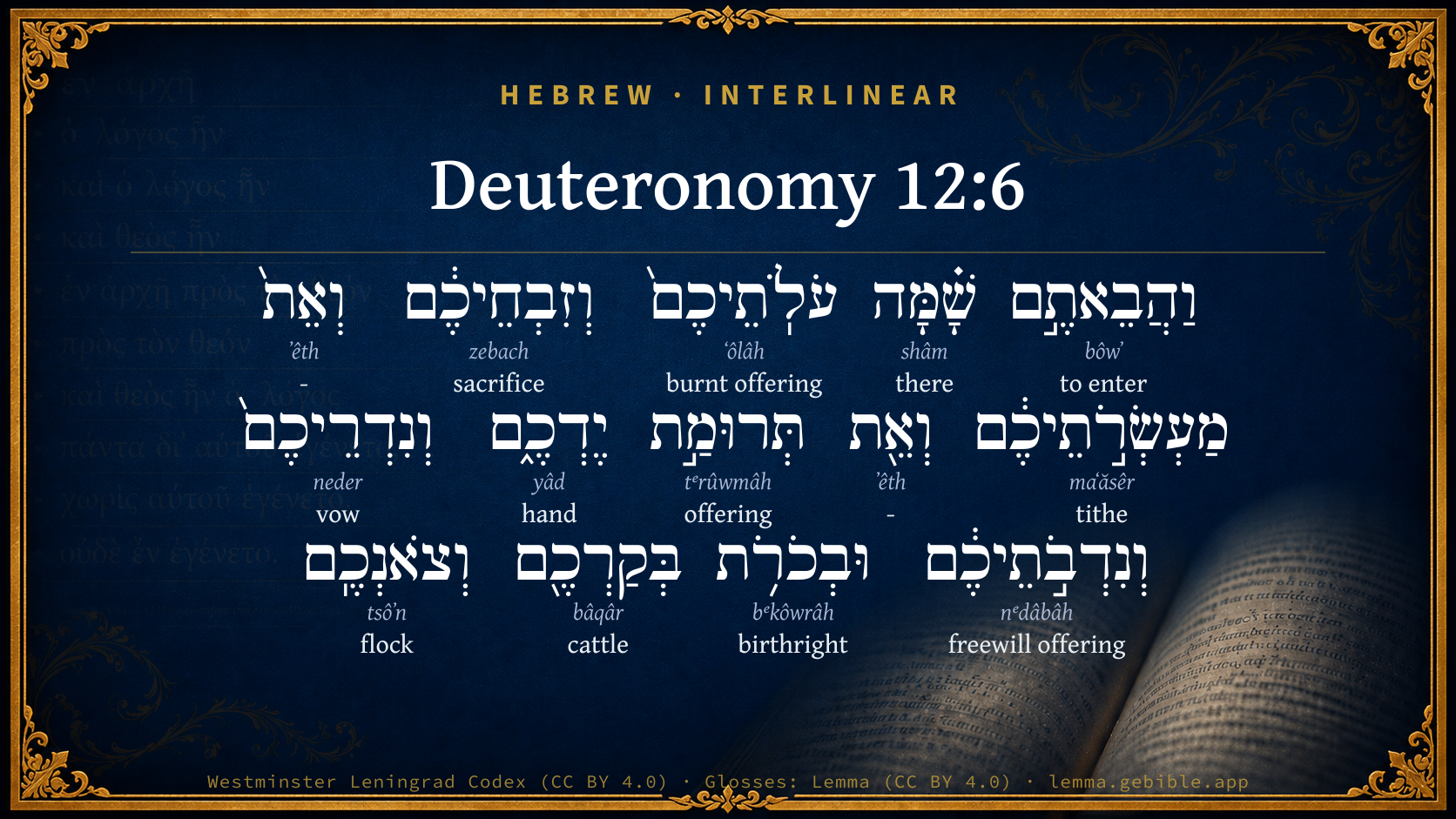
Hebrew (Westminster Leningrad Codex) Deuteronomy 12:6 appears in the Hebrew Old Testament. The text above is from the Westminster Leningrad Codex. Each word links to its Strong’s number, a concise gloss, and parsing drawn from the Open Scriptures Hebrew Bible morphology. Click any word for its full Brown-Driver-Briggs (BDB) entry.
Download image
Cite this verse

Deuteronomy 12:6 (World English Bible). Public Domain. Lemma interlinear Bible study tool, https://lemma.gebible.app/v/deuteronomy/12/6.

Show BibTeX & RIS
BibTeX
RIS
English Translation
and there you shall bring your burnt offerings, and your sacrifices, and your tithes, and the heave-offering of your hand, and your vows, and your freewill-offerings, and the firstborn of your herd and of your flock:
World English Bible · Public Domain
Download a study sheet

One document with this verse’s original text, its word-by-word gloss line, the meaning frame, cross-references with their text, attributed commentary, and full source and license credits — printable, and it pastes into notes with its structure intact.

This verse Autodidact and up

Study sheet (.html) Plain text (.txt)

A passage Seminary Student

Up to 50 verses in one chapter. A passage sheet keeps up to 6 commentary sources and 12 cross-references per verse, in the order this page ranks them, and says so on the sheet whenever that leaves anything out. Ask for a single verse and you get the Autodidact verse sheet above.

Everything on this page stays free to read, with no account — the sheet is a download of what is already on screen, not access to it.

Want to remove ads? Support Godless Engineer
Compare translations 3

The same verse in 3 English versions, stacked beneath the original-language interlinear above. Click any original word for its lexicon entry.

Each is an independent rendering of the whole verse — the interlinear is not word-aligned to these translations.

Highlighted words mark where these versions differ — a whole-verse word diff, not a word-by-word alignment.

  • World English Bible Public Domain
    and there you shall bring your burnt offerings, and your sacrifices, and your tithes, and the heave-offering of your hand, and your vows, and your freewill-offerings, and the firstborn of your herd and of your flock:
  • King James Version Public Domain
    And thither ye shall bring your burnt offerings, and your sacrifices, and your tithes, and heave offerings of your hand, and your vows, and your freewill offerings, and the firstlings of your herds and of your flocks:
  • unfoldingWord Literal Text CC BY-SA 4.0
    And there you shall bring your burnt offerings and your sacrifices and your tithes and the contribution of your hand and your offerings for vows and your freewill offerings, and the firstborn of your herds and flocks.

unfoldingWord Literal Text — © unfoldingWord, licensed CC BY-SA 4.0. Word-aligned USFM3 via Door43 (git.door43.org/unfoldingWord/en_ult).

Versions to compare (up to 4)

3 of 4 selected

Show all 18 translations

Every available English version of this verse, each an independent rendering of the whole verse.

  • World English Bible Public Domain
    and there you shall bring your burnt offerings, and your sacrifices, and your tithes, and the heave-offering of your hand, and your vows, and your freewill-offerings, and the firstborn of your herd and of your flock:
  • Berean Standard Bible Public Domain
    To that place you are to bring your burnt offerings and sacrifices, your tithes and heave offerings, your vow offerings and freewill offerings, as well as the firstborn of your herds and flocks.
  • Majority Standard Bible Public Domain
    To that place you are to bring your burnt offerings and sacrifices, your tithes and heave offerings, your vow offerings and freewill offerings, as well as the firstborn of your herds and flocks.
  • King James Version Public Domain
    And thither ye shall bring your burnt offerings, and your sacrifices, and your tithes, and heave offerings of your hand, and your vows, and your freewill offerings, and the firstlings of your herds and of your flocks:
  • American Standard Version (1901) Public Domain
    and thither ye shall bring your burnt-offerings, and your sacrifices, and your tithes, and the heave-offering of your hand, and your vows, and your freewill-offerings, and the firstlings of your herd and of your flock:
  • Revised Version (1885) Public Domain
    and thither ye shall bring your burnt offerings, and your sacrifices, and your tithes, and the heave offering of your hand, and your vows, and your freewill offerings, and the firstlings of your herd and of your flock:
  • Geneva Bible (1599) Public Domain
    And ye shall bring thither your burnt offerings, and your sacrifices, and your tithes, and the offring of your hands, and your vowes, and your free offrings, and the first borne of your kine and of your sheepe.
  • Douay-Rheims (1899) Public Domain
    And you shall offer in that place your holocausts and victims, the tithes and firstfruits of your hands and your vows and gifts, the firstborn of your herds and your sheep.
  • Young's Literal Translation Public Domain
    and hast brought in thither your burnt-offerings, and your sacrifices, and your tithes, and the heave-offering of your hand, and your vows, and your free-will offerings, and the firstlings of your herd and of your flock;
  • Literal Standard Version CC BY-SA 4.0
    and have brought in there your burnt-offerings, and your sacrifices, and your tithes, and the raised-offering of your hand, and your vows, and your free-will offerings, and the firstlings of your herd and of your flock;
  • Unlocked Literal Bible CC BY-SA 4.0
    It is there that you will bring your burnt offerings, your sacrifices, your tithes, and the offerings presented by your hand, your offerings for vows, your freewill offerings, and the firstborn of your herds and flocks.
  • unfoldingWord Literal Text CC BY-SA 4.0
    And there you shall bring your burnt offerings and your sacrifices and your tithes and the contribution of your hand and your offerings for vows and your freewill offerings, and the firstborn of your herds and flocks.
  • Darby Bible Public Domain
    and thither ye shall bring your burnt-offerings and your sacrifices, and your tithes, and the heave-offering of your hand, and your vows, and your voluntary-offerings, and the firstlings of your kine and of your sheep;
  • World Messianic Bible Public Domain
    You shall bring your burnt offerings, your sacrifices, your tithes, the wave offering of your hand, your vows, your free will offerings, and the firstborn of your herd and of your flock there.
  • Webster's Bible Public Domain
    And thither ye shall bring your burnt-offerings, and your sacrifices, and your tithes, and heave-offerings of your hand, and your vows, and your free-will-offerings, and the firstlings of your herds, and of your flocks:
  • Free Bible Version CC BY-SA 4.0
    You'll take there your burnt offerings and sacrifices, your tithes and all your offerings—your freewill offerings and offerings to fulfill a promise, along with the firstborn of your herds and flocks.
  • Bible in Basic English Public Domain
    And there you are to take your burned offerings and other offerings, and the tenth part of your goods, and the offerings to be lifted up to the Lord, and the offerings of your oaths, and those which you give freely from the impulse of your hearts, and the first births among your herds and your flocks;
  • JPS Tanakh (1917) Public Domain
    and thither ye shall bring your burnt-offerings, and your sacrifices, and your tithes, and the offering of your hand, and your vows, and your freewill-offerings, and the firstlings of your herd and of your flock;

Literal Standard Version (2020), Covenant Press — licensed CC BY-SA 4.0. Text via the HelloAO Bible API (eBible.org). Unlocked Literal Bible (unfoldingWord) — licensed CC BY-SA 4.0. Text via the HelloAO Bible API (eBible.org). unfoldingWord Literal Text — © unfoldingWord, licensed CC BY-SA 4.0. Word-aligned USFM3 via Door43 (git.door43.org/unfoldingWord/en_ult). Free Bible Version, Dr. Jonathan Gallagher — licensed CC BY-SA 4.0. Text via the HelloAO Bible API (eBible.org).

Word by word

More ways to search: Search by grammar → Find every occurrence → Compare this word →

Practice this passage: Drill this verse → Learn its vocabulary →

וּבְכֹרֹ֥ת
bᵉkôwrâh
H1062
“and · birthrights of”
Conjunction + Noun, Common, Both, Plural, Construct
Part of Speech
Conjunction + Noun
Type
Common
Gender
Both
Number
Plural
State
Construct
Full BDB Definition

Origin: from H1060

TWOT: 244c

birthright, primogeniture, right of the first-born
  1. וַהֲבֵאתֶ֣ם bôwʼ H935 “and · to enter” Conjunction + Verb, Hiphil, Sequential Perfect, 2nd Person, Masculine, Plural
  2. שָׁ֗מָּה shâm H8033 “there · toward” Adverb + Suffix, Demonstrative
  3. עֹלֹֽתֵיכֶם֙ ʻôlâh H5930 “burnt offerings · your” Noun, Common, Feminine, Plural, Construct + Suffix, Personal, 2nd Person, Masculine, Plural
  4. וְזִבְחֵיכֶ֔ם zebach H2077 “and · sacrifices · your” Conjunction + Noun, Common, Masculine, Plural, Construct + Suffix, Personal, 2nd Person, Masculine, Plural
  5. וְאֵת֙ ʼêth H853 “and · -” Conjunction + Particle, Direct Object
  6. מַעְשְׂרֹ֣תֵיכֶ֔ם maʻăsêr H4643 “tithes · your” Noun, Common, Masculine, Plural, Construct + Suffix, Personal, 2nd Person, Masculine, Plural
  7. וְאֵ֖ת ʼêth H853 “and · -” Conjunction + Particle, Direct Object
  8. תְּרוּמַ֣ת tᵉrûwmâh H8641 “offering of” Noun, Common, Feminine, Singular, Construct
  9. יֶדְכֶ֑ם yâd H3027 “hand · your” Noun, Common, Both, Singular, Construct + Suffix, Personal, 2nd Person, Masculine, Plural
  10. וְנִדְרֵיכֶם֙ neder H5088 “and · vows · your” Conjunction + Noun, Common, Masculine, Plural, Construct + Suffix, Personal, 2nd Person, Masculine, Plural
  11. וְנִדְבֹ֣תֵיכֶ֔ם nᵉdâbâh H5071 “and · freewill offerings · your” Conjunction + Noun, Common, Feminine, Plural, Construct + Suffix, Personal, 2nd Person, Masculine, Plural
  12. בְּקַרְכֶ֖ם bâqâr H1241 “cattle · your” Noun, Common, Both, Singular, Construct + Suffix, Personal, 2nd Person, Masculine, Plural
  13. וְצֹאנְכֶֽם tsôʼn H6629 “and · flock · your” Conjunction + Noun, Common, Both, Singular, Construct + Suffix, Personal, 2nd Person, Masculine, Plural

About this verse

These counts appear in no published source. They are computed here, from the morphology-tagged text and Lemma’s own curated glosses. What Lemma adds →

14
words
13
distinct lemmas
Pentateuch
section

Notable vocabulary

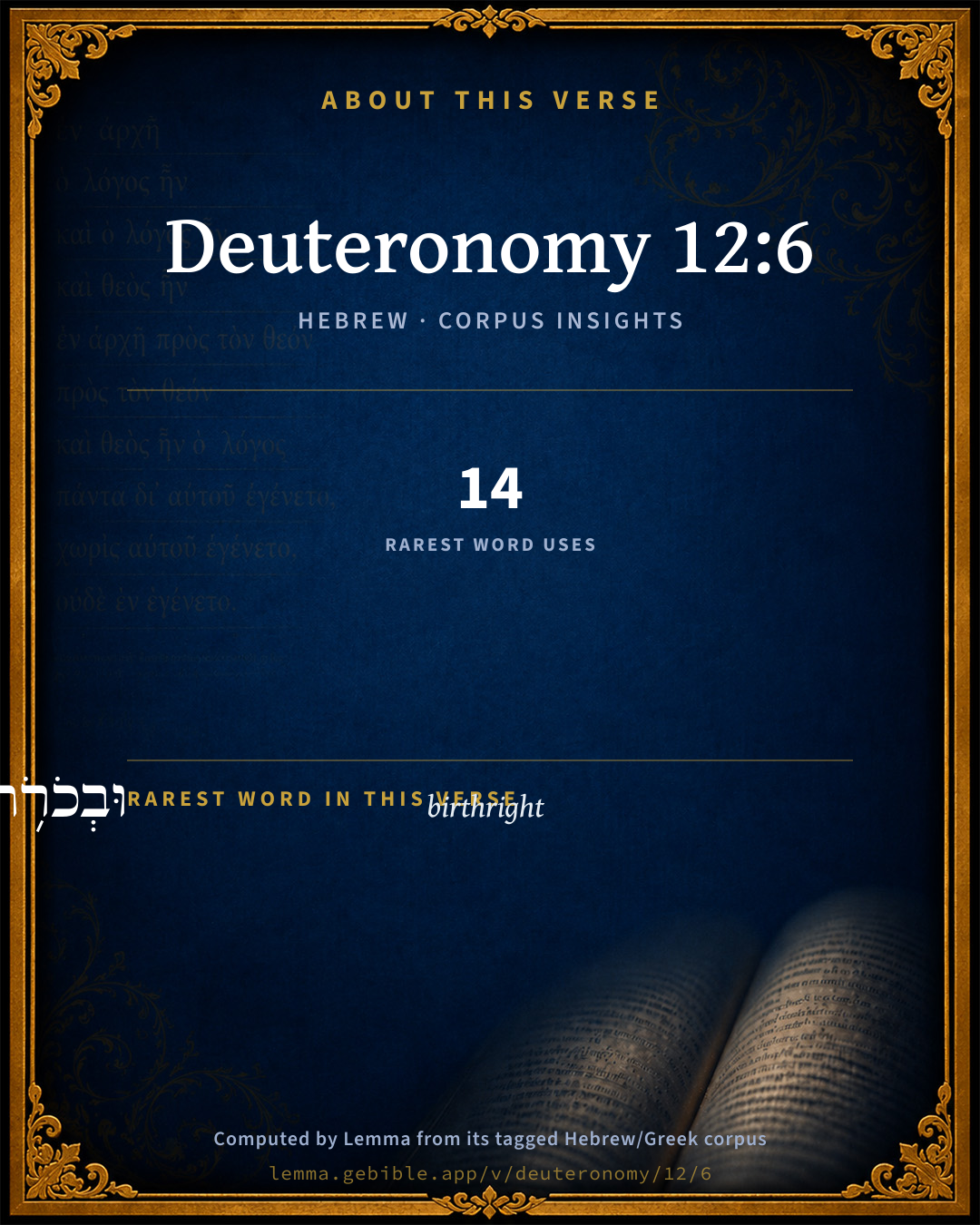
The rarest word here is וּבְכֹרֹ֥ת birthright H1062 — appearing just 14 times in the whole Hebrew Bible.

Shared distinctive vocabulary

וּבְכֹרֹ֥ת birthright H1062 occurs in 13 verses of the Hebrew Bible. Also found in:

Grammatical profile

  • 1 verb
  • 10 nouns
  • 1 adverb
  • 2 particles

Verb forms

  • וַהֲבֵאתֶ֣ם Hiphil · Sequential Perfect

Hebrew & Septuagint length

In English translation the verse runs 36 words from the Hebrew and 38 from the Septuagint (LXX English) — closely comparable.

A rough comparison of the two English renderings, which tokenize alike — not a word-level alignment.

Word counts can differ between the Hebrew and the Greek without any difference in meaning — e.g. the Hebrew direct-object marker אֵת has no separate Greek word, and Greek often adds the article ὁ.

Cross-references

12

Topical passages linked to Deuteronomy 12:6 in the Treasury of Scripture Knowledge — connected by theme and wording, ordered by reader-vote popularity; previews shown in the World English Bible.

  • Deuteronomy 15:19–20 All the firstborn males that are born of your herd and of your flock you shall sanctify to Yahweh your God: you shall do no work with the firstborn of your herd, nor shear the firstborn of your flock.
  • Leviticus 17:3–9 Whatever man there is of the house of Israel, who kills an ox, or lamb, or goat, in the camp, or who kills it outside the camp,
  • Leviticus 27:32–33 All the tithe of the herds or the flocks, whatever passes under the rod, the tenth shall be holy to Yahweh.
  • Numbers 18:15–17 Everything that opens the womb, of all flesh which they offer to Yahweh, both of man and animal shall be yours: nevertheless the firstborn of man shall you surely redeem, and the firstborn of unclean animals shall you redeem.
  • Deuteronomy 12:17 You may not eat within your gates the tithe of your grain, or of your new wine, or of your oil, or the firstborn of your herd or of your flock, nor any of your vows which you vow, nor your freewill-offerings, nor the heave-offering of your hand;
  • Deuteronomy 14:22–26 You shall surely tithe all the increase of your seed, that which comes forth from the field year by year.
  • Deuteronomy 26:2 that you shall take of the first of all the fruit of the ground, which you shall bring in from your land that Yahweh your God gives you; and you shall put it in a basket, and shall go to the place which Yahweh your God shall choose, to cause his name to dwell there.
  • Ezekiel 20:40 For in my holy mountain, in the mountain of the height of Israel, says the Lord Yahweh, there shall all the house of Israel, all of them, serve me in the land: there will I accept them, and there will I require your offerings, and the first fruits of your offerings, with all your holy things.
  • Malachi 3:8 Will a man rob God? Yet you rob me! But you say, 'How have we robbed you?' In tithes and offerings.
  • Malachi 3:10 Bring the whole tithe into the store-house, that there may be food in my house, and test me now in this," says Yahweh of hosts, "if I will not open you the windows of heaven, and pour you out a blessing, that there shall not be room enough for.
  • Luke 11:42 But woe to you Pharisees! For you tithe mint and rue and every herb, but you bypass justice and the love of God. You ought to have done these, and not to have left the other undone.
  • Luke 18:12 I fast twice a week. I give tithes of all that I get.'

Cross-references courtesy of OpenBible.info (CC BY 4.0).

Hebrew and Greek witnesses Masoretic Hebrew ↔ Greek Septuagint

The same verse in the two great witnesses to the Old Testament, shown verse-for-verse.

These are two independent witnesses, not word-aligned to each other, and the Septuagint is shown in lemma (dictionary) form.

Hebrew Deuteronomy 12:6 Masoretic · Westminster Leningrad Codex

וַהֲבֵאתֶ֣ם שָׁ֗מָּה עֹלֹֽתֵיכֶם֙ וְזִבְחֵיכֶ֔ם וְאֵת֙ מַעְשְׂרֹ֣תֵיכֶ֔ם וְאֵ֖ת תְּרוּמַ֣ת יֶדְכֶ֑ם וְנִדְרֵיכֶם֙ וְנִדְבֹ֣תֵיכֶ֔ם וּבְכֹרֹ֥ת בְּקַרְכֶ֖ם וְצֹאנְכֶֽם

and there you shall bring your burnt offerings, and your sacrifices, and your tithes, and the heave-offering of your hand, and your vows, and your freewill-offerings, and the firstborn of your herd and of your flock:

World English Bible · Public Domain

Greek LXX Deuteronomy 12:6 Septuagint · lemma form

καί φέρω ἐκεῖ ὁ ὁλοκαύτωμα σύ καί ὁ θυσίασμα σύ καί ὁ ἀπαρχή σύ καί ὁ εὐχή σύ καί ὁ ἑκούσιος σύ καί ὁ πρωτότοκος ὁ βοῦς σύ καί ὁ πρόβατον σύ

And you⌃ shall carry there your whole burnt offerings, and your sacrifices, and your first fruits, and your vowed-offerings, and your free will offerings, and your offerings of thanksgiving, the firstborn of your herds, and of your flocks.

LXX2012 (modern English Septuagint) · Public Domain

On this verse, John Gill's Exposition discusses the Septuagint’s reading. Read the note in Commentary ↓

Hebrew: Westminster Leningrad Codex (CC BY 4.0). Greek: Septuagint (public domain); English from LXX2012 (modern English Septuagint) (Public Domain). How the Septuagint differs from the Hebrew →

Targum (Aramaic paraphrase)

2

The Targum is the ancient Jewish Aramaic paraphrase of the Hebrew Scriptures — an interpretive translation, not the Hebrew text itself. Onkelos (literal) and Pseudo-Jonathan (expansive) render the Torah, and Jonathan the Prophets. Coverage is partial: where no permissively-licensed English translation exists for a verse, only the Aramaic is shown. This is verse-level text, not a word-by-word alignment to the Hebrew.

  1. Targum Onkelos Torah (Genesis–Deuteronomy)
    וְתַיְתוּן לְתַמָן עֲלָוָתֵיכוֹן וְנִכְסַת קוּדְשֵׁיכוֹן וְיָת מַעְשְׂרָתֵיכוֹן וְיָת אַפְרָשׁוּת יֶדְכוֹן וְנִדְרֵיכוֹן וְנִדְבָתֵיכוֹן וּבְכוֹרֵי תוֹרְכוֹן וְעָנְכוֹן

    (no public-domain English translation for this verse)

    Targum Onkelos — Aramaic: “Onkelos Genesis” (public domain); “Onkelos Exodus” (public domain); “Onkelos Leviticus” (public domain); “Onkelos Numbers” (public domain); “Onkelos Deuteronomy” (public domain). English: “Sefaria Community Translation” (CC0 1.0 (public-domain dedication)); “J.W. Etheridge. The Targums of Onkelos and Jonathan Ben Uzziel on the Pentateuch. London: Longmans, Green, 1862” (public domain). Text via Sefaria.

  2. Targum Pseudo-Jonathan Torah (Genesis–Deuteronomy)
    וְתַיְיתוּן תַּמָּן עַלְוַותְכוֹן וְנִכְסַת קוּדְשֵׁיכוֹן וְיַת מַעֲשַרְתֵּיכוֹן וְיַת אַפְרָשׁוּת יְדֵיכוֹן וְנִדְרֵיכוֹן וְנִיסְבָתֵיכוֹן וּבְכוֹרֵי תוֹרֵיכוֹן וְעָנֵיכוֹן

    and bring your sacrifices and consecrated oblations, your tythes, the separation of your hands, your vows, your voluntary offerings, and the firstlings of your herds and flocks.

    Targum Pseudo-Jonathan — Aramaic: “Targum Jonathan on Genesis” (public domain); “Targum Jonathan on Exodus” (public domain); “Targum Jonathan on Leviticus” (public domain); “Targum Jonathan on Numbers” (public domain); “Targum Jonathan on Deuteronomy” (public domain). English: “The Targum of Jonathan ben Uzziel, trans. J. W. Etheridge, London, 1862” (public domain). Text via Sefaria.

Commentary

Notes on Deuteronomy 12:6 from classic Christian and Jewish commentators (each source and its license shown beneath its notes). The classic Christian expositions comment on the surrounding passage and are grouped to its opening verse, so a note may address several verses; the Jewish commentaries on the Tanakh (Rashi and others) are per-verse, so they appear only where the commentator wrote on this verse.

Lemma curates 59 commentaries, every one of them public domain or Creative Commons licensed, each selected and text-cleaned for this edition rather than reprinted as found. About our sources →

John Gill's Exposition

And thither ye shall bring your burnt offerings,.... For the daily sacrifice, and upon any other account whatsoever; this was before ordered to be brought to the door of the tabernacle of the congregation, and now to the place where that should be fixed, Lev 17:8.

and your sacrifices: all other distinct from burnt offerings, as sin offerings, trespass offerings, and peace offerings, especially the latter. Jarchi interprets them of peace offerings of debt, such as a man was obliged to bring; but as the distance of some persons from Jerusalem was very great, and it was troublesome and expensive, they might, according to the Jewish writers, bring them the next grand festival, when all the males were obliged to appear there; so says Maimonides (c), all offerings of a man, whether by obligation (such as he was bound to bring) or freewill offerings, he must bring at the first feast that comes; and another of their writers observes (d), that if only one feast has passed, and he has not brought his vow, he transgresses an affirmative precept, Deu 12:6 the first feast on which thou comest thither, thou must needs bring it; and if three have passed, he transgresses a negative precept, Deu 23:21.

and your tithes; tithes of beasts, and the second tithes, according to Jarchi:

and heave offerings of your hand; these according to the same writer were the firstfruits, and so it is rendered in the Septuagint version; and thus Maimonides (e) says, the firstfruits are called Trumot, or heave offerings; see Exo 22:29.

and your vows and your freewill offerings; which were a type of peace offerings, Lev 7:16.

and the firstlings of your herds and of your flocks; which were sanctified and devoted to the Lord, Exo 13:2.

(c) Praefat. ad Yad Chazakah. (d) Bartenora in Misn. Roshhashanah, c. 1. sect. 1. & in Misn. Ediot, c. 7. sect. 6. (e) In Misn. Meilah, c. 4. sect. 2.

John Gill's Exposition of the Whole Bible (1746–1763) — public domain (CC PDM 1.0). Text via the HelloAO Bible API.

Trapp's Complete Commentary

John Trapp

Deu 12:6 And thither ye shall bring your burnt offerings, and your sacrifices, and your tithes, and heave offerings of your hand, and your vows, and your freewill offerings, and the firstlings of your herds and of your flocks:

Ver. 6. Heave offerings of your hands.] For none might appear empty handed before the Lord.

John Trapp, A Commentary or Exposition upon All the Books of the Old and New Testament (1647–1656) — public domain. Text from a community e-Sword module.

Matthew Poole's English Annotations

The

sacrifices were wisely appropriated to that one and public place, partly for the security of the true religion, and for the prevention of idolatry and superstition, which otherwise might more easily have crept in; and partly to signify that their sacrifices were not accepted for their own worth, but by God’s gracious appointment, and for the sake of God’s altar, by which they were sanctified, and for the sake of Christ, whom the altar did manifestly represent. Of

tithes, See Poole "Deu 12:17".

Heave-offerings, i.e. your first-fruits, to wit, of the earth, as of corn and wine and oil and other fruits, as plainly appears by comparing this place with Deu 18:4; 26:2, where these are commanded to be brought thither; and seeing here is an exact and particular enumeration of all such things, and these cannot be put under any of the other branches, these must needs be intended here, the rather because the other kind of first-fruits, to wit, of the

herds and

flocks, are here expressly mentioned. And these are called here the heave-offerings of their hand, because the offerer was first to take these into his hands, and to heave them before the Lord, (as other places tell us,) and then to give them to the priest, as appears from Deu 18:3,4; 26:4.

Your free-will offerings; even for your voluntary oblations, which were not due by my prescription, but only by your own choice and voluntary engagement: you may choose what kind of offering you please to vow and offer, but not the place where you shall offer them.

The firstlings of your herds and of your flocks; either,

1. The holy firstlings or first-born, as appears by Num 18, where they are commanded to be brought to this one place here designed, and to be offered upon God’s altar, Deu 12:17. It is objected by some, that those were given to the priests, Num 18:18, but these were to be eaten by the people here, Deu 12:7. But that the next verse doth not say, but only in general, there shall ye eat, to wit, such of the offerings mentioned Deu 12:6 as they were allowed to eat, but not such as were the priest’s peculiar, for these they might not eat, nor all there expressed; for it is evident they might not eat any of the burnt-offerings, nor some parts of the other sacrifices, which are here mentioned. Or,

2. The second births, which were the people’s first-born, or the first which they could eat of, which they were to eat before the Lord by way of acknowledgment of his favour in giving them to them and all their succeeding births. See more on Deu 12:17.

Matthew Poole's English Annotations on the Holy Bible (1683–1685) — public domain. Text from a community e-Sword/MySword module.

Joseph Benson's Commentary

Deu 12:6. Thither bring your burnt-offerings — Which were wisely appropriated to that one place, for the security of the true religion, and for the prevention of idolatry and superstition, which might otherwise more easily have crept in; and to signify that their sacrifices were not accepted for their own worth, but by God’s gracious appointment, and for the sake of God’s altar, by which they were sanctified, and for the sake of Christ, whom the altar manifestly represented. Your heave-offerings — That is, your first-fruits of corn, and wine, and oil, and other fruits. And these are called the heave-offerings of their hand, because the offerer was first to take these into his hands, and to heave them before the Lord, and then to give them to the priest. Your free-will-offerings — Even your voluntary oblations, which were not due by my prescription, but only by your own choice: you may choose what kind of offerings you please to offer, but not the place where you shall offer them.

Joseph Benson's Commentary on the Old and New Testaments (1811–1818) — public domain. Text from a community e-Sword module.

Tyndale Open Study Notes

Tyndale Open Resources

12:6 All of the offerings listed here are expressions of thanksgiving, fellowship, and loyalty to the Lord. In covenant relationships, the vassal offered tribute to the great king as a sign of submission and a promise of dependability (see study note on 1:31).

Tyndale Open Study Notes — © Tyndale Open Resources, licensed CC BY-SA 4.0. Text via the HelloAO Bible API.

Geneva Bible (1599)

Geneva Bible translators

Meaning, the firstfruits.

Geneva Bible (1599) marginal notes — public domain. Text via Bolls.life.

Ellicott's Commentary for English Readers

(6) And thither ye shall bring . . . your tithes—i.e., what the Jews understand as the “second tithe;” on which see Deu_12:17.

A Bible Commentary for English Readers, edited by Charles John Ellicott (1878–1897) — public domain. Text from a community e-Sword module.

Albert Barnes' Notes on the Bible

Some have objected that this command cannot possibly have been ever carried out, at all events until in later (lays the territory which owned obedience to it was narrowed to the little kingdom of Judah. But in these and in other precepts Moses doubtless takes much for granted. He is here, as elsewhere, regulating and defining more precisely institutions which had long been in existence, as to many details of which custom superseded the necessity of specific enactment. No doubt the people well understood what Maimonides expressly tells us in reference to the matter, namely, that where immediate payment could not be made, the debt to God was to be reserved until the next great Feast, and then duly discharged. The thing especially to be observed was that no kind of sacrifice was to be offered except at the sacred spot fixed by God for its acceptance.

Albert Barnes' Notes on the Bible (1834–1885) — public domain. Text from a community e-Sword/MySword module.

Haydock's Catholic Bible Commentary

Hands, which you have procured by your industry, (Menochius) or what you are able to present to the Lord, Leviticus v. 11.

George Leo Haydock (1774–1849), Haydock's Catholic Family Bible and Commentary, 1859 edition — public domain. Excludes Psalms (Douay-Rheims chapter numbering differs from Protestant) and Deuterocanonical books (Catholic canon only).

Whedon's Commentary on the Bible

Daniel D. Whedon

6. Thither ye shall bring — To the place appointed by Jehovah and consecrated by his presence they were to bring their gifts, and celebrate sacrificial festivals. To the objection that it would not be possible for the people from every part of the land to bring these offerings, it may be said that what is provided for in Deu_14:24-25, was doubtless applicable in such cases. Then it must be borne in mind that no part of the land was at a very great distance from the central sanctuary. Dan, the northern limit, was not a hundred miles from Jerusalem.

Burnt offerings — These were to be wholly consumed on the altar, except that the skin was the perquisite of the officiating priest. See Lev_7:8.

Sacrifices — Animals that were slaughtered. With these two classes were also associated meat offerings and drink offerings.

And your tithes — See notes on the seventeenth verse.

Heave offerings — The word here and elsewhere rendered heave is obscurely translated. It refers evidently to some act by which the offering is dedicated to Jehovah.

Daniel D. Whedon (gen. ed.), Commentary on the Old and New Testaments (1874–1909) — public domain. Text from a community e-Sword module.

The Pulpit Commentary

To the appointed place all their sacrificial gifts and offerings were to be brought, and there they were to keep their holy feasts. The gifts are classified in groups.

1. Burnt offerings and sacrifices, the two principal kinds of altar offerings, with which meal offerings and drink offerings were united. (Num_15:4, etc.)

2. Tithes and heave offerings (cf. Lev_27:30-33; Num_18:21-24) The heave offerings are described as of your hand, either because offered by the offerer"s own hand, or to indicate such gifts as were made off-hand (so to speak), voluntary offerings made in addition to the legal offerings from an immediate impulse of grateful emotion.

3. Vows and freewill offerings, sacrifices which were offered in consequence of vows or of spontaneous impulse (cf. Lev_7:16 Lev_22:21 Lev_23:38; Num_15:3 Num_29:39)

4. Firstlings of their herds and of their flocks (cf. Exo_13:2, Exo_13:12; Num_18:15, etc.)

Vers. 6-29. The central sanctuary.

There are difficulties connected with this law from which conclusions have been drawn adverse to the Mosaic authorship of Deuteronomy. These arise:

1. From the lack of evidence that the law was in force in the days of the judges and earlier kings.

2. From the practice of judges, kings, prophets, and other good men in offering sacrifices elsewhere than at the prescribed center.

3. From the mention of other sanctuaries in the history. (e.g. 1Sa 7:26, 1Sa 7:30) But:

1. Ver. 10 shows that it was not contemplated that the law should come into perfect operation till the land was settled, and till a place for a fixed center had been definitely chosen. In point of fact, the unsettled state of matters lasted till the reign of David. (2Sa_7:1) Accordingly, in 1Ki_3:2, it is not urged that, the law did not exist, or that it was not known, but the excuse is advanced for irregularities that "there was no house built unto the Name of the Lord until those days" (cf. 1Ki_8:29 1Ki_9:9; 2Ch_6:5, 2Ch_6:6)

2. While the law lays down the general rule, it is not denied that circumstances might arise, in which under proper Divine authority, exceptional sacrifices might be offered. This fully explains the cases of Gideon, (Jud_1:6:18, 26) of Manoah, (Jud_1:13:16) of David, (2Sa_24:18) of Solomon, (1Ki_3:4, 1Ki_3:5) of Elijah. (1Ki_18:31)

3. Even while the tabernacle was at Shiloh, the ark, for reasons unknown to us, was moved from place to place a circumstance which accounts for sacrifices being offered at the spots where, for the time being, it was located. (Jud_1:21:2) We may infer the presence of the ark in Jud_1:20:26 and on various other occasions.

4. It is not fair to plead, as contradictory of the law, the falling back on local sanctuaries in periods of great national and religious disorganization, as when the land was possessed by enemies, (Jud 6:1-7) or when the ark was in captivity (1Sa_6:1) or separated from the tabernacle; (2Sa_6:11) much less the prevailing neglect of this law in times of acknowledged backsliding and declension. In particular, the period following the rejection of Eli and his sons (1Sa_2:30-35) was one of unusual complications, during which, indeed, Samuel"s own person would seem to have been the chief religious center of the nation.

5. It may further be remarked that the worship at local sanctuaries, having once taken root, justified perhaps by the exigencies of the time, it would be no easy matter to uproot it again, and a modified toleration would have to be accorded. Whatever difficulties inhere in the view of the early existence of this law, it will be found, we believe, that equal or greater difficulties emerge on any other reading of the history. This law was

I AN ASSERTION OF THE PRINCIPLE THAT GOD"S WORSHIP MUST BE ASSOCIATED WITH HIS PRESENCE. (Vers. 5-11.) The sanctuary was constituted by God having "put his Name" there. Under the New Testament the worship of the Father "in spirit and in truth" is liberated from special sacred places, (Joh_4:24) but the principle holds good that his being "in the midst" of his people is essential to worship being acceptable. (Mat_18:20)

II AN IMPORTANT MEANS OF KEEPING ALIVE THE SENSE OF NATIONAL UNITY. The union of the tribes was far from being close. Tribe feeling was often stronger than national feeling. A powerful counteractive to the local interests, and to the jealousies, rivalries, and feuds which tended to divide the nation, was found in the central sanctuary, and in the festivals therewith connected. Like the Olympic games in Greece, the sanctuary festivals formed a bond of unity for the entire people, helped them to realize their national distinctness, and awakened in them lofty and patriotic aspirations. In the Christian Church, everything is valuable which helps to develop the sense of catholicity.

III A MEANS, FURTHER, OF INFUSING WARMTH AND VITALITY INTO RELIGIOUS SERVICES. In religion, as in other matters, we need to avail ourselves of social influences. We need public as well as private worship. The self-wrapt man grows cold. There is a time for outward demonstration, not less than for internal meditation. Sharing our gladness with others, it is multiplied to ourselves a hundred-fold. The importance, in this view of them, of the sanctuary festivals, was very great. They were, from the nature of the case, "events," matters to be looked forward to with interest, and long to be remembered after they had taken place. They involved preparations, and often long journeys. Everything about them the journey in company with neighbors, the season of the year, the friendly greetings, the exhilaration of the scene as they neared the sanctuary, the varied and solemn services at the sanctuary itself was fitted in a singular degree to exalt, awe, quicken, and impress their minds. Such influences, even in gospel times, are not to be despised.

IV A COUNTERACTIVE TO IDOLATRY. It; put something in place of that which was taken away. It provided counter-attractions. Negation is not an effective instrument of reform. If we remove with one hand, we must give with the other. Our methods must be positive. J.O.

The Pulpit Commentary (1880–1919), ed. H.D.M. Spence-Jones & Joseph S. Exell — public domain. Text from a community e-Sword module.

John Wesley's Explanatory Notes

Thither bring your burnt-offerings - Which were wisely appropriated to that one place, for the security of the true religion, and for the prevention of idolatry and superstition, which might otherwise more easily have crept in: and to signify that their sacrifices were not accepted for their own worth, but by God's gracious, appointment, and for the sake of God's altar, by which they were sanctified, and for the sake of Christ, whom the altar manifestly represented. Your heave-offerings - That is, your first-fruits, of corn, and wine, and oil, and other fruits. And these are called the heave-offerings of their hand, because the offerer was first to take these into his hands, and to heave them before the Lord, and then to give them to the priest. Your free-will-offerings - Even your voluntary oblations, which were not due by my prescription, but only by your own choice: you may chuse what kind of offering you please to offer, but not the place where you shall offer them.

John Wesley, Explanatory Notes Upon the Whole Bible (1754–1765) — public domain. Text via the GEBible commentary corpus.

Rashi

Rabbi Shlomo Yitzchaki (Rashi)

וזבחיהם AND YOUR SACRIFICES — Obligatory feast-offerings (cf. Sifrei Devarim 63:7)

מעשרתיכם [THERE YOU SHALL BRING] YOUR TITHES — i.e. both the tithe of the cattle and the second tithe, in order to consume them within the wall(cf. Sifrei Devarim 63:8).

תרומת ידכם THE HEAVE-OFFERING OF YOUR HAND — These are the first-fruits of which it is said, (Deuteronomy 26:4) “And the priest shall take the basket out of thine hand” (cf. Sifrei Devarim 63:9).

ובכרת בקרכם AND THE FIRSTLINGS OF YOUR HERD — in order to give them to the priest that he may offer them there.

Rashi on the Tanakh — English translations: “The Judaica Press complete Tanach with Rashi, translated by A. J. Rosenberg” (CC BY 4.0); “Pentateuch with Rashi's commentary by M. Rosenbaum and A.M. Silbermann, 1929-1934” (public domain); “The Metsudah Tanach series, Lakewood, N.J” (CC BY 4.0); and “The Book of Joshua, Metsudah Publications, 1997” (CC BY 4.0). Text via Sefaria.

Ramban (Nachmanides)

Rabbi Moshe ben Nachman (Ramban / Nachmanides)

YOUR TITHES — “the tithe of cattle and the Second Tithe which are to be eaten within the wall [of Jerusalem]. AND HEAVE-OFFERING OF YOUR HAND — these are the first-fruits of which it is said, And the priest shall take the basket out of thy hand. ” This is Rashi’s language quoting the words of our Rabbis. 63.In line with the plain meaning of Scripture the verse mentions the burnt-offerings, and the sacrifices that he is obligated to eat there within the boundary [of Jerusalem] before the Eternal.. It mentions also that he is to bring there the tithe and the heave-offering to give them to the priests and Levites who are the ministers of the Sanctuary so that they too, rejoice with you and your families, as it says, Bring ye the whole tithe into the store-house, that there be food in My house, and try Me now herewith, saith the Eternal of hosts, if I will not open you the windows of heaven, and pour you out a blessing, that there shall be more than enough. ) is given to the priest, the First Tithe (ma’aseir rishon) to the Levite. The Levite in turn sets aside a tenth of that tithe for the priest, which is called “the heave-offering of the tithe” (terumath ma’aseir). It is also referred to as “the tithe of the tithe.” And so indeed [the prophets and leaders] established an ordinance during the Second Temple concerning the heave-offering and the heave-offering of the tithe ) is given to the priest, the First Tithe (ma’aseir rishon) to the Levite. The Levite in turn sets aside a tenth of that tithe for the priest, which is called “the heave-offering of the tithe” (terumath ma’aseir). It is also referred to as “the tithe of the tithe.” that the people bring them to the Sanctuary, as it is said, and that we should bring the first of our dough, and our heave-offerings, and the fruit of all manner of trees, the wine and the oil, unto the priests, to the chambers of the House of our G-d, and it is further said, [and the Levites shall bring up the tithe of the tithes] unto the House of our G-d, to the chambers, into the treasure-house., Verse 39.And the meaning of the expression and heave-offering of your hand is [in line with the simple meaning of Scripture a reference to the heave-offering and not to the first-fruits] because the Torah has set no fixed measure for the heave-offering [which the Israelite gives to the priest]; rather it consists of whatever his hand sets aside [for the priest]. Similarly, that which is said, Thou mayest not eat within thy gates the tithe of thy corn etc. or the heave-offering of thine hand Second Tithes outside Jerusalem, and to a priest’s eating of first-fruits outside Jerusalem (Makkoth 18a); see also “The Commandments,” Vol. II, pp. 131-140, for various prohibitions included in this verse. Thus here again the heave-offering of thine hand is interpreted as referring to the first-fruits, as explained by Rashi in the verse before us. In line with the plain meaning of Scripture as explained by Ramban, however, the verse is a reminder to the Israelite etc. reminds the Israelite that he is not to eat in his own city the tithe, the firstlings, the vow-offerings, or the heave-offering. And then the verse proceeds to distinguish between them, but thou shalt eat them before the Eternal thy G-d etc. thou, and thy son, and thy daughter, Verse 18. whatever may be eaten by you [i.e., the Second Tithe]; and the Levite that is within thy gates, Verse 18. shall eat there in your gates [i.e., outside Jerusalem] what is due him [i.e., the First Tithe] as it is stated concerning them, And ye may eat in every place. Scripture thus abbreviates concerning matters that are explained elsewhere.And I am further of the opinion regarding the plain meaning of this verse that the expression [in the verse before us] heave-offering of your hand denotes that which a person lifts up to the Eternal of his silver and gold to buy with it a burnt-offering or a [peace-]offering. And [the verse before us] mentions three kinds of offerings: the vow-offerings which are [assumed as obligations when a person says], “I pledge myself to bring an offering of a bullock, or a sheep, or a goat: ” the freewill-offering when he says of a bullock or sheep, “This shall be a burnt-offering and I will bring it to the Sanctuary,” and terumah (the donation) which he lifts up, silver or gold from anything he has, or when he brings his unconsecrated animal to the Sanctuary Court and says to the priests, “This is [given] from my possession to G-d,” similar in expression to the verse, Every one that ‘meirim terumath’ (did lift up an offering) of silver and brass, brought the Eternal’s offering. So also, All ‘terumoth’ of the holy things, which the children of Israel offer unto the Eternal denotes “the offerings” [as explained above rather than, the heave-offering]. Similarly He states with reference to the shekels, half a shekel after the shekel of the Sanctuary etc. half a shekel for ‘terumah’ (an offering) to the Eternal, these to be used for buying the communal offerings, is not limited to the heave-offering given to the priest from the produce of the field, but that it may also signify any donation or offering that a person gives to the Sanctuary. The expression in the verse before us heave-offering of your hand thus denotes the setting aside of any valuables for a sacred purpose. for whatever a person lifts up to G-d from whatever is his own — whether for offerings or for Temple maintenance, as it is stated, and they take for Me ‘terumah’ (an offering);, 25:2. In this case the word terumah denotes “something set apart” for the construction of the Tabernacle. or for the priests, the ministers of the Eternal — it is all called terumah. This is similar to what is written concerning the tax, and thou shalt give it unto Eleazar the priest as ‘terumath Hashem’ (a portion set apart for the Eternal), which remained entirely unconsecrated in Eleazar’s possession [thus proving that terumah need not refer exclusively to the priestly tithe]. A similar usage [of the term terumah is found in the following verse]: And I weighed unto them the silver, and the gold, and the vessels, even ‘terumath’ (the donation for) the House of our G-d, which the king, and his counsellors had offered. Now Scripture [here in the verse before us] does not state “your heave-offerings,” so that we should not mistake it to mean the heave-offering given to the priests [from the produce of the field]; instead it says, the heave-offering of your hand, what you set aside as a freewill offering from what has become your property. Now all things mentioned here must be consumed within a certain location, refers to the Second Tithe and the tithe of cattle, and heave-offering of your hand denotes the donations for the offerings which also require a certain location where they may be eaten — the holiest offerings within the Sanctuary Court, and those of lesser holiness within the city of Jerusalem. for the expression your tithes denotes the tithe of cattle and the Second Tithe which are eaten before the Eternal [i.e., within the wall of the city of Jerusalem]. However, the First Tithe is the tithe of the Levites, and the Poorman’s Tithe belongs to them [the poor; and are the personal property of the recipients and may be eaten anywhere].

Ramban (Nachmanides) on the Tanakh — English translation: “Commentary on the Torah by Ramban (Nachmanides). Translated and annotated by Charles B. Chavel. New York, Shilo Pub. House, 1971-1976” (CC BY 4.0). Text via Sefaria.

Lesson kit

Teaching starters — assembled from the data on this page, not authored interpretation. Every prompt links to the verse data it draws on. Edit before teaching.

Deuteronomy, in the Pentateuch, opens this verse with 14 words (13 distinct Hebrew lemmas). Its most distinctive word is bᵉkôwrâh (“birthright”). A historical commentator’s framing appears above. Read the whole chapter for the surrounding context.

Discussion questions

  1. How does “birthright” (bᵉkôwrâh) shape what this verse is saying?
  2. Genesis 4:4 shares the word «birthright» with this verse. How do the two illuminate each other?
  3. These translations render this verse differently; the difference is in the English rendering, not the original. What questions does that raise?
  4. The verb «וַהֲבֵאתֶ֣ם» is Hiphil Sequential Perfect. How does its form color the action?
  5. Reading how John Gill's Exposition and Trapp's Complete Commentary read this verse, where do the two commentators agree and where do they part?

Things to notice

Reading settings

Reading text

Shown beneath each verse's original-language words.

Old Testament
Old Testament edition

Read the OT as the Masoretic Hebrew (MT) or the Greek Septuagint (LXX).

English shown for the Greek Septuagint (in the Hebrew ↔ Greek comparison).

Comparing translations? Open the Compare panel on any verse page to stack up to four side by side.