Exodus 12:21

Hebrew (Westminster Leningrad Codex) Exodus 12:21 appears in the Hebrew Old Testament. The text above is from the Westminster Leningrad Codex. Each word links to its Strong’s number, a concise gloss, and parsing drawn from the Open Scriptures Hebrew Bible morphology. Click any word for its full Brown-Driver-Briggs (BDB) entry.
Download image
Cite this verse

Exodus 12:21 (World English Bible). Public Domain. Lemma interlinear Bible study tool, https://lemma.gebible.app/v/exodus/12/21.

Show BibTeX & RIS
BibTeX
RIS
English Translation
Then Moses called for all the elders of Israel, and said to them, "Draw out, and take lambs according to your families, and kill the Passover.
World English Bible · Public Domain
Download a study sheet

One document with this verse’s original text, its word-by-word gloss line, the meaning frame, cross-references with their text, attributed commentary, and full source and license credits — printable, and it pastes into notes with its structure intact.

This verse Autodidact and up

Study sheet (.html) Plain text (.txt)

A passage Seminary Student

Up to 50 verses in one chapter. A passage sheet keeps up to 6 commentary sources and 12 cross-references per verse, in the order this page ranks them, and says so on the sheet whenever that leaves anything out. Ask for a single verse and you get the Autodidact verse sheet above.

Everything on this page stays free to read, with no account — the sheet is a download of what is already on screen, not access to it.

Want to remove ads? Support Godless Engineer
Compare translations 3

The same verse in 3 English versions, stacked beneath the original-language interlinear above. Click any original word for its lexicon entry.

Each is an independent rendering of the whole verse — the interlinear is not word-aligned to these translations.

Highlighted words mark where these versions differ — a whole-verse word diff, not a word-by-word alignment.

  • World English Bible Public Domain
    Then Moses called for all the elders of Israel, and said to them, "Draw out, and take lambs according to your families, and kill the Passover.
  • King James Version Public Domain
    Then Moses called for all the elders of Israel, and said unto them, Draw out and take you a lamb according to your families, and kill the passover.
  • unfoldingWord Literal Text CC BY-SA 4.0
    And Moses called for all the elders of Israel, and he said to them, “Proceed and take a lamb for yourself, according to your families, and slaughter the Passover.

unfoldingWord Literal Text — © unfoldingWord, licensed CC BY-SA 4.0. Word-aligned USFM3 via Door43 (git.door43.org/unfoldingWord/en_ult).

Versions to compare (up to 4)

3 of 4 selected

Show all 18 translations

Every available English version of this verse, each an independent rendering of the whole verse.

  • World English Bible Public Domain
    Then Moses called for all the elders of Israel, and said to them, "Draw out, and take lambs according to your families, and kill the Passover.
  • Berean Standard Bible Public Domain
    Then Moses summoned all the elders of Israel and told them, “Go at once and select for yourselves a lamb for each family, and slaughter the Passover lamb.
  • Majority Standard Bible Public Domain
    Then Moses summoned all the elders of Israel and told them, “Go at once and select for yourselves a lamb for each family, and slaughter the Passover lamb.
  • King James Version Public Domain
    Then Moses called for all the elders of Israel, and said unto them, Draw out and take you a lamb according to your families, and kill the passover.
  • American Standard Version (1901) Public Domain
    Then Moses called for all the elders of Israel, and said unto them, Draw out, and take you lambs according to your families, and kill the passover.
  • Revised Version (1885) Public Domain
    Then Moses called for all the elders of Israel, and said unto them, Draw out, and take you lambs according to your families, and kill the passover.
  • Geneva Bible (1599) Public Domain
    Then Moses called all the Elders of Israel, and saide vnto them, Choose out and take you for euerie of your housholdes a lambe, and kill the Passeouer.
  • Douay-Rheims (1899) Public Domain
    And Moses called all the ancients of the children of Israel, and said to them: Go take a lamb by your families, and sacrifice the Phase.
  • Young's Literal Translation Public Domain
    And Moses calleth for all the elders of Israel, and saith unto them, `Draw out and take for yourselves `from' the flock, for your families, and slaughter the passover-sacrifice;
  • Literal Standard Version CC BY-SA 4.0
    And Moses calls for all [the] elderly of Israel and says to them, “Draw out and take for yourselves [from] the flock, for your families, and slaughter the Passover-sacrifice;
  • Unlocked Literal Bible CC BY-SA 4.0
    Then Moses summoned all the elders of Israel and said to them, “Go and select lambs or kids that will be enough to feed your families and kill the Passover lamb.
  • unfoldingWord Literal Text CC BY-SA 4.0
    And Moses called for all the elders of Israel, and he said to them, “Proceed and take a lamb for yourself, according to your families, and slaughter the Passover.
  • Darby Bible Public Domain
    And Moses called all the elders of Israel, and said to them, Seize and take yourselves lambs for your families, and kill the passover.
  • World Messianic Bible Public Domain
    Then Moses called for all the elders of Israel, and said to them, “Draw out, and take lambs according to your families, and kill the Passover.
  • Webster's Bible Public Domain
    Then Moses called for all the elders of Israel, and said to them, Draw out, and take you a lamb, according to your families, and kill the passover.
  • Free Bible Version CC BY-SA 4.0
    Then Moses called together all the elders of Israel and told them, “Go immediately and choose a lamb for each of your families, and kill the Passover lamb.
  • Bible in Basic English Public Domain
    Then Moses sent for the chiefs of Israel, and said to them, See that lambs are marked out for yourselves and your families, and let the Passover lamb be put to death.
  • JPS Tanakh (1917) Public Domain
    Then Moses called for all the elders of Israel, and said unto them: 'Draw out, and take you lambs according to your families, and kill the passover lamb.

Literal Standard Version (2020), Covenant Press — licensed CC BY-SA 4.0. Text via the HelloAO Bible API (eBible.org). Unlocked Literal Bible (unfoldingWord) — licensed CC BY-SA 4.0. Text via the HelloAO Bible API (eBible.org). unfoldingWord Literal Text — © unfoldingWord, licensed CC BY-SA 4.0. Word-aligned USFM3 via Door43 (git.door43.org/unfoldingWord/en_ult). Free Bible Version, Dr. Jonathan Gallagher — licensed CC BY-SA 4.0. Text via the HelloAO Bible API (eBible.org).

Word by word

More ways to search: Search by grammar → Find every occurrence → Compare this word →

Practice this passage: Drill this verse → Learn its vocabulary →

מִֽשְׁכ֗וּ
mâshak
H4900
“draw”
Verb, Qal, Imperative, 2nd Person, Masculine, Plural
Part of Speech
Verb
Stem
Qal
Form
Imperative
Person
2nd Person
Gender
Masculine
Number
Plural
Full BDB Definition

Origin: a primitive root

TWOT: 1257

to draw, drag, seize - (Qal) - to draw (and lift out), drag along, lead along, drag or lead off, draw down - to draw (the bow) - to proceed, march - to draw out or give (a sound) - to draw out, prolong, continue - to trail (seed in sowing) - to cheer, draw, attract, gratify - (Niphal) to be drawn out - (Pual) - to be drawn out, be postponed, be deferred - to be tall
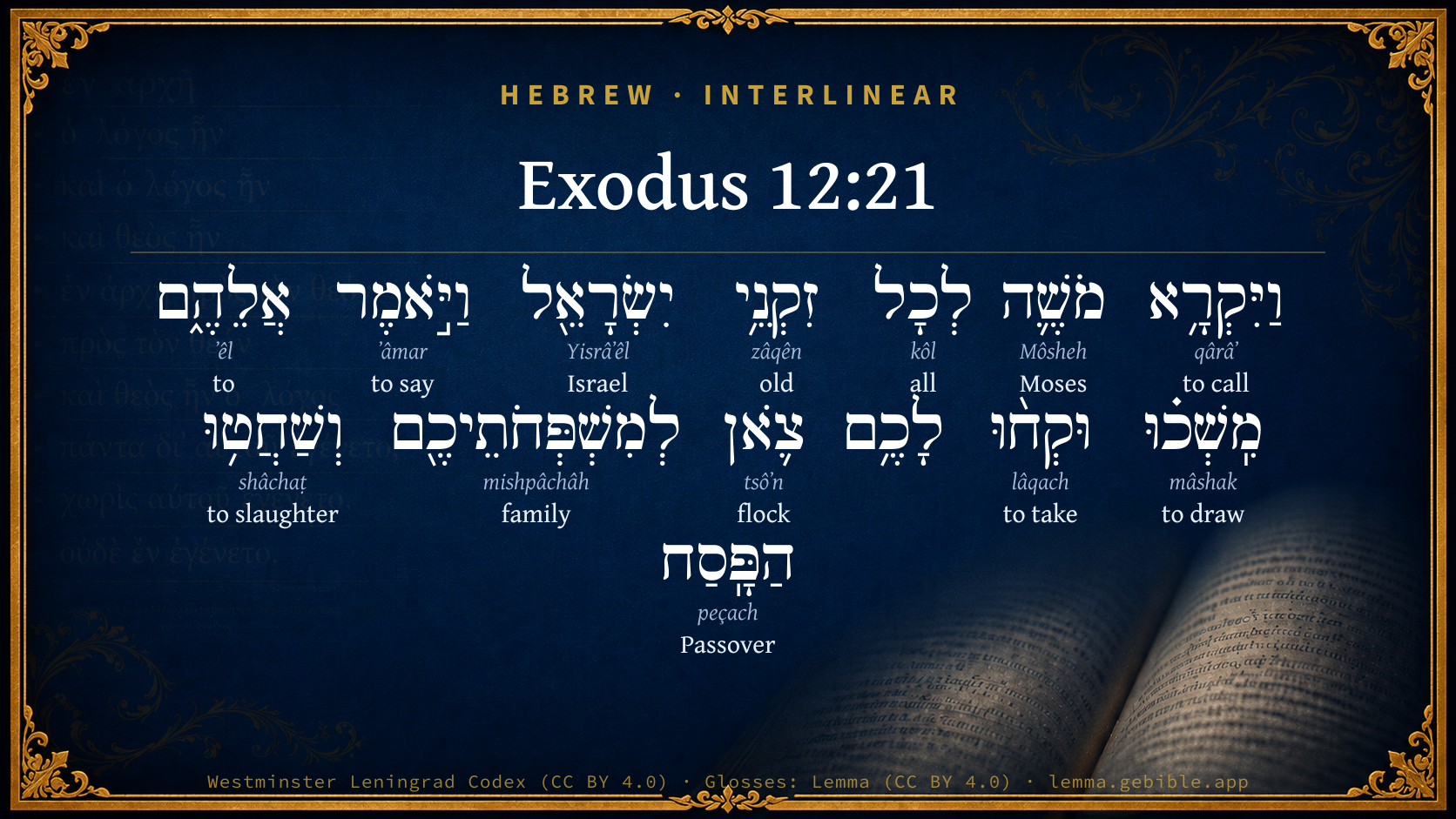
  1. וַיִּקְרָ֥א qârâʼ H7121 “and · to call” Conjunction + Verb, Qal, Sequential Imperfect, 3rd Person, Masculine, Singular
  2. מֹשֶׁ֛ה Môsheh H4872 “Moses” Noun, Proper
  3. לְכָל kôl H3605 “to/for · all of” Preposition + Noun, Common, Masculine, Singular, Construct
  4. זִקְנֵ֥י zâqên H2205 “old of” Adjective, Adjective, Masculine, Plural, Construct
  5. יִשְׂרָאֵ֖ל Yisrâʼêl H3478 “Israel” Noun, Proper
  6. וַיֹּ֣אמֶר ʼâmar H559 “and · to say” Conjunction + Verb, Qal, Sequential Imperfect, 3rd Person, Masculine, Singular
  7. אֲלֵהֶ֑ם ʼêl H413 “to · them” Preposition + Suffix, Personal, 3rd Person, Masculine, Plural
  8. וּקְח֨וּ lâqach H3947 “and · take” Conjunction + Verb, Qal, Imperative, 2nd Person, Masculine, Plural
  9. צֹ֛אן tsôʼn H6629 “flock” Noun, Common, Both, Singular, Absolute
  10. לְמִשְׁפְּחֹתֵיכֶ֖ם mishpâchâh H4940 “to/for · families · your” Preposition + Noun, Common, Feminine, Plural, Construct + Suffix, Personal, 2nd Person, Masculine, Plural
  11. וְשַׁחֲט֥וּ shâchaṭ H7819 “and · slaughter” Conjunction + Verb, Qal, Imperative, 2nd Person, Masculine, Plural
  12. הַפָּֽסַח peçach H6453 “the · Passover” Particle, Definite Article + Noun, Common, Masculine, Singular, Absolute

About this verse

These counts appear in no published source. They are computed here, from the morphology-tagged text and Lemma’s own curated glosses. What Lemma adds →

14
words
13
distinct lemmas
Pentateuch
section

Shared distinctive vocabulary

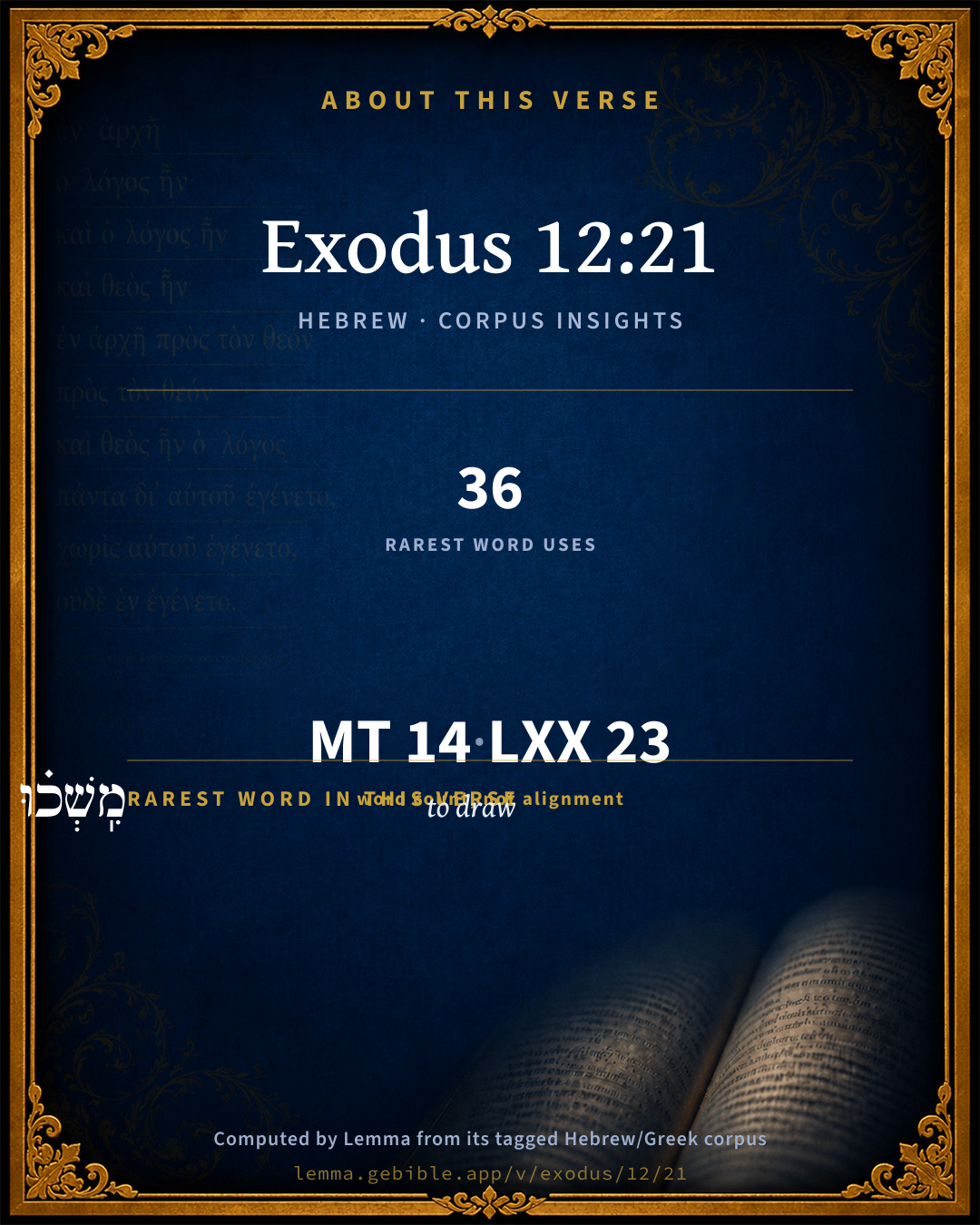
מִֽשְׁכ֗וּ to draw H4900 occurs in 36 verses of the Hebrew Bible. Also found in:

Grammatical profile

  • 5 verbs
  • 6 nouns
  • 1 adjective
  • 2 prepositions

Verb forms

  • וַיִּקְרָ֥א Qal · Sequential Imperfect
  • וַיֹּ֣אמֶר Qal · Sequential Imperfect
  • מִֽשְׁכ֗וּ Qal · Imperative
  • וּקְח֨וּ Qal · Imperative
  • וְשַׁחֲט֥וּ Qal · Imperative

Hebrew & Septuagint length

In English translation the verse runs 26 words from the Hebrew and 31 from the Septuagint (LXX English) — closely comparable.

A rough comparison of the two English renderings, which tokenize alike — not a word-level alignment.

Word counts can differ between the Hebrew and the Greek without any difference in meaning — e.g. the Hebrew direct-object marker אֵת has no separate Greek word, and Greek often adds the article ὁ.

In the original languages it is 14 Hebrew tokens and 23 Greek tokens — but the two are counted differently (Hebrew bundles its prefixes and suffixes into one token; the Greek is in lemma form), so that isn’t a like-for-like length.

Cross-references

16

Topical passages linked to Exodus 12:21 in the Treasury of Scripture Knowledge — connected by theme and wording, ordered by reader-vote popularity; previews shown in the World English Bible.

  • Exodus 12:3 Speak to all the congregation of Israel, saying, 'On the tenth day of this month, they shall take to them every man a lamb, according to their fathers' houses, a lamb for a household;
  • Joshua 5:10 The children of Israel encamped in Gilgal; and they kept the Passover on the fourteenth day of the month at even in the plains of Jericho.
  • 2 Kings 23:21 The king commanded all the people, saying, Keep the Passover to Yahweh your God, as it is written in this book of the covenant.
  • Ezra 6:20 For the priests and the Levites had purified themselves together; all of them were pure: and they killed the Passover for all the children of the captivity, and for their brothers the priests, and for themselves.
  • Mark 14:12–16 On the first day of unleavened bread, when they sacrificed the Passover, his disciples asked him, "Where do you want us to go and make ready that you may eat the Passover?"
  • Numbers 9:2–5 "Moreover let the children of Israel keep the Passover in its appointed season.
  • Exodus 3:16 Go, and gather the elders of Israel together, and tell them, 'Yahweh, the God of your fathers, the God of Abraham, of Isaac, and of Jacob, has appeared to me, saying, "I have surely visited you, and seen that which is done to you in Egypt;
  • Exodus 12:11 This is how you shall eat it: with your loins girded, your shoes on your feet, and your staff in your hand; and you shall eat it in haste: it is Yahweh's Passover.
  • Exodus 17:5 Yahweh said to Moses, "Walk on before the people, and take the elders of Israel with you, and take the rod in your hand with which you struck the Nile, and go.
  • Exodus 19:7 Moses came and called for the elders of the people, and set before them all these words which Yahweh commanded him.
  • Numbers 11:16 Yahweh said to Moses, Gather to me seventy men of the elders of Israel, whom you know to be the elders of the people, and officers over them; and bring them to the tent of meeting, that they may stand there with you.
  • 2 Chronicles 30:15–17 Then they killed the Passover on the fourteenth [day] of the second month: and the priests and the Levites were ashamed, and sanctified themselves, and brought burnt offerings into the house of Yahweh.
  • 2 Chronicles 35:5–6 Stand in the holy place according to the divisions of the fathers' houses of your brothers the children of the people, and [let there be for each] a portion of a fathers' house of the Levites.
  • Luke 22:7–13 The day of unleavened bread came, on which the Passover must be sacrificed.
  • Matthew 26:17–19 Now on the first day of unleavened bread, the disciples came to Jesus, saying to him, "Where do you want us to prepare for you to eat the Passover?"
  • 1 Corinthians 10:4 and all drank the same spiritual drink. For they drank of a spiritual rock that followed them, and the rock was Christ.

Cross-references courtesy of OpenBible.info (CC BY 4.0).

Hebrew and Greek witnesses Masoretic Hebrew ↔ Greek Septuagint

The same verse in the two great witnesses to the Old Testament, shown verse-for-verse.

These are two independent witnesses, not word-aligned to each other, and the Septuagint is shown in lemma (dictionary) form.

Hebrew Exodus 12:21 Masoretic · Westminster Leningrad Codex

וַיִּקְרָ֥א מֹשֶׁ֛ה לְכָל זִקְנֵ֥י יִשְׂרָאֵ֖ל וַיֹּ֣אמֶר אֲלֵהֶ֑ם מִֽשְׁכ֗וּ וּקְח֨וּ לָכֶ֥ם צֹ֛אן לְמִשְׁפְּחֹתֵיכֶ֖ם וְשַׁחֲט֥וּ הַפָּֽסַח

Then Moses called for all the elders of Israel, and said to them, "Draw out, and take lambs according to your families, and kill the Passover.

World English Bible · Public Domain

Greek LXX Exodus 12:21 Septuagint · lemma form

καλέω δέ μωυσῆς πᾶς γερουσία υἱός ἰσραήλ καί εἶπον πρός αὐτός ἀποἔρχομαι λαμβάνω σύ ἑαυτοῦ πρόβατον κατά συγγένεια σύ καί θύω ὁ πασχα

And Moses called all the elders of the children of Israel, and said to them, Go away and take to yourselves a lamb according to your kindred, and kill the passover.

LXX2012 (modern English Septuagint) · Public Domain

On this verse, Lange's Commentary on the Holy Scriptures discusses the Septuagint’s reading. Read the note in Commentary ↓

Hebrew: Westminster Leningrad Codex (CC BY 4.0). Greek: Septuagint (public domain); English from LXX2012 (modern English Septuagint) (Public Domain). How the Septuagint differs from the Hebrew →

Targum (Aramaic paraphrase)

2

The Targum is the ancient Jewish Aramaic paraphrase of the Hebrew Scriptures — an interpretive translation, not the Hebrew text itself. Onkelos (literal) and Pseudo-Jonathan (expansive) render the Torah, and Jonathan the Prophets. Coverage is partial: where no permissively-licensed English translation exists for a verse, only the Aramaic is shown. This is verse-level text, not a word-by-word alignment to the Hebrew.

  1. Targum Onkelos Torah (Genesis–Deuteronomy)
    וּקְרָא משֶׁה לְכָל סָבֵי יִשְׂרָאֵל וַאֲמַר לְהוֹן אִתְנְגִידוּ וְסִיבוּ לְכוֹן (מִן בְּנֵי) עָנָא לְזַרְעֲיָתְכוֹן וְכוּסוּ פִסְחָא:

    (no public-domain English translation for this verse)

    Targum Onkelos — Aramaic: “Onkelos Genesis” (public domain); “Onkelos Exodus” (public domain); “Onkelos Leviticus” (public domain); “Onkelos Numbers” (public domain); “Onkelos Deuteronomy” (public domain). English: “Sefaria Community Translation” (CC0 1.0 (public-domain dedication)); “J.W. Etheridge. The Targums of Onkelos and Jonathan Ben Uzziel on the Pentateuch. London: Longmans, Green, 1862” (public domain). Text via Sefaria.

  2. Targum Pseudo-Jonathan Torah (Genesis–Deuteronomy)
    וּקְרָא משֶׁה לְכָל סָבֵי יִשְרָאֵל וַאֲמַר לְהוֹן נְגוּדוּ יְדֵיכוֹן מִטַּעֲוַות מִצְרָאֵי וּסְבוּ לְכוֹן מִן בְּנֵי עָנָא לְיִיחוּסֵיכוֹן וְכוּסוּ אִימַר פִּסְחָא

    And Mosheh called all the elders of Israel, and said to them, Withdraw your hands from the idols of the Mizraee, and take to you from the offspring of the flock, according to your houses, and kill the paschal lamb.

    Targum Pseudo-Jonathan — Aramaic: “Targum Jonathan on Genesis” (public domain); “Targum Jonathan on Exodus” (public domain); “Targum Jonathan on Leviticus” (public domain); “Targum Jonathan on Numbers” (public domain); “Targum Jonathan on Deuteronomy” (public domain). English: “The Targum of Jonathan ben Uzziel, trans. J. W. Etheridge, London, 1862” (public domain). Text via Sefaria.

Commentary

Notes on Exodus 12:21 from classic Christian and Jewish commentators (each source and its license shown beneath its notes). The classic Christian expositions comment on the surrounding passage and are grouped to its opening verse, so a note may address several verses; the Jewish commentaries on the Tanakh (Rashi and others) are per-verse, so they appear only where the commentator wrote on this verse.

Lemma curates 59 commentaries, every one of them public domain or Creative Commons licensed, each selected and text-cleaned for this edition rather than reprinted as found. About our sources →

Trapp's Complete Commentary

John Trapp

Exo 12:21 Then Moses called for all the elders of Israel, and said unto them, Draw out and take you a lamb according to your families, and kill the passover.

Ver. 21. All the elders of Israel.] The masters of families, who in this family service were to kill and eat, and set before the rest of the household, as priests at home; and to show them the meaning of that mystery.

John Trapp, A Commentary or Exposition upon All the Books of the Old and New Testament (1647–1656) — public domain. Text from a community e-Sword module.

The Biblical Illustrator

Joseph S. Exell

Exo_12:21-23

Strike the lintel and the two side posts with the blood.

Three great truths taught by the Passover

I. The universality of condemnation. Israelite and Egyptian are brought under one common charge of guilt, and there they all stand, condemned already.

II. The great truth of substitution. The lamb instead of the firstborn. Behold the Lamb of God, etc.

III. The third truth taught is appropriation. The Israelite would not have been safe if he had merely killed the lamb; he had to sprinkle its blood on the lintel and on the two side posts. When we repose our confidence in the Person of Christ, we have taken the bunch of hyssop and dipped it in the blood, and from that moment we are safe. (W. Hay Aitken, M. A.)

Christ, our Passover

I. The first thing is this, that salvation then and now is freedom from impending doom. Let us revive that essential idea of our most holy faith in all our hearts and minds. The times greatly need it. As there hung over Egypt that night the awful threat of Gods descending wrath, so let my soul and yours never forget there hangs over this city the threat of impending vengeance. And just because of that, a motive which worked that night upon the hearts of Israelites, and ought to work upon our hearts now, was, and should be, the element and moving principle of fear. Let me reassert this: let me iterate and reiterate it--that fear is a legitimate motive in salvation. Perhaps the Israelites on that occasion were immediately drawn by loving obedience to obey what God had spoken. If so, they were different from you and me. I rather think that while some temperaments would just quietly and unquestioningly yield whenever Moses declared the mind and heart of God, as to what was coming of doom, and as to how salvation was to be secured, others would question; others would be reluctant; others would be very like ourselves. But we do hope that, no matter how they felt rubbed the wrong way (if you will allow the familiar expression), they had sense enough, whether drawn by love or driven by fear, to sprinkle that blood and get in under its shelter in time, and stay there. Ah, yes, it is said to be unphilosophical, that if you do not draw men with love, you will never drive them by fear. Men are moved by fear every day. Why did you go and insure your house last week? Was it not through fear? Why did you insure your life last week, even though the doctor told you that there was nothing wrong with you? Was it not from fear? Grand men, large broad-brewed men, are men who are moved by fear. Methinks Noah was a grand, broad-brewed man, and Noah, moved by fear, prepared him an ark for the saving of his house. It was fear as well as love that clenched every bolt in it. So never go away and boast, my friend, that you have such a big intellect that fear will not move you. This is a real legitimate element in salvation. God works upon it. He plays upon that heart-string by His Word and by His Spirit. He did it then in that night in Egypt.

II. Now, I should like to say, further, re-stating some simple but essential elements of gospel revelation regarding sin and salvation, that salvation was of Gods devising. It was altogether a matter of revelation. Nothing was left to man but bare obedience of mind and hand and foot. Mark that I do not say that God spoke irrationally; I do not say that God simply came and overmastered them with despotic tyrannical power, but I do say that God came forth out of His secret place that memorable night, and Himself devised the plan of salvation. God Himself devised such a plan that no soul needed to be lost if that soul simply believed and obeyed. It was all of God, it was all of grace; so still.

III. I wish to say, further, that on this night of this divinely appointed salvation, when it was received and obeyed, there were one or two things which would surely strike the recipients, and those who were obedient to this heavenly revelation. Draw out a lamb, says Moses, speaking for God, draw out a lamb and kill it, and take its blood and sprinkle it on the lintel and on the two side posts. Every Israelitish father who killed the lamb, not simply with a knife and with his hand, but whose mind and heart were working behind the knife, must surely have had this thought borne upon him--If I am not to die, something is to die. Substitution. Oh, let me ring it out! For me, for me, yeas bound to ring in his ears with every gurgling of that lapping blood. That again is the heart of salvation, for you and for me. If I am to go free, this innocent thing has to part with its very lifes blood. By His stripes we are healed. Bless God for this substitutionary salvation. Then this salvation on that night in Egypt, and this night for you and me, was not only substitutionary, but another very simple idea I would like to revive in your hearts and minds, and it is this: it was after all a matter of simple obedience. Take the blood. It was not enough that it was sprinkled by every Israelitish father or head of a household who represented them all. Every Israelitish father had to take that bunch of hyssop and dip it in the blood, and strike it on the lintel and pass in, he and his household, just as he was told. And there is an element, therefore, in salvation that is illustrated there. What is faith? It is a simple literal bowing of the soul in abject obedience. And, again, it comes out, contrariwise, that the very essence of unbelief now is not a want of understanding, but a want of obedience. There is a moral taint in unbelief. Now, come away to another evening away down the stream of time for centuries; and again it is becoming dark, and there is a darkness deeper than the darkness of the darkening sky. The darkness and blackness of sin, and of all time, are gathering round about that hill called Calvary. Now, watch that Saviour Christ. See that innocent holy Man, holy as a lamb, without blemish and without spot. See the soldier as he thrusts that spear into His side, and out there come blood and water. And, remember this: there is the last blood that shall ever be shed for human sins. There remaineth no more sacrifice for sin, but a certain fearful looking for of judgment and fiery indignation that shall devour the adversaries. Take you a bunch of hyssop, and strike the lintel and the two side posts. God actually condescending to tell a man how to sprinkle the blood! He left no loop-hole by which a man might be lost if he wanted to be saved himself, and to save his wife and his children. If lost, you will be inexcusable. What was the hyssop? Well, so far as I can gather from Scripture, it was a very common plant. You remember that when the range of Solomons botanical knowledge is being indicated, it is said that Solomon spoke of trees from the hyssop that grows out of the wall to the cedar that is in Lebanon. What a poor salvation if God had said, Take a sprig of cedar. What an easy salvation it was when He said, Take a bunch of hyssop--that kind of coarse grass, I suppose, that would grow out of any dyke-back--just like the grass that grew out of the thatch of your mothers house away in the country long ago--a thing so simple; do you not see that everybody could get at it? Instinctively the fathers hand went for it, and used it. There is a something in the powers of your soul and mine that is common and handy, and is continually in use in this work-a-day life of ours. It is continually in use like the bunch of hyssop. And what is that? It is faith. Believe me, faith is as common as the hyssop that sprang out of the wall. With all the rack and ruin that sin has made it is here. Now, what you have to do is this. Take that faith, that confidence that you are exercising in brother-man and sister-woman every day--it is the very cement of society--society would tumble into chaos without it--take that faith of yours and give it a new direction. Give it an operation which it never had before. Believe in the Lord Jesus Christ, and thou shalt be saved. Faith is common, natural, reasonable, sublime. You put it to its highest power, its loftiest use, when it is turned to trust God in the word that He has spoken, and in the love that He has displayed on Calvary.

IV. And the last word I have to say is this-the last word in the text, take the bunch of hyssop, and dip it in the blood, and let none of you go out of the door of his house until the morning. I hear to-day, and so do you, about development, and growth; and what we hear about them gets wearisome, does it not? There was very little development that night. Let none of you go out of the door of his house until the morning. Go in, and stay in, if you would be saved. That is to say, there was to be no advance, and absolutely no development from the simplicity of faith. That which they had begun to do saved them only as they kept it up. Human nature is the same all the world over, whether you are in Egypt or in London; and I can imagine a young Israelite, a young fellow just like ourselves, full of flesh and blood, full of natural go and glow and enthusiasm, feeling it a little irksome as the evening wore on, and as the night darkened down; and feeling that it was rather an ignoble, inglorious position to be huddled in there like sheep, with that word over them, Let none of you go out of the door of his house until the morning. And to be saved in this simple way by the blood-red mark which they did not see, but which, being outside, could be seen by the Destroying Angel as He passed. And I should not wonder, as the Israelites and the Egyptians were not separated one from another, if the Egyptians were all round about the Israelites; and I should not wonder if some young Egyptians came round about these blood-streaked houses and cried, with scoffs and jokes, Come out! Come out! and laughed and said, What are you doing in there? There is no judgment. There was never such a fine night in Egypt. Come out! Come out! Was not that hard to bear? Is not that taunt in our ears yet--Come out, yon stupid believers! And I can imagine a young Israelite chafing and getting restless as the night wore on, and there came no sign of this doom, and no sign of this judgment; I can imagine him shaking himself, and saying, I will assert my manhood. This may do for the old people; and he is going over to the door, but his father rises, and with a voice like thunder says, Unhand that door! Back for your life! And he was right if he did. He was right. The Egyptians might laugh that night, and the young, restless, hot-headed Israelites might have a little trouble, but nobody laughed in the morning. And you and I, children of faith, believers in God and in Gods Christ who died for sin, just for a little while have to stand the laugh, and I admit that it is against our pride. By the grace of God, and in the obedience of faith, let me charge you, hold on, my brother, as you began. Let us keep together, we who belong to the household of faith. How that expression receives its illustration from this story. Let us keep together. Let us encourage ourselves to stay in doors until the morning. Some of you, God bless you, will not have long to wait. God bless all white and whitening heads in this assembly; you will not have long to wait. Now is the time of your salvation nearer than when you believed. For you the morning cometh. (J. McNeill.)

Anxiety in reference to salvation

There is among the Hebrews a legend of two sisters who that night had, with the rest of their household, gone into their dwellings. One of them stood all ready to depart, and began quietly eating her portion of the roast body of the lamb (a type of the soul feeding on Christ), her mind at perfect peace and rest. The other was walking about the dwelling, full of terrible fear lest the Destroying Angel should penetrate therein. This one reproached her sister for being so careless and confident, and finally asked her how it was that she could be so full of assurance when the angel of death and judgment was abroad in the land. The reply was, Why, sister, the blood has been sprinkled; and we have Gods word that when He sees the blood, He will pass over us. Now I have no right to doubt Gods word. I believe He will keep His word. If I were in doubt about the blood having been shed; or if I doubted either the integrity or ability of God in connection with His word, I should be uneasy. But, as I do not question the fact that the blood has been shed, and as I believe that God will be true to His word, I cannot but be at peace. They were both equally safe; but one was at peace, while the other was not. Or, as we should say now: one had assurance; and the other was full of doubts. But if the doubting one had believed what God said, she could not have been in distress. It is even so now. Those believers who make the finished work of Christ the ground of their hope, and are resting simply and sincerely on His Word, are at peace; while those who are trying to find peace in themselves, in their frames and feelings, are never at rest. It is the Blood of Jesus that makes us safe; it is the Word of God concerning blood that makes us sure. (J. Parker, D. D.)

The Biblical Illustrator, edited by Joseph S. Exell (c. 1880s–1900s) — public domain. Text from a community e-Sword module.

The Preacher's Complete Homiletical Commentary

Joseph S. Exell (gen. ed.)

MAIN HOMILETICS OF THE PARAGRAPH.—Exo_12:21-23

THE CELEBRATION OF THE PASSOVER

I. In this incident we have a clear recognition of the principle of vicarious suffering. The lamb was slain instead of the Israelites; the life of the former was taken instead of that of the latter. In this there was substitution. The death of the one secured the safety of the other. If the lamb had not been slain on behalf of the Israelites, and its blood not sprinkled on their door-posts, they must have perished by the stroke of the destroying angel. Hence in this incident we have the principle of vicarious suffering; and this principle extends all through the social life of men. It is seen in the birth of the infant, in the history of the family circle, in the events of everyday life, but supremely in the Cross of Christ. In the Cross of Christ it is seen in its highest embodiment, in its truest meaning, and in its most glorious possibility. There is the innocent dying for the guilty, the God-man suffering for the race. Sometimes this principle is denounced as unjust, but it is a habitual ordination of life, the inevitable outcome of our social and moral relationships. But as regards the Cross of Christ, the principle of substitution, as there manifested, is unique, and has no parallel in the history of men. It is not right for any man to die for another, because no man has a life of his own to give; it does not belong to himself, but to his country and to his family; but Christ, being Divine and from heaven, possessed a life inherently His own, and therefore could lay it down for mankind. Hence the sublime justice and mercy of the act, and the glory of the cross; of this instance of vicarious suffering the Paschal lamb was but a faint emblem.

II. In this incident we have a clear recognition of the need of falling in with all the requirements of the great scheme of salvation. The method whereby the Israelites were to be protected from the stroke of the destroying angel was Divinely originated, clearly revealed, and imperative in requirement. The Israelites would never have invented it themselves; such an idea would never have entered their minds. It was made known to them by Moses and Aaron, and that with due authority and proper emphasis. And by no other way could they have been saved. No doubt many of the Israelites would consider this a very peculiar method of deliverance; they would hardly be able to understand it; but they must obey or die. They may pursue some other course. They may stock the house with medicine ready for pestilence; but vain is their effort. They must obey the Divine command, and that to the very letter; for even if they kill the lamb and omit to sprinkle its blood upon the lintel of the door, they will perish in the coming doom. In all this we are clearly taught the necessity of falling in with all the requirements of the Divine method of human salvation. The sinner must be saved in God’s way, and not after his own. He may reason about the peculiarity of the method of salvation; he may think that other means will be more effective to the end desired; but if he at last is found out of the Divine way of safety, he will inevitably be lost. The blood of Christ sprinkled on the heart is the only sign the destroying angel will recognise, and regard as the token of safety.

III. In this incident we have a clear recognition of the fact that the Divine method of salvation will avert the most awful peril. By being obedient to the requirements of God, as made known by Moses, the Israelites were saved from the destruction that came upon all the first born of Egypt. Not one of the Israelites perished in the awful retribution. Hence we see that the method of God is effective to the salvation of men. And the way of human redemption by the Cross of Christ is effective to the moral safety of all who comply with its conditions. Not one soul has ever been lost that reposed its confidence in the atonement of the Saviour. The trustful soul shall not be hurt by the second death.

IV. In this incident we have a clear recognition of the fact that the efficacy of the Divine method of salvation should be associated with public religious ordinances. (Exo_12:24.) Thus the Israelites were to associate their safety through this great danger in after-years with their religious ordinances; in this way they would be reminded of their past condition; they would be grateful for their present circumstances, and hopeful of the future. Hence the deliverance wrought by God for the soul of man should be commemorated by public ordinances in the house of God.

V. In this incident we have a clear recognition of the fact that the good should be able to give an intelligent explanation of their moral safety. (Exo_12:27.) The Israelites would be able to explain the method of their deliverance from Egyptian bondage and from the stroke of the avenging angel; and so those who are safe through the redemption of Christ should be able and willing to explain and make known the rich mercy of God to them.

SUGGESTIVE COMMENTS ON THE VERSES

Exo_12:21. Faithfulness in God’s ministers binds them to present obedience and discharge of trust.

Men called of God to rule and teach the Church may call others to assist them.

Multitudes of souls cannot be informed of God’s rule without cause, order, and arrangement for their instruction.

Passover preparation and administration must be made by God’s rule.

Exo_12:22-23. Faith is the true bunch of hyssop to sprinkle souls with Passover blood.

Doors and posts are sprinkled only with regard to souls within.

Such as expect God’s salvation must keep in that place where God will give it.

God has His pass of vengeance as of mercy.

God’s eye is upon His covenant when obediently observed for good.

No destroyer can smite until God grant a commission to him.

Exo_12:24-25. God’s redeemed Israel are bound to observe His statutes.

All that God’s law requires must be returned to Him without failing in anything.

The ordinances of God are for all generations.

God’s performance is exact, according to the word that He has spoken.

God’s promise performed requires souls to observe the duty commanded.

Exo_12:26-27. God’s wisdom foreseeth the succeeding generations of His Church and provides for their instruction.

It is accounted meet by God that children should ask and receive instruction about His holy worship.

It is God’s mind that the children of the Church should from infancy be taught to serve God with intelligence.

Parents are bound to know the nature of God’s ordinances, and to teach their children.

The doctrine of sacraments must be declared, as well as the signs used, to make them true.

Not only worship, but the reason of it, must be known by all who will render God reasonable service.

THE NEED OF AN INTELLIGENT APPREHENSION OF THE SERVICE AND WORSHIP OF GOD

I. It is necessary in order to the true performance of religious service and worship. Merely going through the service of God is not worship. There can be no devotion without an intelligent understanding of the service performed; without this, it is superstition. Knowledge is an essential element in devotion, as men cannot be in the highest sense devotional unless they know what they are about, and the meaning of the service in which they are engaged. There are thousands in the sanctuary engaged in a worship they do not really and fully comprehend; they are too careless to inquire into, they are too slothful to study, the solemn truth and ordinances of God.

II. It is necessary in order to the true performance of parental duty and instruction. Children will ask questions; it is right they should, and careful attention will ever be paid to them by the true parent. They will ask questions about God and about His worship; the answers to these inquiries should be instructive and explanatory, and in order to this, parents must themselves be acquainted with the meaning of the Divine service and worship. In many instances such home instruction is neglected because of the sad ignorance of the parents concerning the things of God.

III. It is necessary in order to refute and silence the sceptical reasonings of men. There might in the future be those in Israel who would object to the reasonableness and necessity of the celebration of the Passover, and to silence these it would be necessary to have a thorough knowledge of the ordinance in its origin and meaning. Christian people ought to be able to explain and defend their service and worship. There would be much less infidelity in the land if Christian people were instructed as they ought to be in the ordinances of God.

Exo_12:28. God’s revelation of Himself in grace and ordinances deserves praise from His people.

Worship of God and obedience to Him are well coupled.

Despatch in obedience is very requisite to God’s Israel.

ILLUSTRATIONS

BY

REV. WM. ADAMSON

Sprinkling Symbolism! Exo_12:23. A most significant allusion to the figurative significance of the passover-blood occurs in the prophecies of Ezekiel (Ezekiel 9), where the man clothed with linen is directed to set a mark upon the foreheads of the godly to preserve them from destruction. The same symbolic reference and command occur in the Book of Revelation (Revelation 7), in regard to those who have been sealed as the servants of our God in their foreheads. As has been aptly remarked, Egypt was but a symbol—a glass, into which, if we steadfastly look, we shall see a greater tragedy enacting. We see the great drama of the apocalyps—not the valley of the Nile, with its pyramids and temples; but Europe, with its ten kingdoms and white Alps. We see, not Moses demanding the liberty of the Hebrew captives in the name of Jehovah; but the Reformation walking along the highway to the seven-hilled city, and requiring the liberation of Europe, as he stands on the marble threshold of the Vatican. We see not the ten successive plagues culminating in the slaughter of Pharaoh’s first-born; but the fearful judgments of God upon her ten vassal-states. And we see not Egypt’s first-born; but that crowning scene of terror—the last awful and nameless plague, prior to the Final Exodus of God’s Church, whose members are sealed with the “Blood of the lamb,” to secure them from the coming slaughter, and to ensure their entrance—

“Into the new Salem’s palace hall,

Their everlasting home.”

—Bonar.

Crisis-Emotions! Exo_12:21. The night before any decisive conflict is a solemn and anxious season. On the night before the battle of Ivry, says Hamilton, which was to decide whether Henry should lose his life, or gain his crown, as he eat pondering a map of the battle-field, the hair on one side of the king’s head turned grey. We know also how the commanders felt on the night which raised the siege of Leyden—on the night before Pharsalia, and on the eve of Blenheim of Waterloo. Moses has not told us how he left on the night before the Exodus; but he has given us some interesting glimpses of the scene, or rather the data for introducing it. Chief amongst the natural facts is that it was April, and the night of the full moon. The soft and silvery light fell on the white backs of the African mountains far away, and streamed almost perpendicularly on the mighty pyramids, which, like the spells of the old necromancers, invoke a host of spectres from the shadowy graves of the past,

“Far in whose realm withdrawn,

Old empires sit in sullenness and gloom,

And glorious ages gone,

Lie deep within the shadow of whose tomb.”

—Bryant.

Hyssop! Exo_12:22. When an eastern traveller Visited the city of Sidon, its French consul, who was an enthusiastic botanist, exhibited two varieties of hyssop, one of which he thought was the plant used by Israel. It was a very small green plant, like a moss which covers old walls in damp places. Another, called by the Arabs Z’atar, and having the iragrance of thyme, with a hot pungent taste, and long slender stems, looked more suitable for sprinkling the paschal blood on the lintels, &c. This also grows on garden walls, and is distinct from the hyssop of English druggists and herbalists—a neat, fragrant, labiate plant. It is not found growing on the walls of Palestine, but wild on barren and dry spots of land. Rosenmüller said that the true hyssop was in reality a marjoram—an aromatic plant with while flowers. But Dr. Boyle regards the caper-plant as the missing hyssop, which certainly is to be found in Lower Egypt, where Israel was, as well as on Mount Smai, and plentifully around the ruins of the Holy City. It is a trailing shrub with broad smooth leaves and white flowers, and hangs in festoons from rocks and walls. Perhaps it was employed not only to denote lowliness of spirit, but likewise to signify cleansing property, since from the time of Hippocrates, the caper-plant has been regarded as having cleansing properties useful in curing diseases closely allied to leprosy. Here, however, it implies humility. Each Israelite who grasped it with the hand of faith, as he sprinkled the doorposts of his house, seemed to say—

“Give me the lowest place; not that I dare

Ask for that lowest place, but Thou hast died.”

—Rossetti.

The Preacher's Complete Homiletical Commentary (gen. ed. Joseph S. Exell; Funk & Wagnalls, c. 1892) — public domain (pre-1929). A full-Bible homiletical/sermon-outline anthology covering 65 of 66 books (2 John is absent from the source module). Text from a community e-Sword module.

Lange's Commentary on the Holy Scriptures

C.—The institution of the first passover. The last plague. The release and the preparation for departure

Exo_12:21-36

21Then [And] Moses called for all the elders of Israel, and said unto them, Draw [Go] out,12 and take you a lamb [take you lambs] according to your families, and kill the passoExo Exo_12:22 And ye shall [And] take a bunch of hyssop, and dip it in the blood that is in the basin, and strike the lintel and the two side posts [two posts] with the blood that is in the basin; and none of you shall go out at the door of his 23house until the morning. For [And] Jehovah will pass through to smite the Egyptians; and when he seeth the blood upon the lintel and on the two side posts [two posts], Jehovah will pass over the door, and will not suffer the destroyer to come in unto [come into] your houses to smite you 24And ye shall observe this thing for [as] an ordinance to [for] thee and to [for] thy sons for eExo Exo_12:25 And it shall come to pass, when ye be [are] come to the land which Jehovah will give you, according as he hath promised, that ye shall keep this service. 26And it shall come to pass, when your children shall say unto you, What mean ye by this service? 27That ye shall say, It is the sacrifice of Jehovah’s passover [the passover of Jehovah], who passed over the houses of the children of Israel in Egypt, when he smote the Egyptians, and delivered our houses. And the people bowed the head [bowed down] and worshipped. 28And the children of Israel went away [went], and did 29[did so;] as Jehovah had commanded Moses and Aaron, so did they. And it came to pass that at midnight [at midnight that] Jehovah smote all the first-born in the land of Egypt, from the first-born of Pharaoh that sat on his throne unto the first-born of the captive that was in the dungeon; and all the first-born of cattle. 30And Pharaoh rose up in the night, he, and all his servants, and all the Egyptians; and there was a great cry in Egypt; for there was not a house where there was not one dead. 31And he called for Moses and Aaron by night, and said, Rise up, and get you forth from among my people, both ye and the children of Israel; and go, serve Jehovah, as ye have said. 32Also take your flocks and your herds, as ye have said, and be gone; and bless me also. 33And the Egyptians were urgent upon the people, that they might send them out of the land in haste; for they said, We be [are] all dead men. 34And the people took their dough before it was leavened, their kneading troughs being bound up in their clothes upon their shoulders. 35And the children of Israel did according to the word of Moses; and they borrowed [asked] of the Egyptians jewels [articles] of 36silver, and jewels [articles] of gold, and raiment. And Jehovah gave the people favor in the sight of the Egyptians, so that [and] they lent unto them such things as they required [they gave unto them]: and they spoiled [despoiled] the Egyptians.

TEXTUAL AND GRAMMATICAL

[Exo_12:21. “Draw out,” as the rendering of מִשְׁכוּ, is acquiesced in by Lange, De Wette, “Wordsworth, Murphy, and Canon Cook (in the Speaker’s Commentary), and is defended by Kalisch and Bush. The latter, in a note on Jdg_4:6, affirms that מָשַךְ never means “to approach.” He assigns to it there the meaning “to draft,” or “enlist,” sc. soldiers for his army—a meaning which certainly is no where else (therefore not “frequently,” as Bush says) to be found. That מָשַׁךְ may be used intransitively, Bush does not deny; and indeed in Jdg_20:37 he himself follows the rendering “drew themselves along,” and explains it as descriptive of a mass of men “stretching themselves out in a long train and rapidly urging their way to the city.” This certainly is not far from the meaning which he denies to the word. What significance could be attached to the phrase “draw out,” as here used of the paschal lamb, is not clear. Not “draw out,” in the sense of “pull out,”—a meaning which the word has in such cases as that of Jeremiah, who was drawn up with cords out of the dungeon, Jer_38:13. Not “draw out” in the sense of “draw by lot;” for the word no where has this meaning, and the lambs were not drawn by lot. It could mean only “take”—a meaning which, though assigned to it here by Kalisch, the word no where else has, and which, if it had it, would be the same as that of the following word. There is therefore little doubt that we are to understand the word, with the LXX., Vulg., Gesenius, Fürst, Bunsen, Arnheim, Alford, Keil, Knobel, and others, as used intransitively.—Tr.]

EXEGETICAL AND CRITICAL

The narrative evidently transports us to the 14th day of Nisan, the days of preparation being passed over.

Exo_12:21. For this reason we do not translate מִשְׁכוּ intransitively, “go hence,” etc. The paschal lambs have been for four days in a special enclosure; now they are to be drawn out, seized and slaughtered. Hence also the injunction proceeds at once to the further directions concerning the transaction.

Exo_12:22. A bunch of hyssop.—A handful, says Maimonides. Hyssop “designates probably not the plant which we call hyssop, not the hyssopus officinalis, it being doubtful whether this is found in Syria and Arabia (vid. Ritter, Erdkunde, XVII., p. 686), but a species of the origanum similar to the hyssop” (Keil).—That is in the basin—i.e., in which the blood was caught. None of you shall go out.—They are protected only in the house, behind the propitiatory blood.

Exo_12:23. The destroyer to come in—Comp. the ὀλοθρεύων of Heb_11:28 with 2Sa_24:16; Isa_37:36. So Keil and others, whereas Knobel and others take מַשְׁחִית as abstract=destruction. Knobel’s reasons (p. 105) are easily refuted; e.g., though Jehovah Himself goes through Egypt, yet it does not thence follow that He might not make use of an angel of judgment in the judicial inflictions (to be understood symbolically, vid. Psa_78:49); He Himself, however, distinguishes between His people and the Egyptians.

Exo_12:24-26. The establishment of the Passover festival is again enjoined, and at the same time there is connected with it an injunction to instruct children concerning it. The Israelitish child will not unthinkingly practice a dead worship; he will ask: What does it mean? And the Israelitish fathers must not suppress the questions of the growing mind, but answer them, and thus begin the spiritualizing of the paschal rite.

Exo_12:27. Worshipped.—Expression of faith, allegiance, joy, and gratitude.

Exo_12:28. Brief reference to the festive meal of faith in contrast with the dreadful judgment now beginning. At midnight.—According to Keil, we have no occasion here to look for any natural force as underlying the punishment, but to regard it as a purely supernatural operation of divine omnipotence, inasmuch as here the pestilence is not named, as in 2Sa_24:15. Also (he says) Jehovah administers the last plague without Moses’ mediation. But here too Moses’ prophetic prediction has a place; and also the teleological design of the facts. And this was the main feature of all these punitive miracles, provided we do not conceive Moses’ rod as having itself wrought them. According to Knobel, the miracle consisted in the pestilence “which from the oldest time to the present day has had its chief seat in Egypt.” He gives a series of examples, p. 106. Also statements concerning the season in which the pestilence is accustomed to appear in Egypt: December, February, March. “It is most destructive from March to May.” “Quite in accordance with the facts, the series of plagues ends with the pestilence, which generally lasts till the Nile inundation.” “The pestilence spares many region, e.g., the deserts (Pruner, p. 419).” On the death of the cattle: “According to Hartmann (Erdbeschreibung) von Afrika, I., p. 68), the dogs in Cairo almost constantly have the pestilence; and when it rages among them, it ceases to prevail among men.” According to Knobel, the occurrence was expanded by legendary tradition into a miracle. But miraculous are: (1) The prediction of the fact, its object, and its results; (2) the sudden spread of the plague over the younger generation, the first-born, especially the first-born of the king, being singled out; (3) the fact that both beasts and men suffered; (4) the liberation of Israel. That the religious expression of this great event has its peculiarity, that it makes generalizations, and leaves out subordinate features in accordance with its idealizing tendency and symbolic design—on this point one must shape his views by means of a thorough hermeneutical apprehension of the religious style. Even Keil cannot quite adopt the assumption of Cornelius a Lapide, that in many houses grandfathers, fathers, sons, and wives, in case they were all first-born, were killed. But literally understood, the narrative warrants this. But the perfect realization of the object aimed at lifts the event above the character of a legend.

Exo_12:30-31. The great lamentation which in the night of terror resounds through Egypt becomes the immediate motive for releasing Israel. And he called for Moses.—We need not, with Calvin, lay any stress on the fact that Pharaoh, Exo_10:28, had commanded the men not to show themselves again to him, as if a humiliating inconsistency of the tyrant with himself were not characteristic, and as if in the history of despotism it were not a frequent feature. This crushing humiliation Pharaoh could not escape. Moses and Aaron had to receive the permission from his own month. And we cannot call it mere permission. He drives him out by a mandate which boars unmistakable marks of excitement. Serve Jehovah, as ye have said.—These words involve the promise of complete liberation, and at the same time the intention to require the Israelites to return. As ye have said—he repeats—and finally he even begs for their intercession: “bless me also.” According to Keil, every thing, even the request for their blessing, looks to a manifest and quite unconditional dismissal and emancipation. But this thought is expressed more positively in the behavior of the Egyptians, who were the most terrified.”

Exo_12:33. At all events the Israelites had a right to understand the dismission as an emancipation, although formally this right was not complete until Pharaoh hostilely pursued them. Keil refers to Exo_14:4-5. The report brought to the king, that the people had fled, seems, however, to imply that in the mind of the Egyptians there had been no thought of unconditional emancipation, but only of an unconditional furlough. And when Pharaoh was disposed violently to take back even this promise, that was a new instance of hardness of heart, the last and the fatal one. We are all dead men: as it were, already dead. Expression of the greatest consternation.

Exo_12:34. And the people took their dough, before it was leavened. That is (according to Keil): “The Israelites intended to leaven the dough, because the command to eat unleavened bread for seven days had not yet been made known to them.” But the text evidently means to say just the opposite of this: they carried, in accordance with the command, dough which was entirely free from leaven. They had already put enough for seven days into the baking-pans, and carried these on their shoulders, wrapped up in their outer garments, or rather in wrapping cloths, such as might be used for mantles or wallets.

Exo_12:35-36. Vid. Exo_3:21 and Comm. on Genesis, p. 83.

Footnotes:

[12][Exo_12:21. “Draw out,” as the rendering of מִשְׁכוּ, is acquiesced in by Lange, De Wette, “Wordsworth, Murphy, and Canon Cook (in the Speaker’s Commentary), and is defended by Kalisch and Bush. The latter, in a note on Jdg_4:6, affirms that מָשַךְ never means “to approach.” He assigns to it there the meaning “to draft,” or “enlist,” sc. soldiers for his army—a meaning which certainly is no where else (therefore not “frequently,” as Bush says) to be found. That מָשַׁךְ may be used intransitively, Bush does not deny; and indeed in Jdg_20:37 he himself follows the rendering “drew themselves along,” and explains it as descriptive of a mass of men “stretching themselves out in a long train and rapidly urging their way to the city.” This certainly is not far from the meaning which he denies to the word. What significance could be attached to the phrase “draw out,” as here used of the paschal lamb, is not clear. Not “draw out,” in the sense of “pull out,”—a meaning which the word has in such cases as that of Jeremiah, who was drawn up with cords out of the dungeon, Jer_38:13. Not “draw out” in the sense of “draw by lot;” for the word no where has this meaning, and the lambs were not drawn by lot. It could mean only “take”—a meaning which, though assigned to it here by Kalisch, the word no where else has, and which, if it had it, would be the same as that of the following word. There is therefore little doubt that we are to understand the word, with the LXX., Vulg., Gesenius, Fürst, Bunsen, Arnheim, Alford, Keil, Knobel, and others, as used intransitively.—Tr.]

Lange's Commentary on the Holy Scriptures (Critical, Doctrinal, and Homiletical), ed. John Peter Lange, English translation edited by Philip Schaff (1864–1880) — public domain. Text from a community e-Sword module.

Matthew Henry's Commentary

I. Moses is here, as a faithful steward in God's house, teaching the children of Israel to observe all things which God had commanded him; and no doubt he gave the instructions as largely as he received them, though they are not so largely recorded. It is here added,

1. That this night, when the first-born were to be destroyed, no Israelite must stir out of doors till morning, that is, till towards morning, when they would be called to march out of Egypt, Exo 12:22. Not but that the destroying angel could have known an Israelite from an Egyptian in the street; but God would intimate to them that their safety was owing to the blood of sprinkling; if they put themselves from under the protection of that, it was at their peril. Those whom God has marked for himself must not mingle with evil doers: see Isa 26:20, Isa 26:21. They must not go out of the doors, lest they should straggle and be out of the way when they should be summoned to depart: they must stay within, to wait for the salvation of the Lord, and it is good to do so.

2. That hereafter they should carefully teach their children the meaning of this service, Exo 12:26, Exo 12:27. Observe,

(1.) The question which the children would ask concerning this solemnity (which they would soon take notice of in the family): "What mean you by this service? What is he meaning of all this care and exactness about eating this lamb, and this unleavened bread, more than about common food? Why such a difference between this meal and other meals?" Note, [1.] It is a good thing to see children inquisitive about the things of God; it is to be hoped that those who are careful to ask for the way will find it. Christ himself, when a child, heard and asked questions, Luk 2:46. [2.] It concerns us all rightly to understand the meaning of those holy ordinances wherein we worship God, what is the nature and what the end of them, what is signified and what intended, what is the duty expected from us in them and what are the advantages to be expected by us. Every ordinance has a meaning; some ordinances, as sacraments, have not their meaning so plain and obvious as others have; therefore we are concerned to search, that we may not offer the blind for sacrifice, but may do a reasonable service. If either we are ignorant of, or mistake about, the meaning of holy ordinances, we can neither please God nor profit ourselves.

(2.) The answer which the parents were to return to this question (Exo 12:27): You shall say, It is the sacrifice of the Lord's passover, that is, "By the killing and sacrificing of this lamb, we keep in remembrance the work of wonder and grace which God did for our fathers, when," [1.] "To make way for our deliverance out of bondage, he slew the firstborn of the Egyptians, so compelling them to sign our discharge;" and, [2.] "Though there were with us, even with us, sins against the Lord our God, for which the destroying angel, when he was abroad doing execution, might justly have destroyed our first-born too, yet God graciously appointed and accepted the family-sacrifice of a lamb, instead of the first-born, as, of old, the ram instead of Isaac, and in every house where the lamb was slain the first-born were saved." The repetition of this solemnity in the return of every year was designed, First, To look backward as a memorial, that in it they might remember what great things God had done for them and their fathers. The word pesach signifies a leap, or transition; it is a passing over; for the destroying angel passed over the houses of the Israelites, and did not destroy their first-born. When God brings utter ruin upon his people he says, I will not pass by them any more (Amo 7:8; Amo 8:2), intimating how often he had passed by them, as now when the destroying angel passed over their houses. Note, 1. Distinguishing mercies lay under peculiar obligations. When a thousand fall at our side, and ten thousand at our right hand, and yet we are preserved, and have our lives given us for a prey, this should greatly affect us, Psa 91:7. In war or pestilence, if the arrow of death have passed by us, passed over us, hit the next to us and just missed us, we must not say it was by chance that we were preserved but by the special providence of our God. 2. Old mercies to ourselves, or to our fathers, must not be forgotten, but be had in everlasting remembrance, that God may be praised, our faith in him encouraged, and our hearts enlarged in his service. Secondly, It was designed to look forward as an earnest of the great sacrifice of the Lamb of God in the fulness of time, instead of us and our first-born. We were obnoxious to the sword of the destroying angel, but Christ our passover was sacrificed for us, his death was our life, and thus he was the Lamb slain from the foundation of the world, from the foundation of the Jewish church: Moses kept the passover by faith in Christ, for Christ was the end of the law for righteousness.

II. The people received these instructions with reverence and ready obedience. 1. They bowed the head and worshipped (Exo 12:27): they hereby signified their submission to this institution as a law, and their thankfulness for it as a favour and privilege. Note, When God gives law to us, we must give honour to him; when he speaks, we must bow our heads and worship. 2. They went away and did as they were commanded, Exo 12:23. Here was none of that discontent and murmuring among them which we read of, Exo 5:20, Exo 5:21. The plagues of Egypt had done them good, and raised their expectations of a glorious deliverance, which before they despaired of; and now they went forth to meet it in the way appointed. Note, The perfecting of God's mercies to us must be waited for in a humble observance of his institutions.

Matthew Henry's Commentary on the Whole Bible (1708–1710) — public domain (CC PDM 1.0). Text via the HelloAO Bible API.

Jamieson, Fausset & Brown

Robert Jamieson, A. R. Fausset & David Brown

Then Moses called for all the elders of Israel, &c.--Here are given special directions for the observance.

Jamieson, Fausset & Brown — Commentary Critical and Explanatory on the Whole Bible (1871) — public domain (CC PDM 1.0). Text via the HelloAO Bible API.

Adam Clarke's Commentary

Verse 21. Kill the passover.] That is, the lamb, which was called the paschal or passover lamb. The animal that was to be sacrificed on this occasion got the name of the institution itself: thus the word covenant is often put for the sacrifice offered in making the covenant; so the rock was Christ, 1Co 10:4; bread and wine the body and blood of Christ, Mr 14:22; Mr 14:24. St. Paul copies the expression, 1Co 5:7: Christ our passover (that is, our paschal lamb) is sacrificed for us.

Adam Clarke's Commentary on the Bible (1810–1826) — public domain. Text from a community e-Sword/MySword module.

Ellicott's Commentary for English Readers

THE FIRST PASSOVER KEPT.

(21) Moses called for all the elders.—He had been directed to “speak unto all the congregation” (Exo_12:3), but understood the direction as allowing him to do so mediately, through the elders.

Draw out.—Some understand this intransitively—“Withdraw, and take,” i.e., go, and take; others transitively—“Withdraw a lamb from the flock.”

According to your families—i.e., with reference to the number of your families, but not necessarily one for each. (See Exo_12:4.)

A Bible Commentary for English Readers, edited by Charles John Ellicott (1878–1897) — public domain. Text from a community e-Sword module.

The Cambridge Bible for Schools and Colleges

gen. ed. J. J. S. Perowne

21. Draw out] viz. out of the folds. The intrans. sense Move along (RVm. ‘Go forth’ is much too free), viz. (Di.) to your several homes, to get the lambs, found in Jdg_4:6; Jdg_5:14 (perhaps), Jdg_20:37, Job_21:33, is here scarcely suitable.

lambs] Marg. Or, kids. See on v. 3.

according to your families] If the writer were the same as in vv. 1–13, it is hardly likely that he would represent Moses, when communicating his instructions to the people, as taking no notice of the particulars on which such stress is laid in vv. 4–6.

the passover] See on v. 12. The word is introduced here as if the institution were already well known.

The Cambridge Bible for Schools and Colleges (gen. ed. J. J. S. Perowne; Cambridge University Press, 1878–1918) — public domain. Text from a community e-Sword module.

John Gill's Exposition

Then Moses called for all the elders of Israel,.... Not in age but in office, who were either heads of families, or at least principal men in the tribes; which explains in what manner he was to speak to the congregation of Israel, and convey to them the will of God concerning the observation of these feasts, Exo 12:3,

and said unto them, draw out; a lamb or a kid, out of the flocks on the tenth day of the month, and keep it up until the fourteenth, as in Exo 12:3.

and take you a lamb, according to your families; or "take ye of the flock" (r), whether a lamb or a kid; a lamb for every family, if there was a sufficient number in it to eat it up; if not, two or more families were to join and keep the feast together:

and kill the passover; the lamb for the passover, which was to be done on the fourteenth day of the month; and before the priesthood was established in the family of Aaron, and before the Israelites were possessed of the land of Canaan, and the temple was built at Jerusalem, the passover was killed by the heads of families, and in their own houses, but afterwards it was killed only by the priests, and at Jerusalem and in the temple there, see Deu 16:5.

(r) "de filiis gregis", Onk. & Jon.

John Gill's Exposition of the Whole Bible (1746–1763) — public domain (CC PDM 1.0). Text via the HelloAO Bible API.

Albert Barnes' Notes on the Bible

Draw out - i. e. draw the lamb from the fold and then take it to the house.

The passover - The word is here applied to the lamb; an important fact, marking the lamb as the sign and pledge of the exemption of the Israelites.

Albert Barnes' Notes on the Bible (1834–1885) — public domain. Text from a community e-Sword/MySword module.

Whedon's Commentary on the Bible

Daniel D. Whedon

21. Now follows the fulfilment of Jehovah’s command by Moses.

Draw out and take — Withdraw; go forth to your homes, and make ready the passover: so Septuagint, Vulgate, Arabic, Keil, Knobel. But Gesenius, De Wette, and others interpret choose out, or lay hold of.

Daniel D. Whedon (gen. ed.), Commentary on the Old and New Testaments (1874–1909) — public domain. Text from a community e-Sword module.

The Pulpit Commentary

Ver. 21-28. THE FIRST PASSOVER. Having received the Divine directions as to the new rite, if not with all the fulness ultimately given them, yet with sufficient fulness for the immediate purpose, Moses proceeded to communicate the Divine Will to the people under his protection. Having already aroused the jealousy and hatred of Pharaoh, he could not summon a general assembly of the people, but he ventured to call a meeting of the elders, or heads of principal families, and through them communicated the orders which he had received to the entire nation. We find, in the directions which he gave, two small points which are not comprised in the record of God"s words to him.

1. The designation of the "hyssop," as the instrument, by which the bloodwas to be placed on the side-posts and lintel (ver. 22); and,

2. The injunction not to quit the house "until the morning." These pointsmay have been contained in the original directions, though omitted from the record for brevity; or they may have been added by Moses of his own authority. On the other hand, several very main points of the original directions are not repeated in the injunctions given to the elders, though there can be no doubt that they were communicated.

Draw outi.e. , "Withdraw from the flock." (See ver. 3.) A lamb. The word used is generic, and would not exclude the offering of a goat.

HOMILIES BY J. ORR

Vers. 21-29. Christ our Passover.

The Passover was an eminent type of Christ. It was probably to it the Baptist referred when he said, "Behold the Lamb of God, which taketh away the sin of the world". (Joh_1:29) Paul gives a decisive utterance on the question in the words: "Christ our passover is sacrificed for us". (1Co_5:7)

I POINTS OF ANALOGY BETWEEN THE TRUE PASSOVER AND ITS TYPE.

1. In both the death of a blameless victim. The lamb, physically blameless (ver. 5); Christ, morally faultless. A sinful world needs a sinless Saviour. It has one in Christ. The sinlessness of Christ, a moral miracle. Proofs of this sinlessness.

(1) Christ asserts his own freedom from sin. (Joh_8:29-46 Joh_14:30)

(2) In no part of his conduct does he betray the least consciousness of guilt. Yet it is admitted that Jesus possessed the finest moral insight of any man who has ever lived.

(3) His apostles, one and all, believed him to be sinless. (Heb_4:15 1Pe_2:22; 1Jn_3:5)

(4) His enemies could find no fault in him. (Mat_26:60 Mat_27:23, Mat_27:24)

(5) The very traitor confessed the innocence of Christ. (Mat_27:4)

(6) The delineation of his character in the gospels bears out the averment of his moral blamelessness.

(7) The captious efforts which have been made, by fixing on a few paltry points in the gospel narratives to impeach Christ"s sinlessness, indirectly prove it. "As if sin could ever need to be made out against a real sinner in this small way of special pleading; or as if it were ever the way of sin to err in single particles, or homoeopathic quantities of wrong" (Bushnell).

2. In both, the design is to secure redemption from a dreadful evil. In the one case, from the wrath of God revealed against Egypt in the smiting of its first-born. In the other, from the yet more terrible wrath of God revealed against all ungodliness and unrighteousness of men. (Rom_1:18) "Jesus, which delivered us from the wrath to come". (1Th_1:10) "Saved from wrath through him". (Rom_5:9)

3. In both, the principle of the deliverance is that of vicarious sacrifice. The lamb was substituted for the first-born. It protected the house, on whose door-posts the blood was sprinkled, from the stroke of the avenger. The substitutionary character of the death of Christ is, in like manner, affirmed in innumerable Scriptures. Jesus "died for the ungodly". (Rom_5:6) He "suffered for sins, the just for the unjust". (1Pe_3:18) He gave "his life a ransom for many". (Mat_19:28) His blood is a propitiation. (Rom_3:25) There is just ground for the remark of Coleridge (we quote from memory) that a man who would deal with the language of his father"s will, as Unitarians on this and other points do with the language of the New Testament, would be liable to an action at law.

4. In both, there was need for an act of personal, appropriating faith. "The people bowed the head, and worshipped. And the children of Israel went away, and did as the Lord had commanded "(vers. 27, 28). "Through faith (they) kept the passover, and the sprinkling of blood," etc. (Heb_11:28) Their faith showed itself in sprinkling the blood on their door-posts and lintels, and in sheltering themselves under it. Nothing short of this would have availed to save them. So it is not knowledge about Christ, but faith in him; personal application to his blood, and trust in it as the means of salvation, which secures our safety. Faith is the bunch of hyssop.

5. In both, the slain lamb becomes the food of the new life. There was, on the part of the Israelites, a sacrificial feast upon the flesh of the lamb. This denoted, indeed, peace and fellowship with God, but it was also an act of nourishment. Similarly, under the Gospel, the new life is nourished by feeding upon Christ. We make him ours by inward appropriation and assimilation, and so are spiritually nourished for all holy service. (cf. Joh 6) Minor typical features might be insisted upon (male of the first year, roast with fire, not a bone broken, unleavened bread, hitter herbs of contrition, etc.), but the above are the broad and outstanding ones.

II THE SURPASSING EXCELLENCE OF THE TRUE PASSOVER. It belongs to the nature of a type that it should be surpassed by the antitype. The type is taken from a lower sphere than the thing which it represents. So completely, in the case of the passover, does the reality rise above the type, that when we begin to reflect on it the sense of likeness is all but swallowed up in the sense of disproportion. How great,

1. The contrast in the redemptions. The redemption from Egypt, though spiritual elements were involved in it, was primarily a redemption from the power of Pharaoh, and from a temporal judgment about to fall on Egypt. Underlying it, there was the need for a yet greater redemption a redemption from the curse of a broken law, and from the tyranny of sin and Satan; from death spiritual, temporal, and eternal. It is this higher redemption which Christ has achieved, altering, through his death, the whole relation of God to man, and of (believing)man to God.

2. The contrast in the victims. That, an irrational lamb; this, the Eternal Son of God in human nature, the Lord"s own Christ.

3. The contrast in the efficacy of the blood. The blood of the passover lamb had no inherent virtue to take away sin. Whatever virtue it possessed arose from God"s appointment, or from its typical relation to the sacrifice of Christ. Its imperfection as a sacrifice was seen

1. In the multitude of the victims.

2. In the repetition of the service. (Heb_10:1-3)

But what the flowing of the blood of millions of lambs, year by year slain in atonement for sin could not achieve, Christ has achieved once for all by the offering up of his holy body and soul. The dignity of his person, the greatness of his love, his holy will, the spirit of perfect self-sacrifice in which he, himself sinless, offered himself up to bear the curse of sin for the unholy, confers upon his oblation an exhaustless meritoriousness. Its worth and sufficiency are infinite. (Heb_10:10-15 1Pe_1:19; 1Jn_2:2)

4. The contrast in the specific blessings obtained. The difference in these springs from the contrast in the redemptions. Israel obtained

(1) Escape from judgment.

(2) Outward liberty.

(3) Guidance, care, and instruction in the desert.

(4) Ultimately, an earthly inheritance.

We receive, through Christ,

(1) Pardon of all sins.

(2) A complete justifying righteousness, carrying with it the title to eternal life.

(3) Renewal and sanctification by the Spirit.

(4) Every needed temporal and spiritual blessing in life.

(5) Heaven at the close, with triumph over death, the hope of a resurrection, and of final perfecting in glory. J.O.

Vers. 21-28. Israel and the sacrifice for sin.

I CHRIST SLAIN BY US. The lamb"s blood was not only shed for them, but also by them. The crucifying of Jesus by the Jews, the revelation of what lies in every unrenewed heart. "They shall look upon him whom they have pierced.

II WHAT IS NEEDFUL FOR SALVATION.

1. Appropriating faith. It was the blood applied with their own hands to thedoor of the dwelling that saved those within. It is not enough that the blood be shed. Is it upon our gates? Have we set it by faith between us and destruction?

2. It must be applied as God directs us. It was sprinkled on the lintel anddoorposts not within, but without. It is not enough that we believe. We must make open profession of our faith.

3. We must abide within until the day dawn and salvation come. To putthat blood (which should be between us and the world) behind us, no longer to hide within it but to forget it, is to renounce salvation. Are we without or within the blood-stained gateway? We are saved if we hold the beginning of our confidence steadfast unto the end.

III GOD"S COVENANT GIVES PERFECT SECURITY (ver. 25). The shed blood stands between us and death. The awe and joy of redeemed Israel, a faint emblem of the awe and joy which we shall feel, who shall see the judgment of sin but only from afar.

IV THE DUTY OF THE REDEEMED.

1. Perpetual remembrance (ver. 23). We must, in the ordinance of Christ"sown appointment, shew his death till he come.

2. The handing down the knowledge of salvation (vers. 26, 27). Christiansshould glory in the story of the Cross.

The Pulpit Commentary (1880–1919), ed. H.D.M. Spence-Jones & Joseph S. Exell — public domain. Text from a community e-Sword module.

Kretzmann's Popular Commentary

Paul E. Kretzmann

The People Accept the Ordinances

v. 21. Then Moses called for all the elders of Israel and said unto them, as the representatives of the children of Israel who transmitted the will of God to them, Draw out, select, take out from the flock, and take you a lamb according to your families, and kill the Passover; for the name of the festival was applied to the lamb or kid as the chief sacrifice.

v. 22. And ye shall take a bunch of hyssop, a plant to which cleansing properties were ascribed, and dip it in the blood that is in the basin, which was caught when the animal was slaughtered, and strike the lintel and the two side-posts with the blood that is in the basin, thus applying the blood as a paint. And none of you shall go out at the door of his house until the morning, as a measure of safety, for they were protected only inside the house, behind the blood of sacrifice.

v. 23. For the Lord will pass through to smite the Egyptians; and when He seeth the blood upon the lintel and on the two side-posts, the Lord will pass over the door, and will not suffer the destroyer to come in unto your houses to smite you. With the blood on their door, destruction would not strike them, not because the blood in itself had such extraordinary powers, but because it was the type of the perfect, holy blood of propitiation, that of Christ.

v. 24. And ye shall observe this thing for an ordinance to thee and to thy sons forever. This precept concerning the Passover in its essential features was to be a fixed rule in their midst in their new home, an observance to be transmitted from generation to generation.

v. 25. And it shall come to pass, when ye be come to the land which the Lord will give you, according as He hath promised, that ye shall keep this service.

v. 26. And it shall come to pass, when your children shall say unto you, What mean ye by this service?

v. 27. that ye shall say, It is the sacrifice of the Lord’s Passover, who passed over the houses of the children of Israel in Egypt when He smote the Egyptians and delivered our houses. Note that religious observances should not be performed in a mechanical manner, but with a proper understanding of their origin and their meaning. And the people bowed the head and worshiped. They accepted the words of the Lord in grateful adoration.

v. 28. And the children of Israel went away, and did as the Lord had commanded Moses and Aaron, so did they. This section is of more than usual interest to us Christians, because the Passover Iamb is a type of Jesus Christ, the Lamb of God. Christ was a true man, born of the Virgin Mary. But He was, at the same time, holy, harmless, undefiled, separate from sinners, and made higher than the heavens. He is the Lamb which was sacrificed for the deliverance of all mankind. The blood of Jesus Christ protects us against wrath, against death and destruction; it reconciles us with God, it makes us members of His Church. This Lamb we should eat, we should receive Christ into our hearts as our Redeemer, therefore also purge out the old leaven, and be His own in sincerity and truth. Thus we obtain strength for our pathway through the wilderness of this world to the true Canaan above.

Paul E. Kretzmann, Popular Commentary of the Bible (1921–1924) — public domain. Text from a community e-Sword module.

unfoldingWord translationNotes

Door43 World Missions Community

summoned

officially called

hyssop

a woody plant with small leaves that can be used for sprinkling liquids

the top of the doorframe and the two doorposts

"on the sides and top of the way into the house." See how you translated a similar phrase in Exodus 12:7.

translationWords

elder

lamb

goat

Passover

blood

doorpost

unfoldingWord translationNotes — © Distant Shores Media and the Door43 World Missions Community, licensed CC BY-SA 4.0. Source: git.door43.org/Door43/en_tn.

Rashi

Rabbi Shlomo Yitzchaki (Rashi)

משכו DRAW OUT — He who has sheep let him draw one out from his own,

וקחו OR TAKE, and he who has no sheep let him purchase one in the market (Mekhilta).

למשפחתיכם [A LAMB] ACCORDING TO YOUR FAMILIES — this corresponds to שה לבית אבות a lamb for the house of their fathers in verse 3.

Rashi on the Tanakh — English translations: “The Judaica Press complete Tanach with Rashi, translated by A. J. Rosenberg” (CC BY 4.0); “Pentateuch with Rashi's commentary by M. Rosenbaum and A.M. Silbermann, 1929-1934” (public domain); “The Metsudah Tanach series, Lakewood, N.J” (CC BY 4.0); and “The Book of Joshua, Metsudah Publications, 1997” (CC BY 4.0). Text via Sefaria.

Ramban (Nachmanides)

Rabbi Moshe ben Nachman (Ramban / Nachmanides)

THEN MOSES CALLED FOR ALL THE ELDERS OF ISRAEL, AND SAID UNTO THEM: DRAW OUT, AND TAKE YOU LAMBS ACCORDING TO YOUR FAMILIES AND SLAUGHTER THE PASSOVER. This chapter shortens the account of how the laws which G-d had commanded Moses, as stated in the section above, [were communicated by him to Israel], as it is self-understood that Moses related all the laws to Israel in detail and taught them the matter involved, it being included in the verse, As the Eternal hath commanded Moses and Aaron, so did they. Instead, Scripture mentioned this section in a general way, saying that Moses called for all the elders of Israel and they gathered together to him all the people. Then they [the elders], etc.” said to the whole congregation of Israel, “Draw out the sheep from the flock to your homes, and keep it there from the tenth day of the month [till the fourteenth, when it is to be slaughtered as the Passover-offering].”It is possible that Scripture used the word, mishchu (draw out), because their sheep were very far from them in the land of Goshen, for every shepherd is an abomination unto the Egyptians. It said, and take you, meaning “take the lambs according to your families,” every man a lamb, according to their fathers’ houses, and slaughter the Passover lamb at eventide, all in accordance with what has been explained above concerning this commandment.Now we read in the Mechilta: “Then Moses called for all the elders of Israel. This teaches us that he constituted them a court. (the elders), “and zakein denotes only one who has acquired wisdom” (Kiddushin 32 b). See Ramban above, Verse 2, that “elders” are needed for the Sanctification of the New Moon, as mentioned in the section above, and hence Moses constituted them a court. And he said unto them. The word came from the mouth of Moses, saying it to all Israel., etc. These are the words of Rabbi Yashiya. Rabbi Yonathan says that the word came out from the mouth of Moses saying it to the elders, and the elders saying it to all Israel.” Thus according to Rabbi Yashiya, the expression, Then Moses called for all the elders of Israel, means that he told them to gather together to him all the people, [and he himself told the people all the laws of the Passover mentioned above], as I have explained. But according to the opinion of Rabbi Yonathan, the elders related it to the assembly. Accordingly, the verse stating, Speak ye unto all the congregation of Israel, refers [not to Moses and Aaron mentioned in the two verses there above, but] to the elders that were assembled before [Moses and Aaron, and they — the elders — spoke to the congregation], as is also the purport of the verse, Then it shall be, if it be done in error by ‘the eyes of the congregation,’ [which is a reference to the elders of the congregation, members of the Court].

This section adds an explanation to the putting of the blood [of the Passover-offering, mentioned above in Verse 7], i.e., that it be done with a bunch of hyssop and that it be dipped in the blood that is in the basin, which was not explicitly mentioned above but in a general way, And they shall take of the blood, etc. It teaches us that every undefined “taking” prescribed in the Torah must be with “a bunch,” (Numbers 19:6) it means a bunch of cedar-wood and hyssop tied with scarlet (Parah 3:10). and that all “taking” of the blood [prescribed in the Torah] must be in a vessel, (Leviticus 4:5), it means of the blood that is in the vessel. as our Rabbis have explained. [Moses] put it in basins (further, 24:6).And He further explained to them in this section, and none of you shall go out of the door of his house until the morning, for on account of it they were commanded to put the blood [of the Passover-offering] upon the lintel so that they would be protected there, just as He said, and there shall be no plague upon you to destroy you. Now Rashi commented: “And none of you shall go out. This teaches us that once permission is given to the destroying angel, he does not discriminate between righteous and wicked, and night-time is the domain of the destroying messengers, as it is said, Thou makest darkness, and it is night, wherein all the beasts of the forest do creep forth.” I did not understand that which Rashi said, “and night-time is the domain of the destroying messengers, as it is said, … wherein all the beasts of the forest do creep forth.” Is a person forbidden on any night to go out of the door of his house until the morning, on the authority of this verse? Rather, Rashi should have said, “for on that night permission to destroy was given the angel of destruction, and therefore He warned them against it.” But the Rabbi [Rashi] did not find it correct to say so since the Holy One, blessed be He, in His Presence and in His glory, was the One who smote [the first-born]. This subject is taught in the Mechilta in another version: “And none of you shall go out of the door of his house until the morning. This teaches us that once permission is given to the destroying angel, he does not discriminate between righteous and wicked, as it is said, Come My people, enter into thy chambers … until the indignation be overpast. And it also says, Behold, I am against thee, and will draw forth My sword out of its sheath, and will cut off from thee the righteous and the wicked. And it further says, And it shall come to pass, while My glory passeth by, that I will put thee in a cleft of the rock. This is to teach you. This is to teach you….” that you are to come into a place only in the daytime (Genesis 1:4). and leave it only in the daytime. (Genesis 1:4). And thus you find that the patriarchs and the prophets observed this as a custom, as it is said: And Abraham rose early in the morning;, 22:3. And Jacob rose up early in the morning;, 28:18. And Moses rose up early in the morning; And Joshua rose up in the morning; And Samuel rose early to meet Saul in the morning. Now is it not a kal vachomer: If the patriarchs and the prophets, who went to carry out the will of Him by Whose word the world came into being, observed this as a custom, how much more should all other people observe it! And thus it says, Thou makest darkness, and it is night; The young lions roar after their prey; Thou givest it unto them, they gather it;, Verse 28. The sun ariseth, they slink away., Verse 22. From then on, Man goeth forth unto his work, and to his labor until the evening.”, Verse 23. Thus far extends [the quotation from] the Beraitha. The purport thereof is to state that Scripture warned the Israelites in Egypt not to go out of the door of their homes on that night because the Holy One, blessed be He, was passing through Egypt like a king who passes from one place to another and whose guardsmen go before him so that people should neither meet him nor see him. This is similar to that which is said, And the Eternal my G-d shall come, and all the holy ones with Thee; and also, And it shall come to pass, while My glory passeth by, that I will put thee in a cleft of the rock, i.e., to protect him [Moses] from the seraphim and the heavenly agencies. And since we find that once permission is given to the destroying angel he does not discriminate between righteous and wicked, therefore a person has no right to change from the customary way of the world and leave at night-time, since it is the time of the wild beasts when they go out for prey, and there is no way [for them] to distinguish between righteous and wicked.

Ramban (Nachmanides) on the Tanakh — English translation: “Commentary on the Torah by Ramban (Nachmanides). Translated and annotated by Charles B. Chavel. New York, Shilo Pub. House, 1971-1976” (CC BY 4.0). Text via Sefaria.

Lesson kit

Teaching starters — assembled from the data on this page, not authored interpretation. Every prompt links to the verse data it draws on. Edit before teaching.

Exodus, in the Pentateuch, opens this verse with 14 words (13 distinct Hebrew lemmas). Its most distinctive word is mâshak (“to draw”). A historical commentator’s framing appears above. Read the whole chapter for the surrounding context.

Discussion questions

  1. The word mâshak carries the sense “to draw.” How does it shape the verse?
  2. Genesis 37:28 shares the word «to draw» with this verse. How do the two illuminate each other?
  3. The translations on this page render this verse differently — a whole-verse word diff, not a word-by-word alignment. What might account for the different wordings?
  4. The verb «וַיִּקְרָ֥א» is Qal Sequential Imperfect. How does its form color the action?
  5. Reading how Trapp's Complete Commentary and The Biblical Illustrator read this verse, where do the two commentators agree and where do they part?

Things to notice

Reading settings

Reading text

Shown beneath each verse's original-language words.

Old Testament
Old Testament edition

Read the OT as the Masoretic Hebrew (MT) or the Greek Septuagint (LXX).

English shown for the Greek Septuagint (in the Hebrew ↔ Greek comparison).

Comparing translations? Open the Compare panel on any verse page to stack up to four side by side.