
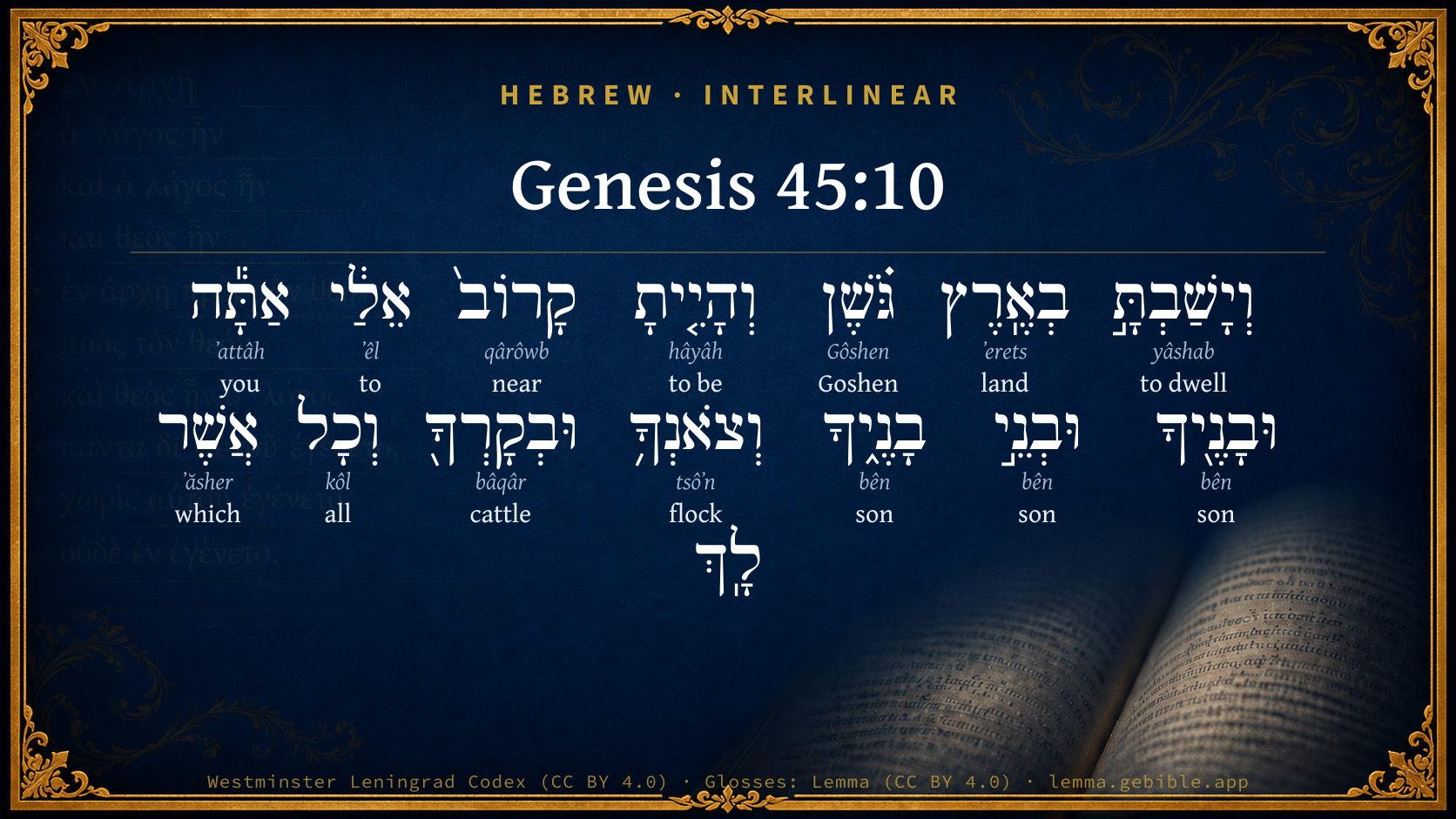
Genesis 45:10

Hebrew (Westminster Leningrad Codex) Genesis 45:10 appears in the Hebrew Old Testament. The text above is from the Westminster Leningrad Codex. Each word links to its Strong’s number, a concise gloss, and parsing drawn from the Open Scriptures Hebrew Bible morphology. Click any word for its full Brown-Driver-Briggs (BDB) entry.
Download image
Cite this verse

Genesis 45:10 (World English Bible). Public Domain. Lemma interlinear Bible study tool, https://lemma.gebible.app/v/genesis/45/10.

Show BibTeX & RIS
BibTeX
RIS
English Translation
You shall dwell in the land of Goshen, and you will be near to me, you, your children, your children's children, your flocks, your herds, and all that you have.
World English Bible · Public Domain
Highlights
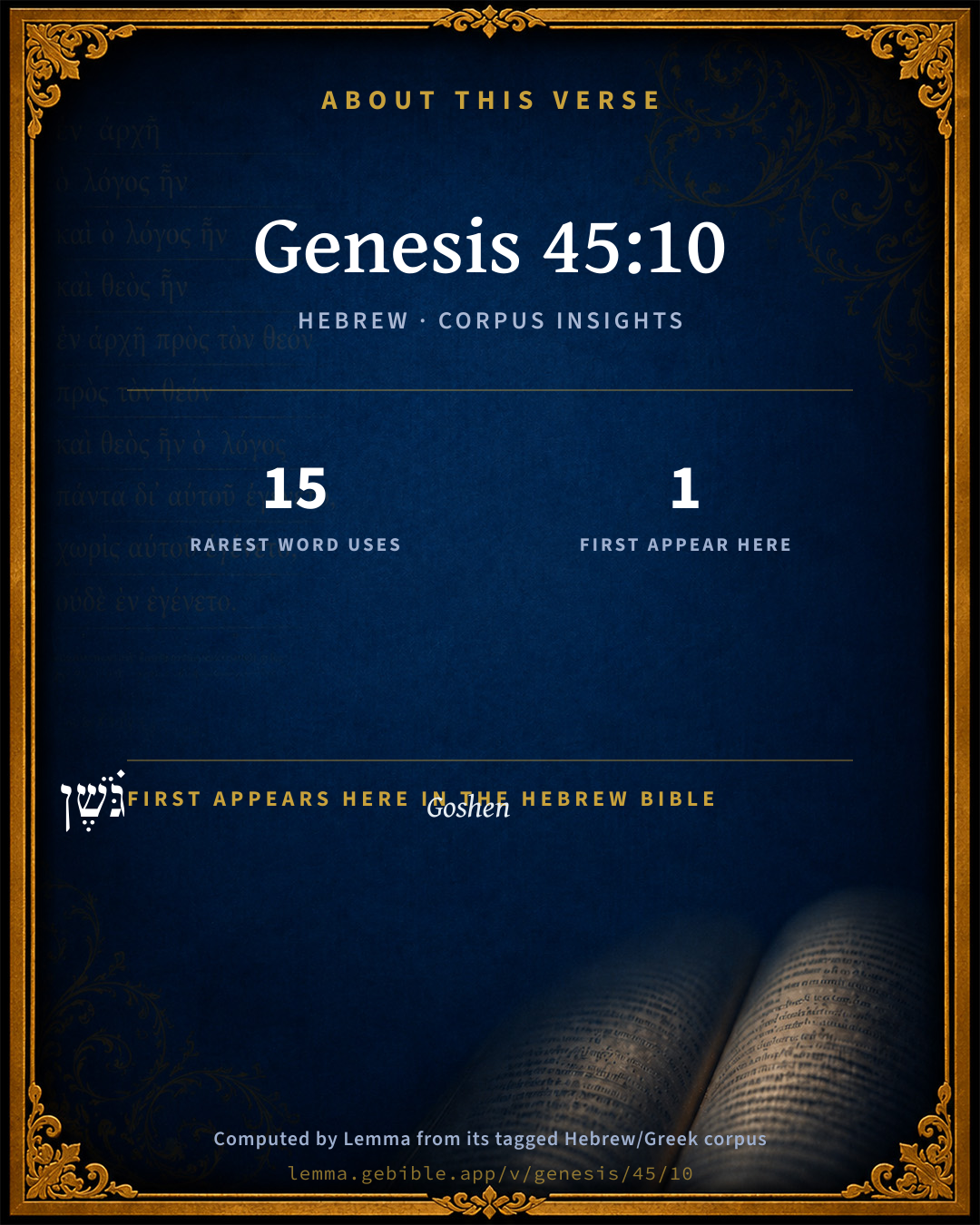
  • 1 first appearance in the Hebrew Bible
Full analysis ↓
Download a study sheet

One document with this verse’s original text, its word-by-word gloss line, the meaning frame, cross-references with their text, attributed commentary, and full source and license credits — printable, and it pastes into notes with its structure intact.

This verse Autodidact and up

Study sheet (.html) Plain text (.txt)

A passage Seminary Student

Up to 50 verses in one chapter. A passage sheet keeps up to 6 commentary sources and 12 cross-references per verse, in the order this page ranks them, and says so on the sheet whenever that leaves anything out. Ask for a single verse and you get the Autodidact verse sheet above.

Everything on this page stays free to read, with no account — the sheet is a download of what is already on screen, not access to it.

Want to remove ads? Support Godless Engineer
Compare translations 3

The same verse in 3 English versions, stacked beneath the original-language interlinear above. Click any original word for its lexicon entry.

Each is an independent rendering of the whole verse — the interlinear is not word-aligned to these translations.

Highlighted words mark where these versions differ — a whole-verse word diff, not a word-by-word alignment.

  • World English Bible Public Domain
    You shall dwell in the land of Goshen, and you will be near to me, you, your children, your children's children, your flocks, your herds, and all that you have.
  • King James Version Public Domain
    And thou shalt dwell in the land of Goshen, and thou shalt be near unto me, thou, and thy children, and thy children's children, and thy flocks, and thy herds, and all that thou hast:
  • unfoldingWord Literal Text CC BY-SA 4.0
    And you will live in the land of Goshen so that you will be near to me—you and your children and your children’s children and your flocks and your herds and all that to you.

unfoldingWord Literal Text — © unfoldingWord, licensed CC BY-SA 4.0. Word-aligned USFM3 via Door43 (git.door43.org/unfoldingWord/en_ult).

Versions to compare (up to 4)

3 of 4 selected

Show all 18 translations

Every available English version of this verse, each an independent rendering of the whole verse.

  • World English Bible Public Domain
    You shall dwell in the land of Goshen, and you will be near to me, you, your children, your children's children, your flocks, your herds, and all that you have.
  • Berean Standard Bible Public Domain
    You shall settle in the land of Goshen and be near me—you and your children and grandchildren, your flocks and herds, and everything you own.
  • Majority Standard Bible Public Domain
    You shall settle in the land of Goshen and be near me—you and your children and grandchildren, your flocks and herds, and everything you own.
  • King James Version Public Domain
    And thou shalt dwell in the land of Goshen, and thou shalt be near unto me, thou, and thy children, and thy children's children, and thy flocks, and thy herds, and all that thou hast:
  • American Standard Version (1901) Public Domain
    and thou shalt dwell in the land of Goshen, and thou shalt be near unto me, thou, and thy children, and thy children's children, and thy flocks, and thy herds, and all that thou hast:
  • Revised Version (1885) Public Domain
    and thou shalt dwell in the land of Goshen, and thou shalt be near unto me, thou, and thy children, and thy children’s children, and thy flocks, and thy herds, and all that thou hast:
  • Geneva Bible (1599) Public Domain
    And thou shalt dwel in ye land of Goshen, and shalt be neere me, thou and thy children, and thy childrens children, and thy sheepe, and thy beastes, and all that thou hast.
  • Douay-Rheims (1899) Public Domain
    And thou shalt dwell in the land of Gessen: and thou shalt be near me, thou and thy sons, and thy son's sons, thy sheep, and thy gerds, and all things that thou hast.
  • Young's Literal Translation Public Domain
    and thou hast dwelt in the land of Goshen, and been near unto me, thou and thy sons, and thy son's sons, and thy flock, and thy herd, and all that thou hast,
  • Literal Standard Version CC BY-SA 4.0
    and you have dwelt in the land of Goshen, and been near to me, you and your sons, and your son’s sons, and your flock, and your herd, and all that you have,
  • Unlocked Literal Bible CC BY-SA 4.0
    You will live in the land of Goshen, and you will be near me, you and your children and your children's children, and your flocks and your herds, and all that you have.
  • unfoldingWord Literal Text CC BY-SA 4.0
    And you will live in the land of Goshen so that you will be near to me—you and your children and your children’s children and your flocks and your herds and all that to you.
  • Darby Bible Public Domain
    And thou shalt dwell in the land of Goshen, and thou shalt be near to me, thou, and thy sons, and thy sons' sons, and thy sheep, and thy cattle, and all that thou hast.
  • World Messianic Bible Public Domain
    You shall dwell in the land of Goshen, and you will be near to me, you, your children, your children’s children, your flocks, your herds, and all that you have.
  • Webster's Bible Public Domain
    And thou shalt dwell in the land of Goshen, and thou shalt be near to me, thou, and thy children, and thy children's children, and thy flocks, and thy herds, and all that thou hast:
  • Free Bible Version CC BY-SA 4.0
    You'll live in the land of Goshen so you can be close to me with your children and grandchildren, and with your flocks and herds and everything that belongs to you.
  • Bible in Basic English Public Domain
    The land of Goshen will be your living-place, and you will be near me; you and your children and your children's children, and your flocks and herds and all you have:
  • JPS Tanakh (1917) Public Domain
    And thou shalt dwell in the land of Goshen, and thou shalt be near unto me, thou, and thy children, and thy children's children, and thy flocks, and thy herds, and all that thou hast;

Literal Standard Version (2020), Covenant Press — licensed CC BY-SA 4.0. Text via the HelloAO Bible API (eBible.org). Unlocked Literal Bible (unfoldingWord) — licensed CC BY-SA 4.0. Text via the HelloAO Bible API (eBible.org). unfoldingWord Literal Text — © unfoldingWord, licensed CC BY-SA 4.0. Word-aligned USFM3 via Door43 (git.door43.org/unfoldingWord/en_ult). Free Bible Version, Dr. Jonathan Gallagher — licensed CC BY-SA 4.0. Text via the HelloAO Bible API (eBible.org).

Word by word

More ways to search: Search by grammar → Find every occurrence → Compare this word →

Practice this passage: Drill this verse → Learn its vocabulary →

גֹּ֗שֶׁן
Gôshen
H1657
“Goshen”
Noun, Proper
Part of Speech
Noun
Type
Proper
Full BDB Definition

Origin: probably of Egyptian origin

TWOT: 390

Goshen = "drawing near" - a region in northern Egypt, east of the lower Nile, where the children of Israel lived from the time of Joseph to the time of Moses - a district in southern Palestine between Gaza and Gibeon - a town in the mountains of Judah probably in the district of Goshen
  1. וְיָשַׁבְתָּ֣ yâshab H3427 “and · to dwell” Conjunction + Verb, Qal, Sequential Perfect, 2nd Person, Masculine, Singular
  2. בְאֶֽרֶץ ʼerets H776 “in/at · land of” Preposition + Noun, Common, Both, Singular, Construct
  3. וְהָיִ֤יתָ hâyâh H1961 “and · to be” Conjunction + Verb, Qal, Sequential Perfect, 2nd Person, Masculine, Singular
  4. קָרוֹב֙ qârôwb H7138 “near” Adjective, Adjective, Masculine, Singular, Absolute
  5. אֵלַ֔י ʼêl H413 “to · me” Preposition + Suffix, Personal, 1st Person, Common, Singular
  6. אַתָּ֕ה ʼattâh H859 “you” Pronoun, Personal, 2nd Person, Masculine, Singular
  7. וּבָנֶ֖יךָ bên H1121 “and · sons · your” Conjunction + Noun, Common, Masculine, Plural, Construct + Suffix, Personal, 2nd Person, Masculine, Singular
  8. וּבְנֵ֣י bên H1121 “and · sons of” Conjunction + Noun, Common, Masculine, Plural, Construct
  9. בָנֶ֑יךָ bên H1121 “sons · your” Noun, Common, Masculine, Plural, Construct + Suffix, Personal, 2nd Person, Masculine, Singular
  10. וְצֹאנְךָ֥ tsôʼn H6629 “and · flock · your” Conjunction + Noun, Common, Both, Singular, Construct + Suffix, Personal, 2nd Person, Masculine, Singular
  11. וּבְקָרְךָ֖ bâqâr H1241 “and · cattle · your” Conjunction + Noun, Common, Both, Singular, Construct + Suffix, Personal, 2nd Person, Masculine, Singular
  12. וְכָל kôl H3605 “and · all of” Conjunction + Noun, Common, Masculine, Singular, Construct
  13. אֲשֶׁר ʼăsher H834 “which” Particle, Relative

About this verse

These counts appear in no published source. They are computed here, from the morphology-tagged text and Lemma’s own curated glosses. What Lemma adds →

15
words
12
distinct lemmas
Pentateuch
section

Notable vocabulary

The rarest word here is גֹּ֗שֶׁן Goshen H1657 — appearing just 15 times in the whole Hebrew Bible.

First appearance in Scripture

This word makes its first canonical appearance in the Hebrew Bible here:

  • גֹּ֗שֶׁן Goshen H1657

Shared distinctive vocabulary

גֹּ֗שֶׁן Goshen H1657 occurs in 14 verses of the Hebrew Bible. Also found in:

Grammatical profile

  • 2 verbs
  • 8 nouns
  • 1 adjective
  • 1 pronoun
  • 2 prepositions
  • 1 particle

Verb forms

  • וְיָשַׁבְתָּ֣ Qal · Sequential Perfect
  • וְהָיִ֤יתָ Qal · Sequential Perfect

Repetition

A word recurs within this verse — often emphatic in Hebrew:

  • וּבָנֶ֖יךָ son H1121 ×3

Hebrew & Septuagint length

In English translation the verse runs 30 words from the Hebrew and 35 from the Septuagint (LXX English) — closely comparable.

A rough comparison of the two English renderings, which tokenize alike — not a word-level alignment.

Word counts can differ between the Hebrew and the Greek without any difference in meaning — e.g. the Hebrew direct-object marker אֵת has no separate Greek word, and Greek often adds the article ὁ.

Cross-references

6

Topical passages linked to Genesis 45:10 in the Treasury of Scripture Knowledge — connected by theme and wording, ordered by reader-vote popularity; previews shown in the World English Bible.

  • Exodus 8:22 I will set apart in that day the land of Goshen, in which my people dwell, that no swarms of flies shall be there; to the end you may know that I am Yahweh in the midst of the earth.
  • Exodus 9:26 Only in the land of Goshen, where the children of Israel were, there was no hail.
  • Genesis 46:34–47:6 that you shall say, 'Your servants have been keepers of cattle from our youth even until now, both we, and our fathers:' that you may dwell in the land of Goshen; for every shepherd is an abomination to the Egyptians."
  • Genesis 46:28–29 He sent Judah before him to Joseph, to show the way before him to Goshen, and they came into the land of Goshen.
  • John 17:24 Father, I desire that they also whom you have given me be with me where I am, that they may see my glory, which you have given me, for you loved me before the foundation of the world.
  • John 14:2–3 In my Father's house are many mansions. If it weren't so, I would have told you. I am going to prepare a place for you.

Cross-references courtesy of OpenBible.info (CC BY 4.0).

Hebrew and Greek witnesses Masoretic Hebrew ↔ Greek Septuagint

The same verse in the two great witnesses to the Old Testament, shown verse-for-verse.

These are two independent witnesses, not word-aligned to each other, and the Septuagint is shown in lemma (dictionary) form.

Hebrew Genesis 45:10 Masoretic · Westminster Leningrad Codex

וְיָשַׁבְתָּ֣ בְאֶֽרֶץ גֹּ֗שֶׁן וְהָיִ֤יתָ קָרוֹב֙ אֵלַ֔י אַתָּ֕ה וּבָנֶ֖יךָ וּבְנֵ֣י בָנֶ֑יךָ וְצֹאנְךָ֥ וּבְקָרְךָ֖ וְכָל אֲשֶׁר לָֽךְ

You shall dwell in the land of Goshen, and you will be near to me, you, your children, your children's children, your flocks, your herds, and all that you have.

World English Bible · Public Domain

Greek LXX Genesis 45:10 Septuagint · lemma form

καί καταοἰκέω ἐν γῆ γεσεμ ἀραβία καί εἰμί ἐγγύς ἐγώ σύ καί ὁ υἱός σύ καί ὁ υἱός ὁ υἱός σύ ὁ πρόβατον σύ καί ὁ βοῦς σύ καί ὅσος σύ εἰμί

And you shall dwell in the land of Gesem of Arabia; and you shall be near me, you and your sons, and your sons' sons, your sheep and your oxen, and whatever things are your.

LXX2012 (modern English Septuagint) · Public Domain

On this verse, Ellicott's Commentary for English Readers discusses the Septuagint’s reading. Read the note in Commentary ↓

Hebrew: Westminster Leningrad Codex (CC BY 4.0). Greek: Septuagint (public domain); English from LXX2012 (modern English Septuagint) (Public Domain). How the Septuagint differs from the Hebrew →

Targum (Aramaic paraphrase)

2

The Targum is the ancient Jewish Aramaic paraphrase of the Hebrew Scriptures — an interpretive translation, not the Hebrew text itself. Onkelos (literal) and Pseudo-Jonathan (expansive) render the Torah, and Jonathan the Prophets. Coverage is partial: where no permissively-licensed English translation exists for a verse, only the Aramaic is shown. This is verse-level text, not a word-by-word alignment to the Hebrew.

  1. Targum Onkelos Torah (Genesis–Deuteronomy)
    וְתֵתֵב בְּאַרְעָא דְגשֶׁן וּתְהֵי קָרִיב לִי אַתְּ וּבְנָיךְ וּבְנֵי בְנָיךְ וְעָנָךְ וְתוֹרָךְ וְכָל דִּי לָךְ

    (no public-domain English translation for this verse)

    Targum Onkelos — Aramaic: “Onkelos Genesis” (public domain); “Onkelos Exodus” (public domain); “Onkelos Leviticus” (public domain); “Onkelos Numbers” (public domain); “Onkelos Deuteronomy” (public domain). English: “Sefaria Community Translation” (CC0 1.0 (public-domain dedication)); “J.W. Etheridge. The Targums of Onkelos and Jonathan Ben Uzziel on the Pentateuch. London: Longmans, Green, 1862” (public domain). Text via Sefaria.

  2. Targum Pseudo-Jonathan Torah (Genesis–Deuteronomy)
    וְתִתֵּיב בְּאַרְעָא דְגשֶׁן וּתְהֵי קָרִיב לְוָתִי אַנְתְּ וּבְנָךְ וּבְנֵי בְנָךְ וְעָנָךְ וְתוֹרָךְ וְכָל דִילָךְ

    and thou shalt dwell in the land of Goshen, and be near me, thou, and thy sons, and thy sons' children, thy sheep, thy oxen, and all that thou hast.

    Targum Pseudo-Jonathan — Aramaic: “Targum Jonathan on Genesis” (public domain); “Targum Jonathan on Exodus” (public domain); “Targum Jonathan on Leviticus” (public domain); “Targum Jonathan on Numbers” (public domain); “Targum Jonathan on Deuteronomy” (public domain). English: “The Targum of Jonathan ben Uzziel, trans. J. W. Etheridge, London, 1862” (public domain). Text via Sefaria.

Commentary

Notes on Genesis 45:10 from classic Christian and Jewish commentators (each source and its license shown beneath its notes). The classic Christian expositions comment on the surrounding passage and are grouped to its opening verse, so a note may address several verses; the Jewish commentaries on the Tanakh (Rashi and others) are per-verse, so they appear only where the commentator wrote on this verse.

Lemma curates 59 commentaries, every one of them public domain or Creative Commons licensed, each selected and text-cleaned for this edition rather than reprinted as found. About our sources →

Trapp's Complete Commentary

John Trapp

Gen 45:10 And thou shalt dwell in the land of Goshen, and thou shalt be near unto me, thou, and thy children, and thy children’s children, and thy flocks, and thy herds, and all that thou hast:

Ver. 10 Thou shalt be near unto me.] So sweet a comfort to friends, that death itself is called but a departure. This the heathen persecutors knew, and therefore banished the Christian confessors far asunder {a} One man may be by his counsel an angel to another; {Ezr 10:3} as Bradford was to Dr Taylor in prison. Communion with such is the "being bound up in the bundle of life," {1Sa 25:29} which was the blessing of Abigail upon David. St John trusted to come unto the elect lady, and "speak face to face, that their joy might be full." {2Jn 1:12} When one desired to see Alexander’s treasure, he bid one of his servants show him, not αργυριου ταλαντα, but τους φιλους; not his wealth, but his friends. {b} What an honour is that, that Christ should say to us, "Ye are my friends, if ye do whatsoever I command you!" {Joh 15:14} And should say to his Father, "Father, I will that they also, whom thou hast given me, be with me where I am; that they may behold my glory, which thou hast given me!" {Joh 17:24} What could Joseph say more for his father and brethren?

{a} Cyprian., Epist.

{b} Liban. Prog. Chris., i.

John Trapp, A Commentary or Exposition upon All the Books of the Old and New Testament (1647–1656) — public domain. Text from a community e-Sword module.

Joseph Benson's Commentary

Gen 45:10. Thou shalt dwell in the land of Goshen — A part of Egypt bordering upon Canaan, well watered and fit for cattle, and therefore most proper for the Israelites, not only for present use, and to keep them at some distance from the inward parts of Egypt and from the court; but also that they might have Canaan always in their eye and mind, and, in God’s time, might, with least disadvantage march thither.

Joseph Benson's Commentary on the Old and New Testaments (1811–1818) — public domain. Text from a community e-Sword module.

Tyndale Open Study Notes

Tyndale Open Resources

45:10 The region of Goshen was in the northeast corner of Egypt, only a few days’ walk from Canaan. Jacob’s family stayed there because there was food and water for themselves and their flocks; later, they were kept there by Egyptians who put them to slave labor.

Tyndale Open Study Notes — © Tyndale Open Resources, licensed CC BY-SA 4.0. Text via the HelloAO Bible API.

Adam Clarke's Commentary

Verse 10. Thou shalt dwell in the land of Goshen] Probably this district had been allotted to Joseph by the king of Egypt, else we can scarcely think he could have promised it so positively, without first obtaining Pharaoh's consent. Goshen was the most easterly province of Lower Egypt, not far from the Arabian Gulf, lying next to Canaan, (for Jacob went directly thither when he came into Egypt,) from whence it is supposed to have been about fourscore miles distant, though Hebron was distant from the Egyptian capital about three hundred miles. At Goshen Jacob stayed till Joseph visited him, Ge 46:28. It is also called the land of Rameses, Ge 47:11, from a city of that name, which was the metropolis of the country. Josephus, Antiq., 1. ii., c. 4, makes Heliopolis, the city of Joseph's father-in-law, the place of the Israelites' residence. As גשם geshem signifies rain in Hebrew, St. Jerome and some others have supposed that גשן Goshen comes from the same root, and that the land in question was called thus because it had rain, which was not the case with Egypt in general; and as it was on the confines of the Arabian Gulf, it is very probable that it was watered from heaven, and it might be owing to this circumstance that it was peculiarly fertile, for it is stated to be the best of the land of Egypt. See Ge 47:6; Ge 47:11. See also Calmet and Dodd.

Adam Clarke's Commentary on the Bible (1810–1826) — public domain. Text from a community e-Sword/MySword module.

Ellicott's Commentary for English Readers

(10) The land of Goshen.—This land, also called “the laud of Rameses” (Gen_47:11), probably from the city “Raamses,” which the Israelites were compelled to build there (Exo_1:11), was situated on the eastern bank of the Nile, and apparently commencing a little to the north of Memphis extended to the Mediterranean, and to the borders of the Philistines’ land (Exo_13:17). In Psa_78:12; Psa_78:43, it is called the “field of Zoan,” or Tanis. It probably was an unsettled district, but rich in pastures, and belonged in a very loose way to Egypt. In the LXX. it is called “Gesem of Arabia,” to which country both Herodotus and Strabo reckoned all the district on the east of the Nile towards the Isthmus of Suez as belonging. And here the Israelites were constantly joined by large numbers of Semitic immigrants, who were enrolled in their “tafs,” and swelled the rapidly increasing number of their dependants. For, as we have seen before, not merely the lineal descendants of Abraham were circumcised, but all his household and his slaves; and being thus admitted into the covenant became members of the Jewish church and nation (Gen_17:23).

A Bible Commentary for English Readers, edited by Charles John Ellicott (1878–1897) — public domain. Text from a community e-Sword module.

The Cambridge Bible for Schools and Colleges

gen. ed. J. J. S. Perowne

10. the land of Goshen] Goshen mentioned only in J, Gen_46:28-29; Gen_46:34; Gen_47:1; Gen_47:4; Gen_47:6; Gen_47:27; Gen_50:8; Exo_8:22; Exo_9:26. By this term seems to be understood a district corresponding to the present Wady-el-Tumilat, a stretch of low ground extending from the eastern arm of the Delta to the Valley of Suez and the Salt Lakes. To the north and south of this district the country was barren and desert. Its identification with “Goshen” was the result of the researches carried out by M. Naville. The region has become more familiar in modern times as the country of the brief campaign terminated by the battle of Tel el-Kebir (1882). LXX here and Gen_46:34 translates Goshen, Γέσεμ Ἀραβίας = “Gesem of Arabia.” “Arabia” was one of the 23 “nomes” into which the Delta was divided; and the capital of the “nome” Arabia, called Phakussa, has been conjecturally identified with the ancient locality, Kes, with the article pa prefixed.

near unto me] If Joseph lived at On (Gen_41:45) or at Memphis, Goshen would be near at hand.

The Cambridge Bible for Schools and Colleges (gen. ed. J. J. S. Perowne; Cambridge University Press, 1878–1918) — public domain. Text from a community e-Sword module.

John Gill's Exposition

And thou shall dwell in the land of Goshen,.... Called by Artapanus (t) Kaisan or Kessan; the Septuagint version Gesan of Arabia, as it was that part of Egypt which bordered on Arabia: it seems to be the same with the land of Rameses, see Gen 47:11; and the Heliopolitan home, which, Strabo (u) says, was reckoned to be in Arabia, and in which were both the city of Heliopolis and the city Heroopolis, according to Ptolemy (w); for in the Septuagint version of Gen 46:28, instead of Goshen is Heroopolis, or the city of the Heroes in the land of Rameses, with which agrees Josephus (x): wherefore Dr. Shaw (y) observes, the land of Rameses or Goshen could be no other than the Heliopolitan home, taking in that part of Arabia which lay bounded near Heliopolis by the Nile, and near Heroopolis by the correspondent part of the Red Sea. Now either before this time Joseph had got a grant of this country, of Pharaoh, to dispose of at pleasure, or he had so much power and authority of himself as to put his father into it: or it may be, it was the domains of his father in law the priest of On, since On or Onii, according to Ptolemy (z), was the metropolis of the Heliopolitan home, and by some thought to be Heliopolis itself, and perhaps might be Joseph's own country, which he had with the daughter of the priest of On: indeed if what the Jewish writers say (a), that Pharaoh, king of Egypt in Abraham's time, gave to Sarah the land of Goshen for an inheritance, and therefore the Israelites dwelt in it, because it was Sarah their "mother's"; it would account for Joseph's proposing to put them into the possession of it without the leave of Pharaoh; but Goshen seems to have been in the grant of Pharaoh, who agreed and confirmed what Joseph proposed, Gen 47:6,

and thou shalt be near unto me; as he would be in Goshen, if Memphis was the royal seat at this time, as some think (b), and not Tanis or Zoan; or Heliopolis, or both, in their turn; and Artapanus (c) is express for it, that Memphis was the seat of that king of Egypt, in whose court Moses was brought up; and especially Heliopolis, nay be thought to be so, if Joseph dwelt at On or Heliopolis, where his father in law was priest or prince, which was near if not in Goshen itself: and according to Bunting (d), On or Oni was the metropolis of Goshen; and Leo Africanus says (e), that the sahidic province, in which was Fium, where the Israelites dwelt, see Gen 47:11, was the seat of the nobility of the ancient Egyptians:

thou and thy children, and thy children's children: for Jacob's sons had all of them children, even Benjamin the youngest, as appears from the following chapter:

and thy flocks, and thy herds, and all that thou hast; and Goshen, being a place of pasturage, was fit and suitable for them; and so Josephus says (f), of Heliopolis, which he takes to be the place where Jacob was placed, that there the king's shepherds had their pastures.

(t) Apud Euseb. Praepar. Evangel. l. 9. c. 23. p. 27. (u) Geograph. l. 17. p. 555. (w) Geograph. l. 4. c. 5. (x) Antiqu. l. 2. c. 7. sect. 5. (y) Travels, 305, 306. Ed. 2. (z) Ut supra. (w)) (a) Pirke Eliezer, c. 26. (b) Dr. Shaw. ut supra, (y)) p. 304, &c. Jablonski de Terra Goshen, Dissert. 4. sect. 3, 4, 5. & Sicardus in ib. Dissert. 5. sect. 1. (c) Apud Euseb. Praepar. Evangel. l. 9. c. 23, 27. (d) Travels, &c. p. 76. (e) Descriptio Africae, l. 8. p. 669. (f) Ut supra, (x)) sect. 6.

John Gill's Exposition of the Whole Bible (1746–1763) — public domain (CC PDM 1.0). Text via the HelloAO Bible API.

Haydock's Catholic Bible Commentary

Gessen, to the north-east of Egypt, near me, at Tanis, in the Delta and near the promised land, being a part of Arabia. (Haydock) --- Heliopolis, where many suppose Joseph resided, is situated in the same canton, and was one of the chief cities after Ramesse, the capital, chap. xlvi. 28. This country is often refreshed by showers of rain, (Calmet) which never falls in most parts of Egypt. It is intersected by many canals, and is very rich and proper for pasturage. (Haydock)

George Leo Haydock (1774–1849), Haydock's Catholic Family Bible and Commentary, 1859 edition — public domain. Excludes Psalms (Douay-Rheims chapter numbering differs from Protestant) and Deuterocanonical books (Catholic canon only).

Matthew Poole's English Annotations

Goshen, a part of Egypt bordering upon Canaan, well watered and fit for cattle, and therefore most proper for the Israelites, not only for present use, and to keep them at some distance from the inward parts of Egypt, and from the court, but also that they might have Canaan always in their eye and mind, and in God’s time might with least disadvantage march thither. Joseph promiseth this place, either because it was least inhabited, being in the borders of the land, or because he justly presumed upon the king’s favour, and knew that the growing famine would give him opportunity to dispose of the people as he pleased.

Matthew Poole's English Annotations on the Holy Bible (1683–1685) — public domain. Text from a community e-Sword/MySword module.

Whedon's Commentary on the Bible

Daniel D. Whedon

10. Dwell in the land of Goshen — “Joseph invites his father to come and settle in Goshen, apparently before consulting Pharaoh upon the matter, trusting to his influence with the king to secure this favour. Goshen was on the north-eastern frontier of Egypt, bordering upon the desert, the part of the country nearest to Canaan, east of the Pelusiac branch of the Nile. It was well adapted to a pastoral people, being fertilized by artificial irrigation through canals from the Nile, and by wells from which the water is raised by wheels. The surface being less elevated than the rest of the land, it is more easily irrigated. There are here at present more flocks and herds, and also more fishermen, than in any other part of Egypt, so that at the present day, as in the time of Joseph, it is reckoned as ‘the best of the land.’ (ROBINSON’S Biblical Researches, 1:53).” — Newhall.

Daniel D. Whedon (gen. ed.), Commentary on the Old and New Testaments (1874–1909) — public domain. Text from a community e-Sword module.

Ramban (Nachmanides)

Rabbi Moshe ben Nachman (Ramban / Nachmanides)

AND THOU SHALT DWELL IN THE LAND OF GOSHEN. Joseph knew that his father would not want to stay in that part of the land of Egypt where the royal palace was. Therefore he now informed him that he will settle him in the land of Goshen. The meaning of the expression, Thou and thy children, is that it is connected with the previous verse: Come down unto me… thou and thy children, and thy children’s children, and thy flocks, and thy herds, and all that thou hast.

Ramban (Nachmanides) on the Tanakh — English translation: “Commentary on the Torah by Ramban (Nachmanides). Translated and annotated by Charles B. Chavel. New York, Shilo Pub. House, 1971-1976” (CC BY 4.0). Text via Sefaria.

Lesson kit

Teaching starters — assembled from the data on this page, not authored interpretation. Every prompt links to the verse data it draws on. Edit before teaching.

Genesis, in the Pentateuch, opens this verse with 15 words (12 distinct Hebrew lemmas). Its most distinctive word is Gôshen (“Goshen”). A historical commentator’s framing appears above. Read the whole chapter for the surrounding context.

Discussion questions

  1. How does “Goshen” (Gôshen) shape what this verse is saying?
  2. The word “Goshen” first appears here in Scripture. What is being introduced at this debut?
  3. Genesis 46:28 shares the word «Goshen» with this verse. How do the two illuminate each other?
  4. “son” occurs 3× in this one verse. What is the effect of the repetition?
  5. The translations on this page render this verse differently — a whole-verse word diff, not a word-by-word alignment. What might account for the different wordings?
  6. The verb «וְיָשַׁבְתָּ֣» is Qal Sequential Perfect. How does its form color the action?
  7. Reading how Trapp's Complete Commentary and Joseph Benson's Commentary read this verse, where do the two commentators agree and where do they part?

Things to notice

  • 1 word makes its first canonical appearance in Scripture here.
  • These translations choose different wording for 10 words in this verse.
  • “son” occurs 3× in this single verse.
  • 12 distinct Hebrew lemmas span 15 words in this verse.

Reading settings

Reading text

Shown beneath each verse's original-language words.

Old Testament
Old Testament edition

Read the OT as the Masoretic Hebrew (MT) or the Greek Septuagint (LXX).

English shown for the Greek Septuagint (in the Hebrew ↔ Greek comparison).

Comparing translations? Open the Compare panel on any verse page to stack up to four side by side.