
1 Chronicles 5:21

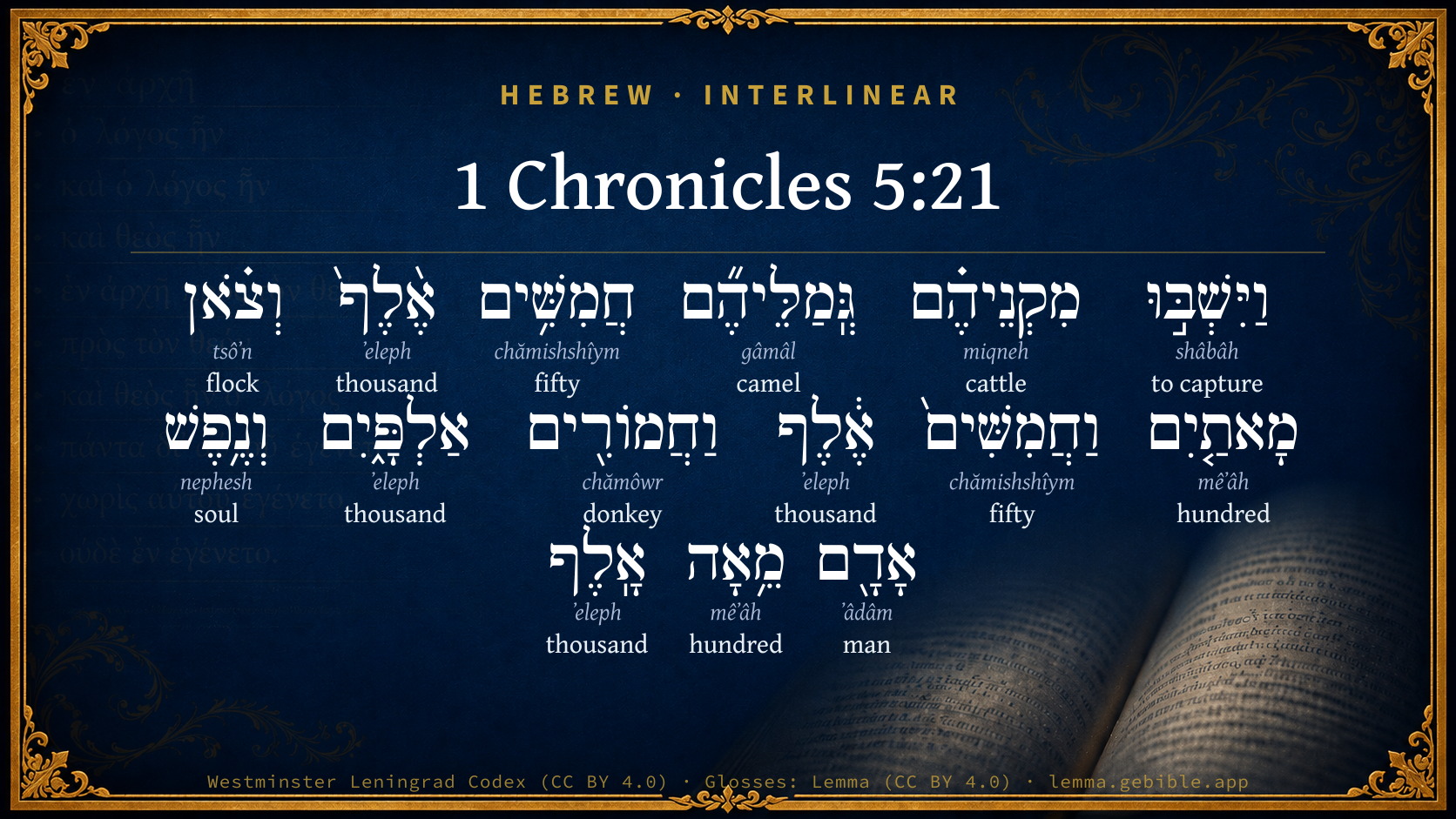
Hebrew (Westminster Leningrad Codex) 1 Chronicles 5:21 appears in the Hebrew Old Testament. The text above is from the Westminster Leningrad Codex. Each word links to its Strong’s number, a concise gloss, and parsing drawn from the Open Scriptures Hebrew Bible morphology. Click any word for its full Brown-Driver-Briggs (BDB) entry.
Download image
Cite this verse

1 Chronicles 5:21 (World English Bible). Public Domain. Lemma interlinear Bible study tool, https://lemma.gebible.app/v/1-chronicles/5/21.

Show BibTeX & RIS
BibTeX
RIS
English Translation
They took away their cattle; of their camels fifty thousand, and of sheep two hundred fifty thousand, and of donkeys two thousand, and of men one hundred thousand.
World English Bible · Public Domain
Download a study sheet

One document with this verse’s original text, its word-by-word gloss line, the meaning frame, cross-references with their text, attributed commentary, and full source and license credits — printable, and it pastes into notes with its structure intact.

This verse Autodidact and up

Study sheet (.html) Plain text (.txt)

A passage Seminary Student

Up to 50 verses in one chapter. A passage sheet keeps up to 6 commentary sources and 12 cross-references per verse, in the order this page ranks them, and says so on the sheet whenever that leaves anything out. Ask for a single verse and you get the Autodidact verse sheet above.

Everything on this page stays free to read, with no account — the sheet is a download of what is already on screen, not access to it.

Want to remove ads? Support Godless Engineer
Compare translations 3

The same verse in 3 English versions, stacked beneath the original-language interlinear above. Click any original word for its lexicon entry.

Each is an independent rendering of the whole verse — the interlinear is not word-aligned to these translations.

Highlighted words mark where these versions differ — a whole-verse word diff, not a word-by-word alignment.

  • World English Bible Public Domain
    They took away their cattle; of their camels fifty thousand, and of sheep two hundred fifty thousand, and of donkeys two thousand, and of men one hundred thousand.
  • King James Version Public Domain
    And they took away their cattle; of their camels fifty thousand, and of sheep two hundred and fifty thousand, and of asses two thousand, and of men an hundred thousand.
  • unfoldingWord Literal Text CC BY-SA 4.0
    And they captured their livestock: their camels, 50,000, and sheep, 250,000, and donkeys, 2,000, and soul of man, 100,000.

unfoldingWord Literal Text — © unfoldingWord, licensed CC BY-SA 4.0. Word-aligned USFM3 via Door43 (git.door43.org/unfoldingWord/en_ult).

Versions to compare (up to 4)

3 of 4 selected

Show all 18 translations

Every available English version of this verse, each an independent rendering of the whole verse.

  • World English Bible Public Domain
    They took away their cattle; of their camels fifty thousand, and of sheep two hundred fifty thousand, and of donkeys two thousand, and of men one hundred thousand.
  • Berean Standard Bible Public Domain
    They seized the livestock of the Hagrites—50,000 camels, 250,000 sheep, and 2,000 donkeys. They also took 100,000 captives,
  • Majority Standard Bible Public Domain
    They seized the livestock of the Hagrites—50,000 camels, 250,000 sheep, and 2,000 donkeys. They also took 100,000 captives,
  • King James Version Public Domain
    And they took away their cattle; of their camels fifty thousand, and of sheep two hundred and fifty thousand, and of asses two thousand, and of men an hundred thousand.
  • American Standard Version (1901) Public Domain
    And they took away their cattle; of their camels fifty thousand, and of sheep two hundred and fifty thousand, and of asses two thousand, and of men a hundred thousand.
  • Revised Version (1885) Public Domain
    And they took away their cattle; of their camels fifty thousand, and of sheep two hundred and fifty thousand, and of asses two thousand, and of men an hundred thousand.
  • Geneva Bible (1599) Public Domain
    And they led away their cattel, euen their camels fiftie thousand, and two hundreth, and fiftie thousand sheepe, and two thousand asses, and of persons an hundreth thousand.
  • Douay-Rheims (1899) Public Domain
    And they took all that they possessed, of camels fifty thousand, and of sheep two hundred and fifty thousand, and of asses two thousand, and of men a hundred thousand souls.
  • Young's Literal Translation Public Domain
    And they take captive their cattle, of their camels fifty thousand, and of sheep two hundred and fifty thousand, and of asses two thousand, and of human beings a hundred thousand;
  • Literal Standard Version CC BY-SA 4.0
    And they take their livestock captive—fifty thousand of their camels, and two hundred and fifty thousand sheep, and two thousand donkeys, and one hundred thousand of mankind;
  • Unlocked Literal Bible CC BY-SA 4.0
    They captured their animals, including fifty thousand camels, 250,000 sheep, two thousand donkeys, and 100,000 men.
  • unfoldingWord Literal Text CC BY-SA 4.0
    And they captured their livestock: their camels, 50,000, and sheep, 250,000, and donkeys, 2,000, and soul of man, 100,000.
  • Darby Bible Public Domain
    And they took away their cattle: their camels fifty thousand, and two hundred and fifty thousand sheep, and two thousand asses, and a hundred thousand human souls.
  • World Messianic Bible Public Domain
    They took away their livestock: of their camels fifty thousand, and of sheep two hundred fifty thousand, and of donkeys two thousand, and of men one hundred thousand.
  • Webster's Bible Public Domain
    And they took away their cattle; of their camels fifty thousand, and of sheep two hundred and fifty thousand, and of asses two thousand, and of men a hundred thousand.
  • Free Bible Version CC BY-SA 4.0
    They captured their enemies' livestock—fifty thousand camels, two hundred fifty thousand sheep, and two thousand donkeys. They also captured one hundred thousand people,
  • Bible in Basic English Public Domain
    And they took away their cattle: fifty thousand camels, two hundred and fifty thousand sheep, and two thousand asses, and a hundred thousand men.
  • JPS Tanakh (1917) Public Domain
    And they took away their cattle: of their camels fifty thousand, and of sheep two hundred and fifty thousand, and of asses two thousand; and of souls of men a hundred thousand.

Literal Standard Version (2020), Covenant Press — licensed CC BY-SA 4.0. Text via the HelloAO Bible API (eBible.org). Unlocked Literal Bible (unfoldingWord) — licensed CC BY-SA 4.0. Text via the HelloAO Bible API (eBible.org). unfoldingWord Literal Text — © unfoldingWord, licensed CC BY-SA 4.0. Word-aligned USFM3 via Door43 (git.door43.org/unfoldingWord/en_ult). Free Bible Version, Dr. Jonathan Gallagher — licensed CC BY-SA 4.0. Text via the HelloAO Bible API (eBible.org).

Word by word

More ways to search: Search by grammar → Find every occurrence → Compare this word →

Practice this passage: Drill this verse → Learn its vocabulary →

וַיִּשְׁבּ֣וּ
shâbâh
H7617
“and · to capture”
Conjunction + Verb, Qal, Sequential Imperfect, 3rd Person, Masculine, Plural
Part of Speech
Conjunction + Verb
Stem
Qal
Form
Sequential Imperfect
Person
3rd Person
Gender
Masculine
Number
Plural
Full BDB Definition

Origin: a primitive root

TWOT: 2311

to take captive - (Qal) - to take captive - captive (participle) - to lead captive - (Niphal) to be taken captive
  1. מִקְנֵיהֶ֗ם miqneh H4735 “cattle · their” Noun, Common, Masculine, Singular, Construct + Suffix, Personal, 3rd Person, Masculine, Plural
  2. גְּֽמַלֵּיהֶ֞ם gâmâl H1581 “camels · their” Noun, Common, Masculine, Plural, Construct + Suffix, Personal, 3rd Person, Masculine, Plural
  3. חֲמִשִּׁ֥ים chămishshîym H2572 “fifty” Adjective, Cardinal number, Both, Plural, Absolute
  4. אֶ֨לֶף֙ ʼeleph H505 “thousand” Adjective, Cardinal number, Both, Singular, Absolute
  5. וְצֹ֗אן tsôʼn H6629 “and · flock” Conjunction + Noun, Common, Both, Singular, Absolute
  6. מָאתַ֤יִם mêʼâh H3967 “hundred” Adjective, Cardinal number, Both, Dual, Absolute
  7. וַחֲמִשִּׁים֙ chămishshîym H2572 “and · fifty” Conjunction + Adjective, Cardinal number, Both, Plural, Absolute
  8. אֶ֔לֶף ʼeleph H505 “thousand” Adjective, Cardinal number, Both, Singular, Absolute
  9. וַחֲמוֹרִ֖ים chămôwr H2543 “and · donkeys” Conjunction + Noun, Common, Both, Plural, Absolute
  10. אַלְפָּ֑יִם ʼeleph H505 “thousand” Adjective, Cardinal number, Both, Plural, Absolute
  11. וְנֶ֥פֶשׁ nephesh H5315 “and · soul of” Conjunction + Noun, Common, Both, Singular, Construct
  12. אָדָ֖ם ʼâdâm H120 “man” Noun, Common, Masculine, Singular, Absolute
  13. מֵ֥אָה mêʼâh H3967 “hundred” Adjective, Cardinal number, Both, Singular, Absolute
  14. אָֽלֶף ʼeleph H505 “thousand” Adjective, Cardinal number, Both, Singular, Absolute

About this verse

These counts appear in no published source. They are computed here, from the morphology-tagged text and Lemma’s own curated glosses. What Lemma adds →

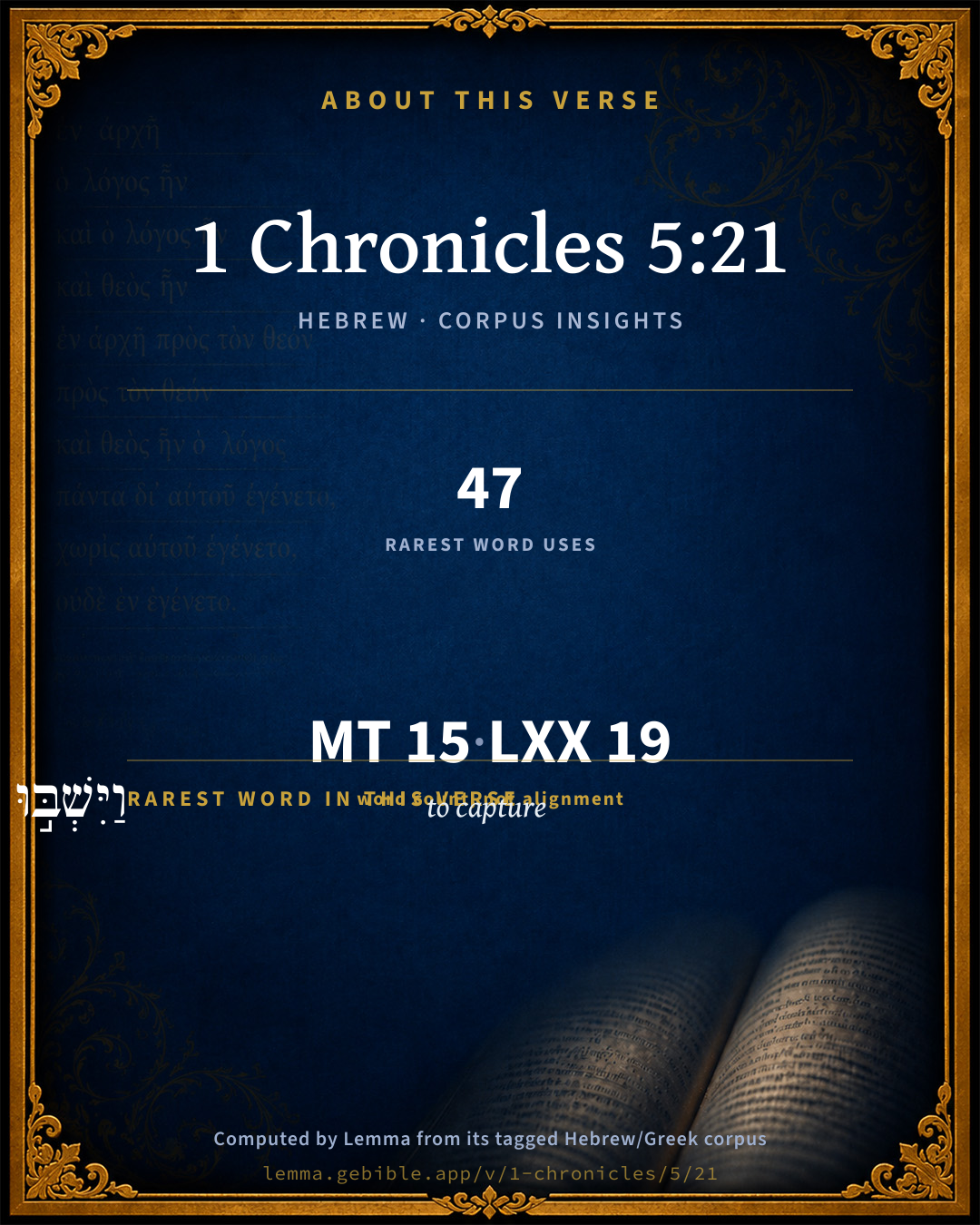
15
words
10
distinct lemmas
Historical
section

Shared distinctive vocabulary

וַיִּשְׁבּ֣וּ to capture H7617 occurs in 42 verses of the Hebrew Bible. Also found in:

Grammatical profile

  • 1 verb
  • 6 nouns
  • 8 adjectives

Verb forms

  • וַיִּשְׁבּ֣וּ Qal · Sequential Imperfect

Repetition

Words recur within this verse — often emphatic in Hebrew:

  • אֶ֨לֶף֙ thousand H505 ×4
  • חֲמִשִּׁ֥ים fifty H2572 ×2
  • מָאתַ֤יִם hundred H3967 ×2

Hebrew & Septuagint length

In English translation the verse runs 28 words from the Hebrew and 24 from the Septuagint (LXX English) — closely comparable.

A rough comparison of the two English renderings, which tokenize alike — not a word-level alignment.

Word counts can differ between the Hebrew and the Greek without any difference in meaning — e.g. the Hebrew direct-object marker אֵת has no separate Greek word, and Greek often adds the article ὁ.

In the original languages it is 15 Hebrew tokens and 19 Greek tokens — but the two are counted differently (Hebrew bundles its prefixes and suffixes into one token; the Greek is in lemma form), so that isn’t a like-for-like length.

Cross-references

2

Topical passages linked to 1 Chronicles 5:21 in the Treasury of Scripture Knowledge — connected by theme and wording, ordered by reader-vote popularity; previews shown in the World English Bible.

  • Numbers 31:35 and thirty-two thousand persons in all, of the women who had not known man by lying with him.
  • Revelation 18:13 and cinnamon, incense, perfume, frankincense, wine, olive oil, fine flour, wheat, sheep, horses, chariots, bodies, and people's souls.

Cross-references courtesy of OpenBible.info (CC BY 4.0).

Hebrew and Greek witnesses Masoretic Hebrew ↔ Greek Septuagint

The same verse in the two great witnesses to the Old Testament, shown verse-for-verse.

These are two independent witnesses, not word-aligned to each other, and the Septuagint is shown in lemma (dictionary) form.

Hebrew 1 Chronicles 5:21 Masoretic · Westminster Leningrad Codex

וַיִּשְׁבּ֣וּ מִקְנֵיהֶ֗ם גְּֽמַלֵּיהֶ֞ם חֲמִשִּׁ֥ים אֶ֨לֶף֙ וְצֹ֗אן מָאתַ֤יִם וַחֲמִשִּׁים֙ אֶ֔לֶף וַחֲמוֹרִ֖ים אַלְפָּ֑יִם וְנֶ֥פֶשׁ אָדָ֖ם מֵ֥אָה אָֽלֶף

They took away their cattle; of their camels fifty thousand, and of sheep two hundred fifty thousand, and of donkeys two thousand, and of men one hundred thousand.

World English Bible · Public Domain

Greek LXX 1 Chronicles 5:21 Septuagint · lemma form

καί αἰχμαλωτεύω ὁ ἀποσκευή αὐτός κάμηλος πεντακισχίλιοι καί πρόβατον διακόσιοι πεντήκοντα χιλιάς ὄνος δισχίλιοι καί ψυχή ἀνήρ ἑκατόν χιλιάς

And they took captive their store; five thousand camels, and two hundred and fifty thousand sheep, two thousand asses, and one hundred thousand men.

LXX2012 (modern English Septuagint) · Public Domain

Hebrew: Westminster Leningrad Codex (CC BY 4.0). Greek: Septuagint (public domain); English from LXX2012 (modern English Septuagint) (Public Domain). How the Septuagint differs from the Hebrew →

Commentary

Notes on 1 Chronicles 5:21 from classic Christian and Jewish commentators (each source and its license shown beneath its notes). The classic Christian expositions comment on the surrounding passage and are grouped to its opening verse, so a note may address several verses; the Jewish commentaries on the Tanakh (Rashi and others) are per-verse, so they appear only where the commentator wrote on this verse.

Lemma curates 59 commentaries, every one of them public domain or Creative Commons licensed, each selected and text-cleaned for this edition rather than reprinted as found. About our sources →

Trapp's Complete Commentary

John Trapp

1Ch 5:21 And they took away their cattle; of their camels fifty thousand, and of sheep two hundred and fifty thousand, and of asses two thousand, and of men an hundred thousand.

Ver. 21. Of their camels, fifty thousand.] These creatures were much set by in those eastern parts; as for their usefulness to bear great burdens, so for their unthirstiness, for they will travel three or four days together and not care to drink. Implentur cameli, cum bibendi est occasio, et in praeteritum, et in futurum, saith Pliny {a} They drink when they do, both for the time past and for the time to come.

And of sheep.] Good et ad esum, et ad usum.

And of asses two thousand.] Little set by, and therefore a less number.

{a} Lib. viii. cap. 18.

John Trapp, A Commentary or Exposition upon All the Books of the Old and New Testament (1647–1656) — public domain. Text from a community e-Sword module.

Joseph Benson's Commentary

1Ch 5:21. Of their camels fifty thousand — For camels were very numerous in Arabia, being used in war and for burdens, &c., and being very patient of thirst, and therefore most fit for those hot and dry countries. Of men a hundred thousand — Whom they took prisoners, and either used as slaves, or sold them for such.

Joseph Benson's Commentary on the Old and New Testaments (1811–1818) — public domain. Text from a community e-Sword module.

Geneva Bible (1599)

Geneva Bible translators

Hebrew, souls of men.

Geneva Bible (1599) marginal notes — public domain. Text via Bolls.life.

Adam Clarke's Commentary

Verse 21. They took away their cattle] This was a war of extermination as to the political state of the people, which nothing could justify but an especial direction of God; and this he could never give against any, unless the cup of their iniquity had been full. The Hagarites were full of idolatry: see 1Ch 5:25.

Adam Clarke's Commentary on the Bible (1810–1826) — public domain. Text from a community e-Sword/MySword module.

John Gill's Exposition

And the children of the half tribe of Manasseh dwelt in the land,.... Not in the land of the Hagarites, but in the land of Gilead and Bashan beyond Jordan, given them by Moses. The writer, having reckoned the genealogies of some of the principal men of Reuben and Gad, proceeds to give a short account of some principal men in this half tribe:

they increased from Bashan; where they first settled, and extended their possessions:

unto Baalhermon and Senir, and unto Mount Hermon; mountains which lay to the north of the land of Canaan, and are what geographers call Antilibanus.

John Gill's Exposition of the Whole Bible (1746–1763) — public domain (CC PDM 1.0). Text via the HelloAO Bible API.

Matthew Poole's English Annotations

Of their camels fifty thousand; for camels were very numerous in Arabia, being used in war, and for burdens, &c., and being very patient of thirst, and therefore most fit for those hot and dry countries.

Of men an hundred thousand; whom they took prisoners, and either used as slaves, or sold them for such.

Matthew Poole's English Annotations on the Holy Bible (1683–1685) — public domain. Text from a community e-Sword/MySword module.

Whedon's Commentary on the Bible

Daniel D. Whedon

21. Camels fifty thousand — The booty taken in this war seems almost incredible; but when we compare the immense wealth in flocks and herds of a single Bedouin chief like Job, (Job_1:3,) or Mesha, (2Ki_3:4,) we have reason to believe that the numbers here given are not erroneous.

Daniel D. Whedon (gen. ed.), Commentary on the Old and New Testaments (1874–1909) — public domain. Text from a community e-Sword module.

The Pulpit Commentary

Of men; literally, of the soul, i.e. life of men (comp. 2Ki_7:7 with Jer_44:7, in illustration of the twofold application of vpn,; see also. (Num_31:19, Num_31:28, Num_31:32-35)

HOMILIES BY J.R. THOMSON Ver. 2.

Judah"s pre-eminence.

The tribe of Judah holds the first and most prominent place in these genealogies. Reuben was the firstborn, and Joseph had the birthright; but precedence was given to Judah. This was foretold in the remarkable language in which old Jacob, upon his dying bed, spoke of this one of his sons and the tribe of which he was the progenitor.

I THE TRIBE OF JUDAH TOOK PRECEDENCE OF ALL. When the tribes were numbered under Moses, that of Judah was found to exceed all the others in number. When the Israelites were organized for the war against the Canaanites, Judah was divinely appointed to be the vanguard of the army. A similar precedence is accorded to the tribe of Judah in this Book of Chronicles.

II FROM THE TRIBE OF JUDAH SPRANG DAVID AND THE ROYAL HOUSE. Of Israel the Lord chose Judah, and of that tribe the family of Jesse, and of that family the youthful David. The great King of Israel and his glorious son shed a splendour upon the national annals. And when the separation of the kingdoms came about, the kingdom of Judah was distinguished in many ways, both civil and religious, above the sister kingdom of Northern Palestine.

III The greatest distinction and privilege of Judah was this: FROM THIS TRIBE SPRANG THE MESSIAH. Jesus, the Son of David, was a descendant from Judah. This was the true "Lion of the tribe of Judah.

PRACTICAL LESSONS.

1. Mark the hand of God in family history. Providence raises up one houseand sets down another. Families are sometimes selected to fulfil high purposes; and when they are found faithful to their vocation honour is put upon them by him who says, "Them that honour me I will honour.

2. Remember your accountability to God for family advantages. If God hasgiven much, he will require the more. T.

The Pulpit Commentary (1880–1919), ed. H.D.M. Spence-Jones & Joseph S. Exell — public domain. Text from a community e-Sword module.

Keil & Delitzsch

C. F. Keil & F. Delitzsch

And the children of the half tribe of Manasseh dwelt in the land,.... Not in the land of the Hagarites, but in the land of Gilead and Bashan beyond Jordan, given them by Moses. The writer, having reckoned the genealogies of some of the principal men of Reuben and Gad, proceeds to give a short account of some principal men in this half tribe:

they increased from Bashan; where they first settled, and extended their possessions:

unto Baalhermon and Senir, and unto Mount Hermon; mountains which lay to the north of the land of Canaan, and are what geographers call Antilibanus.

Keil & Delitzsch — Biblical Commentary on the Old Testament (1861–1891) — public domain (CC PDM 1.0). Text via the HelloAO Bible API. (Old Testament only.)

Lesson kit

Teaching starters — assembled from the data on this page, not authored interpretation. Every prompt links to the verse data it draws on. Edit before teaching.

1 Chronicles, in the Historical, opens this verse with 15 words (10 distinct Hebrew lemmas). Its most distinctive word is shâbâh (“to capture”). A historical commentator’s framing appears above. Read the whole chapter for the surrounding context.

Discussion questions

  1. The word shâbâh carries the sense “to capture.” How does it shape the verse?
  2. How does Genesis 14:14, which shares the word «to capture», read alongside this verse?
  3. What does the repetition of “thousand” (4× in this one verse) do in this verse?
  4. These translations render this verse differently; the difference is in the English rendering, not the original. What questions does that raise?
  5. «וַיִּשְׁבּ֣וּ» is a Qal Sequential Imperfect verb. How does that grammatical form shape the action described?
  6. Compare how Trapp's Complete Commentary and Joseph Benson's Commentary read this verse. Where do they agree or differ?

Things to notice

Reading settings

Reading text

Shown beneath each verse's original-language words.

Old Testament
Old Testament edition

Read the OT as the Masoretic Hebrew (MT) or the Greek Septuagint (LXX).

English shown for the Greek Septuagint (in the Hebrew ↔ Greek comparison).

Comparing translations? Open the Compare panel on any verse page to stack up to four side by side.