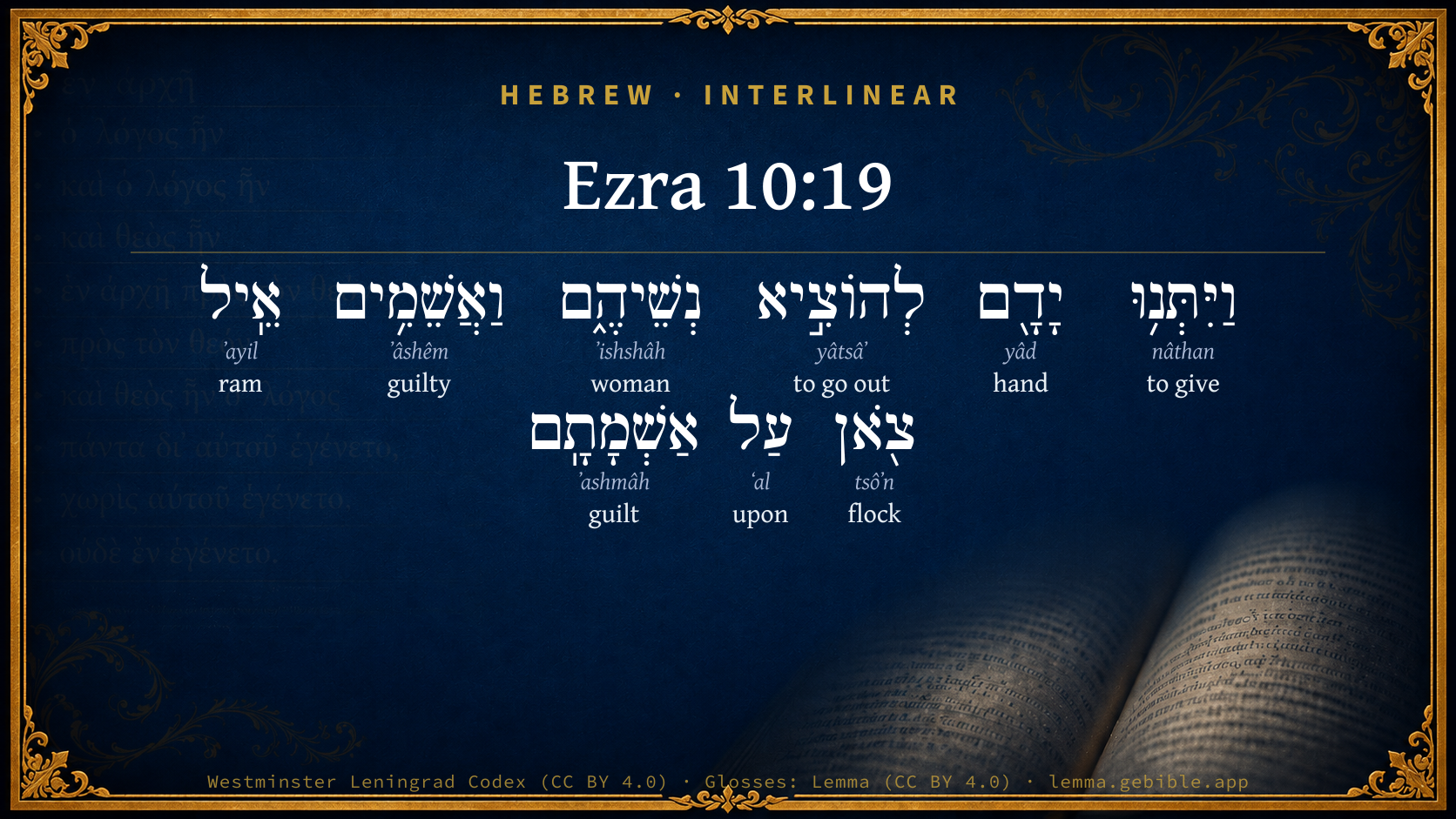
Ezra 10:19

Hebrew (Westminster Leningrad Codex) Ezra 10:19 appears in the Hebrew Old Testament. The text above is from the Westminster Leningrad Codex. Each word links to its Strong’s number, a concise gloss, and parsing drawn from the Open Scriptures Hebrew Bible morphology. Click any word for its full Brown-Driver-Briggs (BDB) entry.
Download image
Cite this verse

Ezra 10:19 (World English Bible). Public Domain. Lemma interlinear Bible study tool, https://lemma.gebible.app/v/ezra/10/19.

Show BibTeX & RIS
BibTeX
RIS
English Translation
They gave their hand that they would put away their wives; and being guilty, [they offered] a ram of the flock for their guilt.
World English Bible · Public Domain
Download a study sheet

One document with this verse’s original text, its word-by-word gloss line, the meaning frame, cross-references with their text, attributed commentary, and full source and license credits — printable, and it pastes into notes with its structure intact.

This verse Autodidact and up

Study sheet (.html) Plain text (.txt)

A passage Seminary Student

Up to 50 verses in one chapter. A passage sheet keeps up to 6 commentary sources and 12 cross-references per verse, in the order this page ranks them, and says so on the sheet whenever that leaves anything out. Ask for a single verse and you get the Autodidact verse sheet above.

Everything on this page stays free to read, with no account — the sheet is a download of what is already on screen, not access to it.

Want to remove ads? Support Godless Engineer
Compare translations 3

The same verse in 3 English versions, stacked beneath the original-language interlinear above. Click any original word for its lexicon entry.

Each is an independent rendering of the whole verse — the interlinear is not word-aligned to these translations.

Highlighted words mark where these versions differ — a whole-verse word diff, not a word-by-word alignment.

  • World English Bible Public Domain
    They gave their hand that they would put away their wives; and being guilty, [they offered] a ram of the flock for their guilt.
  • King James Version Public Domain
    And they gave their hands that they would put away their wives; and being guilty, they offered a ram of the flock for their trespass.
  • unfoldingWord Literal Text CC BY-SA 4.0
    So they gave their hand to cause their wives to go out, and, being guilty ones, a ram of the flock for their guilt.

unfoldingWord Literal Text — © unfoldingWord, licensed CC BY-SA 4.0. Word-aligned USFM3 via Door43 (git.door43.org/unfoldingWord/en_ult).

Versions to compare (up to 4)

3 of 4 selected

Show all 18 translations

Every available English version of this verse, each an independent rendering of the whole verse.

  • World English Bible Public Domain
    They gave their hand that they would put away their wives; and being guilty, [they offered] a ram of the flock for their guilt.
  • Berean Standard Bible Public Domain
    They pledged to send their wives away, and for their guilt they presented a ram from the flock as a guilt offering.
  • Majority Standard Bible Public Domain
    They pledged to send their wives away, and for their guilt they presented a ram from the flock as a guilt offering.
  • King James Version Public Domain
    And they gave their hands that they would put away their wives; and being guilty, they offered a ram of the flock for their trespass.
  • American Standard Version (1901) Public Domain
    And they gave their hand that they would put away their wives; and being guilty, `they offered' a ram of the flock for their guilt.
  • Revised Version (1885) Public Domain
    And they gave their hand that they would put away their wives; and being guilty, they offered a ram of the flock for their guilt.
  • Geneva Bible (1599) Public Domain
    And they gaue their hads, that they would put away their wiues, and they that had trespassed, gaue a ramme for their trespasse.
  • Douay-Rheims (1899) Public Domain
    And they gave their hands to put away their wives, and to offer for their offence a ram of the flock.
  • Young's Literal Translation Public Domain
    and they give their hand to send out their wives, and, being guilty, a ram of the flock, for their guilt.
  • Literal Standard Version CC BY-SA 4.0
    and they give their hand to send out their wives, and being guilty, a ram of the flock for their guilt.
  • Unlocked Literal Bible CC BY-SA 4.0
    So they determined to send their wives away. Since they were guilty, they offered a ram from the flock for their guilt.
  • unfoldingWord Literal Text CC BY-SA 4.0
    So they gave their hand to cause their wives to go out, and, being guilty ones, a ram of the flock for their guilt.
  • Darby Bible Public Domain
    And they gave their hand to send away their wives; and they offered a ram of the flock, as trespass-offering for their guilt.
  • World Messianic Bible Public Domain
    They gave their hand that they would put away their wives; and being guilty, they offered a ram of the flock for their guilt.
  • Webster's Bible Public Domain
    And they gave their hands that they would put away their wives; and being guilty, they offered a ram of the flock for their trespass.
  • Free Bible Version CC BY-SA 4.0
    They vowed to send their wives away, and they presented a ram from the flock as a guilt offering for their guilt.
  • Bible in Basic English Public Domain
    And they gave their word that they would put away their wives; and for their sin, they gave an offering of a male sheep of the flock.
  • JPS Tanakh (1917) Public Domain
    And they gave their hand that they would put away their wives; and being guilty, they offered a ram of the flock for their guilt.

Literal Standard Version (2020), Covenant Press — licensed CC BY-SA 4.0. Text via the HelloAO Bible API (eBible.org). Unlocked Literal Bible (unfoldingWord) — licensed CC BY-SA 4.0. Text via the HelloAO Bible API (eBible.org). unfoldingWord Literal Text — © unfoldingWord, licensed CC BY-SA 4.0. Word-aligned USFM3 via Door43 (git.door43.org/unfoldingWord/en_ult). Free Bible Version, Dr. Jonathan Gallagher — licensed CC BY-SA 4.0. Text via the HelloAO Bible API (eBible.org).

Word by word

More ways to search: Search by grammar → Find every occurrence → Compare this word →

Practice this passage: Drill this verse → Learn its vocabulary →

וַאֲשֵׁמִ֥ים
ʼâshêm
H818
“and · guilty”
Conjunction + Adjective, Adjective, Masculine, Plural, Absolute
Part of Speech
Conjunction + Adjective
Type
Adjective
Gender
Masculine
Number
Plural
State
Absolute
Full BDB Definition

Origin: from H816

TWOT: 180a

guilty, faulty (and obliged to offer a guilt-offering)
  1. וַיִּתְּנ֥וּ nâthan H5414 “and · to give” Conjunction + Verb, Qal, Sequential Imperfect, 3rd Person, Masculine, Plural
  2. יָדָ֖ם yâd H3027 “hand · their” Noun, Common, Both, Singular, Construct + Suffix, Personal, 3rd Person, Masculine, Plural
  3. לְהוֹצִ֣יא yâtsâʼ H3318 “to go out” Preposition + Verb, Hiphil, Infinitive Construct
  4. נְשֵׁיהֶ֑ם ʼishshâh H802 “women · their” Noun, Common, Feminine, Plural, Construct + Suffix, Personal, 3rd Person, Masculine, Plural
  5. אֵֽיל ʼayil H352 “ram of” Noun, Common, Masculine, Singular, Construct
  6. צֹ֖אן tsôʼn H6629 “flock” Noun, Common, Both, Singular, Absolute
  7. עַל ʻal H5921 “upon” Preposition
  8. אַשְׁמָתָֽם ʼashmâh H819 “guilt · their” Noun, Common, Feminine, Singular, Construct + Suffix, Personal, 3rd Person, Masculine, Plural

About this verse

These counts appear in no published source. They are computed here, from the morphology-tagged text and Lemma’s own curated glosses. What Lemma adds →

9
words
9
distinct lemmas
Historical
section

Notable vocabulary

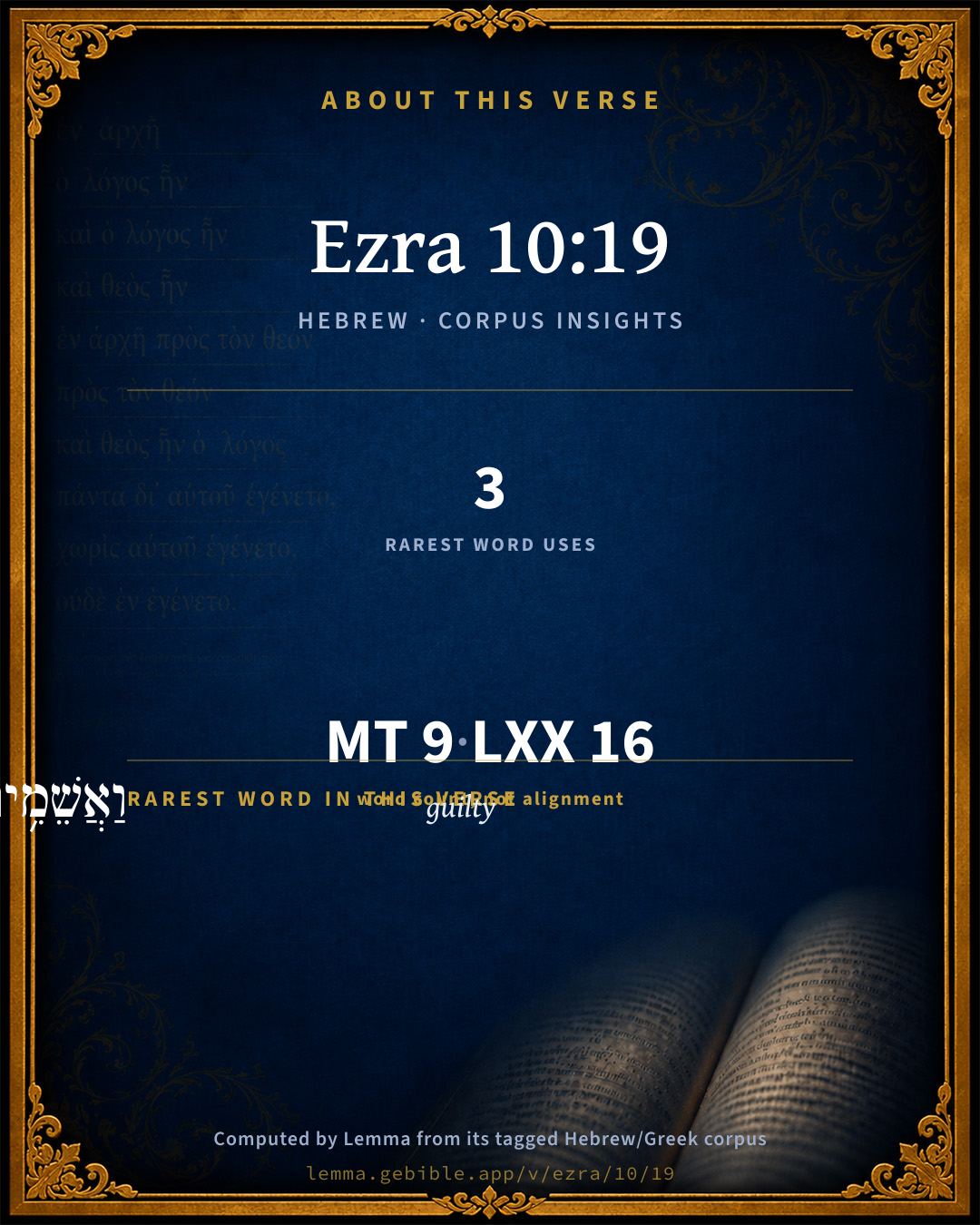
The rarest word here is וַאֲשֵׁמִ֥ים guilty H818 — appearing just 3 times in the whole Hebrew Bible.

Shared distinctive vocabulary

וַאֲשֵׁמִ֥ים guilty H818 occurs in 3 verses of the Hebrew Bible. Also found in:

Grammatical profile

  • 2 verbs
  • 5 nouns
  • 1 adjective
  • 1 preposition

Verb forms

  • וַיִּתְּנ֥וּ Qal · Sequential Imperfect
  • לְהוֹצִ֣יא Hiphil · Infinitive Construct

Hebrew & Septuagint length

In English translation the verse runs 24 words from the Hebrew and 23 from the Septuagint (LXX English) — closely comparable.

A rough comparison of the two English renderings, which tokenize alike — not a word-level alignment.

Word counts can differ between the Hebrew and the Greek without any difference in meaning — e.g. the Hebrew direct-object marker אֵת has no separate Greek word, and Greek often adds the article ὁ.

In the original languages it is 9 Hebrew tokens and 16 Greek tokens — but the two are counted differently (Hebrew bundles its prefixes and suffixes into one token; the Greek is in lemma form), so that isn’t a like-for-like length.

Cross-references

8

Topical passages linked to Ezra 10:19 in the Treasury of Scripture Knowledge — connected by theme and wording, ordered by reader-vote popularity; previews shown in the World English Bible.

  • Leviticus 6:6 He shall bring his trespass offering to Yahweh, a ram without blemish from the flock, according to your estimation, for a trespass offering, to the priest.
  • 2 Kings 10:15 When he was departed there, he lighted on Jehonadab the son of Rechab coming to meet him; and he greeted him, and said to him, Is your heart right, as my heart is with your heart? Jehonadab answered, It is. If it be, give me your hand. He gave him his hand; and he took him up to him into the chariot.
  • Leviticus 5:15–16 "If anyone commits a trespass, and sins unwittingly, in the holy things of Yahweh; then he shall bring his trespass offering to Yahweh, a ram without blemish from the flock, according to your estimation in silver by shekels, after the shekel of the sanctuary, for a trespass offering.
  • Leviticus 6:4 then it shall be, if he has sinned, and is guilty, he shall restore that which he took by robbery, or the thing which he has gotten by oppression, or the deposit which was committed to him, or the lost thing which he found,
  • 1 Chronicles 29:24 All the princes, the mighty men, and also all of the sons of king David submitted themselves to Solomon the king.
  • 2 Chronicles 30:8 Now don't you be stiff-necked, as your fathers were; but yield yourselves to Yahweh, and enter into his sanctuary, which he has sanctified forever, and serve Yahweh your God, that his fierce anger may turn away from you.
  • Lamentations 5:6 We have given the hand to the Egyptians, To the Assyrians, to be satisfied with bread.
  • Galatians 2:9 and when they perceived the grace that was given to me, James and Cephas and John, they who were reputed to be pillars, gave to me and Barnabas the right hand of fellowship, that we should go to the Gentiles, and they to the circumcision.

Cross-references courtesy of OpenBible.info (CC BY 4.0).

Hebrew and Greek witnesses Masoretic Hebrew ↔ Greek Septuagint

The same verse in the two great witnesses to the Old Testament, shown verse-for-verse.

These are two independent witnesses, not word-aligned to each other, and the Septuagint is shown in lemma (dictionary) form.

Hebrew Ezra 10:19 Masoretic · Westminster Leningrad Codex

וַיִּתְּנ֥וּ יָדָ֖ם לְהוֹצִ֣יא נְשֵׁיהֶ֑ם וַאֲשֵׁמִ֥ים אֵֽיל צֹ֖אן עַל אַשְׁמָתָֽם

They gave their hand that they would put away their wives; and being guilty, [they offered] a ram of the flock for their guilt.

World English Bible · Public Domain

Greek LXX Ezra 10:19 Septuagint · lemma form

καί δίδωμι χείρ αὐτός ὁ ἐκφέρω γυνή αὐτός καί πλημμέλεια κριός ἐκ πρόβατον περί πλημμέλησις αὐτός

And they pledged themselves to put away their wives, and offered a ram of the flock for a trespass-offering because of their trespass.

LXX2012 (modern English Septuagint) · Public Domain

In the Septuagint this is one book — Esdras B (2 Esdras): Ezra is chapters 1–10, Nehemiah 11–23.

Hebrew: Westminster Leningrad Codex (CC BY 4.0). Greek: Septuagint (public domain); English from LXX2012 (modern English Septuagint) (Public Domain). How the Septuagint differs from the Hebrew →

Commentary

Notes on Ezra 10:19 from classic Christian and Jewish commentators (each source and its license shown beneath its notes). The classic Christian expositions comment on the surrounding passage and are grouped to its opening verse, so a note may address several verses; the Jewish commentaries on the Tanakh (Rashi and others) are per-verse, so they appear only where the commentator wrote on this verse.

Lemma curates 59 commentaries, every one of them public domain or Creative Commons licensed, each selected and text-cleaned for this edition rather than reprinted as found. About our sources →

Trapp's Complete Commentary

John Trapp

Ezr 10:19 And they gave their hands that they would put away their wives; and [being] guilty, [they offered] a ram of the flock for their trespass.

Ver. 19. And they gave their hands] i.e. They plighted their troth, and assured the assent of their hearts, 2Ki 10:15.

That they would put away their wives] Though as dear to them, haply, as was George Carpenter’s (martyr), burnt at Munchen, in Bavaria; My wife and children, said he, are so dear unto me, that they cannot be bought from me for all the riches and possessions of the duke of Bavaria: but for the love of my Lord God I will willingly forsake them. Let us do so by our dilecta delicta, our dearest and most delicious sins.

They offered a ram of the flock] This shows that they sinned against knowledge; for a sin of ignorance the oblation was not a ram, but a goat.

John Trapp, A Commentary or Exposition upon All the Books of the Old and New Testament (1647–1656) — public domain. Text from a community e-Sword module.

Geneva Bible (1599)

Geneva Bible translators

As a token that they would keep promise and do it.

Geneva Bible (1599) marginal notes — public domain. Text via Bolls.life.

Jamieson, Fausset & Brown

Robert Jamieson, A. R. Fausset & David Brown

they gave their hands--that is, came under a solemn engagement, which was usually ratified by pledging the right hand (Pro 6:1; Eze 17:18). The delinquents of the priestly order bound themselves to do like the common Israelites (Ezr 10:25), and sought to expiate their sin by sacrificing a ram as a trespass offering.

Next: Nehemiah Introduction

Jamieson, Fausset & Brown — Commentary Critical and Explanatory on the Whole Bible (1871) — public domain (CC PDM 1.0). Text via the HelloAO Bible API.

Adam Clarke's Commentary

Verse 19. They gave their hands] They bound themselves in the most solemn manner to do as the rest of the delinquents had done; and they made all acknowledgment of their iniquity to God by offering each a ram for a trespass-offering.

Adam Clarke's Commentary on the Bible (1810–1826) — public domain. Text from a community e-Sword/MySword module.

The Cambridge Bible for Schools and Colleges

gen. ed. J. J. S. Perowne

19. they gave their hands] R.V. their hand. The Hebrew has the singular. On this symbol of a promise or pledge compare 2Ki_10:15 ‘If it be, give me thine hand. And he gave him his hand’. Eze_17:18 ‘And behold, he had given his hand, and yet hath done all these things’. Lam_5:6 ‘We have given the hand to the Egyptians’. 2Ch_30:8 ‘But yield yourselves (Heb. give the hand) unto the Lord’.

and being guilty, &c.] It has been supposed that whereas the solemn pledge or promise, to put away the strange women, was made by all, the priests alone had to offer the sacrifice of a ram. The sacrifice of a ram for a guilt offering is enjoined, ‘if anyone commit a trespass and sin unwittingly, in the holy things of the Lord’ (see Lev_5:14-19). There is however no real reason for limiting the guilt offering to the priests. The passage from Leviticus makes no such restriction. It is probable that this verse represents the form of solemn renunciation imposed upon all the offenders, i.e. the promise and the guilt offering. It is mentioned after the first names on the list, and should be understood after each recorded group of names. The repetition of the formula was considered unnecessary.

being guilty] These words sound like the sentence of the commission, after investigating each case.

20, 21, 22. The sons of Immer, Harim and Pashur. In Ezr_2:37-39 and Neh_7:40-42 the order of the names is Immer, Pashur and Harim. In 1Ch_24:8-14 ‘Harim’ is the third and Immer the sixteenth priestly course: see notes on Ezr_2:37, &c.

Several of the names here mentioned occur in the lists of Nehemiah 8, 12.

The Cambridge Bible for Schools and Colleges (gen. ed. J. J. S. Perowne; Cambridge University Press, 1878–1918) — public domain. Text from a community e-Sword module.

John Gill's Exposition

And they gave their hands that they would put away their wives,.... They proposed to do it, and actually did it:

and being guilty; of which they were fully convinced:

they offered a ram of the flock for their trespass; to make atonement for it, and thereby set an example to others to do the like. Aben Ezra observes, that we do not find that the trespass offering was a mulct to such who married strange wives, and conjectures, that it was the advice of the chief men to do it. From hence, to the end of Ezr 10:43, is a list of the men that had married strange wives, and put them away; those in Ezr 10:20, were priests; in Ezr 10:23, Levites, and those of them who were singers or porters; the rest were Israelites: and it is a very common distinction, in rabbinical writers, to distinguish the Jews into priests, Levites, and Israelites; of these we know no more than their names; some of the heads of the families may be observed in Ezr 2:1.

John Gill's Exposition of the Whole Bible (1746–1763) — public domain (CC PDM 1.0). Text via the HelloAO Bible API.

Haydock's Catholic Bible Commentary

Hands. Thus the Persians confirmed their most solemn engagements. (Calmet)

George Leo Haydock (1774–1849), Haydock's Catholic Family Bible and Commentary, 1859 edition — public domain. Excludes Psalms (Douay-Rheims chapter numbering differs from Protestant) and Deuterocanonical books (Catholic canon only).

Matthew Poole's English Annotations

They gave their hand, i.e. they covenanted or swore by giving their hand; which was the usual gesture in those cases; of which see Lev 6:2; Eze 17:18.

Matthew Poole's English Annotations on the Holy Bible (1683–1685) — public domain. Text from a community e-Sword/MySword module.

Whedon's Commentary on the Bible

Daniel D. Whedon

LIST OF THOSE WHO HAD TAKEN STRANGE WIVES, Ezr_10:18-44.

So important to the new community was the whole procedure, that the names of the implicated ones were chronicled, and immortalized in connexion with this sad affair. Ezra embodied the list in his own book as a testimony of his care for Israel, and here it still stands, a monument of his fidelity to the people of his God.

The list gives, 1) the names of the sons of the priests who had taken strange wives, Ezr_10:18-22; Ezra 2) the names of the Levites, Ezr_10:23; Ezra 3) the names of the singers, Ezr_10:24; Ezra 4) the names of non-official or ordinary Israelites, Ezr_10:25-43.

19. Gave their hands — As a solemn form of indicating their acceptance of the covenant, (Ezr_10:3,) and of binding themselves to put away their wives. Handshaking is a natural ceremony of ratifying a solemn agreement between parties. Comp. 2Ki_10:15.

A ram… for their trespass — According to the law of Lev_6:1-6.

Daniel D. Whedon (gen. ed.), Commentary on the Old and New Testaments (1874–1909) — public domain. Text from a community e-Sword module.

The Pulpit Commentary

They gave their hands that they would put away their wives. It is not clear whether this is intended to be said of Maaseiah, Eliezer, Jarib, and Gedaliah only, or of the entire body of persons found guilty of having married strange wives. Most probably the court made out the divorces in the generality of cases, but were content to take a solemn pledge from members of the high priest"s family.

The Pulpit Commentary (1880–1919), ed. H.D.M. Spence-Jones & Joseph S. Exell — public domain. Text from a community e-Sword module.

Rashi

Rabbi Shlomo Yitzchaki (Rashi)

And they advised them Heb. וַיִתְּנוּ יָדָם, lit. and they gave their hand, their advice, like (II Sam. 14:19): “Behold Joab’s advice (יַד יוֹאָב) is with you in all this (sic).”

for their guilt This was a temporary ruling.

Rashi on the Tanakh — English translations: “The Judaica Press complete Tanach with Rashi, translated by A. J. Rosenberg” (CC BY 4.0); “Pentateuch with Rashi's commentary by M. Rosenbaum and A.M. Silbermann, 1929-1934” (public domain); “The Metsudah Tanach series, Lakewood, N.J” (CC BY 4.0); and “The Book of Joshua, Metsudah Publications, 1997” (CC BY 4.0). Text via Sefaria.

Lesson kit

Teaching starters — assembled from the data on this page, not authored interpretation. Every prompt links to the verse data it draws on. Edit before teaching.

Ezra, in the Historical, opens this verse with 9 words (9 distinct Hebrew lemmas). Its most distinctive word is ʼâshêm (“guilty”). A historical commentator’s framing appears above. Read the whole chapter for the surrounding context.

Discussion questions

  1. How does “guilty” (ʼâshêm) shape what this verse is saying?
  2. How does Genesis 42:21, which shares the word «guilty», read alongside this verse?
  3. The translations on this page render this verse differently — a whole-verse word diff, not a word-by-word alignment. What might account for the different wordings?
  4. «וַיִּתְּנ֥וּ» is a Qal Sequential Imperfect verb. How does that grammatical form shape the action described?
  5. Compare how Trapp's Complete Commentary and Geneva Bible (1599) read this verse. Where do they agree or differ?

Things to notice

Reading settings

Reading text

Shown beneath each verse's original-language words.

Old Testament
Old Testament edition

Read the OT as the Masoretic Hebrew (MT) or the Greek Septuagint (LXX).

English shown for the Greek Septuagint (in the Hebrew ↔ Greek comparison).

Comparing translations? Open the Compare panel on any verse page to stack up to four side by side.