
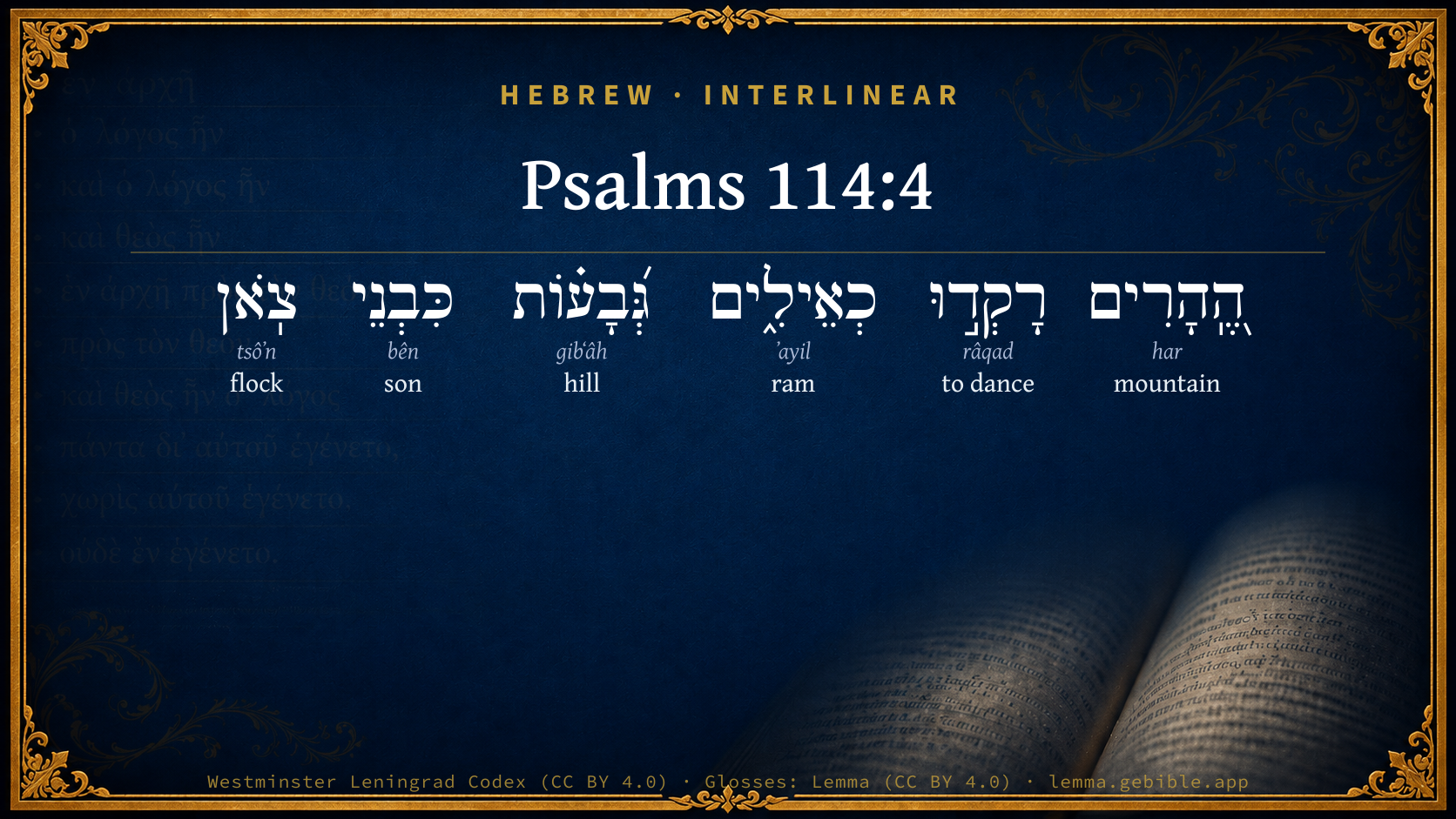
Psalms 114:4

Hebrew (Westminster Leningrad Codex) Psalms 114:4 appears in the Hebrew Old Testament. The text above is from the Westminster Leningrad Codex. Each word links to its Strong’s number, a concise gloss, and parsing drawn from the Open Scriptures Hebrew Bible morphology. Click any word for its full Brown-Driver-Briggs (BDB) entry.
Download image
Cite this verse

Psalms 114:4 (World English Bible). Public Domain. Lemma interlinear Bible study tool, https://lemma.gebible.app/v/psalms/114/4.

Show BibTeX & RIS
BibTeX
RIS
English Translation
The mountains skipped like rams, The little hills like lambs.
World English Bible · Public Domain
Download a study sheet

One document with this verse’s original text, its word-by-word gloss line, the meaning frame, cross-references with their text, attributed commentary, and full source and license credits — printable, and it pastes into notes with its structure intact.

This verse Autodidact and up

Study sheet (.html) Plain text (.txt)

A passage Seminary Student

Up to 50 verses in one chapter. A passage sheet keeps up to 6 commentary sources and 12 cross-references per verse, in the order this page ranks them, and says so on the sheet whenever that leaves anything out. Ask for a single verse and you get the Autodidact verse sheet above.

Everything on this page stays free to read, with no account — the sheet is a download of what is already on screen, not access to it.

Want to remove ads? Support Godless Engineer
Compare translations 3

The same verse in 3 English versions, stacked beneath the original-language interlinear above. Click any original word for its lexicon entry.

Each is an independent rendering of the whole verse — the interlinear is not word-aligned to these translations.

Highlighted words mark where these versions differ — a whole-verse word diff, not a word-by-word alignment.

  • World English Bible Public Domain
    The mountains skipped like rams, The little hills like lambs.
  • King James Version Public Domain
    The mountains skipped like rams, and the little hills like lambs.
  • unfoldingWord Literal Text CC BY-SA 4.0
    The mountains skipped like rams, the hills like sons of the flock.

unfoldingWord Literal Text — © unfoldingWord, licensed CC BY-SA 4.0. Word-aligned USFM3 via Door43 (git.door43.org/unfoldingWord/en_ult).

Versions to compare (up to 4)

3 of 4 selected

Show all 18 translations

Every available English version of this verse, each an independent rendering of the whole verse.

  • World English Bible Public Domain
    The mountains skipped like rams, The little hills like lambs.
  • Berean Standard Bible Public Domain
    the mountains skipped like rams, the hills like lambs.
  • Majority Standard Bible Public Domain
    the mountains skipped like rams, the hills like lambs.
  • King James Version Public Domain
    The mountains skipped like rams, and the little hills like lambs.
  • American Standard Version (1901) Public Domain
    The mountains skipped like rams, The little hills like lambs.
  • Revised Version (1885) Public Domain
    The mountains skipped like rams, the little hills like young sheep.
  • Geneva Bible (1599) Public Domain
    The mountaines leaped like rams, and the hils as lambes.
  • Douay-Rheims (1899) Public Domain
    The mountains skipped like rams, and the hills like the lambs of the flock.
  • Young's Literal Translation Public Domain
    The mountains have skipped as rams, Heights as sons of a flock.
  • Literal Standard Version CC BY-SA 4.0
    The mountains have skipped as rams, || Heights as sons of a flock.
  • Unlocked Literal Bible CC BY-SA 4.0
    The mountains skipped like rams, the hills skipped like lambs.
  • unfoldingWord Literal Text CC BY-SA 4.0
    The mountains skipped like rams, the hills like sons of the flock.
  • Darby Bible Public Domain
    The mountains skipped like rams, the hills like lambs.
  • World Messianic Bible Public Domain
    The mountains skipped like rams, the little hills like lambs.
  • Webster's Bible Public Domain
    The mountains skipped like rams, and the little hills like lambs.
  • Free Bible Version CC BY-SA 4.0
    Mountains jumped in fright like rams, hills startled like lambs.
  • Bible in Basic English Public Domain
    The mountains were jumping like goats, and the little hills like lambs.
  • JPS Tanakh (1917) Public Domain
    The mountains skipped like rams, the hills like young sheep.

Literal Standard Version (2020), Covenant Press — licensed CC BY-SA 4.0. Text via the HelloAO Bible API (eBible.org). Unlocked Literal Bible (unfoldingWord) — licensed CC BY-SA 4.0. Text via the HelloAO Bible API (eBible.org). unfoldingWord Literal Text — © unfoldingWord, licensed CC BY-SA 4.0. Word-aligned USFM3 via Door43 (git.door43.org/unfoldingWord/en_ult). Free Bible Version, Dr. Jonathan Gallagher — licensed CC BY-SA 4.0. Text via the HelloAO Bible API (eBible.org).

Word by word

More ways to search: Search by grammar → Find every occurrence → Compare this word →

Practice this passage: Drill this verse → Learn its vocabulary →

About this verse

These counts appear in no published source. They are computed here, from the morphology-tagged text and Lemma’s own curated glosses. What Lemma adds →

6
words
6
distinct lemmas
Wisdom
section

Notable vocabulary

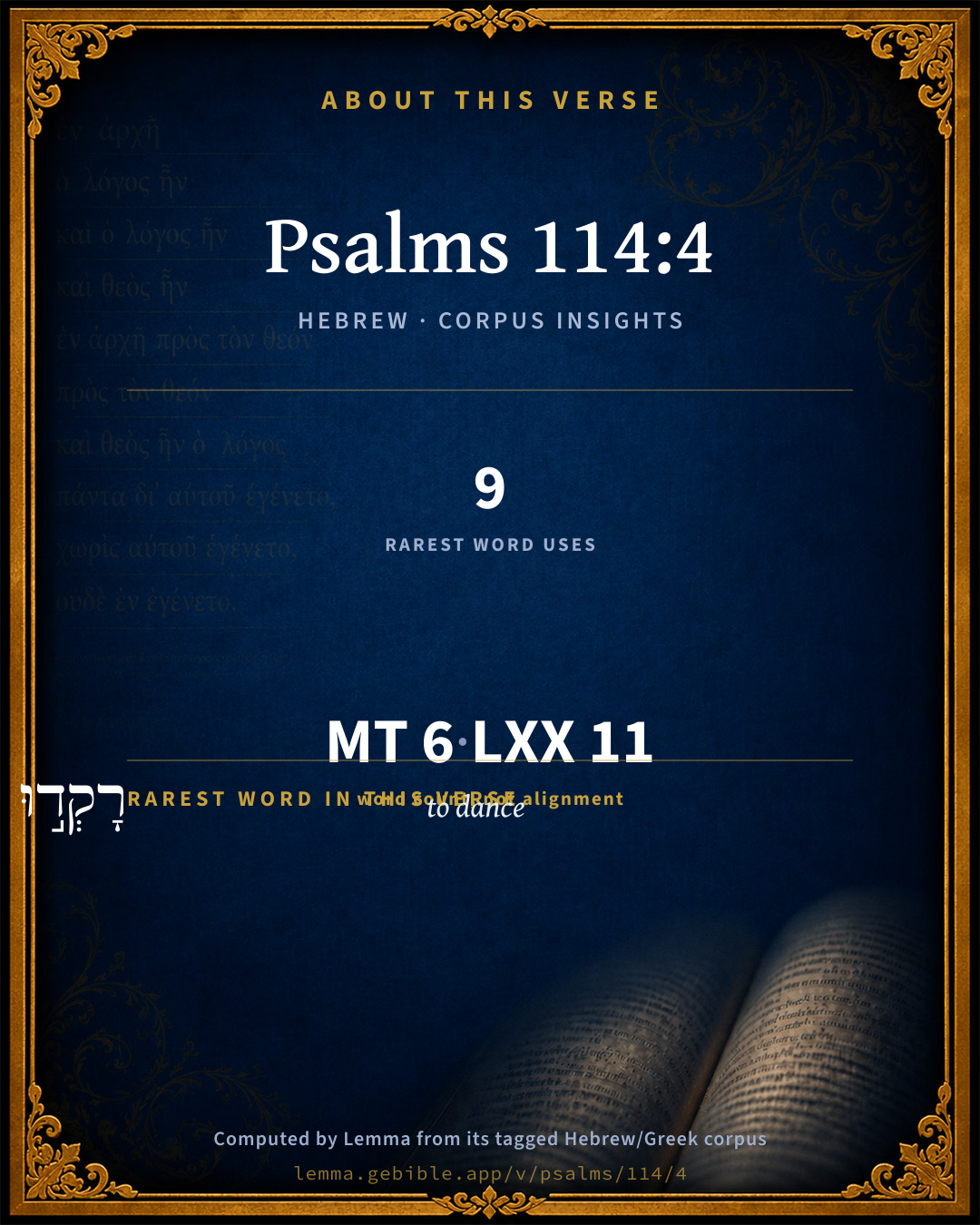
The rarest word here is רָקְד֣וּ to dance H7540 — appearing just 9 times in the whole Hebrew Bible.

Shared distinctive vocabulary

רָקְד֣וּ to dance H7540 occurs in 9 verses of the Hebrew Bible. Also found in:

Grammatical profile

  • 1 verb
  • 5 nouns

Verb forms

  • רָקְד֣וּ Qal · Perfect

Hebrew & Septuagint length

In English translation the verse runs 10 words from the Hebrew and 10 from the Septuagint (LXX English) — the same length.

A rough comparison of the two English renderings, which tokenize alike — not a word-level alignment.

Word counts can differ between the Hebrew and the Greek without any difference in meaning — e.g. the Hebrew direct-object marker אֵת has no separate Greek word, and Greek often adds the article ὁ.

In the original languages it is 6 Hebrew tokens and 11 Greek tokens — but the two are counted differently (Hebrew bundles its prefixes and suffixes into one token; the Greek is in lemma form), so that isn’t a like-for-like length.

Cross-references

14

Topical passages linked to Psalms 114:4 in the Treasury of Scripture Knowledge — connected by theme and wording, ordered by reader-vote popularity; previews shown in the World English Bible.

  • Judges 5:4–5 Yahweh, when you went forth out of Seir, When you marched out of the field of Edom, The earth trembled, the sky also dropped, Yes, the clouds dropped water.
  • Exodus 19:18 Mount Sinai, the whole of it, smoked, because Yahweh descended on it in fire; and its smoke ascended like the smoke of a furnace, and the whole mountain quaked greatly.
  • Exodus 20:18 All the people perceived the thunderings, the lightnings, the sound of the trumpet, and the mountain smoking. When the people saw it, they trembled, and stayed at a distance.
  • Habakkuk 3:6 He stood, and shook the earth. He looked, and made the nations tremble. The ancient mountains were crumbled. The age-old hills collapsed. His ways are eternal.
  • Jeremiah 4:23–24 I saw the earth, and, behold, it was waste and void; and the heavens, and they had no light.
  • Habakkuk 3:8 Was Yahweh displeased with the rivers? Was your anger against the rivers, Or your wrath against the sea, That you rode on your horses, On your chariots of salvation?
  • 2 Peter 3:7–11 But the heavens that now are, and the earth, by the same word have been stored up for fire, being reserved against the day of judgment and destruction of ungodly men.
  • Revelation 20:11 I saw a great white throne, and him who sat on it, from whose face the earth and the heaven fled away. There was found no place for them.
  • Psalms 18:7 Then the earth shook and trembled. The foundations also of the mountains quaked and were shaken, Because he was angry.
  • Psalms 29:6 He makes them also to skip like a calf; Lebanon and Sirion like a young, wild ox.
  • Micah 1:3–4 For, behold, Yahweh comes forth out of his place, And will come down and tread on the high places of the earth.
  • Nahum 1:5 The mountains quake before him, and the hills melt away. The earth trembles at his presence, yes, the world, and all who dwell in it.
  • Psalms 68:16 Why do you look in envy, you rugged mountains, At the mountain where God chooses to reign? Yes, Yahweh will dwell there forever.
  • Psalms 39:6 "Surely every man walks like a shadow. Surely they busy themselves in vain. He heaps up, and doesn't know who shall gather.

Cross-references courtesy of OpenBible.info (CC BY 4.0).

Hebrew and Greek witnesses Masoretic Hebrew ↔ Greek Septuagint

The same verse in the two great witnesses to the Old Testament, shown verse-for-verse.

You’re reading Greek Psalm 113 (Hebrew Psalm 114). The Septuagint counts the superscription, so verse numbers can differ from the Hebrew — chapter-level alignment, not verse-by-verse. Numbering follows Rahlfs.

These are two independent witnesses, not word-aligned to each other, and the Septuagint is shown in lemma (dictionary) form.

Hebrew Psalms 114:4 Masoretic · Westminster Leningrad Codex

הֶֽ֭הָרִים רָקְד֣וּ כְאֵילִ֑ים גְּ֝בָע֗וֹת כִּבְנֵי צֹֽאן

The mountains skipped like rams, The little hills like lambs.

World English Bible · Public Domain

Greek LXX Greek Psalm 113:4 Septuagint · lemma form

ὁ ὄρος σκιρτάω ὡσεί κριός καί ὁ βουνός ὡς ἀρνίον πρόβατον

The mountains skipped like rams, and the hills like lambs.

LXX2012 (modern English Septuagint) · Public Domain

Hebrew: Westminster Leningrad Codex (CC BY 4.0). Greek: Septuagint (public domain); English from LXX2012 (modern English Septuagint) (Public Domain). How the Septuagint differs from the Hebrew →

Commentary

Notes on Psalms 114:4 from classic Christian and Jewish commentators (each source and its license shown beneath its notes). The classic Christian expositions comment on the surrounding passage and are grouped to its opening verse, so a note may address several verses; the Jewish commentaries on the Tanakh (Rashi and others) are per-verse, so they appear only where the commentator wrote on this verse.

Lemma curates 59 commentaries, every one of them public domain or Creative Commons licensed, each selected and text-cleaned for this edition rather than reprinted as found. About our sources →

Trapp's Complete Commentary

John Trapp

Psa 114:4 The mountains skipped like rams, [and] the little hills like lambs.

Ver. 4. The mountains skipped like rams] sc. At the giving of the law, Exo 19:18, which also causeth heartquakes in believers; but the unjust knoweth no shame, Zep 3:5; is past feeling, Eph 4:19.

John Trapp, A Commentary or Exposition upon All the Books of the Old and New Testament (1647–1656) — public domain. Text from a community e-Sword module.

J. A. Alexander on Psalms

Joseph Addison Alexander

4. (Psa 114:4) The mountains skipped like rams, (the) hills like the young of sheep. As the Psalmist is reciting actual events, to be used as symbols and pledges of others, this cannot be explained as a poetical figure, but must be understood as referring to the concussion of Sinai, with its various peaks and neighbouring mountains. See Exo 19:18, Jdg 5:4, Psa 68:8; Psa 97:4-5, Hab 3:6. Here again the familiar use of mountains to denote states and empires is suggestive of the same consolation as in Psa 114:3.

Joseph Addison Alexander, The Psalms Translated and Explained (1850) — public domain. Text from a community e-Sword module.

Geneva Bible (1599)

Geneva Bible translators

Seeing that these dead creatures felt God’s power, and after a sort saw it, much more his people ought to consider it, and glorify him for the same.

Geneva Bible (1599) marginal notes — public domain. Text via Bolls.life.

Ellicott's Commentary for English Readers

(4) Skipped.—The Hebrew word thus rendered is translated “dance” in Ecc_3:4. (See Psa_18:7.) Exo_19:18 was no doubt in the poet’s thought, but the leaping of the hills formed part of every theophany.

A Bible Commentary for English Readers, edited by Charles John Ellicott (1878–1897) — public domain. Text from a community e-Sword module.

The Cambridge Bible for Schools and Colleges

gen. ed. J. J. S. Perowne

4. A poetical description of the earthquake which accompanied the giving of the Law at Sinai (Exo_19:18; cp. Jdg_5:4; Psa_68:8). For the figure cp. Psa_29:6.

The Cambridge Bible for Schools and Colleges (gen. ed. J. J. S. Perowne; Cambridge University Press, 1878–1918) — public domain. Text from a community e-Sword module.

John Gill's Exposition

The mountains skipped like rams,.... The mountains of Sinai and Horeb quaked and moved at the presence of the Lord, when he descended thereon to give the law; these saw his glory and trembled, Exo 19:18.

And the little hills like lambs; very beautiful are the larger mountains of Sinai and Horeb compared to rams, and the motion of them to their skipping; and the little hills adjacent to them to lambs: these may represent the greater and lesser governors in the Roman empire at the time when such large conversions were made in it as before observed; and which skipped, and trembled, and fled, and were moved out of their places at the downfall of Paganism and progress of Christianity, Rev 6:14 and also may be an emblem of the difficulties which lie like mountains and hills in the way of a sinner's conversion and effectual calling, which yet give way to and are surmounted by the efficacious grace of God; all mountains become a plain before him, and when he works none can let.

John Gill's Exposition of the Whole Bible (1746–1763) — public domain (CC PDM 1.0). Text via the HelloAO Bible API.

Albert Barnes' Notes on the Bible

The mountains skipped like rams - As flocks in their gambols. They seemed to move from place to place; everything seemed to be unsettled, and acknowledged the presence of the Omnipotent One. The word rendered “skipped” means to leap for joy; to dance. See the notes at Psa 29:6. The reference here is to the agitations and commotions of the peaks of Sinai, when God came down to deliver the law. Exo 19:16-18.

And the little hills like lambs - Hebrew, Like the sons of the flock. The reference here is to the less prominent eminences of Sinai. The lofty hills, and the smaller hills surrounding, seemed to be all in a state of commotion.

Albert Barnes' Notes on the Bible (1834–1885) — public domain. Text from a community e-Sword/MySword module.

Matthew Poole's English Annotations

Horeb and Sinai, two tops of one mountain, and other neighbouring hills or mountains. Compare Exo 19:18; Psa 68:8; Hab 3:6,10.

Matthew Poole's English Annotations on the Holy Bible (1683–1685) — public domain. Text from a community e-Sword/MySword module.

The Treasury of David

Charles H. Spurgeon

Ver. 4. The mountains skipped like rams, and the little hills like lambs. At the coming of the Lord to Mount Sinai, the hills moved; either leaping for joy in the presence of their Creator like young lambs; or, if you will, springing from their places in affright at the terrible majesty of Jehovah, and flying like a flock of sheep when alarmed. Men fear the mountains, but the mountains tremble before the Lord. Sheep and lambs move lightly in the meadows; but the hills, which we are wont to call eternal, were as readily made to move as the most active creatures. Rams in their strength, and lambs in their play, are not more stirred than were the solid hills when Jehovah marched by. Nothing is immovable but God himself: the mountains shall depart, and the hills be removed, but the covenant of his grace abideth fast for ever and ever. Even thus do mountains of sin and hills of trouble move when the Lord comes forth to lead his people to their eternal Canaan. Let us never fear, but rather let our faith say unto this mountain, "Be thou removed hence and cast into the sea, "and it shall be done.

Ver. 4. The mountains skipped like rams, etc. The figure drawn from the lambs and rams would appear to be inferior to the magnitude of the subject. But it was the prophet's intention to express in the homeliest way the incredible manner in which God, on these occasions, displayed his power. The stability of the earth being, as it were, founded on the mountains, what connection can they have with rams and lambs, that they should be agitated, skipping hither and thither? In speaking in this homely style, he does not mean to detract from the greatness of the miracle, but more forcibly to engrave these extraordinary tokens of God's power on the illiterate. John Calvin.

Ver. 4. Skipped. A poetic description of the concussion caused by the thunder and lightning that accompanied the divine presence. James G. Murphy.

Ver. 4. At the giving of the law at Sinai, Horeb and the mountains around, both great and small, shook with a sudden and mighty earthquake, like rams leaping in a grassy plain, with the young sheep frisking round them. Plain Commentary.

Ver. 4-6. When Christ descends upon the soul in the work of conversion, what strength doth he put forth! The strongholds of sin are battered down, every high thing that exalts itself against the knowledge of Christ is brought into captivity to the obedience of his sceptre, 2Co 10:4-5. Devils are cast out of the possession which they have kept for many years without the least disturbance. Strong lusts are mortified and the very constitution of the soul is changed. What ailed thee, O thou sea, that thou fleddest? thou Jordan, that thou wast driven back? ye mountains, that ye skipped like rams?, etc. The prophet speaks those words of the powerful entrance of the children of Israel into Canaan. The like is done by Christ in the conversion of a sinner. Jordan is driven back, the whole course of the soul is altered, the mountains skip like rams. There are many mountains in the soul of a sinner, as pride, unbelief, self conceitedness, atheism, profaneness, etc. These mountains are plucked up by the roots in a moment when Christ begins the work of conversion. Ralph Robinson.

Ver. 4. The movableness of things which appear to be fixed and settled. God's power of creating a stir in lethargic minds, among ancient systems, and prejudiced persons of the highest rank.

Psalms 114:5*

Charles H. Spurgeon's The Treasury of David (1869–1885) — public domain. Psalms only. Text from a community e-Sword/MySword module.

Whedon's Commentary on the Bible

Daniel D. Whedon

4. Mountains skipped—That is, Horeb and Sinai moved to and fro. The word rendered skip, here, indicates a hasty, undulating motion, a coming and retiring, as from fright. In Exo_19:18 it is said, “The whole mount quaked greatly.” See the same figure, Psa_29:6; Hab_3:8. The phenomenon is that of a violent earthquake.

Daniel D. Whedon (gen. ed.), Commentary on the Old and New Testaments (1874–1909) — public domain. Text from a community e-Sword module.

The Pulpit Commentary

The mountains skipped like rams, and the little hills like lambs. The poet sees in the earthquake that shook Sinai (Exo_19:18) a general commotion of the entire region, in which both the greater and the lesser elevations take part. (comp. Psa_29:6 Psa_68:8, Psa_68:16)

The Pulpit Commentary (1880–1919), ed. H.D.M. Spence-Jones & Joseph S. Exell — public domain. Text from a community e-Sword module.

John Wesley's Explanatory Notes

The mountains - Horeb and Sinai, two tops of one mountain, and other neighbouring mountains.

John Wesley, Explanatory Notes Upon the Whole Bible (1754–1765) — public domain. Text via the GEBible commentary corpus.

Lesson kit

Teaching starters — assembled from the data on this page, not authored interpretation. Every prompt links to the verse data it draws on. Edit before teaching.

Psalms, in the Wisdom, opens this verse with 6 words (6 distinct Hebrew lemmas). Its most distinctive word is râqad (“to dance”). A historical commentator’s framing appears above. Read the whole chapter for the surrounding context.

Discussion questions

  1. How does “to dance” (râqad) shape what this verse is saying?
  2. 1 Chronicles 15:29 shares the word «to dance» with this verse. How do the two illuminate each other?
  3. These translations render this verse differently; the difference is in the English rendering, not the original. What questions does that raise?
  4. The verb «רָקְד֣וּ» is Qal Perfect. How does its form color the action?
  5. Reading how Trapp's Complete Commentary and J. A. Alexander on Psalms read this verse, where do the two commentators agree and where do they part?

Things to notice

Reading settings

Reading text

Shown beneath each verse's original-language words.

Old Testament
Old Testament edition

Read the OT as the Masoretic Hebrew (MT) or the Greek Septuagint (LXX).

English shown for the Greek Septuagint (in the Hebrew ↔ Greek comparison).

Comparing translations? Open the Compare panel on any verse page to stack up to four side by side.