
Deuteronomy 15:19

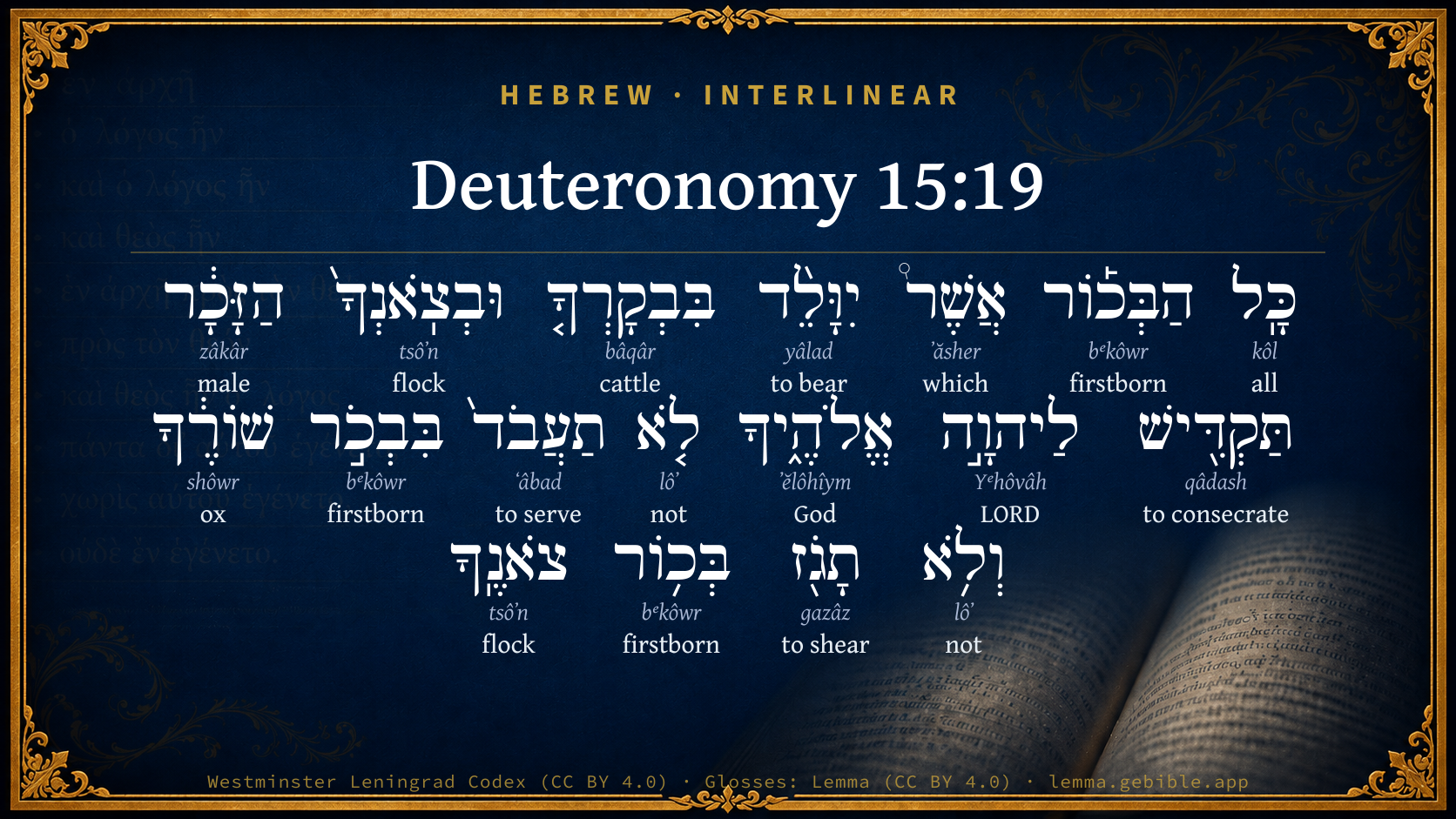
Hebrew (Westminster Leningrad Codex) Deuteronomy 15:19 appears in the Hebrew Old Testament. The text above is from the Westminster Leningrad Codex. Each word links to its Strong’s number, a concise gloss, and parsing drawn from the Open Scriptures Hebrew Bible morphology. Click any word for its full Brown-Driver-Briggs (BDB) entry.
Download image
Cite this verse

Deuteronomy 15:19 (World English Bible). Public Domain. Lemma interlinear Bible study tool, https://lemma.gebible.app/v/deuteronomy/15/19.

Show BibTeX & RIS
BibTeX
RIS
English Translation
All the firstborn males that are born of your herd and of your flock you shall sanctify to Yahweh your God: you shall do no work with the firstborn of your herd, nor shear the firstborn of your flock.
World English Bible · Public Domain
Download a study sheet

One document with this verse’s original text, its word-by-word gloss line, the meaning frame, cross-references with their text, attributed commentary, and full source and license credits — printable, and it pastes into notes with its structure intact.

This verse Autodidact and up

Study sheet (.html) Plain text (.txt)

A passage Seminary Student

Up to 50 verses in one chapter. A passage sheet keeps up to 6 commentary sources and 12 cross-references per verse, in the order this page ranks them, and says so on the sheet whenever that leaves anything out. Ask for a single verse and you get the Autodidact verse sheet above.

Everything on this page stays free to read, with no account — the sheet is a download of what is already on screen, not access to it.

Want to remove ads? Support Godless Engineer
Compare translations 3

The same verse in 3 English versions, stacked beneath the original-language interlinear above. Click any original word for its lexicon entry.

Each is an independent rendering of the whole verse — the interlinear is not word-aligned to these translations.

Highlighted words mark where these versions differ — a whole-verse word diff, not a word-by-word alignment.

  • World English Bible Public Domain
    All the firstborn males that are born of your herd and of your flock you shall sanctify to Yahweh your God: you shall do no work with the firstborn of your herd, nor shear the firstborn of your flock.
  • King James Version Public Domain
    All the firstling males that come of thy herd and of thy flock thou shalt sanctify unto the LORD thy God: thou shalt do no work with the firstling of thy bullock, nor shear the firstling of thy sheep.
  • unfoldingWord Literal Text CC BY-SA 4.0
    All the firstborn that are born in your herd and your flock, you shall sanctify the males to Yahweh your God. You shall not work with the firstborn of your herd, and you shall not shear the firstborn of your flock.

unfoldingWord Literal Text — © unfoldingWord, licensed CC BY-SA 4.0. Word-aligned USFM3 via Door43 (git.door43.org/unfoldingWord/en_ult).

Versions to compare (up to 4)

3 of 4 selected

Show all 18 translations

Every available English version of this verse, each an independent rendering of the whole verse.

  • World English Bible Public Domain
    All the firstborn males that are born of your herd and of your flock you shall sanctify to Yahweh your God: you shall do no work with the firstborn of your herd, nor shear the firstborn of your flock.
  • Berean Standard Bible Public Domain
    You must set apart to the LORD your God every firstborn male produced by your herds and flocks. You are not to put the firstborn of your oxen to work, nor are you to shear the firstborn of your flock.
  • Majority Standard Bible Public Domain
    You must set apart to the LORD your God every firstborn male produced by your herds and flocks. You are not to put the firstborn of your oxen to work, nor are you to shear the firstborn of your flock.
  • King James Version Public Domain
    All the firstling males that come of thy herd and of thy flock thou shalt sanctify unto the LORD thy God: thou shalt do no work with the firstling of thy bullock, nor shear the firstling of thy sheep.
  • American Standard Version (1901) Public Domain
    All the firstling males that are born of thy herd and of thy flock thou shalt sanctify unto Jehovah thy God: thou shalt do no work with the firstling of thy herd, nor shear the firstling of thy flock.
  • Revised Version (1885) Public Domain
    All the firstling males that are born of thy herd and of thy flock thou shalt sanctify unto the LORD thy God: thou shalt do no work with the firstling of thine ox, nor shear the firstling of thy flock.
  • Geneva Bible (1599) Public Domain
    All the first borne males that come of thy cattell, and of thy sheepe, thou shalt sanctifie vnto the Lord thy God. Thou shalt do no worke with thy first borne bullocke, nor sheare thy first borne sheepe.
  • Douay-Rheims (1899) Public Domain
    Of the firstlings, that come of thy herds and thy sheep, thou shalt sanctify to the Lord thy God whatsoever is of the male sex. Thou shalt not work with the firstling of a bullock, and thou shalt not shear the firstlings of thy sheep.
  • Young's Literal Translation Public Domain
    `Every firstling that is born in thy herd and in thy flock -- the male thou dost sanctify to Jehovah thy God; thou dost not work with the firstling of thine ox, nor shear the firstling of thy flock;
  • Literal Standard Version CC BY-SA 4.0
    Every firstling that is born in your herd and in your flock—you sanctify the male to your God YHWH; you do not work with the firstling of your ox, nor shear the firstling of your flock;
  • Unlocked Literal Bible CC BY-SA 4.0
    All the firstborn males in your herd and your flock you must set apart to Yahweh your God. You will do no work with the firstborn of your herd, nor shear the firstborn of your flock.
  • unfoldingWord Literal Text CC BY-SA 4.0
    All the firstborn that are born in your herd and your flock, you shall sanctify the males to Yahweh your God. You shall not work with the firstborn of your herd, and you shall not shear the firstborn of your flock.
  • Darby Bible Public Domain
    Every firstling that is born among thy kine and among thy sheep that is a male, thou shalt hallow to Jehovah thy God: thou shalt do no work with the firstling of thy kine, nor shear the firstling of thy sheep.
  • World Messianic Bible Public Domain
    You shall dedicate all the firstborn males that are born of your herd and of your flock to the LORD your God. You shall do no work with the firstborn of your herd, nor shear the firstborn of your flock.
  • Webster's Bible Public Domain
    All the firstling males that come of thy herd and of thy flock thou shalt sanctify to the LORD thy God: thou shalt do no work with the firstling of thy bullock, nor shear the firstling of thy sheep.
  • Free Bible Version CC BY-SA 4.0
    You are to separate out to give the Lord your God all the firstborn males of your herds and flocks. You must not have the firstborn of your cattle work, and don't shear the firstborn of your sheep.
  • Bible in Basic English Public Domain
    All the first males to come to birth in your herd and your flock are to be holy to the Lord your God: the first birth of your ox is not to be used for work, the wool of your first lamb is not to be cut.
  • JPS Tanakh (1917) Public Domain
    All the firstling males that are born of thy herd and of thy flock thou shalt sanctify unto the LORD thy God; thou shalt do no work with the firstling of thine ox, nor shear the firstling of thy flock.

Literal Standard Version (2020), Covenant Press — licensed CC BY-SA 4.0. Text via the HelloAO Bible API (eBible.org). Unlocked Literal Bible (unfoldingWord) — licensed CC BY-SA 4.0. Text via the HelloAO Bible API (eBible.org). unfoldingWord Literal Text — © unfoldingWord, licensed CC BY-SA 4.0. Word-aligned USFM3 via Door43 (git.door43.org/unfoldingWord/en_ult). Free Bible Version, Dr. Jonathan Gallagher — licensed CC BY-SA 4.0. Text via the HelloAO Bible API (eBible.org).

Word by word

More ways to search: Search by grammar → Find every occurrence → Compare this word →

Practice this passage: Drill this verse → Learn its vocabulary →

תָגֹ֖ז
gazâz
H1494
“to shear”
Verb, Qal, Imperfect, 2nd Person, Masculine, Singular
Part of Speech
Verb
Stem
Qal
Form
Imperfect
Person
2nd Person
Gender
Masculine
Number
Singular
Full BDB Definition

Origin: a primitive root [akin to H1468 ]

TWOT: 336

to shear, mow - (Qal) - to shear - shearer (participle) - (Niphal) to be cut off, be destroyed
  1. כָּֽל kôl H3605 “all of” Noun, Common, Masculine, Singular, Construct
  2. הַבְּכ֡וֹר bᵉkôwr H1060 “the · firstborn” Particle, Definite Article + Noun, Common, Masculine, Singular, Absolute
  3. אֲשֶׁר֩ ʼăsher H834 “which” Particle, Relative
  4. יִוָּלֵ֨ד yâlad H3205 “to bear” Verb, Niphal, Imperfect, 3rd Person, Masculine, Singular
  5. בִּבְקָרְךָ֤ bâqâr H1241 “in/at · cattle · your” Preposition + Noun, Common, Both, Singular, Construct + Suffix, Personal, 2nd Person, Masculine, Singular
  6. וּבְצֹֽאנְךָ֙ tsôʼn H6629 “and · in/at · flock · your” Conjunction + Preposition + Noun, Common, Both, Singular, Construct + Suffix, Personal, 2nd Person, Masculine, Singular
  7. הַזָּכָ֔ר zâkâr H2145 “the · male” Particle, Definite Article + Noun, Common, Masculine, Singular, Absolute
  8. תַּקְדִּ֖ישׁ qâdash H6942 “to consecrate” Verb, Hiphil, Imperfect, 2nd Person, Masculine, Singular
  9. לַיהוָ֣ה Yᵉhôvâh H3068 “to/for · LORD” Preposition + Noun, Proper
  10. אֱלֹהֶ֑יךָ ʼĕlôhîym H430 “God(s) · your” Noun, Common, Masculine, Plural, Construct + Suffix, Personal, 2nd Person, Masculine, Singular
  11. לֹ֤א lôʼ H3808 “not” Particle, Negative
  12. תַעֲבֹד֙ ʻâbad H5647 “to serve” Verb, Qal, Imperfect, 2nd Person, Masculine, Singular
  13. בִּבְכֹ֣ר bᵉkôwr H1060 “in/at · firstborn of” Preposition + Noun, Common, Masculine, Singular, Construct
  14. שׁוֹרֶ֔ךָ shôwr H7794 “ox · your” Noun, Common, Masculine, Singular, Construct + Suffix, Personal, 2nd Person, Masculine, Singular
  15. וְלֹ֥א lôʼ H3808 “and · not” Conjunction + Particle, Negative
  16. בְּכ֥וֹר bᵉkôwr H1060 “firstborn of” Noun, Common, Masculine, Singular, Construct
  17. צֹאנֶֽךָ tsôʼn H6629 “flock · your” Noun, Common, Both, Singular, Construct + Suffix, Personal, 2nd Person, Masculine, Singular

About this verse

These counts appear in no published source. They are computed here, from the morphology-tagged text and Lemma’s own curated glosses. What Lemma adds →

18
words
14
distinct lemmas
Pentateuch
section

Notable vocabulary

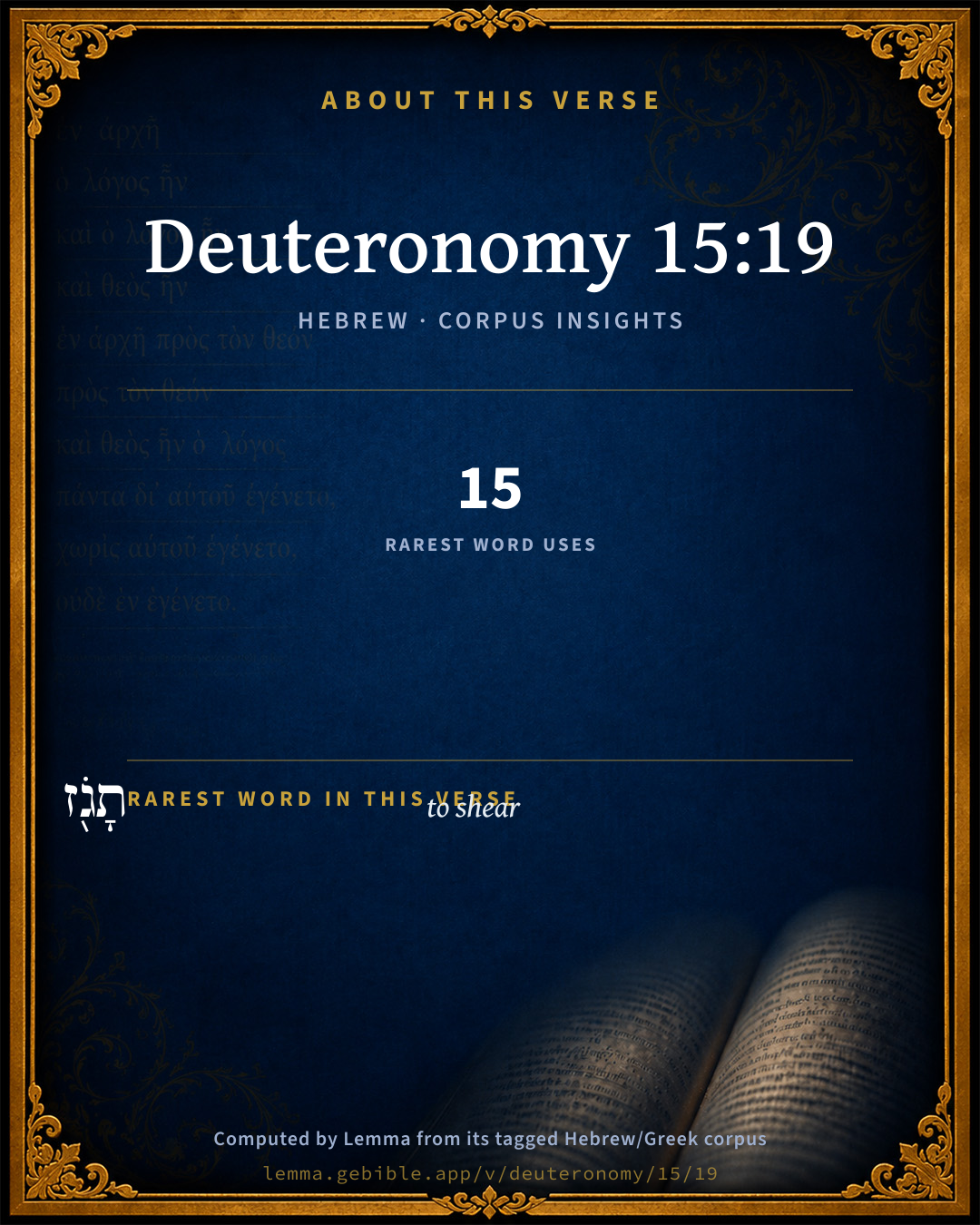
The rarest word here is תָגֹ֖ז to shear H1494 — appearing just 15 times in the whole Hebrew Bible.

Shared distinctive vocabulary

תָגֹ֖ז to shear H1494 occurs in 15 verses of the Hebrew Bible. Also found in:

Grammatical profile

  • 4 verbs
  • 11 nouns
  • 3 particles

Verb forms

  • יִוָּלֵ֨ד Niphal · Imperfect
  • תַּקְדִּ֖ישׁ Hiphil · Imperfect
  • תַעֲבֹד֙ Qal · Imperfect
  • תָגֹ֖ז Qal · Imperfect

Repetition

Words recur within this verse — often emphatic in Hebrew:

  • הַבְּכ֡וֹר firstborn H1060 ×3
  • וּבְצֹֽאנְךָ֙ flock H6629 ×2
  • לֹ֤א not H3808 ×2

Hebrew & Septuagint length

In English translation the verse runs 39 words from the Hebrew and 40 from the Septuagint (LXX English) — closely comparable.

A rough comparison of the two English renderings, which tokenize alike — not a word-level alignment.

Word counts can differ between the Hebrew and the Greek without any difference in meaning — e.g. the Hebrew direct-object marker אֵת has no separate Greek word, and Greek often adds the article ὁ.

Cross-references

14

Topical passages linked to Deuteronomy 15:19 in the Treasury of Scripture Knowledge — connected by theme and wording, ordered by reader-vote popularity; previews shown in the World English Bible.

  • Exodus 13:2 "Sanctify to me all of the firstborn, whatever opens the womb among the children of Israel, both of man and of animal. It is mine."
  • Exodus 13:12 that you shall set apart to Yahweh all that opens the womb, and every firstborn which you have that comes from an animal. The males shall be Yahweh's.
  • Leviticus 27:26 "'Only the firstborn among animals, which is made a firstborn to Yahweh, no man may dedicate it; whether an ox or sheep, it is Yahweh's.
  • Numbers 18:15 Everything that opens the womb, of all flesh which they offer to Yahweh, both of man and animal shall be yours: nevertheless the firstborn of man shall you surely redeem, and the firstborn of unclean animals shall you redeem.
  • Numbers 18:17 But the firstborn of a cow, or the firstborn of a sheep, or the firstborn of a goat, you shall not redeem; they are holy: you shall sprinkle their blood on the altar, and shall burn their fat for an offering made by fire, for a sweet savor to Yahweh.
  • Deuteronomy 12:17 You may not eat within your gates the tithe of your grain, or of your new wine, or of your oil, or the firstborn of your herd or of your flock, nor any of your vows which you vow, nor your freewill-offerings, nor the heave-offering of your hand;
  • Deuteronomy 16:14 and you shall rejoice in your feast, you, and your son, and your daughter, and your man-servant, and your maid-servant, and the Levite, and the foreigner, and the fatherless, and the widow, who are within your gates.
  • Exodus 34:19 All that opens the womb is mine; and all your cattle that is male, the firstborn of cow and sheep.
  • Numbers 3:13 for all the firstborn are mine. On the day that I struck down all the firstborn in the land of Egypt I made holy to me all the firstborn in Israel, both man and animal. They shall be mine. I am Yahweh."
  • Deuteronomy 12:5–7 But to the place which Yahweh your God shall choose out of all your tribes, to put his name there, even to his habitation shall you seek, and there you shall come;
  • Deuteronomy 14:23 You shall eat before Yahweh your God, in the place which he shall choose, to cause his name to dwell there, the tithe of your grain, of your new wine, and of your oil, and the firstborn of your herd and of your flock; that you may learn to fear Yahweh your God always.
  • Deuteronomy 16:11 and you shall rejoice before Yahweh your God, you, and your son, and your daughter, and your man-servant, and your maid-servant, and the Levite who is within your gates, and the foreigner, and the fatherless, and the widow, who are in the midst of you, in the place which Yahweh your God shall choose, to cause his name to dwell there.
  • Hebrews 12:23 to the general assembly and assembly of the firstborn who are enrolled in heaven, to God the Judge of all, to the spirits of just men made perfect,
  • Romans 8:29 For whom he foreknew, he also predestined to be conformed to the image of his Son, that he might be the firstborn among many brothers.

Cross-references courtesy of OpenBible.info (CC BY 4.0).

Hebrew and Greek witnesses Masoretic Hebrew ↔ Greek Septuagint

The same verse in the two great witnesses to the Old Testament, shown verse-for-verse.

These are two independent witnesses, not word-aligned to each other, and the Septuagint is shown in lemma (dictionary) form.

Hebrew Deuteronomy 15:19 Masoretic · Westminster Leningrad Codex

כָּֽל הַבְּכ֡וֹר אֲשֶׁר֩ יִוָּלֵ֨ד בִּבְקָרְךָ֤ וּבְצֹֽאנְךָ֙ הַזָּכָ֔ר תַּקְדִּ֖ישׁ לַיהוָ֣ה אֱלֹהֶ֑יךָ לֹ֤א תַעֲבֹד֙ בִּבְכֹ֣ר שׁוֹרֶ֔ךָ וְלֹ֥א תָגֹ֖ז בְּכ֥וֹר צֹאנֶֽךָ

All the firstborn males that are born of your herd and of your flock you shall sanctify to Yahweh your God: you shall do no work with the firstborn of your herd, nor shear the firstborn of your flock.

World English Bible · Public Domain

Greek LXX Deuteronomy 15:19 Septuagint · lemma form

πᾶς πρωτότοκος ὅς ἐάν τίκτω ἐν ὁ βοῦς σύ καί ἐν ὁ πρόβατον σύ ὁ ἀρσενικός ἁγιάζω κύριος ὁ θεός σύ οὐ ἐργάζομαι ἐν ὁ πρωτότοκος μόσχος σύ καί οὐ μή κείρω ὁ πρωτότοκος ὁ πρόβατον σύ

Every firstborn that shall be born among your kine and your sheep, you shall sanctify the males to the Lord your God; you shall not work with your firstborn calf, and you shall not shear the firstborn of your sheep.

LXX2012 (modern English Septuagint) · Public Domain

Hebrew: Westminster Leningrad Codex (CC BY 4.0). Greek: Septuagint (public domain); English from LXX2012 (modern English Septuagint) (Public Domain). How the Septuagint differs from the Hebrew →

Targum (Aramaic paraphrase)

2

The Targum is the ancient Jewish Aramaic paraphrase of the Hebrew Scriptures — an interpretive translation, not the Hebrew text itself. Onkelos (literal) and Pseudo-Jonathan (expansive) render the Torah, and Jonathan the Prophets. Coverage is partial: where no permissively-licensed English translation exists for a verse, only the Aramaic is shown. This is verse-level text, not a word-by-word alignment to the Hebrew.

  1. Targum Onkelos Torah (Genesis–Deuteronomy)
    כָּל בּוּכְרָא דִי יִתְיְלִיד בְּתוֹרָךְ וּבְעָנָךְ דִכְרִין תַּקְדֵשׁ קָדָם יְיָ אֱלָהָךְ לָא תִפְלַח בְּבוּכְרָא דְתוֹרָךְ וְלָא תֵגוֹז בּוּכְרָא דְעָנָךְ

    (no public-domain English translation for this verse)

    Targum Onkelos — Aramaic: “Onkelos Genesis” (public domain); “Onkelos Exodus” (public domain); “Onkelos Leviticus” (public domain); “Onkelos Numbers” (public domain); “Onkelos Deuteronomy” (public domain). English: “Sefaria Community Translation” (CC0 1.0 (public-domain dedication)); “J.W. Etheridge. The Targums of Onkelos and Jonathan Ben Uzziel on the Pentateuch. London: Longmans, Green, 1862” (public domain). Text via Sefaria.

  2. Targum Pseudo-Jonathan Torah (Genesis–Deuteronomy)
    כָּל בּוּכְרָא דְאִתְיְלִיד בְּתוֹרָךְ וּבְעָנָךְ דּוּכְרַיָא תַּקְדֵּישׁ קֳדָם יְיָ אֱלָהָךְ לָא תִפְלוֹחַ בְּבִכּוּרֵי תּוֹרֵיכוֹן וְלָא תֵיגוֹז בִּכּוּרֵי עָנֵיכוֹן

    Every firstling male that cometh of thy herd and flock thou shalt consecrate before the Lord thy God. Thou shalt not work with the firstlings of your herd, nor shear the firstlings of your flocks;

    Targum Pseudo-Jonathan — Aramaic: “Targum Jonathan on Genesis” (public domain); “Targum Jonathan on Exodus” (public domain); “Targum Jonathan on Leviticus” (public domain); “Targum Jonathan on Numbers” (public domain); “Targum Jonathan on Deuteronomy” (public domain). English: “The Targum of Jonathan ben Uzziel, trans. J. W. Etheridge, London, 1862” (public domain). Text via Sefaria.

Commentary

Notes on Deuteronomy 15:19 from classic Christian and Jewish commentators (each source and its license shown beneath its notes). The classic Christian expositions comment on the surrounding passage and are grouped to its opening verse, so a note may address several verses; the Jewish commentaries on the Tanakh (Rashi and others) are per-verse, so they appear only where the commentator wrote on this verse.

Lemma curates 59 commentaries, every one of them public domain or Creative Commons licensed, each selected and text-cleaned for this edition rather than reprinted as found. About our sources →

Matthew Henry's Commentary

Here is, 1. A repetition of the law concerning the firstlings of their cattle, that, if they were males, they were to be sanctified to the Lord (Deu 15:19), in remembrance of, and in thankfulness for, the sparing of the first-born of Israel, when the first-born of the Egyptians, both of man and beast, were slain by the destroying angel (Exo 13:2, Exo 13:15); on the eighth day it was to be given to God (Exo 22:30), and to be divided between the priest and the altar, Num 18:17, Num 18:18. 2. An addition to that law, for the further explication of it, directing them what to do with the firstlings, (1.) That were females: "Thou shalt do no work with the female firstlings of the cow, nor shear those of the sheep" (Deu 15:19); of them the learned bishop Patrick understands it. Though the female firstlings were not so entirely sanctified to God as the males, nor so early as at eight days old, yet they were not to be converted by the owners to their own use as the other cattle, but must be offered to God as peace-offerings, or used in a religious feast, at the year's end, Deu 15:20. Thou shalt eat it before the Lord thy God, as directed Deu 12:18. (2.) But what must they do with that which was blemished, ill-blemished? Deu 15:21. Were it male or female, it must not be brought near the sanctuary, nor used either for sacrifice or for holy feasting, for it would not be fit to honour God with, nor to typify Christ, who is a Lamb without blemish; yet it must not be reared, but killed and eaten at their own houses as common food (Deu 15:22), only they must be sure not to eat it with the blood, Deu 15:23. The frequent repetition of this caution intimates what need the people had of it, and what stress God laid upon it. What a mercy it is that we are not under this yoke! We are not dieted as they were; we make no difference between a first calf, or lamb, and the rest that follow. Let us therefore realize the gospel meaning of this law, devoting ourselves and the first of our time and strength to God, as a kind of first-fruits of his creatures, and using all our comforts and enjoyments to his praise and under the direction of his law, as we have them all by his gift.

Matthew Henry's Commentary on the Whole Bible (1708–1710) — public domain (CC PDM 1.0). Text via the HelloAO Bible API.

Albert Barnes' Notes on the Bible

Compare Exo 13:11 ff. The directions of the preceding legislation (see Num 18:15 ff) are here assumed, with the injunction added, that the animals thus set apart to God Deu 15:19 were not to be used by their owners for their earthly purposes. It is further allowed that firstborn animals which had a blemish should be regarded as exceptions, and instead of being given to God might be used as food Deu 15:21-22. The application of the firstborn of cattle is here directed as in Deu 12:6, Deu 12:17; Deu 14:23 : they are to be consumed in the sacred Feasts at the sanctuary.

Albert Barnes' Notes on the Bible (1834–1885) — public domain. Text from a community e-Sword/MySword module.

Joseph Benson's Commentary

Deu 15:19-20. All the firstling males thou shalt sanctify — Giving them to God on the eighth day. And thou shalt do no work with the female firstlings of the cow, nor shear those of the sheep. Even these must be offered to God as peace-offerings, or used in a religious feast. Year by year — Namely, in the solemn feasts, which returned upon them every year.

Joseph Benson's Commentary on the Old and New Testaments (1811–1818) — public domain. Text from a community e-Sword module.

The Annotated Bible

Arno C. Gaebelein

12. The Firstlings and the Three Feasts

CHAPTERS 15:19-16:17

1. Concerning the firstlings (Deu 15:19-23)

2. Passover (Deu 16:1-8)

3. Feast of weeks (Deu 16:9-12)

4. Feast of tabernacles (Deu 16:13-17)

What is said in the closing verses of chapter 15 is supplementary to the law given concerning the first-born in Exo 13:2; Exo 13:12 and Numbers 18. They were not to be worked or sheared. “Before the Lord thy God shalt thou eat it, year after year, in the place which the Lord shall choose, thou and thy household.” Nothing which had a blemish, was lame or blind could be sacrificed. The spotless Lamb of God is here in view once more and the type is given how we are to feed on Him in the presence of God, in the sanctuary.

The feasts were mentioned in Exodus 12; Leviticus 23; Numbers 28-29. Here only the Passover, the feast of weeks and the feast of tabernacles are given. The critics claim that there is contradiction between this chapter and the laws concerning the feasts in the previous books of the Pentateuch. Such contradiction, however, does not exist. That only these three feasts are mentioned here is in full harmony with the character and message of Deuteronomy.

Obedience, as we have repeatedly learned from the study of past chapters, is the demand of Jehovah from His people. The three prominent feasts were absolutely obligatory. Three times in a year all the males were commanded to appear before the Lord to keep these three feasts. No such demand was made in keeping the feast of trumpets and the day of atonement. Because these three feasts were to be obeyed, they are mentioned in Deuteronomy. The objections of the critics spring (as all other objections and criticisms) from the lack of spiritual discernment. The contradiction they see is only another evidence of the perfection of His Word. “The place, which Jehovah thy God will choose” occurs six times in this chapter. This was not mentioned in Exodus, Leviticus or Numbers. This again is characteristic of the book. Over twenty-five times mention is made of the place which Jehovah will choose, the gathering place of His people in His presence, and this demands obedience. What these feasts mean typically and dispensationally may be learned by consulting the annotations of Leviticus 23. The fact is also to be remembered that they came out of Egypt (verses 3 and 12). They are commanded to rejoice on the feast of weeks (Pentecost) and on the feast of tabernacles (typical of the time of joy and blessing in the coming age); but the statement “thou shalt rejoice” is omitted in connection with Passover. Redemption is typified in that feast. This calls forth gratitude and praise to God. The solemnity of the death of the Lamb of God and the judgment our Lord had to pass through, must be the reason why the command to rejoice is absent.

Arno C. Gaebelein, The Annotated Bible (1913–1922) — public domain. Text from a community e-Sword module.

Tyndale Open Study Notes

Tyndale Open Resources

15:19 The firstborn males of livestock represented the firstborn sons of Israel who had been spared from death in the tenth plague (Exod 12:12, 29; 13:2, 12; 22:29).

Tyndale Open Study Notes — © Tyndale Open Resources, licensed CC BY-SA 4.0. Text via the HelloAO Bible API.

Geneva Bible (1599)

Geneva Bible translators

For they are the Lord’s.

Geneva Bible (1599) marginal notes — public domain. Text via Bolls.life.

Jamieson, Fausset & Brown

Robert Jamieson, A. R. Fausset & David Brown

All the firstling males of thy herd and of thy flock thou shalt sanctify unto the Lord thy God--[See on Exo 13:2]; see Exo 22:30).

thou shalt do not work with the firstling of thy bullock--that is, the second firstlings (see Deu 12:17-18; Deu 14:23).

Next: Deuteronomy Chapter 16

Jamieson, Fausset & Brown — Commentary Critical and Explanatory on the Whole Bible (1871) — public domain (CC PDM 1.0). Text via the HelloAO Bible API.

Ellicott's Commentary for English Readers

(19) All the firstling males. . . . thou shalt sanctify—i.e., recognise them as the property of Jehovah by not using them for ordinary purposes. In Lev_27:26 we read, “No man shall sanctify it”—i.e., shall make it the subject of a special vow or dedication, because it already belongs to Jehovah. This is the only interpretation consistent with the context in Leviticus; for Deuteronomy 27 deals entirely with “voluntary” offerings, which are in a sense outside the Law. (See Notes at the commencement of Deuteronomy 28, 29).

A Bible Commentary for English Readers, edited by Charles John Ellicott (1878–1897) — public domain. Text from a community e-Sword module.

The Cambridge Bible for Schools and Colleges

gen. ed. J. J. S. Perowne

19. firstling] Heb. bekôr, firstborn both of men (e.g. Deu_21:15 f., Exo_11:5) and of animals; either collectively or of the individual firstling. The root meaning is to break; and bekôr is defined (Exo_13:2; Exo_34:19) as that which openeth, or cleaveth, the womb. It covers, therefore, not the earliest births of every year in the herd or flock, but the firstborn of every dam. W. R. Smith, Rel. Sem. 443, compares the ambiguous Ar. fara‘. Another form, bikku̅ri̅m, is applied to firstfruits in general; bikkurah is the early fig (Mic_7:1, etc.).

males] ‘At least a preference for male victims is found among the Semites generally, even where the deity is a goddess,’ W. R. Smith, Rel. Sem. 280 n.; with instances from the Semitic and African races. He connects the distinction on the one hand with the prevalence of kinship through women and on the other with the fact that the cow fosters man with its milk.

thou shalt sanctify unto the Lord] So P, Exo_13:2 (but with a different form of the same vb.); J. Exo_13:12, thou shalt cause to pass over to Jehovah; Exo_34:19, all that openeth the womb is mine.

19–23. Of Firstlings

All male firstlings of herd and flock are to be sanctified to Jehovah; those of the ox shall not work nor those of the sheep be shorn; their flesh shall be eaten before the Lord by the offerer and his household at the One Altar year by year (Deu_15:9 f.). A blemished firstling shall not be sacrificed, but eaten at home under the conditions laid down (Deu_12:20 ff.) for the profane slaughter and eating of animals (Deu_15:21-23).—Sg. throughout. Steuern. takes Deu_15:21 and Deu_15:22 f. as probably later additions on the ground that the former is covered by Deu_17:1, the latter by Deu_12:22 ff. But their repetition in this law is pertinent to its central purpose. For reasons why the law is placed just here see below on Deu_15:20.

The earliest law on firstlings is found in variant forms in J, Exo_13:11-16; Exo_34:19 f. and E, Exo_22:2 f. (see the notes in Driver’s Exod. 108, 235, 370 ff. with comparative table). These enjoin the passing over or giving to the Lord of all firstborn males, both human and animal; those of men and ‘unclean’ animals (i.e. unfit for sacrifice) may be redeemed. D does not give so full a law on the subject, for his only intention is to adapt the practice enjoined in these earlier laws to the new conditions in which sacrifice is lawful only at the one shrine. Hence he says nothing of the firstborn of men or of unclean beasts. And hence he omits the provision in Exo_22:29 f, that the firstlings of ox and sheep were to be taken from the dam after seven days and on the eighth given to the Lord; because, while this was practicable when there were many local shrines, it is no longer so when there is to be one altar. Hence also he substitutes the general direction that the offerings are to be made year by year. No more clear illustration could be afforded of the fact that D’s code was not intended as a complete legislation, but that its motive was simply to modify earlier codes or the consuetudinary laws of Israel to the new situation brought about by its central law of one sanctuary.—P’s law on the subject, Num_18:15-18, is similar to the others; but adds that the flesh of the firstlings of oxen, sheep and goats shall be the perquisite of the priests: an injunction irreconcileable with D’s, that it is to be enjoyed by the offerer and his family, and indicative, like so much else in P, of the growing power of the priesthood to absorb what had previously been the rights of the laity.

The Cambridge Bible for Schools and Colleges (gen. ed. J. J. S. Perowne; Cambridge University Press, 1878–1918) — public domain. Text from a community e-Sword module.

John Gill's Exposition

All the firstling males that come of thy herd, or of thy flock, thou shalt sanctify unto the Lord thy God,.... According to the law in Exo 13:2. See Gill on Exo 13:2; See Gill on Exo 13:12; See Gill on Exo 13:13,

thou shalt do no work with the firstling of thy bullock: as to plough or tread out the corn with it, which were done with other heifers:

nor shear the firstling of thy sheep; nor was the wool shorn of it to be made use of; one of the Jewish canons runs thus,"if any man weave an hand's breadth of the wool of a firstling into cloth, the cloth is to be burnt (l).''

(l) Misn. Orlah, c. 3. sect. 3.

John Gill's Exposition of the Whole Bible (1746–1763) — public domain (CC PDM 1.0). Text via the HelloAO Bible API.

Haydock's Catholic Bible Commentary

Firstlings. Some belonged to the priests. Others, of which Moses speaks here, might be disposed of by the owners, chap. xii. 17. (Calmet) --- Thus females, which came first, belonged to them, but they could not work with them; (Menochius) with such at least as were the best, and fattened for a religious feast. Sheep designed for this purpose were not to be shorn; or, as the original term means, their wool was not to be "torn away." Bellon observes, that this is still the custom in some parts of the East, as it was formerly in Italy, according to Varro. Pliny ([Natural History?] viii. 48,) also remarks, that fleece was torn off in some places, (Calmet) and the same method is said to prevail still in Shetland. (Haydock)

George Leo Haydock (1774–1849), Haydock's Catholic Family Bible and Commentary, 1859 edition — public domain. Excludes Psalms (Douay-Rheims chapter numbering differs from Protestant) and Deuterocanonical books (Catholic canon only).

Matthew Poole's English Annotations

With the firstling of thy bullock: this is meant, either,

1. Of the male firstlings; which, they say, is forbidden here, because some did plough with the firstlings of their oxen, and shear the firstlings of their sheep, before they were offered. But this seems absurd and incredible, because they were to be offered on the eighth day, Exo 22:30, when they were very unfit for such uses. Or rather,

2. The second firstlings, of which see on Deu 12:17.

Matthew Poole's English Annotations on the Holy Bible (1683–1685) — public domain. Text from a community e-Sword/MySword module.

Whedon's Commentary on the Bible

Daniel D. Whedon

19-23. The firstling males — The firstborn of the herd and flock, if males, were to be set apart — not used for ordinary purposes — to be devoted to the service of Jehovah.

Sanctify unto the Lord thy God — That is, these were to be used in the sacred feasts which were to be celebrated at the sanctuary, the place which the Lord shall choose.

Daniel D. Whedon (gen. ed.), Commentary on the Old and New Testaments (1874–1909) — public domain. Text from a community e-Sword module.

The Pulpit Commentary

Vers. 19-23. in Deu_12:6, 17 and in Deu_14:23, reference is made to sacrificial meals, and to the appropriation of the firstlings of the herds and flocks thereto; Moses here reverts to this, and gives a fuller exposition of it. It is enjoined that, as all the firstborn were to be sanctified to the Lord, (Exo_13:2-13) they were not to work with the firstborn of their cattle, either by yoking the bullock to the plough or wagon or by shearing the sheep: these belonged to God, and were not to be put to any vulgar uses of men; year by year they were to be brought to the sanctuary, offered as sacrifices, and eaten before the Lord. If any of the firstborn animals were blind, or lame, or in any way blemished, such was not to be offered to the Lord, but might be used as food in their ordinary places of residence. (cf. Lev_22:19, etc.)

Vers. 19-23. The firstlings.

The solution of the apparent discrepancy between this passage and Num_18:18 seems to lie in the custom of inviting the worshippers to share in the feasts provided by their offerings. View the sanctification of the firstlings as symbolical.

1. Of God"s claim on the first and choicest of what we have for his own service.

(1) Of our property.

(2) Of our affections.

(3) Of our powers of body and mind.

2. Of God"s right to redeemed life. The firstlings were redeemed by God for himself on the memorable night of the deliverance from Egypt. (Exo_13:12) God claims redeemed life as peculiarly his own. (Isa_43:1-4; 1Co_6:20)

1. Of God"s right to young life. A symbol of early consecration.

2. Of happy fellowship with God. The fellowship was a fruit of the dedication of the best. J.O.

Vers. 19-23. The firstlings for God.

The firstlings which were males were not to be reared for work, but kept for communion. They were to constitute, if perfect, a peace offering before God; if imperfect, they were to be eaten at home, imperfect fellowship between imperfect persons. Just as in the firstfruits God claimed the first share; so in the case of the firstlings of the herd or flock, and the firstborn among men.

I THE BEGINNINGS OF LIFE SHOULD BE RECOGNIZED AS GIFTS OF GOD, AND DEDICATED GRATEFULLY TO HIM. He is the Source of life; hence the firstlings should be the cause of quiet meditation and acknowledgment. Such increase should be the occasion of special fellowship with God, enlarging gratitude and dictating devotion.

II IMFERFECTIONS IN GOD"S GIFTS SHOULD BE ACCEPTED BY MEN AS MORE THAN THEY DESERVE. The imperfect firstling, in being made a feast for men only, and not a sacrifice for God as well, seemed to say that, however imperfect God"s gift may be sometimes, it should be gratefully accepted as beyond our desert. The blemished, the lame, the blind, when God sends them in his providence, we should not despise, but rather hail them as beyond our desert.

And if this was to be the case in the use of beasts, does it not throw clear light upon our conduct in the case of imperfect men? When children come into this world with any defect, let us not rebel against his will, but cherish the defective gift as reminding us how little we deserve, and by our love give such children compensation.

III THE DEDICATION OF THE PERFECT FIRSTLING POINTED TO THE CONSECRATED FIRSTBORN, JESUS CHRIST. He is indeed the Firstborn of every creature. To him the firstlings and firstborn pointed. He was dedicated in life and death to the Father. He became the great Peace Offering which makes God and man one. And this suggests

1. The Father"s delight in Jesus. How it burst forth from time to time in "This is my beloved Son, in whom I am well pleased"! What delight in our Lord"s life! what satisfaction in his obedience unto death! God well pleased!

2. Our delight in Jesus. Jesus becomes the medium of communion. We have him in common with God. "Our fellowship is with the Father, and with his Son Jesus Christ". (1Jn_1:3) The more we meditate upon him, the deeper must be our delight. R.M.E.

Vers. 19-23. The first for God.

As God is supreme, so his claim to recognition and obedience must have consideration prior to all other claims. Such priority is his indefeasible right; such priority best subserves the interests of men. The first day of the week he claims and hallows; the firstfruits of the soil he claims for religious offering; the first place in our affections he asks as his due; the firstborn, both of man and of beast, he marks as his own. This is his royalty.

I THE REPRODUCTIONS OF LIFE A CONTINUOUS CREATION OF GOD. It is acknowledged on every side that life can only spring from life. No arrangements of material atoms no processes of chemical change with which men are acquainted can produce life. It is a force unique in itself, and can only rationally be traced to the creative power of a personal God. The potency to reproduce life, which God has placed in all the species, is as clearly a demonstration of his creative energy as if he manifestly and alone created each individual being. We cannot escape from the conclusion that he is sole Life-giver. I kill," saith God, and I make alive.

II THE CLAIM OF THE FIRSTBORN ALONE IS A CONCESSION OF THE FULLEST RIGHTS OF GOD. He has a rightful proprietorship in all life. But he allows to man, as his liege vassal, dominion over the inferior races of his creatures. Acknowledgment of man"s subjection must, however, be made; tribute must be paid to the Heavenly King. This arrangement is an act of combined justice and kindness. For man"s highest good, he must be kept in perpetual remembrance of his dependence and his obligation. If the springs of gratitude in man"s nature should dry up, his loss would be immeasurable. Every memorial we have of God is a gospel.

III GOD"S CLAIM AND MAN"S ENJOYMENT ARE IDENTICAL. This devotement of the firstlings to God was no real loss: it was every way a blessing. It cherished in them a feeling of filial dependence. It took them up to the temple, year by year, and so brought them into close contact with eternal things. It served to link religion with the commonest affairs of daily life. It taught them that God found a pleasure in their enjoyments, and that his commandments were promotive of real delight. Thus the acts of Jehovah"s worship were not identified with fasting and austerity, but with eating and drinking in the sacred temple. The pleasure was all the greater because it was social. In the banquet and festivity the whole household partook.

IV IMPERFECT SACRIFICES PROHIBITED. Very evident is it that this demand of the firstborn was designed for spiritual instruction. However great God"s care for our bodily life appears, his desire for our souls" well-being is immeasurably greater. By such visible and impressive methods God sought to teach the Jews that perfection of nature was God"s design, and that such perfection would alone find a place in his heavenly temple. The best feelings and aspirations of our nature yearn after perfection. Nothing less will satisfy the mind of God; nothing less will satisfy us. "Then shall I be satisfied, when I awake with thy likeness.

V YET BLEMISHED LIFE IS BETTER THAN BARRENNESS. A lame or a blemished lamb a firstborn was not utterly useless. It served as food for man, it sustained human life. But it was deprived of the honor of being devoted to God. Imperfect service is not altogether useless in the world. If we do a kindness to a neighbor, though no love to God prompt the deed, some good will result. Continuance in good deeds will gradually lead to better feelings and to nobler purposes. He who serves well his fellow-men now, will ere long learn to serve God. Let us ever follow the best sentiments which arise within, though yet very imperfect. D.

The Pulpit Commentary (1880–1919), ed. H.D.M. Spence-Jones & Joseph S. Exell — public domain. Text from a community e-Sword module.

John Wesley's Explanatory Notes

All the firstling males thou shalt sanctify - Giving them to God on the eighth day. And thou shalt do no work with the female firstlings of the cow, nor shear those of the sheep. Even these must be offered to God as peace-offerings, or used in a religious feast.

John Wesley, Explanatory Notes Upon the Whole Bible (1754–1765) — public domain. Text via the GEBible commentary corpus.

Keil & Delitzsch

C. F. Keil & F. Delitzsch

Application of the first-born of Cattle. - From the laws respecting the poor and slaves, to which the instructions concerning the tithes (Deu 14:22-29) had given occasion, Moses returns to appropriation of the first-born of the herd and flock to sacrificial meals, which he had already touched upon in Deu 12:6, Deu 12:17, and Deu 14:23, and concludes by an explanation upon this point. The command, which the Lord had given when first they came out of Egypt (Exo 13:2, Exo 13:12), that all the first-born of the herd and flock should be sanctified to Him, is repeated here by Moses, with the express injunction that they were not to work with the first-born of cattle (by yoking them to the plough or waggon), and not to shear the first-born of sheep; that is to say, they were not to use the first-born animals which were sanctified to the Lord for their own earthly purposes, but to offer them year by year as sacrifices to the Lord, and consume them in sacrificial meals. To this he adds (Deu 15:21, Deu 15:22) that further provision, that first-born animals, which were blind or lame, or had any other bad fault, were not to be offered in sacrifice to the Lord, but, like ordinary animals used for food, could be eaten in all the towns of the land. Although the first part of this law was involved in the general laws as to the kind of animal that could be offered in sacrifice (Lev 22:19.), it was by no means unimportant to point out distinctly their applicability to the first-born, and add some instructions with regard to the way in which they were to be applied. (On Deu 15:22 and Deu 15:23, see Deu 12:15 and Deu 12:16.)

Keil & Delitzsch — Biblical Commentary on the Old Testament (1861–1891) — public domain (CC PDM 1.0). Text via the HelloAO Bible API. (Old Testament only.)

Kretzmann's Popular Commentary

Paul E. Kretzmann

Of the Firstlings

v. 19. All the firstling males that come of thy herd and of thy flock thou shalt sanctify unto the Lord, thy God, as a sacrifice or its equivalent; thou shalt do no work with the firstling of thy bullock, nor shear the firstling of thy sheep, use the animals consecrated to Jehovah for earthly purposes.

v. 20. Thou shalt eat it before the Lord, thy God, year by year, in the place which the Lord shall choose, thou and thy household, as a sacrificial meal. Cf Deu 12:5-7; Exo 13:2; Exo 34:19.

v. 21. And if there be any blemish therein, as, if it be lame, or blind, or have any ill blemish, if it is not physically perfect, thou shalt not sacrifice it unto the Lord, thy God, in order not to profane the sacred meals.

v. 22. Thou shalt eat it within thy gates, every Israelite in his own city; the (Levitically) unclean and the clean person shall eat it alike, as the roebuck and as the hart, which were not sacrificial animals, but could be used for food, Deu 12:15 to Deu 21:22.

v. 23. Only thou shalt not eat the blood thereof; thou shalt pour it upon the ground as water, Deu 12:16 to Deu 23:24. They were to be holy, undefiled, as the people consecrated to the Lord, a fact which is true also with regard to the spiritual condition of the Christians, who also are a chosen generation, 1Pe 2:9.

Paul E. Kretzmann, Popular Commentary of the Bible (1921–1924) — public domain. Text from a community e-Sword module.

unfoldingWord translationNotes

Door43 World Missions Community

General Information:

Moses continues speaking to the people of Israel.

shear

to cut off wool or hair

before Yahweh

"in the presence of Yahweh"

year by year

"each year" or "every year"

lame

crippled or physically disabled

translationWords

firstborn

flocks

set apart

Yahweh

God

year

household

blemish

sacrifice

unfoldingWord translationNotes — © Distant Shores Media and the Door43 World Missions Community, licensed CC BY-SA 4.0. Source: git.door43.org/Door43/en_tn.

Rashi

Rabbi Shlomo Yitzchaki (Rashi)

כל הבכור... תקדיש ALL THE FIRSTLING MALES … THOU SHALT SANCTIFY [UNTO THE LORD] — But in another passage (Leviticus 27:26) it states, “[Only the firstborn of the beasts …] one shall not sanctify it”? How can these be reconciled? The latter passage means: he must not dedicate it as a different sacrifice (i.e. offer it as an עולה or שלמים instead of as a בכור), whilst here it teaches that it is a duty to say: “Thou art holy as a firstborn!” Another comment is: It is impossible to say that “thou shalt sanctify” is to be taken literally, for it already states in another passage “one shall not sanctify it”; it is, on the other hand, also impossible to take “one shall not sanctify it” literally, since it states “thou shalt sanctify it”. How can these be reconciled? In the following manner: by taking תקדיש in our verse to imply: “thou mayest dedicate” so far as the dedication of its value (הקדש עלוי) is concerned, and then he must give a sum corresponding to the טובת הנאה in it to the Temple treasury, but you must not dedicate it as far as the altar is concerned (i.e. dedicate it as any sacrifice other than as a בכור) (Arakhin 29a: cf. Sifrei Devarim 124:4).

לא תעבד בבכור שורך ולא תגז וגו׳ THOU SHALT NOT WORK WITH THE FIRSTLING OF THY HERD, NOR SHEAR [THE FIRSTLING OF THY FLOCK] — The converse case also (working with the firstborn sheep and using the hair of the firstborn calf) have our Rabbis derived to be forbidden, but Scripture merely speaks of what usually occurs (Sifrei Devarim 124:6; Bekhorot 25a).

Rashi on the Tanakh — English translations: “The Judaica Press complete Tanach with Rashi, translated by A. J. Rosenberg” (CC BY 4.0); “Pentateuch with Rashi's commentary by M. Rosenbaum and A.M. Silbermann, 1929-1934” (public domain); “The Metsudah Tanach series, Lakewood, N.J” (CC BY 4.0); and “The Book of Joshua, Metsudah Publications, 1997” (CC BY 4.0). Text via Sefaria.

Lesson kit

Teaching starters — assembled from the data on this page, not authored interpretation. Every prompt links to the verse data it draws on. Edit before teaching.

Deuteronomy, in the Pentateuch, opens this verse with 18 words (14 distinct Hebrew lemmas). Its most distinctive word is gazâz (“to shear”). A historical commentator’s framing appears above. Read the whole chapter for the surrounding context.

Discussion questions

  1. What does “to shear” (gazâz) contribute to the verse as a whole?
  2. How does Genesis 31:19, which shares the word «to shear», read alongside this verse?
  3. What does the repetition of “firstborn” (3× in this one verse) do in this verse?
  4. These translations render this verse differently. What is at stake in choosing one wording over another?
  5. «יִוָּלֵ֨ד» is a Niphal Imperfect verb. How does that grammatical form shape the action described?
  6. Compare how Matthew Henry's Commentary and Albert Barnes' Notes on the Bible read this verse. Where do they agree or differ?

Things to notice

Reading settings

Reading text

Shown beneath each verse's original-language words.

Old Testament
Old Testament edition

Read the OT as the Masoretic Hebrew (MT) or the Greek Septuagint (LXX).

English shown for the Greek Septuagint (in the Hebrew ↔ Greek comparison).

Comparing translations? Open the Compare panel on any verse page to stack up to four side by side.