
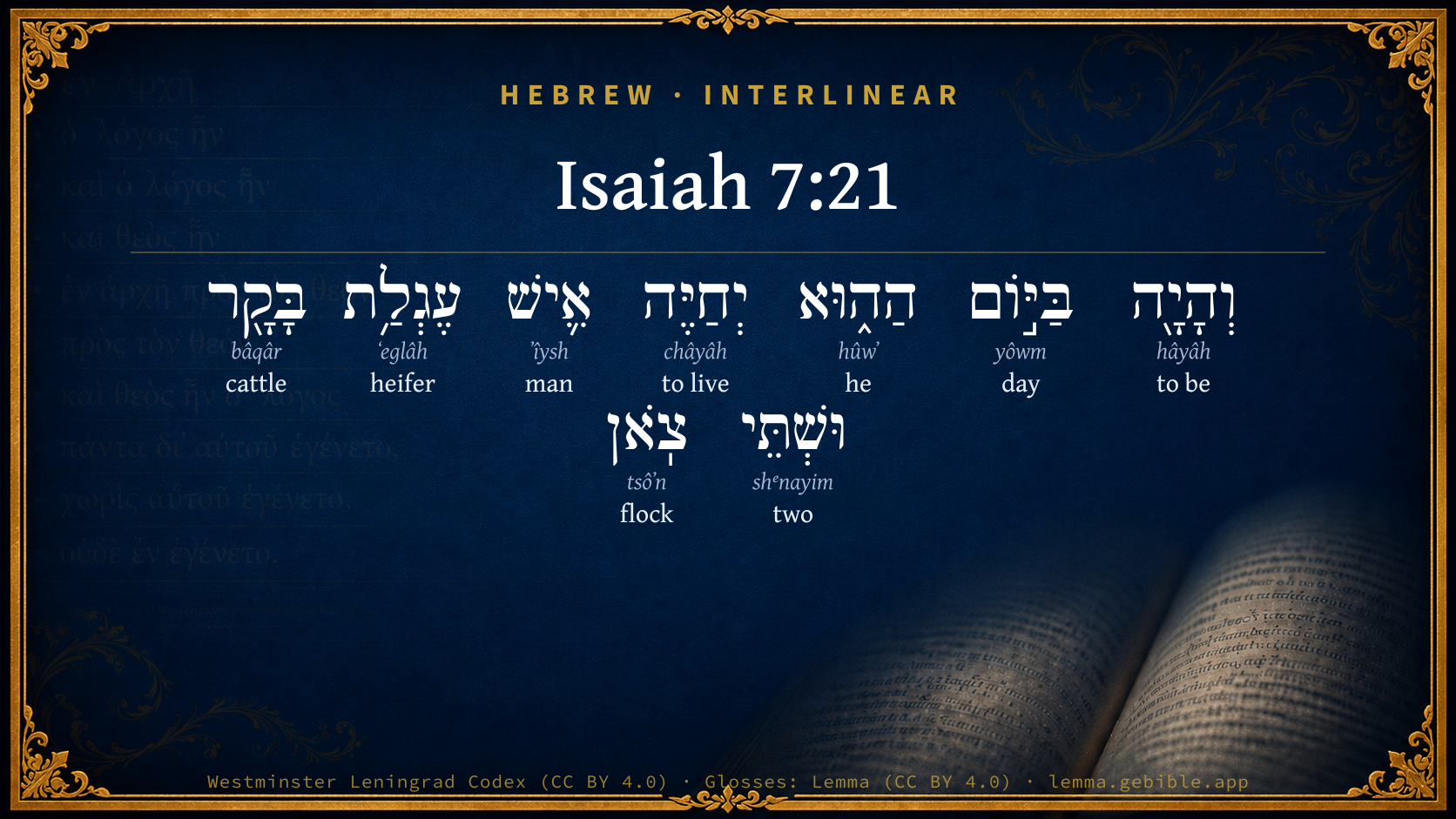
Isaiah 7:21

Hebrew (Westminster Leningrad Codex) Isaiah 7:21 appears in the Hebrew Old Testament. The text above is from the Westminster Leningrad Codex. Each word links to its Strong’s number, a concise gloss, and parsing drawn from the Open Scriptures Hebrew Bible morphology. Click any word for its full Brown-Driver-Briggs (BDB) entry.
Download image
Cite this verse

Isaiah 7:21 (World English Bible). Public Domain. Lemma interlinear Bible study tool, https://lemma.gebible.app/v/isaiah/7/21.

Show BibTeX & RIS
BibTeX
RIS
English Translation
It shall happen in that day that a man shall keep alive a young cow, and two sheep;
World English Bible · Public Domain
Download a study sheet

One document with this verse’s original text, its word-by-word gloss line, the meaning frame, cross-references with their text, attributed commentary, and full source and license credits — printable, and it pastes into notes with its structure intact.

This verse Autodidact and up

Study sheet (.html) Plain text (.txt)

A passage Seminary Student

Up to 50 verses in one chapter. A passage sheet keeps up to 6 commentary sources and 12 cross-references per verse, in the order this page ranks them, and says so on the sheet whenever that leaves anything out. Ask for a single verse and you get the Autodidact verse sheet above.

Everything on this page stays free to read, with no account — the sheet is a download of what is already on screen, not access to it.

Want to remove ads? Support Godless Engineer
Compare translations 3

The same verse in 3 English versions, stacked beneath the original-language interlinear above. Click any original word for its lexicon entry.

Each is an independent rendering of the whole verse — the interlinear is not word-aligned to these translations.

Highlighted words mark where these versions differ — a whole-verse word diff, not a word-by-word alignment.

  • World English Bible Public Domain
    It shall happen in that day that a man shall keep alive a young cow, and two sheep;
  • King James Version Public Domain
    And it shall come to pass in that day, that a man shall nourish a young cow, and two sheep;
  • unfoldingWord Literal Text CC BY-SA 4.0
    And it will happen in that day, a man will keep alive a calf of the herd and two of the flock.

unfoldingWord Literal Text — © unfoldingWord, licensed CC BY-SA 4.0. Word-aligned USFM3 via Door43 (git.door43.org/unfoldingWord/en_ult).

Versions to compare (up to 4)

3 of 4 selected

Show all 18 translations

Every available English version of this verse, each an independent rendering of the whole verse.

  • World English Bible Public Domain
    It shall happen in that day that a man shall keep alive a young cow, and two sheep;
  • Berean Standard Bible Public Domain
    On that day a man will raise a young cow and two sheep,
  • Majority Standard Bible Public Domain
    On that day a man will raise a young cow and two sheep,
  • King James Version Public Domain
    And it shall come to pass in that day, that a man shall nourish a young cow, and two sheep;
  • American Standard Version (1901) Public Domain
    And it shall come to pass in that day, that a man shall keep alive a young cow, and two sheep;
  • Revised Version (1885) Public Domain
    And it shall come to pass in that day, that a man shall nourish a young cow, and two sheep;
  • Geneva Bible (1599) Public Domain
    And in the same day shall a man nourish a yong kow, and two sheepe.
  • Douay-Rheims (1899) Public Domain
    And it shall come to pass in that day, that a man shall nourish a young cow, and two sheep.
  • Young's Literal Translation Public Domain
    And it hath come to pass, in that day, A man keepeth alive a heifer of the herd, And two of the flock,
  • Literal Standard Version CC BY-SA 4.0
    And it has come to pass in that day, || A man keeps alive a heifer of the herd, || And two of the flock,
  • Unlocked Literal Bible CC BY-SA 4.0
    On that day, a man will keep alive a young cow and two sheep,
  • unfoldingWord Literal Text CC BY-SA 4.0
    And it will happen in that day, a man will keep alive a calf of the herd and two of the flock.
  • Darby Bible Public Domain
    And it shall come to pass in that day, [that] a man shall nourish a young cow and two sheep,
  • World Messianic Bible Public Domain
    It shall happen in that day that a man shall keep alive a young cow, and two sheep.
  • Webster's Bible Public Domain
    And it shall come to pass in that day, that a man shall nourish a young cow, and two sheep;
  • Free Bible Version CC BY-SA 4.0
    At that time someone who manages to keep a young cow and two sheep alive
  • Bible in Basic English Public Domain
    And it will be in that day that a man will give food to a young cow and two sheep;
  • JPS Tanakh (1917) Public Domain
    And it shall come to pass in that day, that a man shall rear a young cow, and two sheep;

Literal Standard Version (2020), Covenant Press — licensed CC BY-SA 4.0. Text via the HelloAO Bible API (eBible.org). Unlocked Literal Bible (unfoldingWord) — licensed CC BY-SA 4.0. Text via the HelloAO Bible API (eBible.org). unfoldingWord Literal Text — © unfoldingWord, licensed CC BY-SA 4.0. Word-aligned USFM3 via Door43 (git.door43.org/unfoldingWord/en_ult). Free Bible Version, Dr. Jonathan Gallagher — licensed CC BY-SA 4.0. Text via the HelloAO Bible API (eBible.org).

Word by word

More ways to search: Search by grammar → Find every occurrence → Compare this word →

Practice this passage: Drill this verse → Learn its vocabulary →

About this verse

These counts appear in no published source. They are computed here, from the morphology-tagged text and Lemma’s own curated glosses. What Lemma adds →

9
words
9
distinct lemmas
Prophets
section

Notable vocabulary

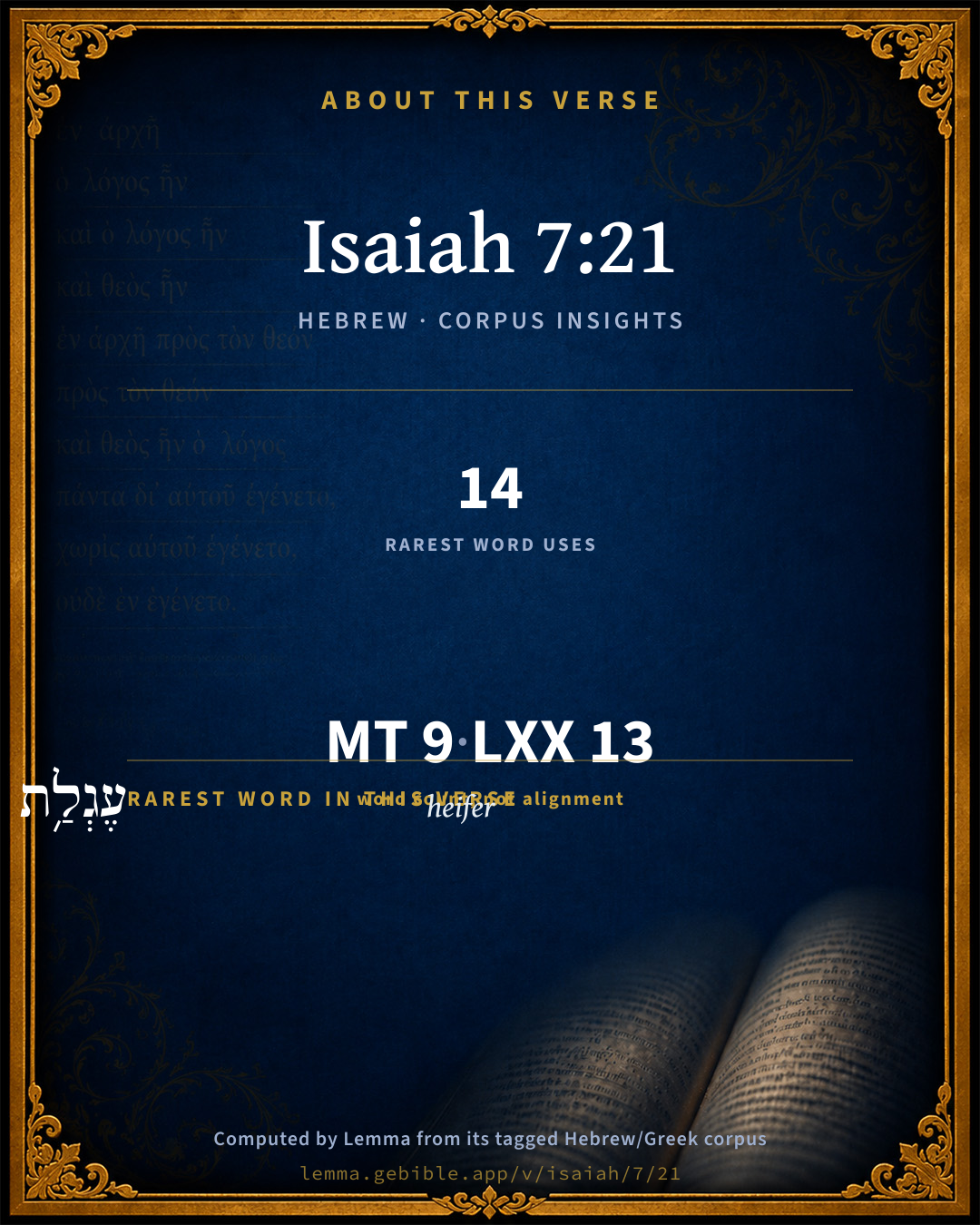
The rarest word here is עֶגְלַ֥ת heifer H5697 — appearing just 14 times in the whole Hebrew Bible.

Shared distinctive vocabulary

עֶגְלַ֥ת heifer H5697 occurs in 13 verses of the Hebrew Bible. Also found in:

Grammatical profile

  • 2 verbs
  • 5 nouns
  • 1 adjective
  • 1 pronoun

Verb forms

  • וְהָיָ֖ה Qal · Sequential Perfect
  • יְחַיֶּה Piel · Imperfect

Hebrew & Septuagint length

In English translation the verse runs 18 words from the Hebrew and 19 from the Septuagint (LXX English) — closely comparable.

A rough comparison of the two English renderings, which tokenize alike — not a word-level alignment.

Word counts can differ between the Hebrew and the Greek without any difference in meaning — e.g. the Hebrew direct-object marker אֵת has no separate Greek word, and Greek often adds the article ὁ.

In the original languages it is 9 Hebrew tokens and 13 Greek tokens — but the two are counted differently (Hebrew bundles its prefixes and suffixes into one token; the Greek is in lemma form), so that isn’t a like-for-like length.

Cross-references

5

Topical passages linked to Isaiah 7:21 in the Treasury of Scripture Knowledge — connected by theme and wording, ordered by reader-vote popularity; previews shown in the World English Bible.

  • Isaiah 5:17 Then the lambs will graze as in their pasture, And strangers will eat the ruins of the rich.
  • Jeremiah 39:10 But Nebuzaradan the captain of the guard left of the poor of the people, who had nothing, in the land of Judah, and gave them vineyards and fields at the same time.
  • Isaiah 17:2 The cities of Aroer are forsaken; they shall be for flocks, which shall lie down, and none shall make them afraid.
  • Isaiah 37:30 This shall be the sign to you: you shall eat this year that which grows of itself, and in the second year that which springs of the same; and in the third year sow you, and reap, and plant vineyards, and eat the fruit of it.
  • Isaiah 7:25 All the hills that were cultivated with the hoe, you shall not come there for fear of briers and thorns; but it shall be for the sending forth of oxen, and for the treading of sheep."

Cross-references courtesy of OpenBible.info (CC BY 4.0).

Hebrew and Greek witnesses Masoretic Hebrew ↔ Greek Septuagint

The same verse in the two great witnesses to the Old Testament, shown verse-for-verse.

These are two independent witnesses, not word-aligned to each other, and the Septuagint is shown in lemma (dictionary) form.

Hebrew Isaiah 7:21 Masoretic · Westminster Leningrad Codex

וְהָיָ֖ה בַּיּ֣וֹם הַה֑וּא יְחַיֶּה אִ֛ישׁ עֶגְלַ֥ת בָּקָ֖ר וּשְׁתֵּי צֹֽאן

It shall happen in that day that a man shall keep alive a young cow, and two sheep;

World English Bible · Public Domain

Greek LXX Isaiah 7:21 Septuagint · lemma form

καί εἰμί ἐν ὁ ἡμέρα ἐκεῖνος τρέφω ἄνθρωπος δάμαλις βοῦς καί δύο πρόβατον

And it shall come to pass in that day, that a man shall rear a heifer, and two sheep.

LXX2012 (modern English Septuagint) · Public Domain

Hebrew: Westminster Leningrad Codex (CC BY 4.0). Greek: Septuagint (public domain); English from LXX2012 (modern English Septuagint) (Public Domain). How the Septuagint differs from the Hebrew →

Targum (Aramaic paraphrase)

1

The Targum is the ancient Jewish Aramaic paraphrase of the Hebrew Scriptures — an interpretive translation, not the Hebrew text itself. Onkelos (literal) and Pseudo-Jonathan (expansive) render the Torah, and Jonathan the Prophets. Coverage is partial: where no permissively-licensed English translation exists for a verse, only the Aramaic is shown. This is verse-level text, not a word-by-word alignment to the Hebrew.

  1. Targum Jonathan Prophets (Joshua–Malachi)
    וִיהֵי בְּעִדָנָא הַהִיא יְקַיֵם גְבַר עִגְלַת תּוֹרִין וּתְרֵין עָן:

    And it shall come to pass in that time, that a man shall nourish a young cow and two sheep.

    Targum Jonathan — Aramaic: “Mikraot Gedolot” (public domain). English: “Sefaria Community Translation” (CC0 1.0 (public-domain dedication)); “London "Chaldee Paraphrase," 1871” (public domain). Text via Sefaria.

Commentary

Notes on Isaiah 7:21 from classic Christian and Jewish commentators (each source and its license shown beneath its notes). The classic Christian expositions comment on the surrounding passage and are grouped to its opening verse, so a note may address several verses; the Jewish commentaries on the Tanakh (Rashi and others) are per-verse, so they appear only where the commentator wrote on this verse.

Lemma curates 59 commentaries, every one of them public domain or Creative Commons licensed, each selected and text-cleaned for this edition rather than reprinted as found. About our sources →

Jamieson, Fausset & Brown

Robert Jamieson, A. R. Fausset & David Brown

THE COMING DESOLATE STATE OF THE LAND OWING TO THE ASSYRIANS AND EGYPTIANS. (Isa 7:21-25)

nourish--that is, own.

young cow--a heifer giving milk. Agriculture shall cease, and the land become one great pasturage.

Jamieson, Fausset & Brown — Commentary Critical and Explanatory on the Whole Bible (1871) — public domain (CC PDM 1.0). Text via the HelloAO Bible API.

Trapp's Complete Commentary

John Trapp

Isa 7:21 And it shall come to pass in that day, [that] a man shall nourish a young cow, and two sheep;

Ver. 21. A man shall nourish two sheep.] He that was wont to say, Mille meae Siculis errant in montibus agnae, {a} shall now be reduced to so great penury as to be glad of two sheep, and have scarce a young heifer left for his necessary subsistence, who was wont to have many ploughs going. They shall not now, as heretofore, "join house to house, and land to land"; they shall not keep race horses, or hunting dogs, &c.

{a} Virg. Eclog.

John Trapp, A Commentary or Exposition upon All the Books of the Old and New Testament (1647–1656) — public domain. Text from a community e-Sword module.

Joseph Benson's Commentary

Isa 7:21-25. These verses “contain an elegant and very expressive description of a country depopulated, and left to run wild, from its adjuncts and circumstances; the vineyards and corn-fields, before well cultivated, now overrun with briers and thorns; much grass, so that the few cattle that are left, a young cow and two sheep, have their full range, and abundant pasture; so as to yield milk in plenty to the scanty family of the owner: the thinly-scattered people living not on corn, wine, and oil, the produce of cultivation, but on milk and honey, the gifts of nature; and the whole land given up to the wild beasts; so that the miserable inhabitants are forced to go out armed with bows and arrows, either to defend themselves against the wild beasts, or to supply themselves with necessary food by hunting.” — Bishop Lowth.

Joseph Benson's Commentary on the Old and New Testaments (1811–1818) — public domain. Text from a community e-Sword module.

Geneva Bible (1599)

Geneva Bible translators

He that before had a great number of cattle, shall be content with one cow and two sheep.

Geneva Bible (1599) marginal notes — public domain. Text via Bolls.life.

The Cambridge Bible for Schools and Colleges

gen. ed. J. J. S. Perowne

21, 22. The land having gone out of cultivation, the sparse population is reduced to the pastoral life of the desert. Cf. ch. Isa_5:14; Isa_5:17, Isa_32:12-14.

The Cambridge Bible for Schools and Colleges (gen. ed. J. J. S. Perowne; Cambridge University Press, 1878–1918) — public domain. Text from a community e-Sword module.

John Gill's Exposition

And it shall come to pass in that day,.... Not in the days of Hezekiah, after the destruction of Sennacherib's army, when there followed great fruitfulness and plenty, Isa 37:30 as Kimchi and Jarchi interpret it; but in the days of Nebuchadnezzar, after the destruction of Jerusalem, when some poor men were left in the land to till it, Jer 39:10 for of these, and not of rich men, are the following words to be understood:

that a man shall nourish a young cow and two sheep; this seems to denote both the scarcity of men and cattle, through the ravages of the army of the Chaldeans; that there should not be large herds and flocks, only a single cow, and two or three sheep; and yet men should be so few, and families so thin, that these would be sufficient to support them comfortably.

John Gill's Exposition of the Whole Bible (1746–1763) — public domain (CC PDM 1.0). Text via the HelloAO Bible API.

Albert Barnes' Notes on the Bible

In that day - In the time specified in the previous verses - in the judgments that should be brought upon the land by the Egyptians and Assyrians.

A man shall nourish - Hebrew ‘Make to live:’ that is, he shall own, or feed.

A young cow - The Hebrew denotes a heifer that gives milk. The state which is denoted by this is that of great poverty. Instead of being engaged in agriculture, of possessing great resources in that time, a man should depend, for the subsistence of himself and his family, on what a single cow and two sheep would yield. Probably this is intended also as a description of the general state of the nation, that it would be reduced to great poverty.

And two sheep - Two here seems to be used to denote a very small number. A man, that is, the generality of people, would be so reduced as to be able to purchase and keep no more.

Albert Barnes' Notes on the Bible (1834–1885) — public domain. Text from a community e-Sword/MySword module.

Matthew Poole's English Annotations

This and the following verse contain either,

1. A mitigation of the foregoing calamity, or some comfort for the remainders of the people, after the public devastation; or rather,

2. A further declaration of the threatened desolation; which best agrees not only with the foregoing, but also with the following verses. So the sense of this verse is this, They who formerly used to keep great herds of cattle, and many flocks of sheep, shall esteem it a great happiness if they can keep but one cow and two sheep, to keep themselves from extremity of famine.

Matthew Poole's English Annotations on the Holy Bible (1683–1685) — public domain. Text from a community e-Sword/MySword module.

Whedon's Commentary on the Bible

Daniel D. Whedon

21, 22. From such spoliations, as well as removals of the population, agriculture ceases, and the land goes to rough pasturage. When cultivation in that land is neglected, the tendency is to briers and thorns and thistles. Tristram (Nat. Hist. Bible, p. 423) says, “The combined heat and dryness of the climate seem to develop a tendency to form thorns even in groups where we should least expect them.”

Shall nourish a young cow and two sheep — The idea is, amid great straits from invaders, a man shall do well if he shall be able to save alive this amount of stock. So the word “nourish” indicates that pasturage is abundant, and this shall secure milk, curds, etc., enough. One may preserve himself well if he may but save his stock. If these are taken from him, his peril is certain, because of the fewness of the people, and the neglect of tillage of the soil.

Daniel D. Whedon (gen. ed.), Commentary on the Old and New Testaments (1874–1909) — public domain. Text from a community e-Sword module.

The Pulpit Commentary

A man shall nourish a young cow, and two sheep; literally, two ewes. A stop having been put to cultivation, men shall return to the pastoral life, but shall not possess more than two or three head of cattle apiece, the Assyrians having swept off most of the beasts. Tiglath-Pileser, in his inscriptions, mentions his carrying off homed cattle and sheep to the amount of many thousands from the countries which he overran or conquered ("Records of the Past," vol. 5. pp. 49, 52).

The Pulpit Commentary (1880–1919), ed. H.D.M. Spence-Jones & Joseph S. Exell — public domain. Text from a community e-Sword module.

John Wesley's Explanatory Notes

Sheep - They who formerly used to keep great herds of cattle, and many flocks of sheep, shall esteem it a happiness if they can keep but one cow and two sheep.

John Wesley, Explanatory Notes Upon the Whole Bible (1754–1765) — public domain. Text via the GEBible commentary corpus.

Keil & Delitzsch

C. F. Keil & F. Delitzsch

"And it will come to pass in that day, that a man will keep a small cow and a couple of sheep; and it comes to pass, for the abundance of the milk they give he will eat cream: for butter and honey will every one eat that is left within the land." The former prosperity would be reduced to the most miserable housekeeping. One man would keep a milch cow and two head of sheep (or goats) alive with the greatest care, the strongest and finest full-grown cattle having fallen into the hands of the foe (היּה, like החיה in other places: shtē, not shnē, because two female sheep or goats are meant). But this would be quite enough, for there would be only a few men left in the land; and as all the land would be pasture, the small number of animals would yield milk in abundance. Bread and wine would be unattainable. Whoever had escaped the Assyrian razor, would eat thickened milk and honey, that and nothing but that, without variation, ad nauseam. The reason for this would be, that the hills, which at other times were full of vines and corn-fields, would be overgrown with briers.

Keil & Delitzsch — Biblical Commentary on the Old Testament (1861–1891) — public domain (CC PDM 1.0). Text via the HelloAO Bible API. (Old Testament only.)

Rashi

Rabbi Shlomo Yitzchaki (Rashi)

a man shall keep alive and since the land will be empty, for the armies will pillage the livestock, and in the few that remain I will give a blessing.

Rashi on the Tanakh — English translations: “The Judaica Press complete Tanach with Rashi, translated by A. J. Rosenberg” (CC BY 4.0); “Pentateuch with Rashi's commentary by M. Rosenbaum and A.M. Silbermann, 1929-1934” (public domain); “The Metsudah Tanach series, Lakewood, N.J” (CC BY 4.0); and “The Book of Joshua, Metsudah Publications, 1997” (CC BY 4.0). Text via Sefaria.

Ibn Ezra

Rabbi Abraham ibn Ezra

ושתי צאן And two sheep. Elliptical expression for ושתי שיות צאן And two lambs of the flock.

A man. Every one that will be in Jerusalem.

Ibn Ezra on the Tanakh — English translations: “Sefaria Community Translation” (CC0 1.0 (public-domain dedication)); “Yalkut, Sifsei Chachomim Chumash, Metsudah Publications, 2009” (CC BY 4.0); and “Commentary of Ibn Ezra on Isaiah - trans. by M. Friedlander, 1873” (public domain). Text via Sefaria.

Lesson kit

Teaching starters — assembled from the data on this page, not authored interpretation. Every prompt links to the verse data it draws on. Edit before teaching.

Isaiah, in the Prophets, opens this verse with 9 words (9 distinct Hebrew lemmas). Its most distinctive word is ʻeglâh (“heifer”). A historical commentator’s framing appears above. Read the whole chapter for the surrounding context.

Discussion questions

  1. The word ʻeglâh carries the sense “heifer.” How does it shape the verse?
  2. How does Genesis 15:9, which shares the word «heifer», read alongside this verse?
  3. These translations render this verse differently. What is at stake in choosing one wording over another?
  4. «וְהָיָ֖ה» is a Qal Sequential Perfect verb. How does that grammatical form shape the action described?
  5. Compare how Jamieson, Fausset & Brown and Trapp's Complete Commentary read this verse. Where do they agree or differ?

Things to notice

Reading settings

Reading text

Shown beneath each verse's original-language words.

Old Testament
Old Testament edition

Read the OT as the Masoretic Hebrew (MT) or the Greek Septuagint (LXX).

English shown for the Greek Septuagint (in the Hebrew ↔ Greek comparison).

Comparing translations? Open the Compare panel on any verse page to stack up to four side by side.