
Job 42:12

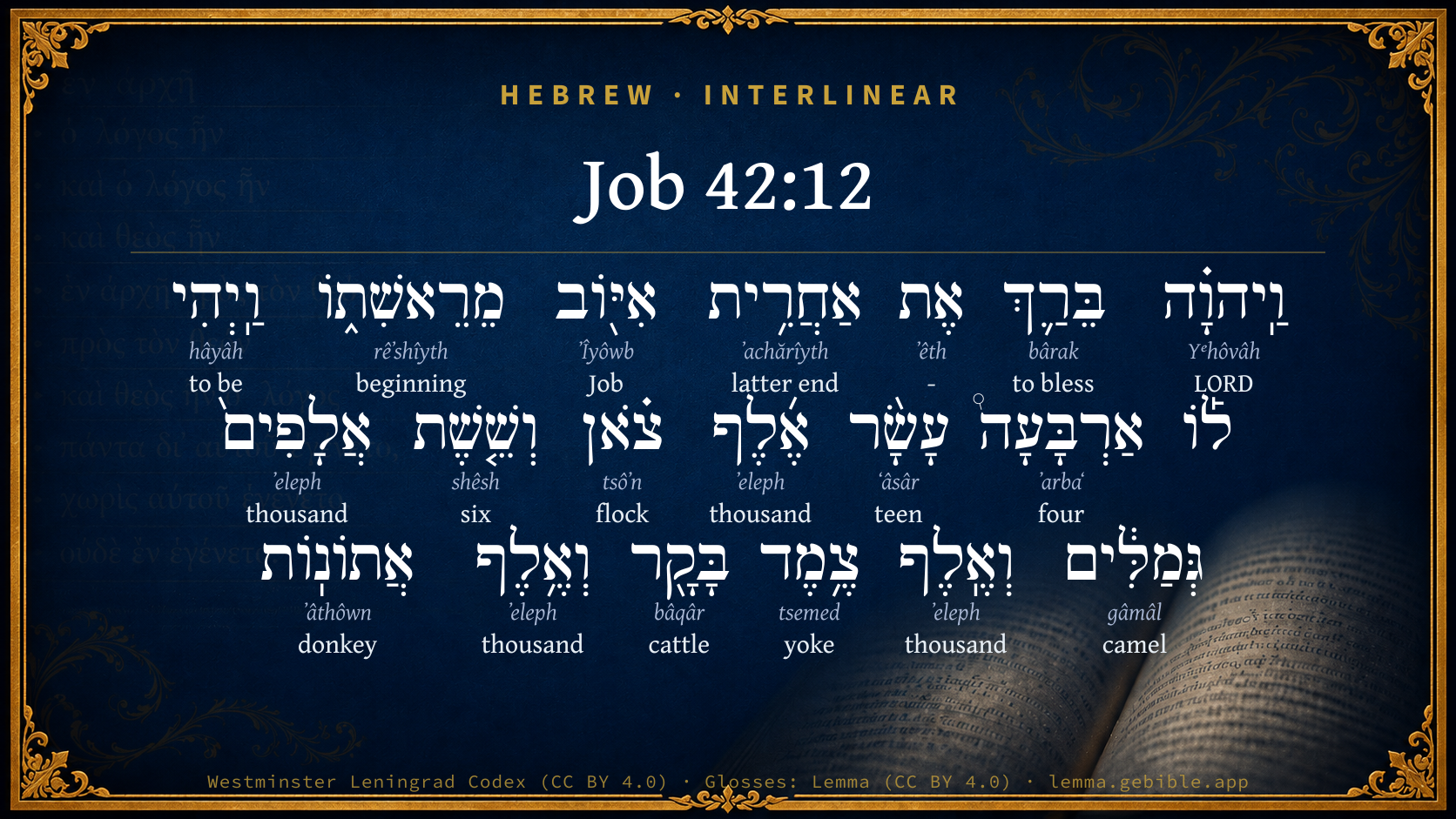
Hebrew (Westminster Leningrad Codex) Job 42:12 appears in the Hebrew Old Testament. The text above is from the Westminster Leningrad Codex. Each word links to its Strong’s number, a concise gloss, and parsing drawn from the Open Scriptures Hebrew Bible morphology. Click any word for its full Brown-Driver-Briggs (BDB) entry.
Download image
Cite this verse

Job 42:12 (World English Bible). Public Domain. Lemma interlinear Bible study tool, https://lemma.gebible.app/v/job/42/12.

Show BibTeX & RIS
BibTeX
RIS
English Translation
So Yahweh blessed the latter end of Job more than his beginning. He had fourteen thousand sheep, six thousand camels, one thousand yoke of oxen, and a thousand female donkeys.
World English Bible · Public Domain
Download a study sheet

One document with this verse’s original text, its word-by-word gloss line, the meaning frame, cross-references with their text, attributed commentary, and full source and license credits — printable, and it pastes into notes with its structure intact.

This verse Autodidact and up

Study sheet (.html) Plain text (.txt)

A passage Seminary Student

Up to 50 verses in one chapter. A passage sheet keeps up to 6 commentary sources and 12 cross-references per verse, in the order this page ranks them, and says so on the sheet whenever that leaves anything out. Ask for a single verse and you get the Autodidact verse sheet above.

Everything on this page stays free to read, with no account — the sheet is a download of what is already on screen, not access to it.

Want to remove ads? Support Godless Engineer
Compare translations 3

The same verse in 3 English versions, stacked beneath the original-language interlinear above. Click any original word for its lexicon entry.

Each is an independent rendering of the whole verse — the interlinear is not word-aligned to these translations.

Highlighted words mark where these versions differ — a whole-verse word diff, not a word-by-word alignment.

  • World English Bible Public Domain
    So Yahweh blessed the latter end of Job more than his beginning. He had fourteen thousand sheep, six thousand camels, one thousand yoke of oxen, and a thousand female donkeys.
  • King James Version Public Domain
    So the LORD blessed the latter end of Job more than his beginning: for he had fourteen thousand sheep, and six thousand camels, and a thousand yoke of oxen, and a thousand she asses.
  • unfoldingWord Literal Text CC BY-SA 4.0
    And Yahweh blessed the finish of Job more than his start. And it was to him 14,000 sheep and 6,000 camels and 1,000 yoke of oxen and 1,000 female donkeys.

unfoldingWord Literal Text — © unfoldingWord, licensed CC BY-SA 4.0. Word-aligned USFM3 via Door43 (git.door43.org/unfoldingWord/en_ult).

Versions to compare (up to 4)

3 of 4 selected

Show all 18 translations

Every available English version of this verse, each an independent rendering of the whole verse.

  • World English Bible Public Domain
    So Yahweh blessed the latter end of Job more than his beginning. He had fourteen thousand sheep, six thousand camels, one thousand yoke of oxen, and a thousand female donkeys.
  • Berean Standard Bible Public Domain
    So the LORD blessed Job’s latter days more than his first. He owned 14,000 sheep, 6,000 camels, 1,000 yoke of oxen, and 1,000 female donkeys.
  • Majority Standard Bible Public Domain
    So the LORD blessed Job’s latter days more than his first. He owned 14,000 sheep, 6,000 camels, 1,000 yoke of oxen, and 1,000 female donkeys.
  • King James Version Public Domain
    So the LORD blessed the latter end of Job more than his beginning: for he had fourteen thousand sheep, and six thousand camels, and a thousand yoke of oxen, and a thousand she asses.
  • American Standard Version (1901) Public Domain
    So Jehovah blessed the latter end of Job more than his beginning: And he had fourteen thousand sheep, and six thousand camels, and a thousand yoke of oxen, and a thousand she-asses.
  • Revised Version (1885) Public Domain
    So the LORD blessed the latter end of Job more than his beginning: and he had fourteen thousand sheep, and six thousand camels, and a thousand yoke of oxen, and a thousand she-asses.
  • Geneva Bible (1599) Public Domain
    So the Lord blessed the last dayes of Iob more then the first: for he had foureteene thousand sheepe, and sixe thousand camels, and a thousand yoke of oxen, and a thousand shee asses.
  • Douay-Rheims (1899) Public Domain
    And the Lord blessed the latter end of Job more than his beginning. And he had fourteen thousand sheep, and six thousand camels, and a thousand yoke of oxen, and a thousand she asses.
  • Young's Literal Translation Public Domain
    And Jehovah hath blessed the latter end of Job more than his beginning, and he hath fourteen thousand of a flock, and six thousand camels, and a thousand pairs of oxen, and a thousand she-asses.
  • Literal Standard Version CC BY-SA 4.0
    And YHWH has blessed the latter end of Job more than his beginning, and he has fourteen thousand of a flock, and six thousand camels, and one thousand pairs of oxen, and one thousand female donkeys.
  • Unlocked Literal Bible CC BY-SA 4.0
    Yahweh blessed the final end of Job's life more than the first; he had fourteen thousand sheep, six thousand camels, one thousand yoke of oxen, and one thousand female donkeys.
  • unfoldingWord Literal Text CC BY-SA 4.0
    And Yahweh blessed the finish of Job more than his start. And it was to him 14,000 sheep and 6,000 camels and 1,000 yoke of oxen and 1,000 female donkeys.
  • Darby Bible Public Domain
    And Jehovah blessed the latter end of Job more than his beginning; and he had fourteen thousand sheep, and six thousand camels, and a thousand yoke of oxen, and a thousand she-asses.
  • World Messianic Bible Public Domain
    So the LORD blessed the latter end of Job more than his beginning. He had fourteen thousand sheep, six thousand camels, one thousand yoke of oxen, and a thousand female donkeys.
  • Webster's Bible Public Domain
    So the LORD blessed the latter end of Job more than his beginning: for he had fourteen thousand sheep, and six thousand camels, and a thousand yoke of oxen, and a thousand she asses.
  • Free Bible Version CC BY-SA 4.0
    The Lord blessed the last part of Job's life more than the first part. Now he owned 14,000 sheep, 6,000 camels, 1,000 teams of oxen, and 1,000 female donkeys.
  • Bible in Basic English Public Domain
    And the Lord's blessing was greater on the end of Job's life than on its start: and so he came to have fourteen thousand sheep and goats, and six thousand camels, and two thousand oxen, and a thousand she-asses.
  • JPS Tanakh (1917) Public Domain
    So the LORD blessed the latter end of Job more than his beginning; and he had fourteen thousand sheep, and six thousand camels, and a thousand yoke of oxen, and a thousand she-asses.

Literal Standard Version (2020), Covenant Press — licensed CC BY-SA 4.0. Text via the HelloAO Bible API (eBible.org). Unlocked Literal Bible (unfoldingWord) — licensed CC BY-SA 4.0. Text via the HelloAO Bible API (eBible.org). unfoldingWord Literal Text — © unfoldingWord, licensed CC BY-SA 4.0. Word-aligned USFM3 via Door43 (git.door43.org/unfoldingWord/en_ult). Free Bible Version, Dr. Jonathan Gallagher — licensed CC BY-SA 4.0. Text via the HelloAO Bible API (eBible.org).

Word by word

More ways to search: Search by grammar → Find every occurrence → Compare this word →

Practice this passage: Drill this verse → Learn its vocabulary →

צֶ֥מֶד
tsemed
H6776
“yoke of”
Noun, Common, Masculine, Singular, Construct
Part of Speech
Noun
Type
Common
Gender
Masculine
Number
Singular
State
Construct
Full BDB Definition

Origin: a yoke or team (ie pair)

TWOT: 1927a

couple, pair, team, yoke - couple, pair, span (usually of animals) - acre - the amount of land a span of oxen could plow in one day
  1. וַֽיהוָ֗ה Yᵉhôvâh H3068 “and · LORD” Conjunction + Noun, Proper
  2. בֵּרַ֛ךְ bârak H1288 “to bless” Verb, Piel, Perfect, 3rd Person, Masculine, Singular
  3. אֶת ʼêth H853 “-” Particle, Direct Object
  4. אַחֲרִ֥ית ʼachărîyth H319 “latter end of” Noun, Common, Feminine, Singular, Construct
  5. אִיּ֖וֹב ʼÎyôwb H347 “Job” Noun, Proper
  6. מֵרֵאשִׁת֑וֹ rêʼshîyth H7225 “from · beginning · his” Preposition + Noun, Common, Feminine, Singular, Construct + Suffix, Personal, 3rd Person, Masculine, Singular
  7. וַֽיְהִי hâyâh H1961 “and · to be” Conjunction + Verb, Qal, Sequential Imperfect, 3rd Person, Masculine, Singular
  8. אַרְבָּעָה֩ ʼarbaʻ H702 “four” Adjective, Cardinal number, Masculine, Singular, Absolute
  9. עָשָׂ֨ר ʻâsâr H6240 “teen” Adjective, Cardinal number, Masculine, Singular, Absolute
  10. אֶ֜לֶף ʼeleph H505 “thousand” Adjective, Cardinal number, Both, Singular, Absolute
  11. צֹ֗אן tsôʼn H6629 “flock” Noun, Common, Both, Singular, Absolute
  12. וְשֵׁ֤שֶׁת shêsh H8337 “and · six” Conjunction + Adjective, Cardinal number, Masculine, Singular, Construct
  13. אֲלָפִים֙ ʼeleph H505 “thousand” Adjective, Cardinal number, Both, Plural, Absolute
  14. גְּמַלִּ֔ים gâmâl H1581 “camels” Noun, Common, Masculine, Plural, Absolute
  15. וְאֶֽלֶף ʼeleph H505 “and · thousand” Conjunction + Adjective, Cardinal number, Both, Singular, Absolute
  16. בָּקָ֖ר bâqâr H1241 “cattle” Noun, Common, Both, Singular, Absolute
  17. וְאֶ֥לֶף ʼeleph H505 “and · thousand” Conjunction + Adjective, Cardinal number, Both, Singular, Absolute
  18. אֲתוֹנֽוֹת ʼâthôwn H860 “donkeys” Noun, Common, Feminine, Plural, Absolute

About this verse

These counts appear in no published source. They are computed here, from the morphology-tagged text and Lemma’s own curated glosses. What Lemma adds →

20
words
16
distinct lemmas
Wisdom
section

Notable vocabulary

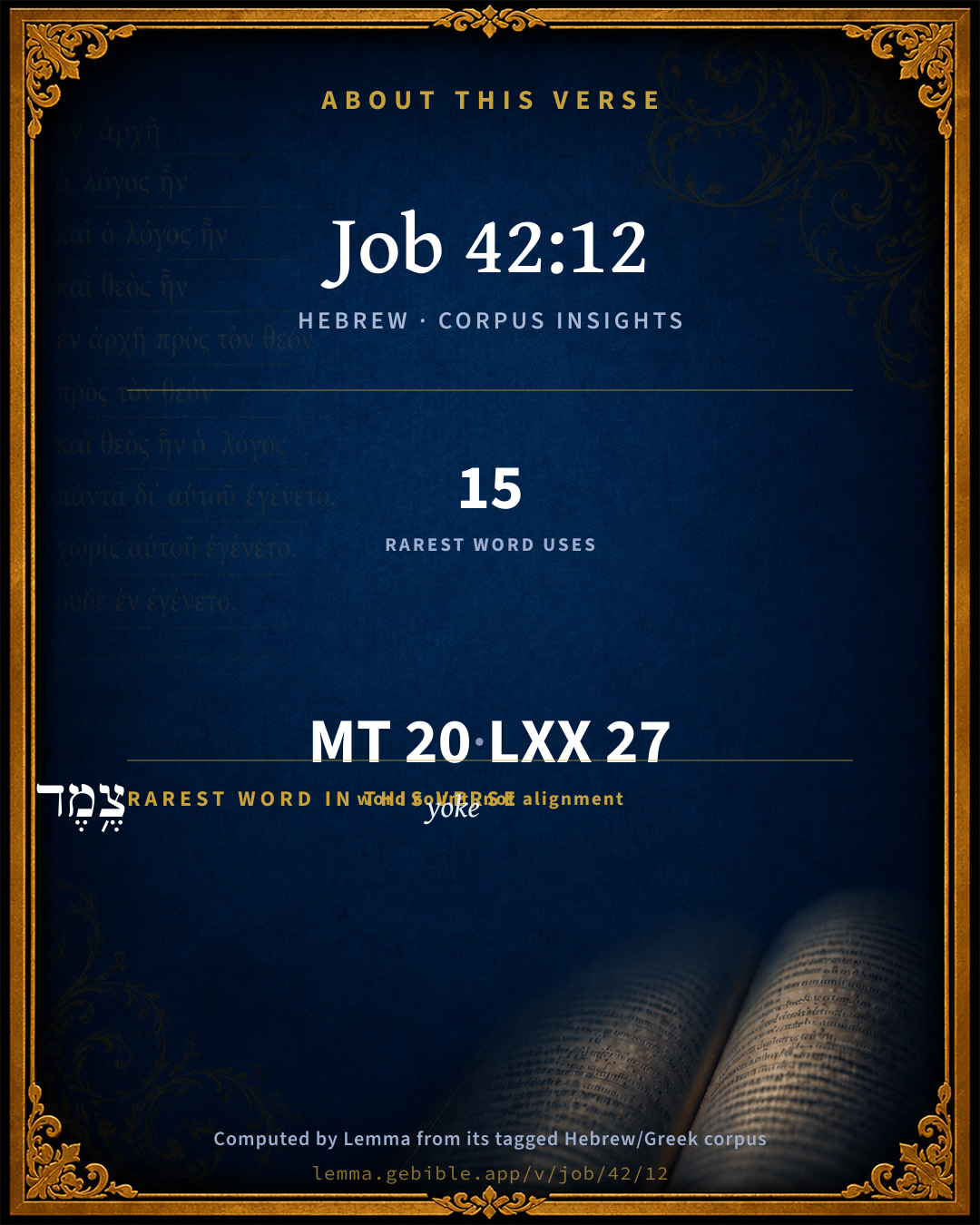
The rarest word here is צֶ֥מֶד yoke H6776 — appearing just 15 times in the whole Hebrew Bible.

Shared distinctive vocabulary

צֶ֥מֶד yoke H6776 occurs in 15 verses of the Hebrew Bible. Also found in:

Grammatical profile

  • 2 verbs
  • 9 nouns
  • 7 adjectives
  • 1 preposition
  • 1 particle

Verb forms

  • בֵּרַ֛ךְ Piel · Perfect
  • וַֽיְהִי Qal · Sequential Imperfect

Repetition

A word recurs within this verse — often emphatic in Hebrew:

  • אֶ֜לֶף thousand H505 ×4

Hebrew & Septuagint length

In English translation the verse runs 30 words from the Hebrew and 34 from the Septuagint (LXX English) — closely comparable.

A rough comparison of the two English renderings, which tokenize alike — not a word-level alignment.

Word counts can differ between the Hebrew and the Greek without any difference in meaning — e.g. the Hebrew direct-object marker אֵת has no separate Greek word, and Greek often adds the article ὁ.

In the original languages it is 20 Hebrew tokens and 27 Greek tokens — but the two are counted differently (Hebrew bundles its prefixes and suffixes into one token; the Greek is in lemma form), so that isn’t a like-for-like length.

Cross-references

11

Topical passages linked to Job 42:12 in the Treasury of Scripture Knowledge — connected by theme and wording, ordered by reader-vote popularity; previews shown in the World English Bible.

  • Job 8:7 Though your beginning was small, Yet your latter end would greatly increase.
  • Ecclesiastes 7:8 Better is the end of a thing than its beginning. The patient in spirit is better than the proud in spirit.
  • Proverbs 10:22 Yahweh's blessing brings wealth, And he adds no trouble to it.
  • Genesis 24:35 Yahweh has blessed my master greatly. He has become great. He has given him flocks and herds, silver and gold, men-servants and maid-servants, and camels and donkeys.
  • Psalms 144:13–15 Our barns are full, filled with all kinds of provision. Our sheep bring forth thousands and ten thousands in our fields.
  • Genesis 26:12–14 Isaac sowed in that land, and reaped in the same year one hundred times what he planted. Yahweh blessed him.
  • Job 1:3 His possessions also were seven thousand sheep, three thousand camels, five hundred yoke of oxen, five hundred she-donkeys, and a very great household; so that this man was the greatest of all the children of the east.
  • Deuteronomy 8:16 who fed you in the wilderness with manna, which your fathers didn't know; that he might humble you, and that he might prove you, to do you good at your latter end:
  • Psalms 107:38 He blesses them also, so that they are multiplied greatly. He doesn't allow their cattle to decrease.
  • 1 Timothy 6:17 Charge those who are rich in this present world that they not be haughty, nor have their hope set on the uncertainty of riches, but on the living God, who richly provides us with everything to enjoy;
  • James 5:11 Behold, we call them blessed who endured. You have heard of the patience of Job, and have seen the Lord in the outcome, and how the Lord is full of compassion and mercy.

Cross-references courtesy of OpenBible.info (CC BY 4.0).

Hebrew and Greek witnesses Masoretic Hebrew ↔ Greek Septuagint

The same verse in the two great witnesses to the Old Testament, shown verse-for-verse.

These are two independent witnesses, not word-aligned to each other, and the Septuagint is shown in lemma (dictionary) form.

Hebrew Job 42:12 Masoretic · Westminster Leningrad Codex

וַֽיהוָ֗ה בֵּרַ֛ךְ אֶת אַחֲרִ֥ית אִיּ֖וֹב מֵרֵאשִׁת֑וֹ וַֽיְהִי ל֡וֹ אַרְבָּעָה֩ עָשָׂ֨ר אֶ֜לֶף צֹ֗אן וְשֵׁ֤שֶׁת אֲלָפִים֙ גְּמַלִּ֔ים וְאֶֽלֶף צֶ֥מֶד בָּקָ֖ר וְאֶ֥לֶף אֲתוֹנֽוֹת

So Yahweh blessed the latter end of Job more than his beginning. He had fourteen thousand sheep, six thousand camels, one thousand yoke of oxen, and a thousand female donkeys.

World English Bible · Public Domain

Greek LXX Job 42:12 Septuagint · lemma form

ὁ δέ κύριος εὐλογέω ὁ ἔσχατος ιωβ ἤ ὁ ἔμπροσθεν εἰμί δέ ὁ κτῆνος αὐτός πρόβατον μύριοι τετρακισχίλιοι κάμηλος ἑξακισχίλιοι ζεῦγος βοῦς χίλιοι ὄνος θῆλυς νομάς χίλιοι

And the Lord blessed the latter end of Job, more than the beginning: and his cattle were fourteen thousand sheep, six thousand camels, a thousand yoke of oxen, a thousand she-asses of the pastures.

LXX2012 (modern English Septuagint) · Public Domain

On this verse, Haydock's Catholic Bible Commentary discusses the Septuagint’s reading. Read the note in Commentary ↓

Hebrew: Westminster Leningrad Codex (CC BY 4.0). Greek: Septuagint (public domain); English from LXX2012 (modern English Septuagint) (Public Domain). How the Septuagint differs from the Hebrew →

Commentary

Notes on Job 42:12 from classic Christian and Jewish commentators (each source and its license shown beneath its notes). The classic Christian expositions comment on the surrounding passage and are grouped to its opening verse, so a note may address several verses; the Jewish commentaries on the Tanakh (Rashi and others) are per-verse, so they appear only where the commentator wrote on this verse.

Lemma curates 59 commentaries, every one of them public domain or Creative Commons licensed, each selected and text-cleaned for this edition rather than reprinted as found. About our sources →

Trapp's Complete Commentary

John Trapp

Job 42:12 So the LORD blessed the latter end of Job more than his beginning: for he had fourteen thousand sheep, and six thousand camels, and a thousand yoke of oxen, and a thousand she asses.

Ver. 12. So the Lord blessed the latter end of Job] According to Bildad’s prophecy, Job 8:7, and St James’s useful observation, Jas 5:11, "Ye have heard of the patience of Job, and have seen the end of the Lord; that the Lord is very pitiful, and of tender mercy." If he afflict any of his, it is in very faithfulness, that he may be true to their souls; it is also in great mercy, that he may do them good in the latter end, Deu 8:16; and this they themselves also shall both see and say by that time he hath brought both ends together, Psa 119:71. Be ye therefore patient, stablish your hearts, Jas 5:8. Patient Job had all doubled to him. Joseph as a slave became his master’s master. Valentinian lost his tribuneship for Christ, but was afterwards made emperor. Queen Elizabeth from a prisoner became a great princess. But if God deny his suffering servants temporals, and give them in spirituals, they have no cause to complain; one way or other they shall be sure to have it. Great is the gain of godliness.

For he had fourteen thousand sheep, &c.] Cattle only are instanced, because therein especially consisted the wealth of that country: Pecunia a pecude. Mηλα pecudes et postea opes significant (Melancth.). But other good things also doubtless were doubled unto him, as his family, possessions, grounds, houses, and especially wisdom, to make a good use of all; for commonly Stultitiam patiuntur opes: and what is more contemptible than a rich fool, a golden beast, as Caligula called his father-in-law, Syllanus.

John Trapp, A Commentary or Exposition upon All the Books of the Old and New Testament (1647–1656) — public domain. Text from a community e-Sword module.

The Biblical Illustrator

Joseph S. Exell

Job_42:12-17

So the Lord blessed the latter end of Job.

The limitation of Jobs blessings to this life

Is there not something incongruous in the large award of temporal good, and even something unnecessary in the renewed honour among men? To us it seems that a good man will be satisfied with the favour and fellowship of a loving God. Yet, assuming that the conclusion is a part of the history on which the poem was founded, we can justify the blaze of splendour that bursts on Job after sorrow, instruction, and reconciliation. Life only can reward life. That great principle was rudely shadowed forth in the old belief that God protects His servants even to a green old age. Job had lived strongly, alike in mundane and moral region. How is he to find continued life? The authors power could not pass the limits of the natural to promise a reward. Net yet was it possible, even for a great thinker, to affirm that continued fellowship with Eloah, that continued intellectual and spiritual energy that we call eternal life. A vision of it had come to him; he had seen the day of the Lord afar off, but dimly, by moments. To carry a life into it was beyond his power. Sheol made nothing perfect; and beyond Sheol no prophet eye had ever travelled. There was nothing for it then, but to use the history as it stood, adding symbolic touches, and show the restored life in development on earth, more powerful than ever, more esteemed, more richly endowed for good action. Priestly office and power are given to Job. Wider opportunities for service, more cordial esteem and affection, the highest office that man can bear, these are the reward of Job. And with the terms of the symbolism we shall not quarrel who have heard the Lord say, Well done, thou good servant; because thou wast found faithful in a very little, have thou authority over ten cities. (R. A. Watson.)

Light at eventide

Have not some of us had experience in the glorious Alps, when, on nearly reaching the top, we have been surrounded by clouds, mist filled the air, the tempest hurtled around us, and we sat down utterly disappointed in our hope of a glorious view, and ready to wail with despair at a lost day, a lost prospect, a lost joy? But by and by a strong wind swept the heavens and revealed the beauty of the skies! There stood the white throne of the Monta Rosa and yonder the magnificent Matterhorn, and as the evening sun bathed it in rosy glory we have stood lost in admiration. At evening time it was light. Have not you and I had experiences in the past like that? Ah! we have, and realised the blessed hope. We cannot give up in despair, even in times of trial. Many are the experiences of this kind in the history of Gods people. Look at poor old Jacob, bewailing the fate of his dead: All these things are against me; I will go down into the grave unto my son mourning. Wait a minute! The caravan is coming! Glorious news! His sons returning, bringing full sacks of corn to Jacob and his family. At evening time to the old man it is light--it is light! (T. L. Cuyler, D. D.)

Alls well that ends well

The Book of Job is sometimes called a key to the Bible. Certain it is that it explains one of the deep moral problems that has vexed mankind, as well as it did the patriarch and his friends.

1. Job discerns the nature of afflictions, and repents of his sin and folly.

2. His character is vindicated before his friends.

3. His former dignity and honour are restored.

4. His former prosperity is doubled.

(1) It is generally believed that he lived, after these afflictions, twice his former age.

(2) His property was doubled.

(3) His offspring became as numerous as before.

We have here an indication of immortality. His former children were not lost, though dead. He was doubly enriched; for he had not now as many on earth as in heaven. Reflections--

1. All earthly troubles must, sooner or later, have an end, even as cycles of time.

2. The success of a life is to be judged from its ending--e.g., Solon and Croesus.

3. The afflictions of the righteous are not penal, but corrective and sanctifying.

4. If this year ends well morally for us each--no matter how it may be otherwise--we should be devoutly thankful, and press onward till we reach that final ending which shall sum up a whole lifetime. (Lewis O. Thompson.)

The Biblical Illustrator, edited by Joseph S. Exell (c. 1880s–1900s) — public domain. Text from a community e-Sword module.

Joseph Benson's Commentary

Job 42:12. So the Lord blessed the latter end of Job — Not only with spiritual, but also with temporal blessings. For he had fourteen thousand sheep, &c. — Just double to what they were, Job 1:3. This is a remarkable instance of the extent of the divine providence to things that seem minute as this, the exact number of a man’s cattle: as also of the harmony of providence, and the reference of one event to another: for known unto God are all his works, from the beginning to the end.

Joseph Benson's Commentary on the Old and New Testaments (1811–1818) — public domain. Text from a community e-Sword module.

Whedon's Commentary on the Bible

Daniel D. Whedon

THE END OF JOB MORE BLESSED THAN THE BEGINNING. Job_42:12-17.

12. So the Lord blessed the latter end of Job — The exact doubling of Job’s flocks and herds comes within the domain of the miraculous; its object, to show to all ages that the return of Job to prosperity was not a mere stroke of fortune, but the unmistakable result of divine interposition. “The visible evidence of God’s mercy in Job’s case… was a pledge of God’s unseen love to all who endure; and it was vouchsafed to Job as such. Besides, Satan had so contrived Job’s afflictions by an extraordinary coincidence of events, (which God permitted him to execute, chaps. 1 and 2,) that it might seem to Job’s friends and to the world that Job was stricken of God as a sinner, and that he might be accused (as he was by his friends) as guilty in God’s sight.” — Wordsworth.

Sheep… camels… oxen… and she asses — See note on chap. Job_1:3.

Daniel D. Whedon (gen. ed.), Commentary on the Old and New Testaments (1874–1909) — public domain. Text from a community e-Sword module.

Tyndale Open Study Notes

Tyndale Open Resources

42:12 When God blessed Job, it ironically fulfilled Bildad’s promise (8:7).

Tyndale Open Study Notes — © Tyndale Open Resources, licensed CC BY-SA 4.0. Text via the HelloAO Bible API.

Geneva Bible (1599)

Geneva Bible translators

God made him twice so rich in cattle as he was afore, and gave him as many children as he had taken from him.

Geneva Bible (1599) marginal notes — public domain. Text via Bolls.life.

Jamieson, Fausset & Brown

Robert Jamieson, A. R. Fausset & David Brown

Probably by degrees, not all at once.

Jamieson, Fausset & Brown — Commentary Critical and Explanatory on the Whole Bible (1871) — public domain (CC PDM 1.0). Text via the HelloAO Bible API.

Adam Clarke's Commentary

Verse 12. The Lord blessed the latter end of Job] Was it not in consequence of his friends bringing him a lamb, sheep, or other kind of cattle, and the quantity of gold mentioned, that his stock of sheep was increased so speedily to 14,000, his camels to 6000, his oxen to 2000, and his she-asses to 1000?

Mr. Heath takes the story of the conduct of Job's friends by the worst handle; see Job 42:11. Is it not likely that they themselves were the cause of his sudden accumulation of property? and that they did not visit him, nor seek his familiarity because he was now prosperous; but because they saw that God had turned his captivity, and miraculously healed him? This gave them full proof of his innocence, and they no longer considered him an anathema, or devoted person, whom they should avoid and detest, but one who had been suffering under a strange dispensation of Divine Providence, and who was now no longer a suspicious character, but a favourite of heaven, to whom they should show every possible kindness. They therefore joined hands with God to make the poor man live and their presents were the cause, under God of his restoration to affluence. This takes the subject by the other handle; and I think, as far as the text is concerned, by the right one.

He had fourteen thousand sheep] The reader, by referring to Job 1:3, will perceive that the whole of Job's property was exactly doubled.

Adam Clarke's Commentary on the Bible (1810–1826) — public domain. Text from a community e-Sword/MySword module.

Ellicott's Commentary for English Readers

(12) Fourteen thousand sheep.—The number of Job’s cattle here is exactly the double of those in Job_1:3. That Job’s latter end should be blessed had been the promise of all his friends (Job_5:24, &c., Job_8:7-20, &c., Job_11:16, &c., 22:27, &c.), but then it was hampered with a condition which involved the falsehood of all Job’s previous life, and it was the unjust imputation of this falsehood to Job which was an offence against the truth of God, and Was so regarded by Him. Truth had to be violated in order that God’s justice might stand, which was the greatest possible offence and indignity to the Divine justice.

A Bible Commentary for English Readers, edited by Charles John Ellicott (1878–1897) — public domain. Text from a community e-Sword module.

The Cambridge Bible for Schools and Colleges

gen. ed. J. J. S. Perowne

12. The exact doubling of Job’s former possessions shews that we are not reading literal history here.

The Cambridge Bible for Schools and Colleges (gen. ed. J. J. S. Perowne; Cambridge University Press, 1878–1918) — public domain. Text from a community e-Sword module.

John Gill's Exposition

He had also seven sons, and three daughters. The same number of children, and of the same sort he had before, Job 1:2; and according to Nachman the very same he had before, which the additional letter in the word "seven" is with him the notification of; so that the doubting of what he had before, Job 42:10; respects only his substance, and particularly his cattle; though the Targum says he had fourteen sons, and so Jarchi (t); others think these may be said to be double to Job in their good qualities, external and internal, in their dispositions, virtues, and graces; and others, inasmuch as his former children were not lost, but lived with God, and would live for ever, they might now be said to be double; and so they consider this as a proof of the immortality of the soul, and of the resurrection of the body; but these senses are not to be trusted to; whether these children were by a former wife or another is uncertain.

(t) Vid. Balmes. Gram. Strat. 26.

John Gill's Exposition of the Whole Bible (1746–1763) — public domain (CC PDM 1.0). Text via the HelloAO Bible API.

Albert Barnes' Notes on the Bible

So the Lord blessed the latter end of Job - To wit, by giving him double what he had possessed before his calamities came upon him; see Job 42:10.

For he had fourteen thousand sheep ... - The possessions which are here enumerated are in each instance just twice as much as he possessed in the early part of his life. In regard to their value, and the rank in society which they indicated, see the notes at Job 1:3. The only thing which is omitted here, and which it is not said was doubled, was his “household,” or “husbandry” (Job 1:3, “margin”), but it is evident that this must have been increased in a corresponding manner to have enabled him to keep and maintain such flocks and herds. We are not to suppose that these were granted to him at once, but as he lived an hundred and forty years after his afflictions, he had ample time to accumulate this property.

Albert Barnes' Notes on the Bible (1834–1885) — public domain. Text from a community e-Sword/MySword module.

Haydock's Catholic Bible Commentary

Asses. Septuagint, "droves of," &c., which would greatly increase the number.

George Leo Haydock (1774–1849), Haydock's Catholic Family Bible and Commentary, 1859 edition — public domain. Excludes Psalms (Douay-Rheims chapter numbering differs from Protestant) and Deuterocanonical books (Catholic canon only).

Matthew Poole's English Annotations

The Lord blessed Job, not only with spiritual, but also with temporal and earthly blessings.

Matthew Poole's English Annotations on the Holy Bible (1683–1685) — public domain. Text from a community e-Sword/MySword module.

The Pulpit Commentary

So the Lord blessed the latter end of Job more than his beginning (comp. above, ver. 10). The restoration of prosperity, prophesied by Eliphaz, (Job_5:18 Job_5:26) Bildad, (Job_8:20, Job_8:21) and Zophar, (Job_11:13-19) but not expected by Job, came, not inconsequence of any universal law, but by the will of God, and his pure grace and favour. It in no way pledged God to compensate worldly adversity by worldly prosperity in the case of any other sufferer; and certainly the general law seems to be that such earthly compensation is withheld. But, in combination with the instinct which demands that retributive justice shall prevail universally, it may be taken as an earnest of God"s ultimate dealings with men, and a sure indication that, if not on earth, at least in the future state; each man shall receive "the deeds done in the body," according to that he hath done, whether it be good or evil. For he had (rather, and he had) fourteen thousand sheep, and six thousand camels, and a thousand yoke of oxen, and a thousand she-asses. In every case the exact double of his original possessions. (see Job_1:3; and comp. above, ver. 12) We need not suppose, however, that either the round numbers, or the exact duplicity, are historical.

The Pulpit Commentary (1880–1919), ed. H.D.M. Spence-Jones & Joseph S. Exell — public domain. Text from a community e-Sword module.

John Wesley's Explanatory Notes

Blessed - Not only with spiritual, but also with temporal blessings. Just double to what they were, chap. i, 3. This is a remarkable instance of the extent of the Divine providence, to things that seem minute as this, the exact number of a man's cattle; as also of the harmony of providence, and the reference of one event to another: for known unto God are all his works, from the beginning to the end.

John Wesley, Explanatory Notes Upon the Whole Bible (1754–1765) — public domain. Text via the GEBible commentary corpus.

unfoldingWord translationNotes

Door43 World Missions Community

more than the first

The words "he blesed" and "of Job's life" are understood from the previous phrase. They can be repeated here AT: "more than he blessed the first part of Job's life" (See: Ellipsis)

fourteen thousand sheep

14,000 sheep (See: Numbers)

six thousand camels

6,000 camels (See: Numbers)

one thousand yoke of oxen

1,000 yoke of oxen (See: Numbers)

seven sons and three daughters

7 sons and 3 daughters (See: Numbers)

Jemimah ... Keziah ... Keren-Happuch

women's names (See: How to Translate Names)

translationWords

bless

life

camel

donkey

unfoldingWord translationNotes — © Distant Shores Media and the Door43 World Missions Community, licensed CC BY-SA 4.0. Source: git.door43.org/Door43/en_tn.

Rashi

Rabbi Shlomo Yitzchaki (Rashi)

more than his beginning More than his former wealth.

Rashi on the Tanakh — English translations: “The Judaica Press complete Tanach with Rashi, translated by A. J. Rosenberg” (CC BY 4.0); “Pentateuch with Rashi's commentary by M. Rosenbaum and A.M. Silbermann, 1929-1934” (public domain); “The Metsudah Tanach series, Lakewood, N.J” (CC BY 4.0); and “The Book of Joshua, Metsudah Publications, 1997” (CC BY 4.0). Text via Sefaria.

Lesson kit

Teaching starters — assembled from the data on this page, not authored interpretation. Every prompt links to the verse data it draws on. Edit before teaching.

Job, in the Wisdom, opens this verse with 20 words (16 distinct Hebrew lemmas). Its most distinctive word is tsemed (“yoke”). A historical commentator’s framing appears above. Read the whole chapter for the surrounding context.

Discussion questions

  1. What does “yoke” (tsemed) contribute to the verse as a whole?
  2. Judges 19:3 shares the word «yoke» with this verse. How do the two illuminate each other?
  3. “thousand” occurs 4× in this one verse. What is the effect of the repetition?
  4. These translations render this verse differently; the difference is in the English rendering, not the original. What questions does that raise?
  5. The verb «בֵּרַ֛ךְ» is Piel Perfect. How does its form color the action?
  6. Reading how Trapp's Complete Commentary and The Biblical Illustrator read this verse, where do the two commentators agree and where do they part?

Things to notice

Reading settings

Reading text

Shown beneath each verse's original-language words.

Old Testament
Old Testament edition

Read the OT as the Masoretic Hebrew (MT) or the Greek Septuagint (LXX).

English shown for the Greek Septuagint (in the Hebrew ↔ Greek comparison).

Comparing translations? Open the Compare panel on any verse page to stack up to four side by side.