Isaiah 22:13

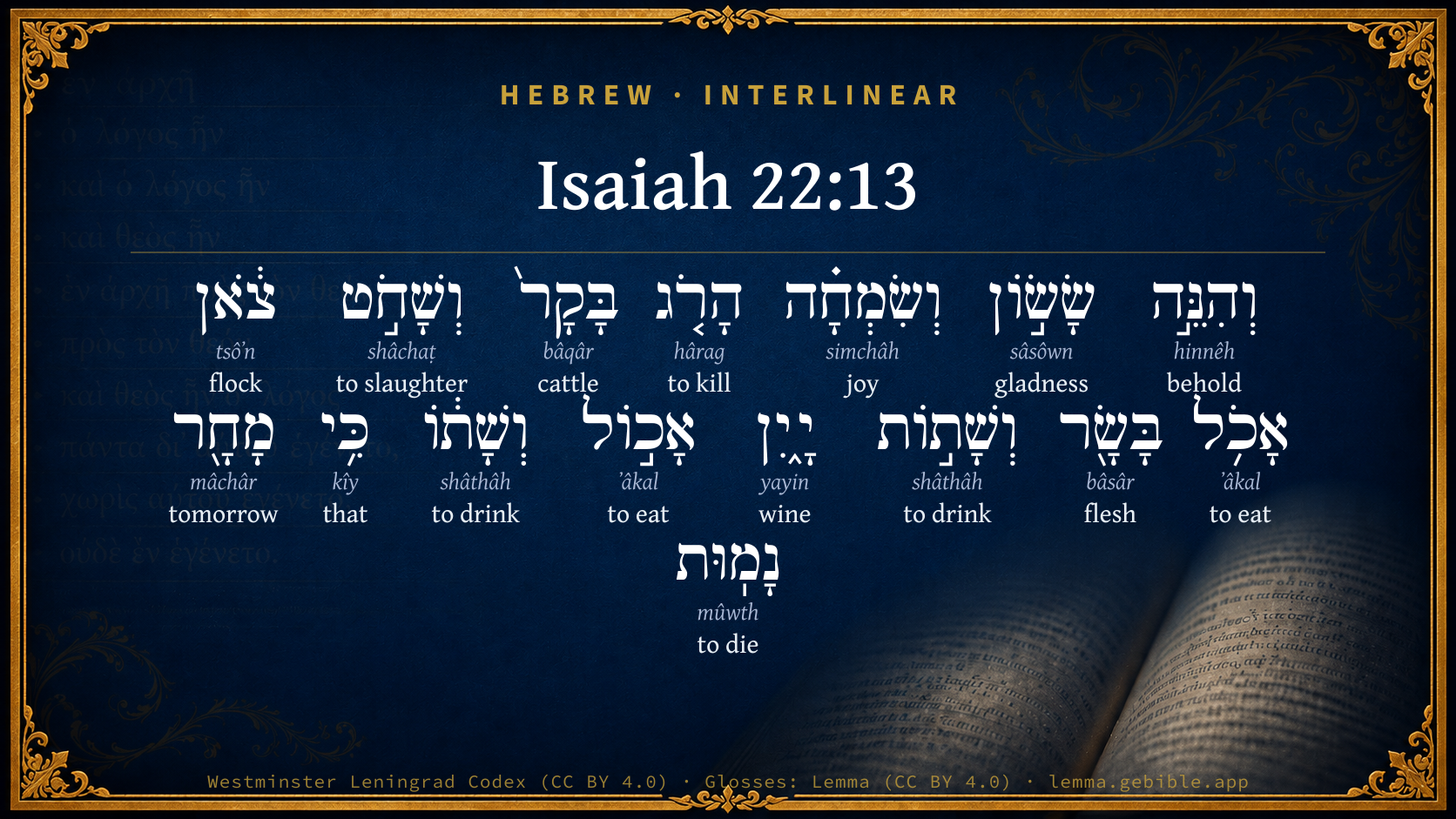
Hebrew (Westminster Leningrad Codex) Isaiah 22:13 appears in the Hebrew Old Testament. The text above is from the Westminster Leningrad Codex. Each word links to its Strong’s number, a concise gloss, and parsing drawn from the Open Scriptures Hebrew Bible morphology. Click any word for its full Brown-Driver-Briggs (BDB) entry.
Download image
Cite this verse

Isaiah 22:13 (World English Bible). Public Domain. Lemma interlinear Bible study tool, https://lemma.gebible.app/v/isaiah/22/13.

Show BibTeX & RIS
BibTeX
RIS
English Translation
and behold, joy and gladness, killing oxen and killing sheep, eating flesh and drinking wine: let us eat and drink, for tomorrow we shall die.
World English Bible · Public Domain
Download a study sheet

One document with this verse’s original text, its word-by-word gloss line, the meaning frame, cross-references with their text, attributed commentary, and full source and license credits — printable, and it pastes into notes with its structure intact.

This verse Autodidact and up

Study sheet (.html) Plain text (.txt)

A passage Seminary Student

Up to 50 verses in one chapter. A passage sheet keeps up to 6 commentary sources and 12 cross-references per verse, in the order this page ranks them, and says so on the sheet whenever that leaves anything out. Ask for a single verse and you get the Autodidact verse sheet above.

Everything on this page stays free to read, with no account — the sheet is a download of what is already on screen, not access to it.

Want to remove ads? Support Godless Engineer
Compare translations 3

The same verse in 3 English versions, stacked beneath the original-language interlinear above. Click any original word for its lexicon entry.

Each is an independent rendering of the whole verse — the interlinear is not word-aligned to these translations.

Highlighted words mark where these versions differ — a whole-verse word diff, not a word-by-word alignment.

  • World English Bible Public Domain
    and behold, joy and gladness, killing oxen and killing sheep, eating flesh and drinking wine: let us eat and drink, for tomorrow we shall die.
  • King James Version Public Domain
    And behold joy and gladness, slaying oxen, and killing sheep, eating flesh, and drinking wine: let us eat and drink; for to morrow we shall die.
  • unfoldingWord Literal Text CC BY-SA 4.0
    but behold, joy and gladness, slaughtering cattle and killing sheep, eating flesh and drinking wine: “Eat and drink, for tomorrow we die!”

unfoldingWord Literal Text — © unfoldingWord, licensed CC BY-SA 4.0. Word-aligned USFM3 via Door43 (git.door43.org/unfoldingWord/en_ult).

Versions to compare (up to 4)

3 of 4 selected

Show all 18 translations

Every available English version of this verse, each an independent rendering of the whole verse.

  • World English Bible Public Domain
    and behold, joy and gladness, killing oxen and killing sheep, eating flesh and drinking wine: let us eat and drink, for tomorrow we shall die.
  • Berean Standard Bible Public Domain
    But look, there is joy and gladness, butchering of cattle and slaughtering of sheep, eating of meat and drinking of wine: “Let us eat and drink, for tomorrow we die!”
  • Majority Standard Bible Public Domain
    But look, there is joy and gladness, butchering of cattle and slaughtering of sheep, eating of meat and drinking of wine: “Let us eat and drink, for tomorrow we die!”
  • King James Version Public Domain
    And behold joy and gladness, slaying oxen, and killing sheep, eating flesh, and drinking wine: let us eat and drink; for to morrow we shall die.
  • American Standard Version (1901) Public Domain
    and behold, joy and gladness, slaying oxen and killing sheep, eating flesh and drinking wine: let us eat and drink, for to-morrow we shall die.
  • Revised Version (1885) Public Domain
    and behold, joy and gladness, slaying oxen and killing sheep, eating flesh and drinking wine: let us eat and drink, for tomorrow we shall die.
  • Geneva Bible (1599) Public Domain
    And beholde, ioy and gladnes, slaying oxen and killing sheepe, eating flesh, and drinking wine, eating and drinking: for to morowe we shall die.
  • Douay-Rheims (1899) Public Domain
    And behold joy and gladness, killing calves, and slaying rams, eating flesh, and drinking wine: Let us eat and drink; for to morrow we shall die.
  • Young's Literal Translation Public Domain
    And lo, joy and gladness, slaying of oxen, And slaughtering of sheep, Eating of flesh, and drinking of wine, Eat and drink, for to-morrow we die.
  • Literal Standard Version CC BY-SA 4.0
    And behold, joy and gladness, slaying of oxen, || And slaughtering of sheep, || Eating of flesh, and drinking of wine, || Eat and drink, for tomorrow we die.
  • Unlocked Literal Bible CC BY-SA 4.0
    But look, instead, celebration and gladness, killing cattle and slaughtering sheep, eating meat and drinking wine; let us eat and drink, for tomorrow we will die.
  • unfoldingWord Literal Text CC BY-SA 4.0
    but behold, joy and gladness, slaughtering cattle and killing sheep, eating flesh and drinking wine: “Eat and drink, for tomorrow we die!”
  • Darby Bible Public Domain
    and behold joy and rejoicing, slaying oxen, and killing sheep, eating flesh, and drinking wine: -- Let us eat and drink, for to-morrow we die.
  • World Messianic Bible Public Domain
    and behold, there is joy and gladness, killing cattle and killing sheep, eating meat and drinking wine: “Let’s eat and drink, for tomorrow we will die.”
  • Webster's Bible Public Domain
    And behold joy and gladness, slaying oxen, and killing sheep, eating flesh, and drinking wine: let us eat and drink; for to-morrow we shall die.
  • Free Bible Version CC BY-SA 4.0
    Instead, you go on happily partying! You slaughter cattle and sheep so you can have your feasts, eating meat and drinking wine, saying, “Let's eat and drink, because we're going to die tomorrow!”
  • Bible in Basic English Public Domain
    But in place of these there was joy and delight, oxen and sheep were being made ready for food, there was feasting and drinking: men said, Now is the time for food and wine, for tomorrow death comes.
  • JPS Tanakh (1917) Public Domain
    And behold joy and gladness, slaying oxen and killing sheep, eating flesh and drinking wine — 'Let us eat and drink, for tomorrow we shall die!'

Literal Standard Version (2020), Covenant Press — licensed CC BY-SA 4.0. Text via the HelloAO Bible API (eBible.org). Unlocked Literal Bible (unfoldingWord) — licensed CC BY-SA 4.0. Text via the HelloAO Bible API (eBible.org). unfoldingWord Literal Text — © unfoldingWord, licensed CC BY-SA 4.0. Word-aligned USFM3 via Door43 (git.door43.org/unfoldingWord/en_ult). Free Bible Version, Dr. Jonathan Gallagher — licensed CC BY-SA 4.0. Text via the HelloAO Bible API (eBible.org).

Word by word

More ways to search: Search by grammar → Find every occurrence → Compare this word →

Practice this passage: Drill this verse → Learn its vocabulary →

שָׂשׂ֣וֹן
sâsôwn
H8342
“gladness”
Noun, Common, Masculine, Singular, Absolute
Part of Speech
Noun
Type
Common
Gender
Masculine
Number
Singular
State
Absolute
Full BDB Definition

Origin: from H7797

TWOT: 2246a

gladness, joy, exultation, rejoicing - exultation, joy
  1. וְהִנֵּ֣ה hinnêh H2009 “and · behold” Conjunction + Particle, Demonstrative
  2. וְשִׂמְחָ֗ה simchâh H8057 “and · joy” Conjunction + Noun, Common, Feminine, Singular, Absolute
  3. הָרֹ֤ג hârag H2026 “to kill” Verb, Qal, Infinitive Absolute
  4. בָּקָר֙ bâqâr H1241 “cattle” Noun, Common, Both, Singular, Absolute
  5. וְשָׁחֹ֣ט shâchaṭ H7819 “and · to slaughter” Conjunction + Verb, Qal, Infinitive Absolute
  6. צֹ֔אן tsôʼn H6629 “flock” Noun, Common, Both, Singular, Absolute
  7. אָכֹ֥ל ʼâkal H398 “to eat” Verb, Qal, Infinitive Absolute
  8. בָּשָׂ֖ר bâsâr H1320 “flesh” Noun, Common, Masculine, Singular, Absolute
  9. וְשָׁת֣וֹת shâthâh H8354 “and · to drink” Conjunction + Verb, Qal, Infinitive Absolute
  10. יָ֑יִן yayin H3196 “wine” Noun, Common, Masculine, Singular, Absolute
  11. אָכ֣וֹל ʼâkal H398 “to eat” Verb, Qal, Infinitive Absolute
  12. וְשָׁת֔וֹ shâthâh H8354 “and · to drink” Conjunction + Verb, Qal, Infinitive Absolute
  13. כִּ֥י kîy H3588 “that” Conjunction
  14. מָחָ֖ר mâchâr H4279 “tomorrow” Noun, Common, Masculine, Singular, Absolute
  15. נָמֽוּת mûwth H4191 “to die” Verb, Qal, Imperfect, 1st Person, Common, Plural

About this verse

These counts appear in no published source. They are computed here, from the morphology-tagged text and Lemma’s own curated glosses. What Lemma adds →

16
words
14
distinct lemmas
Prophets
section

Notable vocabulary

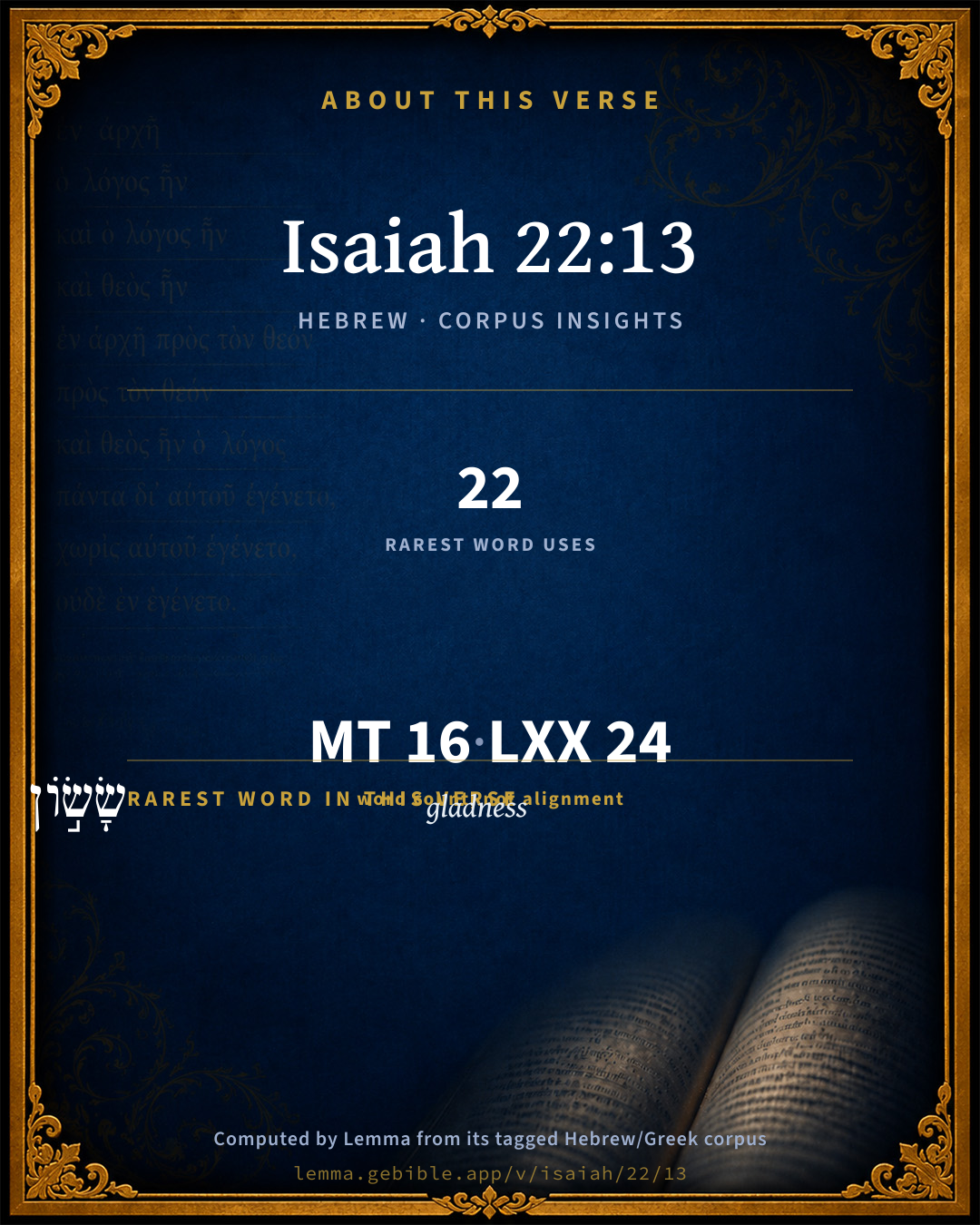
The rarest word here is שָׂשׂ֣וֹן gladness H8342 — appearing just 22 times in the whole Hebrew Bible.

Shared distinctive vocabulary

שָׂשׂ֣וֹן gladness H8342 occurs in 22 verses of the Hebrew Bible. Also found in:

Grammatical profile

  • 7 verbs
  • 7 nouns
  • 1 conjunction
  • 1 particle

Verb forms

  • הָרֹ֤ג Qal · Infinitive Absolute
  • וְשָׁחֹ֣ט Qal · Infinitive Absolute
  • אָכֹ֥ל Qal · Infinitive Absolute
  • וְשָׁת֣וֹת Qal · Infinitive Absolute
  • אָכ֣וֹל Qal · Infinitive Absolute
  • וְשָׁת֔וֹ Qal · Infinitive Absolute
  • נָמֽוּת Qal · Imperfect

Repetition

Words recur within this verse — often emphatic in Hebrew:

  • אָכֹ֥ל to eat H398 ×2
  • וְשָׁת֣וֹת to drink H8354 ×2

Hebrew & Septuagint length

In English translation the verse runs 25 words from the Hebrew and 30 from the Septuagint (LXX English) — closely comparable.

A rough comparison of the two English renderings, which tokenize alike — not a word-level alignment.

Word counts can differ between the Hebrew and the Greek without any difference in meaning — e.g. the Hebrew direct-object marker אֵת has no separate Greek word, and Greek often adds the article ὁ.

In the original languages it is 16 Hebrew tokens and 24 Greek tokens — but the two are counted differently (Hebrew bundles its prefixes and suffixes into one token; the Greek is in lemma form), so that isn’t a like-for-like length.

Cross-references

9

Topical passages linked to Isaiah 22:13 in the Treasury of Scripture Knowledge — connected by theme and wording, ordered by reader-vote popularity; previews shown in the World English Bible.

  • Isaiah 56:12 Come you, [say they], I will get wine, and we will fill ourselves with strong drink; and tomorrow shall be as this day, [a day] great beyond measure.
  • Luke 17:26–29 As it happened in the days of Noah, even so will it be also in the days of the Son of Man.
  • 1 Corinthians 15:32 If I fought with animals at Ephesus for human purposes, what does it profit me? If the dead are not raised, then "let us eat and drink, for tomorrow we die."
  • James 5:5 You have lived delicately on the earth, and taken your pleasure. You have nourished your hearts as in a day of slaughter.
  • Isaiah 5:12 The harp, lyre, tambourine, and flute, with wine, are at their feasts; But they don't regard the work of Yahweh, Neither have they considered the operation of his hands.
  • Isaiah 5:22 Woe to those who are mighty to drink wine, And champions at mixing strong drink;
  • Isaiah 21:4–5 My heart flutters, horror has frightened me; the twilight that I desired has been turned into trembling to me.
  • Amos 6:3–7 Those who put far away the evil day, And cause the seat of violence to come near;
  • Isaiah 28:7–8 Even these reel with wine, and stagger with strong drink; the priest and the prophet reel with strong drink, they are swallowed up of wine, they stagger with strong drink; they err in vision, they stumble in judgment.

Cross-references courtesy of OpenBible.info (CC BY 4.0).

Hebrew and Greek witnesses Masoretic Hebrew ↔ Greek Septuagint

The same verse in the two great witnesses to the Old Testament, shown verse-for-verse.

These are two independent witnesses, not word-aligned to each other, and the Septuagint is shown in lemma (dictionary) form.

Hebrew Isaiah 22:13 Masoretic · Westminster Leningrad Codex

וְהִנֵּ֣ה שָׂשׂ֣וֹן וְשִׂמְחָ֗ה הָרֹ֤ג בָּקָר֙ וְשָׁחֹ֣ט צֹ֔אן אָכֹ֥ל בָּשָׂ֖ר וְשָׁת֣וֹת יָ֑יִן אָכ֣וֹל וְשָׁת֔וֹ כִּ֥י מָחָ֖ר נָמֽוּת

and behold, joy and gladness, killing oxen and killing sheep, eating flesh and drinking wine: let us eat and drink, for tomorrow we shall die.

World English Bible · Public Domain

Greek LXX Isaiah 22:13 Septuagint · lemma form

αὐτός δέ ποιέω εὐφροσύνη καί ἀγαλλίαμα σφάζω μόσχος καί θύω πρόβατον ὥστε ἐσθίω κρέας καί πίνω οἶνος λέγω ἐσθίω καί πίνω αὔριον γάρ ἀποθνήσκω

but they engaged in joy and gladness, slaying calves, and killing sheep, so as to eat flesh, and drink wine; saying, Let us eat and drink; for to-morrow we die.

LXX2012 (modern English Septuagint) · Public Domain

Hebrew: Westminster Leningrad Codex (CC BY 4.0). Greek: Septuagint (public domain); English from LXX2012 (modern English Septuagint) (Public Domain). How the Septuagint differs from the Hebrew →

Targum (Aramaic paraphrase)

1

The Targum is the ancient Jewish Aramaic paraphrase of the Hebrew Scriptures — an interpretive translation, not the Hebrew text itself. Onkelos (literal) and Pseudo-Jonathan (expansive) render the Torah, and Jonathan the Prophets. Coverage is partial: where no permissively-licensed English translation exists for a verse, only the Aramaic is shown. This is verse-level text, not a word-by-word alignment to the Hebrew.

  1. Targum Jonathan Prophets (Joshua–Malachi)
    וְהָא בִּיַע וְחֶדְוָה אָמְרִין נִקְטוֹל תוֹרִין וְנִנְכַס עָאן נֵיכוּל בְּסַר וְנִשְׁתֵּי חֲמַר נֵיכוּל וְנִשְׁתֵּי מִדִנְמוּת לָא נְחֵי:

    But, behold, joy and gladness; they say, Let us slay oxen, and kill sheep, we will eat flesh, we will drink wine; let us eat, and drink, since we shall die, and not live.

    Targum Jonathan — Aramaic: “Mikraot Gedolot” (public domain). English: “Sefaria Community Translation” (CC0 1.0 (public-domain dedication)); “London "Chaldee Paraphrase," 1871” (public domain). Text via Sefaria.

Commentary

Notes on Isaiah 22:13 from classic Christian and Jewish commentators (each source and its license shown beneath its notes). The classic Christian expositions comment on the surrounding passage and are grouped to its opening verse, so a note may address several verses; the Jewish commentaries on the Tanakh (Rashi and others) are per-verse, so they appear only where the commentator wrote on this verse.

Lemma curates 59 commentaries, every one of them public domain or Creative Commons licensed, each selected and text-cleaned for this edition rather than reprinted as found. About our sources →

Trapp's Complete Commentary

John Trapp

Isa 22:13 And behold joy and gladness, slaying oxen, and killing sheep, eating flesh, and drinking wine: let us eat and drink; for to morrow we shall die.

Ver. 13. And behold joy and gladness.] Or, But behold, see the madness of these cross grained creatures, who, to thwart the Almighty, in laetitiam et luxum prosiliunt, take a clean contrary course to what he had prescribed, as if they had done it on purpose. {a}

Eating and drinking.] This was all they minded, or were good for, as we say. Gulonum non alia est cura quam cibum ingerere, digerere, egerere, saith Bernard. The belly god is set all on his paunch, as the ass fish hath his heart in his belly; as the spider is little else but belly; as the gulon (a beast so called) eateth that which he preyeth upon - if it be a horse, till all be devoured - ever filling his belly, and then emptying it, and then falling to it again till all be consumed; such a delight hath he in his appetite.

For to morrow we shall die.] So the prophets tell us, but we are wiser than to believe them; so the enemy threateneth us, but we are too well fortified to fear him; so it may happen, for we are all mortal; let us therefore make much of ourselves while we may.

“ Indulge genio, carpamus dulcia: nostrum est

Quod vivis: cinis et manes et fabula fies. ”

- Pers., Sat. v.

St Paul saith that the epicures of his time used the like atheistic expressions. {1Co 15:32, see there} It is the guise of graceless wretches to jest out God’s judgments, and to jeer when they should fear.

{a} Per omne ασωτιας genus grassabantur. - Scult.

John Trapp, A Commentary or Exposition upon All the Books of the Old and New Testament (1647–1656) — public domain. Text from a community e-Sword module.

Geneva Bible (1599)

Geneva Bible translators

Instead of repentance ye were joyful and made great cheer, contemning the admonitions of the Prophets, saying, Let us eat and drink for our Prophets say, that we shall die tomorrow.

Geneva Bible (1599) marginal notes — public domain. Text via Bolls.life.

Jamieson, Fausset & Brown

Robert Jamieson, A. R. Fausset & David Brown

Notwithstanding Jehovah's "call to mourning" (Isa 22:12), many shall make the desperate state of affairs a reason for reckless revelry (Isa 5:11-12, Isa 5:14; Jer 18:12; Co1 15:32).

In Isa 36:3, Isa 36:22; Isa 37:2, we find Shebna "a scribe," and no longer prefect of the palace ("over the household"), and Eliakim in that office, as is here foretold. Shebna is singled out as the subject of prophecy (the only instance of an individual being so in Isaiah), as being one of the irreligious faction that set at naught the prophet's warnings (Isa. 28:1-33:24); perhaps it was he who advised the temporary ignominious submission of Hezekiah to Sennacherib.

Jamieson, Fausset & Brown — Commentary Critical and Explanatory on the Whole Bible (1871) — public domain (CC PDM 1.0). Text via the HelloAO Bible API.

Adam Clarke's Commentary

Verse 13. Let us eat and drink, for to-morrow we shall die.] This has been the language of all those who have sought their portion in this life, since the foundation of the world. So the poet: -

Heu, heu nos miseri! quam totus homuncio nil est!

Sic erimus cuncti, postquam nos auferet orcus.

Ergo vivamus, dum licet esse, bene.

Alas alas! what miserable creatures are we, only the semblances of men! And so shall we be all when we come to die. Therefore let us live joyfully while we may.

Domitian had an image of death hung up in his dining-room, to show his guests that as life was uncertain, they should make the best of it by indulging themselves. On this Martial, to flatter the emperor, whom he styles god, wrote the following epigram: -

Frange thoros, pete vina, tingere nardo.

Ipse jubet mortis te meminisse Deus.

Sit down to table - drink heartily - anoint thyself with spikenard; for God himself commands thee to remember death.

So the adage: -

Ede, bibe, lude: post mortem nulla voluptas.

"Eat, drink, and play, while here ye may:

No revelry after your dying day."

St. Paul quotes the same heathen sentiment, 1Co 15:32: "Let us eat and drink, for to-morrow we die."

Anacreon is full in point, and from him nothing better can be expected: -

Ὡς ουν ετ' ευδι' εστιν,

Και πινε και κυβευε

Και σπενδε τῳ Λυαιῳ·

Μη νουσος, ην τις ελθῃ,

Λεγῃ, σε μη δει πινειν.

ANAC. Od. xv., l. 11.

"While no tempest blots your sky,

Drink, and throw the sportful dye:

But to Bacchus drench the ground,

Ere you push the goblet round;

Lest some fatal illness cry,

'Drink no more the cup of joy.'"

ADDISON.

Adam Clarke's Commentary on the Bible (1810–1826) — public domain. Text from a community e-Sword/MySword module.

Ellicott's Commentary for English Readers

(13) And behold joy and gladness . . .—As things were, however, the danger, imminent as it was, led, as in the plague at Athens in the time of Pericles, and that of Florence in the time of Boccaccio, not to repentance, but to recklessness and sensuality. The cry of the baser form of epicureanism in all ages (1Co_15:32) was uttered, or acted on, and the prophet echoes the spoken words, or gives utterance to the unspoken thought, in tones of burning indignation.

A Bible Commentary for English Readers, edited by Charles John Ellicott (1878–1897) — public domain. Text from a community e-Sword module.

The Cambridge Bible for Schools and Colleges

gen. ed. J. J. S. Perowne

13. Instead of this the people rush to drown reflection in riotous festivities. The immediate occasion of the revelry was no doubt a great sacrifice of thanksgiving to Jehovah for their unexpected deliverance, but this only rendered their irreligious spirit more detestable to Jehovah (cf. Isa_1:10-17).

for to morrow we shall die] Cf. 1Co_15:32. Probably a current proverb. But the revellers may very well have been conscious that their escape had only procured for them a precarious respite. And in the next verse Isaiah assures them that they shall die.

The Cambridge Bible for Schools and Colleges (gen. ed. J. J. S. Perowne; Cambridge University Press, 1878–1918) — public domain. Text from a community e-Sword module.

John Gill's Exposition

And behold joy and gladness,.... As if it was a time of rejoicing, rather than of weeping and mourning; and as if they were at a festival, and in the greatest prosperity and liberty, and not besieged by a powerful army:

slaying oxen, and killing sheep: not for sacrifice, to make atonement for sin, as typical of the great sacrifice; but to eat, and that not as at ordinary meals, or merely for the support of life, but as at feasts, where, as there was great plenty, so luxury and intemperance were indulged; just as Belshazzar did, at the same time that Babylon was beset by the army of the Medes and Persians, Dan 5:1 so the Jews here, having taken the armour out of the treasury, and furnished the soldiers with them, and took care of provisions of bread and water, and having repaired and fortified the walls of the city, thought themselves secure, and gave up themselves to feasting, mirth, and pleasure: saying,

let us eat and drink, for tomorrow we shall die; which they said, not as believing their case to be desperate; that the next day, or in a few days, their city would be taken by the Assyrians, and they should be put to the sword, and therefore, since they had but a short life to live, they would live a merry one; but rather as not believing it, but scoffing at the prophet, and at the word of the Lord by him; as if they should say, the prophet says we shall die tomorrow, or we are in great danger of being suddenly destroyed; but let us not be dismayed at such words, and to show that we do not believe them, or if this is our case, let us take our fill of pleasure, while we may have it. This is the language of epicures, and of such that disbelieve the resurrection of the dead, and a future state, to whom the apostle applies the words in Co1 15:32.

John Gill's Exposition of the Whole Bible (1746–1763) — public domain (CC PDM 1.0). Text via the HelloAO Bible API.

Albert Barnes' Notes on the Bible

And behold ... - When they ought to give themselves to fasting and prayer, they gave themselves up to revelry and riot.

Let us eat and drink - Saying, Let us eat and drink. That is, it is inevitable that we must soon die. The army of the Assyrian is approaching, and the city cannot stand against him. It is in vain to make a defense, and in vain to call upon God. Since we “must” soon die, we may as well enjoy life while it lasts. This is always the language of the epicure; and it seems to be the language of no small part of the world. Probably if the “real” feelings of the great mass of worldly people were expressed, they could not be better expressed than in this passage of Isaiah: ‘We must soon die at all events. We cannot avoid that, for it is the common lot of all. And since we have been sent into a dying world; since we had no agency in being placed here; since it is impossible to prevent this doom, we may as well “enjoy” life while it lasts, and give ourselves to pleasure, dissipation, and revelry.

While we can, we will take our comfort, and when death comes we will submit to it, simply because we cannot avoid it.’ Thus, while God calls people to repentance and seriousness; and while he would urge them, by the consideration that, this life is short, to prepare for a better life; and while he designs that the nearness of death should lead them to think solemnly of it, they abuse all His mercies, endeavor to thwart all His arrangements, and live and die like the brutes. This passage is quoted by Paul in his argument on the subject of the resurrection in 1Co 15:32. Sentiments remarkably similar to this occur in the writings of the Greek and Roman poets. Among the Egyptians, the fact that life is short was urged as one argument for promoting soberness and temperance, and in order to produce this effect, it was customary at their feasts to have introduced, at some part of the entertainment, a wooden image of Osiris in the form of a human mummy standing erect, or lying on a bier, and to show it to each of the guests, warning him of his mortality, and of the transitory nature of human pleasures.

He was reminded that one day he would be like that; and was told that people ‘ought to love one another, and to avoid those evils which tend to make them consider life too long, when in reality it is too short, and while enjoying the blessings of this life, to bear in mind that life was precarious, and that death would soon close all their comforts.’ (See Wilkinson’s “Ancient Egyptians,” vol. ii. pp. 409-411.) With the Greeks and Romans, however, as well as the Jews in the time of Isaiah, the fact of the shortness of life was used to produce just the contrary effect - to prompt them to dissipation and licentiousness. The fact of the temporary pilgrimage of man served as an inducement to enjoy the pleasures of life while they lasted, since death was supposed to close the scene, and no prospect was held out of happiness in a future state. This sentiment was expressed in their songs at their entertainments to urge themselves on to greater indulgence in wine and in pleasure. Thus, in Anacreon, Ode 4:

Εις εαυτον

Ο δ ̓ Ερως χιτωνα δησας

Υπερ αυχενος παπυρῳ

Μεθυ μοι διηκονειτὀ

Τροχος αρματος γαροια

Βιοτος τρεχει κυλισθεις

Ολιγη δε κεισομεσθα

Κονις, οστεων λυθεντων

Τι σε δει λιθον μυριζειν;

Τι δε γῃ χεειν ματαια;

Εμε μαλλον, ως ετι ζω,

Μυριζον, καλει δ ̓ εταιρην.

Πριν, Ερως, εκει με απελθειο

Υπο νερτερων χορειας,

Σκεδασαι θελω μεριμνας.

Eis eauton

Ho d' Erōs chitōna dēesas

Huper auchenos papurō

Methu moi diēkoneito.

Trochos armatos gar oia

Biotos trechei kulistheis

Oligē de keisomestha

Konis, osteōn luthentōn.

Ti se dei lithon murizein;

Ti de gē cheein mataia;

eme mallon, hōs eti zō,

Murizon, kalei d' hetairēn

Prin, Erōs, ekei me apelthein

Hupo nerterōn choreias,

Skedasai thelō merimnas.

‘In decent robe behind him bound,

Cupid shall serve the goblet round;

For fast away our moments steal,

Like the swift chariot’s rolling wheel;

The rapid course is quickly done,

And soon the race of life is run.

Then, then, alas! we droop, we die;

And sunk in dissolution lie:

Our frame no symmetry retains,

Nought but a little dust remains.

Why o’er the tomb are odors shed?

Why poured libations to the dead?

To me, far better, while I live,

Rich wines and balmy fragrance give.

Now, now, the rosy wreath prepare,

And hither call the lovely fair.

Now, while I draw my vital breath,

Ere yet I lead the dance of death,

For joy my sorrows I’ll resign,

And drown my cares in rosy wine.’

A similar sentiment occurs in Horace. Odyssey iii. 13:

Huc vina, et unguente, et nimium brevis

Flores amoenos ferre jube rosae.

Dum res, et aetas, et sororum

Fila trium patiuntur atra.

And still more strikingly in Petronius, “Satyric.” c. 34, “ad finem:”

Heu, heu, nos miseros, quam torus homuncio nil est!

Sic erimus cuncti, postquam nos auferat Orcus:

Ergo vivamus, dum licet esse, bene.

The same sentiments prevailed among the Jews in the time of the author of the Book of Wisdom (Wisd. 11:1-9): ‘Our life is short and tedious, and in the death of a man there is no remedy: neither was there any man known to have returned from the grave. For we are born at all adventure; and we shall be hereafter as though we had never been, for the breath in our nostrils is as smoke, and a little spark in the moving of our heart. Come on, therefore, let us enjoy the good things that are present; let us fill ourselves with costly wine and ointments, and let no flower of the spring pass by us; let us crown ourselves with rose buds before they be withered; let none of us go without his part of our voluptuousness; let us leave tokens of our joyfulness in every place.’ It was with reference to such sentiments as these, that Dr. Doddridge composed that beautiful epigram which Dr. Johnson pronounced the finest in the English language:

‘Live while you live,’ the sacred preacher cries,

‘And give to God each moment as it flies;’

‘Live while you live,’ the Epicure would say,

‘And seize the pleasures of the present day.’

Lord, in my view, let both united be,

I live to pleasure when I live to thee.

Albert Barnes' Notes on the Bible (1834–1885) — public domain. Text from a community e-Sword/MySword module.

Haydock's Catholic Bible Commentary

Die. Thus the pagans encouraged themselves to feast. (Calmet) --- Ergo vivamus dum licet esse bene. (Petronius) --- This conduct betrayed an entire want of faith. (Calmet) --- "Nothing offends God so much....as contempt proceeding from despair." (St. Jerome)

George Leo Haydock (1774–1849), Haydock's Catholic Family Bible and Commentary, 1859 edition — public domain. Excludes Psalms (Douay-Rheims chapter numbering differs from Protestant) and Deuterocanonical books (Catholic canon only).

Matthew Poole's English Annotations

Eating flesh; not only for necessity, but to excess and luxury, as eating and drinking are taken, Mat 24:38.

Let us eat and drink; for to-morrow we shall die: the prophets tell us that we shall certainly and suddenly be destroyed; it concerns us therefore to make our best of the present time, and to be merry whilst we have the opportunity. A most perverse and desperate conclusion, proceeding from obstinate profaneness, and contempt of God’s judgments.

Matthew Poole's English Annotations on the Holy Bible (1683–1685) — public domain. Text from a community e-Sword/MySword module.

The Pulpit Commentary

And behold joy and gladness (comp. ver. 2). "Let us eat and drink, for to-morrow we die," is a common sentiment, if not a common expression. It has been supposed to have given rise to the Egyptian practice of carrying round the model of a mummy to the guests at feasts. According to the Greeks, Sardanapalus had a phrase very like it engraved upon his tomb ("Ancient Monarchies," vol. 2. p. 500). Sailors have often acted upon it, when they found it impossible to save their ship. On seeing their city invested, a portion of the inhabitants of Jerusalem, despairing of safety, did as sailors have done so frequently.

The Pulpit Commentary (1880–1919), ed. H.D.M. Spence-Jones & Joseph S. Exell — public domain. Text from a community e-Sword module.

John Wesley's Explanatory Notes

Let us, &c. - A most perverse and desperate conclusion.

John Wesley, Explanatory Notes Upon the Whole Bible (1754–1765) — public domain. Text via the GEBible commentary corpus.

J. A. Alexander on Isaiah

Joseph Addison Alexander

“And behold mirth and jollity, slaying of oxen and killing of sheep, eating of flesh and drinking of wine; eat and drink, for tomorrow we die.” This verse presents the contrast of their actual behavior with that to which God called them by His providence. The common version, ‘let us eat and drink’, is perfectly correct as to sense, but needlessly departs from the peculiar and expressive form of the original. I have substituted eat and drink, not as imperatives, but as the simplest forms of the English verbs. (See above, Isa 21:5) To eat and to drink might be considered more exact, but would not exhibit the compression and eloquence of the original. It has been disputed whether these last words are expressive of contemptuous incredulity or of a desperate determination to spend the residue of life in pleasure. It is by no means clear that these two feelings are exclusive of each other, since the same man might express his disbelief of the threatening, and his resolution, if it should prove true, to die in the enjoyment of his favourite indulgences. At all events, there can be no need of restricting the full import of the language, as adapted to express both states of mind, in different persons, if not in the same.

Joseph Addison Alexander, The Prophecies of Isaiah (1846–1847; New York: Scribner, 1870–1878) — public domain. Text from a community e-Sword module.

Rashi

Rabbi Shlomo Yitzchaki (Rashi)

And behold, joy and happiness The Holy One, blessed be He, so to speak, is mourning, and you are eating and rejoicing.

for tomorrow we will die in the World to Come. The prophets tell us in the name of the Holy One, blessed be He, that we will have no share in the World to Come. Let us, therefore, enjoy ourselves during our lifetime.

Rashi on the Tanakh — English translations: “The Judaica Press complete Tanach with Rashi, translated by A. J. Rosenberg” (CC BY 4.0); “Pentateuch with Rashi's commentary by M. Rosenbaum and A.M. Silbermann, 1929-1934” (public domain); “The Metsudah Tanach series, Lakewood, N.J” (CC BY 4.0); and “The Book of Joshua, Metsudah Publications, 1997” (CC BY 4.0). Text via Sefaria.

Ibn Ezra

Rabbi Abraham ibn Ezra

הרג Slaying, causing the separation of the soul from the body; הרג is used with reference to cattle instead of שחט, and on the other side וישחטם, And he slaughtered them (Num. 14:16) is used with reference to men instead of.ויהרגם

For to-morrow we shall die. The prophet foretells what people will say in the days of the siege.

Ibn Ezra on the Tanakh — English translations: “Sefaria Community Translation” (CC0 1.0 (public-domain dedication)); “Yalkut, Sifsei Chachomim Chumash, Metsudah Publications, 2009” (CC BY 4.0); and “Commentary of Ibn Ezra on Isaiah - trans. by M. Friedlander, 1873” (public domain). Text via Sefaria.

Lesson kit

Teaching starters — assembled from the data on this page, not authored interpretation. Every prompt links to the verse data it draws on. Edit before teaching.

Isaiah, in the Prophets, opens this verse with 16 words (14 distinct Hebrew lemmas). Its most distinctive word is sâsôwn (“gladness”). A historical commentator’s framing appears above. Read the whole chapter for the surrounding context.

Discussion questions

  1. The word sâsôwn carries the sense “gladness.” How does it shape the verse?
  2. How does Esther 8:16, which shares the word «gladness», read alongside this verse?
  3. What does the repetition of “to eat” (2× in this one verse) do in this verse?
  4. These translations render this verse differently. What is at stake in choosing one wording over another?
  5. «הָרֹ֤ג» is a Qal Infinitive Absolute verb. How does that grammatical form shape the action described?
  6. Compare how Trapp's Complete Commentary and Geneva Bible (1599) read this verse. Where do they agree or differ?

Things to notice

Reading settings

Reading text

Shown beneath each verse's original-language words.

Old Testament
Old Testament edition

Read the OT as the Masoretic Hebrew (MT) or the Greek Septuagint (LXX).

English shown for the Greek Septuagint (in the Hebrew ↔ Greek comparison).

Comparing translations? Open the Compare panel on any verse page to stack up to four side by side.