
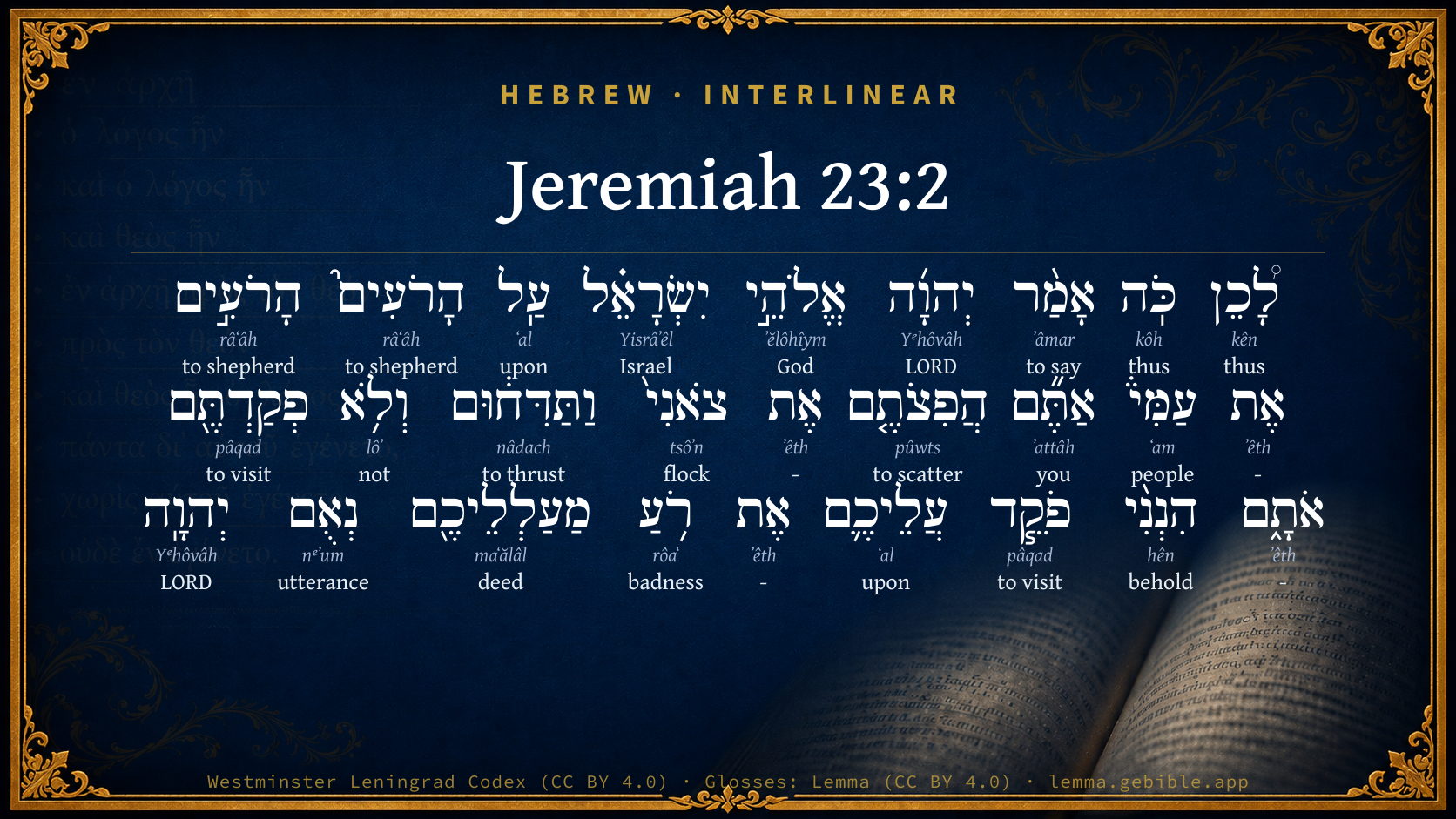
Jeremiah 23:2

Hebrew (Westminster Leningrad Codex) Jeremiah 23:2 appears in the Hebrew Old Testament. The text above is from the Westminster Leningrad Codex. Each word links to its Strong’s number, a concise gloss, and parsing drawn from the Open Scriptures Hebrew Bible morphology. Click any word for its full Brown-Driver-Briggs (BDB) entry.
Download image
Cite this verse

Jeremiah 23:2 (World English Bible). Public Domain. Lemma interlinear Bible study tool, https://lemma.gebible.app/v/jeremiah/23/2.

Show BibTeX & RIS
BibTeX
RIS
English Translation
Therefore thus says Yahweh, the God of Israel, against the shepherds who feed my people: You have scattered my flock, and driven them away, and have not visited them; behold, I will visit on you the evil of your doings, says Yahweh.
World English Bible · Public Domain
Download a study sheet

One document with this verse’s original text, its word-by-word gloss line, the meaning frame, cross-references with their text, attributed commentary, and full source and license credits — printable, and it pastes into notes with its structure intact.

This verse Autodidact and up

Study sheet (.html) Plain text (.txt)

A passage Seminary Student

Up to 50 verses in one chapter. A passage sheet keeps up to 6 commentary sources and 12 cross-references per verse, in the order this page ranks them, and says so on the sheet whenever that leaves anything out. Ask for a single verse and you get the Autodidact verse sheet above.

Everything on this page stays free to read, with no account — the sheet is a download of what is already on screen, not access to it.

Want to remove ads? Support Godless Engineer
Compare translations 3

The same verse in 3 English versions, stacked beneath the original-language interlinear above. Click any original word for its lexicon entry.

Each is an independent rendering of the whole verse — the interlinear is not word-aligned to these translations.

Highlighted words mark where these versions differ — a whole-verse word diff, not a word-by-word alignment.

  • World English Bible Public Domain
    Therefore thus says Yahweh, the God of Israel, against the shepherds who feed my people: You have scattered my flock, and driven them away, and have not visited them; behold, I will visit on you the evil of your doings, says Yahweh.
  • King James Version Public Domain
    Therefore thus saith the LORD God of Israel against the pastors that feed my people; Ye have scattered my flock, and driven them away, and have not visited them: behold, I will visit upon you the evil of your doings, saith the LORD.
  • unfoldingWord Literal Text CC BY-SA 4.0
    “Therefore, thus says Yahweh, the God of Israel, concerning the shepherds who are shepherding my people: ‘You, yourselves have scattered my flock and have driven them away, and you have not attended to them. Behold, I am attending to you for the evil of your deeds’”—the declaration of Yahweh.

unfoldingWord Literal Text — © unfoldingWord, licensed CC BY-SA 4.0. Word-aligned USFM3 via Door43 (git.door43.org/unfoldingWord/en_ult).

Versions to compare (up to 4)

3 of 4 selected

Show all 18 translations

Every available English version of this verse, each an independent rendering of the whole verse.

  • World English Bible Public Domain
    Therefore thus says Yahweh, the God of Israel, against the shepherds who feed my people: You have scattered my flock, and driven them away, and have not visited them; behold, I will visit on you the evil of your doings, says Yahweh.
  • Berean Standard Bible Public Domain
    Therefore this is what the LORD, the God of Israel, says about the shepherds who tend My people: “You have scattered My flock and driven them away, and have not attended to them. Behold, I will attend to you for the evil of your deeds, declares the LORD.
  • Majority Standard Bible Public Domain
    Therefore this is what the LORD, the God of Israel, says about the shepherds who tend My people: “You have scattered My flock and driven them away, and have not attended to them. Behold, I will attend to you for the evil of your deeds, declares the LORD.
  • King James Version Public Domain
    Therefore thus saith the LORD God of Israel against the pastors that feed my people; Ye have scattered my flock, and driven them away, and have not visited them: behold, I will visit upon you the evil of your doings, saith the LORD.
  • American Standard Version (1901) Public Domain
    Therefore thus saith Jehovah, the God of Israel, against the shepherds that feed my people: Ye have scattered my flock, and driven them away, and have not visited them; behold, I will visit upon you the evil of your doings, saith Jehovah.
  • Revised Version (1885) Public Domain
    Therefore thus saith the LORD, the God of Israel, against the shepherds that feed my people: Ye have scattered my flock, and driven them away, and have not visited them; behold, I will visit upon you the evil of your doings, saith the LORD.
  • Geneva Bible (1599) Public Domain
    Therefore thus saith the Lord God of Israel vnto the pastors that feede my people, Yee haue scattered my flock and thrust them out, and haue not visited them: beholde, I will visite you for the wickednesse of your works, saith the Lord.
  • Douay-Rheims (1899) Public Domain
    Therefore thus saith the Lord the God of Israel to the pastors that feed my people: You have scattered my flock, and driven them away, and have not visited them: behold I will visit upon you for the evil of your doings, saith the Lord.
  • Young's Literal Translation Public Domain
    Therefore, thus said Jehovah, God of Israel, Against the shepherds who feed My people, Ye have scattered My flock, and drive them away, And have not inspected them, Lo, I am charging on you the evil of your doings, An affirmation of Jehovah.
  • Literal Standard Version CC BY-SA 4.0
    Therefore, thus said YHWH, God of Israel, || Against the shepherds who feed My people: “You have scattered My flock, and drive them away, || And have not inspected them, || Behold, I am charging on you the evil of your doings,” || A declaration of YHWH.
  • Unlocked Literal Bible CC BY-SA 4.0
    Therefore Yahweh, the God of Israel, says this concerning the shepherds who are shepherding his people, “You have scattered my flock and have driven them away. You have not cared for them. So I am about to punish you for the evil you have done—this is Yahweh's declaration.
  • unfoldingWord Literal Text CC BY-SA 4.0
    “Therefore, thus says Yahweh, the God of Israel, concerning the shepherds who are shepherding my people: ‘You, yourselves have scattered my flock and have driven them away, and you have not attended to them. Behold, I am attending to you for the evil of your deeds’”—the declaration of Yahweh.
  • Darby Bible Public Domain
    Therefore thus saith Jehovah the God of Israel concerning the shepherds that feed my people: Ye have scattered my flock,and driven them away, and have not visited them: behold, I will visit upon you the evil of your doings, saith Jehovah.
  • World Messianic Bible Public Domain
    Therefore the LORD, the God of Israel, says against the shepherds who feed my people: “You have scattered my flock, driven them away, and have not visited them. Behold, I will visit on you the evil of your doings,” says the LORD.
  • Webster's Bible Public Domain
    Therefore thus saith the LORD God of Israel against the pastors that feed my people; Ye have scattered my flock, and driven them away, and have not visited them: behold, I will visit upon you the evil of your doings, saith the LORD.
  • Free Bible Version CC BY-SA 4.0
    This is what the Lord, the God of Israel, says about the shepherds who were meant to look after my people: You have scattered my flock. You have chased them away. You didn't take care of them, so now I will take care of you for all the evil you've done, declares the Lord.
  • Bible in Basic English Public Domain
    So this is what the Lord, the God of Israel, has said against the keepers who have the care of my people: You have let my flock be broken up, driving them away and not caring for them; see, I will send on you the punishment for the evil of your doings, says the Lord.
  • JPS Tanakh (1917) Public Domain
    Therefore thus saith the LORD, the God of Israel, against the shepherds that feed My people: Ye have scattered My flock, and driven them away, and have not taken care of them; behold, I will visit upon you the evil of your doings, saith the LORD.

Literal Standard Version (2020), Covenant Press — licensed CC BY-SA 4.0. Text via the HelloAO Bible API (eBible.org). Unlocked Literal Bible (unfoldingWord) — licensed CC BY-SA 4.0. Text via the HelloAO Bible API (eBible.org). unfoldingWord Literal Text — © unfoldingWord, licensed CC BY-SA 4.0. Word-aligned USFM3 via Door43 (git.door43.org/unfoldingWord/en_ult). Free Bible Version, Dr. Jonathan Gallagher — licensed CC BY-SA 4.0. Text via the HelloAO Bible API (eBible.org).

Word by word

More ways to search: Search by grammar → Find every occurrence → Compare this word →

Practice this passage: Drill this verse → Learn its vocabulary →

רֹ֥עַ
rôaʻ
H7455
“badness of”
Noun, Common, Masculine, Singular, Construct
Part of Speech
Noun
Type
Common
Gender
Masculine
Number
Singular
State
Construct
Full BDB Definition

Origin: from H7489

TWOT: 2191b

badness, evil - badness, bad quality - wilfulness - evil, badness (ethical) - sadness
  1. לָ֠כֵן kên H3651 “to/for · thus” Preposition + Adverb
  2. כֹּֽה kôh H3541 “thus” Adverb
  3. אָמַ֨ר ʼâmar H559 “to say” Verb, Qal, Perfect, 3rd Person, Masculine, Singular
  4. יְהוָ֜ה Yᵉhôvâh H3068 “LORD” Noun, Proper
  5. אֱלֹהֵ֣י ʼĕlôhîym H430 “God(s) of” Noun, Common, Masculine, Plural, Construct
  6. יִשְׂרָאֵ֗ל Yisrâʼêl H3478 “Israel” Noun, Proper
  7. עַֽל ʻal H5921 “upon” Preposition
  8. הָרֹעִים֮ râʻâh H7462 “the · shepherding” Particle, Definite Article + Verb, Qal, Participle Active, Masculine, Plural, Absolute
  9. הָרֹעִ֣ים râʻâh H7462 “the · shepherding” Particle, Definite Article + Verb, Qal, Participle Active, Masculine, Plural, Absolute
  10. אֶת ʼêth H853 “-” Particle, Direct Object
  11. עַמִּי֒ ʻam H5971 “people · my” Noun, Common, Masculine, Singular, Construct + Suffix, Personal, 1st Person, Common, Singular
  12. אַתֶּ֞ם ʼattâh H859 “you” Pronoun, Personal, 2nd Person, Masculine, Plural
  13. הֲפִצֹתֶ֤ם pûwts H6327 “to scatter” Verb, Hiphil, Perfect, 2nd Person, Masculine, Plural
  14. אֶת ʼêth H853 “-” Particle, Direct Object
  15. צֹאנִי֙ tsôʼn H6629 “flock · my” Noun, Common, Both, Singular, Construct + Suffix, Personal, 1st Person, Common, Singular
  16. וַתַּדִּח֔וּם nâdach H5080 “and · to thrust · them” Conjunction + Verb, Hiphil, Sequential Imperfect, 2nd Person, Masculine, Plural + Suffix, Personal, 3rd Person, Masculine, Plural
  17. וְלֹ֥א lôʼ H3808 “and · not” Conjunction + Particle, Negative
  18. פְקַדְתֶּ֖ם pâqad H6485 “to visit” Verb, Qal, Perfect, 2nd Person, Masculine, Plural
  19. אֹתָ֑ם ʼêth H853 “- · them” Particle, Direct Object + Suffix, Personal, 3rd Person, Masculine, Plural
  20. הִנְנִ֨י hên H2005 “behold · me” Particle, Demonstrative + Suffix, Personal, 1st Person, Common, Singular
  21. פֹקֵ֧ד pâqad H6485 “visiting” Verb, Qal, Participle Active, Masculine, Singular, Absolute
  22. עֲלֵיכֶ֛ם ʻal H5921 “upon · you” Preposition + Suffix, Personal, 2nd Person, Masculine, Plural
  23. אֶת ʼêth H853 “-” Particle, Direct Object
  24. מַעַלְלֵיכֶ֖ם maʻălâl H4611 “deeds · your” Noun, Common, Masculine, Plural, Construct + Suffix, Personal, 2nd Person, Masculine, Plural
  25. נְאֻם nᵉʼum H5002 “utterance of” Noun, Common, Masculine, Singular, Construct
  26. יְהוָֽה Yᵉhôvâh H3068 “LORD” Noun, Proper

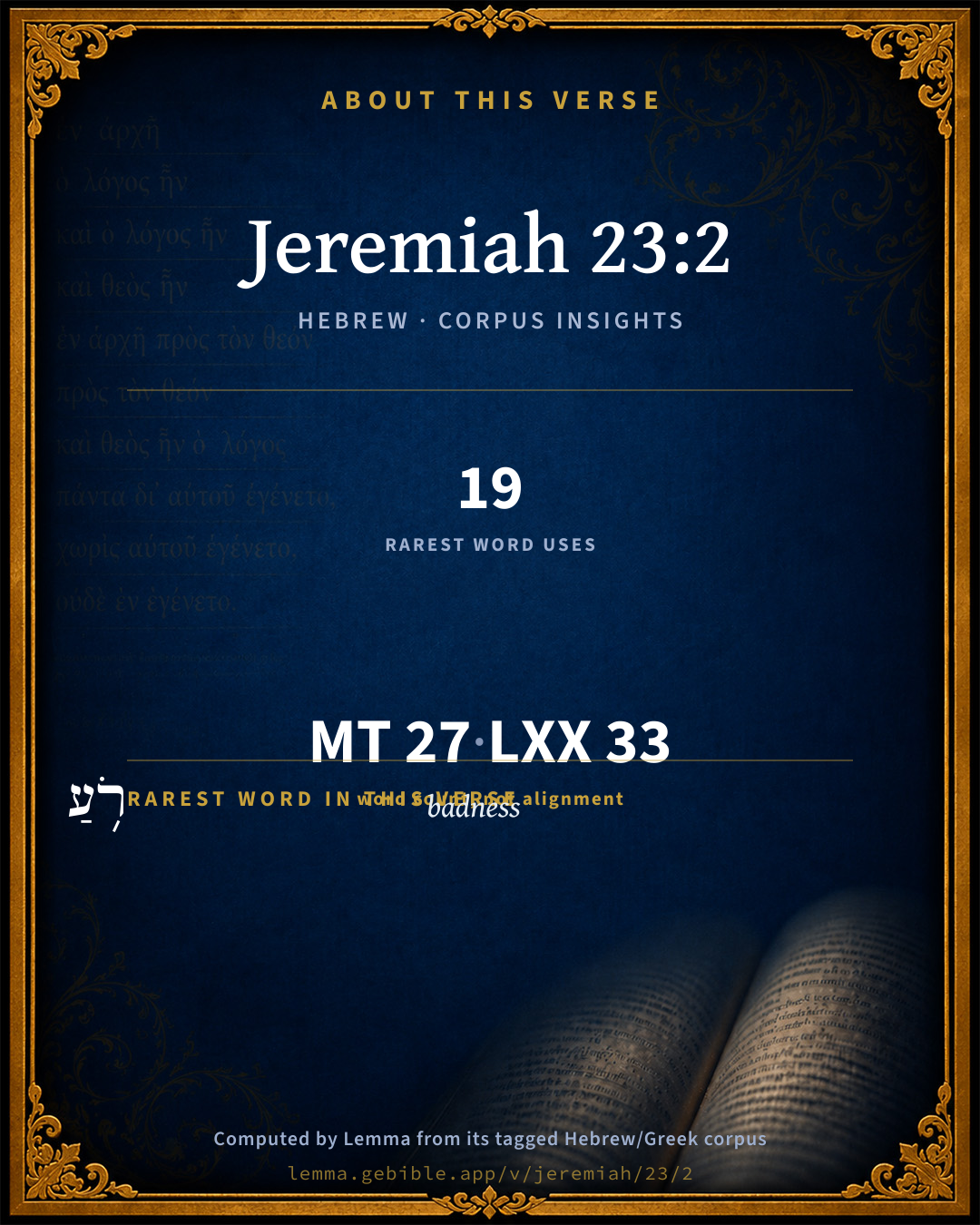
About this verse

These counts appear in no published source. They are computed here, from the morphology-tagged text and Lemma’s own curated glosses. What Lemma adds →

27
words
20
distinct lemmas
Prophets
section

Notable vocabulary

The rarest word here is רֹ֥עַ badness H7455 — appearing just 19 times in the whole Hebrew Bible.

Shared distinctive vocabulary

רֹ֥עַ badness H7455 occurs in 19 verses of the Hebrew Bible. Also found in:

Grammatical profile

  • 7 verbs
  • 9 nouns
  • 1 pronoun
  • 2 prepositions
  • 2 adverbs
  • 6 particles

Verb forms

  • אָמַ֨ר Qal · Perfect
  • הָרֹעִים֮ Qal · Participle Active
  • הָרֹעִ֣ים Qal · Participle Active
  • הֲפִצֹתֶ֤ם Hiphil · Perfect
  • וַתַּדִּח֔וּם Hiphil · Sequential Imperfect
  • פְקַדְתֶּ֖ם Qal · Perfect
  • פֹקֵ֧ד Qal · Participle Active

Repetition

Words recur within this verse — often emphatic in Hebrew:

  • יְהוָ֜ה LORD H3068 ×2
  • עַֽל upon H5921 ×2
  • הָרֹעִים֮ to shepherd H7462 ×2
  • פְקַדְתֶּ֖ם to visit H6485 ×2

Hebrew & Septuagint length

In the original languages it is 27 Hebrew tokens and 33 Greek tokens — but the two are counted differently (Hebrew bundles its prefixes and suffixes into one token; the Greek is in lemma form), so that isn’t a like-for-like length.

Cross-references

13

Topical passages linked to Jeremiah 23:2 in the Treasury of Scripture Knowledge — connected by theme and wording, ordered by reader-vote popularity; previews shown in the World English Bible.

  • Exodus 32:34 Now go, lead the people to the place of which I have spoken to you. Behold, my angel shall go before you. Nevertheless in the day when I punish, I will punish them for their sin."
  • Jeremiah 21:12 House of David, thus says Yahweh, Execute justice in the morning, and deliver him who is robbed out of the hand of the oppressor, lest my wrath go forth like fire, and burn so that none can quench it, because of the evil of your doings.
  • Micah 7:4 The best of them is like a brier. The most upright is worse than a thorn hedge. The day of your watchmen, Even your visitation, has come; Now is the time of their confusion.
  • Jeremiah 23:34 As for the prophet, and the priest, and the people, who shall say, The burden of Yahweh, I will even punish that man and his house.
  • Jeremiah 5:9 Shall I not visit for these things? says Yahweh; and shall not my soul be avenged on such a nation as this?
  • Jeremiah 5:29 Shall I not visit for these things? says Yahweh; shall not my soul be avenged on such a nation as this?
  • Jeremiah 8:12 Were they ashamed when they had committed abomination? nay, they were not at all ashamed, neither could they blush: therefore shall they fall among those who fall; in the time of their visitation they shall be cast down, says Yahweh.
  • Jeremiah 11:22 therefore thus says Yahweh of hosts, Behold, I will punish them: the young men shall die by the sword; their sons and their daughters shall die by famine;
  • Jeremiah 13:21 What will you say, when he shall set over you as head those whom you have yourself taught to be friends to you? shall not sorrows take hold of you, as of a woman in travail?
  • Hosea 2:13 I will visit on her the days of the Baals, To which she burned incense, When she decked herself with her earrings and her jewels, And went after her lovers, And forgot me," says Yahweh.
  • Matthew 25:43 I was a stranger, and you didn't take me in; naked, and you didn't clothe me; sick, and in prison, and you didn't visit me.'
  • James 1:27 Pure religion and undefiled before our God and Father is this: to visit the fatherless and widows in their affliction, and to keep oneself unstained by the world.
  • Matthew 25:36 naked, and you clothed me; I was sick, and you visited me; I was in prison, and you came to me.'

Cross-references courtesy of OpenBible.info (CC BY 4.0).

Hebrew and Greek witnesses Masoretic Hebrew ↔ Greek Septuagint

The same verse in the two great witnesses to the Old Testament, shown verse-for-verse.

These are two independent witnesses, not word-aligned to each other, and the Septuagint is shown in lemma (dictionary) form.

Hebrew Jeremiah 23:2 Masoretic · Westminster Leningrad Codex

לָ֠כֵן כֹּֽה אָמַ֨ר יְהוָ֜ה אֱלֹהֵ֣י יִשְׂרָאֵ֗ל עַֽל הָרֹעִים֮ הָרֹעִ֣ים אֶת עַמִּי֒ אַתֶּ֞ם הֲפִצֹתֶ֤ם אֶת צֹאנִי֙ וַתַּדִּח֔וּם וְלֹ֥א פְקַדְתֶּ֖ם אֹתָ֑ם הִנְנִ֨י פֹקֵ֧ד עֲלֵיכֶ֛ם אֶת רֹ֥עַ מַעַלְלֵיכֶ֖ם נְאֻם יְהוָֽה

Therefore thus says Yahweh, the God of Israel, against the shepherds who feed my people: You have scattered my flock, and driven them away, and have not visited them; behold, I will visit on you the evil of your doings, says Yahweh.

World English Bible · Public Domain

Greek LXX Structure differs

In the Septuagint, Jeremiah is about an eighth shorter than the Hebrew and arranges its material differently — the Oracles Against the Nations (Hebrew chapters 46–51) appear in the middle of the Greek book, after 25:13. Because the chapter and verse boundaries do not line up, a verse-for-verse comparison with the Hebrew is not shown.

A verse-for-verse comparison isn’t shown here because the chapters and verses don’t line up. Switch to the LXX edition with the MT / LXX toggle above to read the Greek directly.

Hebrew: Westminster Leningrad Codex (CC BY 4.0). Greek: Septuagint (public domain); English from a public-domain English Septuagint. How the Septuagint differs from the Hebrew →

Targum (Aramaic paraphrase)

1

The Targum is the ancient Jewish Aramaic paraphrase of the Hebrew Scriptures — an interpretive translation, not the Hebrew text itself. Onkelos (literal) and Pseudo-Jonathan (expansive) render the Torah, and Jonathan the Prophets. Coverage is partial: where no permissively-licensed English translation exists for a verse, only the Aramaic is shown. This is verse-level text, not a word-by-word alignment to the Hebrew.

  1. Targum Jonathan Prophets (Joshua–Malachi)
    בְּכֵן כִּדְנָן אֲמַר יְיָ אֱלָהָא דְיִשְׂרָאֵל עַל פַּרְנָסַיָא דִמְפַרְנְסִין יַת עַמִי אַתּוּן בְּדַרְתּוּן יַת עַמִי וְטַלְטֵילְתִּינוּן וְלָא תְבַעֲתוּן יַתְהוֹן הָאֲנָא מַסְעַר עֲלֵיכוֹן יַת בִּישׁוּת עוֹבָדֵיכוֹן אֲמַר יְיָ:

    (no public-domain English translation for this verse)

    Targum Jonathan — Aramaic: “Mikraot Gedolot” (public domain). English: “Sefaria Community Translation” (CC0 1.0 (public-domain dedication)); “London "Chaldee Paraphrase," 1871” (public domain). Text via Sefaria.

Commentary

Notes on Jeremiah 23:2 from classic Christian and Jewish commentators (each source and its license shown beneath its notes). The classic Christian expositions comment on the surrounding passage and are grouped to its opening verse, so a note may address several verses; the Jewish commentaries on the Tanakh (Rashi and others) are per-verse, so they appear only where the commentator wrote on this verse.

Lemma curates 59 commentaries, every one of them public domain or Creative Commons licensed, each selected and text-cleaned for this edition rather than reprinted as found. About our sources →

Trapp's Complete Commentary

John Trapp

Jer 23:2 Therefore thus saith the LORD God of Israel against the pastors that feed my people; Ye have scattered my flock, and driven them away, and have not visited them: behold, I will visit upon you the evil of your doings, saith the LORD.

Ver. 2. Against the pastors.] Impostors, rather.

That feed my people.] Or, That feed upon my people, rather; attonsioni gregis potius quam attentioni consulentes, more minding gain than godliness.

Ye have scattered my flock.] And worried them, as so many evening wolves, {Zep 3:3} grievous, or fat wolves. {Act 20:29} {See Trapp on "Act 20:29"}

Behold, I will visit upon you.] Ludit in voce visitare; I will visit you in another sense, for your not visiting my people according to your duty. {Eze 34:4; Eze 34:6; Eze 34:8}

John Trapp, A Commentary or Exposition upon All the Books of the Old and New Testament (1647–1656) — public domain. Text from a community e-Sword module.

Joseph Benson's Commentary

Jer 23:2-4. Therefore thus saith the Lord against the pastors that feed my people — That undertake the care of my people, though they do not faithfully execute their trust. God calls them his people, his flock, the sheep of his pasture, with respect to the ancient covenant which he had made with their fathers. They are said to have fed this people, because it was their duty to have done so. Ye have scattered my flock — Namely, by acts of violence and oppression, driving them from their places to seek more safe and quiet abodes. Or, instead of looking after them, you have suffered them to be dispersed, and through your ill example they have gone astray to idolatry, and that, with your other sins, has brought upon them their expulsion from their own land and a general dispersion. Behold, I will visit upon you the evil of your doings — Will deal with you as your sins have deserved. They would not visit the flock in the way of duty, and therefore God will visit them in a way of vengeance. And I will gather the remnant of my flock — Though there be but a remnant of my flock, a little remnant left, that has narrowly escaped destruction, I will gather that remnant; will find them out wherever they are, and will find out ways and means to bring them back out of all countries whither I have driven them. It was the justice of God for the sins of their shepherds that dispersed them, but the mercy of God shall gather them when the shepherds that betrayed them are cut off. And being brought to their former habitations, as sheep to their folds, there they shall be fruitful, and increase in numbers. And I will set up shepherds over them — Who shall make it their business, not only to rule, but also to feed them, namely, with knowledge and understanding. They shall fear no more — As they formerly did, when they were continually exposed to the oppressions of their rulers at home, or the invasions and assaults of their enemies from abroad; but they shall be preserved in peace and safety, and none of them shall be lacking. Though the times may have been long bad with the church, it does not follow that they will be always so. Such pastors as Zerubbabel and Nehemiah, though they did not live in such pomp as Jehoiakim and Jeconiah lived in, nor made such a figure, were as great blessings to the people as the others were plagues to them. The peace and prosperity of the church are not connected with, much less do they depend upon, the pomp of her rulers.

Joseph Benson's Commentary on the Old and New Testaments (1811–1818) — public domain. Text from a community e-Sword module.

Geneva Bible (1599)

Geneva Bible translators

Whose charge is to feed the flock, but they eat the fruit thereof, Ezek. 34:3.

Geneva Bible (1599) marginal notes — public domain. Text via Bolls.life.

Jamieson, Fausset & Brown

Robert Jamieson, A. R. Fausset & David Brown

Ye have not . . . visited them . . . I will visit upon you--just retribution. Play upon the double sense of "visit." "Visit upon," namely, in wrath (Exo 32:34).

Jamieson, Fausset & Brown — Commentary Critical and Explanatory on the Whole Bible (1871) — public domain (CC PDM 1.0). Text via the HelloAO Bible API.

Adam Clarke's Commentary

Verse 2. Ye have scattered my flock] The bad government both in Church and State was a principal cause of the people's profligacy.

Adam Clarke's Commentary on the Bible (1810–1826) — public domain. Text from a community e-Sword/MySword module.

John Calvin's Commentaries

He afterwards adds, Thus saith Jehovah, the God of Israel, to the pastors who feed my people In the same sense he calls them now his people, as he had called them before the flock of his pastures. They had alienated themselves from God, and he had already by his own decree repudiated them; and God might in one respect have deemed them aliens; and yet in respect of the covenant he acknowledged them as his own; and hence he calls them his people He now then confirms what we have already noticed, that these pastors were not only thieves and robbers, but also sacrilegious; for they not only had exercised cruelty towards the flock, but as far as they could injured and dishonored God himself, who had undertaken the care of that people.

But there is here a twofold concession, he calls them pastors, and they are said to feed the people. He had said before that they destroyed and scattered the flock, and now he says that they fed them; but in what sense we well know, for by this kind of irony he meant to reprove them; they boasted that they were pastors, and they thought that their crimes would by such a covering be buried in the sight of God, as in the sight of men. In a similar manner when we speak in the present day of the Pope and his mitred bishops and filthy clergy, we use expressions which are commonly employed. But Antichrist is everything but a father, and we know how far they are from being really bishops who assume the title; and as to the clergy, the name is sacred, but they are very far from being God’s heritage. We indeed make no account of these empty titles. But it is a great aggravation of their guilt, that they being devils, should assume angelic names, that they being wolves and robbers, and sacrilegious, should falsely pretend God’s name, and recommend themselves by spurious titles, as though they were pastors, bishops, abbots, and prelates, and what not.

So then our Prophet calls those whom he condemns, by way of taunt, pastors, and says that they fed, that is, were called for this end, to do this work. But he afterwards adds, My flock have ye scattered, and driven away, and not visited Surely it was not to feed, to have no care for the sheep. To visit is to be extended here to every part of the duty of overseeing, as though he had said, that the flock had been by them neglected, betrayed, and deserted. We hence see that they had wholly neglected their pastoral office. But the other two things are still worse, for they had scattered and driven away the flock. Their sloth in neglecting the flock was not to be tolerated; but it was still more intolerable when they exercised so much cruelty as to scatter the flock as though they were deadly enemies; and yet these are the things for which Jeremiah condemns them. We hence see that there was an implied taunt, when he conceded to them the office of feeding.

He then denounces judgment on them, I will visit upon you the wickedness of your doings Here God declares that he would punish the pastors, to whom was justly ascribed the scattering of the people. For though no one was exempt from blame, as it has been before stated; yet the main fault belonged to these pastors. This then is the reason why God declares that he would take vengeance; for he would not have his flock scattered with impunity.

John Calvin's Commentaries (1540-1563) — public domain. Text from the Calvin Translation Society English edition (1840s-50s) via the Christian Classics Ethereal Library (ccel.org). Calvin's coverage is partial (roughly two-thirds of the Bible); uncommented books and verses are honest gaps, never fabricated. The 19th-century editor's footnotes and remarks are omitted so the notes are faithfully Calvin's own voice.

Ellicott's Commentary for English Readers

(2) Ye have scattered my flock.—The charge was true literally as well as spiritually. The dispersion of the people in Egypt, Assyria, and Chaldæa was the result of the neglect, the tyranny, the feebleness of their rulers. They had been led, not as the Eastern shepherd leads (Joh_10:4-5), but “driven”—not to the fold, but “away” into far lands.

Have not visited.—i.e., cared for and regarded. They were negligent, but God was not, and He therefore would “visit” them by reproof and chastisement.

A Bible Commentary for English Readers, edited by Charles John Ellicott (1878–1897) — public domain. Text from a community e-Sword module.

The Cambridge Bible for Schools and Colleges

gen. ed. J. J. S. Perowne

2. feed] Heb. shepherd. Cp. Jer_3:15.

scattered] by exile, voluntary or forced, in Egypt or Babylon.

driven them away] the opposite of that which is an Eastern shepherd’s duty, viz. to go before his flock, leading them to pasture or fold (Isa_40:11; Joh_10:3 f.).

visited … visit upon] The twofold sense of the Hebrew word is kept up in the English. Because the shepherds have not visited their flock for good, they shall themselves be visited with punishment.

3, 4 are considered by Co., but quite needlessly, to reflect a position of affairs which was later than Jeremiah’s date. The same critic, however, retains, though somewhat doubtfully, 7, 8, against which he might have brought the same objection. Moreover, the words “be fruitful and multiply” (see on Jer_3:16) are not decisive against the genuineness of the v. here.

The Cambridge Bible for Schools and Colleges (gen. ed. J. J. S. Perowne; Cambridge University Press, 1878–1918) — public domain. Text from a community e-Sword module.

John Gill's Exposition

Therefore thus saith the Lord God of Israel,.... The covenant God of that people, who are Called his sheep, and the sheep of his pasture; having made a covenant with their fathers, and provided a good pasture for them, the land of Israel, where they enjoyed all blessings, civil and religious, and appointed persons over them to feed them; but these did not do their duty, and therefore the Lord was against them, as follows:

against the pastors that feed my people; whose office it was to feed, rule, and defend them; and who pretended to do it, but did it not;

ye have scattered my flock, and driven them away, and have not visited them; they had been the means of their being driven out of their dwellings, and out of their own land, and of their being among the nations of the world, and took no care for the return of them, any more than they concerned themselves for their welfare when over them; or they suffered the enemy, like beasts of prey, to come in among them, which scattered them, and drove them from their pasture, as sheep are by bears, dogs, and wolves; and took no care to preserve them from them, or to gather them together again to their pasture. The people of the Jews, at the time when Christ came, hereafter prophesied of, were scattered as sheep without a shepherd, and are called the lost sheep of the house of Israel, Mat 9:36;

behold, I will visit upon you the evil of your doings, saith the Lord; that is, punish them for their iniquities; since they visited not the flock in a way of mercy and kindness, as the duty of their office required, the Lord would visit them in a way of justice, and punish them according to their deserts.

John Gill's Exposition of the Whole Bible (1746–1763) — public domain (CC PDM 1.0). Text via the HelloAO Bible API.

Albert Barnes' Notes on the Bible

They had scattered them first spiritually by leading them into idolatry; and secondly, many had literally been taken to Egypt with Jehoahaz, many in Jehoiakim’s time had fled there, while others fell away to the Chaldaeans: and finally the best of the land had been carried to Babylon with Jeconiah.

Driven away - i. e., made them outcasts. In the East, shepherds never drive their flocks, but go ahead of them Joh 10:4-5.

Have not visited them - i. e., have not concerned yourselves about their conduct.

Albert Barnes' Notes on the Bible (1834–1885) — public domain. Text from a community e-Sword/MySword module.

Matthew Poole's English Annotations

That feed my people: God calleth them his people, his flock, the sheep of his pasture, with respect to the ancient covenant which God had made with their fathers, Abraham, Isaac, and Jacob. They are said to have fed this people, because it was their duty, and the business of their office, so to have done, though they had failed in it, and had done the quite contrary, scattering them by their acts of violence and oppression, and driving them from their places to seek some more safe and quiet places of abode; or by their prodigious wickednesses, having been the cause of their being carried into captivity: not visiting them, that is, taking any due care of their good and welfare, seeing what they wanted, and supplying them, as good rulers ought to have done; for which neglect God threateneth to visit upon them the evil of their doings. The Hebrew word signifieth to visit with a visitation of care and love, and also with a visitation of justice and severity, and is often so used in holy writ.

Matthew Poole's English Annotations on the Holy Bible (1683–1685) — public domain. Text from a community e-Sword/MySword module.

Whedon's Commentary on the Bible

Daniel D. Whedon

2. The pastors — In the first verse the article is not in the original, and is incorrectly introduced into the Version. It is a general principle. Woe to shepherds — any and all shepherds — when they destroy and scatter the sheep; that is, when they themselves do that which they are specially set to prevent. But in this verse the article is used to identify those to whom this woe now applies.

Scattered… driven — As the wolf does. The Eastern shepherd does not drive his flock, but “goeth before them.”

Daniel D. Whedon (gen. ed.), Commentary on the Old and New Testaments (1874–1909) — public domain. Text from a community e-Sword module.

The Pulpit Commentary

The Lord God of Israel; strictly, Jehovah the God of Israel. This national title of Jehovah suggests, in such a connection, that the crime of the kings is nothing short of sacrilege. Ye have scattered, etc.; i.e. been the cause of their scattering, Have not visited them. "To visit" often, by a natural association of ideas, means "to give attention to." By an equally natural association, it means "to fall upon, to punish." Hence, in the next clause, I will visit upon you. We have the same combination of meanings Zec_10:3.

The Pulpit Commentary (1880–1919), ed. H.D.M. Spence-Jones & Joseph S. Exell — public domain. Text from a community e-Sword module.

John Wesley's Explanatory Notes

That feed - They are said to have fed this people, because it was their duty so to do.

John Wesley, Explanatory Notes Upon the Whole Bible (1754–1765) — public domain. Text via the GEBible commentary corpus.

Rashi

Rabbi Shlomo Yitzchaki (Rashi)

and have not taken care of them You were not careful to watch them.

Rashi on the Tanakh — English translations: “The Judaica Press complete Tanach with Rashi, translated by A. J. Rosenberg” (CC BY 4.0); “Pentateuch with Rashi's commentary by M. Rosenbaum and A.M. Silbermann, 1929-1934” (public domain); “The Metsudah Tanach series, Lakewood, N.J” (CC BY 4.0); and “The Book of Joshua, Metsudah Publications, 1997” (CC BY 4.0). Text via Sefaria.

Lesson kit

Teaching starters — assembled from the data on this page, not authored interpretation. Every prompt links to the verse data it draws on. Edit before teaching.

Jeremiah, in the Prophets, opens this verse with 27 words (20 distinct Hebrew lemmas). Its most distinctive word is rôaʻ (“badness”). A historical commentator’s framing appears above. Read the whole chapter for the surrounding context.

Discussion questions

  1. What does “badness” (rôaʻ) contribute to the verse as a whole?
  2. Genesis 41:19 shares the word «badness» with this verse. How do the two illuminate each other?
  3. “LORD” occurs 2× in this one verse. What is the effect of the repetition?
  4. These translations render this verse differently. What is at stake in choosing one wording over another?
  5. The verb «אָמַ֨ר» is Qal Perfect. How does its form color the action?
  6. Reading how Trapp's Complete Commentary and Joseph Benson's Commentary read this verse, where do the two commentators agree and where do they part?

Things to notice

Reading settings

Reading text

Shown beneath each verse's original-language words.

Old Testament
Old Testament edition

Read the OT as the Masoretic Hebrew (MT) or the Greek Septuagint (LXX).

English shown for the Greek Septuagint (in the Hebrew ↔ Greek comparison).

Comparing translations? Open the Compare panel on any verse page to stack up to four side by side.