
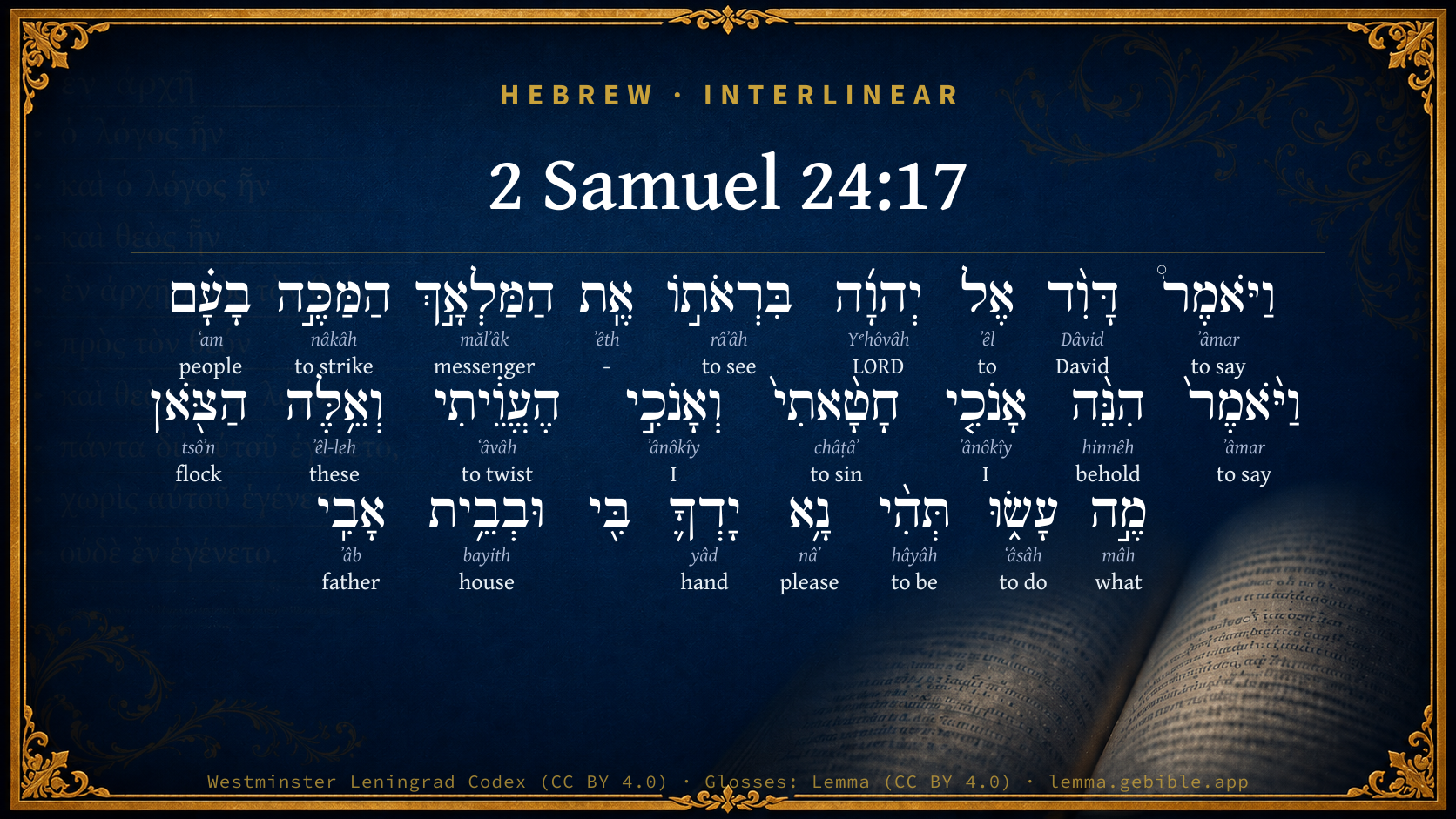
2 Samuel 24:17

Hebrew (Westminster Leningrad Codex) 2 Samuel 24:17 appears in the Hebrew Old Testament. The text above is from the Westminster Leningrad Codex. Each word links to its Strong’s number, a concise gloss, and parsing drawn from the Open Scriptures Hebrew Bible morphology. Click any word for its full Brown-Driver-Briggs (BDB) entry.
Download image
Cite this verse

2 Samuel 24:17 (World English Bible). Public Domain. Lemma interlinear Bible study tool, https://lemma.gebible.app/v/2-samuel/24/17.

Show BibTeX & RIS
BibTeX
RIS
English Translation
David spoke to Yahweh when he saw the angel who struck the people, and said, Behold, I have sinned, and I have done perversely; but these sheep, what have they done? Please let your hand be against me, and against my father's house.
World English Bible · Public Domain
Download a study sheet

One document with this verse’s original text, its word-by-word gloss line, the meaning frame, cross-references with their text, attributed commentary, and full source and license credits — printable, and it pastes into notes with its structure intact.

This verse Autodidact and up

Study sheet (.html) Plain text (.txt)

A passage Seminary Student

Up to 50 verses in one chapter. A passage sheet keeps up to 6 commentary sources and 12 cross-references per verse, in the order this page ranks them, and says so on the sheet whenever that leaves anything out. Ask for a single verse and you get the Autodidact verse sheet above.

Everything on this page stays free to read, with no account — the sheet is a download of what is already on screen, not access to it.

Want to remove ads? Support Godless Engineer
Compare translations 3

The same verse in 3 English versions, stacked beneath the original-language interlinear above. Click any original word for its lexicon entry.

Each is an independent rendering of the whole verse — the interlinear is not word-aligned to these translations.

Highlighted words mark where these versions differ — a whole-verse word diff, not a word-by-word alignment.

  • World English Bible Public Domain
    David spoke to Yahweh when he saw the angel who struck the people, and said, Behold, I have sinned, and I have done perversely; but these sheep, what have they done? Please let your hand be against me, and against my father's house.
  • King James Version Public Domain
    And David spake unto the LORD when he saw the angel that smote the people, and said, Lo, I have sinned, and I have done wickedly: but these sheep, what have they done? let thine hand, I pray thee, be against me, and against my father's house.
  • unfoldingWord Literal Text CC BY-SA 4.0
    And David spoke to Yahweh when he saw the angel, the striker among the people, and he said, “Behold, I, I have sinned, and I, I have committed iniquity. But these sheep, what have they done? Please, let your hand be against me and against the house of my father.”

unfoldingWord Literal Text — © unfoldingWord, licensed CC BY-SA 4.0. Word-aligned USFM3 via Door43 (git.door43.org/unfoldingWord/en_ult).

Versions to compare (up to 4)

3 of 4 selected

Show all 18 translations

Every available English version of this verse, each an independent rendering of the whole verse.

  • World English Bible Public Domain
    David spoke to Yahweh when he saw the angel who struck the people, and said, Behold, I have sinned, and I have done perversely; but these sheep, what have they done? Please let your hand be against me, and against my father's house.
  • Berean Standard Bible Public Domain
    When David saw the angel striking down the people, he said to the LORD, “Surely I, the shepherd, have sinned and acted wickedly. But these sheep, what have they done? Please, let Your hand fall upon me and my father’s house.”
  • Majority Standard Bible Public Domain
    When David saw the angel striking down the people, he said to the LORD, “Surely I, the shepherd, have sinned and acted wickedly. But these sheep, what have they done? Please, let Your hand fall upon me and my father’s house.”
  • King James Version Public Domain
    And David spake unto the LORD when he saw the angel that smote the people, and said, Lo, I have sinned, and I have done wickedly: but these sheep, what have they done? let thine hand, I pray thee, be against me, and against my father's house.
  • American Standard Version (1901) Public Domain
    And David spake unto Jehovah when he saw the angel that smote the people, and said, Lo, I have sinned, and I have done perversely; but these sheep, what have they done? let thy hand, I pray thee, be against me, and against my father's house.
  • Revised Version (1885) Public Domain
    And David spake unto the LORD when he saw the angel that smote the people, and said, Lo, I have sinned, and I have done perversely: but these sheep, what have they done? let thine hand, I pray thee, be against me, and against my father’s house.
  • Geneva Bible (1599) Public Domain
    And Dauid spake vnto the Lord (when he sawe the Angel that smote the people) and saide, Behold, I haue sinned, yea, I haue done wickedly: but these sheepe, what haue they done? let thine hand, I pray thee, be against mee and against my fathers house.
  • Douay-Rheims (1899) Public Domain
    And David said to the Lord, when he saw the angel striking the people: It is I; I am he that have sinned, I have done wickedly: these that are the sheep, what have they done? let thy hand, I beseech thee, be turned against me, and against my father's house.
  • Young's Literal Translation Public Domain
    And David speaketh unto Jehovah, when he seeth the messenger who is smiting among the people, and saith, `Lo, I have sinned, yea, I have done perversely; and these -- the flock -- what have they done? Let, I pray Thee, Thy hand be on me, and on the house of my father.'
  • Literal Standard Version CC BY-SA 4.0
    And David speaks to YHWH when he sees the messenger who is striking among the people, and says, “Behold, I have sinned, indeed, I have done perversely; and these—the flock—what have they done? Please let Your hand be on me and on the house of my father.”
  • Unlocked Literal Bible CC BY-SA 4.0
    Then David spoke to Yahweh when he saw the angel who had attacked the people, and said, “I have sinned, and I have acted perversely. But these sheep, what have they done? Please let your hand punish me and my father's family!”
  • unfoldingWord Literal Text CC BY-SA 4.0
    And David spoke to Yahweh when he saw the angel, the striker among the people, and he said, “Behold, I, I have sinned, and I, I have committed iniquity. But these sheep, what have they done? Please, let your hand be against me and against the house of my father.”
  • Darby Bible Public Domain
    And David spoke to Jehovah when he saw the angel that smote among the people, and said, Behold, it is I that have sinned, and it is I that have committed iniquity; but these sheep, what have they done? let thy hand, I pray thee, be on me, and on my father's house!
  • World Messianic Bible Public Domain
    David spoke to the LORD when he saw the angel who struck the people, and said, “Behold, I have sinned, and I have done perversely; but these sheep, what have they done? Please let your hand be against me, and against my father’s house.”
  • Webster's Bible Public Domain
    And David spoke to the LORD when he saw the angel that smote the people, and said, Lo, I have sinned, and I have done wickedly: but these sheep, what have they done? let thy hand, I pray thee, be against me, and against my father's house.
  • Free Bible Version CC BY-SA 4.0
    When David saw the angel striking down the people, he said to the Lord, “I'm the one who has sinned; I'm the one who has done wrong. These people are just sheep. What have they done? Punish me and my family instead.”
  • Bible in Basic English Public Domain
    And when David saw the angel who was causing the destruction of the people, he said to the Lord, Truly, the sin is mine; I have done wrong: but these are only sheep; what have they done? let your hand be against me and against my family.
  • JPS Tanakh (1917) Public Domain
    And David spoke unto the LORD when he saw the angel that smote the people, and said: 'Lo, I have sinned, and I have done iniquitously; but these sheep, what have they done? let Thy hand, I pray Thee, be against me, and against my father's house.'

Literal Standard Version (2020), Covenant Press — licensed CC BY-SA 4.0. Text via the HelloAO Bible API (eBible.org). Unlocked Literal Bible (unfoldingWord) — licensed CC BY-SA 4.0. Text via the HelloAO Bible API (eBible.org). unfoldingWord Literal Text — © unfoldingWord, licensed CC BY-SA 4.0. Word-aligned USFM3 via Door43 (git.door43.org/unfoldingWord/en_ult). Free Bible Version, Dr. Jonathan Gallagher — licensed CC BY-SA 4.0. Text via the HelloAO Bible API (eBible.org).

Word by word

More ways to search: Search by grammar → Find every occurrence → Compare this word →

Practice this passage: Drill this verse → Learn its vocabulary →

הֶעֱוֵ֔יתִי
ʻâvâh
H5753
“to twist”
Verb, Hiphil, Perfect, 1st Person, Common, Singular
Part of Speech
Verb
Stem
Hiphil
Form
Perfect
Person
1st Person
Gender
Common
Number
Singular
Full BDB Definition

Origin: a primitive root

TWOT: 1577

to bend, twist, distort - (Niphal) to be bent, be bowed down, be twisted, be perverted - (Piel) to twist, distort - (Hiphil) to do perversely - to commit iniquity, do wrong, pervert - (Qal) to do wrong, commit iniquity - (Hiphil) to commit iniquity
  1. וַיֹּאמֶר֩ ʼâmar H559 “and · to say” Conjunction + Verb, Qal, Sequential Imperfect, 3rd Person, Masculine, Singular
  2. דָּוִ֨ד Dâvid H1732 “David” Noun, Proper
  3. אֶל ʼêl H413 “to” Preposition
  4. יְהוָ֜ה Yᵉhôvâh H3068 “LORD” Noun, Proper
  5. בִּרְאֹת֣וֹ râʼâh H7200 “in/at · to see · him” Preposition + Verb, Qal, Infinitive Construct + Suffix, Personal, 3rd Person, Masculine, Singular
  6. אֶֽת ʼêth H853 “-” Particle, Direct Object
  7. הַמַּלְאָ֣ךְ mălʼâk H4397 “the · messenger” Particle, Definite Article + Noun, Common, Masculine, Singular, Absolute
  8. הַמַּכֶּ֣ה nâkâh H5221 “the · striking” Particle, Definite Article + Verb, Hiphil, Participle Active, Masculine, Singular, Absolute
  9. בָעָ֗ם ʻam H5971 “in/at the · people” Preposition, Determined + Noun, Common, Masculine, Singular, Absolute
  10. וַיֹּ֨אמֶר֙ ʼâmar H559 “and · to say” Conjunction + Verb, Qal, Sequential Imperfect, 3rd Person, Masculine, Singular
  11. הִנֵּ֨ה hinnêh H2009 “behold” Particle, Demonstrative
  12. אָנֹכִ֤י ʼânôkîy H595 “I” Pronoun, Personal, 1st Person, Common, Singular
  13. חָטָ֨אתִי֙ châṭâʼ H2398 “to sin” Verb, Qal, Perfect, 1st Person, Common, Singular
  14. וְאָנֹכִ֣י ʼânôkîy H595 “and · I” Conjunction + Pronoun, Personal, 1st Person, Common, Singular
  15. וְאֵ֥לֶּה ʼêl-leh H428 “and · these” Conjunction + Pronoun, Demonstrative, Common, Plural
  16. הַצֹּ֖אן tsôʼn H6629 “the · flock” Particle, Definite Article + Noun, Common, Both, Singular, Absolute
  17. מֶ֣ה mâh H4100 “what” Particle, Interrogative
  18. עָשׂ֑וּ ʻâsâh H6213 “to do” Verb, Qal, Perfect, 3rd Person, Common, Plural
  19. תְּהִ֨י hâyâh H1961 “to be” Verb, Qal, Jussive, 3rd Person, Feminine, Singular
  20. נָ֥א nâʼ H4994 “please” Particle, Exhortation
  21. יָדְךָ֛ yâd H3027 “hand · your” Noun, Common, Both, Singular, Construct + Suffix, Personal, 2nd Person, Masculine, Singular
  22. וּבְבֵ֥ית bayith H1004 “and · in/at · house of” Conjunction + Preposition + Noun, Common, Masculine, Singular, Construct
  23. אָבִֽי ʼâb H1 “father · my” Noun, Common, Masculine, Singular, Construct + Suffix, Personal, 1st Person, Common, Singular

About this verse

These counts appear in no published source. They are computed here, from the morphology-tagged text and Lemma’s own curated glosses. What Lemma adds →

25
words
22
distinct lemmas
Historical
section

Notable vocabulary

The rarest word here is הֶעֱוֵ֔יתִי to twist H5753 — appearing just 17 times in the whole Hebrew Bible.

Shared distinctive vocabulary

הֶעֱוֵ֔יתִי to twist H5753 occurs in 17 verses of the Hebrew Bible. Also found in:

Grammatical profile

  • 8 verbs
  • 8 nouns
  • 3 pronouns
  • 2 prepositions
  • 4 particles

Verb forms

  • וַיֹּאמֶר֩ Qal · Sequential Imperfect
  • בִּרְאֹת֣וֹ Qal · Infinitive Construct
  • הַמַּכֶּ֣ה Hiphil · Participle Active
  • וַיֹּ֨אמֶר֙ Qal · Sequential Imperfect
  • חָטָ֨אתִי֙ Qal · Perfect
  • הֶעֱוֵ֔יתִי Hiphil · Perfect
  • עָשׂ֑וּ Qal · Perfect
  • תְּהִ֨י Qal · Jussive

Repetition

Words recur within this verse — often emphatic in Hebrew:

  • וַיֹּאמֶר֩ to say H559 ×2
  • אָנֹכִ֤י I H595 ×2

Hebrew & Septuagint length

In English translation the verse runs 43 words from the Hebrew and 46 from the Septuagint (LXX English) — closely comparable.

A rough comparison of the two English renderings, which tokenize alike — not a word-level alignment.

Word counts can differ between the Hebrew and the Greek without any difference in meaning — e.g. the Hebrew direct-object marker אֵת has no separate Greek word, and Greek often adds the article ὁ.

In the original languages it is 25 Hebrew tokens and 47 Greek tokens — but the two are counted differently (Hebrew bundles its prefixes and suffixes into one token; the Greek is in lemma form), so that isn’t a like-for-like length.

Cross-references

15

Topical passages linked to 2 Samuel 24:17 in the Treasury of Scripture Knowledge — connected by theme and wording, ordered by reader-vote popularity; previews shown in the World English Bible.

  • 1 Chronicles 21:16–17 David lifted up his eyes, and saw the angel of Yahweh standing between earth and the sky, having a drawn sword in his hand stretched out over Jerusalem. Then David and the elders, clothed in sackcloth, fell on their faces.
  • Psalms 74:1 God, why have you rejected us forever? Why does your anger smolder against the sheep of your pasture?
  • 2 Samuel 24:10 David's heart struck him after that he had numbered the people. David said to Yahweh, I have sinned greatly in that which I have done: but now, Yahweh, put away, I beg you, the iniquity of your servant; for I have done very foolishly.
  • Job 42:6 Therefore I abhor myself, And repent in dust and ashes."
  • Ezekiel 34:23–24 I will set up one shepherd over them, and he shall feed them, even my servant David; he shall feed them, and he shall be their shepherd.
  • Genesis 44:33 Now therefore, please let your servant stay instead of the boy, a bondservant to my lord; and let the boy go up with his brothers.
  • 1 Kings 22:17 He said, I saw all Israel scattered on the mountains, as sheep that have no shepherd: and Yahweh said, These have no master; let them return every man to his house in peace.
  • Job 7:20 If I have sinned, what do I do to you, you watcher of men? Why have you set me as a mark for you, So that I am a burden to myself?
  • Psalms 44:11 You have made us like sheep for food, And have scattered us among the nations.
  • Psalms 51:2–5 Wash me thoroughly from my iniquity. Cleanse me from my sin.
  • Isaiah 6:5 Then I said, "Woe is me! For I am undone, because I am a man of unclean lips, and I dwell in the midst of a people of unclean lips: for my eyes have seen the King, Yahweh of Hosts!"
  • Ezekiel 34:2–6 Son of man, prophesy against the shepherds of Israel, prophesy, and tell them, even to the shepherds, Thus says the Lord Yahweh: Woe to the shepherds of Israel who feed themselves! Shouldn't the shepherds feed the sheep?
  • Zechariah 13:7 "Awake, sword, against my shepherd, And against the man who is close to me," says Yahweh of Hosts. Strike the shepherd, and the sheep will be scattered; And I will turn my hand against the little ones.
  • John 10:11–12 I am the good shepherd. The good shepherd lays down his life for the sheep.
  • 1 Peter 2:24–25 who his own self bore our sins in his body on the tree, that we, having died to sins, might live to righteousness; by whose stripes you were healed.

Cross-references courtesy of OpenBible.info (CC BY 4.0).

Hebrew and Greek witnesses Masoretic Hebrew ↔ Greek Septuagint

The same verse in the two great witnesses to the Old Testament, shown verse-for-verse.

These are two independent witnesses, not word-aligned to each other, and the Septuagint is shown in lemma (dictionary) form.

Hebrew 2 Samuel 24:17 Masoretic · Westminster Leningrad Codex

וַיֹּאמֶר֩ דָּוִ֨ד אֶל יְהוָ֜ה בִּרְאֹת֣וֹ אֶֽת הַמַּלְאָ֣ךְ הַמַּכֶּ֣ה בָעָ֗ם וַיֹּ֨אמֶר֙ הִנֵּ֨ה אָנֹכִ֤י חָטָ֨אתִי֙ וְאָנֹכִ֣י הֶעֱוֵ֔יתִי וְאֵ֥לֶּה הַצֹּ֖אן מֶ֣ה עָשׂ֑וּ תְּהִ֨י נָ֥א יָדְךָ֛ בִּ֖י וּבְבֵ֥ית אָבִֽי

David spoke to Yahweh when he saw the angel who struck the people, and said, Behold, I have sinned, and I have done perversely; but these sheep, what have they done? Please let your hand be against me, and against my father's house.

World English Bible · Public Domain

Greek LXX 2 Samuel 24:17 Septuagint · lemma form

καί εἶπον δαυίδ πρός κύριος ἐν ὁ ὁράω αὐτός ὁ ἄγγελος τύπτω ἐν ὁ λαός καί εἶπον ἰδού ἐγώ εἰμί ἀδικέω καί ἐγώ εἰμί ὁ ποιμήν κακοποιέω καί οὗτος ὁ πρόβατον τίς ποιέω γίγνομαι δή ὁ χείρ σύ ἐν ἐγώ καί ἐν ὁ οἶκος ὁ πατήρ ἐγώ

And David spoke to the Lord when he saw the angel striking the people, and he said, Behold, it is I that have done wrong, but these sheep what have they done? Let your hand, I pray you, be upon me, and upon my father's house.

LXX2012 (modern English Septuagint) · Public Domain

Hebrew: Westminster Leningrad Codex (CC BY 4.0). Greek: Septuagint (public domain); English from LXX2012 (modern English Septuagint) (Public Domain). How the Septuagint differs from the Hebrew →

Targum (Aramaic paraphrase)

1

The Targum is the ancient Jewish Aramaic paraphrase of the Hebrew Scriptures — an interpretive translation, not the Hebrew text itself. Onkelos (literal) and Pseudo-Jonathan (expansive) render the Torah, and Jonathan the Prophets. Coverage is partial: where no permissively-licensed English translation exists for a verse, only the Aramaic is shown. This is verse-level text, not a word-by-word alignment to the Hebrew.

  1. Targum Jonathan Prophets (Joshua–Malachi)
    וַאֲמַר דָוִד קֳדָם יְיָ כַּד חֲזָא יַת מַלְאָכָא דְמִקַטֵל בְּעַמָא וַאֲמַר הָא אֲנָא חָבִית וַאֲנָא סְרָחִית וְאִלֵין עַמָא דְאִינוּן כְּעָנָא בְּיַד רַעְיָא מָה עֲבָדוּ תְּהֵי כְּעַן מָחֲתָךְ בִּי וּבְבֵית אַבָּא:

    (no public-domain English translation for this verse)

    Targum Jonathan — Aramaic: “Mikraot Gedolot” (public domain). English: “Sefaria Community Translation” (CC0 1.0 (public-domain dedication)); “London "Chaldee Paraphrase," 1871” (public domain). Text via Sefaria.

Commentary

Notes on 2 Samuel 24:17 from classic Christian and Jewish commentators (each source and its license shown beneath its notes). The classic Christian expositions comment on the surrounding passage and are grouped to its opening verse, so a note may address several verses; the Jewish commentaries on the Tanakh (Rashi and others) are per-verse, so they appear only where the commentator wrote on this verse.

Lemma curates 59 commentaries, every one of them public domain or Creative Commons licensed, each selected and text-cleaned for this edition rather than reprinted as found. About our sources →

Trapp's Complete Commentary

John Trapp

2Sa 24:17 And David spake unto the LORD when he saw the angel that smote the people, and said, Lo, I have sinned, and I have done wickedly: but these sheep, what have they done? let thine hand, I pray thee, be against me, and against my father’s house.

Ver. 17. The angel that smote the people.] For the king’s offence. Great men’s sins do more hurt than others; (1.) By imitation; (2.) By imputation; for plectuntur Achivi. Howbeit, the people also had deserved destruction for their many foul enormities; especially for the abuse of their peace, and contempt of God’s word, as Bede noteth of the Britons, anne Christi 420, who were therefore visited with such a contagious plague, that the living were scarce able to bury the dead.

And said, Lo, I have sinned.] Hitherto he offered not himself to the plague, saith Chrysostom, because he still expected and made account to be taken away by it. Now, seeing it was God’s will to spare him, he crieth out, Ecce ego peccavi, En ego qui feci, in me convertito ferrum. Mr Bradford, martyr, in a certain holy letter of his, writeth thus: - Let the anger and plagues of God, most justly fallen upon us, be applied to every one of our deserts, that from the bottom of our hearts every one of us may say, It is I, Lord, that have sinned against thee; it is mine hypocrisy, vain glory, covetousness, uncleanness, carnality, security, idleness unthankfulness self-love, and such like, which have deserved the taking away of our good king, of thy word and true religion, of thy good ministry, by exile, imprisonment, and death, &c. {a}

But these sheep, what have they done?] They had done enough to draw upon them this destruction; but he, as a good Shepherd (ποιμην, q.d., οιμην), {b} offereth himself to punishment, that they may go free. Chrysostom writeth, that the Capadocian shepherds, and the Lydian likewiss suffer much hardship by heat and cold, for the good of their flocks. {c} Jacob did so for the good of Laban; {Gen 31:6} but never any like Jesus Christ, the great Shepherd, who not only offered, but freely gave his life for his sheep. {Joh 10:11}

{a} Act. and Mon, 1477.

{b} Ab οις, ovis, et μαω, desidero.

{c} Hom. xv. Epist. ad Rom.

John Trapp, A Commentary or Exposition upon All the Books of the Old and New Testament (1647–1656) — public domain. Text from a community e-Sword module.

The Biblical Illustrator

Joseph S. Exell

2Sa_24:17

And David spake unto the Lord when he saw the angel that smote the people.

The problem of undeserved suffering

Davids sin in numbering the people was want of confidence in God. At any rate, it is certain that for a time he lost his faith, and was in open rebellion against God. Then came his punishment--a grievous punishment for the king who has the welfare of his people at heart. One man sins; his sin is punished; but the punishment fails on the innocent--that is the strange problem which rises before us on reading this chapter, and it is a problem which very often presents itself in the facts of human life. The problem is forced on our notice every day we live. A careless shipwright does not send his bolt or rivet home properly, and, in a storm at sea, a gallant ship founders, carrying with it many precious lives. A man commits a great crime; he is found out and punished, but the punishment does not stop with himself: it falls also on his family, who have to bear the shame and the reverse of fortune. A husband and father becomes a drunkard; the sin brings its inevitable punishment; but the punishment is as heavy on the wife, who is never free from anxious care, and on the children, who grow: up weakly, uneducated, and wilful, for the lack of parental guidance. Two or three men combine in a gigantic fraud; they are detected and punished, and utter ruin falls on them; but the consequences of the fraud, in a thousand ramifications, affect the happiness and prosperity of a whole nation. A sovereign does not feel himself secure on his throne, and, in order to surround himself with military glory and strengthen his position, declares war against a neighbouring people. The punishment of his ambition is disastrous to himself; but still worse are the calamities which come on thousands of his unoffending subjects. Is not the suffering of the innocent with the guilty, and for the guilty, one of the most familiar facts in human life? We would think it fair and right that each one should start in life with the same chance of good and evil, and should have it in his power to carve out his fortunes as seemeth, good to him but it is only too plain that such is not the case. Some are overweighted from the very first; some spend all their lives in reaching the point from which others start; some struggle on for a few years, and die in the bloom of youth, through inherited feebleness of constitution. And even if we did all start with the same chances, it is evident that we do not work through life freely and independently; our aims are defeated, our efforts crushed by events over which we have but little influence. Job, sitting among his comforters and bewailing his unhappy fate; Prometheus, chained to the rock and defying the unjust power that chains him; Philoctetes, left behind in his misery on the desert island--these present, in the highest flights of tragic poetry, what many a one feels bitterly in his own thoughts--the truth that wrong-doing and suffering do not always go together; and to those who believe in a Governor of the universe they present also some apparent justification for the complaint of mankind, which is most briefly expressed in the words of Solon to Croesus, King of Lydia, The Deity is altogether envious and full of confusion (Herod 1, 32.) So long as the facts are put in this way, I do not think it possible to explain or palliate them. It is of no use to say that, looking to the whole experience of human history, sin is punished and righteousness prospers. The doctrine of averages, however true and consoling to the plilosophising observer, does not make the: individual wrong lighter. Nor is it of much use, I fear, to point out that suffering is not always a misfortune, nor prosperity a gain; for the man who has been ruined by others guilt, the wife who has been bereaved through anothers folly, the youth who finds himself cramped and fettered by the circumstances of his birth, does not cry out against the suffering so much as against the seeming injustice and unfairness. But let us look at all these facts from another point of view. Our difficulty hitherto has been, that the innocent have often to suffer for the guilty, that punishment often falls on those who have not deserved it. But what are we to say about the enjoyment of benefits for which we have not laboured, the reaping of reward where there has been no desert on our part? Is there not such a thing as receiving good where we had not earned it? And, when we talk of the innocent suffering with or for the guilty, should we not also speak of the undeserving being blessed with prosperity along with the deserving, or even instead of the, deserving? We cry out passionately against receiving less than justice in the arrangements of the universe; but do we not sometimes receive more than our just share? To go back to the case from which we started: the people were suffering in Israel on account of the sin of their king; but had they not derived great benefit from the same kings good government, or success in war? If they did not deserve to share in his punishment, can we say that they deserved to share in his prosperity? But the same is true of life generally. If we suffer where we have not sinned, do we not also prosper where we have not proved worthy? If, after all our toils and honest exertions, our hopes are defeated through the fault of others, do we not also reap where we have not sowed, and gather where we have not strawed? If the wrong-doing of others sometimes brings an undeserved retribution on our heads, is it not true that every day some happiness is added to our lot, through the right-doing of others? The fraud of two or three men causes a national calamity; but the honest dealing of a thousand others, with their conscientious discharge of duty, makes the nation prosperous, secures to very many the advantages of an easy income with little trouble to themselves, and preserves the country from bankruptcy, moral and commercial; and if the calamity is undeserved, surely we cannot say that we have deserved all the prosperity. Just think how, in a hundred ways, we reap the benefit of other mens labour; how our enormous material prosperity during this century has been chiefly due to James Warts invention of the steam-engine, so that thousands have now the opportunity of culture and refinement, who otherwise would hays been toiling in the fields all day, with dulled senses and faculties of thought disused. Think how many lives are saved every year in our coal-mines by Sir Humphrey Davys lamp; think how much physical suffering has been spared us, in the practice of surgery, by the discovery of nitrous oxide and chloroform; think how many pure and pleasant thoughts have come to us through the work of some great poet, or painter, or musician--and say, is it not emphatically true that, if we suffer by the sins of our fellow-men, we benefit also by their virtues? Here, again, it would be easy to furnish examples; it is sufficient to observe the general principle that the influence of other men on our fortunes is for good as well as for evil. But look further at the problem of hereditary evil--the sins of the fathers coming on the children--is there not also such a thing as hereditary good? We have not all inherited feeble constitutions from our ancestors, or the race would come to an end; we are not all placed in circumstances where we cannot lead an honest life, otherwise society would cease to exist. As an actual fact, hereditary evil is the exception; and what we have to consider, in most cases, is the great fact of hereditary good, which is as little deserved by us as the evil. Is it not the case with many of us that the patient industry, the upright conduct, and the virtuous lives of our fathers and forefathers, have surrounded us with advantages from the very moment of our birth--advantages which they perhaps were morally bound to secure for us, but which we have in no sense earned by our own merit? If our fathers and forefathers were only discharging their duty, none the less have they, in such ways, conferred great blessings upon us. Thus far our considerations have involved no principle distinctively religious. We are dealing with facts which are facts to the Atheist or Agnostic quite as much as to the Christian. Up to this point, we have only reached this conclusion--that our weal and woe are indissolubly linked with the actions of our fellow-men, that from this connection there come to us both good and evil, and that we must be content to take the evil with the good. Now, how does the gospel of Christ stand to all this? Does it help us further in solving the problem? It does give a complete solution, but in a very unexpected way. So far from regarding this problem of undeserved suffering as a part of the universe to be explained or defended, Christianity takes it up as the starting-point of its moral teaching. Now, see how all this bears on our problem. The universe is so ordered that we live in the closest relations to one another; we exercise an immense influence over one anothers fortunes, both for good and evil. We accept the good without acknowledging it with gratitude; we receive the evil with loud complainings against fate, and passionate upbraidings against Providence; but all the time we think only of ourselves. Christ bids us think of others. While we complain because we suffer from others wrong-doing, Christ says to us, Take heed that others do not suffer from your wrong-doing. You live in close relation with your fellow-man; then see to it that, from this relation, nothing but good flows to him; love even your enemies, bless even them, that curse you, do good even to them that hate you; in all things strive to make your fellow-man better, happier, nobler, by loving him with all your heart. In short, while we cry out about our rights, Christ bids us think of our duties; while we think only of the claims we have on others, He calls us to consider also the claims which others have on us. In this there seems to me to lie the true solution of the problem. We must cease to look at it with purblind selfishness of vision; we must not continue to ask the one question, Why should I suffer, being innocent? but we must also ask, Why should I receive benefit when I have neither laboured nor deserved? and above all, we must ask, How can I live and act, so that my life and actions shall bring good, and good only, to my fellow-men? We utter passionate complaints about our own wrongs and woes, about the evil influences which our fellow-men exercise on our fortunes; but we should utter heartfelt acknowledgments of boundless good received from the good offices of those who went before, and those who are living now. We are related to one another, not as Alpine peaks rising from a cold sea of mist--divided, solitary; but as stones which help each other in building up the great fabric of Gods world. God has clearly meant it to be so. Not one of us lives to himself or dies to himself; the living or dying, even of the humblest man, has its influence on some other fellow-creature for evil or for good. What a changed world it would be if all such influence--if the influence of every mans living and dying--were an unmixed good to others! Where, then, would be the undeserved suffering which at present seems such a grievous wrong? But Christs command has, for its practical result, the direction of every mans influence for good; and the whole essence of Christian morality lies in the words of St. John, Little children, love one another. If we could only adopt, in its entirety, the principle of Christs commandment, we would be vexed no more by perplexing doubts and anxious fears--we would find, in this solidarity of the human race, our greatest strength and our best educator. Buffering, whether deserved or undeserved, can always be traced to sin; and sin has its root in the selfishness of our thoughts, feelings, and actions. If love were to take the place of selfishness in every human heart, sin would be unknown, its consequent suffering unheard of, and earth be changed from a purgatory into a paradise. In spite of the centuries which are completed since Christ lived and died in the world, Christianity, as a moral force among men, is little more than in its infancy. Whatever power it may have had over individual hearts, in cleansing them from sin and widening them to some comprehension of Gods love, the full significance of its teaching has been little felt on society as a whole. But more and more, as men become possessed by this intense feeling of sympathy with their fellows, this single-hearted desire to make all their influence on them tell for good, this death of all selfishness, this regenerator of the moral nature which Christ called forth, and which we denominate love--more and more the evils under which the race of men now groan will disappear. (D. Hunter, D. D.)

The Biblical Illustrator, edited by Joseph S. Exell (c. 1880s–1900s) — public domain. Text from a community e-Sword module.

Joseph Benson's Commentary

2Sa 24:17. These sheep, what have they done? — What? They have done many things amiss. Their rebellions and other vices had been many, and it was for their own sins, as well as for David’s, that this heavy judgment now befell them. The king, however, as became a penitent, is severe on his own faults, while he extenuates theirs. Let thy hand be against me — Herein David shows his piety and fatherly care of his people, and that he was a type of Christ; and against my father’s house — My nearest relations. These, probably, had either put David upon, or encouraged him in this action. And, besides, it was but fit that his family, who partook of his honour and happiness, should also partake in his sufferings, rather than those who were less related to him.

Joseph Benson's Commentary on the Old and New Testaments (1811–1818) — public domain. Text from a community e-Sword module.

Tyndale Open Study Notes

Tyndale Open Resources

24:17 I am the one who has sinned: David’s earlier confession of sin was limited to his circumstances (“forgive my guilt,” 24:10); now he prayed for those he considered innocent (but see 24:1) and offered to die in their place. • as sheep: David was the shepherd of Israel (see study note on 7:8).

Tyndale Open Study Notes — © Tyndale Open Resources, licensed CC BY-SA 4.0. Text via the HelloAO Bible API.

Geneva Bible (1599)

Geneva Bible translators

David saw not the just cause why God plagued the people, and therefore he offereth himself to God’s corrections as the only cause of this evil.

Geneva Bible (1599) marginal notes — public domain. Text via Bolls.life.

Jamieson, Fausset & Brown

Robert Jamieson, A. R. Fausset & David Brown

David . . . said--or, "had said,"

I have sinned . . . but these sheep, what have they done?--The guilt of numbering the people lay exclusively with David. But in the body politic as well as natural, when the head suffers, all the members suffer along with it; and, besides, although David's sin was the immediate cause, the great increase of national offenses at this time had (Sa2 24:1) kindled the anger of the Lord.

Jamieson, Fausset & Brown — Commentary Critical and Explanatory on the Whole Bible (1871) — public domain (CC PDM 1.0). Text via the HelloAO Bible API.

Adam Clarke's Commentary

Verse 17. But these sheep, what have they done?] It seems that in the order of Providence there is no way of punishing kings in their regal capacity, but by afflictions on their land, in which the people must necessarily suffer. If the king, therefore, by his own personal offenses, in which the people can have no part, bring down God's judgments upon his people, (though they suffer innocently,) grievous will be the account that he must give to God. The people generally suffer for the miscarriages of their governors: this has been observed in every age.

Quicquid delirant reges, plectuntur Achivi.

__________________ "When doting monarchs urge

Unsound resolves, their subjects feel the scourge."

HOR. Ep. lib. i., ep. 2, ver. 14. Against my father's house.]

That is, against his own family; even to cut it off from the face of the earth.

Adam Clarke's Commentary on the Bible (1810–1826) — public domain. Text from a community e-Sword/MySword module.

The Cambridge Bible for Schools and Colleges

gen. ed. J. J. S. Perowne

17. when he saw the angel] The writer of Chronicles, dwelling upon the details of the miraculous circumstances which attended the designation of the site of the Temple, records that “David lifted up his eyes, and saw the angel of the Lord standing between the earth and the heaven, having a drawn sword in his hand stretched out over Jerusalem. And David and the elders, who were clothed in sackcloth, fell upon their faces” (2Sa_21:16).

I have sinned, and I have done wickedly] It is I that have sinned and I that have done perversely. The pronoun is twice emphatically expressed. Sin is doubly described as missing an aim, coming short of the mark of duty; and as crooked or perverse action, following the leadings of self-will instead of the straightforward path of right. Cp. 1Ki_8:47; Psa_32:1-2.

these sheep, what have they done] Cp. ch. 2Sa_7:8; Psa_74:1; Psa_95:7. David takes all the blame upon himself, for his offence had been the immediate cause of the plague, and it is characteristic of true penitence to dwell exclusively on its own sin, without respect to the complicity of others. But it is clear from 2Sa_24:1 that the sin was the sin of the people as well as of David. See Additional Note v. p. 238.

The Cambridge Bible for Schools and Colleges (gen. ed. J. J. S. Perowne; Cambridge University Press, 1878–1918) — public domain. Text from a community e-Sword module.

John Gill's Exposition

And David spake unto the Lord,.... In prayer; he and the elders of Israel being clothed in sackcloth, and fallen on their faces, he prayed, not unto the angel, but to Jehovah that sent him; see Ch1 21:16,

when he saw the angel that smote the people; in the air over Jerusalem, with a drawn sword in his hand, which made him appear terrible:

and said, lo, I have sinned, and I have done wickedly; in numbering the people:

but these sheep, what have they done? he looked upon himself as the only transgressor, and his people as innocent, and as harmless as sheep; he thought of no sins but his own; these were uppermost in his mind, and lay heavy on his conscience; and it grieved him extremely the his people should suffer on his account: but they were not so innocent as he thought and suggests; and it was not only for his, but their sins, this evil came; he was suffered to do what he did, to bring upon them deserved punishment for their rebellion against him, and other sins; however, this shows the high opinion he had of them, the great affection he had for them, and his sympathy with them in this time of distress:

let thine hand, I pray thee, be against me, and against my father's house; let me and mine die, and not they; a type of Christ, the good Shepherd, willing to lay down his life for the sheep, and suffer in their stead, that they might go free.

John Gill's Exposition of the Whole Bible (1746–1763) — public domain (CC PDM 1.0). Text via the HelloAO Bible API.

Albert Barnes' Notes on the Bible

Compare the passage in Chronicles. The account here is abridged; and 2Sa 24:18 has the appearance of being the original statement.

Albert Barnes' Notes on the Bible (1834–1885) — public domain. Text from a community e-Sword/MySword module.

Haydock's Catholic Bible Commentary

Are, like sheep. (Menochius) --- They were not accountable for the fault of their shepherd, or king; nor were they punished for it, (Haydock) but for joining in the revolts of Absalom, Seba, &c., (Salien) as well as for other secret offences. (Haydock) --- Some groundlessly condemn the people, for entertaining sentiments of pride, along with David. Both king and people suffer, when either draws down the vengeance of heaven.

George Leo Haydock (1774–1849), Haydock's Catholic Family Bible and Commentary, 1859 edition — public domain. Excludes Psalms (Douay-Rheims chapter numbering differs from Protestant) and Deuterocanonical books (Catholic canon only).

Matthew Poole's English Annotations

Let thine hand be against me; wherein David shows his justice, and piety, and fatherly care of his people, and that he was a type of Christ.

Against my father’s house; against my nearest relations, who probably either put David upon, or encouraged him in, this action, because they were no less vain-glorious than David; and the honour which they thought would come to David thereby, would also redound to them; or, at least, they did not use their utmost endeavours to dissuade David from it, as they should have done, and therefore were involved in David’s guilt. Howsoever, it was but fit and reasonable that his family, which did partake of his honour and happiness, should also partake in his suffering, rather than those who were less related to him. Nor doth David absolutely desire that they may suffer, but only speaks comparatively, and by way of supposition, and with reference to God’s good pleasure.

Matthew Poole's English Annotations on the Holy Bible (1683–1685) — public domain. Text from a community e-Sword/MySword module.

Whedon's Commentary on the Bible

Daniel D. Whedon

17. Saw the angel — His vision was so spiritualized, and his inner sense so enlarged, that he was permitted to behold “the angel of the Lord stand between the earth and heaven, having a drawn sword in his hand stretched out over Jerusalem.” Compare Chronicles 2Sa_21:16; Num_22:31; Jos_5:13. The elders who were with him in penitential garb seem to have seen the angel also. Such angelic personages are often around us in their ministrations of judgment or of love, but rarely have they been allowed to manifest themselves to human vision.

I have sinned — I, only I, am the guilty cause of all this woe! It is ever a characteristic of the subdued and heartbroken penitent to take all possible blame upon himself. He who in professedly deep contrition throws any blame on others, or seeks to involve others in his guilt, is not so much a penitent as a disappointed schemer.

Daniel D. Whedon (gen. ed.), Commentary on the Old and New Testaments (1874–1909) — public domain. Text from a community e-Sword module.

The Pulpit Commentary

I have done wickedly; Hebrew, I have done perversely, or crookedly. David acknowledges that his conduct had not been upright and straightforward, but that he had turned aside into the paths of self-will and personal aggrandizement. These sheep, what have they done? The sin had been quite as much that of the people as of the king; for the war lust had entered into the very heart of the nation. But David, with that warmth of feeling which makes his character so noble, can see only his own fault. It is not a true repentance when the sinner looks for excuses, and apportions the blame between himself and others. To David the people seemed innocent, or, if at all to blame, he felt that it was he who had set them the example and led them on. The narrative in this place is much briefer than in Chronicles.

Vers. 17-19 (ZION.) (1Ch_21:16-19)

Self-devotion.

sheep, what have they done?" etc. (ver. 17). As through one man many suffer, so through one man many are delivered from suffering and greatly benefited. This is especially the case when, like David, he is their head and representative, the shepherd of the flock of God (ver. 17; 2Sa_5:2) His numbering the people in a spirit of self-exaltation was the occasion (not the cause, ver. 1) of the pestilence; his intercession for them in a spirit of self-devotion is now the means in connection with which the calamity is limited in its duration (from three days to nine hours) and wholly removed (ver. 25). Already, with an "awful rose of dawn," the agent of destruction goes forth on his mission, and a "great cry" of distress reaches the city. (Exo_12:30) Then the king gathers the elders together (at the tabernacle and before the curtained ark, 2Sa_7:2 2Sa_12:20 2Sa_15:25; adjoining the palace in Zion,; (2Sa_5:7) they are clothed with sackcloth, and overwhelmed with fear and grief (1Ch_21:16; 2Sa_12:16 2Sa_15:30) and at length, "about the time of assembly," or evening oblation, (Act_3:1) there appears (beyond the Tyropoean Valley) on Mount Moriah, (2Ch_3:1) "by the threshing floor of Araunah the Jebusite" (just outside the city), "the angel of the Lord standing between the earth and the heaven, having a drawn sword in his hand stretched out over Jerusalem;" and they "fell upon their faces" in humiliation before the Lord. "Significantly, it was as the Divine command of mercy sped to arrest the arm of the angel messenger of the judgment, that he became visible to David and his companions in prayer" (Edersheim). "As in 2Ki_6:17 the source of seeing the heavenly powers was in Elisha, and by his mediation the eyes of his servant were opened, so here the flight of David"s mind communicated itself to the elders of his retinue, whom he collected about him; and, after he had repaired to the place where he saw the vision, was revealed even to the sons of Araunah" (Hengstenberg) "And David said unto God," etc. "And Gad came that day to David," etc. (ver. 18; 1Ch_21:18) Here is

I A FEARFUL VISION OF JUDGMENT impending over the people. This judgment may be regarded as representing that to which nations are exposed in this world, and individuals both here and hereafter; real, terrible and imminent; the result and reflection of human sin and guilt, which

Blackens in the cloud, Flashes across its mass the jagged fire, Whirls in the whirlwind and pollutes the air, Turns all the joyous melodies of earth To murmurings of doom. (Talfourd.)

1. Similar judgment has been already executed (ver. 15; Jud_1:7; Rom_5:12; Rev_2:11 Rev_21:8) "The wages of sin is death.

2. Solemn warnings of its certain and speedy approach have beenrepeatedly given (vers. 13, 17; 2Pe_2:3; 1Th_5:2, 1Th_5:3)

3. Only a few persons have any adequate impression thereof; whilst theybehold "the wrath to come," the rest are blind and unconcerned, immersed in the pleasures and cares of this life (Luk_21:34; Mat_7:14)

4. They whose eyes are opened are naturally impelled to seek the salvationof themselves and others, and are under the obligation of doing so. (Jud_1:22, 23) "Take a censer," etc.; "and he stood between the dead and the living; and the plague was stayed" (Num_16:46-48; Joe_2:17)

II A FERVENT ENTREATY FOR THE PEOPLE, that they may be spared. In his intercession for them (1Sa_12:23 1Sa_15:10, 1Sa_15:11, 1Sa_15:35) David:

1. Takes the burden of their guilt upon himself; whilst he recognizes hisresponsibility, openly confesses his transgression in "commanding the people to be numbered", (1Ch_21:17) and honours the justice of God in inflicting punishment; he "forgets their sin is his own," regarding them, "not indeed as free from every kind of blame, but only from the sin which God was punishing by pestilence" (Keil). "Many of those sheep were wolves to David. What had they done? They had done that which was the occasion of David"s sin and the cause of their own punishment; but that gracious penitent knew his own sin; he knew not theirs" (Hall).

2. Feels a tender compassion for them in their misery and danger. Hislanguage "shows the high opinion he had of them, the great affection he had for them, and his sympathy with them in this time of distress" (Gill).

3. Offers himself freely, and his "father"s house" (his life and all his mostcherished hopes) to the stroke, that it may be averted from his people. "Hitherto David offered not himself to the plague, because, as Chrysostom conjectureth, he still expected and made account of himself to be taken away in the plague, but now seeing that it was God"s will to spare him, he doth voluntarily offer himself" (Wilier).

4. Urges an effectual plea on their behalf; not merely that they areblameless (in comparison with himself), and may be righteously spared, but that they are the chosen flock of the Divine Shepherd, whose mercies are great, whose promises to them are numerous and faithful, and whose glory they are designed to promote in the earth. (1Sa_12:22; Psa_74:1; Psa_95:7) "Wilt thou also destroy the righteous with the wicked?"; (Gen_18:23) "Yet now if thou wilt forgive their sin," etc. (Exo_32:32; 1Ki_18:36; Dan_9:3) "I could wish that I myself were accursed from Christ on behalf of my brethren," etc.; (Rom_9:3) "Father, forgive them; for they know not what they do"; (Luk_23:34) "The good Shepherd giveth his life for the sheep"; (Joh_10:11) "He ever liveth to make intercession". (Heb_7:27) "In his hands intercessory prayer is the refuge of the guilty, the hope of the penitent, a mysterious chain fastened to the throne of God, the stay and support of a sinking world.

III A FAVOURABLE ANSWER FROM THE LORD. Although David sees not the interposition of God, by which the hand of the angel is stayed, yet his prayer "availeth much in its working". (Jam_5:16) "And the angel of the Lord now transformed from a minister of wrath into a minister of mercy commanded Gad who previously announced the message of judgment to say," etc.; (1Ch_21:18) "And Gad came that day to David, and said unto him, Go up, rear an altar," etc.; "And David went up as the Lord commanded" (vers. 18, 19). The answer is propitious; a sign of Divine reconciliation. But why the command to rear an altar, instead of the direct assurance of forgiveness? (2Sa_12:13)

1. To show forth to all the people (who confess by their elders andrepresentatives that they have part in the king"s transgression) that forgiveness is possible only in connection with sacrifice, wherein justice and mercy are alike exhibited.

2. To call forth their renewed and open obedience and self-devotion.

3. To give there a public sign of the Divine acceptance and removal of thejudgment. (1Ch_21:26, 1Ch_21:27)

4. To establish a new and permanent centre of Divine worship, in fulfilmentof previous promises; (2Sa_7:13) so overruling the evil for good, and turning the curse into a blessing. (1Ch_22:1) This was a turning point in the history of the nation; and henceforth the service of the tabernacle began to be superseded by that of the temple.

CONCLUSION. Let it be remembered, that the intercession of Christ (unlike that of David) is the intercession of the Innocent for the guilty; that he is also himself the Altar, "which sanctifieth the gift," and "the Propitiation for our sins;" and that in dependence upon him, as well as after his example and in his spirit, all our prayers and "spiritual sacrifices" must be presented unto God. D.

The Pulpit Commentary (1880–1919), ed. H.D.M. Spence-Jones & Joseph S. Exell — public domain. Text from a community e-Sword module.

unfoldingWord translationNotes

Door43 World Missions Community

I have sinned, and I have acted perversely

These phrases mean the same thing and are combined for emphasis. AT: "I have sinned terribly" (See: Parallelism)

But these sheep, what have they done?

David uses a question and compares the people to sheep to emphasize that they have done nothing wrong. This rhetorical question can be translated as a statement. AT: "These ordinary people have done nothing wrong." (See: Rhetorical Question and Metaphor)

Please let your hand punish me

Here the metonym "hand" refers to power. AT: "Please punish me" (See: Metonymy)

translationWords

ewe

punish

family

unfoldingWord translationNotes — © Distant Shores Media and the Door43 World Missions Community, licensed CC BY-SA 4.0. Source: git.door43.org/Door43/en_tn.

Lesson kit

Teaching starters — assembled from the data on this page, not authored interpretation. Every prompt links to the verse data it draws on. Edit before teaching.

2 Samuel, in the Historical, opens this verse with 25 words (22 distinct Hebrew lemmas). Its most distinctive word is ʻâvâh (“to twist”). A historical commentator’s framing appears above. Read the whole chapter for the surrounding context.

Discussion questions

  1. The word ʻâvâh carries the sense “to twist.” How does it shape the verse?
  2. How does 1 Samuel 20:30, which shares the word «to twist», read alongside this verse?
  3. What does the repetition of “to say” (2× in this one verse) do in this verse?
  4. These translations render this verse differently; the difference is in the English rendering, not the original. What questions does that raise?
  5. «וַיֹּאמֶר֩» is a Qal Sequential Imperfect verb. How does that grammatical form shape the action described?
  6. Compare how Trapp's Complete Commentary and The Biblical Illustrator read this verse. Where do they agree or differ?

Things to notice

Reading settings

Reading text

Shown beneath each verse's original-language words.

Old Testament
Old Testament edition

Read the OT as the Masoretic Hebrew (MT) or the Greek Septuagint (LXX).

English shown for the Greek Septuagint (in the Hebrew ↔ Greek comparison).

Comparing translations? Open the Compare panel on any verse page to stack up to four side by side.