
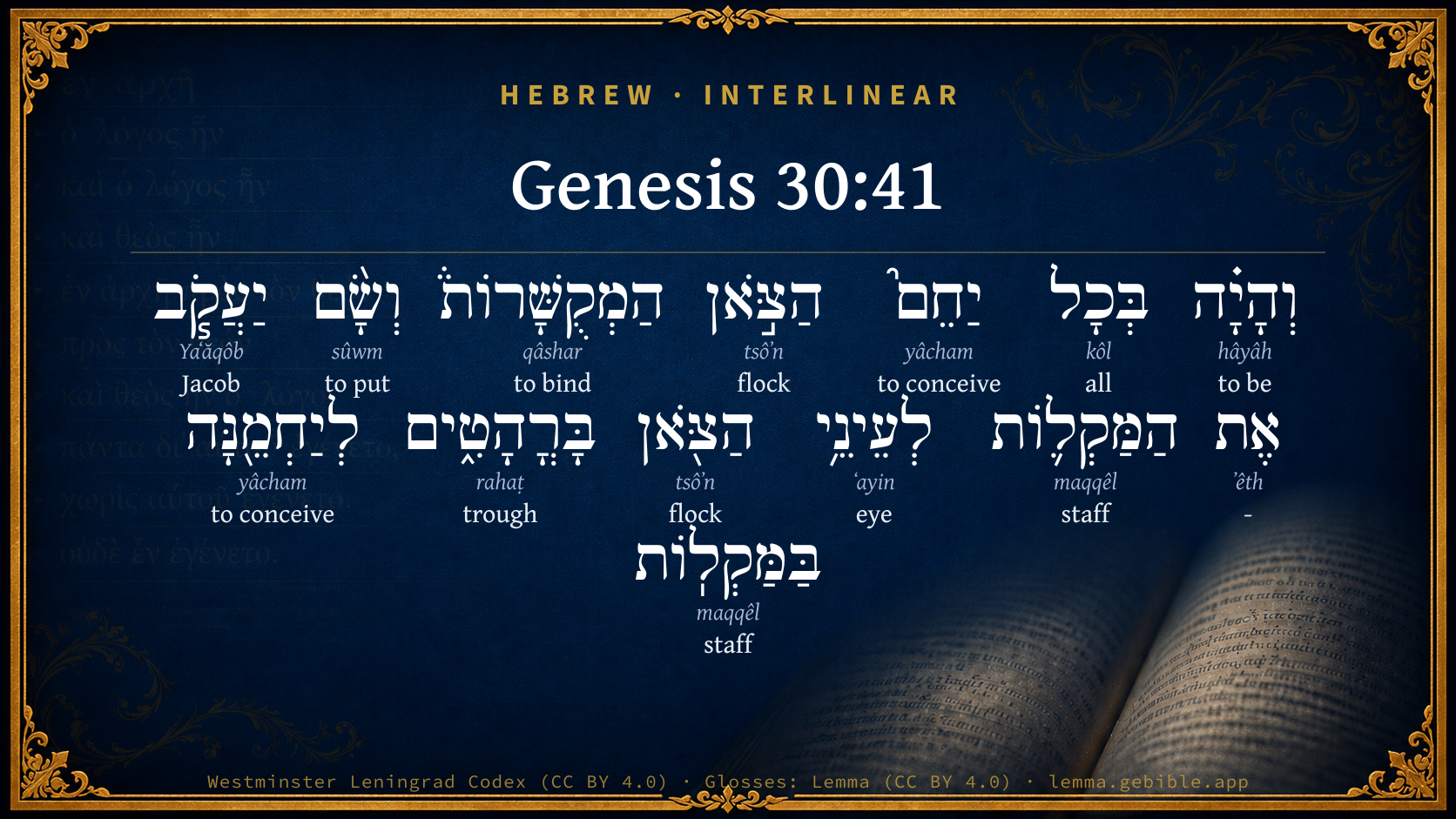
Genesis 30:41

Hebrew (Westminster Leningrad Codex) Genesis 30:41 appears in the Hebrew Old Testament. The text above is from the Westminster Leningrad Codex. Each word links to its Strong’s number, a concise gloss, and parsing drawn from the Open Scriptures Hebrew Bible morphology. Click any word for its full Brown-Driver-Briggs (BDB) entry.
Download image
Cite this verse

Genesis 30:41 (World English Bible). Public Domain. Lemma interlinear Bible study tool, https://lemma.gebible.app/v/genesis/30/41.

Show BibTeX & RIS
BibTeX
RIS
English Translation
It happened, whenever the stronger of the flock conceived, that Jacob laid the rods before the eyes of the flock in the gutters, that they might conceive among the rods;
World English Bible · Public Domain
Highlights
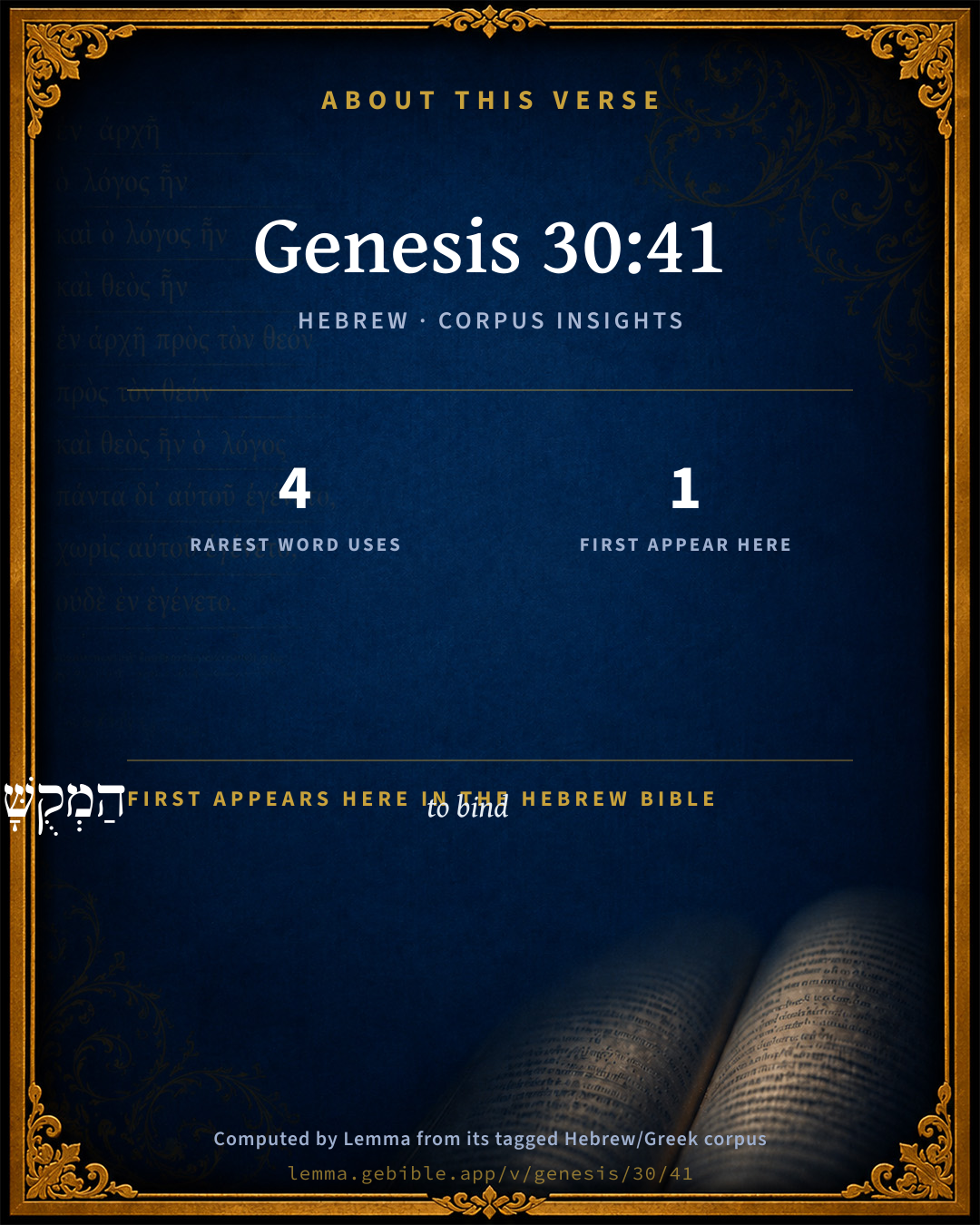
  • 1 first appearance in the Hebrew Bible
Full analysis ↓
Download a study sheet

One document with this verse’s original text, its word-by-word gloss line, the meaning frame, cross-references with their text, attributed commentary, and full source and license credits — printable, and it pastes into notes with its structure intact.

This verse Autodidact and up

Study sheet (.html) Plain text (.txt)

A passage Seminary Student

Up to 50 verses in one chapter. A passage sheet keeps up to 6 commentary sources and 12 cross-references per verse, in the order this page ranks them, and says so on the sheet whenever that leaves anything out. Ask for a single verse and you get the Autodidact verse sheet above.

Everything on this page stays free to read, with no account — the sheet is a download of what is already on screen, not access to it.

Want to remove ads? Support Godless Engineer
Compare translations 3

The same verse in 3 English versions, stacked beneath the original-language interlinear above. Click any original word for its lexicon entry.

Each is an independent rendering of the whole verse — the interlinear is not word-aligned to these translations.

Highlighted words mark where these versions differ — a whole-verse word diff, not a word-by-word alignment.

  • World English Bible Public Domain
    It happened, whenever the stronger of the flock conceived, that Jacob laid the rods before the eyes of the flock in the gutters, that they might conceive among the rods;
  • King James Version Public Domain
    And it came to pass, whensoever the stronger cattle did conceive, that Jacob laid the rods before the eyes of the cattle in the gutters, that they might conceive among the rods.
  • unfoldingWord Literal Text CC BY-SA 4.0
    So it happened whenever the strong animals were in heat, then Jacob put the branches in the troughs before the eyes of the flocks so that they would mate by the branches.

unfoldingWord Literal Text — © unfoldingWord, licensed CC BY-SA 4.0. Word-aligned USFM3 via Door43 (git.door43.org/unfoldingWord/en_ult).

Versions to compare (up to 4)

3 of 4 selected

Show all 18 translations

Every available English version of this verse, each an independent rendering of the whole verse.

  • World English Bible Public Domain
    It happened, whenever the stronger of the flock conceived, that Jacob laid the rods before the eyes of the flock in the gutters, that they might conceive among the rods;
  • Berean Standard Bible Public Domain
    Whenever the stronger females of the flock were in heat, Jacob would place the branches in the troughs, in full view of the animals, so that they would breed in front of the branches.
  • Majority Standard Bible Public Domain
    Whenever the stronger females of the flock were in heat, Jacob would place the branches in the troughs, in full view of the animals, so that they would breed in front of the branches.
  • King James Version Public Domain
    And it came to pass, whensoever the stronger cattle did conceive, that Jacob laid the rods before the eyes of the cattle in the gutters, that they might conceive among the rods.
  • American Standard Version (1901) Public Domain
    And it came to pass, whensoever the stronger of the flock did conceive, that Jacob laid the rods before the eyes of the flock in the gutters, that they might conceive among the rods;
  • Revised Version (1885) Public Domain
    And it came to pass, whensoever the stronger of the flock did conceive, that Jacob laid the rods before the eyes of the flock in the gutters, that they might conceive among the rods;
  • Geneva Bible (1599) Public Domain
    And in euery ramming time of the stronger sheepe, Iaakob layde the rods before the eyes of the sheepe in the gutters, that they might conceiue before the rods.
  • Douay-Rheims (1899) Public Domain
    So when the ewes went first to ram, Jacob put the rods in the roughs of water before the eyes of the rams, and of the ewes, that they might conceive while they were looking upon them:
  • Young's Literal Translation Public Domain
    And it hath come to pass whenever the strong ones of the flock conceive, that Jacob set the rods before the eyes of the flock in the gutters, to cause them to conceive by the rods,
  • Literal Standard Version CC BY-SA 4.0
    And it has come to pass, whenever the strong ones of the flock conceive, that Jacob sets the rods before the eyes of the flock in the gutters, to cause them to conceive by the rods,
  • Unlocked Literal Bible CC BY-SA 4.0
    Whenever the stronger sheep in the flock were breeding, then Jacob would lay the sticks in the watering troughs before the eyes of the flock, so that they might conceive among the sticks.
  • unfoldingWord Literal Text CC BY-SA 4.0
    So it happened whenever the strong animals were in heat, then Jacob put the branches in the troughs before the eyes of the flocks so that they would mate by the branches.
  • Darby Bible Public Domain
    And it came to pass whensoever the strong cattle were ardent, that Jacob laid the rods before the eyes of the flock in the gutters, that they might become ardent among the rods;
  • World Messianic Bible Public Domain
    Whenever the stronger of the flock conceived, Jacob laid the rods in front of the eyes of the flock in the watering troughs, that they might conceive among the rods;
  • Webster's Bible Public Domain
    And it came to pass, whenever the stronger cattle conceived, that Jacob laid the rods before the eyes of the cattle in the gutters, that they might conceive among the rods.
  • Free Bible Version CC BY-SA 4.0
    When the strong females were ready to breed, Jacob put the sticks in the troughs where the flocks could see them when they mated.
  • Bible in Basic English Public Domain
    And whenever the stronger ones of the flock became with young, Jacob put the sticks in front of them in the drinking-places, so that they might become with young when they saw the sticks.
  • JPS Tanakh (1917) Public Domain
    And it came to pass, whensoever the stronger of the flock did conceive, that Jacob laid the rods before the eyes of the flock in the gutters, that they might conceive among the rods;

Literal Standard Version (2020), Covenant Press — licensed CC BY-SA 4.0. Text via the HelloAO Bible API (eBible.org). Unlocked Literal Bible (unfoldingWord) — licensed CC BY-SA 4.0. Text via the HelloAO Bible API (eBible.org). unfoldingWord Literal Text — © unfoldingWord, licensed CC BY-SA 4.0. Word-aligned USFM3 via Door43 (git.door43.org/unfoldingWord/en_ult). Free Bible Version, Dr. Jonathan Gallagher — licensed CC BY-SA 4.0. Text via the HelloAO Bible API (eBible.org).

Word by word

More ways to search: Search by grammar → Find every occurrence → Compare this word →

Practice this passage: Drill this verse → Learn its vocabulary →

בָּרֳהָטִ֑ים
rahaṭ
H7298
“in/at the · troughs”
Preposition, Determined + Noun, Common, Masculine, Plural, Absolute
Part of Speech
Preposition + Noun
Type
Common
Gender
Masculine
Number
Plural
State
Absolute
Full BDB Definition

Origin: from an unused root apparently meaning to hollow out

TWOT: TWOT - 2127a , 2128a

trough, hollow - lock of hair - meaning dubious
  1. וְהָיָ֗ה hâyâh H1961 “and · to be” Conjunction + Verb, Qal, Perfect, 3rd Person, Masculine, Singular
  2. בְּכָל kôl H3605 “in/at · all of” Preposition + Noun, Common, Masculine, Singular, Construct
  3. יַחֵם֮ yâcham H3179 “to conceive” Verb, Piel, Infinitive Construct
  4. הַצֹּ֣אן tsôʼn H6629 “the · flock” Particle, Definite Article + Noun, Common, Both, Singular, Absolute
  5. הַמְקֻשָּׁרוֹת֒ qâshar H7194 “the · bound” Particle, Definite Article + Verb, Pual, Participle Passive, Feminine, Plural, Absolute
  6. וְשָׂ֨ם sûwm H7760 “and · to put” Conjunction + Verb, Qal, Perfect, 3rd Person, Masculine, Singular
  7. יַעֲקֹ֧ב Yaʻăqôb H3290 “Jacob” Noun, Proper
  8. אֶת ʼêth H853 “-” Particle, Direct Object
  9. הַמַּקְל֛וֹת maqqêl H4731 “the · staves” Particle, Definite Article + Noun, Common, Masculine, Plural, Absolute
  10. לְעֵינֵ֥י ʻayin H5869 “to/for · eyes of” Preposition + Noun, Common, Both, Dual, Construct
  11. הַצֹּ֖אן tsôʼn H6629 “the · flock” Particle, Definite Article + Noun, Common, Both, Singular, Absolute
  12. לְיַחְמֵ֖נָּה yâcham H3179 “to conceive · her” Preposition + Verb, Piel, Infinitive Construct + Suffix, Personal, 3rd Person, Feminine, Singular
  13. בַּמַּקְלֽוֹת maqqêl H4731 “in/at the · staves” Preposition, Determined + Noun, Common, Masculine, Plural, Absolute

About this verse

These counts appear in no published source. They are computed here, from the morphology-tagged text and Lemma’s own curated glosses. What Lemma adds →

14
words
11
distinct lemmas
Pentateuch
section

Notable vocabulary

The rarest word here is בָּרֳהָטִ֑ים trough H7298 — appearing just 4 times in the whole Hebrew Bible.

First appearance in Scripture

This word makes its first canonical appearance in the Hebrew Bible here:

  • הַמְקֻשָּׁרוֹת֒ to bind H7194

Shared distinctive vocabulary

בָּרֳהָטִ֑ים trough H7298 occurs in 4 verses of the Hebrew Bible. Also found in:

Grammatical profile

  • 5 verbs
  • 8 nouns
  • 1 particle

Verb forms

  • וְהָיָ֗ה Qal · Perfect
  • יַחֵם֮ Piel · Infinitive Construct
  • הַמְקֻשָּׁרוֹת֒ Pual · Participle Passive
  • וְשָׂ֨ם Qal · Perfect
  • לְיַחְמֵ֖נָּה Piel · Infinitive Construct

Repetition

Words recur within this verse — often emphatic in Hebrew:

  • יַחֵם֮ to conceive H3179 ×2
  • הַצֹּ֣אן flock H6629 ×2
  • הַמַּקְל֛וֹת staff H4731 ×2

Hebrew & Septuagint length

In English translation the verse runs 30 words from the Hebrew and 34 from the Septuagint (LXX English) — closely comparable.

A rough comparison of the two English renderings, which tokenize alike — not a word-level alignment.

Word counts can differ between the Hebrew and the Greek without any difference in meaning — e.g. the Hebrew direct-object marker אֵת has no separate Greek word, and Greek often adds the article ὁ.

Hebrew and Greek witnesses Masoretic Hebrew ↔ Greek Septuagint

The same verse in the two great witnesses to the Old Testament, shown verse-for-verse.

These are two independent witnesses, not word-aligned to each other, and the Septuagint is shown in lemma (dictionary) form.

Hebrew Genesis 30:41 Masoretic · Westminster Leningrad Codex

וְהָיָ֗ה בְּכָל יַחֵם֮ הַצֹּ֣אן הַמְקֻשָּׁרוֹת֒ וְשָׂ֨ם יַעֲקֹ֧ב אֶת הַמַּקְל֛וֹת לְעֵינֵ֥י הַצֹּ֖אן בָּרֳהָטִ֑ים לְיַחְמֵ֖נָּה בַּמַּקְלֽוֹת

It happened, whenever the stronger of the flock conceived, that Jacob laid the rods before the eyes of the flock in the gutters, that they might conceive among the rods;

World English Bible · Public Domain

Greek LXX Genesis 30:41 Septuagint · lemma form

γίγνομαι δέ ἐν ὁ καιρός ὅς ἐνκισσάω ὁ πρόβατον ἐν γαστήρ λαμβάνω τίθημι ἰακώβ ὁ ῥάβδος ἐναντίον ὁ πρόβατον ἐν ὁ ληνός ὁ ἐνκισσάω αὐτός κατά ὁ ῥάβδος

And it came to pass in the time wherein the cattle became pregnant, conceiving in the belly, Jacob put the rods before the cattle in the troughs, that they might conceive by the rods.

LXX2012 (modern English Septuagint) · Public Domain

Hebrew: Westminster Leningrad Codex (CC BY 4.0). Greek: Septuagint (public domain); English from LXX2012 (modern English Septuagint) (Public Domain). How the Septuagint differs from the Hebrew →

Targum (Aramaic paraphrase)

2

The Targum is the ancient Jewish Aramaic paraphrase of the Hebrew Scriptures — an interpretive translation, not the Hebrew text itself. Onkelos (literal) and Pseudo-Jonathan (expansive) render the Torah, and Jonathan the Prophets. Coverage is partial: where no permissively-licensed English translation exists for a verse, only the Aramaic is shown. This is verse-level text, not a word-by-word alignment to the Hebrew.

  1. Targum Onkelos Torah (Genesis–Deuteronomy)
    וַהֲוֵי בְּכָל עִדַּן דְּמִתְיַחֲמָן עָנָא מְבַכַּרְתָּא וּמְשַׁוִּי יַעֲקֹב יָת חוּטְרַיָּא לְעֵינֵי עָנָא בִּרְהָטַיָּא לְיַחָמוּתְהוֹן בְּחוּטְרַיָּא

    (no public-domain English translation for this verse)

    Targum Onkelos — Aramaic: “Onkelos Genesis” (public domain); “Onkelos Exodus” (public domain); “Onkelos Leviticus” (public domain); “Onkelos Numbers” (public domain); “Onkelos Deuteronomy” (public domain). English: “Sefaria Community Translation” (CC0 1.0 (public-domain dedication)); “J.W. Etheridge. The Targums of Onkelos and Jonathan Ben Uzziel on the Pentateuch. London: Longmans, Green, 1862” (public domain). Text via Sefaria.

  2. Targum Pseudo-Jonathan Torah (Genesis–Deuteronomy)
    וַהֲוָה בְּכָל עִידַן דְמִתְיַחֲמָן עָנָא מְבַכְּרָתָא וּמְשַׁוִי יַעֲקב יַת חוּטְרַיָא לְעֵינֵי עָנָא בְּמוּרְכְיָיתָא לְיַחֲמוּתְהֶן קְבֵל חוּטְרַיָיא

    And it was that whenever the early (prime) sheep conceived, Jakob set the rods in the canals before the eyes of the sheep, that they might conceive before the rods.

    Targum Pseudo-Jonathan — Aramaic: “Targum Jonathan on Genesis” (public domain); “Targum Jonathan on Exodus” (public domain); “Targum Jonathan on Leviticus” (public domain); “Targum Jonathan on Numbers” (public domain); “Targum Jonathan on Deuteronomy” (public domain). English: “The Targum of Jonathan ben Uzziel, trans. J. W. Etheridge, London, 1862” (public domain). Text via Sefaria.

Commentary

Notes on Genesis 30:41 from classic Christian and Jewish commentators (each source and its license shown beneath its notes). The classic Christian expositions comment on the surrounding passage and are grouped to its opening verse, so a note may address several verses; the Jewish commentaries on the Tanakh (Rashi and others) are per-verse, so they appear only where the commentator wrote on this verse.

Lemma curates 59 commentaries, every one of them public domain or Creative Commons licensed, each selected and text-cleaned for this edition rather than reprinted as found. About our sources →

Trapp's Complete Commentary

John Trapp

Gen 30:41 And it came to pass, whensoever the stronger cattle did conceive, that Jacob laid the rods before the eyes of the cattle in the gutters, that they might conceive among the rods.

Ver. 41. The stronger cattle.] Heb., Bound together, i.e., lusty and well set.

John Trapp, A Commentary or Exposition upon All the Books of the Old and New Testament (1647–1656) — public domain. Text from a community e-Sword module.

Geneva Bible (1599)

Geneva Bible translators

As they which took the ram about September and brought forth about March: so the feebler in March, and lamb in September.

Geneva Bible (1599) marginal notes — public domain. Text via Bolls.life.

Adam Clarke's Commentary

Verse 41. Whensoever the stronger cattle did conceive] The word מקשרות mekushsharoth, which we translate stronger, is understood by several of the ancient interpreters as signifying the early, first-born, or early spring cattle; and hence it is opposed to עטפים atuphim, which we translate feeble, and which Symmachus properly renders δευτερογονοι, cattle of the second birth, as he renders the word mekushsharoth by πρωτογονοι, cattle of the first or earliest birth. Now this does not apply merely to two births from the same female in one year, which actually did take place according to the rabbins, the first in Nisan, about our March, and the second in Tisri, about our September; but it more particularly refers to early and late lambs, c., in the same year as those that are born just at the termination of winter, and in the very commencement of spring, are every way more valuable than those which were born later in the same spring. Jacob therefore took good heed not to try his experiments with those late produced cattle, because he knew these would produce a degenerate breed, but with the early cattle, which were strong and vigorous, by which his breed must be improved. Hence the whole flock of Laban must be necessarily injured, while Jacob's flock was preserved in a state of increasing perfection. All this proves a consummate knowledge in Jacob of his pastoral office. If extensive breeders in this country were to attend to the same plan, our breed would be improved in a most eminent degree. What a fund of instruction upon almost every subject is to be found in the sacred writings!

Adam Clarke's Commentary on the Bible (1810–1826) — public domain. Text from a community e-Sword/MySword module.

Ellicott's Commentary for English Readers

(41, 42) The stronger cattle . . . when the cattle were feeble.—The words for “strong” and “feeble” are literally bound and covered, so that evidently we have technical terms, which Onkelos and the Syriac explain of the females at the two breeding seasons. The ewes in the spring, after the cold season, are bound, firmly knit together, and the lambs strong and healthy. The other word, covered, seems to mean seeking concealment, hiding away (Job_23:9); and therefore faint, its meaning in Psa_61:2, Psalms 102, title (Authorised Version, overwhelmed), and Isa_57:16 (Authorised Version, fail). The autumn-born lambs are of no great value, and Jacob left them to the course of nature.

A Bible Commentary for English Readers, edited by Charles John Ellicott (1878–1897) — public domain. Text from a community e-Sword module.

The Cambridge Bible for Schools and Colleges

gen. ed. J. J. S. Perowne

41. the stronger] A third device on Jacob’s part. He is careful, at the breeding season, to pick out only the finer animals before which to place the peeled rods. Hence he obtained for his own share the young of the better animals.

The Cambridge Bible for Schools and Colleges (gen. ed. J. J. S. Perowne; Cambridge University Press, 1878–1918) — public domain. Text from a community e-Sword module.

Matthew Poole's English Annotations

It is known that the cattle in those parts did conceive and bring forth twice in a year, at spring and in autumn; and it is supposed that the

stronger here mentioned, are such as joined in the spring, and the feeble they that joined in autumn.

Matthew Poole's English Annotations on the Holy Bible (1683–1685) — public domain. Text from a community e-Sword/MySword module.

The Pulpit Commentary

And it came to pass, whensoever the stronger cattle did conceive, literally, in every healing of the cattle, the bound ones, i.e. the firm, compact sheep, "the spring flock" (Luther), which, being conceived in spring and dropped in autumn, are supposed to be stronger than those conceived in autumn and dropped in spring; but this is doubtfulthat Jacob laid the rods before the eyes of the cattle in the gutters, that they might conceive among the rods. Jacob s third artifice aimed at securing for himself a vigorous breed of sheep.

The Pulpit Commentary (1880–1919), ed. H.D.M. Spence-Jones & Joseph S. Exell — public domain. Text from a community e-Sword module.

Keil & Delitzsch

C. F. Keil & F. Delitzsch

He did not adopt the trick with the rods, however, on every occasion of copulation, for the sheep in those countries lamb twice a year, but only at the copulation of the strong sheep (המקשּׁרות the bound ones, i.e., firm and compact), - Luther, "the spring flock;" ליחמנּה inf. Pi. "to conceive it (the young);" - but not "in the weakening of the sheep," i.e., when they were weak, and would produce weak lambs. The meaning is probably this: he only adopted this plan at the summer copulation, not the autumn; for, in the opinion of the ancients (Pliny, Columella), lambs that were conceived in the spring and born in the autumn were stronger than those born in the spring (cf. Bochart l.c. p. 582). Jacob did this, possibly, less to spare Laban, than to avoid exciting suspicion, and so leading to the discovery of his trick. - In Gen 30:43 the account closes with the remark, that the man increased exceedingly, and became rich in cattle (רבּות צאן many head of sheep and goats) and slaves, without expressing approbation of Jacob's conduct, or describing his increasing wealth as a blessing from God. The verdict is contained in what follows.

Keil & Delitzsch — Biblical Commentary on the Old Testament (1861–1891) — public domain (CC PDM 1.0). Text via the HelloAO Bible API. (Old Testament only.)

unfoldingWord translationNotes

Door43 World Missions Community

before the eyes of the flock

Here the flock's "eyes" represent the sheep and emphasize what they see. AT: "so that the flock could see them" (See: Synecdoche)

among the sticks

"in front of the sticks"

the feebler animals

"the weaker animals"

So the feebler animals were Laban's, and the stronger were Jacob's

"So the weaker offspring belonged to Laban, while the stronger offspring belonged to Jacob." You can make this even more explicit. AT: "So the weaker offspring did not have stripes or spots and so belonged to Laban, while the stronger offspring did have stripes or spots and so belonged to Jacob" (See: Assumed Knowledge and Implicit Information)

translationWords

Jacob

conceive

Laban

unfoldingWord translationNotes — © Distant Shores Media and the Door43 World Missions Community, licensed CC BY-SA 4.0. Source: git.door43.org/Door43/en_tn.

Rashi

Rabbi Shlomo Yitzchaki (Rashi)

המקשרות THE STRONGER—Explain it as the Targum renders it: הבכירות the early-bearing sheep; but I have no evidence in the Scripture (i.e. I have no other example of the use of this word) to prove that this is its meaning. Menachem classifies it under the same root as (2 Samuel 15:31) “Ahitophel is among the conspirators (בקשרים)”, and as (2 Samuel 15:12) “And the conspiracy (הקשר) was strong” — so that the meaning would be those sheep that banded themselves together (mated) in order to accelerate their pregnancy (i.e. in order that they might become בכירות, early-bearing sheep).

Rashi on the Tanakh — English translations: “The Judaica Press complete Tanach with Rashi, translated by A. J. Rosenberg” (CC BY 4.0); “Pentateuch with Rashi's commentary by M. Rosenbaum and A.M. Silbermann, 1929-1934” (public domain); “The Metsudah Tanach series, Lakewood, N.J” (CC BY 4.0); and “The Book of Joshua, Metsudah Publications, 1997” (CC BY 4.0). Text via Sefaria.

Ramban (Nachmanides)

Rabbi Moshe ben Nachman (Ramban / Nachmanides)

THE FLOCKS ‘HAMEKUSHAROTH.’ The correct interpretation of this expression appears to me to be that they are the flocks in which the males follow the females at all times, never leaving them due to their abundant desire, as in the expression, Seeing that his soul is ‘keshurah’ (bound up) with the lad’s soul. This is also found in the language of our Sages: “a swine karuch (clinging) to a ewe;” “clinging to her.” And the offspring born at that time are called hakeshurim after the name of their father.But many authorities say that keshurim are “the strong ones” whose limbs are firmly attached to each other with a strong tie, as this is the basis of health, while atuphim are “the weak ones” whose soul ‘tithataph’ (fainted) in them, and who have no desire, as in the expression, ‘ha’atuphim’ (that faint) for hunger. Onkelos translated hamekusharoth as the early-bearing sheep, and atuphim as the late-bearing ones, for such is the fact: [the early-bearing sheep are the stronger ones, and the late-bearing ones are weaker].

Ramban (Nachmanides) on the Tanakh — English translation: “Commentary on the Torah by Ramban (Nachmanides). Translated and annotated by Charles B. Chavel. New York, Shilo Pub. House, 1971-1976” (CC BY 4.0). Text via Sefaria.

Radak

Rabbi David Kimhi (Radak)

והיה בכל יחם, during all the periods when the animals were in heat, i.e. at the time when they mated; this is in accordance with Onkelos’ rendering of these words. This is the standard translation every time the word occurs.

ויחם, the reason the infinitive mode is used for the word is in order for it to be connected to the preceding word בכל, which is used in lieu of the word שם, “there, wherever.” When the word does not signify any specific time, i.e. either past, present of future, which would limit its application, then the word בכל is appropriate as it also is a totally inclusive word, not allowing for exceptions. The infinitive is therefore absolutely in place. The sheep give birth twice a year, and the Torah now tells us before which of the cycle of births Yaakov positioned the sticks by the troughs. Yaakov positioned the sticks before the first cycle of births which was numerically much smaller, because Lavan did not bother to check on what was going on during that period. Before the second birthing during that year Yaakov did not position the sticks in order to arouse the imagination of the animals because at that time Lavan would come to inspect his sheep and if he had discovered that Yaakov was using these sticks this would have resulted in a quarrel between them, and Lavan would have stolen from him whatever he thought should be his. Even though Yaakov had never positioned the sticks in front of any animals that were Lavan’s, as I explained on verse 37, in the name of my late father, Lavan would have argued that just as Yaakov placed this sticks before his own animals so he would presumably do also when watering Lavan’s flocks.

The meaning of the words המקושרות, הקשורים and העטופים, as well as the word ובהעטיף, is in accordance with the way Onkelos translates them, descriptions of the time cycle during which certain animals would give birth. My late father of blessed memory, explained that the agreement for the first year called for the result of the first birthing to be Yaakov’s, whereas the result of the second birthing would be Lavan’s.

ליחמנה במקלות, to bring them to heat through their viewing the sticks, as I already explained. The letter ה at the end of the word ליחמנה is appended just as we find this letter appended in such words as אותנה (Exodus 35,26), where we do not know any reason for this addition. The word really should have been ליחמן without the letter ה at the end but with a dagesh in the final ן. Still we do have a similar construction to ours here in Micah 7,7 עיני תיראנה בה as well as in Ezekiel 4,12 תעגנה לעיניהם where the letter נ in תעגנה is “weak,” i.e. without the dagesh we would have expected. Even though, as we explained, the places where these constructions occur are not quite analogous to one another, the fact remains that the entire story is told by the Torah in such detail in order to show the reader to what extent G’d’s providence intervened in order to make sure that Yaakov did not lose out to the crooked Lavan. This once again confirms what we read in Psalms 37,12 and 33 that זומם רשע לצדיק....ה' לא יעזבנו בידו, “when the wicked tries to set a trap the righteous G’d will not abandon the righteous to the devices of the wicked.”

Radak on the Tanakh — English translations: “Sefaria Community Translation” (CC0 1.0 (public-domain dedication)); “Eliyahu Munk, HaChut Hameshulash” (CC BY 4.0); “Rabbi Mike Feuer, Jerusalem Anthology” (CC BY 4.0); and “R. David Kimhi on the first book of Psalms, Translated by R.G. Finch, London, 1919” (public domain). Text via Sefaria.

Lesson kit

Teaching starters — assembled from the data on this page, not authored interpretation. Every prompt links to the verse data it draws on. Edit before teaching.

Genesis, in the Pentateuch, opens this verse with 14 words (11 distinct Hebrew lemmas). Its most distinctive word is rahaṭ (“trough”). A historical commentator’s framing appears above. Read the whole chapter for the surrounding context.

Discussion questions

  1. How does “trough” (rahaṭ) shape what this verse is saying?
  2. The word “to bind” first appears here in Scripture. What is being introduced at this debut?
  3. Genesis 30:38 shares the word «trough» with this verse. How do the two illuminate each other?
  4. “to conceive” occurs 2× in this one verse. What is the effect of the repetition?
  5. The translations on this page render this verse differently — a whole-verse word diff, not a word-by-word alignment. What might account for the different wordings?
  6. The verb «וְהָיָ֗ה» is Qal Perfect. How does its form color the action?
  7. Reading how Trapp's Complete Commentary and Geneva Bible (1599) read this verse, where do the two commentators agree and where do they part?

Things to notice

  • 1 word makes its first canonical appearance in Scripture here.
  • These translations choose different wording for 25 words in this verse.
  • “to conceive” occurs 2× in this single verse.
  • 11 distinct Hebrew lemmas span 14 words in this verse.

Reading settings

Reading text

Shown beneath each verse's original-language words.

Old Testament
Old Testament edition

Read the OT as the Masoretic Hebrew (MT) or the Greek Septuagint (LXX).

English shown for the Greek Septuagint (in the Hebrew ↔ Greek comparison).

Comparing translations? Open the Compare panel on any verse page to stack up to four side by side.