
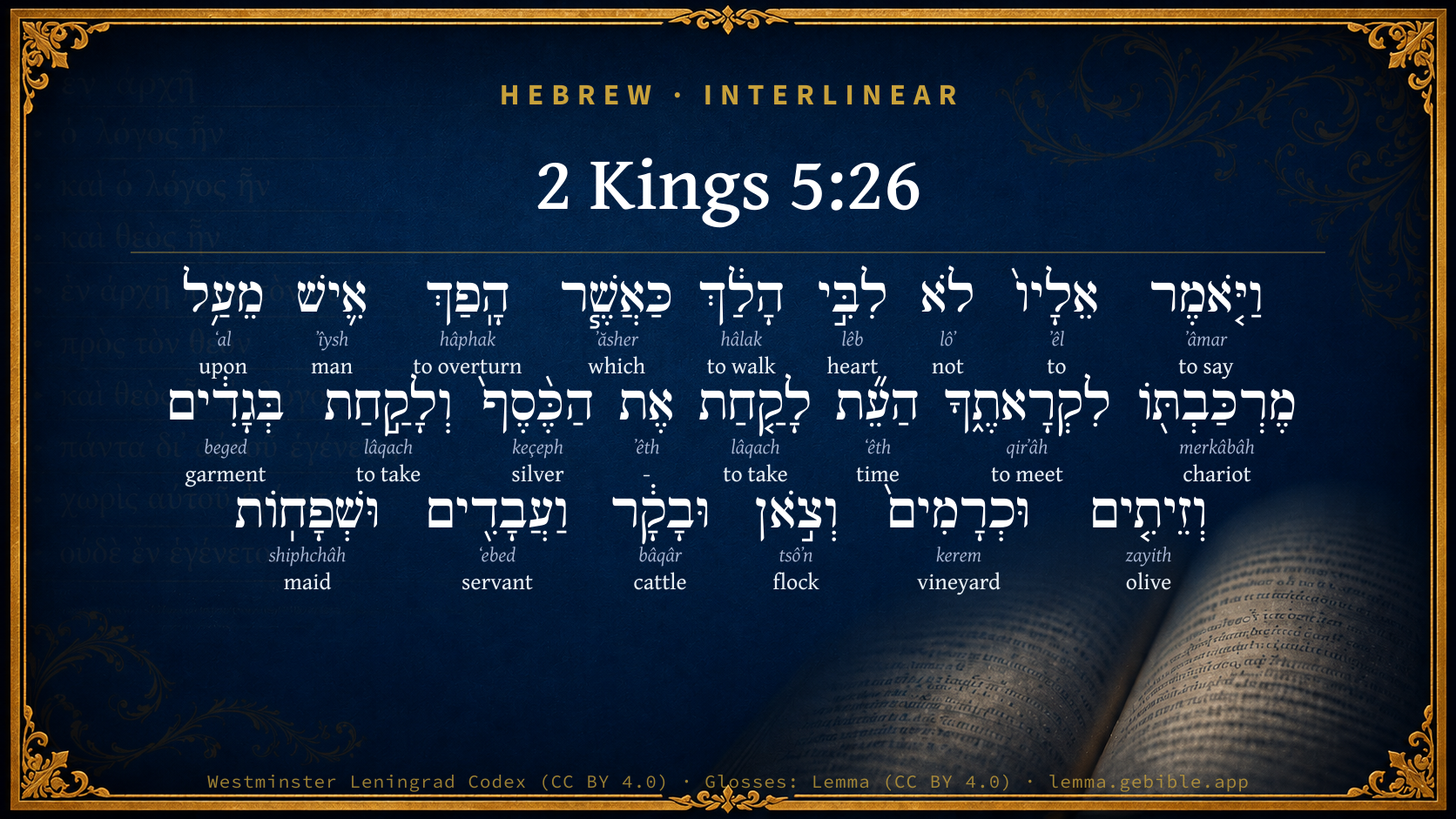
2 Kings 5:26

Hebrew (Westminster Leningrad Codex) 2 Kings 5:26 appears in the Hebrew Old Testament. The text above is from the Westminster Leningrad Codex. Each word links to its Strong’s number, a concise gloss, and parsing drawn from the Open Scriptures Hebrew Bible morphology. Click any word for its full Brown-Driver-Briggs (BDB) entry.
Download image
Cite this verse

2 Kings 5:26 (World English Bible). Public Domain. Lemma interlinear Bible study tool, https://lemma.gebible.app/v/2-kings/5/26.

Show BibTeX & RIS
BibTeX
RIS
English Translation
He said to him, Didn't my heart go with you, when the man turned from his chariot to meet you? Is it a time to receive money, and to receive garments, and olive groves and vineyards, and sheep and oxen, and men-servants and maid-servants?
World English Bible · Public Domain
Download a study sheet

One document with this verse’s original text, its word-by-word gloss line, the meaning frame, cross-references with their text, attributed commentary, and full source and license credits — printable, and it pastes into notes with its structure intact.

This verse Autodidact and up

Study sheet (.html) Plain text (.txt)

A passage Seminary Student

Up to 50 verses in one chapter. A passage sheet keeps up to 6 commentary sources and 12 cross-references per verse, in the order this page ranks them, and says so on the sheet whenever that leaves anything out. Ask for a single verse and you get the Autodidact verse sheet above.

Everything on this page stays free to read, with no account — the sheet is a download of what is already on screen, not access to it.

Want to remove ads? Support Godless Engineer
Compare translations 3

The same verse in 3 English versions, stacked beneath the original-language interlinear above. Click any original word for its lexicon entry.

Each is an independent rendering of the whole verse — the interlinear is not word-aligned to these translations.

Highlighted words mark where these versions differ — a whole-verse word diff, not a word-by-word alignment.

  • World English Bible Public Domain
    He said to him, Didn't my heart go with you, when the man turned from his chariot to meet you? Is it a time to receive money, and to receive garments, and olive groves and vineyards, and sheep and oxen, and men-servants and maid-servants?
  • King James Version Public Domain
    And he said unto him, Went not mine heart with thee, when the man turned again from his chariot to meet thee? Is it a time to receive money, and to receive garments, and oliveyards, and vineyards, and sheep, and oxen, and menservants, and maidservants?
  • unfoldingWord Literal Text CC BY-SA 4.0
    And he said to him, “Did my heart not go when the man turned from upon his chariot to meet you? a time to take silver or to take clothing or olives trees or vineyards or sheep or cattle or male servants or female servants?

unfoldingWord Literal Text — © unfoldingWord, licensed CC BY-SA 4.0. Word-aligned USFM3 via Door43 (git.door43.org/unfoldingWord/en_ult).

Versions to compare (up to 4)

3 of 4 selected

Show all 18 translations

Every available English version of this verse, each an independent rendering of the whole verse.

  • World English Bible Public Domain
    He said to him, Didn't my heart go with you, when the man turned from his chariot to meet you? Is it a time to receive money, and to receive garments, and olive groves and vineyards, and sheep and oxen, and men-servants and maid-servants?
  • Berean Standard Bible Public Domain
    But Elisha questioned him, “Did not my spirit go with you when the man got down from his chariot to meet you? Is this the time to accept money and clothing, olive groves and vineyards, sheep and oxen, menservants and maidservants?
  • Majority Standard Bible Public Domain
    But Elisha questioned him, “Did not my spirit go with you when the man got down from his chariot to meet you? Is this the time to accept money and clothing, olive groves and vineyards, sheep and oxen, menservants and maidservants?
  • King James Version Public Domain
    And he said unto him, Went not mine heart with thee, when the man turned again from his chariot to meet thee? Is it a time to receive money, and to receive garments, and oliveyards, and vineyards, and sheep, and oxen, and menservants, and maidservants?
  • American Standard Version (1901) Public Domain
    And he said unto him, Went not my heart `with thee', when the man turned from his chariot to meet thee? Is it a time to receive money, and to receive garments, and oliveyards and vineyards, and sheep and oxen, and men-servants and maid-servants?
  • Revised Version (1885) Public Domain
    And he said unto him, Went not mine heart with thee, when the man turned again from his chariot to meet thee? Is it a time to receive money, and to receive garments, and oliveyards and vineyards, and sheep and oxen, and menservants and maidservants?
  • Geneva Bible (1599) Public Domain
    But he saide vnto him, Went not mine heart with thee when the man turned againe from his charet to meete thee? Is this a time to take money, and to receiue garments, and oliues, and vineyardes, and sheepe, and oxen, and men seruants, and maide seruants?
  • Douay-Rheims (1899) Public Domain
    But he said: Was not my heart present, when the man turned back from his chariot to meet thee? So now thou hast received money, and received garments, to buy oliveyards, and vineyards, and sheep, and oxen, and menservants, and maidservants.
  • Young's Literal Translation Public Domain
    And he saith unto him, `My heart went not when the man turned from off his chariot to meet thee; is it a time to take silver, and to take garments, and olives, and vines, and flock, and herd, and men-servants, and maid-servants?
  • Literal Standard Version CC BY-SA 4.0
    And he says to him, “My heart did not go when the man turned from off his chariot to meet you; is it a time to take silver, and to take garments, and olives, and vines, and flock, and herd, and menservants, and maidservants?
  • Unlocked Literal Bible CC BY-SA 4.0
    Elisha said to Gehazi, “Was not my spirit with you when the man turned his chariot to meet you? Is this a time to accept money and clothes, olive orchards and vineyards, sheep and oxen, and male servants and female servants?
  • unfoldingWord Literal Text CC BY-SA 4.0
    And he said to him, “Did my heart not go when the man turned from upon his chariot to meet you? a time to take silver or to take clothing or olives trees or vineyards or sheep or cattle or male servants or female servants?
  • Darby Bible Public Domain
    And he said to him, Did not my heart go, when the man turned again from his chariot to meet thee? Is it a time to receive money, and to receive garments, and oliveyards, and vineyards, and sheep, and oxen, and bondmen, and bondwomen?
  • World Messianic Bible Public Domain
    He said to him, “Didn’t my heart go with you when the man turned from his chariot to meet you? Is it a time to receive money, and to receive garments, and olive groves and vineyards, and sheep and cattle, and male servants and female servants?
  • Webster's Bible Public Domain
    And he said to him, Went not my heart with thee, when the man turned again from his chariot to meet thee? Is it a time to receive money, and to receive garments, and olive-yards, and vineyards, and sheep, and oxen, and men-servants, and maid-servants?
  • Free Bible Version CC BY-SA 4.0
    But Elisha told him, “Didn't I see you in my mind's eye when the man got down from his chariot to meet you? Is this the time to take money and clothing, olive groves and vineyards, sheep and oxen, male and female servants?
  • Bible in Basic English Public Domain
    And he said to him, Did not my heart go with you, when the man got down from his carriage and went back to you? Is this a time for getting money, and clothing, and olive-gardens and vine-gardens, and sheep and oxen, and men-servants and women-servants?
  • JPS Tanakh (1917) Public Domain
    And he said unto him: 'Went not my heart with thee, when the man turned back from his chariot to meet thee? Is it a time to receive money, and to receive garments, and oliveyards and vineyards, and sheep and oxen, and men-servants and maid-servants?

Literal Standard Version (2020), Covenant Press — licensed CC BY-SA 4.0. Text via the HelloAO Bible API (eBible.org). Unlocked Literal Bible (unfoldingWord) — licensed CC BY-SA 4.0. Text via the HelloAO Bible API (eBible.org). unfoldingWord Literal Text — © unfoldingWord, licensed CC BY-SA 4.0. Word-aligned USFM3 via Door43 (git.door43.org/unfoldingWord/en_ult). Free Bible Version, Dr. Jonathan Gallagher — licensed CC BY-SA 4.0. Text via the HelloAO Bible API (eBible.org).

Word by word

More ways to search: Search by grammar → Find every occurrence → Compare this word →

Practice this passage: Drill this verse → Learn its vocabulary →

וְזֵיתִ֤ים
zayith
H2132
“and · olives”
Conjunction + Noun, Common, Masculine, Plural, Absolute
Part of Speech
Conjunction + Noun
Type
Common
Gender
Masculine
Number
Plural
State
Absolute
Full BDB Definition

Origin: probably from an unused root [akin to H2099 ]

TWOT: 548

olive, olive tree (noun masculine) - olive tree - olives - mountain facing Jerusalem on the east side (noun proper locative)
  1. וַיֹּ֤אמֶר ʼâmar H559 “and · to say” Conjunction + Verb, Qal, Sequential Imperfect, 3rd Person, Masculine, Singular
  2. אֵלָיו֙ ʼêl H413 “to · him” Preposition + Suffix, Personal, 3rd Person, Masculine, Singular
  3. לֹא lôʼ H3808 “not” Particle, Negative
  4. לִבִּ֣י lêb H3820 “heart · my” Noun, Common, Masculine, Singular, Construct + Suffix, Personal, 1st Person, Common, Singular
  5. הָלַ֔ךְ hâlak H1980 “to walk” Verb, Qal, Perfect, 3rd Person, Masculine, Singular
  6. כַּאֲשֶׁ֧ר ʼăsher H834 “like/as · which” Preposition + Particle, Relative
  7. הָֽפַךְ hâphak H2015 “to overturn” Verb, Qal, Perfect, 3rd Person, Masculine, Singular
  8. אִ֛ישׁ ʼîysh H376 “man” Noun, Common, Masculine, Singular, Absolute
  9. מֵעַ֥ל ʻal H5921 “from · upon” Preposition + Preposition
  10. מֶרְכַּבְתּ֖וֹ merkâbâh H4818 “chariot · his” Noun, Common, Feminine, Singular, Construct + Suffix, Personal, 3rd Person, Masculine, Singular
  11. לִקְרָאתֶ֑ךָ qirʼâh H7125 “to meet · you” Preposition + Verb, Qal, Infinitive Construct + Suffix, Personal, 2nd Person, Masculine, Singular
  12. הַעֵ֞ת ʻêth H6256 “time” Particle, Interrogative + Noun, Common, Both, Singular, Absolute
  13. לָקַ֤חַת lâqach H3947 “to take” Preposition + Verb, Qal, Infinitive Construct
  14. אֶת ʼêth H853 “-” Particle, Direct Object
  15. הַכֶּ֨סֶף֙ keçeph H3701 “the · silver” Particle, Definite Article + Noun, Common, Masculine, Singular, Absolute
  16. וְלָקַ֣חַת lâqach H3947 “and · to take” Conjunction + Preposition + Verb, Qal, Infinitive Construct
  17. בְּגָדִ֔ים beged H899 “garments” Noun, Common, Masculine, Plural, Absolute
  18. וּכְרָמִים֙ kerem H3754 “and · vineyards” Conjunction + Noun, Common, Both, Plural, Absolute
  19. וְצֹ֣אן tsôʼn H6629 “and · flock” Conjunction + Noun, Common, Both, Singular, Absolute
  20. וּבָקָ֔ר bâqâr H1241 “and · cattle” Conjunction + Noun, Common, Both, Singular, Absolute
  21. וַעֲבָדִ֖ים ʻebed H5650 “and · servants” Conjunction + Noun, Common, Masculine, Plural, Absolute
  22. וּשְׁפָחֽוֹת shiphchâh H8198 “and · maids” Conjunction + Noun, Common, Feminine, Plural, Absolute

About this verse

These counts appear in no published source. They are computed here, from the morphology-tagged text and Lemma’s own curated glosses. What Lemma adds →

23
words
22
distinct lemmas
Historical
section

Shared distinctive vocabulary

וְזֵיתִ֤ים olive H2132 occurs in 36 verses of the Hebrew Bible. Also found in:

Grammatical profile

  • 6 verbs
  • 12 nouns
  • 2 prepositions
  • 3 particles

Verb forms

  • וַיֹּ֤אמֶר Qal · Sequential Imperfect
  • הָלַ֔ךְ Qal · Perfect
  • הָֽפַךְ Qal · Perfect
  • לִקְרָאתֶ֑ךָ Qal · Infinitive Construct
  • לָקַ֤חַת Qal · Infinitive Construct
  • וְלָקַ֣חַת Qal · Infinitive Construct

Repetition

A word recurs within this verse — often emphatic in Hebrew:

  • לָקַ֤חַת to take H3947 ×2

Hebrew & Septuagint length

In English translation the verse runs 44 words from the Hebrew and 61 from the Septuagint (LXX English) — closely comparable.

A rough comparison of the two English renderings, which tokenize alike — not a word-level alignment.

Word counts can differ between the Hebrew and the Greek without any difference in meaning — e.g. the Hebrew direct-object marker אֵת has no separate Greek word, and Greek often adds the article ὁ.

Cross-references

16

Topical passages linked to 2 Kings 5:26 in the Treasury of Scripture Knowledge — connected by theme and wording, ordered by reader-vote popularity; previews shown in the World English Bible.

  • Colossians 2:5 For though I am absent in the flesh, yet am I with you in the spirit, rejoicing and seeing your order, and the steadfastness of your faith in Christ.
  • 1 Corinthians 5:3 For I most assuredly, as being absent in body but present in spirit, have already, as though I were present, judged him who has done this thing.
  • 2 Kings 6:12 One of his servants said, No, my lord, O king; but Elisha, the prophet who is in Israel, tells the king of Israel the words that you speak in your bedchamber.
  • Acts 20:35 In all things I gave you an example, that so laboring you ought to help the weak, and to remember the words of the Lord Jesus, that he himself said, 'It is more blessed to give than to receive.'"
  • 2 Kings 5:16 But he said, As Yahweh lives, before whom I stand, I will receive none. He urged him to take it; but he refused.
  • Matthew 10:8 Heal the sick, cleanse the lepers, and cast out demons. Freely you received, so freely give.
  • 1 Corinthians 9:11–12 If we sowed to you spiritual things, is it a great thing if we reap your fleshly things?
  • Genesis 14:23 that I will not take a thread nor a shoe-latchet nor anything that is yours, lest you should say, 'I have made Abram rich.'
  • Psalms 63:11 But the king shall rejoice in God. Everyone who swears by him will praise him, For the mouth of those who speak lies shall be silenced.
  • 2 Thessalonians 3:8–9 neither did we eat bread from anyone's hand without paying for it, but in labor and travail worked night and day, that we might not burden any of you;
  • Proverbs 12:19 Truth's lips will be established forever, But a lying tongue is only momentary.
  • Proverbs 12:22 Lying lips are an abomination to Yahweh, But those who do the truth are his delight.
  • Ecclesiastes 3:1–8 For everything there is a season, and a time for every purpose under heaven:
  • Acts 20:33 I coveted no one's silver, or gold, or clothing.
  • 2 Corinthians 11:8–12 I robbed other assemblies, taking wages from them that I might serve you.
  • Acts 5:9 But Peter asked her, "How is it that you have agreed together to tempt the Spirit of the Lord? Behold, the feet of those who have buried your husband are at the door, and they will carry you out."

Cross-references courtesy of OpenBible.info (CC BY 4.0).

Hebrew and Greek witnesses Masoretic Hebrew ↔ Greek Septuagint

The same verse in the two great witnesses to the Old Testament, shown verse-for-verse.

These are two independent witnesses, not word-aligned to each other, and the Septuagint is shown in lemma (dictionary) form.

Hebrew 2 Kings 5:26 Masoretic · Westminster Leningrad Codex

וַיֹּ֤אמֶר אֵלָיו֙ לֹא לִבִּ֣י הָלַ֔ךְ כַּאֲשֶׁ֧ר הָֽפַךְ אִ֛ישׁ מֵעַ֥ל מֶרְכַּבְתּ֖וֹ לִקְרָאתֶ֑ךָ הַעֵ֞ת לָקַ֤חַת אֶת הַכֶּ֨סֶף֙ וְלָקַ֣חַת בְּגָדִ֔ים וְזֵיתִ֤ים וּכְרָמִים֙ וְצֹ֣אן וּבָקָ֔ר וַעֲבָדִ֖ים וּשְׁפָחֽוֹת

He said to him, Didn't my heart go with you, when the man turned from his chariot to meet you? Is it a time to receive money, and to receive garments, and olive groves and vineyards, and sheep and oxen, and men-servants and maid-servants?

World English Bible · Public Domain

Greek LXX 2 Kings 5:26 Septuagint · lemma form

καί εἶπον πρός αὐτός ελισαιε οὐ ὁ καρδία ἐγώ πορεύομαι μετά σύ ὅτε ἐπιστρέφω ὁ ἀνήρ ἀπό ὁ ἅρμα εἰς συναντή σύ καί νῦν λαμβάνω ὁ ἀργύριον καί νῦν λαμβάνω ὁ ἱμάτιον καί λαμβάνω ἐν αὐτός κῆπος καί ἐλαιών καί ἀμπελών καί πρόβατον καί βοῦς καί παῖς καί παιδίσκη

Whence come you, Giezi? and Giezi said, Your servant has not been hither or there. And Elisaie said to him, Went not my heart with you, when the man returned from his chariot to meet you? and now you have received silver, and now you have received raiment, and olive yards, and vineyards, and sheep, and oxen, and menservants, and maidservants.

LXX2012 (modern English Septuagint) · Public Domain

On this verse, Ellicott's Commentary for English Readers discusses the Septuagint’s reading. Read the note in Commentary ↓

Hebrew: Westminster Leningrad Codex (CC BY 4.0). Greek: Septuagint (public domain); English from LXX2012 (modern English Septuagint) (Public Domain). How the Septuagint differs from the Hebrew →

Targum (Aramaic paraphrase)

1

The Targum is the ancient Jewish Aramaic paraphrase of the Hebrew Scriptures — an interpretive translation, not the Hebrew text itself. Onkelos (literal) and Pseudo-Jonathan (expansive) render the Torah, and Jonathan the Prophets. Coverage is partial: where no permissively-licensed English translation exists for a verse, only the Aramaic is shown. This is verse-level text, not a word-by-word alignment to the Hebrew.

  1. Targum Jonathan Prophets (Joshua–Malachi)
    וַאֲמַר לֵיהּ בְּרוּחַ נְבוּאָה אִתְחַוָא לִי כַּד אִתְהַפִּיךְ גַבְרָא מֵעַל רְתִיכֵיהּ לָקֳדָמוּתֵךְ הֲשָׁעָה הִיא לָךְ דִנְסֵיבְתָּא כַסְפָּא וּנְסֵיבְתָּא לְבוּשַׁיָא וַחֲשַׁבְתָּא בְלִבָּךְ לְמִקְנֵי זֵיתִין וּכְרָמִין וְעָאן וְתוֹרִין וְעַבְדִין וְאַמְהָן:

    (no public-domain English translation for this verse)

    Targum Jonathan — Aramaic: “Mikraot Gedolot” (public domain). English: “Sefaria Community Translation” (CC0 1.0 (public-domain dedication)); “London "Chaldee Paraphrase," 1871” (public domain). Text via Sefaria.

Commentary

Notes on 2 Kings 5:26 from classic Christian and Jewish commentators (each source and its license shown beneath its notes). The classic Christian expositions comment on the surrounding passage and are grouped to its opening verse, so a note may address several verses; the Jewish commentaries on the Tanakh (Rashi and others) are per-verse, so they appear only where the commentator wrote on this verse.

Lemma curates 59 commentaries, every one of them public domain or Creative Commons licensed, each selected and text-cleaned for this edition rather than reprinted as found. About our sources →

Trapp's Complete Commentary

John Trapp

2Ki 5:26 And he said unto him, Went not mine heart [with thee], when the man turned again from his chariot to meet thee? [Is it] a time to receive money, and to receive garments, and oliveyards, and vineyards, and sheep, and oxen, and menservants, and maidservants?

Ver. 26. Went not mine heart with thee?] Was not all the transaction revealed as really and clearly unto me, as if I had been there bodily present?

Is it a time to receive money?] Giving is kind, and taking is courteous: and both may at some times and in some cases be done without sin. There is much use of godly discretion, doubtless, in directing us when to open, when to shut our hands.

And oliveyards and vineyards?] The purchase of all which Gehazi was now busily meditating with his two talents.

John Trapp, A Commentary or Exposition upon All the Books of the Old and New Testament (1647–1656) — public domain. Text from a community e-Sword module.

Joseph Benson's Commentary

2Ki 5:26. Went not my heart with thee? &c. — Was not I present with thee in mind, when the man, &c. Is it a time to receive money? &c. — Was this a fit season for this action? I had but just refused his gifts, and that obstinately, for important reasons; and now thou hast given him cause to think that this was done in mere vain-glory, and that I inwardly desired, and sought only a fitter place and opportunity, to take secretly in private what I refused in public; thus bringing reproach on our religion, and on the God we worship. And olive-yards, &c. — Which Gehazi intended to purchase with this money; and therefore the prophet names them, to inform him that he exactly knew, not only his outward actions, but even his most secret intentions. What a folly is it to presume upon sin in hopes of secrecy! When thou goest aside into any by-path, doth not thy own conscience go with thee? Nay, doth not the eye of God go with thee? What then avails the absence of human witnesses?

Joseph Benson's Commentary on the Old and New Testaments (1811–1818) — public domain. Text from a community e-Sword module.

Geneva Bible (1599)

Geneva Bible translators

That is, money to buy possessions with: meaning, that it is detestable in the servants of God to have covetous minds.

Was I not present with thee in spirit?

Geneva Bible (1599) marginal notes — public domain. Text via Bolls.life.

Adam Clarke's Commentary

Verse 26. Went not mine heart with thee] The Chaldee gives this a good turn: By the prophetic spirit it was shown unto me, when the man returned from his chariot to meet thee.

Is it a time to receive money] He gave him farther proof of this all-discerning prophetic spirit in telling him what he designed to do with the money; he intended to set up a splendid establishment, to have men-servants and maid-servants, to have oliveyards and vineyards, and sheep and oxen, This, as the Chaldee says, he had thought in his heart to do.

Adam Clarke's Commentary on the Bible (1810–1826) — public domain. Text from a community e-Sword/MySword module.

Ellicott's Commentary for English Readers

(26) Went not mine heart . . . meet thee?—Rather, Nor did my heart (i.e., consciousness) go away, when a man turned (and alighted) from his chariot to meet thee. The prophet, in severe irony, adopts Gehazi’s own phrase: Maurer, “Non abierat animus meus;” “I was there in spirit, and witnessed everything.” The sentence has given the commentators much trouble. (See the elaborate Note in Thenius. We might have expected wĕlô, and w may have been omitted, owing to the preceding w; but it is not absolutely necessary.) The Authorised Version follows the LXX. (Vat.), which supplies the expression “with thee” (μετὰ σοῦ̑), wanting in the Hebrew text. The Targum paraphrases: “By the spirit of prophecy I was informed when the man turned,” &c. The Syriac follows with, “My heart informed me when the man turned,” &c.

Is it a time to receive.—Comp. Ecc_3:2, seq. The LXX., pointing the Hebrew differently, reads: καὶ νῦν ἔλαβες τὸ ἀργύριον καὶ νῦν ἔλαβες τὰ ἱμάτια καὶ. (“And now thou receivedst the money,” &c.). So also the Vulg. and Arabic, but not the Targum and Syriac. Böttcher, retaining the interrogative particle of the Hebrew, adopts this: “Didst thou then take the money?” &c. But the Masoretic pointing appears to be much more suitable. The prophet’s question comes to this: “Was that above all others a proper occasion for yielding to your desire of gain, when you were dealing with a heathen? Ought you not to have been studiously disinterested in your behaviour to such an one, that he might learn not to confound the prophets of Jehovah with the mercenary diviners and soothsayers of the false gods?” The prophet’s disciple is bound, like his master, to seek, not worldly power, but spiritual; for the time is one of ardent struggle against the encroachments of paganism.

And oliveyards . . . maidservants?—The prophet develops Gehazi’s object in asking for the money: he wished to purchase lands, and live stock, and slaves—whatever constituted the material wealth of the time. The Targum inserts the explanatory: “And thou thoughtest in thy heart to purchase oliveyards,” &c. So Vulg.: “ut emas oliveta.”

A Bible Commentary for English Readers, edited by Charles John Ellicott (1878–1897) — public domain. Text from a community e-Sword module.

The Cambridge Bible for Schools and Colleges

gen. ed. J. J. S. Perowne

26. Went not mine heart with thee] The Hebrew has nothing to represent the last two words, as will be seen from the italics both of A.V. and R.V. But the rendering is that of the LXX., and is probably correct. The verb takes up that which Gehazi had used, ‘Thy servant went no whither’. On a former occasion Elisha in Gehazi’s presence (2Ki_4:27) had said of some event ‘the Lord hath not told me’, but now he finds that in spirit his master had been with him, and was aware of all that had occurred.

Is it a time to receive money] The opportunity of Naaman’s visit had been used by Elisha to direct the thoughts of the heathen officer to Jehovah alone as the healer of his disease. Hence he had never shewn himself to Naaman till the cure was complete, and had steadily refused any present lest it should be thought that he deemed himself in any way instrumental in the recovery. Such conduct must have impressed Naaman greatly, and now Gehazi has done his best to obliterate the impression. In the enumeration of all the grand possessions which the ill-gotten talents were to purchase Elisha shews Gehazi that he has been reading all his thoughts.

The Cambridge Bible for Schools and Colleges (gen. ed. J. J. S. Perowne; Cambridge University Press, 1878–1918) — public domain. Text from a community e-Sword module.

John Gill's Exposition

And he said unto him, went not mine heart with thee?.... Did my heart or knowledge go from me, that what thou hast done should be hid from me? so Ben Gersom and others; or my heart did not go with thee, it was contrary to my mind and will what thou didst; so Abendana; or rather, as the Targum, by a spirit of prophecy it was shown unto me, &c. I knew full well what thou wentest for, and hast done; and so Maimonides (y); was not I employed in my thoughts? or, did I not think that so it was as thou hast done? I did:

when the man turned again from chariot to meet thee? meaning Naaman the Syrian:

is it a time to receive money, and to receive garments: as Gehazi had now done:

and oliveyards, and vineyards, and sheep and oxen, and menservants, and maidservants? that is, to purchase those with the two talents of silver he had received, as he thought in his heart, or intended to do, as the Targum; or had given orders to purchase such for him to the persons to whom he had committed the care of them in the tower; this was not a proper time, when the honour of the prophet, and the credit of religion, and the good of this man, as a new proselyte, were in danger thereby.

(y) Moreh Nevochim, par. 1. c. 39.

John Gill's Exposition of the Whole Bible (1746–1763) — public domain (CC PDM 1.0). Text via the HelloAO Bible API.

Albert Barnes' Notes on the Bible

Went not mine heart with thee? - i. e. “Was I not with thee in spirit - did I not see the whole transaction, as if I had been present at it?” He uses the verb “went,” because Gehazi has just denied his “going.”

Is it a time ... - i. e. “Was this a proper occasion to indulge greed, when a Gentile was to be favorably impressed, and made to feel that the faith of the Israelites was the only true religion? Was it not, on the contrary, an occasion for the exhibition of the greatest unselfishness, that so a pagan might be won to the truth?”

And oliveyards and vineyards ... - Gehazi’s thoughts had probably run on to the disposition which he would make of his wealth, and the prophet here follows them, enumerating his servant’s intended purchases.

Albert Barnes' Notes on the Bible (1834–1885) — public domain. Text from a community e-Sword/MySword module.

Haydock's Catholic Bible Commentary

Present is not expressed in Hebrew but must be understood. Protestants, "Went not mine heart with thee." (Haydock) --- God has revealed the whole transaction to me. (Menochius) --- Heart in Scripture, often denotes the spirit or soul. (Haydock)

George Leo Haydock (1774–1849), Haydock's Catholic Family Bible and Commentary, 1859 edition — public domain. Excludes Psalms (Douay-Rheims chapter numbering differs from Protestant) and Deuterocanonical books (Catholic canon only).

Matthew Poole's English Annotations

Went not mine heart with thee? did not my mind. being enlightened by God’s Spirit, discern what thou saidst and didst?

Is it a time? was this a fit season for this action? I had but newly and obstinately refused his gifts, for great reasons; of which See Poole "2Ki 5:16"; and now thou hast given him cause to think that I was a cursed and wicked impostor, who vain-gloriously refused in public what I inwardly and greedily desired, and sought only a fitter place and opportunity to take; and that all our religion is but an imposture; and that the God who owns such a vile wretch for his prophet, as thou hast represented me to him, is not so holy and righteous as we pretend.

Garments, and oliveyards, & c.; which Gehazi intended to purchase with this money; and therefore the prophet names them, to inform him that he exactly knew by Divine inspiration, not only Gehazi’s outward actions, but even his most secret intentions.

Matthew Poole's English Annotations on the Holy Bible (1683–1685) — public domain. Text from a community e-Sword/MySword module.

Whedon's Commentary on the Bible

Daniel D. Whedon

26. Went not mine heart with thee — Elisha, by Divine revelation, was enabled to see all Gehazi’s actions and read the wickedness of his heart. So Peter, in the case of Ananias and Sapphira. Act_5:1-11.

Is it a time to receive money — Shall we, by covetousness, identify ourselves with the corrupt and lying priests and prophets who bring dishonour on Jehovah’s name, and on the holy office, by receiving, with avaricious grasp, money and garments and cattle and servants? However right and proper in itself it might be for priests or prophets to receive such gifts under ordinary circumstances, the times then forbade. Such gifts had in Israel become so associated with priestly covetousness and venality that it behooved the true prophet to decline them.

Daniel D. Whedon (gen. ed.), Commentary on the Old and New Testaments (1874–1909) — public domain. Text from a community e-Sword module.

The Pulpit Commentary

And he said unto him, Went not mine heart with thee? There is no "with thee" in the original; and the words have been taken in quite a different sense. Ewald regards yBil, "my heart," as designating Gehazi, and meaning "my loved one, my favorite disciple." "Thou hast denied that thou wentest any whither; but did not my favorite disciple in truth go forth, when the man turned again from his chariot, as Naaman did?" (ver. 21). But no parallel instance can be adduced of any such use of yBili, which is altogether too strong a term to be applied to a mere favorite servant. The irony, moreover, of the term under the circumstances would be too great. Maurer"s interpretation of yBili by "my prophetic power" (my prophetic power had not departed from me) is no better, since it requires to be taken in two different senses in the two most closely connected clauses of vers. 25 and 26. Altogether, our version would seem to be the best rendering that has been suggested. It accords with the Septuagint, with Theodoret, and with the Vulgate; and it gives a satisfactory sense: "Did not my spirit go forth with thee when thou wentest forth, etc.? Was I not present in spirit during the whole transaction?" When the man turned again from his chariot to meet thee? (see ver. 21). Is it a time to receive money, and to receive garments, and olive yards, and vineyards, and sheep, and oxen, and menservants, and maidservants?

The prophet follows Gehazi"s thoughts, which had been to purchase, with the money obtained from Naaman, olive yards, and vineyards, and sheep, and oxen, etc.; and asks Was this a time for such proceedings? Keil well explains, "Was this the time, when so many hypocrites pretend to be prophets from selfishness and avarice, and bring the prophetic office into contempt with unbelievers, for a servant of the true God to take money and goods from a non-Israelite... that he might acquire property and luxury for himself?" It was evidently a most unfit time. As Thenius says, "In any other case better than in this mightest thou have yielded to thy desire for gold and goods."

The Pulpit Commentary (1880–1919), ed. H.D.M. Spence-Jones & Joseph S. Exell — public domain. Text from a community e-Sword module.

John Wesley's Explanatory Notes

Olive yards, &c. - Which Gehazi intended to purchase with this money: and therefore the prophet names them, to inform him, that he exactly knew, not only his outward actions, but even his most secret intentions. What a folly is it, to presume upon sin in hopes of secrecy? When thou goest aside into any bye-path, doth not thy own conscience go with thee? Nay, doth not the eye of God go with thee? What then avails the absence of human witnesses?

John Wesley, Explanatory Notes Upon the Whole Bible (1754–1765) — public domain. Text via the GEBible commentary corpus.

unfoldingWord translationNotes

Door43 World Missions Community

Was not my spirit with you when the man turned his chariot to meet you?

Elisha uses this rhetorical question to emphasize that Yahweh allowed him to see what Gehazi had done. This can be written as a statement. AT: "You should have realized that my spirit could see you when Naaman stopped his chariot and talked to you." (See: Rhetorical Question)

Is this a time to accept money ... female servants?

Elisha uses this rhetorical question to emphasize that this is not the time take gifts. This can be written as a statement. AT: "This is not the time to accept money ... female servants." (See: Rhetorical Question)

the leprosy of Naaman will be on you and your descendants

This speaks of Gehazi and his descendant getting leprosy as if Naaman's leprosy was taken from him and given to Gehazi. AT: "you and your descendants will have leprosy, just as Naaman had leprosy"

So Gehazi went out from his presence

The phrase "his presence" refers to the area where Elisha could see him. This means that he left the room where Elisha was. AT: "When Gehazi left the room, he was" (See: Idiom)

as white as snow

Leprosy makes skin white. Here Gehazi's leprous skin is compared to the color of snow. AT: "with skin that was white like snow" (See: Simile)

translationWords

spirit

olive

vineyard

ewe

cow

descend

eternity

unfoldingWord translationNotes — © Distant Shores Media and the Door43 World Missions Community, licensed CC BY-SA 4.0. Source: git.door43.org/Door43/en_tn.

Rashi

Rabbi Shlomo Yitzchaki (Rashi)

Was that the time to take silver. To become wealthy, and to buy with it clothing and olive [trees], etc.

Rashi on the Tanakh — English translations: “The Judaica Press complete Tanach with Rashi, translated by A. J. Rosenberg” (CC BY 4.0); “Pentateuch with Rashi's commentary by M. Rosenbaum and A.M. Silbermann, 1929-1934” (public domain); “The Metsudah Tanach series, Lakewood, N.J” (CC BY 4.0); and “The Book of Joshua, Metsudah Publications, 1997” (CC BY 4.0). Text via Sefaria.

Lesson kit

Teaching starters — assembled from the data on this page, not authored interpretation. Every prompt links to the verse data it draws on. Edit before teaching.

2 Kings, in the Historical, opens this verse with 23 words (22 distinct Hebrew lemmas). Its most distinctive word is zayith (“olive”). A historical commentator’s framing appears above. Read the whole chapter for the surrounding context.

Discussion questions

  1. What does “olive” (zayith) contribute to the verse as a whole?
  2. How does Genesis 8:11, which shares the word «olive», read alongside this verse?
  3. What does the repetition of “to take” (2× in this one verse) do in this verse?
  4. These translations render this verse differently. What is at stake in choosing one wording over another?
  5. «וַיֹּ֤אמֶר» is a Qal Sequential Imperfect verb. How does that grammatical form shape the action described?
  6. Compare how Trapp's Complete Commentary and Joseph Benson's Commentary read this verse. Where do they agree or differ?

Things to notice

Reading settings

Reading text

Shown beneath each verse's original-language words.

Old Testament
Old Testament edition

Read the OT as the Masoretic Hebrew (MT) or the Greek Septuagint (LXX).

English shown for the Greek Septuagint (in the Hebrew ↔ Greek comparison).

Comparing translations? Open the Compare panel on any verse page to stack up to four side by side.