Psalms 79:13

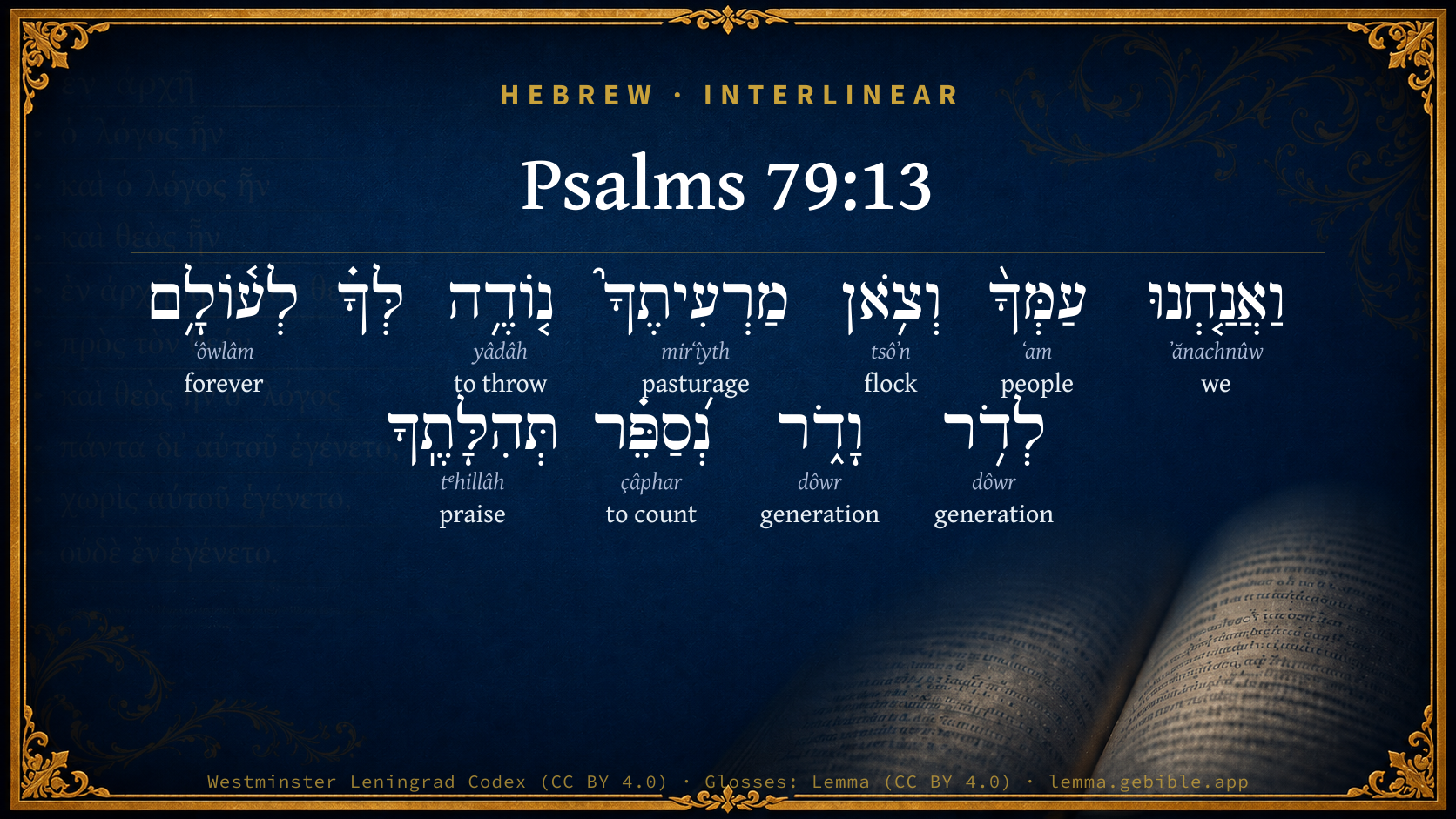
Hebrew (Westminster Leningrad Codex) Psalms 79:13 appears in the Hebrew Old Testament. The text above is from the Westminster Leningrad Codex. Each word links to its Strong’s number, a concise gloss, and parsing drawn from the Open Scriptures Hebrew Bible morphology. Click any word for its full Brown-Driver-Briggs (BDB) entry.
Download image
Cite this verse

Psalms 79:13 (World English Bible). Public Domain. Lemma interlinear Bible study tool, https://lemma.gebible.app/v/psalms/79/13.

Show BibTeX & RIS
BibTeX
RIS
English Translation
So we, your people and sheep of your pasture, Will give you thanks forever. We will praise you forever, to all generations.
World English Bible · Public Domain
Download a study sheet

One document with this verse’s original text, its word-by-word gloss line, the meaning frame, cross-references with their text, attributed commentary, and full source and license credits — printable, and it pastes into notes with its structure intact.

This verse Autodidact and up

Study sheet (.html) Plain text (.txt)

A passage Seminary Student

Up to 50 verses in one chapter. A passage sheet keeps up to 6 commentary sources and 12 cross-references per verse, in the order this page ranks them, and says so on the sheet whenever that leaves anything out. Ask for a single verse and you get the Autodidact verse sheet above.

Everything on this page stays free to read, with no account — the sheet is a download of what is already on screen, not access to it.

Want to remove ads? Support Godless Engineer
Compare translations 3

The same verse in 3 English versions, stacked beneath the original-language interlinear above. Click any original word for its lexicon entry.

Each is an independent rendering of the whole verse — the interlinear is not word-aligned to these translations.

Highlighted words mark where these versions differ — a whole-verse word diff, not a word-by-word alignment.

  • World English Bible Public Domain
    So we, your people and sheep of your pasture, Will give you thanks forever. We will praise you forever, to all generations.
  • King James Version Public Domain
    So we thy people and sheep of thy pasture will give thee thanks for ever: we will shew forth thy praise to all generations.
  • unfoldingWord Literal Text CC BY-SA 4.0
    And we, your people and the flock of your pasture, will give thanks to you forever; to generation and generation we will recount your praise.

unfoldingWord Literal Text — © unfoldingWord, licensed CC BY-SA 4.0. Word-aligned USFM3 via Door43 (git.door43.org/unfoldingWord/en_ult).

Versions to compare (up to 4)

3 of 4 selected

Show all 18 translations

Every available English version of this verse, each an independent rendering of the whole verse.

  • World English Bible Public Domain
    So we, your people and sheep of your pasture, Will give you thanks forever. We will praise you forever, to all generations.
  • Berean Standard Bible Public Domain
    Then we Your people, the sheep of Your pasture, will thank You forever; from generation to generation we will declare Your praise.
  • Majority Standard Bible Public Domain
    Then we Your people, the sheep of Your pasture, will thank You forever; from generation to generation we will declare Your praise.
  • King James Version Public Domain
    So we thy people and sheep of thy pasture will give thee thanks for ever: we will shew forth thy praise to all generations.
  • American Standard Version (1901) Public Domain
    So we thy people and sheep of thy pasture Will give thee thanks for ever: We will show forth thy praise to all generations. Psalm 80 For the Chief Musician, set to Shoshanim Eduth.. A Psalm of Asaph.
  • Revised Version (1885) Public Domain
    So we thy people and sheep of thy pasture will give thee thanks for ever: we will shew forth thy praise to all generations.
  • Geneva Bible (1599) Public Domain
    So wee thy people, and sheepe of thy pasture shall praise thee for euer: and from generation to generation we will set foorth thy praise.
  • Douay-Rheims (1899) Public Domain
    But we thy people, and the sheep of thy pasture, will give thanks to thee for ever. We will shew forth thy praise, unto generation and generation.
  • Young's Literal Translation Public Domain
    And we, Thy people, and the flock of Thy pasture, We give thanks to Thee to the age, To all generations we recount Thy praise!
  • Literal Standard Version CC BY-SA 4.0
    And we, Your people, and the flock of Your pasture, || We give thanks to You for all time, || We recount Your praise from generation to generation!
  • Unlocked Literal Bible CC BY-SA 4.0
    So we your people and sheep of your pasture will give you thanks forever. We will tell your praises to all generations.
  • unfoldingWord Literal Text CC BY-SA 4.0
    And we, your people and the flock of your pasture, will give thanks to you forever; to generation and generation we will recount your praise.
  • Darby Bible Public Domain
    And we, thy people and the sheep of thy pasture, will give thanks unto thee for ever; we will shew forth thy praise from generation to generation.
  • World Messianic Bible Public Domain
    So we, your people and sheep of your pasture, will give you thanks forever. We will praise you forever, to all generations.
  • Webster's Bible Public Domain
    So we thy people and sheep of thy pasture will give thee thanks for ever: we will show forth thy praise to all generations.
  • Free Bible Version CC BY-SA 4.0
    Then we your people, the flock of your pasture, will praise you forever. We will thank you for all generations to come.
  • Bible in Basic English Public Domain
    So we your people, and the sheep of your flock, will give you glory for ever: we will go on praising you through all generations.
  • JPS Tanakh (1917) Public Domain
    So we that are Thy people and the flock of Thy pasture will give Thee thanks for ever; we will tell of Thy praise to all generations.

Literal Standard Version (2020), Covenant Press — licensed CC BY-SA 4.0. Text via the HelloAO Bible API (eBible.org). Unlocked Literal Bible (unfoldingWord) — licensed CC BY-SA 4.0. Text via the HelloAO Bible API (eBible.org). unfoldingWord Literal Text — © unfoldingWord, licensed CC BY-SA 4.0. Word-aligned USFM3 via Door43 (git.door43.org/unfoldingWord/en_ult). Free Bible Version, Dr. Jonathan Gallagher — licensed CC BY-SA 4.0. Text via the HelloAO Bible API (eBible.org).

Word by word

More ways to search: Search by grammar → Find every occurrence → Compare this word →

Practice this passage: Drill this verse → Learn its vocabulary →

מַרְעִיתֶךָ֮
mirʻîyth
H4830
“pasturage · your”
Noun, Common, Feminine, Singular, Construct + Suffix, Personal, 2nd Person, Masculine, Singular
Part of Speech
Noun
Type
Common
Gender
Feminine
Number
Singular
State
Construct
Full BDB Definition

Origin: from H7462 in the sense of feeding

TWOT: 2185c

pasturing, pasturage, shepherding - pasturing, shepherding - pasturage - flock (metonymy)
  1. וַאֲנַ֤חְנוּ ʼănachnûw H587 “and · we” Conjunction + Pronoun, Personal, 1st Person, Common, Plural
  2. עַמְּךָ֨ ʻam H5971 “people · your” Noun, Common, Masculine, Singular, Construct + Suffix, Personal, 2nd Person, Masculine, Singular
  3. וְצֹ֥אן tsôʼn H6629 “and · flock of” Conjunction + Noun, Common, Both, Singular, Construct
  4. נ֤וֹדֶ֥ה yâdâh H3034 “to throw” Verb, Hiphil, Imperfect, 1st Person, Common, Plural
  5. לְע֫וֹלָ֥ם ʻôwlâm H5769 “to/for · forever” Preposition + Noun, Common, Masculine, Singular, Absolute
  6. לְדֹ֥ר dôwr H1755 “to/for · generation” Preposition + Noun, Common, Masculine, Singular, Absolute
  7. וָדֹ֑ר dôwr H1755 “and · generation” Conjunction + Noun, Common, Masculine, Singular, Absolute
  8. נְ֝סַפֵּ֗ר çâphar H5608 “to count” Verb, Piel, Imperfect, 1st Person, Common, Plural
  9. תְּהִלָּתֶֽךָ tᵉhillâh H8416 “praise · your” Noun, Common, Feminine, Singular, Construct + Suffix, Personal, 2nd Person, Masculine, Singular

About this verse

These counts appear in no published source. They are computed here, from the morphology-tagged text and Lemma’s own curated glosses. What Lemma adds →

11
words
9
distinct lemmas
Wisdom
section

Notable vocabulary

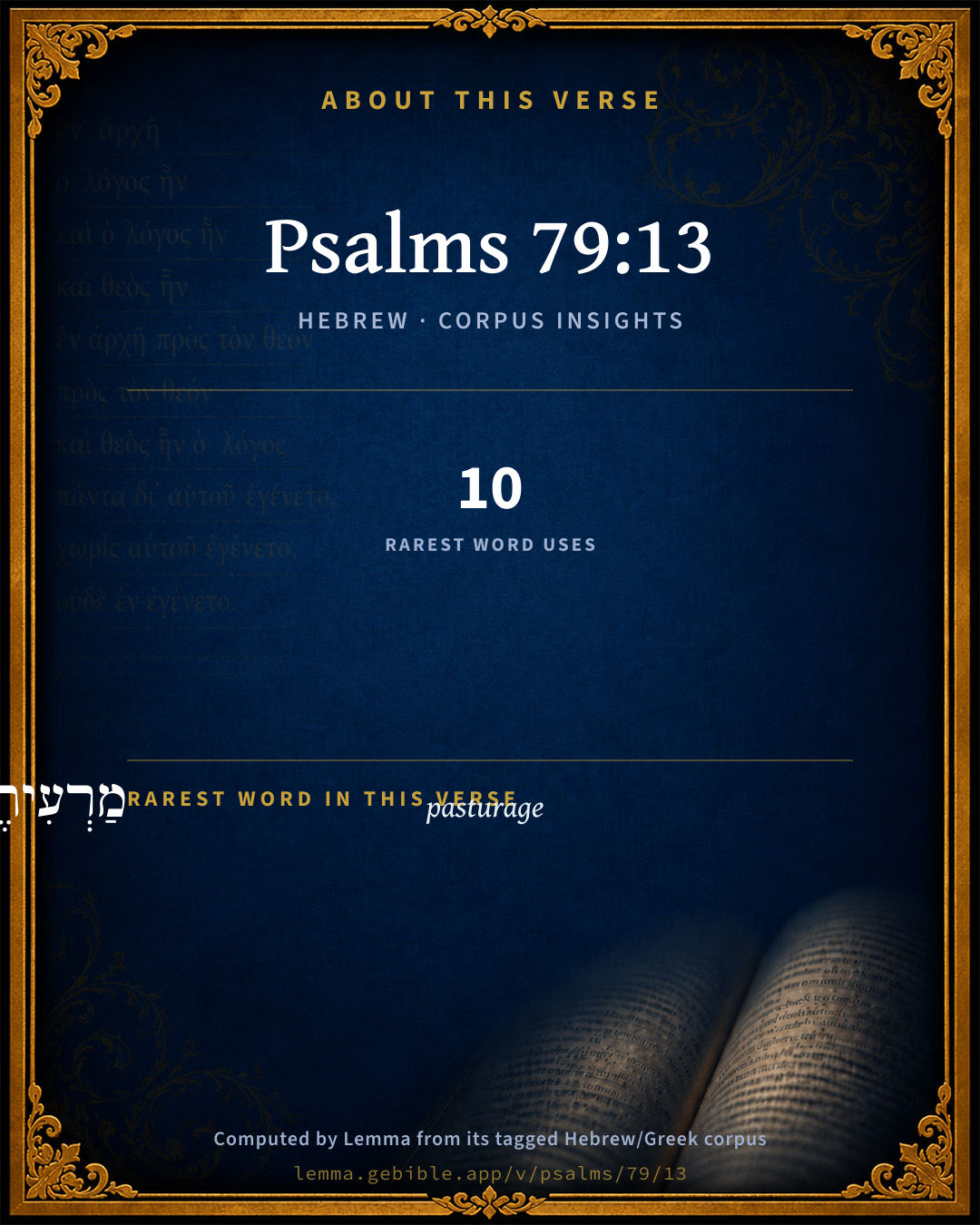
The rarest word here is מַרְעִיתֶךָ֮ pasturage H4830 — appearing just 10 times in the whole Hebrew Bible.

Shared distinctive vocabulary

מַרְעִיתֶךָ֮ pasturage H4830 occurs in 10 verses of the Hebrew Bible. Also found in:

Grammatical profile

  • 2 verbs
  • 7 nouns
  • 1 pronoun
  • 1 preposition

Verb forms

  • נ֤וֹדֶ֥ה Hiphil · Imperfect
  • נְ֝סַפֵּ֗ר Piel · Imperfect

Repetition

A word recurs within this verse — often emphatic in Hebrew:

  • לְדֹ֥ר generation H1755 ×2

Hebrew & Septuagint length

In English translation the verse runs 22 words from the Hebrew and 26 from the Septuagint (LXX English) — closely comparable.

A rough comparison of the two English renderings, which tokenize alike — not a word-level alignment.

Word counts can differ between the Hebrew and the Greek without any difference in meaning — e.g. the Hebrew direct-object marker אֵת has no separate Greek word, and Greek often adds the article ὁ.

Cross-references

9

Topical passages linked to Psalms 79:13 in the Treasury of Scripture Knowledge — connected by theme and wording, ordered by reader-vote popularity; previews shown in the World English Bible.

  • Psalms 95:7 For he is our God. We are the people of his pasture, And the sheep in his care. Today, oh that you would hear his voice!
  • Isaiah 43:21 the people which I formed for myself, that they might set forth my praise.
  • Psalms 74:1 God, why have you rejected us forever? Why does your anger smolder against the sheep of your pasture?
  • Psalms 100:3 Know that Yahweh, he is God. It is he who has made us, and we are his. We are his people, and the sheep of his pasture.
  • Psalms 145:4 One generation will commend your works to another, And will declare your mighty acts.
  • Psalms 44:8 In God we have made our boast all day long, We will give thanks to your name forever. Selah.
  • Psalms 45:17 I will make your name to be remembered in all generations. Therefore the peoples shall give you thanks forever and ever.
  • Psalms 74:18 Remember this, that the enemy has mocked you, Yahweh. Foolish people have blasphemed your name.
  • Psalms 74:22 Arise, God! Plead your own cause. Remember how the foolish man mocks you all day.

Cross-references courtesy of OpenBible.info (CC BY 4.0).

Hebrew and Greek witnesses Masoretic Hebrew ↔ Greek Septuagint

The same verse in the two great witnesses to the Old Testament, shown verse-for-verse.

You’re reading Greek Psalm 78 (Hebrew Psalm 79). The Septuagint counts the superscription, so verse numbers can differ from the Hebrew — chapter-level alignment, not verse-by-verse. Numbering follows Rahlfs.

These are two independent witnesses, not word-aligned to each other, and the Septuagint is shown in lemma (dictionary) form.

Hebrew Psalms 79:13 Masoretic · Westminster Leningrad Codex

וַאֲנַ֤חְנוּ עַמְּךָ֨ וְצֹ֥אן מַרְעִיתֶךָ֮ נ֤וֹדֶ֥ה לְּךָ֗ לְע֫וֹלָ֥ם לְדֹ֥ר וָדֹ֑ר נְ֝סַפֵּ֗ר תְּהִלָּתֶֽךָ

So we, your people and sheep of your pasture, Will give you thanks forever. We will praise you forever, to all generations.

World English Bible · Public Domain

Greek LXX Greek Psalm 78:13 Septuagint · lemma form

ἐγώ δέ λαός σύ καί πρόβατον ὁ νομή σύ ἀντιὁμολογέω σύ εἰς ὁ αἰών εἰς γενεά καί γενεά ἐκἀγγέλλω ὁ αἴνεσις σύ

For we are your people and the sheep of your pasture; we will give you thanks for ever; we will declare your praise throughout all generations.

LXX2012 (modern English Septuagint) · Public Domain

Hebrew: Westminster Leningrad Codex (CC BY 4.0). Greek: Septuagint (public domain); English from LXX2012 (modern English Septuagint) (Public Domain). How the Septuagint differs from the Hebrew →

Commentary

Notes on Psalms 79:13 from classic Christian and Jewish commentators (each source and its license shown beneath its notes). The classic Christian expositions comment on the surrounding passage and are grouped to its opening verse, so a note may address several verses; the Jewish commentaries on the Tanakh (Rashi and others) are per-verse, so they appear only where the commentator wrote on this verse.

Lemma curates 59 commentaries, every one of them public domain or Creative Commons licensed, each selected and text-cleaned for this edition rather than reprinted as found. About our sources →

Adam Clarke's Commentary

Verse 13. We thy people] Whom thou hast chosen from among all the people of the earth.

And sheep of thy pasture] Of whom thou thyself art the Shepherd. Let us not be destroyed by those who are thy enemies; and we, in all our generations, will give thanks unto thee for ever.

ANALYSIS OF THE SEVENTY-NINTH PSALM

This Psalm contains the four following parts: -

I. A complaint for the desolation of Jerusalem, Ps 79:1-5.

II. A deprecation of God's anger, Ps 79:5.

III. A twofold petition: -

1. Against the enemies of God's people, Ps 79:6-7; Ps 79:10-12.

2. For the people, Ps 79:8-9.

IV. A doxology, Ps 79:13.

I. The complaint is bitter, and is amplified by a climax, -

1. "The heathen are come into thine inheritance," Ps 79:1.

2. "The holy temple they have defiled," Ps 79:1.

3. "They have laid Jerusalem in heaps," Ps 79:2.

4. They have exercised cruelty towards the dead.

5. "They have shed blood like water," Ps 79:3.

6. They have not even buried those whom they slaughtered.

7. "We are become a reproach, a scorn, and a derision," Ps 79:4.

II. Next comes the cause of their calamity.

1. God's anger was kindled because of their sins, Ps 79:5.

2. This anger he deprecates, Ps 79:5.

III. The twofold prayer, -

1. Against the enemy: 1. Pour out thy wrath on them, not on us, Ps 79:6; 2. He adds the reason: "They have devoured Jacob." Ps 79:7.

2. The second part of the prayer is in behalf of the people: 1. "Remember not against us former offences," Ps 79:8. 2. "Let thy mercy prevent us." The reasons: "We are brought very low." 3. His prayer is directed for help to the God of salvation. 4. For deliverance and pardon of sin, Ps 79:9.

His arguments to prevail with God: -

1. The blasphemy of the heathen, Ps 79:10.

2. The misery of the people, Ps 79:11. And another prayer against the enemy, Ps 79:12.

IV. The doxology.

1. We, who are thy people, will be thankful.

2. We will leave a record of thy mercy to all generations, Ps 79:13.

Adam Clarke's Commentary on the Bible (1810–1826) — public domain. Text from a community e-Sword/MySword module.

Trapp's Complete Commentary

John Trapp

Psa 79:13 So we thy people and sheep of thy pasture will give thee thanks for ever: we will shew forth thy praise to all generations.

Ver. 13. So we thy people … will give thee praise] A service which the saints know to be so acceptable to God, that they commonly promise it, and accordingly perform it, Hos 14:2, engaging also their children, as here, to do the like.

John Trapp, A Commentary or Exposition upon All the Books of the Old and New Testament (1647–1656) — public domain. Text from a community e-Sword module.

The Biblical Illustrator

Joseph S. Exell

Psa_79:13

We will show forth Thy praise to all generations.

Gods people should speak Gods praise

Dr. Parkhurst says he loves to think that every man is sent into the world with something to tell. That is what makes of any man a prophet, being filled with a story too big for his own soul to house, a story he cannot, dare not, keep to himself. This truth God has given you to utter makes you a witness. You may be a false witness, and no witness is more than he who says nothing; or you may be a true and faithful witness, testifying to the best you know by your face and hands, your smiles and deeds and words. That is a startling thought of Andrew Murrays: God does not ask us to hide Christ away in our impure hearts. Christ gives Himself to us constantly, but in order that we may as constantly give Him to others. Truth is like the water pressed upon the foul garments, that cleanses them if it is forced out again, but rots them all the more if it is allowed to remain. So is the religion that we selfishly cherish unexpressed. Indeed, is there a worse form of selfishness than that? (Amos R. Wells.)

.

Psa_80:1-19

The Biblical Illustrator, edited by Joseph S. Exell (c. 1880s–1900s) — public domain. Text from a community e-Sword module.

Joseph Benson's Commentary

Psa 79:13. So we thy people will give thanks for ever — “Such is the resolution of a church under persecution; and such ought to be the practice of every church when delivered out of it, and restored to the favour and protection of her God. The same is the duty of every soul with regard to afflictions and mercies of a private kind. But how glorious will be the day, when, triumphant over sin and sorrow, over every thing that exalteth itself, the church universal shall behold the adversary disarmed for ever.” When the Lord God, having swallowed up death in victory, will wipe away tears from off all faces, and take away the rebuke of his people from off all the earth: when it shall be said, Lo! this is our God, we have waited for him, and he hath saved us: this is Jehovah; we have waited for him, we will be glad and rejoice in his salvation, Isa 25:8-9.

Joseph Benson's Commentary on the Old and New Testaments (1811–1818) — public domain. Text from a community e-Sword module.

J. A. Alexander on Psalms

Joseph Addison Alexander

13. (Psa 79:13) And we, thy people and flock of thy pasture, will give thanks to thee for ever, to generation and generation will we recount thy praise. Some interpreters needlessly make two distinct propositions, we (are) thy people (and therefore) will give thanks, etc. The flock of thy pasture, that which thou feedest, that of which thou art the shepherd. See above, on Psa 74:1; Psa 78:70-72. For ever, literally to eternity. The following words, though thrown into the first clause by the masoretic interpunction, belong to the second, as appears from the parallel structure of the sentence.

Joseph Addison Alexander, The Psalms Translated and Explained (1850) — public domain. Text from a community e-Sword module.

Geneva Bible (1599)

Geneva Bible translators

We ought to desire no benefit of God, but on this condition to praise his name, Isa. 43:21.

Geneva Bible (1599) marginal notes — public domain. Text via Bolls.life.

John Calvin's Commentaries

In the last verse, the pious Jews declare that the fruit of their deliverance will be, that the name of God will be celebrated; and we ought not to desire our preservation or welfare for any other end. When he freely bestows upon us all things, the design for which he does this is, that his goodness may be made known and exalted. Now, these sufferers engage to make a grateful acknowledgement of their deliverance, and declare that this will not be done merely for a short time, but that the remembrance of it will be transmitted to their posterity, and pass, in continued succession, from age to age to the end of the world. The particular designation here given to them is also worthy of notice: We are thy people, and the sheep of thy pasture As the posterity of Abraham were chosen to celebrate the name of God, and that his praises might resound in Zion, what would have been the consequence had that people been destroyed, but that the memory of the name of God would have perished? This passage, there is no doubt, corresponds with that prophecy of Isaiah,

“This people have I formed for myself; they shall show forth my praise.” (Isaiah 43:21)

John Calvin's Commentaries (1540-1563) — public domain. Text from the Calvin Translation Society English edition (1840s-50s) via the Christian Classics Ethereal Library (ccel.org). Calvin's coverage is partial (roughly two-thirds of the Bible); uncommented books and verses are honest gaps, never fabricated. The 19th-century editor's footnotes and remarks are omitted so the notes are faithfully Calvin's own voice.

Ellicott's Commentary for English Readers

(13) “The last word of the psalm is Tehillah; the one crowning privilege of God’s people; the exulting and triumphant confidence in God, which only His chosen can entertain and express. It is here placed in splendid contrast with the reproach of the heathen, and of the malicious neighbours mentioned in the preceding verse. Let them curse so long as thou dost bless (Burgess, Notes on the Hebrew Psalms).

A Bible Commentary for English Readers, edited by Charles John Ellicott (1878–1897) — public domain. Text from a community e-Sword module.

The Cambridge Bible for Schools and Colleges

gen. ed. J. J. S. Perowne

13. Concluding vow of thanksgiving. Israel will then be able to render its tribute of unceasing praise to its Lord and Shepherd.

sheep of thy pasture] Cp. Psa_74:1, note; Psa_80:1.

thy praise] Cp. Psa_74:21; Psa_78:4. To set forth Jehovah’s praise was Israel’s mission, Isa_43:21.

The Cambridge Bible for Schools and Colleges (gen. ed. J. J. S. Perowne; Cambridge University Press, 1878–1918) — public domain. Text from a community e-Sword module.

John Gill's Exposition

So we thy people, and sheep of thy pasture,.... Who were the people of God, not by creation and providence only, as all men are, being his creatures, and provided for by him; but by special choice, and by covenant grace: and "the sheep of his pasture"; whom he feeds as a shepherd does his flock, provides good pasture for them, and leads them into it:

will give thee thanks for ever, we will show forth thy praise to all generations: the above petitions being answered and fulfilled; the work of praise is acceptable unto God, what he is well pleased with, being glorified thereby; and is what becomes his people to do, and which they are formed for, and that for evermore, as long as they live in this world, and to all eternity in another; and who will and do take care that the wonders of divine grace and providence be transmitted and told to their posterity in succeeding ages, that so thanks may be given him, and his praise shown forth in one generation after another.

Next: Psalms Chapter 80

John Gill's Exposition of the Whole Bible (1746–1763) — public domain (CC PDM 1.0). Text via the HelloAO Bible API.

Albert Barnes' Notes on the Bible

So we thy people, and sheep of thy pasture - See the notes at Psa 74:1.

Will give thee thanks for ever - Will praise thee always; will acknowledge thee as our God, and will evermore render thee thanksgiving.

We will shew forth thy praise to all generations - Margin, as in Hebrew, to generation and generation. That is, We will make arrangements that the memory of these gracious acts shall be transmitted to future times; to distant generations. This was done by the permanent record, made in the Scriptures, of these gracious interpositions of God, and by their being carefully preserved by each generation to whom they came. No work has been more faithfully done than that by which the records of God’s ancient dealings with his people have been preserved from age to age - that by which the sacred Scriptures have been guarded against error, and handed down from one generation to another.

Albert Barnes' Notes on the Bible (1834–1885) — public domain. Text from a community e-Sword/MySword module.

The Pulpit Commentary

So we thy people and sheep of thy pasture. (see Psa_74:1; and comp. Psa_78:52) Will give thee thanks forever. When thou hast punished our enemies, and delivered us, we will give thee thanks perpetually, and show forth thy praise to all generations. An instance of identical parallelism.

Divine relationships our best plea in prayer.

"We thy people and sheep of thy pasture." This verse gives a gleam of hope and confidence at the end of the long cry of anguish. Compare a New Testament cry, "Though we believe not, yet he abideth faithful; he cannot deny himself." Illustrate by our Lord"s distress on the cross. In extreme anguish, he yet could say, My God, my God!" We may set in order three possible pleas which we are permitted to use in prayer.

(1) Our needs;

(2) God"s Name;

(3) God"s relations.

He must be consistent with himself.

I OUR NEEDS. This may seem the most persuasive plea from our point of view. It is, indeed, our best plea in asking from our fellow men. With them we must make out a clear case of need. And God graciously allows it to be our plea with him. But in our family life we know that the children"s wanting a thing is not a sufficient reason for giving it to them; because their wants and desires are not necessarily their real needs. There are some considerations on which their needs must be estimated. True, we ought to speak quite freely our thoughts about our needs when we draw near to God; and it is equally true that a Divine and gracious consideration of our needs guides the Divine decisions and the Divine doings; but we must not think of this as the supreme persuasion with God.

II GOD"S NAME. In the Old Testament it is impressively presented to us that the supreme motive urging God is jealousy of his own Divine Name.

All good for man is bound up in keeping the honour of the Divine Name. Man has no anchorage for his trust and hope if God be not infinitely good. For our sakes he must do nothing, give nothing, withhold nothing, if these things imperil his Name, make us question his Divine integrity. Ezekiel is the prophet who puts this point most forcibly. "Thus saith the Lord God, I do not this for your sakes, O house of Israel, but for mine holy Name"s sake". (Eze_36:22) Apply to God"s Name as the Almighty One, the All-holy One, the All-saving One. There must always be consistency between the Divine doings and the Divine Name. Good men, like Joshua, are jealous of the Divine Name.

III GOD"S RELATIONS. Not what he abstractly is, but what he relatively is to us. God has been pleased to come into relations with us; to set himself in relations. He has therefore limited himself, conditioned himself, placed himself under honourable obligations. And so our supreme plea in prayer has come to be, reminding God of the honourable obligations involved in his relationships to us. We may be sure of this he must be true to himself. This may be fully opened out in connection with the most blessed relationship of Fatherhood. R.T.

The Pulpit Commentary (1880–1919), ed. H.D.M. Spence-Jones & Joseph S. Exell — public domain. Text from a community e-Sword module.

Keil & Delitzsch

C. F. Keil & F. Delitzsch

If we have thus far correctly hit upon the parts of which the Psalm is composed (9. 9. 9), then the lamentation closes with this tristichic vow of thanksgiving.

Keil & Delitzsch — Biblical Commentary on the Old Testament (1861–1891) — public domain (CC PDM 1.0). Text via the HelloAO Bible API. (Old Testament only.)

Lesson kit

Teaching starters — assembled from the data on this page, not authored interpretation. Every prompt links to the verse data it draws on. Edit before teaching.

Psalms, in the Wisdom, opens this verse with 11 words (9 distinct Hebrew lemmas). Its most distinctive word is mirʻîyth (“pasturage”). A historical commentator’s framing appears above. Read the whole chapter for the surrounding context.

Discussion questions

  1. What does “pasturage” (mirʻîyth) contribute to the verse as a whole?
  2. Psalms 74:1 shares the word «pasturage» with this verse. How do the two illuminate each other?
  3. “generation” occurs 2× in this one verse. What is the effect of the repetition?
  4. These translations render this verse differently; the difference is in the English rendering, not the original. What questions does that raise?
  5. The verb «נ֤וֹדֶ֥ה» is Hiphil Imperfect. How does its form color the action?
  6. Reading how Adam Clarke's Commentary and Trapp's Complete Commentary read this verse, where do the two commentators agree and where do they part?

Things to notice

  • These translations choose different wording for 11 words in this verse.
  • “generation” occurs 2× in this single verse.
  • 9 distinct Hebrew lemmas span 11 words in this verse.

Reading settings

Reading text

Shown beneath each verse's original-language words.

Old Testament
Old Testament edition

Read the OT as the Masoretic Hebrew (MT) or the Greek Septuagint (LXX).

English shown for the Greek Septuagint (in the Hebrew ↔ Greek comparison).

Comparing translations? Open the Compare panel on any verse page to stack up to four side by side.