
1 Kings 1:19

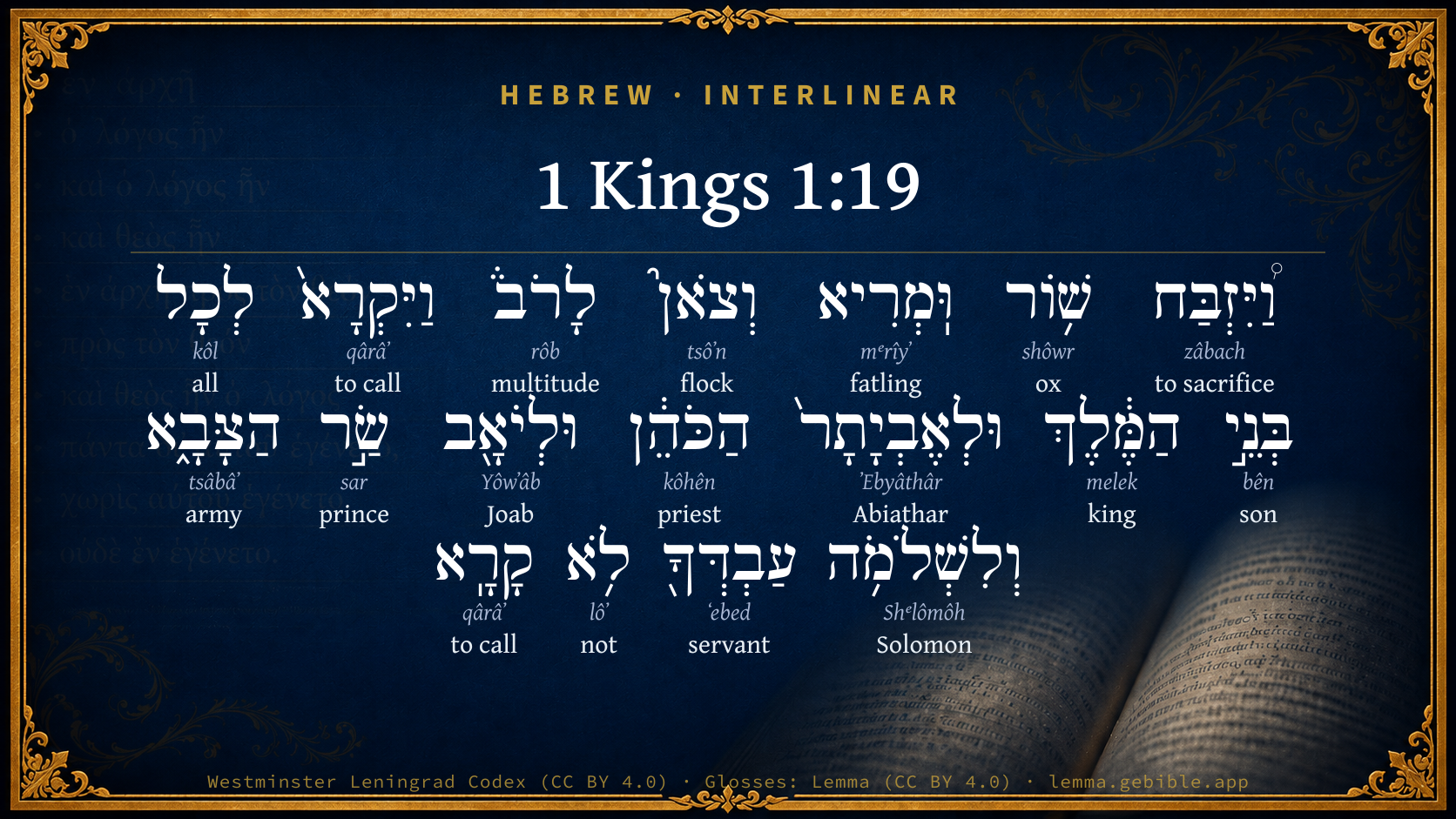
Hebrew (Westminster Leningrad Codex) 1 Kings 1:19 appears in the Hebrew Old Testament. The text above is from the Westminster Leningrad Codex. Each word links to its Strong’s number, a concise gloss, and parsing drawn from the Open Scriptures Hebrew Bible morphology. Click any word for its full Brown-Driver-Briggs (BDB) entry.
Download image
Cite this verse

1 Kings 1:19 (World English Bible). Public Domain. Lemma interlinear Bible study tool, https://lemma.gebible.app/v/1-kings/1/19.

Show BibTeX & RIS
BibTeX
RIS
English Translation
and he has slain oxen and fatlings and sheep in abundance, and has called all the sons of the king, and Abiathar the priest, and Joab the captain of the host; but he hasn't called Solomon your servant.
World English Bible · Public Domain
Download a study sheet

One document with this verse’s original text, its word-by-word gloss line, the meaning frame, cross-references with their text, attributed commentary, and full source and license credits — printable, and it pastes into notes with its structure intact.

This verse Autodidact and up

Study sheet (.html) Plain text (.txt)

A passage Seminary Student

Up to 50 verses in one chapter. A passage sheet keeps up to 6 commentary sources and 12 cross-references per verse, in the order this page ranks them, and says so on the sheet whenever that leaves anything out. Ask for a single verse and you get the Autodidact verse sheet above.

Everything on this page stays free to read, with no account — the sheet is a download of what is already on screen, not access to it.

Want to remove ads? Support Godless Engineer
Compare translations 3

The same verse in 3 English versions, stacked beneath the original-language interlinear above. Click any original word for its lexicon entry.

Each is an independent rendering of the whole verse — the interlinear is not word-aligned to these translations.

Highlighted words mark where these versions differ — a whole-verse word diff, not a word-by-word alignment.

  • World English Bible Public Domain
    and he has slain oxen and fatlings and sheep in abundance, and has called all the sons of the king, and Abiathar the priest, and Joab the captain of the host; but he hasn't called Solomon your servant.
  • King James Version Public Domain
    And he hath slain oxen and fat cattle and sheep in abundance, and hath called all the sons of the king, and Abiathar the priest, and Joab the captain of the host: but Solomon thy servant hath he not called.
  • unfoldingWord Literal Text CC BY-SA 4.0
    And he has sacrificed ox and fatling and sheep to abundance, and he has called to all of the sons of the king and to Abiathar the priest and to Joab the commander of the army, but to Solomon your servant he has not called.

unfoldingWord Literal Text — © unfoldingWord, licensed CC BY-SA 4.0. Word-aligned USFM3 via Door43 (git.door43.org/unfoldingWord/en_ult).

Versions to compare (up to 4)

3 of 4 selected

Show all 18 translations

Every available English version of this verse, each an independent rendering of the whole verse.

  • World English Bible Public Domain
    and he has slain oxen and fatlings and sheep in abundance, and has called all the sons of the king, and Abiathar the priest, and Joab the captain of the host; but he hasn't called Solomon your servant.
  • Berean Standard Bible Public Domain
    And he has sacrificed an abundance of oxen, fattened calves, and sheep, and has invited all the other sons of the king, as well as Abiathar the priest and Joab the commander of the army. But he did not invite your servant Solomon.
  • Majority Standard Bible Public Domain
    And he has sacrificed an abundance of oxen, fattened calves, and sheep, and has invited all the other sons of the king, as well as Abiathar the priest and Joab the commander of the army. But he has not invited your servant Solomon.
  • King James Version Public Domain
    And he hath slain oxen and fat cattle and sheep in abundance, and hath called all the sons of the king, and Abiathar the priest, and Joab the captain of the host: but Solomon thy servant hath he not called.
  • American Standard Version (1901) Public Domain
    and he hath slain oxen and fatlings and sheep in abundance, and hath called all the sons of the king, and Abiathar the priest, and Joab the captain of the host; but Solomon thy servant hath he not called.
  • Revised Version (1885) Public Domain
    and he hath slain oxen and fatlings and sheep in abundance, and hath called all the sons of the king, and Abiathar the priest, and Joab the captain of the host: but Solomon thy servant hath he not called.
  • Geneva Bible (1599) Public Domain
    And he hath offred many oxen, and fatte cattel, and sheepe, and hath called all the sonnes of the King, and Abiathar the Priest, and Ioab the captaine of the hoste: but Salomon thy seruant hath he not bidden.
  • Douay-Rheims (1899) Public Domain
    He hath killed oxen, and all fat cattle, and many rams, and invited all the king's sons, and Abiathar the priest, and Joab the general of the army: but Solomon thy servant he invited not.
  • Young's Literal Translation Public Domain
    and he sacrificeth ox, and fatling, and sheep in abundance, and calleth for all the sons of the king, and for Abiathar the priest, and for Joab head of the host -- and for Solomon thy servant he hath not called.
  • Literal Standard Version CC BY-SA 4.0
    and he sacrifices ox, and fatling, and sheep in abundance, and calls for all the sons of the king, and for Abiathar the priest, and for Joab head of the host—and he has not called for your servant Solomon.
  • Unlocked Literal Bible CC BY-SA 4.0
    He has sacrificed oxen, fatted calves, and sheep in abundance, and has invited all the sons of the king, Abiathar the priest, and Joab the captain of the army, but he has not invited Solomon your servant.
  • unfoldingWord Literal Text CC BY-SA 4.0
    And he has sacrificed ox and fatling and sheep to abundance, and he has called to all of the sons of the king and to Abiathar the priest and to Joab the commander of the army, but to Solomon your servant he has not called.
  • Darby Bible Public Domain
    And he has sacrificed oxen and fatted cattle and sheep in abundance, and has invited all the sons of the king and Abiathar the priest and Joab the captain of the host; but Solomon thy servant has he not invited.
  • World Messianic Bible Public Domain
    He has slain cattle and fatlings and sheep in abundance, and has called all the sons of the king, Abiathar the priest, and Joab the captain of the army; but he hasn’t called Solomon your servant.
  • Webster's Bible Public Domain
    And he hath slain oxen, and fat cattle, and sheep in abundance, and hath called all the sons of the king, and Abiathar the priest, and Joab the captain of the host: but Solomon thy servant hath he not called.
  • Free Bible Version CC BY-SA 4.0
    He has sacrificed plenty of cattle, fattened calves, and sheep, and he has invited all the king's sons, Abiathar the priest, and Joab the army commander. But he didn't invite your servant Solomon.
  • Bible in Basic English Public Domain
    And has put to death oxen and fat beasts and sheep in great numbers, and has sent for all the sons of the king, and Abiathar the priest, and Joab, the captain of the army; but he has not sent for Solomon your servant.
  • JPS Tanakh (1917) Public Domain
    And he hath slain oxen and fatlings and sheep in abundance, and hath called all the sons of the king, and Abiathar, the priest, and Joab the captain of the host; but Solomon thy servant hath he not called.

Literal Standard Version (2020), Covenant Press — licensed CC BY-SA 4.0. Text via the HelloAO Bible API (eBible.org). Unlocked Literal Bible (unfoldingWord) — licensed CC BY-SA 4.0. Text via the HelloAO Bible API (eBible.org). unfoldingWord Literal Text — © unfoldingWord, licensed CC BY-SA 4.0. Word-aligned USFM3 via Door43 (git.door43.org/unfoldingWord/en_ult). Free Bible Version, Dr. Jonathan Gallagher — licensed CC BY-SA 4.0. Text via the HelloAO Bible API (eBible.org).

Word by word

More ways to search: Search by grammar → Find every occurrence → Compare this word →

Practice this passage: Drill this verse → Learn its vocabulary →

וּֽמְרִיא
mᵉrîyʼ
H4806
“and · fatling”
Conjunction + Noun, Common, Masculine, Singular, Absolute
Part of Speech
Conjunction + Noun
Type
Common
Gender
Masculine
Number
Singular
State
Absolute
Full BDB Definition

Origin: from H4754 in the sense of grossness, through the idea of domineering (compare H4756 )

TWOT: 1239a

well-fed, fatling
  1. וַ֠יִּזְבַּח zâbach H2076 “and · to sacrifice” Conjunction + Verb, Qal, Sequential Imperfect, 3rd Person, Masculine, Singular
  2. שׁ֥וֹר shôwr H7794 “ox” Noun, Common, Masculine, Singular, Absolute
  3. וְצֹאן֮ tsôʼn H6629 “and · flock” Conjunction + Noun, Common, Both, Singular, Absolute
  4. לָרֹב֒ rôb H7230 “to/for · multitude” Preposition + Noun, Common, Both, Singular, Absolute
  5. וַיִּקְרָא֙ qârâʼ H7121 “and · to call” Conjunction + Verb, Qal, Sequential Imperfect, 3rd Person, Masculine, Singular
  6. לְכָל kôl H3605 “to/for · all of” Preposition + Noun, Common, Masculine, Singular, Construct
  7. בְּנֵ֣י bên H1121 “sons of” Noun, Common, Masculine, Plural, Construct
  8. הַמֶּ֔לֶךְ melek H4428 “the · king” Particle, Definite Article + Noun, Common, Masculine, Singular, Absolute
  9. וּלְאֶבְיָתָר֙ ʼEbyâthâr H54 “and · to/for · Abiathar” Conjunction + Preposition + Noun, Proper
  10. הַכֹּהֵ֔ן kôhên H3548 “the · priest” Particle, Definite Article + Noun, Common, Masculine, Singular, Absolute
  11. וּלְיֹאָ֖ב Yôwʼâb H3097 “and · to/for · Joab” Conjunction + Preposition + Noun, Proper
  12. שַׂ֣ר sar H8269 “prince of” Noun, Common, Masculine, Singular, Construct
  13. הַצָּבָ֑א tsâbâʼ H6635 “the · army” Particle, Definite Article + Noun, Common, Both, Singular, Absolute
  14. וְלִשְׁלֹמֹ֥ה Shᵉlômôh H8010 “and · to/for · Solomon” Conjunction + Preposition + Noun, Proper
  15. עַבְדְּךָ֖ ʻebed H5650 “servant · your” Noun, Common, Masculine, Singular, Construct + Suffix, Personal, 2nd Person, Masculine, Singular
  16. לֹ֥א lôʼ H3808 “not” Particle, Negative
  17. קָרָֽא qârâʼ H7121 “to call” Verb, Qal, Perfect, 3rd Person, Masculine, Singular

About this verse

These counts appear in no published source. They are computed here, from the morphology-tagged text and Lemma’s own curated glosses. What Lemma adds →

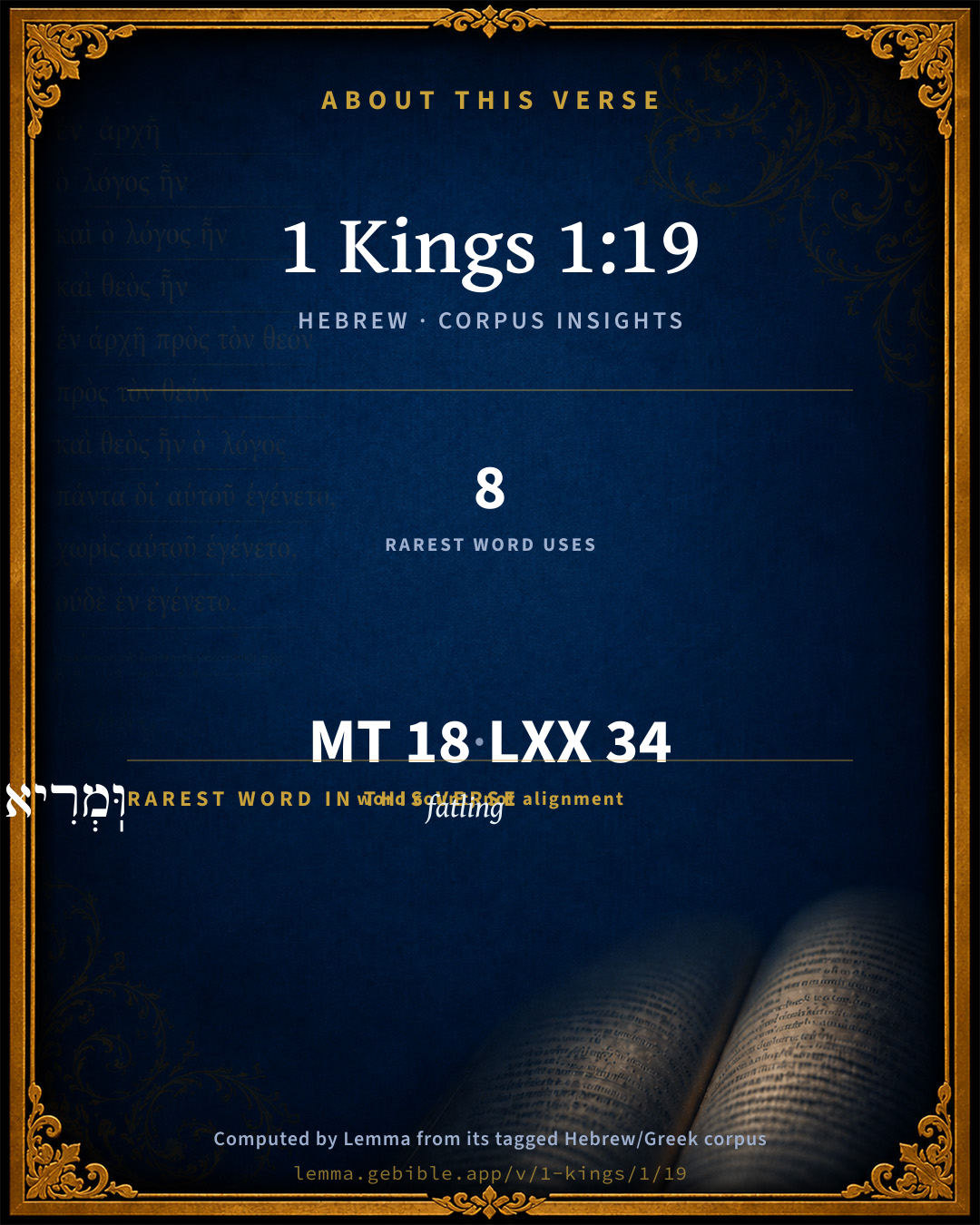
18
words
17
distinct lemmas
Historical
section

Notable vocabulary

The rarest word here is וּֽמְרִיא fatling H4806 — appearing just 8 times in the whole Hebrew Bible.

Shared distinctive vocabulary

וּֽמְרִיא fatling H4806 occurs in 8 verses of the Hebrew Bible. Also found in:

Grammatical profile

  • 3 verbs
  • 14 nouns
  • 1 particle

Verb forms

  • וַ֠יִּזְבַּח Qal · Sequential Imperfect
  • וַיִּקְרָא֙ Qal · Sequential Imperfect
  • קָרָֽא Qal · Perfect

Repetition

A word recurs within this verse — often emphatic in Hebrew:

  • וַיִּקְרָא֙ to call H7121 ×2

Hebrew & Septuagint length

In English translation the verse runs 38 words from the Hebrew and 37 from the Septuagint (LXX English) — closely comparable.

A rough comparison of the two English renderings, which tokenize alike — not a word-level alignment.

Word counts can differ between the Hebrew and the Greek without any difference in meaning — e.g. the Hebrew direct-object marker אֵת has no separate Greek word, and Greek often adds the article ὁ.

In the original languages it is 18 Hebrew tokens and 34 Greek tokens — but the two are counted differently (Hebrew bundles its prefixes and suffixes into one token; the Greek is in lemma form), so that isn’t a like-for-like length.

Cross-references

2

Topical passages linked to 1 Kings 1:19 in the Treasury of Scripture Knowledge — connected by theme and wording, ordered by reader-vote popularity; previews shown in the World English Bible.

  • 1 Kings 1:7–10 He conferred with Joab the son of Zeruiah, and with Abiathar the priest: and they following Adonijah helped him.
  • 1 Kings 1:25 For he is gone down this day, and has slain oxen and fatlings and sheep in abundance, and has called all the king's sons, and the captains of the host, and Abiathar the priest; and, behold, they are eating and drinking before him, and say, [Long] live king Adonijah.

Cross-references courtesy of OpenBible.info (CC BY 4.0).

Hebrew and Greek witnesses Masoretic Hebrew ↔ Greek Septuagint

The same verse in the two great witnesses to the Old Testament, shown verse-for-verse.

These are two independent witnesses, not word-aligned to each other, and the Septuagint is shown in lemma (dictionary) form.

Hebrew 1 Kings 1:19 Masoretic · Westminster Leningrad Codex

וַ֠יִּזְבַּח שׁ֥וֹר וּֽמְרִיא וְצֹאן֮ לָרֹב֒ וַיִּקְרָא֙ לְכָל בְּנֵ֣י הַמֶּ֔לֶךְ וּלְאֶבְיָתָר֙ הַכֹּהֵ֔ן וּלְיֹאָ֖ב שַׂ֣ר הַצָּבָ֑א וְלִשְׁלֹמֹ֥ה עַבְדְּךָ֖ לֹ֥א קָרָֽא

and he has slain oxen and fatlings and sheep in abundance, and has called all the sons of the king, and Abiathar the priest, and Joab the captain of the host; but he hasn't called Solomon your servant.

World English Bible · Public Domain

Greek LXX 1 Kings 1:19 Septuagint · lemma form

καί θυσιάζω μόσχος καί ἀρνός καί πρόβατον εἰς πλῆθος καί καλέω πᾶς ὁ υἱός ὁ βασιλεύς καί αβιαθαρ ὁ ἱερεύς καί ιωαβ ὁ ἄρχων ὁ δύναμις καί ὁ σαλωμών ὁ δοῦλος σύ οὐ καλέω

And he has sacrificed calves and lambs and sheep in abundance, and has called all the king's sons, and Abiathar the priest and Joab the commander-in-chief of the host; but Solomon your servant he has not called.

LXX2012 (modern English Septuagint) · Public Domain

Hebrew: Westminster Leningrad Codex (CC BY 4.0). Greek: Septuagint (public domain); English from LXX2012 (modern English Septuagint) (Public Domain). How the Septuagint differs from the Hebrew →

Targum (Aramaic paraphrase)

1

The Targum is the ancient Jewish Aramaic paraphrase of the Hebrew Scriptures — an interpretive translation, not the Hebrew text itself. Onkelos (literal) and Pseudo-Jonathan (expansive) render the Torah, and Jonathan the Prophets. Coverage is partial: where no permissively-licensed English translation exists for a verse, only the Aramaic is shown. This is verse-level text, not a word-by-word alignment to the Hebrew.

  1. Targum Jonathan Prophets (Joshua–Malachi)
    וּנְכֵיס תּוֹרִין וּפַטִימִין וְעָאן לִסְגֵי וְזַמִין לְכָל בְנֵי מַלְכָּא וּלְאֶבְיָתָר כַּהֲנָא וּלְיוֹאָב רַב חֵילָא וְלִשְׁלֹמֹה עַבְדָךְ לָא זַמִין:

    (no public-domain English translation for this verse)

    Targum Jonathan — Aramaic: “Mikraot Gedolot” (public domain). English: “Sefaria Community Translation” (CC0 1.0 (public-domain dedication)); “London "Chaldee Paraphrase," 1871” (public domain). Text via Sefaria.

Commentary

Notes on 1 Kings 1:19 from classic Christian and Jewish commentators (each source and its license shown beneath its notes). The classic Christian expositions comment on the surrounding passage and are grouped to its opening verse, so a note may address several verses; the Jewish commentaries on the Tanakh (Rashi and others) are per-verse, so they appear only where the commentator wrote on this verse.

Lemma curates 59 commentaries, every one of them public domain or Creative Commons licensed, each selected and text-cleaned for this edition rather than reprinted as found. About our sources →

Trapp's Complete Commentary

John Trapp

1Ki 1:19 And he hath slain oxen and fat cattle and sheep in abundance, and hath called all the sons of the king, and Abiathar the priest, and Joab the captain of the host: but Solomon thy servant hath he not called.

Ver. 19. But Solomon thy servant.] Not thy sovereign, as Adonijah affecteth to be. See on 1Ki 1:9-10.

John Trapp, A Commentary or Exposition upon All the Books of the Old and New Testament (1647–1656) — public domain. Text from a community e-Sword module.

Joseph Benson's Commentary

1Ki 1:19-20. Solomon thy servant — She speaks very submissively, and calls herself his handmaid, and her son his servant. The eyes of all Israel are upon thee — This she said that she might free him from all fear of such a rebellion as Absalom raised; the people not being yet joined to Adonijah, but continuing in suspense till the king had declared his mind about his successor.

Joseph Benson's Commentary on the Old and New Testaments (1811–1818) — public domain. Text from a community e-Sword module.

John Gill's Exposition

And he hath slain oxen, and fat cattle, and sheep in abundance,.... Has made a grand entertainment, and is feasting and rejoicing; which was another instance of irreverence and disrespect to his aged father, labouring under the infirmities of old age, and on his dying bed, and he carousing, and showing all the tokens of pleasure in the view of his death, and wishing for it:

and hath called all the sons of the king; invited them to his entertainment, in order to gain them to his interest:

and Abiathar the priest, and Joab the captain of the host; two persons, though of eminent rank, she knew David had no respect for, and therefore it would not be pleasing to him to hear that they were invited, had this affair been more acceptable than it was; Bathsheba, considering the shortness of the time she had to think, and the flurry she must be in, very artfully threw together the most material things that might work upon the mind of David in her favour:

but Solomon thy servant hath he not called; which made it a plain case that it was not a feast of a peace offering, nor a common friendly entertainment, but a feast made on account of his accession to the throne; and that he looked upon Solomon as his rival, and bore an ill will to him on that account, and bad a design upon him.

John Gill's Exposition of the Whole Bible (1746–1763) — public domain (CC PDM 1.0). Text via the HelloAO Bible API.

Matthew Poole's English Annotations

Who is not so presumptuous as Adonijah, usurping the throne before his time; but carries himself modestly and submissively, as thy son, and servant, and subject.

Matthew Poole's English Annotations on the Holy Bible (1683–1685) — public domain. Text from a community e-Sword/MySword module.

The Pulpit Commentary

And he hath slain oxen and fat cattle and sheep in abundance, and hath called all the sons of the king, and Abiathar the priest, and Joab the captain of the host; but Solomon thy servant hath he not called. Said, not to "show that Solomon had reason to fear the worst if Adonijah should succeed" (Keil), but to prove that there was a plot. It showed the cloven foot. And this woman"s child died in the night; because she overlaid it.

The Pulpit Commentary (1880–1919), ed. H.D.M. Spence-Jones & Joseph S. Exell — public domain. Text from a community e-Sword module.

Lesson kit

Teaching starters — assembled from the data on this page, not authored interpretation. Every prompt links to the verse data it draws on. Edit before teaching.

1 Kings, in the Historical, opens this verse with 18 words (17 distinct Hebrew lemmas). Its most distinctive word is mᵉrîyʼ (“fatling”). A historical commentator’s framing appears above. Read the whole chapter for the surrounding context.

Discussion questions

  1. How does “fatling” (mᵉrîyʼ) shape what this verse is saying?
  2. 2 Samuel 6:13 shares the word «fatling» with this verse. How do the two illuminate each other?
  3. “to call” occurs 2× in this one verse. What is the effect of the repetition?
  4. These translations render this verse differently; the difference is in the English rendering, not the original. What questions does that raise?
  5. The verb «וַ֠יִּזְבַּח» is Qal Sequential Imperfect. How does its form color the action?
  6. Reading how Trapp's Complete Commentary and Joseph Benson's Commentary read this verse, where do the two commentators agree and where do they part?

Things to notice

Reading settings

Reading text

Shown beneath each verse's original-language words.

Old Testament
Old Testament edition

Read the OT as the Masoretic Hebrew (MT) or the Greek Septuagint (LXX).

English shown for the Greek Septuagint (in the Hebrew ↔ Greek comparison).

Comparing translations? Open the Compare panel on any verse page to stack up to four side by side.