1 Kings 4:23

Hebrew (Westminster Leningrad Codex) 1 Kings 4:23 appears in the Hebrew Old Testament. The text above is from the Westminster Leningrad Codex. Each word links to its Strong’s number, a concise gloss, and parsing drawn from the Open Scriptures Hebrew Bible morphology. Click any word for its full Brown-Driver-Briggs (BDB) entry.
Download image
Cite this verse

1 Kings 4:23 (World English Bible). Public Domain. Lemma interlinear Bible study tool, https://lemma.gebible.app/v/1-kings/4/23.

Show BibTeX & RIS
BibTeX
RIS
English Translation
ten fat oxen, and twenty oxen out of the pastures, and one hundred sheep, besides harts, and gazelles, and roebucks, and fattened fowl.
World English Bible · Public Domain
Highlights
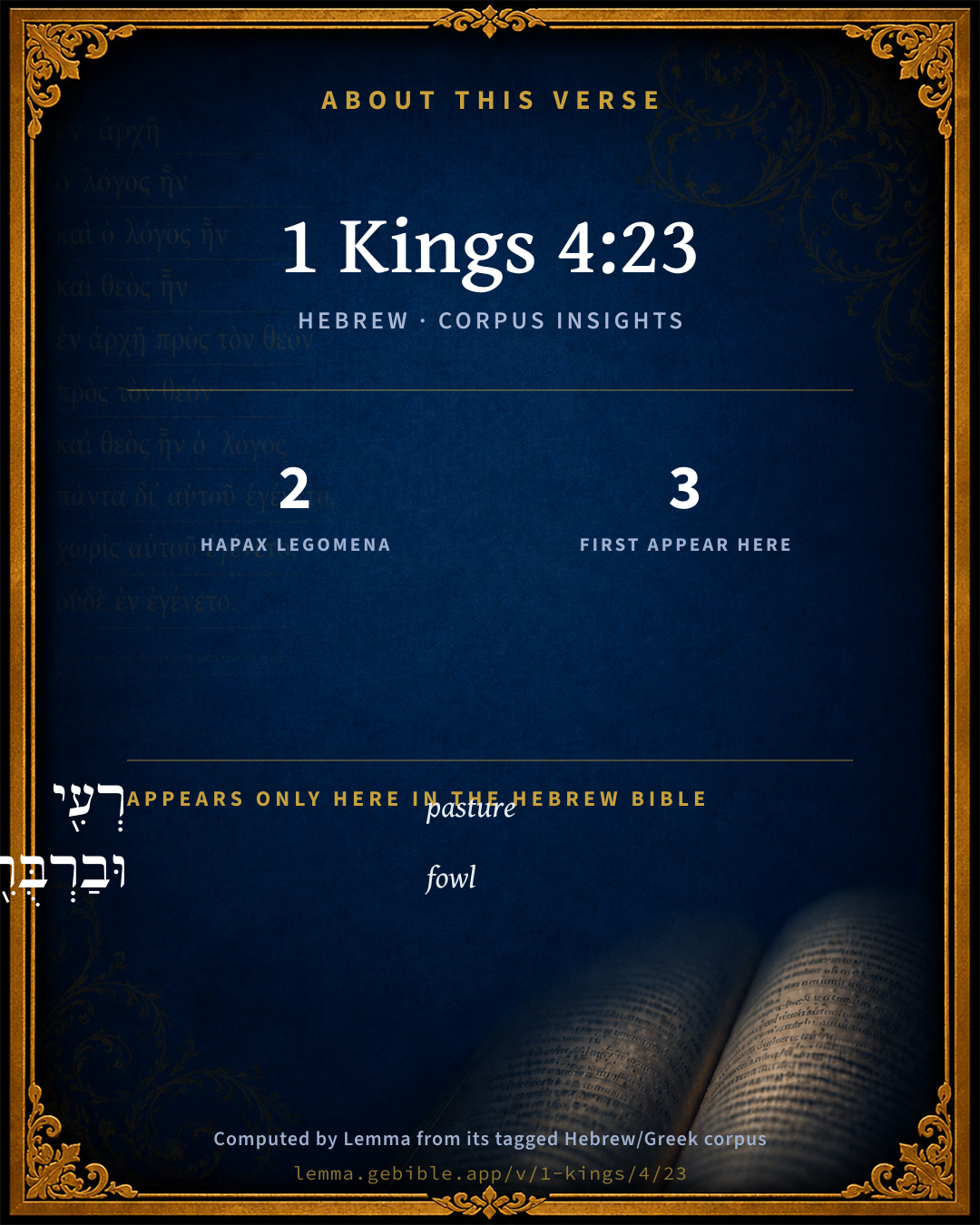
  • 2 hapax legomena — only here in the Hebrew Bible
  • 3 first appearances in the Hebrew Bible
Full analysis ↓
Download a study sheet

One document with this verse’s original text, its word-by-word gloss line, the meaning frame, cross-references with their text, attributed commentary, and full source and license credits — printable, and it pastes into notes with its structure intact.

This verse Autodidact and up

Study sheet (.html) Plain text (.txt)

A passage Seminary Student

Up to 50 verses in one chapter. A passage sheet keeps up to 6 commentary sources and 12 cross-references per verse, in the order this page ranks them, and says so on the sheet whenever that leaves anything out. Ask for a single verse and you get the Autodidact verse sheet above.

Everything on this page stays free to read, with no account — the sheet is a download of what is already on screen, not access to it.

Want to remove ads? Support Godless Engineer
Compare translations 3

The same verse in 3 English versions, stacked beneath the original-language interlinear above. Click any original word for its lexicon entry.

Each is an independent rendering of the whole verse — the interlinear is not word-aligned to these translations.

Highlighted words mark where these versions differ — a whole-verse word diff, not a word-by-word alignment.

  • World English Bible Public Domain
    ten fat oxen, and twenty oxen out of the pastures, and one hundred sheep, besides harts, and gazelles, and roebucks, and fattened fowl.
  • King James Version Public Domain
    Ten fat oxen, and twenty oxen out of the pastures, and an hundred sheep, beside harts, and roebucks, and fallowdeer, and fatted fowl.
  • unfoldingWord Literal Text CC BY-SA 4.0
    ten fat cattle and 20 pasture cattle and 100 sheep, apart from deer and gazelle and roebuck and fattened fowl.

unfoldingWord Literal Text — © unfoldingWord, licensed CC BY-SA 4.0. Word-aligned USFM3 via Door43 (git.door43.org/unfoldingWord/en_ult).

Versions to compare (up to 4)

3 of 4 selected

Show all 18 translations

Every available English version of this verse, each an independent rendering of the whole verse.

  • World English Bible Public Domain
    ten fat oxen, and twenty oxen out of the pastures, and one hundred sheep, besides harts, and gazelles, and roebucks, and fattened fowl.
  • Berean Standard Bible Public Domain
    ten fat oxen, twenty range oxen, and a hundred sheep, as well as deer, gazelles, roebucks, and fattened poultry.
  • Majority Standard Bible Public Domain
    ten fat oxen, twenty range oxen, and a hundred sheep, as well as deer, gazelles, roebucks, and fattened poultry.
  • King James Version Public Domain
    Ten fat oxen, and twenty oxen out of the pastures, and an hundred sheep, beside harts, and roebucks, and fallowdeer, and fatted fowl.
  • American Standard Version (1901) Public Domain
    ten fat oxen, and twenty oxen out of the pastures, and a hundred sheep, besides harts, and gazelles, and roebucks, and fatted fowl.
  • Revised Version (1885) Public Domain
    ten fat oxen, and twenty oxen out of the pastures, and an hundred sheep, beside harts, and gazelles, and roebucks, and fatted fowl.
  • Geneva Bible (1599) Public Domain
    Ten fat oxen, and twentie oxen of the pastures, and an hundreth sheepe, beside hartes, and buckes, and bugles, and fat foule.
  • Douay-Rheims (1899) Public Domain
    Ten fat oxen and twenty out of the pastures, and a hundred rams, besides venison of harts, roes, and buffles, and fatted fowls.
  • Young's Literal Translation Public Domain
    ten fat oxen, and twenty feeding oxen, and a hundred sheep, apart from hart, and roe, and fallow-deer, and fatted beasts of the stalls,
  • Literal Standard Version CC BY-SA 4.0
    ten fat oxen, and twenty feeding oxen, and one hundred sheep, apart from deer, and roe, and fallow-deer, and fatted beasts of the stalls,
  • Unlocked Literal Bible CC BY-SA 4.0
    ten fat oxen, twenty oxen out of the pastures, and one hundred sheep, besides deer, gazelles, roebucks, and fattened fowl.
  • unfoldingWord Literal Text CC BY-SA 4.0
    ten fat cattle and 20 pasture cattle and 100 sheep, apart from deer and gazelle and roebuck and fattened fowl.
  • Darby Bible Public Domain
    ten fatted oxen, and twenty oxen out of the pastures, and a hundred sheep, besides harts, and gazelles, and fallow-deer, and fatted fowl.
  • World Messianic Bible Public Domain
    ten head of fat cattle, twenty head of cattle out of the pastures, and one hundred sheep, in addition to deer, gazelles, roebucks, and fattened fowl.
  • Webster's Bible Public Domain
    Ten fat oxen, and twenty oxen out of the pastures, and a hundred sheep, besides harts, and roebucks, and fallow-deer, and fatted fowls.
  • Free Bible Version CC BY-SA 4.0
    ten fattened cattle, twenty range cattle, one hundred sheep, as well as deer, gazelles, roe deer, and fattened poultry.
  • Bible in Basic English Public Domain
    Ten fat oxen and twenty oxen from the fields, and a hundred sheep, in addition to harts and gazelles and roes and fat fowls.
  • JPS Tanakh (1917) Public Domain
    (5-3) ten fat oxen, and twenty oxen out of the pastures, and a hundred sheep, beside harts, and gazelles, and roebucks, and fatted fowl.

Literal Standard Version (2020), Covenant Press — licensed CC BY-SA 4.0. Text via the HelloAO Bible API (eBible.org). Unlocked Literal Bible (unfoldingWord) — licensed CC BY-SA 4.0. Text via the HelloAO Bible API (eBible.org). unfoldingWord Literal Text — © unfoldingWord, licensed CC BY-SA 4.0. Word-aligned USFM3 via Door43 (git.door43.org/unfoldingWord/en_ult). Free Bible Version, Dr. Jonathan Gallagher — licensed CC BY-SA 4.0. Text via the HelloAO Bible API (eBible.org).

Word by word

More ways to search: Search by grammar → Find every occurrence → Compare this word →

Practice this passage: Drill this verse → Learn its vocabulary →

רְעִ֖י
rᵉʻîy
H7471
“pasture”
Noun, Common, Masculine, Singular, Absolute
Part of Speech
Noun
Type
Common
Gender
Masculine
Number
Singular
State
Absolute
Full BDB Definition

Origin: from H7462

TWOT: 2185a

pasture
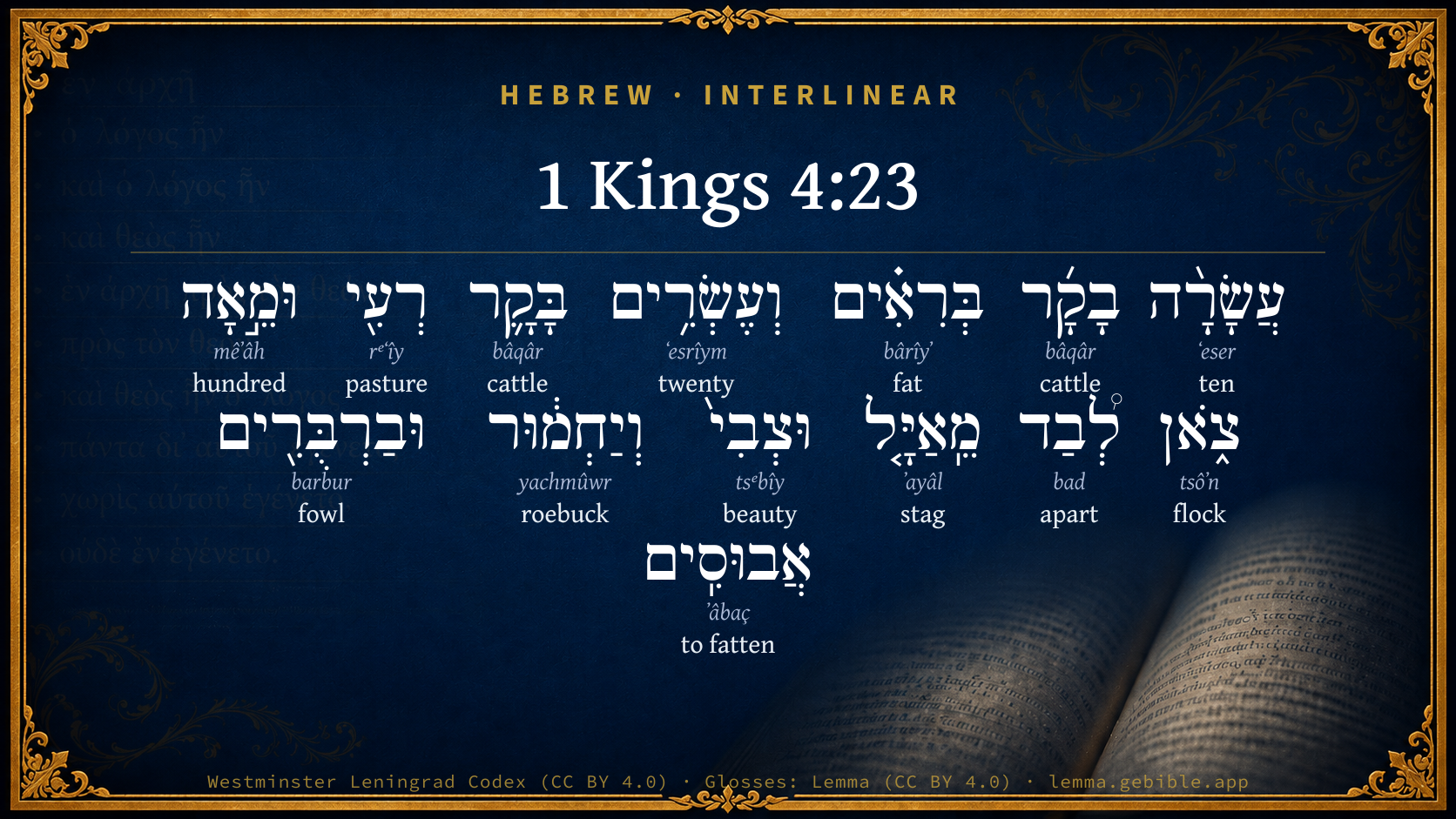
  1. עֲשָׂרָ֨ה ʻeser H6235 “ten” Adjective, Cardinal number, Masculine, Singular, Absolute
  2. בָקָ֜ר bâqâr H1241 “cattle” Noun, Common, Both, Singular, Absolute
  3. בְּרִאִ֗ים bârîyʼ H1277 “fat” Adjective, Adjective, Masculine, Plural, Absolute
  4. וְעֶשְׂרִ֥ים ʻesrîym H6242 “and · twenty” Conjunction + Adjective, Cardinal number, Both, Plural, Absolute
  5. בָּקָ֛ר bâqâr H1241 “cattle” Noun, Common, Both, Singular, Absolute
  6. וּמֵ֣אָה mêʼâh H3967 “and · hundred” Conjunction + Adjective, Cardinal number, Both, Singular, Absolute
  7. צֹ֑אן tsôʼn H6629 “flock” Noun, Common, Both, Singular, Absolute
  8. לְ֠בַד bad H905 “to/for · apart” Preposition + Noun, Common, Masculine, Singular, Absolute
  9. מֵֽאַיָּ֤ל ʼayâl H354 “from · stag” Preposition + Noun, Common, Both, Singular, Absolute
  10. וּצְבִי֙ tsᵉbîy H6643 “and · beauty” Conjunction + Noun, Common, Both, Singular, Absolute
  11. וְיַחְמ֔וּר yachmûwr H3180 “and · roebuck” Conjunction + Noun, Common, Masculine, Singular, Absolute
  12. וּבַרְבֻּרִ֖ים barbur H1257 “and · fowls” Conjunction + Noun, Common, Masculine, Plural, Absolute
  13. אֲבוּסִֽים ʼâbaç H75 “fattened” Verb, Qal, Participle Passive, Masculine, Plural, Absolute

About this verse

These counts appear in no published source. They are computed here, from the morphology-tagged text and Lemma’s own curated glosses. What Lemma adds →

14
words
13
distinct lemmas
Historical
section

Notable vocabulary

2 hapax legomena — words that appear only here in the entire Hebrew Bible:

  • רְעִ֖י pasture H7471
  • וּבַרְבֻּרִ֖ים fowl H1257

First appearance in Scripture

These words make their first canonical appearance in the Hebrew Bible here:

  • רְעִ֖י pasture H7471
  • וּבַרְבֻּרִ֖ים fowl H1257
  • אֲבוּסִֽים to fatten H75

Shared distinctive vocabulary

וְיַחְמ֔וּר roebuck H3180 occurs in 2 verses of the Hebrew Bible. Also found in:

Grammatical profile

  • 1 verb
  • 9 nouns
  • 4 adjectives

Verb forms

  • אֲבוּסִֽים Qal · Participle Passive

Repetition

A word recurs within this verse — often emphatic in Hebrew:

  • בָקָ֜ר cattle H1241 ×2

Hebrew & Septuagint length

In English translation the verse runs 23 words from the Hebrew and 18 from the Septuagint (LXX English) — closely comparable.

A rough comparison of the two English renderings, which tokenize alike — not a word-level alignment.

Word counts can differ between the Hebrew and the Greek without any difference in meaning — e.g. the Hebrew direct-object marker אֵת has no separate Greek word, and Greek often adds the article ὁ.

Cross-references

1

Topical passages linked to 1 Kings 4:23 in the Treasury of Scripture Knowledge — connected by theme and wording, ordered by reader-vote popularity; previews shown in the World English Bible.

  • Nehemiah 5:17–18 Moreover there were at my table, of the Jews and the rulers, one hundred fifty men, besides those who came to us from among the nations that were round about us.

Cross-references courtesy of OpenBible.info (CC BY 4.0).

Hebrew and Greek witnesses Masoretic Hebrew ↔ Greek Septuagint

The same verse in the two great witnesses to the Old Testament, shown verse-for-verse.

These are two independent witnesses, not word-aligned to each other, and the Septuagint is shown in lemma (dictionary) form.

Hebrew 1 Kings 4:23 Masoretic · Westminster Leningrad Codex

עֲשָׂרָ֨ה בָקָ֜ר בְּרִאִ֗ים וְעֶשְׂרִ֥ים בָּקָ֛ר רְעִ֖י וּמֵ֣אָה צֹ֑אן לְ֠בַד מֵֽאַיָּ֤ל וּצְבִי֙ וְיַחְמ֔וּר וּבַרְבֻּרִ֖ים אֲבוּסִֽים

ten fat oxen, and twenty oxen out of the pastures, and one hundred sheep, besides harts, and gazelles, and roebucks, and fattened fowl.

World English Bible · Public Domain

Greek LXX 1 Kings 4:23 Septuagint · lemma form
and ten choice calves, and twenty pastured oxen, and one hundred sheep, besides stags, and choice fatted does.

LXX2012 (modern English Septuagint) · Public Domain

On this verse, The Cambridge Bible for Schools and Colleges discusses the Septuagint’s reading. Read the note in Commentary ↓

Hebrew: Westminster Leningrad Codex (CC BY 4.0). Greek: Septuagint (public domain); English from LXX2012 (modern English Septuagint) (Public Domain). How the Septuagint differs from the Hebrew →

Commentary

Notes on 1 Kings 4:23 from classic Christian and Jewish commentators (each source and its license shown beneath its notes). The classic Christian expositions comment on the surrounding passage and are grouped to its opening verse, so a note may address several verses; the Jewish commentaries on the Tanakh (Rashi and others) are per-verse, so they appear only where the commentator wrote on this verse.

Lemma curates 59 commentaries, every one of them public domain or Creative Commons licensed, each selected and text-cleaned for this edition rather than reprinted as found. About our sources →

Trapp's Complete Commentary

John Trapp

1Ki 4:23 Ten fat oxen, and twenty oxen out of the pastures, and an hundred sheep, beside harts, and roebucks, and fallowdeer, and fatted fowl.

Ver. 23. Ten fat oxen … and fatted fowl.] Lectissima quaeque altilia; yet not with such luxury and gormandise as sundry Roman emperors. Anthony, who contended with Cleopatra in prodigal spending upon a banquet, and wrote, or rather vomited out a book of his own intemperances. Geta the emperor would have his dishes served in by the alphabet, viz., anserem, anatem, aprum; aliquando fasianum, farra, ficus; aliquando pullum, pavunem, perdicem, &c. {a} Caligula would have his bread gilded. Well might Nasica say of Rome, when nothing so luxurious, Stant moenia, ruunt mores; The walls indeed stand, but good manners are fallen to the ground and abolished. Not so at Jerusalem in Solomon’s days.

{a} Bruson., lib. iii. cap. 1.

John Trapp, A Commentary or Exposition upon All the Books of the Old and New Testament (1647–1656) — public domain. Text from a community e-Sword module.

Ellicott's Commentary for English Readers

(23) On this side the river.—This translation, although it expresses the true reference, viz., to the country west of the Euphrates, is literally incorrect. The words mean, “on the further side of the river,” considered from the point of view of Babylon (see the use in the later books, or in Ezr_4:6; Ezr_6:6, &c.); and accordingly indicate composition at the time of the Exile, or, at any rate, at a period when the Babylonish empire was so established in supreme sovereignty as to determine the geographical nomenclature of the East.

A Bible Commentary for English Readers, edited by Charles John Ellicott (1878–1897) — public domain. Text from a community e-Sword module.

The Cambridge Bible for Schools and Colleges

gen. ed. J. J. S. Perowne

23. roebucks] The Hebrew word (צבי) is rendered δορκὰς by the LXX. i.e. a gazelle. It is akin to the proper name Tabitha, i.e. Δορκὰς (Act_9:36). The rendering roebuck is better suited to the description of the next kind of animals mentioned and which A. V. translates fallow deer.

fatted fowl] The word rendered ‘fowl,’ is found only in this passage. The Chaldee paraphrase, as well as the Syriac and the Vulgate interpret it thus, so that we have full support from Jewish tradition. Kimchi thinks common fowls are meant. Gesenius, connecting the word with a root signifying pure, thinks geese or swans may be intended.

The Cambridge Bible for Schools and Colleges (gen. ed. J. J. S. Perowne; Cambridge University Press, 1878–1918) — public domain. Text from a community e-Sword module.

John Gill's Exposition

And Solomon had forty thousand stalls for horses,.... In Ch2 9:25; it is only four thousand; and therefore some think that here is a mistake of the copier, of "arbaim", forty, for "arbah", four; which it is thought might be through divine permission, in such lesser matters, without any prejudice to the authority of the Scriptures in matters of faith and practice; but without supposing this, a reconciliation may be made, by observing, that here the writer, as Ben Gersom notes, gives the number of the horses that were in the stables, which were forty thousand, there the stables themselves, which were four thousand, ten horses in a stable; or here he numbers the stalls, which were forty thousand, and there the stables, which were four thousand, there being ten stalls in each; and the word there has the letter "yod" in it more than here, which is the numerical letter for "ten", and may point thereunto; or here the writer speaks of all the stalls for horses Solomon had throughout the kingdom, there of those only he had in Jerusalem. Benjamin of Tudela (g) affirms, that these stalls, or stables, which Solomon built very strong of large stones, are still in being in Jerusalem, and that there is no building to be seen like it any where; but no other writer speaks of them; nor is it at all probable that they should remain:

for his chariots, and twelve thousand horsemen; some of the said stalls of horses were for his chariots, to draw in them for various uses, of which had 1400, Kg1 10:26; and others to mount twelve thousand horsemen, who were placed in various parts, to defend kingdom.

(g) Itinerar. p. 43.

John Gill's Exposition of the Whole Bible (1746–1763) — public domain (CC PDM 1.0). Text via the HelloAO Bible API.

Albert Barnes' Notes on the Bible

Harts ... - The exact sorts of wild land animals here intended are very uncertain. Perhaps it would be best to translate “wild-goats, gazelles, and wild oxen,” which abounded in the wilder parts of Syria, from where Solomon would be supplied. (See 1Ki 4:24.) (Yahmur, or the “roebuck,” gives its name to a valley in a wooded district, south of Carmel (Conder).) The use of game at the royal banquets of Assyria appears in the sculptures.

Albert Barnes' Notes on the Bible (1834–1885) — public domain. Text from a community e-Sword/MySword module.

Haydock's Catholic Bible Commentary

Buffaloes. Yachmur means also a sort of wild-goat, like a stag, Deuteronomy xiv. 5. (Bochart, Anim. i. B. iii. 22.) --- Fowls. Some Rabbins explain barburim, (or borbrim) of capons, or birds from Barbary; as if this name had been known in the days of Solomon. (Calmet) --- There was an ancient Ethiopian Barbary on the Persian gulf, (Bochart) with which the Rabbins were not acquainted. (Calmet)

George Leo Haydock (1774–1849), Haydock's Catholic Family Bible and Commentary, 1859 edition — public domain. Excludes Psalms (Douay-Rheims chapter numbering differs from Protestant) and Deuterocanonical books (Catholic canon only).

Matthew Poole's English Annotations

Ten fat oxen, fitted in stalls.

Out of the pastures; well fleshed, tender, and good, though not so fat as the former.

Matthew Poole's English Annotations on the Holy Bible (1683–1685) — public domain. Text from a community e-Sword/MySword module.

Whedon's Commentary on the Bible

Daniel D. Whedon

23. Twenty oxen out of the pastures — Such as had been taken immediately from the field, in distinction from such as had been stallfed. It is said that one hundred oxen were daily slaughtered for the kings of Persia; and Tavernier relates that as many as five hundred sheep and lambs were daily consumed at the court of the Sultan.

Harts… roebucks… fallow deer — Various species of the genus cervus, or deer family. See Deu_12:15; Deu_14:5.

Fatted fowl — Domesticated poultry.

Daniel D. Whedon (gen. ed.), Commentary on the Old and New Testaments (1874–1909) — public domain. Text from a community e-Sword module.

The Pulpit Commentary

Ten fat Heb. fatted, i.e., for table oxen, and twenty fat oxen out of the pastures, and a hundred sheep, beside harts and roebucks or gazelles and fallowdeer Roebucks. The name Yahmur is still current in Palestine in this sense (Conder, p. 91), and fatted fowl This word ( occurs nowhere else. The meaning most in favour is geese.

The Pulpit Commentary (1880–1919), ed. H.D.M. Spence-Jones & Joseph S. Exell — public domain. Text from a community e-Sword module.

John Wesley's Explanatory Notes

Fat - Fatted in stalls. Out of pastures - Well fleshed, tender and good, though not so fat as the former.

John Wesley, Explanatory Notes Upon the Whole Bible (1754–1765) — public domain. Text via the GEBible commentary corpus.

Lesson kit

Teaching starters — assembled from the data on this page, not authored interpretation. Every prompt links to the verse data it draws on. Edit before teaching.

1 Kings, in the Historical, opens this verse with 14 words (13 distinct Hebrew lemmas). Its most distinctive word is rᵉʻîy (“pasture”). A historical commentator’s framing appears above. Read the whole chapter for the surrounding context.

Discussion questions

  1. How does “pasture” (rᵉʻîy) shape what this verse is saying?
  2. This verse holds 2 words here found nowhere else in the Hebrew Bible. What might the rare words draw attention to?
  3. 3 words here appear for the first time in Scripture. What is being introduced at this debut?
  4. Deuteronomy 14:5 shares the word «roebuck» with this verse. How do the two illuminate each other?
  5. “cattle” occurs 2× in this one verse. What is the effect of the repetition?
  6. These translations render this verse differently. What is at stake in choosing one wording over another?
  7. The verb «אֲבוּסִֽים» is Qal Participle Passive. How does its form color the action?
  8. Reading how Trapp's Complete Commentary and Ellicott's Commentary for English Readers read this verse, where do the two commentators agree and where do they part?

Things to notice

  • 2 words in this verse appear nowhere else in the Hebrew Bible.
  • 3 words make their first canonical appearance in Scripture here.
  • These translations choose different wording for 22 words in this verse.
  • “cattle” occurs 2× in this single verse.
  • 13 distinct Hebrew lemmas span 14 words in this verse.

Reading settings

Reading text

Shown beneath each verse's original-language words.

Old Testament
Old Testament edition

Read the OT as the Masoretic Hebrew (MT) or the Greek Septuagint (LXX).

English shown for the Greek Septuagint (in the Hebrew ↔ Greek comparison).

Comparing translations? Open the Compare panel on any verse page to stack up to four side by side.