
Psalms 77:20

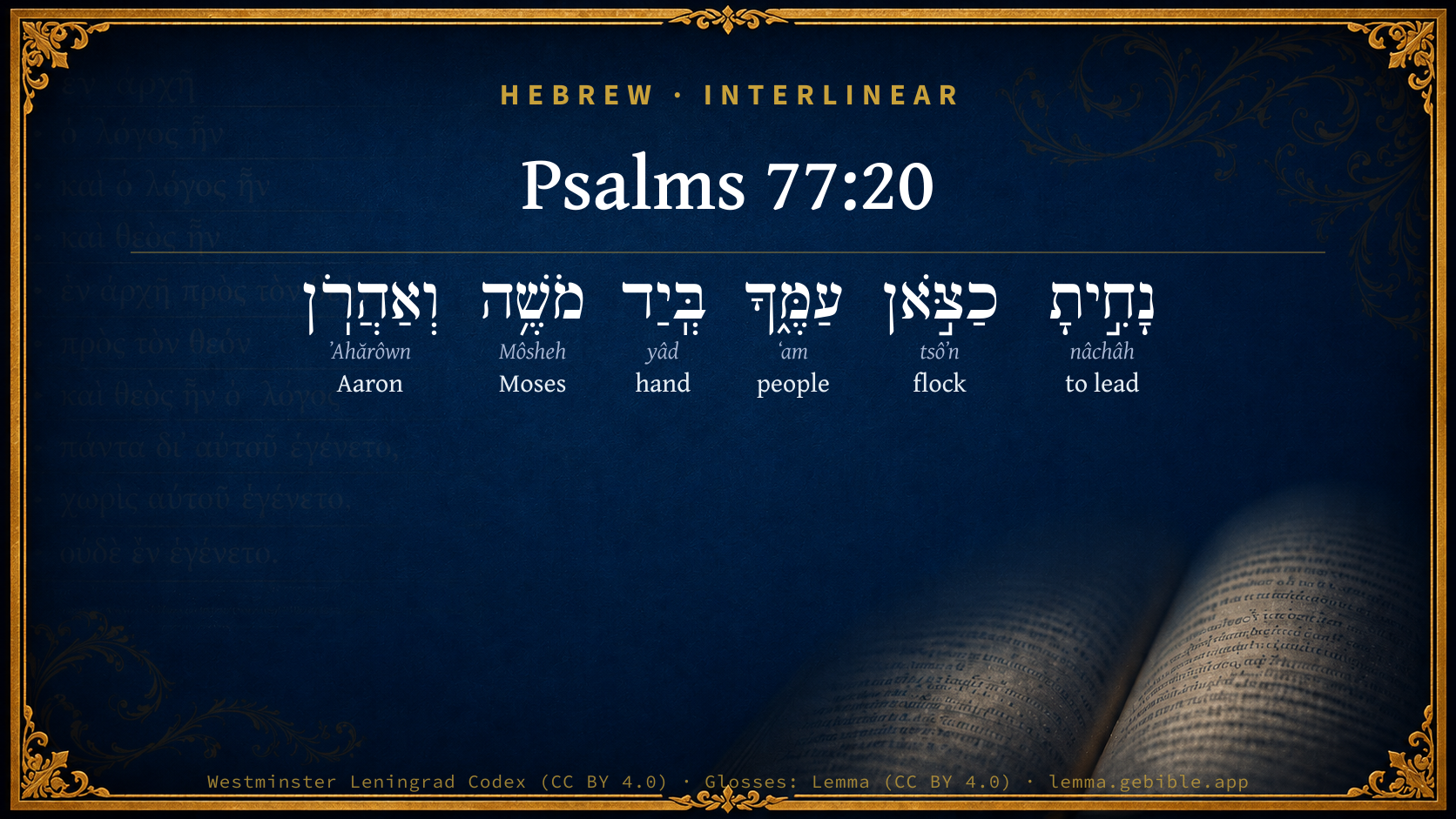
Hebrew (Westminster Leningrad Codex) Psalms 77:20 appears in the Hebrew Old Testament. The text above is from the Westminster Leningrad Codex. Each word links to its Strong’s number, a concise gloss, and parsing drawn from the Open Scriptures Hebrew Bible morphology. Click any word for its full Brown-Driver-Briggs (BDB) entry.
Download image
Cite this verse

Psalms 77:20 (World English Bible). Public Domain. Lemma interlinear Bible study tool, https://lemma.gebible.app/v/psalms/77/20.

Show BibTeX & RIS
BibTeX
RIS
English Translation
You led your people like a flock, By the hand of Moses and Aaron.
World English Bible · Public Domain
Download a study sheet

One document with this verse’s original text, its word-by-word gloss line, the meaning frame, cross-references with their text, attributed commentary, and full source and license credits — printable, and it pastes into notes with its structure intact.

This verse Autodidact and up

Study sheet (.html) Plain text (.txt)

A passage Seminary Student

Up to 50 verses in one chapter. A passage sheet keeps up to 6 commentary sources and 12 cross-references per verse, in the order this page ranks them, and says so on the sheet whenever that leaves anything out. Ask for a single verse and you get the Autodidact verse sheet above.

Everything on this page stays free to read, with no account — the sheet is a download of what is already on screen, not access to it.

Want to remove ads? Support Godless Engineer
Compare translations 3

The same verse in 3 English versions, stacked beneath the original-language interlinear above. Click any original word for its lexicon entry.

Each is an independent rendering of the whole verse — the interlinear is not word-aligned to these translations.

Highlighted words mark where these versions differ — a whole-verse word diff, not a word-by-word alignment.

  • World English Bible Public Domain
    You led your people like a flock, By the hand of Moses and Aaron.
  • King James Version Public Domain
    Thou leddest thy people like a flock by the hand of Moses and Aaron.
  • unfoldingWord Literal Text CC BY-SA 4.0
    You led your people like a flock by the hand of Moses and Aaron.

unfoldingWord Literal Text — © unfoldingWord, licensed CC BY-SA 4.0. Word-aligned USFM3 via Door43 (git.door43.org/unfoldingWord/en_ult).

Versions to compare (up to 4)

3 of 4 selected

Show all 18 translations

Every available English version of this verse, each an independent rendering of the whole verse.

  • World English Bible Public Domain
    You led your people like a flock, By the hand of Moses and Aaron.
  • Berean Standard Bible Public Domain
    You led Your people like a flock by the hand of Moses and Aaron.
  • Majority Standard Bible Public Domain
    You led Your people like a flock by the hand of Moses and Aaron.
  • King James Version Public Domain
    Thou leddest thy people like a flock by the hand of Moses and Aaron.
  • American Standard Version (1901) Public Domain
    Thou leddest thy people like a flock, By the hand of Moses and Aaron. Psalm 78 Maschil of Asaph.
  • Revised Version (1885) Public Domain
    Thou leddest thy people like a flock, by the hand of Moses and Aaron.
  • Geneva Bible (1599) Public Domain
    Thou diddest leade thy people like sheepe by the hand of Moses and Aaron.
  • Douay-Rheims (1899) Public Domain
    Thy way is in the sea, and thy paths in many waters: and thy footsteps shall not be known.
  • Young's Literal Translation Public Domain
    Thou hast led as a flock Thy people, By the hand of Moses and Aaron!
  • Literal Standard Version CC BY-SA 4.0
    You have led Your people as a flock, || By the hand of Moses and Aaron!
  • Unlocked Literal Bible CC BY-SA 4.0
    You led your people like a flock by the hand of Moses and Aaron.
  • unfoldingWord Literal Text CC BY-SA 4.0
    You led your people like a flock by the hand of Moses and Aaron.
  • Darby Bible Public Domain
    Thou leddest thy people like a flock by the hand of Moses and Aaron.
  • World Messianic Bible Public Domain
    You led your people like a flock, by the hand of Moses and Aaron.
  • Webster's Bible Public Domain
    \\77:19\\Thy way is in the sea, and thy path in the great waters, and thy footsteps are not known.
  • Free Bible Version CC BY-SA 4.0
    You led your people like a flock, shepherded by Moses and Aaron.
  • Bible in Basic English Public Domain
    You were guiding your people like a flock, by the hand of Moses and Aaron.
  • JPS Tanakh (1917) Public Domain
    (77-21) Thou didst lead Thy people like a flock, by the hand of Moses and Aaron.

Literal Standard Version (2020), Covenant Press — licensed CC BY-SA 4.0. Text via the HelloAO Bible API (eBible.org). Unlocked Literal Bible (unfoldingWord) — licensed CC BY-SA 4.0. Text via the HelloAO Bible API (eBible.org). unfoldingWord Literal Text — © unfoldingWord, licensed CC BY-SA 4.0. Word-aligned USFM3 via Door43 (git.door43.org/unfoldingWord/en_ult). Free Bible Version, Dr. Jonathan Gallagher — licensed CC BY-SA 4.0. Text via the HelloAO Bible API (eBible.org).

Word by word

More ways to search: Search by grammar → Find every occurrence → Compare this word →

Practice this passage: Drill this verse → Learn its vocabulary →

About this verse

These counts appear in no published source. They are computed here, from the morphology-tagged text and Lemma’s own curated glosses. What Lemma adds →

6
words
6
distinct lemmas
Wisdom
section

Shared distinctive vocabulary

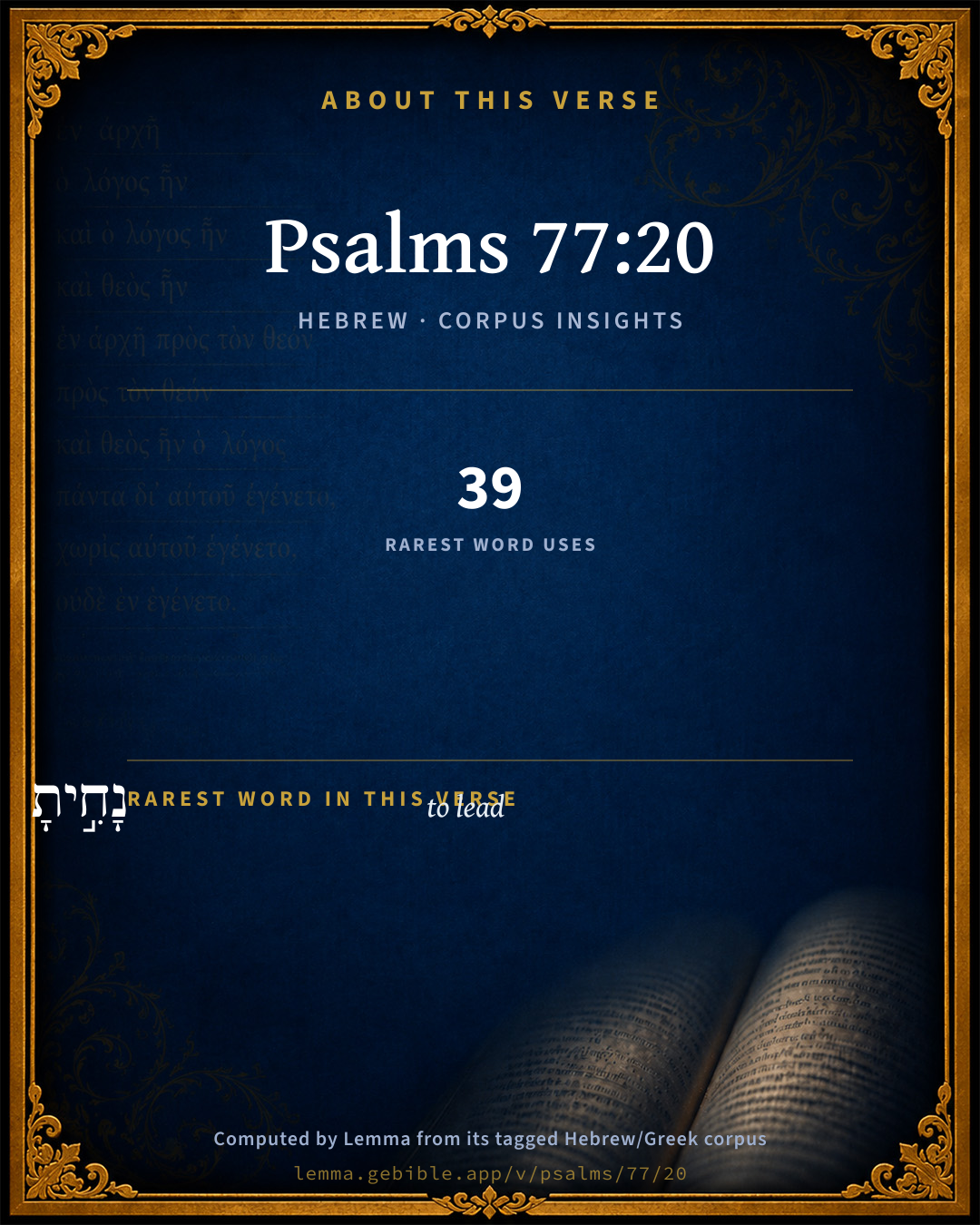
נָחִ֣יתָ to lead H5148 occurs in 39 verses of the Hebrew Bible. Also found in:

Grammatical profile

  • 1 verb
  • 5 nouns

Verb forms

  • נָחִ֣יתָ Qal · Perfect

Hebrew & Septuagint length

In English translation the verse runs 14 words from the Hebrew and 14 from the Septuagint (LXX English) — the same length.

A rough comparison of the two English renderings, which tokenize alike — not a word-level alignment.

Word counts can differ between the Hebrew and the Greek without any difference in meaning — e.g. the Hebrew direct-object marker אֵת has no separate Greek word, and Greek often adds the article ὁ.

Cross-references

7

Topical passages linked to Psalms 77:20 in the Treasury of Scripture Knowledge — connected by theme and wording, ordered by reader-vote popularity; previews shown in the World English Bible.

  • Exodus 13:21 Yahweh went before them by day in a pillar of cloud, to lead them on their way, and by night in a pillar of fire, to give them light, that they might go by day and by night:
  • Exodus 14:19 The angel of God, who went before the camp of Israel, moved and went behind them; and the pillar of cloud moved from before them, and stood behind them.
  • Psalms 78:52 But he led forth his own people like sheep, And guided them in the wilderness like a flock.
  • Isaiah 63:11–12 Then he remembered the days of old, Moses [and] his people, [saying], Where is he who brought them up out of the sea with the shepherds of his flock? where is he who put his holy Spirit in the midst of them?
  • Psalms 80:1 Hear us, Shepherd of Israel, You who lead Joseph like a flock, You who sit above the cherubim, shine forth.
  • Hosea 12:13 By a prophet Yahweh brought Israel up out of Egypt, And by a prophet he was preserved.
  • Acts 7:35–36 "This Moses, whom they refused, saying, 'Who made you a ruler and a judge?'--God has sent him as both a ruler and a deliverer by the hand of the angel who appeared to him in the bush.

Cross-references courtesy of OpenBible.info (CC BY 4.0).

Hebrew and Greek witnesses Masoretic Hebrew ↔ Greek Septuagint

The same verse in the two great witnesses to the Old Testament, shown verse-for-verse.

You’re reading Greek Psalm 76 (Hebrew Psalm 77). The Septuagint counts the superscription, so verse numbers can differ from the Hebrew — chapter-level alignment, not verse-by-verse. Numbering follows Rahlfs.

These are two independent witnesses, not word-aligned to each other, and the Septuagint is shown in lemma (dictionary) form.

Hebrew Psalms 77:20 Masoretic · Westminster Leningrad Codex

נָחִ֣יתָ כַצֹּ֣אן עַמֶּ֑ךָ בְּֽיַד מֹשֶׁ֥ה וְאַהֲרֹֽן

You led your people like a flock, By the hand of Moses and Aaron.

World English Bible · Public Domain

Greek LXX Greek Psalm 76:20 Septuagint · lemma form

ἐν ὁ θάλασσα ὁ ὁδός σύ καί ὁ τρίβος σύ ἐν ὕδωρ πολύς καί ὁ ἴχνος σύ οὐ γιγνώσκω

You did guide your people as sheep by the hand of Moses and Aaron.

LXX2012 (modern English Septuagint) · Public Domain

Hebrew: Westminster Leningrad Codex (CC BY 4.0). Greek: Septuagint (public domain); English from LXX2012 (modern English Septuagint) (Public Domain). How the Septuagint differs from the Hebrew →

Commentary

Notes on Psalms 77:20 from classic Christian and Jewish commentators (each source and its license shown beneath its notes). The classic Christian expositions comment on the surrounding passage and are grouped to its opening verse, so a note may address several verses; the Jewish commentaries on the Tanakh (Rashi and others) are per-verse, so they appear only where the commentator wrote on this verse.

Lemma curates 59 commentaries, every one of them public domain or Creative Commons licensed, each selected and text-cleaned for this edition rather than reprinted as found. About our sources →

Trapp's Complete Commentary

John Trapp

Psa 77:20 Thou leddest thy people like a flock by the hand of Moses and Aaron.

Ver. 20. Thou leddest thy people like a flock] And so he still leadeth his Church with much love and care, by good magistrates and ministers, who are as his under-shepherds.

John Trapp, A Commentary or Exposition upon All the Books of the Old and New Testament (1647–1656) — public domain. Text from a community e-Sword module.

Joseph Benson's Commentary

Psa 77:20. Thou leddest thy people — First through the sea, and afterward through the vast howling wilderness to Canaan; like a flock — With singular care and tenderness, as a shepherd doth his sheep. The Psalm concludes abruptly, and does not apply those ancient instances of God’s power to the present distresses, whether personal or national, as one might have expected. For as soon as the good man began to meditate on these things he found he had gained his point. His very entrance upon this matter gave him light and joy; his fears suddenly and strangely vanished, so that he needed to go no further; he went his way and did eat, and his countenance was no more sad.

Joseph Benson's Commentary on the Old and New Testaments (1811–1818) — public domain. Text from a community e-Sword module.

J. A. Alexander on Psalms

Joseph Addison Alexander

21. (Psa 77:20). Thou didst guide like a flock thy people, by the hand of Moses and Aaron. Like a flock in perfect safety and with perfect ease. The comparison of Moses, at this juncture, to a shepherd, reappears in Isa 63:11-14. The conclusion of the psalm appears abrupt, but any devout Israelite could draw the inference for himself, that he who had so gloriously saved his people could deliver them again.

Joseph Addison Alexander, The Psalms Translated and Explained (1850) — public domain. Text from a community e-Sword module.

Adam Clarke's Commentary

Verse 20. Thou leddest thy people like a flock] This may refer to the pillar of cloud and fire. It went before them, and they followed it. So, in the eastern countries, the shepherd does not drive, but leads, his flock. He goes before them to find them pasture, and they regularly follow him.

By the hand of Moses and Aaron.] They were God's agents; and acted, in civil and sacred things, just as directed by the Most High.

ANALYSIS OF THE SEVENTY-SEVENTH PSALM

In this Psalm the prophet shows the bitter agony which a troubled spirit undergoes from a sense of God's displeasure; and the comfort which it afterwards receives through faith in his promises.

There are two parts in this Psalm: -

I. The psalmist sets forth the strife between the flesh and the spirit; and how the flesh tempts the spirit to despair, and calls in question the goodness of God, Ps 77:1-10.

II. Next, he shows the victory of the spirit over the flesh; being raised, encouraged, and confirmed by the nature, promises, and works of God, Ps 77:11-20.

This is an excellent Psalm, and of great use in spiritual desertion.

I. The strife. The prophet betakes himself to God. 1. He prays. 2. Prays often. 3. Prays earnestly. 4. And with a troubled soul. The Psalm is, therefore, not the expression of a despairing soul, but of one that has a great conflict with temptation.

Though he complains, yet he despairs not.

I. His complaint is bitter, and he sets down how he was exercised.

1. He found no intermission; day and night he was in distress. His voice was continually lifted up, and his hands constantly stretched out to God in prayer. When no man saw him, he prayed. His complaint was in secret, and far from hypocrisy, which always loves to have witnesses.

2. He refused to be comforted, Ps 77:2.

3. Even the "remembrance of God troubled him," Ps 77:3.

4. His soul was overwhelmed, Ps 77:3.

5. He became at last speechless through grief, Ps 77:4.

6. All sleep departed from him, Ps 77:4.

II. He shows that his grief was aggravated by a consideration of the happiness he once enjoyed, but had lost.

1. He had considered the days of old, Ps 77:5.

2. He could rejoice in and praise God, Ps 77:6.

3. But now, on diligent search, all good is gone, Ps 77:6.

4. His debate between hope and despair, which leads him to break out in the following interrogations: 1. Will the Lord cast off for ever? 2. Will he be favourable no more? 3. Is his mercy clean gone? 4. Doth his promise fail? 5. Hath God forgotten to be gracious? 6. Hath he in anger shut up his tender mercies? Ps 77:7-9.

II. How he is restored.

1. He begins with a correction of himself: "I said, This is my infirmity," Ps 77:10.

2. Takes encouragement from a remembrance, -

(1) Of God's ways: "I will remember - the right hand of the Most High," Ps 77:10.

(2) Of his WORKS: "I will remember thy wonders of old," Ps 77:11.

3. On these he will meditate and discourse, Ps 77:12.

(1) He then addresses his speech to God; who he understands is to be sought in his sanctuary, Ps 77:13.

(2) And who is "infinitely great and good," Ps 77:13.

(3) Who has declared his strength among the people, Ps 77:14.

(4) And particularly to the descendants of Jacob, Ps 77:15.

III. He amplifies the story of their deliverance from Egypt by several instances of God's power.

1. In the RED SEA: "The waters saw thee," Ps 77:16.

2. In the HEAVENS: "The clouds poured out water, Ps 77:17.

3. In the EARTH: "The earth trembled and shook," Ps 77:18.

IV. The final cause of all was that he might lead his people out of their bondage, and destroy their enemies, Ps 77:19-20.

Adam Clarke's Commentary on the Bible (1810–1826) — public domain. Text from a community e-Sword/MySword module.

The Cambridge Bible for Schools and Colleges

gen. ed. J. J. S. Perowne

20. Conclusion. The convulsions of nature were the heralds of deliverance (Luk_21:28), and the Shepherd of Israel led forth His flock under the guidance of His chosen servants. Cp. Exo_15:13; Psa_78:52 ff; Psa_74:1, note. The words of the last line come from Num_33:1; cp. Mic_6:4; Isa_63:11 ff.

The Cambridge Bible for Schools and Colleges (gen. ed. J. J. S. Perowne; Cambridge University Press, 1878–1918) — public domain. Text from a community e-Sword module.

John Gill's Exposition

Thou leddest thy people like a flock,.... Either through the Red sea, according to R. Moses Hacohen, as Aben Ezra observes; see Isa 63:11, or rather, as he and Kimchi, through the wilderness, after they were led through the sea; the people of Israel are compared to a flock of sheep; the Lord is represented as the Shepherd of them, who took care of them, protected and preserved them from their enemies:

by the hand of Moses and Aaron; the one was their civil and the other their ecclesiastical governor, and both under the Lord, and instruments of his, in guiding and conducting the people in all things needful for them. The Arabic version adds, "Allelujah"; from all this the psalmist concluded, though it is not mentioned, that as God had delivered his people of old out of their straits and difficulties, so he hoped and believed, that as he could, he would deliver him in his own time and way; and by this means his faith was relieved and strengthened.

Next: Psalms Chapter 78

John Gill's Exposition of the Whole Bible (1746–1763) — public domain (CC PDM 1.0). Text via the HelloAO Bible API.

Albert Barnes' Notes on the Bible

Thou leddest thy people like a flock by the hand of Moses and Aaron - This satisfied and comforted the mind of the psalmist. God had never forsaken his people. He had shown himself faithful in his dealings with them. He had acted the part of a good shepherd. In all the dangers of their way; in their perilous journey through the wilderness; amidst foes, privations, and troubles - rocks, sands, storms, tempests - when surrounded by enemies, and when their camp was infested with poisonous serpents - God had shown himself able to protect his people, and had been faithful to all his promises and covenant-engagements. Looking back to this period of their history, the psalmist saw that there was abundant reason for confiding in God, and that the mind should repose on him calmly amid all that was dark and mysterious in his dealings. In view of the past, the mind ought to be calm; encouraged by the past, however incomprehensible may be God’s doings, people may come to him, and entrust all their interests to him with the confident assurance that their salvation will be secure, and that all which seems dark and mysterious in the dealings of God will yet be made clear.

Albert Barnes' Notes on the Bible (1834–1885) — public domain. Text from a community e-Sword/MySword module.

Matthew Poole's English Annotations

Thou leddest thy people; first through the sea, and afterwards through the vast howling wilderness to Canaan.

Like a flock; with singular care and tenderness, as a shepherd doth his sheep. And therefore I hope thou wilt take care of thy poor dispersed and distressed flock, and bring them once again into their own land.

Matthew Poole's English Annotations on the Holy Bible (1683–1685) — public domain. Text from a community e-Sword/MySword module.

The Treasury of David

Charles H. Spurgeon

Ver. 20. Thou leddest thy people like a flock by the hand of Moses and Aaron. What a transition from tempest to peace, from wrath to love. Quietly as a flock Israel was guided on, by human agency which veiled the excessive glory of the divine presence. The smiter of Egypt was the shepherd of Israel. He drove his foes before him, but went before his people. Heaven and earth fought on his side against the sons of Ham, but they were equally subservient to the interests of the sons of Jacob. Therefore, with devout joy and full of consolation, we close this Psalm; the song of one who forgot how to speak and yet learned to sing far more sweetly than his fellows.

Whole Psalm. See Psalms on "Ps 77:1" for further information.

Ver. 20. Thou leddest thy people like a flock, etc. From this verse the afflicted may learn many consolations. First, that the best people that be are no better able to resist temptation, than the simple sheep is able to withstand the brier that catcheth him. The next, that man is of no more ability to beware of temptations, than the poor sheep is to avoid the brier, being preserved only by the diligence of the shepherd. The third, that as the shepherd is careful of his entangled and briard sheep, so is God of his afflicted faithful. And the fourth is, that the people of Israel could take no harm of the water, because they entered the sea at God's commandment. Whereof we learn, that no danger can hurt when God doth command us to enter into it; and all dangers overcome us if we choose them ourselves, besides God's commandment; as Peter, when he went at God's commandment upon the water, took no hurt; but when he entered into the bishop's house upon his own presumption, was overcome and denied Christ. The Israelites, when they fought at God's commandment, the peril was nothing; but when they would do it of their own heads, they perished: so that we are bound to attend upon God's commandment, and then no danger shall destroy us, though it pain us. The other doctrine is in this, that God used the ministry of Moses and Aaron in the deliverance of his people, who did command them to do nothing but that the Lord did first bid. Whereof we learn that such as be ministers appointed of God, and do nothing but as God commandeth, are to be followed; as Paul saith, "Follow me, as I follow Christ." John Hooper.

Ver. 20. Thou leddest thy people like a flock. Observe, the good shepherd leads his followers like sheep: First, with great solicitude and care, to protect them from wolves. Secondly, with consideration and kindness, for the sheep is a harmless animal. Thirdly, with a wise strictness, for sheep easily wander, and they are of all animals the most stupid. Thomas Le Blanc.

Ver. 20. Leddest thy people. Our guiding must be mild and gentle, else it is not duxisti, but traxisti; drawing and driving, and no leading. Leni spiritu non dure manu, rather by an inward sweet influence to be led, than by an outward extreme violence to be forced forward. So did God lead his people here. Not the greatest pace, I wist, for they were a year marching that they might have posted in eleven days, as Moses saith. (De 1:2.) No nor yet the nearest way neither, as Moses telleth us. (Ex 8:18.) For he fetched a compass divers times, as all wise governors by his example must do, that desire rather safely to lead, than hastily to drive forward. "The Spirit of God leadeth this people, "saith Isaiah (Isa 63:14) "as an horse is ridden down the hill into a valley; " which must not be at a gallop, lest horse and ruler both come down one over another; but warily and easily. Lancelot Andrewes.

Ver. 20. By the hand of Moses and Aaron. He says not, Moses and Aaron led the people of Israel; but, Thou leddest the people, and that thy people, by the hand of Moses and Aaron. Great was the power of these two men; nevertheless neither of them was the shepherd of the sheep, but each was a servant to the one and only true shepherd, to whom the sheep exclusively belonged. Nor yet was either the leader of the sheep, but the shepherd himself was present and led his own flock, to whom these two acted as servants. There are therefore three things to be learned from this passage. First, the sheep do not belong to the servants, but to the true shepherd. Secondly, the true shepherd is the leader of his own sheep. Thirdly, the offices of Moses and Aaron was to attend to this duty, that the Lord's sheep should be properly led and pastured. So Christ himself leads the sheep, his own sheep, and for this work he employs the ministry of his servants. Musculus.

Ver. 20. The psalmist has reached the climax of his strain, he has found relief from his sorrow by forcing his thoughts into another channel, by dwelling on all God's mightiest wonders of old; but there he must end: in his present intensity of passion he cannot trust himself to draw forth in detail any mere lessons of comfort. There are seasons when even the holiest faith cannot bear to listen to words of reasoning; though it can still find a support whereon to rest, in the simple contemplation, in all their native grandeur, of the deeds that God hath wrought. Joseph Francis Thrupp.

Ver. 20.

I. The subjects of divine guidance: thy people.

II. The manner of their guidance: like a flock --

separated, united, dependent.

III. The agents employed: by the hand; the Great

Shepherd leads by the hand of under shepherds. "May

every under shepherd keep his eye intent on Thee."

Ver. 20. Church history.

I. The church a flock.

II. God seen as leading it on.

III. Instrumentality always used.

Charles H. Spurgeon's The Treasury of David (1869–1885) — public domain. Psalms only. Text from a community e-Sword/MySword module.

Whedon's Commentary on the Bible

Daniel D. Whedon

20. Thou leddest thy people like a flock—A beautiful Asaphic figure, (Psa_80:1,) and a resting of faith at last in the great Shepherd of Israel. Here the psalm abruptly closes, as if the author had left it unfinished. But “where our psalm leaves off, Habakkuk, chap. 3, goes on, taking it up from that point like a continuation. For the prophet begins with the prayer to revive that deed of redemption of the Mosaic days of old, and in the midst of wrath to remember mercy; and, in expressions and figures which are borrowed from our psalm, he then beholds a fresh deed of redemption, by which that of old is eclipsed.”—Delitzsch.

Daniel D. Whedon (gen. ed.), Commentary on the Old and New Testaments (1874–1909) — public domain. Text from a community e-Sword module.

The Pulpit Commentary

Thou leddest thy people like a flock. (comp. Isa_63:11 Psa_78:52) By the hand of Moses and Aaron. God was the true Leader. Moses and Aaron were but his instruments. Moses at one time refused to lead any more, unless God would pledge himself to go up with him. (see Exo_33:12-16)

God the Shepherd of his people.

"Thou leddest thy people like a flock." Vaihinger gives a keynote in his sentence, "The minstrel lets his harp drop, and reclines in fulness of faith on God"s love." In the psalm depressing circumstances awaken depressing thoughts; they even make the psalmist think hard things about God. He found relief in turning his thoughts away from himself and his own condition, and dwelling on the larger theme of God"s ways of dealing with his people through all the generations. After going over them awhile, he lightens upon a new and satisfying idea of God with which he may close his meditations. God is really the Shepherd of his people. Read his work aright, and you cannot fail to recognize that it is just shepherding. He leads as a shepherd leads his flock. The shepherd figure is familiar to Scripture readers; but our Western associations cannot fill the term with its best meanings and suggestions. In mountain districts, or on broad moorlands and plains, we get more suitable impressions of the perils of sheep, and of the exclusive devotion of the shepherd to their care.

I GOD AS SHEPHERD FOR THE NEEDS OF HIS PEOPLE. Shepherding involves competency of knowledge of the district, so as to provide pasture and water. Apply to the provisions made for Israel when journeying through the wilderness manna, water, meat. These represent our common everyday needs, which truly come by the Shepherd"s providing, arranging, and controlling. But a flock has special needs, such as arise from sickness, weather, time of lambs, etc. And so the striking figure is given us of God, "He shall feed his flock like a Shepherd; he shall gather the lambs in his arm, and carry them in his bosom, and shall gently lead those that give suck." Shepherding, then flock leading involves that our "God doth provide." "My God shall supply all your needs.

II GOD AS SHEPHERD FOR THE CHANGES OF HIS PEOPLE. This point is specially Eastern. Flocks necessarily kept moving, changing the pasture grounds, because of failing food and need of adjustment to different seasons. In mountain lands the cattle are taken to the higher grounds for the summer months, and brought down into the valleys again before winter sets in. Some of the changes in the circumstances of God"s people are made by his providence. There never was an age of greater restlessness and changeableness than this in which we live. Some of the changes come through our own wills and wilfulness; and these changes try the Shepherd. Within the Shepherd"s will the sheep have their own will freedom, in many ways, to follow their own inclination. So we have a large liberty, a measure of free will; but it has always to he kept within the Shepherd"s lines. Man"s free will must be kept well within God"s will. On this side special dealing is sometimes found necessary for the sheep and for God"s people. The Shepherd may require to be even rough in his restrainings and restorings.

III GOD AS SHEPHERD FOR THE DANGERS OF HIS PEOPLE. Illustrate from Eastern flocks: day dangers such as crossing rivers, broken limbs, sudden floods down the wadies, etc.; night dangers need of finding sheep cotes, gathering brushwood to top the hurriedly raised wall of the fold, watching against wild animals and robbers. But the sheep are not aware of, or fail to estimate, their dangers. All the burden of watching depends on the shepherd. So the dangers of God"s people come from

(1) what they are;

(2) where they are;

(3) the relation between what they are and where they are.

Their Shepherd knows precisely both them and their circumstances. The faithfulness of our Shepherd only meets with fitting response in our submission and obedience. If God is still leading his people as a flock, two things may be impressed on us.

1. Able to lead is God"s attribute.

2. Willing to be led is his people"s attitude. R.T.

The Pulpit Commentary (1880–1919), ed. H.D.M. Spence-Jones & Joseph S. Exell — public domain. Text from a community e-Sword module.

John Wesley's Explanatory Notes

Leddest - First through the sea, and afterwards through the wilderness, with singular care and tenderness, as a shepherd doth his sheep.

John Wesley, Explanatory Notes Upon the Whole Bible (1754–1765) — public domain. Text via the GEBible commentary corpus.

Keil & Delitzsch

C. F. Keil & F. Delitzsch

If we have divided the strophes correctly, then this is the refrain-like close. Like a flock God led His people by Moses and Aaron (Num 33:1) to the promised goal. At this favourite figure, which is as it were the monogram of the Psalms of Asaph and of his school, the poet stops, losing himself in the old history of redemption, which affords him comfort in abundance, and is to him a prophecy of the future lying behind the afflictive years of the present.

Keil & Delitzsch — Biblical Commentary on the Old Testament (1861–1891) — public domain (CC PDM 1.0). Text via the HelloAO Bible API. (Old Testament only.)

Rashi

Rabbi Shlomo Yitzchaki (Rashi)

and Your steps were not known The steps are not recognizable on the water. [The word] ועקבותיךָ means trazes in Old French, footprints.

Rashi on the Tanakh — English translations: “The Judaica Press complete Tanach with Rashi, translated by A. J. Rosenberg” (CC BY 4.0); “Pentateuch with Rashi's commentary by M. Rosenbaum and A.M. Silbermann, 1929-1934” (public domain); “The Metsudah Tanach series, Lakewood, N.J” (CC BY 4.0); and “The Book of Joshua, Metsudah Publications, 1997” (CC BY 4.0). Text via Sefaria.

Lesson kit

Teaching starters — assembled from the data on this page, not authored interpretation. Every prompt links to the verse data it draws on. Edit before teaching.

Psalms, in the Wisdom, opens this verse with 6 words (6 distinct Hebrew lemmas). Its most distinctive word is nâchâh (“to lead”). A historical commentator’s framing appears above. Read the whole chapter for the surrounding context.

Discussion questions

  1. The word nâchâh carries the sense “to lead.” How does it shape the verse?
  2. Genesis 24:27 shares the word «to lead» with this verse. How do the two illuminate each other?
  3. The translations on this page render this verse differently — a whole-verse word diff, not a word-by-word alignment. What might account for the different wordings?
  4. The verb «נָחִ֣יתָ» is Qal Perfect. How does its form color the action?
  5. Reading how Trapp's Complete Commentary and Joseph Benson's Commentary read this verse, where do the two commentators agree and where do they part?

Things to notice

Reading settings

Reading text

Shown beneath each verse's original-language words.

Old Testament
Old Testament edition

Read the OT as the Masoretic Hebrew (MT) or the Greek Septuagint (LXX).

English shown for the Greek Septuagint (in the Hebrew ↔ Greek comparison).

Comparing translations? Open the Compare panel on any verse page to stack up to four side by side.