
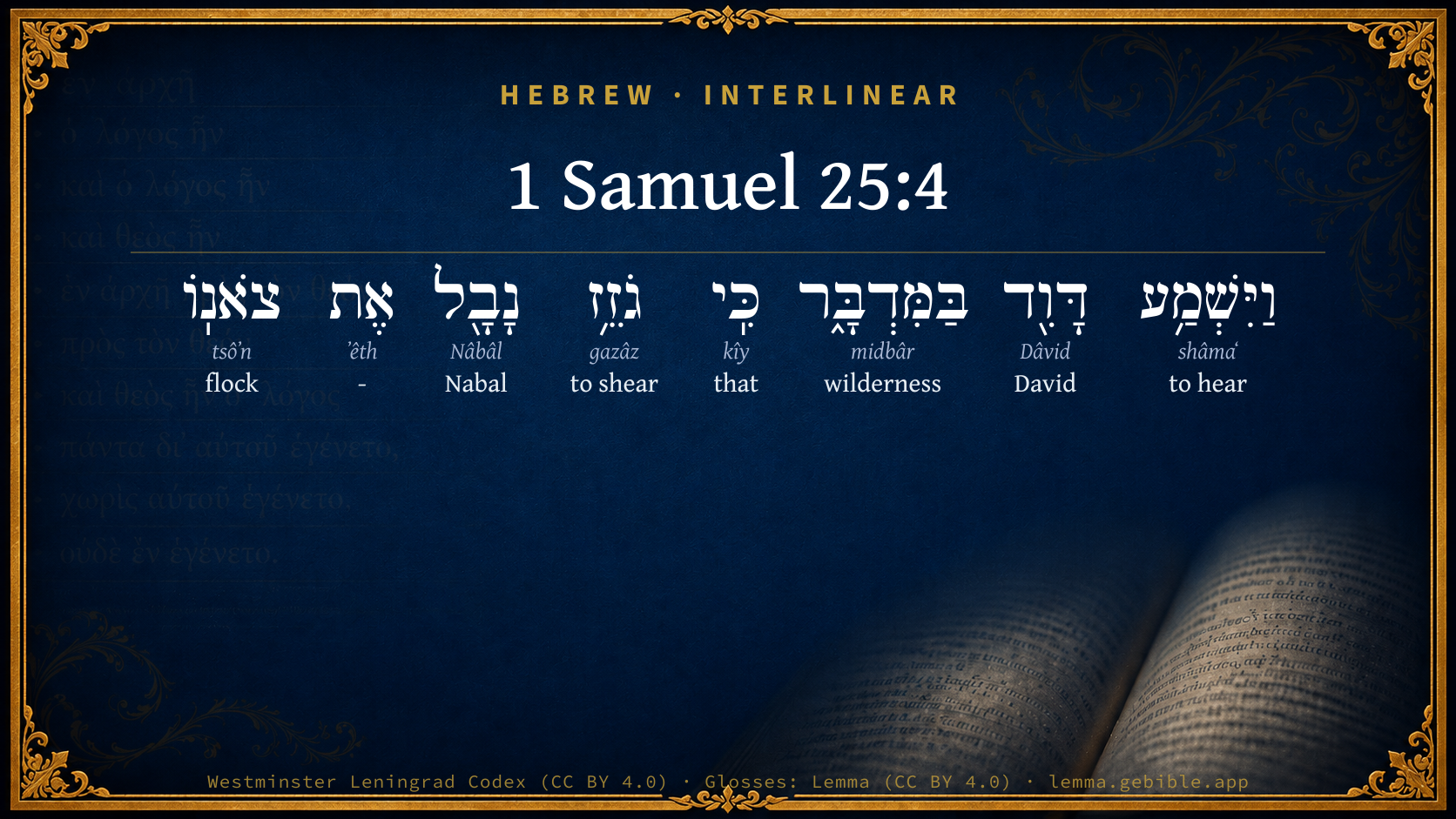
1 Samuel 25:4

Hebrew (Westminster Leningrad Codex) 1 Samuel 25:4 appears in the Hebrew Old Testament. The text above is from the Westminster Leningrad Codex. Each word links to its Strong’s number, a concise gloss, and parsing drawn from the Open Scriptures Hebrew Bible morphology. Click any word for its full Brown-Driver-Briggs (BDB) entry.
Download image
Cite this verse

1 Samuel 25:4 (World English Bible). Public Domain. Lemma interlinear Bible study tool, https://lemma.gebible.app/v/1-samuel/25/4.

Show BibTeX & RIS
BibTeX
RIS
English Translation
David heard in the wilderness that Nabal was shearing his sheep.
World English Bible · Public Domain
Download a study sheet

One document with this verse’s original text, its word-by-word gloss line, the meaning frame, cross-references with their text, attributed commentary, and full source and license credits — printable, and it pastes into notes with its structure intact.

This verse Autodidact and up

Study sheet (.html) Plain text (.txt)

A passage Seminary Student

Up to 50 verses in one chapter. A passage sheet keeps up to 6 commentary sources and 12 cross-references per verse, in the order this page ranks them, and says so on the sheet whenever that leaves anything out. Ask for a single verse and you get the Autodidact verse sheet above.

Everything on this page stays free to read, with no account — the sheet is a download of what is already on screen, not access to it.

Want to remove ads? Support Godless Engineer
Compare translations 3

The same verse in 3 English versions, stacked beneath the original-language interlinear above. Click any original word for its lexicon entry.

Each is an independent rendering of the whole verse — the interlinear is not word-aligned to these translations.

Highlighted words mark where these versions differ — a whole-verse word diff, not a word-by-word alignment.

  • World English Bible Public Domain
    David heard in the wilderness that Nabal was shearing his sheep.
  • King James Version Public Domain
    And David heard in the wilderness that Nabal did shear his sheep.
  • unfoldingWord Literal Text CC BY-SA 4.0
    And David heard in the wilderness that Nabal was shearing his sheep.

unfoldingWord Literal Text — © unfoldingWord, licensed CC BY-SA 4.0. Word-aligned USFM3 via Door43 (git.door43.org/unfoldingWord/en_ult).

Versions to compare (up to 4)

3 of 4 selected

Show all 18 translations

Every available English version of this verse, each an independent rendering of the whole verse.

  • World English Bible Public Domain
    David heard in the wilderness that Nabal was shearing his sheep.
  • Berean Standard Bible Public Domain
    While David was in the wilderness, he heard that Nabal was shearing sheep.
  • Majority Standard Bible Public Domain
    While David was in the wilderness, he heard that Nabal was shearing sheep.
  • King James Version Public Domain
    And David heard in the wilderness that Nabal did shear his sheep.
  • American Standard Version (1901) Public Domain
    And David heard in the wilderness that Nabal was shearing his sheep.
  • Revised Version (1885) Public Domain
    And David heard in the wilderness that Nabal did shear his sheep.
  • Geneva Bible (1599) Public Domain
    And Dauid heard in the wildernesse, that Nabal did shere his sheepe.
  • Douay-Rheims (1899) Public Domain
    And when David heard in the wilderness that Nabal was shearing his sheep,
  • Young's Literal Translation Public Domain
    And David heareth in the wilderness that Nabal is shearing his flock,
  • Literal Standard Version CC BY-SA 4.0
    And David hears in the wilderness that Nabal is shearing his flock,
  • Unlocked Literal Bible CC BY-SA 4.0
    David heard in the wilderness that Nabal was shearing his sheep.
  • unfoldingWord Literal Text CC BY-SA 4.0
    And David heard in the wilderness that Nabal was shearing his sheep.
  • Darby Bible Public Domain
    And David heard in the wilderness that Nabal was shearing his sheep.
  • World Messianic Bible Public Domain
    David heard in the wilderness that Nabal was shearing his sheep.
  • Webster's Bible Public Domain
    And David heard in the wilderness that Nabal was shearing his sheep.
  • Free Bible Version CC BY-SA 4.0
    David was in the wilderness, and he heard that Nabal was shearing sheep.
  • Bible in Basic English Public Domain
    And David had word in the waste land that Nabal was cutting the wool of his sheep.
  • JPS Tanakh (1917) Public Domain
    And David heard in the wilderness that Nabal was shearing his sheep.

Literal Standard Version (2020), Covenant Press — licensed CC BY-SA 4.0. Text via the HelloAO Bible API (eBible.org). Unlocked Literal Bible (unfoldingWord) — licensed CC BY-SA 4.0. Text via the HelloAO Bible API (eBible.org). unfoldingWord Literal Text — © unfoldingWord, licensed CC BY-SA 4.0. Word-aligned USFM3 via Door43 (git.door43.org/unfoldingWord/en_ult). Free Bible Version, Dr. Jonathan Gallagher — licensed CC BY-SA 4.0. Text via the HelloAO Bible API (eBible.org).

Word by word

More ways to search: Search by grammar → Find every occurrence → Compare this word →

Practice this passage: Drill this verse → Learn its vocabulary →

About this verse

These counts appear in no published source. They are computed here, from the morphology-tagged text and Lemma’s own curated glosses. What Lemma adds →

8
words
8
distinct lemmas
Historical
section

Notable vocabulary

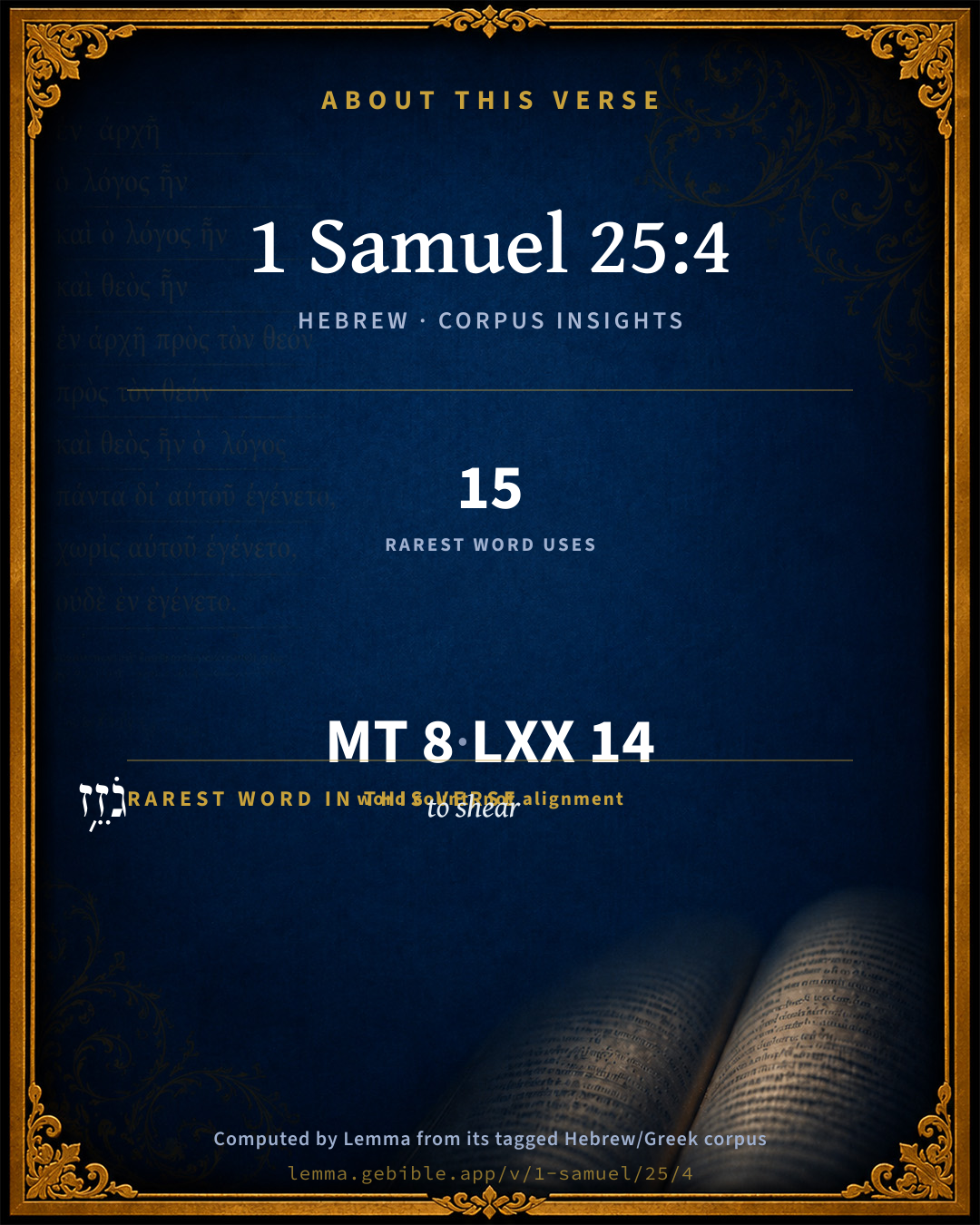
The rarest word here is גֹזֵ֥ז to shear H1494 — appearing just 15 times in the whole Hebrew Bible.

Shared distinctive vocabulary

גֹזֵ֥ז to shear H1494 occurs in 15 verses of the Hebrew Bible. Also found in:

Grammatical profile

  • 2 verbs
  • 4 nouns
  • 1 conjunction
  • 1 particle

Verb forms

  • וַיִּשְׁמַ֥ע Qal · Sequential Imperfect
  • גֹזֵ֥ז Qal · Participle Active

Hebrew & Septuagint length

In English translation the verse runs 11 words from the Hebrew and 14 from the Septuagint (LXX English) — closely comparable.

A rough comparison of the two English renderings, which tokenize alike — not a word-level alignment.

Word counts can differ between the Hebrew and the Greek without any difference in meaning — e.g. the Hebrew direct-object marker אֵת has no separate Greek word, and Greek often adds the article ὁ.

In the original languages it is 8 Hebrew tokens and 14 Greek tokens — but the two are counted differently (Hebrew bundles its prefixes and suffixes into one token; the Greek is in lemma form), so that isn’t a like-for-like length.

Cross-references

2

Topical passages linked to 1 Samuel 25:4 in the Treasury of Scripture Knowledge — connected by theme and wording, ordered by reader-vote popularity; previews shown in the World English Bible.

  • Genesis 38:13 It was told Tamar, saying, "Behold, your father-in-law is going up to Timnah to shear his sheep."
  • 2 Samuel 13:23 It happened after two full years, that Absalom had sheep-shearers in Baal Hazor, which is beside Ephraim: and Absalom invited all the king's sons.

Cross-references courtesy of OpenBible.info (CC BY 4.0).

Hebrew and Greek witnesses Masoretic Hebrew ↔ Greek Septuagint

The same verse in the two great witnesses to the Old Testament, shown verse-for-verse.

These are two independent witnesses, not word-aligned to each other, and the Septuagint is shown in lemma (dictionary) form.

Hebrew 1 Samuel 25:4 Masoretic · Westminster Leningrad Codex

וַיִּשְׁמַ֥ע דָּוִ֖ד בַּמִּדְבָּ֑ר כִּֽי גֹזֵ֥ז נָבָ֖ל אֶת צֹאנֽוֹ

David heard in the wilderness that Nabal was shearing his sheep.

World English Bible · Public Domain

Greek LXX 1 Samuel 25:4 Septuagint · lemma form

καί ἀκούω δαυίδ ἐν ὁ ἔρημος ὅτι κείρω ναβαλ ὁ καρμήλιος ὁ ποίμνιον αὐτός

And David heard in the wilderness, that Nabal the Carmelite was shearing his sheep.

LXX2012 (modern English Septuagint) · Public Domain

Hebrew: Westminster Leningrad Codex (CC BY 4.0). Greek: Septuagint (public domain); English from LXX2012 (modern English Septuagint) (Public Domain). How the Septuagint differs from the Hebrew →

Targum (Aramaic paraphrase)

1

The Targum is the ancient Jewish Aramaic paraphrase of the Hebrew Scriptures — an interpretive translation, not the Hebrew text itself. Onkelos (literal) and Pseudo-Jonathan (expansive) render the Torah, and Jonathan the Prophets. Coverage is partial: where no permissively-licensed English translation exists for a verse, only the Aramaic is shown. This is verse-level text, not a word-by-word alignment to the Hebrew.

  1. Targum Jonathan Prophets (Joshua–Malachi)
    וּשְׁמַע דָוִד בְּמַדְבְּרָא אֲרֵי גָזֵיז נָבָל יַת עָנֵיהּ:

    (no public-domain English translation for this verse)

    Targum Jonathan — Aramaic: “Mikraot Gedolot” (public domain). English: “Sefaria Community Translation” (CC0 1.0 (public-domain dedication)); “London "Chaldee Paraphrase," 1871” (public domain). Text via Sefaria.

Commentary

Notes on 1 Samuel 25:4 from classic Christian and Jewish commentators (each source and its license shown beneath its notes). The classic Christian expositions comment on the surrounding passage and are grouped to its opening verse, so a note may address several verses; the Jewish commentaries on the Tanakh (Rashi and others) are per-verse, so they appear only where the commentator wrote on this verse.

Lemma curates 59 commentaries, every one of them public domain or Creative Commons licensed, each selected and text-cleaned for this edition rather than reprinted as found. About our sources →

Trapp's Complete Commentary

John Trapp

1Sa 25:4 And David heard in the wilderness that Nabal did shear his sheep.

Ver. 4. That Nabal did shear his sheep.] At which time the Jews used to make great feasts, in remembrance of their forefathers that were shepherds, saith Lyra.

John Trapp, A Commentary or Exposition upon All the Books of the Old and New Testament (1647–1656) — public domain. Text from a community e-Sword module.

The Biblical Illustrator

Joseph S. Exell

1Sa_25:4-13

And David heard in the wilderness that Nabal did shear his sheep.

Nabal, the churl

David never made a wiser choice, and he never said a truer thing, than when he exclaimed, Let me fall now into the hand of the Lord (for His mercies are great), and let me not fall into the hand of man. The history of Davids collision with Nabal furnishes us with a twofold confirmation of the truth of Davids assertion and the wisdom of his decision. David, in a season of feebleness, sought to rest himself upon Nabals gratitude, and he found that be was trusting in the staff of a broken reed which pierced him. In his necessity he made an appeal to Nabals generosity, and he found it was as vain as trying to quench his thirst with the waters of Marah. On the other hand, Nabals ingratitude and unkindness met with no charity at first on the part of David. While Nabal was utterly destitute of brotherly kindness, David failed for a time in the love which is not easily provoked. Whether it be for the relief of our necessities, or for the pardon of our transgressions, let us fall now into the hand of the Lord, for His mercies are great. Everything around Nabal was calculated to make him a happy, thankful, sweet-tempered, and kindhearted man. He had good blood in his veins; and by the memories of his noble and godly ancestor he ought to have been restrained from all that was mean and graceless. The inspired writer alludes be his ancestry as if that increased the guilt of his conduct. he was of the house of Caleb; but he was a bad branch growing out of a good stock, for he was churlish and evil in his doings. Alas! he was neither the first nor the last of those who have come into possession of many of the temporal results of their fathers piety, but have shamefully repudiated the godliness which brought the golden harvest. The Bible makes the nobleness of a mans ancestry one more reason why he should serve the Lord and cleave to Him with full purpose of heart. The prophet Jeremiah went with words of sharp rebuke and heavy condemnation to one who was proving himself a degenerate son of a godly sire, Did not thy father eat, and drink, and do judgment and justice, and then it was well with him? But thine eyes and thine heart are not but for thy covetousness, and for oppression, and for violence, to do it. Nabal had what many would deem a far more substantial reason for personal goodness than the fact that he belonged to the house of Caleb. The wealth which had come down to him had evidently been increased by the Divine blessing on his own endeavours, and he stood forth conspicuous above all his neighbours for the splendour and luxury with which he could surround himself. The man was very great, but his prosperity hardened his heart and filled his spirit with haughtiness. The arrogance of spirit, and coarseness of speech, and niggardliness of heart, which Nabal displayed, were unmistakable proofs that in his prosperity he had forgotten the God to whom he was indebted for it. Hence that which should have made his lowliness to grow and blossom like a lily of the valley, did only serve to make his poisonous pride flourish like the deadly nightshade, and that which should have filled him with grateful love to God and generous love to men, only helped to increase his self-indulgence and his self-idolatry. There was another reason why better things might have been reasonably expected of Nabal. God had given him a true help-meet--a woman who, if he had yielded to her influence, would have done much to lift him out of his roughness and wickedness into refinement and godliness. It is one of the marvels of human nature that some rough and selfish men can live for year after year in fellowship with gentle and self-denying women, and yet be no more impressed and improved by them than the dead heart of Absalom was moved by the tears and wailings of his disconsolate father. If such men die impenitent and unpardoned, surely for them condemnation will be heavy and perdition will be deep! David was in danger of perishing for lack of a little of that of which Nabal had such an abundance, and therefore the appeal for relief was sent. Amongst the Jews, and other Eastern peoples, the time of sheep shearing was commonly the season of special liberality. Beside the force of good old customs, there was another reason why on that particular day Davids solicitation was seasonable. It was partly on the ground that his men had been guardians of the flocks that David rested his appeal, and there could not be a better time for that appeal than the season when the flocks were counted and the fleeces were gathered. Many have thought that the prudence and policy of Davids conduct, were more obvious than its dignity. Did he not in some measure demean himself, they ask, by setting forth so fully the services he had rendered? It is not usual, they say, be do a man a good turn, and then to go and tell him all about it, and ask for some grateful recognition of it. Before we blame David for being undignified, let us try to realize his position and his temptations, he must have been in great straits, or he would never have sent in such a way to a man like Nabal. There are people whom you cannot fully know until you ask them for something. While no direct appeal is made to their supposed benevolence, their real character is masked; but the moment you press them to be generous, despite all their efforts to wear it still, the severing drops off, and they stand forth in all their native unsightliness. To what a revelation of Nabals heart the prayer of David led! Nabal could not say it was the wrong day for charity, so he said this was a wrong case. Such people are never destitute of reasons for not giving, and are not ashamed to try and cover their niggardliness with excuses so flimsy that even the sight of a bat would be strong enough to pierce them. If he had been placed in circumstances like Abraham, and angels had come to partake of his hospitality, he would probably have cried out, Give my bread and flesh to people with wings! What next, I wonder! The provocation to David must have been great, and we are more grieved than surprised that at once his soul was all on fire with wrath. David forgot how much God had done for Nabal, what ingratitude God had received at Nabals hand, and yet how patiently God had borne with him for many years, and how lavishly God had blessed him despite all his guiltiness. We might have hoped that, instead of fostering human vengeance, David would have striven to imitate Divine long-suffering; but, the wisest men are not always wise, and the best men are not always consistent. The history shows, what is very credible, that Nabal was a great coward as well as a coarse blusterer. When he heard of Davids indignation his heart died within him, and he became as a stone. It would seem as if the weight of his own craven fears helped to sink him into the grave. Possibly his own cowardice was the instrument with which the Lord smote him; and the terrors of his guilty spirit were the disease of which he died. This much is certain, he perished for his sins. The very day wherein he refused relief to those who had befriended him, he held a feast in his house like the feast of a king. He was utterly wanting in meekness and gentleness, courtesy and kindness. He would indulge himself even to gluttony and drunkenness, and yet refused his bread to those who were ready to perish. His name has become imperishable by being written in the book which is to be translated into every tongue and read in every land; but the immortality which Scripture has given him is an immortality of infamy. (C. Vince.)

The Biblical Illustrator, edited by Joseph S. Exell (c. 1880s–1900s) — public domain. Text from a community e-Sword module.

Joseph Benson's Commentary

1Sa 25:4-6. Nabal did shear his sheep — Which times were celebrated with feasting. That liveth in prosperity — In the Hebrew it is, To him that liveth, but the word life in Scripture often signifies happiness, as death signifies misery. By speaking thus, David both congratulates Nabal’s felicity, and tacitly intimates to him the distress in which he and his men were.

Joseph Benson's Commentary on the Old and New Testaments (1811–1818) — public domain. Text from a community e-Sword module.

Jamieson, Fausset & Brown

Robert Jamieson, A. R. Fausset & David Brown

Nabal did shear his sheep, and David sent out ten young men, &c.--David and his men lurked in these deserts, associating with the herdsmen and shepherds of Nabal and others and doing them good offices, probably in return for information and supplies obtained through them. Hence when Nabal held his annual sheep-shearing in Carmel, David felt himself entitled to share in the festival and sent a message, recounting his own services and asking for a present. "In all these particulars we were deeply struck with the truth and strength of the biblical description of manners and customs almost identically the same as they exist at the present day. On such a festive occasion, near a town or village, even in our own time, an Arab sheik of the neighboring desert would hardly fail to put in a word either in person or by message; and his message, both in form and substance, would be only a transcript of that of David" [ROBINSON].

Jamieson, Fausset & Brown — Commentary Critical and Explanatory on the Whole Bible (1871) — public domain (CC PDM 1.0). Text via the HelloAO Bible API.

Ellicott's Commentary for English Readers

(4) And David heard in the wilderness.—The question of the support of the large band of devoted followers who obeyed David must have been usually a very anxious one. No doubt, contributions from the farmers and sheep-masters materially aided the supplies David and his men derived from their raids across the Philistine borders. It is likely enough that some of these contributions were not always willingly made; still, there is no doubt that the presence of the armed band of David during the latter years of Saul afforded considerable protection to the border land. His position resembled that of a modern Arab sheik of a friendly Bedaween tribe, and it is clear that on the whole his career as head of an army of free lances tended to popularise him among the southern tribes of Israel. Nabal’s conduct appears to have been more than churlish and foolish, for David, according to the showing of Nabal’s own shepherds, had on many occasions been of substantial service to them as they tended their flocks in exposed and dangerous localities. The testimony of these shepherd folk may be accepted generally as the popular estimate of David and his acts during this rough and sorely tried period of his life.

A Bible Commentary for English Readers, edited by Charles John Ellicott (1878–1897) — public domain. Text from a community e-Sword module.

John Gill's Exposition

And David heard in the wilderness,.... In the wilderness of Paran, where he was, and a wilderness it was to him, being in want of food, as the following relation shows:

that Nabal did shear his sheep; when there was generally good living, and so a proper person, and a proper time, for David to apply for the relief of his wants.

John Gill's Exposition of the Whole Bible (1746–1763) — public domain (CC PDM 1.0). Text via the HelloAO Bible API.

Matthew Poole's English Annotations

Which times were celebrated with feasting and jollity. See 2Sa 13:23,24.

Matthew Poole's English Annotations on the Holy Bible (1683–1685) — public domain. Text from a community e-Sword/MySword module.

The Pulpit Commentary

Vers. 4, 5. Though David had gone some distance southward of Carmel, yet it was worth his while to send men to Nabal"s sheep shearing, as the maintenance of his numerous force must have been a continual difficulty. The large number, ten, also shows that he expected a liberal gift of food. Probably such missions were not uncommon, and the large sheep masters were glad to supply the wants of one who guarded their flocks and defended them from the incursions of the desert tribes.

The Pulpit Commentary (1880–1919), ed. H.D.M. Spence-Jones & Joseph S. Exell — public domain. Text from a community e-Sword module.

John Wesley's Explanatory Notes

Shear sheep - Which times were celebrated with feasting.

John Wesley, Explanatory Notes Upon the Whole Bible (1754–1765) — public domain. Text via the GEBible commentary corpus.

unfoldingWord translationNotes

Door43 World Missions Community

shearing his sheep

"shaving the wool off his sheep"

greet him in my name

"greet him as I would greet him if I were there"

Live in prosperity

"I desire that you may live in prosperity." The abstract noun "prosperity" can be translated as a verb. AT: "I desire that you possess many good things as long as you live" (See: Abstract Nouns)

Peace to you and peace to your house, and peace be to all that you have

"I desire that peace may come to you, your household and your possessions"

translationWords

David

desert

send

life

peace

unfoldingWord translationNotes — © Distant Shores Media and the Door43 World Missions Community, licensed CC BY-SA 4.0. Source: git.door43.org/Door43/en_tn.

Lesson kit

Teaching starters — assembled from the data on this page, not authored interpretation. Every prompt links to the verse data it draws on. Edit before teaching.

1 Samuel, in the Historical, opens this verse with 8 words (8 distinct Hebrew lemmas). Its most distinctive word is gazâz (“to shear”). A historical commentator’s framing appears above. Read the whole chapter for the surrounding context.

Discussion questions

  1. What does “to shear” (gazâz) contribute to the verse as a whole?
  2. How does Genesis 31:19, which shares the word «to shear», read alongside this verse?
  3. These translations render this verse differently; the difference is in the English rendering, not the original. What questions does that raise?
  4. «וַיִּשְׁמַ֥ע» is a Qal Sequential Imperfect verb. How does that grammatical form shape the action described?
  5. Compare how Trapp's Complete Commentary and The Biblical Illustrator read this verse. Where do they agree or differ?

Things to notice

Reading settings

Reading text

Shown beneath each verse's original-language words.

Old Testament
Old Testament edition

Read the OT as the Masoretic Hebrew (MT) or the Greek Septuagint (LXX).

English shown for the Greek Septuagint (in the Hebrew ↔ Greek comparison).

Comparing translations? Open the Compare panel on any verse page to stack up to four side by side.