
Isaiah 63:11

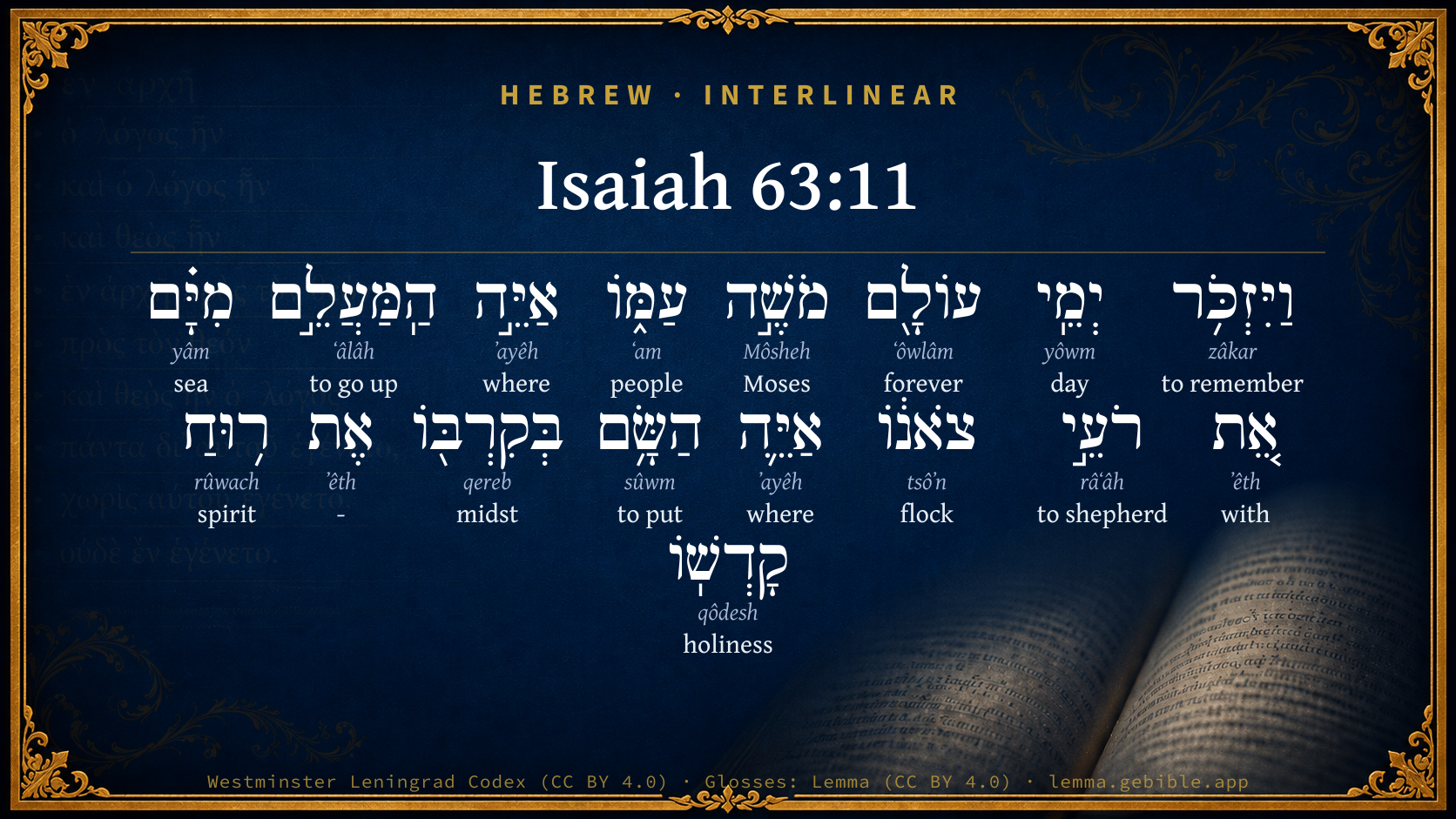
Hebrew (Westminster Leningrad Codex) Isaiah 63:11 appears in the Hebrew Old Testament. The text above is from the Westminster Leningrad Codex. Each word links to its Strong’s number, a concise gloss, and parsing drawn from the Open Scriptures Hebrew Bible morphology. Click any word for its full Brown-Driver-Briggs (BDB) entry.
Download image
Cite this verse

Isaiah 63:11 (World English Bible). Public Domain. Lemma interlinear Bible study tool, https://lemma.gebible.app/v/isaiah/63/11.

Show BibTeX & RIS
BibTeX
RIS
English Translation
Then he remembered the days of old, Moses [and] his people, [saying], Where is he who brought them up out of the sea with the shepherds of his flock? where is he who put his holy Spirit in the midst of them?
World English Bible · Public Domain
Download a study sheet

One document with this verse’s original text, its word-by-word gloss line, the meaning frame, cross-references with their text, attributed commentary, and full source and license credits — printable, and it pastes into notes with its structure intact.

This verse Autodidact and up

Study sheet (.html) Plain text (.txt)

A passage Seminary Student

Up to 50 verses in one chapter. A passage sheet keeps up to 6 commentary sources and 12 cross-references per verse, in the order this page ranks them, and says so on the sheet whenever that leaves anything out. Ask for a single verse and you get the Autodidact verse sheet above.

Everything on this page stays free to read, with no account — the sheet is a download of what is already on screen, not access to it.

Want to remove ads? Support Godless Engineer
Compare translations 3

The same verse in 3 English versions, stacked beneath the original-language interlinear above. Click any original word for its lexicon entry.

Each is an independent rendering of the whole verse — the interlinear is not word-aligned to these translations.

Highlighted words mark where these versions differ — a whole-verse word diff, not a word-by-word alignment.

  • World English Bible Public Domain
    Then he remembered the days of old, Moses [and] his people, [saying], Where is he who brought them up out of the sea with the shepherds of his flock? where is he who put his holy Spirit in the midst of them?
  • King James Version Public Domain
    Then he remembered the days of old, Moses, and his people, saying, Where is he that brought them up out of the sea with the shepherd of his flock? where is he that put his holy Spirit within him?
  • unfoldingWord Literal Text CC BY-SA 4.0
    And his people remembered the days of eternity, Moses, “Where the one having brought them up from the sea with the shepherds of his flock? Where the one having put the Spirit of his holiness in his midst,

unfoldingWord Literal Text — © unfoldingWord, licensed CC BY-SA 4.0. Word-aligned USFM3 via Door43 (git.door43.org/unfoldingWord/en_ult).

Versions to compare (up to 4)

3 of 4 selected

Show all 18 translations

Every available English version of this verse, each an independent rendering of the whole verse.

  • World English Bible Public Domain
    Then he remembered the days of old, Moses [and] his people, [saying], Where is he who brought them up out of the sea with the shepherds of his flock? where is he who put his holy Spirit in the midst of them?
  • Berean Standard Bible Public Domain
    Then His people remembered the days of old, the days of Moses. Where is He who brought them through the sea with the shepherds of His flock? Where is the One who set His Holy Spirit among them,
  • Majority Standard Bible Public Domain
    Then His people remembered the days of old, the days of Moses. Where is He who brought them through the sea with the shepherds of His flock? Where is the One who set His Holy Spirit among them,
  • King James Version Public Domain
    Then he remembered the days of old, Moses, and his people, saying, Where is he that brought them up out of the sea with the shepherd of his flock? where is he that put his holy Spirit within him?
  • American Standard Version (1901) Public Domain
    Then he remembered the days of old, Moses `and' his people, `saying', Where is he that brought them up out of the sea with the shepherds of his flock? where is he that put his holy Spirit in the midst of them?
  • Revised Version (1885) Public Domain
    Then he remembered the days of old, Moses, and his people, saying, Where is he that brought them up out of the sea with the shepherds of his flock? where is he that put his holy spirit in the midst of them?
  • Geneva Bible (1599) Public Domain
    Then he remembred the olde time of Moses and his people, saying, Where is hee that brought them vp out of the Sea with the shepheard of his sheepe? where is he that put his holy Spirit within him?
  • Douay-Rheims (1899) Public Domain
    And he remembered the days of old of Moses, and of his people: Where is he that brought them up out of the sea, with the shepherds of his flock? where is he that put in the midst of them the spirit of his Holy One?
  • Young's Literal Translation Public Domain
    And He remembereth the days of old, Moses -- his people. Where `is' He who is bringing them up from the sea, The shepherd of his flock? Where `is' He who is putting in its midst His Holy Spirit?
  • Literal Standard Version CC BY-SA 4.0
    And He remembers the days of old, || Moses—his people. Where [is] He who is bringing them up from the sea, || The shepherd of His flock? Where [is] He who is putting in its midst His Holy Spirit?
  • Unlocked Literal Bible CC BY-SA 4.0
    His people thought about the ancient times of Moses. They said, “Where is God, who brought them up out of the sea with the shepherds of his flock? Where is God, who put his Holy Spirit among them?
  • unfoldingWord Literal Text CC BY-SA 4.0
    And his people remembered the days of eternity, Moses, “Where the one having brought them up from the sea with the shepherds of his flock? Where the one having put the Spirit of his holiness in his midst,
  • Darby Bible Public Domain
    But he remembered the days of old, Moses [and] his people: Where is he that brought them up out of the sea with the shepherds of his flock? Where is he that put his holy Spirit within him,
  • World Messianic Bible Public Domain
    Then he remembered the days of old, Moses and his people, saying, “Where is he who brought them up out of the sea with the shepherds of his flock? Where is he who put his Holy Spirit among them?”
  • Webster's Bible Public Domain
    Then he remembered the days of old, Moses, and his people, saying, Where is he that brought them out of the sea with the shepherd of his flock? where is he that put his holy Spirit within him?
  • Free Bible Version CC BY-SA 4.0
    Then they thought back to the days of old when Moses led his people out of Egypt. They shouted out, “Where is the one who took Israel through the sea, along with the shepherds of his flock? Where is the one who placed his Holy Spirit among his people?
  • Bible in Basic English Public Domain
    Then the early days came to their minds, the days of Moses his servant: and they said, Where is he who made the keeper of his flock come up from the sea? where is he who put his holy spirit among them,
  • JPS Tanakh (1917) Public Domain
    Then His people remembered the days of old, the days of Moses: 'Where is He that brought them up out of the sea with the shepherds of His flock? Where is He that put His holy spirit in the midst of them?

Literal Standard Version (2020), Covenant Press — licensed CC BY-SA 4.0. Text via the HelloAO Bible API (eBible.org). Unlocked Literal Bible (unfoldingWord) — licensed CC BY-SA 4.0. Text via the HelloAO Bible API (eBible.org). unfoldingWord Literal Text — © unfoldingWord, licensed CC BY-SA 4.0. Word-aligned USFM3 via Door43 (git.door43.org/unfoldingWord/en_ult). Free Bible Version, Dr. Jonathan Gallagher — licensed CC BY-SA 4.0. Text via the HelloAO Bible API (eBible.org).

Word by word

More ways to search: Search by grammar → Find every occurrence → Compare this word →

Practice this passage: Drill this verse → Learn its vocabulary →

אַיֵּ֣ה
ʼayêh
H346
“where”
Particle, Interrogative
Part of Speech
Particle
Type
Interrogative
Full BDB Definition

Origin: prolonged from H335

TWOT: 75a

where? - of persons, things - rhetorical
  1. וַיִּזְכֹּ֥ר zâkar H2142 “and · to remember” Conjunction + Verb, Qal, Sequential Imperfect, 3rd Person, Masculine, Singular
  2. יְמֵֽי yôwm H3117 “days of” Noun, Common, Masculine, Plural, Construct
  3. עוֹלָ֖ם ʻôwlâm H5769 “forever” Noun, Common, Masculine, Singular, Absolute
  4. מֹשֶׁ֣ה Môsheh H4872 “Moses” Noun, Proper
  5. עַמּ֑וֹ ʻam H5971 “people · his” Noun, Common, Masculine, Singular, Construct + Suffix, Personal, 3rd Person, Masculine, Singular
  6. הַֽמַּעֲלֵ֣ם ʻâlâh H5927 “the · going up · them” Particle, Definite Article + Verb, Hiphil, Participle Active, Masculine, Singular, Construct + Suffix, Personal, 3rd Person, Masculine, Plural
  7. מִיָּ֗ם yâm H3220 “from · sea” Preposition + Noun, Common, Masculine, Singular, Absolute
  8. אֵ֚ת ʼêth H854 “with” Preposition
  9. רֹעֵ֣י râʻâh H7462 “shepherding” Verb, Qal, Participle Active, Masculine, Plural, Construct
  10. צֹאנ֔וֹ tsôʼn H6629 “flock · his” Noun, Common, Both, Singular, Construct + Suffix, Personal, 3rd Person, Masculine, Singular
  11. אַיֵּ֛ה ʼayêh H346 “where” Particle, Interrogative
  12. הַשָּׂ֥ם sûwm H7760 “the · putting” Particle, Definite Article + Verb, Qal, Participle Active, Masculine, Singular, Absolute
  13. בְּקִרְבּ֖וֹ qereb H7130 “in/at · midst · his” Preposition + Noun, Common, Masculine, Singular, Construct + Suffix, Personal, 3rd Person, Masculine, Singular
  14. אֶת ʼêth H853 “-” Particle, Direct Object
  15. ר֥וּחַ rûwach H7307 “spirit of” Noun, Common, Both, Singular, Construct
  16. קָדְשֽׁוֹ qôdesh H6944 “holiness · his” Noun, Common, Masculine, Singular, Construct + Suffix, Personal, 3rd Person, Masculine, Singular

About this verse

These counts appear in no published source. They are computed here, from the morphology-tagged text and Lemma’s own curated glosses. What Lemma adds →

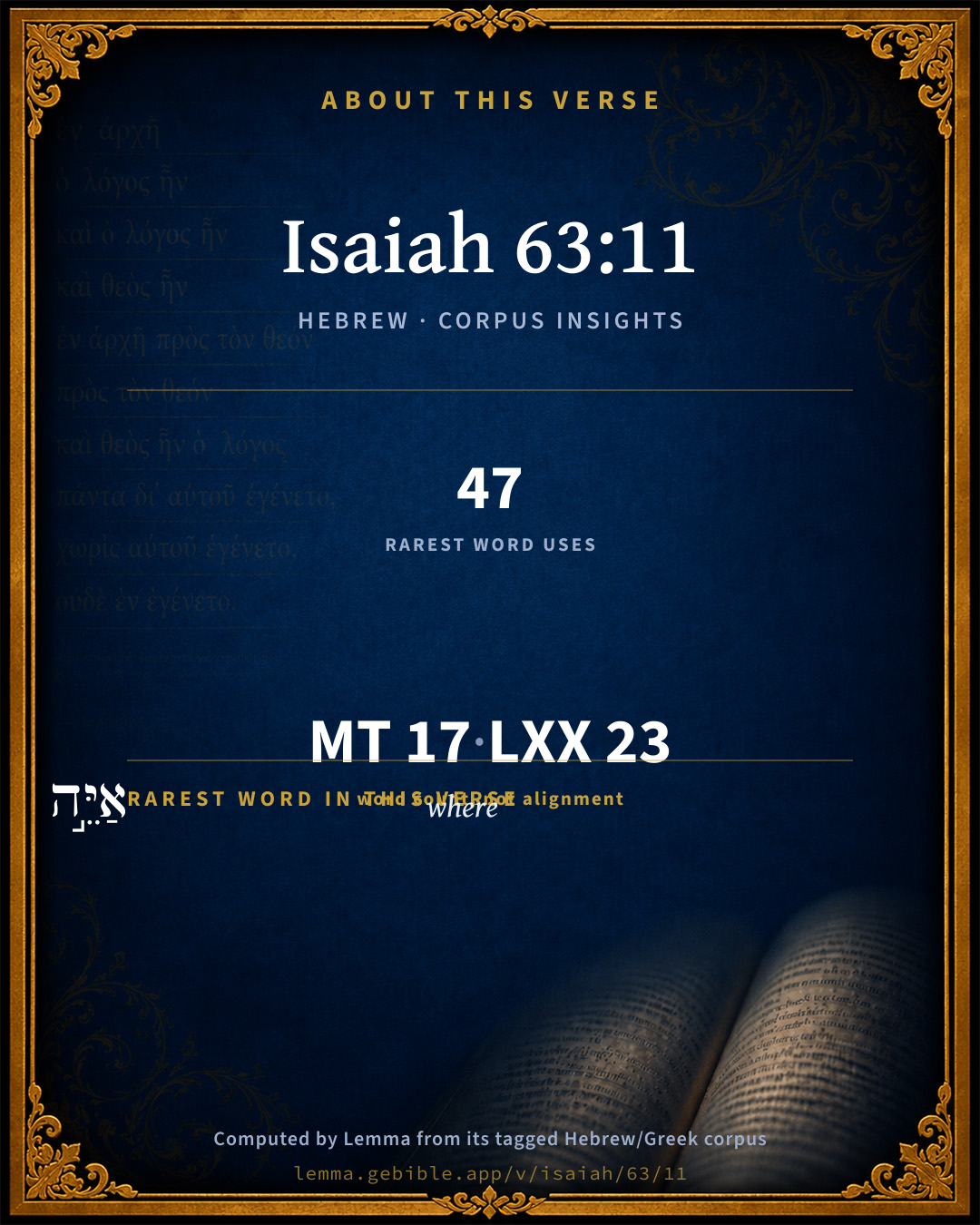
17
words
16
distinct lemmas
Prophets
section

Shared distinctive vocabulary

אַיֵּ֣ה where H346 occurs in 40 verses of the Hebrew Bible. Also found in:

Grammatical profile

  • 4 verbs
  • 9 nouns
  • 1 preposition
  • 3 particles

Verb forms

  • וַיִּזְכֹּ֥ר Qal · Sequential Imperfect
  • הַֽמַּעֲלֵ֣ם Hiphil · Participle Active
  • רֹעֵ֣י Qal · Participle Active
  • הַשָּׂ֥ם Qal · Participle Active

Repetition

A word recurs within this verse — often emphatic in Hebrew:

  • אַיֵּ֣ה where H346 ×2

Hebrew & Septuagint length

In English translation the verse runs 42 words from the Hebrew and 31 from the Septuagint (LXX English) — closely comparable.

A rough comparison of the two English renderings, which tokenize alike — not a word-level alignment.

Word counts can differ between the Hebrew and the Greek without any difference in meaning — e.g. the Hebrew direct-object marker אֵת has no separate Greek word, and Greek often adds the article ὁ.

In the original languages it is 17 Hebrew tokens and 23 Greek tokens — but the two are counted differently (Hebrew bundles its prefixes and suffixes into one token; the Greek is in lemma form), so that isn’t a like-for-like length.

Cross-references

22

Topical passages linked to Isaiah 63:11 in the Treasury of Scripture Knowledge — connected by theme and wording, ordered by reader-vote popularity; previews shown in the World English Bible.

  • Numbers 11:17 I will come down and talk with you there: and I will take of the Spirit which is on you, and will put it on them; and they shall bear the burden of the people with you, that you not bear it yourself alone.
  • Exodus 14:22 The children of Israel went into the midst of the sea on the dry ground, and the waters were a wall to them on their right hand, and on their left.
  • Numbers 11:25 Yahweh came down in the cloud, and spoke to him, and took of the Spirit that was on him, and put it on the seventy elders: and it happened that when the Spirit rested on them, they prophesied, but they did so no more.
  • Psalms 77:20 You led your people like a flock, By the hand of Moses and Aaron.
  • Haggai 2:5 This is the word that I covenanted with you when you came out of Egypt, and my Spirit lived among you. Don't be afraid.'
  • Numbers 11:29 Moses said to him, Are you jealous for my sake? would that all Yahweh's people were prophets, that Yahweh would put his Spirit on them!
  • Zechariah 4:6 Then he answered and spoke to me, saying, "This is the word of Yahweh to Zerubbabel, saying, 'Not by might, nor by power, but by my Spirit,' says Yahweh of Hosts.
  • Luke 1:54–55 He has given help to Israel, his servant, that he might remember mercy,
  • Exodus 14:30 Thus Yahweh saved Israel that day out of the hand of the Egyptians; and Israel saw the Egyptians dead on the seashore.
  • Exodus 32:11–12 Moses begged Yahweh his God, and said, "Yahweh, why does your wrath burn hot against your people, that you have brought forth out of the land of Egypt with great power and with a mighty hand?
  • Leviticus 26:40–45 "'If they confess their iniquity, and the iniquity of their fathers, in their trespass which they trespassed against me, and also that, because they walked contrary to me,
  • Numbers 14:13–25 Moses said to Yahweh, Then the Egyptians will hear it; for you brought up this people in your might from among them;
  • Deuteronomy 4:30–31 When you are in oppression, and all these things are come on you, in the latter days you shall return to Yahweh your God, and listen to his voice:
  • Nehemiah 9:20 You gave also your good Spirit to instruct them, and didn't withhold your manna from their mouth, and gave them water for their thirst.
  • Psalms 25:6 Yahweh, remember your tender mercies and your loving kindness, For they are from old times.
  • Psalms 77:5–11 I have considered the days of old, The years of ancient times.
  • Psalms 89:47–50 Remember how short my time is! For what vanity have you created all the children of men!
  • Psalms 143:5 I remember the days of old. I meditate on all your doings. I contemplate the work of your hands.
  • Isaiah 51:9–10 Awake, awake, put on strength, arm of Yahweh; awake, as in the days of old, the generations of ancient times. Isn't it you who did cut Rahab in pieces, who pierced the monster?
  • Isaiah 63:15 Look down from heaven, and see from the habitation of your holiness and of your glory: where are your zeal and your mighty acts? the yearning of your heart and your compassion is restrained toward me.
  • Jeremiah 2:6 Neither said they, Where is Yahweh who brought us up out of the land of Egypt, who led us through the wilderness, through a land of deserts and of pits, through a land of drought and of the shadow of death, through a land that none passed through, and where no man lived?
  • Daniel 4:8 But at the last Daniel came in before me, whose name was Belteshazzar, according to the name of my god, and in whom is the spirit of the holy gods: and I told the dream before him, [saying],

Cross-references courtesy of OpenBible.info (CC BY 4.0).

Hebrew and Greek witnesses Masoretic Hebrew ↔ Greek Septuagint

The same verse in the two great witnesses to the Old Testament, shown verse-for-verse.

These are two independent witnesses, not word-aligned to each other, and the Septuagint is shown in lemma (dictionary) form.

Hebrew Isaiah 63:11 Masoretic · Westminster Leningrad Codex

וַיִּזְכֹּ֥ר יְמֵֽי עוֹלָ֖ם מֹשֶׁ֣ה עַמּ֑וֹ אַיֵּ֣ה הַֽמַּעֲלֵ֣ם מִיָּ֗ם אֵ֚ת רֹעֵ֣י צֹאנ֔וֹ אַיֵּ֛ה הַשָּׂ֥ם בְּקִרְבּ֖וֹ אֶת ר֥וּחַ קָדְשֽׁוֹ

Then he remembered the days of old, Moses [and] his people, [saying], Where is he who brought them up out of the sea with the shepherds of his flock? where is he who put his holy Spirit in the midst of them?

World English Bible · Public Domain

Greek LXX Isaiah 63:11 Septuagint · lemma form

καί μιμνήσκω ἡμέρα αἰώνιος ὁ ἀναβιβάζω ἐκ ὁ γῆ ὁ ποιμήν ὁ πρόβατον ποῦ εἰμί ὁ τίθημι ἐν αὐτός ὁ πνεῦμα ὁ ἅγιος

Then he remembered the ancient days, saying, Where is he that brought up from the sea the shepherd of the sheep? where is he that put his Holy Spirit in them?

LXX2012 (modern English Septuagint) · Public Domain

On this verse, Keil & Delitzsch discusses the Septuagint’s reading. Read the note in Commentary ↓

Hebrew: Westminster Leningrad Codex (CC BY 4.0). Greek: Septuagint (public domain); English from LXX2012 (modern English Septuagint) (Public Domain). How the Septuagint differs from the Hebrew →

Targum (Aramaic paraphrase)

1

The Targum is the ancient Jewish Aramaic paraphrase of the Hebrew Scriptures — an interpretive translation, not the Hebrew text itself. Onkelos (literal) and Pseudo-Jonathan (expansive) render the Torah, and Jonathan the Prophets. Coverage is partial: where no permissively-licensed English translation exists for a verse, only the Aramaic is shown. This is verse-level text, not a word-by-word alignment to the Hebrew.

  1. Targum Jonathan Prophets (Joshua–Malachi)
    וְחָס עַל יְקַר שְׁמֵהּ בְּדִיל דוּכְרָן טַבְוָתֵהּ דְמִן עַלְמָא גְבוּרָן דַעֲבַד עַל יְדֵי מֹשֶׁה לְעַמֵהּ דִלְמָא יֵימַר אָן דְאַסְקִינוּן מִן יַמָא אָן דְדַבְּרִינוּן בְּמַדְבְּרָא כְּרַעֲיָא לְעָנֵהּ אָן דְאַשְׁרֵי בֵינֵיהוֹן יַת מֵימַר נְבִיֵי קוּדְשֵׁהּ:

    And He had compassion for the glory of His name, because of the remembrance of His goodness of old, the mighty works which He did by the hands of Moses for His people; lest the Gentiles should say, Where is He that brought them up out of the sea? Where is He that led them through the wilderness, as a shepherd his flock? Where is He that made the word of His holy prophets to dwell amongst them?

    Targum Jonathan — Aramaic: “Mikraot Gedolot” (public domain). English: “Sefaria Community Translation” (CC0 1.0 (public-domain dedication)); “London "Chaldee Paraphrase," 1871” (public domain). Text via Sefaria.

Commentary

Notes on Isaiah 63:11 from classic Christian and Jewish commentators (each source and its license shown beneath its notes). The classic Christian expositions comment on the surrounding passage and are grouped to its opening verse, so a note may address several verses; the Jewish commentaries on the Tanakh (Rashi and others) are per-verse, so they appear only where the commentator wrote on this verse.

Lemma curates 59 commentaries, every one of them public domain or Creative Commons licensed, each selected and text-cleaned for this edition rather than reprinted as found. About our sources →

Trapp's Complete Commentary

John Trapp

Isa 63:11 Then he remembered the days of old, Moses, [and] his people, [saying], Where [is] he that brought them up out of the sea with the shepherd of his flock? where [is] he that put his holy Spirit within him?

Ver. 11. Then he remembered,] i.e., Israel remembered the days of old; Heb., Of antiquity, the days of yore, as some old translations have it. See Psa 89:50, &c.

Saying, Where is he that brought them up out of the sea?] q.d., How is it that he is not now to be found, as then he was for the succour of his poor people? They had "vexed his Holy Spirit," and therefore he withdrew himself. See Hos 5:6.

With the shepherd of his flock.] Or, Shepherds - as some ancient copies had it - viz., Moses and Aaron. {Psa 77:20}

Where is he that put his Holy Spirit within him?] But this Holy Spirit they had vexed, {Isa 63:10} and now they sorrowfully inquire after. Delicata res est Spiritus Sanctus; ita nos tractat, sicut tractatur, saith a father - i.e., The Spirit of God is a delicate thing; he deals with us, as we deal by him.

John Trapp, A Commentary or Exposition upon All the Books of the Old and New Testament (1647–1656) — public domain. Text from a community e-Sword module.

The Biblical Illustrator

Joseph S. Exell

Isa_63:11-14

Then he remembered the days of old

Israel rembering Gods dealings with His people

It is possible that the words Moses and His people are marginal explanations, the former to shepherd and the latter to he: Then he (Israel) remembered the days of old, saying, Where is He (God). . . with the shepherd of flock (Moses) . . . His holy Spirit within it! (the flock).

(A. B. Davidson, D. D.)

Where is the Lord?

I. A SACRED, LOVING REMEMBRANCE. The people remembered what God did to them. What was it?

1. He gave them leaders. Where is He that brought them up out of the sea? etc. Moses and Aaron, and a band of godly men who were with them, were the leaders of the people, through the sea and through the wilderness. We are apt to think too little of our leaders. First of all we think too much of them. We seem to swing like a pendulum between these two extremes. There have been epochs in history that were prolific of great leaders of the Christian Church. No sooner did Luther give his clarion call, than God seemed to have a bird in every bush; and Calvin, and Farel, and Melancthon, and Zwingle, and many besides joined him in his brave protest against the harlot-church of Rome. The Church remembers those happy days, with earnest longing for their return.

2. God put His Spirit within these shepherds. They would have been nothing without it. A man with Gods Holy Spirit within him, can anybody estimate his worth?

3. Then there was, as a happy memory for the Church, a great manifestation of the Divine power. That let them by the right hand of Moses. The right hand of Moses, by itself, was no more than your right hand or mine; but when Gods glorious arm worked by the right hand of Moses, the sea divided, and made a way for the hosts of Israel to pass over. What we want to-day is a manifestation of Divine power.

4. Then there came to Gods people a very marvellous deliverance: That led them,, through the deep, as a horse in the wilderness, that they should not stumble. Understand by the word wilderness here, an expansive grassy plain; a place of wild grass and Kerbs, for so it means. And as a horse is led where it is flat and level, and he does not stumble, so were the hosts of Israel led through the Red Sea. God has done so with His Church in all time. Her seas of difficulty have had no difficulty about them.

5. As a blessed ending to their trials, God brought them into a place of rest: As a beast goeth down into the valley, the Spirit of the Lord causeth him to rest: so didst Thou lead Thy people. In the desert they rested a good deal; but in Canaan they rested altogether. As the cattle come down from the mountains, where they have been picking up their food, when the plains are fat with grass, and they feed to their full, and lie down and rest, so did God deal with His people. I read it, first, literally as a sketch of Israels history; next, as a sketch of the Church a history. The same thing has happened to us as individuals.

II. AN OBJECT CLEARLY SHINING, like the morning star I see, through the text, Gods great motive in working these wonders for His people.

1. It was God who did it all. But then, why had God done all this? Did He do it because of His peoples merits, or numbers, or capacities?

2. God works His great wonders of grace with the high motive of making known to His creatures His own glory, manifesting what He is and who He is, that they may worship Him.

III. AN ANXIOUS INQUIRY, which I find twice over in my text. Believing in what God has done and believing that His motive still remains the same, we begin to cry, Where as He that brought them up out of the sea with the she herd of His flock? etc.

1. This question suggests that there is some faith left. Where is He? He is somewhere, Then, He lives.

2. The question implies that some were beginning to seek Him. Where is He?

3. It shows that she has begun to mourn over His absence. I like the reduplicated word. Where is He? Where is He? Not, Where is Moses? Where are the leaders? The fathers, where are they? But where is He that made the fathers? Where is He that sent us Moses and Aaron? Where is He that divided the waters, and led His people safely? Oh, if He were here! One hour of His glorious arm; just a day of His almighty working, and what should we not see?

4. Where is He, then? Well, He is hidden because of our sins.

5. For your comfort, the next verse (Isa_63:15) tells you where He is. He is in heaven. They cannot expel Him from His throne.

6. Where is He? Well, He is Himself making an inquiry; for, as some read the whole passage, it is God Himself speaking. He remembered the days of old, Moses and His people; and when He hid Himself, and would not work in wrath, yet He said to Himself, Where is He that brought them up out of the sea with the shepherd of His flock? When God Himself begins to ask where He is and to regret those happier days, something will come of it. (C. H.Spurgeon.)

The Biblical Illustrator, edited by Joseph S. Exell (c. 1880s–1900s) — public domain. Text from a community e-Sword module.

Joseph Benson's Commentary

Isa 63:11-14. Then, or yet, he remembered the days of old — “God is here represented by an elegant figure, as recollecting with himself what he had done for his people, and using that as a motive why he should still own and defend them. The same argument is used by Moses: see the margin. Moses and his people — Or, what great things he had done for them by Moses. Where is he that brought them out of the sea — That divided the sea for them? Here God speaks of himself as in the former clause; and dividing the sea being one of the greatest miracles he ever wrought for his people, it is therefore mentioned, with peculiar propriety, by way of encouragement to them in their sore troubles, as indeed it frequently is. With the shepherd — Or shepherds, as the margin reads it; of his flock — That is, Moses and Aaron. That put his Holy Spirit within him — That gave his Spirit, the spirit of wisdom and courage, as well as of prophecy, to Moses and the seventy elders, to furnish them with gifts and graces for the great work of governing his people. That led them by the right hand of Moses — Namely, by the power that God gave him. With his glorious arm — Or, that arm wherewith God gained to himself so much glory, being always present to the assistance of Moses, Deu 4:34. Dividing the water before them — The Red sea, and also Jordan. To make himself an everlasting name — With reference both to his power and providence: that he might be glorified, and that everlastingly, upon this account. That led them through the deep — Between those vast heaps of waters, that stood up as a wall on each side of them. As a horse in the wilderness — Or plain, as the word rendered wilderness is sometimes taken; namely, with as much safety as a horse traverses the plain ground, or with as much ease as a horse is led by the bridle. That they should not stumble — That is, though the sea was but newly divided, yet the ground was so dried and smoothed by the wind which God sent, that it was, as it were, prepared before them. As a beast, &c. — As a beast goes down to his pasture; or as a camel, or such like beast of burden, travels through a champaign country, so the Spirit of the Lord conducted the people of Israel into the promised land of rest and security.

Joseph Benson's Commentary on the Old and New Testaments (1811–1818) — public domain. Text from a community e-Sword module.

Keil & Delitzsch

C. F. Keil & F. Delitzsch

Israel being brought to a right mind in the midst of this state of punishment, longed fro the better past to return. "Then His people remembered the days of the olden time, of Moses: Where is He who brought them up out of the sea with the shepherd of his flock? where is He who put the spirit of His holiness in the midst of them; who caused the arm of His majesty to go at the right of Moses; who split the waters before them, to make Himself an everlasting name: who caused them to pass through abysses of the deep, like the horse upon the plain, without their stumbling? Like the cattle which goeth down into the valley, the Spirit of Jehovah brought them to rest: thus hast Thou led Thy people, to make Thyself a majestic name." According to the accentuation before us, Isa 63:11 should be rendered thus: "Then He (viz., Jehovah) remembered the days of the olden time, the Moses of His people" (lxx, Targ., Syr., Jerome). But apart from the strange expression "the Moses of His people," which might perhaps be regarded as possible, because the proper name mōsheh might suggest the thought of its real meaning in Hebrew, viz., extrahens = liberator, but which the Syriac rejects by introducing the reading ‛abhdō (Moses, His servant), we have only to look at the questions of evidently human longing which follow, to see that Jehovah cannot be the subject to ויּזכּר (remembered), by which these reminiscences are introduced. It is the people which begins its inquiries with איּה, just as in Jer 2:6 (cf., Isa 51:9-10), and recals "the days of olden time," according to the admonition in Deu 32:7. Consequently, in spite of the accents, such Jewish commentators as Saad. and Rashi regard "his people" (‛ammō) as the subject; whereas others, such as AE, Kimchi, and Abravanel, take account of the accents, and make the people the suppressed subject of the verb "remembered," by rendering it thus, "Then it remembered the days of olden time, (the days) of Moses (and) His people," or in some similar way. But with all modifications the rendering is forced and lame. The best way of keeping to the accents is that suggested by Stier, "Then men (indef. man, the French on) remembered the days of old, the Moses of His people."

But why did the prophet not say ויּזכּרוּ, as the proper sequel to Isa 63:10? We prefer to adopt the following rendering and accentuation: Then remembered (zakeph gadol) the days-of-old (mercha) of Moses (tiphchah) His people. The object stands before the subject, as for example in Kg2 5:13 (compare the inversions in Isa 8:22 extr., Isa 22:2 init.); and mosheh is a genitive governing the composite "days of old" (for this form of the construct state, compare Isa 28:1 and Rut 2:1). The retrospect commences with "Where is He who led them up?" etc. The suffix of המּעלם (for המעלם, like רדם in Psa 68:28, and therefore with the verbal force predominant) refers to the ancestors; and although the word is determined by the suffix, it has the article as equivalent to a demonstrative pronoun (ille qui sursum duxit, eduxit eos). "The shepherd of his flock" is added as a more precise definition, not dependent upon vayyizkōr, as even the accents prove. את is rendered emphatic by yethib, since here it signifies un cum. The Targum takes it in the sense of instar pastoris gregis sui; but though עם is sometimes used in this way, את never is. Both the lxx and Targum read רעה; Jerome, on the other hand, adopts the reading רעי, and this is the Masoretic reading, for the Masora in Gen 47:3 reckons four רעה, without including the present passage. Kimchi and Abravanel also support this reading, and Norzi very properly gives it the preference. The shepherds of the flock of Jehovah are Moses and Aaron, together with Miriam (Ps. 77:21; Mic 6:4). With these (i.e., in their company or under their guidance) Jehovah led His people up out of Egypt through the Red Sea. With the reading רעי, the question whether beqirbô refers to Moses or Israel falls to the ground. Into the heart of His people (Neh 9:20) Jehovah put the spirit of His holiness: it was present in the midst of Israel, inasmuch as Moses, Aaron, Miriam, the Seventy, and the prophets in the camp possessed it, and inasmuch as Joshua inherited it as the successor of Moses, and all the people might become possessed of it. The majestic might of Jehovah, which manifested itself majestically, is called the "arm of His majesty;" an anthropomorphism to which the expression "who caused it to march at the right hand of Moses" compels us to give an interpretation worthy of God. Stier will not allow that תּפארתּו זרע is to be taken as the object, and exclaims, "What a marvellous figure of speech, an arm walking at a person's right hand!" But the arm which is visible in its deeds belongs to the God who is invisible in His own nature; and the meaning is, that the active power of Moses was not left to itself, but he overwhelming omnipotence of God went by its side, and endowed it with superhuman strength. It was by virtue of this that the elevated staff and extended hand of Moses divided the Red Sea (Exo 14:16). בּוקע has mahpach attached to the ב, and therefore the tone drawn back upon the penultimate, and metheg with the tsere, that it may not be slipped over in the pronunciation. The clause וגו לעשׂות affirms that the absolute purpose of God is in Himself. But He is holy love, and whilst willing for Himself, He wills at the same time the salvation of His creatures. He makes to Himself an "everlasting name," by glorifying Himself in such memorable miracles of redemption, as that performed in the deliverance of His people out of Egypt. According to the general order of the passage, Isa 63:13 apparently refers to the passage through the Jordan; but the psalmist, in Psa 106:9 (cf., Psa 77:17), understood it as referring to the passage through the Red Sea. The prayer dwells upon this chief miracle, of which the other was only an after-play. "As the horse gallops over the plain," so did they pass through the depths of the sea יכּשׁלוּ לא (a circumstantial minor clause), i.e., without stumbling. Then follows another beautiful figure: "like the beast that goeth down into the valley," not "as the beast goeth down into the valley," the Spirit of Jehovah brought it (Israel) to rest, viz., to the menūchâh of the Canaan flowing with milk and honey (Deu 12:9; Psa 95:11), where it rested and was refreshed after the long and wearisome march through the sandy desert, like a flock that had descended from the bare mountains to the brooks and meadows of the valley. The Spirit of God is represented as the leader here (as in Psa 143:10), viz., through the medium of those who stood, enlightened and instigated by Him, at the head of the wandering people. The following כּן is no more a correlate of the foregoing particle of comparison than in Isa 52:14. It is a recapitulation, and refers to the whole description as far back as Isa 63:9, passing with נהגתּ into the direct tone of prayer.

Keil & Delitzsch — Biblical Commentary on the Old Testament (1861–1891) — public domain (CC PDM 1.0). Text via the HelloAO Bible API. (Old Testament only.)

Geneva Bible (1599)

Geneva Bible translators

That is, in Moses that he might well govern the people: some refer this giving of the spirit to the people.

That is, the people of Israel, being afflicted, called to remembrance God’s benefits, which he had bestowed upon their fathers in times past.

Meaning, Moses.

Geneva Bible (1599) marginal notes — public domain. Text via Bolls.life.

Jamieson, Fausset & Brown

Robert Jamieson, A. R. Fausset & David Brown

remembered--Notwithstanding their perversity, He forgot not His covenant of old; therefore He did not wholly forsake them (Lev 26:40-42, Lev 26:44-45; Psa 106:45-46); the Jews make this their plea with God, that He should not now forsake them.

saying--God is represented, in human language, mentally speaking of Himself and His former acts of love to Israel, as His ground for pitying them notwithstanding their rebellion.

sea--Red Sea.

shepherd--Moses; or if the Hebrew be read plural, "shepherds," Moses, Aaron, and the other leaders (so Psa 77:20).

put . . . Spirit . . . within him--Hebrew, "in the inward parts of him," that is, Moses; or it refers to the flock, "in the midst of his people" (Num 11:17, Num 11:25; Neh 9:20; Hag 2:5).

Jamieson, Fausset & Brown — Commentary Critical and Explanatory on the Whole Bible (1871) — public domain (CC PDM 1.0). Text via the HelloAO Bible API.

Adam Clarke's Commentary

Verse 11. Moses and his people - "Moses his servant"] For עמו ammo, his people, two MSS. (one of them ancient) and one of my own, (ancient,) and one of De Rossi's, and the old edition of 1488, and the Syriac, read עבדו abdo, his servant. These two words have been mistaken one for the other in other places; Ps 78:71, and Ps 80:5, for עמו ammo, his people, and עמך ammecha, thy people, the Septuagint read עבדו abdo, his servant, and עבדך abdecha, thy servant.

Where is he that brought them up out of the sea with the shepherd of his flock? where c. - "How he brought them up from the sea, with the shepherd of his flock how," c.] For איה aiyeh, how, interrogative, twice, the Syriac Version reads איך eich, how, without interrogation, as that particle is used in the Syriac language, and sometimes in the Hebrew. See Ru 3:18; Ec 2:16.

The shepherd of his flock] That is, Moses. The MSS. and editions vary in this word; some have it רעה roeh, in the singular number; so the Septuagint, Syriac, and Chaldee. Others רעי roey, plural, the shepherds. - L.

Adam Clarke's Commentary on the Bible (1810–1826) — public domain. Text from a community e-Sword/MySword module.

Ellicott's Commentary for English Readers

(11) Then he remembered . . .—The readings vary, and the construction is difficult. Probably, the best rendering is, His people remembered the ancient days of Moses. In any case, it is Israel that remembers, and by that act repents. (Comp. the tone and thoughts of Psalms 77, 78, 105, 106)

With the shepherd . . .—Many MSS., as in the margin, give the plural, “shepherds,” probably as including Aaron and Miriam as among the leaders and deliverers of the people. (Comp. Psa_77:20; Mic_6:4.)

Within him.—Not Moses only, but Israel collectively. Note the many instances of the gift of the Spirit, to Bezaleel (Exo_35:31), to the Seventy Elders (Num_11:25), to Joshua (Deu_34:9). (Comp. Neh_9:20.)

A Bible Commentary for English Readers, edited by Charles John Ellicott (1878–1897) — public domain. Text from a community e-Sword module.

The Cambridge Bible for Schools and Colleges

gen. ed. J. J. S. Perowne

11. In adversity the people realised the privilege they had forfeited by their rebellion, and longed for a return of the days of Moses.

Then he (i.e. Israel) remembered &c.]. Since the second half of the verse contains obviously words of the people, the subject of “remembered” must be Israel, not Jehovah. In the view of many commentators this subj. is expressed in the following phrase “his people” (“Then his people remembered the days of old”). But this order of words would be unnatural. The two expressions “Moses” and “his people” probably represent separate marginal glosses which have crept into the text, the first explanatory of “shepherd” and the second perhaps of “his flock.” Neither is found in the LXX.

Where is he &c.] Or, Where is He that brought up from the sea the shepherd of His flock (i.e. Moses)? This reading is easier than that of the Massoretic text; it is supported by Hebr. MSS., and is followed by the LXX. The plural “shepherds” of R.V. represents the received Hebrew text; but the singular is the older and better reading. The plural was no doubt substituted in order to include Aaron (cf. Psa_77:20).

This turning back of the people’s mind to the wonders of the Exodus is a hopeful sign of penitence which Jeremiah did not discover in the men of his day: “neither said they, Where is the Lord that brought us up out of the land of Egypt?” (Jer_2:6).

that put his holy Spirit within him] Rather, within it, i.e. His flock, the community; see on Isa_63:10. Cf. Hag_2:5; Neh_9:20; Num_11:17; Num_11:25.

The Cambridge Bible for Schools and Colleges (gen. ed. J. J. S. Perowne; Cambridge University Press, 1878–1918) — public domain. Text from a community e-Sword module.

John Gill's Exposition

Then he remembered the days of old, Moses, and his people,.... Which may be understood either of the Lord, who remembered his lovingkindnesses towards these people, and his tender mercies which had been ever of old; the covenant he made with their fathers, Abraham, Isaac, and Jacob; the wonders he did for them in Egypt, at the Red sea, and in the wilderness, by the hand of Moses; his intercession to him on their behalf, and the many great and good things he did for them; and therefore determined not now to cast them off altogether, but to do as he had done before; and, to stir up himself thereunto, puts the following questions:

where is he? &c.; so the Targum paraphrases it,

"he had mercy for the glory of his name, and because of the remembrance of his goodness of old, the mighty things he did by the hands of Moses to his people;''

and adds,

"lest they should say;''

that is, the Gentiles, as Aben Ezra also explains it, lest they should by way of taunt and reproach say, as follows: "where is he?" &c.; compare with this Deu 32:26. Gussetius (z) thinks the last words should be rendered, "the extractor of his people"; or, he that drew out his people; that is, out of many waters, delivered them from various afflictions, as in Psa 18:16 and to be understood not of Moses, only in allusion to him, who had his name from being drawn out of the waters; but of a divine Person, who is said to do all the following things; so Ben Melech says the word here has the signification of drawing, or bringing out, as in the above psalm: or else these are the words of the people themselves; at least of some of the truly good and gracious, wise and faithful, among them, in this time of their distress; calling to mind former times, and former appearances of God for them, using them as pleas and arguments with him, and as an encouragement to their faith and hope; and right it is to

remember the years of the right hand of the most High, Psa 77:10 so Jarchi takes them to be the words of the prophet in his distress, bemoaning and saying, in a supplicating way, what is after expressed; and Kimchi interprets them of Israel in captivity; it seems to be the language of the believing Jews a little before the destruction of Jerusalem by the Romans, or about the time of their conversion in the latter day: saying,

where is he that brought them up out of the sea, with the shepherd of his flock? or "shepherds" (a), according to another reading; that is, Moses and Aaron, by the hands of whom the Lord led his people Israel as a flock of sheep, and which were his, and not the property of those shepherds; they were only instruments by, and with whom, he brought them through the sea, and out of it, which was a wonderful work of God, and often mentioned as a proof of his power, as it is here; for what is it he cannot do who did this? see Psa 77:20.

where is he that put his Holy Spirit within him? either within Moses, the shepherd of the flock, as Aben Ezra; or within Israel, the flock itself, as Jarchi; for the Spirit of God was not only upon Moses, but upon the seventy elders, and upon all the people at Sinai, as Kimchi observes; and indeed the Holy Spirit was given to the body of the people to instruct and teach them, according to Neh 9:20 now these questions are put, not by way of jeer, but by way of complaint, for want of the divine presence as formerly; and by way of inquiry where the Lord was; and by way of expostulation with him, that he would show himself again, as in the days of old.

(z) Ebr. Comment. p. 482, (a) "cum pastoribus", Pagninus, Montanus, Tigurine version, Vitringa.

John Gill's Exposition of the Whole Bible (1746–1763) — public domain (CC PDM 1.0). Text via the HelloAO Bible API.

Albert Barnes' Notes on the Bible

Then he remembered - He did not forget his solemn premises to be their protector and their God. For their crimes they were subjected to punishment, but God did not forget that they were his people, nor that he had entered into covenant with them. The object of this part of the petition seems to be, to recall the fact that in former times God had never wholly forsaken them, and to plead that the same thing might occur now. Even in the darkest days of adversity, God still remembered his promises, and interposed to save them. Such they trusted it would be still.

Moses and his people - Lowth renders this, ‘Moses his servant,’ supposing that a change had occurred in the Hebrew text. It would be natural indeed to suppose that the word ‘servant’ would occur here (see the Hebrew), but the authority is not sufficient for the change. The idea seems to be that which is in our translation, and which is approved by Vitringa and Gesenius. ‘He recalled the ancient days when he led Moses and his people through the sea and the wilderness.’

Where is he - The Chaldee renders this, ‘Lest they should say, Where is he?’ that is, lest surrounding nations should ask in contempt and scorn, Where is the protector of the people, who defended them in other times? According to this, the sense is that God remembered the times of Moses and interposed, lest his not doing it should bring reproach upon his name and cause. Lowth renders it, ‘How he brought them up;’ that is, he recollected his former interposition. But the true idea is that of one asking a question. ‘Where now is the God that formerly appeared for their aid? And though it is the language of God himself, yet it indicates that state of mind which arises when the question is asked, Where is now the former protector and God of the people?

That brought them up out of the sea - The Red Sea, when he delivered them from Egypt. This fact is the subject of a constant reference in the Scriptures, when the sacred writers would illustrate the goodness of God in any great and signal deliverance.

With the shepherd of his flock - Margin, ‘Shepherds.’ Lowth and Noyes render this in the singular, supposing it to refer to Moses. The Septuagint, Chaldee, and Syriac, also read it in the singular. The Hebrew is in the plural (רעי ro‛ēy), though some manuscripts read it in the singular. If it is to be read in the plural, as the great majority of manuscripts read it, it probably refers to Moses and Aaron as the shepherds or guides of the people. Or it may also include others, meaning that Yahweh led up the people with all their rulers and guides.

Where is he that put his Holy Spirit within him? - (see the notes at Isa 63:10). Hebrew, בקרבו beqirebô - ‘In the midst of him,’ that is, in the midst of the people or the flock. They were then under his guidance and sanctifying influence. The generation which was led to the land of Canaan was eminently pious, perhaps more so than any other of the people of Israel (compare Jos 24:31; Jdg 2:6-10). The idea here is, that God, who then gave his Holy Spirit, had seemed to forsake them. The nation seemed to be abandoned to wickedness; and in this state, God remembered how he had formerly chosen and sanctified them; and he proposed again to impart to them the same Spirit.

Albert Barnes' Notes on the Bible (1834–1885) — public domain. Text from a community e-Sword/MySword module.

Haydock's Catholic Bible Commentary

CHAPTER LXIII.

Flock. Psalm lxxvi. 21. --- One. Moses inspired by God. (Calmet)

George Leo Haydock (1774–1849), Haydock's Catholic Family Bible and Commentary, 1859 edition — public domain. Excludes Psalms (Douay-Rheims chapter numbering differs from Protestant) and Deuterocanonical books (Catholic canon only).

Matthew Poole's English Annotations

Then, or yet,

he remembered: this relates either,

1. To the people, and then he is collectively taken; and so it looks like the language of the people in Babylon, and must be read, he shall remember. Or,

2. It may look back to their condition in the wilderness; and thus they may properly say, Where is he? or that God that delivered his people of old, to do the like for us now? there is a like phrase used by Elisha, 2Ki 2:14. Or rather

3. To God, as it were recollecting himself in a pathetical prosopoeia: q.d. Where is he? Where am I with my former bowels, that moved me to help them of old, that I would now turn to be their enemy? Or, Is my hand shortened that I cannot do it? And so in the following verses he gives a particular description how kind he had been to them formerly, the times mentioned Isa 63:9; and thus God seems to work upon himself.

Moses and his people; or what great things he had done for them by Moses·

Where is he that brought them up out of the sea? here God speaks of himself, as in the former clause, viz. that divided the sea for them, being one of the greatest miracles that ever God wrought for his people; it is therefore frequently mentioned by way of encouragement to them, when they are in sore troubles.

The shepherd; or, shepherds; viz. Moses, that brought out his people as a shepherd doth his flock; he and Aaron are both joined, Psa 77:20.

His holy Spirit, i.e. those abilities and gifts wherewith God furnished Moses, as properly proceeding from the Spirit, he can do the like again, and qualify instruments for his work.

Matthew Poole's English Annotations on the Holy Bible (1683–1685) — public domain. Text from a community e-Sword/MySword module.

Whedon's Commentary on the Bible

Daniel D. Whedon

11-13. Then he remembered the days of old — His own covenant was not forgotten, though unavailing to the people if they kept not their part good. Their repentance always caused Jehovah to return to his wonted mercies. See Jos_24:31; Jdg_2:6-10; Isa_41:10-14; Isa_45:1-6.

As a horse in the wilderness — Or, as a courier through the desert, without stumbling. So the Israelites were led without falling while they submitted to Jehovah’s guidance.

Daniel D. Whedon (gen. ed.), Commentary on the Old and New Testaments (1874–1909) — public domain. Text from a community e-Sword module.

The Pulpit Commentary

Then he remembered the days of old. It is questioned who remembered, God or his people. Gesenius, Hitzig, Ewald, Nagelbach, Delitzsch, Knobel, and Mr. Cheyne are in favour of the people; Bishop Lowth and Dr. Kay of God. The reflections which follow (vers. 11-13) seem certainly most appropriate to the people, or to the prophet speaking in their name. Where is he that brought them up out of the sea? i.e. "the Red Sea". (comp. Isa_51:10) What has become of the protecting God who then delivered them? With the shepherd of his flock; or, shepherds, according to another reading. The "shepherd" might be either Moses, or "the angel of his face" (ver. 9). The "shepherds if that reading be preferred must be Moses, Aaron, and perhaps Miriam. (Mic_6:4) Where he that put his Holy Spirit within him? The "him" of this passage undoubtedly refers to "the people" (Rosenmuller, Knobel, Delitzsch, Kay, Cheyne). God gave to the people in the wilderness "his good Spirit to instruct them", (Neh_9:20) and guide them, (Hag_2:4, Hag_2:5) and govern them. (Num_11:17)

The Pulpit Commentary (1880–1919), ed. H.D.M. Spence-Jones & Joseph S. Exell — public domain. Text from a community e-Sword module.

John Wesley's Explanatory Notes

He remembered - This relates, either

1. To the people, and then he is collectively taken, and so it looks like the language of the people in Babylon, and must be read, he shall remember. Or,

2. It may look back to their condition in the wilderness, and thus they may properly say, Where is he? Or that God who delivered his people of old, to do the like for us now? There is a like phrase used by God, as it were recollecting himself, Where is he? Where am I with my former bowels, that moved me to help them of old? His people - What great things he had done for them by Moses. The sea - Here God speaks of himself, as in the former clause, that divided the sea for them. Shepherds - Moses and Aaron. Holy spirit - Those abilities and gifts, wherewith God furnished Moses, as properly proceeding from the Spirit.

John Wesley, Explanatory Notes Upon the Whole Bible (1754–1765) — public domain. Text via the GEBible commentary corpus.

J. A. Alexander on Isaiah

Joseph Addison Alexander

“And He remembered the days of old, Moses (and) His people. Were is He that brought them up from the sea, the shepherd of His flock? Where is He that put within him His Holy Spirit?” Some make Jehovah the subject of the first verb, and suppose Him to be here described as relenting. But as the following can be naturally understood only as the language of the people, especially when compared with Jer 2:6, most writers are agreed in referring this clause to the people also. The Targum gives a singular turn to the sentence by supplying ‘lest they say’ before the second clause, which then becomes the language of the enemies of Israel, exulting in the failure of Jehovah’s promises. This explanation may appear to derive some support from the analogy of Deu 32:17, which no doubt suggested it; but a fatal objection is that the essential idea is one not expressed but arbitrarily supplied. Another singular interpretation is the one contained in the Dutch Bible, which makes God the subject of the first verb but includes it in the language of the people, complaining that He dealt with them no longer as He once did: ‘Once He remembered the days of old, etc., but now where is He, etc.’ But here again that on which the whole depends must be supplied without authority. The latest writers are agreed that the first clause describes the repentance of the people, and that the second gives their very words, contrasting their actual condition with their former privileges and enjoyments. The English Bible makes Moses and his people correlatives, as objects of the verb remembered: ‘He remembered the ancient days, viz. those of Moses and his people.’ The simplest construction of the next clause is, ‘where is he that brought them up from the sea, (that brought up) the shepherd of his flock?’ The him in the last clause refers to people. The clause implies, if it does not express directly, the idea of a personal spirit, as in the preceding verse.

Joseph Addison Alexander, The Prophecies of Isaiah (1846–1847; New York: Scribner, 1870–1878) — public domain. Text from a community e-Sword module.

unfoldingWord translationNotes

Door43 World Missions Community

They said

"we said." Here "they" refers to the people of Israel. Isaiah included himself as a member of the people.

who brought them up out of the sea

The story of Yahweh miraculously splitting the waters of the Sea of Reeds so that the Israelites could cross and escape the Egyptians is assumed knowledge. (See: Assumed Knowledge and Implicit Information)

the shepherds of his flock

Leaders are sometimes referred to as "shepherds." AT: "the leaders of his people" (See: Metaphor)

translationWords

people of God

Moses

Sea of Reeds

shepherd

flocks

unfoldingWord translationNotes — © Distant Shores Media and the Door43 World Missions Community, licensed CC BY-SA 4.0. Source: git.door43.org/Door43/en_tn.

Rashi

Rabbi Shlomo Yitzchaki (Rashi)

And His people remembered the days of old, [the days of] Moses The prophet laments and says in an expression of supplication, Today in exile, His people remembers the days of old, the days of Moses, and in its trouble, it says, Where is Moses our shepherd, who drew us up from the Reed Sea?

[like] a shepherd his flock Compared to a shepherd who brings up his flock. Where is he who placed within Israel the Holy Spirit of the Holy One, blessed be He, and taught us statutes and ordinances?

Rashi on the Tanakh — English translations: “The Judaica Press complete Tanach with Rashi, translated by A. J. Rosenberg” (CC BY 4.0); “Pentateuch with Rashi's commentary by M. Rosenbaum and A.M. Silbermann, 1929-1934” (public domain); “The Metsudah Tanach series, Lakewood, N.J” (CC BY 4.0); and “The Book of Joshua, Metsudah Publications, 1997” (CC BY 4.0). Text via Sefaria.

Ibn Ezra

Rabbi Abraham ibn Ezra

Then he remembered the days of old, the days that have passed.

משה עמו The days of Moses and his people. As to the asyndeton משה עמוּ comp. שמש ירח the sun and moon (Hab. 3:11). The word משה, however, may also be taken as a participle, meaning he who brought out, who delivered Israel; but the first explanation is preferable.

Where is he that, etc. Where is he, that brought them up, out of the Red Sea?

את רעה צאנו With the shepherd of his flock. With Moses who was the shepherd of Israel.

That put within him, that put within Moses, the angel of the Lord, or, that put in the midst of Israel.

Ibn Ezra on the Tanakh — English translations: “Sefaria Community Translation” (CC0 1.0 (public-domain dedication)); “Yalkut, Sifsei Chachomim Chumash, Metsudah Publications, 2009” (CC BY 4.0); and “Commentary of Ibn Ezra on Isaiah - trans. by M. Friedlander, 1873” (public domain). Text via Sefaria.

Lesson kit

Teaching starters — assembled from the data on this page, not authored interpretation. Every prompt links to the verse data it draws on. Edit before teaching.

Isaiah, in the Prophets, opens this verse with 17 words (16 distinct Hebrew lemmas). Its most distinctive word is ʼayêh (“where”). A historical commentator’s framing appears above. Read the whole chapter for the surrounding context.

Discussion questions

  1. How does “where” (ʼayêh) shape what this verse is saying?
  2. Genesis 18:9 shares the word «where» with this verse. How do the two illuminate each other?
  3. “where” occurs 2× in this one verse. What is the effect of the repetition?
  4. These translations render this verse differently; the difference is in the English rendering, not the original. What questions does that raise?
  5. The verb «וַיִּזְכֹּ֥ר» is Qal Sequential Imperfect. How does its form color the action?
  6. Reading how Trapp's Complete Commentary and The Biblical Illustrator read this verse, where do the two commentators agree and where do they part?

Things to notice

Reading settings

Reading text

Shown beneath each verse's original-language words.

Old Testament
Old Testament edition

Read the OT as the Masoretic Hebrew (MT) or the Greek Septuagint (LXX).

English shown for the Greek Septuagint (in the Hebrew ↔ Greek comparison).

Comparing translations? Open the Compare panel on any verse page to stack up to four side by side.