

Proverbs 27:23

Hebrew (Westminster Leningrad Codex) Proverbs 27:23 appears in the Hebrew Old Testament. The text above is from the Westminster Leningrad Codex. Each word links to its Strong’s number, a concise gloss, and parsing drawn from the Open Scriptures Hebrew Bible morphology. Click any word for its full Brown-Driver-Briggs (BDB) entry.
Download image
Cite this verse

Proverbs 27:23 (World English Bible). Public Domain. Lemma interlinear Bible study tool, https://lemma.gebible.app/v/proverbs/27/23.

Show BibTeX & RIS
BibTeX
RIS
English Translation
Know well the state of your flocks, And pay attention to your herds:
World English Bible · Public Domain
Download a study sheet

One document with this verse’s original text, its word-by-word gloss line, the meaning frame, cross-references with their text, attributed commentary, and full source and license credits — printable, and it pastes into notes with its structure intact.

This verse Autodidact and up

Study sheet (.html) Plain text (.txt)

A passage Seminary Student

Up to 50 verses in one chapter. A passage sheet keeps up to 6 commentary sources and 12 cross-references per verse, in the order this page ranks them, and says so on the sheet whenever that leaves anything out. Ask for a single verse and you get the Autodidact verse sheet above.

Everything on this page stays free to read, with no account — the sheet is a download of what is already on screen, not access to it.

Want to remove ads? Support Godless Engineer
Compare translations 3

The same verse in 3 English versions, stacked beneath the original-language interlinear above. Click any original word for its lexicon entry.

Each is an independent rendering of the whole verse — the interlinear is not word-aligned to these translations.

Highlighted words mark where these versions differ — a whole-verse word diff, not a word-by-word alignment.

  • World English Bible Public Domain
    Know well the state of your flocks, And pay attention to your herds:
  • King James Version Public Domain
    Be thou diligent to know the state of thy flocks, and look well to thy herds.
  • unfoldingWord Literal Text CC BY-SA 4.0
    Know well the faces of your flock; set your heart to the herds.

unfoldingWord Literal Text — © unfoldingWord, licensed CC BY-SA 4.0. Word-aligned USFM3 via Door43 (git.door43.org/unfoldingWord/en_ult).

Versions to compare (up to 4)

3 of 4 selected

Show all 18 translations

Every available English version of this verse, each an independent rendering of the whole verse.

  • World English Bible Public Domain
    Know well the state of your flocks, And pay attention to your herds:
  • Berean Standard Bible Public Domain
    Be sure to know the state of your flocks, and pay close attention to your herds;
  • Majority Standard Bible Public Domain
    Be sure to know the state of your flocks, and pay close attention to your herds;
  • King James Version Public Domain
    Be thou diligent to know the state of thy flocks, and look well to thy herds.
  • American Standard Version (1901) Public Domain
    Be thou diligent to know the state of thy flocks, `And' look well to thy herds:
  • Revised Version (1885) Public Domain
    Be thou diligent to know the state of thy flocks, and look well to thy herds:
  • Geneva Bible (1599) Public Domain
    Be diligent to know ye state of thy flocke, and take heede to the heardes.
  • Douay-Rheims (1899) Public Domain
    Be diligent to know the countenance of thy cattle, and consider thy own flocks:
  • Young's Literal Translation Public Domain
    Know well the face of thy flock, Set thy heart to the droves,
  • Literal Standard Version CC BY-SA 4.0
    Know the face of your flock well, || Set your heart to the droves,
  • Unlocked Literal Bible CC BY-SA 4.0
    Be sure you know the condition of your flocks and be concerned about your herds,
  • unfoldingWord Literal Text CC BY-SA 4.0
    Know well the faces of your flock; set your heart to the herds.
  • Darby Bible Public Domain
    Be well acquainted with the appearance of thy flocks; look well to thy herds:
  • World Messianic Bible Public Domain
    Know well the state of your flocks, and pay attention to your herds,
  • Webster's Bible Public Domain
    Be thou diligent to know the state of thy flocks, and look well to thy herds.
  • Free Bible Version CC BY-SA 4.0
    You should know the condition of your flocks really well and take good care of your herds,
  • Bible in Basic English Public Domain
    Take care to have knowledge about the condition of your flocks, looking well after your herds;
  • JPS Tanakh (1917) Public Domain
    Be thou diligent to know the state of thy flocks, and look well to thy herds;

Literal Standard Version (2020), Covenant Press — licensed CC BY-SA 4.0. Text via the HelloAO Bible API (eBible.org). Unlocked Literal Bible (unfoldingWord) — licensed CC BY-SA 4.0. Text via the HelloAO Bible API (eBible.org). unfoldingWord Literal Text — © unfoldingWord, licensed CC BY-SA 4.0. Word-aligned USFM3 via Door43 (git.door43.org/unfoldingWord/en_ult). Free Bible Version, Dr. Jonathan Gallagher — licensed CC BY-SA 4.0. Text via the HelloAO Bible API (eBible.org).

Word by word

More ways to search: Search by grammar → Find every occurrence → Compare this word →

Practice this passage: Drill this verse → Learn its vocabulary →

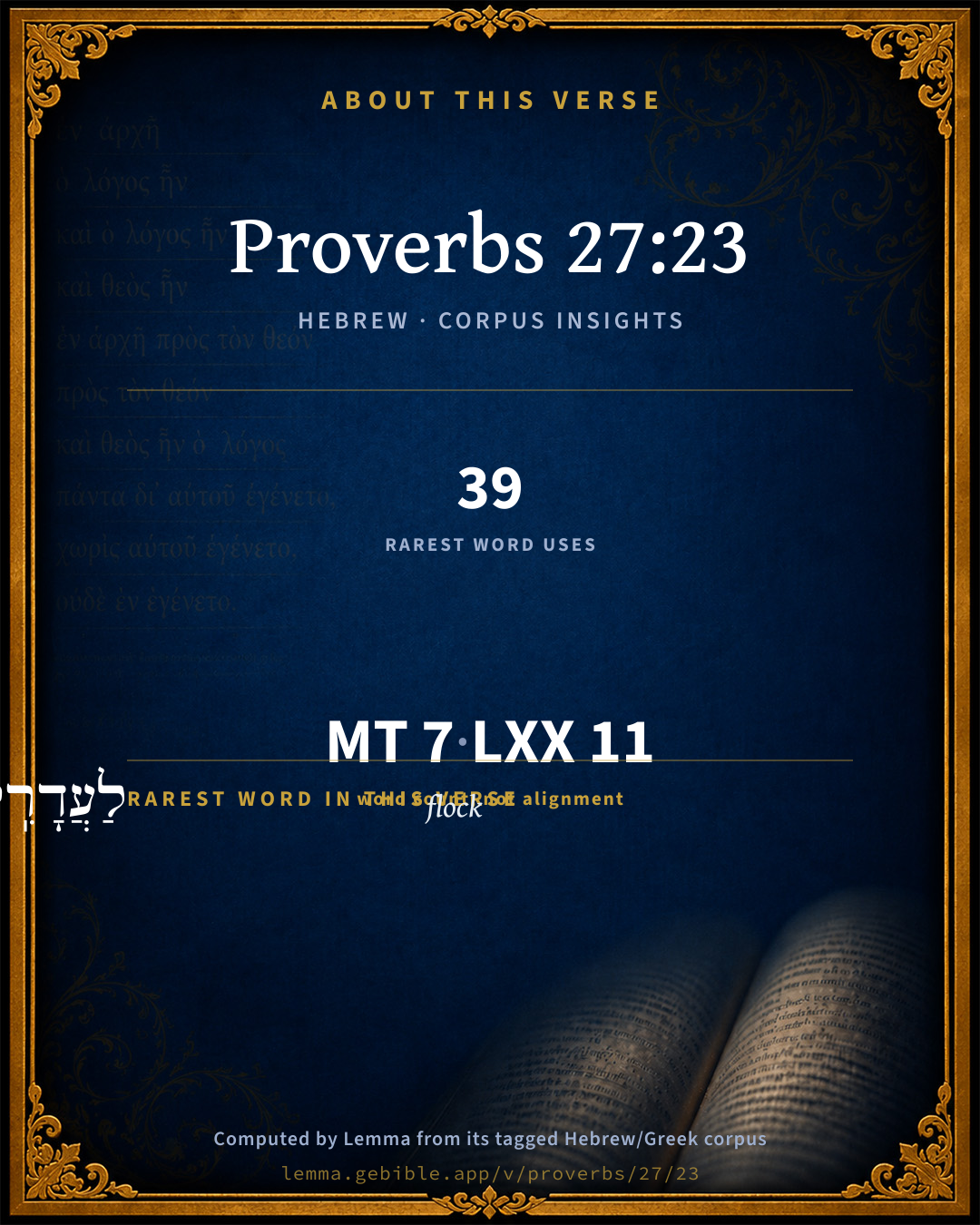
About this verse

These counts appear in no published source. They are computed here, from the morphology-tagged text and Lemma’s own curated glosses. What Lemma adds →

7
words
6
distinct lemmas
Wisdom
section

Shared distinctive vocabulary

לַעֲדָרִֽים flock H5739 occurs in 34 verses of the Hebrew Bible. Also found in:

Grammatical profile

  • 3 verbs
  • 4 nouns

Verb forms

  • יָדֹ֣עַ Qal · Infinitive Absolute
  • תֵּ֭דַע Qal · Jussive
  • שִׁ֥ית Qal · Imperative

Repetition

A word recurs within this verse — often emphatic in Hebrew:

  • יָדֹ֣עַ to know H3045 ×2

Hebrew & Septuagint length

In English translation the verse runs 13 words from the Hebrew and 15 from the Septuagint (LXX English) — closely comparable.

A rough comparison of the two English renderings, which tokenize alike — not a word-level alignment.

Word counts can differ between the Hebrew and the Greek without any difference in meaning — e.g. the Hebrew direct-object marker אֵת has no separate Greek word, and Greek often adds the article ὁ.

In the original languages it is 7 Hebrew tokens and 11 Greek tokens — but the two are counted differently (Hebrew bundles its prefixes and suffixes into one token; the Greek is in lemma form), so that isn’t a like-for-like length.

Cross-references

12

Topical passages linked to Proverbs 27:23 in the Treasury of Scripture Knowledge — connected by theme and wording, ordered by reader-vote popularity; previews shown in the World English Bible.

  • 1 Peter 5:2 Shepherd the flock of God which is among you, exercising the oversight, not under compulsion, but voluntarily, not for dishonest gain, but willingly;
  • John 21:15–17 So when they had eaten their breakfast, Jesus said to Simon Peter, "Simon, son of Jonah, do you love me more than these?" He said to him, "Yes, Lord; you know that I have affection for you." He said to him, "Feed my lambs."
  • Genesis 33:13 Jacob said to him, "My lord knows that the children are tender, and that the flocks and herds with me have their young, and if they overdrive them one day, all the flocks will die.
  • 2 Chronicles 26:10 He built towers in the wilderness, and hewed out many cisterns, for he had much cattle; in the lowland also, and in the plain: [and he had] farmers and vineyard keepers in the mountains and in the fruitful fields; for he loved farming.
  • Proverbs 24:32 Then I saw, and considered well. I saw, and received instruction:
  • Ezekiel 34:31 You my sheep, the sheep of my pasture, are men, and I am your God, says the Lord Yahweh.
  • John 10:3 The gatekeeper opens the gate for him, and the sheep listen to his voice. He calls his own sheep by name, and leads them out.
  • Deuteronomy 32:46 He said to them, Set your heart to all the words which I testify to you this day, which you shall command your children to observe to do, [even] all the words of this law.
  • 1 Chronicles 27:29–31 and over the herds that fed in Sharon was Shitrai the Sharonite: and over the herds that were in the valleys was Shaphat the son of Adlai:
  • Ezekiel 34:22–24 therefore will I save my flock, and they shall no more be a prey; and I will judge between sheep and sheep.
  • Genesis 31:38–40 These twenty years have I been with you. Your ewes and your female goats have not cast their young, and I haven't eaten the rams of your flocks.
  • 1 Samuel 17:28 Eliab his eldest brother heard when he spoke to the men; and Eliab's anger was kindled against David, and he said, Why are you come down? and with whom have you left those few sheep in the wilderness? I know your pride, and the naughtiness of your heart; for you have come down that you might see the battle.

Cross-references courtesy of OpenBible.info (CC BY 4.0).

Hebrew and Greek witnesses Masoretic Hebrew ↔ Greek Septuagint

The same verse in the two great witnesses to the Old Testament, shown verse-for-verse.

These are two independent witnesses, not word-aligned to each other, and the Septuagint is shown in lemma (dictionary) form.

Hebrew Proverbs 27:23 Masoretic · Westminster Leningrad Codex

יָדֹ֣עַ תֵּ֭דַע פְּנֵ֣י צֹאנֶ֑ךָ שִׁ֥ית לִ֝בְּךָ֗ לַעֲדָרִֽים

Know well the state of your flocks, And pay attention to your herds:

World English Bible · Public Domain

Greek LXX Proverbs 27:23 Septuagint · lemma form

γνωστῶς ἐπιγιγνώσκω ψυχή ποίμνιον σύ καί ἐπιἵστημι καρδία σύ σός ἀγέλη

Do you thoroughly know the number of your flock, and pay attention to your herds.

LXX2012 (modern English Septuagint) · Public Domain

On this verse, Keil & Delitzsch discusses the Septuagint’s reading. Read the note in Commentary ↓

Hebrew: Westminster Leningrad Codex (CC BY 4.0). Greek: Septuagint (public domain); English from LXX2012 (modern English Septuagint) (Public Domain). How the Septuagint differs from the Hebrew →

Commentary

Notes on Proverbs 27:23 from classic Christian and Jewish commentators (each source and its license shown beneath its notes). The classic Christian expositions comment on the surrounding passage and are grouped to its opening verse, so a note may address several verses; the Jewish commentaries on the Tanakh (Rashi and others) are per-verse, so they appear only where the commentator wrote on this verse.

Lemma curates 59 commentaries, every one of them public domain or Creative Commons licensed, each selected and text-cleaned for this edition rather than reprinted as found. About our sources →

Trapp's Complete Commentary

John Trapp

Pro 27:23 Be thou diligent to know the state of thy flocks, [and] look well to thy herds.

Ver. 23. Be thou diligent to know the state, &c.] Heb., Knowing thou shalt know the face of thy flocks; alluding, belike, to those shepherds that know their sheep asunder by their visages, and can call them by name, as Joh 10:3

And look well to thy herds.] Heb., Set thy heart to them - that is, be very inquisitive and solicitous of their welfare. Leave not all to servants, though never so faithful; but supervise and oversee business, as Boaz did. His eyes were in every corner - on the servants, on the reapers, on the gleaners. He lodged in the midst of his husbandry, he was not to learn that the master’s eye feeds the horse, and the master’s foot soils the land, {a} and that Procul a villa sua dissitus, iacturae vicinus, as Columella {b} hath it: He that is far from his husbandry is not far from poverty. And unless the master be present, saith the same author, it will be as in an army where the general is absent, cuncta officia cessant, all business will be hindered. He must be as the great wheel to set all awork, or little will be done.

“Eις εστι δουλος οικιας ο δεσποτης.”

{a} Arist. Oecon., lib i. cap. 6.

{b} Lib. i. cap. 1.

John Trapp, A Commentary or Exposition upon All the Books of the Old and New Testament (1647–1656) — public domain. Text from a community e-Sword module.

Albert Barnes' Notes on the Bible

The verses sing the praises of the earlier patriarchal life, with its flocks and herds, and tillage of the ground, as compared with the commerce of a later time, with money as its chief or only wealth.

Pro 27:23

The state - literally, face. The verse is an illustration of Joh 10:3, Joh 10:14.

Pro 27:24

Riches - The money which men may steal, or waste, is contrasted with the land of which the owner is not so easily deprived. Nor will the crown (both the “crown of pure gold” worn on the mitre of the high priest, Exo 29:6; Exo 39:30; and the kingly diadem, the symbol of power generally) be transmitted (as flocks and herds had been) “from one generation to another.”

Pro 27:25

Appeareth - Better, When the grass disappeareth, the “tender grass showeth itself.” Stress is laid on the regular succession of the products of the earth. The “grass” (“hay”) of the first clause is (compare Psa 37:2; Psa 90:5; Psa 103:15; 2Ki 19:26) the proverbial type of what is perishable and fleeting. The verse gives a picture of the pleasantness of the farmer’s calling; compared with this what can wealth or rank offer? With this there mingles (compare Pro 27:23) the thought that each stage of that life in its season requires care and watchfulness.

Albert Barnes' Notes on the Bible (1834–1885) — public domain. Text from a community e-Sword/MySword module.

The Biblical Illustrator

Joseph S. Exell

Pro_27:23

Be thou diligent to know the state of thy flocks, and look well to thy herds.

Kindness to animals

We live in an age when great regard is paid to the comfort and well-being of every class of the community, and when efforts are made to promote the general happiness. When so much is being done to add to the happiness of the human family we should not be forgetful of the dumb animals, to which, for our comfort, we are so largely indebted. It is always a good sign of a man when he takes a kindly interest in the brutes. A man who can roughly treat a horse or a dog can never be one in whom his own family find much to love. The days are gone of cruel and disgusting sports, in which men found their pleasure in watching the sufferings of the lower creatures. But a good deal of pain is still caused through mere thoughtlessness. See Bible notices of animals.

1. The fact of their creation by God. They were brought upon the earth before man was, and have, by priority, a right to such comforts as it affords.

2. Their being named by Adam. This indicated his lordship over them, and the interest God would have him take in them.

3. When man had sinned, by the slaughter of innocent animals he was impressively taught, and continually reminded of, the only way of salvation.

4. In the time of the Flood the animals were carefully preserved.

5. In the Mosaic economy laws were enacted for the protection and well-being of the creatures. Many make the mistake of thinking that animals must be frightened into obedience. A kind and gentle treatment, as it is the most humane, is also the most successful. They are fond of being praised and encouraged: a kind word or affectionate stroke makes them wonderfully happy, and even the expression of countenance they learn to understand. Remember it is said of God, With the merciful man Thou wilt show Thyself merciful. His eye is upon us, and He will call us to account for every act of cruelty done to the creatures He has made. Strive, then, to be like Him in kindness and in gentleness. (J. Thain Davidson, D.D.)

.

The Biblical Illustrator, edited by Joseph S. Exell (c. 1880s–1900s) — public domain. Text from a community e-Sword module.

Joseph Benson's Commentary

Pro 27:23-24. Be diligent to know the state of thy flock — That thou mayest preserve and improve what thou hast, and take care that thy expenses do not exceed thy income. Flocks and herds are here put for all riches and possessions, because anciently they were the chief part of a man’s riches. And look well, &c. — Hebrew, שׁית לבךְ, set thy heart, &c. Trust not to thy servants, as many do, but make use of thine own eyes and reason for the conduct of thy affairs, lest thou come to ruin, as many have done by this very means. For riches — Hebrew, חסן, treasure, is not for ever — The sense is, what thou now possessest will not last always, but will soon be spent, if thou do not take care to preserve and improve it. And doth the crown endure, &c. — That is, a condition of the greatest honour and plenty. As if he had said, If a man had the wealth of a kingdom, without provident care and due diligence, it would soon be brought to nothing.

Joseph Benson's Commentary on the Old and New Testaments (1811–1818) — public domain. Text from a community e-Sword module.

The Preacher's Complete Homiletical Commentary

Joseph S. Exell (gen. ed.)

MAIN HOMILETICS OF THE PARAGRAPH.—Pro_27:23-27

MODEL FARMING

These words were especially applicable to the Israelitish people in their early history, when every family lived upon its own domain and found all its simple wants supplied by the produce of the land and the cattle which fed upon it. This paragraph deals—

I. With the duties of such a life. Solomon has several times before given exhortations to diligence in labour, but here he seems rather to enforce the necessity of diligent and constant supervision on the part of the master and owner of the land. He is not addressing a hired servant, but one who is a landed proprietor and has flocks and herds of his own. If a man in so highly favoured a position desires to reap all its benefits he must diligently superintend all whom he employs and set them a good example of industry and perseverance. He must not be content to leave these things to hirelings, but must give such close attention to all that is going on in his domain as to be able intelligently to guide all the varied engagements which follow one another as one season succeeds the other. No man ought to consider this an unworthy employment of his mental powers, and he who does so would do well to remember that the cultivation of the soil was the employment which God gave to man when He first created him in His own image. As an incentive to industry in this direction the proverb contains a reminder of the uncertainty of riches—it is unwise of any man to be wholly dependent upon a fortune made in the past and to have no resource in case of its loss.

II. It sets forth the rewards attached to the performance of such duties. There is first the supply of the necessaries of life. Luxuries are not promised, but it is implied that simple food and clothing will not be wanting; and a sufficiency of these is all that is really needful to man’s comfort. But there is a pleasure in obtaining them in this way which is surely not found in any other calling. The cultivator of the ground escapes much of the monotony found in most other professions, and has pleasures and advantages to which dwellers in the city are strangers. If he is more exposed to the hardships of the winter, the joy of spring—“when the tender grass sheweth itself”—is surely enough to repay him for it, and then follow the varied occupations of summer, one affording relief to the other, until the year is crowned with the “joy of harvest.” Surely no mode of life is more favourable to bodily and spiritual health than the one here sketched by the Wise Man.

OUTLINES AND SUGGESTIVE COMMENTS

Solomon tells us, in another place, that the instability and uncertainty of earthly things, after all our care, is a motive to draw off our hearts from them, and to fix our eyes upon nobler objects; but he tells us, in this place, that the perishing nature of earthly things is likewise a reason for bestowing a moderate and lawful share of our attention upon our temporal interests. Lawson.

Pro_27:25. The frail condition of fading worldly things is here well expressed, it appeareth only and is cut down. The tender grass sheweth itself, and it is but a shewing, for that being done, it is eaten up presently, being at once, as it were, both seen and devoured. The herbs of the mountain are gathered; their growing is not mentioned as being no sooner grown than gathered, and as being grown for the gathering only.… Wherefore as the careful husbandman looketh to the hay and grass and herbs, and takes them in their time, so is the good spiritual husbandman to consider the short time of worldly contentments, and in their time to use them, at no time to trust in them. As hay and grass and herbs are taken in their season, so it is the season in all things that is to be taken. And, therefore, when the season appeareth, let not thy negligence appear in omitting it; when occasion shows itself, show not thyself careless in apprehending of it; when the fruit of opportunity is to be gathered, climb the mountain speedily.—Jermin.

Pro_27:26-27. In these two verses the wise man dehorteth from wastefulness of apparel, and from excess in diet.… The proverbial sense is, that plainness of apparel keepeth a man’s estate warmest; and that a homespun thread in clothing is a strong and lasting thread in the web of a man’s worldly fortune, and that a sober and temperate feeding both in himself and family doth best feed the estate of any man, and that the flock of a man thriveth best when he is contented with the nourishment and sustenance that cometh from the flock.—Jermin.

The Preacher's Complete Homiletical Commentary (gen. ed. Joseph S. Exell; Funk & Wagnalls, c. 1892) — public domain (pre-1929). A full-Bible homiletical/sermon-outline anthology covering 65 of 66 books (2 John is absent from the source module). Text from a community e-Sword module.

Keil & Delitzsch

C. F. Keil & F. Delitzsch

An exhortation to rural industry, and particularly to the careful tending of cattle for breeding, forms the conclusion of the foregoing series of proverbs, in which we cannot always discern an intentional grouping. It is one of the Mashal-odes spoken of vol. i. p. 12. It consists of 11 = 4 + 7 lines.

23 Give heed to the look of thy small cattle,

Be considerate about the herds.

24 For prosperity continues not for ever;

And does the diadem continue from generation to generation?

25 (But) the hay is gone, and the after-growth appears,

And the grass of the mountains is gathered:

26 Lambs serve to clothe thee,

And goats are the price of a field.

27 And there is plenty of goats' milk for thy nourishment,

And for the nourishment of thy house,

And subsistence for thy maidens.

The beginning directs to the fut., as is not common in these proverbs, vid., Pro 26:26. With ידע, to take knowledge, which is strengthened by the inf. intensivus, is interchanged שׁית לב, which means at Pro 24:32 to consider well, but here, to be careful regarding anything. צאן is the small or little cattle, thus sheep and goats. Whether לעדרים (here and at Isa 17:2) contains the article is questionable (Gesen. 35. 2 A), and, since the herds are called העדרים, is not probable; thus: direct thy attention to the herds, that is, to this, that thou hast herds. פּני is the external side in general; here, the appearance which the sheep present; thus their condition as seen externally. In Pro 27:24 I formerly regarded נזר as a synonym of גּז, to be understood of the produce of wool, or, with Hitzig, of the shearing of the meadow, and thus the produce of the meadow. But this interpretation of the word is untenable, and Pro 27:25 provides for Pro 27:24, thus understood, no natural continuation of thought. That חסן signifies a store, fulness of possessions, property, and abundance, has already been shown under Pro 15:6; but נזר is always the mark of royal, and generally of princely dignity, and here denotes, per meton. signi pro re signata, that dignity itself. With the negative expression in 24a the interrogative in 24b is interchanged as at Job 40:9, with the implied negative answer; ואם, of an oath ("and truly not," as at Isa 62:8), presents the same thought, but with a passionate colouring here unnecessary. Rightly Fleischer: "ready money, moveable property, and on the other hand the highest positions of honour, are far more easily torn away from a man, and secure to him far less of quiet prosperity, than husbandry, viewed particularly with respect to the rearing of cattle." In other words: the possession of treasures and of a lofty place of power and of honour has not in itself the security of everlasting duration; but rural economy, and particularly the rearing of cattle, gives security for food and clothing. The Chethı̂b לדור דור is found, e.g., at Exo 3:15; the Kerı̂ לדּור ודור substitutes the more usual form. If Pro 27:25 was an independent whole (Hitzig: grass vanishes and fresh green appears, etc.), then the meaning here and onward would be that in the sphere of husbandry it is otherwise than is said in Pro 27:24 : there that which is consumed renews itself, and there is an enlarging circulation. But this contrast to Pro 27:24 must be expressed and formed unambiguously. The connection is rather this, that Pro 27:23 commends the rearing of cattle, Pro 27:24 confirms it, and 25ff. discuss what real advantages, not dependent on the accidents of public and social life, it brings.

I rejoice to agree with Fleischer in the opinion that the perfects of Pro 27:25 form a complex hypothetical antecedent to Pro 27:26 : Quum evanuerit gramen (sc. vetus) et apparuerint herbae recentes et collecta fuerint pabula montium, agni vestitui tuo (inservient) et pretium agri (sc. a te emendi) erunt hirci, i.e., then wilt thou nourish thy herds of sheep and goats with the grass on thy fields, and with the dried gathered hay; and these will yield for thee, partly immediately and partly by the money derived therefrom (viz., from the valuable goats not needed for the flocks), all that is needful for thy life. He also remarks, under גּלה, that it means to make a place void, empty (viz., to quit the place, vacuer la forteresse); hence to leave one's fatherland or home, to wander abroad; thus, rhetorically and poetically of things and possessions: to disappear. חציר (from חצר, to be green) is hay, and דּשׁא the after-growing second crop (after-grass); thus a meadow capable of being mowed a second time is though of. עשּׂבות הרים (with Dag. dirimens, as e.g., ענּבי Deu 32:32) are the herbage of the mountains. The time when one proceeds to sheep-shearing, Pro 27:25 cannot intend to designate; it sets before us an interesting rural harvest scene, where, after a plentiful ingathering of hay, one sees the meadows again overspread with new grass (Ewald); but with us the shearing of sheep takes place in the month of May, when the warm season of the year is just at hand. The poet means in general to say, that when the hay is mown and now the herbage is grown up, and also the fodder from the mountains (Psa 106:20) has been gathered home, when thus the barns are filled with plenty, the husbandman is guaranteed against the future on all sides by his stock of cattle. חלב (from חלב, Arab. halyb, with halab) is the usual metaplastic connecting form of חלב, milk. דּי (from דּי, like חי from חי), generally connected with the genitive of the person or thing, for which anything is sufficient (e.g., Pro 25:16, דּיּך, to which Fleischer compares Arab. hasbuha, tassuha kifayuha), has here the genitive of the thing of which, or in which, one has enough. The complex subject-conception is limited by Rebia, and the governing דּי has the subordinated disjunctive Legarmeh. עזּים is a word of two genders (epicoenum), Gesen. 107, 1d. In וחיּים the influence of the ל still continues; one does not need to supply it meanwhile, since all that maintains and nourishes life can be called חיים (vita = victus), e.g., Pro 3:22. The lxx translates בּיתך by σῶν θεραπόντων, and omits (as also the Syr., but not the Syro-Hexap.) the last line as now superfluous; but that the maids attending to the cattle - by whom we particularly think of milkers - are especially mentioned, intentionally presents the figure of a well-ordered household, full of varied life and activity (Job 40:29).

Keil & Delitzsch — Biblical Commentary on the Old Testament (1861–1891) — public domain (CC PDM 1.0). Text via the HelloAO Bible API. (Old Testament only.)

Tyndale Open Study Notes

Tyndale Open Resources

27:23-27 Agricultural property can provide food and clothing from generation to generation; these resources require continuous labor and attention or, like riches, they disappear.

Tyndale Open Study Notes — © Tyndale Open Resources, licensed CC BY-SA 4.0. Text via the HelloAO Bible API.

Matthew Henry's Commentary

Here is, I. A command given us to be diligent in our callings. It is directed to husbandmen and shepherds, and those that deal in cattle, but it is to be extended to all other lawful callings; whatever our business is, within doors or without, we must apply our minds to it. This command intimates, 1. That we ought to have some business to do in this world and not to live in idleness. 2. We ought rightly and fully to understand our business, and know what we have to do, and not meddle with that which we do not understand. 3. We ought to have an eye to it ourselves, and not turn over all the care of it to others. We should, with our own eyes, inspect the state of our flocks, it is the master's eye that makes them fat. 4. We must be discreet and considerate in the management of our business, know the state of things, and look well to them, that nothing may be lost, no opportunity let slip, but every thing done in proper time and order, and so as to turn to the best advantage. 5. We must be diligent and take pains; not only sit down and contrive, but be up and doing: "Set thy heart to thy herds, as one in care; lay thy hands, lay thy bones, to thy business."

II. The reasons to enforce this command. Consider,

1. The uncertainty of worldly wealth (Pro 27:24): Riches are not for ever. (1.) Other riches are not so durable as these are: "Look well to thy flocks and herds, thy estate in the country and the stock upon that, for these are staple commodities, which, in a succession, will be for ever, whereas riches in trade and merchandise will not be so; the crown itself may perhaps not be so sure to thy family as thy flocks and herds." (2.) Even these riches will go to decay if they be not well looked after. If a man had an abbey (as we say), and were slothful and wasteful, he might make an end of it. Even the crown and the revenues of it, if care be not taken, will suffer damage, nor will it continue to every generation without very good management. Though David had the crown entailed on his family, yet he looked well to his flocks, Ch1 27:29, Ch1 27:31.

2. The bounty and liberality of nature, or rather of the God of nature, and his providence (Pro 27:25): The hay appears. In taking care of the flocks and herds, (1.) "There needs no great labour, no ploughing or sowing; the food for them is the spontaneous product of the ground; thou hast nothing to do but to turn them into it in the summer, when the grass shows itself, and to gather the herbs of the mountains for them against winter. God has done his part; thou art ungrateful to him, and unjustly refusest to serve his providence, if thou dost not do thine." (2.) "There is an opportunity to be observed and improved, a time when the hay appears; but, if thou let slip that time, thy flocks and herds will fare the worse for it. As for ourselves, so for our cattle, we ought, with the ant, to provide meat in summer."

3. The profit of good husbandry in a family: "Keep thy sheep, and thy sheep will help to keep thee; thou shalt have food for thy children and servants, goats' milk enough (Pro 27:27); and enough is as good as a feast. Thou shalt have raiment likewise: the lambs' wool shall be for thy clothing. Thou shalt have money to pay thy rent; the goats thou shalt have to sell shall be the price of thy field;" nay, as some understand it, "Thou shalt become a purchaser, and buy land to leave to thy children," (Pro 27:26). Note, (1.) If we have food and raiment, and wherewithal to give every body his own, we have enough, and ought to be not only content, but thankful. (2.) Masters of families must provide not only for themselves, but for their families, and see that their servants have a fitting maintenance. (3.) Plain food and plain clothing, if they be but competent, are all we should aim at. "Reckon thyself well done to if thou be clothed with home-spun cloth with the fleece of thy own lambs, and fed with goats' milk; let that serve for thy food which serves for the food of thy household and the maintenance of thy maidens. Be not desirous of dainties, far-fetched and dear-bought." (4.) This should encourage us to be careful and industrious about our business, that that will bring in a sufficient maintenance for our families; we shall eat the labour of our hands.

Matthew Henry's Commentary on the Whole Bible (1708–1710) — public domain (CC PDM 1.0). Text via the HelloAO Bible API.

Jamieson, Fausset & Brown

Robert Jamieson, A. R. Fausset & David Brown

flocks--constituted the staple of wealth. It is only by care and diligence that the most solid possessions can be perpetuated (Pro 23:5).

Jamieson, Fausset & Brown — Commentary Critical and Explanatory on the Whole Bible (1871) — public domain (CC PDM 1.0). Text via the HelloAO Bible API.

Adam Clarke's Commentary

Verse 23. The state of thy flocks] The directions to the end of the chapter refer chiefly to pastoral and agricultural affairs. Do not trust thy flocks to the shepherd merely; number them thyself; look into their condition; see how they are tended; and when, and with what, and in what proportion, they are fed.

Adam Clarke's Commentary on the Bible (1810–1826) — public domain. Text from a community e-Sword/MySword module.

Ellicott's Commentary for English Readers

(23) Be thou diligent to know the state of thy herds. . . .—In the last five verses of this chapter the peace and security of the pastoral life are described as being far superior to the uncertainty attending other sources of wealth and the regal power. For the spiritual sense of this passage comp. 1Pe_5:2-4

A Bible Commentary for English Readers, edited by Charles John Ellicott (1878–1897) — public domain. Text from a community e-Sword module.

John Gill's Exposition

The hay appeareth, and the tender grass showeth itself,.... Some think this is mentioned to illustrate the uncertainty of riches, which soon vanish away; as the tender grass shows itself, and is presently cut down and quickly appears hay, and that soon consumed; but rather this contains an argument to take to the pastoral life and calling, since it may be performed with so much ease; for the earth, the valleys and hills, are covered with grass for the cattle; so that there is no further trouble than to drive the flocks into the pastures, and feed them there; or to cut down the grass, and make hay of it, and lay it up against the winter for fodder for them. The first clause, I think, may be rendered, "the hay removes" (u), or is carried off; the grass being fit to cut, is mowed and made hay of, and that is carried off and laid up for the winter: "and the tender grass showeth itself"; springs up after the hay is carried off and so makes a second crop; or, however, becomes good pasture for cattle to feed on;

and herbs of the mountains are gathered; for the present use of the cattle; or being made hay of, are laid up for future use; or are gathered for medicine; many of this kind grow on mountains.

(u) "migrat", Cocceius; "cum migraverit", Michaelis.

John Gill's Exposition of the Whole Bible (1746–1763) — public domain (CC PDM 1.0). Text via the HelloAO Bible API.

Haydock's Catholic Bible Commentary

Flocks. John x. 3., and Ecclesiasticus vii. 24. This may be applied to pastors.

George Leo Haydock (1774–1849), Haydock's Catholic Family Bible and Commentary, 1859 edition — public domain. Excludes Psalms (Douay-Rheims chapter numbering differs from Protestant) and Deuterocanonical books (Catholic canon only).

Matthew Poole's English Annotations

To know the state of thy flocks; that thou mayst preserve and improve what thou hast, and take care that thine expenses may not exceed thine incomes.

Flocks and herds are here put for all riches and possessions, because anciently they were the chief part of a man’s riches.

Look well, Heb. set thine heart. Trust not wholly to thy servants, as many do, that they may give up themselves wholly to case and pleasure; but make rise of thine own eyes and reason for the conduct of thine affairs, lest thou come to ruin, as many have done by this very means.

Matthew Poole's English Annotations on the Holy Bible (1683–1685) — public domain. Text from a community e-Sword/MySword module.

Whedon's Commentary on the Bible

Daniel D. Whedon

23. From this verse to the end of the chapter we have precepts pertaining to husbandry and the pastoral life.

State — Literally, face, appearance.

Look well to — Literally, set thine heart upon. The original is very forcible, and implies such personal care, attention, and familiarity with his flocks, that he would recognise the faces of individual sheep and goats, giving them affectionate oversight and superintendence. Comp. Joh_10:1, et seq., especially Pro_27:3-4. The small cattle of the Hebrews consisted chiefly of sheep and goats, usually pastured together. Hence, צאן, (tson,) flock, mostly of sheep, sometimes included both sheep and goats.

Daniel D. Whedon (gen. ed.), Commentary on the Old and New Testaments (1874–1909) — public domain. Text from a community e-Sword module.

The Pulpit Commentary

Vers. 23-27. A mashal ode in praise of a pastoral and agricultural life. The moralist evidently desires to recall his countrymen from the luxury of cities and the temptations of money making to the simple ways of the patriarchs and the pleasures of country pursuits which are the best foundation of enduring prosperity.

Be thou diligent to know the state of thy flocks. "State;" (panim); vultum, Vulgate; the face, look, appearance. The LXX has qucav , which may perhaps mean "the number a necessary precaution when the sheep wandered on the downs and mountains, and had to be collected in the evening and folded. These precepts are naturally applied to all rulers, and especially to Christian pastors who have the oversight of the flock of Christ. (1Pe_5:2-4) Ecc_7:22, "Hast thou cattle? have an eye to them; and if they he for thy profit, keep them with thee.

Vers. 23-27. The man diligent in his business.

I ECONOMY AND FORESIGHT. (Vers. 23-25) He looks after the outgoings of his farm, well aware that there is in all things constant waste, that even the royal crown is a perishable thing. All knowledge is useful, and prudence applies through the whole scale of our being. Let the man, "if he have hands, handle; if eyes, measure and discriminate; let him accept and hive every fact of chemistry, natural history, and economy; the more he has, the less he is willing to spare any one. Time is always bringing the occasions that disclose their value. Some wisdom comes out of every natural and innocent action." To preserve and hold together are as necessary as to gain in every kind of riches.

II THE FRUITS OF INDUSTRY. (Vers. 26, 27) Joyous is the sight when man"s toil united with the forces of nature, has been blessed with the abundant harvests and the rich flocks. Let a man keep the laws of God, and his way will be strewn with satisfactions. To find out the secret of "working together with God" in all the departments of our life is one of the deepest secrets of satisfaction and blessedness. J.

Vers. 23-27 (and ver. 8). A commendation of diligence.

It is likely enough that Solomon, oppressed with the burdens and vexations, with the difficulties and dangers, of the throne, looked longingly toward those pastoral scenes which he here describes. But, keen and shrewd man that he was, he must have known that contentment does not always find a home in the homestead, and that there may be as much disquietude of heart in the fields of the beautiful country as there is in the streets of the crowded city. We look for something more than an ordinary "pastoral" in these verses. We recognize in them a royal commendation of diligence.

I THERE IS NEED OF DILIGENCE IN EVERY SPHERE. "Be diligent to know the state of thy flocks, and look well to thy herds." Pastoral prosperity demands the care and the labour of the shepherd or the herdsman, as well as do the transactions of princes and the affairs of state. It will be a poor season and a bad harvest if the farmer is dreaming all day long. It is true that kids and calves and lambs grow up "of themselves," and that "the earth bringeth forth fruit of itself"; (Mar_4:28) but it is also true that without watchful care on the shepherd"s part the flock will be sickly and small, and that without toil and skill on the part of the farmer the hay crop and the wheat crop will be quite disappointing. And so in everything. Whatever the sphere may be, diligence is the invariable condition of success. The man who will not take pains, who does not work and strive, who does not throw his strength and energy into his occupation, will soon find how great is his mistake.

II DILIGENCE MUST BE CONCENTRATED IF IT IS TO BE REMUNERATIVE. (Ver. 8) A man that is everywhere but at home, who is interested in everybody"s business but his own, who can tell his neighbours how to improve their estate while his own is neglected, who has a hand in a hundred activities, may be exceedingly busy and (in his way) diligent; but he is not a "man of business," and he does not show the diligence which yields a good result. Let a man know "his place" and keep it; and, while selfishness and narrowness of spirit are bad and blameful enough, it is needful for him to give his strength to his own sphere, his forces to his own fields.

III A WISE DILIGENCE WILL BE WELL REWARDED.

1. It will procure domestic comfort (vers. 25-27).

2. It will lead to honour and reputation. (Pro_22:29)

3. It will invest with power, (Pro_12:24)

4. It will enrich with various kinds of human wealth. (Pro_10:4 Pro_13:4 Pro_21:5)

Patient industry is the source of all the good which beautifies and brightens, which adorns and enlarges, human life.

IV THERE IS A SERIOUS UNCERTAINTY AGAINST WHICH TO PROVIDE. (Ver. 24) You may be the son of a king, but the crown sometimes changes hands; dynasties are not immortal. You may have a large treasure at command, but the thief; who wears many guises and comes to us in many forms, may steal it away. Better depend on self-reliance than on such props as these; have the diligent hand at your side, and you will be able to defy the chances and the losses that come in the hour and in the way when we look not for them.

V THERE IS ONE SPHERE IN WHICH DILIGENCE IS OF INESTIMABLE VALUE THE KEEPING OF OUR OWN HEART. With the most devout and the most sedulous care should we "keep" our spiritual nature, for from it flow the streams of life or death. (see homily on Pro_4:23) C.

The Pulpit Commentary (1880–1919), ed. H.D.M. Spence-Jones & Joseph S. Exell — public domain. Text from a community e-Sword module.

John Wesley's Explanatory Notes

Flock - Flocks and herds are here put for all possessions, because anciently they were the chief part of a man's riches.

John Wesley, Explanatory Notes Upon the Whole Bible (1754–1765) — public domain. Text via the GEBible commentary corpus.

Bridges on Proverbs

Charles Bridges

’This declareth the great goodness of God towards man, and the diligence that he requireth of him for the preservation of his gifts.’†1 It is a lively picture of the occupations, advantages, and responsibilities of rural life in olden days. It is specially appropriate to a nation, whose chief riches were, in its early origin, in pastures and flocks. Their father Jacob admirably exemplified this rule. He knew well the state of his flocks and herds.†2 Even King David, mindful of his ancient employ, kept his flocks and herds under constant inspection.†3 Uzziah also deemed a pastoral charge no degradation to his royal dignity.†4 The rule inculcates personal attention. All should not be left to servants. The master’s eye, like Boaz,†5 should, as far as possible, overlook the work. Riches are a fickle possession. They would not be for ever. (Pro 23:5 .) Even the crown might not endure to every generation. Native produce is more permanent wealth. Honest industry secures a more certain maintenance, springing up out of the earth, a more immediate gift of God.

The Bible is thus a directory for all the diversified employments of life. It teaches that every man ought to have a business, and rebukes the neglect of practical every-day duties. God may be glorified by a single eye and purpose in every station; by the laborer, the farmer, the servant, no less than by the master. (Col 3:22-24 .) We must "serve the Lord in fervency of spirit." But a part of this service is, that we be "not slothful in business." (Rom 12:11 .) Indolence would make the cares of life an excuse for a low standard of religion. But to retire from the burden would be to neglect "serving the will of God in our generation" (Act 13:36 ); to "put our light under a bushel, instead of upon a candlestick;" to cover it, instead of "letting it shine." (Mat 5:14-16 .) Our own calling is the way of God for us; and in this way, let us commit ourselves to God, and be at peace. (1Co 7:20, 1Co 7:24 .) His Providence extends to little things, as well as to things of greater moment. The least is under his care, as if there was nothing else. There is no weariness, perplexity, or labor. A single glance is sufficient. Nothing escapes his all-seeing eye. He that "telleth the number of the stars," numbereth "also the hairs of our head."†6 Sweet balm for that cankering care, which is the bane of all godliness!

This picture also exhibits the fruits of industry, as far preferable to those of ambition. The comparison with those, whose station places them beyond the need of labor, affords no matter for envy; much for thankfulness. The various produce of the field — the hay and grass in the pastures; the herbage on the mountains;†7 the suitable clothing from the lambs (Job 31:20 ); the goats paying the price of the field; the sufficiency of wholesome food for the household and maidens — all is the overflowing bounty of our gracious God. "How excellent is thy loving-kindness, O God!" (Psa 36:7 .) Thus "man goeth forth unto his work and unto his labor until the evening," singing his song of praise — "O LORD, how manifold are thy works! in wisdom hast thou made them all: the earth is full of thy riches." (Pro 104:23-24 .)

Footnotes:

†1 Reformer’s Notes.

†2 Gen 30:32-42; Gen 31:38-40 ; Gen 33:13 .

†3 1Ch 27:29-31, with 1Sa 16:11 . Psa 78:70-71 .

†4 2Ch 26:10 .

†5 Rth 2:4-5; Rth 3:7 .

†6 Psa 147:4. Mat 10:30 .

†7 Psa 104:14. ’The word translated hay properly means grass. Where vegetation was so abundant, they have seldom occasion to make hay.’ — Holden. Compare Parkhurst.

Charles Bridges, An Exposition of the Book of Proverbs (1846) — public domain. Text from a community e-Sword module.

unfoldingWord translationNotes

Door43 World Missions Community

Be sure you know the condition of your flocks and be concerned about your herds

These two phrases have basically the same meaning and are used together for emphasis. (See: Parallelism)

your flocks

"flocks of sheep"

your herds

"herds of goats"

Does a crown endure for all generations?

This question expects a negative answer to make the point that the reign of earthly rulers does not last forever. This can be expressed as a statement. AT: "A crown does not endure for all generations" (See: Rhetorical Question)

a crown

Here "crown" is a metonym for a king's rule over his kingdom. AT: "a king's rule" (See: Metonymy)

the new growth appears

"the new sprouts appear" or "the new grass starts to grow"

translationWords

flocks

crown

endure

generation

unfoldingWord translationNotes — © Distant Shores Media and the Door43 World Missions Community, licensed CC BY-SA 4.0. Source: git.door43.org/Door43/en_tn.

Rashi

Rabbi Shlomo Yitzchaki (Rashi)

the condition of your flocks lit. the face of your flocks. Do not think lightly of always paying attention to them to determine what they require.

Rashi on the Tanakh — English translations: “The Judaica Press complete Tanach with Rashi, translated by A. J. Rosenberg” (CC BY 4.0); “Pentateuch with Rashi's commentary by M. Rosenbaum and A.M. Silbermann, 1929-1934” (public domain); “The Metsudah Tanach series, Lakewood, N.J” (CC BY 4.0); and “The Book of Joshua, Metsudah Publications, 1997” (CC BY 4.0). Text via Sefaria.

Lesson kit

Teaching starters — assembled from the data on this page, not authored interpretation. Every prompt links to the verse data it draws on. Edit before teaching.

Proverbs, in the Wisdom, opens this verse with 7 words (6 distinct Hebrew lemmas). Its most distinctive word is ʻêder (“flock”). A historical commentator’s framing appears above. Read the whole chapter for the surrounding context.

Discussion questions

  1. The word ʻêder carries the sense “flock.” How does it shape the verse?
  2. How does Genesis 29:2, which shares the word «flock», read alongside this verse?
  3. What does the repetition of “to know” (2× in this one verse) do in this verse?
  4. These translations render this verse differently; the difference is in the English rendering, not the original. What questions does that raise?
  5. «יָדֹ֣עַ» is a Qal Infinitive Absolute verb. How does that grammatical form shape the action described?
  6. Compare how Trapp's Complete Commentary and Albert Barnes' Notes on the Bible read this verse. Where do they agree or differ?

Things to notice

Reading settings

Reading text

Shown beneath each verse's original-language words.

Old Testament
Old Testament edition

Read the OT as the Masoretic Hebrew (MT) or the Greek Septuagint (LXX).

English shown for the Greek Septuagint (in the Hebrew ↔ Greek comparison).

Comparing translations? Open the Compare panel on any verse page to stack up to four side by side.