
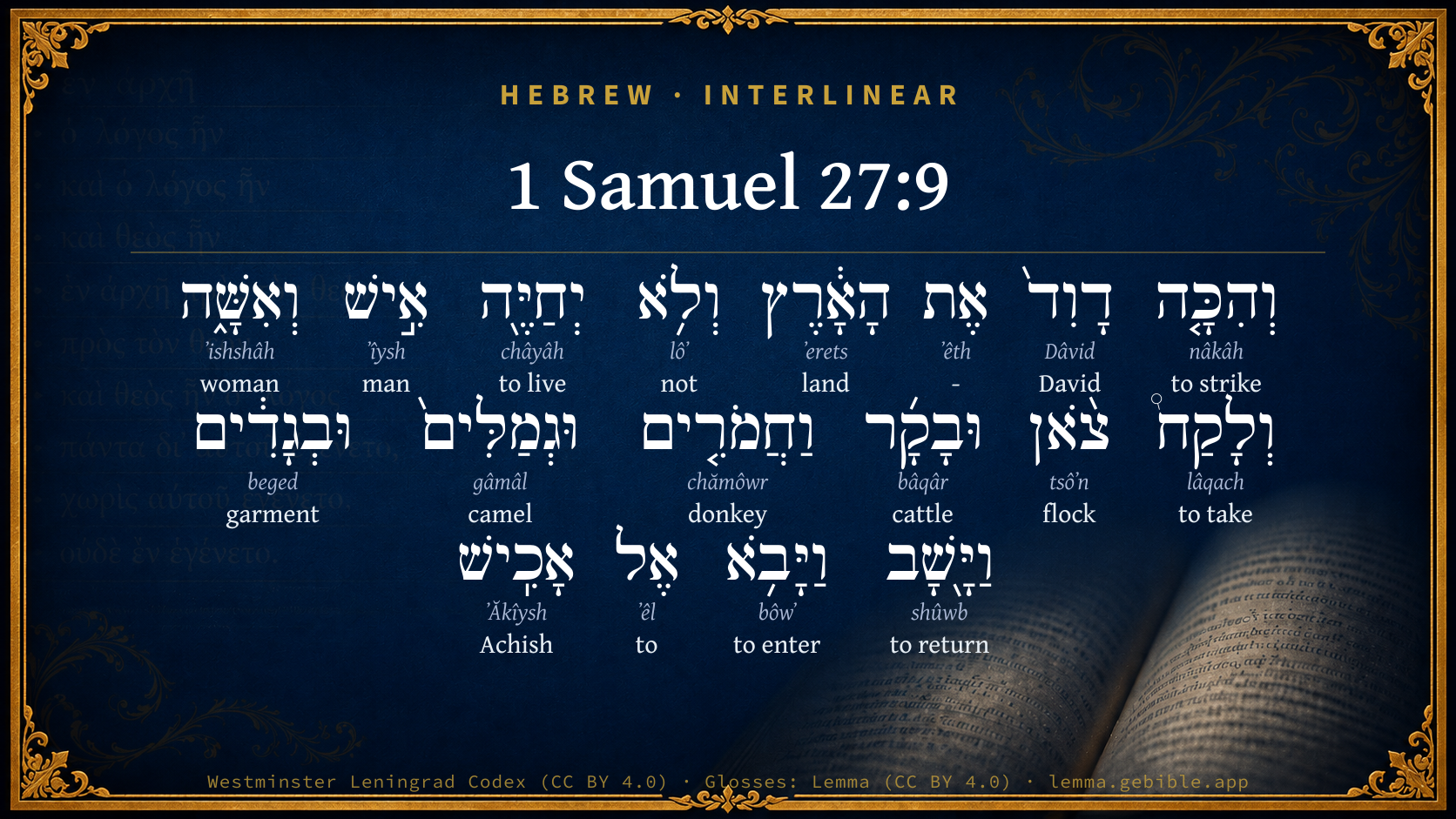
1 Samuel 27:9

Hebrew (Westminster Leningrad Codex) 1 Samuel 27:9 appears in the Hebrew Old Testament. The text above is from the Westminster Leningrad Codex. Each word links to its Strong’s number, a concise gloss, and parsing drawn from the Open Scriptures Hebrew Bible morphology. Click any word for its full Brown-Driver-Briggs (BDB) entry.
Download image
Cite this verse

1 Samuel 27:9 (World English Bible). Public Domain. Lemma interlinear Bible study tool, https://lemma.gebible.app/v/1-samuel/27/9.

Show BibTeX & RIS
BibTeX
RIS
English Translation
David struck the land, and saved neither man nor woman alive, and took away the sheep, and the oxen, and the donkeys, and the camels, and the clothing; and he returned, and came to Achish.
World English Bible · Public Domain
Download a study sheet

One document with this verse’s original text, its word-by-word gloss line, the meaning frame, cross-references with their text, attributed commentary, and full source and license credits — printable, and it pastes into notes with its structure intact.

This verse Autodidact and up

Study sheet (.html) Plain text (.txt)

A passage Seminary Student

Up to 50 verses in one chapter. A passage sheet keeps up to 6 commentary sources and 12 cross-references per verse, in the order this page ranks them, and says so on the sheet whenever that leaves anything out. Ask for a single verse and you get the Autodidact verse sheet above.

Everything on this page stays free to read, with no account — the sheet is a download of what is already on screen, not access to it.

Want to remove ads? Support Godless Engineer
Compare translations 3

The same verse in 3 English versions, stacked beneath the original-language interlinear above. Click any original word for its lexicon entry.

Each is an independent rendering of the whole verse — the interlinear is not word-aligned to these translations.

Highlighted words mark where these versions differ — a whole-verse word diff, not a word-by-word alignment.

  • World English Bible Public Domain
    David struck the land, and saved neither man nor woman alive, and took away the sheep, and the oxen, and the donkeys, and the camels, and the clothing; and he returned, and came to Achish.
  • King James Version Public Domain
    And David smote the land, and left neither man nor woman alive, and took away the sheep, and the oxen, and the asses, and the camels, and the apparel, and returned, and came to Achish.
  • unfoldingWord Literal Text CC BY-SA 4.0
    And David struck the land and did not let a man or a woman live. And he took sheep and cattle and donkeys and camels and garments. And he returned and came to Achish.

unfoldingWord Literal Text — © unfoldingWord, licensed CC BY-SA 4.0. Word-aligned USFM3 via Door43 (git.door43.org/unfoldingWord/en_ult).

Versions to compare (up to 4)

3 of 4 selected

Show all 18 translations

Every available English version of this verse, each an independent rendering of the whole verse.

  • World English Bible Public Domain
    David struck the land, and saved neither man nor woman alive, and took away the sheep, and the oxen, and the donkeys, and the camels, and the clothing; and he returned, and came to Achish.
  • Berean Standard Bible Public Domain
    Whenever David attacked a territory, he did not leave a man or woman alive, but he took the flocks and herds, the donkeys, camels, and clothing. Then he would return to Achish,
  • Majority Standard Bible Public Domain
    Whenever David attacked a territory, he did not leave a man or woman alive, but he took the flocks and herds, the donkeys, camels, and clothing. Then he would return to Achish,
  • King James Version Public Domain
    And David smote the land, and left neither man nor woman alive, and took away the sheep, and the oxen, and the asses, and the camels, and the apparel, and returned, and came to Achish.
  • American Standard Version (1901) Public Domain
    And David smote the land, and saved neither man nor woman alive, and took away the sheep, and the oxen, and the asses, and the camels, and the apparel; and he returned, and came to Achish.
  • Revised Version (1885) Public Domain
    And David smote the land, and saved neither man nor woman alive, and took away the sheep, and the oxen, and the asses, and the camels, and the apparel; and he returned, and came to Achish.
  • Geneva Bible (1599) Public Domain
    And Dauid smote the lande, and left neither man nor woman aliue, and tooke sheepe, and oxen, and asses, and camels, and apparell, and returned and came to Achish.
  • Douay-Rheims (1899) Public Domain
    And David wasted all the land, and left neither man nor woman alive: and took away the sheep and the oxen, and the asses, and the camels, and the apparel, and returned and came to Achis.
  • Young's Literal Translation Public Domain
    and David hath smitten the land, and doth not keep alive man and woman, and hath taken sheep, and oxen, and asses, and camels, and garments, and turneth back, and cometh in unto Achish.
  • Literal Standard Version CC BY-SA 4.0
    and David has struck the land, and does not keep alive man and woman, and has taken sheep, and oxen, and donkeys, and camels, and garments, and turns back, and comes to Achish.
  • Unlocked Literal Bible CC BY-SA 4.0
    David attacked the land and saved neither man nor woman alive; he took away the sheep, the oxen, the donkeys, the camels, and the clothing; he would return and come again to Achish.
  • unfoldingWord Literal Text CC BY-SA 4.0
    And David struck the land and did not let a man or a woman live. And he took sheep and cattle and donkeys and camels and garments. And he returned and came to Achish.
  • Darby Bible Public Domain
    And David smote the land, and left neither man nor woman alive, and took away the sheep, and the oxen, and the asses, and the camels, and the apparel, and returned, and came to Achish.
  • World Messianic Bible Public Domain
    David struck the land, and saved no man or woman alive, and took away the sheep, the cattle, the donkeys, the camels, and the clothing. Then he returned, and came to Achish.
  • Webster's Bible Public Domain
    And David smote the land, and left neither man nor woman alive, and took away the sheep, and the oxen, and the asses, and the camels, and the apparel, and returned, and came to Achish.
  • Free Bible Version CC BY-SA 4.0
    When David attacked a place, he did not leave anybody alive. He took the flocks and herds, the donkeys, camels, and clothing. Then he would go back to Achish.
  • Bible in Basic English Public Domain
    And David again and again made attacks on the land till not a man or a woman was still living; and he took away the sheep and the oxen and the asses and the camels and the clothing; and he came back to Achish.
  • JPS Tanakh (1917) Public Domain
    And David smote the land, and left neither man nor woman alive, and took away the sheep, and the oxen, and the asses, and the camels, and the apparel. And he returned, and came to Achish.

Literal Standard Version (2020), Covenant Press — licensed CC BY-SA 4.0. Text via the HelloAO Bible API (eBible.org). Unlocked Literal Bible (unfoldingWord) — licensed CC BY-SA 4.0. Text via the HelloAO Bible API (eBible.org). unfoldingWord Literal Text — © unfoldingWord, licensed CC BY-SA 4.0. Word-aligned USFM3 via Door43 (git.door43.org/unfoldingWord/en_ult). Free Bible Version, Dr. Jonathan Gallagher — licensed CC BY-SA 4.0. Text via the HelloAO Bible API (eBible.org).

Word by word

More ways to search: Search by grammar → Find every occurrence → Compare this word →

Practice this passage: Drill this verse → Learn its vocabulary →

אָכִֽישׁ
ʼĂkîysh
H397
“Achish”
Noun, Proper
Part of Speech
Noun
Type
Proper
Full BDB Definition

Origin: of uncertain derivation

TWOT: None

Achish = "I will blacken (or terrify)" or " only a man" - Philistine king of Gath
  1. וְהִכָּ֤ה nâkâh H5221 “and · to strike” Conjunction + Verb, Hiphil, Perfect, 3rd Person, Masculine, Singular
  2. דָוִד֙ Dâvid H1732 “David” Noun, Proper
  3. אֶת ʼêth H853 “-” Particle, Direct Object
  4. הָאָ֔רֶץ ʼerets H776 “the · land” Particle, Definite Article + Noun, Common, Both, Singular, Absolute
  5. וְלֹ֥א lôʼ H3808 “and · not” Conjunction + Particle, Negative
  6. יְחַיֶּ֖ה châyâh H2421 “to live” Verb, Piel, Imperfect, 3rd Person, Masculine, Singular
  7. אִ֣ישׁ ʼîysh H376 “man” Noun, Common, Masculine, Singular, Absolute
  8. וְאִשָּׁ֑ה ʼishshâh H802 “and · woman” Conjunction + Noun, Common, Feminine, Singular, Absolute
  9. וְלָקַח֩ lâqach H3947 “and · to take” Conjunction + Verb, Qal, Perfect, 3rd Person, Masculine, Singular
  10. צֹ֨אן tsôʼn H6629 “flock” Noun, Common, Both, Singular, Absolute
  11. וּבָקָ֜ר bâqâr H1241 “and · cattle” Conjunction + Noun, Common, Both, Singular, Absolute
  12. וַחֲמֹרִ֤ים chămôwr H2543 “and · donkeys” Conjunction + Noun, Common, Both, Plural, Absolute
  13. וּגְמַלִּים֙ gâmâl H1581 “and · camels” Conjunction + Noun, Common, Masculine, Plural, Absolute
  14. וּבְגָדִ֔ים beged H899 “and · garments” Conjunction + Noun, Common, Masculine, Plural, Absolute
  15. וַיָּ֖שָׁב shûwb H7725 “and · to return” Conjunction + Verb, Qal, Sequential Imperfect, 3rd Person, Masculine, Singular
  16. וַיָּבֹ֥א bôwʼ H935 “and · to enter” Conjunction + Verb, Qal, Sequential Imperfect, 3rd Person, Masculine, Singular
  17. אֶל ʼêl H413 “to” Preposition

About this verse

These counts appear in no published source. They are computed here, from the morphology-tagged text and Lemma’s own curated glosses. What Lemma adds →

18
words
18
distinct lemmas
Historical
section

Notable vocabulary

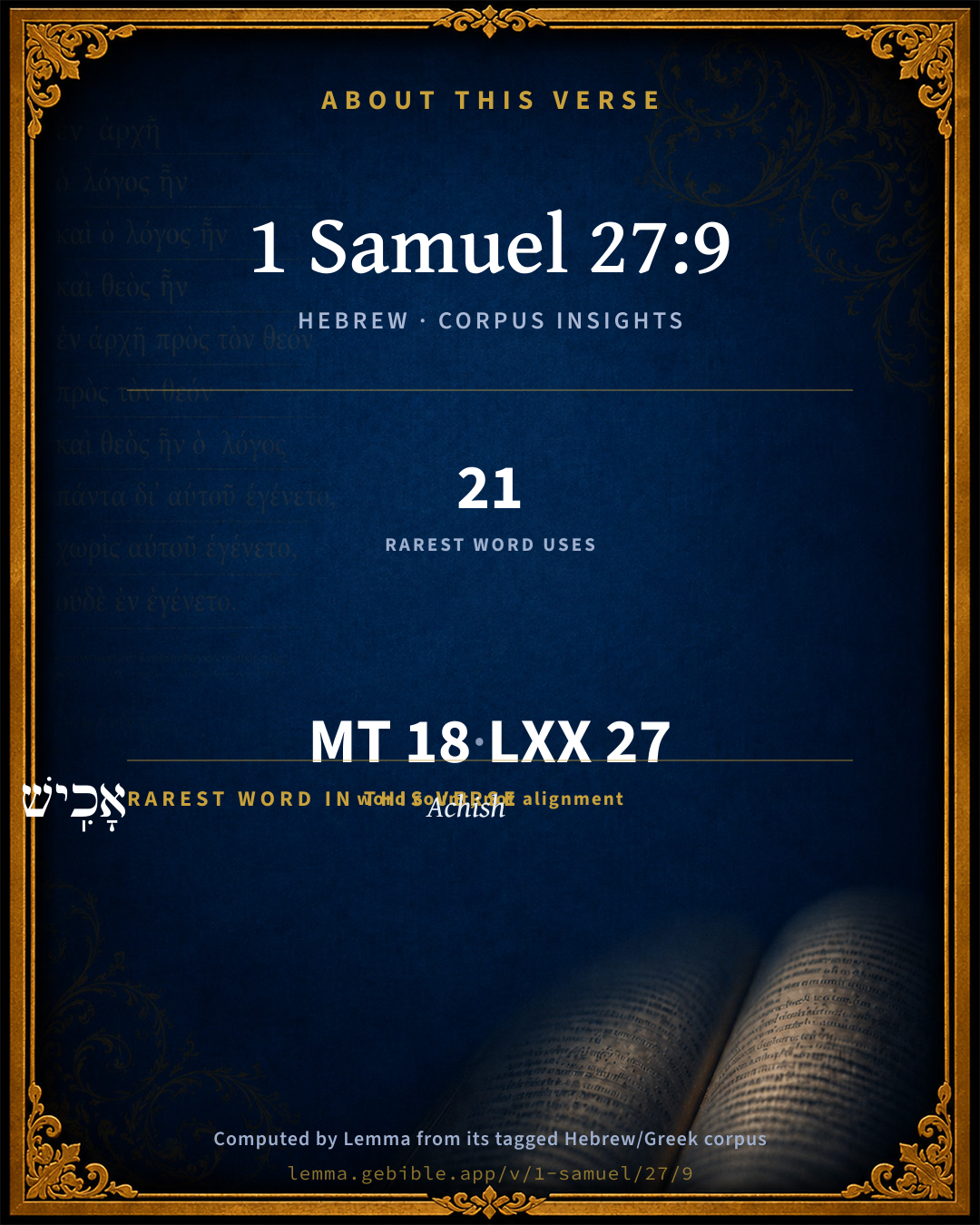
The rarest word here is אָכִֽישׁ Achish H397 — appearing just 21 times in the whole Hebrew Bible.

Shared distinctive vocabulary

אָכִֽישׁ Achish H397 occurs in 20 verses of the Hebrew Bible. Also found in:

Grammatical profile

  • 5 verbs
  • 10 nouns
  • 1 preposition
  • 2 particles

Verb forms

  • וְהִכָּ֤ה Hiphil · Perfect
  • יְחַיֶּ֖ה Piel · Imperfect
  • וְלָקַח֩ Qal · Perfect
  • וַיָּ֖שָׁב Qal · Sequential Imperfect
  • וַיָּבֹ֥א Qal · Sequential Imperfect

Hebrew & Septuagint length

In English translation the verse runs 35 words from the Hebrew and 31 from the Septuagint (LXX English) — closely comparable.

A rough comparison of the two English renderings, which tokenize alike — not a word-level alignment.

Word counts can differ between the Hebrew and the Greek without any difference in meaning — e.g. the Hebrew direct-object marker אֵת has no separate Greek word, and Greek often adds the article ὁ.

In the original languages it is 18 Hebrew tokens and 27 Greek tokens — but the two are counted differently (Hebrew bundles its prefixes and suffixes into one token; the Greek is in lemma form), so that isn’t a like-for-like length.

Cross-references

7

Topical passages linked to 1 Samuel 27:9 in the Treasury of Scripture Knowledge — connected by theme and wording, ordered by reader-vote popularity; previews shown in the World English Bible.

  • 1 Samuel 15:3 Now go and strike Amalek, and utterly destroy all that they have, and don't spare them; but kill both man and woman, infant and suckling, ox and sheep, camel and donkey.
  • Genesis 16:7 The angel of Yahweh found her by a fountain of water in the wilderness, by the fountain in the way to Shur.
  • Genesis 25:18 They lived from Havilah to Shur that is before Egypt, as you go toward Assyria. He lived opposite all his relatives.
  • Exodus 15:22 Moses led Israel onward from the Red Sea, and they went out into the wilderness of Shur; and they went three days in the wilderness, and found no water.
  • Deuteronomy 25:17–19 Remember what Amalek did to you by the way as you came forth out of Egypt;
  • Joshua 6:21 They utterly destroyed all that was in the city, both man and woman, both young and old, and ox, and sheep, and donkey, with the edge of the sword.
  • 1 Samuel 15:7 Saul struck the Amalekites, from Havilah as you go to Shur, that is before Egypt.

Cross-references courtesy of OpenBible.info (CC BY 4.0).

Hebrew and Greek witnesses Masoretic Hebrew ↔ Greek Septuagint

The same verse in the two great witnesses to the Old Testament, shown verse-for-verse.

These are two independent witnesses, not word-aligned to each other, and the Septuagint is shown in lemma (dictionary) form.

Hebrew 1 Samuel 27:9 Masoretic · Westminster Leningrad Codex

וְהִכָּ֤ה דָוִד֙ אֶת הָאָ֔רֶץ וְלֹ֥א יְחַיֶּ֖ה אִ֣ישׁ וְאִשָּׁ֑ה וְלָקַח֩ צֹ֨אן וּבָקָ֜ר וַחֲמֹרִ֤ים וּגְמַלִּים֙ וּבְגָדִ֔ים וַיָּ֖שָׁב וַיָּבֹ֥א אֶל אָכִֽישׁ

David struck the land, and saved neither man nor woman alive, and took away the sheep, and the oxen, and the donkeys, and the camels, and the clothing; and he returned, and came to Achish.

World English Bible · Public Domain

Greek LXX 1 Samuel 27:9 Septuagint · lemma form

καί τύπτω ὁ γῆ καί οὐ ζωογονέω ἀνήρ καί γυνή καί λαμβάνω ποίμνιον καί βουκόλιον καί ὄνος καί κάμηλος καί ἱματισμός καί ἀναστρέφω καί ἄρχω πρός αγχους

And he struck the land, and saved neither man nor woman alive; and they took flocks, and herds, and asses, and camels, and raiment; and they returned and came to Anchus.

LXX2012 (modern English Septuagint) · Public Domain

Hebrew: Westminster Leningrad Codex (CC BY 4.0). Greek: Septuagint (public domain); English from LXX2012 (modern English Septuagint) (Public Domain). How the Septuagint differs from the Hebrew →

Targum (Aramaic paraphrase)

1

The Targum is the ancient Jewish Aramaic paraphrase of the Hebrew Scriptures — an interpretive translation, not the Hebrew text itself. Onkelos (literal) and Pseudo-Jonathan (expansive) render the Torah, and Jonathan the Prophets. Coverage is partial: where no permissively-licensed English translation exists for a verse, only the Aramaic is shown. This is verse-level text, not a word-by-word alignment to the Hebrew.

  1. Targum Jonathan Prophets (Joshua–Malachi)
    וּמְחֵי דָוִד יַת יַתְבֵי אַרְעָא וְלָא מְקַיֵם גְבַר וְאִתָּא וּשְׁבָא עָאן וְתוֹרִין וַחֲמָרִין וְגַמְלִין וּנְסִיב לְבוּשִׁין וְתָאִיב וְאָתֵי לְוַת אָכִישׁ:

    (no public-domain English translation for this verse)

    Targum Jonathan — Aramaic: “Mikraot Gedolot” (public domain). English: “Sefaria Community Translation” (CC0 1.0 (public-domain dedication)); “London "Chaldee Paraphrase," 1871” (public domain). Text via Sefaria.

Commentary

Notes on 1 Samuel 27:9 from classic Christian and Jewish commentators (each source and its license shown beneath its notes). The classic Christian expositions comment on the surrounding passage and are grouped to its opening verse, so a note may address several verses; the Jewish commentaries on the Tanakh (Rashi and others) are per-verse, so they appear only where the commentator wrote on this verse.

Lemma curates 59 commentaries, every one of them public domain or Creative Commons licensed, each selected and text-cleaned for this edition rather than reprinted as found. About our sources →

Trapp's Complete Commentary

John Trapp

1Sa 27:9 And David smote the land, and left neither man nor woman alive, and took away the sheep, and the oxen, and the asses, and the camels, and the apparel, and returned, and came to Achish.

Ver. 9. And left neither man nor woman alive.] To tell tales, or carry tidings. This he might lawfully do, for they were people devoted to utter destruction.

John Trapp, A Commentary or Exposition upon All the Books of the Old and New Testament (1647–1656) — public domain. Text from a community e-Sword module.

Joseph Benson's Commentary

1Sa 27:9. And left neither man nor woman alive — In that part where he came; but there were many of the Amalekites yet left in another part of that land.

Joseph Benson's Commentary on the Old and New Testaments (1811–1818) — public domain. Text from a community e-Sword module.

Tyndale Open Study Notes

Tyndale Open Resources

27:9 David did not leave one person alive: At least some of these people were among those whom God had commanded Israel to destroy (see 15:3; 28:18; Deut 25:17-19; Josh 13:13).

Tyndale Open Study Notes — © Tyndale Open Resources, licensed CC BY-SA 4.0. Text via the HelloAO Bible API.

Adam Clarke's Commentary

Verse 9. David smote the land] Here was a complete extirpation of all these people, not one being left alive, lest he should carry tidings of the disasters of his country! The spoil which David took consisted of sheep, oxen, asses, camels, and apparel.

Adam Clarke's Commentary on the Bible (1810–1826) — public domain. Text from a community e-Sword/MySword module.

Ellicott's Commentary for English Readers

(9) And left neither man nor woman alive.—These acts of ferocious barbarity are simply without excuse; the reason for them is told us in 1Sa_27:11. No captive was to be left alive to tell the tale to King Achish, who was under the delusion that David’s feats of arms were carried out at the expense of his own countrymen, whose lands he was harrying. At this the Philistine rejoiced when he heard David was thus burning his only bridge of retreat: by alienating by these cruelties the affection of the people of Israel, by means of which, at some future time, he might have been recalled to his native land. There were a few occasions in the history of the chosen race when a war of extermination was commended. Then Israel was simply the stern instrument of wrath, used—as a pestilence is at times—to carry out the will of the earth’s Master; but David had no such charge. Was it not these acts of ruthless cruelty which left on this king’s hands the stain of blood which rendered them unfit in after days to build the House of the Lord he longed so passionately to erect? (1Ch_28:3).

And took away the sheep, and the oxen, and the asses, and the camels, and the apparel.—To fight under David’s banner now promised to be a lucrative service as well as an adventurous and wild career. Here at Ziklag, and for some time previously, we hear of brave discontented spirits from all parts of Israel joining him. In 1 Chronicles 12 we have a long and accurate list of heroes who formed that Ziklag band. Amongst these gallant soldiers who now, to use the chronicler’s term, “day by day came to David to help him,” were a troop of Benjamites who had joined him some time before: their leader Amasai, on being questioned as to their reason for joining him, answered, “We are on thy side, thou son of Jesse . . . for thy God helpeth thee” (1Ch_12:18). The words of Amasai express the feeling which seems to have pervaded Israel at that time in reference to David. The people throughout the land were coming to feel that Jehovah had indeed chosen David. The chronicler even speaks of David’s band at Ziklag, after the recruits from all parts of Israel had poured in, “as a great host, like the host of God” (1Ch_12:22).

A Bible Commentary for English Readers, edited by Charles John Ellicott (1878–1897) — public domain. Text from a community e-Sword module.

The Cambridge Bible for Schools and Colleges

gen. ed. J. J. S. Perowne

9. the sheep, &c.] In which the wealth of nomad tribes consists. Cp. 1Sa_15:3, &c.; Job_1:3. “We rode through five large Arab camps, and every hill-side and valley was filled with thousands of sheep, goats, oxen, asses, and camels.” Tristram, Land of Israel, p. 532.

returned and came to Achish] After these expeditions he reported himself to Achish at Gath, and handed over to him the covenanted share of the plunder. It is to be inferred that Achish expected David to pay a kind of tribute, as well as to render personal service in war (1Sa_28:1).

The Cambridge Bible for Schools and Colleges (gen. ed. J. J. S. Perowne; Cambridge University Press, 1878–1918) — public domain. Text from a community e-Sword module.

John Gill's Exposition

And David smote the land,.... In which the above mentioned people dwelt, that is, the inhabitants of it:

and left neither man nor woman alive; for these being the old Canaanites and Amalekites, according to the law of God were not to be spared, but utterly destroyed; which may be observed to remove the charge of cruelty that might be brought against David on this account, Deu 7:2; though this must be understood of such that came within his reach; for it is certain there were people of these several names after this; see Sa1 30:1,

and took away the sheep, and the oxen, and the asses, and the camels,

and the apparel, and returned, and came to Achish; at Gath, to make a report of what he had been about and done; and what he brought was a good booty for the support of his men and their families.

John Gill's Exposition of the Whole Bible (1746–1763) — public domain (CC PDM 1.0). Text via the HelloAO Bible API.

Haydock's Catholic Bible Commentary

Apparel. Saul alone had been ordered to destroy all the property of Amalec. (Abulensis)

George Leo Haydock (1774–1849), Haydock's Catholic Family Bible and Commentary, 1859 edition — public domain. Excludes Psalms (Douay-Rheims chapter numbering differs from Protestant) and Deuterocanonical books (Catholic canon only).

Matthew Poole's English Annotations

Left neither man nor woman alive, to wit, in that part where he came; but there were more of the Amalekites yet left in another part of that land, 1Sa 30:1.

Matthew Poole's English Annotations on the Holy Bible (1683–1685) — public domain. Text from a community e-Sword/MySword module.

Whedon's Commentary on the Bible

Daniel D. Whedon

9. David smote the land — What was the occasion or reason of this terrible slaughter we are not informed, but probably roving bands from these tribes had made incursions into the land adjoining Ziklag. Compare 1Ch_12:21. The question of Achish, in 1Sa_27:10, seems to imply that David was wont to make such predatory excursions; and some have sought to justify him in this slaughter on the ground that these nations were under the curse of God, and the Israelites were divinely authorized to exterminate them. But this was no sufficient warrant for David, while a fugitive from his native land, and without special instruction from God, to undertake the work on his own responsibility. If any apology is to be offered, it is the supposition that these tribes were disturbing the country by their lawless raids for plunder.

Daniel D. Whedon (gen. ed.), Commentary on the Old and New Testaments (1874–1909) — public domain. Text from a community e-Sword module.

The Pulpit Commentary

Vers. 9, 10. David smote the land. These expeditions were made partly to occupy his men, but chiefly to obtain the means of subsistence. They also seem to have brought David great renown, for in 1Ch_12:1-22 we read of warriors from far distant tribes coming to him to swell his forces, and the enthusiasm for him was even such that a band of men swam across the Jordan to join him (ibid. ver. 15); while others from Manasseh deserted to him from Saul"s army before the battle of Mount Gilboa, so that at last he had with him "a great host, like the host of God" (ibid. vers. 19-21). He came to Achish. To give him a portion of the spoil. And Achish said. Like the verb went up in ver. 8, the word indicates repeated action. David made many expeditions against these wild tribes, and on each occasion, when presenting himself at Gath, Achish would inquire, Whither have ye made a roadi.e. an inroad, or a raid today? As it stands the Hebrew means, "Do not make an inroad today;" but the cor. rection of the text given in the A.V has considerable authority from the versions. The Jerahmeelites, mentioned again in ch. 30:29, were the descendants of Hezron, the firstborn of Pharez, the son of Judah, (1Ch_2:9) and so were one of the great families into which the tribe of Judah was divided. Apparently they occupied the most southerly position of its territory. The Kenites (see on ch. 15:6) are here described as being in close alliance with the men of Judah. Probably they lived under their protection, and paid them tribute. The south is literally "the Negeb," the dry land, so called from the absence of streams (comp., Psa_126:4) which formed not only the southernmost part of the territory of Judah, but extended far into the Arabian desert. Achish naturally understood it as the proper name for that part of the Negeb which belonged to Judah, whereas David meant it as it is translated in the A.V, where there is no obscurity as to its meaning.

The Pulpit Commentary (1880–1919), ed. H.D.M. Spence-Jones & Joseph S. Exell — public domain. Text from a community e-Sword module.

John Wesley's Explanatory Notes

Let neither man, &c. - In that part where he came: but there were more of the Amalekites yet left in another part of that land.

John Wesley, Explanatory Notes Upon the Whole Bible (1754–1765) — public domain. Text via the GEBible commentary corpus.

Lesson kit

Teaching starters — assembled from the data on this page, not authored interpretation. Every prompt links to the verse data it draws on. Edit before teaching.

1 Samuel, in the Historical, opens this verse with 18 words (18 distinct Hebrew lemmas). Its most distinctive word is ʼĂkîysh (“Achish”). A historical commentator’s framing appears above. Read the whole chapter for the surrounding context.

Discussion questions

  1. What does “Achish” (ʼĂkîysh) contribute to the verse as a whole?
  2. 1 Samuel 21:10 shares the word «Achish» with this verse. How do the two illuminate each other?
  3. These translations render this verse differently. What is at stake in choosing one wording over another?
  4. The verb «וְהִכָּ֤ה» is Hiphil Perfect. How does its form color the action?
  5. Reading how Trapp's Complete Commentary and Joseph Benson's Commentary read this verse, where do the two commentators agree and where do they part?

Things to notice

Reading settings

Reading text

Shown beneath each verse's original-language words.

Old Testament
Old Testament edition

Read the OT as the Masoretic Hebrew (MT) or the Greek Septuagint (LXX).

English shown for the Greek Septuagint (in the Hebrew ↔ Greek comparison).

Comparing translations? Open the Compare panel on any verse page to stack up to four side by side.