
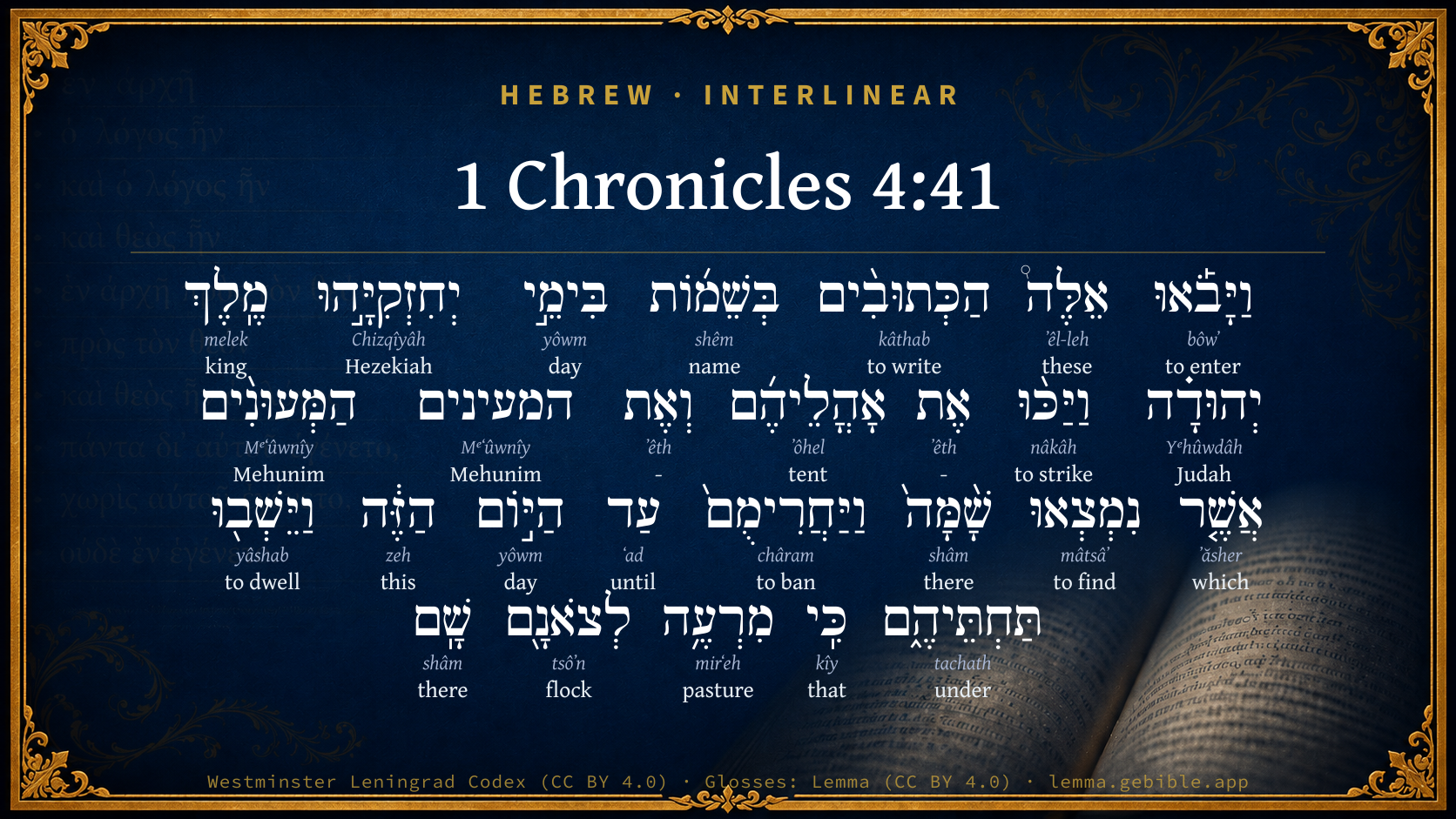
1 Chronicles 4:41

Hebrew (Westminster Leningrad Codex) 1 Chronicles 4:41 appears in the Hebrew Old Testament. The text above is from the Westminster Leningrad Codex. Each word links to its Strong’s number, a concise gloss, and parsing drawn from the Open Scriptures Hebrew Bible morphology. Click any word for its full Brown-Driver-Briggs (BDB) entry.
Download image
Cite this verse

1 Chronicles 4:41 (World English Bible). Public Domain. Lemma interlinear Bible study tool, https://lemma.gebible.app/v/1-chronicles/4/41.

Show BibTeX & RIS
BibTeX
RIS
English Translation
These written by name came in the days of Hezekiah king of Judah, and struck their tents, and the Meunim who were found there, and destroyed them utterly to this day, and lived in their place; because there was pasture there for their flocks.
World English Bible · Public Domain
Highlights
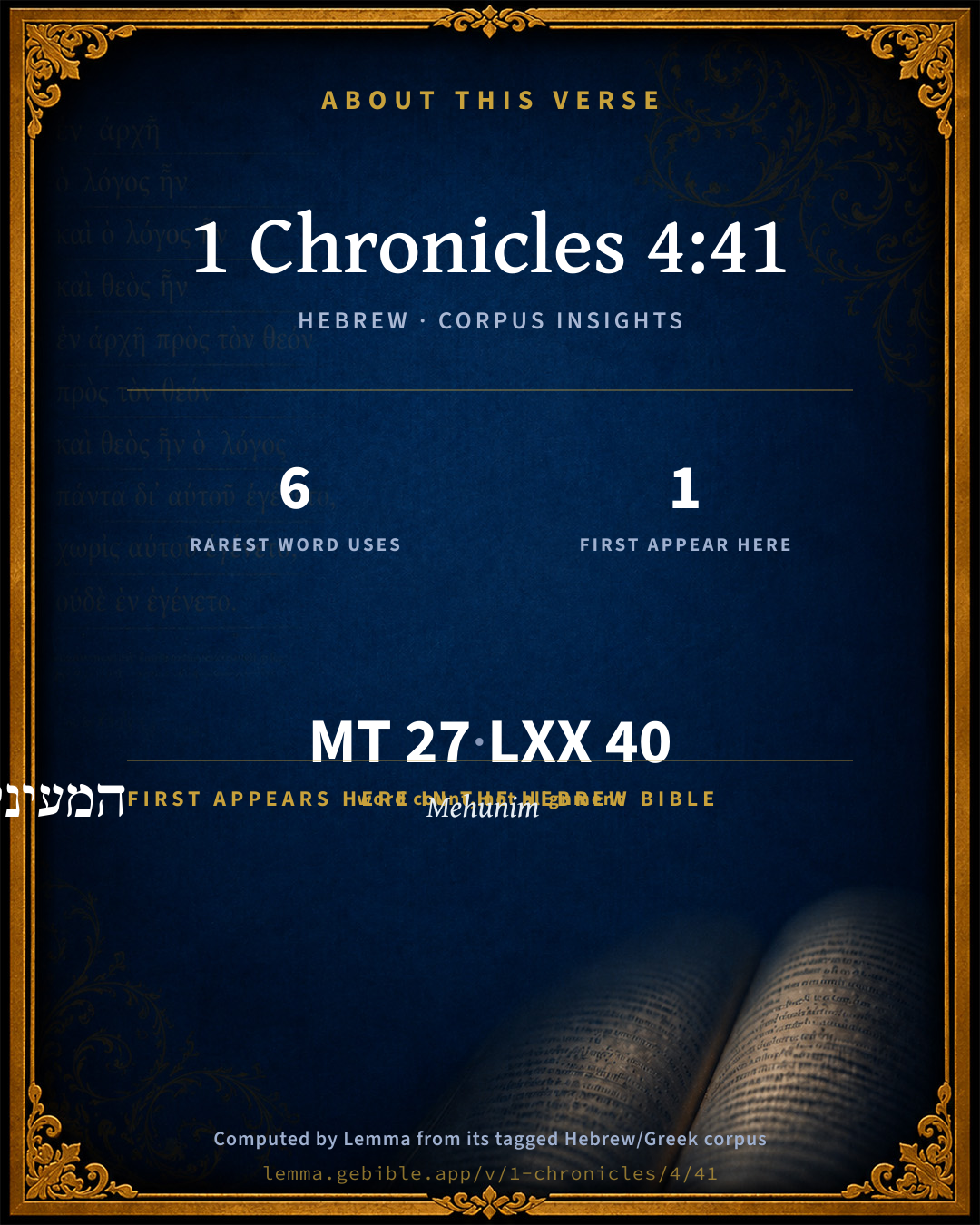
  • 1 first appearance in the Hebrew Bible
Full analysis ↓
Download a study sheet

One document with this verse’s original text, its word-by-word gloss line, the meaning frame, cross-references with their text, attributed commentary, and full source and license credits — printable, and it pastes into notes with its structure intact.

This verse Autodidact and up

Study sheet (.html) Plain text (.txt)

A passage Seminary Student

Up to 50 verses in one chapter. A passage sheet keeps up to 6 commentary sources and 12 cross-references per verse, in the order this page ranks them, and says so on the sheet whenever that leaves anything out. Ask for a single verse and you get the Autodidact verse sheet above.

Everything on this page stays free to read, with no account — the sheet is a download of what is already on screen, not access to it.

Want to remove ads? Support Godless Engineer
Compare translations 3

The same verse in 3 English versions, stacked beneath the original-language interlinear above. Click any original word for its lexicon entry.

Each is an independent rendering of the whole verse — the interlinear is not word-aligned to these translations.

Highlighted words mark where these versions differ — a whole-verse word diff, not a word-by-word alignment.

  • World English Bible Public Domain
    These written by name came in the days of Hezekiah king of Judah, and struck their tents, and the Meunim who were found there, and destroyed them utterly to this day, and lived in their place; because there was pasture there for their flocks.
  • King James Version Public Domain
    And these written by name came in the days of Hezekiah king of Judah, and smote their tents, and the habitations that were found there, and destroyed them utterly unto this day, and dwelt in their rooms: because there was pasture there for their flocks.
  • unfoldingWord Literal Text CC BY-SA 4.0
    And these, written by names, came in the days of Hezekiah, king of Judah, and they struck their tents and the Meunites, who were found there. And they devoted them to this day, and they dwelled in their place because pasture for their flock there.

unfoldingWord Literal Text — © unfoldingWord, licensed CC BY-SA 4.0. Word-aligned USFM3 via Door43 (git.door43.org/unfoldingWord/en_ult).

Versions to compare (up to 4)

3 of 4 selected

Show all 18 translations

Every available English version of this verse, each an independent rendering of the whole verse.

  • World English Bible Public Domain
    These written by name came in the days of Hezekiah king of Judah, and struck their tents, and the Meunim who were found there, and destroyed them utterly to this day, and lived in their place; because there was pasture there for their flocks.
  • Berean Standard Bible Public Domain
    These who were noted by name came in the days of Hezekiah king of Judah. They attacked the Hamites and Meunites there in their dwellings, devoting them to destruction even to this day. Then they settled in their place, because there was pasture for their flocks.
  • Majority Standard Bible Public Domain
    These who were noted by name came in the days of Hezekiah king of Judah. They attacked the Hamites in their dwellings as well as the Meunites who were there, devoting them to destruction even to this day. Then they settled in their place, because there was pasture for their flocks.
  • King James Version Public Domain
    And these written by name came in the days of Hezekiah king of Judah, and smote their tents, and the habitations that were found there, and destroyed them utterly unto this day, and dwelt in their rooms: because there was pasture there for their flocks.
  • American Standard Version (1901) Public Domain
    And these written by name came in the days of Hezekiah king of Judah, and smote their tents, and the Meunim that were found there, and destroyed them utterly unto this day, and dwelt in their stead; because there was pasture there for their flocks.
  • Revised Version (1885) Public Domain
    And these written by name came in the days of Hezekiah king of Judah, and smote their tents, and the Meunim that were found there, and destroyed them utterly, unto this day, and dwelt in their stead: because there was pasture there for their flocks.
  • Geneva Bible (1599) Public Domain
    And these described by name, came in the dayes of Hezekiah king of Iudah, and smote their tents, and the inhabitants that were found there, and destroyed them vtterly vnto this day, and dwelt in their roume, because there was pasture there for their sheepe.
  • Douay-Rheims (1899) Public Domain
    And these whose names are written above, came in the days of Ezechias king of Juda: and they beat down their tents, and slew the inhabitants that were found there, and utterly destroyed them unto this day: and they dwelt in their place, because they found there fat pastures.
  • Young's Literal Translation Public Domain
    And these who are written by name come in the days of Hezekiah king of Judah, and smite their tents, and the habitations that have been found there, and devote them to destruction unto this day, and dwell in their stead, because pasture for their flock `is' there.
  • Literal Standard Version CC BY-SA 4.0
    And these who are written by name come in the days of Hezekiah king of Judah, and strike their tents, and the habitations that have been found there, and devote them to destruction to this day, and dwell in their stead, because pasture for their flock [is] there.
  • Unlocked Literal Bible CC BY-SA 4.0
    These just listed by name came in the days of Hezekiah king of Judah, and attacked the Hamite settlements and the Meunites, who were there also. They destroyed them completely and lived there because they found pasture for their flocks.
  • unfoldingWord Literal Text CC BY-SA 4.0
    And these, written by names, came in the days of Hezekiah, king of Judah, and they struck their tents and the Meunites, who were found there. And they devoted them to this day, and they dwelled in their place because pasture for their flock there.
  • Darby Bible Public Domain
    And these written by name came in the days of Hezekiah king of Judah, and smote their tents and the habitations that were found there, and destroyed them utterly unto this day, and dwelt in their stead; for there was pasture there for their flocks.
  • World Messianic Bible Public Domain
    These written by name came in the days of Hezekiah king of Judah, and struck their tents and the Meunim who were found there; and they destroyed them utterly to this day, and lived in their place, because there was pasture there for their flocks.
  • Webster's Bible Public Domain
    And these written by name came in the days of Hezekiah king of Judah, and smote their tents, and the habitations that were found there, and destroyed them utterly to this day, and dwelt in their room: because there was pasture there for their flocks.
  • Free Bible Version CC BY-SA 4.0
    In the time of Hezekiah, king of Judah, the leaders listed above by name came and attacked these descendants of Ham where they lived, along with the Meunites there and totally destroyed them, as is clear to this very day. Then they settled there, because there was pastureland for their flocks.
  • Bible in Basic English Public Domain
    And these whose names are given came in the days of Hezekiah, king of Judah, and made an attack on the Meunim who were living there, and put an end to them to this day, and took their place, because there was grass there for their flocks.
  • JPS Tanakh (1917) Public Domain
    And these written by name came in the days of Hezekiah king of Judah, and smote their tents, and the Meunim that were found there, and destroyed them utterly, unto this day, and dwelt in their stead; because there was pasture there for their flocks.

Literal Standard Version (2020), Covenant Press — licensed CC BY-SA 4.0. Text via the HelloAO Bible API (eBible.org). Unlocked Literal Bible (unfoldingWord) — licensed CC BY-SA 4.0. Text via the HelloAO Bible API (eBible.org). unfoldingWord Literal Text — © unfoldingWord, licensed CC BY-SA 4.0. Word-aligned USFM3 via Door43 (git.door43.org/unfoldingWord/en_ult). Free Bible Version, Dr. Jonathan Gallagher — licensed CC BY-SA 4.0. Text via the HelloAO Bible API (eBible.org).

Word by word

More ways to search: Search by grammar → Find every occurrence → Compare this word →

Practice this passage: Drill this verse → Learn its vocabulary →

המעינים
Mᵉʻûwnîy
H4586
“the · Mehunim”
Particle, Definite Article + Noun, Gentilic, Masculine, Plural, Absolute
Part of Speech
Particle + Noun
Type
Gentilic
Gender
Masculine
Number
Plural
State
Absolute
Full BDB Definition

Origin: probably patrial from H4584

TWOT: None

Mehunim or Meunim = "habitations" - a people who lived south of Canaan - a group of returning exiles, perhaps descendants of 1
  1. וַיָּבֹ֡אוּ bôwʼ H935 “and · to enter” Conjunction + Verb, Qal, Sequential Imperfect, 3rd Person, Masculine, Plural
  2. אֵלֶּה֩ ʼêl-leh H428 “these” Pronoun, Demonstrative, Common, Plural
  3. הַכְּתוּבִ֨ים kâthab H3789 “the · written” Particle, Definite Article + Verb, Qal, Participle Passive, Masculine, Plural, Absolute
  4. בְּשֵׁמ֜וֹת shêm H8034 “in/at · names” Preposition + Noun, Common, Masculine, Plural, Absolute
  5. בִּימֵ֣י yôwm H3117 “in/at · days of” Preposition + Noun, Common, Masculine, Plural, Construct
  6. יְחִזְקִיָּ֣הוּ Chizqîyâh H2396 “Hezekiah” Noun, Proper
  7. מֶֽלֶךְ melek H4428 “king of” Noun, Common, Masculine, Singular, Construct
  8. יְהוּדָ֗ה Yᵉhûwdâh H3063 “Judah” Noun, Proper
  9. וַיַּכּ֨וּ nâkâh H5221 “and · to strike” Conjunction + Verb, Hiphil, Sequential Imperfect, 3rd Person, Masculine, Plural
  10. אֶת ʼêth H853 “-” Particle, Direct Object
  11. אָהֳלֵיהֶ֜ם ʼôhel H168 “tents · their” Noun, Common, Masculine, Plural, Construct + Suffix, Personal, 3rd Person, Masculine, Plural
  12. וְאֶת ʼêth H853 “and · -” Conjunction + Particle, Direct Object
  13. הַמְּעוּנִ֨ים Mᵉʻûwnîy H4586 “the · Mehunim” Particle, Definite Article + Noun, Gentilic, Masculine, Plural, Absolute
  14. אֲשֶׁ֤ר ʼăsher H834 “which” Particle, Relative
  15. נִמְצְאוּ mâtsâʼ H4672 “to find” Verb, Niphal, Perfect, 3rd Person, Common, Plural
  16. שָׁ֨מָּה֙ shâm H8033 “there · toward” Adverb + Suffix, Demonstrative
  17. וַיַּחֲרִימֻם֙ châram H2763 “and · to ban · them” Conjunction + Verb, Hiphil, Sequential Imperfect, 3rd Person, Masculine, Plural + Suffix, Personal, 3rd Person, Masculine, Plural
  18. עַד ʻad H5704 “until” Preposition
  19. הַיּ֣וֹם yôwm H3117 “the · day” Particle, Definite Article + Noun, Common, Masculine, Singular, Absolute
  20. הַזֶּ֔ה zeh H2088 “the · this” Particle, Definite Article + Pronoun, Demonstrative, Masculine, Singular
  21. וַיֵּשְׁב֖וּ yâshab H3427 “and · to dwell” Conjunction + Verb, Qal, Sequential Imperfect, 3rd Person, Masculine, Plural
  22. תַּחְתֵּיהֶ֑ם tachath H8478 “under · them” Preposition + Suffix, Personal, 3rd Person, Masculine, Plural
  23. כִּֽי kîy H3588 “that” Conjunction
  24. מִרְעֶ֥ה mirʻeh H4829 “pasture” Noun, Common, Masculine, Singular, Absolute
  25. לְצֹאנָ֖ם tsôʼn H6629 “to/for · flock · their” Preposition + Noun, Common, Both, Singular, Construct + Suffix, Personal, 3rd Person, Masculine, Plural
  26. שָֽׁם shâm H8033 “there” Adverb

About this verse

These counts appear in no published source. They are computed here, from the morphology-tagged text and Lemma’s own curated glosses. What Lemma adds →

27
words
23
distinct lemmas
Historical
section

Notable vocabulary

The rarest word here is המעינים Mehunim H4586 — appearing just 6 times in the whole Hebrew Bible.

First appearance in Scripture

This word makes its first canonical appearance in the Hebrew Bible here:

  • המעינים Mehunim H4586

Shared distinctive vocabulary

המעינים Mehunim H4586 occurs in 4 verses of the Hebrew Bible. Also found in:

Grammatical profile

  • 6 verbs
  • 11 nouns
  • 2 pronouns
  • 2 prepositions
  • 1 conjunction
  • 2 adverbs
  • 3 particles

Verb forms

  • וַיָּבֹ֡אוּ Qal · Sequential Imperfect
  • הַכְּתוּבִ֨ים Qal · Participle Passive
  • וַיַּכּ֨וּ Hiphil · Sequential Imperfect
  • נִמְצְאוּ Niphal · Perfect
  • וַיַּחֲרִימֻם֙ Hiphil · Sequential Imperfect
  • וַיֵּשְׁב֖וּ Qal · Sequential Imperfect

Repetition

Words recur within this verse — often emphatic in Hebrew:

  • בִּימֵ֣י day H3117 ×2
  • המעינים Mehunim H4586 ×2
  • שָׁ֨מָּה֙ there H8033 ×2

Hebrew & Septuagint length

In English translation the verse runs 44 words from the Hebrew and 50 from the Septuagint (LXX English) — closely comparable.

A rough comparison of the two English renderings, which tokenize alike — not a word-level alignment.

Word counts can differ between the Hebrew and the Greek without any difference in meaning — e.g. the Hebrew direct-object marker אֵת has no separate Greek word, and Greek often adds the article ὁ.

In the original languages it is 27 Hebrew tokens and 40 Greek tokens — but the two are counted differently (Hebrew bundles its prefixes and suffixes into one token; the Greek is in lemma form), so that isn’t a like-for-like length.

Cross-references

7

Topical passages linked to 1 Chronicles 4:41 in the Treasury of Scripture Knowledge — connected by theme and wording, ordered by reader-vote popularity; previews shown in the World English Bible.

  • 2 Kings 18:8–12 He struck the Philistines to Gaza and the borders of it, from the tower of the watchmen to the fortified city.
  • Acts 17:26 He made from one blood every nation of men to dwell on all the surface of the earth, having determined appointed seasons, and the boundaries of their dwellings,
  • Numbers 32:1–4 Now the children of Reuben and the children of Gad had a very great multitude of cattle: and when they saw the land of Jazer, and the land of Gilead, that behold, the place was a place for cattle;
  • Judges 10:12 The Sidonians also, and the Amalekites, and the Maonites, did oppress you; and you cried to me, and I saved you out of their hand.
  • 1 Chronicles 4:34–38 Meshobab, and Jamlech, and Joshah the son of Amaziah,
  • Isaiah 14:28–32 In the year that king Ahaz died was this burden.
  • Jeremiah 49:20 Therefore hear the counsel of Yahweh, that he has taken against Edom; and his purposes, that he has purposed against the inhabitants of Teman: Surely they shall drag them away, [even] the little ones of the flock; surely he shall make their habitation desolate over them.

Cross-references courtesy of OpenBible.info (CC BY 4.0).

Hebrew and Greek witnesses Masoretic Hebrew ↔ Greek Septuagint

The same verse in the two great witnesses to the Old Testament, shown verse-for-verse.

These are two independent witnesses, not word-aligned to each other, and the Septuagint is shown in lemma (dictionary) form.

Hebrew 1 Chronicles 4:41 Masoretic · Westminster Leningrad Codex

וַיָּבֹ֡אוּ אֵלֶּה֩ הַכְּתוּבִ֨ים בְּשֵׁמ֜וֹת בִּימֵ֣י יְחִזְקִיָּ֣הוּ מֶֽלֶךְ יְהוּדָ֗ה וַיַּכּ֨וּ אֶת אָהֳלֵיהֶ֜ם וְאֶת המעינים הַמְּעוּנִ֨ים אֲשֶׁ֤ר נִמְצְאוּ שָׁ֨מָּה֙ וַיַּחֲרִימֻם֙ עַד הַיּ֣וֹם הַזֶּ֔ה וַיֵּשְׁב֖וּ תַּחְתֵּיהֶ֑ם כִּֽי מִרְעֶ֥ה לְצֹאנָ֖ם שָֽׁם

These written by name came in the days of Hezekiah king of Judah, and struck their tents, and the Meunim who were found there, and destroyed them utterly to this day, and lived in their place; because there was pasture there for their flocks.

World English Bible · Public Domain

Greek LXX 1 Chronicles 4:41 Septuagint · lemma form

καί ἔρχομαι οὗτος ὁ γράφω ἐπί ὄνομα ἐν ἡμέρα εζεκιας βασιλεύς ἰουδά καί πατάσσω ὁ οἶκος αὐτός καί ὁ μιναῖος ὅς εὑρίσκω ἐκεῖ καί ἀναθεματίζω αὐτός ἕως ὁ ἡμέρα οὗτος καί οἰκέω ἀντί αὐτός ὅτι νομή ὁ κτῆνος αὐτός ἐκεῖ

And these who are written by name came in the days of Ezekias king of Juda, and they struck the people's houses, and the Minaeans whom they found there, and utterly destroyed them until this day: and they lived in their place, because there was pasture there for their cattle.

LXX2012 (modern English Septuagint) · Public Domain

On this verse, Ellicott's Commentary for English Readers discusses the Septuagint’s reading. Read the note in Commentary ↓

Hebrew: Westminster Leningrad Codex (CC BY 4.0). Greek: Septuagint (public domain); English from LXX2012 (modern English Septuagint) (Public Domain). How the Septuagint differs from the Hebrew →

Commentary

Notes on 1 Chronicles 4:41 from classic Christian and Jewish commentators (each source and its license shown beneath its notes). The classic Christian expositions comment on the surrounding passage and are grouped to its opening verse, so a note may address several verses; the Jewish commentaries on the Tanakh (Rashi and others) are per-verse, so they appear only where the commentator wrote on this verse.

Lemma curates 59 commentaries, every one of them public domain or Creative Commons licensed, each selected and text-cleaned for this edition rather than reprinted as found. About our sources →

Trapp's Complete Commentary

John Trapp

1Ch 4:41 And these written by name came in the days of Hezekiah king of Judah, and smote their tents, and the habitations that were found there, and destroyed them utterly unto this day, and dwelt in their rooms: because [there was] pasture there for their flocks.

Ver. 41. Came in the days of Hezekiah.] In the beginning of his reign; for in the sixth year of his reign the ten tribes were carried captive by Shalmaneser. {2Ki 18:10-11} So that it seems these Simeonites did not long enjoy their new conquests God often punisheth the wicked by others as wicked.

John Trapp, A Commentary or Exposition upon All the Books of the Old and New Testament (1647–1656) — public domain. Text from a community e-Sword module.

Joseph Benson's Commentary

1Ch 4:41. These came in the days of Hezekiah — But a little before their captivity, which was in the sixth year of Hezekiah, 2 Kings 17. So their joy in their new, pleasant, and fruitful possessions, lasted but for a very little while. And smote their tents — The people dwelling in tents; in which, it seems, they continued to dwell for the convenience of pasturage. And destroyed them unto this day — So as that they could never after recover themselves.

Joseph Benson's Commentary on the Old and New Testaments (1811–1818) — public domain. Text from a community e-Sword module.

Tyndale Open Study Notes

Tyndale Open Resources

4:41 completely destroyed: See “Complete Destruction” Theme Note.

Tyndale Open Study Notes — © Tyndale Open Resources, licensed CC BY-SA 4.0. Text via the HelloAO Bible API.

Ellicott's Commentary for English Readers

(41) These who were written by name.—The Ameers enumerated in 1Ch_4:34-37.

Smote their tents.—These Hamites, like the men of Laish, were nomades.

And the habitations that were found there.—Heb. text, the wells: Heb. marg., the Maonites, in Hebrew a very similar word. LXX., τοὺς Mivaíovs, the Maonites or Minacans. The text may be compared with the Syriac, which reads, “And all springs of water that were there they stopped up.” But the Margin is probably correct, as the verb which the Syriac supplies is wanting in the Hebrew. The Maonites appear to have been sojourners from Maon, south of the Dead Sea, near Petra, now called Maân. (Comp. 2Ch_20:1.)

Destroyed them utterly.—Devoted them to God for destruction; Jos_6:17, “the city shall be accursed unto the Lord.” This practice was not peculiar to Israel, but was common to the Semitic races. Mesha, king of Moab, in like manner devoted the inhabitants of Nebo, 7,000 in number, to destruction in the name of ‘Ashtar-Chemosh. (See the Stele of Dibân, lines 14-17, in Dr. Ginsburg’s The Moabite Stone.)

Unto this day—That is, to the time when this record was first written, long before the chronicler borrowed it from his sources.

A Bible Commentary for English Readers, edited by Charles John Ellicott (1878–1897) — public domain. Text from a community e-Sword module.

The Cambridge Bible for Schools and Colleges

gen. ed. J. J. S. Perowne

41. and the habitations] R.V. and the Meunim. Cp. 2Ch_20:1 (note) and 1Ch_26:7, R.V.

destroyed them utterly] R.V. mg., devoted them (cp. Jos_6:18; Jos_6:21, R.V.).

in their rooms] R.V. in their stead. Cp. Luk_14:8, A.V. and R.V.

The Cambridge Bible for Schools and Colleges (gen. ed. J. J. S. Perowne; Cambridge University Press, 1878–1918) — public domain. Text from a community e-Sword module.

John Gill's Exposition

And they smote the rest of the Amalekites that were escaped,.... That escaped the sword of Saul; though, according to the Jews (n), 100,000 of them were slain by him in one day; and of the sword of David, though he is said not to leave man or woman alive, Sa1 27:8.

and dwelt there unto this day; in the cities of the Amalekites, even of the posterity of the above; who were some of the remnant of Israel, that were not carried away by the king of Assyria, and who dwelt here after the return of the Jews from the Babylonish captivity, even in the times of Ezra, the writer of this book; see Ch2 34:9.

(n) Midrash Esther, fol. 93. 4.

Next: 1 Chronicles Chapter 5

John Gill's Exposition of the Whole Bible (1746–1763) — public domain (CC PDM 1.0). Text via the HelloAO Bible API.

Albert Barnes' Notes on the Bible

The habitations - Rather, “the Mehunim” (compare 2Ch 36:7), called also “Maonites” (see Jdg 10:12 note).

Albert Barnes' Notes on the Bible (1834–1885) — public domain. Text from a community e-Sword/MySword module.

Haydock's Catholic Bible Commentary

Inhabitants. Septuagint, "and the Mineans." Hebrew meyenim, "the inhabitants of Maon," in Arabia. See Judges x. 11. Syriac and Arabic, "the fountains."

George Leo Haydock (1774–1849), Haydock's Catholic Family Bible and Commentary, 1859 edition — public domain. Excludes Psalms (Douay-Rheims chapter numbering differs from Protestant) and Deuterocanonical books (Catholic canon only).

Matthew Poole's English Annotations

In the days of Hezekiah king of Judah; but a little before their captivity, which was in the sixth year of Hezekiah, 2Ki 17. So their joy in their new, and pleasant, and fruitful possessions lasted but for a very little while.

Smote their tents, i.e. the people dwelling in tents; for so it seems these still did for the conveniency of pasturage.

Destroyed them utterly unto this day, i.e. so as they could never after recover themselves.

Matthew Poole's English Annotations on the Holy Bible (1683–1685) — public domain. Text from a community e-Sword/MySword module.

Whedon's Commentary on the Bible

Daniel D. Whedon

41. The habitations that were found there — Rather, the Meunim, or Meunites, who were found there. These seem to have been an Arabian tribe of nomads from the vicinity of Mount Seir. Compare 2Ch_26:7.

Daniel D. Whedon (gen. ed.), Commentary on the Old and New Testaments (1874–1909) — public domain. Text from a community e-Sword module.

The Pulpit Commentary

The habitations that were found there. So the Authorized Version, which has mistakenly Englished a word which should have been left a proper name, "the Maon-ires," i.e. the people elsewhere called in the Authorized Version the Mahunim. In doing this, our translators followed the Targum, copied by Luther and Junius (but see Gesenius, "Thesaurus," 1002 a; "Notes on Burckhardt," 1069; Bertheau, in "Chronik.;" and Septuagint reading). Unto this day, in this verse, as also in ver. 43, must not be understood to mark the date of the compiler of Chronicles, but that of the document or authority upon which he as a compiler drew anterior, of course, to the Captivity.

The Pulpit Commentary (1880–1919), ed. H.D.M. Spence-Jones & Joseph S. Exell — public domain. Text from a community e-Sword module.

Keil & Delitzsch

C. F. Keil & F. Delitzsch

And they smote the rest of the Amalekites that were escaped,.... That escaped the sword of Saul; though, according to the Jews (n), 100,000 of them were slain by him in one day; and of the sword of David, though he is said not to leave man or woman alive, Sa1 27:8.

and dwelt there unto this day; in the cities of the Amalekites, even of the posterity of the above; who were some of the remnant of Israel, that were not carried away by the king of Assyria, and who dwelt here after the return of the Jews from the Babylonish captivity, even in the times of Ezra, the writer of this book; see Ch2 34:9.

(n) Midrash Esther, fol. 93. 4.

Next: 1 Chronicles Chapter 5

Keil & Delitzsch — Biblical Commentary on the Old Testament (1861–1891) — public domain (CC PDM 1.0). Text via the HelloAO Bible API. (Old Testament only.)

Lesson kit

Teaching starters — assembled from the data on this page, not authored interpretation. Every prompt links to the verse data it draws on. Edit before teaching.

1 Chronicles, in the Historical, opens this verse with 27 words (23 distinct Hebrew lemmas). Its most distinctive word is Mᵉʻûwnîy (“Mehunim”). A historical commentator’s framing appears above. Read the whole chapter for the surrounding context.

Discussion questions

  1. The word Mᵉʻûwnîy carries the sense “Mehunim.” How does it shape the verse?
  2. The word “Mehunim” first appears here in Scripture. What is being introduced at this debut?
  3. 2 Chronicles 26:7 shares the word «Mehunim» with this verse. How do the two illuminate each other?
  4. “day” occurs 2× in this one verse. What is the effect of the repetition?
  5. These translations render this verse differently; the difference is in the English rendering, not the original. What questions does that raise?
  6. The verb «וַיָּבֹ֡אוּ» is Qal Sequential Imperfect. How does its form color the action?
  7. Reading how Trapp's Complete Commentary and Joseph Benson's Commentary read this verse, where do the two commentators agree and where do they part?

Things to notice

Reading settings

Reading text

Shown beneath each verse's original-language words.

Old Testament
Old Testament edition

Read the OT as the Masoretic Hebrew (MT) or the Greek Septuagint (LXX).

English shown for the Greek Septuagint (in the Hebrew ↔ Greek comparison).

Comparing translations? Open the Compare panel on any verse page to stack up to four side by side.