
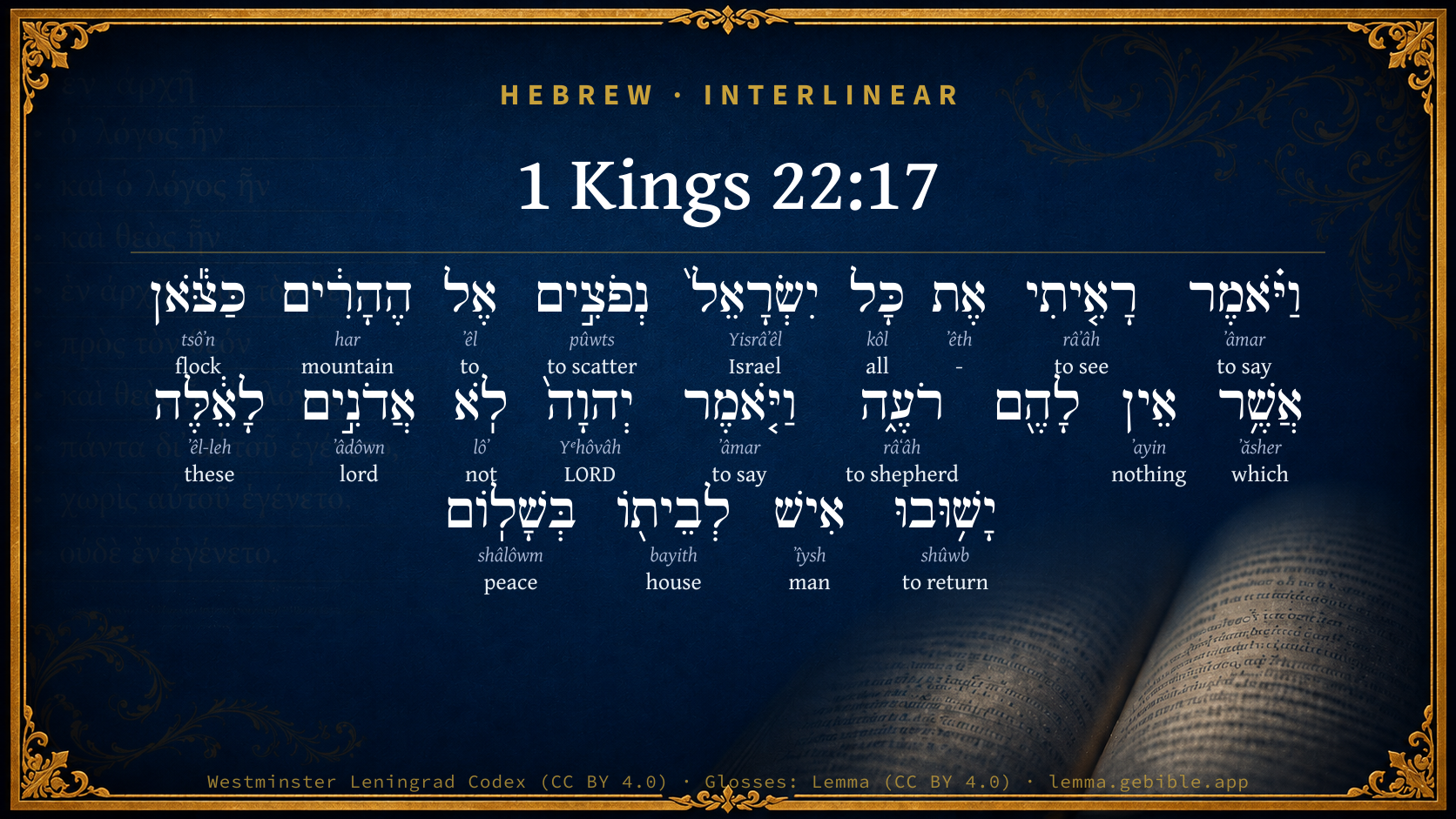
1 Kings 22:17

Hebrew (Westminster Leningrad Codex) 1 Kings 22:17 appears in the Hebrew Old Testament. The text above is from the Westminster Leningrad Codex. Each word links to its Strong’s number, a concise gloss, and parsing drawn from the Open Scriptures Hebrew Bible morphology. Click any word for its full Brown-Driver-Briggs (BDB) entry.
Download image
Cite this verse

1 Kings 22:17 (World English Bible). Public Domain. Lemma interlinear Bible study tool, https://lemma.gebible.app/v/1-kings/22/17.

Show BibTeX & RIS
BibTeX
RIS
English Translation
He said, I saw all Israel scattered on the mountains, as sheep that have no shepherd: and Yahweh said, These have no master; let them return every man to his house in peace.
World English Bible · Public Domain
Download a study sheet

One document with this verse’s original text, its word-by-word gloss line, the meaning frame, cross-references with their text, attributed commentary, and full source and license credits — printable, and it pastes into notes with its structure intact.

This verse Autodidact and up

Study sheet (.html) Plain text (.txt)

A passage Seminary Student

Up to 50 verses in one chapter. A passage sheet keeps up to 6 commentary sources and 12 cross-references per verse, in the order this page ranks them, and says so on the sheet whenever that leaves anything out. Ask for a single verse and you get the Autodidact verse sheet above.

Everything on this page stays free to read, with no account — the sheet is a download of what is already on screen, not access to it.

Want to remove ads? Support Godless Engineer
Compare translations 3

The same verse in 3 English versions, stacked beneath the original-language interlinear above. Click any original word for its lexicon entry.

Each is an independent rendering of the whole verse — the interlinear is not word-aligned to these translations.

Highlighted words mark where these versions differ — a whole-verse word diff, not a word-by-word alignment.

  • World English Bible Public Domain
    He said, I saw all Israel scattered on the mountains, as sheep that have no shepherd: and Yahweh said, These have no master; let them return every man to his house in peace.
  • King James Version Public Domain
    And he said, I saw all Israel scattered upon the hills, as sheep that have not a shepherd: and the LORD said, These have no master: let them return every man to his house in peace.
  • unfoldingWord Literal Text CC BY-SA 4.0
    And he said, “I saw all of Israel scattered on the hills like a flock when no shepherd is to them. And Yahweh said, ‘No masters to these. Let them return, a man to his house, in peace.’”

unfoldingWord Literal Text — © unfoldingWord, licensed CC BY-SA 4.0. Word-aligned USFM3 via Door43 (git.door43.org/unfoldingWord/en_ult).

Versions to compare (up to 4)

3 of 4 selected

Show all 18 translations

Every available English version of this verse, each an independent rendering of the whole verse.

  • World English Bible Public Domain
    He said, I saw all Israel scattered on the mountains, as sheep that have no shepherd: and Yahweh said, These have no master; let them return every man to his house in peace.
  • Berean Standard Bible Public Domain
    So Micaiah declared: “I saw all Israel scattered on the hills like sheep without a shepherd. And the LORD said, ‘These people have no master; let each one return home in peace.’”
  • Majority Standard Bible Public Domain
    So Micaiah declared: “I saw all Israel scattered on the hills like sheep without a shepherd. And the LORD said, ‘These people have no master; let each one return home in peace.’”
  • King James Version Public Domain
    And he said, I saw all Israel scattered upon the hills, as sheep that have not a shepherd: and the LORD said, These have no master: let them return every man to his house in peace.
  • American Standard Version (1901) Public Domain
    And he said, I saw all Israel scattered upon the mountains, as sheep that have no shepherd: and Jehovah said, These have no master; let them return every man to his house in peace.
  • Revised Version (1885) Public Domain
    And he said, I saw all Israel scattered upon the mountains, as sheep that have no shepherd: and the LORD said, These have no master; let them return every man to his house in peace.
  • Geneva Bible (1599) Public Domain
    Then he said, I sawe all Israel scattered vpon the mountaines, as sheepe that had no shepheard. And the Lord sayde, These haue no master, let euery man returne vnto his house in peace.
  • Douay-Rheims (1899) Public Domain
    And he said: I saw all Israel scattered upon the hills, like sheep that have no shepherd: and the Lord said: These have no master: let every man of them return to his house in peace.
  • Young's Literal Translation Public Domain
    And he saith, `I have seen all Israel scattered on the hills as sheep that have no shepherd, and Jehovah saith, These have no master; they turn back each to his house in peace.'
  • Literal Standard Version CC BY-SA 4.0
    And he says, “I have seen all Israel scattered on the hills as sheep that have no shepherd, and YHWH says, These have no master; let them return—each to his house in peace.”
  • Unlocked Literal Bible CC BY-SA 4.0
    So Micaiah said, “I saw all Israel scattered to the mountains, like sheep who have no shepherd, and Yahweh said, 'These have no shepherd. Let every man return to his house in peace.'”
  • unfoldingWord Literal Text CC BY-SA 4.0
    And he said, “I saw all of Israel scattered on the hills like a flock when no shepherd is to them. And Yahweh said, ‘No masters to these. Let them return, a man to his house, in peace.’”
  • Darby Bible Public Domain
    And he said, I saw all Israel scattered upon the mountains, as sheep that have no shepherd. And Jehovah said, These have no master: let them return every man to his house in peace.
  • World Messianic Bible Public Domain
    He said, “I saw all Israel scattered on the mountains, as sheep that have no shepherd. The LORD said, ‘These have no master. Let them each return to his house in peace.’”
  • Webster's Bible Public Domain
    And he said, I saw all Israel scattered upon the hills, as sheep that have not a shepherd: and the LORD said, These have no master: let them return every man to his house in peace.
  • Free Bible Version CC BY-SA 4.0
    So Micaiah answered, “I saw all Israel scattered on the mountains like sheep without a shepherd. The Lord said, ‘These people have no master; let each of them go home in peace.’”
  • Bible in Basic English Public Domain
    Then he said, I saw all Israel wandering on the mountains like sheep without a keeper; and the Lord said, These have no master: let them go back, every man to his house in peace.
  • JPS Tanakh (1917) Public Domain
    And he said: 'I saw all Israel scattered upon the mountains, as sheep that have no shepherd; and the LORD said: These have no master; let them return every man to his house in peace.'

Literal Standard Version (2020), Covenant Press — licensed CC BY-SA 4.0. Text via the HelloAO Bible API (eBible.org). Unlocked Literal Bible (unfoldingWord) — licensed CC BY-SA 4.0. Text via the HelloAO Bible API (eBible.org). unfoldingWord Literal Text — © unfoldingWord, licensed CC BY-SA 4.0. Word-aligned USFM3 via Door43 (git.door43.org/unfoldingWord/en_ult). Free Bible Version, Dr. Jonathan Gallagher — licensed CC BY-SA 4.0. Text via the HelloAO Bible API (eBible.org).

Word by word

More ways to search: Search by grammar → Find every occurrence → Compare this word →

Practice this passage: Drill this verse → Learn its vocabulary →

נְפֹצִ֣ים
pûwts
H6327
“scattered”
Verb, Niphal, Participle Passive, Masculine, Plural, Absolute
Part of Speech
Verb
Stem
Niphal
Form
Participle Passive
Gender
Masculine
Number
Plural
State
Absolute
Full BDB Definition

Origin: a primitive root

TWOT: 1745 , 1746 , 1800

to scatter, be dispersed, be scattered - (Qal) to be dispersed, be scattered - (Niphal) - to be scattered - to be spread abroad - (Hiphil) to scatter - Hithpael) scatter - (Qal) to flow, overflow - to break - (Polel) to shatter - (Pilpel) to dash to pieces
  1. וַיֹּ֗אמֶר ʼâmar H559 “and · to say” Conjunction + Verb, Qal, Sequential Imperfect, 3rd Person, Masculine, Singular
  2. רָאִ֤יתִי râʼâh H7200 “to see” Verb, Qal, Perfect, 1st Person, Common, Singular
  3. אֶת ʼêth H853 “-” Particle, Direct Object
  4. כָּל kôl H3605 “all of” Noun, Common, Masculine, Singular, Construct
  5. יִשְׂרָאֵל֙ Yisrâʼêl H3478 “Israel” Noun, Proper
  6. אֶל ʼêl H413 “to” Preposition
  7. הֶהָרִ֔ים har H2022 “the · mountains” Particle, Definite Article + Noun, Common, Masculine, Plural, Absolute
  8. כַּצֹּ֕אן tsôʼn H6629 “like/as the · flock” Preposition, Determined + Noun, Common, Both, Singular, Absolute
  9. אֲשֶׁ֥ר ʼăsher H834 “which” Particle, Relative
  10. אֵין ʼayin H369 “nothing” Particle, Negative
  11. רֹעֶ֑ה râʻâh H7462 “shepherding” Verb, Qal, Participle Active, Masculine, Singular, Absolute
  12. וַיֹּ֤אמֶר ʼâmar H559 “and · to say” Conjunction + Verb, Qal, Sequential Imperfect, 3rd Person, Masculine, Singular
  13. יְהוָה֙ Yᵉhôvâh H3068 “LORD” Noun, Proper
  14. לֹֽא lôʼ H3808 “not” Particle, Negative
  15. אֲדֹנִ֣ים ʼâdôwn H113 “lords” Noun, Common, Masculine, Plural, Absolute
  16. לָאֵ֔לֶּה ʼêl-leh H428 “to/for · these” Preposition + Pronoun, Demonstrative, Common, Plural
  17. יָשׁ֥וּבוּ shûwb H7725 “to return” Verb, Qal, Jussive, 3rd Person, Masculine, Plural
  18. אִישׁ ʼîysh H376 “man” Noun, Common, Masculine, Singular, Absolute
  19. לְבֵית֖וֹ bayith H1004 “to/for · house · his” Preposition + Noun, Common, Masculine, Singular, Construct + Suffix, Personal, 3rd Person, Masculine, Singular
  20. בְּשָׁלֽוֹם shâlôwm H7965 “in/at · peace” Preposition + Noun, Common, Masculine, Singular, Absolute

About this verse

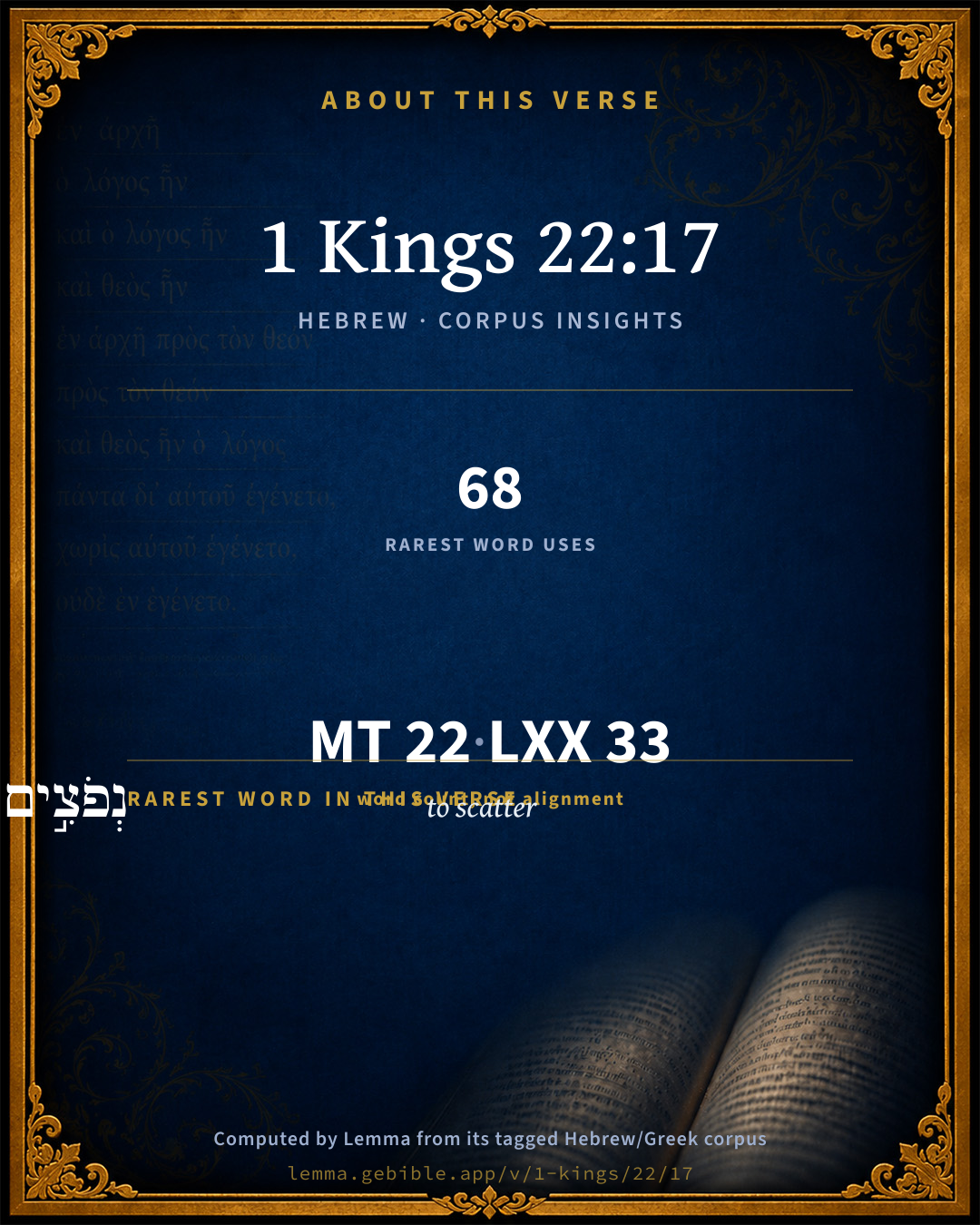
These counts appear in no published source. They are computed here, from the morphology-tagged text and Lemma’s own curated glosses. What Lemma adds →

22
words
20
distinct lemmas
Historical
section

Grammatical profile

  • 6 verbs
  • 9 nouns
  • 1 pronoun
  • 2 prepositions
  • 4 particles

Verb forms

  • וַיֹּ֗אמֶר Qal · Sequential Imperfect
  • רָאִ֤יתִי Qal · Perfect
  • נְפֹצִ֣ים Niphal · Participle Passive
  • רֹעֶ֑ה Qal · Participle Active
  • וַיֹּ֤אמֶר Qal · Sequential Imperfect
  • יָשׁ֥וּבוּ Qal · Jussive

Repetition

A word recurs within this verse — often emphatic in Hebrew:

  • וַיֹּ֗אמֶר to say H559 ×2

Hebrew & Septuagint length

In English translation the verse runs 33 words from the Hebrew and 38 from the Septuagint (LXX English) — closely comparable.

A rough comparison of the two English renderings, which tokenize alike — not a word-level alignment.

Word counts can differ between the Hebrew and the Greek without any difference in meaning — e.g. the Hebrew direct-object marker אֵת has no separate Greek word, and Greek often adds the article ὁ.

In the original languages it is 22 Hebrew tokens and 33 Greek tokens — but the two are counted differently (Hebrew bundles its prefixes and suffixes into one token; the Greek is in lemma form), so that isn’t a like-for-like length.

Cross-references

14

Topical passages linked to 1 Kings 22:17 in the Treasury of Scripture Knowledge — connected by theme and wording, ordered by reader-vote popularity; previews shown in the World English Bible.

  • Numbers 27:17 who may go out before them, and who may come in before them, and who may lead them out, and who may bring them in; that the congregation of Yahweh not be as sheep which have no shepherd.
  • Matthew 9:36 But when he saw the multitudes, he was moved with compassion for them, because they were harassed and scattered, like sheep without a shepherd.
  • 1 Kings 22:34–36 A certain man drew his bow at a venture, and struck the king of Israel between the joints of the armor: therefore he said to the driver of his chariot, Turn your hand, and carry me out of the host; for I am severely wounded.
  • 2 Chronicles 18:16–17 He said, I saw all Israel scattered on the mountains, as sheep that have no shepherd: and Yahweh said, These have no master; let them return every man to his house in peace.
  • Jeremiah 50:6 My people have been lost sheep: their shepherds have caused them to go astray; they have turned them away on the mountains; they have gone from mountain to hill; they have forgotten their resting-place.
  • Jeremiah 50:17 Israel is a hunted sheep; the lions have driven him away: first, the king of Assyria devoured him; and now at last Nebuchadrezzar king of Babylon has broken his bones.
  • Ezekiel 34:4–6 You haven't strengthened the diseased, neither have you healed that which was sick, neither have you bound up that which was broken, neither have you brought back that which was driven away, neither have you sought that which was lost; but with force and with rigor have you ruled over them.
  • Zechariah 13:7 "Awake, sword, against my shepherd, And against the man who is close to me," says Yahweh of Hosts. Strike the shepherd, and the sheep will be scattered; And I will turn my hand against the little ones.
  • Acts 10:11–17 He saw heaven opened and a certain container descending to him, like a great sheet let down by four corners on the earth,
  • 1 Samuel 9:9 (In earlier times in Israel, when a man went to inquire of God, thus he said, Come, and let us go to the seer; for he who is now called a Prophet was before called a Seer.)
  • Jeremiah 1:11–16 Moreover the word of Yahweh came to me, saying, Jeremiah, what see you? I said, I see a rod of an almond tree.
  • Jeremiah 23:1–2 Woe to the shepherds who destroy and scatter the sheep of my pasture! says Yahweh.
  • Zechariah 10:2 For the teraphim have spoken vanity, and the diviners have seen a lie; And they have told false dreams. They comfort in vain. Therefore they go their way like sheep. They are oppressed, because there is no shepherd.
  • Ezekiel 1:4 I looked, and, behold, a stormy wind came out of the north, a great cloud, with flashing lightning, and a brightness round about it, and out of the midst of it as it were glowing metal, out of the midst of the fire.

Cross-references courtesy of OpenBible.info (CC BY 4.0).

Hebrew and Greek witnesses Masoretic Hebrew ↔ Greek Septuagint

The same verse in the two great witnesses to the Old Testament, shown verse-for-verse.

These are two independent witnesses, not word-aligned to each other, and the Septuagint is shown in lemma (dictionary) form.

Hebrew 1 Kings 22:17 Masoretic · Westminster Leningrad Codex

וַיֹּ֗אמֶר רָאִ֤יתִי אֶת כָּל יִשְׂרָאֵל֙ נְפֹצִ֣ים אֶל הֶהָרִ֔ים כַּצֹּ֕אן אֲשֶׁ֥ר אֵין לָהֶ֖ם רֹעֶ֑ה וַיֹּ֤אמֶר יְהוָה֙ לֹֽא אֲדֹנִ֣ים לָאֵ֔לֶּה יָשׁ֥וּבוּ אִישׁ לְבֵית֖וֹ בְּשָׁלֽוֹם

He said, I saw all Israel scattered on the mountains, as sheep that have no shepherd: and Yahweh said, These have no master; let them return every man to his house in peace.

World English Bible · Public Domain

Greek LXX 1 Kings 22:17 Septuagint · lemma form

καί εἶπον μιχαιας οὐ οὕτως ὁράω πᾶς ὁ ἰσραήλ διασπείρω ἐν ὁ ὄρος ὡς ποίμνιον ὅς οὐ εἰμί ποιμήν καί εἶπον κύριος οὐ κύριος οὗτος ἀναστρέφω ἕκαστος εἰς ὁ οἶκος αὐτός ἐν εἰρήνη

And he said, Not so. I saw all Israel scattered on the mountains as a flock without a shepherd: and the Lord said, Is not God lord of these? let each one return to his home in peace.

LXX2012 (modern English Septuagint) · Public Domain

On this verse, The Cambridge Bible for Schools and Colleges discusses the Septuagint’s reading. Read the note in Commentary ↓

Hebrew: Westminster Leningrad Codex (CC BY 4.0). Greek: Septuagint (public domain); English from LXX2012 (modern English Septuagint) (Public Domain). How the Septuagint differs from the Hebrew →

Targum (Aramaic paraphrase)

1

The Targum is the ancient Jewish Aramaic paraphrase of the Hebrew Scriptures — an interpretive translation, not the Hebrew text itself. Onkelos (literal) and Pseudo-Jonathan (expansive) render the Torah, and Jonathan the Prophets. Coverage is partial: where no permissively-licensed English translation exists for a verse, only the Aramaic is shown. This is verse-level text, not a word-by-word alignment to the Hebrew.

  1. Targum Jonathan Prophets (Joshua–Malachi)
    וַאֲמַר חֲזֵיתִי יַת כָּל יִשְׂרָאֵל מְבַדְרִין עַל טוּרַיָא כַּעֲנָא דְלֵית לְהוֹן רָעִי וַאֲמַר יְיָ לֵית רִבּוֹנִין לְאִלֵין יְתוּבוּן גְבַר לְבֵיתֵיהּ בִּשְׁלָם:

    (no public-domain English translation for this verse)

    Targum Jonathan — Aramaic: “Mikraot Gedolot” (public domain). English: “Sefaria Community Translation” (CC0 1.0 (public-domain dedication)); “London "Chaldee Paraphrase," 1871” (public domain). Text via Sefaria.

Commentary

Notes on 1 Kings 22:17 from classic Christian and Jewish commentators (each source and its license shown beneath its notes). The classic Christian expositions comment on the surrounding passage and are grouped to its opening verse, so a note may address several verses; the Jewish commentaries on the Tanakh (Rashi and others) are per-verse, so they appear only where the commentator wrote on this verse.

Lemma curates 59 commentaries, every one of them public domain or Creative Commons licensed, each selected and text-cleaned for this edition rather than reprinted as found. About our sources →

Trapp's Complete Commentary

John Trapp

1Ki 22:17 And he said, I saw all Israel scattered upon the hills, as sheep that have not a shepherd: and the LORD said, These have no master: let them return every man to his house in peace.

Ver. 17. And he said.] Being thus adjured, he speaks out, as did likewise our Saviour. {Mat 26:63-64}

I saw all Israel, &c.] This was plain enough, without a gloss; Ahab shall die, and his army be routed.

John Trapp, A Commentary or Exposition upon All the Books of the Old and New Testament (1647–1656) — public domain. Text from a community e-Sword module.

Joseph Benson's Commentary

1Ki 22:17. And he said, I saw — Namely, in the Spirit, or in a vision; all Israel scattered upon the hills — Upon the mountains of Gilead, where they lay encamped by Ahab’s order, or to which they fled from the enemy. As sheep that have no shepherd — As people that have lost their king. The Lord said, These have no master; let them return, &c. — Discharged from the war. This was fulfilled, 1Ki 22:36.

Joseph Benson's Commentary on the Old and New Testaments (1811–1818) — public domain. Text from a community e-Sword module.

Tyndale Open Study Notes

Tyndale Open Resources

22:17 Like God himself (Ps 23; Isa 40:10-11), Israel’s kings and leaders were charged with care of the people much as a shepherd cares for his sheep (Num 27:16-17; Ezek 34:2, 11-16). The motif of the shepherd and the sheep, applied to the coming Messiah (Ezek 34:23-24), was fulfilled in Christ the Good Shepherd (John 10:1-11). Although he laid down his life for the sheep (John 10:14-18; 1 Pet 2:24-25), he still lives (Heb 13:20) and will come again for them (1 Pet 5:4).

Tyndale Open Study Notes — © Tyndale Open Resources, licensed CC BY-SA 4.0. Text via the HelloAO Bible API.

Geneva Bible (1599)

Geneva Bible translators

It is better they return home than to be punished and scattered, because they take war in hand without God’s counsel and approbation.

Geneva Bible (1599) marginal notes — public domain. Text via Bolls.life.

Jamieson, Fausset & Brown

Robert Jamieson, A. R. Fausset & David Brown

I saw all Israel scattered upon the hills, as sheep that have not a shepherd--The purport of this was that the army of Israel would be defeated and dispersed; that Ahab would fall in the battle, and the people return without either being pursued or destroyed by the enemy.

Jamieson, Fausset & Brown — Commentary Critical and Explanatory on the Whole Bible (1871) — public domain (CC PDM 1.0). Text via the HelloAO Bible API.

Adam Clarke's Commentary

Verse 17. These have no master] Here the prophet foretells the defeat of Israel, and the death of the king; they were as sheep that had not a shepherd, people that had no master, the political shepherd and master (Ahab) shall fall in battle.

Adam Clarke's Commentary on the Bible (1810–1826) — public domain. Text from a community e-Sword/MySword module.

The Cambridge Bible for Schools and Colleges

gen. ed. J. J. S. Perowne

17. And he said] Here the LXX. adds οὐχ οὕτως, ‘Not so,’ and there is a similar insertion at the beginning of 1Ki_22:19, where see note.

I saw all Israel] Here Micaiah in true prophetic tone relates a vision which foretells the utter ruin of the coming expedition.

scattered upon the hills] R.V. mountains. This is A.V. in 2 Chronicles, and the change gives a sense of greater dispersion. But in any case the two places should be alike.

as sheep that have not a [R.V. no] shepherd] Again the rendering in 2 Chronicles is adopted. The language of Micaiah spake in no doubtful tone of the coming death of Ahab. For the simile cf. Num_27:17, a passage which may have been in Micaiah’s thoughts.

let them return] The prophet pictures the great disaster as falling specially upon Ahab. When he was slain, there would be no attempt to prevent the escape of his army.

The Cambridge Bible for Schools and Colleges (gen. ed. J. J. S. Perowne; Cambridge University Press, 1878–1918) — public domain. Text from a community e-Sword module.

John Gill's Exposition

And the Lord said, who shall persuade Ahab, that he may go up and fall at Ramothgilead?.... Not that it can be supposed that the Lord entered into a consultation with the angels upon this subject; only that it was the decree of God that he should go thither, and fall by the hand of the man whom he had let go, as a just punishment of him:

and one said on this manner, and another said on that manner; not that there was such an altercation among them; it only signifies, that there are various ways and means, by which the purposes and decrees of God may be and are brought about.

John Gill's Exposition of the Whole Bible (1746–1763) — public domain (CC PDM 1.0). Text via the HelloAO Bible API.

Albert Barnes' Notes on the Bible

Thus adjured, Micaiah wholly changes his tone. Ahab cannot possibly mistake the meaning of his vision, especially as the metaphor of “sheep and shepherd” for king and people was familiar to the Israelites from the prayer of Moses Num 27:17.

Albert Barnes' Notes on the Bible (1834–1885) — public domain. Text from a community e-Sword/MySword module.

Haydock's Catholic Bible Commentary

No shepherd....no master, clearly intimated (Menochius) that the king should perish in the battle. Paralipomenon reads: These have no masters. (Haydock)

George Leo Haydock (1774–1849), Haydock's Catholic Family Bible and Commentary, 1859 edition — public domain. Excludes Psalms (Douay-Rheims chapter numbering differs from Protestant) and Deuterocanonical books (Catholic canon only).

Matthew Poole's English Annotations

I saw; in the spirit, or in a vision.

Upon the hills; upon the mountains of Gilead, nigh Ramoth; either where they lay encamped by Ahab’s order, or to which they fled from the enemy, esteeming that the safest place. See Mat 24:16.

As sheep that have not a shepherd; as people who have lost their king. See Num 27:17; Isa 40:11; 44:28; Eze 34:23.

Every man to his house in peace; discharged from the war; which was fulfilled, 1Ki 22:36.

Matthew Poole's English Annotations on the Holy Bible (1683–1685) — public domain. Text from a community e-Sword/MySword module.

Whedon's Commentary on the Bible

Daniel D. Whedon

17. As sheep that have not a shepherd — Appropriate simile of a people that have lost their king, and so a prophecy of the fall of Ahab and the dispersion of his army. As Zedekiah had used imagery drawn from the Pentateuch, so does Micaiah also bear witness to that ancient book by using another simile of Moses. Compare Num_27:17.

Daniel D. Whedon (gen. ed.), Commentary on the Old and New Testaments (1874–1909) — public domain. Text from a community e-Sword module.

The Pulpit Commentary

And he said We may imagine how entire was the change of tone. He now speaks with profound seriousness. Thenius sees in the peculiarity and originality of this vision a proof of the historical truth of this history. "We feel that we are gradually drawing nearer to the times of the later prophets. It is a vision which might rank amongst those of Isaiah or Ezekiel" (Stanley), I saw all Israel scattered upon the hills, as sheep that have not a shepherd: and the Lord said, These have no master: let them return every man to his house in peace. The last words are illustrated by the command of ver. 31; compare ver. 36. We may also picture the effect these words would have on the assembly at the city gate. For, however much they might be inclined to discredit Micaiah"s words, and however much the reckless, unreasoning war spirit might possess them, there were none who did not understand that this vision portended the dispersion of the Israelite army and the death of its leader. King and people had been constantly represented under the figure of shepherd and sheep, and notably by Moses himself, who had used these very words, "sheep without a shepherd" (Num_27:17; cf. Psa_78:70, Psa_78:71; Isa_44:28; Jer_23:1, 2 Eze 34, passim. It is observable that Micaiah"s vision, like Zedekiah"s parable, borrows the language of the Pentateuch. Coincidences of this remote character are the most powerful proofs that the Pentateuch was then written.

The Pulpit Commentary (1880–1919), ed. H.D.M. Spence-Jones & Joseph S. Exell — public domain. Text from a community e-Sword module.

John Wesley's Explanatory Notes

I saw - In the spirit, or in a vision. The hills - Upon the mountains of Gilead, nigh Ramoth, where they lay encamped by Ahab's order. As sheep - As people who have lost their king. Return - Discharged from the war: which was fulfilled, ver. 26.

John Wesley, Explanatory Notes Upon the Whole Bible (1754–1765) — public domain. Text via the GEBible commentary corpus.

Rashi

Rabbi Shlomo Yitzchaki (Rashi)

These have no masters. You alone will die in the war, as the matter is stated below, “Do not battle the small or the great, but only with the king of Yisroel himself.” Even though it was stated, “and your people instead of his people,” the drop of blood that came out of the righteous man, Michoyhu, whose friend struck him, striking and wounding him, was an atonement for all Yisroel. So it is explained in the [Midrash] Aggadah.

Rashi on the Tanakh — English translations: “The Judaica Press complete Tanach with Rashi, translated by A. J. Rosenberg” (CC BY 4.0); “Pentateuch with Rashi's commentary by M. Rosenbaum and A.M. Silbermann, 1929-1934” (public domain); “The Metsudah Tanach series, Lakewood, N.J” (CC BY 4.0); and “The Book of Joshua, Metsudah Publications, 1997” (CC BY 4.0). Text via Sefaria.

Lesson kit

Teaching starters — assembled from the data on this page, not authored interpretation. Every prompt links to the verse data it draws on. Edit before teaching.

1 Kings, in the Historical, opens this verse with 22 words (20 distinct Hebrew lemmas). Its most distinctive word is pûwts (“to scatter”). A historical commentator’s framing appears above. Read the whole chapter for the surrounding context.

Discussion questions

  1. What does “to scatter” (pûwts) contribute to the verse as a whole?
  2. How does Numbers 27:17, which shares this passage’s theme, read alongside this verse?
  3. What does the repetition of “to say” (2× in this one verse) do in this verse?
  4. These translations render this verse differently; the difference is in the English rendering, not the original. What questions does that raise?
  5. «וַיֹּ֗אמֶר» is a Qal Sequential Imperfect verb. How does that grammatical form shape the action described?
  6. Compare how Trapp's Complete Commentary and Joseph Benson's Commentary read this verse. Where do they agree or differ?

Things to notice

Reading settings

Reading text

Shown beneath each verse's original-language words.

Old Testament
Old Testament edition

Read the OT as the Masoretic Hebrew (MT) or the Greek Septuagint (LXX).

English shown for the Greek Septuagint (in the Hebrew ↔ Greek comparison).

Comparing translations? Open the Compare panel on any verse page to stack up to four side by side.