
Leviticus 22:21

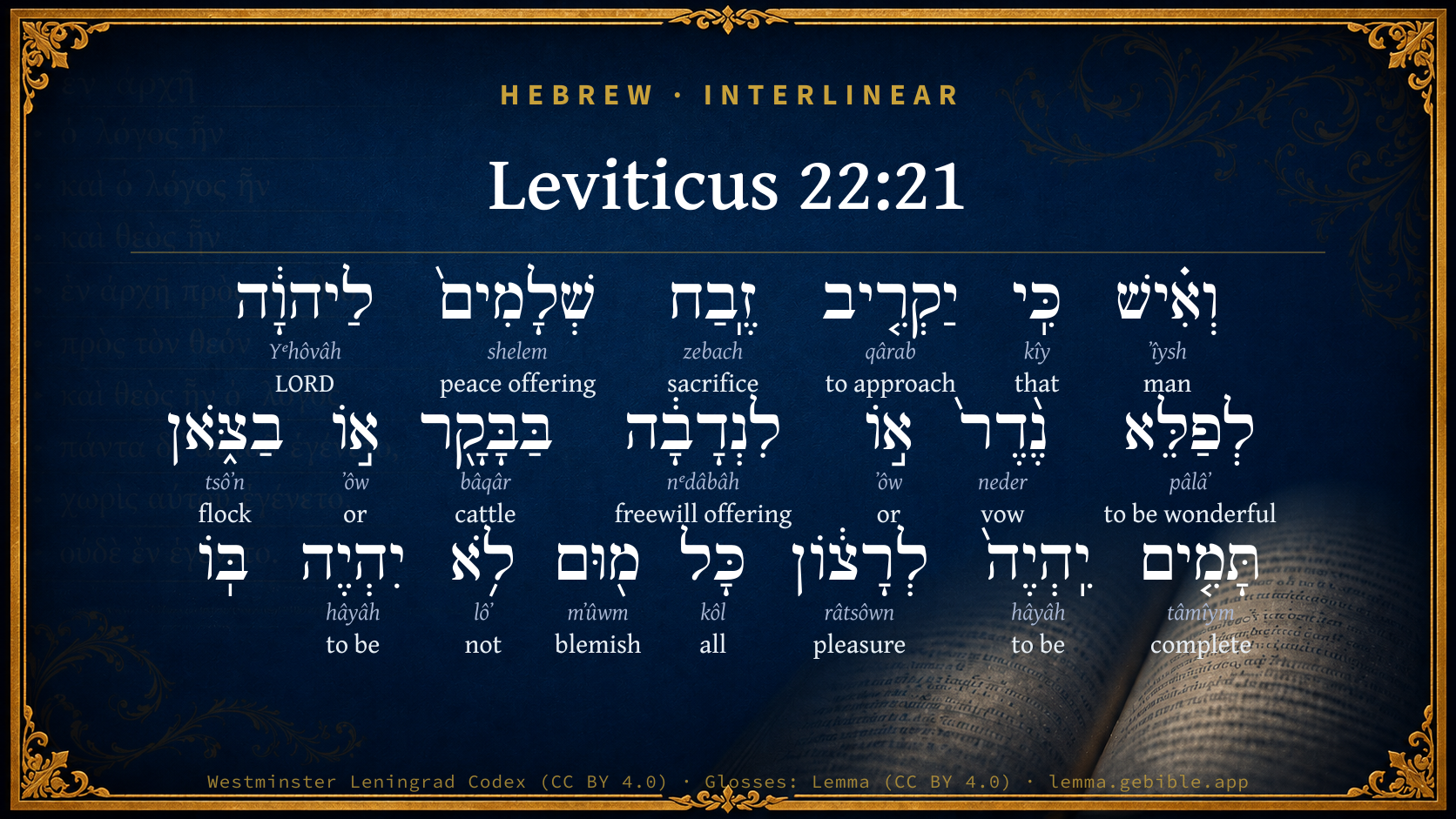
Hebrew (Westminster Leningrad Codex) Leviticus 22:21 appears in the Hebrew Old Testament. The text above is from the Westminster Leningrad Codex. Each word links to its Strong’s number, a concise gloss, and parsing drawn from the Open Scriptures Hebrew Bible morphology. Click any word for its full Brown-Driver-Briggs (BDB) entry.
Download image
Cite this verse

Leviticus 22:21 (World English Bible). Public Domain. Lemma interlinear Bible study tool, https://lemma.gebible.app/v/leviticus/22/21.

Show BibTeX & RIS
BibTeX
RIS
English Translation
Whoever offers a sacrifice of peace offerings to Yahweh to accomplish a vow, or for a freewill offering, of the herd or of the flock, it shall be perfect to be accepted; there shall be no blemish therein.
World English Bible · Public Domain
Download a study sheet

One document with this verse’s original text, its word-by-word gloss line, the meaning frame, cross-references with their text, attributed commentary, and full source and license credits — printable, and it pastes into notes with its structure intact.

This verse Autodidact and up

Study sheet (.html) Plain text (.txt)

A passage Seminary Student

Up to 50 verses in one chapter. A passage sheet keeps up to 6 commentary sources and 12 cross-references per verse, in the order this page ranks them, and says so on the sheet whenever that leaves anything out. Ask for a single verse and you get the Autodidact verse sheet above.

Everything on this page stays free to read, with no account — the sheet is a download of what is already on screen, not access to it.

Want to remove ads? Support Godless Engineer
Compare translations 3

The same verse in 3 English versions, stacked beneath the original-language interlinear above. Click any original word for its lexicon entry.

Each is an independent rendering of the whole verse — the interlinear is not word-aligned to these translations.

Highlighted words mark where these versions differ — a whole-verse word diff, not a word-by-word alignment.

  • World English Bible Public Domain
    Whoever offers a sacrifice of peace offerings to Yahweh to accomplish a vow, or for a freewill offering, of the herd or of the flock, it shall be perfect to be accepted; there shall be no blemish therein.
  • King James Version Public Domain
    And whosoever offereth a sacrifice of peace offerings unto the LORD to accomplish his vow, or a freewill offering in beeves or sheep, it shall be perfect to be accepted; there shall be no blemish therein.
  • unfoldingWord Literal Text CC BY-SA 4.0
    And a man, when he presents a sacrifice of peace offerings to Yahweh to fulfill a vow or as a freewill offering among the cattle or among the flock, it shall be perfect for acceptance. Any blemish shall not be on it:

unfoldingWord Literal Text — © unfoldingWord, licensed CC BY-SA 4.0. Word-aligned USFM3 via Door43 (git.door43.org/unfoldingWord/en_ult).

Versions to compare (up to 4)

3 of 4 selected

Show all 18 translations

Every available English version of this verse, each an independent rendering of the whole verse.

  • World English Bible Public Domain
    Whoever offers a sacrifice of peace offerings to Yahweh to accomplish a vow, or for a freewill offering, of the herd or of the flock, it shall be perfect to be accepted; there shall be no blemish therein.
  • Berean Standard Bible Public Domain
    When a man presents a peace offering to the LORD from the herd or flock to fulfill a vow or as a freewill offering, it must be without blemish or defect to be acceptable.
  • Majority Standard Bible Public Domain
    When a man presents a peace offering to the LORD from the herd or flock to fulfill a vow or as a freewill offering, it must be without blemish or defect to be acceptable.
  • King James Version Public Domain
    And whosoever offereth a sacrifice of peace offerings unto the LORD to accomplish his vow, or a freewill offering in beeves or sheep, it shall be perfect to be accepted; there shall be no blemish therein.
  • American Standard Version (1901) Public Domain
    And whosoever offereth a sacrifice of peace-offerings unto Jehovah to accomplish a vow, or for a freewill-offering, of the herd or of the flock, it shall be perfect to be accepted; there shall be no blemish therein.
  • Revised Version (1885) Public Domain
    And whosoever offereth a sacrifice of peace offerings unto the LORD to accomplish a vow, or for a freewill offering, of the herd or of the flock, it shall be perfect to be accepted; there shall be no blemish therein.
  • Geneva Bible (1599) Public Domain
    And whosoeuer bringeth a peace offring vnto ye Lord to accomplish his vowe, or for a free offring, of the beeues, or of the sheepe, his free offring shall bee perfect, no blemish shalbe in it.
  • Douay-Rheims (1899) Public Domain
    The man that offereth a victim of peace offerings to the Lord, either paying his vows, or offering of his own accord, whether of beeves or of sheep, shall offer it without blemish, that it may be acceptable: there shall be no blemish in it.
  • Young's Literal Translation Public Domain
    `And when a man bringeth near a sacrifice of peace-offerings to Jehovah, to complete a vow, or for a willing-offering, of the herd or of the flock, it is perfect for a pleasing thing: no blemish is in it;
  • Literal Standard Version CC BY-SA 4.0
    And when a man brings a sacrifice of peace-offerings near to YHWH, to complete a special vow, or for a willing-offering, of the herd or of the flock, it is perfect for a pleasing thing: no blemish is in it.
  • Unlocked Literal Bible CC BY-SA 4.0
    Whoever offers a sacrifice of fellowship offerings from the herd or the flock to Yahweh to fulfill a vow, or as a freewill offering, it must be unblemished to be accepted. There must be no defect in the animal.
  • unfoldingWord Literal Text CC BY-SA 4.0
    And a man, when he presents a sacrifice of peace offerings to Yahweh to fulfill a vow or as a freewill offering among the cattle or among the flock, it shall be perfect for acceptance. Any blemish shall not be on it:
  • Darby Bible Public Domain
    And if any present a sacrifice of peace-offering to Jehovah to accomplish a vow, or a voluntary offering of oxen or small cattle, it shall be without blemish to be accepted: there shall be no defect therein.
  • World Messianic Bible Public Domain
    Whoever offers a sacrifice of peace offerings to the LORD to accomplish a vow, or for a free will offering of the herd or of the flock, it shall be perfect to be accepted. It shall have no defect.
  • Webster's Bible Public Domain
    And whoever offereth a sacrifice of peace-offerings to the LORD to accomplish his vow, or a free-will-offering in beeves, or sheep, it shall be perfect to be accepted: there shall be in it no blemish.
  • Free Bible Version CC BY-SA 4.0
    If you want to present a peace offering to the Lord from the herd or flock to fulfill a promise or as a freewill offering, in order to be acceptable the animal must be perfect, completely without defects.
  • Bible in Basic English Public Domain
    And whoever makes a peace-offering to the Lord, in payment of an oath or as a free offering, from the herd or the flock, if it is to be pleasing to the Lord, let it be free from any mark or damage.
  • JPS Tanakh (1917) Public Domain
    And whosoever bringeth a sacrifice of peace-offerings unto the LORD in fulfilment of a vow clearly uttered, or for a freewill-offering, of the herd or of the flock, it shall be perfect to be accepted; there shall be no blemish therein.

Literal Standard Version (2020), Covenant Press — licensed CC BY-SA 4.0. Text via the HelloAO Bible API (eBible.org). Unlocked Literal Bible (unfoldingWord) — licensed CC BY-SA 4.0. Text via the HelloAO Bible API (eBible.org). unfoldingWord Literal Text — © unfoldingWord, licensed CC BY-SA 4.0. Word-aligned USFM3 via Door43 (git.door43.org/unfoldingWord/en_ult). Free Bible Version, Dr. Jonathan Gallagher — licensed CC BY-SA 4.0. Text via the HelloAO Bible API (eBible.org).

Word by word

More ways to search: Search by grammar → Find every occurrence → Compare this word →

Practice this passage: Drill this verse → Learn its vocabulary →

מ֖וּם
mʼûwm
H3971
“blemish”
Noun, Common, Masculine, Singular, Absolute
Part of Speech
Noun
Type
Common
Gender
Masculine
Number
Singular
State
Absolute
Full BDB Definition

Origin: as if passive participle from an unused root

TWOT: 1137a

blemish, spot, defect - of physical defect - of moral stain
  1. וְאִ֗ישׁ ʼîysh H376 “and · man” Conjunction + Noun, Common, Masculine, Singular, Absolute
  2. כִּֽי kîy H3588 “that” Conjunction
  3. יַקְרִ֤יב qârab H7126 “to approach” Verb, Hiphil, Imperfect, 3rd Person, Masculine, Singular
  4. זֶֽבַח zebach H2077 “sacrifice of” Noun, Common, Masculine, Singular, Construct
  5. שְׁלָמִים֙ shelem H8002 “peace offerings” Noun, Common, Masculine, Plural, Absolute
  6. לַיהוָ֔ה Yᵉhôvâh H3068 “to/for · LORD” Preposition + Noun, Proper
  7. לְפַלֵּא pâlâʼ H6381 “to be wonderful” Preposition + Verb, Piel, Infinitive Construct
  8. נֶ֨דֶר֙ neder H5088 “vow” Noun, Common, Masculine, Singular, Absolute
  9. א֣וֹ ʼôw H176 “or” Conjunction
  10. לִנְדָבָ֔ה nᵉdâbâh H5071 “to/for · freewill offering” Preposition + Noun, Common, Feminine, Singular, Absolute
  11. בַּבָּקָ֖ר bâqâr H1241 “in/at the · cattle” Preposition, Determined + Noun, Common, Both, Singular, Absolute
  12. א֣וֹ ʼôw H176 “or” Conjunction
  13. בַצֹּ֑אן tsôʼn H6629 “in/at the · flock” Preposition, Determined + Noun, Common, Both, Singular, Absolute
  14. תָּמִ֤ים tâmîym H8549 “complete” Adjective, Adjective, Masculine, Singular, Absolute
  15. יִֽהְיֶה֙ hâyâh H1961 “to be” Verb, Qal, Imperfect, 3rd Person, Masculine, Singular
  16. לְרָצ֔וֹן râtsôwn H7522 “to/for · pleasure” Preposition + Noun, Common, Masculine, Singular, Absolute
  17. כָּל kôl H3605 “all of” Noun, Common, Masculine, Singular, Construct
  18. לֹ֥א lôʼ H3808 “not” Particle, Negative
  19. יִהְיֶה hâyâh H1961 “to be” Verb, Qal, Imperfect, 3rd Person, Masculine, Singular

About this verse

These counts appear in no published source. They are computed here, from the morphology-tagged text and Lemma’s own curated glosses. What Lemma adds →

21
words
18
distinct lemmas
Pentateuch
section

Notable vocabulary

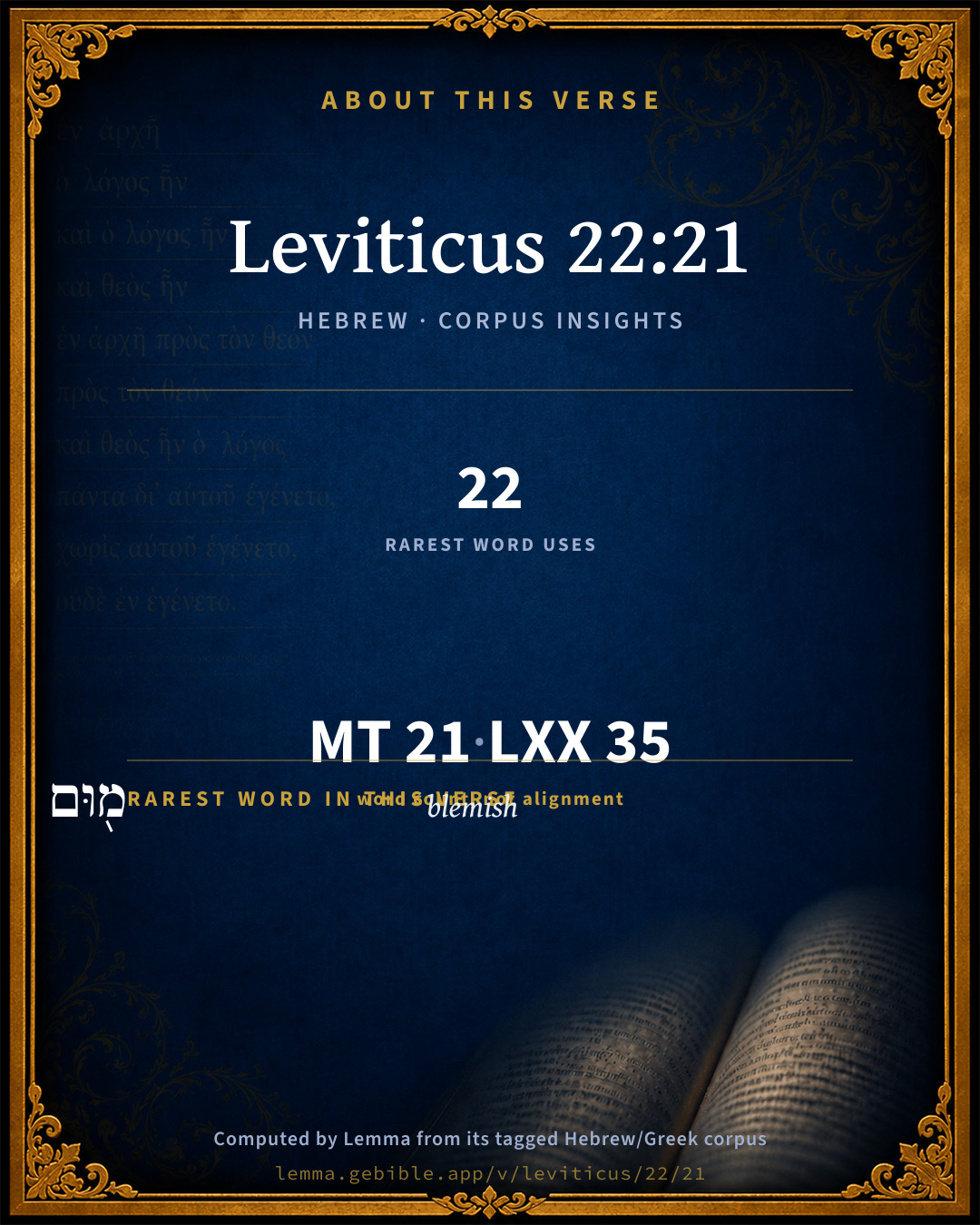
The rarest word here is מ֖וּם blemish H3971 — appearing just 22 times in the whole Hebrew Bible.

Shared distinctive vocabulary

מ֖וּם blemish H3971 occurs in 19 verses of the Hebrew Bible. Also found in:

Grammatical profile

  • 4 verbs
  • 11 nouns
  • 1 adjective
  • 1 preposition
  • 3 conjunctions
  • 1 particle

Verb forms

  • יַקְרִ֤יב Hiphil · Imperfect
  • לְפַלֵּא Piel · Infinitive Construct
  • יִֽהְיֶה֙ Qal · Imperfect
  • יִהְיֶה Qal · Imperfect

Repetition

Words recur within this verse — often emphatic in Hebrew:

  • יִֽהְיֶה֙ to be H1961 ×2
  • א֣וֹ or H176 ×2

Hebrew & Septuagint length

In English translation the verse runs 38 words from the Hebrew and 48 from the Septuagint (LXX English) — closely comparable.

A rough comparison of the two English renderings, which tokenize alike — not a word-level alignment.

Word counts can differ between the Hebrew and the Greek without any difference in meaning — e.g. the Hebrew direct-object marker אֵת has no separate Greek word, and Greek often adds the article ὁ.

In the original languages it is 21 Hebrew tokens and 35 Greek tokens — but the two are counted differently (Hebrew bundles its prefixes and suffixes into one token; the Greek is in lemma form), so that isn’t a like-for-like length.

Cross-references

11

Topical passages linked to Leviticus 22:21 in the Treasury of Scripture Knowledge — connected by theme and wording, ordered by reader-vote popularity; previews shown in the World English Bible.

  • Numbers 15:8 When you prepare a bull for a burnt offering, or for a sacrifice, to accomplish a vow, or for peace-offerings to Yahweh;
  • Numbers 15:3 and will make an offering by fire to Yahweh, a burnt offering, or a sacrifice, to accomplish a vow, or as a freewill-offering, or in your set feasts, to make a sweet savor to Yahweh, of the herd, or of the flock;
  • Leviticus 3:6 "'If his offering for a sacrifice of peace offerings to Yahweh is from the flock; male or female, he shall offer it without blemish.
  • Ecclesiastes 5:4–5 When you vow a vow to God, don't defer to pay it; for he has no pleasure in fools. Pay that which you vow.
  • Leviticus 3:1 "'If his offering is a sacrifice of peace offerings; if he offers it from the herd, whether male or female, he shall offer it without blemish before Yahweh.
  • Deuteronomy 23:21–23 When you shall vow a vow to Yahweh your God, you shall not be slack to pay it: for Yahweh your God will surely require it of you; and it would be sin in you.
  • Leviticus 7:11–38 "'This is the law of the sacrifice of peace offerings, which one shall offer to Yahweh.
  • Psalms 50:14 Offer to God the sacrifice of thanksgiving. Pay your vows to the Most High.
  • Proverbs 7:14 "Sacrifices of peace-offerings are with me. This day I have paid my vows.
  • Genesis 28:20 Jacob vowed a vow, saying, "If God will be with me, and will keep me in this way that I go, and will give me bread to eat, and clothing to put on,
  • Genesis 35:1–3 God said to Jacob, "Arise, go up to Bethel, and live there. Make there an altar to God, who appeared to you when you fled from the face of Esau your brother."

Cross-references courtesy of OpenBible.info (CC BY 4.0).

Hebrew and Greek witnesses Masoretic Hebrew ↔ Greek Septuagint

The same verse in the two great witnesses to the Old Testament, shown verse-for-verse.

These are two independent witnesses, not word-aligned to each other, and the Septuagint is shown in lemma (dictionary) form.

Hebrew Leviticus 22:21 Masoretic · Westminster Leningrad Codex

וְאִ֗ישׁ כִּֽי יַקְרִ֤יב זֶֽבַח שְׁלָמִים֙ לַיהוָ֔ה לְפַלֵּא נֶ֨דֶר֙ א֣וֹ לִנְדָבָ֔ה בַּבָּקָ֖ר א֣וֹ בַצֹּ֑אן תָּמִ֤ים יִֽהְיֶה֙ לְרָצ֔וֹן כָּל מ֖וּם לֹ֥א יִהְיֶה בּֽוֹ

Whoever offers a sacrifice of peace offerings to Yahweh to accomplish a vow, or for a freewill offering, of the herd or of the flock, it shall be perfect to be accepted; there shall be no blemish therein.

World English Bible · Public Domain

Greek LXX Leviticus 22:21 Septuagint · lemma form

καί ἄνθρωπος ὅς ἄν προςφέρω θυσία σωτήριον ὁ κύριος διαστέλλω εὐχή κατά αἵρεσις ἤ ἐν ὁ ἑορτή σύ ἐκ ὁ βουκόλιον ἤ ἐκ ὁ πρόβατον ἄμωμος εἰμί εἰς δεκτός πᾶς μῶμος οὐ εἰμί ἐν αὐτός

And whatever man shall offer a peace-offering to the Lord, discharging a vow, or in the way of free will offering, or an offering in your feasts, of the herds or of the sheep, it shall be without blemish for acceptance: there shall be no blemish in it.

LXX2012 (modern English Septuagint) · Public Domain

On this verse, John Gill's Exposition discusses the Septuagint’s reading. Read the note in Commentary ↓

Hebrew: Westminster Leningrad Codex (CC BY 4.0). Greek: Septuagint (public domain); English from LXX2012 (modern English Septuagint) (Public Domain). How the Septuagint differs from the Hebrew →

Targum (Aramaic paraphrase)

2

The Targum is the ancient Jewish Aramaic paraphrase of the Hebrew Scriptures — an interpretive translation, not the Hebrew text itself. Onkelos (literal) and Pseudo-Jonathan (expansive) render the Torah, and Jonathan the Prophets. Coverage is partial: where no permissively-licensed English translation exists for a verse, only the Aramaic is shown. This is verse-level text, not a word-by-word alignment to the Hebrew.

  1. Targum Onkelos Torah (Genesis–Deuteronomy)
    וּגְבַר אֲרֵי יְקָרֵב נִכְסַת קוּדְשַׁיָא קֳדָם יְיָ לְפָרָשָׁא נִדְרָא אוֹ לִנְדַבְתָּא בְּתוֹרֵי אוֹ בְעָנָא שְׁלִים יְהֵי לְרַעֲוָא כָּל מוּמָא לָא יְהֵי בֵהּ

    (no public-domain English translation for this verse)

    Targum Onkelos — Aramaic: “Onkelos Genesis” (public domain); “Onkelos Exodus” (public domain); “Onkelos Leviticus” (public domain); “Onkelos Numbers” (public domain); “Onkelos Deuteronomy” (public domain). English: “Sefaria Community Translation” (CC0 1.0 (public-domain dedication)); “J.W. Etheridge. The Targums of Onkelos and Jonathan Ben Uzziel on the Pentateuch. London: Longmans, Green, 1862” (public domain). Text via Sefaria.

  2. Targum Pseudo-Jonathan Torah (Genesis–Deuteronomy)
    וּגְבַר אֲרוּם יִקְרַב נִכְסַת קוּדְשַׁיָא קֳדָם יְיָ לְאַפְרָשָׁא נִדְרָא אוֹ נְסֵיבְתָּא בְּתוֹרֵי אוֹ בְעָנָא שְׁלִים יְהֵי לְרַעֲוָא כָּל מוּמָא לָא יְהֵי בֵיהּ

    And if a man will offer a consecrated victim before the Lord to fulfil a vow, or as a free will offering, from the herd, or from the flock, it must be perfect to be acceptable; no blemish shall be in it.

    Targum Pseudo-Jonathan — Aramaic: “Targum Jonathan on Genesis” (public domain); “Targum Jonathan on Exodus” (public domain); “Targum Jonathan on Leviticus” (public domain); “Targum Jonathan on Numbers” (public domain); “Targum Jonathan on Deuteronomy” (public domain). English: “The Targum of Jonathan ben Uzziel, trans. J. W. Etheridge, London, 1862” (public domain). Text via Sefaria.

Commentary

Notes on Leviticus 22:21 from classic Christian and Jewish commentators (each source and its license shown beneath its notes). The classic Christian expositions comment on the surrounding passage and are grouped to its opening verse, so a note may address several verses; the Jewish commentaries on the Tanakh (Rashi and others) are per-verse, so they appear only where the commentator wrote on this verse.

Lemma curates 59 commentaries, every one of them public domain or Creative Commons licensed, each selected and text-cleaned for this edition rather than reprinted as found. About our sources →

Trapp's Complete Commentary

John Trapp

Lev 22:21 And whosoever offereth a sacrifice of peace offerings unto the LORD to accomplish [his] vow, or a freewill offering in beeves or sheep, it shall be perfect to be accepted; there shall be no blemish therein.

Ver. 21. It shall be perfect to be accepted.] Saints also are perfect in God’s acceptation, if harmless and blameless.

John Trapp, A Commentary or Exposition upon All the Books of the Old and New Testament (1647–1656) — public domain. Text from a community e-Sword module.

The Biblical Illustrator

Joseph S. Exell

Lev_22:21

It shall be perfect to be accepted.

A plain mans sermon

1. The ceremonial law, as ordained by the hand of Moses and Aaron, called the worshippers of God to great carefulness before Him. Before their minds that solemn truth was ever made visible, I the Lord thy God am a jealous God. Nothing might be done thoughtlessly. Of every ceremony it might be said, It must be perfect to be accepted. God must have the minds and thoughts of men, or He counts that they are no worshippers. We need to think a great deal more about how we come before the Most High; and if we thought more and prayed more, we should become more certain of our inability to do anything as we ought to do it, and we should be driven to a more entire dependence upon the Spirit of God in every act of worship. This in itself would be a great blessing.

2. The ceremonial law also engendered in men who did think a great respect for the holiness of God. They could not help seeing that God required everything in His service to be of the very best. They must have felt that sin was not a trifle, but a thing for which there must be life given and blood shed before it could be removed; and that life and blood must be the life and blood of a perfect and unblemished offering.

3. Under the Jewish ceremonial law, one of the most prominent thoughts, next to a great respect for the holiness of God, would be a deep regard for the law of God. Everywhere that the Israelite went he was surrounded by law. If men do not understand the law, they will not feel that they are sinners; and if they are not consciously sinners, they will never value the sin-offering.

I. First, then, the rule of our text, it shall be perfect to be accepted, may be used to shut out all those faulty offerings whereon so many place their confidence.

1. It most effectually judges and casts forth all self-righteousness, although this is the great deceit wherewith thousands are buoyed up with false hopes. It shall be perfect to be accepted; there shall be no blemish therein. If you can come up to this rule you shall be saved by your righteousness; but if you cannot reach you must fail of acceptance.

2. Why, look, ye that hope to be saved by your own doings, your nature at the very first is tainted! There is evil in your heart from the very beginning, so that you are not perfect and are not without blemish. Who can bring a clean thing out of an unclean? Not one.

3. Look again, for I feel sure that there must have been a blemish somewhere as matter of fact. As yet you are not conscious of a blemish; and possibly there is some justification for this unconsciousness. Looking upon you, I feel inclined to love you, as Jesus loved that young man who could say of the commandments, All these have I kept from my youth up. But I must beg you to answer this question--Has there not been a blemish in your motives? What have you been doing all these good things for? Why, that I might be saved! Precisely so. Therefore selfishness has been the motive which has ruled your life. Moreover, it is not only your nature and your motive which are imperfect. You certainly must have erred somewhere or other, in some act of your life. The Scripture also is dead against you when it says, There is none righteous; no, not one.

4. Methinks if I could read all hearts, there is not one here, however self-righteous he may be, who would not have to confess distinct acts of sin. I know how some of you have lived. You were amiable girls and excellent young women, and have grown up to be careful, loving wives; and therefore you say, I never did anybody any harm; surely I may be accepted. I wish that there were more like you. I am not condemning you; far from it; but I know that your tendency is to think that because of all this you must in yourselves be accepted of God. Give me your hand, and let me say to you, with tears, It is not so, my sister; it is not so, my brother. It must be perfect to be accepted; there must be no blemish in it. This is a death-blow for your self-confidence; for there was a time, some day or other in your life, in which you did wrong. What I have you no hasty temper? Have no quick words escaped you which you would wish to recall? What! have you never murmured against God, or complained of His providence? Have you never been slothful when you ought to have been diligent? Can you say that your heart has never desired evil--never imagined impurity? Have you never gone to live in an old house which looked like new? You had fresh paint, and varnish, and paper in superabundance; and you thought yourself dwelling in one of the sweetest of places, till one day it happened that a board was taken up, and you saw under the floor. What a gathering of every foul thing! You could not have lived in that house at peace for a minute had you known what had been covered up. Rottenness had been hidden, decay had been doctored, death had been decorated. That is just like our humanity. When lusts are quiet, they are all there. The best man in this place, who is not a believer in Christ, would go mad if he were to see himself as God sees him.

5. This text makes a clean sweep of all other kinds of human confidences. Some are deceived in this sort: Well, they say, I do not trust in my works; but I am a religious person, and I attend the sacrament, and I go to my place of worship pretty regularly. I feel that I must certainly be right. I have faith in Jesus Christ and in myself. In various ways men thus compose an image whose feet are part of iron and part of clay.

II. As this rule shuts out all other confidences, so this rule shuts us up to the sacrifice of Jesus Christ. Oh, if I had the tongues of men and of angels, I could never fitly tell you of Him who offered Himself without spot unto God, for He is absolutely perfect; there is no blemish in Him!

1. He is perfect in His nature as God and man. There was not the possibility of sinning about the Saviour--no tendency that way, no desire that way. Nothing that could be construed into evil ever came upon His character.

2. As He was perfect in His nature, so was He in His motive. What brought Him from above but love to God and man? You can find no trace of ambition in Christ Jesus. In Him there is no thought of self.

3. As His nature was perfect, so was His spirit. He was never sinfully angry, nor harsh, nor untrue, nor idle. Tile air of His soul was the atmosphere of heaven rather than of earth.

4. Look at His life of obedience, and see how perfect that was. Which commandment did He ever break? Which duty of relationship did He ever forget? He honoured the law of God and loved the souls of men.

5. Look at the perfection of His sacrifice. He gave His body to be tortured, and His mind to be crushed and broken, even unto the death-agony. He gave Himself for us a perfect sacrifice. All that the law could ask was in Him.

III. Listen, ye that follow after righteousness, ye that know the Lord! You are saved. You have not, therefore, to bring any sacrifice by way of a sin-offering, but you have to bring sacrifices of thanksgiving. It is your reasonable service that you offer your bodies a living sacrifice unto God. If you do this you cannot bring an absolutely perfect sacrifice, but you must labour to let it be perfect in what is often the Biblical sense of perfection. You must take care that what you bring is not blind, for the blind were not to be offered. You must serve God with a single eye to the glory of God. And as it must not be blind, so it must not be broken. Whenever we serve God, we must do it with the whole of our being, for if we try to serve God with a bit of our nature, and leave the rest unconsecrated, we shall not be accepted. Next, they were not to bring a maimed sacrifice: that is, one without its limbs. Some people give grudgingly, that is to say, they come up to the collection-box with a limp. Many serve Christ with a broken arm. The holy work is done, but it is painfully and slowly done. Among the heathen, I believe, they never offered in sacrifice to the gods a calf that had to be carried. The reason was that they considered that the sacrifice ought to be willing to be offered, and so it must be able to walk up to the altar. Notice in the Old Testament, though there were many creatures, both birds and beasts, that were offered to God, they never offered any fish on the holy altar. The reason probably is that a fish could not come there alive. Its life would be spent before it came to the altar, and therefore it could not render a life unto God. Take care that you bring your bodies a living sacrifice. We must not bring Him the mere chrysalis of a man, out of which the life has gone; but we must bring before Him our living, unmaimed selves if we would be acceptable before Him. It is then added, or having a wen. It does not look as though it would hurt the sacrifice much to have a wen; yet there must not be a wen, or spot, or wrinkle, or any such thing. Above all, avoid that big wen of pride. The sacrifice was not to be scabbed, or to have the scurvy. That is to say, it was to be without any sort of outward fault. I have heard men say, It is true I did not do that thing well, but my heart was right. That may be, but you must try and make the whole matter as good as it can be. What a deal of scabbed service our Lord gets! Men try to be benevolent to their fellow-creatures with an irritable temper. Certain people try to serve God, and write stinging letters to promote brotherly love, and dogmatical epistles in favour of large-mindedness. Too many render to the Lord hurried, thoughtless worship; and many more give for offerings their smallest coins and such things as they will never miss. God has many a scurvy sheep brought before Him. The best of the best should be given to the Best of the best. Would God that the best of our lives, the best hours of the morning, the best skill of our hands, the best thoughts of our minds, the very cream of our being, were given to our God! (C. H. Spurgeon.)

Offerings to be without blemish

1. This law was, then, necessary for the preserving of the honour of the sanctuary and of the God that was there worshipped.

2. This law made all the legal sacrifices the fitter to be types of Christ, the great Sacrifice, from which all those derived their virtue.

3. It is an instruction to us to offer to God the best we have in our spiritual sacrifices. If our devotions be ignorant, and cold, and trifling, and full of distractions, we offer the blind, and the lame, and the sick for sacrifice. But cursed be the deceiver that doth so, for while he thinks to put a cheat upon God, he puts a damning cheat upon his own soul. (Matthew Henry, D. D.)

Blemishes in our sacrifices

All religious service is of the nature of sacrifice.

I. Read this requirement of perfect sacrifices, and by it let us test our regard for the sabbath services. God has once, at least, read us a very solemn lesson of the manner in which He regards lost Sabbaths. Seventy Sabbatical years the Jews allowed to drop out of their calendar. Seventy years were spent by them in captivity. A fearful presage to us of what might be the national judgment if, as a Church and people, we went on to blot out from amongst us our day of rest. Every one will agree that if the Sabbath be obligatory, then it is assuredly obligatory thus far--

1. That there be regular attendance upon public service.

2. Of the other hours of the day, that a part be spent in private devotional exercises, a part in religious reading; that a higher and more sacred tone of conversation be maintained; that some work of piety and love be performed.

II. By this test let us judge our sanctuary worship. Examine ourselves in the house of God. Difficulty of keeping the mind collected and devout results from want of due preparation.

1. Something may be said respecting the posture of body we assume in the sanctuary. Position of body reacts upon the mind. Indolence is associated with, and leads to, irreverence. Kneeling is required equally by the dignity of God and the weakness of our nature.

2. So with the voice. Difficult to overestimate how much is lost--

(a) to the beauty of our services;

(b) to the glory of God;

(c) to our own souls, by the silence so many of us maintain, both in the responses and in the service of song.

But there are more serious blemishes in our sanctuary sacrifices than these. Where is--

(1) The constant mental effort essential to true worship and proper in the presence of God?

(2) The self-distrust due from such sinful creatures as we?

(3) The self-discipline to bring ourselves into responsiveness to Gods Spirit?

(4) The inward up-looking for Divine light and grace?

(5) The frequent reminding our selves of what we are and what God is?

(6) The simple spirit of self-application?

(7) The faith to give wings to prayer?

Well might St. James say, Ye have not because ye ask not, or ask amiss. Blemish on sacrifice drives the flame down again.

III. By this test let us examine our observance of the sacrament of the Lords supper. A word in solemn affection to some. You never attend the sacrament to celebrate the Lords death at all. Others, if at all, so irregularly as almost to turn the attendance into a mockery.

1. Happy for us that we can turn from all our poor blemished sacrifices to that pure and perfect sacrifice of Christ, which has been offered without blemish and without spot for us.

2. Only let us never forget that he who would safely trust in the power of that Sacrifice for his salvation must take the spotlessness of that Sacrifice for his daily pattern. (Anon.)

Giving the worst to God

A pastor went one day to call on a member of his church, who was a farmer. During the conversation the work of Christian benevolences was touched upon, and the farmer proudly alluded to the fact that out of his few acres of ground he always set aside one acre to the Lords use. The pastor, hoping to here get the material for an illustration in his own work, asked the farmer brother, Which acre do you set aside? This was a question that came very unexpectedly, but the farmer was honest enough to tell the truth, and replied, When it is a dry season, I select one up there, pointing to a field on the hillside; and when it is a wet season, I choose one down there, pointing to a field of very low land which lay at the foot of the hill. I give this illustration, not on account of its rarity, but because it is a true picture of thousands of professed Christians, who give to Gods service that part of their time and means that is left after first satisfying their own personal selfish ends. (Sharpened Arrows.)

God ought to have the best

One cold morning a little ragged, woeful-looking child came in at our back door, begging for food. Please, maam, mend the children most starved. Only a bit o bread. Have you no father or mother, child? asked

I. Yesm, and a look of shame and despair mantled his hollow cheeks. Dont they work and earn money? Yesm, little; but they most allus spend it afore they gets home, at the Horn o Plenty. Immediately my heart became adamant. The miserable, drunken brutes, thought I, Ill not feed their children. Then I remembered there is a very stale loaf of bread in the cupboard, scarcely fit for toast. I gave that to the child, very glad to dispose of it. He grabbed it eagerly, with a clutch that reminded one of the grasp of the drowning, when they would fain save themselves. Little Gracie, our six-year-old darling, had been a silent spectator; but after the boy departed, she came to me with deep inquiry depicted upon her spiritual countenance, saying, Mamma, if Jesus Christ had come and said He was starving to death, would you have given Him that awful dry loaf of bread? Why, child, said I, why do you ask such a question ? Why, when we give to the poor, ought we not to think that we are really giving to Jesus Himself? I thought He said so when here upon the earth. Well, Gracie, said I, kissing her sweet, troubled face, I think you are right, and I will remember your lesson next time. Yes, Gracie, we, whom the Lord hath blessed in our granary and our store, would soon relieve suffering humanity if we gave our alms as if we really were giving to the Blessed Redeemer. We are too prone to forget this truth. The very best that we have in the house isnt too good for Him, is it, mamma? asked she. No, no, my precious child, replied I, clasping her to my heart and thinking, Out of the mouths of babes and sucklings hast Thou ordained strength and wisdom. (Christian Age.)

Worthless offerings

A missionary in China, describing in the Sunday at Home, the sacrifices which are offered to Confucius at the usual and autumnal equinoxes, says, We looked at the victims, and they were diseased, scraggy brutes, worthless offerings. Oh, the mockery and the utter insincerity and indifference of the Chinese mind to all sense of honour I My friend explained the matter to me; he said they were allowed so much by the Treasury for this purpose, and the cheaper they could get the animals the more they could pocket. (J. Tinling.)

The Biblical Illustrator, edited by Joseph S. Exell (c. 1880s–1900s) — public domain. Text from a community e-Sword module.

Joseph Benson's Commentary

Lev 22:21. To accomplish a vow — It was not unusual with them to make such a vow when they undertook a journey, went to sea, were sick, or in any danger. It shall be perfect — That sacrifice was accounted perfect which wanted none of its parts, nor had any defect in any of them; so that perfect here is the same as without blemish, Lev 22:19. The design of this law was still to remind them that they ought to offer to God the most excellent of every thing in its kind, and to guard the worship of God from falling into contempt, as it might have done, had they been allowed to offer to their Maker what men despised, Mal 1:8. It served also to keep up a due distinction between things sacred and things common, for these same animals which were unfit to be offered to God might be used for common food.

Joseph Benson's Commentary on the Old and New Testaments (1811–1818) — public domain. Text from a community e-Sword module.

Tyndale Open Study Notes

Tyndale Open Resources

22:21 A peace offering could function in several ways: as a thanksgiving offering, an offering to fulfill a vow, or a voluntary offering (see 3:1-17).

Tyndale Open Study Notes — © Tyndale Open Resources, licensed CC BY-SA 4.0. Text via the HelloAO Bible API.

Ellicott's Commentary for English Readers

(21) A sacrifice of peace offerings.—(See Lev_3:1.)

To accomplish a vow.—In fulfilment of a vow made in time of impending danger (Gen_28:20-22; Jon_1:16, &c.).

Freewill offering.—Generally brought in acknowledgment of mercies received.

A Bible Commentary for English Readers, edited by Charles John Ellicott (1878–1897) — public domain. Text from a community e-Sword module.

John Gill's Exposition

Blind, or broken, or maimed,.... Which is "blind" of one eye, or both: and so the Egyptians, as they would not sacrifice any of their oxen that had any blemishes on them, and were of a different colour, or changed in their form, so likewise such that were deprived of either of their eyes (x). Some, as Aben Ezra observes, restrain that which is "broken" to its being broken in the head; but others interpret it of any fracture of the foot, as well as the head, and even of the tail, side, or rib; though others think, that such fractures as were not open and visible are excepted, as that of the rib; so Gersom; and with the Heathens, as Pliny (y) would have remarked, as they were not used to sacrifice calves, brought on men's shoulders, so neither anything that halted: that which is maimed some understand of that whose foot is broken, as Aben Ezra also remarks; but the word is by the Septuagint rendered, "cut in the tongue"; and the Targum of Jonathan, "whose eyebrows are smitten"; and Jarchi seems to take in both, interpreting it the eyebrow which is cut or broken, and so the lip, which is cut or broken: but it is rather to be understood more generally of its being maimed or mutilated in any part of it; so with the Heathens, as Porphyry (z) affirms, beasts that were mutilated were not to be sacrificed; and in the Comedian (a), a sacrifice is objected to, because it had no tail; upon which the Scholiast observes, that whatever was mutilated was not offered in sacred services, nor was any thing imperfect or unsound sacrificed to the gods; and particularly Servius (b) remarks, if their tongues were cut or slit; which illustrates the Septuagint version, which is observed by Grotius:

or having a wen: or full of warts, as others; the Targum of Jonathan is, whose eyes are smitten with a mixture of white and black; and so Gersom interprets it of a like defect in the eye, in the white of the eye; for he says, if it was in the black or pupil of the eye, the eye would be blind:

or scurvy or scabbed: the same of those in men; See Gill on Lev 21:20,

ye shall not offer these unto the Lord; any creatures defective in any of these instances; three times this is said, as Jarchi observes, to make them careful concerning the sanctification of them, and concerning the slaying of them, and concerning the sprinkling of their blood:

nor make an offering by fire of them upon the altar unto the Lord; a burnt offering on the altar of burnt offering, or burn the fat of them upon it.

(x) Chaeremon. apud Porphyr. de Abstinentia, l. 4. sect. 7. (y) Nat. Hist. l. 8. c. 45. (z) De Abstinentia, l. 2. sect. 23. (a) Aristoph. Acharnens. ver. 784. (b) In Virgil. Aeneid. l. 6.

John Gill's Exposition of the Whole Bible (1746–1763) — public domain (CC PDM 1.0). Text via the HelloAO Bible API.

Matthew Poole's English Annotations

To wit, none of the blemishes mentioned Lev 22:22,24; for some blemishes did not hinder the acceptance of a free will offering, but only of a vow, Lev 22:23.

Matthew Poole's English Annotations on the Holy Bible (1683–1685) — public domain. Text from a community e-Sword/MySword module.

Whedon's Commentary on the Bible

Daniel D. Whedon

21. Peace offerings — See chaps. 3 and Lev_7:11-21, notes.

Sheep — Properly, small cattle, sheep and goats. See Lev_1:10.

It shall be perfect to be accepted — God can demand nothing less without degrading his own majesty and fostering the selfishness of the worshipper. Hence this law is found among all nations that sacrifice victims to their gods. Herodotus records that the Egyptian priests carefully examined the animals brought for sacrifice. It was a law of Solon that none but select victims were to be sacrificed. These were distinguished by a mark. See Virgil’s Georgics, 3. 157, and 4:550, and AEneid, 4:57. The spiritual lesson is of great importance. See Mat_5:48; Rom_12:1, notes; Heb_10:22.

Daniel D. Whedon (gen. ed.), Commentary on the Old and New Testaments (1874–1909) — public domain. Text from a community e-Sword module.

Keil & Delitzsch

C. F. Keil & F. Delitzsch

Every peace-offering was also to be faultless, whether brought "to fulfil a special (important) vow" (cf. Num 15:3, Num 15:8 : פּלּא, from פּלא to be great, distinguished, wonderful), or as a freewill gift; that is to say, it was to be free from such faults as blindness, or a broken limb (from lameness therefore: Deu 15:21), or cutting (i.e., mutilation, answering to חרוּם Lev 21:18), or an abscess (יבּלת, from יבל to flow, probably a flowing suppurating abscess).

Keil & Delitzsch — Biblical Commentary on the Old Testament (1861–1891) — public domain (CC PDM 1.0). Text via the HelloAO Bible API. (Old Testament only.)

Rashi

Rabbi Shlomo Yitzchaki (Rashi)

לפלא נדר means, expressing it by speech (not expressing it mentally,‎ בלב).

Rashi on the Tanakh — English translations: “The Judaica Press complete Tanach with Rashi, translated by A. J. Rosenberg” (CC BY 4.0); “Pentateuch with Rashi's commentary by M. Rosenbaum and A.M. Silbermann, 1929-1934” (public domain); “The Metsudah Tanach series, Lakewood, N.J” (CC BY 4.0); and “The Book of Joshua, Metsudah Publications, 1997” (CC BY 4.0). Text via Sefaria.

Lesson kit

Teaching starters — assembled from the data on this page, not authored interpretation. Every prompt links to the verse data it draws on. Edit before teaching.

Leviticus, in the Pentateuch, opens this verse with 21 words (18 distinct Hebrew lemmas). Its most distinctive word is mʼûwm (“blemish”). A historical commentator’s framing appears above. Read the whole chapter for the surrounding context.

Discussion questions

  1. How does “blemish” (mʼûwm) shape what this verse is saying?
  2. How does Leviticus 21:17, which shares the word «blemish», read alongside this verse?
  3. What does the repetition of “to be” (2× in this one verse) do in this verse?
  4. The translations on this page render this verse differently — a whole-verse word diff, not a word-by-word alignment. What might account for the different wordings?
  5. «יַקְרִ֤יב» is a Hiphil Imperfect verb. How does that grammatical form shape the action described?
  6. Compare how Trapp's Complete Commentary and The Biblical Illustrator read this verse. Where do they agree or differ?

Things to notice

Reading settings

Reading text

Shown beneath each verse's original-language words.

Old Testament
Old Testament edition

Read the OT as the Masoretic Hebrew (MT) or the Greek Septuagint (LXX).

English shown for the Greek Septuagint (in the Hebrew ↔ Greek comparison).

Comparing translations? Open the Compare panel on any verse page to stack up to four side by side.