Genesis 29:7

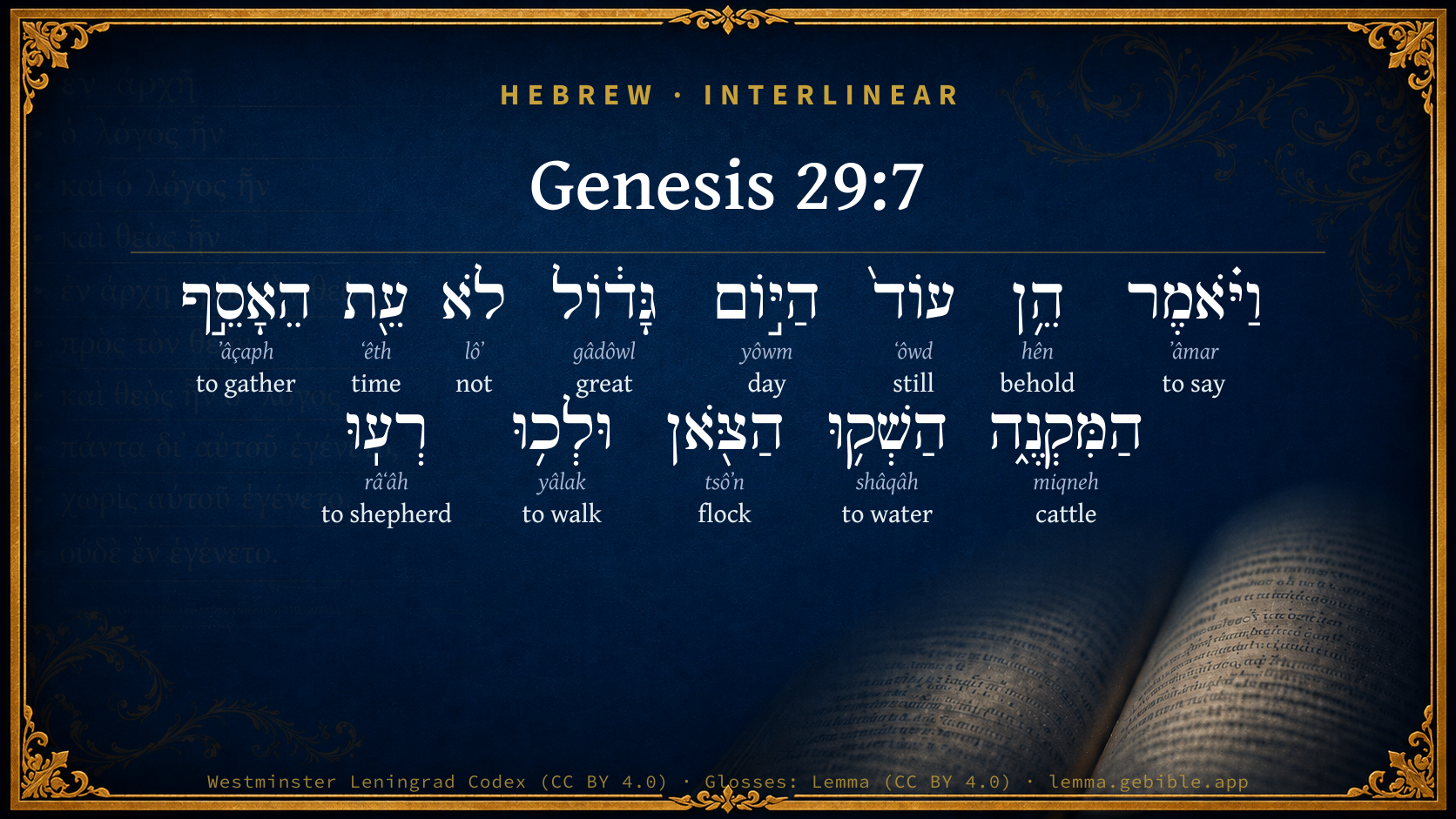
Hebrew (Westminster Leningrad Codex) Genesis 29:7 appears in the Hebrew Old Testament. The text above is from the Westminster Leningrad Codex. Each word links to its Strong’s number, a concise gloss, and parsing drawn from the Open Scriptures Hebrew Bible morphology. Click any word for its full Brown-Driver-Briggs (BDB) entry.
Download image
Cite this verse

Genesis 29:7 (World English Bible). Public Domain. Lemma interlinear Bible study tool, https://lemma.gebible.app/v/genesis/29/7.

Show BibTeX & RIS
BibTeX
RIS
English Translation
He said, "Behold, it is still the middle of the day, not time to gather the cattle together. Water the sheep, and go and feed them."
World English Bible · Public Domain
Download a study sheet

One document with this verse’s original text, its word-by-word gloss line, the meaning frame, cross-references with their text, attributed commentary, and full source and license credits — printable, and it pastes into notes with its structure intact.

This verse Autodidact and up

Study sheet (.html) Plain text (.txt)

A passage Seminary Student

Up to 50 verses in one chapter. A passage sheet keeps up to 6 commentary sources and 12 cross-references per verse, in the order this page ranks them, and says so on the sheet whenever that leaves anything out. Ask for a single verse and you get the Autodidact verse sheet above.

Everything on this page stays free to read, with no account — the sheet is a download of what is already on screen, not access to it.

Want to remove ads? Support Godless Engineer
Compare translations 3

The same verse in 3 English versions, stacked beneath the original-language interlinear above. Click any original word for its lexicon entry.

Each is an independent rendering of the whole verse — the interlinear is not word-aligned to these translations.

Highlighted words mark where these versions differ — a whole-verse word diff, not a word-by-word alignment.

  • World English Bible Public Domain
    He said, "Behold, it is still the middle of the day, not time to gather the cattle together. Water the sheep, and go and feed them."
  • King James Version Public Domain
    And he said, Lo, it is yet high day, neither is it time that the cattle should be gathered together: water ye the sheep, and go and feed them.
  • unfoldingWord Literal Text CC BY-SA 4.0
    Then he said, “Behold, the day still large. not time for the livestock to be gathered. Water the sheep, and go pasture.”

unfoldingWord Literal Text — © unfoldingWord, licensed CC BY-SA 4.0. Word-aligned USFM3 via Door43 (git.door43.org/unfoldingWord/en_ult).

Versions to compare (up to 4)

3 of 4 selected

Show all 18 translations

Every available English version of this verse, each an independent rendering of the whole verse.

  • World English Bible Public Domain
    He said, "Behold, it is still the middle of the day, not time to gather the cattle together. Water the sheep, and go and feed them."
  • Berean Standard Bible Public Domain
    “Look,” said Jacob, “it is still broad daylight; it is not yet time to gather the livestock. Water the sheep and take them back to pasture.”
  • Majority Standard Bible Public Domain
    “Look,” said Jacob, “it is still broad daylight; it is not yet time to gather the livestock. Water the sheep and take them back to pasture.”
  • King James Version Public Domain
    And he said, Lo, it is yet high day, neither is it time that the cattle should be gathered together: water ye the sheep, and go and feed them.
  • American Standard Version (1901) Public Domain
    And he said, Lo, it is yet high day, neither is it time that the cattle should be gathered together. Water ye the sheep, and go and feed them.
  • Revised Version (1885) Public Domain
    And he said, Lo, it is yet high day, neither is it time that the cattle should be gathered together: water ye the sheep, and go and feed them.
  • Geneva Bible (1599) Public Domain
    Then he sayd, Lo, it is yet hie day, neither is it time that the cattell shoulde be gathered together: water ye the sheepe and go feede them.
  • Douay-Rheims (1899) Public Domain
    And Jacob said: There is yet much day remaining, neither is it time to bring the flocks into the folds again: first give the sheep drink, and so lead them back to feed.
  • Young's Literal Translation Public Domain
    And he saith, `Lo, the day `is' still great, `it is' not time for the cattle to be gathered; water ye the flock, and go, delight yourselves.'
  • Literal Standard Version CC BY-SA 4.0
    And he says, “Behold, the day [is] still great, [it is] not time for the livestock to be gathered; water the flock, and go, delight yourselves.”
  • Unlocked Literal Bible CC BY-SA 4.0
    Jacob said, “See, it is the middle of the day. It is not the time for the flocks to be gathered together. You should water the sheep and then go and let them graze.”
  • unfoldingWord Literal Text CC BY-SA 4.0
    Then he said, “Behold, the day still large. not time for the livestock to be gathered. Water the sheep, and go pasture.”
  • Darby Bible Public Domain
    And he said, Behold, it is yet high day; it is not time that the cattle should be gathered together; water the sheep, and go, feed [them].
  • World Messianic Bible Public Domain
    He said, “Behold, it is still the middle of the day, not time to gather the livestock together. Water the sheep, and go and feed them.”
  • Webster's Bible Public Domain
    And he said, Lo, it is yet high day, neither is it time that the cattle should be collected: water ye the sheep, and go and feed them.
  • Free Bible Version CC BY-SA 4.0
    “Look, there's still plenty of daylight left,” said Jacob. “It's too early to round up the sheep yet. Why not let them drink so they can go back to grazing?”
  • Bible in Basic English Public Domain
    Then Jacob said, The sun is still high and it is not time to get the cattle together: get water for the sheep and go and give them their food.
  • JPS Tanakh (1917) Public Domain
    And he said: 'Lo, it is yet high day, neither is it time that the cattle should be gathered together; water ye the sheep, and go and feed them.'

Literal Standard Version (2020), Covenant Press — licensed CC BY-SA 4.0. Text via the HelloAO Bible API (eBible.org). Unlocked Literal Bible (unfoldingWord) — licensed CC BY-SA 4.0. Text via the HelloAO Bible API (eBible.org). unfoldingWord Literal Text — © unfoldingWord, licensed CC BY-SA 4.0. Word-aligned USFM3 via Door43 (git.door43.org/unfoldingWord/en_ult). Free Bible Version, Dr. Jonathan Gallagher — licensed CC BY-SA 4.0. Text via the HelloAO Bible API (eBible.org).

Word by word

More ways to search: Search by grammar → Find every occurrence → Compare this word →

Practice this passage: Drill this verse → Learn its vocabulary →

הַשְׁק֥וּ
shâqâh
H8248
“water”
Verb, Hiphil, Imperative, 2nd Person, Masculine, Plural
Part of Speech
Verb
Stem
Hiphil
Form
Imperative
Person
2nd Person
Gender
Masculine
Number
Plural
Full BDB Definition

Origin: a primitive root

TWOT: 2452

to give to drink, irrigate, drink, water, cause to drink water - (Hiphil) - to water, irrigate - to water, give drink to - (Pual) to be watered - (Niphal) variant
  1. וַיֹּ֗אמֶר ʼâmar H559 “and · to say” Conjunction + Verb, Qal, Sequential Imperfect, 3rd Person, Masculine, Singular
  2. הֵ֥ן hên H2005 “behold” Particle, Demonstrative
  3. עוֹד֙ ʻôwd H5750 “still” Adverb
  4. הַיּ֣וֹם yôwm H3117 “the · day” Particle, Definite Article + Noun, Common, Masculine, Singular, Absolute
  5. גָּד֔וֹל gâdôwl H1419 “great” Adjective, Adjective, Masculine, Singular, Absolute
  6. לֹא lôʼ H3808 “not” Particle, Negative
  7. עֵ֖ת ʻêth H6256 “time of” Noun, Common, Both, Singular, Construct
  8. הֵאָסֵ֣ף ʼâçaph H622 “to gather” Verb, Niphal, Infinitive Construct
  9. הַמִּקְנֶ֑ה miqneh H4735 “the · cattle” Particle, Definite Article + Noun, Common, Masculine, Singular, Absolute
  10. הַצֹּ֖אן tsôʼn H6629 “the · flock” Particle, Definite Article + Noun, Common, Both, Singular, Absolute
  11. וּלְכ֥וּ yâlak H3212 “and · walk” Conjunction + Verb, Qal, Imperative, 2nd Person, Masculine, Plural
  12. רְעֽוּ râʻâh H7462 “shepherd” Verb, Qal, Imperative, 2nd Person, Masculine, Plural

About this verse

These counts appear in no published source. They are computed here, from the morphology-tagged text and Lemma’s own curated glosses. What Lemma adds →

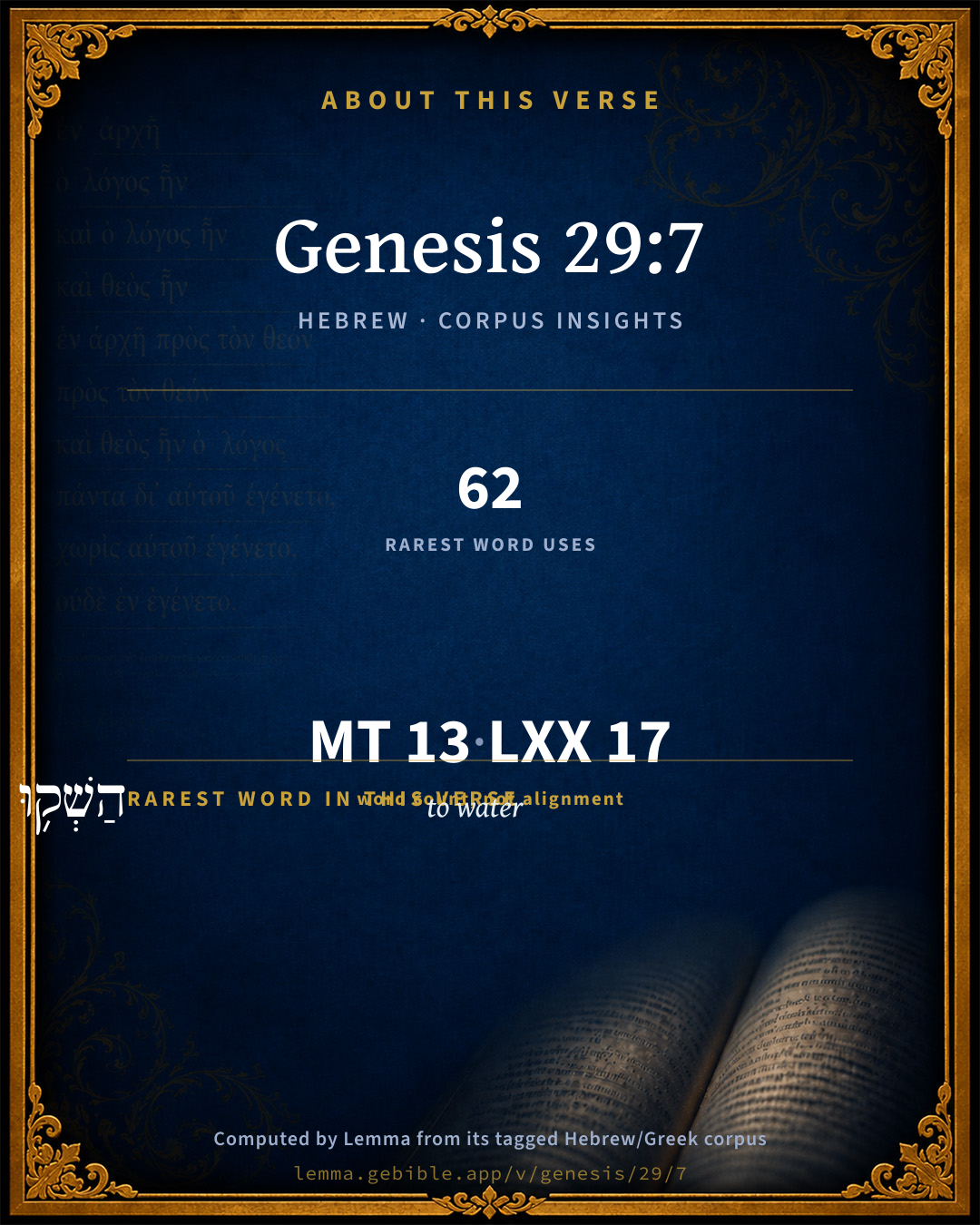
13
words
13
distinct lemmas
Pentateuch
section

Grammatical profile

  • 5 verbs
  • 4 nouns
  • 1 adjective
  • 1 adverb
  • 2 particles

Verb forms

  • וַיֹּ֗אמֶר Qal · Sequential Imperfect
  • הֵאָסֵ֣ף Niphal · Infinitive Construct
  • הַשְׁק֥וּ Hiphil · Imperative
  • וּלְכ֥וּ Qal · Imperative
  • רְעֽוּ Qal · Imperative

Hebrew & Septuagint length

In English translation the verse runs 26 words from the Hebrew and 28 from the Septuagint (LXX English) — closely comparable.

A rough comparison of the two English renderings, which tokenize alike — not a word-level alignment.

Word counts can differ between the Hebrew and the Greek without any difference in meaning — e.g. the Hebrew direct-object marker אֵת has no separate Greek word, and Greek often adds the article ὁ.

In the original languages it is 13 Hebrew tokens and 17 Greek tokens — but the two are counted differently (Hebrew bundles its prefixes and suffixes into one token; the Greek is in lemma form), so that isn’t a like-for-like length.

Cross-references

2

Topical passages linked to Genesis 29:7 in the Treasury of Scripture Knowledge — connected by theme and wording, ordered by reader-vote popularity; previews shown in the World English Bible.

  • Ephesians 5:16 redeeming the time, because the days are evil.
  • Galatians 6:9–10 Let us not be weary in doing good, for we will reap in due season, if we don't give up.

Cross-references courtesy of OpenBible.info (CC BY 4.0).

Hebrew and Greek witnesses Masoretic Hebrew ↔ Greek Septuagint

The same verse in the two great witnesses to the Old Testament, shown verse-for-verse.

These are two independent witnesses, not word-aligned to each other, and the Septuagint is shown in lemma (dictionary) form.

Hebrew Genesis 29:7 Masoretic · Westminster Leningrad Codex

וַיֹּ֗אמֶר הֵ֥ן עוֹד֙ הַיּ֣וֹם גָּד֔וֹל לֹא עֵ֖ת הֵאָסֵ֣ף הַמִּקְנֶ֑ה הַשְׁק֥וּ הַצֹּ֖אן וּלְכ֥וּ רְעֽוּ

He said, "Behold, it is still the middle of the day, not time to gather the cattle together. Water the sheep, and go and feed them."

World English Bible · Public Domain

Greek LXX Genesis 29:7 Septuagint · lemma form

καί εἶπον ἰακώβ ἔτι εἰμί ἡμέρα πολύς οὔπω ὥρα συνἄγω ὁ κτῆνος ποτίζω ὁ πρόβατον ἀποἔρχομαι βόσκω

And Jacob said, it is yet high day, it is not yet time that the flocks be gathered together; water you⌃ the flocks, and depart and feed them.

LXX2012 (modern English Septuagint) · Public Domain

Hebrew: Westminster Leningrad Codex (CC BY 4.0). Greek: Septuagint (public domain); English from LXX2012 (modern English Septuagint) (Public Domain). How the Septuagint differs from the Hebrew →

Targum (Aramaic paraphrase)

2

The Targum is the ancient Jewish Aramaic paraphrase of the Hebrew Scriptures — an interpretive translation, not the Hebrew text itself. Onkelos (literal) and Pseudo-Jonathan (expansive) render the Torah, and Jonathan the Prophets. Coverage is partial: where no permissively-licensed English translation exists for a verse, only the Aramaic is shown. This is verse-level text, not a word-by-word alignment to the Hebrew.

  1. Targum Onkelos Torah (Genesis–Deuteronomy)
    וַאֲמַר הָא עוֹד יוֹמָא סַגִי לָא עִדַן לְמִכְנַשׁ בְּעִיר אַשְׁקוּ עָנָא וְאִזִילוּ רְעוּ

    (no public-domain English translation for this verse)

    Targum Onkelos — Aramaic: “Onkelos Genesis” (public domain); “Onkelos Exodus” (public domain); “Onkelos Leviticus” (public domain); “Onkelos Numbers” (public domain); “Onkelos Deuteronomy” (public domain). English: “Sefaria Community Translation” (CC0 1.0 (public-domain dedication)); “J.W. Etheridge. The Targums of Onkelos and Jonathan Ben Uzziel on the Pentateuch. London: Longmans, Green, 1862” (public domain). Text via Sefaria.

  2. Targum Pseudo-Jonathan Torah (Genesis–Deuteronomy)
    וַאֲמַר הָא עִידַן יוֹמָא סַגִי לָא עִידַן לְמִיכְנַשׁ בְּעִיר אַשְׁקוּ עָנָא וְאֵיזִילוּ רְעוּ

    And he said, Behold, the time of the day is great; it is not time to gather home the cattle; water the sheep, and let them go (again) to pasture.

    Targum Pseudo-Jonathan — Aramaic: “Targum Jonathan on Genesis” (public domain); “Targum Jonathan on Exodus” (public domain); “Targum Jonathan on Leviticus” (public domain); “Targum Jonathan on Numbers” (public domain); “Targum Jonathan on Deuteronomy” (public domain). English: “The Targum of Jonathan ben Uzziel, trans. J. W. Etheridge, London, 1862” (public domain). Text via Sefaria.

Commentary

Notes on Genesis 29:7 from classic Christian and Jewish commentators (each source and its license shown beneath its notes). The classic Christian expositions comment on the surrounding passage and are grouped to its opening verse, so a note may address several verses; the Jewish commentaries on the Tanakh (Rashi and others) are per-verse, so they appear only where the commentator wrote on this verse.

Lemma curates 59 commentaries, every one of them public domain or Creative Commons licensed, each selected and text-cleaned for this edition rather than reprinted as found. About our sources →

Trapp's Complete Commentary

John Trapp

Gen 29:7 And he said, Lo, [it is] yet high day, neither [is it] time that the cattle should be gathered together: water ye the sheep, and go [and] feed [them].

Ver. 7. Neither is it time, &c.] Time is a precious commodity, and must be thriftily husbanded. The common complaint is, We want time: but the truth is, we do not so much want, as waste it, as the heathen observed: {a} which they that do, are wastefullest prodigals: for, of all other possessions, two may be had together; but two moments of time cannot be possessed together. This made the philosopher so parsimonious of time: Nullus mihi per otium exit dies - I cannot afford to cast away a day; pattem noctium studiis vindico - part of the night I take for my studies. So did Charles the Great; and after him, Charles the Fifth, who, when at any time in the field against the enemy, spent what hours he could spare in the study of the mathematics. He had, for that purpose, as his instructor, Turrianus of Cremona ever with him. As if he had been of Cato’s mind, {b} that great men must be able to give good account, non minus otii, quam negotii ; no less of their leisure, than of their labour. His constant custom was, saith Cicero, {c} to call to mind, at evening, what thing soever he had seen, read, or done, that day. King Alfred, that reigned here (Anno Dom. 872), is said to have cast the natural day into three parts: eight hours he spent in praying, study, and writing; eight in the service of his body; eight in the affairs of state. Which spaces (having then no other engine for it) he measured by a great wax light, divided into so many parts; receiving notice by the keeper thereof, as the various hours passed in the burning. {d}

“ Qui nescit quo vita modo volat, audiat horas:

Quam sit vita brevis, nos docet ille sonus .”

{a} Non parum habemus temporis, sed multum perdimus. - Senec. Epist.

{b} Cato in Orig.

{c} Cic. De Senect.

{d} Dan. Chron., fol. 13.

John Trapp, A Commentary or Exposition upon All the Books of the Old and New Testament (1647–1656) — public domain. Text from a community e-Sword module.

Adam Clarke's Commentary

Verse 7. It is yet high day] The day is but about half run; neither is it time that the cattle should be gathered together-it is surely not time yet to put them into the folds; give them therefore water, and take them again to pasture.

Adam Clarke's Commentary on the Bible (1810–1826) — public domain. Text from a community e-Sword/MySword module.

Ellicott's Commentary for English Readers

(7) Neither is it time that the cattle should be gathered together.—Rather, neither is it time for folding the cattle. As there were still several hours of daylight, Jacob is surprised that they do not immediately upon their arrival give the sheep water, and drive them back to the pasture. But if the well belonged to Laban, their reason for waiting till Rachel came is plain.

A Bible Commentary for English Readers, edited by Charles John Ellicott (1878–1897) — public domain. Text from a community e-Sword module.

The Cambridge Bible for Schools and Colleges

gen. ed. J. J. S. Perowne

7. it is yet high day] Lit. “the day is great”; like the Fr. “il fait grand jour.” Lat. adhuc multum diei super est. Jacob is a practical shepherd; he says “there is still the whole afternoon: what is the good of wasting time, and delaying to water the sheep?” It was not yet time to gather together the animals to bring them back for the night.

The Cambridge Bible for Schools and Colleges (gen. ed. J. J. S. Perowne; Cambridge University Press, 1878–1918) — public domain. Text from a community e-Sword module.

John Gill's Exposition

And he said, lo, it is yet high day,.... Noonday, when the sun is highest; at which time in those hot countries flocks used to be made to lie down in shady places, and by still waters, to which the allusion is in Psa 23:2; or however the sun was still up very high, and there was a great deal of the day yet to come; for so the phrase is, "yet the day is great" or "much" (c), a long time still untonight:

neither is it time that the cattle should be gathered together; off of the pastures, to be had home, and put into folds, which was usually done in the evening:

water ye the sheep, and go and feed them; give them water out of the well to drink, and then lead them out the pastures, and let them feed until the night is coming on: this he said not in an authoritative way, or in a surly ill natured manner, and as reproving them for their slothfulness; but kindly and gently giving his advice, who was a shepherd himself, and knew what was proper to be done; and this appears by the shepherds taking in good part what he said, and returning a civil answer.

(c) "magnus", Pagninus, Montanus, Drusius; "multus", Junius & Tremellius, Piscator, Schmidt; "multum adhuc suparet diei", Vatablus.

John Gill's Exposition of the Whole Bible (1746–1763) — public domain (CC PDM 1.0). Text via the HelloAO Bible API.

Haydock's Catholic Bible Commentary

To feed. He shews his knowledge of pastoral affairs, and his concern for them. (Menochius)

George Leo Haydock (1774–1849), Haydock's Catholic Family Bible and Commentary, 1859 edition — public domain. Excludes Psalms (Douay-Rheims chapter numbering differs from Protestant) and Deuterocanonical books (Catholic canon only).

Matthew Poole's English Annotations

Neither is it time that the cattle should be taken from their pasture, and brought to be watered.

Matthew Poole's English Annotations on the Holy Bible (1683–1685) — public domain. Text from a community e-Sword/MySword module.

Whedon's Commentary on the Bible

Daniel D. Whedon

7. Yet high day — Hebrews, the day is yet great. That is, a great portion of it yet remains.

Water… go… feed — Kalisch remarks that Jacob,”strengthened by the consciousness of his brilliant mission, addressed the unknown shepherds not only with cordiality, but with self-assurance and authority, and ventured even a gentle reproof of indolence.”

Daniel D. Whedon (gen. ed.), Commentary on the Old and New Testaments (1874–1909) — public domain. Text from a community e-Sword module.

The Pulpit Commentary

And he said, Lo, it is yet high day (literally, the day is yet great, i.e. much of it still remains), neither is it time that the cattle should he gathered together (i.e. to shut them up for the night): water ye the sheep, and go and feed them being desirous to get the shepherds away from the well that he might meet Rachel alone (Keil, Lange, Murphy), though perhaps his words with as much correctness may be traced to that prudent and industrious habit of mind which afterwards shone forth so conspicuously in himself, and which instinctively caused him to frown upon laziness and inactivity (Starke, Kalisch, Bush).

The Pulpit Commentary (1880–1919), ed. H.D.M. Spence-Jones & Joseph S. Exell — public domain. Text from a community e-Sword module.

unfoldingWord translationNotes

Door43 World Missions Community

it is the middle of the day

"the sun is still high in the sky" or "the sun is still shining brightly"

for the flocks to be gathered together

This can be stated in active form. AT: "for you to gather the flocks" (See: Active or Passive)

to be gathered together

This means to gather them together inside a fence for them to stay for the night. The full meaning of this can be made explicit. (See: Assumed Knowledge and Implicit Information)

let them graze

"let them eat grass in the field"

We cannot water them

"We have to wait to water them." This has to do with timing, not permission.

until all the flocks are gathered together

This can be stated in active form. AT: "until the other shepherds gather their flocks" (See: Active or Passive)

from the well's mouth

Here "mouth" is way of referring to an opening. AT: "from the well" or "from the opening of the well" (See: Idiom)

and we will water the sheep

"then we will water the sheep"

translationWords

flocks

unfoldingWord translationNotes — © Distant Shores Media and the Door43 World Missions Community, licensed CC BY-SA 4.0. Source: git.door43.org/Door43/en_tn.

Rashi

Rabbi Shlomo Yitzchaki (Rashi)

הן עוד היום גדול LO, IT IS YET HIGH DAY — Because he saw them lying down he thought that they wished to take the cattle home, and that they should not graze any longer. He, therefore, said to them, “Lo, it is yet high day” — meaning, if you are hired men you have not yet finished your day’s task, and if these are your own cattle, nevertheless — 'לא עת האסף המקנה וגו IT IS NOT YET TIME FOR THE CATTLET TO BE GATHERED TOGETHER TO TAKE THEM HOME (Genesis Rabbah 70:11).

Rashi on the Tanakh — English translations: “The Judaica Press complete Tanach with Rashi, translated by A. J. Rosenberg” (CC BY 4.0); “Pentateuch with Rashi's commentary by M. Rosenbaum and A.M. Silbermann, 1929-1934” (public domain); “The Metsudah Tanach series, Lakewood, N.J” (CC BY 4.0); and “The Book of Joshua, Metsudah Publications, 1997” (CC BY 4.0). Text via Sefaria.

Sforno

Rabbi Ovadia Sforno

The day is yet long. He thought they were shirking their duties. The righteous are disturbed by injustice even when they are not the victims.

Sforno on the Tanakh — English translation: “Yalkut, Sifsei Chachomim Chumash, Metsudah Publications, 2009” (CC BY 4.0). Text via Sefaria.

Radak

Rabbi David Kimhi (Radak)

ויאמר, ויאמרו, it is clear who the subjects are without their names or vocations having to be restated.

Radak on the Tanakh — English translations: “Sefaria Community Translation” (CC0 1.0 (public-domain dedication)); “Eliyahu Munk, HaChut Hameshulash” (CC BY 4.0); “Rabbi Mike Feuer, Jerusalem Anthology” (CC BY 4.0); and “R. David Kimhi on the first book of Psalms, Translated by R.G. Finch, London, 1919” (public domain). Text via Sefaria.

Lesson kit

Teaching starters — assembled from the data on this page, not authored interpretation. Every prompt links to the verse data it draws on. Edit before teaching.

Genesis, in the Pentateuch, opens this verse with 13 words (13 distinct Hebrew lemmas). Its most distinctive word is shâqâh (“to water”). A historical commentator’s framing appears above. Read the whole chapter for the surrounding context.

Discussion questions

  1. What does “to water” (shâqâh) contribute to the verse as a whole?
  2. Ephesians 5:16 shares this passage’s theme. How do the two illuminate each other?
  3. The translations on this page render this verse differently — a whole-verse word diff, not a word-by-word alignment. What might account for the different wordings?
  4. The verb «וַיֹּ֗אמֶר» is Qal Sequential Imperfect. How does its form color the action?
  5. Reading how Trapp's Complete Commentary and Adam Clarke's Commentary read this verse, where do the two commentators agree and where do they part?

Things to notice

Reading settings

Reading text

Shown beneath each verse's original-language words.

Old Testament
Old Testament edition

Read the OT as the Masoretic Hebrew (MT) or the Greek Septuagint (LXX).

English shown for the Greek Septuagint (in the Hebrew ↔ Greek comparison).

Comparing translations? Open the Compare panel on any verse page to stack up to four side by side.