Numbers 32:16

Hebrew (Westminster Leningrad Codex) Numbers 32:16 appears in the Hebrew Old Testament. The text above is from the Westminster Leningrad Codex. Each word links to its Strong’s number, a concise gloss, and parsing drawn from the Open Scriptures Hebrew Bible morphology. Click any word for its full Brown-Driver-Briggs (BDB) entry.
Download image
Cite this verse

Numbers 32:16 (World English Bible). Public Domain. Lemma interlinear Bible study tool, https://lemma.gebible.app/v/numbers/32/16.

Show BibTeX & RIS
BibTeX
RIS
English Translation
They came near to him, and said, We will build sheepfolds here for our cattle, and cities for our little ones:
World English Bible · Public Domain
Highlights
  • 1 first appearance in the Hebrew Bible
Full analysis ↓
Download a study sheet

One document with this verse’s original text, its word-by-word gloss line, the meaning frame, cross-references with their text, attributed commentary, and full source and license credits — printable, and it pastes into notes with its structure intact.

This verse Autodidact and up

Study sheet (.html) Plain text (.txt)

A passage Seminary Student

Up to 50 verses in one chapter. A passage sheet keeps up to 6 commentary sources and 12 cross-references per verse, in the order this page ranks them, and says so on the sheet whenever that leaves anything out. Ask for a single verse and you get the Autodidact verse sheet above.

Everything on this page stays free to read, with no account — the sheet is a download of what is already on screen, not access to it.

Want to remove ads? Support Godless Engineer
Compare translations 3

The same verse in 3 English versions, stacked beneath the original-language interlinear above. Click any original word for its lexicon entry.

Each is an independent rendering of the whole verse — the interlinear is not word-aligned to these translations.

Highlighted words mark where these versions differ — a whole-verse word diff, not a word-by-word alignment.

  • World English Bible Public Domain
    They came near to him, and said, We will build sheepfolds here for our cattle, and cities for our little ones:
  • King James Version Public Domain
    And they came near unto him, and said, We will build sheepfolds here for our cattle, and cities for our little ones:
  • unfoldingWord Literal Text CC BY-SA 4.0
    And they came near to him and said, “Here we will build walls of the flock for our livestock and cities for our children.

unfoldingWord Literal Text — © unfoldingWord, licensed CC BY-SA 4.0. Word-aligned USFM3 via Door43 (git.door43.org/unfoldingWord/en_ult).

Versions to compare (up to 4)

3 of 4 selected

Show all 18 translations

Every available English version of this verse, each an independent rendering of the whole verse.

  • World English Bible Public Domain
    They came near to him, and said, We will build sheepfolds here for our cattle, and cities for our little ones:
  • Berean Standard Bible Public Domain
    Then the Gadites and Reubenites approached Moses and said, “We want to build sheepfolds here for our livestock and cities for our little ones.
  • Majority Standard Bible Public Domain
    Then the Gadites and Reubenites approached Moses and said, “We want to build sheepfolds here for our livestock and cities for our little ones.
  • King James Version Public Domain
    And they came near unto him, and said, We will build sheepfolds here for our cattle, and cities for our little ones:
  • American Standard Version (1901) Public Domain
    And they came near unto him, and said, We will build sheepfolds here for our cattle, and cities for our little ones:
  • Revised Version (1885) Public Domain
    And they came near unto him, and said, We will build sheepfolds here for our cattle, and cities for our little ones:
  • Geneva Bible (1599) Public Domain
    And they went neere to him, and said, We will builde sheepe foldes here for our sheepe, and for our cattell, and cities for our children.
  • Douay-Rheims (1899) Public Domain
    But they coming near, said: We will make sheepfolds, and stalls for our cattle, and strong cities for our children:
  • Young's Literal Translation Public Domain
    And they come nigh unto him, and say, `Folds for the flock we build for our cattle here, and cities for our infants;
  • Literal Standard Version CC BY-SA 4.0
    And they come near to him and say, “We build folds for the flock here for our livestock, and cities for our infants;
  • Unlocked Literal Bible CC BY-SA 4.0
    So they came near Moses and said, “Allow us to build fences here for our cattle and cities for our families.
  • unfoldingWord Literal Text CC BY-SA 4.0
    And they came near to him and said, “Here we will build walls of the flock for our livestock and cities for our children.
  • Darby Bible Public Domain
    And they drew near to him, and said, We will build sheepfolds here for our cattle, and cities for our little ones;
  • World Messianic Bible Public Domain
    They came near to him, and said, “We will build sheepfolds here for our livestock, and cities for our little ones;
  • Webster's Bible Public Domain
    And they came near to him, and said, We will build sheep-folds here for our cattle, and cities for our little ones:
  • Free Bible Version CC BY-SA 4.0
    Then the tribes of Gad and Reuben came to Moses and told him, “We would plan to build stone walls to keep our livestock safe and towns for our children.
  • Bible in Basic English Public Domain
    Then they came to him, and said, We will make safe places for our cattle here, and towns for our little ones;
  • JPS Tanakh (1917) Public Domain
    And they came near unto him, and said: 'We will build sheepfolds here for our cattle, and cities for our little ones;

Literal Standard Version (2020), Covenant Press — licensed CC BY-SA 4.0. Text via the HelloAO Bible API (eBible.org). Unlocked Literal Bible (unfoldingWord) — licensed CC BY-SA 4.0. Text via the HelloAO Bible API (eBible.org). unfoldingWord Literal Text — © unfoldingWord, licensed CC BY-SA 4.0. Word-aligned USFM3 via Door43 (git.door43.org/unfoldingWord/en_ult). Free Bible Version, Dr. Jonathan Gallagher — licensed CC BY-SA 4.0. Text via the HelloAO Bible API (eBible.org).

Word by word

More ways to search: Search by grammar → Find every occurrence → Compare this word →

Practice this passage: Drill this verse → Learn its vocabulary →

גִּדְרֹ֥ת
gᵉdêrâh
H1448
“walls of”
Noun, Common, Feminine, Plural, Construct
Part of Speech
Noun
Type
Common
Gender
Feminine
Number
Plural
State
Construct
Full BDB Definition

Origin: from H1447

TWOT: 318b

wall, hedge - sheepfold (construct with 'sheep')
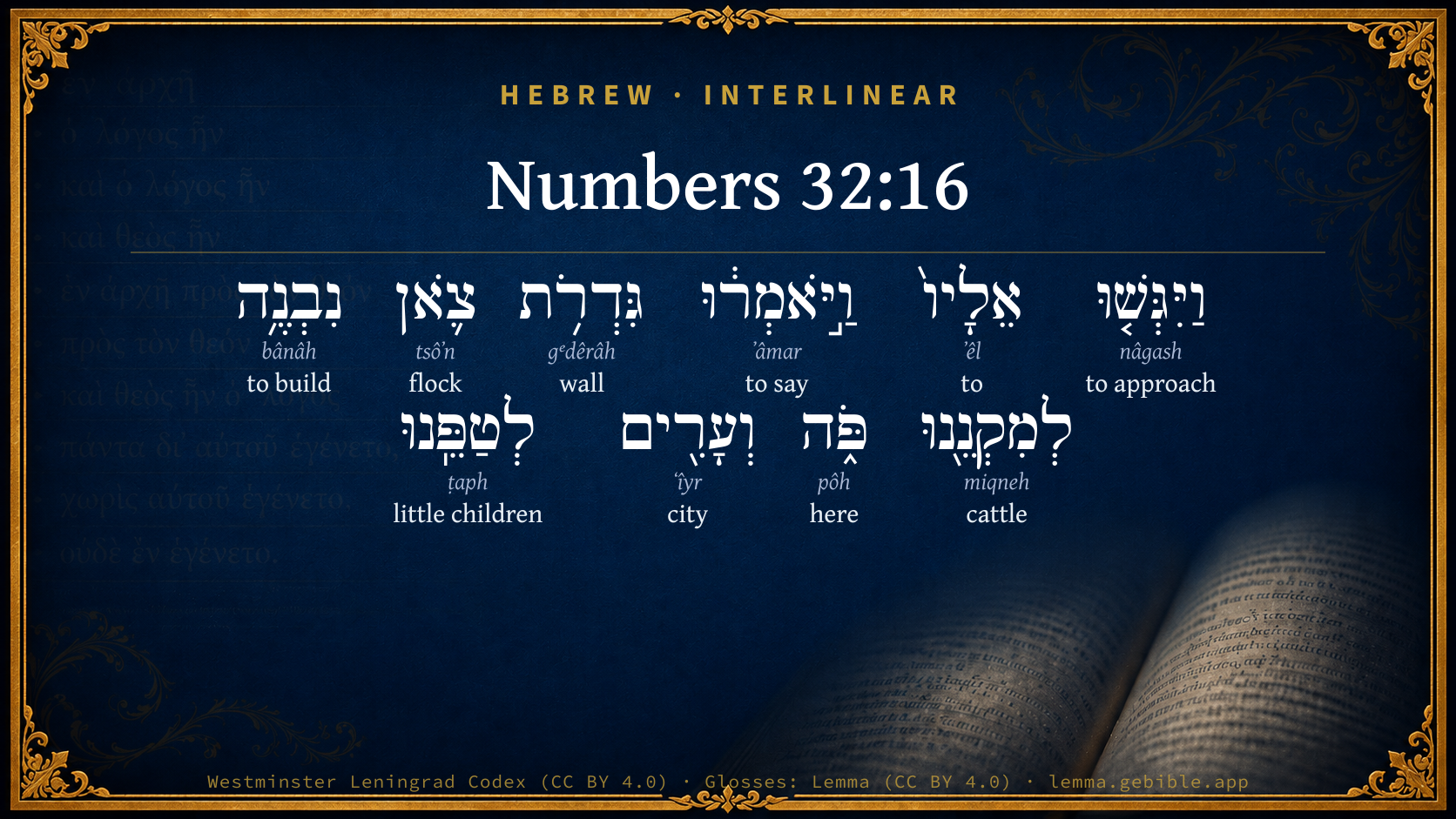
  1. וַיִּגְּשׁ֤וּ nâgash H5066 “and · to approach” Conjunction + Verb, Qal, Sequential Imperfect, 3rd Person, Masculine, Plural
  2. אֵלָיו֙ ʼêl H413 “to · him” Preposition + Suffix, Personal, 3rd Person, Masculine, Singular
  3. וַ֣יֹּאמְר֔וּ ʼâmar H559 “and · to say” Conjunction + Verb, Qal, Sequential Imperfect, 3rd Person, Masculine, Plural
  4. צֹ֛אן tsôʼn H6629 “flock” Noun, Common, Both, Singular, Absolute
  5. נִבְנֶ֥ה bânâh H1129 “to build” Verb, Qal, Imperfect, 1st Person, Common, Plural
  6. לְמִקְנֵ֖נוּ miqneh H4735 “to/for · cattle · our” Preposition + Noun, Common, Masculine, Singular, Construct + Suffix, Personal, 1st Person, Common, Plural
  7. פֹּ֑ה pôh H6311 “here” Adverb
  8. וְעָרִ֖ים ʻîyr H5892 “and · cities” Conjunction + Noun, Common, Feminine, Plural, Absolute
  9. לְטַפֵּֽנוּ ṭaph H2945 “to/for · little children · our” Preposition + Noun, Common, Masculine, Singular, Construct + Suffix, Personal, 1st Person, Common, Plural

About this verse

These counts appear in no published source. They are computed here, from the morphology-tagged text and Lemma’s own curated glosses. What Lemma adds →

10
words
10
distinct lemmas
Pentateuch
section

Notable vocabulary

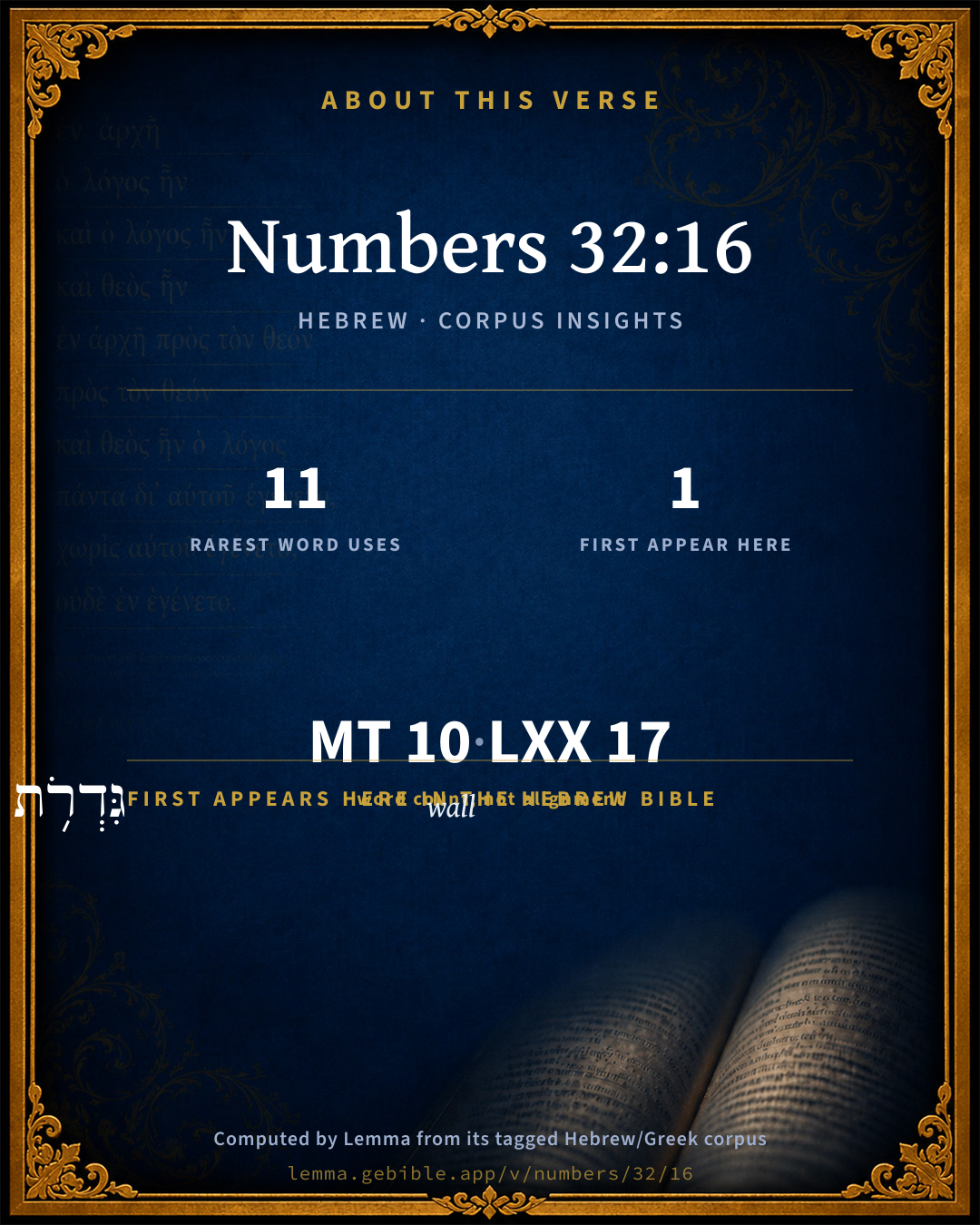
The rarest word here is גִּדְרֹ֥ת wall H1448 — appearing just 11 times in the whole Hebrew Bible.

First appearance in Scripture

This word makes its first canonical appearance in the Hebrew Bible here:

  • גִּדְרֹ֥ת wall H1448

Shared distinctive vocabulary

גִּדְרֹ֥ת wall H1448 occurs in 11 verses of the Hebrew Bible. Also found in:

Grammatical profile

  • 3 verbs
  • 5 nouns
  • 1 preposition
  • 1 adverb

Verb forms

  • וַיִּגְּשׁ֤וּ Qal · Sequential Imperfect
  • וַ֣יֹּאמְר֔וּ Qal · Sequential Imperfect
  • נִבְנֶ֥ה Qal · Imperfect

Hebrew & Septuagint length

In English translation the verse runs 21 words from the Hebrew and 20 from the Septuagint (LXX English) — closely comparable.

A rough comparison of the two English renderings, which tokenize alike — not a word-level alignment.

Word counts can differ between the Hebrew and the Greek without any difference in meaning — e.g. the Hebrew direct-object marker אֵת has no separate Greek word, and Greek often adds the article ὁ.

In the original languages it is 10 Hebrew tokens and 17 Greek tokens — but the two are counted differently (Hebrew bundles its prefixes and suffixes into one token; the Greek is in lemma form), so that isn’t a like-for-like length.

Cross-references

2

Topical passages linked to Numbers 32:16 in the Treasury of Scripture Knowledge — connected by theme and wording, ordered by reader-vote popularity; previews shown in the World English Bible.

  • Genesis 33:17 Jacob traveled to Succoth, built himself a house, and made shelters for his cattle. Therefore the name of the place is called Succoth.
  • Numbers 34:22 Of the tribe of the children of Dan a prince, Bukki the son of Jogli.

Cross-references courtesy of OpenBible.info (CC BY 4.0).

Hebrew and Greek witnesses Masoretic Hebrew ↔ Greek Septuagint

The same verse in the two great witnesses to the Old Testament, shown verse-for-verse.

These are two independent witnesses, not word-aligned to each other, and the Septuagint is shown in lemma (dictionary) form.

Hebrew Numbers 32:16 Masoretic · Westminster Leningrad Codex

וַיִּגְּשׁ֤וּ אֵלָיו֙ וַ֣יֹּאמְר֔וּ גִּדְרֹ֥ת צֹ֛אן נִבְנֶ֥ה לְמִקְנֵ֖נוּ פֹּ֑ה וְעָרִ֖ים לְטַפֵּֽנוּ

They came near to him, and said, We will build sheepfolds here for our cattle, and cities for our little ones:

World English Bible · Public Domain

Greek LXX Numbers 32:16 Septuagint · lemma form

καί προςἔρχομαι αὐτός καί λέγω ἔπαυλις πρόβατον οἰκοδομέω ὧδε ὁ κτῆνος ἐγώ καί πόλις ὁ ἀποσκευή ἐγώ

And they came to him, and said, We will build here folds for our cattle, and cities for our possessions;

LXX2012 (modern English Septuagint) · Public Domain

Hebrew: Westminster Leningrad Codex (CC BY 4.0). Greek: Septuagint (public domain); English from LXX2012 (modern English Septuagint) (Public Domain). How the Septuagint differs from the Hebrew →

Targum (Aramaic paraphrase)

2

The Targum is the ancient Jewish Aramaic paraphrase of the Hebrew Scriptures — an interpretive translation, not the Hebrew text itself. Onkelos (literal) and Pseudo-Jonathan (expansive) render the Torah, and Jonathan the Prophets. Coverage is partial: where no permissively-licensed English translation exists for a verse, only the Aramaic is shown. This is verse-level text, not a word-by-word alignment to the Hebrew.

  1. Targum Onkelos Torah (Genesis–Deuteronomy)
    וּקְרִיבוּ לְוָתֵיהּ וַאֲמָרוּ חַטְרִין דְעָאן נִבְנֵי לִבְעִירָנָא הָכָא וְקִרְוִין לְטַפְלָנָא

    (no public-domain English translation for this verse)

    Targum Onkelos — Aramaic: “Onkelos Genesis” (public domain); “Onkelos Exodus” (public domain); “Onkelos Leviticus” (public domain); “Onkelos Numbers” (public domain); “Onkelos Deuteronomy” (public domain). English: “Sefaria Community Translation” (CC0 1.0 (public-domain dedication)); “J.W. Etheridge. The Targums of Onkelos and Jonathan Ben Uzziel on the Pentateuch. London: Longmans, Green, 1862” (public domain). Text via Sefaria.

  2. Targum Pseudo-Jonathan Torah (Genesis–Deuteronomy)
    וּקְרִיבוּ לְוָותֵיהּ וְאָמָרוּ דִירִין דְעָאן נִבְנֵי לִבְעִירָנָא הָכָא וְקִירְוִין לְטַפְלָנָא

    And they drew near to him, and said, We will build sheepfolds for our flocks, and towns for our families;

    Targum Pseudo-Jonathan — Aramaic: “Targum Jonathan on Genesis” (public domain); “Targum Jonathan on Exodus” (public domain); “Targum Jonathan on Leviticus” (public domain); “Targum Jonathan on Numbers” (public domain); “Targum Jonathan on Deuteronomy” (public domain). English: “The Targum of Jonathan ben Uzziel, trans. J. W. Etheridge, London, 1862” (public domain). Text via Sefaria.

Commentary

Notes on Numbers 32:16 from classic Christian and Jewish commentators (each source and its license shown beneath its notes). The classic Christian expositions comment on the surrounding passage and are grouped to its opening verse, so a note may address several verses; the Jewish commentaries on the Tanakh (Rashi and others) are per-verse, so they appear only where the commentator wrote on this verse.

Lemma curates 59 commentaries, every one of them public domain or Creative Commons licensed, each selected and text-cleaned for this edition rather than reprinted as found. About our sources →

Trapp's Complete Commentary

John Trapp

Num 32:16 And they came near unto him, and said, We will build sheepfolds here for our cattle, and cities for our little ones:

Ver. 16. We will build sheep folds.] This was their intent at first, though Moses mistook them. There may be gross mistakes, and thereupon grievous unkindnesses, betwixt dearest friends. Cyril, and John, bishop of Antioch, objected heresy one to another, and proceeded as far as excommunication; postea comperti idem sentire: so did Cyril and Theodoret.

John Trapp, A Commentary or Exposition upon All the Books of the Old and New Testament (1647–1656) — public domain. Text from a community e-Sword module.

The Biblical Illustrator

Joseph S. Exell

Num_32:16-27

We will build sheepfolds here for our cattle, and cities for our little ones.

But we ourselves will go ready armed.

The amended proposal of the Reubenites and Gadites

I. The amended proposal made.

1. That they should province at once for the safe settlement of their families and their flocks and herds.

2. That they would assist their brethren in the conquest of Canaan.

3. That they would not leave their brethren until that conquest was completely effected.

4. That they would not seek for any inheritance with their brethren on the other side of the Jordan.

II. The amended proposal accepted.

1. Moses re-affirms the chief terms of their proposal.

2. He accepts their proposal as righteous.

3. He warns them that if they fail to faithfully fulfil its terms punishment will overtake them.

III. The amended proposal confirmed. Lessons:

1. The duty of manifesting a practical regard for the rights and interests of others.

2. The importance of faithfully fulfilling the engagements into which we enter.

3. The delusiveness of the notion that any one can sin and escape the punishment of sin. (W. Jones.)

Conflict the condition of attainment, and suffering the consequence of sin

I. A truth to be confirmed--that those who would share in the inheritance must engage in the conflict.

II. A warning to be applied--that sin brings punishment; and that those who think to sin with impunity, under a dispensation of mercy, will find themselves fearfully disappointed.

III. A personal application to be made. (Samuel Thodey.)

Necessity for conflict in the open field

A skilful botanist, an exile in a foreign land, was thankful to accept the position of an under-gardener in the service of a man of wealth. While filling this humble office, his attention was attracted by a rare plant which had been sent to the owner of the garden, and which had been placed in the hot-house under the impression that it was a native of the tropics. So far from thriving, it had begun so evidently to wither and decay that the unskilful gardener was about to remove it to a still warmer place, when the observant eye of the botanist discovered it to be a production of the Arctic regions, and insisted that it should be exposed to the icy breath of winter. Forthwith it revived, and began to flourish. In like manner, if Christians will shut themselves up in the confined and heated atmosphere of worldliness and sin, they can neither hope for growth nor fruitfulness. Heroic conflict in the open field with the enemies of our salvation, the overcoming of temptation in the way of daily duty, constant communication with the Holy Spirit of God in the use of the appointed means of grace--these are the only safeguards for the soul. (Christian Age.)

The Biblical Illustrator, edited by Joseph S. Exell (c. 1880s–1900s) — public domain. Text from a community e-Sword module.

Whedon's Commentary on the Bible

Daniel D. Whedon

THE MODIFIED PETITION OF REUBEN AND GAD, Num_32:16-32.

16. They came near — Evidently after retiring from the first audience with Moses and consulting with the people of their tribes.

Sheepfolds — It is the custom of the nomads of this region to surround their tents with stone walls about the height of a man, that the flocks may not be scattered in the night, and that the falling of the cobblestones laid on the top, knocked off by the wolf climbing up the wall, might give an alarm.

Cities — Captured cities were to be repaired. In Argob, a district east of the Sea of Galilee, Jair took sixty cities.

Daniel D. Whedon (gen. ed.), Commentary on the Old and New Testaments (1874–1909) — public domain. Text from a community e-Sword module.

Tyndale Open Study Notes

Tyndale Open Resources

32:16-19 The Reubenites and Gadites assured Moses that they would not discourage their fellow Israelites and would support the war to its very end. There were still dangers east of the Jordan River, so they wanted to safeguard their livestock and families.

Tyndale Open Study Notes — © Tyndale Open Resources, licensed CC BY-SA 4.0. Text via the HelloAO Bible API.

Jamieson, Fausset & Brown

Robert Jamieson, A. R. Fausset & David Brown

they came near--The narrative gives a picturesque description of this scene. The suppliants had shrunk back, dreading from the undisguised emotions of their leader that their request would be refused. But, perceiving, from the tenor of his discourse, that his objection was grounded only on the supposition that they would not cross the Jordan to assist their brethren, they became emboldened to approach him with assurances of their goodwill.

We will build sheepfolds here for our cattle, and cities for our little ones--that is, rebuild, repair. It would have been impossible within two months to found new cities, or even to reconstruct those which had been razed to the ground. Those cities of the Amorites were not absolutely demolished, and they probably consisted only of mud-built, or dry-stone walls.

Jamieson, Fausset & Brown — Commentary Critical and Explanatory on the Whole Bible (1871) — public domain (CC PDM 1.0). Text via the HelloAO Bible API.

Adam Clarke's Commentary

Verse 16. We will build - cities for our little ones] It was impossible for these, numerous as they might be, to build cities and fortify them for the defence of their families in their absence. Calmet supposes they meant no more than repairing the cities of the Amorites which they had lately taken; which work might have been very easily accomplished in the time which they spent on this side of Jordan, before they went over with their brethren, to put them in possession of the land.

Adam Clarke's Commentary on the Bible (1810–1826) — public domain. Text from a community e-Sword/MySword module.

Ellicott's Commentary for English Readers

(16) We will build sheepfolds . . . —The sheepfolds were commonly constructed of loose stones piled up on one another.

And cities for our little ones.—The word which is rendered “build” often means to “build up” or “repair,” and it probably has that meaning in this place, as applied to the cities. (See Num_32:26.)

A Bible Commentary for English Readers, edited by Charles John Ellicott (1878–1897) — public domain. Text from a community e-Sword module.

John Gill's Exposition

But we ourselves will go ready armed before the children of Israel,.... This they said to free themselves from the charge of cowardice, and that they did not mean to sit still while their brethren went to war; they were willing to put on their armour, and be ready to meet the enemy upon the borders of the land, and engage with them, and to expose their lives in favour of their brethren:

until we have brought them unto their place; to the land of Canaan, the place designed for them, and given unto them, to the possession of it, and a settlement in it:

and our little ones shall dwell in the fenced cities, because of the inhabitants of the land; where they might be safe from them, which they proposed to repair and refortify for the security of them, while they went with their brethren into the land of Canaan, to put them into possession of that, of which they made not the least doubt; and so served to clear them of suspicion of any distrust they had of entering into and possessing the land, which might tend to discourage the people.

John Gill's Exposition of the Whole Bible (1746–1763) — public domain (CC PDM 1.0). Text via the HelloAO Bible API.

The Pulpit Commentary

Sheep-folds. axo trodGi. These were rude enclosures built of loose stones piled on one another, into which the flocks were driven at night for safety.

Vers. 16-32. The final arrangement.

I REUBEN AND GAD DO NOT RESENT THE LANGUAGE OF MOSES. This is all the more noticeable because the language is so strong and humiliating. They seem to admit that his reproaches, his warnings, and his predictions had been only too clearly justified by their conduct. Learn from this that when there is occasion to express righteous anger, one must not begin to take counsel with the shallow maxims of worldly prudence. There is need in the service of God for great common sense, for far more of it than usually finds exercise, but there is no common sense where courage, straightforwardness, and the manly assertion of all Christian principles are absent. It is a very foolish thing to use strong language just by way of liberating the effervescence of the soul. But when strong language is deserved and the occasion demands the utterance of it, then do not spare. Moses might have said to himself, "This is a very ticklish state of affairs; if I do not humour these people they will certainly act according to their desire, whether I consent or not." Some leaders and so-called skilful managers and tacticians would have humoured Reuben and Gad at such a crisis as this. But it was not for Moses to humour anybody, or trifle with men who were trifling with God. And he had his immediate reward. "They came near unto him" (verse 16). You can see them almost cringing before Moses, fawning upon him in their eagerness to get their requests. His eye has pierced into their mean hearts, and they know it. They have not one word of defense to offer, not one protest against being so hardly dealt with. Learn then from the example of Moses here, and of Paul on more than one occasion, how to speak out when silence, or, what is worse, delicate picking and choosing of words, involves unfaithfulness to God. We must never be coarse, vindictive, abusive, or spiteful; but if we have a genuine concern for the good of men and the glory of God, he will put as it were his own word into our lips, so controlling language, tone, and features that it will be what his word always is, a discerner of the thoughts and intents of the heart.

II BUT THOUGH THEY DO NOT RESENT THE REBUKE OF MOSES, THEY HOLD TO THEIR ORIGINAL PURPOSE. So confident are they that they call this much-coveted]and their inheritance. They cannot but feel the probing force of what Moses has said, but they are also quick to notice what he has omitted to say. If they had put their thoughts into speech they would have run somewhat like this: "He has been a shepherd himself, a practical man in flocks and herds, and of course he knows nicely that these lands for which we ask are just the place for our cattle. We shall hold to our choice, though it may involve a little more trouble and delay than we could have wished." Even when men are made to smart under a just, unanswerable rebuke they keep to their darling projects. They do not believe in their hearts, even though Christ says it, that one cannot serve God and mammon. Reuben and Gad mean to try the experiment of living east of Jordan, and yet keeping their place in the unity and the privileges of Israel.

III THEY PROPOSE A RASH AND DIFFICULT COMPROMISE. The more we consider what they undertook to do, the more also we see their short-sighted policy. Mark their overweening self-confidence. They cannot risk the chance which was indeed no chance at all, but a Divine certainty of finding suitable pastures in Canaan, but they are quite willing to risk their families and flocks in fenced cities of the land they had chosen. Yet on their own admission fenced cities were no adequate security. The fighting men among them were going across Jordan to help in conquering a land where, as had been reported to their fathers, the cities were walled and very great. (Num_13:28) There appears in their resolution a curious mixture of reasonable faith and rash self-confidence. They have learned enough to assure them that Canaan will be conquered, and they are quite ready to believe that in some unaccountable way their own dearest possessions will also be safe. Yet they did not really know how long they were to be absent. It seems to have been several years before they were allowed to return, and when they did return it was not with the unmingled self-congratulations which might have been expected. He who would]earn how disastrous their choice turned out in the end must carefully consider Jos 22. Most assuredly, whatever Reuben and Gad gained in pastures they more than lost in their permanent isolation from their brethren. Y.

The Pulpit Commentary (1880–1919), ed. H.D.M. Spence-Jones & Joseph S. Exell — public domain. Text from a community e-Sword module.

Keil & Delitzsch

C. F. Keil & F. Delitzsch

The persons thus reproved came near to Moses, and replied, "We will build sheep-folds here for our flocks, and towns for our children; but we will equip ourselves hastily (חשׁים, part. pass. hasting) before the children of Israel, till we bring them to their place" (i.e., to Canaan). צאן גּדרת, folds or pens for flocks, that were built of stones piled up one upon another (Sa1 24:4).

(Note: According to Wetstein (Reiseber. p. 29), it is a regular custom with the nomads in Leja, to surround every place, where they pitch their tents, with a Sira, i.e., with an enclosure of stones about the height of a man, that the flocks may not be scattered in the night, and that they may know at once, from the noise made by the falling of the smaller stones which are laid at the top, if a wolf attempts to enter the enclosure during the night.)

By the building of towns, we are to understand the rebuilding and fortification of them. טף, the children, including the women, and such other defenceless members of the family as were in need of protection (see at Exo 12:37). When their families were secured in fortified towns against the inhabitants of the land, the men who could bear arms would not return to their houses till the children of Israel, i.e., the rest of the tribes, had all received their inheritance: for they did not wish for an inheritance on the other side of Jordan and farther on, if (כּי) their inheritance was assigned them on this side Jordan towards the east. The application of the expression היּרדּן מעבר to the land on the east of the Jordan, as well as to that on the west, points to a time when the Israelites had not yet obtained a firm footing in Canaan. At that time the land to the west of the river could very naturally be spoken of as "beyond the Jordan," from the subjective stand-point of the historian, who was then on the east of the river; whereas, according to the objective and geographical usage, the land "beyond Jordan" signifies the country to the east of the river. But in order to prevent misunderstanding, in this particular instance the expression היּרדּן עבר is defined more precisely as מזרחה, "towards the east," when it is intended to apply to the land on the east of the Jordan.

Keil & Delitzsch — Biblical Commentary on the Old Testament (1861–1891) — public domain (CC PDM 1.0). Text via the HelloAO Bible API. (Old Testament only.)

unfoldingWord translationNotes

Door43 World Missions Community

will be ready and armed

"will be ready with weapons" or "will be ready to fight a war"

in the fortified cities

"in the secured cities"

translationWords

Moses

cow

family

stronghold

people group

unfoldingWord translationNotes — © Distant Shores Media and the Door43 World Missions Community, licensed CC BY-SA 4.0. Source: git.door43.org/Door43/en_tn.

Rashi

Rabbi Shlomo Yitzchaki (Rashi)

נבנה למקננו פה WE WILL BUILD [SHEEP FOLDS] FOR OUR CATTLE HERE — They paid more regard to their property than to their sons and daughters, because they mentioned their cattle before their children. Moses said to them, “Not so! Make the chief thing the chief thing and what is subordinate subordinate. First build cities for your little ones and afterwards enclosures for your flocks” (cf. v. 24) (Midrash Tanchuma, Matot 7).

Rashi on the Tanakh — English translations: “The Judaica Press complete Tanach with Rashi, translated by A. J. Rosenberg” (CC BY 4.0); “Pentateuch with Rashi's commentary by M. Rosenbaum and A.M. Silbermann, 1929-1934” (public domain); “The Metsudah Tanach series, Lakewood, N.J” (CC BY 4.0); and “The Book of Joshua, Metsudah Publications, 1997” (CC BY 4.0). Text via Sefaria.

Lesson kit

Teaching starters — assembled from the data on this page, not authored interpretation. Every prompt links to the verse data it draws on. Edit before teaching.

Numbers, in the Pentateuch, opens this verse with 10 words (10 distinct Hebrew lemmas). Its most distinctive word is gᵉdêrâh (“wall”). A historical commentator’s framing appears above. Read the whole chapter for the surrounding context.

Discussion questions

  1. How does “wall” (gᵉdêrâh) shape what this verse is saying?
  2. The word “wall” first appears here in Scripture. What is being introduced at this debut?
  3. Numbers 32:24 shares the word «wall» with this verse. How do the two illuminate each other?
  4. These translations render this verse differently; the difference is in the English rendering, not the original. What questions does that raise?
  5. The verb «וַיִּגְּשׁ֤וּ» is Qal Sequential Imperfect. How does its form color the action?
  6. Reading how Trapp's Complete Commentary and The Biblical Illustrator read this verse, where do the two commentators agree and where do they part?

Things to notice

Reading settings

Reading text

Shown beneath each verse's original-language words.

Old Testament
Old Testament edition

Read the OT as the Masoretic Hebrew (MT) or the Greek Septuagint (LXX).

English shown for the Greek Septuagint (in the Hebrew ↔ Greek comparison).

Comparing translations? Open the Compare panel on any verse page to stack up to four side by side.