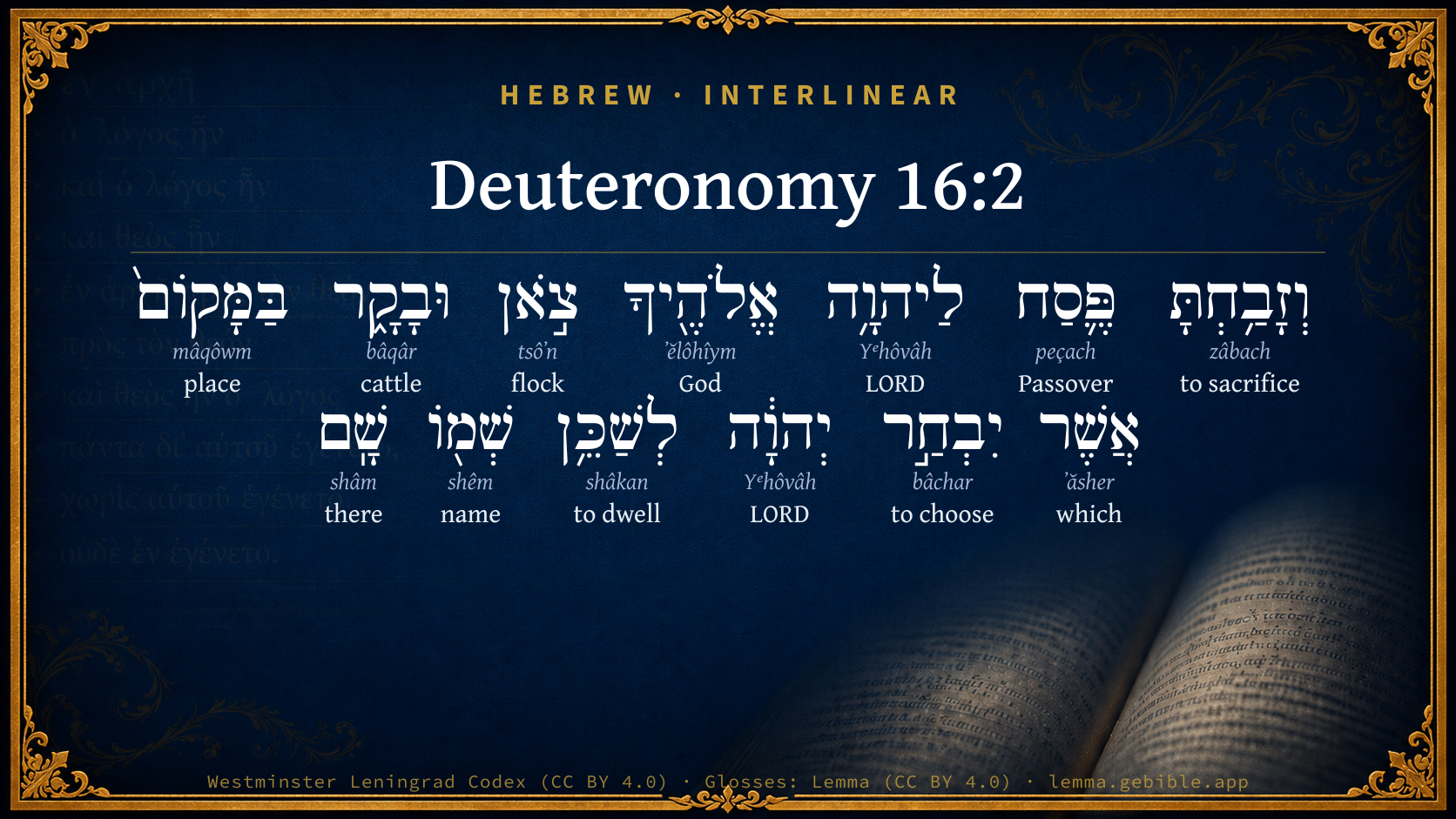
Deuteronomy 16:2

Hebrew (Westminster Leningrad Codex) Deuteronomy 16:2 appears in the Hebrew Old Testament. The text above is from the Westminster Leningrad Codex. Each word links to its Strong’s number, a concise gloss, and parsing drawn from the Open Scriptures Hebrew Bible morphology. Click any word for its full Brown-Driver-Briggs (BDB) entry.
Download image
Cite this verse

Deuteronomy 16:2 (World English Bible). Public Domain. Lemma interlinear Bible study tool, https://lemma.gebible.app/v/deuteronomy/16/2.

Show BibTeX & RIS
BibTeX
RIS
English Translation
You shall sacrifice the Passover to Yahweh your God, of the flock and the herd, in the place which Yahweh shall choose, to cause his name to dwell there.
World English Bible · Public Domain
Download a study sheet

One document with this verse’s original text, its word-by-word gloss line, the meaning frame, cross-references with their text, attributed commentary, and full source and license credits — printable, and it pastes into notes with its structure intact.

This verse Autodidact and up

Study sheet (.html) Plain text (.txt)

A passage Seminary Student

Up to 50 verses in one chapter. A passage sheet keeps up to 6 commentary sources and 12 cross-references per verse, in the order this page ranks them, and says so on the sheet whenever that leaves anything out. Ask for a single verse and you get the Autodidact verse sheet above.

Everything on this page stays free to read, with no account — the sheet is a download of what is already on screen, not access to it.

Want to remove ads? Support Godless Engineer
Compare translations 3

The same verse in 3 English versions, stacked beneath the original-language interlinear above. Click any original word for its lexicon entry.

Each is an independent rendering of the whole verse — the interlinear is not word-aligned to these translations.

Highlighted words mark where these versions differ — a whole-verse word diff, not a word-by-word alignment.

  • World English Bible Public Domain
    You shall sacrifice the Passover to Yahweh your God, of the flock and the herd, in the place which Yahweh shall choose, to cause his name to dwell there.
  • King James Version Public Domain
    Thou shalt therefore sacrifice the passover unto the LORD thy God, of the flock and the herd, in the place which the LORD shall choose to place his name there.
  • unfoldingWord Literal Text CC BY-SA 4.0
    And you shall sacrifice the Passover to Yahweh your God, the flock and the herd, in the place that Yahweh will choose to make his name stay there.

unfoldingWord Literal Text — © unfoldingWord, licensed CC BY-SA 4.0. Word-aligned USFM3 via Door43 (git.door43.org/unfoldingWord/en_ult).

Versions to compare (up to 4)

3 of 4 selected

Show all 18 translations

Every available English version of this verse, each an independent rendering of the whole verse.

  • World English Bible Public Domain
    You shall sacrifice the Passover to Yahweh your God, of the flock and the herd, in the place which Yahweh shall choose, to cause his name to dwell there.
  • Berean Standard Bible Public Domain
    You are to offer to the LORD your God the Passover sacrifice from the herd or flock in the place the LORD will choose as a dwelling for His Name.
  • Majority Standard Bible Public Domain
    You are to offer to the LORD your God the Passover sacrifice from the herd or flock in the place the LORD will choose as a dwelling for His Name.
  • King James Version Public Domain
    Thou shalt therefore sacrifice the passover unto the LORD thy God, of the flock and the herd, in the place which the LORD shall choose to place his name there.
  • American Standard Version (1901) Public Domain
    And thou shalt sacrifice the passover unto Jehovah thy God, of the flock and the herd, in the place which Jehovah shall choose, to cause his name to dwell there.
  • Revised Version (1885) Public Domain
    And thou shalt sacrifice the passover unto the LORD thy God, of the flock and the herd, in the place which the LORD shall choose to cause his name to dwell there.
  • Geneva Bible (1599) Public Domain
    Thou shalt therefore offer the Passeouer vnto the Lord thy God, of sheepe and bullockes in the place where the Lord shall chose to cause his Name to dwell.
  • Douay-Rheims (1899) Public Domain
    And thou shalt sacrifice the phase to the Lord thy God, of sheep, and of oxen, in the place which the Lord thy God shall choose, that his name may dwell there.
  • Young's Literal Translation Public Domain
    and thou hast sacrificed a passover to Jehovah thy God, of the flock, and of the herd, in the place which Jehovah doth choose to cause His name to tabernacle there.
  • Literal Standard Version CC BY-SA 4.0
    and you have sacrificed a Passover to your God YHWH, of the flock and of the herd, in the place which YHWH chooses to cause His Name to dwell there.
  • Unlocked Literal Bible CC BY-SA 4.0
    You will sacrifice the Passover to Yahweh your God with some of the flock and the herd in the place that Yahweh will choose as his sanctuary.
  • unfoldingWord Literal Text CC BY-SA 4.0
    And you shall sacrifice the Passover to Yahweh your God, the flock and the herd, in the place that Yahweh will choose to make his name stay there.
  • Darby Bible Public Domain
    And thou shalt sacrifice the passover to Jehovah thy God, of the flock and of the herd, in the place which Jehovah will choose to cause his name to dwell there.
  • World Messianic Bible Public Domain
    You shall sacrifice the Passover to the LORD your God, of the flock and the herd, in the place which the LORD shall choose to cause his name to dwell there.
  • Webster's Bible Public Domain
    Thou shalt therefore sacrifice the passover to the LORD thy God, of the flock and the herd, in the place which the LORD shall choose to place his name there.
  • Free Bible Version CC BY-SA 4.0
    The Passover sacrifice from your herd or flock must be offered to the Lord your God in the place where the Lord will choose to live with you.
  • Bible in Basic English Public Domain
    The Passover offering, from your flock or your herd, is to be given to the Lord your God in the place marked out by him as the resting-place of his name.
  • JPS Tanakh (1917) Public Domain
    And thou shalt sacrifice the passover-offering unto the LORD thy God, of the flock and the herd, in the place which the LORD shall choose to cause His name to dwell there.

Literal Standard Version (2020), Covenant Press — licensed CC BY-SA 4.0. Text via the HelloAO Bible API (eBible.org). Unlocked Literal Bible (unfoldingWord) — licensed CC BY-SA 4.0. Text via the HelloAO Bible API (eBible.org). unfoldingWord Literal Text — © unfoldingWord, licensed CC BY-SA 4.0. Word-aligned USFM3 via Door43 (git.door43.org/unfoldingWord/en_ult). Free Bible Version, Dr. Jonathan Gallagher — licensed CC BY-SA 4.0. Text via the HelloAO Bible API (eBible.org).

Word by word

More ways to search: Search by grammar → Find every occurrence → Compare this word →

Practice this passage: Drill this verse → Learn its vocabulary →

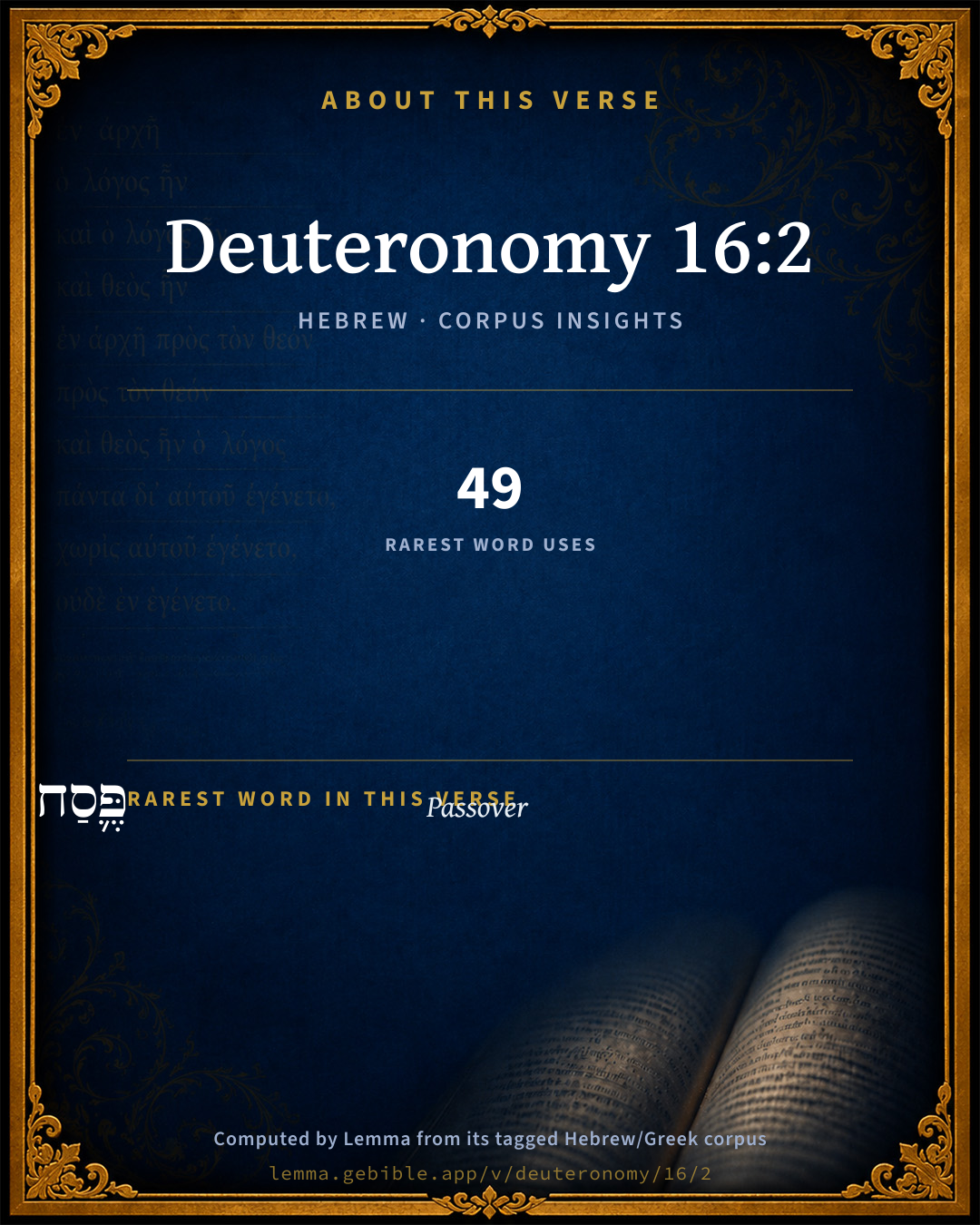
פֶּ֛סַח
peçach
H6453
“Passover”
Noun, Common, Masculine, Singular, Absolute
Part of Speech
Noun
Type
Common
Gender
Masculine
Number
Singular
State
Absolute
Full BDB Definition

Origin: from H6452

TWOT: 1786a

passover - sacrifice of passover - animal victim of the passover - festival of the passover
  1. וְזָבַ֥חְתָּ zâbach H2076 “and · to sacrifice” Conjunction + Verb, Qal, Sequential Perfect, 2nd Person, Masculine, Singular
  2. לַיהוָ֥ה Yᵉhôvâh H3068 “to/for · LORD” Preposition + Noun, Proper
  3. אֱלֹהֶ֖יךָ ʼĕlôhîym H430 “God(s) · your” Noun, Common, Masculine, Plural, Construct + Suffix, Personal, 2nd Person, Masculine, Singular
  4. צֹ֣אן tsôʼn H6629 “flock” Noun, Common, Both, Singular, Absolute
  5. וּבָקָ֑ר bâqâr H1241 “and · cattle” Conjunction + Noun, Common, Both, Singular, Absolute
  6. בַּמָּקוֹם֙ mâqôwm H4725 “in/at the · place” Preposition, Determined + Noun, Common, Masculine, Singular, Absolute
  7. אֲשֶׁר ʼăsher H834 “which” Particle, Relative
  8. יִבְחַ֣ר bâchar H977 “to choose” Verb, Qal, Imperfect, 3rd Person, Masculine, Singular
  9. יְהוָ֔ה Yᵉhôvâh H3068 “LORD” Noun, Proper
  10. לְשַׁכֵּ֥ן shâkan H7931 “to dwell” Preposition + Verb, Piel, Infinitive Construct
  11. שְׁמ֖וֹ shêm H8034 “name · his” Noun, Common, Masculine, Singular, Construct + Suffix, Personal, 3rd Person, Masculine, Singular
  12. שָֽׁם shâm H8033 “there” Adverb

About this verse

These counts appear in no published source. They are computed here, from the morphology-tagged text and Lemma’s own curated glosses. What Lemma adds →

13
words
12
distinct lemmas
Pentateuch
section

Shared distinctive vocabulary

פֶּ֛סַח Passover H6453 occurs in 46 verses of the Hebrew Bible. Also found in:

Grammatical profile

  • 3 verbs
  • 8 nouns
  • 1 adverb
  • 1 particle

Verb forms

  • וְזָבַ֥חְתָּ Qal · Sequential Perfect
  • יִבְחַ֣ר Qal · Imperfect
  • לְשַׁכֵּ֥ן Piel · Infinitive Construct

Repetition

A word recurs within this verse — often emphatic in Hebrew:

  • לַיהוָ֥ה LORD H3068 ×2

Hebrew & Septuagint length

In English translation the verse runs 29 words from the Hebrew and 31 from the Septuagint (LXX English) — closely comparable.

A rough comparison of the two English renderings, which tokenize alike — not a word-level alignment.

Word counts can differ between the Hebrew and the Greek without any difference in meaning — e.g. the Hebrew direct-object marker אֵת has no separate Greek word, and Greek often adds the article ὁ.

Cross-references

15

Topical passages linked to Deuteronomy 16:2 in the Treasury of Scripture Knowledge — connected by theme and wording, ordered by reader-vote popularity; previews shown in the World English Bible.

  • Deuteronomy 12:5 But to the place which Yahweh your God shall choose out of all your tribes, to put his name there, even to his habitation shall you seek, and there you shall come;
  • Deuteronomy 12:26 Only your holy things which you have, and your vows, you shall take, and go to the place which Yahweh shall choose:
  • Matthew 26:17 Now on the first day of unleavened bread, the disciples came to Jesus, saying to him, "Where do you want us to prepare for you to eat the Passover?"
  • Mark 14:12 On the first day of unleavened bread, when they sacrificed the Passover, his disciples asked him, "Where do you want us to go and make ready that you may eat the Passover?"
  • Luke 22:8 He sent Peter and John, saying, "Go and prepare the Passover for us, that we may eat."
  • Luke 22:15 He said to them, "I have earnestly desired to eat this Passover with you before I suffer,
  • 1 Corinthians 5:7 Purge out the old yeast, that you may be a new lump, even as you are unleavened. For indeed Christ, our Passover, has been sacrificed in our place.
  • Exodus 12:5–7 Your lamb shall be without blemish, a male a year old. You shall take it from the sheep, or from the goats:
  • Numbers 28:16–19 In the first month, on the fourteenth day of the month, is Yahweh's Passover.
  • Deuteronomy 12:11 then it shall happen that to the place which Yahweh your God shall choose, to cause his name to dwell there, there shall you bring all that I command you: your burnt offerings, and your sacrifices, your tithes, and the heave-offering of your hand, and all your choice vows which you vow to Yahweh.
  • Deuteronomy 12:14 but in the place which Yahweh shall choose in one of your tribes, there you shall offer your burnt offerings, and there you shall do all that I command you.
  • Deuteronomy 12:18 but you shall eat them before Yahweh your God in the place which Yahweh your God shall choose, you, and your son, and your daughter, and your man-servant, and your maid-servant, and the Levite who is within your gates: and you shall rejoice before Yahweh your God in all that you put your hand to.
  • Deuteronomy 15:20 You shall eat it before Yahweh your God year by year in the place which Yahweh shall choose, you and your household.
  • 2 Chronicles 35:7 Josiah gave to the children of the people, of the flock, lambs and kids, all of them for the Passover offerings, to all who were present, to the number of thirty thousand, and three thousand bulls: these were of the king's substance.
  • Matthew 26:2 "You know that after two days the Passover is coming, and the Son of Man will be delivered up to be crucified."

Cross-references courtesy of OpenBible.info (CC BY 4.0).

Hebrew and Greek witnesses Masoretic Hebrew ↔ Greek Septuagint

The same verse in the two great witnesses to the Old Testament, shown verse-for-verse.

These are two independent witnesses, not word-aligned to each other, and the Septuagint is shown in lemma (dictionary) form.

Hebrew Deuteronomy 16:2 Masoretic · Westminster Leningrad Codex

וְזָבַ֥חְתָּ פֶּ֛סַח לַיהוָ֥ה אֱלֹהֶ֖יךָ צֹ֣אן וּבָקָ֑ר בַּמָּקוֹם֙ אֲשֶׁר יִבְחַ֣ר יְהוָ֔ה לְשַׁכֵּ֥ן שְׁמ֖וֹ שָֽׁם

You shall sacrifice the Passover to Yahweh your God, of the flock and the herd, in the place which Yahweh shall choose, to cause his name to dwell there.

World English Bible · Public Domain

Greek LXX Deuteronomy 16:2 Septuagint · lemma form

καί θύω ὁ πασχα κύριος ὁ θεός σύ πρόβατον καί βοῦς ἐν ὁ τόπος ὅς ἐάν ἐκλέγω κύριος ὁ θεός σύ αὐτός ἐπικαλέω ὁ ὄνομα αὐτός ἐκεῖ

And you shall sacrifice the passover to the Lord your God, sheep and oxen in the place which the Lord your God shall choose to have his name called upon it.

LXX2012 (modern English Septuagint) · Public Domain

On this verse, The Cambridge Bible for Schools and Colleges discusses the Septuagint’s reading. Read the note in Commentary ↓

Hebrew: Westminster Leningrad Codex (CC BY 4.0). Greek: Septuagint (public domain); English from LXX2012 (modern English Septuagint) (Public Domain). How the Septuagint differs from the Hebrew →

Targum (Aramaic paraphrase)

2

The Targum is the ancient Jewish Aramaic paraphrase of the Hebrew Scriptures — an interpretive translation, not the Hebrew text itself. Onkelos (literal) and Pseudo-Jonathan (expansive) render the Torah, and Jonathan the Prophets. Coverage is partial: where no permissively-licensed English translation exists for a verse, only the Aramaic is shown. This is verse-level text, not a word-by-word alignment to the Hebrew.

  1. Targum Onkelos Torah (Genesis–Deuteronomy)
    וְתִכּוֹס פִּסְחָא קֳדָם יְיָ אֱלָהָךְ מִן בְּנֵי עָנָא וְנִכְסַת קוּדְשַׁיָא מִן תּוֹרֵי בְּאַתְרָא דִי יִתִּרְעֵי יְיָ לְאַשְׁרָאָה שְׁכִנְתֵּה תַּמָן

    (no public-domain English translation for this verse)

    Targum Onkelos — Aramaic: “Onkelos Genesis” (public domain); “Onkelos Exodus” (public domain); “Onkelos Leviticus” (public domain); “Onkelos Numbers” (public domain); “Onkelos Deuteronomy” (public domain). English: “Sefaria Community Translation” (CC0 1.0 (public-domain dedication)); “J.W. Etheridge. The Targums of Onkelos and Jonathan Ben Uzziel on the Pentateuch. London: Longmans, Green, 1862” (public domain). Text via Sefaria.

  2. Targum Pseudo-Jonathan Torah (Genesis–Deuteronomy)
    וְתִיכְסוּן פִּסְחָא קֳדָם יְיָ אֱלָהָכוֹן בֵּינֵי שִׁמְשָׁתָא וְעָאן וְתוֹרֵי לִמְחָר בִּכְרַן יוֹמָא לְחֶדְוַת חַגָּא בְּאַתְרָא דְיִתְרְעֵי יְיָ לְאַשְׁרָאָה שְׁכִינְתֵּיהּ תַּמָּן

    But you shall sacrifice the pascha before the Lord your God between the suns; and the sheep and the bullocks on the morrow, on that same day to rejoice in the feast at the place which the Lord will choose to make His Shekinah to dwell there.

    Targum Pseudo-Jonathan — Aramaic: “Targum Jonathan on Genesis” (public domain); “Targum Jonathan on Exodus” (public domain); “Targum Jonathan on Leviticus” (public domain); “Targum Jonathan on Numbers” (public domain); “Targum Jonathan on Deuteronomy” (public domain). English: “The Targum of Jonathan ben Uzziel, trans. J. W. Etheridge, London, 1862” (public domain). Text via Sefaria.

Commentary

Notes on Deuteronomy 16:2 from classic Christian and Jewish commentators (each source and its license shown beneath its notes). The classic Christian expositions comment on the surrounding passage and are grouped to its opening verse, so a note may address several verses; the Jewish commentaries on the Tanakh (Rashi and others) are per-verse, so they appear only where the commentator wrote on this verse.

Lemma curates 59 commentaries, every one of them public domain or Creative Commons licensed, each selected and text-cleaned for this edition rather than reprinted as found. About our sources →

Joseph Benson's Commentary

Deu 16:2-3. Thou shalt sacrifice the passover — Strictly so called; which was the paschal lamb. The sheep and oxen here mentioned were additional sacrifices which were to be offered in the seven days of the paschal solemnity, Num 28:18. Indeed, the passage may be rendered, Thou shalt therefore observe the feast of the passover unto the Lord thy God with sheep and with oxen. Bread of affliction — So called, because it was not pleasant nor easily digested, and was appointed to be used to put them in mind of their afflictions and miseries in Egypt, and of their coming out from thence in haste, being allowed no time to leaven or prepare their bread.

Joseph Benson's Commentary on the Old and New Testaments (1811–1818) — public domain. Text from a community e-Sword module.

Tyndale Open Study Notes

Tyndale Open Resources

16:2 the place . . . for his name to be honored: The Lord’s name represented the Lord himself. When he placed his name in the Tabernacle or Temple, he was effectively taking up residence there (see 12:5, 18).

Tyndale Open Study Notes — © Tyndale Open Resources, licensed CC BY-SA 4.0. Text via the HelloAO Bible API.

Geneva Bible (1599)

Geneva Bible translators

Thou shalt eat the Easter lamb.

Geneva Bible (1599) marginal notes — public domain. Text via Bolls.life.

Jamieson, Fausset & Brown

Robert Jamieson, A. R. Fausset & David Brown

Thou shalt therefore sacrifice the passover--not the paschal lamb, which was strictly and properly the passover. The whole solemnity is here meant, as is evident from the mention of the additional victims that required to be offered on the subsequent days of the feast (Num 28:18-19; Ch2 35:8-9), and from the allusion to the continued use of unleavened bread for seven days, whereas the passover itself was to be eaten at once. The words before us are equivalent to "thou shalt observe the feast of the passover."

Jamieson, Fausset & Brown — Commentary Critical and Explanatory on the Whole Bible (1871) — public domain (CC PDM 1.0). Text via the HelloAO Bible API.

The Cambridge Bible for Schools and Colleges

gen. ed. J. J. S. Perowne

2. of the flock and the herd] Sheep, goat or ox, and doubtless as in J, a firstling. P, Exo_12:3-6, prescribes a male of the first year (see Driver’s note), but limits it to a lamb or kid; in later practice a lamb was invariably chosen.

in the place which Jehovah shall choose] To Jehovah Sam. LXX add thy God. In J, Exo_12:21-26, the service is domestic; and P, Exo_12:3 ff., also preserves its domestic character, cp. Exo_12:46.

The Cambridge Bible for Schools and Colleges (gen. ed. J. J. S. Perowne; Cambridge University Press, 1878–1918) — public domain. Text from a community e-Sword module.

John Gill's Exposition

Thou shalt therefore sacrifice the passover unto the Lord thy God,.... In the month Abib, and in the night of that month they came out of Egypt, even on the fourteenth day of it at night, between the two evenings, as the Targum of Jonathan; which was a lamb, and typical of Christ, the passover sacrificed for us, Co1 5:7.

of the flock and the herd; that is, you shall sacrifice also the offerings which were offered throughout the seven days of unleavened bread, and these were both sheep and oxen, Num 28:19 and are expressly called passover offerings and peace offerings, Ch2 30:21, for what was strictly and properly the passover was only of the flock, a lamb, and not of the herd, or a bullock; though Aben Ezra says there were some that thought that in Egypt it was only a lamb or a kid, but now it might be a bullock; which he observes is not right. It may be indeed that the word "passover" here is a general term, comprehending the whole passover solemnity, and all the sacrifices of the seven days: the Jews commonly understand this clause of the Chagigah, or feast of the fifteenth day, the first day of unleavened bread, and so the Targum of Jonathan,"and the sheep and the oxen on the morrow;''some distinguish them thus, the flock for the duty of the passover, the herd for the peace offerings, so Aben Ezra; or as Jarchi interprets it, the flock of the lambs and kids, and the herd for the Chagigah or festival; in the Talmud (m); the flock, this is the passover; the herd, this is the Chagigah, so Abendana: there was a Chagigah of the fourteenth day, which was brought with the lamb and eaten first, when the company was too large for the lamb, that their might eat with satiety (n); but this was not reckoned obligatory upon them (o), but they were bound to bring their Chagigah on the fifteenth day:

in the place which the Lord thy God shall choose to place his name there; that is, at Jerusalem, as the event has shown; hence we read of the parents of our Lord going up to Jerusalem every year at the feast of the passover, Luk 2:41.

(m) T. Bab. Pesachim, fol. 70. 2. (n) Jarchi in loc. Maimon. Hilchot Corban Pesach, c. 8. l. 3. (o) T. Bab. Pesachim, fol. 71. 1, 2. Maimon. ut supra, (n)) c. 10. sect. 13. Aruch in voc. fol. 58. 1.

John Gill's Exposition of the Whole Bible (1746–1763) — public domain (CC PDM 1.0). Text via the HelloAO Bible API.

Haydock's Catholic Bible Commentary

Phase. Hebrew and Septuagint, "the Phase (or lamb) to the Lord thy God, sheep and oxen," or "of the flock and the herd," (Protestant) offered on the same festival, (Haydock) or victims proper for the solemnity, besides the paschal lamb, Numbers xxviii. 19., and 2 Paralipomenon xxx. 15. Peace-offerings were also made; (Leviticus vi. 12., and 2 Paralipomenon xxxv. 7,) and of these free offerings some explain the words of the Jews, (John xviii. 28,) as they suppose the lamb had been eaten the night before. (Menochius; Bochart; Tirinus) --- They might, however, have refrained from eating of these on that day. (Calmet) --- But they perhaps did not choose to be debarred of that privilege. --- There. The place peculiarly consecrated to the worship of God, for length of days. (Haydock)

George Leo Haydock (1774–1849), Haydock's Catholic Family Bible and Commentary, 1859 edition — public domain. Excludes Psalms (Douay-Rheims chapter numbering differs from Protestant) and Deuterocanonical books (Catholic canon only).

Matthew Poole's English Annotations

The passover, i.e. either,

1. Properly and strictly so called, which was the paschal lamb, and so the sheep and oxen, which here follow, are mentioned only as additional sacrifices, which were to be offered in the seven days of the paschal solemnity, Num 28:18,19, &c. Or,

2. Largely, to wit, for the passover-offerings, to wit, which were offered after the lamb in the seven days, and so this very word is used 2Ch 35:8,9. And this signification seems necessary here, partly because it is here said to consist

of the flock and of the herd, or of sheep and oxen, and partly because it follows, Deu 16:3, Thou shalt eat no leavened bread with it, seven days shalt thou eat unleavened bread therewith, i.e. with the passover, which could not be done with the passover strictly so called, which was to be wholly spent in one day. Or,

3. The feast of the passover, and so the place may be rendered, Thou shalt therefore observe or keep the feast of the passover (as those same Hebrew words are taken, Num 9:5; Jos 5:10; 2Ch 35:1,17,18,19) unto the Lord thy God, with sheep and with oxen, as is prescribed, Num 28:18, &c.

Matthew Poole's English Annotations on the Holy Bible (1683–1685) — public domain. Text from a community e-Sword/MySword module.

Whedon's Commentary on the Bible

Daniel D. Whedon

2. Thou shalt… sacrifice the passover — The term passover, in its primary meaning, is applied to the lamb or kid; but the word was also used in an extended meaning for all the offerings of the feast.

In the place which the Lord shall choose — The observance of these festivals was to become connected with their national life, and for that reason a central sanctuary would be desirable. Here all the tribes could meet to commemorate the great events connected with their providential history.

Daniel D. Whedon (gen. ed.), Commentary on the Old and New Testaments (1874–1909) — public domain. Text from a community e-Sword module.

John Wesley's Explanatory Notes

The passover - That is, the feast of the passover, and so the place may be rendered, thou shalt therefore observe the feast of the passover unto the Lord thy God, with sheep, and with oxen, as is prescribed, Num. xxviii, 18, &c.

John Wesley, Explanatory Notes Upon the Whole Bible (1754–1765) — public domain. Text via the GEBible commentary corpus.

Rashi

Rabbi Shlomo Yitzchaki (Rashi)

וזבחת פסח לה' אלהיך צאן THOU SHALT THEREFORE SACRIFICE THE PASSOVER UNTO THE LORD THY GOD OF SHEEP, as it is said of the Passover offering, (Exodus 12:5) “Ye shall take it from the sheep or from the goats”,

— ובקר AND OXEN thou shalt slaughter as the חגיגה (the festival offering sacrificed on the fourteenth of Nisan in addition to the Passover offering); for if they have counted themselves (formed themselves) into too large a company for the Passover offering (so that one lamb will not suffice for them) they bring together with it a festival offering and this is eaten first, in order that it (the Passover sacrifice) can be eaten in satiety (i.e. after the appetite is satisfied; cf. Pesachim 69b, 70a). — And besides this our Rabbis derived many Halachic matters from this verse (cf. Sifrei Devarim 129; Berakhot 9a).

Rashi on the Tanakh — English translations: “The Judaica Press complete Tanach with Rashi, translated by A. J. Rosenberg” (CC BY 4.0); “Pentateuch with Rashi's commentary by M. Rosenbaum and A.M. Silbermann, 1929-1934” (public domain); “The Metsudah Tanach series, Lakewood, N.J” (CC BY 4.0); and “The Book of Joshua, Metsudah Publications, 1997” (CC BY 4.0). Text via Sefaria.

Ramban (Nachmanides)

Rabbi Moshe ben Nachman (Ramban / Nachmanides)

AND THOU SHALT SACRIFICE THE PASSOVER-OFFERING UNTO THE ETERNAL THY G-D THE FLOCK AND THE HERD. Its purport by way of the plain meaning of Scripture is similar to the expressions: the ox, the sheep, and the goats [which means: “the ox, ‘and’ the sheep … “]; Reuben, Simeon, Levi [which means: “Reuben, ‘and’ Simeon, ‘and’ Levi”], And here it means: “and thou shalt sacrifice the Passover-offering unto the Eternal thy G-d, ‘and’ the flock and the herd [thou shalt bring for the Festal-offering,” as will be explained]. Therefore, [because the flock and the herd are not used for the Passover-offering], he does not say “and thou shalt sacrifice the Passover-offering unto the Eternal thy G-d, ‘of’ the flock and ‘of’ the herd,” as He says in all places: ye shall bring your offering ‘of’ the cattle, ‘of’ the herd, or ‘of’ the flock; and if his offering be ‘of’ the flock;, Verse 10. if he offer ‘of’ the herd., 3:1. But here he commands concerning the Passover-offering, which is the sheep as He has previously mentioned; and sheep and herd, rams and goats and calves, to celebrate the Festal-offering on that day, just as he commanded concerning the Festivals of Weeks and Tabernacles, saying, And thou shalt keep the Festival of Weeks unto the Eternal thy G-d after the measure of the freewill offering of thy hand, meaning that he shall bring herd and sheep as peace-offerings in accordance with his means. So also he said with reference to Tabernacles, Seven days shalt thou keep a feast unto the Eternal thy G-d etc., Verse 15. and at the end he included all three [festivals] together., Verse 16. Similar to this [where the connecting letter vav — “and” is missing] is the verse: In the first month, in the fourteenth day of the month, ye shall have the Passover; a feast of seven days, unleavened bread shall be eaten, which means “‘and’ a feast of seven days.” We find this also in the Passover celebrated by King Josiah where it says, of the flock, lambs, and kids, all of them for the Passover-offerings … and three thousand bullocks, and afterwards it says, And they roasted the Passover [-offering] with fire according to the ordinance, and the holy offerings they boiled in pots, and in cauldrons, and in pans, and carried them quickly to all the children of the people., Verse 13. Thus Scripture explained there that the lambs and kids were all for the Passover-offerings, not the goats themselves [that were older than a year] nor the herd, as it is written, Your lamb shall be without blemish, a male of the first year; ye shall take it from the sheep or from the goats. And Scripture explains that the herd that he mentioned were three thousand, and they were holy offerings which were boiled in pots to be carried quickly to the people to eat their fill, as our Rabbis have received by tradition concerning the Festal-offering. And Onkelos connected here [in the verse before us] the word flock with the Passover-offering [for he translated as follows: “and thou shalt sacrifice the Passover-offering from the young lambs, and holy offerings from the herd”]. But in that case the vav in the word u’bakar (“and” the herd) does not connect itself well [with the word tzon — “flock,” since the connecting letter, vav, indicates that the herd and the flock were used for the same offerings, while Onkelos says that the flock was for the Passover-offering and the herd was for other types of offerings.] in the word u’bakar (‘and’ the herd). Moreover, the flock is not valid for the Passover-offering, [but only males less than a year old, so it is not correct to explain as Onkelos did that the flock was used for the Passover-offering]. The correct explanation is what we have said.Now he explained here many things. Thus he mentioned concerning the unleavened bread that it be bread of affliction, teaching that he commanded to remember that they left [Egypt] in haste, and this [bread of] affliction is a remembrance that they were living in Egypt with sparing bread and scant water. Thus he alludes to two things [that they eat unleavened bread in order to remember that they went out in haste and there was no time for their dough to rise, and that they remember that they ate there “bread of affliction”]. And thus the Rabbis also said [in the Passover Hagadah]: “This is the bread of affliction that our fathers ate in the land of Egypt.” Or it may be that he is saying that the unleavened bread be made like bread of poverty [flour and water] and not like rich bread [kneaded with wine, oil or honey] as our Rabbis stated. And he also explained in the commandment pertaining to leaven that it shall not ‘be seen’ with thee in ‘all thy borders’ [seven days], for at first He said, [seven days] shall there be no leaven “‘found’ in your houses. ”, 13:7 where it already states, Neither shall there be leaven seen with thee in all thy borders! But Ramban’s point is that here it adds seven days to the earlier prohibition of leaven not being “seen” in all “the borders,” thus making it parallel to the prohibition of leaven not being “found” in “the houses” where, in Exodus, it states seven days. See my Hebrew commentary p. 415.

Ramban (Nachmanides) on the Tanakh — English translation: “Commentary on the Torah by Ramban (Nachmanides). Translated and annotated by Charles B. Chavel. New York, Shilo Pub. House, 1971-1976” (CC BY 4.0). Text via Sefaria.

Lesson kit

Teaching starters — assembled from the data on this page, not authored interpretation. Every prompt links to the verse data it draws on. Edit before teaching.

Deuteronomy, in the Pentateuch, opens this verse with 13 words (12 distinct Hebrew lemmas). Its most distinctive word is peçach (“Passover”). A historical commentator’s framing appears above. Read the whole chapter for the surrounding context.

Discussion questions

  1. The word peçach carries the sense “Passover.” How does it shape the verse?
  2. Exodus 12:11 shares the word «Passover» with this verse. How do the two illuminate each other?
  3. “LORD” occurs 2× in this one verse. What is the effect of the repetition?
  4. These translations render this verse differently. What is at stake in choosing one wording over another?
  5. The verb «וְזָבַ֥חְתָּ» is Qal Sequential Perfect. How does its form color the action?
  6. Reading how Joseph Benson's Commentary and Tyndale Open Study Notes read this verse, where do the two commentators agree and where do they part?

Things to notice

Reading settings

Reading text

Shown beneath each verse's original-language words.

Old Testament
Old Testament edition

Read the OT as the Masoretic Hebrew (MT) or the Greek Septuagint (LXX).

English shown for the Greek Septuagint (in the Hebrew ↔ Greek comparison).

Comparing translations? Open the Compare panel on any verse page to stack up to four side by side.