
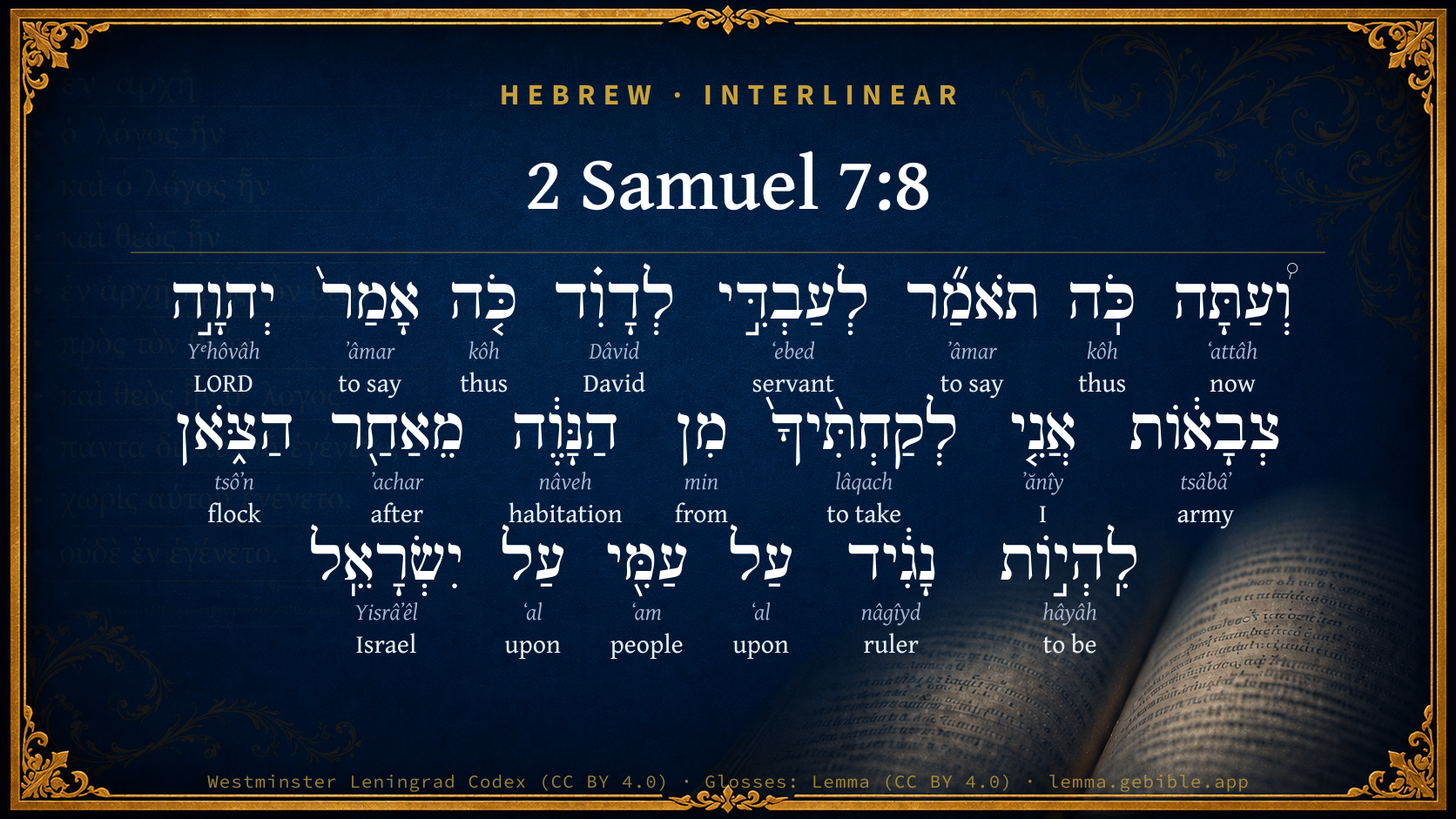
2 Samuel 7:8

Hebrew (Westminster Leningrad Codex) 2 Samuel 7:8 appears in the Hebrew Old Testament. The text above is from the Westminster Leningrad Codex. Each word links to its Strong’s number, a concise gloss, and parsing drawn from the Open Scriptures Hebrew Bible morphology. Click any word for its full Brown-Driver-Briggs (BDB) entry.
Download image
Cite this verse

2 Samuel 7:8 (World English Bible). Public Domain. Lemma interlinear Bible study tool, https://lemma.gebible.app/v/2-samuel/7/8.

Show BibTeX & RIS
BibTeX
RIS
English Translation
Now therefore thus shall you tell my servant David, Thus says Yahweh of Hosts, I took you from the sheep pen, from following the sheep, that you should be prince over my people, over Israel;
World English Bible · Public Domain
Download a study sheet

One document with this verse’s original text, its word-by-word gloss line, the meaning frame, cross-references with their text, attributed commentary, and full source and license credits — printable, and it pastes into notes with its structure intact.

This verse Autodidact and up

Study sheet (.html) Plain text (.txt)

A passage Seminary Student

Up to 50 verses in one chapter. A passage sheet keeps up to 6 commentary sources and 12 cross-references per verse, in the order this page ranks them, and says so on the sheet whenever that leaves anything out. Ask for a single verse and you get the Autodidact verse sheet above.

Everything on this page stays free to read, with no account — the sheet is a download of what is already on screen, not access to it.

Want to remove ads? Support Godless Engineer
Compare translations 3

The same verse in 3 English versions, stacked beneath the original-language interlinear above. Click any original word for its lexicon entry.

Each is an independent rendering of the whole verse — the interlinear is not word-aligned to these translations.

Highlighted words mark where these versions differ — a whole-verse word diff, not a word-by-word alignment.

  • World English Bible Public Domain
    Now therefore thus shall you tell my servant David, Thus says Yahweh of Hosts, I took you from the sheep pen, from following the sheep, that you should be prince over my people, over Israel;
  • King James Version Public Domain
    Now therefore so shalt thou say unto my servant David, Thus saith the LORD of hosts, I took thee from the sheepcote, from following the sheep, to be ruler over my people, over Israel:
  • unfoldingWord Literal Text CC BY-SA 4.0
    And now, thus shall you say to my servant, to David, ‘Thus says Yahweh of Armies, “I, I took you from the pasture, from after the flock, to become a ruler over my people, over Israel.

unfoldingWord Literal Text — © unfoldingWord, licensed CC BY-SA 4.0. Word-aligned USFM3 via Door43 (git.door43.org/unfoldingWord/en_ult).

Versions to compare (up to 4)

3 of 4 selected

Show all 18 translations

Every available English version of this verse, each an independent rendering of the whole verse.

  • World English Bible Public Domain
    Now therefore thus shall you tell my servant David, Thus says Yahweh of Hosts, I took you from the sheep pen, from following the sheep, that you should be prince over my people, over Israel;
  • Berean Standard Bible Public Domain
    Now then, you are to tell My servant David that this is what the LORD of Hosts says: I took you from the pasture, from following the flock, to be the ruler over My people Israel.
  • Majority Standard Bible Public Domain
    Now then, you are to tell My servant David that this is what the LORD of Hosts says: I took you from the pasture, from following the flock, to be the ruler over My people Israel.
  • King James Version Public Domain
    Now therefore so shalt thou say unto my servant David, Thus saith the LORD of hosts, I took thee from the sheepcote, from following the sheep, to be ruler over my people, over Israel:
  • American Standard Version (1901) Public Domain
    Now therefore thus shalt thou say unto my servant David, Thus saith Jehovah of hosts, I took thee from the sheepcote, from following the sheep, that thou shouldest be prince over my people, over Israel;
  • Revised Version (1885) Public Domain
    Now therefore thus shalt thou say unto my servant David, Thus saith the LORD of hosts, I took thee from the sheepcote, from following the sheep, that thou shouldest be prince over my people, over Israel:
  • Geneva Bible (1599) Public Domain
    Nowe therefore so say vnto my seruant Dauid, Thus saieth the Lord of hostes, I tooke thee from the sheepecote following the sheepe, that thou mightest bee ruler ouer my people, ouer Israel.
  • Douay-Rheims (1899) Public Domain
    And now thus shalt thou speak to my servant David: Thus saith the Lord of hosts: a I took thee out of the pastures from following the sheep to be ruler over my people Israel:
  • Young's Literal Translation Public Domain
    and now, thus dost thou say to My servant, to David: `Thus said Jehovah of Hosts, I have taken thee from the comely place, from after the flock, to be leader over My people, over Israel;
  • Literal Standard Version CC BY-SA 4.0
    And now, thus you say to My servant, to David, Thus said YHWH of Hosts: I have taken you from the pasture, from after the flock, to be leader over My people, over Israel;
  • Unlocked Literal Bible CC BY-SA 4.0
    Now then, tell my servant David, “This is what Yahweh of hosts says: 'I took you from the pasture, from following the sheep, so that you would be ruler over my people Israel.
  • unfoldingWord Literal Text CC BY-SA 4.0
    And now, thus shall you say to my servant, to David, ‘Thus says Yahweh of Armies, “I, I took you from the pasture, from after the flock, to become a ruler over my people, over Israel.
  • Darby Bible Public Domain
    And now, thus shalt thou say unto my servant David, Thus saith Jehovah of hosts: I took thee from the pasture-grounds, from following the sheep, to be prince over my people, over Israel;
  • World Messianic Bible Public Domain
    Now therefore tell my servant David this: ‘The LORD of Hosts says, “I took you from the sheep pen, from following the sheep, to be prince over my people, over Israel.
  • Webster's Bible Public Domain
    Now therefore so shalt thou say to my servant David, thus saith the LORD of hosts, I took thee from the sheep-cote, from following the sheep, to be ruler over my people, over Israel:
  • Free Bible Version CC BY-SA 4.0
    So then, tell my servant David this is what the Lord Almighty says. I was the one who took you from the fields, from looking after sheep, to become a leader of my people Israel.
  • Bible in Basic English Public Domain
    Then say these words to my servant David, The Lord of armies says, I took you from the fields, from keeping the sheep, so that you might be a ruler over my people, over my people Israel:
  • JPS Tanakh (1917) Public Domain
    Now therefore thus shalt thou say unto My servant David: Thus saith the LORD of hosts: I took thee from the sheepcote, from following the sheep, that thou shouldest be prince over My people, over Israel.

Literal Standard Version (2020), Covenant Press — licensed CC BY-SA 4.0. Text via the HelloAO Bible API (eBible.org). Unlocked Literal Bible (unfoldingWord) — licensed CC BY-SA 4.0. Text via the HelloAO Bible API (eBible.org). unfoldingWord Literal Text — © unfoldingWord, licensed CC BY-SA 4.0. Word-aligned USFM3 via Door43 (git.door43.org/unfoldingWord/en_ult). Free Bible Version, Dr. Jonathan Gallagher — licensed CC BY-SA 4.0. Text via the HelloAO Bible API (eBible.org).

Word by word

More ways to search: Search by grammar → Find every occurrence → Compare this word →

Practice this passage: Drill this verse → Learn its vocabulary →

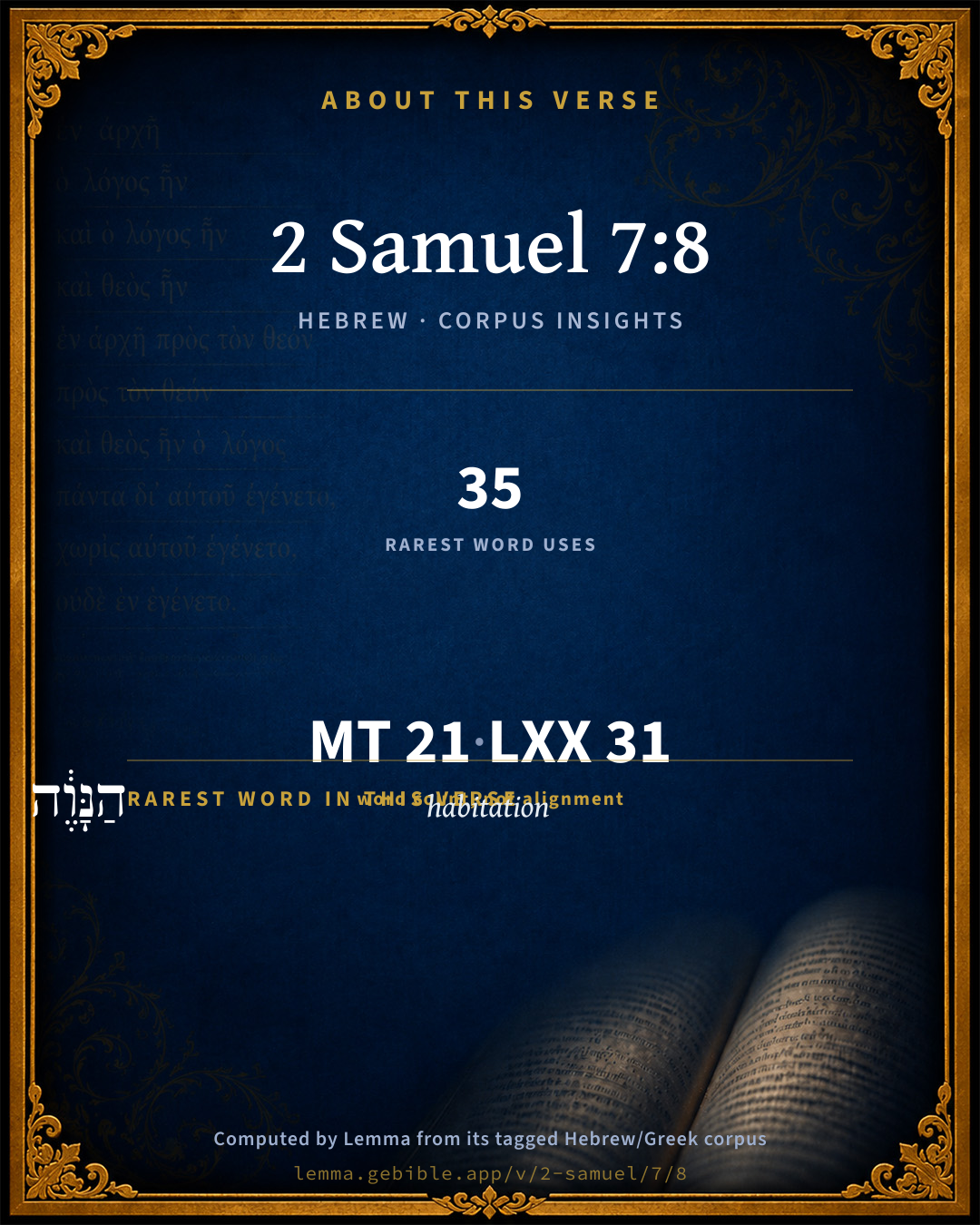
הַנָּוֶ֔ה
nâveh
H5116
“the · habitation”
Particle, Definite Article + Noun, Common, Both, Singular, Absolute
Part of Speech
Particle + Noun
Type
Common
Gender
Both
Number
Singular
State
Absolute
Full BDB Definition

Origin: from H5115

TWOT: 1322a , 1322b , 1322c

abode, habitation, abode of shepherds or flocks, pasture (noun masculine) - abode (of sheep) - abode (of shepherds) - meadow - habitation - dwelling, abiding (adjective)
  1. וְ֠עַתָּה ʻattâh H6258 “and · now” Conjunction + Adverb
  2. כֹּֽה kôh H3541 “thus” Adverb
  3. תֹאמַ֞ר ʼâmar H559 “to say” Verb, Qal, Imperfect, 2nd Person, Masculine, Singular
  4. לְעַבְדִּ֣י ʻebed H5650 “to/for · servant · my” Preposition + Noun, Common, Masculine, Singular, Construct + Suffix, Personal, 1st Person, Common, Singular
  5. לְדָוִ֗ד Dâvid H1732 “to/for · David” Preposition + Noun, Proper
  6. כֹּ֤ה kôh H3541 “thus” Adverb
  7. אָמַר֙ ʼâmar H559 “to say” Verb, Qal, Perfect, 3rd Person, Masculine, Singular
  8. יְהוָ֣ה Yᵉhôvâh H3068 “LORD” Noun, Proper
  9. צְבָא֔וֹת tsâbâʼ H6635 “armies” Noun, Common, Both, Plural, Absolute
  10. אֲנִ֤י ʼănîy H589 “I” Pronoun, Personal, 1st Person, Common, Singular
  11. לְקַחְתִּ֨יךָ֙ lâqach H3947 “to take · you” Verb, Qal, Perfect, 1st Person, Common, Singular + Suffix, Personal, 2nd Person, Masculine, Singular
  12. מִן min H4480 “from” Preposition
  13. מֵאַחַ֖ר ʼachar H310 “from · after” Preposition + Preposition
  14. הַצֹּ֑אן tsôʼn H6629 “the · flock” Particle, Definite Article + Noun, Common, Both, Singular, Absolute
  15. לִֽהְי֣וֹת hâyâh H1961 “to be” Preposition + Verb, Qal, Infinitive Construct
  16. נָגִ֔יד nâgîyd H5057 “ruler” Noun, Common, Masculine, Singular, Absolute
  17. עַל ʻal H5921 “upon” Preposition
  18. עַמִּ֖י ʻam H5971 “people · my” Noun, Common, Masculine, Singular, Construct + Suffix, Personal, 1st Person, Common, Singular
  19. עַל ʻal H5921 “upon” Preposition
  20. יִשְׂרָאֵֽל Yisrâʼêl H3478 “Israel” Noun, Proper

About this verse

These counts appear in no published source. They are computed here, from the morphology-tagged text and Lemma’s own curated glosses. What Lemma adds →

21
words
18
distinct lemmas
Historical
section

Shared distinctive vocabulary

הַנָּוֶ֔ה habitation H5116 occurs in 34 verses of the Hebrew Bible. Also found in:

Grammatical profile

  • 4 verbs
  • 9 nouns
  • 1 pronoun
  • 4 prepositions
  • 3 adverbs

Verb forms

  • תֹאמַ֞ר Qal · Imperfect
  • אָמַר֙ Qal · Perfect
  • לְקַחְתִּ֨יךָ֙ Qal · Perfect
  • לִֽהְי֣וֹת Qal · Infinitive Construct

Repetition

Words recur within this verse — often emphatic in Hebrew:

  • כֹּֽה thus H3541 ×2
  • תֹאמַ֞ר to say H559 ×2
  • עַל upon H5921 ×2

Hebrew & Septuagint length

In English translation the verse runs 35 words from the Hebrew and 32 from the Septuagint (LXX English) — closely comparable.

A rough comparison of the two English renderings, which tokenize alike — not a word-level alignment.

Word counts can differ between the Hebrew and the Greek without any difference in meaning — e.g. the Hebrew direct-object marker אֵת has no separate Greek word, and Greek often adds the article ὁ.

In the original languages it is 21 Hebrew tokens and 31 Greek tokens — but the two are counted differently (Hebrew bundles its prefixes and suffixes into one token; the Greek is in lemma form), so that isn’t a like-for-like length.

Cross-references

7

Topical passages linked to 2 Samuel 7:8 in the Treasury of Scripture Knowledge — connected by theme and wording, ordered by reader-vote popularity; previews shown in the World English Bible.

  • 1 Samuel 16:11–12 Samuel said to Jesse, Are here all your children? He said, There remains yet the youngest, and, behold, he is keeping the sheep. Samuel said to Jesse, Send and get him; for we will not sit down until he come here.
  • 2 Samuel 6:21 David said to Michal, [It was] before Yahweh, who chose me above your father, and above all his house, to appoint me prince over the people of Yahweh, over Israel: therefore will I play before Yahweh.
  • Psalms 78:70–71 He also chose David his servant, And took him from the sheepfolds;
  • 1 Chronicles 17:7 Now therefore thus shall you tell my servant David, Thus says Yahweh of Hosts, I took you from the sheep pen, from following the sheep, that you should be prince over my people Israel:
  • 2 Samuel 12:7 Nathan said to David, "You are the man. This is what Yahweh, the God of Israel, says: 'I anointed you king over Israel, and I delivered you out of the hand of Saul.
  • 1 Samuel 10:1 Then Samuel took the vial of oil, and poured it on his head, and kissed him, and said, Isn't it that Yahweh has anointed you to be prince over his inheritance?
  • 1 Samuel 9:16 Tomorrow about this time I will send you a man out of the land of Benjamin, and you shall anoint him to be prince over my people Israel; and he shall save my people out of the hand of the Philistines: for I have looked on my people, because their cry is come to me.

Cross-references courtesy of OpenBible.info (CC BY 4.0).

Hebrew and Greek witnesses Masoretic Hebrew ↔ Greek Septuagint

The same verse in the two great witnesses to the Old Testament, shown verse-for-verse.

These are two independent witnesses, not word-aligned to each other, and the Septuagint is shown in lemma (dictionary) form.

Hebrew 2 Samuel 7:8 Masoretic · Westminster Leningrad Codex

וְ֠עַתָּה כֹּֽה תֹאמַ֞ר לְעַבְדִּ֣י לְדָוִ֗ד כֹּ֤ה אָמַר֙ יְהוָ֣ה צְבָא֔וֹת אֲנִ֤י לְקַחְתִּ֨יךָ֙ מִן הַנָּוֶ֔ה מֵאַחַ֖ר הַצֹּ֑אן לִֽהְי֣וֹת נָגִ֔יד עַל עַמִּ֖י עַל יִשְׂרָאֵֽל

Now therefore thus shall you tell my servant David, Thus says Yahweh of Hosts, I took you from the sheep pen, from following the sheep, that you should be prince over my people, over Israel;

World English Bible · Public Domain

Greek LXX 2 Samuel 7:8 Septuagint · lemma form

καί νῦν ὅδε εἶπον ὁ δοῦλος ἐγώ δαυίδ ὅδε λέγω κύριος παντοκράτωρ λαμβάνω σύ ἐκ ὁ μάνδρα ὁ πρόβατον ὁ εἰμί σύ εἰς ἡγέομαι ἐπί ὁ λαός ἐγώ ἐπί ὁ ἰσραήλ

And now thus shall you say to my servant David, Thus says the Lord Almighty, I took you from the sheep-cote, that you should be a prince over my people, over Israel.

LXX2012 (modern English Septuagint) · Public Domain

On this verse, Keil & Delitzsch discusses the Septuagint’s reading. Read the note in Commentary ↓

Hebrew: Westminster Leningrad Codex (CC BY 4.0). Greek: Septuagint (public domain); English from LXX2012 (modern English Septuagint) (Public Domain). How the Septuagint differs from the Hebrew →

Targum (Aramaic paraphrase)

1

The Targum is the ancient Jewish Aramaic paraphrase of the Hebrew Scriptures — an interpretive translation, not the Hebrew text itself. Onkelos (literal) and Pseudo-Jonathan (expansive) render the Torah, and Jonathan the Prophets. Coverage is partial: where no permissively-licensed English translation exists for a verse, only the Aramaic is shown. This is verse-level text, not a word-by-word alignment to the Hebrew.

  1. Targum Jonathan Prophets (Joshua–Malachi)
    וּכְעַן כִּדְנַן תֵּימַר לְעַבְדִי לְדָוִד כִּדְנַן אֲמַר יְיָ צְבָאוֹת אֲנָא דְבַרְתָּךְ מִן דִירָא מִבָּתַר עָנָא לְמֶהֱוֵי מַלְכָּא עַל עַמִי עַל יִשְׂרָאֵל:

    (no public-domain English translation for this verse)

    Targum Jonathan — Aramaic: “Mikraot Gedolot” (public domain). English: “Sefaria Community Translation” (CC0 1.0 (public-domain dedication)); “London "Chaldee Paraphrase," 1871” (public domain). Text via Sefaria.

Commentary

Notes on 2 Samuel 7:8 from classic Christian and Jewish commentators (each source and its license shown beneath its notes). The classic Christian expositions comment on the surrounding passage and are grouped to its opening verse, so a note may address several verses; the Jewish commentaries on the Tanakh (Rashi and others) are per-verse, so they appear only where the commentator wrote on this verse.

Lemma curates 59 commentaries, every one of them public domain or Creative Commons licensed, each selected and text-cleaned for this edition rather than reprinted as found. About our sources →

Trapp's Complete Commentary

John Trapp

2Sa 7:8 Now therefore so shalt thou say unto my servant David, Thus saith the LORD of hosts, I took thee from the sheepcote, from following the sheep, to be ruler over my people, over Israel:

Ver. 8. Now therefore so shalt thou say unto my servant David.] God signified his good acceptance by calling him his servant David: for at another time, when he had offended, it was plain David. {2Sa 24:12} So when the people had set up an idol, God fathereth them upon Moses; {Exo 32:7} he would own them no longer.

I took thee from the sheepcote.] So that thou needest not to doubt of my love, though I use not thy service in this particular.

To be ruler over my people, over Israel.] Do this well, and thou needest not be idle.

John Trapp, A Commentary or Exposition upon All the Books of the Old and New Testament (1647–1656) — public domain. Text from a community e-Sword module.

The Biblical Illustrator

Joseph S. Exell

2Sa_7:8

I took thee from the sheepcote.

Gods making of a life

Though he was a born king by nature and character, David was not born a king. His father was a simple farmer, and his childhood was spent in the quiet scenes of a humble village. Jesus was born in the same Judean village-city, little Bethlehem. It is exactly thus that God ever carries out His mighty programme of action in creation, providence, and grace. The Rev. W. L. Watkinson says that, on visiting an art gallery recently, he noticed that some of the greatest pictures had not a splendid thing in them. The ordinary artist, when he wants to be effective, paints in a breadth of golden harvest, or be portrays a kingfisher or some other iridescent bird, or a tree in bloom, or that captivating thing, a rainbow. But you will notice that some of the greatest painters that ever lived never touch these things. They take common things--a railway cut, a ploughed field--no conspicuous object, only the black earth, the brown earth, the red earth; but their touch is a supreme touch, so that you can see the blossom in the dust and the rainbow in the cloud; and the picture, although it contains not a brilliant thing, is bathed in imagination, poetry, and beauty. So Christ can take the most common human plants in His garden and develop them into the most indescribable beauty and interest. God can take our poor humble lives and crown them with dignity and glory, as He honoured David the shepherd boy, if we fall into the royal line of the servants of righteousness. Before honour is humility. David was not a self-exalted king. He was called to rule, and he followed the Divine call wherever it led him, whether into the desert or into the palace.

Filling present limits

If a man be not signally successful in his present field he cannot reasonably hope to be more successful in a larger field. He must first fill out to his existing limits before he will be able to expand into the area of larger boundaries. A man may indeed have abilities beyond the sphere he is in at present, but in every such case the first indication of this is his filling that sphere satisfactorily. If he lacks where he is, he ought not to feel that he could do better, or even as well, if he were in a larger place. It were folly to expect that there is milk enough for a gallon measure when it cannot fill a pint pot. (Great Thoughts.)

God the Giver of power

That God is the Giver of power and dominion is a truth which has always been recognized in the unchangeable East. Thus, in the inscription of Darius on the rock at Behistun, the ninth paragraph reads: Says Darius the king:--Ormazd [the god] granted me the empire. Ormazd brought help to me so that I gained this empire. By the grace of Ormazd, I hold this empire. Substitute Jehovah for Ormazd, and David might truthfully have written that inscription. Again, in the Annals of Assurbanipal which are preserved on terra-cotta cylinders, now in the British Museum, it is said: I am Assurbanipal, the seed of [the gods] Assur and Beltis, son of the great king of the North Palace, whom [the gods] Assur and Sin the lord of crowns, raised to the kingdom, prophesying his name from the days of old; and in his birth have created him to rule Assyria. [The gods] Shamas, Vul, and Ishtar, in power most high, commanded the making of his kingdom. (Sunday School Times.)

From obscurity to eminence

For purposes of sober illustration or intense appeal to the unselfish and heroic, nothing can surpass the life of David Livingstone, whom Florence Nightingale called the greatest man of his generation. The vision of the boy placing his book on the spinning-jenny and studying amid the roar of the machinery at Blantyre, or sitting contentedly down before his fathers door to spend the night, upon arriving after the hour for locking it; the old coat, eleven years behind the fashion, which he wore when he emerged at Cape Town after Kolobeng had been pillaged; the sadness of the scene when he buried his little daughter in the first grave in all this country, he wrote to his parents, marked as the resting-place of one of whom it is believed and confessed that she stall live again; his jocular letters to his daughter Agnes about his distorted teeth, so that my smile is like that of a hippopotamus; the meeting with Stanley when he was a mere ruckle of bones; the indomitable grit of the man whose last words in Scotland were, Fear God, and work hard--this life is full of such things as these, capable of use, inviting it. And when, before or since, has this world been swayed by eloquence comparable with that of his death? No pulpit has ever spoken with such power. The worn frame kneeling by the bedside at Ilala, pulseless and grill, while the rain dripped from the eaves of the hut, dead in the attitude of prayer, solitary and alone, sent a thrill through the souls of men which, thank God, is vibrating still, and is working out the redemption wrought once for Africa by the worlds Redeemer. (W. G. Blaikie.)

2Sa_7:8-17

Go, do all that is in thine heart.

Divine correction of a prophets mistake and Divine denial of a kings desire

1. It is pleasant to glance at the circumstances which gave birth to Davids desire to build the temple. The regal position into which he passed on the death of Saul was no bed of roses. The land was still over-run by the Philistines, who held many of its strongest fortresses. Jerusalem was in the hands of the Jebusites. There was hard and long-lasting work to be done, but David gave himself to it with full purpose of heart; and his God who had called him to it did not suffer him to labour in vain. Victory after victory crowned his arduous struggles, until, at last, the Philistines were for ever banished; the Land of Promise was fully possessed by the Israelites; and Davids unresisted rule extended over all the twelve tribes. It was a happy time for the king and his people. Peace had come into the land, and prosperity was in her train. The king sat in his house, and the Lord had given him rest round about from all his enemies. We can scarcely enter into the joy which all this created, and the thankfulness it inspired; not because we know nothing of such circumstances, but because we have-always lived in them. Those who have never mourned on account of the deep darkness of midnight, cannot appreciate the beauty of the dawn and the splendours of the noon like men who through long hours of thick gloom have watched and waited for the morning. How can we estimate the blessedness of peace and security, as it was estimated by the Hebrews after nearly a life-time of constant disquiet and bloody strife, and well-grounded dread of national annihilation and of individual slavery or death? It may be asked, if David were so joyous and thankful, could he not have taken his harp of sweet and solemn sound, and have expressed his new-born praise in some new-born psalm? Doubtless he did this, but it was not enough to satisfy his gratitude. The truly thankful heart is glad to put on its singing robes, and lift its exultant strains to heaven; but it cannot be contented with words and music alone, even though another David should pen the hymn, and an inspired Handel should compose the melody. It will want to express its emotion in works, to put on the garb of a willing servant, and, in addition to saying great things about God, to do right and good and noble things for God. Let us be assured that if we know and believe the love that God hath to us--if His love have enkindled ours--we too shall be eager to embody our living thankfulness in deeds of truth, and kindness, and purity. The praise that expresses itself in action is not only the most acceptable to God, it is also the only praise which can give relief to the spirit burdened with a sense of what it owes to Him, whose mercy is like Himself--without beginning of days or end of years.

2. We must turn from the origin and nature of Davids purpose to Nathans mistaken sanction of it. A sympathetic heart is a great quickener of the brain. If your spirit be in unison with that of another man, how readily you and he can understand each other. Half words are enough, and either of you can fully discern the others desire or purpose long before his language has fully disclosed it. It is this taw of our nature which makes it so much easier for a man to find out the Divine Will when his heart is brought into living sympathy with God. Then his faculty of discernment is so perfect that to him God can say, I will guide thee with Mine eye. Between Nathan and David there was this sympathy, so that the latter had scarcely begun to speak about his purpose before the former divined all that be intended. Here is a most instructive case of the fallability of an always good and ofttimes inspired man! It is frequently difficult to distinguish between the inclinations of our own wills and the guidance of Gods hand. It is so easy to mistake the bent of our own desires for the intimations of Providence; and when our own hearts are in favour of a thing it requires little argument to convince us that God is in favour of it too. No matter how wise or right any course may appear to be, if we would be always safe we must always distrust our own unaided judgments, and cherish the dependent and teachable spirit, which cries, Lord, what wilt Thou have me to do? Nathan went home to his evening prayer, and his nightly rest, and was speedily made aware of his error.

3. We have now to look at the denial of Davids desire, and at the facts and promises which were set before him to reconcile him to his disappointment. There was neither disdain of his gratitude nor condemnation of his idea that the prospered nation ought to have a better house for holy service. The Lord in His great kindness was careful so to convey the denial that it could not possibly impair Davids faith in the Divine love, nor excite his hostility to the Divine plan. He testified that Gods gentleness had made him great. Of that gentleness he seldom had richer experience than on this occasion.

(1) The first words in the message were calculated to pacify Davids conscience, which had been troubled about the poverty of the place wherein God was worshipped. He was reminded that the matter which had distressed him had called forth no complaint from the Lord.

(2) Having referred to the forbearance which others had met with, the Divine message proceeds to speak of what had been done for David. The Lord spake as if He feared that by thwarting Davids purpose He might expose His love to unjust suspicion; and therefore He was careful to show that He had already done so much for His servant that, whatever course He might see it best to pursue, His love ought not to be suspected for a moment. Surely He had placed that beyond the shadow of a doubt! The way in which Davids doubts were prevented is the way in which ours must be checked and cured. If Gods nay to our requests should tempt us to distrust His love, we must meet the temptation with memories of the many times and the manifold ways wherein He has heard our prayer and enriched us with His blessing. There is great significance in the fact that in refusing David the coveted honour of building the temple, the Lord reminded him of the glory as well as the mercy already bestowed upon him. Was it not telling David that the fame he had secured was enough for any one mans lawful ambition? Why should he want to add to that the glory of being the greatest temple-builder the world had seen? He must not aspire to that crown too. God would reserve it for another. Men righteously denounced Napoleon for his desire to make a French empire of all Europe. There is too often a Napoleonism in commerce which is not a whit more admirable. Instead of vigorously and contentedly pursuing their own proper business, men have sought profitable pecuniary connection with ten or twenty other totally distinct enterprises. In how many cases this vaulting ambition has overleaped itself!

(3) From another part of the inspired history we learn that the character of Davids preceding work was given as one reason why the present purpose was to be laid aside. It should not be supposed that this implies censure of Davids warlike course. Had he not been qualified for it, and called be it, by God? Was it not a necessary work, and had he not Divine succour in it? It was both lawful and expedient; and yet it had unfitted him for the new kind of work to which he wanted to put his hands. In our present imperfect state, ability for one thing may involve disability for another thing. As no one man is intended to gain everything, so no one man is endowed with all the talents. Happy is he who finds out what he is fit for, and devotes himself to it; and is either so wise or so busy that he does not attempt numerous other achievements.

(4) Another way in which the Lord sought to reconcile David to the denial of his desire was by promising that his purpose should not perish, but be carried out by his own son. It is no wonder that Gods message checked all murmuring all rebellion in Davids heart. He did more than cheerfully submit; he exulted in the decision and purpose of the Lord. Instead of weeping and wailing, because his plan had not been adopted, he broke out into an impassioned and sublime strain of thanksgiving. Let it be remembered to the honour of his piety that such was-his confidence in the wisdom and love and faithfulness of God that one of the most fervent songs he ever sung was inspired by the very message in which he was told he was not to do what he had asked to do. It ought to be easier for us to imitate Davids hearty acquiescence, because we know that subsequent events proved how wise it was. According to Gods promise, Solomon succeeded to the throne, and was in every way fitted for the task assigned to him. It was a magnificent testimony to the truth that Gods Nay and Gods Yea are only two different forms in which the same everlasting love and infinite wisdom are expressed. (C. Vince.)

Nathans mistake

Davids proposal was so generous and so religious that the prophet Nathan didnt have a question that its prompting was from the Lord. He was ready to bid the king God-speed, without a doubt as to the propriety of the thing proposed. But the sequel showed that Davids plan didnt have the Lords approval. Nor was this the last time that a man of God made a mistake in supposing that because a proposition was a religious one it necessarily had the Lords approval. A young man comes to his pastor, and says that he has decided to give up everything else and study for the ministry. It doesnt follow that the minister ought to say, Go, do all that is in thine heart; for the Lord is with thee. It is still a question whether this well-intentioned proposal is really of the Lord. So again, it may be, when a man comes with a proposition as to the use of his property, in establishing a local fund for the support of the ministry, in founding another college, or in building a new hospital. To show a religious purpose is one thing. To be sure that that purpose has the Lords approval, or that just as it is it deserves the approval of the Lords ministers, is quite another thing. Other men of God need to learn caution from the experience of Nathan. (H. C. Trumbull.)

A noble purpose unrealised

I. A conception of a noble purpose. It was a great thought that came to David. It was in part suggested by the exigencies of the situation. After the ark had come to its new home, Asaph and others had been appointed to celebrate, and thank, and praise the Lord, and minister before Him (1Ch_16:4-37); and it is supposed that, at this period, the twenty-four courses of priests were appointed, an arrangement which lasted to the time of our Lord. It is thus, especially in young life, that great conceptions visit the soul; ideals of surpassing beauty cast a light forward upon the future; resolves of service for God and man brace the soul as the air from the glaciers does the dwellers in the plains; and all life assumes a nobler aspect, and is set to a higher key. Secretly that lad resolves to be a preacher, missionary, or philanthropist; and that girl, to be queen in an ideal home, or to go far hence to the zenanas of India. I will do this great thing for God, the young heart says to itself, altogether heedless of sacrifice, tears, blood. The bugle-notes of lofty purpose ring out gladly, summoning the soul to noble exploit; and it is saved from the low levels which satisfy others by the immortal hope that has already gone forward to occupy the future. Young people, never surrender your ideal, nor act unworthily of it, nor disobey the heavenly vision. Above all, when you come to the house of cedar, and God has given you rest, be more than ever careful to gird yourselves, and arise to realize the purpose that visited you when you kept your fathers sheep.

II. The ideal is not always realized. There is no definite No spoken by Gods gentle lips. He presses His promises and blessings upon us, and leads us forward in a golden haze of love, which conceals this negative. The plant is conscious of a great possibility throbbing within it; but somehow the days pass, and it does not come to a flower. The picture which is to gain immortality is always to be painted; the book which is to elucidate the problem of the ages is always to be written; the immortal song is always to be sung. The young man is kept at his desk in the counting-house instead of going to the pulpit; the girl becomes a withered woman, cherishing a faded flower; the king hands on to his son the building of the house.

III. God explains his reasons afterwards. What we know not now, we shall know hereafter. The blood-stained hand might not raise the temple of peace. It would have wounded David needlessly to have been told this at the time. It was enough to wrap up the Divine No in a promise of infinite blessing; but, as the years passed, the reason for Gods refusal grew clear and distinct before him. Meanwhile, David possessed his soul in patience, and said to himself: God has a reason, I cannot understand it; but it is well.

IV. An unrealized conception may yet be fraught with immense blessing. Solomon completes the story. David was a better man because he had given expression to the noble purpose. Its gleam left a permanent glow on his life. The rejected candidate to the missionary society stands upon a higher moral platform than those who were never touched by the glow of missionary enthusiasm. For a woman to have loved passionately, even though the dark waters may have engulfed her love before it was consummated, leaves her ever after richer, deeper, than if she had never loved, nor been loved in return. God will credit us with what we would have been if we might. In the glory David will find himself credited with the building of the temple on Mount Zion.

V. Do the next thing. The energy which David would have expended in building the temple wrought itself out in gathering the materials for its construction. If you cannot have what you hoped, do not sit down in despair and allow the energies of your life to run to waste; but arise, and gird yourself to help others to achieve. If you may not build, you may gather materials for him that shall. If you may not go down the mine, you can hold the ropes. There is a fact in nature known as the law of the conservation of force. The force of the accumulating velocity of the falling stone passes into heat, of which some is retained by the stone, the rest passes into the atmosphere. No true ideals are fruitless; somehow they help the world of men. No tears are wept, no prayers uttered, no conceptions honestly entertained in vain. (F. B. Meyer, B. A.)

Our hearts the measure of our work

Think much about intentions. Give, and it shall be given you; good measure, pressed down, and shaken together, and running over, shall men give into your bosom. For with the same measure that ye mete withal it shall be measured to you again. After which Bengel acutely annotates that it is by our hearts that we both mete out to others and have it meted out to ourselves. It would have gone hard with-the poor widow if she, had only had a farthing meted out to her in her Lords judgment on her. But her Lord looked on her heart. And thus it is that she sits in heaven to-day among the queens who sit there on their thrones of gold, because she had such a queenly heart that day in the temple porch. Both from Davids intended temple, from the poor widows actual collection at the door of Davids temple, and from Bengels spiritual annotation let us learn this spiritual lesson, that our hearts are the measure both of our work and of our wages in the sight of God. You cannot build and repair all the churches and mission-houses and manses at home and abroad you would like to build and repair. You cannot endow all the chairs of sacred learning you would like: You cannot contribute to the sustentation of the Christian ministry as you would like. You cannot visit and relieve all the fatherless and widows in their affliction as you would like. You cannot stop all the sources of sin and misery in this world as you would like. You cannot make the reading, or the religion, or the devotional life of your people what your heart is full of. You wish you could. So did David. David had magnificent dreams about the temple. He built the temple every night in his sleep. And had he been permitted he would not have slept with his fathers till he had dedicated a most magnificent house to the name of the Lord. But it stands in Gods true and faithful Word, that it was all in Davids heart. And He who looks not so much on the action as on the intention, He saw in this also a man after His own heart. May all Davids good intentions, and generous preparations be found in all our rich people, and may all the widows love and goodwill be found in all our poor people. For the heart is the measure. And as we measure our good words, and good wishes, and good purposes, and good preparations, and good performances in our heart, so will it be measured back to us by Him who sees and weighs and measures the heart and nothing but the heart. (Alex. Whyte, D. D.)

The Biblical Illustrator, edited by Joseph S. Exell (c. 1880s–1900s) — public domain. Text from a community e-Sword module.

Joseph Benson's Commentary

2Sa 7:8. So shalt thou say unto my servant David — Lest David should be discouraged, or judge himself neglected of God, as one thought unworthy of so great an honour, God here gives him the honourable title of his servant, thereby signifying that he accepted of his service and good intentions.

Joseph Benson's Commentary on the Old and New Testaments (1811–1818) — public domain. Text from a community e-Sword module.

Keil & Delitzsch

C. F. Keil & F. Delitzsch

After thus declining his proposal, the Lord made known His gracious purpose to David: "Thus saith Jehovah of hosts" (not only Jehovah, as in Sa2 7:5, but Jehovah Sebaoth, because He manifests himself in the following revelation as the God of the universe): "I have taken thee from the pasturage (grass-plat), behind the flock, to be prince over my people Israel; and was with thee whithersoever thou wentest, and exterminated all thine enemies before thee, and so made thee, ועשׂיתי (perfect with vav consec.), a great name, ... and created a place for my people Israel, and planted them, so that they dwell in their place, and do not tremble any more (before their oppressors); and the sons of wickedness do not oppress them any further, as at the beginning, and from the day when I appointed judges over my people Israel: and I create thee rest from all thine enemies. And Jehovah proclaims to thee, that Jehovah will make thee a house." The words ישׂ עמּי ... היּום למן are to be joined to בּראשׁונה, "as in the beginning," i.e., in Egypt, and from the time of the judges; that is to say, during the rule of the judges, when the surrounding nations constantly oppressed and subjugated Israel. The plan usually adopted, of connecting the words with והניחתי, does not yield any suitable thought at all, as God had not given David rest from the very beginning of the times of the judges; but the period of the judges was long antecedent to the time of David, and was not a period of rest for the Israelites. Again, והניחתי does not resume what is stated in Sa2 7:9, and is not to be rendered as a preterite in the sense of "I have procured thee rest," but as a perfect with vav consec., "and I procure thee rest" from what is now about to come to pass. And והגּיד is to be taken in the same way: the Lord shows thee, first of all through His promise (which follows), and then through the fact itself, the realization of His word. והניחתי refers to the future, as well as the building of David's house, and therefore not to the rest from all his enemies, which God had already secured for David, but to that which He would still further secure for him, that is to say, to the maintenance and establishment of that rest. The commentary upon this is to be found in Psa 89:22-24. In the Chronicles (Ch1 17:10) there is a somewhat different turn given to the last clauses: "and I bend down all thine enemies, and make it (the bending-down) known to thee (by the fact), and a house will Jehovah build for thee." The thought is not essentially changed by this; consequently there is no ground for any emendation of the text, which is not even apparently necessary, unless, like Bertheau, we misinterpret the words, and connect והכנעתּי erroneously with the previous clause.

Sa2 7:8-11

The connection between Sa2 7:5-7 and Sa2 7:8-16 has been correctly indicated by Thenius as follows: Thou shalt not build a house for Me; but I, who have from the very beginning glorified myself in thee and my people (Sa2 7:8-11), will build a house for thee; and thy son shall erect a house for me (Sa2 7:13). This thought is not merely "a play upon words entirely in the spirit of prophecy," but contains the deep general truth that God must first of all build a man's house, before the man can build God's house, and applies it especially to the kingdom of God in Israel. As long as the quiet and full possession of the land of Canaan, which had been promised by the Lord to the people of God for their inheritance, was disputed by their enemies round about, even the dwelling-place of their God could not assume any other form than that of a wanderer's tent. The kingdom of God in Israel first acquired its rest and consolation through the efforts of David, when God had made all his foes subject to him and established his throne firmly, i.e., had assured to his descendants the possession of the kingdom for all future time. And it was this which ushered in the time for the building of a stationary house as a dwelling for the name of the Lord, i.e., for the visible manifestation of the presence of God in the midst of His people. The conquest of the citadel of Zion and the elevation of this fortress into the palace of the king, whom the Lord had given to His people, formed the commencement of the establishment of the kingdom of God. But this commencement received its first pledge of perpetuity from the divine assurance that the throne of David should be established for all future time. And this the Lord was about to accomplish: He would build David a house, and then his seed should build the house of the Lord. No definite reason is assigned why David himself was not to build the temple. We learn this first of all from David's last words (Ch1 28:3), in which he says to the assembled heads of the nation, "God said to me, Thou shalt not build a house for my name, because thou art a man of wars, and hast shed blood." Compare with this the similar words of David to Solomon in Ch1 22:8, and Solomon's statement in his message to Hiram, that David had been prevented from building the temple in consequence of his many wars. It was probably not till afterwards that David was informed by Nathan what the true reason was. As Hengstenberg has correctly observed, the fact that David was not permitted to build the temple on account of his own personal unworthiness, did not involve any blame for what he had done; for David stood in a closer relation to the Lord than Solomon did, and the wars which he waged were wars of the Lord (Sa1 25:28) for the maintenance and defence of the kingdom of God. But inasmuch as these wars were necessary and inevitable, they were practical proofs that David's kingdom and government were not yet established, and therefore that the time for the building of the temple had not yet come, and the rest of peace was not yet secured. The temple, as the symbolical representation of the kingdom of God, as also to correspond to the nature of that kingdom, and shadow forth the peace of the kingdom of God. For this reason, David, the man of war, was not to build the temple; but that was to be reserved for Solomon, the man of peace, the type of the Prince of Peace (Isa 9:5).

Sa2 7:12-13

In Sa2 7:12-16 there follows a more precise definition of the way in which the Lord would build a house for His servant David: "When thy days shall become full, and thou shalt lie with thy fathers, I will set up thy seed after thee, who shall come from thy body, and establish his kingdom. He will build a house for my name, and I shall establish the throne of his kingdom for ever." הקים, to set up i.e., to promote to royal dignity. יצא אשׁר is not to be altered into יצא אשׁר, as Thenius and others maintain. The assumption that Solomon had already been born, is an unfounded one (see the note to Sa2 5:11); and it by no means follows from the statement in Sa2 7:1, to the effect that God had given David rest from all his enemies, that his resolution to build a temple was not formed till the closing years of his reign.

Sa2 7:14-16

"I will be a father to him, and he will be a son to me; so that if he go astray, I shall chastise him with rods of men, and with strokes of the children of men (i.e., not 'with moderate punishment, such as parents are accustomed to inflict,' as Clericus explains it, but with such punishments as are inflicted upon all men who go astray, and from which even the seed of David is not to be excepted). But my mercy shall not depart from him, as I caused it to depart from Saul, whom I put away before thee. And thy house and thy kingdom shall be established for ever before thee; thy throne shall be established for ever." It is very obvious, from all the separate details of this promise, that it related primarily to Solomon, and had a certain fulfilment in him and his reign. On the death of David, his son Solomon ascended the throne, and God defended his kingdom against the machinations of Adonijah (Kg1 2:12); so that Solomon was able to say, "The Lord hath fulfilled His word that He spoke; for I have risen up in the stead of my father David," etc. (Kg1 8:20). Solomon built the temple, as the Lord said to David (Kg1 6:1; Kg1 8:15.). But in his old age Solomon sinned against the Lord by falling into idolatry; and as a punishment for this, after his death his kingdom was rent from his son, not indeed entirely, as one portion was still preserved to the family for David's sake (Kg1 11:9.). Thus the Lord punished him with rods of men, but did not withdraw from him His grace. At the same time, however unmistakeable the allusions to Solomon are, the substance of the promise is not fully exhausted in him. The threefold repetition of the expression "for ever," the establishment of the kingdom and throne of David for ever, points incontrovertibly beyond the time of Solomon, and to the eternal continuance of the seed of David. The word seed denotes the posterity of a person, which may consist either in one son or in several children, or in a long line of successive generations. The idea of a number of persons living at the same time, is here precluded by the context of the promise, as only one of David's successors could sit upon the throne at a time. On the other hand, the idea of a number of descendants following one another, is evidently contained in the promise, that God would not withdraw His favour from the seed, even if it went astray, as He had done from Saul, since this implies that even in that case the throne should be transmitted from father to son. There is still more, however, involved in the expression "for ever." When the promise was given that the throne of the kingdom of David should continue "to eternity," an eternal duration was also promised to the seed that should occupy this throne, just as in Sa2 7:16 the house and kingdom of David are spoken of as existing for ever, side by side. We must not reduce the idea of eternity to the popular notion of a long incalculable period, but must take it in an absolute sense, as the promise is evidently understood in Psa 89:30 : "I set his seed for ever, and this throne as the days of heaven." No earthly kingdom, and no posterity of any single man, has eternal duration like the heaven and the earth; but the different families of men become extinct, as the different earthly kingdoms perish, and other families and kingdoms take their place. The posterity of David, therefore, could only last for ever by running out in a person who lives for ever, i.e., by culminating in the Messiah, who lives for ever, and of whose kingdom there is no end. The promise consequently refers to the posterity of David, commencing with Solomon and closing with Christ: so that by the "seed" we are not to understand Solomon alone, with the kings who succeeded him, nor Christ alone, to the exclusion of Solomon and the earthly kings of the family of David; nor is the allusion to Solomon and Christ to be regarded as a double allusion to two different objects.

But if this is established, - namely, that the promise given to the seed of David that his kingdom should endure for ever only attained its ultimate fulfilment in Christ, - we must not restrict the building of the house of God to the erection of Solomon's temple. "The building of the house of the Lord goes hand in hand with the eternity of the kingdom" (Hengstenberg). As the kingdom endures for ever, so the house built for the dwelling-place of the Lord must also endure for ever, as Solomon said at the dedication of the temple (Kg1 8:13): "I have surely built Thee an house to dwell in, a settled place for Thee to abide in for ever." The everlasting continuance of Solomon's temple must not be reduced, however, to the simple fact, that even if the temple of Solomon should be destroyed, a new building would be erected in its place by the earthly descendants of Solomon, although this is also implied in the words, and the temple of Zerubbabel is included as the restoration of that of Solomon. For it is not merely in its earthly form, as a building of wood and stone, that the temple is referred to, but also and chiefly in its essential characteristic, as the place of the manifestation and presence of God in the midst of His people. The earthly form is perishable, the essence eternal. This essence was the dwelling of God in the midst of His people, which did not cease with the destruction of the temple at Jerusalem, but culminated in the appearance of Jesus Christ, in whom Jehovah came to His people, and, as God the Word, made human nature His dwelling-place (ἐσκήνωσεν ἐν ἡμῖν, Joh 1:14) in the glory of the only-begotten Son of the Father; so that Christ could say to the Jews, "Destroy this temple (i.e., the temple of His body), and in three days I will build it up again" (Joh 2:19). It is with this building up of the temple destroyed by the Jews, through the resurrection of Jesus Christ from the dead, that the complete and essential fulfilment of our promise begins. It is perpetuated with the Christian church in the indwelling of the Father and Son through the Holy Ghost in the hearts of believers (Joh 14:23; Co1 6:19), by which the church of Jesus Christ is built up a spiritual house of God, composed of living stones (Ti1 3:15; Pe1 2:5; compare Co2 6:16; Heb 3:6); and it will be perfected in the completion of the kingdom of God at the end of time in the new Jerusalem, which shall come down upon the new earth out of heaven from God, as the true tabernacle of God with men (Rev 21:1-3).

As the building of the house of God receives its fulfilment first of all through Christ, so the promise, "I will be to him a father, and he shall be to me a son," is first fully realized in Jesus Christ, the only-begotten Son of the heavenly Father (vid., Heb 1:5). In the Old Testament the relation between father and son denotes the deepest intimacy of love; and love is perfected in unity of nature, in the communication to the son of all that the father hath. The Father loveth the Son, and hath given all things into His hand (Joh 3:35). Sonship therefore includes the government of the world. This not only applied to Christ, the only-begotten Son of God, but also to the seed of David generally, so far as they truly attained to the relation of children of God. So long as Solomon walked in the ways of the Lord, he ruled over all the kingdoms from the river (Euphrates) to the border of Egypt (Kg1 5:1); but when his heart turned away from the Lord in his old age, adversaries rose up against him (Kg1 11:14., Kg1 11:23.), and after his death the greater part of the kingdom was rent from his son. The seed of David was chastised for its sins; and as its apostasy continued, it was humbled yet more and more, until the earthly throne of David became extinct. Nevertheless the Lord did not cause His mercy to depart from him. When the house of David had fallen into decay, Jesus Christ was born of the seed of David according to the flesh, to raise up the throne of His father David again, and to reign for ever as King over the house of Jacob (Luk 1:32-33), and to establish the house and kingdom of David for ever. - In Sa2 7:16, where the promise returns to David again with the words, "thy house and thy kingdom shall be established for ever," the expression לפניך (before thee), which the lxx and Syriac have arbitrarily changed into לפני (before me), should be particularly observed. David, as the tribe-father and founder of the line of kings, is regarded either "as seeing all his descendants pass before him in a vision," as O. v. Gerlach supposes, or as continuing to exist in his descendants.

Keil & Delitzsch — Biblical Commentary on the Old Testament (1861–1891) — public domain (CC PDM 1.0). Text via the HelloAO Bible API. (Old Testament only.)

Tyndale Open Study Notes

Tyndale Open Resources

7:8-17 Instead of David’s building God a house, God promised to build David a house, a permanent dynasty of kings from David’s descendants.

7:8 tending sheep: Kings in the ancient Near East were often called shepherds (see 1 Kgs 22:17; Isa 44:28; Ezek 34:2; 37:24; Nah 3:18; Zech 10:3). David, who had been a shepherd, called the Lord his shepherd (Ps 23:1).

Tyndale Open Study Notes — © Tyndale Open Resources, licensed CC BY-SA 4.0. Text via the HelloAO Bible API.

Ellicott's Commentary for English Readers

(8) Sheepcote.—Better, pasture.

A Bible Commentary for English Readers, edited by Charles John Ellicott (1878–1897) — public domain. Text from a community e-Sword module.

The Cambridge Bible for Schools and Colleges

gen. ed. J. J. S. Perowne

8. from the sheepcote] Rather, from the pasture. Cp. Psa_78:70-71.

to be ruler] Cp. ch. 2Sa_5:2, 2Sa_6:21.

The Cambridge Bible for Schools and Colleges (gen. ed. J. J. S. Perowne; Cambridge University Press, 1878–1918) — public domain. Text from a community e-Sword module.

John Gill's Exposition

Now therefore so shalt thou say unto my servant David,.... For it was taken well at his hands, in part, that it was in his heart, and he had a desire to build an house for God, though he was wrong in determining upon it without seeking the Lord; and lest he should be discouraged by the prohibition of him from building, the following things are observed to assure him it was not from disregard unto him, or displeasure at him, that he would not be employed in this service; since the Lord had given sufficient tokens of his favour to him, and with which he should be content, as having honour enough done him; it was enough that God had raised him up from a low estate to great grandeur and dignity:

thus saith the Lord of hosts, I took thee from the sheepcote, from following the sheep, to be ruler over my people, over Israel; for that was his employment, to keep his father's sheep, before he was taken into Saul's court, and married his daughter, when after his death he came to have the crown, of Israel: now this is said, not to upbraid him with his former meanness, but to observe the goodness of God unto him, and what reason he had for thankfulness, and to look upon himself as a favourite of God, who of a keeper of sheep was made a shepherd of men, to rule and feed them; so Cyrus is called a shepherd, Isa 44:28; and Agamemnon, in Homer (w), is called "the shepherd of the people".

(w) Iliad. 2.

John Gill's Exposition of the Whole Bible (1746–1763) — public domain (CC PDM 1.0). Text via the HelloAO Bible API.

Matthew Poole's English Annotations

So shalt thou say unto my servant David: lest David should be too much discouraged, or judge himself neglected and forsaken of God, as one thought unworthy of so great an honour, God here gives him the honourable title of his servant, thereby signifying that he accepted of his service, and of his good intentions, which also was expressed at this time, as it may seem from 1Ki 8:18, though not in this place.

I took thee from the sheep-cote, to be ruler over my people; I advanced thee, and I do not repent of it.

Matthew Poole's English Annotations on the Holy Bible (1683–1685) — public domain. Text from a community e-Sword/MySword module.

The Pulpit Commentary

I took thee from the sheepcote. There is in Nathan"s message a marked advance upon the words of all previous prophecies. Hitherto God"s promises had been general, and no tribe, and much less any special person, had been chosen as the progenitor of the Messiah. The nearest approach to the selection of a tribe had been the prediction of Judah"s supremacy until Shiloh came; (Gen_49:10) but it was not even there expressly declared that Shiloh should be of Judah"s race. But now David is clearly chosen. Jehovah takes him from the sheepcote; Hebrew, "the meadow". (see Psa_78:70) It was in the meadows, the Naioth, round Ramah, that Samuel had gathered the young men of Israel to study their ancient records, and raise their country to a sense of its high calling. In those meadows David had been formed for his high vocation; but he had returned from them to Bethlehem, to feed his father"s sheep. And now, "from following the ewes that gave suck," Jehovah takes him to be "his servant," a word of high dignity, applied to but few persons in the Old Testament. It signifies the prime minister, or vicegerent of Jehovah, as the theocratic king, and is the special title of Moses among God"s people, and, among the heathen, of Nebuchadnezzar, as one summoned to do a great work for God. But it is in the last twenty-seven chapters of Isaiah that the title reaches its full grandeur. For there, first of all, Israel is called Jehovah"s servant, because it was Israel"s office to be the witness for the oneness of God amidst the debasing polytheism of all the nations round. And then, finally, the servant is Messiah, as being the personal Representative of God upon earth. The title is now given to David as the type of Christ"s kingly office, and also as the sweet singer, who added a new service to the worship of God, and made it more spiritual, and more like the service of angels round God"s throne.

The Pulpit Commentary (1880–1919), ed. H.D.M. Spence-Jones & Joseph S. Exell — public domain. Text from a community e-Sword module.

John Wesley's Explanatory Notes

My servant - Lest David should be too much discouraged, or judge himself neglected of God, as one thought unworthy of so great an honour, God here gives him the honourable title of his servant, thereby signifying that he accepted of his service, and good intentions.

John Wesley, Explanatory Notes Upon the Whole Bible (1754–1765) — public domain. Text via the GEBible commentary corpus.

unfoldingWord translationNotes

Door43 World Missions Community

General Information:

Yahweh describes his promises to King David through the prophet Nathan.

Now

This does not mean "at this moment," but is used to draw attention to the important point that follows.

tell my servant David, "This is what Yahweh of hosts says: 'I took you ... your name great, like the names of the great ones of the earth.

This has quotations within quotations. It may be necessary to translate the direct quotations as indirect quotations as in the UDB. AT: "tell my servant David that I took him ... his name great, like the names of the great ones of the earth" (See: Quotes Within Quotes and Direct and Indirect Quotations)

tell my servant David

Yahweh is still telling the prophet Nathan what he should tell David.

I took you from the pasture

David's job as a shepherd is referred to by the place he watched his sheep. AT: "I took you from your job as a shepherd" (See: Metonymy)

I have been with you

Here "with you" means that Yahweh has helped and blessed David. (See: Idiom)

I have cut off all your enemies

Yahweh destroying David's enemies is spoken of as if Yahweh cut them off, as one would cut a piece of cloth or cut a branch from a tree. (See: Metaphor)

make your name great

Here "name" represents a person's reputation. (See: Metonymy)

the great ones

The phrase "great ones" means famous persons.

translationWords

Yahweh of hosts

ewe

rule

people of God

cut off

adversary

name

unfoldingWord translationNotes — © Distant Shores Media and the Door43 World Missions Community, licensed CC BY-SA 4.0. Source: git.door43.org/Door43/en_tn.

Rashi

Rabbi Shlomo Yitzchaki (Rashi)

From the corral. The corral [used by] sheperds as [can be found], "the dugout dwelling of sheperds." (Zfsaphania, 2:6).

Rashi on the Tanakh — English translations: “The Judaica Press complete Tanach with Rashi, translated by A. J. Rosenberg” (CC BY 4.0); “Pentateuch with Rashi's commentary by M. Rosenbaum and A.M. Silbermann, 1929-1934” (public domain); “The Metsudah Tanach series, Lakewood, N.J” (CC BY 4.0); and “The Book of Joshua, Metsudah Publications, 1997” (CC BY 4.0). Text via Sefaria.

Lesson kit

Teaching starters — assembled from the data on this page, not authored interpretation. Every prompt links to the verse data it draws on. Edit before teaching.

2 Samuel, in the Historical, opens this verse with 21 words (18 distinct Hebrew lemmas). Its most distinctive word is nâveh (“habitation”). A historical commentator’s framing appears above. Read the whole chapter for the surrounding context.

Discussion questions

  1. What does “habitation” (nâveh) contribute to the verse as a whole?
  2. Exodus 15:13 shares the word «habitation» with this verse. How do the two illuminate each other?
  3. “thus” occurs 2× in this one verse. What is the effect of the repetition?
  4. The translations on this page render this verse differently — a whole-verse word diff, not a word-by-word alignment. What might account for the different wordings?
  5. The verb «תֹאמַ֞ר» is Qal Imperfect. How does its form color the action?
  6. Reading how Trapp's Complete Commentary and The Biblical Illustrator read this verse, where do the two commentators agree and where do they part?

Things to notice

Reading settings

Reading text

Shown beneath each verse's original-language words.

Old Testament
Old Testament edition

Read the OT as the Masoretic Hebrew (MT) or the Greek Septuagint (LXX).

English shown for the Greek Septuagint (in the Hebrew ↔ Greek comparison).

Comparing translations? Open the Compare panel on any verse page to stack up to four side by side.