
Nehemiah 10:36

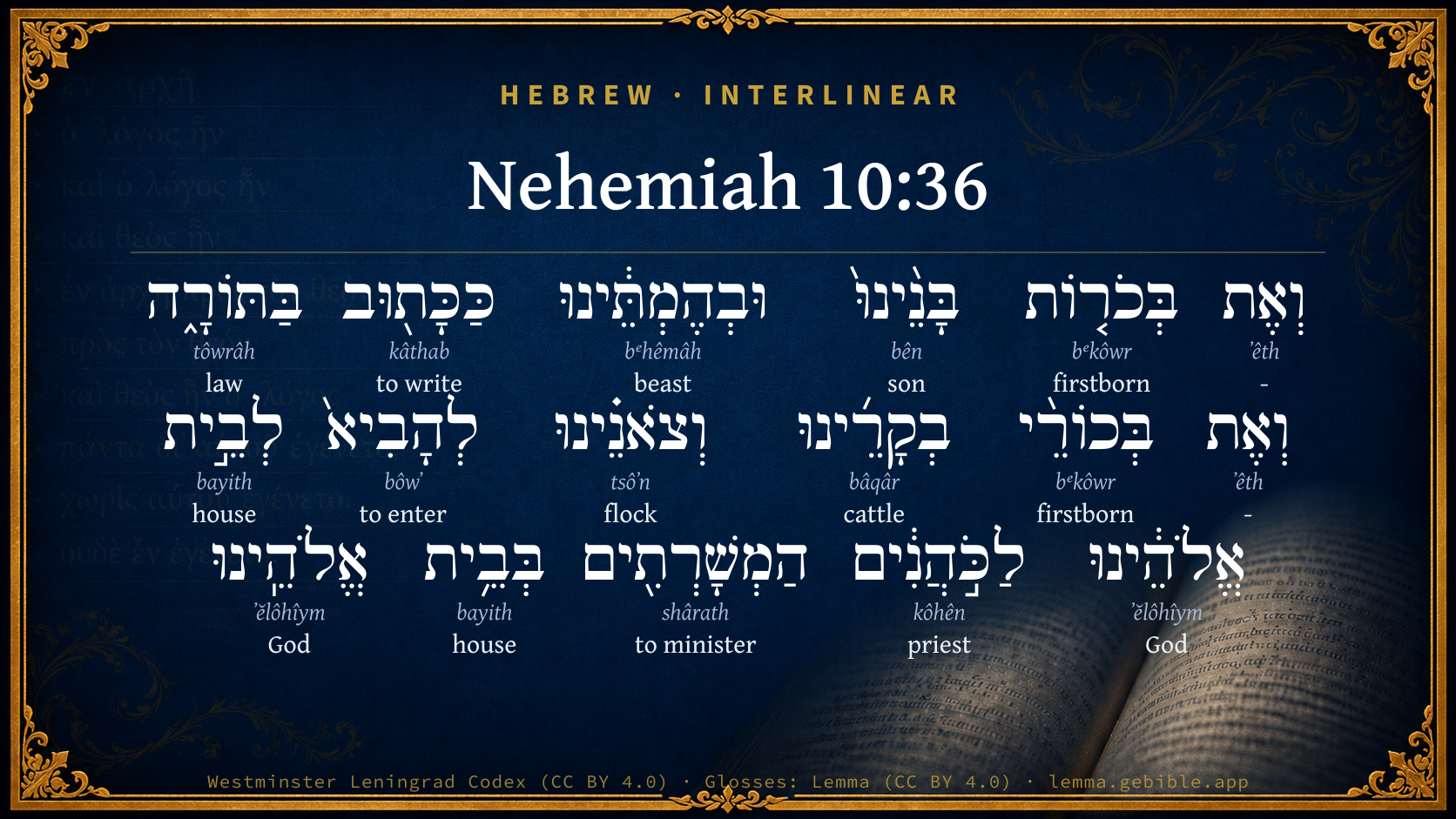
Hebrew (Westminster Leningrad Codex) Nehemiah 10:36 appears in the Hebrew Old Testament. The text above is from the Westminster Leningrad Codex. Each word links to its Strong’s number, a concise gloss, and parsing drawn from the Open Scriptures Hebrew Bible morphology. Click any word for its full Brown-Driver-Briggs (BDB) entry.
Download image
Cite this verse

Nehemiah 10:36 (World English Bible). Public Domain. Lemma interlinear Bible study tool, https://lemma.gebible.app/v/nehemiah/10/36.

Show BibTeX & RIS
BibTeX
RIS
English Translation
also the firstborn of our sons, and of our cattle, as it is written in the law, and the firstborn of our herds and of our flocks, to bring to the house of our God, to the priests who minister in the house of our God;
World English Bible · Public Domain
Download a study sheet

One document with this verse’s original text, its word-by-word gloss line, the meaning frame, cross-references with their text, attributed commentary, and full source and license credits — printable, and it pastes into notes with its structure intact.

This verse Autodidact and up

Study sheet (.html) Plain text (.txt)

A passage Seminary Student

Up to 50 verses in one chapter. A passage sheet keeps up to 6 commentary sources and 12 cross-references per verse, in the order this page ranks them, and says so on the sheet whenever that leaves anything out. Ask for a single verse and you get the Autodidact verse sheet above.

Everything on this page stays free to read, with no account — the sheet is a download of what is already on screen, not access to it.

Want to remove ads? Support Godless Engineer
Compare translations 3

The same verse in 3 English versions, stacked beneath the original-language interlinear above. Click any original word for its lexicon entry.

Each is an independent rendering of the whole verse — the interlinear is not word-aligned to these translations.

Highlighted words mark where these versions differ — a whole-verse word diff, not a word-by-word alignment.

  • World English Bible Public Domain
    also the firstborn of our sons, and of our cattle, as it is written in the law, and the firstborn of our herds and of our flocks, to bring to the house of our God, to the priests who minister in the house of our God;
  • King James Version Public Domain
    Also the firstborn of our sons, and of our cattle, as it is written in the law, and the firstlings of our herds and of our flocks, to bring to the house of our God, unto the priests that minister in the house of our God:
  • unfoldingWord Literal Text CC BY-SA 4.0
    and the firstborns of our sons and our livestock, as written in the law, even the firstborns of our herds and our flocks, to bring them to the house of our God, to the priests, the ones who minister in the house of our God.

unfoldingWord Literal Text — © unfoldingWord, licensed CC BY-SA 4.0. Word-aligned USFM3 via Door43 (git.door43.org/unfoldingWord/en_ult).

Versions to compare (up to 4)

3 of 4 selected

Show all 18 translations

Every available English version of this verse, each an independent rendering of the whole verse.

  • World English Bible Public Domain
    also the firstborn of our sons, and of our cattle, as it is written in the law, and the firstborn of our herds and of our flocks, to bring to the house of our God, to the priests who minister in the house of our God;
  • Berean Standard Bible Public Domain
    And we will bring the firstborn of our sons and our livestock, as it is written in the Law, and will bring the firstborn of our herds and flocks to the house of our God, to the priests who minister in the house of our God.
  • Majority Standard Bible Public Domain
    And we will bring the firstborn of our sons and our livestock, as it is written in the Law, and will bring the firstborn of our herds and flocks to the house of our God, to the priests who minister in the house of our God.
  • King James Version Public Domain
    Also the firstborn of our sons, and of our cattle, as it is written in the law, and the firstlings of our herds and of our flocks, to bring to the house of our God, unto the priests that minister in the house of our God:
  • American Standard Version (1901) Public Domain
    also the first-born of our sons, and of our cattle, as it is written in the law, and the firstlings of our herds and of our flocks, to bring to the house of our God, unto the priests that minister in the house of our God;
  • Revised Version (1885) Public Domain
    also the firstborn of our sons, and of our cattle, as it is written in the law, and the firstlings of our herds and of our flocks, to bring to the house of our God, unto the priests that minister in the house of our God:
  • Geneva Bible (1599) Public Domain
    And the first borne of our sonnes, and of our cattel, as it is written in the Lawe, and the first borne of our bullockes and of our sheepe, to bring it into the house of our God, vnto ye Priests that minister in the house of our God,
  • Douay-Rheims (1899) Public Domain
    And the firstborn of our sons, and of our cattle, as it is written in the law, and the firstlings of our oxen, and of our sheep, to be offered in the house of our God, to the priests who minister in the house of our God.
  • Young's Literal Translation Public Domain
    and the firstlings of our sons, and of our cattle, as it is written in the law, and the firstlings of our herds and our flocks, to bring in to the house of our God, to the priests who are ministering in the house of our God.
  • Literal Standard Version CC BY-SA 4.0
    and the firstlings of our sons, and of our livestock, as it is written in the Law, and the firstlings of our herds and our flocks, to bring into the house of our God, to the priests who are ministering in the house of our God.
  • Unlocked Literal Bible CC BY-SA 4.0
    As it is written in the law, we promised to bring to the house of God and to the priests who serve there, the firstborn of our sons and of our herds and flocks.
  • unfoldingWord Literal Text CC BY-SA 4.0
    and the firstborns of our sons and our livestock, as written in the law, even the firstborns of our herds and our flocks, to bring them to the house of our God, to the priests, the ones who minister in the house of our God.
  • Darby Bible Public Domain
    and the firstborn of our sons and of our cattle, as it is written in the law; and to bring the firstlings of our herds and of our flocks to the house of our God, to the priests that minister in the house of our God;
  • World Messianic Bible Public Domain
    also the firstborn of our sons and of our livestock, as it is written in the Torah, and the firstborn of our herds and of our flocks, to bring to the house of our God, to the priests who minister in the house of our God;
  • Webster's Bible Public Domain
    Also the first-born of our sons, and of our cattle, as it is written in the law, and the firstlings of our herds and of our flocks, to bring to the house of our God, to the priests that minister in the house of our God:
  • Free Bible Version CC BY-SA 4.0
    We will bring the firstborn of our sons and of our livestock and of our herds and flocks to the Temple of our God, to the priests who minister there, as required by the Law.
  • Bible in Basic English Public Domain
    As well as the first of our sons and of our cattle, as it is recorded in the law, and the first lambs of our herds and of our flocks, which are to be taken to the house of our God, to the priests who are servants in the house of our God:
  • JPS Tanakh (1917) Public Domain
    (10-37) also the first-born of our sons, and of our cattle, as it is written in the Law, and the firstlings of our herds and of our flocks, to bring to the house of our God, unto the priests that minister in the house of our God;

Literal Standard Version (2020), Covenant Press — licensed CC BY-SA 4.0. Text via the HelloAO Bible API (eBible.org). Unlocked Literal Bible (unfoldingWord) — licensed CC BY-SA 4.0. Text via the HelloAO Bible API (eBible.org). unfoldingWord Literal Text — © unfoldingWord, licensed CC BY-SA 4.0. Word-aligned USFM3 via Door43 (git.door43.org/unfoldingWord/en_ult). Free Bible Version, Dr. Jonathan Gallagher — licensed CC BY-SA 4.0. Text via the HelloAO Bible API (eBible.org).

Word by word

More ways to search: Search by grammar → Find every occurrence → Compare this word →

Practice this passage: Drill this verse → Learn its vocabulary →

הַמְשָׁרְתִ֖ים
shârath
H8334
“the · ministering”
Particle, Definite Article + Verb, Piel, Participle Active, Masculine, Plural, Absolute
Part of Speech
Particle + Verb
Stem
Piel
Form
Participle Active
Gender
Masculine
Number
Plural
State
Absolute
Full BDB Definition

Origin: a primitive root

TWOT: 2472

(Piel) to minister, serve, minister to
  1. וְאֶת ʼêth H853 “and · -” Conjunction + Particle, Direct Object
  2. בְּכֹר֤וֹת bᵉkôwr H1060 “firstborn of” Noun, Common, Masculine, Plural, Construct
  3. בָּנֵ֨ינוּ֙ bên H1121 “sons · our” Noun, Common, Masculine, Plural, Construct + Suffix, Personal, 1st Person, Common, Plural
  4. וּבְהֶמְתֵּ֔ינוּ bᵉhêmâh H929 “and · beast · our” Conjunction + Noun, Common, Feminine, Singular, Construct + Suffix, Personal, 1st Person, Common, Plural
  5. כַּכָּת֖וּב kâthab H3789 “like/as the · written” Preposition, Determined + Verb, Qal, Participle Passive, Masculine, Singular, Absolute
  6. בַּתּוֹרָ֑ה tôwrâh H8451 “in/at the · law” Preposition, Determined + Noun, Common, Feminine, Singular, Absolute
  7. וְאֶת ʼêth H853 “and · -” Conjunction + Particle, Direct Object
  8. בְּכוֹרֵ֨י bᵉkôwr H1060 “firstborn of” Noun, Common, Masculine, Plural, Construct
  9. בְקָרֵ֜ינוּ bâqâr H1241 “cattle · our” Noun, Common, Both, Plural, Construct + Suffix, Personal, 1st Person, Common, Plural
  10. וְצֹאנֵ֗ינוּ tsôʼn H6629 “and · flocks · our” Conjunction + Noun, Common, Both, Plural, Construct + Suffix, Personal, 1st Person, Common, Plural
  11. לְהָבִיא֙ bôwʼ H935 “to enter” Preposition + Verb, Hiphil, Infinitive Construct
  12. לְבֵ֣ית bayith H1004 “to/for · house of” Preposition + Noun, Common, Masculine, Singular, Construct
  13. אֱלֹהֵ֔ינוּ ʼĕlôhîym H430 “God(s) · our” Noun, Common, Masculine, Plural, Construct + Suffix, Personal, 1st Person, Common, Plural
  14. לַכֹּ֣הֲנִ֔ים kôhên H3548 “to/for the · priests” Preposition, Determined + Noun, Common, Masculine, Plural, Absolute
  15. בְּבֵ֥ית bayith H1004 “in/at · house of” Preposition + Noun, Common, Masculine, Singular, Construct
  16. אֱלֹהֵֽינוּ ʼĕlôhîym H430 “God(s) · our” Noun, Common, Masculine, Plural, Construct + Suffix, Personal, 1st Person, Common, Plural

About this verse

These counts appear in no published source. They are computed here, from the morphology-tagged text and Lemma’s own curated glosses. What Lemma adds →

17
words
13
distinct lemmas
Historical
section

Grammatical profile

  • 3 verbs
  • 12 nouns
  • 2 particles

Verb forms

  • כַּכָּת֖וּב Qal · Participle Passive
  • לְהָבִיא֙ Hiphil · Infinitive Construct
  • הַמְשָׁרְתִ֖ים Piel · Participle Active

Repetition

Words recur within this verse — often emphatic in Hebrew:

  • בְּכֹר֤וֹת firstborn H1060 ×2
  • לְבֵ֣ית house H1004 ×2
  • אֱלֹהֵ֔ינוּ God H430 ×2

Cross-references

8

Topical passages linked to Nehemiah 10:36 in the Treasury of Scripture Knowledge — connected by theme and wording, ordered by reader-vote popularity; previews shown in the World English Bible.

  • Exodus 13:2 "Sanctify to me all of the firstborn, whatever opens the womb among the children of Israel, both of man and of animal. It is mine."
  • Leviticus 27:26–27 "'Only the firstborn among animals, which is made a firstborn to Yahweh, no man may dedicate it; whether an ox or sheep, it is Yahweh's.
  • Exodus 13:12–15 that you shall set apart to Yahweh all that opens the womb, and every firstborn which you have that comes from an animal. The males shall be Yahweh's.
  • Exodus 34:19 All that opens the womb is mine; and all your cattle that is male, the firstborn of cow and sheep.
  • Numbers 18:9–19 This shall be your of the most holy things, [reserved] from the fire: every offering of theirs, even every meal-offering of theirs, and every sin-offering of theirs, and every trespass-offering of theirs, which they shall render to me, shall be most holy for you and for your sons.
  • Deuteronomy 12:6 and there you shall bring your burnt offerings, and your sacrifices, and your tithes, and the heave-offering of your hand, and your vows, and your freewill-offerings, and the firstborn of your herd and of your flock:
  • 1 Corinthians 9:6–14 Or have only Barnabas and I no right to not work?
  • Galatians 6:6 But let him who is taught in the word share all good things with him who teaches.

Cross-references courtesy of OpenBible.info (CC BY 4.0).

Hebrew and Greek witnesses Masoretic Hebrew ↔ Greek Septuagint

The same verse in the two great witnesses to the Old Testament, shown verse-for-verse.

These are two independent witnesses, not word-aligned to each other, and the Septuagint is shown in lemma (dictionary) form.

Hebrew Nehemiah 10:36 Masoretic · Westminster Leningrad Codex

וְאֶת בְּכֹר֤וֹת בָּנֵ֨ינוּ֙ וּבְהֶמְתֵּ֔ינוּ כַּכָּת֖וּב בַּתּוֹרָ֑ה וְאֶת בְּכוֹרֵ֨י בְקָרֵ֜ינוּ וְצֹאנֵ֗ינוּ לְהָבִיא֙ לְבֵ֣ית אֱלֹהֵ֔ינוּ לַכֹּ֣הֲנִ֔ים הַמְשָׁרְתִ֖ים בְּבֵ֥ית אֱלֹהֵֽינוּ

also the firstborn of our sons, and of our cattle, as it is written in the law, and the firstborn of our herds and of our flocks, to bring to the house of our God, to the priests who minister in the house of our God;

World English Bible · Public Domain

Greek LXX Structure differs

The Septuagint has no separate book of Nehemiah. Its Greek text is the second half of Esdras B (2 Esdras), chapters 11–23; Ezra is the first half (1–10).

A verse-for-verse comparison isn’t shown here because the chapters and verses don’t line up. Switch to the LXX edition with the MT / LXX toggle above to read the Greek directly.

Hebrew: Westminster Leningrad Codex (CC BY 4.0). Greek: Septuagint (public domain); English from a public-domain English Septuagint. How the Septuagint differs from the Hebrew →

Commentary

Notes on Nehemiah 10:36 from classic Christian and Jewish commentators (each source and its license shown beneath its notes). The classic Christian expositions comment on the surrounding passage and are grouped to its opening verse, so a note may address several verses; the Jewish commentaries on the Tanakh (Rashi and others) are per-verse, so they appear only where the commentator wrote on this verse.

Lemma curates 59 commentaries, every one of them public domain or Creative Commons licensed, each selected and text-cleaned for this edition rather than reprinted as found. About our sources →

Trapp's Complete Commentary

John Trapp

Neh 10:36 Also the firstborn of our sons, and of our cattle, as [it is] written in the law, and the firstlings of our herds and of our flocks, to bring to the house of our God, unto the priests that minister in the house of our God:

Ver. 36. Also the firstborn of our sons] These God claimed as his due, Exo 12:2; Exo 22:29; Num 3:13, and called for, as best beloved of the parents; that, together with them, he might draw men’s best affections to himself. They were to be redeemed, as were also the firstlings of all beasts not fit for sacrifice, Exo 13:13, and the redemption money brought to the priests (who were God’s receivers), that they might be the better encouraged in the law of the Lord, as Hezekiah phraseth it, 2Ch 31:4.

To bring to the house of our God, unto the priests] No man might offer his own sacrifice, though it were never so good, but present it to the priest, Lev 17:5, who was to offer as well the poor man’s lamb as the rich man’s ox. It is by Christ alone that we must draw nigh to God, &c.

John Trapp, A Commentary or Exposition upon All the Books of the Old and New Testament (1647–1656) — public domain. Text from a community e-Sword module.

Geneva Bible (1599)

Geneva Bible translators

By this rehearsal is meant that there was no part nor ceremony in the Law, whereunto they did not bind themselves by covenant.

Geneva Bible (1599) marginal notes — public domain. Text via Bolls.life.

Adam Clarke's Commentary

Verse 36. Also the first-born] See this law, and the reasons of it, Ex 13:1-13. As by this law the Lord had a right to all the firstborn, instead of these he was pleased to take the tribe of Levi for the whole; and thus the Levites served at the tabernacle and temple, instead of the first-born of all the tribes.

Adam Clarke's Commentary on the Bible (1810–1826) — public domain. Text from a community e-Sword/MySword module.

Ellicott's Commentary for English Readers

(36) The firstborn of our sons, and of our cattle.—Similarly collocated in Num_16:15-16; but there the cattle are defined as “unclean beasts,” thus distinguished from “the firstlings of our herds and of our flocks.” The latter were to be brought to “the priests that minister” for sacrifice; the former were, with the sons, to be redeemed by money, according to the priests’ valuation.

A Bible Commentary for English Readers, edited by Charles John Ellicott (1878–1897) — public domain. Text from a community e-Sword module.

The Cambridge Bible for Schools and Colleges

gen. ed. J. J. S. Perowne

36. the firstborn of our sons] The firstborn of the children of Israel ‘from a month old’ were redeemed ‘for the money of five shekels, after the shekel of the sanctuary.’ Num_18:16; cf. Exo_13:13; Exo_34:20.

of our cattle, as it is written in the law] The firstlings of oxen, sheep and goats were not redeemed; they were holy; their fat was offered as a burnt offering; the flesh was the portion of the priests. See Num_18:17-19. But the firstborn of all unclean beasts were redeemed for a price. Cf. Exo_23:19; Num_18:15.

herds … flocks] i.e. the goats and sheep mentioned in Num_18:17.

The Cambridge Bible for Schools and Colleges (gen. ed. J. J. S. Perowne; Cambridge University Press, 1878–1918) — public domain. Text from a community e-Sword module.

John Gill's Exposition

And that we should bring the first fruits of our dough,.... According to the law in Num 15:20

and our offerings; their heave offerings, Num 18:8

and the fruit of all manner of trees; bore by them on the fourth year after their planting, Lev 19:23

of wine and oil; to which Aben Ezra restrains the fruit of the trees, see Num 18:12, all these they were to bring

unto the priests, to the chambers the house of our God; there to be laid up for the use of it; and oil and wine were frequently used in sacrifices:

and the tithes of our ground unto the Levites, that the same Levites might have the tithes in all the cities of our village; the tenth part of the produce of their agriculture everywhere throughout the land, see Num 18:21.

John Gill's Exposition of the Whole Bible (1746–1763) — public domain (CC PDM 1.0). Text via the HelloAO Bible API.

Whedon's Commentary on the Bible

Daniel D. Whedon

36. The firstborn of our sons — To be redeemed, according to the law of Num_18:15-16.

As it is written in the law — Compare, for all these items, the marginal references.

Daniel D. Whedon (gen. ed.), Commentary on the Old and New Testaments (1874–1909) — public domain. Text from a community e-Sword module.

The Pulpit Commentary

The first-born of our sons and of our cattle, as it is written in the law. See Exo_22:29 Exo_34:19. The firstborn children were to be "redeemed."

The Pulpit Commentary (1880–1919), ed. H.D.M. Spence-Jones & Joseph S. Exell — public domain. Text from a community e-Sword module.

Rashi

Rabbi Shlomo Yitzchaki (Rashi)

the first fruits of our soil The first of every fruit of a tree. They are required by rabbinical injunction.

Rashi on the Tanakh — English translations: “The Judaica Press complete Tanach with Rashi, translated by A. J. Rosenberg” (CC BY 4.0); “Pentateuch with Rashi's commentary by M. Rosenbaum and A.M. Silbermann, 1929-1934” (public domain); “The Metsudah Tanach series, Lakewood, N.J” (CC BY 4.0); and “The Book of Joshua, Metsudah Publications, 1997” (CC BY 4.0). Text via Sefaria.

Lesson kit

Teaching starters — assembled from the data on this page, not authored interpretation. Every prompt links to the verse data it draws on. Edit before teaching.

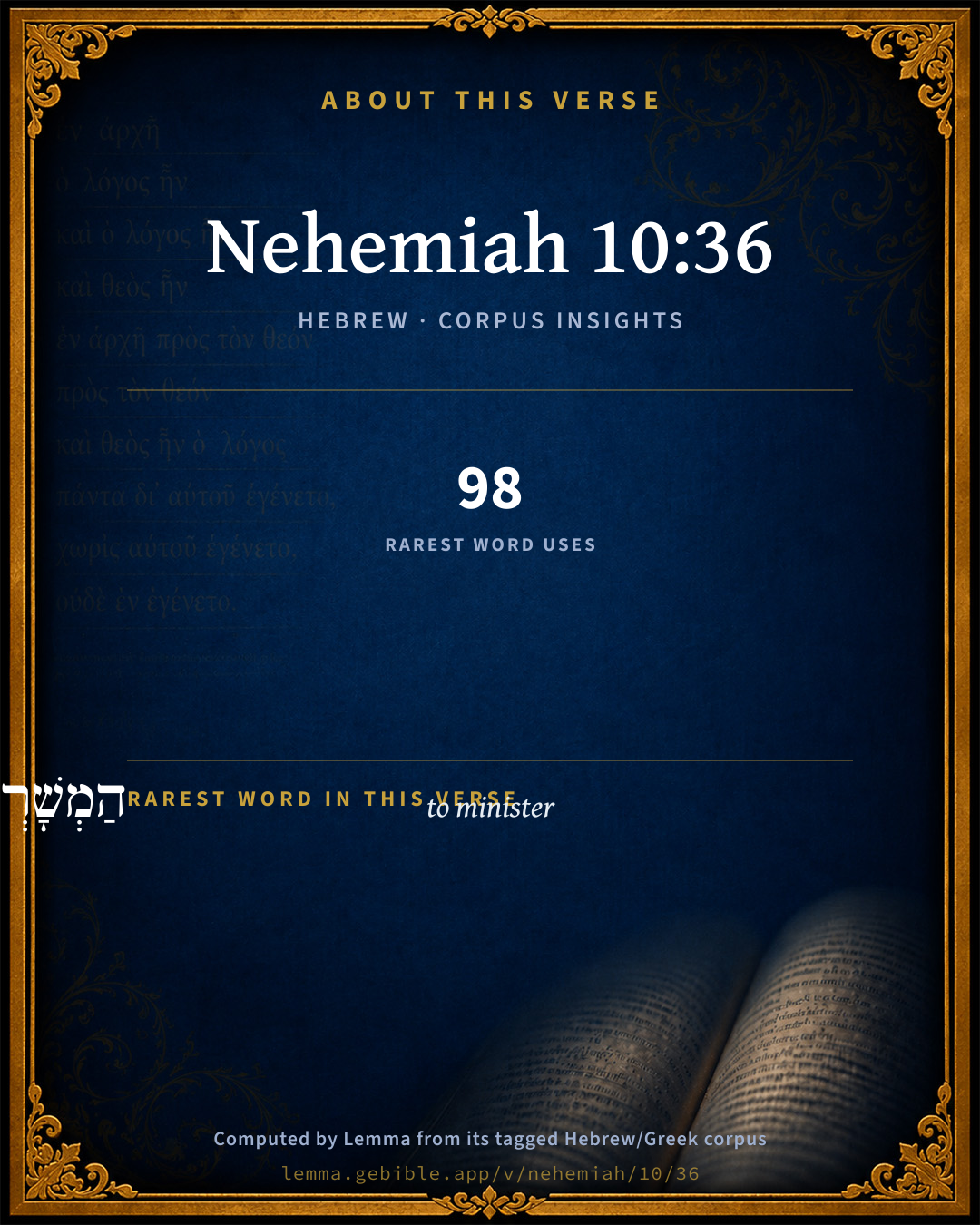
Nehemiah, in the Historical, opens this verse with 17 words (13 distinct Hebrew lemmas). Its most distinctive word is shârath (“to minister”). A historical commentator’s framing appears above. Read the whole chapter for the surrounding context.

Discussion questions

  1. The word shârath carries the sense “to minister.” How does it shape the verse?
  2. How does Exodus 13:2, which shares this passage’s theme, read alongside this verse?
  3. What does the repetition of “firstborn” (2× in this one verse) do in this verse?
  4. These translations render this verse differently; the difference is in the English rendering, not the original. What questions does that raise?
  5. «כַּכָּת֖וּב» is a Qal Participle Passive verb. How does that grammatical form shape the action described?
  6. Compare how Trapp's Complete Commentary and Geneva Bible (1599) read this verse. Where do they agree or differ?

Things to notice

  • These translations choose different wording for 9 words in this verse.
  • “firstborn” occurs 2× in this single verse.
  • 13 distinct Hebrew lemmas span 17 words in this verse.

Reading settings

Reading text

Shown beneath each verse's original-language words.

Old Testament
Old Testament edition

Read the OT as the Masoretic Hebrew (MT) or the Greek Septuagint (LXX).

English shown for the Greek Septuagint (in the Hebrew ↔ Greek comparison).

Comparing translations? Open the Compare panel on any verse page to stack up to four side by side.