Amos 7:15

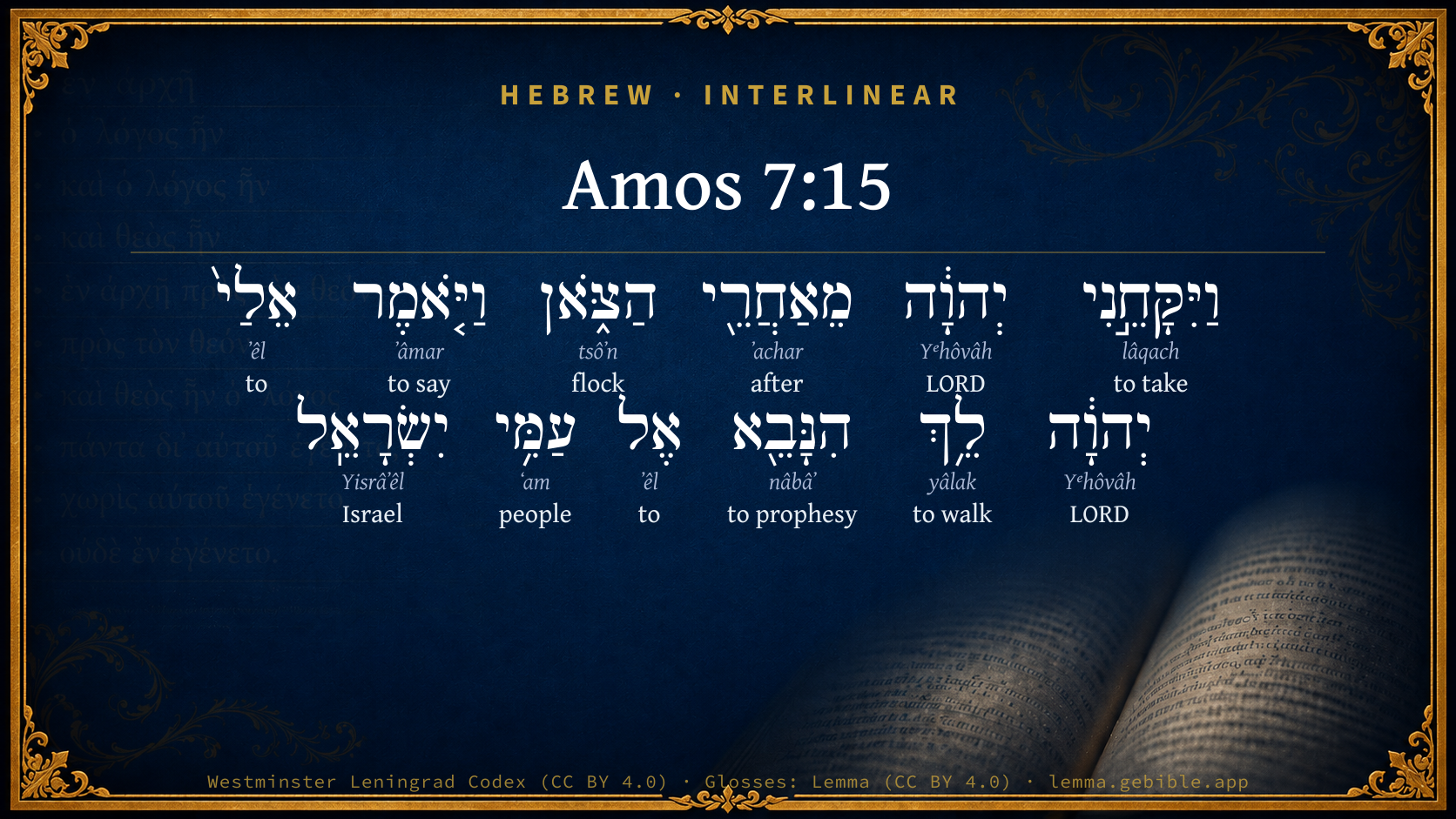
Hebrew (Westminster Leningrad Codex) Amos 7:15 appears in the Hebrew Old Testament. The text above is from the Westminster Leningrad Codex. Each word links to its Strong’s number, a concise gloss, and parsing drawn from the Open Scriptures Hebrew Bible morphology. Click any word for its full Brown-Driver-Briggs (BDB) entry.
Download image
Cite this verse

Amos 7:15 (World English Bible). Public Domain. Lemma interlinear Bible study tool, https://lemma.gebible.app/v/amos/7/15.

Show BibTeX & RIS
BibTeX
RIS
English Translation
and Yahweh took me from following the flock, and Yahweh said to me, 'Go, prophesy to my people Israel.'
World English Bible · Public Domain
Download a study sheet

One document with this verse’s original text, its word-by-word gloss line, the meaning frame, cross-references with their text, attributed commentary, and full source and license credits — printable, and it pastes into notes with its structure intact.

This verse Autodidact and up

Study sheet (.html) Plain text (.txt)

A passage Seminary Student

Up to 50 verses in one chapter. A passage sheet keeps up to 6 commentary sources and 12 cross-references per verse, in the order this page ranks them, and says so on the sheet whenever that leaves anything out. Ask for a single verse and you get the Autodidact verse sheet above.

Everything on this page stays free to read, with no account — the sheet is a download of what is already on screen, not access to it.

Want to remove ads? Support Godless Engineer
Compare translations 3

The same verse in 3 English versions, stacked beneath the original-language interlinear above. Click any original word for its lexicon entry.

Each is an independent rendering of the whole verse — the interlinear is not word-aligned to these translations.

Highlighted words mark where these versions differ — a whole-verse word diff, not a word-by-word alignment.

  • World English Bible Public Domain
    and Yahweh took me from following the flock, and Yahweh said to me, 'Go, prophesy to my people Israel.'
  • King James Version Public Domain
    And the LORD took me as I followed the flock, and the LORD said unto me, Go, prophesy unto my people Israel.
  • unfoldingWord Literal Text CC BY-SA 4.0
    But Yahweh took me from tending the flock, and Yahweh said to me, ‘Go, prophesy to my people Israel.’

unfoldingWord Literal Text — © unfoldingWord, licensed CC BY-SA 4.0. Word-aligned USFM3 via Door43 (git.door43.org/unfoldingWord/en_ult).

Versions to compare (up to 4)

3 of 4 selected

Show all 18 translations

Every available English version of this verse, each an independent rendering of the whole verse.

  • World English Bible Public Domain
    and Yahweh took me from following the flock, and Yahweh said to me, 'Go, prophesy to my people Israel.'
  • Berean Standard Bible Public Domain
    But the LORD took me from following the flock and said to me, ‘Go, prophesy to My people Israel.’
  • Majority Standard Bible Public Domain
    But the LORD took me from following the flock and said to me, ‘Go, prophesy to My people Israel.’
  • King James Version Public Domain
    And the LORD took me as I followed the flock, and the LORD said unto me, Go, prophesy unto my people Israel.
  • American Standard Version (1901) Public Domain
    and Jehovah took me from following the flock, and Jehovah said unto me, Go, prophesy unto my people Israel.
  • Revised Version (1885) Public Domain
    and the LORD took me from following the flock, and the LORD said unto me, Go, prophesy unto my people Israel.
  • Geneva Bible (1599) Public Domain
    And the Lord tooke me as I followed the flocke, and the Lord said vnto me, Go, prophecie vnto my people Israel.
  • Douay-Rheims (1899) Public Domain
    And the Lord took me when I followed the flock, and the Lord said to me: Go, prophesy to my people Israel.
  • Young's Literal Translation Public Domain
    and Jehovah taketh me from after the flock, and Jehovah saith unto me, Go, prophesy unto My people Israel.
  • Literal Standard Version CC BY-SA 4.0
    and YHWH takes me from after the flock, and YHWH says to me, Go, prophesy to My people Israel.
  • Unlocked Literal Bible CC BY-SA 4.0
    But Yahweh took me from tending the flock and said to me, 'Go, prophesy to my people Israel.'
  • unfoldingWord Literal Text CC BY-SA 4.0
    But Yahweh took me from tending the flock, and Yahweh said to me, ‘Go, prophesy to my people Israel.’
  • Darby Bible Public Domain
    And Jehovah took me as I followed the flock, and Jehovah said unto me, Go, prophesy unto my people Israel.
  • World Messianic Bible Public Domain
    and the LORD took me from following the flock, and the LORD said to me, ‘Go, prophesy to my people Israel.’
  • Webster's Bible Public Domain
    And the LORD took me as I followed the flock, and the LORD said to me, Go, prophesy to my people Israel.
  • Free Bible Version CC BY-SA 4.0
    The Lord took me from following my flock, and the Lord told me, ‘Go, and give my message to my people of Israel.’”
  • Bible in Basic English Public Domain
    And the Lord took me from the flock, and the Lord said to me, Go, be a prophet to my people Israel.
  • JPS Tanakh (1917) Public Domain
    and the LORD took me from following the flock, and the LORD said unto me: Go, prophesy unto My people Israel.

Literal Standard Version (2020), Covenant Press — licensed CC BY-SA 4.0. Text via the HelloAO Bible API (eBible.org). Unlocked Literal Bible (unfoldingWord) — licensed CC BY-SA 4.0. Text via the HelloAO Bible API (eBible.org). unfoldingWord Literal Text — © unfoldingWord, licensed CC BY-SA 4.0. Word-aligned USFM3 via Door43 (git.door43.org/unfoldingWord/en_ult). Free Bible Version, Dr. Jonathan Gallagher — licensed CC BY-SA 4.0. Text via the HelloAO Bible API (eBible.org).

Word by word

More ways to search: Search by grammar → Find every occurrence → Compare this word →

Practice this passage: Drill this verse → Learn its vocabulary →

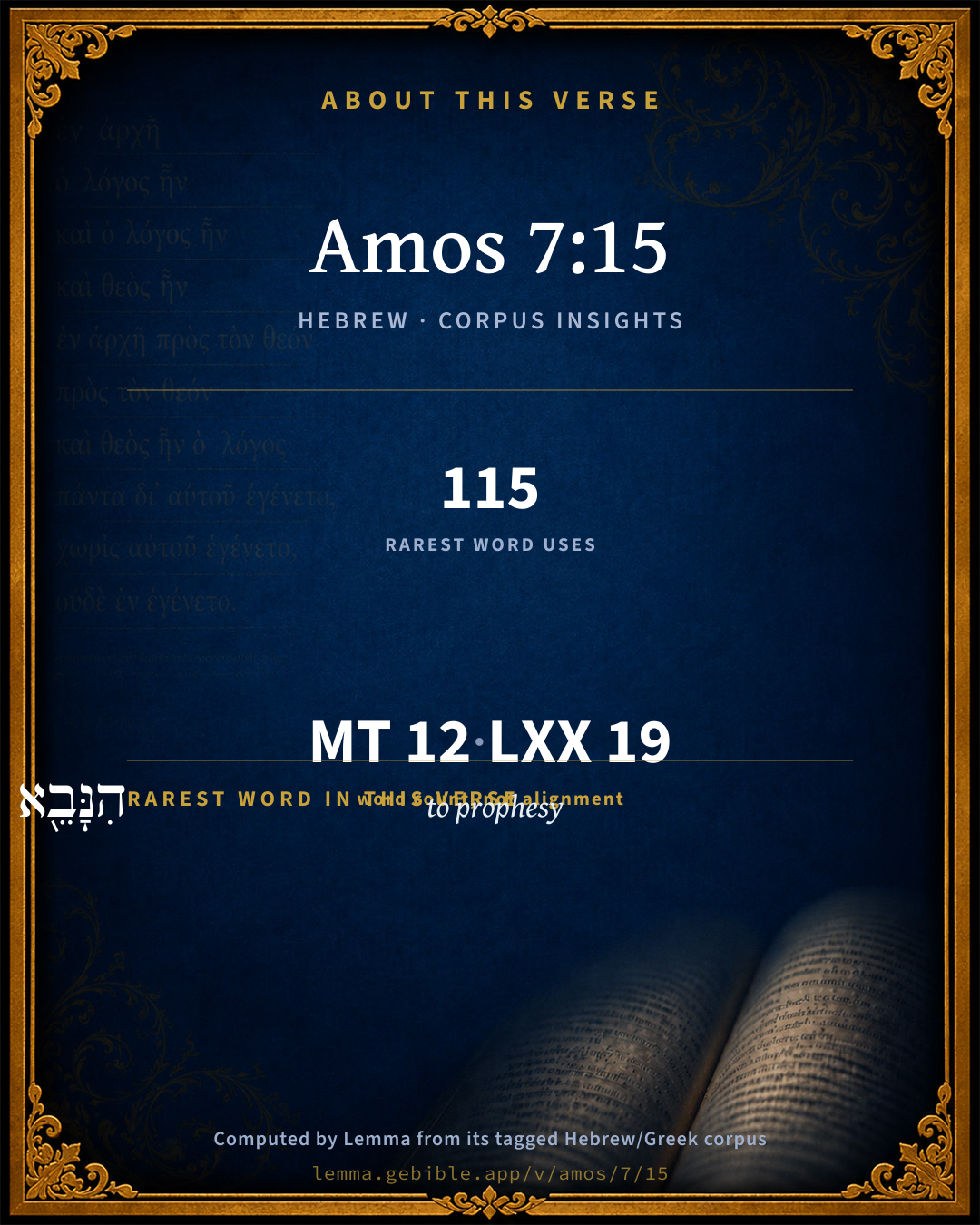
הִנָּבֵ֖א
nâbâʼ
H5012
“prophesy”
Verb, Niphal, Imperative, 2nd Person, Masculine, Singular
Part of Speech
Verb
Stem
Niphal
Form
Imperative
Person
2nd Person
Gender
Masculine
Number
Singular
Full BDB Definition

Origin: a primitive root

TWOT: 1277

to prophesy - (Niphal) - to prophesy - under influence of divine spirit - of false prophets - (Hithpael) - to prophesy - under influence of divine spirit - of false prophets
  1. וַיִּקָּחֵ֣נִי lâqach H3947 “and · to take · me” Conjunction + Verb, Qal, Sequential Imperfect, 3rd Person, Masculine, Singular + Suffix, Personal, 1st Person, Common, Singular
  2. יְהוָ֔ה Yᵉhôvâh H3068 “LORD” Noun, Proper
  3. מֵאַחֲרֵ֖י ʼachar H310 “from · after” Preposition + Preposition
  4. הַצֹּ֑אן tsôʼn H6629 “the · flock” Particle, Definite Article + Noun, Common, Both, Singular, Absolute
  5. וַיֹּ֤אמֶר ʼâmar H559 “and · to say” Conjunction + Verb, Qal, Sequential Imperfect, 3rd Person, Masculine, Singular
  6. אֵלַי֙ ʼêl H413 “to · me” Preposition + Suffix, Personal, 1st Person, Common, Singular
  7. יְהוָ֔ה Yᵉhôvâh H3068 “LORD” Noun, Proper
  8. לֵ֥ךְ yâlak H3212 “walk” Verb, Qal, Imperative, 2nd Person, Masculine, Singular
  9. אֶל ʼêl H413 “to” Preposition
  10. עַמִּ֥י ʻam H5971 “people · my” Noun, Common, Masculine, Singular, Construct + Suffix, Personal, 1st Person, Common, Singular
  11. יִשְׂרָאֵֽל Yisrâʼêl H3478 “Israel” Noun, Proper

About this verse

These counts appear in no published source. They are computed here, from the morphology-tagged text and Lemma’s own curated glosses. What Lemma adds →

12
words
10
distinct lemmas
Prophets
section

Grammatical profile

  • 4 verbs
  • 5 nouns
  • 3 prepositions

Verb forms

  • וַיִּקָּחֵ֣נִי Qal · Sequential Imperfect
  • וַיֹּ֤אמֶר Qal · Sequential Imperfect
  • לֵ֥ךְ Qal · Imperative
  • הִנָּבֵ֖א Niphal · Imperative

Repetition

Words recur within this verse — often emphatic in Hebrew:

  • יְהוָ֔ה LORD H3068 ×2
  • אֵלַי֙ to H413 ×2

Hebrew & Septuagint length

In English translation the verse runs 19 words from the Hebrew and 21 from the Septuagint (LXX English) — closely comparable.

A rough comparison of the two English renderings, which tokenize alike — not a word-level alignment.

Word counts can differ between the Hebrew and the Greek without any difference in meaning — e.g. the Hebrew direct-object marker אֵת has no separate Greek word, and Greek often adds the article ὁ.

In the original languages it is 12 Hebrew tokens and 19 Greek tokens — but the two are counted differently (Hebrew bundles its prefixes and suffixes into one token; the Greek is in lemma form), so that isn’t a like-for-like length.

Cross-references

11

Topical passages linked to Amos 7:15 in the Treasury of Scripture Knowledge — connected by theme and wording, ordered by reader-vote popularity; previews shown in the World English Bible.

  • 2 Samuel 7:8 Now therefore thus shall you tell my servant David, Thus says Yahweh of Hosts, I took you from the sheep pen, from following the sheep, that you should be prince over my people, over Israel;
  • Ezekiel 2:3–4 He said to me, Son of man, I send you to the children of Israel, to nations that are rebellious, which have rebelled against me: they and their fathers have transgressed against me even to this very day.
  • Psalms 78:70–72 He also chose David his servant, And took him from the sheepfolds;
  • Jeremiah 1:7 But Yahweh said to me, Don't say, I am a child; for to whoever I shall send you, you shall go, and whatever I shall command you, you shall speak.
  • Matthew 4:18–19 Walking by the sea of Galilee, he saw two brothers: Simon, who is called Peter, and Andrew, his brother, casting a net into the sea; for they were fishermen.
  • Matthew 9:9 As Jesus passed by from there, he saw a man called Matthew sitting at the tax collection office. He said to him, "Follow me." He got up and followed him.
  • Acts 1:8 But you will receive power when the Holy Spirit has come upon you. You will be witnesses to me in Jerusalem, in all Judea and Samaria, and to the uttermost parts of the earth."
  • Acts 5:20 "Go stand and speak in the temple to the people all the words of this life."
  • Luke 24:46–48 He said to them, "Thus it is written, and thus it was necessary for the Christ to suffer and to rise from the dead the third day,
  • Acts 4:20 for we can't help telling the things which we saw and heard."
  • Acts 5:29–32 But Peter and the apostles answered, "We must obey God rather than men.

Cross-references courtesy of OpenBible.info (CC BY 4.0).

Hebrew and Greek witnesses Masoretic Hebrew ↔ Greek Septuagint

The same verse in the two great witnesses to the Old Testament, shown verse-for-verse.

These are two independent witnesses, not word-aligned to each other, and the Septuagint is shown in lemma (dictionary) form.

Hebrew Amos 7:15 Masoretic · Westminster Leningrad Codex

וַיִּקָּחֵ֣נִי יְהוָ֔ה מֵאַחֲרֵ֖י הַצֹּ֑אן וַיֹּ֤אמֶר אֵלַי֙ יְהוָ֔ה לֵ֥ךְ הִנָּבֵ֖א אֶל עַמִּ֥י יִשְׂרָאֵֽל

and Yahweh took me from following the flock, and Yahweh said to me, 'Go, prophesy to my people Israel.'

World English Bible · Public Domain

Greek LXX Amos 7:15 Septuagint · lemma form

καί ἀναλαμβάνω ἐγώ κύριος ἐκ ὁ πρόβατον καί εἶπον κύριος πρός ἐγώ βαδίζω προφητεύω ἐπί ὁ λαός ἐγώ ἰσραήλ

And the Lord took me from the sheep, and the Lord said to me, Go, and prophesy to my people Israel.

LXX2012 (modern English Septuagint) · Public Domain

Hebrew: Westminster Leningrad Codex (CC BY 4.0). Greek: Septuagint (public domain); English from LXX2012 (modern English Septuagint) (Public Domain). How the Septuagint differs from the Hebrew →

Targum (Aramaic paraphrase)

1

The Targum is the ancient Jewish Aramaic paraphrase of the Hebrew Scriptures — an interpretive translation, not the Hebrew text itself. Onkelos (literal) and Pseudo-Jonathan (expansive) render the Torah, and Jonathan the Prophets. Coverage is partial: where no permissively-licensed English translation exists for a verse, only the Aramaic is shown. This is verse-level text, not a word-by-word alignment to the Hebrew.

  1. Targum Jonathan Prophets (Joshua–Malachi)
    וְדַבַּרְנִי יְיָ מִן דִירָא מִבָּתַר עָנָא וַאֲמַר לִי יְיָ אֱזֵל אִתְנַבֵּי עַל עַמִי יִשְׂרָאֵל:

    (no public-domain English translation for this verse)

    Targum Jonathan — Aramaic: “Mikraot Gedolot” (public domain). English: “Sefaria Community Translation” (CC0 1.0 (public-domain dedication)); “London "Chaldee Paraphrase," 1871” (public domain). Text via Sefaria.

Commentary

Notes on Amos 7:15 from classic Christian and Jewish commentators (each source and its license shown beneath its notes). The classic Christian expositions comment on the surrounding passage and are grouped to its opening verse, so a note may address several verses; the Jewish commentaries on the Tanakh (Rashi and others) are per-verse, so they appear only where the commentator wrote on this verse.

Lemma curates 59 commentaries, every one of them public domain or Creative Commons licensed, each selected and text-cleaned for this edition rather than reprinted as found. About our sources →

Trapp's Complete Commentary

John Trapp

Amo 7:15 And the LORD took me as I followed the flock, and the LORD said unto me, Go, prophesy unto my people Israel.

Ver. 15. And the Lord took me, as I followed the flock] As he took Elisha from the plough tail, the apostles from casting and mending their nets, &c. Asinos elegit Christus et idiotas, sed oculavit in prudentes: simulque dona dedit, et ministeria, he called them to the office, and withal he gifted them. He called also learned Nathanael, and Nicodemus, a master in Israel; lest, if he had called none but such as were simple (saith John de Turrecremata), it should have been thought they had been deceived through their simplicity. But it is God’s way to choose the foolish things of the world to confound the wise; and things that are not, to bring to nought things that are, that no flesh should glory in his presence, 1Co 1:27-29.

And the Lord said unto me] He often inculcates the name of the Lord, to show that there was a necessity of his prophesying; for who can safely disobey such a commander? see Amo 3:8. Aut faciendum, aut patiendum. The philosopher could tell the emperor, who challenged him to dispute, that there was no contesting with him that had twenty legions at his command.

Go, prophesy unto my people Israel] Keep within my precincts, and thou shalt be sure of my protection; be true to thy trust, and I will see to thy safety. If thou have not fine manchet (as Bucer said to Bradford, encouraging him to bestow his talent in preaching), yet give the poor people barley bread, or whatever else the Lord hath committed unto thee. Having therefore such a call from heaven to this work, with what face canst thou hinder me therein? With what countenance will ye appear before the judgment seat of Christ (said Dr Taylor, martyr, to Stephen Gardiner, Lord Chancellor, who had thus saluted him, Art thou come, thou villain? how darest thou look me in the face for shame? knowest thou not who I am, &c.?) How dare ye for shame look any Christian man in the face, seeing you have forsaken the truth, denied our Saviour Christ and his word, and done contrary to your own oath and writing? And, if I should be afraid of your lordly looks, why fear you not God, the Lord of us all? who hath sent us on his errand, which we must deliver, and truth be spoken, however it be taken, 1Co 9:16.

John Trapp, A Commentary or Exposition upon All the Books of the Old and New Testament (1647–1656) — public domain. Text from a community e-Sword module.

The Biblical Illustrator

Joseph S. Exell

Amo_7:15

The Lord took me as I followed the flock, and the Lord said unto me, Go, prophesy unto My people Israel.

The messenger faithful to his mission

Holy Scripture seldom teaches more impressively than when it teaches by contrasts. There may be instituted a contrast between two classes of religious workers.

1. Professional religious workers. In every age there have been such men--conventional religionists, whose creed is compromise, and whose maxim is, Sail with the stream.

2. Men whose hearts the Lord has touched. Such was Amos. Observe the surroundings of his life. What Was it the mere professionals were afraid of in his message? They may have feared lest the people should be roused to think. More probably they felt the inward uneasiness which hollow profession must ever experience when brought into contrast with genuine piety and the power of the Holy Ghost. The presence and testimony of Amos condemned them. The priest Amaziah suggested that Amos would be wise to flee away to the land of Judah. There would have been nothing necessarily sinful in following this advice. The presence of the prophet in Jerusalem would have been hailed with the warmest sympathy and welcome. He would have gained a wide popularity, and would have been an object of general admiration. And we are all liable to be influenced by such motives. We do not like to stand alone, beset with continual difficulties arising from our position. No doubt Amos would have yielded had he not been walking in the Spirit, and it is only this that will keep an.y of us at the post of duty. We are often tempted to run away from the cross given us to bear, flattering ourselves all the time that in doing so we are seeking opportunities of greater usefulness. We cannot get away from the Cross; it is the law of true Christian experience. Satan will always entice us to run away. Consider the temptations of the prophet more in detail.

1. Immunity from danger is promised. Amos was in a state of continual danger where he was.

2. If Amos would only go across the border, he had a clear prospect of obtaining what none of us can do without--bread. He might count upon a comfortable maintenance, a good living. A judicious use of his religion would have got him on in the world, and his godliness might have been made the steppingstone to rank and fortune. The position of Amos where he was must have been very precarious; he had left his regular means of livelihood, and was living a life of faith. He must have been living, as we say, from hand to mouth. To stay where he was would be to continue in poverty, perhaps to starve.

3. There was something more than even bread. Which of us does not know the yearning of the human heart for sympathy? How painful it is to stand alone! Which of us is altogether indifferent to popularity?

4. Even this was not all. The temptation is backed by an attempt to get up a question of casuistry. The king has commanded you not to speak, and you are disobeying him. How dare you arrogate to yourself such airs of superiority, and set yourself up as better than every one else? This is one of the severest trials of the Christian life. It does seem to those who do not take pains to find out the truth, as if we assumed an attitude of religious superiority. But, after all, our position is not as trying as Amoss was. Our only safety is ever to put our direct duty to God before our indirect. Be loyal to Him-personally, first; be loyal to Him indirectly, through your king or your parent, second; and remember you cannot be loyal to Him indirectly, when you have ceased to be loyal to Him directly. Against all these considerations of expediency and self-interest what had Amos to set? Only one mighty word from the lips of God. It was this that kept him at his post. Go, prophesy unto My people Israel. That was all; but it was clear. The voice said, Amos, go! From that moment Amos lived for God and His work; he turned his back on the sheepfold, gave up the gathering of sycamore, and began to deliver his message. Everything seemed to wave him back to his primitive seclusion. But against all opposition rang out the clear inner voice, Amos, go; have not I sent thee? And he went, with his life in his hand. He went, in the face of the jeers, and scoffs, and threats of the world, and the advice of such religious professors as Amaziah. We do not want two-faced Christians. We want men who, like Amos, are carried forward by the mighty consciousness of the Divine call, men in whom inmost heart the mighty, some of God is heard, calling them as by name, and bidding them Go. (W. M. Hay-Aitken, M. A.)

A humble origin remembered

Felix Faure, the late president of the French Republic, never sought to conceal his lowly origin. Hanging in a conspicuous place on the wall of his presidential office was a photograph of a young man wearing a tanners blouse and wooden shoes. Faure the president, did not forget that he was once Faure the currier.

The Biblical Illustrator, edited by Joseph S. Exell (c. 1880s–1900s) — public domain. Text from a community e-Sword module.

Tyndale Open Study Notes

Tyndale Open Resources

7:15 Amos was not motivated by financial gain. Instead, the Lord’s voice (see 1:2; 3:8) moved Amos to prophesy.

Tyndale Open Study Notes — © Tyndale Open Resources, licensed CC BY-SA 4.0. Text via the HelloAO Bible API.

Jamieson, Fausset & Brown

Robert Jamieson, A. R. Fausset & David Brown

took me as I followed the flock--So David was taken (Sa2 7:8; Psa 78:70-71). Messiah is the antitypical Shepherd (Psa 23:1-6; John 10:1-18).

unto my people--"against" [MAURER]; so Amo 7:16. Jehovah claims them still as His by right, though slighting His authority. God would recover them to His service by the prophet's ministry.

Jamieson, Fausset & Brown — Commentary Critical and Explanatory on the Whole Bible (1871) — public domain (CC PDM 1.0). Text via the HelloAO Bible API.

Ellicott's Commentary for English Readers

(15) Followed the flock.—There is no hint of any lack of education or refinement (see Introduction) through the exclusion of any special aid derived from the training of earlier prophets. In this case God’s inward call had been more than sufficient.

A Bible Commentary for English Readers, edited by Charles John Ellicott (1878–1897) — public domain. Text from a community e-Sword module.

The Cambridge Bible for Schools and Colleges

gen. ed. J. J. S. Perowne

15. It was while he was engaged in the ordinary occupations of his rustic life, that he became conscious of a call, which he could not but obey (cf. Amo_3:8), to become the prophet of Jehovah’s people, Israel.

from following the flock] Cf. (of David) 2Sa_7:8; Psa_78:71.

The Cambridge Bible for Schools and Colleges (gen. ed. J. J. S. Perowne; Cambridge University Press, 1878–1918) — public domain. Text from a community e-Sword module.

John Gill's Exposition

And the Lord took me as I followed the flock,.... Or "from behind" it (u); a description of a shepherd, such an one Amos was, and in this employ when the Lord called him, and took him to be a prophet; he did not seek after it, nor did he take this honour to himself; by which it appears that his mission was divine, and that he did not enter on this work with lucrative views: thus God took David in a like state of life, and made him king of Israel; and Elisha from the plough, and made him a prophet: and Christ several of his disciples from being fishermen, and made them fishers of men, or ministers of the word; and so their call appeared more clear and manifest;

and the Lord said unto me; in a vision or dream by night; or by an articulate voice he heard; or by an impulse upon his spirit, which comes from the Spirit of God:

go, prophesy unto my people Israel; for so they were by profession, and notwithstanding their apostasy; as yet they were not tallied "Loammi", Hos 1:9; to these the prophet was bid to go out of the land of Judea, where he was a herdsman, and prophesy in the name of the Lord to them; wherefore what he did was in obedience to the command of God, and he did but his duty; and what he in this verse and Amo 7:14 declares, is a sufficient vindication of himself, his character, and conduct; and having done this, he has something to say to the priest, as follows.

(u) "de post pecus", Montanus; "de post gregem", Vatablus; "a post gregem", Liveleus.

John Gill's Exposition of the Whole Bible (1746–1763) — public domain (CC PDM 1.0). Text via the HelloAO Bible API.

Haydock's Catholic Bible Commentary

CHAPTER VII.

George Leo Haydock (1774–1849), Haydock's Catholic Family Bible and Commentary, 1859 edition — public domain. Excludes Psalms (Douay-Rheims chapter numbering differs from Protestant) and Deuterocanonical books (Catholic canon only).

Matthew Poole's English Annotations

The Lord, the great and jealous God, whom you oppose by idols, took me; by an extraordinary power of his Spirit took me off from my old, mean, and private employment and recess, and I could not withstand him.

As I followed the flock; a description of a shepherd’s employment.

The Lord said unto me; commanded, whether by voice from heaven. or extraordinary irradiation of his mind, or impulse of the Divine prophetic Spirit, comes all to one, his authority is Divine.

Go out of Judah.

Prophesy; as a prophet instruct, threaten, promise, invite. and foretell.

My people Israel; the ten tribes, which with like civility are called by Amos God’s people as he is called seer.

Matthew Poole's English Annotations on the Holy Bible (1683–1685) — public domain. Text from a community e-Sword/MySword module.

The Pulpit Commentary

As I followed; literally, from after from behind, as in the call of David, (2Sa_7:8 Psa_78:70) The Divine call came to him suddenly and imperatively, and he must needs obey it. He, therefore, could not follow Amaziah"s counsel.

Prophecy.

Amos was one of the "goodly fellowship of the prophets," who once witnessed for God on earth, and who now praise God in heaven. There was a long succession of prophets in Hebrew history, and especially during one epoch of that history. The Christian dispensation has also enjoyed the benefit of prophetic gifts and prophetic ministrations.

I THE AUTHOR AND THE AUTHORITY OF PROPHECY. No true prophet ever spake the counsels of his own wisdom merely. The preface to a prophetic utterance is this: "Thus saith the Lord." "The Lord took me," says Amos, in his simple, graphic style, "as I was following the flock, and the Lord said unto me, Go, prophesy.

The prophet was called and appointed by the Lord of all truth and power.

The prophet was entrusted by the Lord with a special message. It was these facts that aggravated the guilt of those who were inattentive to the Divine message, who rejected and persecuted the Divine messengers.

II THE MATTER AND SUBSTANCE OF PROPHECY. The function of the prophet was to utter forth the mind and will of the Eternal. Sometimes it is supposed that it was his special duty to declare things to come, to foretell. Doubtless the prophet was often directed to warn of evils about to descend upon the guilty and impenitent. But to foretell was not so much his distinctive office as to tell forth the commands and the counsels of the Lord.

III THE PROPHET AS THE VEHICLE OF PROPHECY. Personality, loving intelligence and will, a truly human nature, such was the condition to be fulfilled by the chosen vehicle of the Divine purposes. Men of temperaments as different as Elijah and Jeremiah were selected by him who can make use of every instrument for the fulfilment of his own purposes. One thing was necessary, that the prophet"s whole nature should be penetrated by the Spirit of God, that he should give himself up entirely to become the minister and the messenger of Eternal Wisdom.

IV THE METHODS OF PROPHECY. Speech was no doubt the chief means by which the prophet conveyed his message to his fellow men; speech of every kind, bold and gentle, figurative and plain, commanding and persuasive. Life was no inconsiderable part of prophecy. There were cases in which the very actions and habits of the prophet were a testimony to men. Symbols were not infrequently employed in order to impart lessons which could be better taught thus than by the logical forms of speech. God made use of every method which human nature allowed and the conditions of the prophetic ministry suggested.

V THE PURPORT OF PROPHECY. An agency so special and so highly qualified must have aimed at an end proportionably important and valuable. It may be noted that:

Prophecy was largely intended to lead sinful people to repentance and reformation.

To encourage the obedient and spiritual amidst difficulties and persecutions.

To introduce higher views of religion than those current at the time, and thus to prepare the way for the dispensation of the Messiah, for the religion of the Spirit, for the universal kingdom of truth and righteousness. T.

The Pulpit Commentary (1880–1919), ed. H.D.M. Spence-Jones & Joseph S. Exell — public domain. Text from a community e-Sword module.

Lesson kit

Teaching starters — assembled from the data on this page, not authored interpretation. Every prompt links to the verse data it draws on. Edit before teaching.

Amos, in the Prophets, opens this verse with 12 words (10 distinct Hebrew lemmas). Its most distinctive word is nâbâʼ (“to prophesy”). A historical commentator’s framing appears above. Read the whole chapter for the surrounding context.

Discussion questions

  1. How does “to prophesy” (nâbâʼ) shape what this verse is saying?
  2. How does 2 Samuel 7:8, which shares this passage’s theme, read alongside this verse?
  3. What does the repetition of “LORD” (2× in this one verse) do in this verse?
  4. These translations render this verse differently; the difference is in the English rendering, not the original. What questions does that raise?
  5. «וַיִּקָּחֵ֣נִי» is a Qal Sequential Imperfect verb. How does that grammatical form shape the action described?
  6. Compare how Trapp's Complete Commentary and The Biblical Illustrator read this verse. Where do they agree or differ?

Things to notice

Reading settings

Reading text

Shown beneath each verse's original-language words.

Old Testament
Old Testament edition

Read the OT as the Masoretic Hebrew (MT) or the Greek Septuagint (LXX).

English shown for the Greek Septuagint (in the Hebrew ↔ Greek comparison).

Comparing translations? Open the Compare panel on any verse page to stack up to four side by side.