Psalms 65:13

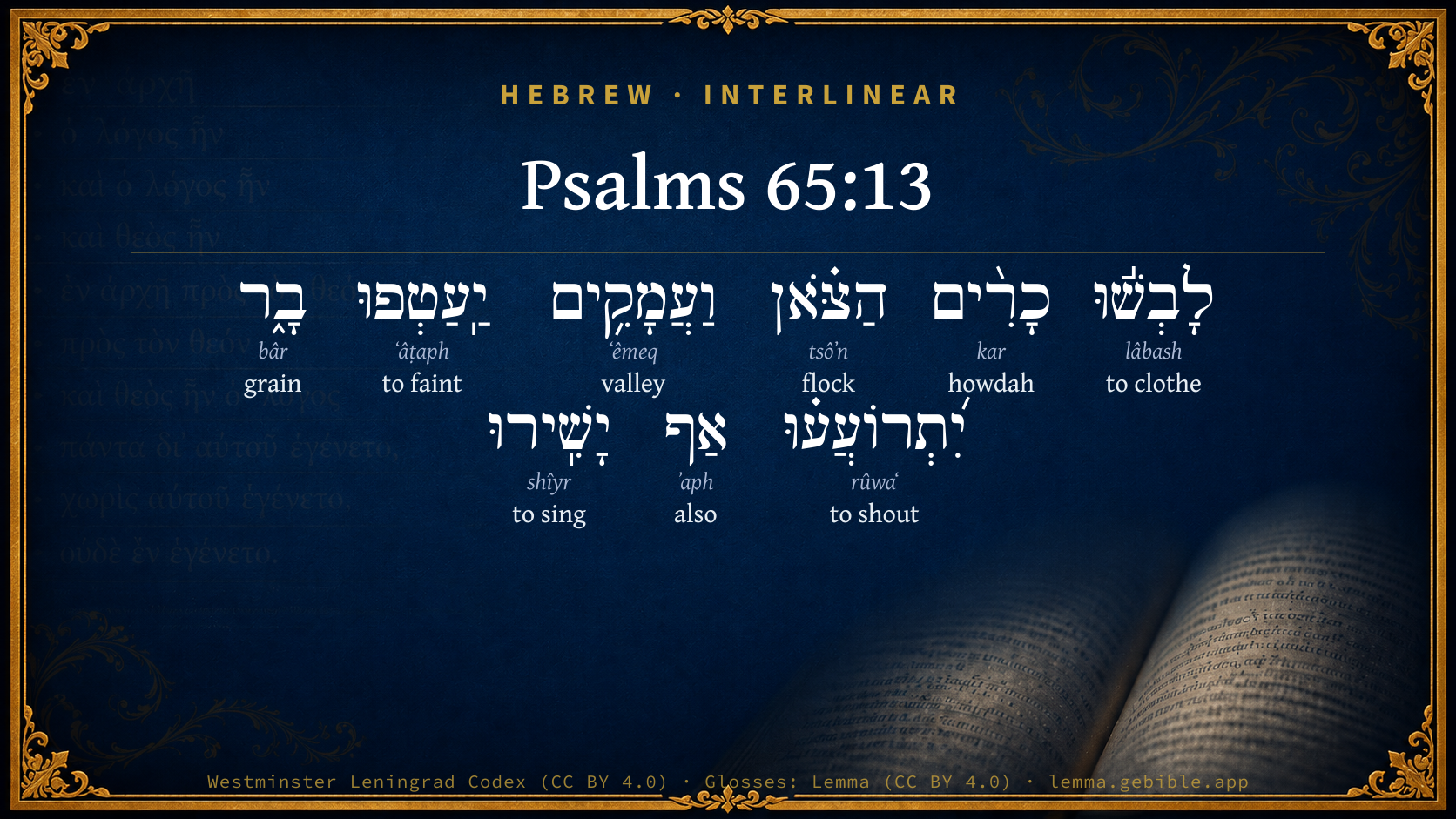
Hebrew (Westminster Leningrad Codex) Psalms 65:13 appears in the Hebrew Old Testament. The text above is from the Westminster Leningrad Codex. Each word links to its Strong’s number, a concise gloss, and parsing drawn from the Open Scriptures Hebrew Bible morphology. Click any word for its full Brown-Driver-Briggs (BDB) entry.
Download image
Cite this verse

Psalms 65:13 (World English Bible). Public Domain. Lemma interlinear Bible study tool, https://lemma.gebible.app/v/psalms/65/13.

Show BibTeX & RIS
BibTeX
RIS
English Translation
The pastures are covered with flocks. The valleys also are clothed with grain. They shout for joy! They also sing.
World English Bible · Public Domain
Download a study sheet

One document with this verse’s original text, its word-by-word gloss line, the meaning frame, cross-references with their text, attributed commentary, and full source and license credits — printable, and it pastes into notes with its structure intact.

This verse Autodidact and up

Study sheet (.html) Plain text (.txt)

A passage Seminary Student

Up to 50 verses in one chapter. A passage sheet keeps up to 6 commentary sources and 12 cross-references per verse, in the order this page ranks them, and says so on the sheet whenever that leaves anything out. Ask for a single verse and you get the Autodidact verse sheet above.

Everything on this page stays free to read, with no account — the sheet is a download of what is already on screen, not access to it.

Want to remove ads? Support Godless Engineer
Compare translations 3

The same verse in 3 English versions, stacked beneath the original-language interlinear above. Click any original word for its lexicon entry.

Each is an independent rendering of the whole verse — the interlinear is not word-aligned to these translations.

Highlighted words mark where these versions differ — a whole-verse word diff, not a word-by-word alignment.

  • World English Bible Public Domain
    The pastures are covered with flocks. The valleys also are clothed with grain. They shout for joy! They also sing.
  • King James Version Public Domain
    The pastures are clothed with flocks; the valleys also are covered over with corn; they shout for joy, they also sing.
  • unfoldingWord Literal Text CC BY-SA 4.0
    The meadows put on a flock, and the valleys cover grain. They shout joyfully; indeed, they sing.

unfoldingWord Literal Text — © unfoldingWord, licensed CC BY-SA 4.0. Word-aligned USFM3 via Door43 (git.door43.org/unfoldingWord/en_ult).

Versions to compare (up to 4)

3 of 4 selected

Show all 18 translations

Every available English version of this verse, each an independent rendering of the whole verse.

  • World English Bible Public Domain
    The pastures are covered with flocks. The valleys also are clothed with grain. They shout for joy! They also sing.
  • Berean Standard Bible Public Domain
    The pastures are clothed with flocks, and the valleys are decked with grain. They shout in triumph; indeed, they sing.
  • Majority Standard Bible Public Domain
    The pastures are clothed with flocks, and the valleys are decked with grain. They shout in triumph; indeed, they sing.
  • King James Version Public Domain
    The pastures are clothed with flocks; the valleys also are covered over with corn; they shout for joy, they also sing.
  • American Standard Version (1901) Public Domain
    The pastures are clothed with flocks; The valleys also are covered over with grain; They shout for joy, they also sing. Psalm 66 For the Chief Musician. A song, a Psalm.
  • Revised Version (1885) Public Domain
    The pastures are clothed with flocks; the valleys also are covered over with corn; they shout for joy, they also sing.
  • Geneva Bible (1599) Public Domain
    The pastures are clad with sheepe: the valleis also shalbe couered with corne: therefore they shoute for ioye, and sing.
  • Douay-Rheims (1899) Public Domain
    The beautiful places of the wilderness shall grow fat: and the hills shall be girded about with joy,
  • Young's Literal Translation Public Domain
    Clothed have lambs the flock, And valleys are covered with corn, They shout -- yea, they sing!
  • Literal Standard Version CC BY-SA 4.0
    The meadows are clothed with the flock, || And valleys are covered with grain, || They shout—indeed, they sing!
  • Unlocked Literal Bible CC BY-SA 4.0
    The pastures are clothed with flocks; the valleys also are covered over with grain; they shout for joy, and they sing.
  • unfoldingWord Literal Text CC BY-SA 4.0
    The meadows put on a flock, and the valleys cover grain. They shout joyfully; indeed, they sing.
  • Darby Bible Public Domain
    The meadows are clothed with flocks, and the valleys are covered over with corn; they shout for joy, yea, they sing.
  • World Messianic Bible Public Domain
    The pastures are covered with flocks. The valleys also are clothed with grain. They shout for joy! They also sing.
  • Webster's Bible Public Domain
    \\65:12\\They drop upon the pastures of the wilderness: and the little hills rejoice on every side.
  • Free Bible Version CC BY-SA 4.0
    The meadows are covered with flocks of sheep, and the valleys with fields of grain. Everything triumphantly sings for joy.
  • Bible in Basic English Public Domain
    The grass-land is thick with flocks; the valleys are full of grain; they give glad cries and songs of joy.
  • JPS Tanakh (1917) Public Domain
    (65-14) The meadows are clothed with flocks; the valleys also are covered over with corn; they shout for joy, yea, they sing.

Literal Standard Version (2020), Covenant Press — licensed CC BY-SA 4.0. Text via the HelloAO Bible API (eBible.org). Unlocked Literal Bible (unfoldingWord) — licensed CC BY-SA 4.0. Text via the HelloAO Bible API (eBible.org). unfoldingWord Literal Text — © unfoldingWord, licensed CC BY-SA 4.0. Word-aligned USFM3 via Door43 (git.door43.org/unfoldingWord/en_ult). Free Bible Version, Dr. Jonathan Gallagher — licensed CC BY-SA 4.0. Text via the HelloAO Bible API (eBible.org).

Word by word

More ways to search: Search by grammar → Find every occurrence → Compare this word →

Practice this passage: Drill this verse → Learn its vocabulary →

About this verse

These counts appear in no published source. They are computed here, from the morphology-tagged text and Lemma’s own curated glosses. What Lemma adds →

9
words
9
distinct lemmas
Wisdom
section

Notable vocabulary

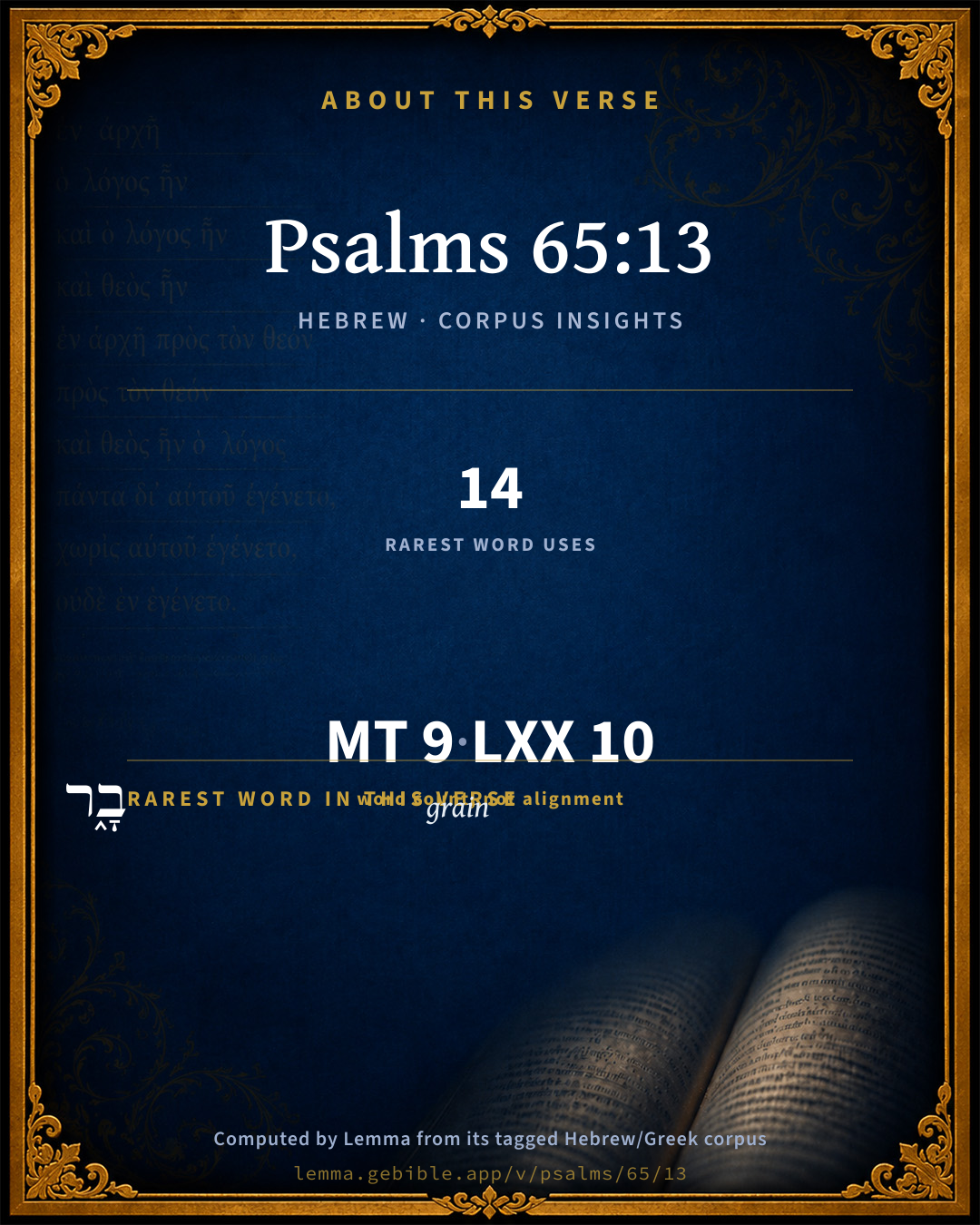
The rarest word here is בָ֑ר grain H1250 — appearing just 14 times in the whole Hebrew Bible.

Shared distinctive vocabulary

בָ֑ר grain H1250 occurs in 14 verses of the Hebrew Bible. Also found in:

Grammatical profile

  • 4 verbs
  • 4 nouns
  • 1 particle

Verb forms

  • לָבְשׁ֬וּ Qal · Perfect
  • יַֽעַטְפוּ Qal · Imperfect
  • יִ֝תְרוֹעֲע֗וּ Hithpolel · Imperfect
  • יָשִֽׁירוּ Qal · Imperfect

Hebrew & Septuagint length

In English translation the verse runs 20 words from the Hebrew and 25 from the Septuagint (LXX English) — closely comparable.

A rough comparison of the two English renderings, which tokenize alike — not a word-level alignment.

Word counts can differ between the Hebrew and the Greek without any difference in meaning — e.g. the Hebrew direct-object marker אֵת has no separate Greek word, and Greek often adds the article ὁ.

In the original languages it is 9 Hebrew tokens and 10 Greek tokens — but the two are counted differently (Hebrew bundles its prefixes and suffixes into one token; the Greek is in lemma form), so that isn’t a like-for-like length.

Cross-references

14

Topical passages linked to Psalms 65:13 in the Treasury of Scripture Knowledge — connected by theme and wording, ordered by reader-vote popularity; previews shown in the World English Bible.

  • Isaiah 55:12 For you shall go out with joy, and be led forth with peace: the mountains and the hills shall break forth before you into singing; and all the trees of the fields shall clap their hands.
  • Isaiah 35:1–2 The wilderness and the dry land shall be glad; and the desert shall rejoice, and blossom as the rose.
  • Isaiah 30:23 He will give the rain for your seed, with which you shall sow the ground; and bread of the increase of the ground, and it shall be fat and plenteous. In that day shall your cattle feed in large pastures;
  • Acts 14:17 Yet he didn't leave himself without witness, in that he did good and gave you rains from the sky and fruitful seasons, filling our hearts with food and gladness."
  • Psalms 96:11–13 Let the heavens be glad, and let the earth rejoice. Let the sea roar, and it's fullness!
  • Psalms 98:7–9 Let the sea roar with its fullness; The world, and those who dwell therein.
  • Isaiah 44:23 Sing, you heavens, for Yahweh has done it; shout, you lower parts of the earth; break forth into singing, you mountains, O forest, and every tree therein: for Yahweh has redeemed Jacob, and will glorify himself in Israel.
  • Psalms 72:16 There shall be abundance of grain throughout the land. Its fruit sways like Lebanon. Let it flourish, thriving like the grass of the field.
  • Psalms 104:24–28 Yahweh, how many are your works! In wisdom have you made them all. The earth is full of your riches.
  • Psalms 144:13 Our barns are full, filled with all kinds of provision. Our sheep bring forth thousands and ten thousands in our fields.
  • Isaiah 35:10 and the ransomed of Yahweh shall return, and come with singing to Zion; and everlasting joy shall be on their heads: they shall obtain gladness and joy, and sorrow and sighing shall flee away.
  • Isaiah 52:9 Break forth into joy, sing together, you waste places of Jerusalem; for Yahweh has comforted his people, he has redeemed Jerusalem.
  • Jeremiah 48:33 Gladness and joy is taken away from the fruitful field and from the land of Moab; and I have caused wine to cease from the wine presses: none shall tread with shouting; the shouting shall be no shouting.
  • Zechariah 9:17 For how great is his goodness, And how great is his beauty! Grain will make the young men flourish, And new wine the virgins.

Cross-references courtesy of OpenBible.info (CC BY 4.0).

Hebrew and Greek witnesses Masoretic Hebrew ↔ Greek Septuagint

The same verse in the two great witnesses to the Old Testament, shown verse-for-verse.

You’re reading Greek Psalm 64 (Hebrew Psalm 65). The Septuagint counts the superscription, so verse numbers can differ from the Hebrew — chapter-level alignment, not verse-by-verse. Numbering follows Rahlfs.

These are two independent witnesses, not word-aligned to each other, and the Septuagint is shown in lemma (dictionary) form.

Hebrew Psalms 65:13 Masoretic · Westminster Leningrad Codex

לָבְשׁ֬וּ כָרִ֨ים הַצֹּ֗אן וַעֲמָקִ֥ים יַֽעַטְפוּ בָ֑ר יִ֝תְרוֹעֲע֗וּ אַף יָשִֽׁירוּ

The pastures are covered with flocks. The valleys also are clothed with grain. They shout for joy! They also sing.

World English Bible · Public Domain

Greek LXX Greek Psalm 64:13 Septuagint · lemma form

πιαίνω ὁ ὡραῖος ὁ ἔρημος καί ἀγαλλίασις ὁ βουνός περιζώννυμι

The rams of the flock are clothed with wool, and the valleys shall abound in corn; they shall cry aloud, yes they shall sing hymns.

LXX2012 (modern English Septuagint) · Public Domain

On this verse, John Gill's Exposition discusses the Septuagint’s reading. Read the note in Commentary ↓

Hebrew: Westminster Leningrad Codex (CC BY 4.0). Greek: Septuagint (public domain); English from LXX2012 (modern English Septuagint) (Public Domain). How the Septuagint differs from the Hebrew →

Commentary

Notes on Psalms 65:13 from classic Christian and Jewish commentators (each source and its license shown beneath its notes). The classic Christian expositions comment on the surrounding passage and are grouped to its opening verse, so a note may address several verses; the Jewish commentaries on the Tanakh (Rashi and others) are per-verse, so they appear only where the commentator wrote on this verse.

Lemma curates 59 commentaries, every one of them public domain or Creative Commons licensed, each selected and text-cleaned for this edition rather than reprinted as found. About our sources →

Trapp's Complete Commentary

John Trapp

Psa 65:13 The pastures are clothed with flocks; the valleys also are covered over with corn; they shout for joy, they also sing.

Ver. 13. The pastures, &c.] Here is stately rhetoric all along.

John Trapp, A Commentary or Exposition upon All the Books of the Old and New Testament (1647–1656) — public domain. Text from a community e-Sword module.

Joseph Benson's Commentary

Psa 65:13. The pastures — Which were bare before; are clothed with flocks — As they are with grass. They are so well stocked that they seem covered over with sheep and cattle, feeding or resting in them; the valleys also are covered with corn — So that the face of the earth cannot be seen for the abundance of it. He mentions valleys, or low grounds, as being generally most fruitful, but does not intend to exclude other places. Such are some of the good effects of these refreshing, fertilizing rains. They shout for joy: they also sing — They are abundantly satisfied with thy goodness, and, in their manner, sing forth the praises, and declare the goodness of their great Creator and Benefactor.

Joseph Benson's Commentary on the Old and New Testaments (1811–1818) — public domain. Text from a community e-Sword module.

Tyndale Open Study Notes

Tyndale Open Resources

65:13 Nature bursts out in praise of the Creator (see 79:13; 96:11-13; 148:3-5, 7-12; Isa 55:12-13).

Tyndale Open Study Notes — © Tyndale Open Resources, licensed CC BY-SA 4.0. Text via the HelloAO Bible API.

Geneva Bible (1599)

Geneva Bible translators

That is, the dumb creatures shall not only rejoice for a time for God’s benefits, but shall continually sing.

Geneva Bible (1599) marginal notes — public domain. Text via Bolls.life.

Adam Clarke's Commentary

Verse 13. The pastures are clothed with flocks] Cattle are seen in every plain, avenue, and vista, feeding abundantly; and the valleys are clothed, and wave with the richest harvests; and transports of joy are heard every where in the cheerful songs of the peasantry, the singing of the birds, the neighing of the horse, the lowing of the ox, and the bleating of the sheep. Claudian uses the same image: -

Viridis amictus montium.

"The green vesture of the mountains."

Shout for joy, they also sing.] They are not loud and unmeaning sounds, they are both music and harmony in their different notes; all together form one great concert, and the bounty of God is the subject which they all celebrate. What an inimitable description! And yet the nervous Hebrew is not half expressed, even by the amended translation and paraphrase above.

ANALYSIS OF THE SIXTY-FIFTH PSALM

This is wholly a poem of thanksgiving; and teaches us how, and for what, we are to praise God. 1. For spiritual; 2. For temporal blessings; and, 3. This publicly; in Zion - in his Church.

It has two general parts: -

I. Praise to God for his blessings to his followers, Ps 65:1-5.

II. His common benefits to all mankind, Ps 65:6-13.

I. He sets forth God's grace to his followers of which he reckons several particulars: -

1. He has established a public ministry among them, and an atoning sacrifice.

2. He directs and hears their prayers; and to him by sacrifice, prayer, and praise, may all human beings come.

3. Though evil tongues may prevail against them for a time, yet he will deliver them.

4. The transgressions committed against him he will accept an atonement for, and pardon, Ps 65:1-4. See the notes.

5. All that truly worship him in his ordinances shall be made partakers of spiritual blessedness: "We shall be satisfied with the goodness of thy house," Ps 65:4.

6. He works powerfully and terribly, but righteously, in behalf of his followers, against their enemies: "By terrible things in righteousness," Ps 65:5. 1. He answers them when they call. 2. By terrible things, - as in Egypt, the wilderness, c. 3. And the motive to it is, his justice or righteousness, by which he punishes his enemies, and gives retribution to his people.

All this he concludes with a double eulogy of God:

1. Showing what he is peculiarly to his people: "O God of our salvation."

2. What he is to ALL "the confidence of all the ends of the earth," for he sustains all, be they where they may.

II. He descends from his peculiar providence, - the care he takes of, and the benefits he bestows on, his Church, - to his general providence, his ordering and sustaining the whole world; which he amplifies: -

1. "By his strength he setteth fast the mountains," c., which is true literally: but, tropologically, it may mean kingdoms and states.

2. He stilleth the noise of the sea, - and of the waves, - for to them he sets bounds: "And the tumult of the people." He stills devils, tyrants, armies, seditions, &c.

3. He does this so, that even those who are in the uttermost parts of the sea are afraid at his tokens. They see from the phenomena of nature how powerful and fearful God is.

4. The sun, moon, planets, and stars are under his guidance. Day and night are ordered by him: "Thou makest the outgoings of the morning and evening to rejoice."

5. The earth and its inhabitants are his peculiar care: "Thou visitest the earth," &c., Ps 65:9-11.

In all which the prophet shoves God's mercy, 1. In the rain. 2. In the rivers. 3. In the growing of the corn. 4. In providing grass for cattle. 5. In providing store in the summer and autumn. 6. His clouds drop fatness upon the earth, and all nature rejoices. The meaning of all is, Man may plough, sow, dig, manure, prune, watch, fence, &c. but it is God that gives the increase.

For an account of the imagery here employed, see the notes. The Psalm is grand beyond description, and can never be sufficiently admired.

Adam Clarke's Commentary on the Bible (1810–1826) — public domain. Text from a community e-Sword/MySword module.

The Cambridge Bible for Schools and Colleges

gen. ed. J. J. S. Perowne

13. The meadows are clothed with sheep;

And the vales are decked with wheat;

They shout for joy, yea sing.

With the last line cp. Isa_55:12. The vales (Heb. ‘çmek) denote “the long broad sweeps sometimes found between parallel ranges of hills” (Sinai and Pal., p. 481) which were the natural cornfields of Palestine (1Sa_6:13). The graphic touch of the Heb., which represents the pastures and vales as shouting one to another, can hardly be preserved in translation.

The Cambridge Bible for Schools and Colleges (gen. ed. J. J. S. Perowne; Cambridge University Press, 1878–1918) — public domain. Text from a community e-Sword module.

John Gill's Exposition

The pastures are clothed with flocks,.... Of sheep, which are so thick, that there is scarce anything to be seen upon the pastures but them; which look as if they were clothed with them: these may intend the multitude of converts, signified by the flocks of Kedar, and rams of Nebaioth; which gathering about the church, and joining to her, she clothes herself with them as with an ornament, Isa 60:7 it may be rendered the "rams clothe", or "cover, the flocks" (s); or the flocks are clothed, or covered, with the rams, as expressive of their copulation with them; and so the Targum,

"the rams ascend upon the flocks;''

which sense is favoured by the Septuagint, Vulgate Latin, Ethiopic, and Arabic versions;

the valleys also are covered over with corn; being made very fruitful with the rain, and bringing forth in great abundance; so humble souls are the most fruitful ones;

they shout for joy, they also sing; that is, the pastures, hills, and valleys, being laden with all kind of fruit for the use of man and beast, for necessity and pleasure, which occasion joy to the inhabitants of the earth: this may be expressive of the joy that will be among men, when the interest of Christ will be in a more flourishing condition in the latter day; see Isa 49:13.

(s) Sept. "arietes", V. L.

Next: Psalms Chapter 66

John Gill's Exposition of the Whole Bible (1746–1763) — public domain (CC PDM 1.0). Text via the HelloAO Bible API.

Albert Barnes' Notes on the Bible

The pastures are clothed with flocks - The flocks stand so thick together, and are spread so far, that they seem to be a clothing for the pasture; or, the fields are entirely covered with them.

The valleys also are covered over with corn - With grain. That is, the parts of the land - the fertile valleys - which are devoted to tillage. They are covered over, or clothed with waving grain, as the pasture-fields are with flocks.

They shout for joy, they also sing - They seem to be full of joy and happiness. What a beautiful image is this! How well does it express the loveliness of nature; how appropriately does it describe the goodness of God! Everything seems to be happy; to be full of song; and all this is to be traced to the goodness of God, as it all serves to express that goodness. Strange that there should be an atheist in such a world as this; - strange that there should be an unhappy man; - strange that amidst such beauties, while all nature joins in rejoicing and praise - pastures, cultivated fields, valleys, hills - there can be found a human being who, instead of uniting in the language of joy, makes himself miserable by attempting to cherish the feeling that God is not good!

Albert Barnes' Notes on the Bible (1834–1885) — public domain. Text from a community e-Sword/MySword module.

Matthew Poole's English Annotations

This is added as the effect of these comfortable rains, that they fill the pastures with grass for cattle, and the valleys (which he mentions as the most fruitful places, though he doth not exclude the rest) with corn for the use of man.

They shout for joy, they also sing, i.e. they are abundantly satisfied with thy goodness, and in their manner sing forth the praises and declare the goodness of their Creator and Benefactor. Compare Psa 147:8. Such passions or actions as these are oft figuratively ascribed to lifeless creatures, both in sacred and profane poetical writings; which are said to rejoice or mourn, &c, when their condition is such as calls for rejoicing or mourning, and would cause them to do so, if they were capable of such actions

Matthew Poole's English Annotations on the Holy Bible (1683–1685) — public domain. Text from a community e-Sword/MySword module.

The Treasury of David

Charles H. Spurgeon

Ver. 13. The pastures are clothed with flocks. The clothing of man first clothes the fields. Pastures appear to be quite covered with numerous flocks when the grass is abundant.

The valleys also are covered over with corn. The arable as well as the pasture land is rendered fruitful. God's clouds, like ravens, bring us both bread and flesh. Grazing flocks and waving crops are equally the gifts of the Preserver of men, and for both praise should be rendered. Sheep shearing and harvest should both be holiness unto the Lord.

They shout for joy. The bounty of God makes the earth vocal with his praise, and in opened ears it lifts up a joyous shout. The cattle low out the divine praises, and the rustling ears of grain sing a soft sweet melody unto the Lord.

"Ye forests bend, ye harvests wave to him;

Breathe your still song into the reaper's heart,

As home he goes beneath the joyous moon.

Bleat out afresh, ye hills; ye mossy rocks

Retain the sound; the broad responsive low

Ye valleys raise; for the GREAT SHEPHERD reigns,

And his unsuffering kingdom yet will come."

They also sing. The voice of nature is articulate to God; it is not only a shout, but a song. Well ordered are the sounds of animate creation as they combine with the equally well tuned ripple of the waters, and sighings of the wind. Nature has no discords. Her airs are melodious, her chorus is full of harmony. All, all is for the Lord; the world is a hymn to the Eternal, blessed is he who, hearing, joins in it, and makes one singer in the mighty chorus.

Ver. 13. The phrase, the pastures are clothed with flocks, cannot be regarded as the vulgar language of poetry. It appears peculiarly beautiful and appropriate, when we consider the numerous flocks which whitened the plains of Syria and Canaan. In the eastern countries, sheep are much more prolific than with us, and they derive their name from their great fruitfulness; bringing forth, as they are said to do, "thousands and ten thousands in their streets, " Ps 144:13. They, therefore, formed no mean part of the wealth of the East. James Anderson, in editorial Note to Calvin in loc.

Ver. 13. The hills, where not tilled, were bushy and green, and sprinkled with numerous flocks; the valleys broad and covered with a rich crop of wheat; the fields full of reapers and gleaners in the midst of the harvest, with asses and camels receiving their loads of sheaves, and feeding unmuzzled and undisturbed upon the ripe grain. Edward Robinson.

Ver. 13. It may seem strange, that he should first tell us, that they shout for joy, and then add the feebler expression, that they sing; interposing, too, the insensitive particle, pa, aph, they shout for joy, YEA, they also sing. The verb, however, admits of being taken in the future tense, they shall sing; and this denotes a continuation of joy, that they would rejoice, not only one year, but through the endless succession of the seasons. I may add, what is well known, that in Hebrew the order of expression is frequently inverted in this way. John Calvin.

Ver. 13. They also sing. They ardently sing: such is the real meaning of pa; primarily "heat" or "warmth, "thence "ardour, passion, anger, "and thence again "the nostrils, "as the supposed seat of this feeling. John Mason Good.

Ver. 13. The song of nature and the ear which hears it.

Charles H. Spurgeon's The Treasury of David (1869–1885) — public domain. Psalms only. Text from a community e-Sword/MySword module.

Whedon's Commentary on the Bible

Daniel D. Whedon

13. Pastures—The word properly means sheep, young sheep: but in Isa_30:23 it must take the sense of pasture. So here the connexion imposes the same sense, only the idea is sheepwalk. The sheepwalk shall be clothed with sheep. The mountains and uplands of Palestine begin to appear brown and barren as early as June, for want of moisture.

The valleys—Contrasted with the upland downs or sheepwalks. As the latter are clothed with sheep, so are these with corn—all kinds of edible grain. And in this richness of divine blessing animals and inanimate nature shout for joy, yea, they also will sing.

Daniel D. Whedon (gen. ed.), Commentary on the Old and New Testaments (1874–1909) — public domain. Text from a community e-Sword module.

The Pulpit Commentary

The pastures are clothed with flocks; or, with their flocks; i.e. the flocks befitting them. The valleys also are covered over with corn. The great open sweeps between the ranges of hills are completely covered over with grain crops, wheat, barley, millet; and the result is that they seem to shout for joy, they also sing. This is better than the rendering of Ewald and Delitzsch, "Man shouts for joy; he sings." All the poets personify Nature, and make her sympathize with human kind. (comp. Isa_14:8 Isa_35:1 Isa_55:12; Virg., "Eclog.," 5:62; "Georg.," 4:461)

The Pulpit Commentary (1880–1919), ed. H.D.M. Spence-Jones & Joseph S. Exell — public domain. Text from a community e-Sword module.

John Wesley's Explanatory Notes

Sing - They are abundantly satisfied with thy goodness, and in their manner sing forth the praise of their benefactor.

John Wesley, Explanatory Notes Upon the Whole Bible (1754–1765) — public domain. Text via the GEBible commentary corpus.

unfoldingWord translationNotes

Door43 World Missions Community

The pastures are clothed with flocks

The writer speaks of the pastures as being so covered with flocks that it is like the pastures are wearing a garment.

pastures

a large field where animals feed on the grass

flocks

group of animals, such as sheep and goats

they shout for joy, and they sing

The pastures, hills and valleys are so bountiful, that they seem to shout and sing for joy. AT: "they are like joyful singing people" (See: Personification)

they shout

The word "they" refers to the pastures and valleys.

translationWords

clothe

unfoldingWord translationNotes — © Distant Shores Media and the Door43 World Missions Community, licensed CC BY-SA 4.0. Source: git.door43.org/Door43/en_tn.

Rashi

Rabbi Shlomo Yitzchaki (Rashi)

They drip The heavens [drip] upon the dwellings of the desert.

Rashi on the Tanakh — English translations: “The Judaica Press complete Tanach with Rashi, translated by A. J. Rosenberg” (CC BY 4.0); “Pentateuch with Rashi's commentary by M. Rosenbaum and A.M. Silbermann, 1929-1934” (public domain); “The Metsudah Tanach series, Lakewood, N.J” (CC BY 4.0); and “The Book of Joshua, Metsudah Publications, 1997” (CC BY 4.0). Text via Sefaria.

Lesson kit

Teaching starters — assembled from the data on this page, not authored interpretation. Every prompt links to the verse data it draws on. Edit before teaching.

Psalms, in the Wisdom, opens this verse with 9 words (9 distinct Hebrew lemmas). Its most distinctive word is bâr (“grain”). A historical commentator’s framing appears above. Read the whole chapter for the surrounding context.

Discussion questions

  1. What does “grain” (bâr) contribute to the verse as a whole?
  2. How does Genesis 41:35, which shares the word «grain», read alongside this verse?
  3. These translations render this verse differently; the difference is in the English rendering, not the original. What questions does that raise?
  4. «לָבְשׁ֬וּ» is a Qal Perfect verb. How does that grammatical form shape the action described?
  5. Compare how Trapp's Complete Commentary and Joseph Benson's Commentary read this verse. Where do they agree or differ?

Things to notice

Reading settings

Reading text

Shown beneath each verse's original-language words.

Old Testament
Old Testament edition

Read the OT as the Masoretic Hebrew (MT) or the Greek Septuagint (LXX).

English shown for the Greek Septuagint (in the Hebrew ↔ Greek comparison).

Comparing translations? Open the Compare panel on any verse page to stack up to four side by side.