Psalms 100:3

Hebrew (Westminster Leningrad Codex) Psalms 100:3 appears in the Hebrew Old Testament. The text above is from the Westminster Leningrad Codex. Each word links to its Strong’s number, a concise gloss, and parsing drawn from the Open Scriptures Hebrew Bible morphology. Click any word for its full Brown-Driver-Briggs (BDB) entry.
Download image
Cite this verse

Psalms 100:3 (World English Bible). Public Domain. Lemma interlinear Bible study tool, https://lemma.gebible.app/v/psalms/100/3.

Show BibTeX & RIS
BibTeX
RIS
English Translation
Know that Yahweh, he is God. It is he who has made us, and we are his. We are his people, and the sheep of his pasture.
World English Bible · Public Domain
Download a study sheet

One document with this verse’s original text, its word-by-word gloss line, the meaning frame, cross-references with their text, attributed commentary, and full source and license credits — printable, and it pastes into notes with its structure intact.

This verse Autodidact and up

Study sheet (.html) Plain text (.txt)

A passage Seminary Student

Up to 50 verses in one chapter. A passage sheet keeps up to 6 commentary sources and 12 cross-references per verse, in the order this page ranks them, and says so on the sheet whenever that leaves anything out. Ask for a single verse and you get the Autodidact verse sheet above.

Everything on this page stays free to read, with no account — the sheet is a download of what is already on screen, not access to it.

Want to remove ads? Support Godless Engineer
Compare translations 3

The same verse in 3 English versions, stacked beneath the original-language interlinear above. Click any original word for its lexicon entry.

Each is an independent rendering of the whole verse — the interlinear is not word-aligned to these translations.

Highlighted words mark where these versions differ — a whole-verse word diff, not a word-by-word alignment.

  • World English Bible Public Domain
    Know that Yahweh, he is God. It is he who has made us, and we are his. We are his people, and the sheep of his pasture.
  • King James Version Public Domain
    Know ye that the LORD he is God: it is he that hath made us, and not we ourselves; we are his people, and the sheep of his pasture.
  • unfoldingWord Literal Text CC BY-SA 4.0
    Know that Yahweh, he God; he, he made us, and not we, his people and the sheep of his pasture.

unfoldingWord Literal Text — © unfoldingWord, licensed CC BY-SA 4.0. Word-aligned USFM3 via Door43 (git.door43.org/unfoldingWord/en_ult).

Versions to compare (up to 4)

3 of 4 selected

Show all 18 translations

Every available English version of this verse, each an independent rendering of the whole verse.

  • World English Bible Public Domain
    Know that Yahweh, he is God. It is he who has made us, and we are his. We are his people, and the sheep of his pasture.
  • Berean Standard Bible Public Domain
    Know that the LORD is God. It is He who made us, and we are His; we are His people, and the sheep of His pasture.
  • Majority Standard Bible Public Domain
    Know that the LORD is God. It is He who made us, and we are His; we are His people, and the sheep of His pasture.
  • King James Version Public Domain
    Know ye that the LORD he is God: it is he that hath made us, and not we ourselves; we are his people, and the sheep of his pasture.
  • American Standard Version (1901) Public Domain
    Know ye that Jehovah, he is God: It is he that hath made us, and we are his; We are his people, and the sheep of his pasture.
  • Revised Version (1885) Public Domain
    Know ye that the LORD he is God: it is he that hath made us, and we are his; we are his people, and the sheep of his pasture.
  • Geneva Bible (1599) Public Domain
    Knowe ye that euen the Lord is God: hee hath made vs, and not we our selues: we are his people, and the sheepe of his pasture.
  • Douay-Rheims (1899) Public Domain
    Know ye that the Lord he is God: he made us, and not we ourselves. We are his people and the sheep of his pasture.
  • Young's Literal Translation Public Domain
    Know that Jehovah He `is' God, He made us, and we are His, His people -- and the flock of His pasture.
  • Literal Standard Version CC BY-SA 4.0
    Know that YHWH [is] God, || He made us, and we are His, || His people—and the flock of His pasture.
  • Unlocked Literal Bible CC BY-SA 4.0
    Know that Yahweh is God; he made us, and we are his. We are his people and the sheep of his pasture.
  • unfoldingWord Literal Text CC BY-SA 4.0
    Know that Yahweh, he God; he, he made us, and not we, his people and the sheep of his pasture.
  • Darby Bible Public Domain
    Know that Jehovah is God: it is he that hath made us, and not we ourselves; [we are] his people, and the sheep of his pasture.
  • World Messianic Bible Public Domain
    Know that the LORD, he is God. It is he who has made us, and we are his. We are his people, and the sheep of his pasture.
  • Webster's Bible Public Domain
    Know ye that the LORD he is God: it is he that hath made us, and not we ourselves; we are his people, and the sheep of his pasture.
  • Free Bible Version CC BY-SA 4.0
    Know that the Lord is God! He made us, so we belong to him. We are his people, the flock he cares for.
  • Bible in Basic English Public Domain
    Be certain that the Lord is God; it is he who has made us, and we are his; we are his people, and the sheep to whom he gives food.
  • JPS Tanakh (1917) Public Domain
    Know ye that the LORD He is God; it is He that hath made us, and we our His, His people, and the flock of His pasture.

Literal Standard Version (2020), Covenant Press — licensed CC BY-SA 4.0. Text via the HelloAO Bible API (eBible.org). Unlocked Literal Bible (unfoldingWord) — licensed CC BY-SA 4.0. Text via the HelloAO Bible API (eBible.org). unfoldingWord Literal Text — © unfoldingWord, licensed CC BY-SA 4.0. Word-aligned USFM3 via Door43 (git.door43.org/unfoldingWord/en_ult). Free Bible Version, Dr. Jonathan Gallagher — licensed CC BY-SA 4.0. Text via the HelloAO Bible API (eBible.org).

Word by word

More ways to search: Search by grammar → Find every occurrence → Compare this word →

Practice this passage: Drill this verse → Learn its vocabulary →

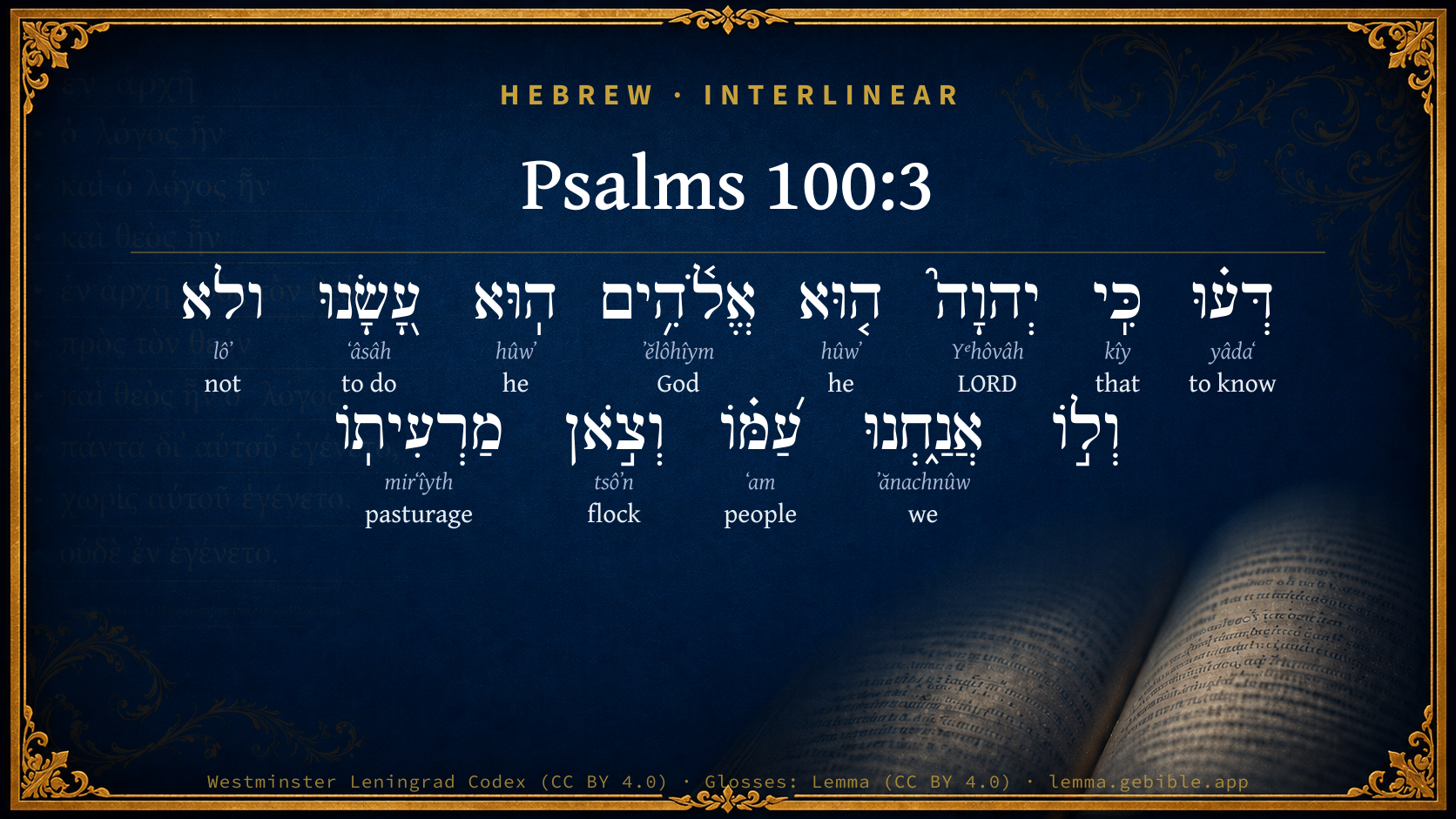
מַרְעִיתֽוֹ
mirʻîyth
H4830
“pasturage · his”
Noun, Common, Feminine, Singular, Construct + Suffix, Personal, 3rd Person, Masculine, Singular
Part of Speech
Noun
Type
Common
Gender
Feminine
Number
Singular
State
Construct
Full BDB Definition

Origin: from H7462 in the sense of feeding

TWOT: 2185c

pasturing, pasturage, shepherding - pasturing, shepherding - pasturage - flock (metonymy)
  1. דְּע֗וּ yâdaʻ H3045 “know” Verb, Qal, Imperative, 2nd Person, Masculine, Plural
  2. כִּֽי kîy H3588 “that” Conjunction
  3. יְהוָה֮ Yᵉhôvâh H3068 “LORD” Noun, Proper
  4. ה֤וּא hûwʼ H1931 “he” Pronoun, Personal, 3rd Person, Masculine, Singular
  5. אֱלֹ֫הִ֥ים ʼĕlôhîym H430 “God(s)” Noun, Common, Masculine, Plural, Absolute
  6. הֽוּא hûwʼ H1931 “he” Pronoun, Personal, 3rd Person, Masculine, Singular
  7. עָ֭שָׂנוּ ʻâsâh H6213 “to do · us” Verb, Qal, Perfect, 3rd Person, Masculine, Singular + Suffix, Personal, 1st Person, Common, Plural
  8. ולא lôʼ H3808 “and · not” Conjunction + Particle, Negative
  9. אֲנַ֑חְנוּ ʼănachnûw H587 “we” Pronoun, Personal, 1st Person, Common, Plural
  10. עַ֝מּ֗וֹ ʻam H5971 “people · his” Noun, Common, Masculine, Singular, Construct + Suffix, Personal, 3rd Person, Masculine, Singular
  11. וְצֹ֣אן tsôʼn H6629 “and · flock of” Conjunction + Noun, Common, Both, Singular, Construct

About this verse

These counts appear in no published source. They are computed here, from the morphology-tagged text and Lemma’s own curated glosses. What Lemma adds →

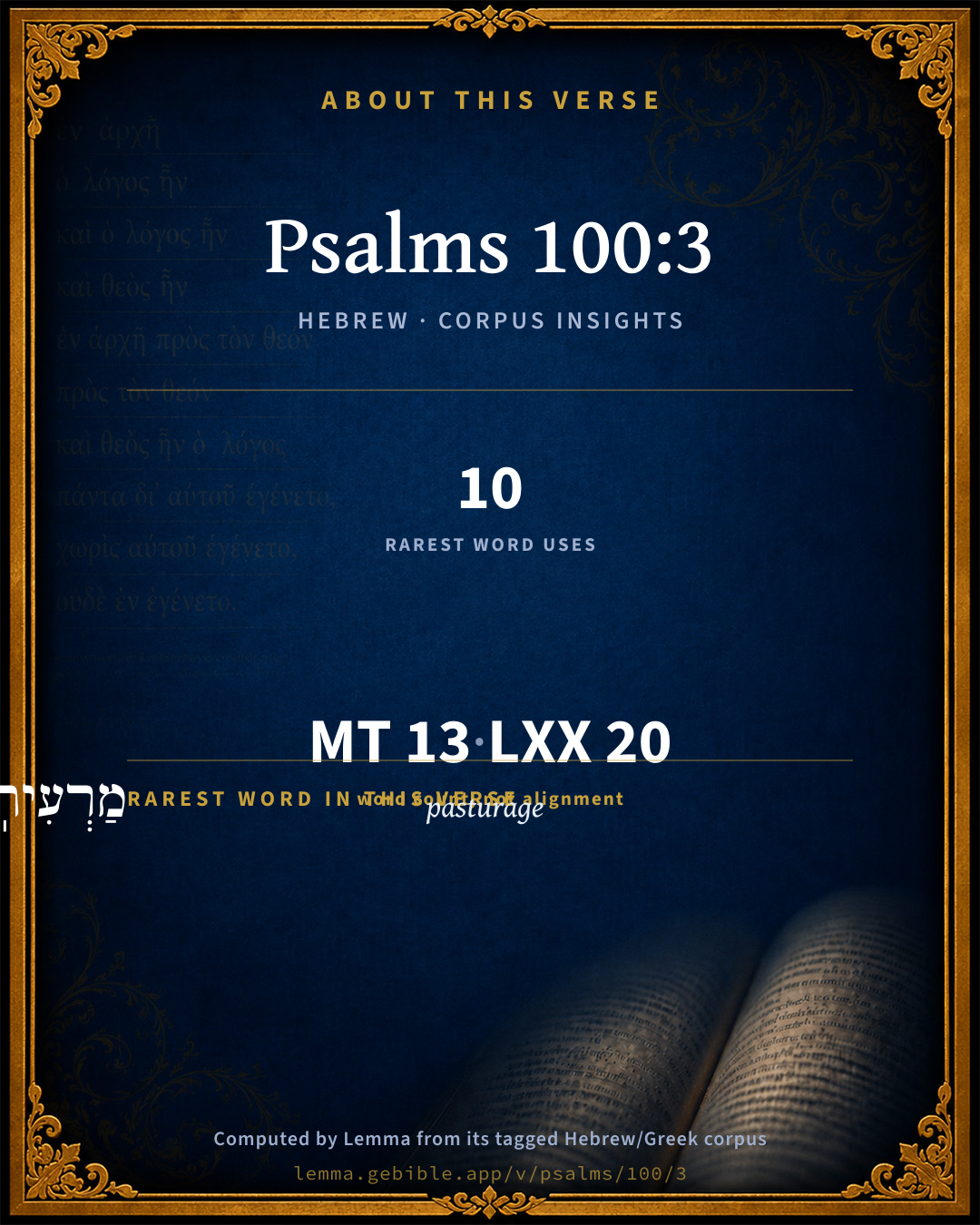
13
words
11
distinct lemmas
Wisdom
section

Notable vocabulary

The rarest word here is מַרְעִיתֽוֹ pasturage H4830 — appearing just 10 times in the whole Hebrew Bible.

Shared distinctive vocabulary

מַרְעִיתֽוֹ pasturage H4830 occurs in 10 verses of the Hebrew Bible. Also found in:

Grammatical profile

  • 2 verbs
  • 5 nouns
  • 3 pronouns
  • 1 preposition
  • 1 conjunction
  • 1 particle

Verb forms

  • דְּע֗וּ Qal · Imperative
  • עָ֭שָׂנוּ Qal · Perfect

Repetition

A word recurs within this verse — often emphatic in Hebrew:

  • ה֤וּא he H1931 ×2

Hebrew & Septuagint length

In English translation the verse runs 27 words from the Hebrew and 24 from the Septuagint (LXX English) — closely comparable.

A rough comparison of the two English renderings, which tokenize alike — not a word-level alignment.

Word counts can differ between the Hebrew and the Greek without any difference in meaning — e.g. the Hebrew direct-object marker אֵת has no separate Greek word, and Greek often adds the article ὁ.

In the original languages it is 13 Hebrew tokens and 20 Greek tokens — but the two are counted differently (Hebrew bundles its prefixes and suffixes into one token; the Greek is in lemma form), so that isn’t a like-for-like length.

Cross-references

39

Topical passages linked to Psalms 100:3 in the Treasury of Scripture Knowledge — connected by theme and wording, ordered by reader-vote popularity; previews shown in the World English Bible.

  • Psalms 95:6–7 Oh come, let's worship and bow down. Let's kneel before Yahweh, our Maker,
  • Psalms 46:10 "Be still, and know that I am God. I will be exalted among the nations. I will be exalted in the earth."
  • Psalms 119:73 Your hands have made me and formed me. Give me understanding, that I may learn your commandments.
  • John 17:3 This is eternal life, that they should know you, the only true God, and him whom you sent, Jesus Christ.
  • Ephesians 2:10 For we are his workmanship, created in Christ Jesus for good works, which God prepared before that we would walk in them.
  • 1 John 5:20 We know that the Son of God has come, and has given us an understanding, that we know him who is true, and we are in him who is true, in his Son Jesus Christ. This is the true God, and eternal life.
  • Ezekiel 34:30–31 They shall know that I, Yahweh, their God am with them, and that they, the house of Israel, are my people, says the Lord Yahweh.
  • 1 Peter 4:19 Therefore let them also who suffer according to the will of God in doing good entrust their souls to him, as to a faithful Creator.
  • Psalms 149:2 Let Israel rejoice in him who made them. Let the children of Zion be joyful in their King.
  • Deuteronomy 4:35 To you it was shown, that you might know that Yahweh he is God; there is none else besides him.
  • John 10:26–28 But you don't believe, because you are not of my sheep, as I told you.
  • Deuteronomy 4:39 Know therefore this day, and lay it to your heart, that Yahweh he is God in heaven above and on the earth beneath; there is none else.
  • Psalms 79:13 So we, your people and sheep of your pasture, Will give you thanks forever. We will praise you forever, to all generations.
  • Psalms 139:13–24 For you formed my inmost being. You knit me together in my mother's womb.
  • 1 Corinthians 6:19–20 Or don't you know that your body is a temple of the Holy Spirit which is in you, which you have from God? You are not your own,
  • Galatians 4:8–9 However at that time, not knowing God, you were in bondage to those who by nature are not gods.
  • 1 Peter 2:25 For you were going astray like sheep; but are now returned to the Shepherd and Overseer of your souls.
  • Psalms 78:52 But he led forth his own people like sheep, And guided them in the wilderness like a flock.
  • 2 Corinthians 4:6 seeing it is God who said, "Light will shine out of darkness," who has shone in our hearts, to give the light of the knowledge of the glory of God in the face of Jesus Christ.
  • 1 Peter 5:2–4 Shepherd the flock of God which is among you, exercising the oversight, not under compulsion, but voluntarily, not for dishonest gain, but willingly;
  • Job 10:8–13 'Your hands have framed me and fashioned me altogether; Yet you destroy me.
  • Ezekiel 34:11 For thus says the Lord Yahweh: Behold, I myself, even I, will search for my sheep, and will seek them out.
  • 1 Samuel 17:46–47 This day will Yahweh deliver you into my hand; and I will strike you, and take your head from off you; and I will give the dead bodies of the host of the Philistines this day to the birds of the sky, and to the wild animals of the earth; that all the earth may know that there is a God in Israel,
  • Jeremiah 10:10 But Yahweh is the true God; he is the living God, and an everlasting King: at his wrath the earth trembles, and the nations are not able to abide his indignation.
  • Acts 17:23–24 For as I passed along, and observed the objects of your worship, I found also an altar with this inscription: 'TO AN UNKNOWN GOD.' What therefore you worship in ignorance, this I announce to you.
  • Deuteronomy 7:9 Know therefore that Yahweh your God, he is God, the faithful God, who keeps covenant and loving kindness with them who love him and keep his commandments to a thousand generations,
  • 1 Kings 18:36–39 It happened at the time of the offering of the [evening] offering, that Elijah the prophet came near, and said, Yahweh, the God of Abraham, of Isaac, and of Israel, let it be known this day that you are God in Israel, and that I am your servant, and that I have done all these things at your word.
  • 2 Kings 19:19 Now therefore, Yahweh our God, save you us, I beg you, out of his hand, that all the kingdoms of the earth may know that you Yahweh are God alone.
  • Psalms 74:1–2 God, why have you rejected us forever? Why does your anger smolder against the sheep of your pasture?
  • Isaiah 40:9–11 You who tell good news to Zion, go up on a high mountain; you who tell good news to Jerusalem, lift up your voice with strength; lift it up, don't be afraid; say to the cities of Judah, Behold, your God!
  • Isaiah 63:11 Then he remembered the days of old, Moses [and] his people, [saying], Where is he who brought them up out of the sea with the shepherds of his flock? where is he who put his holy Spirit in the midst of them?
  • Isaiah 63:19 We are become as they over whom you never bear rule, as those who were not called by your name.
  • Ecclesiastes 12:1 Remember also your Creator in the days of your youth, Before the evil days come, and the years draw near, When you will say, "I have no pleasure in them;"
  • Acts 20:28–29 Take heed, therefore, to yourselves, and to all the flock, in which the Holy Spirit has made you overseers, to shepherd the assembly of the Lord and God which he purchased with his own blood.
  • 1 Peter 2:9 But you are a chosen race, a royal priesthood, a holy nation, a people for God's own possession, that you may show forth the excellencies of him who called you out of darkness into his marvelous light:
  • Psalms 12:4 Who have said, "With our tongue we will prevail. Our lips are our own. Who is lord over us?"
  • Psalms 95:3 For Yahweh is a great God, A great King above all gods.
  • John 10:14–16 I am the good shepherd. I know my own, and I'm known by my own;
  • Job 10:3 Is it good to you that you should oppress, That you should despise the work of your hands, And smile on the counsel of the wicked?

Cross-references courtesy of OpenBible.info (CC BY 4.0).

Hebrew and Greek witnesses Masoretic Hebrew ↔ Greek Septuagint

The same verse in the two great witnesses to the Old Testament, shown verse-for-verse.

You’re reading Greek Psalm 99 (Hebrew Psalm 100). The Septuagint counts the superscription, so verse numbers can differ from the Hebrew — chapter-level alignment, not verse-by-verse. Numbering follows Rahlfs.

These are two independent witnesses, not word-aligned to each other, and the Septuagint is shown in lemma (dictionary) form.

Hebrew Psalms 100:3 Masoretic · Westminster Leningrad Codex

דְּע֗וּ כִּֽי יְהוָה֮ ה֤וּא אֱלֹ֫הִ֥ים הֽוּא עָ֭שָׂנוּ ולא וְל֣וֹ אֲנַ֑חְנוּ עַ֝מּ֗וֹ וְצֹ֣אן מַרְעִיתֽוֹ

Know that Yahweh, he is God. It is he who has made us, and we are his. We are his people, and the sheep of his pasture.

World English Bible · Public Domain

Greek LXX Greek Psalm 99:3 Septuagint · lemma form

γιγνώσκω ὅτι κύριος αὐτός εἰμί ὁ θεός αὐτός ποιέω ἐγώ καί οὐ ἐγώ λαός αὐτός καί πρόβατον ὁ νομή αὐτός

Know that the Lord he is God; he made us, and not we ourselves; we are his people, and the sheep of his pasture.

LXX2012 (modern English Septuagint) · Public Domain

On this verse, J. A. Alexander on Psalms discusses the Septuagint’s reading. Read the note in Commentary ↓

Hebrew: Westminster Leningrad Codex (CC BY 4.0). Greek: Septuagint (public domain); English from LXX2012 (modern English Septuagint) (Public Domain). How the Septuagint differs from the Hebrew →

Commentary

Notes on Psalms 100:3 from classic Christian and Jewish commentators (each source and its license shown beneath its notes). The classic Christian expositions comment on the surrounding passage and are grouped to its opening verse, so a note may address several verses; the Jewish commentaries on the Tanakh (Rashi and others) are per-verse, so they appear only where the commentator wrote on this verse.

Lemma curates 59 commentaries, every one of them public domain or Creative Commons licensed, each selected and text-cleaned for this edition rather than reprinted as found. About our sources →

Trapp's Complete Commentary

John Trapp

Psa 100:3 Know ye that the LORD he [is] God: [it is] he [that] hath made us, and not we ourselves; [we are] his people, and the sheep of his pasture.

Ver. 3. Know ye that the Lord he is God] Be convinced of it, ye heathens, whose fantasies have forged false gods; and ye Jews, acknowledge the true God to be Three in one, and One in three.

It is he that hath made us] And newly made us; "for we are his workmanship" (a second time) "created in Christ Jesus unto good works," Eph 2:10. The word signifieth, saith Kimchi, Ornare beneficiis, afficere donis, gratiis cumulare {confer 1Sa 12:6} and so is distinguished from Bara, to create, and Jatsar, to form. William of Malmesbury telleth of a certain emperor of Germany, who, coming by chance into a church on the sabbath day, found there a most misshapen priest, pene portentum naturae, insomuch as the emperor much scorned and contemned him; but when he heard him read those words in the service, "For it is he that hath made us, and not we ourselves," the emperor checked his own proud thoughts, and made inquiry into the quality and conditions of the man, and finding, upon examination, that he was a very learned and devout man, he made him archbishop of Collen, which place he discharged with much commendations.

We are his people, and the sheep] See Psa 95:7. This is a privilege proper to the communion of saints.

John Trapp, A Commentary or Exposition upon All the Books of the Old and New Testament (1647–1656) — public domain. Text from a community e-Sword module.

The Biblical Illustrator

Joseph S. Exell

Psa_100:3-5

Know ye that the Lord He is God.

The claims of God

Mans chief end is to glorify God, and to enjoy Him for ever. There is a vast amount both of theology and philosophy in that simple answer, which our old divines have put into the mouth of a child. Were we to-day what we should be, it would be our element to love, to serve, to adore our God, and we should not need ministers to stir us to our pleasurable duty or remind us of Jehovahs claims.

I. Thy claims of God, on what are they grounded?

1. They are grounded, first of all upon His Godhead. Know ye that Jehovah He is God. As Matthew Henry has very properly said, ignorance is not the mother of devotion, though it be the mother of superstition. True knowledge is the mother and the nurse of piety. Really to know the deity of God, to get some idea of what is meant by saying that He is God, is to have the very strongest argument forced upon ones soul for obedience and worship.

2. The second ground of the Lords claim is His creation of us. It is He that hath made us, and not we ourselves. You never saw a child startled when it was told for the first time that God made it, for within that little mind there dwells an instinct which accepts the statement.

3. A third reason for living unto the Lord lies in His shepherding of us. We are His people, and the sheep of His pasture. God has not left us and gone away. He has not left us as the ostrich leaves her eggs, to be broken by the passers foot. He is watching over us at every hour; even as a shepherd guards his flock. Over us all He exercises an unceasing care, a watchful providence, and therefore we should return to Him daily praise. Men, because ye are men, adore the God who keeps you living men; but saintly men, men renewed and fed out of the storehouse of Divine grace, serve your God, I pray you, with all your heart, and soul, and strength, because you especially are the sheep of His pasture and the people of His hand.

4. A fourth reason for adoration and service is the Divine character (verse 5). Here are three master motives for serving the Lord our God. Oh that all would feel their weight. First, He is good. Now, if I were to lift up a standard in this assembly and say, This banner represents the cause of everything that is just, right, true, kind, and benevolent, I should expect many a young heart to enlist beneath it; for when pretenders in all lands have talked of liberty and virtue choice spirits have been enchanted and rushed to death for the grand old cause. Now, God is good, just, right, true, kind, benevolent; in a word, God is love, and therefore who would not serve Him? Then it is added, His mercy is everlasting. Who would not serve one whose mercy endureth for ever? Cruel is that heart which infinite gentleness does not persuade. If God be merciful, man should no more be rebellious. It is added, His truth endureth to all generations, that is to say, you will not find in God one thing to-day and another thing to-morrow. What He promises He will perform. Every word of His stands fast for ever, like Himself, immutable. Thus I have set before you the grounds of Gods claims; are they solid? Do you consent to them? Oh, that sovereign grace would constrain each of us to live alone for the glory of God. It is His most righteous due.

II. The claims of God--how have we regarded them? Answer for yourselves. Alas, some have paid no respect to these claims--in fact they have denied them, and have said in effect, Who is the Lord that I should obey His voice? Sorrowfully must we all confess also that where we have tried to honour the Lord, and have done so in a measure by His grace, yet we have failed of perfection; we have to confess that oftentimes the pressure of the body which is near, and of the things that are seen and tangible, has been greater upon us than the force of the things which cannot be seen, but are eternal. We have yielded to self too often, and have robbed the Lord. What shall we do in this case? Why, we have to bless our everlasting God and Father, that He has provided an atoning sacrifice for all our shortcomings, and that there is One, partaker of our nature who stands in the gap on our behalf, in whom we can be accepted, notwithstanding all our shortcomings and offences. Let us go to God in Christ Jesus.

III. The claims of God, when they are regarded, how do they influence men? Let me show you how healthy it is to serve God. The man who serves God, led by the Spirit of God so to do, is humble. Were he proud it were proof at once that he was not serving God; but the remembrance that God is his sovereign, and has made him, that in His hand is his breath, makes the good man feel that he is nothing but dust and ashes at his very best. How horrible it is when man lives for lust, and puts forth all his strength to indulge his passions! Brutes! beasts! Alas! I slander the beasts when I compare them to such men. The man who lives for God is a far nobler being. Why, in the very act of self-renunciation and of dedication to God the man has been lifted up from earth, and from all that holds him down to its dust and mire, and he has risen so much nearer to the cherubim, so much nearer, in fact, to the Divine. This makes a man a man, for a man who serves is courageous, and too manly to be a slave. The love of God makes heroes. Give a man a resolve to serve God, and he is endowed with wondrous perseverance. Look at the apostles, and martyrs, and missionaries of the faith, how they have pressed on, despite a world in arms; when a nation has been apparently inaccessible they have found an entrance; when the first missionary has died another has been ready to follow in his footsteps. The first Church, in her weakness, and poverty, and ignorance, struggled with philosophy and wealth, and all the power of heathen Rome, till at last the weak overcame the strong, and the foolish overthrew the wise. O Lord, Thy service makes us akin to Thee. Blessed are they that wear Thy yokel How strong they grow, how patient to endure, how firm to stand fast, how swift to run. They mount with wings as eagles when they learn to serve Thee. The man who is led by the Holy Ghost to serve God is incited thereby to a zeal, a fervour, and a self-sacrifice to which nothing else could bring him. (C. H. Spurgeon.)

It is He that hath made us, and not we ourselves.--

God-made or man-made?

There is a superficial way of reading these words which makes them a mere truism. That noble paraphrase of the psalm, All people that on earth do dwell, seems rather to fall flat and stale. Without our aid He did us make. The psalmist is not giving utterance to a commonplace of that sort. That is not the point at all. The psalmist is, as you will see, calling upon all lands, the heathen lands, to believe in God, to believe that He is the Lord, and there is no other, because His workmanship is manifest in the people whom He has chosen; His guiding and shaping Spirit has been within them and upon them to make them what they are. All that they have of moral and religious training and continuance is the gift of His grace, and the result of His training. They are the witness to the world of Gods constancy, faithfulness, truth, and mercy. Consider the application of these words--

I. Is the individual Christian life. No man with any religious conviction, or any religious emotion, can look back on the story of his life up to this point, through all these changes, wrestlings, temptations, and moral victories, without feeling that Gods shaping hand has been with him there all through. That man sees nothing clearly, and feels nothing deeply, who does not both see and feel that all the best things in him are not self-wrought, but are the result of forces not his own, and higher than his own. Alas, there is much of the self-made left in all of us, and it is the part of which we are the least proud. There are in us bits of the world, the flesh, and the devil, that have not been crucified with Christ; and there are hard lumps in the tenderest heart which have not felt the melting of His love. Would God they were replaced by Diviner stuff! But all the good you have and know, the noble faith, the uplifting, cheering hope, the recoil from sin, and the patience, and the courage, and the self-sacrifice, and the wells of pity, and the fountains of love, the joy in God, and the sweet singing in your heart at Jesus Name--all these have been woven in you by God, and the Spirit of God, and the indwelling Christ.

II. In the nation to which we belong. How a reader of the Bible can find God in every page of Jewish history and not see His overshadowing and guiding presence in the wonderful story of Britains growth and greatness is to me an indication of incomprehensible dulness. We are not a self-made people, no, indeed. Our builder and maker has been God. For no human thought would ever have imagined, and no prophets vision would ever have foreseen, the unexampled and extraordinary growth and expansion of this little island and its people. Looked at on the map, it is a mere dot on the surface of the globe; yet its name, and flag, and ruling power, and shaping ideas have girdled and well-nigh embraced the globe. Men say we owe it to our insular position, our sea-protected shores, or perhaps to our climatic influences, or to the singular mixture of races in our composition, or to the blunders and failures of other nations, or to the grit and determination in our character; or we owe it to the wisdom of our statesmen, the enterprise of our merchants, the daring of our sailors, the valour of our soldiers, and to the sturdy, self-reliant independence which has been at the base of all the rest. And they do not see that most of these are moral and religious causes; that behind them, in the shadow, God has been standing watching and working, and that underneath them all have been the everlasting arms. They forget how heavenly light dawned and shone down on the people in their superstitious and benighted days to give them religion in its purest form and to make them righteous, truth-loving, and strong in the fear of God. They do not remember that our fathers were delivered almost in spite of themselves from the blight of superstition, how the truth set them free and gave them room to expand. They do not take into account how large a part has been played by our open Bible and our praying heroes. They do not see that reverence and faith, and faith-rooted justice and Christian virtues have been the very soul and backbone of our peoples strength, and that nearly all our greatest thinkers, writers, statesmen, sailors, soldiers have grown up in nurseries of prayer. They are blind to the fact, moreover, that once and again in days of stress and trial, in the dark and cloudy days when the fortunes of the nation have been well-nigh overwhelmed, the outstretched arm of God brought our fathers through Red Seas of trouble to a safe and wealthy place. Nay, we may say that hundreds of times the very blunders, follies and crimes of our statesmen have been overruled and our people led along paths which their own wisdom and foresight would never have chosen; and it may be all summed up in this, that through all the guilts and sins which have had their part in the upbuilding, the Almighty Architect has been the chief worker in carrying our name and commerce to the uttermost parts of the earth and in bringing hundreds of millions of souls under our rule. (J. G. Greenhough, M.A.)

God the Maker

It is not in Gods work in creation that the text is laid, but in His redemptive work in history. It is an exultant historical consciousness that teaches the lips of the psalmist to sing, It is He that fashioned us; and His are we.

I. Gods fashionings of human life constitute the chief witness of His power and glory to men. The hand of God was unmistakably the power that fashioned the striking course of Israels history. The great difference between the history of Israel and that of contemporary nations corresponded precisely to the difference in their relation to Jehovah. While other nations had wandered after the gods which were no gods, Israel had been the servant of Jehovah. The authority of Jehovah, and the influence of their worship of Him, had been beyond all question the shaping force of their distinctive and remarkable history. Other nations waxed great in external splendour; Israels own consciousness of national greatness lay in inward truth. Other nations produced statesmen and conquerors; Israels preeminent sons were its seers and prophets. Other nations fell when the foot of the conqueror trampled them into bondage; Israel waxed greater in the dark years of captivity.

II. Gods method in fashioning human lives is selective. The conspicuous instance of the nation of Israel I have already mentioned. This little nation was, by a marvellous process of selection which can be conceived only in reference to a Divine plan, singled out of the general mass of humanity for special blessings, spiritual potencies, and religious responsibilities. In spite of its per-versifies and infirmities, the elective call of God was so effective that it answered to the call, became conscious that it was chosen of God, and was made the radiant centre of truth for the whole world. In varying degrees and for different ends, one can see the elective operations of Gods shaping hand in reference to other nations, and not least in the startling history of our own England. The history of nations is full of acts which irresistibly point to a Divine elective and discriminative power. This principle is still more evident, if possible, in the life of individual men. In the circle of the nation, of the city, of the village, or of the family, we constantly see this process of election, sometimes in very startling forms. By the operation of some unseen and mysterious force, the one is taken and the other left. Gods strongest men have always lived and acted in the holy consciousness that they were singled out by God.

III. Gods selective method is one of concentration with a view to the most effectual universalization. The inward essence of particular election is the yearning of Gods love for the salvation of the world. Gods vessels of mercy are chartered to bear the freight of His grace to every shore. The few are chosen in order that the many may be more effectually reached. Exclusion is but a fleeting phase of Gods elections; the abiding soul of them is a graciously determined and comprehensive inclusion. The mountain of the house of the Lord is exalted above the hills, in order that all nations may flow into it. This gracious development of Gods elective purpose multiplies the honour and glory of the elect spirit. For in this glowing light, every election is twofold. It is an election of a human soul into the grace and Kingdom of God, and it is also an election into the special ministry of salvation to others. (J. Thomas, M.A.)

There is inspiration in the thought that God made us

Our powers are finite, and sometimes we are troubled about that fact, wishing we could do more for our Lord: but we need not fear when we remember that He hath made us, and therefore fixed the measure of our capacity. In Roger de Wendovers Flowers of History, an ancient Saxon chronicle, we read of a Saxon king, who, riding through a forest, came upon a little church in which a priest was saying prayers, and this priest was lame and hump-backed; and therefore the rough Saxon king was ready to despise him, till he heard him chant these words, It is He that hath made us, and not we ourselves. The king blushed, and owned his fault. If, then, we are of small beauty or slender talent, let us not complain, but serve Him who has made us what we are. (C. H. Spurgeon.)

We are His people, and the sheep of His pasture.--

The pasture or provision for Gods sheep

I. God provides good pasture (Eze_34:14). Although spoken of Israel, yet surely Gods spiritual Israel may lay the hand of faith and appropriation upon the promises of this chapter. One chief idea of good pasture in the mind of a shepherd would be pasture from which nutriment could be derived without fear of deleterious herbs. The psalmist says, Thy Word is very pure (Psa_119:140), and again (Psa_12:6). The writings of men may be good and very helpful, but Gods Word is essence. No other book will fully satisfy the soul that has found a living Christ in the written Word, and that knows experimentally how pregnant with life and meaning the Holy Ghost can make the simplest verses of Gods Book.

II. God provides large pastures (Isa_30:23). This seems to refer to literal cattle, but 2Ti_3:16-17, embodies the same thought. In Gods Word may be found everything necessary for the souls real good, but not anything for curious speculation. Yes, large--wide as the needs of the human heart--extensive as the infinite fulness of God. Every promise from cover to cover belongs to the believer, and there is no need of man which has not its corresponding supply in the promises of God. But the mere letter of the Word will profit little; it is only as Christ the living Word, in whom all fulness dwells, is seen and appropriated through the written Word, that the need of the human heart and the infinite fulness of God are brought together.

III. God provides green pastures (Psa_23:2). He maketh me to lie down in green pastures; or, as the margin, pastures of tender grass--some one has rendered it springing grass. Evidently the idea is that of freshness--not stale food. There is a great tendency in our day to feed upon stale spiritual food. One says, I had a great blessing last year through Mr. So-and-Sos preaching. Another says, My Bible seemed to be lit up one morning last week, and I have been living upon the blessing I got then ever since. If Gods pasture is ever green and springing, why have you had no fresh food to-day? In the country you will see the sheep turn from the rank grass of long growth to seek the delicate fresh-springing grass. Your body cannot be strong upon yesterdays food, neither can your soul be strong upon past experiences of blessing in the Word. The fresh pasture is still there, and the Holy Spirit waits to nourish the soul by means of it. Get fresh food daily.

IV. God provides fat pasture (Eze_34:14). Those who have the charge of sheep sometimes say a piece of pasture land has no heart in it; and Christians sometimes say they find their Bibles lifeless--they read them regularly, but get no good from them. It is possible to read chapter after chapter without blessing, for the letter of the Word alone may be compared to the husk which covers the grain--to the casket which contains the precious gem. But use it as revealing Christ; see Him in and through it; take home its warnings; claim the fulfilment of its promises; touch Christ in the Word; feed on Him; seek to extract the kernel from its covering, the gem from its casket, ever seeking and depending upon the Holy Spirits teaching and power, and there will be no more complaint over a dull Bible; but it will be found to be fat, rich pasture that will abundantly satisfy (Psa_36:8), and upon which the soul will gain new life, strength, joy, and power for useful service.

V. God provides pasture in high places (Isa_49:9). And in Eze_34:13-14, the Lord promises to feed His flock upon the mountains and upon the high mountains. May not a New Testament parallel to these high places be found in the heavenly places, or heavenlies, of the Epistle to the Ephesians? Five times in that epistle the words occur, and in no other epistle. A careful study of the context would seem to show that it is a position attained through union with Christ in death and resurrection--a death unto sin (Rom_6:1-23), in His death, that, raised with Him, His resurrection life may be ours; not judicially only, but in actual fact and realization, through faith in Gods mighty power (Eph_1:19-23) and promise. A daily death unto self and sin, that the life of Jesus might be made manifest in our mortal flesh (2Co_4:10-11), that we may be able to say with the apostle (Gal_2:19-20). (The Christian.)

The Biblical Illustrator, edited by Joseph S. Exell (c. 1880s–1900s) — public domain. Text from a community e-Sword module.

Joseph Benson's Commentary

Psa 100:3-5. Know that the Lord — Hebrews Jehovah, he is God — The only living and true God; a being infinitely perfect, self-existent, and self- sufficient; and the fountain of all being; the first cause and last end of all things. It is he that hath made us — Not only by creation, but by regeneration, which is also called a creation, because by it we are made his people. Hence we owe him homage and service, and him only. and not other gods, who did neither make nor new-make us. He, and he only, hath an incontestable right to, and in us, and all things. His we are, to be influenced by his power, disposed of by his will, and devoted to his honour and glory. We are his people — Or subjects, and he is our prince or governor that gives law to us, as moral agents, and will call us to an account for what we do; the sheep of his pasture — Or, as the Hebrew may be rendered, the flock of his feeding, whom he takes care of and provides for. He that made us, maintains us, and gives us all things richly to enjoy. For the Lord is good — Infinite in goodness, and therefore doeth good. His mercy is everlasting — Is a fountain that can never be drawn dry. His truth endureth to all generations — And no word of his shall fall to the ground as antiquated or revoked: his promises are sure to all the faithful, from age to age. If this Psalm be considered as prophetical of the calling both of Jews and Gentiles to the profession of the gospel, then by the gates of Zion, Psa 100:4, must be mystically understood the Christian Church.

Joseph Benson's Commentary on the Old and New Testaments (1811–1818) — public domain. Text from a community e-Sword module.

J. A. Alexander on Psalms

Joseph Addison Alexander

3. (Psa 100:3) Know ye that Jehovah is God; (it is) He (that) made and not we (ourselves), his people, and the sheep of his pasture. This is the first reason given for acknowledging Jehovah's sovereignty, to wit, that he has made his people what they are. With the first clause compare Psa 46:10. Instead of and not we ourselves, the keri or masoretic reading in the margin of the Hebrew Bible has, and his we are. These phrases, though so unlike in English, differ only in a single letter, and not we, and to him we. The first is adopted by the Septuagint and Vulgate, the second by the Targum and Jerome. In favour of the latter is the similar construction of the pronoun we with his people in Psa 129:1-8, Psa 95:7. In favour of the other is its antiquity, and its greater significancy and appropriateness to the context. Some who adopt it read, it is he that has made us (to be) his people the sheep, etc. But besides the violence of this construction, he made us has no doubt the same sense as in Psa 95:6, and his people must mean us who are his people. Sheep (or flock) of his pasture, as in Psa 74:1; Psa 79:13; Psa 95:7.

Joseph Addison Alexander, The Psalms Translated and Explained (1850) — public domain. Text from a community e-Sword module.

Tyndale Open Study Notes

Tyndale Open Resources

100:3 The Lord is the one who determines who his people are. • the sheep of his pasture: God will guide and protect his people (23:1, 4).

Tyndale Open Study Notes — © Tyndale Open Resources, licensed CC BY-SA 4.0. Text via the HelloAO Bible API.

Geneva Bible (1599)

Geneva Bible translators

He chiefly meaneth, touching the spiritual regeneration, whereby we are his sheep and people.

Geneva Bible (1599) marginal notes — public domain. Text via Bolls.life.

Adam Clarke's Commentary

Verse 3. Know ye that the Lord he is God] Acknowledge in every possible way, both in public and private, that Jehovah, the uncreated self-existent, and eternal Being, is Elohim, the God who is in covenant with man, to instruct, redeem, love, and make him finally happy.

It is he that hath made us] He is our Creator and has consequently the only right in and over us.

And not we ourselves] ולא אנחנו velo anachnu. I can never think that this is the true reading, though found in the present Hebrew text, in the Vulgate, Septuagint, AEthiopic, and Syriac. Was there ever a people on earth, however grossly heathenish, that did believe, or could believe, that they had made themselves? In twenty-six of Kennicott's and De Rossi's MSS. we have ולו אנחנו velo anachnu, "and HIS we are;" לו lo, the pronoun, being put for לא lo, the negative particle. This is the reading of the Targum, or Chaldee paraphrase ודיליה אנחנא vedileyh anachna, "and his we are," and is the reading of the text in the Complutensian Polyglot, of both the Psalters which were printed in 1477, and is the keri, or marginal reading in most Masoretic Bibles. Every person must see, from the nature of the subject that it is the genuine reading. The position is founded on the maxim that what a man invents, constructs out of his own materials, without assistance in genius, materials or execution from any other person, is HIS OWN; and to it, its use, and produce, he has the only right. God made us, therefore we are HIS: we are his people, and should acknowledge him for our God; we are the sheep of his pasture, and should devote the lives to him constantly which he continually supports.

Adam Clarke's Commentary on the Bible (1810–1826) — public domain. Text from a community e-Sword/MySword module.

John Calvin's Commentaries

The prophet next makes mention of the great benefits received from God, and, in an especial manner, desires the faithful to meditate upon them. To say God made us is a very generally acknowledged truth; but not to advert to the ingratitude so usual among men, that scarcely one among a hundred seriously acknowledges that he holds his existence from God, although, when hardly put to it, they do not deny that they were created out of nothing; yet every man makes a god of himself, and virtually worships himself, when he ascribes to his own power what God declares belongs to him alone. Moreover, it must be remembered that the prophet is not here speaking of creation in general, (as I have formerly said,) but of that spiritual regeneration by which he creates anew his image in his elect. Believers are the persons whom the prophet here declares to be God’s workmanship, not that they were made men in their mother’s womb, but in that sense in which Paul, in Ephesians 2:10, calls them, Τὸ ποιημα, the workmanship of God, because they are created unto good works which God hath before ordained that they should walk in them; and in reality this agrees best with the subsequent context. For when he says, We are his people, and the sheep of his pasture, he evidently refers to that distinguishing grace which led God to set apart his children for his heritage, in order that he may, as it were, nourish them under his wings, which is a much greater privilege than that of merely being born men. Should any person be disposed to boast that he has of himself become a new man, who is there that would not hold in abhorrence such a base attempt to rob God of that which belongs to him? Nor must we attribute this spiritual birth to our earthly parents, as if by their own power they begat us; for what could a corrupt seed produce? Still the majority of men do not hesitate to claim for themselves all the praise of the spiritual life. Else what mean the preachers of free-will, unless it be to tell us that by our own endeavors we have, from being sons of Adam, become the sons of God? In opposition to this, the prophet in calling us the people of God, informs us that it is of his own good will that we are spiritually regenerated. And by denominating us the sheep of his pasture, he gives us to know that through the same grace which has once been imparted to us, we continue safe and unimpaired until the end. It might be otherwise rendered, he made us his people, etc. But as the meaning is not altered, I have retained that which was the more generally received reading.

John Calvin's Commentaries (1540-1563) — public domain. Text from the Calvin Translation Society English edition (1840s-50s) via the Christian Classics Ethereal Library (ccel.org). Calvin's coverage is partial (roughly two-thirds of the Bible); uncommented books and verses are honest gaps, never fabricated. The 19th-century editor's footnotes and remarks are omitted so the notes are faithfully Calvin's own voice.

Ellicott's Commentary for English Readers

(3) And not we ourselves.—Most commentators now prefer the reading “His we are,” as keeping the parallelism better, besides having great MS. support. The concluding part of the verse is an echo of Psa_95:7.

A Bible Commentary for English Readers, edited by Charles John Ellicott (1878–1897) — public domain. Text from a community e-Sword module.

The Cambridge Bible for Schools and Colleges

gen. ed. J. J. S. Perowne

3. Know that Jehovah is God:

He it is that made us, and we are his,

His people and the sheep of his pasture.

Learn from the works that He has wrought for Israel that Jehovah is the only true God. Cp. Psa_46:10; Deu_7:9. He made Israel of old to be a people for Himself (Deu_32:6; Deu_32:15; Psa_95:6), and now He has once more made them a nation (Isa_60:21). In spite of their sins He has not disowned them; they can still with confidence claim His care and guidance.

The A.V. and not we ourselves follows the K’thîbh, which is supported by the LXX, Syr., and Symm. The A.V. marg. and R.V. we are his., follow the Q’rç, which is supported by the Targ., Jer., and Aq.[55] Though the antithesis he and not we ourselves gives a good sense, the reading we are his is far more significant, as adding a fresh thought. Moreover it agrees best with the construction of the verse in the Heb., and it is supported by the parallels in Psa_95:7; Isa_43:1, cp. Isa_43:21, Isa_44:2.

[55] The Heb. words for not and to him (= his) are pronounced identically (lô) though differently spelt (לֹא, לוֹ): hence the confusion between the readings not we and to him we = his (are) we was easy.

The Cambridge Bible for Schools and Colleges (gen. ed. J. J. S. Perowne; Cambridge University Press, 1878–1918) — public domain. Text from a community e-Sword module.

John Gill's Exposition

Know ye that the Lord he is God,.... Own and acknowledge him to be God, as well as man; and though a man, yet not a mere man, but the great God and our Saviour, the true God and eternal life; so a man, as that he is Jehovah's fellow; or our God, as the Syriac and Ethiopic versions; Immanuel, God with us, God in our nature, God manifest in the flesh:

it is he that hath made us; as men, without whom nothing is made that was made; in him we live, move, and have our being; and, as new creatures, we are his workmanship, created in him, and by him; regenerated by his Spirit and grace, and formed for himself, his service and glory; and made great and honourable by him, raised from a low to an high estate; from being beggars on the dunghill, to sit among princes; yea, made kings and priests unto God by him; so, Kimchi,

"he hath brought us up, and exalted us:''

and not we ourselves; that is, did not make ourselves, neither as creatures, nor as new creatures; as we have no hand in making either our souls or bodies, so neither in our regeneration, or in the work of God upon our hearts; that is solely the Lord's work: there is a double reading of this clause; the marginal reading is,

and we are his; which is followed by the Targum and Aben Ezra: both are approved of by Kimchi, and the sense of both is included; for if the Lord has made us, and not we ourselves, then we are not our own, but his, and ought to serve and glorify him: we are his by creation; "we are also his offspring", as said Aratus (d), an Heathen poet, cited by the Apostle Paul, Act 17:28,

we are his people; by choice and covenant; by his Father's gift, and his own purchase; and by the power of his grace, bringing to a voluntary surrender and subjection to him; even the Gentiles particularly, who were not his people, but now his people, Pe1 2:9,

and the sheep of his pasture; his sheep also by gift and purchase, called by him, made to know his voice, and follow him; for whom he provides pasture, leads to it, and feeds them with it himself; see Psa 74:1.

(d) . Arati Phaenomena, v. 5.

John Gill's Exposition of the Whole Bible (1746–1763) — public domain (CC PDM 1.0). Text via the HelloAO Bible API.

Albert Barnes' Notes on the Bible

Know ye that the Lord, he is God - That is, Let all the nations know that Yahweh is the true God. The idols are vanity. They have no claim to worship; but God is the Creator of all, and is entitled to universal adoration.

It is he that hath made us - The Hebrew is, “He made us,” and this expresses the exact idea. The fact that he is the Creator proves that he is God, since no one but God can perform the work of creation. The highest idea that we can form of power is that which is evinced in an act of creation; that is, in causing anything to exist where there was nothing before. Every created thing, therefore, is a proof of the existence of God; the immensity of the universe is an illustration of the greatness of his power.

And not we ourselves - Margin, “And his we are.” The difference between the text and the margin is owing to a different reading in the Hebrew, varying only in a single letter. The reading in the text is, “And not (לא lo') we;” in the margin, “And to him (לו lô) we.” These words would be pronounced in the same manner, and either of them would convey good sense. The weight of authority is in favor of the common reading, “And not we;” that is, We are not self-created; we derive our being from him. All that we have and are, we owe to him.

We are his people - By virtue of creation. The highest “property” which can exist is that derived from an act of creation. He that has brought anything into existence has a right to it, and may dispose of it as he pleases. It is on this idea essentially that all idea of “property” is founded.

And the sheep of his pasture - As the shepherd owns the flock, so God is our owner; as the shepherd guards his flock and provides for it, so God guards us and provides for us. See the notes at Psa 95:7.

Albert Barnes' Notes on the Bible (1834–1885) — public domain. Text from a community e-Sword/MySword module.

Matthew Poole's English Annotations

It is he that hath made us; both by creation, and by adoption and regeneration, whereby he made us his people, which also is called a creation or making, as Deu 32:6; Isa 29:23; 43:7; Eph 2:10.

And not we ourselves; therefore we owe him homage and service, and him only, and not other gods, who made us not.

Matthew Poole's English Annotations on the Holy Bible (1683–1685) — public domain. Text from a community e-Sword/MySword module.

The Treasury of David

Charles H. Spurgeon

Ver. 3. Know ye that the Lord, he is God. Our worship must be intelligent. We ought to know whom we worship and why. "Man, know thyself, "is a wise aphorism, yet to know our God is truer wisdom; and it is very questionable whether a man can know himself until he knows his God. Jehovah is God in the fullest, most absolute, and most exclusive sense, he is God alone; to know him in that character and prove our knowledge by obedience, trust, submission, zeal, and love is an attainment which only grace can bestow. Only those who practically recognise his Godhead are at all likely to offer acceptable praise.

It is he that hath made us, and not we ourselves. Shall not the creature reverence its maker? Some men live as if they made themselves; they call themselves "self-made men, "and they adore their supposed creators; but Christians recognise the origin of their being and their well-being, and take no honour to themselves either for being, or for being what they are. Neither in our first or second creation dare we put so much as a finger upon the glory, for it is the sole right and property of the Almighty. To disclaim honour for ourselves is as necessary a part of true reverence as to ascribe glory to the Lord. "Non nobis, dominc!" will for ever remain the true believer's confession. Of late philosophy has laboured hard to prove that all things have been developed from atoms, or have, in other words, made themselves: if this theory shall ever find believers, there will certainly remain no reason for accusing the superstitious of credulity, for the amount of credence necessary to accept this dogma of scepticism is a thousandfold greater than that which is required even by an absurd belief in winking Madonnas, and smiling Bambinos. For our part, we find it far more easy to believe that the Lord made us than that we were developed by a long chain of natural selections from floating atoms which fashioned themselves.

We are his people, and the sheep of his pasture. It is our honour to have been chosen from all the world besides to be his own people, and our privilege to be therefore guided by his wisdom, tended by his care, and fed by his bounty. Sheep gather around their shepherd and look up to him; in the same manner let us gather around the great Shepherd of mankind. The avowal of our relation to God is in itself praise; when we recount his goodness we are rendering to him the best adoration; our songs require none of the inventions of fictions, the bare facts are enough; the simple narration of the mercies of the Lord is more astonishing than the productions of imagination. That we are the sheep of his pasture is a plain truth, and at the same time the very essence of poetry.

Ver. 3. Know ye that the LORD he is God, &c. From the reasons of this exhortation, learn, that such is our natural atheism, that we have need again and again to be instructed, that the Lord is God; of whom, and through whom, and for whom are all things. David Dickson.

Ver. 3. It is he that made us... we are his. Now, the ground of God's property in all things is his creating of all... Accordingly, you may observe in many scriptures, where the Lord's propriety is asserted, this, as the ground of it, is annexed: Ps 89:11-12, the heavens, the earth, the whole world, and all therein is thine. Why so? "Thou hast founded them." And so are all the regions and quarters of the world, northern and southern, western and eastern; for Tabor was on the west and Hermon on the east; all are thine, for thou hast created them. So sea and land, Ps 95:5. As all things measured by time, so time itself, the measure of all, Ps 74:16-17. "Thou hast made the light, "i.e. the moon for the night and the sun for the day. He lays claim to all the climes of the earth, and all the seasons of the year on this account; he made them. This will be more evident and unquestionable, if we take notice of these particulars:

1. He made all for himself. He was not employed by any to make it for another, for in that case sometimes the maker is not the owner; but the Lord did employ himself in that great work, and for himself did he undertake and finish it. Pr 16:4 Col 1:15-16.

2. He made all things of nothing, either without any matter at all, or without any but what himself had before made of nothing. A potter when he makes an earthenware vessel, if the clay be not his own which he makes it of, he is not the full owner of the vessel, though he formed it: "the form is his, the matter is another's; "but since the Lord made all of nothing, or of such matter as himself had made, all is wholly his, matter and form, all entirely.

3. He made all without the help or concurrence of any other. There was none that assisted him, or did in the least co-operate with him in the work of creation... Those that assist and concur with another in the making of a thing may claim a share in it; but here lies no such claim in this case, where the Lord alone did all, alone made all. All is his only.

4. He upholds all things in the same manner as he created, continues the being of all things in the same way as he gave it. He does it of himself, without other support, without any assistant. All would fall into nothing in a moment, if he did not every moment bear them up. So that all things on this account have still their being from him every moment, and their well-being too, and all the means which conduce to it; and therefore all are his own. David Clarkson.

Ver. 3. It is he that hath made us. The emperor Henry, while out hunting on the Lord's day called Quinquagesima, his companions being scattered, came unattended to the entrance of a certain wood; and seeing a church hard by, he made for it, and feigning himself to be a soldier, simply requested a mass of the priest. Now that priest was a man of notable piety, but so deformed in person that he seemed a monster rather than a man. When he had attentively considered him, the emperor began to wonder exceedingly why God, from whom all beauty proceeds, should permit so deformed a man to administer his sacraments. But prescntly, when mass commenced, and they came to the passage, Know ye that the Lord he is God, which was chanted by a boy, the priest rebuked the boy for singing negligently, and said with a loud voice, It is he that hath made us, and not we ourselves. Struck by these words, and believing the priest to be a prophet, the emperor raised him, much against his will, to the archbishopric of Cologne, which see he adorned by his devotion and excellent virtues. From "Roger of Wendover's (1237) Flowers of History."

Ver. 3. It is he that hath made us... we are his. Many a one has drawn balsatalc consolation from these words; as for instance Melancthon when disconsolately sorrowful over the body of his son in Dresden on the 12th July, 1559. But in "He made us and we are his, "there is also a rich mine of comfort and of admonition, for the Creator is also the Owner, his heart clings to his creature, and the creature owes itself entirely to him, without whom it would not have had a being, and would not continue in being. F. Delitzsch.

Ver. 3. He that made us, i.e. made us what we are, a people to himself; as in Ps 95:5, 1Sa 12:6, and De 32:6. It was not we that made ourselves his (compare Eze 29:3). "He (and not we ourselves) made us His people, and the flock whom he feeds." Andrew A. Bonar.

Ver. 3. Not we is added, because any share, on the part of the church, in effecting the salvation bestowed upon her, would weaken the testimony which this bears to the exclusive Godhead of the Lord. F. W. Hengstenberg.

Ver. 3, 5. Know ye what God is in himself, and what he is to you. Knowledge is the mother of devotion, and of all obedience; blind sacrifices will never please a seeing God. "Know" it, i.e. consider and apply it, and then you will be more close and constant, more inward and serious, in the worship of him. Let us know, then, these seven things concerning the Lord Jehovah, with whom we have to do in all the acts of religious worship.

1. That the Lord he is God, the only living and true God; that he is a being infinitely perfect, self-existent, and self-sufficient, and the fountain of all being.

2. That he is our Creator: It is he that hath made us, and not we ourselves. We do not, we could not make ourselves; it is God's prerogative to be his own cause; our being is derived and depending.

3. That therefore he is our rightful owner. The Masorites, by altering one letter in the Hebrew, read it, "He made us, and his we are, "or, "to him we belong." Put both the readings together, and we learn, that because God "made us, and not we ourselves, "therefore we are not our own but his.

4. That he is our sovereign Ruler. We are his people, or subjects, and he is our prince, our rector or governor, that gives laws to us as moral agents, and will call us to an account for what we do.

5. That he is our bountiful Benefactor;we are not only his sheep whom he is entitled to, but the sheep of his pasture, whom he takes care of.

6. That he is a God of infinite mercy and good (Ps 100:5); The Lord is good, and therefore doth good; his mercy his everlasting.

7. That he is a God of inviolable truth and faithfulness; His truth endureth to all generations, and no word of his shall fall to the ground as antiquated or revoked. Matthew Henry.

Ver. 3. Know ye that the LORD he is God. That you may be true amid superstition, hopeful in contrition, persistent in supplication, unwearied in exertion, calm in affliction, firm in temptation, bold in persecution, and happy in dissolution. W. J.

Ver. 3. We are his people. We have been twice born, as all his people are. We love the society of his people. We are looking unto Jesus like his people. We are separated from the world as his people. We experience the trials of his people. We prefer the employment of his people. We enjoy the privileges of his people. W. J.

Psalms 100:4*

Charles H. Spurgeon's The Treasury of David (1869–1885) — public domain. Psalms only. Text from a community e-Sword/MySword module.

Whedon's Commentary on the Bible

Daniel D. Whedon

3. Know ye that the Lord he is God—To know that Jehovah is God, is to know that he only is God, and that idols are nothing. This the heathen world is to learn by the works and word of God, especially as manifested in the redemption of his people. 1Ki_18:39; Psa_46:10; Deu_7:9. See on idols, Psa_96:5.

He… hath made us, and not we ourselves—If we take עשׂה, (‘asah,) make, in the sense of constituted, formed, appointed, (as in 1Sa_12:22, “It pleased the Lord to make you his people,”) and refer it to the true Church, the present form of the text makes a good sense. God has made, constituted, the Church by his sole power and authority. The Church did not call herself, nor redeem or constitute herself. The work is all divine. But if the word refers back to the creation of man, the translation “and not we ourselves” is flat and without meaning. The Hebrew simply reads, “He made us, and to (or of) him we [are.]” Or, adopting the Keri, or Hebrew marginal reading, we substitute ולו, velo, for ולא, velo, and read (as in the margin of our common English Bible) “He made us, and we are his.” The doctrine is, that not only has God made us, but he made us for himself. The New Testament expression is found in Col_1:16; Rev_4:11. The opposite to this is rebuked (Isa_29:16; Eze_29:3) where Pharaoh says: “My river is mine own, and I made it for myself.”

Daniel D. Whedon (gen. ed.), Commentary on the Old and New Testaments (1874–1909) — public domain. Text from a community e-Sword module.

The Pulpit Commentary

Know ye that the Lord he is God; or, be sure the fact as a certainty" (see the Prayer book Version). It is he that hath made us, and not we ourselves; or, according to another reading, and his are we. This latter reading is preferred by De Wette, Kay, Cheyne, and the Revised Version. But the other, which was the reading of the LXX, and is supported by the Vulgate and the old commentators generally, should, however, be retained, as yielding a better sense (see the arguments of Hengstenberg, "Commentary on the Psalms," vol. 3. p. 201, Engl. trans.). We are his people, and the sheep of his pasture. (comp. Psa_74:1 Psa_79:13 Psa_95:7)

The gospel of our creation.

"It is he that hath made us, and not we ourselves." This declaration was held to be a gospel. It occurs in a psalm that may well be regarded as a universal psalm. It is not for Jesus only, but for "all people that on earth do dwell." And amongst the reasons wherefore it calls on all to be joyful in the Lord, there is this one that "it is he that hath made us," etc.

I NOW, WE CANNOT CONCEIVE OF GOD AS ACTING WITHOUT MOTIVE. And

II THEREFORE THERE MUST HAVE BEEN MOTIVE FOR THE CREATION OF MAN. We can trace reasons and evidence of purpose in all God"s works, and hence we are sure there must have been such when he created man.

III AND THIS MOTIVE MUST HAVE BEEN GRACIOUS OR THE REVERSE.

1. It could not have been the reverse; for, whether we look at the structure of man"s body, where all seems so adapted to secure health and happiness; or whether we look at man"s mind, the source to him of such unspeakable good; or whether we think of man"s dwelling place, this earth on which he lives, and which is so stored with all that ministers to his comfort, delight, and well being; whichever way we turn there is proof abundant that no malignant motive, or any the reverse of gracious, could have prompted the creation of man.

2. Therefore we are shut up to the conclusion that love, grace, goodness, can alone explain what we see all around us and in ourselves.

IV BUT IF THE MOTIVE WAS A GRACIOUS ONE, WHAT WAS IT? For answer:

1. We look to our own constitution, for that is the nearest idea we can have of God who made us in his own image. And we find:

2. That the purest pleasure springs from love loving others and being loved by them. Why is home so blessed, but because there they are whom we tenderly love, and who love us in like manner?

3. But love that has stood trial and testing is the most precious of all. If, in spite of every inducement to be untrue to us, love has been faithful, how precious that!

4. But all this reveals the reasons wherefore God hath made us, and placed us where we are. He desired objects on whom he might lavish his love, and who would love him, in whose love is our eternal life. And that love would be more precious and more fruitful unto our eternal life in proportion as it endured test and trial. (cf. 1Pe_1:7) Hence we are born into a world of temptation, for so only can our love be perfected.

5. But such temptation will in no case be greater than we can bear. A father may let his son enter for a contest which he knows his son can and will, if he rightly strive, come out with honour; but he would not let him enter where defeat was certain and inevitable. And so our heavenly Father will not suffer us to be tempted above that we are able, though what we are able for we have to endure, because it is good for us that we should. He will submit no child of his to what must issue in ultimate defeat. We cannot conceive of his having created us, knowing that that would be the final issue.

V THEREFORE WE SAY THAT THE FACT OF OUR CREATION BY GOD IS A VERY GOSPEL with which the gospel that "God so loved the world," etc., (Joh_3:16) fitly and beautifully harmonizes. Yes, we may well be joyful in the Lord, because it is "he that hath made us," etc. S.C.

The sovereign rights of God our Maker.

"It is he that hath made us." This might truly enough be the exclamation of an individual; but it is a public psalm, sung at public worship, and it is the expression of a nation. Special interest attaches to it as the language of a restored nation, one that has begun again its national career. It must be associated with the circumstances of the returned exiles, and it is their rejoicing in their new national relations with God. We may cover the entire subject suggested if we take

I GOD AS THE MAKER OF THE INDIVIDUAL.

It is true that God made man. The design, the capacities, the possibilities, and the relations of man, are all and wholly the Divine idea and the Divine handiwork. It is well to see clearly that man"s own creative power stops short at life. Man can make forms; he can quicken no forms into life. But we want to see more impressively the truth that God made each man. However the individuality of men may surprise us, we may be sure that we never can get an individuality which was not the Divine thought. Man makes neither himself nor his peculiarity. Then God, as our Maker, has first claims on those he has made.

II GOD AS THE MAKER, OR FOUNDER, OF THE NATION. Take "nation" as type of all kinds of ways in which men combine together. What is true of the nation is true of the family and of the Church; we are to recognize God as the Arranger of, and Presider over, all forms of human combination. Illustrate from the way in which God created the nation of Israel. Note that the creation of a nation is no simple and sudden act; it is a long process, a shaping and using of various agencies. God selected the nation"s beginning, disciplined a set of tribes through long generations, provided a location for it, etc. The fact of the making of a nation being a prolonged work should not prevent our seeing that it is God"s work. Illustrate by the "Making of England." So God, as the Nation maker, has the first claim on the nations he has made.

III GOD IS THE MAKER, IN THE SENSE OF REMAKER, OF THE NATION. For nations seem at times to break up, and require remaking. Illustrate by Israel"s experiences in the days of the Captivity, and our England"s in the days of the Stuarts. In this remaking we too easily overvalue the human agents. God alone can remake; and the agents are his agents to do his work. R.T.

The Pulpit Commentary (1880–1919), ed. H.D.M. Spence-Jones & Joseph S. Exell — public domain. Text from a community e-Sword module.

unfoldingWord translationNotes

Door43 World Missions Community

the sheep of his pasture

God's people are like his sheep. AT: "the people God provides for and protects" (See: Metaphor)

pasture

a grassy area for feeding animals

translationWords

know

God

people of God

ewe

unfoldingWord translationNotes — © Distant Shores Media and the Door43 World Missions Community, licensed CC BY-SA 4.0. Source: git.door43.org/Door43/en_tn.

Rashi

Rabbi Shlomo Yitzchaki (Rashi)

He made us and we are His When we were not in the world.

Rashi on the Tanakh — English translations: “The Judaica Press complete Tanach with Rashi, translated by A. J. Rosenberg” (CC BY 4.0); “Pentateuch with Rashi's commentary by M. Rosenbaum and A.M. Silbermann, 1929-1934” (public domain); “The Metsudah Tanach series, Lakewood, N.J” (CC BY 4.0); and “The Book of Joshua, Metsudah Publications, 1997” (CC BY 4.0). Text via Sefaria.

Lesson kit

Teaching starters — assembled from the data on this page, not authored interpretation. Every prompt links to the verse data it draws on. Edit before teaching.

Psalms, in the Wisdom, opens this verse with 13 words (11 distinct Hebrew lemmas). Its most distinctive word is mirʻîyth (“pasturage”). A historical commentator’s framing appears above. Read the whole chapter for the surrounding context.

Discussion questions

  1. What does “pasturage” (mirʻîyth) contribute to the verse as a whole?
  2. Psalms 74:1 shares the word «pasturage» with this verse. How do the two illuminate each other?
  3. “he” occurs 2× in this one verse. What is the effect of the repetition?
  4. These translations render this verse differently. What is at stake in choosing one wording over another?
  5. The verb «דְּע֗וּ» is Qal Imperative. How does its form color the action?
  6. Reading how Trapp's Complete Commentary and The Biblical Illustrator read this verse, where do the two commentators agree and where do they part?

Things to notice

Reading settings

Reading text

Shown beneath each verse's original-language words.

Old Testament
Old Testament edition

Read the OT as the Masoretic Hebrew (MT) or the Greek Septuagint (LXX).

English shown for the Greek Septuagint (in the Hebrew ↔ Greek comparison).

Comparing translations? Open the Compare panel on any verse page to stack up to four side by side.