
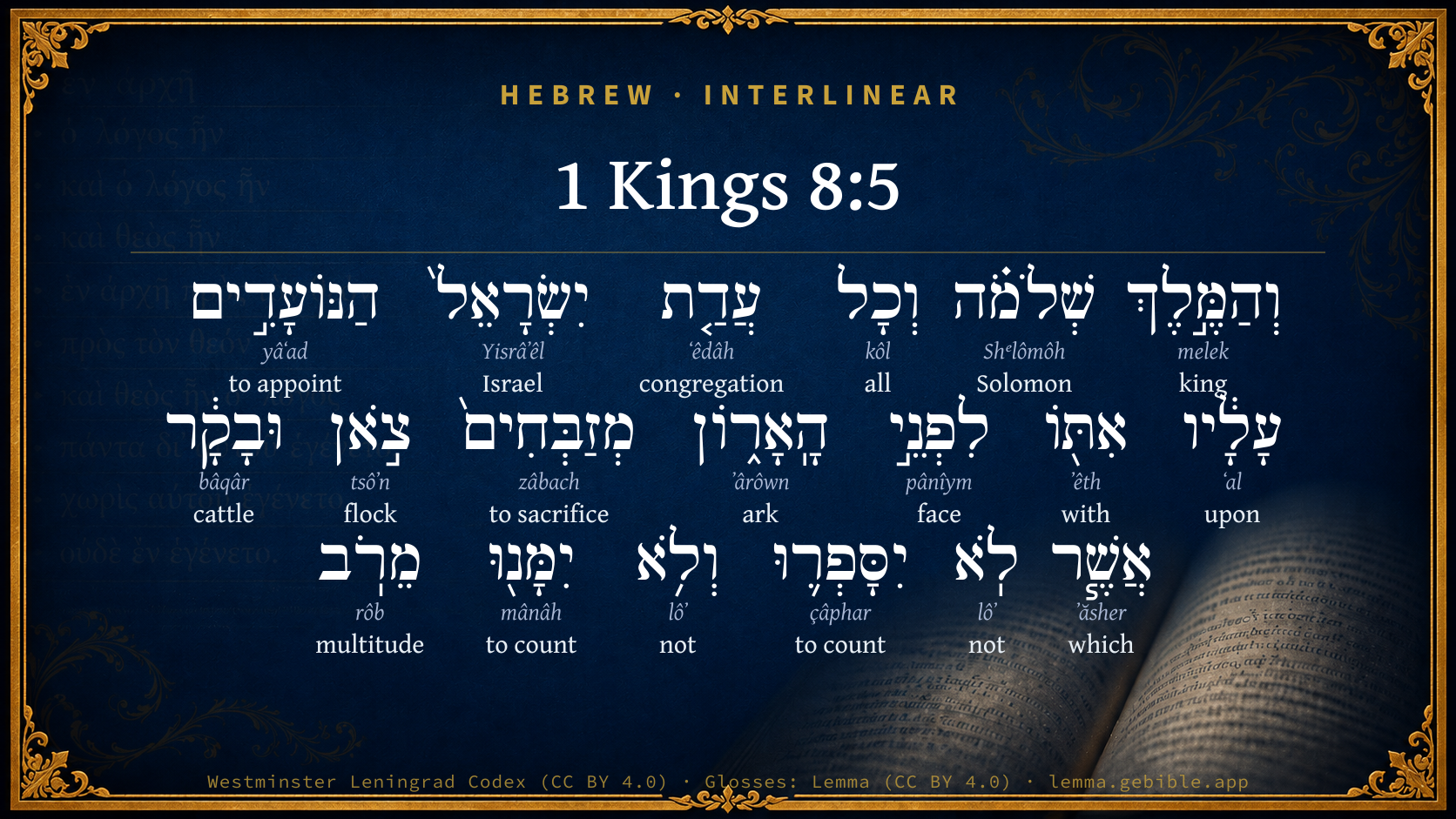
1 Kings 8:5

Hebrew (Westminster Leningrad Codex) 1 Kings 8:5 appears in the Hebrew Old Testament. The text above is from the Westminster Leningrad Codex. Each word links to its Strong’s number, a concise gloss, and parsing drawn from the Open Scriptures Hebrew Bible morphology. Click any word for its full Brown-Driver-Briggs (BDB) entry.
Download image
Cite this verse

1 Kings 8:5 (World English Bible). Public Domain. Lemma interlinear Bible study tool, https://lemma.gebible.app/v/1-kings/8/5.

Show BibTeX & RIS
BibTeX
RIS
English Translation
King Solomon and all the congregation of Israel, who were assembled to him, were with him before the ark, sacrificing sheep and oxen, that could not be counted nor numbered for multitude.
World English Bible · Public Domain
Download a study sheet

One document with this verse’s original text, its word-by-word gloss line, the meaning frame, cross-references with their text, attributed commentary, and full source and license credits — printable, and it pastes into notes with its structure intact.

This verse Autodidact and up

Study sheet (.html) Plain text (.txt)

A passage Seminary Student

Up to 50 verses in one chapter. A passage sheet keeps up to 6 commentary sources and 12 cross-references per verse, in the order this page ranks them, and says so on the sheet whenever that leaves anything out. Ask for a single verse and you get the Autodidact verse sheet above.

Everything on this page stays free to read, with no account — the sheet is a download of what is already on screen, not access to it.

Want to remove ads? Support Godless Engineer
Compare translations 3

The same verse in 3 English versions, stacked beneath the original-language interlinear above. Click any original word for its lexicon entry.

Each is an independent rendering of the whole verse — the interlinear is not word-aligned to these translations.

Highlighted words mark where these versions differ — a whole-verse word diff, not a word-by-word alignment.

  • World English Bible Public Domain
    King Solomon and all the congregation of Israel, who were assembled to him, were with him before the ark, sacrificing sheep and oxen, that could not be counted nor numbered for multitude.
  • King James Version Public Domain
    And king Solomon, and all the congregation of Israel, that were assembled unto him, were with him before the ark, sacrificing sheep and oxen, that could not be told nor numbered for multitude.
  • unfoldingWord Literal Text CC BY-SA 4.0
    And King Solomon and all of the congregation of Israel, the ones having congregated themselves to him, with him to the face of the Box, were sacrificing sheep and cattle that were not counted and were not numbered from abundance.

unfoldingWord Literal Text — © unfoldingWord, licensed CC BY-SA 4.0. Word-aligned USFM3 via Door43 (git.door43.org/unfoldingWord/en_ult).

Versions to compare (up to 4)

3 of 4 selected

Show all 18 translations

Every available English version of this verse, each an independent rendering of the whole verse.

  • World English Bible Public Domain
    King Solomon and all the congregation of Israel, who were assembled to him, were with him before the ark, sacrificing sheep and oxen, that could not be counted nor numbered for multitude.
  • Berean Standard Bible Public Domain
    There, before the ark, King Solomon and the whole congregation of Israel who had assembled with him sacrificed so many sheep and oxen that they could not be counted or numbered.
  • Majority Standard Bible Public Domain
    There, before the ark, King Solomon and the whole congregation of Israel who had assembled with him sacrificed so many sheep and oxen that they could not be counted or numbered.
  • King James Version Public Domain
    And king Solomon, and all the congregation of Israel, that were assembled unto him, were with him before the ark, sacrificing sheep and oxen, that could not be told nor numbered for multitude.
  • American Standard Version (1901) Public Domain
    And king Solomon and all the congregation of Israel, that were assembled unto him, were with him before the ark, sacrificing sheep and oxen, that could not be counted nor numbered for multitude.
  • Revised Version (1885) Public Domain
    And king Solomon and all the congregation of Israel, that were assembled unto him, were with him before the ark, sacrificing sheep and oxen, that could not be told nor numbered for multitude.
  • Geneva Bible (1599) Public Domain
    And King Salomon and all the Congregation of Israel, that were assembled vnto him, were with him before the Arke, offering sheepe and beeues, which could not be tolde, nor nombred for multitude.
  • Douay-Rheims (1899) Public Domain
    And king Solomon, and all the multitude of Israel, that were assembled unto him went with him before the ark, and they sacrificed sheep and oxen that could not be counted or numbered.
  • Young's Literal Translation Public Domain
    And king Solomon and all the company of Israel who are met unto him `are' with him before the ark, sacrificing sheep and oxen, that are not counted nor numbered for multitude.
  • Literal Standard Version CC BY-SA 4.0
    And King Solomon and all the congregation of Israel who are assembled to him [are] with him before the Ark, sacrificing sheep and oxen, that are not counted nor numbered for multitude.
  • Unlocked Literal Bible CC BY-SA 4.0
    King Solomon and all the assembly of Israel came together before the ark, sacrificing sheep and oxen that could not be counted.
  • unfoldingWord Literal Text CC BY-SA 4.0
    And King Solomon and all of the congregation of Israel, the ones having congregated themselves to him, with him to the face of the Box, were sacrificing sheep and cattle that were not counted and were not numbered from abundance.
  • Darby Bible Public Domain
    And king Solomon, and all the assembly of Israel that were assembled to him, [who were] with him before the ark, sacrificed sheep and oxen, which could not be counted nor numbered for multitude.
  • World Messianic Bible Public Domain
    King Solomon and all the congregation of Israel, who were assembled to him, were with him before the ark, sacrificing sheep and cattle that could not be counted or numbered for multitude.
  • Webster's Bible Public Domain
    And king Solomon, and all the congregation of Israel, that were assembled to him, were with him before the ark, sacrificing sheep and oxen, that could not be told nor numbered for multitude.
  • Free Bible Version CC BY-SA 4.0
    In front of the Ark, King Solomon and all the congregation of Israel who had gathered there with him sacrificed many, many sheep and bulls—so numerous they couldn't be counted!
  • Bible in Basic English Public Domain
    And King Solomon and all the men of Israel who had come together there, were with him before the ark, making offerings of sheep and oxen more than might be numbered.
  • JPS Tanakh (1917) Public Domain
    And king Solomon and all the congregation of Israel, that were assembled unto him, were with him before the ark, sacrificing sheep and oxen, that could not be told nor numbered for multitude.

Literal Standard Version (2020), Covenant Press — licensed CC BY-SA 4.0. Text via the HelloAO Bible API (eBible.org). Unlocked Literal Bible (unfoldingWord) — licensed CC BY-SA 4.0. Text via the HelloAO Bible API (eBible.org). unfoldingWord Literal Text — © unfoldingWord, licensed CC BY-SA 4.0. Word-aligned USFM3 via Door43 (git.door43.org/unfoldingWord/en_ult). Free Bible Version, Dr. Jonathan Gallagher — licensed CC BY-SA 4.0. Text via the HelloAO Bible API (eBible.org).

Word by word

More ways to search: Search by grammar → Find every occurrence → Compare this word →

Practice this passage: Drill this verse → Learn its vocabulary →

יִמָּנ֖וּ
mânâh
H4487
“to count”
Verb, Niphal, Imperfect, 3rd Person, Masculine, Plural
Part of Speech
Verb
Stem
Niphal
Form
Imperfect
Person
3rd Person
Gender
Masculine
Number
Plural
Full BDB Definition

Origin: a primitive root

TWOT: 1213

to count, reckon, number, assign, tell, appoint, prepare - (Qal) - to count, number - reckon, assign, appoint - (Niphal) - to be counted, be numbered - to be reckoned, be assigned - (Piel) to appoint, ordain - (Pual) appointed (participle)
  1. וְהַמֶּ֣לֶךְ melek H4428 “and · the · king” Conjunction + Particle, Definite Article + Noun, Common, Masculine, Singular, Absolute
  2. שְׁלֹמֹ֗ה Shᵉlômôh H8010 “Solomon” Noun, Proper
  3. וְכָל kôl H3605 “and · all of” Conjunction + Noun, Common, Masculine, Singular, Construct
  4. עֲדַ֤ת ʻêdâh H5712 “congregation of” Noun, Common, Feminine, Singular, Construct
  5. יִשְׂרָאֵל֙ Yisrâʼêl H3478 “Israel” Noun, Proper
  6. הַנּוֹעָדִ֣ים yâʻad H3259 “the · appointing” Particle, Definite Article + Verb, Niphal, Participle Active, Masculine, Plural, Absolute
  7. עָלָ֔יו ʻal H5921 “upon · him” Preposition + Suffix, Personal, 3rd Person, Masculine, Singular
  8. אִתּ֖וֹ ʼêth H854 “with · him” Preposition + Suffix, Personal, 3rd Person, Masculine, Singular
  9. לִפְנֵ֣י pânîym H6440 “to/for · face(s) of” Preposition + Noun, Common, Both, Plural, Construct
  10. הָֽאָר֑וֹן ʼârôwn H727 “the · ark” Particle, Definite Article + Noun, Common, Both, Singular, Absolute
  11. מְזַבְּחִים֙ zâbach H2076 “sacrificing” Verb, Piel, Participle Active, Masculine, Plural, Absolute
  12. צֹ֣אן tsôʼn H6629 “flock” Noun, Common, Both, Singular, Absolute
  13. וּבָקָ֔ר bâqâr H1241 “and · cattle” Conjunction + Noun, Common, Both, Singular, Absolute
  14. אֲשֶׁ֧ר ʼăsher H834 “which” Particle, Relative
  15. לֹֽא lôʼ H3808 “not” Particle, Negative
  16. יִסָּפְר֛וּ çâphar H5608 “to count” Verb, Niphal, Imperfect, 3rd Person, Masculine, Plural
  17. וְלֹ֥א lôʼ H3808 “and · not” Conjunction + Particle, Negative
  18. מֵרֹֽב rôb H7230 “from · multitude” Preposition + Noun, Common, Both, Singular, Absolute

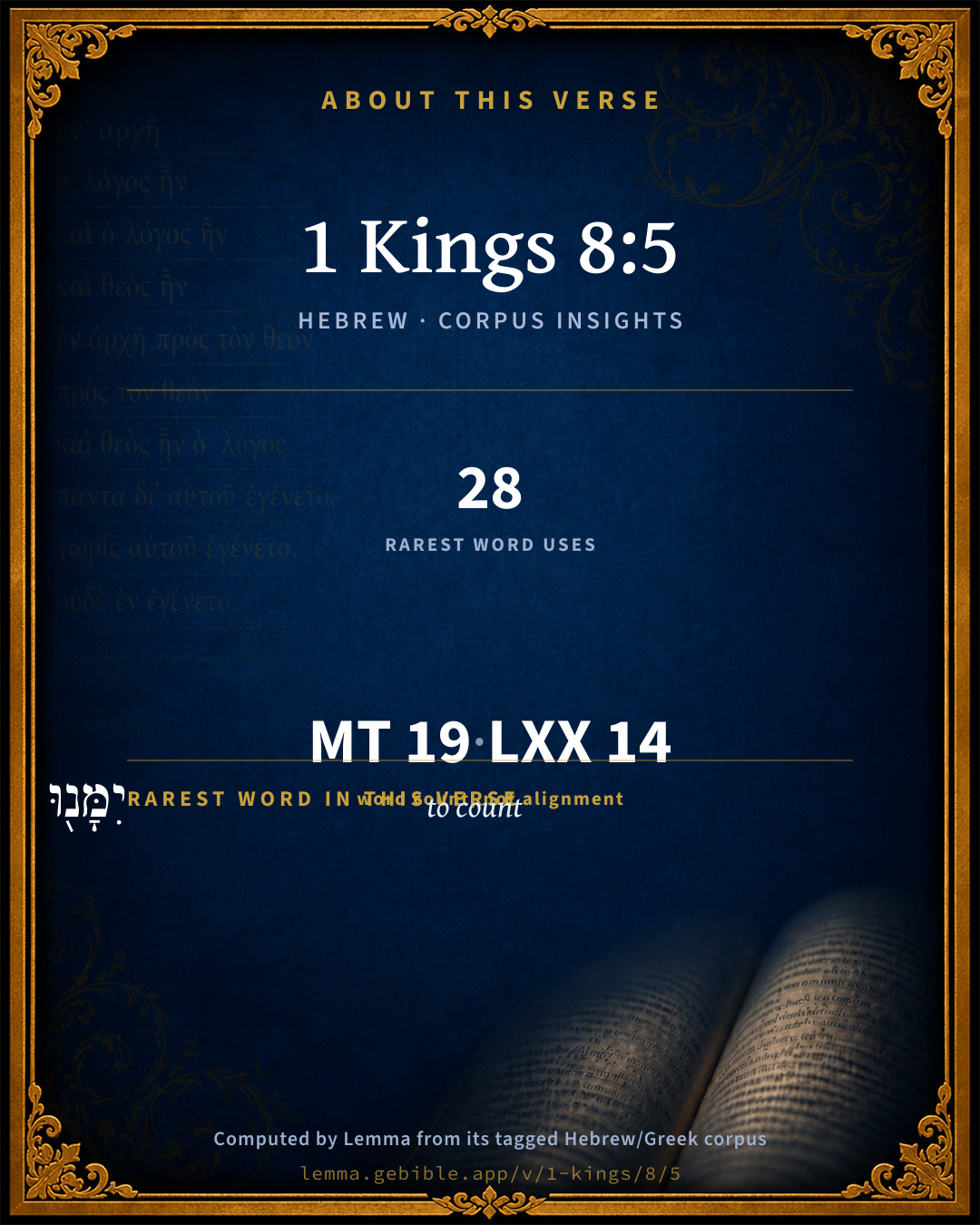
About this verse

These counts appear in no published source. They are computed here, from the morphology-tagged text and Lemma’s own curated glosses. What Lemma adds →

19
words
18
distinct lemmas
Historical
section

Shared distinctive vocabulary

יִמָּנ֖וּ to count H4487 occurs in 27 verses of the Hebrew Bible. Also found in:

Grammatical profile

  • 4 verbs
  • 10 nouns
  • 2 prepositions
  • 3 particles

Verb forms

  • הַנּוֹעָדִ֣ים Niphal · Participle Active
  • מְזַבְּחִים֙ Piel · Participle Active
  • יִסָּפְר֛וּ Niphal · Imperfect
  • יִמָּנ֖וּ Niphal · Imperfect

Repetition

A word recurs within this verse — often emphatic in Hebrew:

Hebrew & Septuagint length

In English translation the verse runs 32 words from the Hebrew and 17 from the Septuagint (LXX English) — the Septuagint runs noticeably shorter here. See the side-by-side →

A rough comparison of the two English renderings, which tokenize alike — not a word-level alignment.

Word counts can differ between the Hebrew and the Greek without any difference in meaning — e.g. the Hebrew direct-object marker אֵת has no separate Greek word, and Greek often adds the article ὁ.

In the original languages it is 19 Hebrew tokens and 14 Greek tokens — but the two are counted differently (Hebrew bundles its prefixes and suffixes into one token; the Greek is in lemma form), so that isn’t a like-for-like length.

Cross-references

3

Topical passages linked to 1 Kings 8:5 in the Treasury of Scripture Knowledge — connected by theme and wording, ordered by reader-vote popularity; previews shown in the World English Bible.

  • 2 Samuel 6:13 It was so, that, when those who bore the ark of Yahweh had gone six paces, he sacrificed an ox and a fattened calf.
  • 1 Kings 8:62–63 The king, and all Israel with him, offered sacrifice before Yahweh.
  • 1 Chronicles 16:1 They brought in the ark of God, and set it in the midst of the tent that David had pitched for it: and they offered burnt offerings and peace-offerings before God.

Cross-references courtesy of OpenBible.info (CC BY 4.0).

Hebrew and Greek witnesses Masoretic Hebrew ↔ Greek Septuagint

The same verse in the two great witnesses to the Old Testament, shown verse-for-verse.

Here the Septuagint runs noticeably shorter than the Hebrew — LXX2012 (modern English Septuagint) 17 words vs World English Bible 32. A rough length comparison of the two English translations, not a word-level alignment — read both below.

These are two independent witnesses, not word-aligned to each other, and the Septuagint is shown in lemma (dictionary) form.

Hebrew 1 Kings 8:5 Masoretic · Westminster Leningrad Codex

וְהַמֶּ֣לֶךְ שְׁלֹמֹ֗ה וְכָל עֲדַ֤ת יִשְׂרָאֵל֙ הַנּוֹעָדִ֣ים עָלָ֔יו אִתּ֖וֹ לִפְנֵ֣י הָֽאָר֑וֹן מְזַבְּחִים֙ צֹ֣אן וּבָקָ֔ר אֲשֶׁ֧ר לֹֽא יִסָּפְר֛וּ וְלֹ֥א יִמָּנ֖וּ מֵרֹֽב

King Solomon and all the congregation of Israel, who were assembled to him, were with him before the ark, sacrificing sheep and oxen, that could not be counted nor numbered for multitude.

World English Bible · Public Domain

Greek LXX 1 Kings 8:5 Septuagint · lemma form

καί ὁ βασιλεύς καί πᾶς ἰσραήλ ἔμπροσθεν ὁ κιβωτός θύω πρόβατον καί βοῦς ἀναρίθμητος

And the king and all Israel were occupied before the ark, sacrificing sheep and oxen, without number.

LXX2012 (modern English Septuagint) · Public Domain

Hebrew: Westminster Leningrad Codex (CC BY 4.0). Greek: Septuagint (public domain); English from LXX2012 (modern English Septuagint) (Public Domain). How the Septuagint differs from the Hebrew →

Targum (Aramaic paraphrase)

1

The Targum is the ancient Jewish Aramaic paraphrase of the Hebrew Scriptures — an interpretive translation, not the Hebrew text itself. Onkelos (literal) and Pseudo-Jonathan (expansive) render the Torah, and Jonathan the Prophets. Coverage is partial: where no permissively-licensed English translation exists for a verse, only the Aramaic is shown. This is verse-level text, not a word-by-word alignment to the Hebrew.

  1. Targum Jonathan Prophets (Joshua–Malachi)
    וּמַלְכָּא שְׁלֹמֹה וְכָל כְּנִשְׁתָּא דְיִשְׂרָאֵל דְאִזְדַמְנוּ עֲלוֹהִי קַיְמִין עִמֵיהּ קֳדָם אֲרוֹנָא מִנַכְסִין עָאן וְתוֹרִין דְלָא יִתְחַשְׁבוּן וְלָא יִתְמְנוּן מִסְגֵי:

    (no public-domain English translation for this verse)

    Targum Jonathan — Aramaic: “Mikraot Gedolot” (public domain). English: “Sefaria Community Translation” (CC0 1.0 (public-domain dedication)); “London "Chaldee Paraphrase," 1871” (public domain). Text via Sefaria.

Commentary

Notes on 1 Kings 8:5 from classic Christian and Jewish commentators (each source and its license shown beneath its notes). The classic Christian expositions comment on the surrounding passage and are grouped to its opening verse, so a note may address several verses; the Jewish commentaries on the Tanakh (Rashi and others) are per-verse, so they appear only where the commentator wrote on this verse.

Lemma curates 59 commentaries, every one of them public domain or Creative Commons licensed, each selected and text-cleaned for this edition rather than reprinted as found. About our sources →

Trapp's Complete Commentary

John Trapp

1Ki 8:5 And king Solomon, and all the congregation of Israel, that were assembled unto him, [were] with him before the ark, sacrificing sheep and oxen, that could not be told nor numbered for multitude.

Ver. 5. Sacrificing sheep and oxen.] At every six paces likely, as 2Sa 6:13, but far more liberally.

John Trapp, A Commentary or Exposition upon All the Books of the Old and New Testament (1647–1656) — public domain. Text from a community e-Sword module.

Joseph Benson's Commentary

1Ki 8:5. King Solomon, and all the congregation with him before the ark — This ceremony of removing the ark from the tabernacle which David had erected for it, to the temple, and depositing it in the most holy place, was opened with a pompous procession. The king himself, accompanied by all his chief officers and the elders of Israel, marched before the ark; these were followed by a great number of priests and Levites, who sung some canticles proper to the occasion, and played upon various instruments. Next to the ark followed another number of singers and players, with other priests bearing the tabernacle and the sacred utensils of the sanctuary, which had been brought from Gibeon. While the priests were placing the ark in the most holy place, the air rung with the sound of a hundred and twenty trumpets, and with the voices of the Levites, who sang the praises of God, repeating these words at proper intervals; Give thanks to the Lord, for he is good; and his mercy endureth for ever. It was then that God seemed to come down in a visible manner, to take possession, as it were, of his new temple, by filling it with a glorious cloud, as he had formerly done the tabernacle; insomuch that the priests could not stand to offer up the sacrifices which they had prepared upon that occasion. See Universal Hist. Sacrificing sheep and oxen that could not be numbered — When the ark was seated in its place; for although they might in the way offer some sacrifices, as David did, yet that was not a proper season to offer so many sacrifices as could not be numbered. This is more particularly related below, (1Ki 8:62-64,) and is here only mentioned by way of anticipation.

Joseph Benson's Commentary on the Old and New Testaments (1811–1818) — public domain. Text from a community e-Sword module.

Tyndale Open Study Notes

Tyndale Open Resources

8:5 The incalculable sacrifices by the Israelites marked both the joy and the solemnity of this occasion.

Tyndale Open Study Notes — © Tyndale Open Resources, licensed CC BY-SA 4.0. Text via the HelloAO Bible API.

Ellicott's Commentary for English Readers

(5) Sacrificing.—This inaugural sacrifice corresponded on a grand scale to the ceremonial of the day, when David brought up the ark to Zion. “When they that bare the ark of the Lord had gone six paces, he sacrificed oxen and fatlings,” “seven bullocks and seven rams” (2Sa_6:13; 1Ch_15:26). It was offered “before the ark,” either as it left Mount Zion, or on arrival in the Temple, before it passed out of sight into the oracle.

A Bible Commentary for English Readers, edited by Charles John Ellicott (1878–1897) — public domain. Text from a community e-Sword module.

The Cambridge Bible for Schools and Colleges

gen. ed. J. J. S. Perowne

5. were with him before the ark] This must refer to the time when the great procession had reached the Temple court. At that spot the ark was set down, and king and people joined in a solemn sacrifice, before the priests bore the ark into the most holy place.

The Cambridge Bible for Schools and Colleges (gen. ed. J. J. S. Perowne; Cambridge University Press, 1878–1918) — public domain. Text from a community e-Sword module.

John Gill's Exposition

And King Solomon, and all the congregation of Israel, that were assembled together,.... On this solemn occasion:

were with him before the ark; while it was in the court of the priests, before it was carried into the most holy place:

sacrificing sheep and oxen, that could not be told nor numbered for multitude; the phrase seems to be hyperbolical, and designed to denote a great number.

John Gill's Exposition of the Whole Bible (1746–1763) — public domain (CC PDM 1.0). Text via the HelloAO Bible API.

Haydock's Catholic Bible Commentary

Sacrificed, by the hands of the priests, (Menochius) or at least (Haydock) gave them the blood to offer upon the altars, which were placed at six paces from one another, in imitation of David, 2 Kings vi. 13. (Calmet) --- Could not. See chap. vii. 47.

George Leo Haydock (1774–1849), Haydock's Catholic Family Bible and Commentary, 1859 edition — public domain. Excludes Psalms (Douay-Rheims chapter numbering differs from Protestant) and Deuterocanonical books (Catholic canon only).

Matthew Poole's English Annotations

Sacrificing sheep and oxen; either, first, In the way, David did upon the like occasion, 2Sa 6:13. Or, secondly, When the ark was come into the priests’ court, where the altar stood, whence it was speedily to be conveyed to that place where the people could never behold it more. Or rather, thirdly, When the ark was seated in its place; for although they might in the way or passage offer some sacrifices, as David did; yet that was not a proper season to offer so many sacrifices as could not be told nor numbered, as these are here said to be; which far better agrees with what is more particularly related below, 1Ki 8:62-64, which is here signified in the general by way of anticipation, as is frequently done in the Scripture in like cases.

Matthew Poole's English Annotations on the Holy Bible (1683–1685) — public domain. Text from a community e-Sword/MySword module.

Whedon's Commentary on the Bible

Daniel D. Whedon

5. Before the ark, sacrificing — Not, as the Vulgate, were walking with him before the ark; or, as Josephus, “the king and all the people went before, rendering the ground moist with sacrifices.” But rather, before the ark was borne into the temple, Solomon and all the multitude assembled in front of it, that is, in sight of it, and offered sacrifices. Thus Thenius: “The ark has already reached the inner court, and there, before it is brought into its appointed place, while it is set down for the time upon the steps of the porch, the king and people offer a solemn sacrifice in its presence.”

Could not be told — See note on 1Ki_3:4.

Daniel D. Whedon (gen. ed.), Commentary on the Old and New Testaments (1874–1909) — public domain. Text from a community e-Sword module.

The Pulpit Commentary

And king Solomon, and all the congregation of Israel, that were assembled unto him were with him; before the ark Prayers and sacrifices alike were offered toward the mercy seat, (Psa_28:2; cf. Exo_25:22) sacrificing sheep and oxen apparently the ark festal en route (cf. 2Sa_6:18) whilst the sacrifices were offered. The object of the sacrifice was to testify the grateful joy of the people at the proximate realization of their hopes. There may have been also in the background the idea of averting the Divine anger, of making a propitiation for possible errors and imperfections in their service. There were tragedies connected with the removal of the ark in time past (1Sa_4:17 2Sa_6:7) which, we may be sure, were not altogether forgotten on this occasion that could not be told or numbered for multitude. (Cf. 2Sa_6:13) But the sacrifices on that occasion were on a much smaller scale. (1Ch_15:26) Josephus adds (Ant. 8:4. 1), that a vast quantity of incense was burnt, and that men preceded the ark, singing and dancing, until it reached its destination) .

The Pulpit Commentary (1880–1919), ed. H.D.M. Spence-Jones & Joseph S. Exell — public domain. Text from a community e-Sword module.

John Wesley's Explanatory Notes

Sacrificing - When the ark was seated in its place: for although they might in the way offer some sacrifices, as David did; yet that was not a proper season to offer so many sacrifices as could not be numbered. This is more particularly related below, ver. 62, 63, 64, which is here signified by way of anticipation.

John Wesley, Explanatory Notes Upon the Whole Bible (1754–1765) — public domain. Text via the GEBible commentary corpus.

Lesson kit

Teaching starters — assembled from the data on this page, not authored interpretation. Every prompt links to the verse data it draws on. Edit before teaching.

1 Kings, in the Historical, opens this verse with 19 words (18 distinct Hebrew lemmas). Its most distinctive word is mânâh (“to count”). The Greek Septuagint runs shorter here. A historical commentator’s framing appears above. Read the whole chapter for the surrounding context.

Discussion questions

  1. How does “to count” (mânâh) shape what this verse is saying?
  2. Genesis 13:16 shares the word «to count» with this verse. How do the two illuminate each other?
  3. “not” occurs 2× in this one verse. What is the effect of the repetition?
  4. Compared with the Hebrew, the Septuagint runs shorter here. What questions does that raise?
  5. These translations render this verse differently. What is at stake in choosing one wording over another?
  6. The verb «הַנּוֹעָדִ֣ים» is Niphal Participle Active. How does its form color the action?
  7. Reading how Trapp's Complete Commentary and Joseph Benson's Commentary read this verse, where do the two commentators agree and where do they part?

Things to notice

Reading settings

Reading text

Shown beneath each verse's original-language words.

Old Testament
Old Testament edition

Read the OT as the Masoretic Hebrew (MT) or the Greek Septuagint (LXX).

English shown for the Greek Septuagint (in the Hebrew ↔ Greek comparison).

Comparing translations? Open the Compare panel on any verse page to stack up to four side by side.