Song of Solomon 1:8

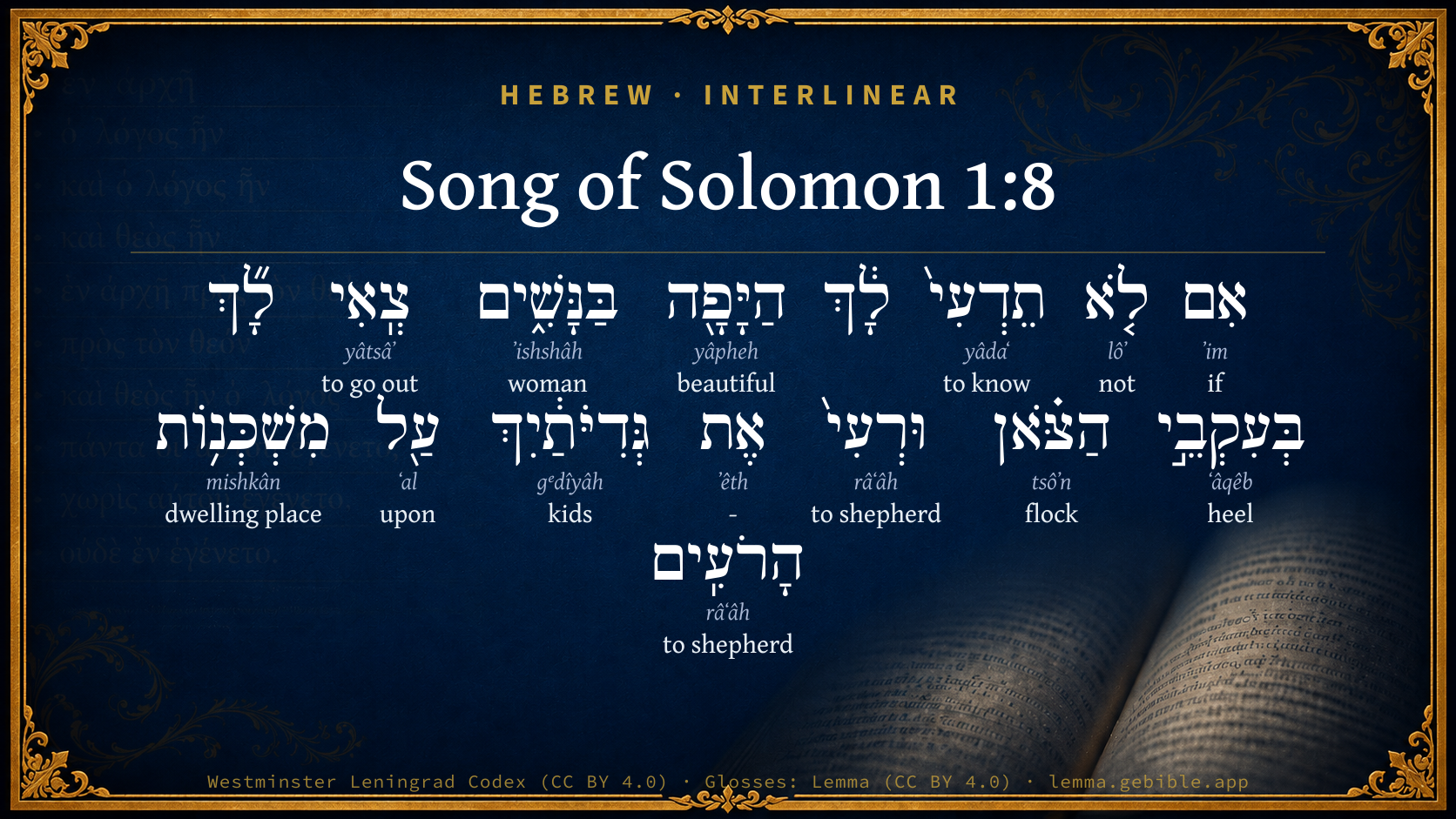
Hebrew (Westminster Leningrad Codex) Song of Solomon 1:8 appears in the Hebrew Old Testament. The text above is from the Westminster Leningrad Codex. Each word links to its Strong’s number, a concise gloss, and parsing drawn from the Open Scriptures Hebrew Bible morphology. Click any word for its full Brown-Driver-Briggs (BDB) entry.
Download image
Cite this verse

Song of Solomon 1:8 (World English Bible). Public Domain. Lemma interlinear Bible study tool, https://lemma.gebible.app/v/song-of-solomon/1/8.

Show BibTeX & RIS
BibTeX
RIS
English Translation
If you don't know, most beautiful among women, Follow the tracks of the sheep. Graze your young goats beside the shepherds' tents.
World English Bible · Public Domain
Highlights
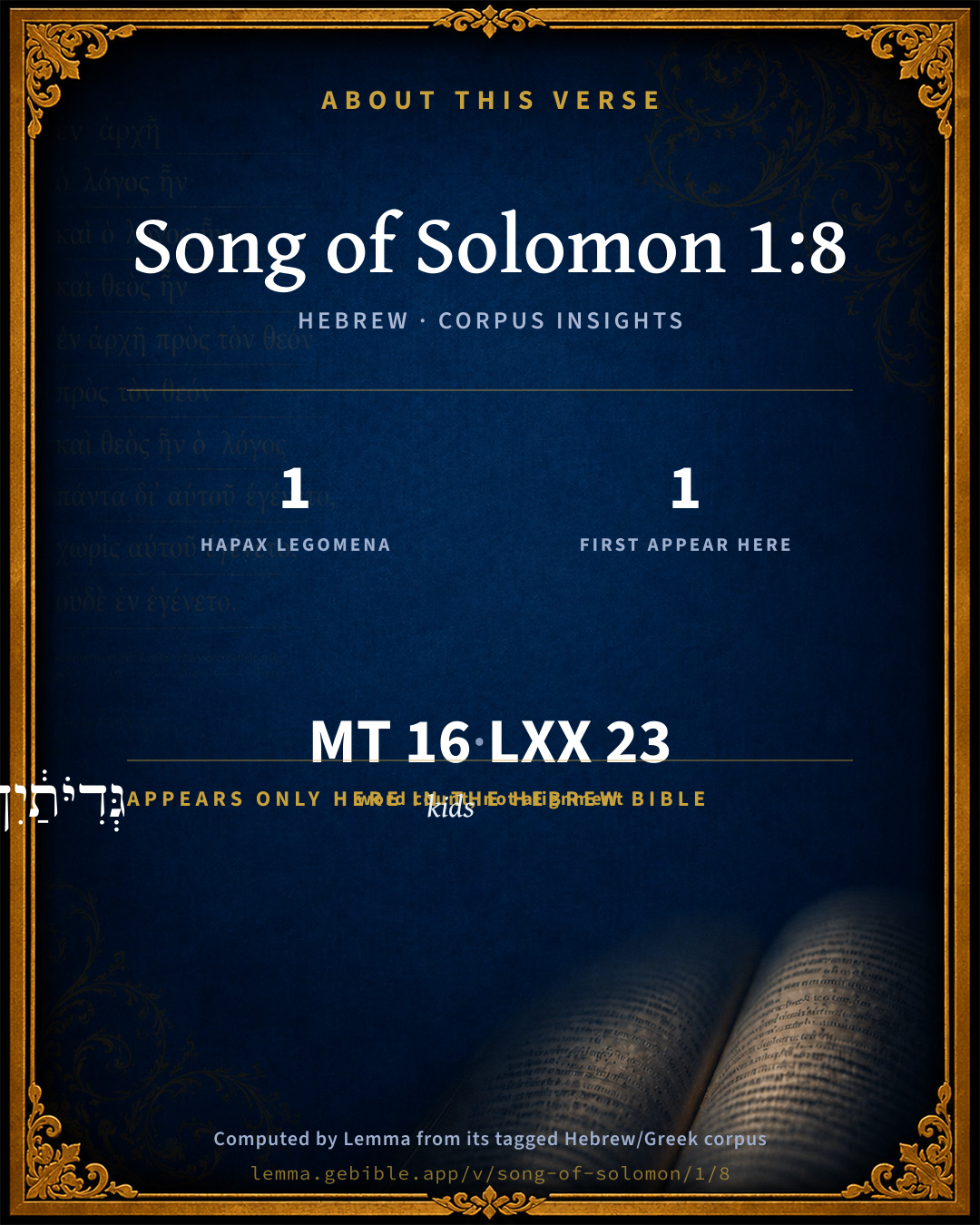
  • 1 hapax legomenon — only here in the Hebrew Bible
  • 1 first appearance in the Hebrew Bible
Full analysis ↓
Download a study sheet

One document with this verse’s original text, its word-by-word gloss line, the meaning frame, cross-references with their text, attributed commentary, and full source and license credits — printable, and it pastes into notes with its structure intact.

This verse Autodidact and up

Study sheet (.html) Plain text (.txt)

A passage Seminary Student

Up to 50 verses in one chapter. A passage sheet keeps up to 6 commentary sources and 12 cross-references per verse, in the order this page ranks them, and says so on the sheet whenever that leaves anything out. Ask for a single verse and you get the Autodidact verse sheet above.

Everything on this page stays free to read, with no account — the sheet is a download of what is already on screen, not access to it.

Want to remove ads? Support Godless Engineer
Compare translations 3

The same verse in 3 English versions, stacked beneath the original-language interlinear above. Click any original word for its lexicon entry.

Each is an independent rendering of the whole verse — the interlinear is not word-aligned to these translations.

Highlighted words mark where these versions differ — a whole-verse word diff, not a word-by-word alignment.

  • World English Bible Public Domain
    If you don't know, most beautiful among women, Follow the tracks of the sheep. Graze your young goats beside the shepherds' tents.
  • King James Version Public Domain
    If thou know not, O thou fairest among women, go thy way forth by the footsteps of the flock, and feed thy kids beside the shepherds' tents.
  • unfoldingWord Literal Text CC BY-SA 4.0
    If you do not know, most beautiful among women, go out in the footprints of the flock, and pasture your young goats beside the tents of the shepherds.

unfoldingWord Literal Text — © unfoldingWord, licensed CC BY-SA 4.0. Word-aligned USFM3 via Door43 (git.door43.org/unfoldingWord/en_ult).

Versions to compare (up to 4)

3 of 4 selected

Show all 18 translations

Every available English version of this verse, each an independent rendering of the whole verse.

  • World English Bible Public Domain
    If you don't know, most beautiful among women, Follow the tracks of the sheep. Graze your young goats beside the shepherds' tents.
  • Berean Standard Bible Public Domain
    If you do not know, O fairest of women, follow the tracks of the flock, and graze your young goats near the tents of the shepherds.
  • Majority Standard Bible Public Domain
    If you do not know, O fairest of women, follow the tracks of the flock, and graze your young goats near the tents of the shepherds.
  • King James Version Public Domain
    If thou know not, O thou fairest among women, go thy way forth by the footsteps of the flock, and feed thy kids beside the shepherds' tents.
  • American Standard Version (1901) Public Domain
    If thou know not, O thou fairest among women, Go thy way forth by the footsteps of the flock, And feed thy kids beside the shepherds' tents.
  • Revised Version (1885) Public Domain
    If thou know not, O thou fairest among women, go thy way forth by the footsteps of the flock, and feed thy kids beside the shepherds’ tents.
  • Geneva Bible (1599) Public Domain
    I haue compared thee, O my loue, to the troupe of horses in the charets of Pharaoh.
  • Douay-Rheims (1899) Public Domain
    To my company of horsemen, in Pharao's chariots, have I likened thee, O my love.
  • Young's Literal Translation Public Domain
    If thou knowest not, O fair among women, Get thee forth by the traces of the flock, And feed thy kids by the shepherds' dwellings!
  • Literal Standard Version CC BY-SA 4.0
    If you do not know, || O beautiful among women, || Go forth by the traces of the flock, || And feed your kids by the shepherds’ dwellings!
  • Unlocked Literal Bible CC BY-SA 4.0
    If you do not know, most beautiful among women, follow the tracks of my flock, and pasture your young goats near the shepherds' tents.
  • unfoldingWord Literal Text CC BY-SA 4.0
    If you do not know, most beautiful among women, go out in the footprints of the flock, and pasture your young goats beside the tents of the shepherds.
  • Darby Bible Public Domain
    If thou know not, thou fairest among women, Go thy way forth by the footsteps of the flock, And feed thy kids beside the shepherds' booths.
  • World Messianic Bible Public Domain
    If you don’t know, most beautiful among women, follow the tracks of the sheep. Graze your young goats beside the shepherds’ tents.
  • Webster's Bible Public Domain
    If thou knowest not, O thou fairest among women, go forth by the footsteps of the flock, and feed thy kids beside the shepherds tents.
  • Free Bible Version CC BY-SA 4.0
    If you really don't know, you who are more beautiful than any other woman, then follow the tracks of my flock, and let your goats graze near the shepherd's tents.
  • Bible in Basic English Public Domain
    If you have not knowledge, O most beautiful among women, go on your way in the footsteps of the flock, and give your young goats food by the tents of the keepers.
  • JPS Tanakh (1917) Public Domain
    If thou know not, O thou fairest among women, go thy way forth by the footsteps of the flock and feed thy kids, beside the shepherds' tents.

Literal Standard Version (2020), Covenant Press — licensed CC BY-SA 4.0. Text via the HelloAO Bible API (eBible.org). Unlocked Literal Bible (unfoldingWord) — licensed CC BY-SA 4.0. Text via the HelloAO Bible API (eBible.org). unfoldingWord Literal Text — © unfoldingWord, licensed CC BY-SA 4.0. Word-aligned USFM3 via Door43 (git.door43.org/unfoldingWord/en_ult). Free Bible Version, Dr. Jonathan Gallagher — licensed CC BY-SA 4.0. Text via the HelloAO Bible API (eBible.org).

Word by word

More ways to search: Search by grammar → Find every occurrence → Compare this word →

Practice this passage: Drill this verse → Learn its vocabulary →

גְּדִיֹּתַ֔יִךְ
gᵉdîyâh
H1429
“kids · your”
Noun, Common, Feminine, Plural, Construct + Suffix, Personal, 2nd Person, Feminine, Singular
Part of Speech
Noun
Type
Common
Gender
Feminine
Number
Plural
State
Construct
Full BDB Definition

Origin: from H1423

TWOT: 314c

kids, young female goats
  1. אִם ʼim H518 “if” Conjunction
  2. לֹ֤א lôʼ H3808 “not” Particle, Negative
  3. תֵדְעִי֙ yâdaʻ H3045 “to know” Verb, Qal, Imperfect, 2nd Person, Feminine, Singular
  4. הַיָּפָ֖ה yâpheh H3303 “the · beautiful” Particle, Definite Article + Adjective, Adjective, Feminine, Singular, Absolute
  5. בַּנָּשִׁ֑ים ʼishshâh H802 “in/at the · women” Preposition, Determined + Noun, Common, Feminine, Plural, Absolute
  6. צְֽאִי yâtsâʼ H3318 “go out” Verb, Qal, Imperative, 2nd Person, Feminine, Singular
  7. בְּעִקְבֵ֣י ʻâqêb H6119 “in/at · heels of” Preposition + Noun, Common, Masculine, Plural, Construct
  8. הַצֹּ֗אן tsôʼn H6629 “the · flock” Particle, Definite Article + Noun, Common, Both, Singular, Absolute
  9. וּרְעִי֙ râʻâh H7462 “and · shepherd” Conjunction + Verb, Qal, Imperative, 2nd Person, Feminine, Singular
  10. אֶת ʼêth H853 “-” Particle, Direct Object
  11. עַ֖ל ʻal H5921 “upon” Preposition
  12. מִשְׁכְּנ֥וֹת mishkân H4908 “dwelling places of” Noun, Common, Masculine, Plural, Construct
  13. הָרֹעִֽים râʻâh H7462 “the · shepherding” Particle, Definite Article + Verb, Qal, Participle Active, Masculine, Plural, Absolute

About this verse

These counts appear in no published source. They are computed here, from the morphology-tagged text and Lemma’s own curated glosses. What Lemma adds →

16
words
13
distinct lemmas
Wisdom
section

Notable vocabulary

1 hapax legomenon — a word that appears only here in the entire Hebrew Bible:

  • גְּדִיֹּתַ֔יִךְ kids H1429

First appearance in Scripture

This word makes its first canonical appearance in the Hebrew Bible here:

  • גְּדִיֹּתַ֔יִךְ kids H1429

Shared distinctive vocabulary

בְּעִקְבֵ֣י heel H6119 occurs in 13 verses of the Hebrew Bible. Also found in:

Grammatical profile

  • 4 verbs
  • 5 nouns
  • 1 adjective
  • 3 prepositions
  • 1 conjunction
  • 2 particles

Verb forms

  • תֵדְעִי֙ Qal · Imperfect
  • צְֽאִי Qal · Imperative
  • וּרְעִי֙ Qal · Imperative
  • הָרֹעִֽים Qal · Participle Active

Repetition

A word recurs within this verse — often emphatic in Hebrew:

  • וּרְעִי֙ to shepherd H7462 ×2

Hebrew & Septuagint length

In English translation the verse runs 22 words from the Hebrew and 27 from the Septuagint (LXX English) — closely comparable.

A rough comparison of the two English renderings, which tokenize alike — not a word-level alignment.

Word counts can differ between the Hebrew and the Greek without any difference in meaning — e.g. the Hebrew direct-object marker אֵת has no separate Greek word, and Greek often adds the article ὁ.

In the original languages it is 16 Hebrew tokens and 23 Greek tokens — but the two are counted differently (Hebrew bundles its prefixes and suffixes into one token; the Greek is in lemma form), so that isn’t a like-for-like length.

Cross-references

25

Topical passages linked to Song of Solomon 1:8 in the Treasury of Scripture Knowledge — connected by theme and wording, ordered by reader-vote popularity; previews shown in the World English Bible.

  • Song of Solomon 6:1 Where has your beloved gone, you fairest among women? Where has your beloved turned, that we may seek him with you? Beloved
  • Song of Solomon 5:9 How is your beloved better than another beloved, You fairest among women? How is your beloved better than another beloved, That you do so adjure us? Beloved
  • Hebrews 11:4–40 By faith, Abel offered to God a more excellent sacrifice than Cain, through which he had testimony given to him that he was righteous, God bearing witness with respect to his gifts; and through it he, being dead, still speaks.
  • James 2:21 Wasn't Abraham our father justified by works, in that he offered up Isaac his son on the altar?
  • James 5:10 Take, brothers, for an example of suffering and of patience, the prophets who spoke in the name of the Lord.
  • Psalms 16:3 As for the saints who are in the earth, They are the excellent ones in whom is all my delight.
  • Psalms 45:11 So the king will desire your beauty, Honor him, for he is your lord.
  • Psalms 45:13 The princess inside is all glorious. Her clothing is interwoven with gold.
  • Proverbs 8:34 Blessed is the man who hears me, Watching daily at my gates, Waiting at my door posts.
  • Song of Solomon 1:15 Behold, you are beautiful, my love. Behold, you are beautiful. Your eyes are doves. Beloved
  • Song of Solomon 2:10 My beloved spoke, and said to me, Rise up, my love, my beautiful one, and come away.
  • Song of Solomon 4:1 Behold, you are beautiful, my love. Behold, you are beautiful. Your eyes are doves behind your veil. Your hair is as a flock of goats, That descend from Mount Gilead.
  • Song of Solomon 4:7 You are all beautiful, my love. There is no spot in you.
  • Song of Solomon 4:10 How beautiful is your love, my sister, my bride! How much better is your love than wine! The fragrance of your perfumes than all manner of spices!
  • Song of Solomon 6:4–10 You are beautiful, my love, as Tirzah, Lovely as Jerusalem, Awesome as an army with banners.
  • Song of Solomon 7:1–13 How beautiful are your feet in sandals, prince's daughter! Your rounded thighs are like jewels, The work of the hands of a skillful workman.
  • Jeremiah 6:16 Thus says Yahweh, Stand you in the ways and see, and ask for the old paths, where is the good way; and walk therein, and you shall find rest for your souls: but they said, We will not walk [therein].
  • John 21:15 So when they had eaten their breakfast, Jesus said to Simon Peter, "Simon, son of Jonah, do you love me more than these?" He said to him, "Yes, Lord; you know that I have affection for you." He said to him, "Feed my lambs."
  • 1 Corinthians 11:1 Be imitators of me, even as I also am of Christ.
  • Ephesians 5:27 that he might present the assembly to himself gloriously, not having spot or wrinkle or any such thing; but that it should be holy and without blemish.
  • Hebrews 6:12 that you won't be sluggish, but imitators of those who through faith and patience inherited the promises.
  • Hebrews 13:7 Remember your leaders, men who spoke to you the word of God, and considering the results of their conduct, imitate their faith.
  • 1 Peter 3:6 as Sarah obeyed Abraham, calling him lord, whose children you now are, if you do well, and are not put in fear by any terror.
  • Revelation 19:7–8 Let us rejoice and be exceedingly glad, and let us give the glory to him. For the marriage of the Lamb has come, and his wife has made herself ready."
  • James 2:25 In like manner wasn't Rahab the prostitute also justified by works, in that she received the messengers, and sent them out another way?

Cross-references courtesy of OpenBible.info (CC BY 4.0).

Hebrew and Greek witnesses Masoretic Hebrew ↔ Greek Septuagint

The same verse in the two great witnesses to the Old Testament, shown verse-for-verse.

These are two independent witnesses, not word-aligned to each other, and the Septuagint is shown in lemma (dictionary) form.

Hebrew Song of Solomon 1:8 Masoretic · Westminster Leningrad Codex

אִם לֹ֤א תֵדְעִי֙ לָ֔ךְ הַיָּפָ֖ה בַּנָּשִׁ֑ים צְֽאִי לָ֞ךְ בְּעִקְבֵ֣י הַצֹּ֗אן וּרְעִי֙ אֶת גְּדִיֹּתַ֔יִךְ עַ֖ל מִשְׁכְּנ֥וֹת הָרֹעִֽים

If you don't know, most beautiful among women, Follow the tracks of the sheep. Graze your young goats beside the shepherds' tents.

World English Bible · Public Domain

Greek LXX Song of Solomon 1:8 Septuagint · lemma form

ἐάν μή γιγνώσκω σεαυτοῦ ὁ καλός ἐν γυνή ἐκἔρχομαι σύ ἐν πτέρνη ὁ ποίμνιον καί ποιμαίνω ὁ ἔριφος σύ ἐπί σκήνωμα ὁ ποιμήν

If you know not yourself, you fair one among women, go you forth by the footsteps of the flocks, and feed your kids by the shepherd's tents.

LXX2012 (modern English Septuagint) · Public Domain

On this verse, Haydock's Catholic Bible Commentary discusses the Septuagint’s reading. Read the note in Commentary ↓

Hebrew: Westminster Leningrad Codex (CC BY 4.0). Greek: Septuagint (public domain); English from LXX2012 (modern English Septuagint) (Public Domain). How the Septuagint differs from the Hebrew →

Commentary

Notes on Song of Solomon 1:8 from classic Christian and Jewish commentators (each source and its license shown beneath its notes). The classic Christian expositions comment on the surrounding passage and are grouped to its opening verse, so a note may address several verses; the Jewish commentaries on the Tanakh (Rashi and others) are per-verse, so they appear only where the commentator wrote on this verse.

Lemma curates 59 commentaries, every one of them public domain or Creative Commons licensed, each selected and text-cleaned for this edition rather than reprinted as found. About our sources →

Ellicott's Commentary for English Readers

(8) If thou know not.—With this verse one subsection of the poem plainly ends. Most of the supporters of the dramatic theory make Son_1:9 begin the second scene of Act I.; and many of them understand this reply to the heroine’s question as an ironical allusion on the part of the court ladies to her low birth. We take it rather as one of the many playful ways in which the poet either recalls or arranges meetings with the object of his passion (comp. Son_2:10-14). In the first seven verses he imagines her sighing for him, and in his absence, fancying, as lovers do, causes which might keep them asunder or make him forsake her, such as the loss of her complexion, her abduction into a royal harem; and then in Son_1:8 shows how groundless her fears are by playfully suggesting a well known way of finding him.

A Bible Commentary for English Readers, edited by Charles John Ellicott (1878–1897) — public domain. Text from a community e-Sword module.

Trapp's Complete Commentary

John Trapp

Son 1:8 If thou know not, O thou fairest among women, go thy way forth by the footsteps of the flock, and feed thy kids beside the shepherds’ tents.

Ver. 8. If thou know not, O thou fairest among women.] So Christ is pleased to style her, who erst held and called herself black and sunburnt. {Son 1:5} Nothing more commends us to Christ than humility and lowly mindedness. {1Pe 3:5} The daughter of Zion, for this is likened to "a comely and delicate woman," her enemies to shepherds with their flocks. {Jer 6:2-3} False prophets also have their flocks, seducers drag disciples after them. {Act 20:30} Faciunt favos et vespae, faciunt Ecclesias et Marcionitae, saith Tertullian; wasps also have their honeycombs; apes imitate men’s actions. These conventiclers the Church must studiously decline, and not viam per avia quaerere, seek truth by wandering through the thicket of errors, as Junius saith one in his time did, who confessed he had spent twenty-two years in trying religions, pretending that Scripture, "Prove all things." The spouse is here directed by the archshepherd to repair to the foddering places, to frequent the public assemblies, to tread in that sheep track, the footsteps of the flock, the shepherds’ tents. There Christ hath promised to feed his lambs (that have golden fleeces, precious souls), to call them by name, as he did Moses, {Exo 33:12; Exo 33:17} Cornelius Act 10:1-2), &c., to "teach them great and hidden things, such as they knew not," {Jer 33:3} to give them spiritual senses, ability to examine what is doctrinally propounded to them, to try before they trust - for all Christ’s sheep are rational, they "know his voice from the voice of a stranger" {Joh 10:5} - to be fully persuaded of the truth that they take up and profess, {Col 2:2 Luk 1:1} to feel the sweetness and goodness, the life and power of it within themselves, {Col 1:9 Job 32:8} to hate false doctrines, and those that would persuade them thereunto, {Psa 119:104} buzzing doubts into their heads. {Rom 16:17 Joh 10:5} So that, though man or angel should object against the truth they have received, they would not yield to him. {Gal 1:8-9} They know that Satan can, and doth, "transform himself into an angel of light," {2Co 11:14} and can act his part by a good man also, as he did by Peter once and again, {Mat 16:23 Gal 2:11-13} and as he did in our remembrance by Mr Archer, a holy man, who yet held and broached hellish opinions. Swenckfeldio non defuit cor bonum, sed caput regulatum, saith Bucholcerus: Swenckfeldius had a good heart, but a wild head, and so became a means of much mischief to many silly, shallow headed people, whom he shamefully seduced. This to prevent, Christ hath given gifts to men; pastors and teachers after his own heart; guides, to "speak unto them the word of God," {Heb 12:7} to "set in order for them acceptable words, "words of truth that may be as "goads, and as nails fastened by those masters of the assemblies which are given from one Shepherd": {Ecc 12:10-11} in fine, to "take heed to themselves, and to all the flock over the which the Holy Ghost hath made them overseers, to feed the Church of God which he hath purchased with his own blood," {Act 20:28} that they might go in and out, and find pastures, such as will breed life, and life in more abundance. {Joh 10:9-10}

Go thy way forth by the footsteps of the flock.] Add endeavour to thy desire; up and be doing: for affection without action is like Rachel, that ancient shepherdess, beautiful, but barren. "Get thee forth therefore by the footsteps of the flock"; tread in the same track that good old Abraham, Isaac, Jacob, David, Paul, &c., did, who followed the Lamb whithersoever he went. Keep to that "good old way," the way that is called holy, "and ye shall find rest to your souls." {Jer 6:16} Walk in the footsteps of faithful Abraham, and ye shall one day rest in the bosom of Abraham. "Walk in the same spirit," in the same footsteps with Paul and Titus, {2Co 12:18} so shall you shortly and surely "receive the end of your faith, the salvation of your souls." {1Pe 1:9}

And feed thy kids.] The Church also is a shepherdess, as were Laban’s and Jethro’s daughters, and hath a little little flock of young goats, that is, of green Christians, who are to be fed with "the sincere milk of the word, that they may grow thereby." {1Pe 2:2}

Beside the shepherds’ tents.] Turn to the undershepherds, the godly ministers, and so "return to the great Shepherd and Bishop of your souls." {1Pe 2:25} Hold you close to these, and "hold fast the form of wholesome words," {2Ti 1:13} and linger not after unsound and unsavoury doctrines, so rife abroad - those murdering morsels that fat men indeed, but it is to the day of slaughter. Silly sheep do eat no grass more greedily than that which rots them. "But thou, O man of God, fly these things, and from such stand off." {1Ti 6:5; 1Ti 6:11}

John Trapp, A Commentary or Exposition upon All the Books of the Old and New Testament (1647–1656) — public domain. Text from a community e-Sword module.

The Biblical Illustrator

Joseph S. Exell

Son_1:8

If thou know not, O thou fairest among women, go thy way forth by the footsteps of the flock.

Christs answer unto His spouse

I. His supposition.

1. The faithful servants and saints of Christ walk in much blindness and ignorance.

2. Christ takes not advantage from the sins or from the ignorance of His people to upbraid them, but doth rather help them against their infirmities (Heb_2:17-18).

II. His compellation.

1. Christ doth win the affections of His saints by sweet insinuations.

(1) To assume them of His goodwill, love, delight, and acceptation.

(2) To cause them to take notice of His grace and love.

2. The Church is exceeding fair and beautiful in Christs eyes (Eph_5:25-27).

(1) This beauty is not natural, nor do we receive it from nature (Eze_16:3-6).

(2) It is supernatural (Eze_16:7-10; Eze_16:13; Eph_4:24).

3. The saints are most fair in Christs eyes, when they are most deformed in their own (2Co_12:9-10).

III. His directions to her.

1. Where she should go.

(1) Out of former evils of blackness and ignorance unto purity and saving knowledge.

(2) From one degree of grace to another.

(3) From all kind of superstition and idolatry to pure worship and sanctity.

2. Where she should feed.

(1) He doth tend and take care for young Christians.

(2) Those that are strong should strengthen and feed those that are Weak.

(3) Young and tender Christians must be fed with wholesome food. (John Robotham.)

The Biblical Illustrator, edited by Joseph S. Exell (c. 1880s–1900s) — public domain. Text from a community e-Sword module.

Joseph Benson's Commentary

Son 1:8. If thou know not — This is Christ’s answer; go thy way, &c. — Observe and follow the paths which my sheep have trodden before thee, my faithful servants, Abraham and others. For the church in all ages is one and the same, and there is but one way, for the substance, in which all the saints, from the beginning to the end of the world walk, Christ being the same yesterday, and to-day, and for ever. Feed thy kids — Take care for the feeding of all, and especially young and weak Christians. Beside the shepherds’ tents — Under the conduct, and according to the instruction of my faithful shepherds, chiefly those who have gone before thee, the prophets and apostles, and in subordination to them, and to their writings, others, whom I shall raise, from time to time, to feed my people.

Joseph Benson's Commentary on the Old and New Testaments (1811–1818) — public domain. Text from a community e-Sword module.

Tyndale Open Study Notes

Tyndale Open Resources

1:8 The man’s first words in this poem lovingly pacify the woman’s anxiety by giving directions to where she should meet him. • The man desires to be with her and tells her to come under the guise of a goatherd, following the trail of his flock.

Tyndale Open Study Notes — © Tyndale Open Resources, licensed CC BY-SA 4.0. Text via the HelloAO Bible API.

Geneva Bible (1599)

Geneva Bible translators

For thy spiritual beauty and excellency there was no worldly treasure to be compared unto thee.

Geneva Bible (1599) marginal notes — public domain. Text via Bolls.life.

Adam Clarke's Commentary

Verse 8. If thou know not] This appears to be the reply of the virgins. They know not exactly; and therefore direct the bride to the shepherds, who would give information.

Adam Clarke's Commentary on the Bible (1810–1826) — public domain. Text from a community e-Sword/MySword module.

The Cambridge Bible for Schools and Colleges

gen. ed. J. J. S. Perowne

8. by the footsteps of the flock] i.e. hard on the footsteps, in the very tracks of the sheep, until she reaches the place where the shepherds’ tents are set up, and there she will find him.

The Cambridge Bible for Schools and Colleges (gen. ed. J. J. S. Perowne; Cambridge University Press, 1878–1918) — public domain. Text from a community e-Sword module.

Haydock's Catholic Bible Commentary

Company. Hebrew, "mare." Such were preferred, as more gentle and swift. Pharao had probably made his son-in-law a present of a magnificent chariot. Theocritus (xviii.) compares the beauty of Helena to a Thessalian horse in a chariot, so that this idea is not low, Genesis xliv. 14., and Osee x. 11. (Calmet) --- Horsemen. Protestants, "horses." (Haydock) --- Hebrew susa. Septuagint Greek: e ippos means also "cavalry," as well as a mare. The Church has nothing to fear. (Menochius)

George Leo Haydock (1774–1849), Haydock's Catholic Family Bible and Commentary, 1859 edition — public domain. Excludes Psalms (Douay-Rheims chapter numbering differs from Protestant) and Deuterocanonical books (Catholic canon only).

Matthew Poole's English Annotations

If thou know not, to wit, where I feed my sheep. For this is Christ’s answer to his spouse or people.

O thou fairest among women; though thou art black in thine own and others’ eyes, yet thou art very beautiful and amiable to me, as being washed white in my blood, and beautified with my gifts and graces.

Go thy way forth by the footsteps of the flock; observe and follow the paths which my sheep had trodden before thee, of my faithful servants, Abraham and others, whose examples are propounded for our imitation, Rom 4:12; Heb 6:12. For the church in all ages is one and the same, and there is but one way for the substance in which all the saints from the beginning to the end of the world do walk, Christ being yesterday, and to-day, and the same for ever, Heb 13:8, and the Lamb slain from the foundation of the world, Rev 13:8.

Feed thy kids; take care for the feeding or teaching of all, and especially of young and weak Christians, who do and shall associate themselves to thee, whom the Holy Ghost calls lambs, Joh 21:15,16, as here kids. For although grown and wanton goats are commonly used in Scripture in a bad sense, yet the kids of the goats do sometimes note believers, as Isa 11:6, and kids were among those sacrifices which represented Christ, Heb 9:12-14. Beside the shepherds’ tents; under the conduct, and according to the instruction, of my faithful shepherds, or pastors; first and chiefly those who have gone before thee, the prophets and apostles, and after, and in subordination to them, and to their writings, others whom I shall raise from time to time to feed my people with wisdom and understanding.

Matthew Poole's English Annotations on the Holy Bible (1683–1685) — public domain. Text from a community e-Sword/MySword module.

Whedon's Commentary on the Bible

Daniel D. Whedon

8. Go thy way — This verse is spoken by the “daughters of Jerusalem.” Its purport is, “If you have lost him, it is a small matter. Go to your accustomed employment and dismiss this unprofitable longing.” This discouraging intimation is a delicate hint to listen to the blandishments of the king, who now appears.

Daniel D. Whedon (gen. ed.), Commentary on the Old and New Testaments (1874–1909) — public domain. Text from a community e-Sword module.

The Pulpit Commentary

(Chorus of ladies. ) If thou know not, O thou fairest among women, go thy way forth by the footsteps of the flock, and feed thy kids beside the shepherds" tents. That another voice is here introduced there can be no doubt; and as it is not like the voice of the bridegroom himself, which is heard in the next verse, we must suppose it to be the chorus of attendant ladies. Delitzsch suggests very plausibly that they are pleasantly chiding the simplicity of the country maiden, and telling her that, if she cannot understand her position, she had better return to her country life. In that case, "if thou know not" would mean If thou canst not rise up to thy privilege; the knowledge referred to being general knowledge or wisdom. The delicate irony is well expressed, as in the reference to the kids thy kids," like a child as thou art. But there may be no intentional irony in the words; rather a playful and sympathetic response to the beautiful simplicity of the bride If thou art waiting to be brought to thy beloved, if thou art seeking thy shepherd, thou most lovely woman, then go quietly on thy way, like a shepherdess tending the kids beside the shepherds" tents; follow the peaceful footsteps of the flock, and in due time the beloved one will appear. This is better than to suppose the ladies presuming to indulge in irony when they must know that Shulamith is the king"s favourite. Besides, the first scene of the poem, which is a kind of introduction, thus ends appropriately with an invitation to peaceful waiting for love. We are prepared for the entrance of the beloved one. The spiritual meaning is simple and clear Those that would be lifted up into the highest enjoyments of religion must not be impatient and doubt that the Lord will reveal himself, but go quietly and patiently on with the work of life, "in the footsteps of the flock," in fellowship with humble souls, and in the paths of peace, in the green pastures and beside the still waters, ready to do anything assigned them, and the time of rejoicing and rapture will come.

How to find God.

The daughters of Jerusalem the inmates of Solomon"s harem who scornfully addressed these words to the faithful girl who was mourning after her beloved, never meant to utter a great spiritual truth when they thus spoke; any more than Caiaphas did when he said, "It is expedient that one man die for the people." The doctrine of the atonement is in that Caiaphas-speech; and so, sacred suggestions for souls that seek their Lord are found in these words of Jerusalem"s daughters. The parallel passage, or comment on this verse, is Heb_11:12, "Be ye followers of them who through faith," etc. Now, it is suggested by this verse that if we would find God

I WE MUST GO FORTH. (Cf. Heb_13:13, "Let us go forth unto him," etc.) We cannot stay

(1) in the world; or

(2) in any known sin; or

(3) amid the common religionism of the day.

II OUR WAY MUST BE THE WAY OF THE LORD"S TRUE PEOPLE. We must go by "the footsteps of the flock." As to who the flock are, cf. John 10. They are the true sheep of Christ; those whom he calls "my sheep." They consist not of those who are indifferent, still less strangers, and, least of all, hostile to him; but of those who have followed him, and do follow him "whithersoever he goeth." It is good, oftentimes, when we are in doubt as to what we should do, to ask ourselves what some sincere follower of Christ whom we have known would have done in like circumstances. Such people leave footprints, and they are clearly discernible, and if we track them we shall come where they are.

III WE MUST FEED OUR SOULS UPON THE WORDS OF THE LORD"S SHEPHERDS. (Cf. Heb_13:7, "Remember those who have the rule over you, who have spoken unto you the Word of God," etc.) Such words are spoken in the Scriptures, and from many a Christian pulpit, and they who seek the Lord have ever found strength and help in the preaching of the Lord"s true pastors. It is easy to joke and jibe at the pulpit, and to say it is time that it were put away amidst old lumber; but let the pulpit be filled by a real Christ-given pastor, the words that are uttered from it shall still feed the flock of God. But especially let us feed upon the Word of him who is "the good Shepherd." We shall newer find him whom we seek unless we obey these counsels.

IV. THOSE WHO WOULD THUS FIND HIM ARE VERY DEAR TO HIM. The speaker had addressed him as "thou whom my soul loveth," and now he addresses her as the "fairest among women." She had said of herself, "I am black," but he says to her, "Thou fairest," etc. All this suggests what so many Scriptures teach as to the children of God being "beautiful" in his sight, and as to his rejoicing over them. S.C.

The Pulpit Commentary (1880–1919), ed. H.D.M. Spence-Jones & Joseph S. Exell — public domain. Text from a community e-Sword module.

John Wesley's Explanatory Notes

If - This is Christ's answer. Go - Observe and follow the paths which my sheep have trodden before thee, my faithful servants, Abraham, and others. For the church in all ages is one and the same, and there is but one way for the substance, in which all the saints from the beginning of the world walk, Christ being the same yesterday, and to day, and forever. Feed - Take care for the feeding of all, and especially young and weak Christians. Beside - Under the conduct, and according to the instruction of my faithful shepherds, chiefly those who have gone before thee, the prophets and apostles, and in subordination to them, and to their writings, and to others whom I shall raise from time to time to feed my people.

John Wesley, Explanatory Notes Upon the Whole Bible (1754–1765) — public domain. Text via the GEBible commentary corpus.

unfoldingWord translationNotes

Door43 World Missions Community

most beautiful among women

"you who are the most beautiful of all women"

follow the tracks of my flock

"follow along behind the flock"

tracks

marks of the hooves of the flock on the ground

pasture your young goats

"graze your young goats" or "let your young goats eat"

translationWords

know

flocks

goat

shepherd

unfoldingWord translationNotes — © Distant Shores Media and the Door43 World Missions Community, licensed CC BY-SA 4.0. Source: git.door43.org/Door43/en_tn.

Rashi

Rabbi Shlomo Yitzchaki (Rashi)

If you do not, etc. This is the shepherd’s reply: If you do not know where you should go to feed your flock, you, O fairest of women, for the shepherd has ceased pasturing them.

go your way in the footsteps of the flocks Look at the footsteps, the way that the flocks went, and the heels are discernible, traces in French, tracks. There are many similar instances in Scripture, e.g. (Ps. 77: 20): “and Your steps (וְעִקְבוֹתֶיךָ) were not known”; (Jer. 13:22): “your steps (עֲקֵבָיִךְ) were cut off”; (Gen. 49:19): “and his troops will return in their tracks (עָקֵב).” He will return in his tracks; now go that way.

and pasture your kids beside the shepherds’ dwellings among the dwellings of the other shepherds beside whom you are, and this is the allegory: If you do not know, My assembly and My congregation, O fairest of women, [the fairest] of the nations, where you will pasture and be saved from the hand of those who oppress you, to be among them, and that your children should not perish, ponder the ways of your early ancestors, who received My Torah and kept My watch and My commandments, and go in their ways, and as a reward for this, you will pasture your kids beside the princes of the nations, and so did Jeremiah say (31:20): “Set up markers for yourself...put your heart to the highway, etc.”

Rashi on the Tanakh — English translations: “The Judaica Press complete Tanach with Rashi, translated by A. J. Rosenberg” (CC BY 4.0); “Pentateuch with Rashi's commentary by M. Rosenbaum and A.M. Silbermann, 1929-1934” (public domain); “The Metsudah Tanach series, Lakewood, N.J” (CC BY 4.0); and “The Book of Joshua, Metsudah Publications, 1997” (CC BY 4.0). Text via Sefaria.

Lesson kit

Teaching starters — assembled from the data on this page, not authored interpretation. Every prompt links to the verse data it draws on. Edit before teaching.

Song of Solomon, in the Wisdom, opens this verse with 16 words (13 distinct Hebrew lemmas). Its most distinctive word is gᵉdîyâh (“kids”). A historical commentator’s framing appears above. Read the whole chapter for the surrounding context.

Discussion questions

  1. How does “kids” (gᵉdîyâh) shape what this verse is saying?
  2. This verse holds 1 word here found nowhere else in the Hebrew Bible. What might the rare word draw attention to?
  3. The word “kids” first appears here in Scripture. What is being introduced at this debut?
  4. Genesis 3:15 shares the word «heel» with this verse. How do the two illuminate each other?
  5. “to shepherd” occurs 2× in this one verse. What is the effect of the repetition?
  6. These translations render this verse differently; the difference is in the English rendering, not the original. What questions does that raise?
  7. The verb «תֵדְעִי֙» is Qal Imperfect. How does its form color the action?
  8. Reading how Ellicott's Commentary for English Readers and Trapp's Complete Commentary read this verse, where do the two commentators agree and where do they part?

Things to notice

  • 1 word in this verse appears nowhere else in the Hebrew Bible.
  • 1 word makes its first canonical appearance in Scripture here.
  • This verse counts 16 Hebrew ↔ 23 Greek words.
  • These translations choose different wording for 23 words in this verse.
  • “to shepherd” occurs 2× in this single verse.

Reading settings

Reading text

Shown beneath each verse's original-language words.

Old Testament
Old Testament edition

Read the OT as the Masoretic Hebrew (MT) or the Greek Septuagint (LXX).

English shown for the Greek Septuagint (in the Hebrew ↔ Greek comparison).

Comparing translations? Open the Compare panel on any verse page to stack up to four side by side.